

Knowing how to check if an email address is valid goes way beyond just looking at the syntax. Real validation means digging deeper. You need to confirm the domain’s mail server actually exists (that’s an MX record lookup) and then ping that server to see if the specific inbox is active—all without actually sending an email.
Why Validating Emails Is Non-Negotiable

Before we jump into the "how," let's get clear on the "why." A clean email list is the engine of any good marketing campaign, but it's amazing how many people treat it like an afterthought. Letting bad emails pile up isn't a small mistake; it's something that creates real, tangible problems that can sabotage your entire outreach strategy.
Think about an e-commerce store blasting out a flash sale. If 15% of their list is junk, thousands of people who might have bought something never even get the message. That's lost revenue, plain and simple. Or a B2B company trying to nurture leads with a drip campaign—every email that bounces back is a wasted resource and a missed connection. These aren't just hypotheticals; this is the everyday cost of a dirty list.
The Hidden Costs of Bad Data
Every single email that bounces sends a bad signal to providers like Gmail and Outlook. Rack up a high bounce rate, and your sender reputation takes a nosedive. Suddenly, even your emails to loyal, engaged customers start getting flagged as spam. It's a quick way to cripple your ability to land in the inbox.
The consequences are pretty stark:
- Wasted Marketing Spend: You’re literally paying to send emails into a black hole.
- Damaged Sender Reputation: High bounce rates make you look like a spammer to the big email providers.
- Skewed Engagement Metrics: Bad emails mess up your open and click-through rates, making it impossible to know what’s actually working.
- Lost Sales Opportunities: Your most important messages—promotions, updates, lead nurturing—never even arrive.
This isn't just about spring cleaning your list. It's about protecting your marketing ROI and making sure your message actually has a fighting chance to be seen.
You don't have to take my word for it. The market for these tools is exploding. The global email validation market was valued at USD 1.1 billion in 2023 and is on track to hit USD 2.5 billion by 2032. That kind of growth tells you that smart businesses are taking this very seriously.
Making sure your recipient addresses are accurate is just a fundamental part of digital communication. For a bigger-picture view, there are great resources on effective business mail management that touch on similar principles. At the end of the day, a solid verification process is the bedrock of any successful campaign. If you want to dive right in, our full guide on https://emailscout.io/how-to-verify-email/ is the perfect place to start.
Here's a quick look at the core techniques we'll be covering, just to give you an idea of what's involved.
Quick Guide to Email Validation Methods
| Validation Method | What It Checks | Complexity Level |
|---|---|---|
| Syntax Check | Basic email format (e.g., user@domain.com) |
Low |
| DNS/MX Record Lookup | Confirms the domain has a mail server | Medium |
| SMTP Handshake | Pings the server to see if the inbox exists | High |
Each of these methods plays a crucial role, from quick and easy format checks to the more complex server-level verifications that provide the highest accuracy.
The First Line of Defense: Syntax and Format
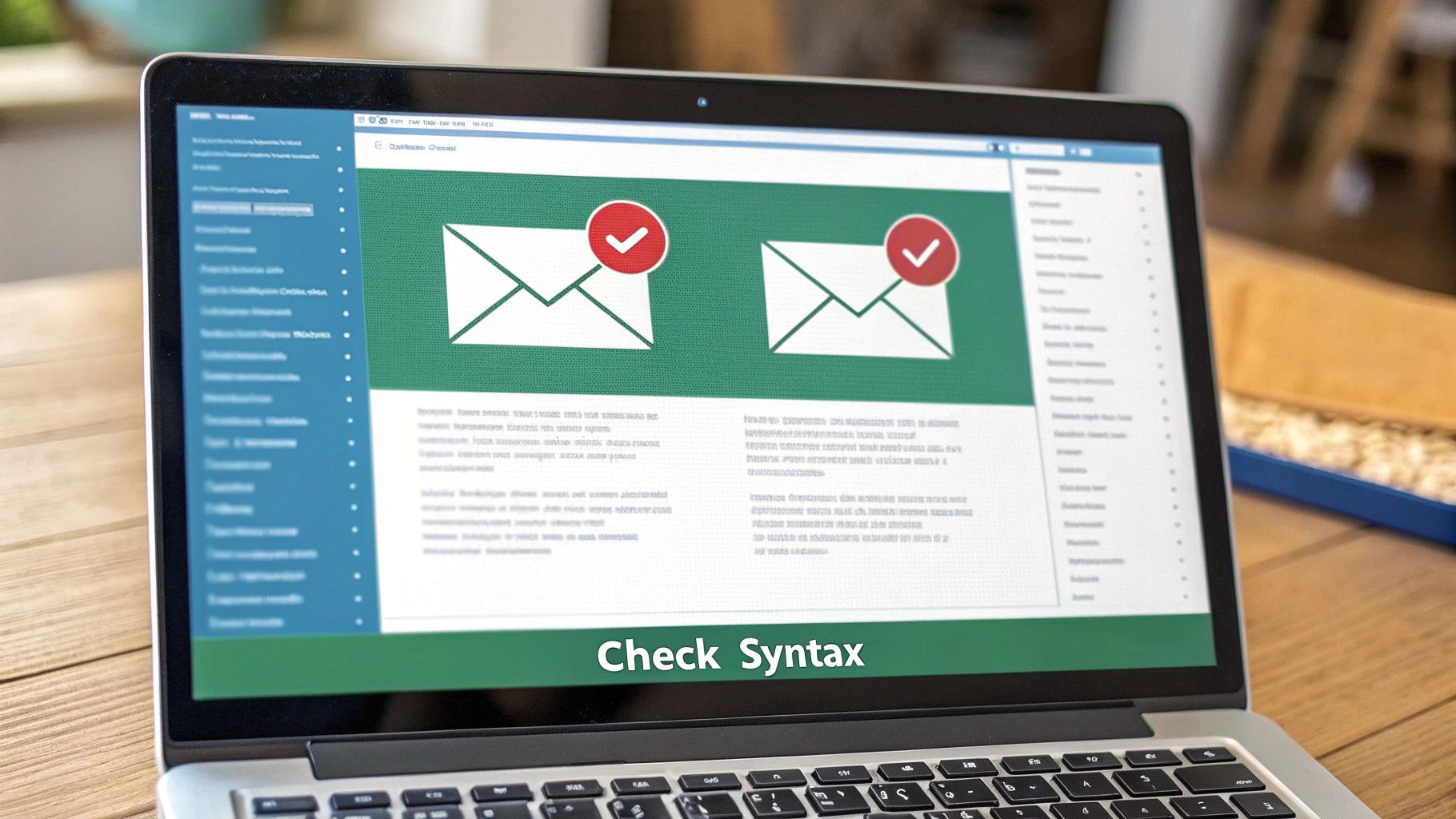
Before you get into the weeds with complex server checks, the first and most basic way to check if an email address is valid is to look at its structure. Think of this initial syntax check as a quick proofread. It’s surprisingly good at catching the most common typos and data entry mistakes before they have a chance to become a bounced email.
Every valid email address is built on a simple foundation: two core parts separated by an "@" symbol. You’ve got the local part (the bit before the "@") and the domain part (everything after). It sounds simple, but there are strict rules for what's allowed in each section. Break one of those rules, and the address is instantly invalid.
Deconstructing the Local Part
The local part—basically the username—is actually more flexible than you might think, but it still has its limits. It can contain uppercase and lowercase letters (A-Z, a-z), numbers (0-9), and a handful of special characters.
The most common characters you'll see are:
- Periods (
.) - Hyphens (
-) - Underscores (
_)
But here’s the catch: you can’t just put them anywhere. For example, an email address can’t start or end with a period, and you can’t have two periods right next to each other. This is exactly why an address like jane..doe@company.com gets flagged as invalid right away. It's a classic formatting mistake that any basic validation tool will catch in a heartbeat.
Think of syntax validation as the gatekeeper. It doesn't know if the person actually exists, but it makes sure the address is written in a language the email system can understand. An incorrectly formatted address is like a letter with no zip code—it’s going nowhere.
Analyzing the Domain Part
The domain part is a bit more straightforward and has stricter rules. It has to be a valid domain name, which means it can only contain letters, numbers, and hyphens. Just like with the local part, it can't start or end with a hyphen.
For instance, an address like support@-company.com is a no-go because of that leading hyphen in the domain. A less obvious but equally fatal error is something like info@company.co,, where a comma was accidentally typed instead of a period. These tiny typos are incredibly common, especially when people are compiling lists by hand.
Here are a few real-world examples that a syntax check would immediately kick out:
john.smith@.gmail.com(Invalid: Domain starts with a period)contact@company com(Invalid: Missing the top-level domain dot)sales@acme.(Invalid: Incomplete domain)
This first format check is the crucial first step that all automated tools perform. It’s a simple, fast, and incredibly efficient way to weed out a huge chunk of bad data without ever having to ping a server. By understanding these fundamental rules, you can spot the obvious errors yourself and get a better feel for what a full verification process is built on.
Confirming the Domain and Mail Server Exist

So, you've checked that an email address has the right structure. Great. But what good is a perfectly formatted address if it points to a domain that doesn't exist? Or one that isn't set up to receive email at all?
This is where the real detective work begins. We need to go a level deeper to see if the destination is legitimate.
Think of the internet’s Domain Name System (DNS) as a colossal, global address book. When we verify an email, we’re essentially looking up the domain to see if it has a valid listing. But we’re not just checking if the company exists; we’re looking for a very specific department: the mail server.
The Role of MX Records
This is where Mail Exchange (MX) records come into play. An MX record is a special entry in that global address book that basically says, "Yep, this domain accepts email, and you can send it right over here." If a domain doesn't have a valid MX record, any email you send is going nowhere fast—it'll just bounce right back.
This check is a powerhouse for knocking out two of the most common invalid email types:
- Domain Typos: It’s a lifesaver for catching simple mistakes, like an address ending in
[email protected]instead of[email protected]. The misspelled "gamil.com" almost certainly won't have an MX record, flagging it as a dead end immediately. - Defunct or Fake Domains: It filters out addresses from websites that have shut down or were completely fabricated. If the domain is gone, its MX records are gone with it.
Verifying the domain and its MX records is like checking a street address to make sure the building exists and has a mailbox. A syntax check confirms the address is written correctly, but the MX lookup confirms there's actually a place to deliver the mail.
Imagine a marketing agency gets a hot new lead from [email protected]. The syntax is flawless. But a quick MX lookup reveals that the "bigcorp-marketing.com" domain doesn't exist. Instantly, they know the lead is junk without ever having to risk their sender reputation by sending an email.
Beyond a Simple Domain Check
This process gives you a much stronger signal of an email's validity than a simple format check ever could. It confirms that a server is actively configured and waiting to accept mail for that specific domain. It’s a non-negotiable step for any serious email verification and a fantastic way to clean up your lists.
While you can do these lookups manually, understanding the concept is what's most important.
If you find yourself with a long list of contacts from the same company, you might want to explore tools for an email lookup by domain to identify common patterns and verify addresses in bulk. This DNS-level check gives you the confidence to move on to the final, most definitive test: the SMTP handshake.
The Ultimate Test: The SMTP Handshake
After you’ve confirmed an email’s syntax is solid and its domain has a real mail server, it's time for the final, most definitive test. This is how we get as close as possible to proving an inbox exists without actually sending a message.
Welcome to the SMTP handshake.
Think of it like walking up to a post office and asking the clerk, "Does a John Doe have a P.O. Box here?" You aren't mailing a letter; you’re just checking if the box is there. The SMTP (Simple Mail Transfer Protocol) handshake operates on the same basic principle. An email verification tool starts a quick, polite chat with the recipient's mail server to ask that exact question.
The tool connects to the server, says it wants to deliver a message to an address like john.doe@example.com, and then waits for the server’s reply. If the server comes back with a confirmation—basically saying, "Yep, that mailbox is here and ready for mail"—we have our answer. That positive response is the strongest signal you can get to check if an email address is valid and active.
Navigating Real-World Complexities
Of course, it’s not always that simple. Mail servers are complicated beasts, often armed with security measures that can get in the way of this simple query. Not every server is willing to give a straight "yes" or "no" to a stranger knocking on its digital door.
You'll usually run into two main roadblocks:
- Catch-All Servers: Some domains set up their mail servers to accept email for any address, whether it’s real or not. This is a "catch-all" configuration. In this case, the server will always give a positive response, making it impossible to know if
john.doe@example.comis a real inbox or just a digital black hole. - Security Protocols: Many servers are designed to block or just ignore these kinds of verification pings. They might see the rapid-fire connection attempts from verification services as sketchy activity and simply refuse to answer, or even temporarily block the connection entirely.
The SMTP handshake is the gold standard for accuracy, but its results are only as good as the server's response. A definitive 'yes' is great, but a vague or non-committal answer requires intelligent interpretation.
Interpreting Server Responses
This is where the quality of your verification tool really shows. A basic script might get a positive response from a catch-all server and wrongly mark the email as "valid." A smarter tool, however, can often identify these catch-all domains. It won't give you a simple "valid"—it'll classify the address as "risky," giving you the context needed to make an informed call.
Modern email validation has moved way beyond simple pings. The best approaches now blend syntax checks, domain verification, and SMTP testing to paint a complete picture of an email's health. Some cutting-edge systems even use AI to analyze patterns and predict an email's long-term validity, while real-time validation at the point of sign-up is becoming standard practice. You can dive deeper into email validation best practices on Mailfloss.
Understanding the SMTP handshake shows you how the most accurate verification methods work behind the scenes. It's not just a blind ping; it's a nuanced conversation that separates a genuinely good email from one that just looks right on the surface. This final check is the key to protecting your sender reputation and making sure your messages land in front of real people.
Automating Your Checks with EmailScout
After walking through the manual steps, it’s pretty clear they don't scale. Checking more than a handful of emails that way is a non-starter. This is exactly where a dedicated tool becomes your best friend.
EmailScout rolls all those tedious steps—the syntax checks, the MX lookups, the SMTP handshake—into one slick, automated process. That kind of efficiency is a must-have for anyone who needs to check if an email address is valid in bulk.
But it’s not just about speed. The real magic is in the extra layer of intelligence these tools provide. For example, EmailScout can spot temporary or disposable "burner" emails. While technically valid, they’re dead ends for any meaningful communication. It also flags generic, role-based accounts like info@ or support@ that rarely lead to good engagement.
From Simple Pings to Smart Analysis
One of the biggest headaches in email validation is the dreaded "catch-all" server. These servers are set up to accept mail for any address at that domain, making it impossible to know if an inbox actually exists. A simple script will get a positive response and mark it as valid, which is often wrong.
This is where EmailScout shines. It can intelligently identify these servers and flag the email as "risky" instead of "valid," giving you the context you need to decide if it's worth the potential bounce.
The whole process is a multi-layered verification system:
- Syntax and Formatting: The first pass, instantly catching typos and basic formatting mistakes.
- Domain and MX Verification: Confirms the domain is real and actually set up to receive email.
- SMTP Handshake: Simulates sending a message to see if the specific mailbox is live.
- Advanced Filtering: This is the smart part—sniffing out disposable domains, role accounts, and those tricky catch-all configurations.
The SMTP handshake is the heart of it all. Think of it as a quick, three-step "conversation" between servers.

This connect-greet-confirm flow is how a tool can verify an inbox exists without ever sending an actual email. If you want to dive deeper into the different capabilities available, you can explore the email validation features from astonishEmail.
Understanding the Results
When you use a tool like EmailScout, you get a clean, simple verdict for every email. No more guesswork. You just pop in the address and get an instant answer that's easy to understand.
This lets you move from complex server codes to straightforward, color-coded statuses.
Typically, the results break down into three main categories:
- Valid: The green light. The tool has confirmed the syntax, the domain's mail server is online, and the specific inbox exists. Send with confidence.
- Invalid: A hard no. The email is undeliverable. This could be from a typo, a dead domain, or the server confirming the mailbox is gone.
- Risky: This is the gray area. The address might be a catch-all, from a disposable service, or the server just didn't respond. Sending to these is a gamble.
By automating these checks, you can scrub your lists in minutes, not hours. This protects your sender reputation, boosts deliverability, and makes sure your campaigns actually land in front of real people. That’s how you maximize your ROI.
If you’re shopping around for a service, it helps to see how the options compare. For a full breakdown, check out our guide on the best free email verification tools to find the perfect fit for what you need.
How Global Differences Impact Email Validation
When you're trying to figure out if an email address is any good, the technical result is only half the story. Just because an address gets a "valid" stamp doesn't mean your email will actually land in their inbox, especially when you're dealing with a global audience.
The truth is, different parts of the world have their own unique digital quirks—from ISP policies to local infrastructure and even cultural norms around email. Sending a campaign to a list in Western Europe is a completely different ballgame than sending one to certain parts of Asia. These aren't just tiny details; they're big enough to change how you should interpret your validation results.
Regional Deliverability Rates Matter
The data doesn't lie: there's a clear divide in how reliably emails get delivered depending on the region. Europe tends to have the highest inbox placement rates, but other areas can be a bit of a minefield. This isn't just theory; it's something you'll see in your campaign stats if you operate internationally.
Regional deliverability can vary wildly. Europe, for example, boasts an inbox placement rate of around 91%, with North America not far behind at 87%. But the Asia-Pacific region often presents a much bigger challenge, with deliverability hovering closer to 78%. It gets even more specific at the country level. The UK hits a stellar 98.8% deliverability, while India is way down at 69.8%. That's a massive gap, and it makes solid validation non-negotiable for international campaigns. If you want to dive deeper into these numbers, UseBouncer has some great stats on global email marketing.
An email address that's technically valid in a region with 78% average deliverability carries a higher inherent risk than one in a region with a 91% rate. This context should directly inform your email strategy.
Practical Steps for Global Campaigns
So, what do you do with this information? You get smarter. A one-size-fits-all approach to email validation just doesn't work when you're dealing with a global list. You have to adapt your strategy based on where your audience lives.
Here are a few things you can do right away:
- Be Extra Cautious with 'Risky' Results: If you're sending to regions with lower deliverability rates, treat any "risky" or "catch-all" emails with suspicion. The chances of them bouncing are just statistically higher there.
- Segment by Geography: This is a big one. Break your email lists down by country or region. It lets you keep a closer eye on performance and tweak your sending habits for what works best in each market.
- Use a Tool That Gets It: A good verification tool understands these international nuances. It's better at interpreting server responses from different corners of the globe, giving you a far more accurate verdict on an email's real status.
At the end of the day, acknowledging these global differences is what separates the pros from the amateurs. It turns validation from a simple technical check into a key part of your international strategy, helping you protect your sender reputation and get more emails where they belong: in the inbox.
A Few Common Questions About Email Validation
Even with the best tools, you’re bound to have a few questions when you first dive into validating email addresses. It’s a new process for a lot of people. Here are some of the most common things we get asked by users just starting out.
How Accurate Is This Stuff, Really?
This is the big one. With a professional tool that layers syntax checks, MX lookups, and SMTP communication, you can expect up to 98% accuracy. It's incredibly reliable, but it’s important to know that 100% is never truly possible.
A few things can get in the way of a perfect score:
- Catch-all servers: These are set up to accept email for any address at a domain, whether the mailbox actually exists or not.
- Greylisting: Some servers will temporarily reject a connection they don't recognize as a security measure.
- Network hiccups: Sometimes, a mail server is just temporarily down or unreachable.
Even with those variables, a multi-step validation process gives you a rock-solid signal of an email's health. You're not aiming for absolute perfection; you're trying to slash your bounce rate and protect your reputation, and this gets you there.
Will This Send an Email to the Person?
Nope, and that's the whole point. This is probably the biggest myth out there. The core of email verification—the SMTP handshake—was designed for exactly this scenario.
Think of it like knocking on a door and asking if "John" is home. The server answers "yes" or "no," but you never actually open the door or go inside. The recipient never gets a notification, and no email ever hits their inbox.
How Often Should I Clean My List?
The short answer? More often than you think. As a rule of thumb, you should validate your entire list at least once a quarter. Marketing data consistently shows that email lists decay by over 20% every single year.
People get new jobs, ditch old email providers, or just stop using an address. If you're running high-stakes campaigns or sending a lot of emails, you should clean your list even more frequently. Better yet, use a real-time verification API to check emails the moment they’re submitted on a form.
Ready to stop guessing and start sending with confidence? EmailScout automates the entire validation process, giving you clear, actionable results in a single click. Find unlimited valid emails for free with EmailScout.