

Hoping for the best isn't a strategy. If you're tired of the feast-or-famine cycle, it's time to stop guessing and start building a real, repeatable system for finding clients.
This playbook cuts through the generic advice and lays out a modern blueprint that actually works: Pinpoint your ideal customer, build a targeted list of decision-makers, write outreach that gets a response, and scale what's working.
Forget waiting for referrals. This is about taking control and creating a predictable pipeline of high-quality leads.
Beyond Luck: Finding Clients With a Modern Blueprint
Let's be real. The old ways of finding clients—endless social media posts, networking events, and just hoping someone stumbles upon your website—are scattered and unreliable. It’s like waiting for lightning to strike. Sure, it might happen, but you can't build a sustainable business on maybes.
We're going to shift from that passive, hopeful approach to active, strategic outreach. It’s about being intentional. It's about knowing exactly who you're contacting and why they should care, turning a game of chance into a predictable process.
The Four Pillars of Client Acquisition
This entire system boils down to four critical stages. Nail these, and you'll turn client acquisition from a frustrating art into a data-driven science.
- Pinpoint Your Ideal Client: Before you write a single email, you have to know exactly who you're looking for. This goes way beyond basic demographics. What are their biggest headaches? What goals keep them up at night?
- Build Targeted Lists: Once you have that crystal-clear picture, it’s time to find them. This is where you'll efficiently gather contact information for the right people at the right companies.
- Write Compelling Outreach: A perfect list is worthless if your message falls flat. Crafting personalized, value-first emails is the key to starting actual conversations, not just getting ignored.
- Scale Your System: Finally, you'll build a process to manage and grow your outreach. This is how you turn one-off campaigns into a consistent engine for new business.
For a deeper dive, this actionable playbook on how to generate leads for B2B is packed with proven strategies.
This simple flowchart breaks down the entire process.
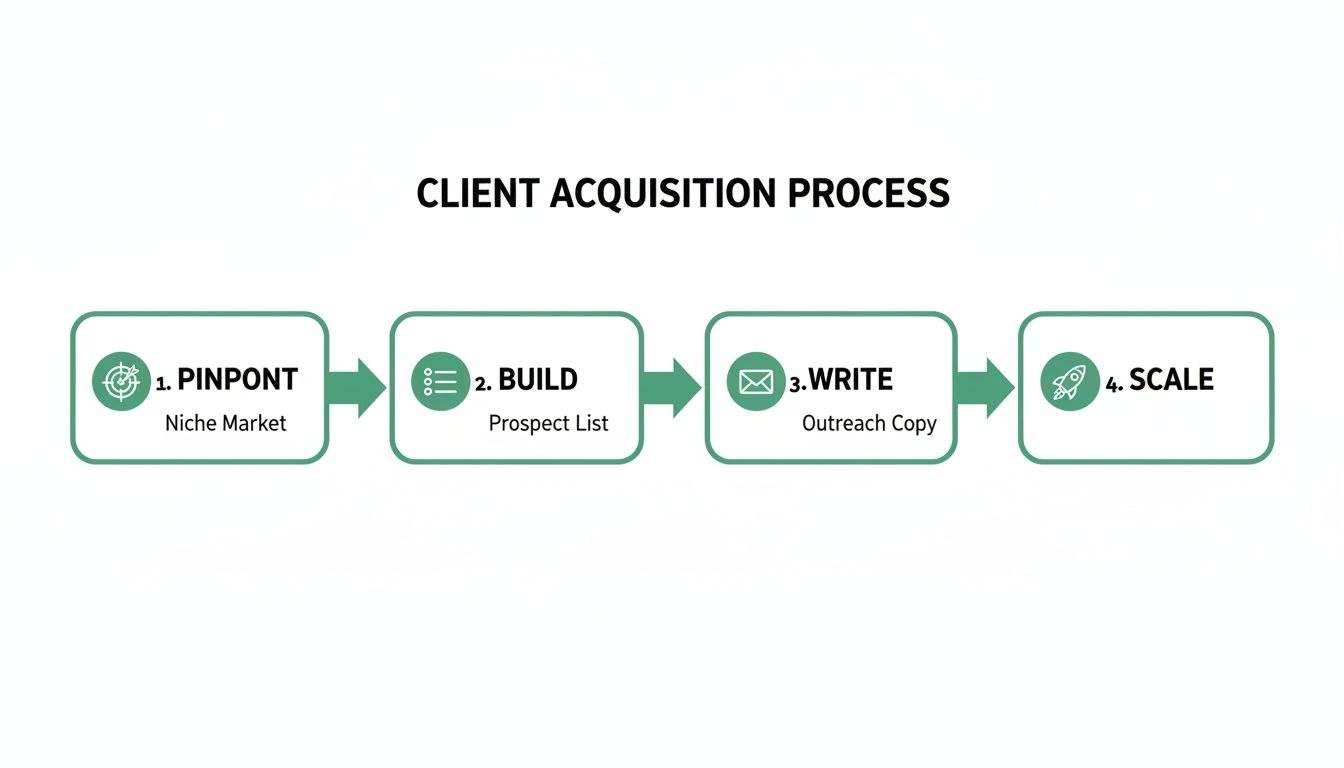
Each step builds on the last, creating a logical flow from high-level strategy to day-to-day execution. Whether you’re a freelancer, an agency owner, or a B2B sales pro, you’re about to get a clear system for keeping your pipeline full.
Pinpointing Your Ideal Client to Stop Wasting Time
Chasing every possible lead is a surefire way to burn out fast. If you want to find the right clients, you have to first define, with crystal clarity, exactly who they are. This is where building an Ideal Client Profile (ICP) becomes the single most important thing you can do for your outreach.
And I'm not talking about vague descriptions like "small businesses" or "startups." We need to get way more specific than that. A truly effective ICP is a detailed snapshot of the exact person, at the exact company, who desperately needs what you're selling and actually has the power to buy it.
Moving Beyond Basic Demographics
A powerful ICP digs past the surface-level data and gets into the human and business drivers behind a purchasing decision. The goal is to understand their world so intimately that your outreach email feels less like a cold pitch and more like a genuinely helpful tip from someone who gets it.
To build out this profile, you need to answer a few key questions:
- What are their biggest day-to-day frustrations? Think about the bottlenecks, the clunky processes, and the recurring headaches that are stopping them from hitting their targets.
- What KPIs are they on the hook for? Are they trying to boost lead gen by 15% this quarter? Or maybe their main goal is cutting customer churn. Their performance metrics are your way in.
- What’s their exact job title? Don’t just aim for "marketing." Are you after a "Marketing Director," a "VP of Demand Generation," or a "Content Marketing Manager"? Precision is everything.
The sharper your ICP, the more effective every other step becomes. A well-defined profile means you’re not just spamming inboxes; you’re starting relevant conversations with people actively looking for the very solution you offer.
A Real-World ICP Example
Let's make this real. Say you run a B2B SaaS company with a project management tool built for content teams. A weak, fuzzy ICP would be something like "marketing teams at tech companies." That's way too broad to be useful.
Now, here’s what a strong, actionable ICP looks like:
- Company: E-commerce brands with 50-200 employees.
- Target Title: Marketing Director or Head of Content.
- Pain Points: They’re constantly blowing past content deadlines, the team is struggling with version control on creative files, and there’s zero visibility into project status, causing last-minute chaos.
- Goals: They need to increase content output by 25% quarter-over-quarter and make the team more efficient to handle upcoming product launches.
- Watering Holes: They follow top marketing influencers on LinkedIn and hang out in private Slack groups for e-commerce marketers.
See the difference? Now you know exactly who to search for, which problems to mention in your emails, and even where to find them online. This kind of specificity turns a vague hunt for clients into a targeted mission.
How to Uncover These Critical Details
So, where do you find all this juicy information? It’s time to put on your detective hat. Professional networking platforms are your best friend here.
LinkedIn is an absolute goldmine for this kind of research. You can search for specific job titles within certain industries and company sizes. Once you find them, dig into their profiles. Pay attention to the language they use, the skills they list, and the articles they share. It's a direct window into their priorities and pain points. For a deeper dive, our guide on how to identify a target audience lays out even more advanced strategies.
By taking the time to build a detailed ICP upfront, you stop wasting cycles on prospects who were never going to be a good fit. Every email you send becomes more relevant, your messaging hits harder, and your chances of starting a real sales conversation go through the roof.
Building High-Quality Prospect Lists Without the Grind
Okay, so you've nailed down your Ideal Client Profile. You're no longer just guessing who to talk to. Now comes the fun part: turning that profile into a real, actionable list of companies and decision-makers who are a perfect match for what you offer. This is where your client search gets serious.
Traditionally, this step was a soul-crushing grind. I'm talking about endless hours spent copying and pasting names from LinkedIn into a spreadsheet, followed by a frustrating hunt for contact info that often led nowhere. That kind of manual work doesn't just eat up your time; it completely kills your momentum before you even send the first email.
Thankfully, the tools we have today have completely changed the game.
From Manual Labor to Automated Precision
Let's get one thing straight: the goal isn't just to build a list. It's to build a high-quality list, and to do it efficiently. Quality beats quantity every single time. A focused list of 100 perfect-fit prospects is worth infinitely more than a spray-and-pray list of 10,000 who probably don't need your help.
This is where a tool like the EmailScout Chrome extension becomes your secret weapon. Instead of seeing list-building as a chore, you can turn it into a swift, almost effortless process. Imagine scrolling through a LinkedIn search for "Marketing Directors in SaaS" and having a tool quietly find and save their verified emails for you in the background.
That's the leap from manual to automated. You let the tech do the heavy lifting, which frees you up to focus on what really matters—writing a killer outreach message.
Harnessing Professional Networks Intelligently
Professional networks are the primary hunting ground for B2B prospects. LinkedIn, in particular, is a goldmine with its powerful search filters. You can zero in on people by industry, company size, job title, and location—the very same criteria you just defined in your ICP.
Here’s how to tackle it with a smart, tool-assisted workflow:
- Run a Targeted Search: Use LinkedIn's filters to get super specific. Think "Head of Content" at "E-commerce companies" with "51-200 employees."
- Activate AutoSave: With a tool like EmailScout, you flip on the AutoSave feature. As you scroll through the search results, the extension gets to work finding and verifying email addresses for the people on your screen.
- Build Your List on Autopilot: Every valid contact gets automatically dropped into a designated list. What used to take hours of tedious clicking and searching now takes a few minutes of casual scrolling.
This approach completely transforms a boring task into an efficient data-gathering mission.
Exploring Company Websites at Scale
Sometimes, your best prospects are all in one place—a specific company's website. Maybe you’re targeting the entire marketing team at a fast-growing startup. Finding each person's email one by one is a huge time-sink.
This is a perfect job for a URL Explorer feature. Instead of hunting down contacts individually, you just plug in the company’s domain (like company.com) and let the tool scan the entire site for any publicly available email addresses. It pulls every contact it can find, saving you a massive amount of time.
Building a solid prospect list is the foundation of any great outreach campaign. When you get this part right, every email you write has the highest possible chance of landing in front of someone who can actually say "yes."
This strategic approach to list-building is why email is still a dominant force. By 2025, there will be 4.6 billion global email users, and the ROI can be an incredible 3600%—that's $36 back for every dollar you spend. By automating the list-building, you tap into that power so much more effectively.
Here’s a look at how you can pull emails directly from a website using the EmailScout extension.

With a simple interface like this, you can instantly see and save the emails found on any page, turning a company's "About Us" or "Team" page into a ready-made prospect list.
These kinds of efficient sales prospecting techniques are absolutely essential for building a predictable pipeline of new clients. When you shift from manual drudgery to smart automation, you’re not just saving time—you’re building a stronger, more accurate foundation for your entire client acquisition strategy.
Writing Outreach Emails People Actually Reply To
Having a perfect list of verified emails is a huge win, but it’s only half the battle. An email address is just an entry point; a compelling message is what actually starts a conversation and helps you find clients.
This is where we move past the cringey, self-absorbed templates that flood every inbox. Instead, we'll focus on writing outreach that people genuinely want to answer.
The difference between an email that gets deleted and one that gets a reply often comes down to one thing: relevance. Your prospect doesn't care about your company's history or your long list of services. They only care about their problems. A great outreach email proves you understand their world before you ask for their time.

The Anatomy of a Reply-Worthy Email
Every successful outreach email has a few core components working together. It’s not about finding some magic template, but rather understanding the principles behind why certain messages work.
Get these right, and you'll have a framework for crafting effective emails every single time.
- A Subject Line That Sparks Curiosity: Ditch the generic, salesy phrases like "Quick Question" or "Intro Call?" Instead, make it specific and intriguing. Mentioning a competitor, a shared connection, or a recent company event can work wonders.
- An Opening Line That Shows You've Done Your Homework: The first sentence must prove this isn't a mass blast. Reference a recent LinkedIn post they wrote, a podcast they were on, or a new initiative their company announced. This instantly builds rapport.
- A Value Proposition That Solves a Problem: Clearly and concisely connect what you do to a problem they are likely facing (based on your ICP research). Don't just list features; explain the outcome.
- A Low-Friction Call to Action (CTA): Make it easy for them to say yes. Instead of "Are you free for a 30-minute demo next week?", try something softer like, "Is this a priority for you right now?" This opens a dialogue, not a calendar commitment.
To make this even clearer, I've broken down these elements into a simple checklist.
Key Outreach Email Components for Higher Response Rates
This table acts as a quick reference to ensure every email you send is optimized to start a conversation, not just pitch a product.
| Email Component | Purpose | Best Practice Example |
|---|---|---|
| Subject Line | Grab attention and earn the open. | "Your thoughts on the [Competitor] acquisition" |
| Opening Line | Show personalization and build rapport. | "Just read your article on Forbes about scaling teams—great stuff." |
| Value Proposition | Connect your solution to their specific pain point. | "Saw you're hiring SDRs. We help teams like yours cut ramp time by 50%." |
| Call to Action (CTA) | Make the next step easy and low-commitment. | "Open to learning more if this is a focus for you?" |
Following this structure helps you move from a generic pitch to a message that feels like a one-to-one conversation.
From Generic Pitch to Personalized Solution
Let's look at the difference in action. Imagine you're pitching a social media management tool to the Head of Marketing at a growing B2C brand.
The Generic (and Bad) Approach:
Subject: Social Media Solution
Hi Jane,
I'm John from SocialPro. We offer an all-in-one social media scheduling, analytics, and reporting platform. Our tool helps businesses save time and increase ROI.
Would you be open to a 15-minute demo next week to see how it works?
Best,
John
This email is all about the sender and will be deleted in seconds. It shows zero research and provides no specific value.
Now, let's try a personalized, problem-solving approach.
The Personalized (and Good) Approach:
Subject: Your recent Shopify Plus podcast episode
Hi Jane,
Loved your insights on the Shopify Plus podcast about scaling customer acquisition. Your point about leveraging user-generated content was spot-on.
I noticed your team is manually collecting and posting customer photos on Instagram. Many marketing heads at brands like yours find this eats up about 10 hours a week that could be spent on strategy.
We built a tool that automates this, freeing up your team to focus on bigger wins.
Is improving that workflow a priority for you currently?
Best,
John
See the difference? This version works because it's about them. It leads with a genuine compliment, identifies a specific, observable pain point, and connects the solution directly to that pain. The CTA is just a simple, low-pressure question.
This is how you start a conversation. For a deeper dive, our guide on how to write cold emails that get replies is an excellent resource.
The core of effective outreach is empathy. Put yourself in their shoes and ask: "Would I reply to this?" If the answer is no, start over.
The numbers back this up. Email marketing can deliver an astonishing ROI of 3600%, and for sales teams, automated outreach boasts a 42.1% open rate. This proves that when done right, email is an incredibly powerful channel for finding new clients.
The goal isn't just to send emails; it's to start conversations. By focusing on personalization, value, and a genuine understanding of your prospect's world, you'll write messages that don't just get opened—they get answered.
Putting Your Outreach System to Work and Scaling Up

You’ve done the hard work. You've built a killer prospect list and figured out how to write a genuinely personal email. Now it’s go-time. This is where you start turning all that prep into a predictable pipeline of client conversations.
But hitting "send" is just the starting line. A single, perfect email almost never breaks through the noise of a busy inbox. The real results come from what you do next.
The magic is in the follow-up. A smart sequence keeps you on their radar without being annoying, showing persistence while adding a little more value each time you pop up. This is how you build a repeatable, scalable machine that consistently brings in new opportunities.
Crafting a Follow-Up Sequence That Gets Replies
Here’s a hard truth: most of your positive replies will come from a follow-up, not the first email. Your prospects are busy. Your message probably landed while they were putting out a fire or jumping into a meeting. A multi-touch sequence just gives them more chances to engage when the time is right.
The trick is to avoid that cringe-worthy "just checking in" email. Nobody likes those. Instead, each follow-up needs to bring something new to the table.
- Follow-Up 1 (2-3 days later): Come at it from a different angle. Briefly touch on a different pain point you solve or a benefit you didn't mention before.
- Follow-Up 2 (4-5 days later): Share something genuinely useful. This could be a link to a case study, a helpful blog post you wrote, or an interesting industry report that shows you know your stuff.
- Follow-Up 3 (about a week later): Send the "breakup" email. Politely close the loop and let them know you won't bother them about this again. You'd be surprised how often this creates a little urgency and gets a response.
A thoughtful follow-up sequence shows you're serious about helping, not just serious about selling. It transforms your outreach from a single shot in the dark into a strategic campaign that builds familiarity and trust over time.
Tracking the Numbers That Actually Move the Needle
If you want to get better at outreach, you have to measure what you're doing. It’s super easy to get bogged down in vanity metrics like open rates, but let’s be honest—opens don’t pay the bills. You need to focus on the data that directly translates to business.
These are the KPIs you should be obsessing over:
- Reply Rate: This is your north star. It tells you if your message is interesting enough to even start a conversation. If this number is low, your subject lines, opening hooks, or your core offer needs a tune-up.
- Positive Reply Rate: Of the people who reply, how many are actually interested? This number separates the polite "no, thanks" from the real leads.
- Meetings Booked: This is the ultimate goal, right? Tracking this shows you how well you're turning initial interest into real sales opportunities.
Focusing on these three metrics helps you pinpoint exactly where your process is breaking down. Low reply rate? Your emails need work. High reply rate but no meetings? Your call to action or how you handle the first response needs rethinking.
Knowing When It's Time for Automation
As you start getting traction, sending every email by hand becomes a bottleneck. Automation is how you scale, but you have to be smart about it. The goal is to automate the repetitive grunt work while keeping the personal touch that gets you replies in the first place.
You should start thinking about automation once you're consistently sending 50-100+ personalized emails every week. At that point, a sales engagement platform can take over your follow-up sequences, making sure no prospect ever falls through the cracks. This frees you up to do what you do best: writing great first-touch emails and talking to interested people.
To really put your growth on autopilot, you might even delegate remote appointment setting tasks to free up even more of your time for closing. Suddenly, you've got a powerful system that’s constantly generating leads and moving them down the pipeline. Your process goes from a bunch of manual tasks to a well-oiled machine that finds clients for you.
Common Questions About Finding Clients
As you dive into building an outreach system, you're bound to run into a few classic questions. I see them pop up all the time. Getting these sorted out early will save you a ton of headaches and help you sidestep the common mistakes people make when trying to find clients.
Let's get right into the big ones.
How Many Follow-Up Emails Should I Send?
Everyone wants a magic number, but the truth is, there isn't one. What we do know from the data is that sequences with 3 to 5 follow-ups tend to hit the sweet spot.
The real key here isn’t the number, but what you do with those follow-ups. Don't just send another "just checking in" email. Each message needs to add a little more value. Share a link to a relevant article, mention a recent win their company posted on LinkedIn, or offer a slightly different angle on their problem. Your goal is polite persistence, not pestering. Think of each email as another chance to be genuinely helpful.
What Is the Best Time and Day to Send Outreach Emails?
You've probably heard the old advice: "Send it on Tuesday at 10 AM." While that's a decent starting point, the honest-to-goodness answer is that it depends entirely on who you're trying to reach.
A C-level executive might be clearing their inbox at 7 AM before the chaos starts, while a creative director might not really dig in until after lunch.
Use the "best practice" times as your first guess, but then you have to test, test, and test again. Your own open and reply rates are the only data that matters. Let that be your guide to what actually works for your ideal client.
How Can I Avoid My Emails Landing in Spam?
Keeping your emails out of the spam folder is part technical, part behavioral. On the technical side, make sure your domain is set up correctly. But most of your deliverability comes down to good sending habits.
Stay away from spammy trigger words like "free trial" or "guarantee," and don't go crazy with flashy formatting or a dozen images. Those are all red flags for spam filters.
But the most important thing? Send personalized, relevant emails to people who might actually want to hear from you. When your recipients open and reply to your messages, it sends a powerful signal to email providers that you're one of the good guys. This positive engagement builds your sender reputation over time, which is what keeps you landing in the primary inbox.
Ready to stop grinding and start building high-quality prospect lists in minutes? EmailScout gives you the tools to find verified emails, automate list-building, and connect with decision-makers effortlessly. Find unlimited emails for free.