

Look, creating a buyer persona isn't just about making up a fictional character. It's about digging into your audience's demographics, their goals, and what keeps them up at night. You're turning cold, hard data into a relatable human profile, so every email you send feels like it’s for a real person—not just another number on a spreadsheet.
Why Generic Outreach Is Costing You Leads

Let's be blunt: that generic, one-size-fits-all marketing you're doing? It's a dead end.
Blasting the same email to your entire list and crossing your fingers is like shouting into a hurricane. Nobody hears you. This approach doesn't just feel lazy; it actively tanks your lead generation and eats into your revenue.
Think about it. Imagine you send a generic email about "our amazing software" to two completely different prospects. One is "SaaS Founder Sarah," who's scrambling to scale her new sales team and desperately needs a simple, effective solution yesterday. The other is "Enterprise Evan," a VP buried in corporate red tape, whose main concerns are security and complex integrations.
A generic message speaks to neither of them. It's instantly deleted.
This is exactly where understanding how to create buyer personas flips the script. You stop guessing and start knowing.
The Real-World Business Impact of Personas
When you take the time to build detailed personas, you stop marketing to a vague "audience" and start talking to individuals. It's a simple shift, but it has a massive ripple effect across your entire company. Suddenly, your sales, marketing, and even product teams are all on the same page, working from a shared understanding of who your customer is and what they actually need.
The results speak for themselves. This isn't just theory; it's about seeing tangible improvements in your metrics.
- Sky-High Engagement: When your message hits on a persona's specific pain point, your open and click-through rates will jump.
- Better Lead Quality: You start attracting prospects who are a perfect fit, which means shorter sales cycles because they're already convinced.
- A Healthier Bottom Line: Personalized marketing isn't a "nice-to-have." It's a revenue driver, plain and simple.
The core difference is empathy. A buyer persona forces you to step into your customer's shoes and see the world from their perspective. When you do that, your marketing stops being an interruption and starts being a solution.
The data backs this up, and the numbers are pretty staggering. For starters, using buyer personas can boost your email open rates by two to five times the average. While a typical campaign might limp along with a 21% open rate, companies using well-defined personas see explosive growth.
But it gets even better. Personalized emails deliver 18 times more revenue than broadcast emails, and customer-centric companies are a whopping 60% more profitable.
The Impact of Persona-Driven Outreach
Here's a quick breakdown of what this looks like in practice.
| Metric | Traditional Outreach | Persona-Driven Outreach |
|---|---|---|
| Engagement | Low open/click rates | High open/click rates |
| Lead Quality | Broad, often unqualified | High-fit, qualified leads |
| Sales Cycle | Long, high friction | Short, low friction |
| Conversion Rate | Low, unpredictable | High, consistent |
| Customer Loyalty | Weak, transactional | Strong, relationship-based |
The difference is night and day. One approach is a shot in the dark; the other is a targeted, strategic move that consistently delivers results.
From Vague Audiences to Precise Targets
Without personas, you're just making educated guesses. You might know your general target audience, but you’re missing the granular details that make a campaign truly connect. Personas add that crucial layer of insight.
Building personas isn't just another box to check on your marketing to-do list. It's a foundational business strategy. It makes every single thing you do—from writing a subject line to developing a new feature—more focused, efficient, and ultimately, more successful.
It's the first real step in turning anonymous prospects into your biggest fans.
Finding the Clues Your Data Already Holds

Before you ever schedule a single interview, you're already sitting on a goldmine of information. Seriously. The most powerful buyer personas start by looking inward, at the clues hidden within the systems you use every day.
Think of this existing data as your treasure map. It points you toward the core truths of who your customers are and what they actually need from you.
Uncover What You Already Know (Internal Sources)
Your Customer Relationship Management (CRM) system is way more than a glorified contact list. It’s a living record of every interaction, revealing purchase patterns, customer lifecycle stages, and clear demographic trends. Start digging for common threads among your best customers.
What industries are they in? What are their job titles? How did they find you in the first place?
Your customer support tickets are another goldmine. They offer a direct line to your users' biggest frustrations and show you where your product or messaging might have gaps. Look for recurring questions or issues—these are the real-world challenges your personas are grappling with.
But the real qualitative gold? That's with your sales team. They’re on the front lines every single day, hearing the unfiltered objections, motivations, and goals of your prospects. Don't just ask for general feedback; get specific with them.
Probing Questions to Ask Your Sales Team
- The 'Aha!' Moment: "Walk me through the exact moment a prospect's eyes light up in a demo. What feature or benefit makes that happen?"
- The Happiness Signal: "What's the one thing our happiest, most successful customers consistently say about us?"
- The Unspoken Need: "What's a challenge prospects mention that we don't directly solve, but is part of their bigger picture?"
- The Obstacle Course: "What are the top 3 objections you hear, and who on their team usually brings them up?"
These questions get you past the surface-level data and straight to the emotional triggers that drive buying decisions.
Sift Through the Public Conversation
Once you’ve squeezed every last drop of insight from your internal data, it's time to head out into the wild. You need to see where your potential customers hang out online to validate what you think you know and discover things you never would have guessed.
Start by lurking in industry-specific forums, Slack communities, or LinkedIn Groups. Pay close attention to the language they use, the questions they ask, and the solutions they recommend to each other. Their unprompted discussions are incredibly revealing.
Analyzing competitor reviews is another killer tactic. Go read the 5-star and 1-star reviews for products in your space.
The 5-star reviews tell you exactly what the market values most. The 1-star reviews highlight critical pain points and unmet needs. This is free, unfiltered market research that can directly inform your persona's biggest challenges and goals.
This whole process is about gathering clues—both hard data and human stories. You’re looking for patterns, common themes, and recurring language. This is the raw material you'll use to build a persona that feels less like a marketing document and more like a real person.
For a deeper dive into turning these conversations into solid findings, check out this great guide on how to analyze interview data.
By combining the hard numbers from your CRM with the stories from your sales team and the public chatter online, you build a rock-solid foundation for the next step: actually talking to your customers.
Mastering the Art of the Customer Interview
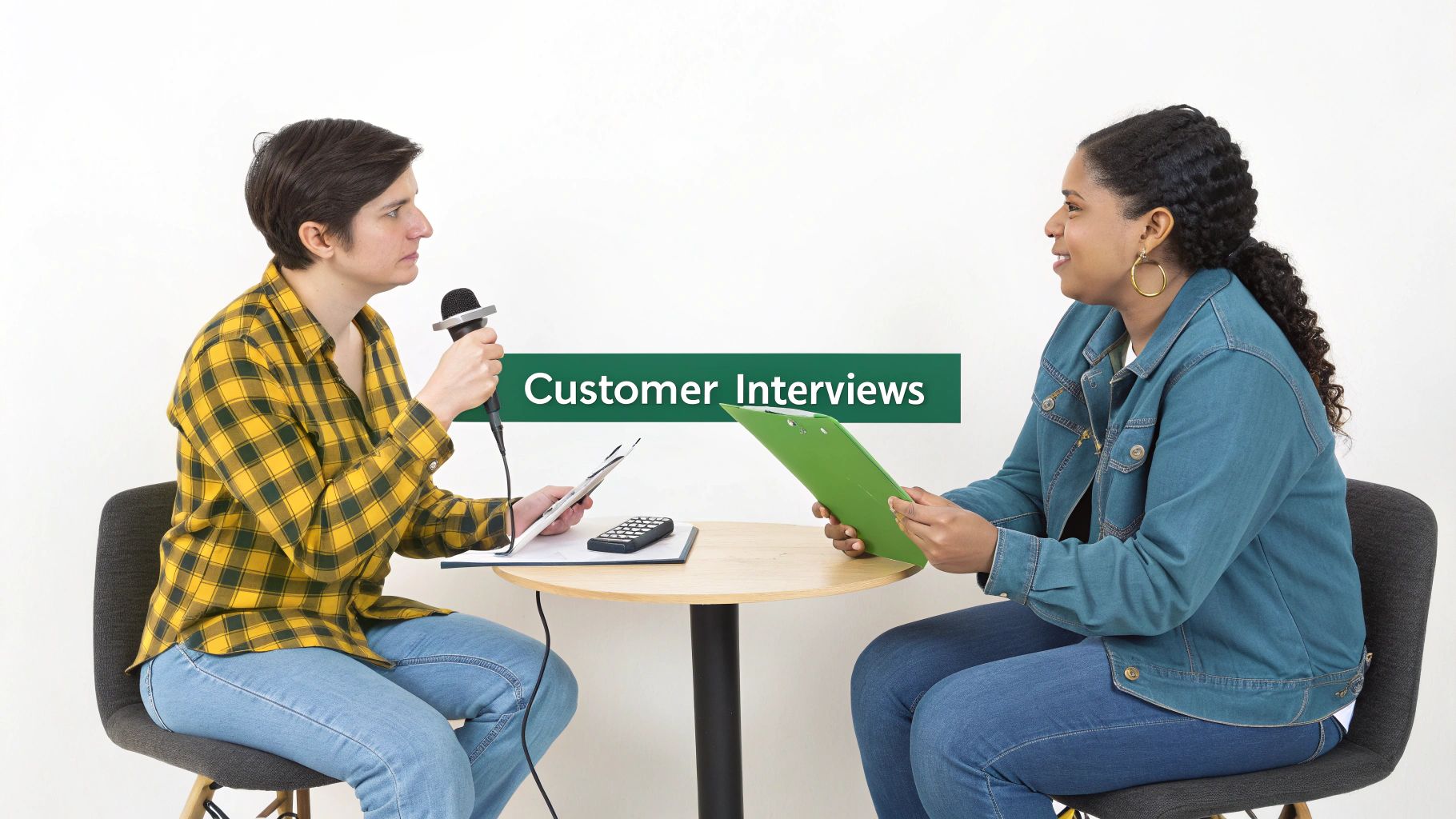
Quantitative data tells you what your customers are doing, but it almost never tells you why. For that, you have to actually talk to them. Direct customer interviews are where you’ll find those game-changing insights that truly bring your buyer personas to life.
These conversations go way beyond simple metrics. They give you a direct line into the motivations, frustrations, and goals that drive every single purchasing decision. It's the difference between looking at a data point and hearing a real story.
Finding the Right People to Interview
Your first instinct might be to cherry-pick your happiest, most loyal customers. And while their feedback is gold, it's just one piece of the puzzle. To build a genuinely useful persona, you need a mix of different perspectives.
Try to recruit a varied group that includes:
- Loyal Advocates: These are your power users. They love your product and can tell you exactly what you're doing right.
- New Customers: Their onboarding experience is still fresh in their minds. They’re perfect for spotting initial hurdles or the exact "aha!" moment that sold them.
- Recent Churns: I know, these conversations can be tough. But they are incredibly valuable for getting an unfiltered look at your product's weaknesses.
- Qualified Prospects: Talk to leads who fit your ideal profile but haven’t pulled the trigger yet. Understanding their hesitation helps you learn how to qualify sales leads much more effectively.
Getting this mix helps you avoid confirmation bias. Your personas will be grounded in the complete reality of your business—not just the highlight reel.
Asking Questions That Uncover Real Insights
The secret to a great interview? Ask open-ended questions that get people talking. You want to avoid simple yes/no answers and encourage them to walk you through their experiences in their own words.
Don't ask, "Was our product easy to set up?" That just gets you a one-word reply.
Instead, try something like, "Can you walk me through the day you realized you needed a solution like ours?" This simple shift opens the door to a story filled with specific challenges and the real emotions behind them.
The goal isn't just to gather facts; it's to understand the context. Listen for the exact language they use to describe their problems. These phrases are pure gold for your marketing copy.
To get those rich, detailed answers, you need the right questions. We've compiled a few essential ones to get you started, broken down by the type of insight they'll give you.
Essential Questions for Persona Interviews
| Category | Sample Question |
|---|---|
| Professional Background | "Can you tell me about your role and what a typical day looks like for you?" |
| Goals & Success | "What does success look like for you, and how does our solution fit into that picture?" |
| Challenges & Pain Points | "Think back to before you used us. What was your process for handling [the problem we solve]?" |
| Buying Process | "What were the biggest roadblocks you faced when trying to get approval for this purchase?" |
| Value & Impact | "If our product disappeared tomorrow, what would be the biggest change in your workflow?" |
These questions are just a starting point. The key is to listen carefully and let the conversation flow naturally, digging deeper whenever you hear something interesting.
Capturing and Analyzing Interview Data
Always, always ask for permission to record your interviews. This frees you up to actually listen and engage in the conversation instead of frantically trying to take notes. Plus, it ensures you capture verbatim quotes—the actual language your customers use.
Once you have a handful of recordings, the real work begins. You'll need to transcribe them and start looking for patterns. Are there recurring themes, common pain points, or shared goals that keep popping up? A solid understanding of how to analyze interview data is what turns a bunch of conversations into actionable strategy.
This is how you connect the dots between individual stories and the broader trends that define your buyer personas.
Scaling Your Findings with Surveys
Interviews give you depth; surveys give you scale.
Once you've identified key themes from your interviews, you can build short, effective surveys to see if those findings hold true across a larger audience.
Use multiple-choice questions based on what you've learned. For instance, if your interviews uncovered 3 common challenges, list them in a survey and ask people to rank them. This quantitative data adds statistical weight to the stories you've collected, giving you a powerful, data-backed foundation for your personas.
Bringing Your Buyer Persona to Life

You've done the heavy lifting—the interviews, the surveys, the data dives. Now it’s time to shape that raw information into a living, breathing document your whole team can actually get behind. This isn't just about listing off demographics. It's about building a story that turns an abstract idea into a relatable person.
A truly great persona is more than a list of facts. It’s a narrative that shines a light on their motivations, fears, and goals. The aim is to build a profile so vivid your team feels like they genuinely know this person and want to help them. This is the moment your research turns into real-world action.
Crafting a Compelling Narrative
To make your persona feel real, start by giving them an identity. It's a small step, but it’s surprisingly powerful. Pick an alliterative name that’s easy to remember, like "Startup Founder Sam" or "Marketing Manager Maria."
Next, find a stock photo that matches your persona's general description. Putting a face to the name makes an immediate difference, helping your team visualize who they're talking to in every email, ad, and sales call.
With a name and face in place, write a quick "Day in the Life" summary. This is where you bring their professional world into focus.
- What are their first tasks when they get to work?
- What meetings are always on their calendar?
- Which tools can't they live without?
- What’s the single most frustrating part of their day?
This summary isn't just fluff; it's a strategic tool for building empathy. When your content team understands that Founder Sam starts his day drowning in a messy lead list, they can write blog posts that speak directly to that pain.
Key Insight: The best personas aren't just static documents; they're empathy-building tools. They should make your customer's challenges feel real and immediate, sparking ideas for how your product can genuinely solve their problems.
When you make their struggles concrete, you create a clear roadmap for your team to follow.
Defining Core Motivations and Frustrations
Once you have the story, it's time to boil down your research into clear, scannable bullet points. This part of the document should let anyone on your team grasp the persona's core drivers in just a few seconds.
Focus on these key areas:
- Goals: What does a "win" look like in their role? Get specific. Instead of "grow the business," try "Increase MQLs by 20% this quarter."
- Challenges: What specific roadblocks are in their way? Details matter. "Struggling with manual lead data entry" is way more actionable than "needs better processes."
- Motivations: What's the why behind their goals? This could be anything from earning a big promotion to being seen as an innovator in their industry.
- Fears/Frustrations: What keeps them up at night? It might be the fear of falling behind competitors or frustration with clunky tools wasting their team's time.
The power of this approach is hard to overstate. In fact, a staggering 36% of companies shortened their sales cycles just by using well-defined buyer personas. The impact can be huge; Thomson Reuters, for example, saw a 72% reduction in lead conversion time and a 175% revenue jump after implementing personas. As some fascinating buyer persona statistics show, this happens because clear personas let you pinpoint motivations and tailor your message with incredible precision.
Building the Complete Persona Profile
To pull it all together, let’s look at a quick example. Here's a condensed profile for "Startup Founder Sam," showing how all these pieces combine to create a genuinely useful tool.
Example Persona: Startup Founder Sam
| Section | Details |
|---|---|
| Identity | Startup Founder Sam, Age 34, Founder of a B2B SaaS company (10-50 employees). |
| Day in the Life | Sam juggles investor meetings, product demos, and sales calls. His biggest time-sink is manually building and verifying lead lists for his small sales team, which pulls him away from high-level strategy. |
| Goals | To find a scalable lead generation process that doesn’t require hiring a full-time researcher and to hit his aggressive Q3 revenue targets. |
| Challenges | His team wastes hours on dead-end leads. He lacks a reliable way to find the direct email addresses of decision-makers at his target accounts. |
| Motivations | Proving his business model to investors and building a company with a strong, positive culture. |
| Frustrations | Generic contact databases with outdated information and the high cost of enterprise-level sales tools that are overkill for his small team. |
This complete profile gives your sales and marketing teams everything they need. They get Sam's daily reality, his primary goals, and exactly what's holding him back. Now, when they create a campaign, they're not just selling a tool; they're offering Sam a direct solution to his biggest headache. This is how you create buyer personas that drive real results.
Putting Your Personas to Work Every Day
So, you've done the hard work. You’ve built a masterpiece—a detailed, data-backed buyer persona that feels like a real person. Now what?
The most important step is making sure it doesn't end up as a forgotten file gathering digital dust on a server. A persona is only valuable when it’s actively shaping your day-to-day work.
This is where your research turns into revenue. Every insight you’ve gathered is a tool waiting to be used to make your marketing smarter, your sales pitches sharper, and your entire outreach strategy more effective. Activating your personas means embedding them so deeply into your workflows that they become second nature.
For marketers, this is a game-changer. It’s the difference between a generic subject line like "Our Newest Features" and a targeted one like "Stop Wasting Time on Bad Leads." The second one speaks directly to a known pain point, making it almost impossible to ignore.
Infusing Personas into Your Marketing Engine
Your personas should be the driving force behind every piece of content you create. Before your team writes a single word for a blog post, social media update, or email campaign, the first question should always be: "Who are we talking to?"
Answering this simple question guides everything that follows.
- Content Creation: If you know "Startup Founder Sam" is overwhelmed by manual tasks, you create blog posts about automation. You film short video tutorials showing him how to solve his specific problem in minutes.
- Email Marketing: Segment your email lists by persona. Send "Marketing Manager Maria" case studies that prove ROI, while "VP of Sales Victor" gets content about hitting aggressive revenue targets.
- Paid Advertising: Use persona details to build hyper-specific audiences for your ad campaigns. You can target ads based on job titles, industry challenges, and even the software tools they likely use, making sure your budget is spent reaching the right people.
The real power of a buyer persona is that it turns marketing from a monologue into a dialogue. You stop broadcasting messages at an audience and start having relevant conversations with real people who have real problems.
This targeted approach doesn't just improve engagement—it significantly boosts lead quality. When your marketing resonates on a deeper level, you attract prospects who are already a perfect fit for your solution.
Arming Your Sales Team with Persona Insights
For your sales team, personas are a strategic playbook. They provide the context needed to move beyond a generic product pitch and have a conversation that truly connects with a prospect's individual needs.
When a salesperson understands they’re talking to "VP of Sales Victor," they're not just selling software; they’re offering a solution to his biggest professional headaches.
Practical Sales Applications:
- Refine Your Pitch: Instead of leading with a laundry list of features, a sales rep can open a call by addressing a persona-specific challenge. For Victor, that might be, "I see you’re hiring SDRs rapidly. Many sales leaders I speak with find it challenging to keep new reps supplied with high-quality leads."
- Anticipate Objections: Good personas should outline common pushback. If Victor is always worried about integration with his CRM, your team can prepare a proactive response and have a relevant case study ready to share.
- Prioritize Your Lead List: Not all leads are created equal. By scoring leads based on how well they match your key personas, your sales team can focus their energy on the opportunities most likely to close. It's a massive efficiency boost.
Real-World Scenario: Targeting VP of Sales Victor
Let's walk through a tangible example. Your goal is to connect with "VP of Sales Victor," who we know struggles with lead quality and equipping his growing team for success.
First, you use a tool like EmailScout to build a hyper-targeted list. You aren’t just looking for any sales leader; you’re searching for VPs of Sales at B2B tech companies with 50-200 employees who are actively hiring sales development representatives. This precision ensures you only reach out to prospects who fit Victor’s profile perfectly. The strategies outlined in our guide on how to generate leads for B2B can provide an excellent framework here.
Next, you craft a personalized outreach sequence. The first email doesn’t even mention your product. Instead, it hits on a common challenge for Victor: "Saw your team is growing—ramping new SDRs is tough. Here’s a resource we put together on a framework for quick, effective onboarding."
This approach immediately establishes value and shows you understand his world. By consistently applying these persona-driven tactics, you transform your outreach from a numbers game into a strategic, empathy-led process that builds trust and drives real business results.
Got Questions About Buyer Personas?
Even with the best roadmap, a few questions always pop up when you're getting your hands dirty building buyer personas. Let's tackle the most common ones I hear from teams to clear things up.
Getting these answers straight from the jump can save you a ton of headaches and wasted effort down the line.
How Many Buyer Personas Do I Actually Need?
This is easily the question I get asked most often. The answer isn't some magic number—it's about clarity, not quantity. Most businesses hit their sweet spot with three to seven personas.
If you're just starting, I'd suggest aiming for two or three that represent your most valuable customer segments. Trying to build ten different personas right out of the gate is a recipe for disaster; you'll spread yourself too thin and won't be able to serve any of them well.
The trick is to have enough personas to cover your major customer groups without them becoming redundant. If "Marketing Manager Maria" and "Content Strategist Chris" have almost identical goals and challenges, you can probably merge them into one, more powerful persona.
How Often Should I Update My Personas?
Your buyer personas aren't a "set it and forget it" project. Think of them as living documents. Markets change, customer habits evolve, and your own product grows. Because of that, you should plan on giving your personas a good look-over at least once a year.
That said, some events should trigger an immediate review:
- A major product launch: A new feature or product could easily attract a totally new type of customer.
- Entering a new market: Expanding into a new industry or country means you're talking to new people.
- Big industry shifts: A major trend can completely change your customers' priorities and pain points overnight.
Your personas are like the GPS for your marketing and sales. An annual update keeps the map fresh so you’re not navigating with last year’s info and sending your strategy down a dead-end street.
Regular check-ins are what keep your personas sharp and effective.
What's a Negative Buyer Persona?
While your standard persona paints a picture of your ideal customer, a negative persona defines who you don't want as a customer. This is an incredibly powerful tool for sharpening your targeting and boosting lead quality.
Negative personas could be people like:
- Students or researchers who love your content but will never actually buy your product.
- Price-obsessed shoppers who have zero brand loyalty and churn the second a cheaper offer comes along.
- Customers whose businesses are too small (or even too big) to get real value from what you offer.
Once you identify these groups, you can actively exclude them from your ad campaigns and lead nurturing. This saves your team a ton of time and makes sure your budget is spent on prospects who are actually a great fit.
B2B vs. B2C Personas: What’s the Difference?
The fundamental process for building personas is the same whether you're selling to businesses or consumers, but the focus of your research will be different.
For B2C personas, you'll dig deep into personal motivations, lifestyle choices, and individual goals. Think "Sustainable Sarah," who makes all her purchasing decisions based on her ethical values.
With B2B personas, the lens shifts to their professional world. You’ll be exploring their job duties, career ambitions, what frustrates them at work, and the internal buying committees they have to deal with. Their decisions are driven by things like ROI, efficiency, and making their team look good.
Ready to stop guessing and start targeting the right decision-makers? EmailScout helps you build hyper-targeted lead lists by finding the verified email addresses of professionals who perfectly match your buyer personas. Find your ideal customers in a single click at EmailScout.