Tag: client acquisition

  • How to Find Clients as a Freelancer: A Proven Playbook

    How to Find Clients as a Freelancer: A Proven Playbook

    Most freelancers don't have a client problem. They have a system problem.

    Work arrives in bursts. You get busy, stop marketing, finish the project, and then stare at a quiet inbox wondering where the next client went. That cycle creates bad decisions. You lower your rates, chase random leads, and say yes to work that doesn't fit.

    The fix isn't another grab bag of tactics. It's building a repeatable process for how to find clients as a freelancer that keeps running when you're busy. Good freelancers treat client acquisition like delivery work. It goes on the calendar, it follows a process, and it gets reviewed.

    Breaking the Feast-or-Famine Cycle for Good

    The feast-or-famine pattern usually starts with reactive behavior. You market only when work is low. Then urgency creeps into every message you send. Prospects can feel that.

    A steadier business comes from a simple shift. Stop thinking in terms of "Where can I get a client today?" Start thinking in terms of What weekly actions produce conversations every month?

    A young professional working on a laptop at a desk with a rising arrow graphic overlaid

    Treat client acquisition like operations

    Freelancers often separate delivery from sales as if sales is optional overhead. It isn't. It is part of the job.

    The strongest shift is operational. You define who you want to work with, build a list, reach out consistently, follow up, and track what happens. That turns lead generation from mood-based activity into routine work.

    Practical rule: Never let a full project load become the reason you stop prospecting completely. Slow the pace if needed, but keep the machine on.

    In this realm, business thinking matters. Agency operators have to build systems that produce demand instead of waiting for it, and many of the same principles apply to solo freelancers. If you want a useful outside perspective on that discipline, Earlybird AI's insights for agency owners are worth reading because they focus on process, positioning, and repeatable growth.

    What a working system looks like

    A practical freelance acquisition machine has a few moving parts:

    • Positioning: You know what kind of client you serve and what problem you solve.
    • Prospecting: You maintain an active list of companies or buyers worth contacting.
    • Outreach: You start conversations across email, LinkedIn, marketplaces, and referrals.
    • Conversion: You turn interest into calls, proposals, and signed work.
    • Review: You track what's producing replies and what isn't.

    The result isn't perfect predictability. Freelance work never becomes completely linear.

    But it does become much less chaotic.

    Define Your High-Value Client and Niche

    Freelancers lose a lot of time by targeting "anyone who needs my service." That sounds flexible, but in practice it makes everything harder. Your messaging gets vague. Your samples feel scattered. Your outreach reads like it could have been sent to anyone.

    Niche selection fixes that. It doesn't box you in. It gives your offer enough shape that the right clients can recognize themselves in it.

    Why specialization speeds up client acquisition

    Most advice about finding freelance clients stays broad. Network more. Post content. Apply to jobs. Ask for referrals. That advice isn't wrong, but it usually skips the most important key factor: who you are trying to sell to.

    According to this analysis on vertical specialization for freelancers, current client acquisition guides often miss specialization strategy, even though research in B2B sales shows that vertical specialization can increase close rates by 40-60% and reduce sales cycles. That's a major edge for freelancers willing to narrow their focus.

    If you're a generalist copywriter, you're competing with everyone. If you're a copywriter for B2B SaaS onboarding emails, e-commerce retention flows, or private equity portfolio websites, your outreach gets sharper fast.

    Build a simple ICP

    Your ideal client profile doesn't need to be a long branding exercise. It needs to answer a few useful questions:

    • Industry fit: Which vertical already values your skill? SaaS, healthcare, e-commerce, local services, agencies, creators, professional services.
    • Company size: Small firms move fast. Larger firms may have more budget but more layers.
    • Buyer role: Who feels the pain first? Founder, head of marketing, sales leader, operations lead.
    • Problem pattern: What issue do you solve repeatedly? Low conversion, weak messaging, inconsistent pipeline, poor outbound setup, slow design turnaround.
    • Trigger event: What makes them ready to buy now? Hiring growth, a new launch, stale website copy, poor response to outreach, lack of internal capacity.

    A quick way to tighten this is to study companies in one category and compare them. Tools used for market validation can help you see common patterns in offers and audience needs. That's where GoldMine AI for early validation can be useful as a research shortcut when you're pressure-testing a niche before building outreach around it.

    You can also use a structured guide to identify your target audience clearly before you write a single pitch.

    The more specific your niche, the easier it becomes to spot fit, write relevant outreach, and quote with confidence.

    A niche should make outreach easier

    Don't choose a niche because it sounds trendy. Choose one because it improves execution.

    A strong niche does three things:

    1. It makes prospecting faster. You know where to look and who to contact.
    2. It improves messaging. You can describe pains in the client's language.
    3. It supports better pricing. Specialists usually get compared on relevance, not just on raw hourly cost.

    If your current positioning makes prospecting feel random, that's your signal. Narrow the field until the right prospects become obvious.

    Build Your Multi-Channel Prospecting Engine

    Relying on one client source is risky. Platforms change. Referrals slow down. Content takes time. Outbound can stall if your targeting is weak.

    A stronger setup uses several channels that support each other. One channel creates immediate opportunity. Another creates passive lead flow. A third gives you direct access to buyers you want most.

    According to this freelancer client acquisition data, 73% of freelancers use online marketplaces like Upwork and Fiverr to secure projects, while over 60% report that referrals from past clients and industry contacts are a powerful source of new work. That tells you something important. The practical model isn't choosing one camp. It's combining visible platform presence with relationship-based lead flow.

    A diagram illustrating a multi-channel prospecting engine for freelancers featuring active platforms, passive streams, and personal branding strategies.

    Channel one works now

    Marketplaces and service platforms are useful when you need active demand. Buyers are already looking. That's the main advantage.

    To make them work, tighten the basics:

    • Profile clarity: Lead with the outcome you help create, not a vague list of skills.
    • Portfolio relevance: Show work that matches the category of project you want next.
    • Proposal discipline: Respond selectively instead of chasing every listing.
    • Speed: The best-fit opportunities usually reward fast, clear replies.

    This isn't a forever-only channel for most freelancers. But it can be an efficient piece of a wider engine.

    Channel two compounds quietly

    Referrals often come from work you've already delivered, but they don't happen automatically. You have to stay remembered.

    A few habits help:

    • Close projects cleanly: Deliver on time, communicate well, and leave the client with confidence.
    • Stay visible: Check in occasionally with former clients and collaborators.
    • Make referrals easy: Remind people what kind of work you want more of.
    • Keep a contact list: Past clients, peers, and former coworkers are part of your pipeline.

    One useful way to strengthen this side of prospecting is warm outreach through your network and LinkedIn relationships. Embers' warm lead generation approach is a solid example of how to start conversations from familiarity instead of always beginning cold.

    Channel three gives you control

    The most valuable prospecting channel is the one you own. That means list building and direct outreach.

    Instead of waiting for someone to post a project, you identify companies that fit your niche, build a lead list, and contact decision-makers directly. That gives you control over volume, relevance, and timing.

    If you want a clean structure for that process, this guide on how to build a sales pipeline is useful because it frames prospecting as a sequence, not a one-off task.

    A healthy pipeline usually has a mix of inbound interest, relationship-driven leads, and targeted outbound. If one slows down, the others keep the business moving.

    Execute a Winning Outreach Sequence

    Most freelancers know they should reach out. Fewer know how to do it without sounding generic, needy, or spammy.

    The biggest mistake is sending one message and calling it outreach. Real outreach is a process. You pick a narrow group of prospects, learn enough to sound relevant, contact them through more than one touchpoint, and follow up long enough to be remembered.

    A person holding a tablet displaying a professional contact management app for freelance outreach.

    Start with a controlled target list

    According to this client acquisition framework for freelancers, an effective approach involves building a segmented list of 50-100 prospects and running a multi-touch contact sequence over 4+ weeks. That same framework notes that using an email finder such as EmailScout can reduce the time spent identifying decision-makers, which makes it easier to keep outreach consistent.

    That matters because outreach breaks down when list-building takes too long.

    A practical list should include:

    • Company name
    • Industry or niche
    • Decision-maker name
    • Role
    • Reason they're a fit
    • Date of first contact
    • Follow-up status
    • Notes from research

    You don't need deep research on every account before you start. You do need enough context to avoid generic messaging.

    Personalize around business context

    Many freelance guides still underplay a core skill in outbound: personalization. This cold outreach gap analysis for freelancers points out that many guides don't explain how freelancers should structure and personalize cold email outreach, what to track, or how to find verified emails efficiently.

    Good personalization isn't flattery. It is relevance.

    Use details like:

    • Recent activity: product launch, hiring push, content update, site redesign
    • Role-specific pain: founders care about growth, marketers care about conversion, operators care about process
    • Visible opportunity: unclear messaging, weak case studies, inactive email program, underused outbound

    Bad personalization says, "I saw your website and loved it."

    Good personalization says, "Your landing page explains features clearly, but the call to action asks for a demo before the value is established."

    Use a multi-touch sequence

    One email rarely does the job. People miss messages, get pulled into meetings, or need context before replying. A sequence solves for timing without turning you into a pest.

    Here is a simple starting point.

    Day Channel Action
    1 Email Send a short first message tied to one clear business issue you noticed
    3 LinkedIn View profile, connect if appropriate, and keep the note brief
    5 Email Follow up with a sharper angle or a specific observation
    8 LinkedIn Engage with a relevant post or company update if one exists
    10 Email Send a final low-pressure message asking whether this is relevant now

    A good first email usually has four parts:

    1. Why them
    2. What you noticed
    3. What you think needs attention
    4. A small next step

    Keep it short. Respect the reader's time.

    If you need examples for that first touch, this article on how to reach out to potential clients gives a useful structure for opening conversations without overexplaining.

    Outreach works better when every message has one job. Start a conversation. Don't cram your whole portfolio, biography, and pricing into the first email.

    Follow up like a professional

    Follow-up isn't nagging when it adds context. It becomes annoying when every message says the same thing.

    A second or third touch can do one of these instead:

    • Mention a more specific issue you found
    • Share a relevant sample
    • Ask whether someone else owns that area internally
    • Offer a narrower next step, such as feedback on one page or campaign

    Freelancers who win outbound usually aren't magical copywriters. They're consistent operators who send targeted messages, keep good records, and stay in motion long enough for timing to work in their favor.

    Write Proposals That Turn Leads Into Projects

    Once a prospect replies, many freelancers lose momentum by sending a flat quote or a vague summary of services. That forces the client to figure out the value on their own.

    A stronger proposal does one thing well. It connects the client's problem to a scoped solution and makes the next step easy.

    A close-up of a person's hand using a red pen to write on a document about proposals.

    Start with the client's situation

    The best proposals don't begin with your credentials. They begin with the client's goals, constraints, and pain points as you understand them.

    A solid structure looks like this:

    • Current situation: What the client is dealing with now
    • Problem summary: What isn't working or what needs improvement
    • Recommended approach: The work you'll do and why it fits
    • Scope: Deliverables, boundaries, timelines, assumptions
    • Investment: Clear pricing and payment terms
    • Next steps: What happens after approval

    This approach reduces confusion. It also shows that you listened.

    Sell outcomes, not task lists

    Clients don't buy "five emails," "three pages," or "monthly design support" in the abstract. They buy movement on a business problem.

    That doesn't mean you promise outcomes you can't guarantee. It means you frame the work around the reason it matters.

    For example, instead of writing:

    • homepage rewrite
    • email sequence
    • messaging guide

    Write:

    • rewrite the homepage so the value proposition is clearer to qualified buyers
    • build an email sequence that supports lead follow-up after demo requests
    • create a messaging guide so future campaigns stay consistent

    That shift changes how your proposal is read. You're no longer selling labor alone. You're selling a clearer path from problem to action.

    If a proposal reads like a menu of freelance tasks, the client will compare you on price. If it reads like a business recommendation, the client will compare you on judgment.

    A useful walkthrough on structuring freelance proposals is below.

    Handle pricing with confidence

    Rate conversations get easier when the scope is clear. Trouble starts when freelancers answer "What's your rate?" before they understand the job.

    You don't need to dodge the question. You need to anchor it properly.

    A simple response is: pricing depends on scope, timeline, complexity, and the outcome the client is trying to achieve. Then give a range if you have enough context, or propose a short discovery call if you don't.

    Project fees usually protect freelancers better than vague hourly estimates when the work is tied to a defined outcome. They also reduce the chance that clients compare you to someone cheaper who is offering a different level of thinking.

    Keep the next step frictionless

    End with one clear path forward. Approve, revise, or schedule a call.

    Don't make the client hunt for your recommendation. State which option you recommend and why. Shorter proposals often win because they reduce decision fatigue.

    Track Your Efforts and Optimize for Growth

    A client acquisition system only improves if you measure it. Otherwise, every bad week feels mysterious and every good week feels accidental.

    Most freelancers don't need a full CRM at the start. A spreadsheet is enough if you update it consistently. The goal is to identify where the pipeline stalls.

    Track the few numbers that matter

    Keep your tracking simple. Focus on activity and movement.

    Useful fields include:

    • Outreach sent: How many first-touch messages went out this week
    • Replies received: Positive, neutral, and negative
    • Conversations booked: Calls, email threads, or discovery chats
    • Proposals sent: Opportunities serious enough to price
    • Wins: Signed work
    • Channel source: Marketplace, referral, niche community, direct outreach, LinkedIn

    This helps you diagnose the problem quickly.

    If outreach volume is low, that's an activity issue. If volume is healthy but replies are weak, your targeting or message may be off. If replies happen but proposals don't close, the issue may sit in discovery, scoping, or pricing.

    Measure channel quality, not just volume

    Not every lead source deserves equal attention.

    According to this review of freelancer case studies in niche communities, data from 150+ freelancer case studies shows that niche communities such as industry Slack groups and Discords generate higher-quality leads with shorter sales cycles than general social media networking. That's a strong reminder to track where good clients come from, not just where you spend time.

    A simple review question helps: which channel produces the cleanest path from first contact to paid work?

    The channel with the most activity isn't always the channel with the most value. Track both.

    Review weekly and adjust one variable

    Don't rebuild your whole process every time results dip. Review once a week and adjust one thing at a time.

    Examples:

    • Tighten the niche if replies are broad but weak
    • Improve subject lines if emails aren't getting opened
    • Add a follow-up touch if initial interest goes cold
    • Refine proposal structure if calls happen but deals stall

    Freelancers who treat this like an ongoing operating system usually make calmer decisions. They stop guessing. They can see where the bottleneck is.

    Your Client Acquisition Questions Answered

    How many outreach emails should I send each week

    Send as many as you can personalize well and follow up on consistently. Quality matters first. A smaller list with strong fit is better than blasting a huge list with generic copy.

    What should I do if nobody replies

    Check three things in order. First, is the targeting right. Second, is the message tied to a real business issue. Third, did you follow up enough times to be seen. A quiet campaign usually means the list or angle needs work, not that outbound never works.

    How do I handle rejection without burning bridges

    Reply briefly, thank them, and move on. If the response is polite, keep the door open for later. Freelance sales has a long memory. Today's "not now" can become next quarter's project.

    Should I focus on cold email or marketplaces

    Use the channel that fits your stage and workload, but don't depend on one forever. Marketplaces can create immediate opportunities. Direct outreach gives you more control over who you work with. A mixed approach is usually more stable.

    What should I personalize in cold outreach

    Keep it practical. Personalize around company context, buyer role, and a visible problem you can help solve. Many guides miss this part. As noted in the earlier cold outreach discussion, freelancers often need a clearer framework for finding verified emails, structuring outreach, and tracking what improves response quality.

    When should I scale the process

    Scale after you have a working baseline. If your targeting is sloppy, more volume just creates more noise. Once a clear niche, message, and follow-up pattern are producing conversations, then increase volume carefully.


    If you want a simpler way to build targeted lead lists and find decision-maker contact details while you research prospects, EmailScout fits naturally into a freelance outreach workflow. It helps turn prospecting from a manual chore into a repeatable process, which is exactly what breaks the feast-or-famine cycle.

  • How to Get Clients for New Business A Proven Framework

    How to Get Clients for New Business A Proven Framework

    The formula for landing your first clients is deceptively simple: focus first, act second. It boils down to knowing exactly who you’re selling to, crafting a message that solves their single biggest problem, and then showing up where they already are.

    Get this foundation right, and everything else—from cold emails to closing deals—gets a whole lot easier.

    Building Your Foundation for Client Acquisition

    Jumping straight into outreach without a clear plan is like driving blind. You might eventually get somewhere, but you’ll waste a ton of time, energy, and money on dead ends. The most successful founders I know all start here, by getting crystal clear on who they serve and the unique value they bring to the table.

    This isn't about writing a 50-page business plan nobody will ever read. It's about answering a few critical questions with surgical precision. When you know your ideal customer inside and out, every decision you make becomes sharper and more effective.

    Define Your Ideal Customer Profile

    Your Ideal Customer Profile (ICP) is a snapshot of the perfect client for your business. This goes way beyond basic demographics. A strong ICP gets into the nitty-gritty: their specific pain points, professional goals, and the exact characteristics that make them a perfect fit for what you offer.

    Without an ICP, you're just shouting into the void. With one, you're having a direct conversation with someone who's actively searching for a solution like yours. For a deeper dive, check out our guide on how to identify your target audience.

    Key Takeaway: Think of your ICP as a strategic compass. It stops you from wasting resources trying to sell to everyone and instead points you directly toward the prospects most likely to buy, stay, and rave about you to others.

    Craft a Compelling Value Proposition

    Once you know who you're talking to, you need to nail what you're going to say. Your value proposition is a short, punchy statement that explains the tangible results a client gets from you. It needs to immediately answer their unspoken question: "What's in it for me?"

    A powerful value proposition is:

    • Specific: It names the primary benefit. Instead of "we improve marketing," try "we increase lead generation for B2B SaaS companies by 30% in 90 days."
    • Pain-Focused: It hits on a major frustration your ideal customer is dealing with right now.
    • Differentiating: It subtly explains why you're the better choice over any alternatives.

    Validate Your Ideas with Low-Budget Research

    You don't need a huge budget to figure out if you're on the right track. Before you go all-in on outreach, you have to validate your assumptions. This early-stage research can also reveal new opportunities; for instance, learning about small business video marketing might open up a whole new way to connect with your audience.

    Here are a few simple ways to get started:

    1. Survey Your Network: Ping a few colleagues or contacts on LinkedIn. Ask if they know anyone who fits your ICP. A quick 15-minute chat can give you more insight than hours of guesswork.
    2. Lurk in Online Communities: Find the forums, Slack channels, or Facebook groups where your target audience hangs out. Pay close attention to the questions they ask and the problems they complain about.
    3. Analyze Your Competitors: Go read the customer reviews and testimonials for your competitors. What do their clients love? What do they hate? This is a goldmine for positioning your own offer.

    Finding Your First Clients with Targeted Prospecting

    So you’ve got a crystal-clear picture of who you're targeting. Now what? The next step is actually finding them, and this is where most new businesses get completely bogged down. It's easy to fall into the trap of either spraying and praying to everyone or spending countless hours on manual, dead-end research.

    Let's get one thing straight: the goal isn't to build the biggest list. It's to build the right list.

    Effective prospecting is a system, not a scramble. It’s about creating a repeatable process that consistently unearths qualified leads who perfectly match your Ideal Customer Profile. This isn't just a one-off task; it's a core business activity that will keep your pipeline full long after you land that first client.

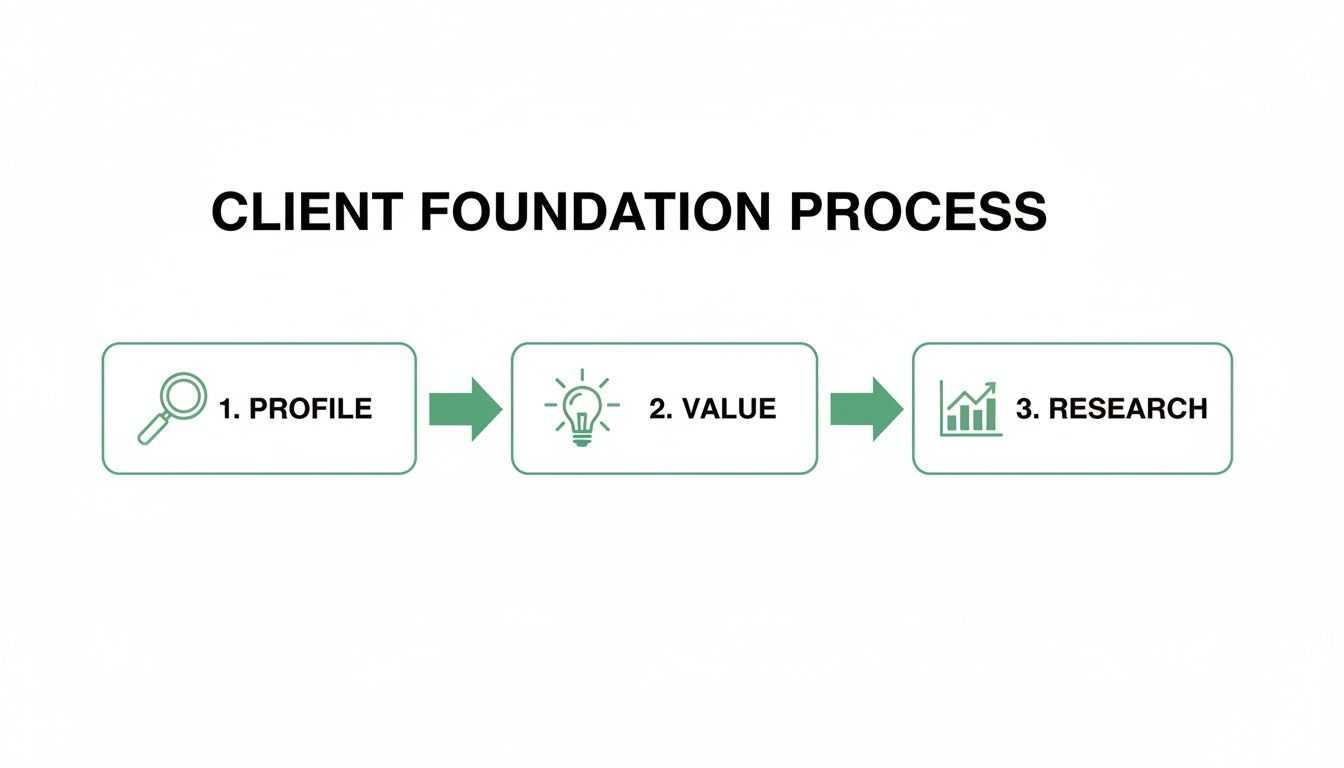
    The whole process boils down to a few key stages: defining your ideal profile, understanding what they actually care about, and then figuring out where to find them.

    A clear diagram illustrating the client foundation process with steps: Profile, Value, and Research.

    As you can see, every successful outreach campaign starts with a deep understanding of your target and the value you bring to the table. That foundation guides every single thing you do next.

    Locating Decision Makers

    You've defined the type of person you need to reach, but where do they hang out online? LinkedIn is the obvious starting point, and for good reason. It’s a massive, searchable database of professionals that’s invaluable for any B2B business.

    But just searching for job titles won't cut it. You have to put on your detective hat and look for buying signals—those little clues that tell you a person or company might be ready to buy right now.

    • Recent Job Changes: A new exec is almost always looking to make a quick impact. That often means bringing in new tools, services, or agencies.
    • Company News: Did a company just announce a big funding round or a new product launch? Events like these create new problems and, more importantly, open up new budgets.
    • Content Engagement: Who's liking, sharing, or commenting on articles related to the problem you solve? These people are actively thinking about your space.

    When you focus on these triggers, you’re no longer just another cold prospector. You’re reaching out to someone with a potential, immediate need, which instantly makes your message more relevant.

    A classic mistake is targeting a company instead of a person. You don't sell to a logo; you sell to a human being who has a specific, frustrating problem. Your number one job is to find the individual who feels that pain the most.

    A Practical Workflow Using EmailScout

    Building a list based on these signals can be a huge time sink if you do it all by hand. This is where you bring in the right tools to work smarter, not harder. An email finder is a non-negotiable part of your tech stack, turning a name and a company into a direct line of communication.

    Let’s walk through a real-world scenario. Imagine you're a new design agency targeting early-stage tech startups. Your ICP is the "Head of Marketing" at a SaaS company with 20-50 employees that just landed a Series A funding round.

    Here’s a simple, repeatable workflow:

    1. Find Target Companies: Use a platform like Crunchbase or LinkedIn Sales Navigator to filter for companies that fit your specific criteria (e.g., SaaS, 20-50 employees, Series A funding in the last 6 months).
    2. Pinpoint the Right Person: Once you have your list of companies, pop over to their website or LinkedIn page. Your mission is to find the person with the "Head of Marketing" title or something similar.
    3. Get the Email Address: Here’s the magic step. With the EmailScout Chrome extension installed, you just go to their LinkedIn profile or the company website and find their verified professional email with a single click. No more guessing games with first.last@company.com.
    4. Segment and Organize: As you find contacts, EmailScout lets you save them directly into organized lists. You could create a list called "Series A SaaS – Marketing Heads" to keep your outreach hyper-focused.

    This straightforward process turns abstract research into an actionable list of qualified prospects. To go even deeper, check out our full guide on sales prospecting techniques. This system ensures every email you send has the best possible shot at reaching the right person, at the right company, with the power to say "yes." This is how you stop guessing and start getting clients systematically.

    Crafting Cold Emails That Actually Get Replies

    Overhead view of a person typing on a laptop, with a coffee mug, notebooks, and a banner reading 'EMAILS THAT CONVERT'.

    Let's be honest: cold email gets a bad rap. That's because most people do it terribly. Our inboxes are graveyards for spammy, self-serving outreach that gets deleted on sight.

    But when you approach it with a little precision and empathy, a well-written email is one of the most direct and effective ways to land your first clients.

    The secret is to stop "selling" and start a conversation. Your only job with that first email is to earn a reply. That's it. Every single word should serve that one goal.

    The Anatomy of an Irresistible Subject Line

    Before anyone reads your perfectly crafted email, they have to open it. Your subject line is the gatekeeper, and its only mission is to spark just enough curiosity to get a click, without feeling like bait.

    The best subject lines are specific, relevant, and feel like they were written by a human.

    Ditch the generic, salesy stuff like "Quick Question" or "Introductory Offer." Instead, tie your subject line directly to something happening in their world.

    • Reference a recent event: "Congrats on the new funding round"
    • Mention a mutual connection: "Jane Smith suggested I reach out"
    • Ask a highly specific question: "Question about [Their Company]'s marketing stack"

    You want it to feel like it could have come from a colleague, not an automated sequence. Keep it short—ideally 5-7 words—so it doesn't get cut off on a phone, where almost half of all emails get read.

    Pro Tip: Your subject line should be the start of a story that the first line of your email immediately continues. This creates a seamless flow that pulls the reader right in.

    Structuring the Email Body for Impact

    Once the email is open, you have about ten seconds to hook them. Long, chunky paragraphs are the fastest way to get your email sent to the trash. Make it scannable, keep it concise, and focus everything on the person reading it.

    A simple, four-part structure consistently gets replies:

    1. The Opening: Kick things off with a personalized line that proves you did your homework. This is where you mention their recent blog post, a company award, or a specific challenge you noticed. Make it clear this email is for them and only them.
    2. The Problem: Briefly state a problem you know their role or company is dealing with. Show them you understand their world and the headaches that come with it.
    3. The Solution (Your Value Prop): Frame your service as the answer to that problem. Don't just list features; talk about the tangible result or outcome they'll get.
    4. The Call-to-Action (CTA): End with a simple, low-effort question. Instead of asking for a 30-minute call, try something like, "Is this something on your radar right now?" This makes it incredibly easy for them to give a quick yes or no.

    When done right, email marketing is still one of the most cost-effective ways to get clients. Data shows the average email marketing conversion rate can be as high as 15.22%, with top automated campaigns reaching almost 5%.

    The Art of the Follow-Up

    Here's the hard truth: most replies don't come from the first email. Not even close. People are busy, inboxes are chaotic, and your message can easily get lost in the noise. A persistent but respectful follow-up plan is an absolute must.

    A simple three-step cadence works like a charm:

    • Email 2 (3 days later): This is just a gentle "bump." Reply to your original email with something short and sweet like, "Just wanted to bring this to the top of your inbox. Any thoughts?"
    • Email 3 (7 days later): Now, add some value. Share a relevant article, a case study, or a quick insight related to their business. The CTA is softer here: "Thought you might find this interesting."
    • Email 4 (14 days later): Time for the breakup email. Politely close the loop. "Assuming this isn't a priority right now, so I won't follow up again. Feel free to reach out if that changes." This often triggers a response because of good old-fashioned FOMO.

    Each follow-up should be shorter than the last—just a quick, easy-to-read nudge. This strategy respects their time while keeping your name top-of-mind. If you need more inspiration, check out these proven examples of cold emails that actually get results.

    Using Personalization to Build Real Connections

    In a world drowning in generic, automated outreach, genuine personalization is your single greatest advantage. Moving beyond the simple {first_name} tag isn’t just a nice-to-have anymore; it's the only way to cut through the noise.

    This is how you land clients when you can't compete on brand recognition or a massive marketing budget. You compete on thoughtfulness. The goal is to make every email feel like a one-to-one conversation, even when you're working at scale.

    And it pays off. Personalized emails are proven to boost click-through rates by 14% and conversion rates by 10%. Even better, they can achieve transaction rates 6 times higher than generic messages. If you want to dig into the numbers, you can explore more data on the impact of targeted email outreach here.

    Quick Research for Maximum Impact

    Good personalization doesn’t mean you need to spend hours stalking a single prospect. It's about being smart and efficient. In just five minutes, you can find more than enough ammo to craft a message that feels genuinely personal.

    Before you hit send, do a quick scan of these key areas:

    • LinkedIn Activity: Did they just share an interesting article, post an update, or get a promotion? A quick mention shows you're actually paying attention.
    • Company News: Hit their company's "News" or "Blog" section. A recent product launch, funding round, or award is a perfect, timely hook.
    • Personal Interests: Sometimes a LinkedIn profile mentions a specific hobby, volunteer work, or their alma mater. Finding even a small point of common ground can build instant rapport.

    This isn't about being creepy. It's about finding an authentic reason to start a real conversation.

    Crafting Messages That Resonate

    Once you have a few specific details, the trick is to weave them naturally into your email. You need to connect what you learned about them to the problem you solve. This simple act transforms your message from a cold pitch into a helpful suggestion.

    Let’s look at a real-world example.

    Generic Opening:

    "Hi Sarah, I saw you're the Head of Marketing at InnovateTech and wanted to reach out."

    Personalized Opening:

    "Hi Sarah, I saw your recent post on LinkedIn about the challenges of scaling content creation for InnovateTech's new product line. Your point about maintaining quality under pressure really stood out."

    See the difference? The second example immediately proves you understand her specific world. It shows you’ve done your homework and aren't just blasting out another template. You’ve earned her attention for the next few sentences.

    Key Takeaway: Personalization isn't just a tactic; it’s a strategy. It shows respect for the recipient's time and makes them far more likely to see you as a potential partner instead of just another salesperson.

    Moving Beyond the First Name

    True personalization goes much deeper than surface-level details. It’s about tailoring your entire value proposition to their specific situation. This is where you connect the dots between their world and your solution.

    Here’s how to put this into practice:

    • Reference Their Role: Speak their language. A CMO cares about different KPIs than a Marketing Manager. Tailor your pitch accordingly.
    • Align with Company Goals: If their company just announced a global expansion, frame your service as the tool to help them get there faster.
    • Address a Recent Trigger: Did they just hire a new sales team? Position your lead generation service as the perfect way to keep that new team fed with qualified opportunities.

    This level of customization demonstrates a deep understanding of their business. It shifts the entire dynamic from you asking for something to you offering a solution to a problem they already have. That’s how you build real, lasting client relationships.

    Expanding Your Reach with Networking and Partnerships

    Two businessmen exchanging business cards at a table with a laptop and 'BUILD PARTNERSHIPS' sign.

    While targeted outreach is an absolute beast for getting clients, putting all your eggs in that one basket can be a bit risky. If you want to build a truly resilient client-getting machine, you have to diversify. That’s where networking and strategic partnerships come in.

    Think of it this way: cold outreach is your offense, the direct play you run to score. Networking and partnerships are your defense and special teams. They create long-term assets that feed you a steady stream of warm, high-converting leads, often when you least expect them. This is how you stop chasing every single client and start having them come to you.

    Master Authentic Digital Networking

    Let's be clear: networking is not about hoarding business cards or machine-gunning connection requests on LinkedIn. It's about building real relationships and positioning yourself as a helpful expert. Today, that happens almost entirely online.

    The secret sauce? Give before you ask. Instead of launching into a sales pitch, start by engaging with the content your ideal clients and potential partners are already posting. A genuinely thoughtful comment that adds to the conversation is worth a hundred generic "Great post!" messages.

    Here’s how it plays out: Say you're a freelance writer targeting SaaS marketing managers. You spot a post from a marketing leader in your niche. Instead of a cold pitch, you drop a comment with a unique insight or a relevant stat. Do this consistently, and you become a familiar, respected name in their world.

    Engage in High-Value Online Communities

    Your ideal clients are already hanging out together online, talking about the very problems you can solve. Your job is to find these digital watering holes—specialized Slack channels, niche subreddits, private Facebook groups—and become a fixture.

    The rules of engagement are simple:

    • Listen first. Get a feel for the community's vibe and rules before you jump in.
    • Answer questions. Share your expertise freely, without a sales pitch attached. Offer real, actionable advice.
    • Be a resource. If someone needs a tool or an article recommendation in your field, be the one who provides it.

    This slow-burn approach positions you as a trusted advisor. Down the road, when someone in that group needs the exact service you offer, guess who they'll think of first? It’s a subtle but incredibly powerful way to build trust long before a sales call ever happens.

    Forge Strategic Referral Partnerships

    One of the absolute fastest ways to get more clients is to team up with other businesses that serve the same audience but aren't your competitors. A solid referral partnership can easily become your single best source of qualified leads.

    Think about complementary services. For example:

    • A web designer could partner with a copywriter and an SEO specialist.
    • A financial advisor could team up with an accountant and an estate planning lawyer.

    When you find the right partner, you're plugging directly into their existing trust and credibility. The leads they send your way are pre-qualified and already warm, which dramatically shortens your sales cycle.

    When you reach out, have a clear, mutually beneficial proposal ready. Explain how you’ll add value for their clients and what you can offer in return. This isn’t a one-way street; it's about creating a win-win that fuels growth for both of you.

    From First Conversation to First Paying Client

    Getting a positive reply is a huge milestone, but it's really just the starting line. Now the real work begins: turning that initial spark of interest into a signed contract. This is your chance to shift from being a prospector to a trusted advisor, guiding the conversation from a casual chat to a closed deal.

    Your first call isn't about selling—it's about diagnosing. Think of it as a "discovery call." The entire goal is to understand their specific pains, their goals, and what they've already tried. You should let them do 80% of the talking. Ask open-ended questions that get to the heart of their problem and listen for the specific challenges your service is built to solve.

    Nailing the Discovery Call

    To make sure every first client interaction is a home run, you need to master some basic call handling best practices. It's all about creating a professional and comfortable experience from the moment they pick up the phone.

    Here’s a simple flow for that first conversation:

    • Build Rapport: Kick things off with a moment of genuine connection. Referencing that personalized point from your email shows you remember who they are and that they aren't just another name on a list.
    • Set the Agenda: Quickly outline the call's purpose. Something as simple as, "I'd love to learn more about your goals and see if we might be a good fit to help," works perfectly.
    • Ask Diagnostic Questions: This is where you dig in. Focus on their "why." Why is this a priority now? What does success look like for them in six months?
    • Confirm Understanding: Before you wrap up, summarize their key challenges back to them. This proves you were listening and, just as importantly, reinforces their pain points in their own mind.

    From Call to Compelling Proposal

    Once you've confirmed their problem and feel like you're a good fit, the next step is sending a proposal. This isn’t a generic brochure; it's a direct response to everything you just learned on the call. Keep it simple, clear, and laser-focused on outcomes, not just a list of activities.

    A great proposal doesn’t just list what you'll do; it clearly outlines the tangible value the client will receive. Frame everything in terms of their goals, using their own words back to them to show you've truly understood their needs.

    How you follow up is just as important as the proposal itself. After you send it over, suggest a specific time to review it together. This gives you a chance to answer questions, handle objections in real-time, and keep the momentum going.

    A simple, "Does Thursday at 2 PM work to walk through this and answer any questions?" keeps the ball in your court and moves you one step closer to landing your first paying client.


    Ready to build a reliable pipeline of qualified leads for your new business? EmailScout's Chrome extension makes it simple to find the verified email addresses of key decision-makers, so you can focus on starting conversations that lead to paying clients. Find unlimited emails for free and start your outreach today at https://emailscout.io.

  • How to Find Clients and Build a Predictable Pipeline

    How to Find Clients and Build a Predictable Pipeline

    Hoping for the best isn't a strategy. If you're tired of the feast-or-famine cycle, it's time to stop guessing and start building a real, repeatable system for finding clients.

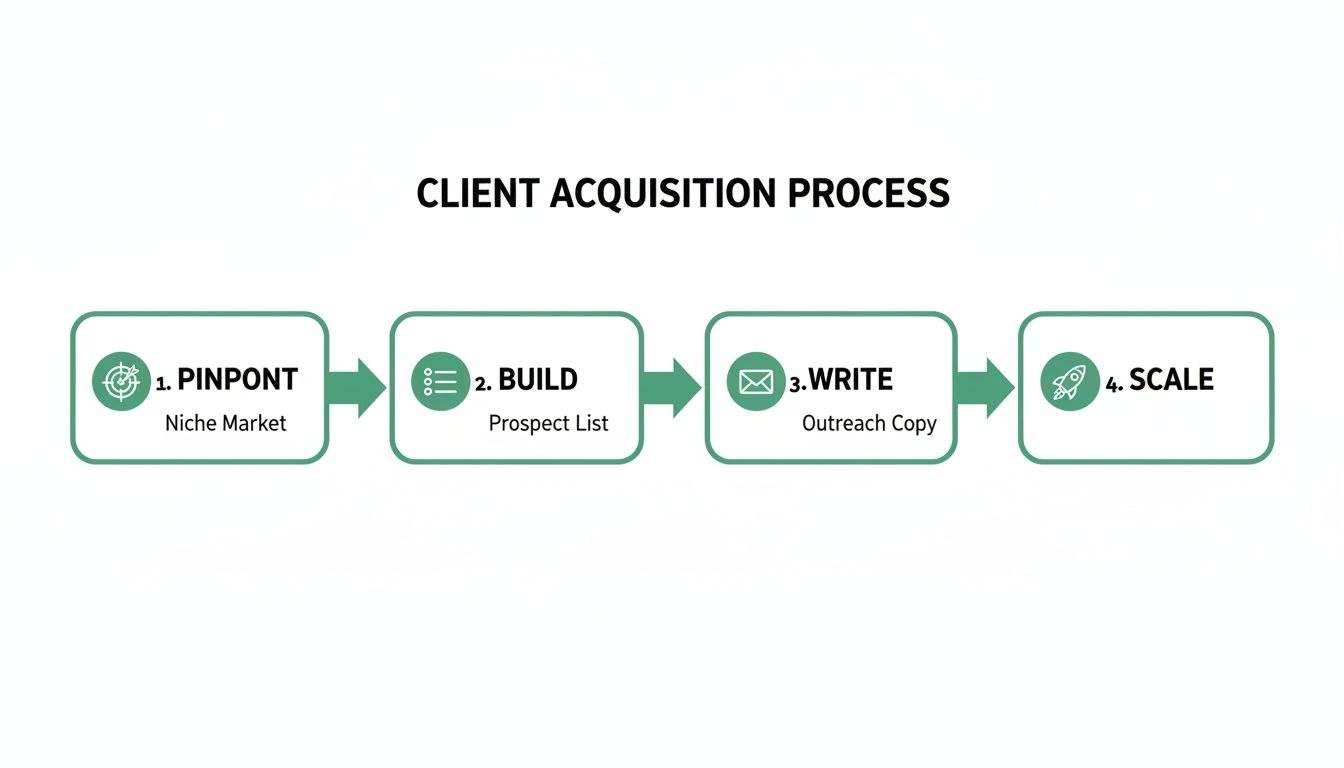
    This playbook cuts through the generic advice and lays out a modern blueprint that actually works: Pinpoint your ideal customer, build a targeted list of decision-makers, write outreach that gets a response, and scale what's working.

    Forget waiting for referrals. This is about taking control and creating a predictable pipeline of high-quality leads.

    Beyond Luck: Finding Clients With a Modern Blueprint

    Let's be real. The old ways of finding clients—endless social media posts, networking events, and just hoping someone stumbles upon your website—are scattered and unreliable. It’s like waiting for lightning to strike. Sure, it might happen, but you can't build a sustainable business on maybes.

    We're going to shift from that passive, hopeful approach to active, strategic outreach. It’s about being intentional. It's about knowing exactly who you're contacting and why they should care, turning a game of chance into a predictable process.

    The Four Pillars of Client Acquisition

    This entire system boils down to four critical stages. Nail these, and you'll turn client acquisition from a frustrating art into a data-driven science.

    • Pinpoint Your Ideal Client: Before you write a single email, you have to know exactly who you're looking for. This goes way beyond basic demographics. What are their biggest headaches? What goals keep them up at night?
    • Build Targeted Lists: Once you have that crystal-clear picture, it’s time to find them. This is where you'll efficiently gather contact information for the right people at the right companies.
    • Write Compelling Outreach: A perfect list is worthless if your message falls flat. Crafting personalized, value-first emails is the key to starting actual conversations, not just getting ignored.
    • Scale Your System: Finally, you'll build a process to manage and grow your outreach. This is how you turn one-off campaigns into a consistent engine for new business.

    For a deeper dive, this actionable playbook on how to generate leads for B2B is packed with proven strategies.

    This simple flowchart breaks down the entire process.

    A clear flowchart outlining a four-step client acquisition process: pinpoint, build, write, and scale.

    Each step builds on the last, creating a logical flow from high-level strategy to day-to-day execution. Whether you’re a freelancer, an agency owner, or a B2B sales pro, you’re about to get a clear system for keeping your pipeline full.

    Pinpointing Your Ideal Client to Stop Wasting Time

    Chasing every possible lead is a surefire way to burn out fast. If you want to find the right clients, you have to first define, with crystal clarity, exactly who they are. This is where building an Ideal Client Profile (ICP) becomes the single most important thing you can do for your outreach.

    And I'm not talking about vague descriptions like "small businesses" or "startups." We need to get way more specific than that. A truly effective ICP is a detailed snapshot of the exact person, at the exact company, who desperately needs what you're selling and actually has the power to buy it.

    Moving Beyond Basic Demographics

    A powerful ICP digs past the surface-level data and gets into the human and business drivers behind a purchasing decision. The goal is to understand their world so intimately that your outreach email feels less like a cold pitch and more like a genuinely helpful tip from someone who gets it.

    To build out this profile, you need to answer a few key questions:

    • What are their biggest day-to-day frustrations? Think about the bottlenecks, the clunky processes, and the recurring headaches that are stopping them from hitting their targets.
    • What KPIs are they on the hook for? Are they trying to boost lead gen by 15% this quarter? Or maybe their main goal is cutting customer churn. Their performance metrics are your way in.
    • What’s their exact job title? Don’t just aim for "marketing." Are you after a "Marketing Director," a "VP of Demand Generation," or a "Content Marketing Manager"? Precision is everything.

    The sharper your ICP, the more effective every other step becomes. A well-defined profile means you’re not just spamming inboxes; you’re starting relevant conversations with people actively looking for the very solution you offer.

    A Real-World ICP Example

    Let's make this real. Say you run a B2B SaaS company with a project management tool built for content teams. A weak, fuzzy ICP would be something like "marketing teams at tech companies." That's way too broad to be useful.

    Now, here’s what a strong, actionable ICP looks like:

    • Company: E-commerce brands with 50-200 employees.
    • Target Title: Marketing Director or Head of Content.
    • Pain Points: They’re constantly blowing past content deadlines, the team is struggling with version control on creative files, and there’s zero visibility into project status, causing last-minute chaos.
    • Goals: They need to increase content output by 25% quarter-over-quarter and make the team more efficient to handle upcoming product launches.
    • Watering Holes: They follow top marketing influencers on LinkedIn and hang out in private Slack groups for e-commerce marketers.

    See the difference? Now you know exactly who to search for, which problems to mention in your emails, and even where to find them online. This kind of specificity turns a vague hunt for clients into a targeted mission.

    How to Uncover These Critical Details

    So, where do you find all this juicy information? It’s time to put on your detective hat. Professional networking platforms are your best friend here.

    LinkedIn is an absolute goldmine for this kind of research. You can search for specific job titles within certain industries and company sizes. Once you find them, dig into their profiles. Pay attention to the language they use, the skills they list, and the articles they share. It's a direct window into their priorities and pain points. For a deeper dive, our guide on how to identify a target audience lays out even more advanced strategies.

    By taking the time to build a detailed ICP upfront, you stop wasting cycles on prospects who were never going to be a good fit. Every email you send becomes more relevant, your messaging hits harder, and your chances of starting a real sales conversation go through the roof.

    Building High-Quality Prospect Lists Without the Grind

    Okay, so you've nailed down your Ideal Client Profile. You're no longer just guessing who to talk to. Now comes the fun part: turning that profile into a real, actionable list of companies and decision-makers who are a perfect match for what you offer. This is where your client search gets serious.

    Traditionally, this step was a soul-crushing grind. I'm talking about endless hours spent copying and pasting names from LinkedIn into a spreadsheet, followed by a frustrating hunt for contact info that often led nowhere. That kind of manual work doesn't just eat up your time; it completely kills your momentum before you even send the first email.

    Thankfully, the tools we have today have completely changed the game.

    From Manual Labor to Automated Precision

    Let's get one thing straight: the goal isn't just to build a list. It's to build a high-quality list, and to do it efficiently. Quality beats quantity every single time. A focused list of 100 perfect-fit prospects is worth infinitely more than a spray-and-pray list of 10,000 who probably don't need your help.

    This is where a tool like the EmailScout Chrome extension becomes your secret weapon. Instead of seeing list-building as a chore, you can turn it into a swift, almost effortless process. Imagine scrolling through a LinkedIn search for "Marketing Directors in SaaS" and having a tool quietly find and save their verified emails for you in the background.

    That's the leap from manual to automated. You let the tech do the heavy lifting, which frees you up to focus on what really matters—writing a killer outreach message.

    Harnessing Professional Networks Intelligently

    Professional networks are the primary hunting ground for B2B prospects. LinkedIn, in particular, is a goldmine with its powerful search filters. You can zero in on people by industry, company size, job title, and location—the very same criteria you just defined in your ICP.

    Here’s how to tackle it with a smart, tool-assisted workflow:

    1. Run a Targeted Search: Use LinkedIn's filters to get super specific. Think "Head of Content" at "E-commerce companies" with "51-200 employees."
    2. Activate AutoSave: With a tool like EmailScout, you flip on the AutoSave feature. As you scroll through the search results, the extension gets to work finding and verifying email addresses for the people on your screen.
    3. Build Your List on Autopilot: Every valid contact gets automatically dropped into a designated list. What used to take hours of tedious clicking and searching now takes a few minutes of casual scrolling.

    This approach completely transforms a boring task into an efficient data-gathering mission.

    Exploring Company Websites at Scale

    Sometimes, your best prospects are all in one place—a specific company's website. Maybe you’re targeting the entire marketing team at a fast-growing startup. Finding each person's email one by one is a huge time-sink.

    This is a perfect job for a URL Explorer feature. Instead of hunting down contacts individually, you just plug in the company’s domain (like company.com) and let the tool scan the entire site for any publicly available email addresses. It pulls every contact it can find, saving you a massive amount of time.

    Building a solid prospect list is the foundation of any great outreach campaign. When you get this part right, every email you write has the highest possible chance of landing in front of someone who can actually say "yes."

    This strategic approach to list-building is why email is still a dominant force. By 2025, there will be 4.6 billion global email users, and the ROI can be an incredible 3600%—that's $36 back for every dollar you spend. By automating the list-building, you tap into that power so much more effectively.

    Here’s a look at how you can pull emails directly from a website using the EmailScout extension.

    A modern desk with a laptop showing client profiles, a notebook, and a pen, under an 'Ideal Client' banner.

    With a simple interface like this, you can instantly see and save the emails found on any page, turning a company's "About Us" or "Team" page into a ready-made prospect list.

    These kinds of efficient sales prospecting techniques are absolutely essential for building a predictable pipeline of new clients. When you shift from manual drudgery to smart automation, you’re not just saving time—you’re building a stronger, more accurate foundation for your entire client acquisition strategy.

    Writing Outreach Emails People Actually Reply To

    Having a perfect list of verified emails is a huge win, but it’s only half the battle. An email address is just an entry point; a compelling message is what actually starts a conversation and helps you find clients.

    This is where we move past the cringey, self-absorbed templates that flood every inbox. Instead, we'll focus on writing outreach that people genuinely want to answer.

    The difference between an email that gets deleted and one that gets a reply often comes down to one thing: relevance. Your prospect doesn't care about your company's history or your long list of services. They only care about their problems. A great outreach email proves you understand their world before you ask for their time.

    A desk setup featuring a laptop with client profiles, a smartphone, and a 'Prospect List' sign.

    The Anatomy of a Reply-Worthy Email

    Every successful outreach email has a few core components working together. It’s not about finding some magic template, but rather understanding the principles behind why certain messages work.

    Get these right, and you'll have a framework for crafting effective emails every single time.

    • A Subject Line That Sparks Curiosity: Ditch the generic, salesy phrases like "Quick Question" or "Intro Call?" Instead, make it specific and intriguing. Mentioning a competitor, a shared connection, or a recent company event can work wonders.
    • An Opening Line That Shows You've Done Your Homework: The first sentence must prove this isn't a mass blast. Reference a recent LinkedIn post they wrote, a podcast they were on, or a new initiative their company announced. This instantly builds rapport.
    • A Value Proposition That Solves a Problem: Clearly and concisely connect what you do to a problem they are likely facing (based on your ICP research). Don't just list features; explain the outcome.
    • A Low-Friction Call to Action (CTA): Make it easy for them to say yes. Instead of "Are you free for a 30-minute demo next week?", try something softer like, "Is this a priority for you right now?" This opens a dialogue, not a calendar commitment.

    To make this even clearer, I've broken down these elements into a simple checklist.

    Key Outreach Email Components for Higher Response Rates

    This table acts as a quick reference to ensure every email you send is optimized to start a conversation, not just pitch a product.

    Email Component Purpose Best Practice Example
    Subject Line Grab attention and earn the open. "Your thoughts on the [Competitor] acquisition"
    Opening Line Show personalization and build rapport. "Just read your article on Forbes about scaling teams—great stuff."
    Value Proposition Connect your solution to their specific pain point. "Saw you're hiring SDRs. We help teams like yours cut ramp time by 50%."
    Call to Action (CTA) Make the next step easy and low-commitment. "Open to learning more if this is a focus for you?"

    Following this structure helps you move from a generic pitch to a message that feels like a one-to-one conversation.

    From Generic Pitch to Personalized Solution

    Let's look at the difference in action. Imagine you're pitching a social media management tool to the Head of Marketing at a growing B2C brand.

    The Generic (and Bad) Approach:

    Subject: Social Media Solution

    Hi Jane,

    I'm John from SocialPro. We offer an all-in-one social media scheduling, analytics, and reporting platform. Our tool helps businesses save time and increase ROI.

    Would you be open to a 15-minute demo next week to see how it works?

    Best,
    John

    This email is all about the sender and will be deleted in seconds. It shows zero research and provides no specific value.

    Now, let's try a personalized, problem-solving approach.

    The Personalized (and Good) Approach:

    Subject: Your recent Shopify Plus podcast episode

    Hi Jane,

    Loved your insights on the Shopify Plus podcast about scaling customer acquisition. Your point about leveraging user-generated content was spot-on.

    I noticed your team is manually collecting and posting customer photos on Instagram. Many marketing heads at brands like yours find this eats up about 10 hours a week that could be spent on strategy.

    We built a tool that automates this, freeing up your team to focus on bigger wins.

    Is improving that workflow a priority for you currently?

    Best,
    John

    See the difference? This version works because it's about them. It leads with a genuine compliment, identifies a specific, observable pain point, and connects the solution directly to that pain. The CTA is just a simple, low-pressure question.

    This is how you start a conversation. For a deeper dive, our guide on how to write cold emails that get replies is an excellent resource.

    The core of effective outreach is empathy. Put yourself in their shoes and ask: "Would I reply to this?" If the answer is no, start over.

    The numbers back this up. Email marketing can deliver an astonishing ROI of 3600%, and for sales teams, automated outreach boasts a 42.1% open rate. This proves that when done right, email is an incredibly powerful channel for finding new clients.

    The goal isn't just to send emails; it's to start conversations. By focusing on personalization, value, and a genuine understanding of your prospect's world, you'll write messages that don't just get opened—they get answered.

    Putting Your Outreach System to Work and Scaling Up

    A laptop on a wooden desk displays an email with a green banner reading 'REPLY-WORTHY EMAIL'.

    You’ve done the hard work. You've built a killer prospect list and figured out how to write a genuinely personal email. Now it’s go-time. This is where you start turning all that prep into a predictable pipeline of client conversations.

    But hitting "send" is just the starting line. A single, perfect email almost never breaks through the noise of a busy inbox. The real results come from what you do next.

    The magic is in the follow-up. A smart sequence keeps you on their radar without being annoying, showing persistence while adding a little more value each time you pop up. This is how you build a repeatable, scalable machine that consistently brings in new opportunities.

    Crafting a Follow-Up Sequence That Gets Replies

    Here’s a hard truth: most of your positive replies will come from a follow-up, not the first email. Your prospects are busy. Your message probably landed while they were putting out a fire or jumping into a meeting. A multi-touch sequence just gives them more chances to engage when the time is right.

    The trick is to avoid that cringe-worthy "just checking in" email. Nobody likes those. Instead, each follow-up needs to bring something new to the table.

    • Follow-Up 1 (2-3 days later): Come at it from a different angle. Briefly touch on a different pain point you solve or a benefit you didn't mention before.
    • Follow-Up 2 (4-5 days later): Share something genuinely useful. This could be a link to a case study, a helpful blog post you wrote, or an interesting industry report that shows you know your stuff.
    • Follow-Up 3 (about a week later): Send the "breakup" email. Politely close the loop and let them know you won't bother them about this again. You'd be surprised how often this creates a little urgency and gets a response.

    A thoughtful follow-up sequence shows you're serious about helping, not just serious about selling. It transforms your outreach from a single shot in the dark into a strategic campaign that builds familiarity and trust over time.

    Tracking the Numbers That Actually Move the Needle

    If you want to get better at outreach, you have to measure what you're doing. It’s super easy to get bogged down in vanity metrics like open rates, but let’s be honest—opens don’t pay the bills. You need to focus on the data that directly translates to business.

    These are the KPIs you should be obsessing over:

    • Reply Rate: This is your north star. It tells you if your message is interesting enough to even start a conversation. If this number is low, your subject lines, opening hooks, or your core offer needs a tune-up.
    • Positive Reply Rate: Of the people who reply, how many are actually interested? This number separates the polite "no, thanks" from the real leads.
    • Meetings Booked: This is the ultimate goal, right? Tracking this shows you how well you're turning initial interest into real sales opportunities.

    Focusing on these three metrics helps you pinpoint exactly where your process is breaking down. Low reply rate? Your emails need work. High reply rate but no meetings? Your call to action or how you handle the first response needs rethinking.

    Knowing When It's Time for Automation

    As you start getting traction, sending every email by hand becomes a bottleneck. Automation is how you scale, but you have to be smart about it. The goal is to automate the repetitive grunt work while keeping the personal touch that gets you replies in the first place.

    You should start thinking about automation once you're consistently sending 50-100+ personalized emails every week. At that point, a sales engagement platform can take over your follow-up sequences, making sure no prospect ever falls through the cracks. This frees you up to do what you do best: writing great first-touch emails and talking to interested people.

    To really put your growth on autopilot, you might even delegate remote appointment setting tasks to free up even more of your time for closing. Suddenly, you've got a powerful system that’s constantly generating leads and moving them down the pipeline. Your process goes from a bunch of manual tasks to a well-oiled machine that finds clients for you.

    Common Questions About Finding Clients

    As you dive into building an outreach system, you're bound to run into a few classic questions. I see them pop up all the time. Getting these sorted out early will save you a ton of headaches and help you sidestep the common mistakes people make when trying to find clients.

    Let's get right into the big ones.

    How Many Follow-Up Emails Should I Send?

    Everyone wants a magic number, but the truth is, there isn't one. What we do know from the data is that sequences with 3 to 5 follow-ups tend to hit the sweet spot.

    The real key here isn’t the number, but what you do with those follow-ups. Don't just send another "just checking in" email. Each message needs to add a little more value. Share a link to a relevant article, mention a recent win their company posted on LinkedIn, or offer a slightly different angle on their problem. Your goal is polite persistence, not pestering. Think of each email as another chance to be genuinely helpful.

    What Is the Best Time and Day to Send Outreach Emails?

    You've probably heard the old advice: "Send it on Tuesday at 10 AM." While that's a decent starting point, the honest-to-goodness answer is that it depends entirely on who you're trying to reach.

    A C-level executive might be clearing their inbox at 7 AM before the chaos starts, while a creative director might not really dig in until after lunch.

    Use the "best practice" times as your first guess, but then you have to test, test, and test again. Your own open and reply rates are the only data that matters. Let that be your guide to what actually works for your ideal client.

    How Can I Avoid My Emails Landing in Spam?

    Keeping your emails out of the spam folder is part technical, part behavioral. On the technical side, make sure your domain is set up correctly. But most of your deliverability comes down to good sending habits.

    Stay away from spammy trigger words like "free trial" or "guarantee," and don't go crazy with flashy formatting or a dozen images. Those are all red flags for spam filters.

    But the most important thing? Send personalized, relevant emails to people who might actually want to hear from you. When your recipients open and reply to your messages, it sends a powerful signal to email providers that you're one of the good guys. This positive engagement builds your sender reputation over time, which is what keeps you landing in the primary inbox.


    Ready to stop grinding and start building high-quality prospect lists in minutes? EmailScout gives you the tools to find verified emails, automate list-building, and connect with decision-makers effortlessly. Find unlimited emails for free.