

Let’s be real—building a sales pipeline boils down to three core things: finding quality leads, figuring out if they have the intent (and budget) to buy, and finally, closing the deal. This whole process is your roadmap for turning a bit of interest into revenue you can actually count on. It’s what keeps your sales team from chasing ghosts and lets them focus on the opportunities that are most likely to convert.
Your Blueprint for a High-Performing Sales Pipeline
Think of your sales pipeline as more than just a deal tracker. It’s an engineered system for creating consistent, predictable revenue. Without one, you’re stuck with random wins and forecasts that are basically just guesswork. A well-defined pipeline, on the other hand, gives you a clean, visual map of where every single prospect is on their journey, from the first "hello" to the signed contract.
That clarity is everything. It's the difference between reacting to whatever sales come in and proactively managing your entire process.
Once you can see the flow of opportunities, you can spot bottlenecks, predict future income with surprising accuracy, and put your resources where they’ll have the most impact. Flying blind just doesn’t work; your team wastes precious time on leads that were never going to pan out in the first place.
The Core Components of a Pipeline
A great pipeline isn't just a list of names. It’s a living, breathing process built on a few key pillars that guide prospects smoothly from one stage to the next. Nail these, and you've got the foundation for a killer sales strategy.
Here’s a quick overview of what every pipeline needs:
| Pipeline Stage | Primary Objective | Key Activity Example |
|---|---|---|
| Lead Generation | To identify and attract potential customers. | Running a targeted ad campaign or collecting contacts at a trade show. |
| Qualification | To determine if a lead fits your ideal customer profile (ICP). | A BDR makes an initial call to assess need, budget, and authority (BANT). |
| Meeting/Demo | To showcase the value of your product or service. | An Account Executive runs a personalized product demonstration. |
| Proposal | To present a formal offer outlining the solution and pricing. | Sending a detailed quote that addresses the prospect's specific pain points. |
| Negotiation & Closing | To finalize terms and secure the signed contract. | Handling objections and agreeing on final pricing and contract details. |
| Post-Sale | To ensure a smooth handoff and customer satisfaction. | Onboarding the new client and introducing them to their account manager. |
These stages aren't set in stone—you should adapt them to your specific sales cycle. The key is to have a clear, repeatable process that everyone on your team understands and follows.
Let's break down the foundational elements that make those stages work.
Clearly Defined Stages
Each stage needs to represent a real step forward in the buyer's journey. Think "Initial Contact," "Discovery Call," "Proposal Sent," and "Negotiation." This gives your team a clear playbook, so they always know what action to take next to move a deal along.
Solid Qualification Criteria
You need a firm set of rules to decide if a lead is even worth pursuing. This is crucial. Without it, your pipeline gets clogged with prospects who don’t have the budget, authority, or genuine need for what you’re selling. It’s the bouncer at the door of your sales process.
Key Metrics for Success
Tracking data is non-negotiable. You have to know your numbers. Metrics like conversion rates between stages, your average deal size, and the length of your sales cycle tell you exactly what’s working and what’s broken.
This diagram gives a great visual of that fundamental flow from finding leads to closing deals.
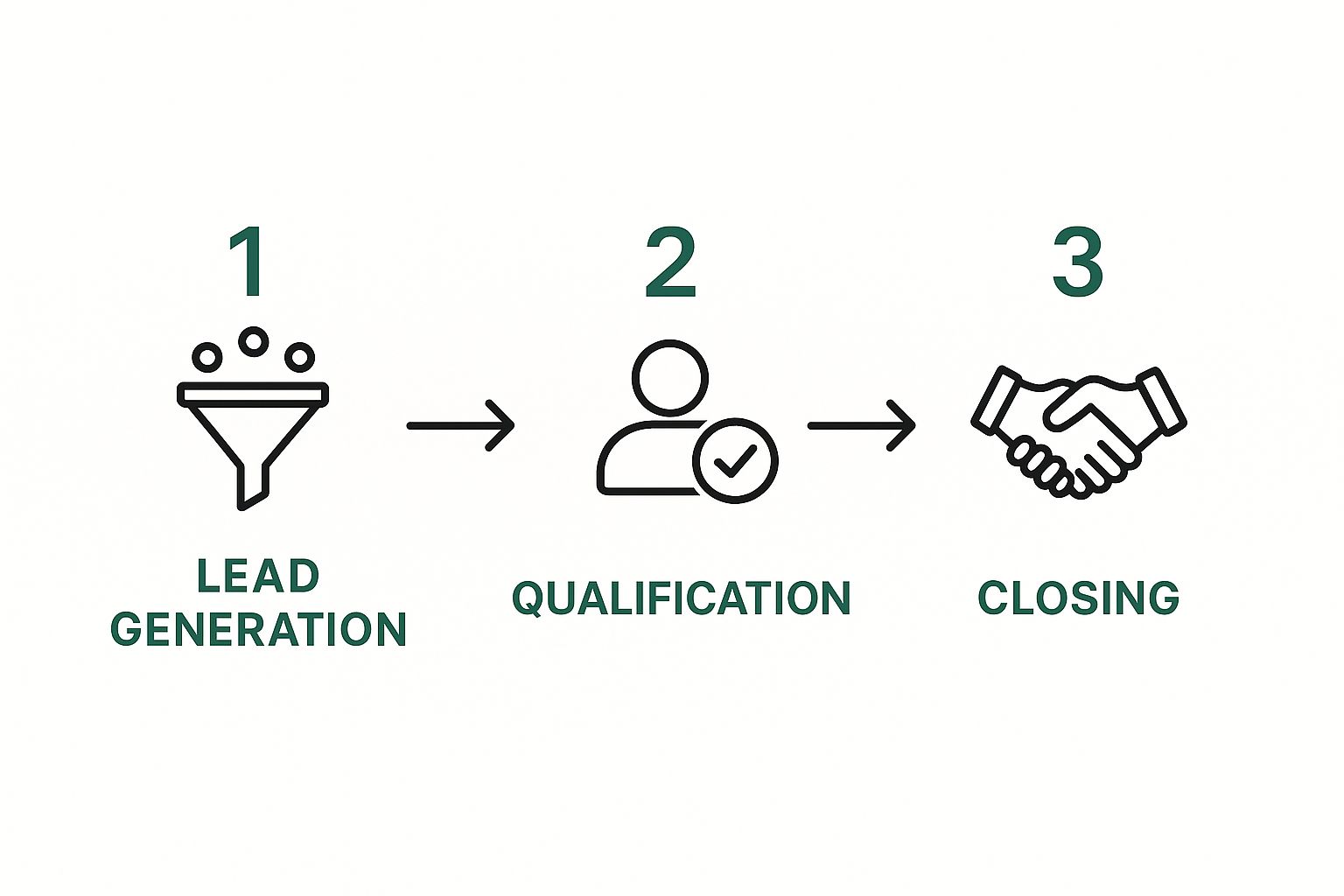
It’s a simple reminder that a pipeline is a step-by-step process. Each stage flows logically into the next, which is how you make sure no opportunity gets lost in the shuffle.
A pipeline isn't just a sales tool; it's a business intelligence engine. Companies that formally define their sales process achieve nearly 30% higher revenue growth compared to those that don’t.
Getting this structure right provides the framework for everything else. By breaking down the sales journey into these manageable stages, you give your team a repeatable playbook for success. It turns sales from an unpredictable art into a predictable science, which sets the stage for the specific strategies we're about to dive into.
Finding and Engaging Your Ideal Customers

A sales pipeline is only as good as the leads you put into it. Shoveling in a ton of random prospects is a fast track to wasted time and missed quotas. The secret to predictable revenue isn't volume; it's focus. You have to go after the right people from the very start.
This is about ditching the old-school, scattergun approach for a smarter, more strategic way of prospecting. It all begins with a crystal-clear picture of who you're trying to reach.
Define Your Ideal Customer Profile
Before you write a single outreach email, you need to know exactly what your perfect customer looks like. This is your Ideal Customer Profile (ICP)—a detailed snapshot of the company that gets the most out of your product and, in turn, gives the most value back to you.
A good ICP isn't just a hunch. It's a data-backed document that steers your entire sales and marketing ship. Without one, your team is basically flying blind, chasing leads that were never a good fit to begin with.
So, how do you build one? Start by looking at your best existing customers. What do they have in common?
- Firmographics: What industry are they in? How big are they, both in revenue and employee count? Where are they located?
- Technographics: What other tech are they using? Their current software stack can be a huge tell that they're ready for your solution.
- Behavioral Traits: How did they find you in the first place? What did their buying journey look like? What specific problems did you solve for them?
When you spot these common threads, you're essentially creating a blueprint for who you should be targeting. This focused strategy is a core part of modern lead generation best practices and keeps your team aimed at high-potential accounts.
Modern Prospecting for Quality Leads
Once your ICP is locked in, the hunt begins. It’s time to find companies that fit the bill. This is where modern prospecting techniques really shine, moving you away from annoying cold calls and toward targeted, value-driven conversations. The goal isn't to interrupt someone's day but to show up with a relevant solution when they need it most.
Think of it like fishing. You wouldn't just throw a net into a random pond. You’d go to the right lake, use the right bait, and be patient. Sales is no different.
Companies with a well-defined sales process—which always starts with targeted prospecting—achieve 18% faster revenue growth than those without one. That's the real-world impact of focusing on quality over quantity.
Your ICP tells you where to fish. Now, let’s talk about how to cast your line.
Leveraging Professional Networks
Platforms like LinkedIn are a goldmine for B2B sales. It’s where your ideal customers are talking about their challenges, sharing their wins, and connecting with others in their field. It’s not just a digital resume anymore; it’s a living, breathing business community.
Here’s a quick-start guide to using it right:
- Tune Up Your Profile: First things first, make sure your profile frames you as a helpful expert, not a pushy salesperson. Your headline should talk about the problems you solve, not just your job title.
- Use Advanced Search: LinkedIn Sales Navigator is a beast for filtering millions of users down to the ones who perfectly match your ICP. You can slice and dice by company size, industry, title, seniority—you name it.
- Engage Authentically: Don’t just send a bland connection request and launch into a pitch. Follow your targets, leave thoughtful comments on their posts, and share valuable content yourself. When you finally reach out, they'll already know who you are.
This approach builds a little bit of rapport before you ever make an ask, which drastically increases your chances of getting a reply.
Finding Verified Contact Information
You’ve identified the right people at the right companies. The last piece of the puzzle is actually getting in touch. A generic "info@" email just isn't going to get you anywhere. You need the direct line to the decision-makers you've been researching.
This is where tools like EmailScout become essential. Instead of wasting hours guessing email formats or digging through company directories, an email finder can pull a verified email address right from someone's LinkedIn profile or a company website. It’s a simple step that saves a massive amount of time and makes your outreach far more efficient.
By combining a sharp ICP with smart prospecting on platforms like LinkedIn and tools for contact discovery, you create a repeatable system. You'll start filling your pipeline not just with leads, but with genuine opportunities that have a much higher chance of closing.
Qualifying and Prioritizing High-Value Leads

Getting leads to flow into your system is one thing, but what you do next is what really matters. A pipeline stuffed with unqualified prospects is a fast track to missed quotas and a burned-out sales team. The most critical skill in building a sales pipeline that actually closes deals is learning to separate the serious buyers from the casual window-shoppers.
This is where qualification comes in. Think of it as the gatekeeper for your entire sales process. It’s what ensures your team spends their limited time and energy on deals that have a real shot at closing. Skip this, and your forecast becomes pure guesswork.
Using Frameworks to Ask the Right Questions
Qualification isn't about running a prospect through a rigid checklist; it's about having a structured conversation to uncover what's really going on. Proven frameworks give you the guardrails for these conversations, helping your team consistently spot the high-value opportunities.
The BANT framework is a classic for a reason—it’s simple, effective, and perfect for those initial qualification calls. It zeros in on four core areas:
- Budget: Do they actually have money set aside for a solution like yours?
- Authority: Are you talking to the person who can sign the check, or at least a key influencer?
- Need: What’s the specific business pain they're trying to fix? Is it a "nice-to-have" or a "hair-on-fire" problem?
- Timeline: When are they looking to get this done? This quarter or sometime next year?
For more complex, big-ticket B2B sales, a more detailed framework like MEDDIC is a game-changer. It forces a much deeper level of discovery, which is essential for navigating those tricky enterprise deals.
A pipeline clogged with unqualified leads is a slow death for a sales team. The top-performing reps aren't the ones with the most deals; they're the ones with the best-qualified deals.
MEDDIC helps you dig into the specifics of a potential deal, so you understand the real dynamics at play. You'll get past the surface-level answers and uncover the internal politics and metrics that truly drive a purchasing decision.
Mastering the MEDDIC Framework
MEDDIC provides a more robust structure for qualifying enterprise-level opportunities where you’re dealing with multiple stakeholders and complex buying processes. It stands for:
- Metrics: What measurable results does the prospect need to see? Think increased revenue, cost savings, or better efficiency.
- Economic Buyer: Who has the ultimate profit-and-loss responsibility for this purchase? This is the person with the final say.
- Decision Criteria: What specific technical, financial, and vendor requirements will they use to judge solutions?
- Decision Process: What are the exact steps, timeline, and people involved from evaluation to a signed contract?
- Identify Pain: What's the primary business problem, and what are the negative consequences if they do nothing?
- Champion: Who inside their organization is fighting for you when you’re not in the room?
By systematically gathering this intel, you can accurately gauge the health of any deal. You'll know if you’re talking to the right people, if the business case is strong enough, and who you need to win over.
Implementing a Lead Scoring Model
While frameworks are great for one-on-one conversations, how do you prioritize inbound leads at scale? This is where a good lead scoring model comes into play. It’s an automated system that ranks prospects based on who they are and how they’re engaging with your company.
The model assigns points for different attributes and actions, giving your sales team a clear, data-driven way to decide who to call first. You can score leads based on two main categories:
Demographic and Firmographic Fit:
- Job Title: A C-level executive might get +15 points, while an intern gets 0.
- Company Size: Companies in your sweet spot get +10 points.
- Industry: Leads from your target industries get +10 points.
Behavioral Signals (Buying Intent):
- Website Visits: Visiting your pricing page could be worth +20 points.
- Content Downloads: Downloading a detailed case study might add +10 points.
- Email Engagement: Clicking a link in a marketing email gets +5 points.
By setting a threshold—for instance, any lead with 75 points or more—you can automatically define who is "sales-qualified." This simple system ensures your reps immediately focus on the hottest leads, dramatically improving their efficiency and the predictability of your sales pipeline.
Moving Deals Forward and Nurturing Key Relationships

So you've qualified a lead. Great. Now the real work begins. The middle stages of your pipeline—nurturing, presenting solutions, and handling objections—are where you either build momentum or watch the deal fizzle out.
It's a delicate dance. You need to guide a prospect from mild interest to a confident decision without being pushy or just plain annoying. This requires a fundamental shift in your mindset, moving from "selling" to genuinely "helping."
Today’s B2B buyers are sharp. They've already done their homework, and a generic sales pitch is the last thing they want to hear. Your job is to become a trusted advisor who adds real value at every single touchpoint.
Crafting a Digital-First Engagement Strategy
Let's face it: modern buyers live online. They expect smooth, on-demand interactions and want to research things on their own time. This isn’t just a passing trend; it's a permanent change in how deals are won.
In fact, recent data shows that a whopping 80% of B2B decision-makers now prefer digital engagement over old-school methods. This stat alone should tell you everything you need to know about building an effective sales pipeline today. A digital-first communication strategy is no longer optional.
A digital-first approach simply means meeting buyers where they are. Think personalized emails, sharing genuinely useful content, and running strategic virtual meetings. Your goal is to make their buying process as easy and informative as possible.
Personalized Follow-Up Sequences That Actually Get Replies
Generic "just checking in" emails are a one-way ticket to your prospect's trash folder. To keep a deal moving, you need a follow-up cadence that is both persistent and valuable, respecting their time while keeping your solution on their radar.
An effective follow-up never feels like a nag. Every single message should offer a new piece of value. This is how you prove your expertise and build the trust required to push the sale forward.
Here’s a simple, value-driven follow-up sequence you can steal:
- Touchpoint 1 (Day 3): Share a case study that’s highly relevant to their industry or specific problem. Frame it like this: "Thought you might find this interesting, given our conversation about [specific problem]."
- Touchpoint 2 (Day 7): Send a link to a short blog post or webinar recording that directly answers a common question related to their challenge.
- Touchpoint 3 (Day 12): Offer something tangible, like a quick, no-strings-attached consultation or a short demo focused on the one key feature that solves their main issue.
This methodical approach keeps you top-of-mind without being a pest. For a deeper dive, check out our guide on https://emailscout.io/how-to-write-cold-emails/. The principles for getting a reply are just as relevant for follow-ups.
A great follow-up isn't about reminding someone you exist. It's about giving them another reason to be glad you do. Each touchpoint should feel less like a sales nudge and more like a helpful resource.
Leveraging Content to Solve Specific Problems
Your content library is one of the most powerful sales tools you have. Stop sending generic product brochures and start thinking like a consultant. Match the perfect piece of content to where your prospect is in their journey. It shows you’re actually listening and are invested in their success.
Picture this: during a discovery call, a prospect mentions they’re struggling to get buy-in from the finance team. The right move isn't to immediately book another demo. It’s to send them your ROI calculator or a whitepaper detailing the financial benefits of your solution.
Here’s a quick way to map content to different pipeline stages:
| Pipeline Stage | Prospect's Question | Ideal Content Asset |
|---|---|---|
| Discovery | "How have others in my industry solved this?" | Industry-specific case studies |
| Evaluation | "How does your solution compare to others?" | Competitor comparison sheets or feature guides |
| Decision | "What will implementation look like for us?" | Onboarding guides or customer testimonials |
Using content this way positions you as an invaluable partner, not just another vendor trying to make a sale.
Handling Objections with Confidence
Objections aren't deal-breakers. They're requests for more information. When a prospect brings up a concern about price, timing, or features, it's a golden opportunity to clarify your value and build a stronger case. Getting defensive will kill a deal on the spot.
The secret is to listen carefully, acknowledge their concern, and then reframe the discussion around value, not cost.
For instance, if a prospect says, "Your price is higher than your competitor's," don't jump to offer a discount. A much better response is: "That's a fair point. Could we walk through the specific features that drive a higher ROI for our clients? Many find that our [unique feature] actually saves them more in the long run."
This turns a potential roadblock into a productive conversation, keeping the deal alive and making your relationship with the buyer even stronger.
Fine-Tuning Your Pipeline with Data and Automation
Your sales pipeline isn’t a "set it and forget it" kind of thing. Think of it more like a high-performance engine; it needs constant tuning to run at its best. By digging into the data to see what’s actually working and using automation to handle the grunt work, you can turn a simple deal tracker into a machine that drives predictable growth.
This all starts with knowing your numbers. If you're not tracking the right metrics, you're flying blind. You have no way of spotting the hidden bottlenecks that are killing your momentum. When you can measure performance, you can start managing it.
Identifying the Metrics That Truly Matter
It’s easy to drown in data. The trick is to focus on a handful of metrics that give you a brutally honest look at your pipeline's health. These numbers tell a story, revealing exactly where your deals get stuck and where they sail right through.
Get started by tracking these essentials:
- Stage-by-Stage Conversion Rate: What percentage of deals actually move from one stage to the next? If you see a massive drop-off between "Demo" and "Proposal," that's a red flag. It probably means your value prop isn't landing the way you think it is.
- Average Deal Size: Knowing the typical value of a closed-won deal is crucial for forecasting revenue. If this number starts to dip, your team might be getting a little too aggressive with discounts.
- Sales Velocity: How long does it take for a deal to go from that first conversation to a signed contract? A slow velocity is a sign of friction somewhere in your process that you need to find and fix.
- Pipeline Coverage: This is the simple ratio of your total open pipeline value to your sales quota. A healthy ratio—often 3x or 4x—gives you the buffer needed to hit your target even when a few deals inevitably fall through.
Watching these metrics lets you shift from making gut-feel decisions to making smart, data-backed moves. You'll know exactly where to focus your coaching and resources to get the biggest bang for your buck.
Using Data to Uncover Bottlenecks
Once you start tracking, patterns will emerge. You might discover that your team is incredible at booking initial meetings but falls flat when it comes to converting them into qualified opportunities. Boom. You've found a bottleneck.
This is where data becomes your best diagnostic tool. A low conversion rate at a specific stage points directly to a problem. Maybe your team needs better training on handling objections, or perhaps the marketing content you're sending isn't resonating with buyers at that point.
Don't just stare at the numbers—ask what story they're telling. A pipeline report isn't a boring list of deals; it's a treasure map showing you the fastest route to revenue.
This data-first approach also grounds your forecasts in reality. When you know your average close rate, you can look at the total value of your pipeline and predict future revenue with surprising accuracy. It also throws a spotlight on the importance of managing your Customer Acquisition Cost (CAC), which you can dig into with our Customer Acquisition Cost Calculator.
The Power of Smart Automation
Okay, let's talk about getting more done. So many of the tedious tasks in sales—sending follow-up emails, updating the CRM, scheduling meetings—can and should be automated. This frees your reps up to do what they're actually good at: talking to people and closing deals.
Automation isn’t about replacing reps with robots. It’s about making them better. By taking the repetitive busywork off their plates, you give them back the time to focus on high-value activities that actually push deals forward.
A formal sales process is the bedrock for this. In fact, companies that define one see nearly 30% more revenue growth than those that don't. When you layer automation on top of that solid foundation, things really take off. Simply automating lead management can boost revenue by 10% or more in just six to nine months.
Here are a few areas where automation is a no-brainer:
- Automated Email Sequences: For leads who aren't quite ready to pull the trigger, a simple nurturing sequence can keep your company top-of-mind with helpful content until the timing is right.
- Task Creation: Set up your CRM to automatically create a task for a rep whenever a deal moves to a new stage. No more "I forgot to follow up."
- Lead Scoring: Let automation score your inbound leads based on their profile and behavior. This instantly flags the hottest prospects so your team knows exactly who to call first.
When you combine sharp data analysis with smart automation, you create a self-improving system. You use data to find the leaks in your pipeline, then use automation and process tweaks to patch them up. The result is a more efficient, predictable, and high-performing sales machine.
Answering Your Top Sales Pipeline Questions
As you get your hands dirty building out a sales pipeline, questions are going to come up. It's just part of the process. Knowing the answers to a few common sticking points can save you a ton of time and help you get your process dialed in for much better results.
Let’s jump into some of the most frequent hurdles sales teams run into when they get serious about managing their pipeline.
How Many Stages Should My Pipeline Have?
There's no single magic number here, but a solid rule of thumb is somewhere between five and seven stages. The most important thing is that each stage represents a real, meaningful step forward in your sales process and requires a specific action from your sales rep to advance the deal.
A classic mistake is building a pipeline with way too many stages. It just becomes overly complex and a nightmare to manage. On the flip side, too few stages can leave you with a blurry, inaccurate picture of where your deals actually are.
You can't go wrong starting with the basics and then tweaking it over time:
- Lead Generation
- Qualification
- Meeting/Demo
- Proposal
- Negotiation & Closing
This simple structure gives you enough detail to be genuinely useful without becoming a burden. As your sales process matures, you can always add, combine, or rename stages to better match your customer’s buying journey.
How Do I Keep My Pipeline From Stalling?
Stalled deals are the silent killer of sales forecasts. The absolute best way to keep things moving is to lock in a clear "next step" at the end of every single interaction. Seriously—never leave a call or meeting without agreeing on a specific date and time for the follow-up.
Letting dead deals linger is one of the biggest pipeline mistakes. It clogs your view, wastes valuable selling time, and creates a false sense of security. Top-performing teams are ruthless about disqualifying opportunities that show no signs of life.
Another key tactic is building a consistent follow-up cadence. We know it takes an average of more than 8 touches to close a deal today, yet a shocking 44% of salespeople give up after just one. Use a smart mix of emails, calls, and even some light social media engagement to stay on a prospect’s radar—just make sure you're providing value, not just "checking in."
What's The Difference Between a Pipeline and a Funnel?
This one trips people up all the time. The easiest way to think about it is this: a sales funnel represents the buyer's journey from their point of view. It tracks their path from first becoming aware of you all the way to making a purchase. It's more of a marketing model, focused on volume and conversion rates between each level.
A sales pipeline, on the other hand, is the set of stages a salesperson works through to turn a qualified lead into a closed-won deal. This is a sales-centric tool that's all about the specific actions your team is taking to win. They're two sides of the same coin, but the pipeline is your active, day-to-day playbook for managing opportunities.
Ready to fill the top of your pipeline with verified leads? EmailScout is a powerful Chrome extension that helps you find anyone's email address in a single click, right from their LinkedIn profile or company website. Start building your outreach lists faster and more accurately today. Get started for free at https://emailscout.io.