Tag: sales pipeline

  • Sales Pipeline Management: A Guide to Closing More Deals

    Sales Pipeline Management: A Guide to Closing More Deals

    A lot of teams are living the same quarter on repeat. Reps are busy all day, the CRM is full, forecasts sound confident in meetings, and then the month ends with deals that “slipped,” prospects who stopped replying, and a pipeline nobody trusts. Activity is high. Clarity is low.

    That usually isn't a talent problem. It's a management problem. More specifically, it's a sales pipeline management problem. When the pipeline is vague, every forecast becomes a guess, every follow-up depends on memory, and every rep invents their own version of the process.

    From Sales Chaos to Predictable Revenue

    The biggest mistake new sales teams make is treating pipeline management like admin work. It isn't admin. It's the operating system for revenue.

    Without a defined pipeline, reps chase the loudest deal, managers coach from anecdotes, and leadership gets a forecast built on optimism. That setup might survive for a short stretch. It breaks under pressure, especially when deal cycles lengthen or handoffs get messy.

    A structured pipeline fixes that by forcing clear answers to basic questions:

    • What stage is this deal really in
    • What has to happen before it can move
    • Who owns the next step
    • How likely is it to close within the period

    Those questions sound simple. In practice, they separate disciplined teams from teams that scramble at the end of every quarter.

    The payoff is not theoretical. Organizations with a well-defined sales pipeline management process achieve 28% higher revenue growth compared to those without, according to HubSpot data highlighted by Forecastio. That's the practical case for structure. Better process creates better revenue outcomes.

    Practical rule: If your team can't explain why each open deal is in its current stage, you don't have a pipeline. You have a wish list.

    Good sales leaders don't ask reps to “work harder” when pipeline quality drops. They tighten definitions, clean up stages, and inspect movement. Predictable revenue comes from repeatable deal progression, not motivational speeches.

    That's why sales pipeline management matters so much. It gives the team a common language, a visible workflow, and a way to spot problems while they're still fixable. Once that system is in place, forecasting gets sharper, coaching gets easier, and reps stop wasting prime selling time on dead or poorly qualified deals.

    The Foundation of Predictable Revenue

    A sales pipeline works like a physical pipeline carrying water. If the pipe is cracked, clogged, or poorly connected, flow slows down. Pressure drops. Output becomes unreliable. Deals behave the same way.

    Healthy pipelines keep opportunities moving at a steady pace. Weak pipelines leak time, attention, and momentum. Some deals never should have entered. Others sit in the wrong stage because nobody defined what “qualified” means. The result is uneven flow and bad forecasting.

    A long transparent pipeline stretching across a sandy beach under a clear blue sky.

    Pipeline versus funnel

    Teams often use sales pipeline and sales funnel like they mean the same thing. They don't.

    A sales pipeline is the seller's view. It tracks active deals and the actions required to move them from one stage to the next. It's a management tool. Reps and managers use it to decide where to focus, what to forecast, and where deals are getting stuck.

    A sales funnel is the buyer journey view. It describes how a larger group of potential buyers narrows as people move from awareness to consideration to decision. Marketing teams use funnel thinking to understand demand generation and conversion patterns.

    Here's the simplest way to keep them separate:

    Term Viewpoint Main use
    Sales pipeline Seller Manage active opportunities
    Sales funnel Buyer Understand journey and conversion behavior

    If your team confuses the two, your reporting usually gets muddy. Marketing starts talking in broad audience terms while sales needs deal-specific next steps. That's one reason alignment matters so much at the top of the pipe.

    For teams working on optimizing lead gen marketing strategy, this distinction matters. Marketing can improve how qualified demand enters the system, but sales still needs a clean pipeline structure to turn that demand into forecastable revenue.

    What a pipeline actually does

    A useful pipeline does three jobs at once:

    1. It organizes active deals so reps know what to do next.
    2. It exposes friction so managers can see where movement slows.
    3. It improves forecasting because stage definitions create consistency.

    A pipeline should tell a rep what action is needed today and tell a manager what risk is building this month.

    That's the foundation. Once the team agrees on how deals move, sales pipeline management stops feeling abstract. It becomes a practical discipline. Every stage, review, and metric has one purpose: keep deal flow moving with less drag and more confidence.

    The Anatomy of a Sales Pipeline

    Most B2B teams don't need a complicated pipeline. They need a clear one. Seven stages is usually enough to reflect how deals move without turning the CRM into a maze.

    A graphic illustration representing sales pipeline stages including prospecting, engagement, and closing with abstract 3D objects.

    A practical seven-stage model

    Below is a simple structure that works well for many B2B teams.

    Stage Entry criteria Core activity Exit criteria
    Lead sourced Contact matches your target account or ICP Research company, role, and likely pain points Enough context exists for first outreach
    Contacted First outbound or inbound touch has happened Email, call, LinkedIn outreach, follow-up Prospect engages or is disqualified
    Qualified There is real fit worth investigating Confirm problem, relevance, and buying context Discovery meeting is booked or completed
    Discovery Two-way conversation is underway Diagnose pain, stakeholders, urgency, process Mutual interest in next step
    Solution fit Needs are clear enough to map your offer Demo, walkthrough, technical or strategic alignment Prospect asks for commercial proposal or next-step package
    Proposal Buyer is evaluating terms or formal scope Send proposal, review terms, handle objections Commercial acceptance moves to final discussion
    Closed won or closed lost Decision is made Final paperwork or close-out notes Deal exits active pipeline

    The exact stage names can change. The discipline can't. Every stage must have a hard entry and exit rule.

    Where teams usually get into trouble

    The most common weak point is the handoff from qualification into discovery and from discovery into proposal. If qualification is sloppy, the rest of the pipeline gets polluted.

    Benchmark data from ZoomInfo's sales pipeline management guide shows that top-performing B2B teams achieve 40-60% progression from Qualified to Discovery, while average teams hover at 25-35%. The same source notes that a drop below 30% from Discovery to Proposal often stems from inadequate qualification criteria.

    That matches what many managers see in real life. Reps hear interest and mark a deal as real. Then discovery reveals there's no urgency, no authority, or no clear problem.

    Weak qualification creates fake pipeline. Fake pipeline creates bad forecasts.

    Stage design rules that actually work

    When building stages, keep these rules in place:

    • Define observable triggers
      Don't use fuzzy language like “interested” or “warm.” Use actions you can verify, such as replied to outreach, attended discovery, requested proposal, or confirmed stakeholder review.

    • Match stages to buyer commitment
      A stage should represent something the buyer did, not just something the rep hopes. Proposal should mean a real proposal was requested or accepted for review, not “I think they're getting close.”

    • Attach mandatory fields to movement
      Before a deal moves into Qualified or Discovery, require the rep to log critical information. That can include pain, stakeholder role, current process, timeline, or notes from the first conversation.

    • Keep the model teachable
      If a new rep can't learn your pipeline in one session, it's too complex. Complexity usually hides poor discipline.

    If your current CRM setup is messy, it helps to review how the broader sales journey is structured. This breakdown of how to create a sales funnel is useful for clarifying where marketing flow ends and active pipeline management begins.

    A good pipeline doesn't just label deals. It creates controlled movement. That's what gives you something to coach, measure, and improve.

    Key Metrics and Reporting for Pipeline Health

    A pipeline without reporting is just a board full of opinions. You need a handful of metrics that explain whether deals are moving cleanly, stalling, or entering the pipe with the wrong quality.

    The mistake many teams make is tracking everything. That produces dashboards nobody uses. Start with a few metrics that tell a coherent story.

    A visual infographic titled Sales Pipeline Health Metrics displaying four key indicators for tracking business sales performance.

    Start with pipeline velocity

    If there's one metric to anchor your sales pipeline management around, it's pipeline velocity. It connects volume, quality, value, and speed in one formula.

    Sales pipeline velocity = (number of opportunities × average deal value × win rate) ÷ average sales cycle length

    That formula comes from Revenue.io's definition of sales pipeline velocity. It matters because it forces teams to stop obsessing over pipeline size alone. A large pipeline that moves slowly and closes poorly is less valuable than a smaller pipeline that converts and closes fast.

    How to read the story behind the numbers

    Velocity rises when one of four things improves:

    • You create more real opportunities
    • You increase average deal value
    • You improve win rate
    • You shorten the sales cycle

    That sounds obvious, but the management value comes from diagnosis. If opportunity count is healthy but velocity is weak, the issue may be poor win rate or slow progression. If win rate is solid but output still lags, cycle length may be dragging revenue timing.

    Use a simple lens for interpretation:

    Metric What it tells you Common issue when weak
    Opportunity count Top-of-pipeline fuel Prospecting or lead quality problems
    Average deal value Commercial positioning Discounting, weak packaging, wrong segment
    Win rate Closing effectiveness Poor qualification or weak deal strategy
    Sales cycle length Process speed Stalled approvals, unclear next steps, slow follow-up

    The supporting metrics that matter

    Velocity is the headline. These are the supporting metrics managers should inspect every week.

    Win rate

    Win rate shows how often the team converts opportunities into closed-won business. In practice, this is one of the fastest ways to expose bad qualification. If reps stuff the pipeline with weak deals, win rate usually suffers before leadership notices the forecast problem.

    Stage conversion rate

    Stage conversion rates reveal where movement breaks down. They're especially useful when one stage looks crowded for too long. If a lot of opportunities reach discovery but too few move forward, the issue may be messaging, qualification, or how reps run calls.

    Sales cycle length

    This measures how long deals take to close once they enter the pipeline. Long cycles aren't always bad. Enterprise deals naturally take longer than transactional ones. What matters is whether your cycle length is consistent enough to support forecasting.

    Manager's view: Don't ask only, “How much pipeline do we have?” Ask, “How fast does qualified pipeline turn into revenue?”

    Coverage and economics

    Pipeline health also has to connect back to economics. For this reason, it helps to pair pipeline reporting with cost efficiency. A tool like this customer acquisition cost calculator helps teams evaluate whether pipeline generation is feeding profitable growth or just creating expensive activity.

    The best reporting setup is boring in the right way. It gets reviewed consistently, uses the same definitions every week, and tells the team where to act. If the numbers can't lead to a coaching decision, they probably don't belong on the dashboard.

    Designing Your High-Performance Pipeline Process

    A pipeline doesn't become useful because it exists in a CRM. It becomes useful when the team follows the same operating rules every week.

    That's where many managers go sideways. They worry that process will slow reps down, so they keep rules loose. In reality, weak process slows reps down far more. It creates duplicate work, missed follow-ups, stale opportunities, and forecasts nobody believes.

    Ownership beats ambiguity

    Every deal needs one clear owner. Not a pod. Not a shared queue. One person.

    That owner is responsible for next steps, stage accuracy, and CRM hygiene. Specialists can support the deal, managers can help unblock it, and product teams can join calls, but the deal should still have a single accountable rep.

    When ownership is fuzzy, three things happen fast:

    • Follow-ups slip because everyone assumes someone else sent them
    • Stage updates lag because no one feels responsible for accuracy
    • Forecast calls get noisy because the rep can't defend deal movement cleanly

    If you want speed, assign ownership early and keep it visible.

    Review cadence is a revenue tool

    Pipeline reviews aren't ceremonies. They're inspection points. A good review catches risk before the quarter closes, not after.

    A practical cadence usually includes:

    • Weekly rep-manager reviews
      Focus on stage movement, next steps, blockers, and aging deals.

    • Monthly team reviews
      Look for broader patterns, stage bottlenecks, and coaching needs.

    • Ad hoc deal reviews for major opportunities
      Bring in leadership only when a specific deal needs help, not as a substitute for regular inspection.

    What works in these meetings is precision. Ask reps what changed since last review, what buyer action happened, and what commitment is scheduled next. If they answer with vague enthusiasm, the deal probably isn't healthy.

    Coverage is where process meets quota

    A disciplined process also protects quota attainment. According to Highspot's sales pipeline benchmarks, a healthy B2B pipeline should have a pipeline coverage ratio of 3x to 4x the quota target, and ratios below 2.5x correlate with a 40% increase in missed quotas.

    That's why process is not bureaucracy. It's how managers make sure enough qualified pipeline exists, stays current, and progresses in time.

    The pipeline should answer two quota questions at all times. Do we have enough coverage, and is that coverage actually moving?

    Data hygiene rules that reps can live with

    Keep your CRM rules strict enough to protect accuracy and simple enough to get adopted.

    A workable standard usually includes:

    1. Mandatory next step for every open deal
      If there's no next meeting, task, or buyer action logged, the deal isn't under control.

    2. Required notes at stage change
      Don't allow movement without a reason. A sentence is often enough.

    3. Clear close rules
      Closed-lost means closed-lost. Don't let dead deals sit open because a rep wants to “keep them warm.”

    4. Aging alerts
      If a deal sits too long in one stage, the manager should challenge it directly.

    High-performance pipeline process isn't complicated. It's disciplined. The teams that treat it that way make cleaner decisions and carry less forecast fiction into the quarter.

    Fueling Your Pipeline with Tech and Qualified Leads

    Even the best pipeline process fails if the top of the pipe stays weak. A clean pipeline needs steady intake. Not random names. Not “someone downloaded a guide.” Qualified contacts, relevant accounts, and enough context to start a real conversation.

    That starts with one rule. Your CRM must be the home of the pipeline. If deal data lives partly in inboxes, partly in spreadsheets, and partly in people's heads, management becomes cleanup work.

    A digital abstract visualization of a flow of orange and blue lines representing lead flow movement.

    Your CRM is the system of record

    The CRM isn't just for reporting upward. It's the place where lead sourcing, qualification, activity history, and stage movement get tied together. If your team uses HubSpot, Salesforce, Pipedrive, or another CRM, the requirement is the same. Every active opportunity needs to live there with current status and a documented next action.

    That's especially important at the top of the funnel because early-stage confusion spreads fast. A poor contact record turns into weak outreach. Weak outreach turns into bad qualification. Bad qualification clogs the rest of the pipeline.

    A modern top-of-funnel playbook

    For most outbound teams, the first operational challenge is simple. Find the right person at the right company and get accurate contact data into the workflow quickly enough to act on it.

    A practical playbook looks like this:

    1. Start with target accounts
      Build a list based on segment, use case, or territory. Don't start with names. Start with companies that match your sales motion.

    2. Identify likely decision-makers
      Use company websites and LinkedIn to map roles. Titles won't be identical across companies, so look for functional responsibility, not only exact job names.

    3. Capture contact details while you research Browser-based sourcing tools help with this process. Reps can gather work emails during normal prospecting instead of switching between multiple tabs and copy-paste steps.

    4. Push contacts into the CRM with structure
      Every new lead should enter with source, account, role, and the first status. If a rep has to clean up the record later, momentum drops.

    5. Launch outreach with context, not just volume
      The opening message should reflect why that contact was selected. Generic outreach creates weak reply quality and wastes sourced leads.

    The point of this workflow isn't to admire efficiency for its own sake. It's to increase the speed at which a rep turns researched accounts into workable opportunities.

    Where automation helps and where it hurts

    Automation is useful at the top of the pipeline when it removes repetitive steps. It hurts when it encourages lazy qualification.

    Good uses of automation include:

    • Auto-saving contact details into records
    • Triggering tasks after new lead creation
    • Standardizing required fields for early qualification
    • Syncing emails and activities into the contact timeline

    Bad uses usually look like mass ingestion of low-context leads, generic sequences sent without account research, or bulk imports that flood the CRM with people who were never worth contacting.

    That's why the best lead automation still keeps a human judgment step in the middle. A rep should decide whether the account fits, whether the contact matters, and whether the outreach angle is credible.

    If your team wants a practical walkthrough for making that sourcing process more consistent, this guide on how to automate lead generation is worth reviewing.

    A short demo can also help teams visualize what a tighter workflow looks like in practice:

    Qualified leads are the real fuel

    The top of the funnel is where velocity begins. If low-fit leads dominate the early stages, the rest of the pipeline slows down. Reps spend time chasing people who can't buy, won't buy, or shouldn't have entered the system in the first place.

    Strong teams source with intent. They define the account list carefully, identify likely stakeholders, capture accurate contact details, and move leads into a structured CRM flow immediately. That creates a cleaner handoff into qualification, which protects velocity all the way downstream.

    Common Pipeline Management Mistakes to Avoid

    Most pipeline failures don't come from one catastrophic error. They come from a handful of habits that look harmless in the moment and expensive by quarter end.

    Pros know the warning signs early. Amateurs explain them away.

    Symptom one, the pipeline has become a graveyard

    If your CRM is full of old deals with no next step, no recent buyer action, and no credible close path, your forecast is inflated.

    The fix is simple. Set a hard rule for when a stale deal gets closed-lost or moved out of the active pipeline.

    Dead deals consume attention twice. First when reps keep revisiting them, then again when managers try to forecast from them.

    Symptom two, stage names mean different things to different reps

    One rep says “qualified” means the buyer replied. Another says it means they confirmed a need. A third uses it for any contact that looks promising.

    That destroys reporting. You can't coach or forecast on inconsistent stage logic.

    The fix. Write entry and exit criteria for every stage in plain language and enforce them in the CRM.

    Symptom three, the team is listening for interest instead of evidence

    “Happy ears” forecasting often creeps in. A prospect sounds engaged, asks smart questions, or says they want to revisit soon. The rep hears momentum and advances the deal.

    Interest is not commitment. Good pipeline management tracks buyer actions, not rep excitement.

    If the buyer hasn't taken a concrete next step, the deal probably hasn't earned the next stage.

    The fix. Advance deals only when the buyer does something observable, such as joining discovery, reviewing a proposal, or confirming a decision process.

    Symptom four, follow-up is inconsistent

    A lot of teams think they have a conversion problem when they really have a follow-up problem. Reps run a good first call, promise materials, get busy, and then wait too long to re-engage.

    Momentum leaks out of the deal. The buyer moves on, priorities shift, or another vendor stays closer.

    The fix. Attach every meeting to a scheduled next action before the call ends, then log it immediately.

    Symptom five, data entry is treated like optional housekeeping

    If notes are late, next steps are missing, and close dates drift without explanation, managers lose visibility. Coaching gets reactive. Forecast calls turn into detective work.

    The fix. Reduce required fields to what matters, then make those fields mandatory.

    Symptom six, managers review pipeline by gut feel

    When review meetings sound like “How do you feel about this one?” instead of “What changed and what buyer action happened?”, the team stays subjective.

    That kind of review rewards confidence over discipline.

    The fix. Run reviews around stage movement, next commitments, and deal age, not rep optimism.

    The line between average and high-performing sales pipeline management is usually this basic. Strong teams remove ambiguity. Weak teams normalize it.

    Your Sales Pipeline Implementation Checklist

    A pipeline improves when the team can act on it immediately. Use this checklist as an operating sequence, not just a planning exercise.

    Build the structure first

    Start with the pipeline itself. Don't open the CRM and invent stages on the fly.

    • Define your core stages Keep the stage model simple enough that every rep can explain it. Sales organizations typically require a progression from sourced lead to closed outcome, with clear middle stages for qualification, discovery, solution fit, and proposal.

    • Write entry and exit criteria
      Each stage needs a specific reason a deal enters and a specific reason it leaves. If “qualified” can mean three different things, fix that before anything else.

    • Map required fields to stage changes
      Decide what information must exist before a deal advances. This keeps early enthusiasm from contaminating downstream forecasting.

    Set up the CRM for discipline

    A CRM should make the process easier to follow, not easier to ignore.

    Minimum setup standards

    CRM element What to include
    Deal owner One accountable rep for every opportunity
    Next step field A specific follow-up action for every open deal
    Stage-change notes Short explanation when a deal advances
    Close reason Useful categories for closed-lost analysis
    Activity logging Calls, emails, meetings, and tasks tied to the record

    If your CRM can't show open deals, next actions, and current stage without extra cleanup, the setup needs work.

    Choose the metrics you'll inspect every week

    Don't overload the dashboard. Use the fewest metrics that still explain pipeline health.

    Your weekly view should include:

    • Pipeline velocity to understand how efficiently opportunities turn into revenue
    • Stage conversion rates to spot friction between key steps
    • Win rate to expose qualification and closing quality
    • Sales cycle length to see whether deals are dragging
    • Coverage against quota to check whether the team has enough active opportunity value

    Those metrics should drive action. If one drops, someone should know what to inspect next.

    Install the management rhythm

    Most implementations fail because they build the fields, hold one meeting, and assume the habit will stick.

    Use a steady cadence:

    1. Hold weekly rep-manager pipeline reviews
      Focus on movement, blockers, stale deals, and the next buyer commitment.

    2. Run monthly team-level pattern reviews
      Compare conversion issues, common objections, and stage-specific coaching needs.

    3. Clean the pipeline continuously
      Close dead deals, challenge old close dates, and remove opportunities with no real progress.

    4. Coach from evidence
      Use notes, activities, and stage behavior. Don't coach from memory.

    Good implementation feels repetitive. That's a strength, not a weakness. Repetition is what makes forecasting reliable.

    Improve the top of the funnel without polluting the rest

    The last part of the checklist is lead quality. If intake is sloppy, everything below it slows down.

    Use this standard:

    • Source accounts intentionally
    • Target relevant decision-makers
    • Enter leads into the CRM with context
    • Qualify quickly
    • Disqualify quickly when fit is weak

    That last point matters. A strong pipeline is not a full pipeline. It's a truthful one.

    When this checklist is in place, sales pipeline management becomes much easier to coach. Reps know what each stage means. Managers can inspect movement without guesswork. Leadership gets a forecast built on evidence instead of mood.


    If your team needs a faster way to find decision-maker emails and feed better contacts into the top of the pipeline, EmailScout is a practical place to start. It helps reps discover work emails while prospecting, reduce manual list-building, and keep outreach moving without adding more friction to the workflow.

  • Master the Difference Between Lead, Prospect, and Customer

    Master the Difference Between Lead, Prospect, and Customer

    Your CRM looks full, but your pipeline feels empty.

    That usually means the team is treating every contact like a potential deal. Marketing hands over a list. Sales starts calling. Reps burn hours on people who downloaded a guide, opened one email, or filled out a form with no buying intent. Then leadership asks for more leads, which makes the problem worse.

    The difference between lead, prospect, and customer isn't a vocabulary issue. It's a workflow issue. If you don't separate those stages clearly, your reps chase noise, your follow-up gets inconsistent, and your real opportunities slow down.

    Why Most Sales Funnels Are Broken (And How to Fix Yours)

    Most sales funnels break at the handoff between attention and qualification. Teams generate names, emails, and company records, but they don't apply different rules to different contact stages. Everything gets dumped into one pipeline bucket labeled "lead."

    A woman working on a laptop displaying a complex CRM interface representing business workflow management challenges.

    That isn't just messy. It's expensive. Salesforce's 2025 State of Sales report says 68% of leads never convert due to poor qualification, and teams misallocate 40% of sales time to unqualified leads, resulting in 25% lower close rates according to Adobe's breakdown of sales lead vs prospect basics.

    More contacts doesn't mean more pipeline

    A large top of funnel can help, but only if your team can sort signal from clutter fast. If you can't, every extra contact adds review time, follow-up load, and CRM bloat. Reps start skipping notes, managers lose forecasting accuracy, and good accounts get buried under weak ones.

    This problem shows up in e-commerce too. If you're working across both outbound and on-site conversion, this practical guide on how to increase your e-commerce conversion rate is useful because it forces the same discipline. Diagnose where buyers drop, then fix the stage instead of blindly adding volume.

    Practical rule: If sales and marketing use the same label for everyone who entered the database, your funnel isn't segmented enough to move quickly.

    What a working funnel looks like

    A healthy process does three things well:

    • Separates stages clearly: A new contact isn't treated like an active buyer.
    • Assigns the right owner: Marketing nurtures early interest. Sales works qualified intent.
    • Changes the next action: Leads get education. Prospects get direct outreach. Customers get retention and expansion plays.

    If your current process doesn't do that, rebuild it around stage-specific actions. This guide on how to create a sales funnel is a useful reference point if you're mapping handoffs, lifecycle stages, and follow-up logic from scratch.

    The Three Core Identities in Your Sales Pipeline

    Teams move faster when everyone agrees on what a contact is. Not in theory. In the CRM, in the queue, and in the rep workflow.

    Here’s the simplest working model.

    Stage What it means Typical signal Team response
    Lead An unqualified contact with early interest or discovered relevance Form fill, email signup, list add, website visit, sourced account contact Research, nurture, score, qualify
    Prospect A qualified lead that fits your ideal customer profile and shows active interest Reply, call, demo request, repeat site activity, confirmed fit Personalized outreach, discovery, objection handling
    Customer A buyer who completed a purchase Signed agreement, completed transaction, activated service Onboarding, support, expansion, renewal

    Lead means possible, not probable

    A lead is someone you know about, but don't know enough about yet. They may have touched your brand, or your team may have identified them as a relevant contact at a company that fits your market.

    Think of a lead like someone who walked past your store and glanced through the window. They're not ignored, but they aren't ready for a sales conversation just because they exist in your database.

    What works at this stage is lightweight qualification. Check company fit, role relevance, and whether there is any visible signal of interest. What doesn't work is dropping every lead into an aggressive call sequence on day one.

    Prospect means qualified and engaged

    A prospect is a lead that has earned more attention. They fit your ideal customer profile, and there's enough evidence that a real buying conversation could happen.

    The store analogy changes here. This person didn't just glance through the window. They came inside, asked a question, compared options, and stayed long enough to show intent.

    A prospect doesn't need to be ready to buy immediately. But they do need enough fit and engagement to justify direct rep time.

    Prospects sit in the part of the pipeline where rep attention has leverage. That's why qualification quality matters more than list size.

    Customer means the deal is closed, not the work

    A customer is the contact or account that has already purchased. At this point, the company has crossed from potential revenue to actual revenue.

    Too many teams stop thinking once a deal closes. That creates a second efficiency problem. Customers need onboarding, support, adoption, and expansion planning. If that handoff breaks, retention suffers and referrals disappear.

    The practical distinction matters because each identity needs a different playbook:

    • Leads need context
    • Prospects need conversation
    • Customers need outcomes

    If you blur those categories, your pipeline slows down because every person gets the wrong message at the wrong time.

    Comparing Leads Prospects and Customers Across Key Metrics

    Definitions help, but reps need a faster filter. When a name appears in the CRM, you should be able to identify the stage by behavior, fit, and next action.

    A comparison chart outlining the differences between leads, prospects, and customers across five key business metrics.

    The side by side view

    Metric Lead Prospect Customer
    Qualification status Not yet qualified Qualified against fit and buying criteria Fully converted
    Intent level Unclear or early Active and visible Purchase completed
    Engagement type Mostly one-way Two-way Ongoing relationship
    Information known Basic contact or firmographic data Fit, need, role, likely use case Purchase history, product usage, account context
    Sales action required Research and nurture Discovery and solution selling Retain, support, expand

    Engagement is the clearest dividing line

    One of the easiest ways to tell the difference between lead prospect and customer is by looking at the direction of communication.

    Prospects actively communicate back through phone calls, email replies, website exploration, and demo requests, whereas leads typically exhibit one-directional communication only, like a form fill. Advanced sales teams track these behavioral signals to classify contacts and prioritize high-intent prospects for immediate sales conversation, as described in Trellus' explanation of prospect and lead behavior.

    That matters operationally. A form submit tells you someone noticed you. A reply tells you they're participating.

    A lead consumes information. A prospect exchanges information.

    What sales should know at each stage

    The amount of usable information should increase as the contact moves down the pipeline.

    For a lead, you usually know things like company name, email, job title, source, and maybe industry. That's enough to decide whether to keep researching or move them into nurture.

    For a prospect, the record should get sharper. You want to know the role they play in the decision, the problem they're trying to solve, whether your product fits their environment, and what kind of next step makes sense.

    For a customer, your focus changes again. The CRM should reflect what they bought, who owns the relationship, what onboarding status looks like, and where expansion could happen later.

    The wrong move at the wrong stage kills velocity

    A lot of funnel drag comes from stage mismatch. Reps call leads as if they're prospects. Marketers nurture prospects as if they're still cold. Customer success inherits accounts with poor notes and no context.

    Here are the common mistakes:

    • Pushing too early: Sales asks for a meeting before the contact has shown enough intent.
    • Waiting too long: A qualified prospect sits in automation when a rep should be calling.
    • Treating customers like net-new buyers: Post-sale communication starts over from zero instead of building on purchase context.

    A simple operating test

    If you want a fast diagnostic, ask these three questions about any contact:

    1. Do they fit the kind of account we sell to?
    2. Have they shown enough engagement to justify rep time?
    3. Have they already bought from us?

    If the answer is only fit or only early interest, they're a lead. If fit and engagement are both present, they're a prospect. If the purchase already happened, they're a customer.

    The label matters because the next action changes. Good sales ops doesn't just name stages. It routes work correctly.

    The Art of Qualification Turning Raw Leads into Viable Prospects

    The biggest speed gain in most pipelines doesn't come from better closing. It comes from better filtering before reps spend serious time.

    A person sorting through colorful glass gems and small dark pebbles, symbolizing the lead qualification process.

    The handoff from lead to prospect is where funnels usually clog. GMass notes that the greatest attrition happens during qualification, and a business might generate 100 leads in a quarter but advance only 15 highly qualified prospects after assessing budget, authority, need, and timeline in its discussion of lead vs prospect qualification.

    Use a first-pass screen before outreach

    You don't need a full discovery call to qualify a contact enough for prioritization. You need a fast first pass.

    A practical screen includes:

    • Fit: Does the company match your target market by industry, size, geography, or operating model?
    • Role: Is the contact close enough to the problem or purchase decision to matter?
    • Need signal: Is there any evidence of pain, initiative, or interest?
    • Timing clue: Are they just browsing, or is there a reason this matters now?

    If those signals are weak, keep the contact in nurture. If they're strong, move them toward direct outreach.

    Apply BANT without turning it into a script

    BANT works when teams use it as a lens, not a robotic checklist.

    • Budget: Can this account realistically buy?
    • Authority: Is this person the decision-maker, a recommender, or an end user?
    • Need: Is there a problem your offer can solve?
    • Timeline: Is there momentum behind a decision?

    Not every answer needs to be complete before outreach starts. The point is to know whether the rep should spend more time here than elsewhere.

    A short walkthrough can help the team standardize how that looks in practice.

    Build a qualification workflow your reps will actually use

    The best qualification process is the one your team can run every day without friction. Keep it simple:

    1. Capture and enrich the contact
      Add the basic record, then attach company and role context.

    2. Score for fit before intent
      A contact can be active and still be a poor account. Fit comes first.

    3. Check for engagement signals
      Replies, repeat visits, and direct questions move a lead closer to prospect status.

    4. Route by readiness
      High-fit, engaged contacts go to reps. Others stay in nurture with clear review dates.

    If your current system relies on reps manually hunting this information across tabs, it won't scale. That's why many teams use enrichment and outreach tools to tighten this step. If you want a practical reference for the criteria and process, this guide on how to qualify sales leads is worth reviewing.

    Qualification isn't about rejecting people. It's about protecting rep time for the contacts most likely to move.

    From Conversation to Conversion Activating Your Prospects

    Once a contact becomes a prospect, the job changes. You're no longer trying to determine whether they belong in the pipeline. You're trying to help them make a decision.

    That means generic nurture usually stops working. Prospects need specific answers, relevant examples, and a path to action that matches where they are in the buying process.

    What moves a prospect forward

    The most reliable prospect activation has three traits.

    • It reflects their situation: Messaging ties directly to the role, problem, and account context.
    • It reduces decision friction: Reps answer implementation, pricing, risk, and timing questions early.
    • It creates momentum: Every touch has a clear next step, whether that's a call, demo, stakeholder meeting, or proposal review.

    A lot of teams lose momentum because they keep sending broad educational content after the buyer has already signaled intent. At that point, the prospect usually wants direct conversation, not another top-of-funnel asset.

    Personalization beats pressure

    Prospects don't convert because sales follows up more often. They convert when follow-up becomes more relevant.

    That means ditching vague messages like "just checking in" and replacing them with something useful. Bring a recommendation. Reference a known pain point. Show the trade-off between doing nothing and solving the issue now.

    If a prospect has already engaged, your outreach should help them decide. It shouldn't remind them that you exist.

    For teams building nurture sequences around this stage, Mastering Automated Lead Nurturing is a useful resource because it focuses on how automation can support timing and relevance instead of replacing thoughtful sales work.

    Don't ignore dormant prospects

    One of the most overlooked parts of the difference between lead prospect and customer is what happens when a qualified prospect goes quiet. Most pipelines treat silence as loss. That's a mistake.

    Gartner's 2025 Pipeline Health study shows 52% of prospects go dormant within 30 days, but re-engagement via automated multi-channel sequences can recover 22% as customers, compared with the 5% industry average, based on Revenue.io's discussion of prospect stages and re-engagement.

    That should change how you manage stalled deals.

    A practical reactivation sequence

    When a prospect goes dormant, use a short, structured reset:

    1. Acknowledge the pause
      Keep the tone direct. Reference the last conversation and the reason timing may have slipped.

    2. Add one new piece of value
      Share a use case, product update, implementation insight, or concise answer to a known objection.

    3. Offer a smaller next step
      Don't force a full demo if the buyer isn't there. Suggest a brief review, async answer, or stakeholder check-in.

    4. Use more than one channel
      Email alone often isn't enough. Pair it with a call, LinkedIn touch, or another relevant channel your team already uses.

    Dormant doesn't always mean dead. Often it means priorities shifted, approvals stalled, or internal alignment broke. Those deals can still close if your re-entry is timely and useful.

    Building an Efficient Pipeline with EmailScout

    Pipeline efficiency comes from execution discipline. You need clean inputs, clear segmentation, and a repeatable way to move contacts from research to outreach without wasting rep hours.

    Screenshot from https://emailscout.io/general-google-scraping-edited-2/

    A lot of teams fail here because their process is split across too many manual steps. They find accounts in one place, gather contact data in another, score fit in a spreadsheet, and push partial records into the CRM later. That lag hurts speed and data quality.

    Segment first, then assign the play

    Organizations that implement CRM segmentation to separate leads from prospects achieve better resource allocation, as sales reps can optimize their approach by identifying which contacts require research versus those ready for consultative selling, improving conversion rates and reducing wasted effort, according to Crunchbase's overview of lead and prospect segmentation.

    That principle should drive your workflow:

    • Lead lane: New contacts, basic firmographic review, nurture or enrichment
    • Prospect lane: Qualified fit, active engagement, direct rep ownership
    • Customer lane: Closed accounts, onboarding, adoption, upsell monitoring

    If your CRM doesn't make those lanes obvious, reps will improvise. Improvised pipelines always get slower over time.

    Where a contact discovery tool fits

    EmailScout functions effectively within a practical stack. It helps teams find business emails and build contact lists while researching accounts, which is useful at the top and middle of the funnel when you're identifying decision-makers, filling missing contact data, and preparing outreach lists. Features like AutoSave and URL Explorer are especially relevant when reps are moving through many accounts and need a cleaner way to collect and organize records before sending sequences.

    Used well, a tool like that supports pipeline velocity in three places:

    • During list building: Reps can collect target contacts without pausing research momentum.
    • During qualification: Role and employer context help determine whether a contact belongs in the lead or prospect lane.
    • During activation: Focused account lists make personalized outreach easier to operationalize.

    If you're sourcing contacts as part of outbound prospecting, the simplest starting point is to find business emails for accounts that already match your ICP, then push only the records with clear fit into qualification review.

    The workflow that keeps reps fast

    A high-velocity pipeline usually runs best with a simple operating rhythm:

    1. Source accounts intentionally
      Start from target companies, not random names.

    2. Collect the right contacts
      Focus on relevant roles tied to the buying problem.

    3. Segment before sequencing
      Separate raw leads from active prospects before any automation goes live.

    4. Hand off with context
      A rep should see role, company, likely use case, and recent engagement in one view.

    5. Close the loop after purchase
      Once the deal is won, hand the account to post-sale with usable notes and expectations.

    The difference between lead prospect and customer only matters if the team operationalizes it. Once those labels drive routing, outreach style, and ownership, pipeline speed gets better because each person works the right contacts at the right depth.


    If your team is spending too much time sorting contacts instead of working real opportunities, EmailScout can help tighten the front half of the pipeline. Use it to collect business contact data, organize account research, and give reps cleaner records for qualification and outreach.

  • Define Outbound Sales: A Practical Guide to Building Growth

    Define Outbound Sales: A Practical Guide to Building Growth

    Think about it this way: instead of sitting back and waiting for customers to find you, you go out and find them. That’s outbound sales in a nutshell. It’s a proactive strategy where your sales team takes the driver's seat, initiating contact with potential customers who haven't necessarily heard of you yet.

    This approach is a game-changer for businesses that know exactly who their ideal customer is. You're not casting a wide net and hoping for the best; you're going straight to the source.

    What Exactly Is Outbound Sales

    Businessman checking his phone and laptop at a desk with 'PROACTIVE OUTREACH' sign.

    Let's break it down with a simple analogy. Imagine you own a fruit stand.

    In an inbound world, you set up your stand, polish the apples, and wait for people to wander by and make a purchase. You're relying on your great location and shiny fruit to attract business.

    But with an outbound strategy, you don’t wait. You load up your best fruit and head directly to the crowded town square where you know hungry customers gather. You're actively offering samples, striking up conversations, and creating sales opportunities on the spot.

    That's the heart of outbound sales. Your sales team becomes that savvy merchant, pinpointing the best places to find customers and reaching out directly. They do this through a few classic channels:

    • Cold emails
    • Phone calls
    • Social media outreach (especially on LinkedIn)
    • Good old-fashioned in-person networking

    The Goal of Outbound Outreach

    Ultimately, the goal is to generate qualified leads and keep the sales funnel topped up with opportunities you wouldn't have found otherwise. You're manufacturing your own demand.

    The whole point is to proactively engage potential customers, which is fundamental to understanding how to build a sales pipeline that consistently drives revenue. This hands-on method gives you direct control over your lead generation, making it incredibly effective for targeting high-value accounts.

    Outbound Sales At a Glance

    To quickly summarize what makes outbound sales tick, here’s a simple breakdown of its core components.

    Characteristic Description
    Initiation The sales representative starts the conversation.
    Targeting Focuses on a specific Ideal Customer Profile (ICP).
    Lead Intent Leads are "cold" and not actively looking for a solution.
    Control Puts the company in full control of lead volume.

    This table highlights the proactive and targeted nature of the outbound process, which puts your team firmly in control of its own success.

    How Modern Outbound Sales Channels Work

    Gone are the days of just blasting a generic message to a massive list and hoping for the best. Today’s most effective outbound sales teams are far more strategic, using a smart mix of channels to build genuine connections and fill their pipeline.

    Think of it less like a brute-force numbers game and more like a coordinated campaign. You have a full toolkit, and the real magic happens when you know which tool to use, when to use it, and how they all work together. A multi-channel approach keeps you on a prospect's radar without ever feeling like a pest.

    Crafting Personalized Cold Emails

    A modern cold email isn't a hard sell—it's the start of a conversation. It needs to be short, hyper-personalized, and focused entirely on the person you're writing to. A great email instantly shows you’ve done your homework.

    • Reference a Trigger Event: Did their company just get a round of funding? Did they hire a new executive or publish an interesting article? Mention it.
    • Focus on a Specific Pain Point: Connect a business challenge they’re likely facing to the solution you offer. Don't be overly promotional.
    • End with a Low-Friction CTA: Instead of pushing for a demo, ask a simple, open-ended question like, "Is solving this a priority for your team right now?"

    Turning Cold Calls into Warm Conversations

    The dreaded cold call isn’t what it used to be. When you do your research first, it’s no longer "cold"—it’s a well-informed, relevant conversation starter. The goal isn't to close the deal right then and there. It's simply to spark enough interest to book a follow-up meeting where you can actually dive in and have a real discovery call. A great call feels less like an interruption and more like a helpful expert reaching out at just the right time.

    The best outbound strategies layer multiple touchpoints. A prospect might ignore your first email, but they’ll recognize your name on a follow-up call because they saw you engage with their LinkedIn post a week earlier.

    Leveraging Social Selling on LinkedIn

    Social selling, especially on LinkedIn, is the glue that binds a modern outbound strategy together. It’s all about building familiarity and credibility before you ever ask for someone’s time.

    When you thoughtfully comment on a prospect's posts, share valuable industry content, or engage with what they’re talking about, you stop being a complete stranger. You become a familiar name in their feed. This "warms up" your outreach so that when your email or call finally comes, it’s far more likely to get a positive response.

    Outbound Sales Vs Inbound Sales

    Trying to decide between outbound and inbound sales is like asking if a hammer is "better" than a screwdriver. It's the wrong question. Both are critical tools in your growth toolkit, and the best builders know how to use each one for the right job.

    The real difference comes down to one simple thing: who starts the conversation?

    Inbound sales is like opening a fantastic coffee shop on a busy street. You create something amazing—great coffee, a cool vibe, helpful blog posts—and people who are already looking for it find their way to your door. They walk in because they're already interested.

    Outbound sales, on the other hand, is about proactively seeking out your ideal customers. You don't wait for them to find you. You identify specific people or companies you know you can help and reach out directly to start a conversation.

    This is what a modern outbound approach looks like—it's not just cold calls anymore.

    Diagram showing modern outbound sales strategy with email for personalized campaigns and social for relationship building.

    As you can see, the most effective strategies blend personalized emails, strategic calls, and social media to build relationships.

    Key Strategic Differences

    So, when do you pick up the hammer versus the screwdriver? It all depends on your goals and who you're trying to reach.

    Outbound shines when you're targeting specific, high-value accounts. Think of companies that might not even know a solution like yours exists but would get immense value from it. You can't wait for them to stumble upon your blog; you have to go to them.

    Inbound is perfect for capturing the attention of prospects who are already aware of their problem and are actively searching for answers. It's about building a pipeline over time by being the most helpful voice in your industry. Of course, many companies are now finding powerful ways for how to generate leads for B2B by making these two strategies work together.

    The most powerful sales engines don’t choose one over the other. They build a hybrid model where inbound marketing creates brand awareness that "warms up" prospects for more effective outbound outreach.

    To make it even clearer, let's break down the core differences side-by-side.

    Comparing Outbound Sales and Inbound Sales

    This table gives you a quick snapshot of how these two approaches stack up across the most important dimensions.

    Dimension Outbound Sales Inbound Sales
    Initiation Seller proactively contacts the prospect. Prospect initiates contact with the seller.
    Lead Intent Cold; prospect is not actively seeking a solution. Warm; prospect has shown interest in a solution.
    Targeting Highly specific and account-based. Broad, based on content and SEO.
    Communication Direct, personalized, and one-to-one. Indirect, often through blogs, guides, or ads.

    Ultimately, understanding these distinctions helps you build a more robust, well-rounded sales strategy that doesn't just rely on one method but uses the best of both worlds.

    Metrics That Actually Measure Outbound Success

    To get a real handle on your outbound sales success, you have to look past the "vanity metrics." Simply counting the number of dials or emails sent is like judging a chef by how many vegetables they chop—it tells you nothing about the quality of the meal. It’s all activity, no outcome.

    True success is measured by what happens after the outreach. You need key performance indicators (KPIs) that prove your efforts are sparking genuine conversations and, more importantly, driving revenue.

    Think of these metrics as diagnostic tools. For instance, if your email reply rate is through the roof but you're barely booking any meetings, that's a huge red flag. It probably means your call-to-action is weak or your value prop isn't strong enough to get them to the next step.

    Key Performance Indicators for Outbound

    Consider these KPIs the vital signs of your outbound engine. They tell you exactly where your strategy is firing on all cylinders and where it needs a serious tune-up.

    • Reply Rate: This is the percentage of prospects who actually hit "reply" to your outreach. A solid reply rate is a great sign that your messaging is personalized, relevant, and grabbing attention.
    • Connect Rate: This tracks how many live conversations you’re having with qualified prospects. It's a direct measure of how good you are at getting past gatekeepers and reaching the decision-makers.
    • Meeting Booked Rate: This is the big one for initial outreach. It's the moment a conversation turns into a scheduled meeting or demo, telling you everything about your lead quality and rep effectiveness.
    • Pipeline Contribution: This metric ties it all together, showing how much new, qualified sales pipeline is coming directly from your outbound team. It’s the clearest link between outreach and revenue potential.

    Your metrics tell a story. A rock-bottom connect rate could mean you're working with bad data. A low meeting booked rate probably points to a weak pitch. Digging into these numbers is how you stop guessing and start building a predictable process.

    Focusing on the right KPIs is only getting more important. In fact, many experts are predicting that by 2026, the connect rate will become the single most critical outbound metric, beating out old-school stats like dials made. High connect rates—which can be boosted with clean data and sharp targeting—correlate directly with revenue.

    By tracking these outcome-driven metrics, you also get a much clearer picture of your acquisition costs. You can plug your numbers into our customer acquisition cost calculator to see just how efficient your campaigns really are.

    Essential Tools for Your Outbound Tech Stack

    A laptop and smartphone display sales tech interfaces on a wooden desk with books, against a green background.

    Trying to run an outbound sales strategy without the right tech is like trying to build a house with only a hammer. It's not impossible, but it's slow, frustrating, and the results won't be pretty.

    The right tools do more than just speed things up; they become force multipliers for your team. They let you personalize outreach at scale and, most importantly, free up your reps to do what they do best: sell.

    Think of your tech stack as a well-oiled machine. Each part has a job, from finding the right person to talk to, all the way to managing the entire relationship. When all the pieces work together, you get a powerful engine for predictable growth.

    Core Components of a Modern Stack

    Any high-performing outbound team I've ever seen relies on a few key pieces of software to stay organized and hit their numbers. These are the absolute non-negotiables.

    • Email Finders & Verifiers: Your perfectly crafted outreach email is completely worthless if it bounces. Tools like EmailScout are the first critical step. They help you build clean prospect lists by finding and verifying the emails of key decision-makers.

    • Sales Engagement Platforms (SEPs): Think of platforms like Outreach or Salesloft as your team's command center. They automate complex outreach sequences that blend emails, calls, and social touches so no prospect ever falls through the cracks. It’s all about consistent follow-up.

    • Customer Relationship Management (CRM): A solid CRM like Salesforce or HubSpot is the central nervous system of your sales org. It’s the single source of truth that tracks every interaction, deal stage, and customer detail. Without it, you’re flying blind.

    The real magic happens when your tech stack isn't just a random collection of tools, but an integrated ecosystem. Your email finder should feed prospects into your sales engagement platform, which then syncs every activity right back to your CRM. That’s how you get a seamless flow of data.

    This integration is what separates the organized, efficient teams from the ones that are constantly scrambling. You can see how different tools fit together in this guide on the best sales prospecting tools.

    At the end of the day, the goal is simple: give your reps everything they need to win. To really sharpen your outbound strategies, you might even look into solutions like the Outboundly AI tool. Tools like these are built to slash the time your team spends on manual work and maximize the time they spend building relationships.

    Common Questions About Outbound Sales

    As you start to think about what outbound sales could look like for your business, a few questions always seem to come up. Let's clear the air on some of the most common ones, moving from theory to practical answers you can actually use.

    Is Outbound Sales Still Effective?

    Yes, absolutely. But it’s not the outbound of ten years ago. Modern outbound sales has moved way past the old "spray and pray" method of spamming huge, generic lists.

    Today, effectiveness comes from hyper-targeted, personal outreach aimed at a very specific Ideal Customer Profile (ICP). For a lot of B2B companies, especially those closing high-value deals, it's still one of the most reliable ways to build a predictable stream of revenue.

    Instead of just waiting around for leads to find you, you're taking control and creating your own opportunities. You get to engage directly with the exact decision-makers you want as customers. When you do it right—with solid research, a genuine desire to help, and a focus on solving real problems—this proactive approach is more powerful than ever.

    What Is the Biggest Challenge in Outbound Sales?

    Hands down, the single biggest challenge is cutting through the noise. Every decision-maker's inbox, voicemail, and LinkedIn feed is completely swamped with sales pitches. Just getting a moment of their attention is the first—and toughest—hurdle.

    The only way to break through is with deep personalization that immediately shows you’ve done your homework. It’s about proving you understand their company, their role, and the specific headaches they're probably dealing with.

    The other big challenge? Building resilience. You're going to hear "no" a lot. Even more often, you'll hear nothing at all. That's just part of the game. The top-performing reps are the ones who stay motivated, learn something from every conversation (or lack thereof), and keep refining their approach without letting the rejection get to them.

    How Do I Start an Outbound Sales Strategy?

    Getting an outbound strategy off the ground is a step-by-step process. Don't try to do everything at once. Start with a solid foundation and build from there.

    1. Define Your Ideal Customer Profile (ICP): First things first, get laser-focused on who you're trying to reach. What industry are they in? What's their company size and job title? More importantly, what are their biggest professional pains and goals? Everything else you do will flow from this.

    2. Build a Clean Prospect List: Once you know who you're looking for, use tools like LinkedIn Sales Navigator to find the right people at the right companies. Then, grab an email finder to get accurate contact info. A clean, targeted list is everything.

    3. Craft Problem-Centric Messaging: Your message shouldn't be about your product's cool features. It needs to speak directly to your ICP's problems. Make your outreach all about them, not about you.

    4. Launch, Measure, and Improve: Decide on your core KPIs (like reply rate and meetings booked) before you send a single email. Kick off your first campaign and get into a rhythm of testing, checking the results, and tweaking your approach.

    How Much Personalization Is Enough?

    Good personalization is so much more than just plugging {{first_name}} and {{company_name}} into a template. You should aim for at least one or two unique details that are specific to that person or their business.

    This could be a quick mention of:

    • A recent company announcement or funding round.
    • A LinkedIn post they recently wrote or commented on.
    • A new executive they just hired.
    • A specific challenge you know is common in their industry.

    The goal here is simple: send a clear signal that this isn't a generic email blast going out to hundreds of people. That little bit of upfront research shows you have genuine interest and respect their time, which dramatically boosts your odds of getting a reply.


    Ready to build a rock-solid prospect list for your outbound strategy? EmailScout helps you find and verify the email addresses of key decision-makers with just one click, so you can focus on crafting the perfect message. Find unlimited emails for free and start building your pipeline today at https://emailscout.io.

  • How to Build a Sales Pipeline That Converts Deals

    How to Build a Sales Pipeline That Converts Deals

    Let’s be real—building a sales pipeline boils down to three core things: finding quality leads, figuring out if they have the intent (and budget) to buy, and finally, closing the deal. This whole process is your roadmap for turning a bit of interest into revenue you can actually count on. It’s what keeps your sales team from chasing ghosts and lets them focus on the opportunities that are most likely to convert.

    Your Blueprint for a High-Performing Sales Pipeline

    Think of your sales pipeline as more than just a deal tracker. It’s an engineered system for creating consistent, predictable revenue. Without one, you’re stuck with random wins and forecasts that are basically just guesswork. A well-defined pipeline, on the other hand, gives you a clean, visual map of where every single prospect is on their journey, from the first "hello" to the signed contract.

    That clarity is everything. It's the difference between reacting to whatever sales come in and proactively managing your entire process.

    Once you can see the flow of opportunities, you can spot bottlenecks, predict future income with surprising accuracy, and put your resources where they’ll have the most impact. Flying blind just doesn’t work; your team wastes precious time on leads that were never going to pan out in the first place.

    The Core Components of a Pipeline

    A great pipeline isn't just a list of names. It’s a living, breathing process built on a few key pillars that guide prospects smoothly from one stage to the next. Nail these, and you've got the foundation for a killer sales strategy.

    Here’s a quick overview of what every pipeline needs:

    Pipeline Stage Primary Objective Key Activity Example
    Lead Generation To identify and attract potential customers. Running a targeted ad campaign or collecting contacts at a trade show.
    Qualification To determine if a lead fits your ideal customer profile (ICP). A BDR makes an initial call to assess need, budget, and authority (BANT).
    Meeting/Demo To showcase the value of your product or service. An Account Executive runs a personalized product demonstration.
    Proposal To present a formal offer outlining the solution and pricing. Sending a detailed quote that addresses the prospect's specific pain points.
    Negotiation & Closing To finalize terms and secure the signed contract. Handling objections and agreeing on final pricing and contract details.
    Post-Sale To ensure a smooth handoff and customer satisfaction. Onboarding the new client and introducing them to their account manager.

    These stages aren't set in stone—you should adapt them to your specific sales cycle. The key is to have a clear, repeatable process that everyone on your team understands and follows.

    Let's break down the foundational elements that make those stages work.

    Clearly Defined Stages

    Each stage needs to represent a real step forward in the buyer's journey. Think "Initial Contact," "Discovery Call," "Proposal Sent," and "Negotiation." This gives your team a clear playbook, so they always know what action to take next to move a deal along.

    Solid Qualification Criteria

    You need a firm set of rules to decide if a lead is even worth pursuing. This is crucial. Without it, your pipeline gets clogged with prospects who don’t have the budget, authority, or genuine need for what you’re selling. It’s the bouncer at the door of your sales process.

    Key Metrics for Success

    Tracking data is non-negotiable. You have to know your numbers. Metrics like conversion rates between stages, your average deal size, and the length of your sales cycle tell you exactly what’s working and what’s broken.

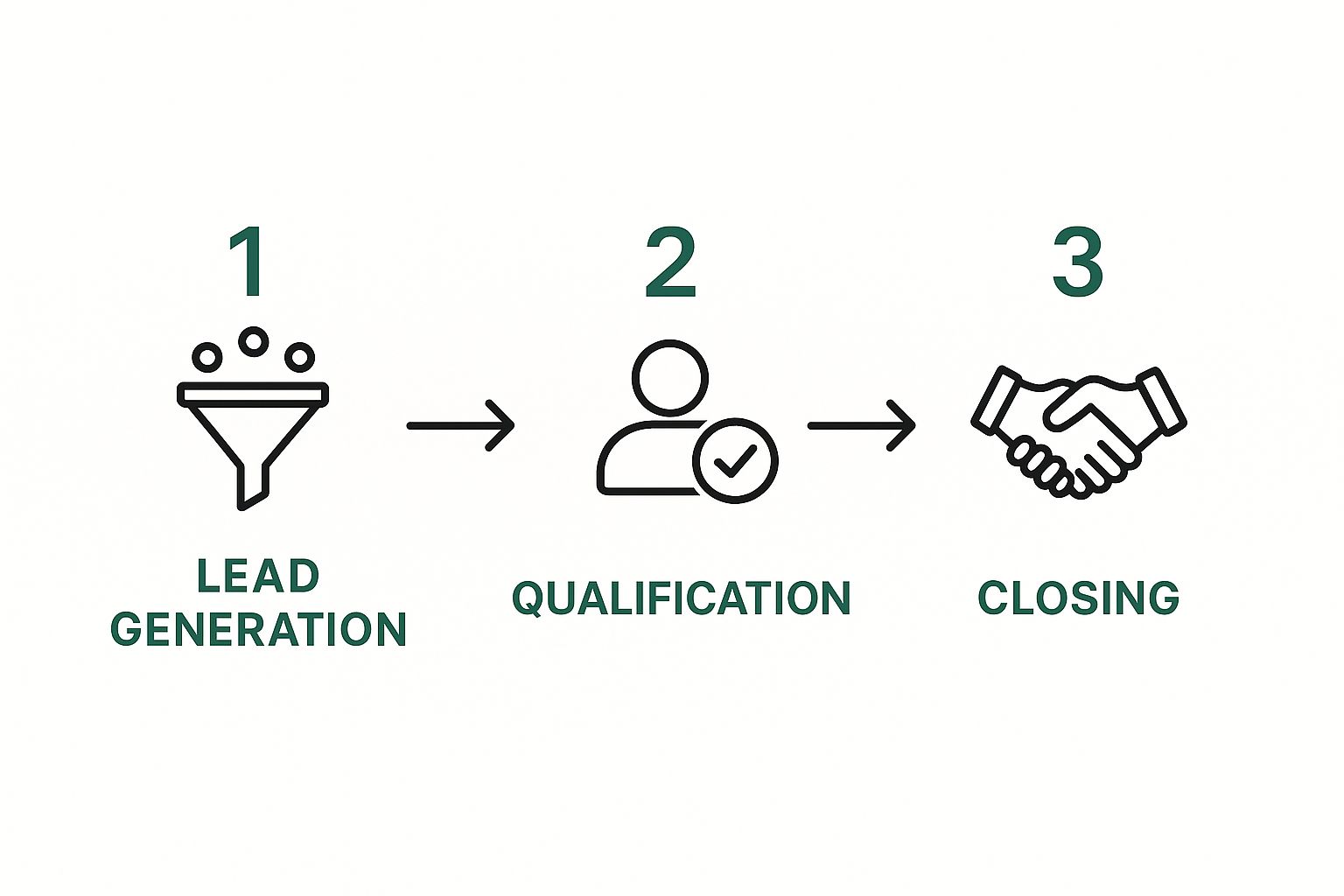
    This diagram gives a great visual of that fundamental flow from finding leads to closing deals.

    Image

    It’s a simple reminder that a pipeline is a step-by-step process. Each stage flows logically into the next, which is how you make sure no opportunity gets lost in the shuffle.

    A pipeline isn't just a sales tool; it's a business intelligence engine. Companies that formally define their sales process achieve nearly 30% higher revenue growth compared to those that don’t.

    Getting this structure right provides the framework for everything else. By breaking down the sales journey into these manageable stages, you give your team a repeatable playbook for success. It turns sales from an unpredictable art into a predictable science, which sets the stage for the specific strategies we're about to dive into.

    Finding and Engaging Your Ideal Customers

    Image

    A sales pipeline is only as good as the leads you put into it. Shoveling in a ton of random prospects is a fast track to wasted time and missed quotas. The secret to predictable revenue isn't volume; it's focus. You have to go after the right people from the very start.

    This is about ditching the old-school, scattergun approach for a smarter, more strategic way of prospecting. It all begins with a crystal-clear picture of who you're trying to reach.

    Define Your Ideal Customer Profile

    Before you write a single outreach email, you need to know exactly what your perfect customer looks like. This is your Ideal Customer Profile (ICP)—a detailed snapshot of the company that gets the most out of your product and, in turn, gives the most value back to you.

    A good ICP isn't just a hunch. It's a data-backed document that steers your entire sales and marketing ship. Without one, your team is basically flying blind, chasing leads that were never a good fit to begin with.

    So, how do you build one? Start by looking at your best existing customers. What do they have in common?

    • Firmographics: What industry are they in? How big are they, both in revenue and employee count? Where are they located?
    • Technographics: What other tech are they using? Their current software stack can be a huge tell that they're ready for your solution.
    • Behavioral Traits: How did they find you in the first place? What did their buying journey look like? What specific problems did you solve for them?

    When you spot these common threads, you're essentially creating a blueprint for who you should be targeting. This focused strategy is a core part of modern lead generation best practices and keeps your team aimed at high-potential accounts.

    Modern Prospecting for Quality Leads

    Once your ICP is locked in, the hunt begins. It’s time to find companies that fit the bill. This is where modern prospecting techniques really shine, moving you away from annoying cold calls and toward targeted, value-driven conversations. The goal isn't to interrupt someone's day but to show up with a relevant solution when they need it most.

    Think of it like fishing. You wouldn't just throw a net into a random pond. You’d go to the right lake, use the right bait, and be patient. Sales is no different.

    Companies with a well-defined sales process—which always starts with targeted prospecting—achieve 18% faster revenue growth than those without one. That's the real-world impact of focusing on quality over quantity.

    Your ICP tells you where to fish. Now, let’s talk about how to cast your line.

    Leveraging Professional Networks

    Platforms like LinkedIn are a goldmine for B2B sales. It’s where your ideal customers are talking about their challenges, sharing their wins, and connecting with others in their field. It’s not just a digital resume anymore; it’s a living, breathing business community.

    Here’s a quick-start guide to using it right:

    1. Tune Up Your Profile: First things first, make sure your profile frames you as a helpful expert, not a pushy salesperson. Your headline should talk about the problems you solve, not just your job title.
    2. Use Advanced Search: LinkedIn Sales Navigator is a beast for filtering millions of users down to the ones who perfectly match your ICP. You can slice and dice by company size, industry, title, seniority—you name it.
    3. Engage Authentically: Don’t just send a bland connection request and launch into a pitch. Follow your targets, leave thoughtful comments on their posts, and share valuable content yourself. When you finally reach out, they'll already know who you are.

    This approach builds a little bit of rapport before you ever make an ask, which drastically increases your chances of getting a reply.

    Finding Verified Contact Information

    You’ve identified the right people at the right companies. The last piece of the puzzle is actually getting in touch. A generic "info@" email just isn't going to get you anywhere. You need the direct line to the decision-makers you've been researching.

    This is where tools like EmailScout become essential. Instead of wasting hours guessing email formats or digging through company directories, an email finder can pull a verified email address right from someone's LinkedIn profile or a company website. It’s a simple step that saves a massive amount of time and makes your outreach far more efficient.

    By combining a sharp ICP with smart prospecting on platforms like LinkedIn and tools for contact discovery, you create a repeatable system. You'll start filling your pipeline not just with leads, but with genuine opportunities that have a much higher chance of closing.

    Qualifying and Prioritizing High-Value Leads

    Image

    Getting leads to flow into your system is one thing, but what you do next is what really matters. A pipeline stuffed with unqualified prospects is a fast track to missed quotas and a burned-out sales team. The most critical skill in building a sales pipeline that actually closes deals is learning to separate the serious buyers from the casual window-shoppers.

    This is where qualification comes in. Think of it as the gatekeeper for your entire sales process. It’s what ensures your team spends their limited time and energy on deals that have a real shot at closing. Skip this, and your forecast becomes pure guesswork.

    Using Frameworks to Ask the Right Questions

    Qualification isn't about running a prospect through a rigid checklist; it's about having a structured conversation to uncover what's really going on. Proven frameworks give you the guardrails for these conversations, helping your team consistently spot the high-value opportunities.

    The BANT framework is a classic for a reason—it’s simple, effective, and perfect for those initial qualification calls. It zeros in on four core areas:

    • Budget: Do they actually have money set aside for a solution like yours?
    • Authority: Are you talking to the person who can sign the check, or at least a key influencer?
    • Need: What’s the specific business pain they're trying to fix? Is it a "nice-to-have" or a "hair-on-fire" problem?
    • Timeline: When are they looking to get this done? This quarter or sometime next year?

    For more complex, big-ticket B2B sales, a more detailed framework like MEDDIC is a game-changer. It forces a much deeper level of discovery, which is essential for navigating those tricky enterprise deals.

    A pipeline clogged with unqualified leads is a slow death for a sales team. The top-performing reps aren't the ones with the most deals; they're the ones with the best-qualified deals.

    MEDDIC helps you dig into the specifics of a potential deal, so you understand the real dynamics at play. You'll get past the surface-level answers and uncover the internal politics and metrics that truly drive a purchasing decision.

    Mastering the MEDDIC Framework

    MEDDIC provides a more robust structure for qualifying enterprise-level opportunities where you’re dealing with multiple stakeholders and complex buying processes. It stands for:

    • Metrics: What measurable results does the prospect need to see? Think increased revenue, cost savings, or better efficiency.
    • Economic Buyer: Who has the ultimate profit-and-loss responsibility for this purchase? This is the person with the final say.
    • Decision Criteria: What specific technical, financial, and vendor requirements will they use to judge solutions?
    • Decision Process: What are the exact steps, timeline, and people involved from evaluation to a signed contract?
    • Identify Pain: What's the primary business problem, and what are the negative consequences if they do nothing?
    • Champion: Who inside their organization is fighting for you when you’re not in the room?

    By systematically gathering this intel, you can accurately gauge the health of any deal. You'll know if you’re talking to the right people, if the business case is strong enough, and who you need to win over.

    Implementing a Lead Scoring Model

    While frameworks are great for one-on-one conversations, how do you prioritize inbound leads at scale? This is where a good lead scoring model comes into play. It’s an automated system that ranks prospects based on who they are and how they’re engaging with your company.

    The model assigns points for different attributes and actions, giving your sales team a clear, data-driven way to decide who to call first. You can score leads based on two main categories:

    Demographic and Firmographic Fit:

    • Job Title: A C-level executive might get +15 points, while an intern gets 0.
    • Company Size: Companies in your sweet spot get +10 points.
    • Industry: Leads from your target industries get +10 points.

    Behavioral Signals (Buying Intent):

    • Website Visits: Visiting your pricing page could be worth +20 points.
    • Content Downloads: Downloading a detailed case study might add +10 points.
    • Email Engagement: Clicking a link in a marketing email gets +5 points.

    By setting a threshold—for instance, any lead with 75 points or more—you can automatically define who is "sales-qualified." This simple system ensures your reps immediately focus on the hottest leads, dramatically improving their efficiency and the predictability of your sales pipeline.

    Moving Deals Forward and Nurturing Key Relationships

    Image

    So you've qualified a lead. Great. Now the real work begins. The middle stages of your pipeline—nurturing, presenting solutions, and handling objections—are where you either build momentum or watch the deal fizzle out.

    It's a delicate dance. You need to guide a prospect from mild interest to a confident decision without being pushy or just plain annoying. This requires a fundamental shift in your mindset, moving from "selling" to genuinely "helping."

    Today’s B2B buyers are sharp. They've already done their homework, and a generic sales pitch is the last thing they want to hear. Your job is to become a trusted advisor who adds real value at every single touchpoint.

    Crafting a Digital-First Engagement Strategy

    Let's face it: modern buyers live online. They expect smooth, on-demand interactions and want to research things on their own time. This isn’t just a passing trend; it's a permanent change in how deals are won.

    In fact, recent data shows that a whopping 80% of B2B decision-makers now prefer digital engagement over old-school methods. This stat alone should tell you everything you need to know about building an effective sales pipeline today. A digital-first communication strategy is no longer optional.

    A digital-first approach simply means meeting buyers where they are. Think personalized emails, sharing genuinely useful content, and running strategic virtual meetings. Your goal is to make their buying process as easy and informative as possible.

    Personalized Follow-Up Sequences That Actually Get Replies

    Generic "just checking in" emails are a one-way ticket to your prospect's trash folder. To keep a deal moving, you need a follow-up cadence that is both persistent and valuable, respecting their time while keeping your solution on their radar.

    An effective follow-up never feels like a nag. Every single message should offer a new piece of value. This is how you prove your expertise and build the trust required to push the sale forward.

    Here’s a simple, value-driven follow-up sequence you can steal:

    • Touchpoint 1 (Day 3): Share a case study that’s highly relevant to their industry or specific problem. Frame it like this: "Thought you might find this interesting, given our conversation about [specific problem]."
    • Touchpoint 2 (Day 7): Send a link to a short blog post or webinar recording that directly answers a common question related to their challenge.
    • Touchpoint 3 (Day 12): Offer something tangible, like a quick, no-strings-attached consultation or a short demo focused on the one key feature that solves their main issue.

    This methodical approach keeps you top-of-mind without being a pest. For a deeper dive, check out our guide on https://emailscout.io/how-to-write-cold-emails/. The principles for getting a reply are just as relevant for follow-ups.

    A great follow-up isn't about reminding someone you exist. It's about giving them another reason to be glad you do. Each touchpoint should feel less like a sales nudge and more like a helpful resource.

    Leveraging Content to Solve Specific Problems

    Your content library is one of the most powerful sales tools you have. Stop sending generic product brochures and start thinking like a consultant. Match the perfect piece of content to where your prospect is in their journey. It shows you’re actually listening and are invested in their success.

    Picture this: during a discovery call, a prospect mentions they’re struggling to get buy-in from the finance team. The right move isn't to immediately book another demo. It’s to send them your ROI calculator or a whitepaper detailing the financial benefits of your solution.

    Here’s a quick way to map content to different pipeline stages:

    Pipeline Stage Prospect's Question Ideal Content Asset
    Discovery "How have others in my industry solved this?" Industry-specific case studies
    Evaluation "How does your solution compare to others?" Competitor comparison sheets or feature guides
    Decision "What will implementation look like for us?" Onboarding guides or customer testimonials

    Using content this way positions you as an invaluable partner, not just another vendor trying to make a sale.

    Handling Objections with Confidence

    Objections aren't deal-breakers. They're requests for more information. When a prospect brings up a concern about price, timing, or features, it's a golden opportunity to clarify your value and build a stronger case. Getting defensive will kill a deal on the spot.

    The secret is to listen carefully, acknowledge their concern, and then reframe the discussion around value, not cost.

    For instance, if a prospect says, "Your price is higher than your competitor's," don't jump to offer a discount. A much better response is: "That's a fair point. Could we walk through the specific features that drive a higher ROI for our clients? Many find that our [unique feature] actually saves them more in the long run."

    This turns a potential roadblock into a productive conversation, keeping the deal alive and making your relationship with the buyer even stronger.

    Fine-Tuning Your Pipeline with Data and Automation

    Your sales pipeline isn’t a "set it and forget it" kind of thing. Think of it more like a high-performance engine; it needs constant tuning to run at its best. By digging into the data to see what’s actually working and using automation to handle the grunt work, you can turn a simple deal tracker into a machine that drives predictable growth.

    This all starts with knowing your numbers. If you're not tracking the right metrics, you're flying blind. You have no way of spotting the hidden bottlenecks that are killing your momentum. When you can measure performance, you can start managing it.

    Identifying the Metrics That Truly Matter

    It’s easy to drown in data. The trick is to focus on a handful of metrics that give you a brutally honest look at your pipeline's health. These numbers tell a story, revealing exactly where your deals get stuck and where they sail right through.

    Get started by tracking these essentials:

    • Stage-by-Stage Conversion Rate: What percentage of deals actually move from one stage to the next? If you see a massive drop-off between "Demo" and "Proposal," that's a red flag. It probably means your value prop isn't landing the way you think it is.
    • Average Deal Size: Knowing the typical value of a closed-won deal is crucial for forecasting revenue. If this number starts to dip, your team might be getting a little too aggressive with discounts.
    • Sales Velocity: How long does it take for a deal to go from that first conversation to a signed contract? A slow velocity is a sign of friction somewhere in your process that you need to find and fix.
    • Pipeline Coverage: This is the simple ratio of your total open pipeline value to your sales quota. A healthy ratio—often 3x or 4x—gives you the buffer needed to hit your target even when a few deals inevitably fall through.

    Watching these metrics lets you shift from making gut-feel decisions to making smart, data-backed moves. You'll know exactly where to focus your coaching and resources to get the biggest bang for your buck.

    Using Data to Uncover Bottlenecks

    Once you start tracking, patterns will emerge. You might discover that your team is incredible at booking initial meetings but falls flat when it comes to converting them into qualified opportunities. Boom. You've found a bottleneck.

    This is where data becomes your best diagnostic tool. A low conversion rate at a specific stage points directly to a problem. Maybe your team needs better training on handling objections, or perhaps the marketing content you're sending isn't resonating with buyers at that point.

    Don't just stare at the numbers—ask what story they're telling. A pipeline report isn't a boring list of deals; it's a treasure map showing you the fastest route to revenue.

    This data-first approach also grounds your forecasts in reality. When you know your average close rate, you can look at the total value of your pipeline and predict future revenue with surprising accuracy. It also throws a spotlight on the importance of managing your Customer Acquisition Cost (CAC), which you can dig into with our Customer Acquisition Cost Calculator.

    The Power of Smart Automation

    Okay, let's talk about getting more done. So many of the tedious tasks in sales—sending follow-up emails, updating the CRM, scheduling meetings—can and should be automated. This frees your reps up to do what they're actually good at: talking to people and closing deals.

    Automation isn’t about replacing reps with robots. It’s about making them better. By taking the repetitive busywork off their plates, you give them back the time to focus on high-value activities that actually push deals forward.

    A formal sales process is the bedrock for this. In fact, companies that define one see nearly 30% more revenue growth than those that don't. When you layer automation on top of that solid foundation, things really take off. Simply automating lead management can boost revenue by 10% or more in just six to nine months.

    Here are a few areas where automation is a no-brainer:

    • Automated Email Sequences: For leads who aren't quite ready to pull the trigger, a simple nurturing sequence can keep your company top-of-mind with helpful content until the timing is right.
    • Task Creation: Set up your CRM to automatically create a task for a rep whenever a deal moves to a new stage. No more "I forgot to follow up."
    • Lead Scoring: Let automation score your inbound leads based on their profile and behavior. This instantly flags the hottest prospects so your team knows exactly who to call first.

    When you combine sharp data analysis with smart automation, you create a self-improving system. You use data to find the leaks in your pipeline, then use automation and process tweaks to patch them up. The result is a more efficient, predictable, and high-performing sales machine.

    Answering Your Top Sales Pipeline Questions

    As you get your hands dirty building out a sales pipeline, questions are going to come up. It's just part of the process. Knowing the answers to a few common sticking points can save you a ton of time and help you get your process dialed in for much better results.

    Let’s jump into some of the most frequent hurdles sales teams run into when they get serious about managing their pipeline.

    How Many Stages Should My Pipeline Have?

    There's no single magic number here, but a solid rule of thumb is somewhere between five and seven stages. The most important thing is that each stage represents a real, meaningful step forward in your sales process and requires a specific action from your sales rep to advance the deal.

    A classic mistake is building a pipeline with way too many stages. It just becomes overly complex and a nightmare to manage. On the flip side, too few stages can leave you with a blurry, inaccurate picture of where your deals actually are.

    You can't go wrong starting with the basics and then tweaking it over time:

    • Lead Generation
    • Qualification
    • Meeting/Demo
    • Proposal
    • Negotiation & Closing

    This simple structure gives you enough detail to be genuinely useful without becoming a burden. As your sales process matures, you can always add, combine, or rename stages to better match your customer’s buying journey.

    How Do I Keep My Pipeline From Stalling?

    Stalled deals are the silent killer of sales forecasts. The absolute best way to keep things moving is to lock in a clear "next step" at the end of every single interaction. Seriously—never leave a call or meeting without agreeing on a specific date and time for the follow-up.

    Letting dead deals linger is one of the biggest pipeline mistakes. It clogs your view, wastes valuable selling time, and creates a false sense of security. Top-performing teams are ruthless about disqualifying opportunities that show no signs of life.

    Another key tactic is building a consistent follow-up cadence. We know it takes an average of more than 8 touches to close a deal today, yet a shocking 44% of salespeople give up after just one. Use a smart mix of emails, calls, and even some light social media engagement to stay on a prospect’s radar—just make sure you're providing value, not just "checking in."

    What's The Difference Between a Pipeline and a Funnel?

    This one trips people up all the time. The easiest way to think about it is this: a sales funnel represents the buyer's journey from their point of view. It tracks their path from first becoming aware of you all the way to making a purchase. It's more of a marketing model, focused on volume and conversion rates between each level.

    A sales pipeline, on the other hand, is the set of stages a salesperson works through to turn a qualified lead into a closed-won deal. This is a sales-centric tool that's all about the specific actions your team is taking to win. They're two sides of the same coin, but the pipeline is your active, day-to-day playbook for managing opportunities.


    Ready to fill the top of your pipeline with verified leads? EmailScout is a powerful Chrome extension that helps you find anyone's email address in a single click, right from their LinkedIn profile or company website. Start building your outreach lists faster and more accurately today. Get started for free at https://emailscout.io.