

Let's cut through the jargon. At its core, demand generation marketing is all about creating genuine awareness and interest in what you do. It's the long game—educating your market and building trust way before anyone is even thinking about making a purchase.
What Is Demand Generation Marketing Without The Jargon

Imagine you run a gourmet food truck. You could just park it on a random street corner and hope people wander by. That's passive.
Or, you could set up at a huge downtown festival. You've got amazing smells wafting through the air, you're handing out free samples, and maybe you even have a local band playing nearby. You're not just selling tacos; you're creating an entire experience that pulls a crowd in.
That festival is a perfect picture of demand generation. It’s the art of creating the whole vibe—the music, the buzz, the excitement—that makes people want what you're selling, sometimes before they even realized they were hungry. You’re building an audience that's excited about your brand and sees you as the only choice.
The Foundational Pillars of Demand Generation
A solid demand gen strategy isn't just one tactic. It’s a mix of different marketing efforts working together to attract, nurture, and build loyalty with the right people.
The main idea is simple: give value first. This means creating content that actually helps people—whether it solves a problem, entertains them, or teaches them something new—without asking for a sale right away. This approach builds incredible trust and positions your brand as an authority. When a need finally pops up, you're the first one they think of.
Demand generation is about giving value through content that educates, entertains, or solves problems. With this approach, your audience knows you, trusts you and comes back for more.
This isn't just about the top of the funnel. It's a full-funnel strategy that covers every single stage of the buyer's journey, from the first "hello" to turning happy customers into your biggest fans. You're not just capturing existing demand; you're actively creating it.
An effective strategy is built on a few key pillars. Understanding how they fit together is crucial.
| Pillar | Primary Role | Example Tactic |
|---|---|---|
| Brand Awareness | Introduce your brand and what you solve to a broad, relevant audience. | SEO-optimized blog posts, social media |
| Inbound Marketing | Attract potential customers with valuable content they're actively searching for. | Webinars, downloadable guides, free tools |
| Audience Nurturing | Build relationships and guide prospects as they make their decision. | Personalized email sequences, retargeting |
| Sales Enablement | Give your sales team the tools and content they need to close deals effectively. | Case studies, product one-pagers |
Each pillar props up the others, creating a powerful engine for growth. By focusing on the entire customer lifecycle, you build a more predictable and scalable way to bring in revenue. To dive deeper, you can explore more resources on marketing and outreach to round out your knowledge. This strategic foundation is what sets you up for everything that comes next.
Demand Generation vs. Lead Generation: Uncovering The Critical Difference
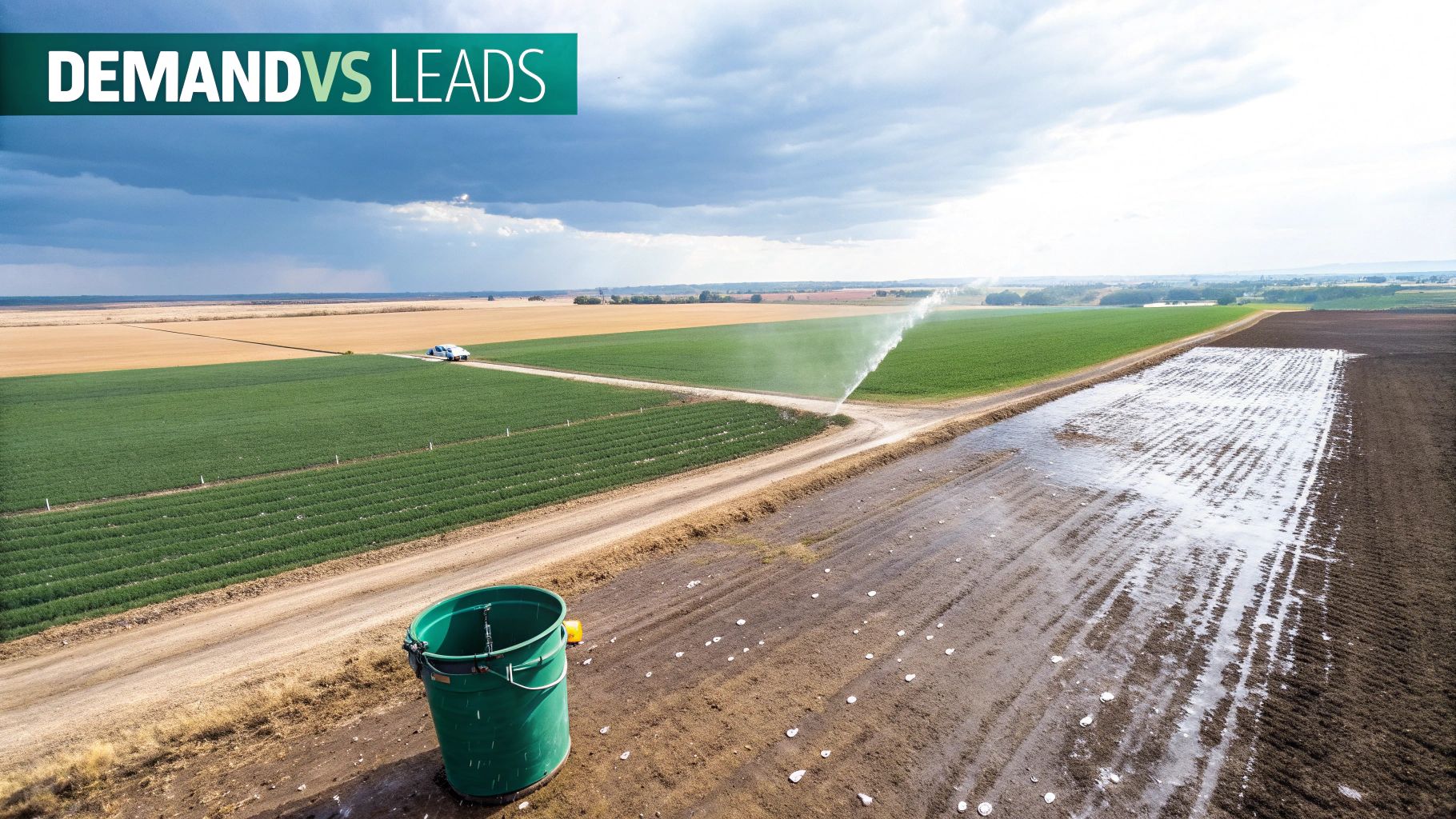
It’s a common mix-up in marketing circles: people use "demand generation" and "lead generation" like they're the same thing. They aren't. While they’re definitely related, understanding the distinction is crucial for building a marketing machine that actually works. Getting this right is how you allocate your budget, set achievable goals, and stop wondering why your pipeline feels empty.
Let's use an analogy. Think of a huge, dry plot of farmland.
Demand generation is the entire irrigation system. It’s the long game. You're enriching the soil, digging the canals, and making it rain to prepare the whole area for growth. The goal is to create a fertile, healthy ecosystem where crops can grow.
Lead generation, on the other hand, is strategically placing buckets to catch that rain. It’s the direct, focused action of capturing the water (leads) from the ground you’ve already prepared. Without the rain, the buckets are useless. And without the buckets, the rain just soaks into the ground, uncaptured.
This is the core difference. Demand generation creates the desire and educates the market on a problem and its solutions. Lead generation is the tactical move to convert that interest into a real, tangible contact.
The Strategic Focus: Top Of Funnel vs. Mid-Funnel
Demand generation lives at the top of the funnel. Its job is broad—create awareness, pique curiosity, and establish your brand as a trusted authority. It’s all about answering the "what" and "why" for people who might not even realize they have a problem yet.
Lead generation takes the baton once that initial interest is there. It operates further down the funnel, targeting people who are now actively looking for answers. The focus shifts from educating an entire market to converting a specific audience. This is where you offer something valuable in exchange for an email address, which is central to understanding what is B2B lead generation.
The simplest way to put it is this: demand generation creates the audience, while lead generation converts that audience into leads. One builds the playing field; the other plays the game on it.
This is especially critical in the B2B world. A staggering 68% of B2B businesses say they struggle with lead generation. More often than not, the real culprit is a lack of investment in building demand in the first place. You can’t harvest crops from barren land.
Key Differences In Goals And Metrics
Because they serve different purposes, you can't measure demand gen and lead gen with the same yardstick. Judging a demand gen campaign by the number of leads it created is like judging a farmer on how many buckets of rain they collected during a drought—it completely misses the point of all the hard work they did to prepare the soil.
To make this crystal clear, here’s a quick comparison of what separates these two powerful strategies.
Demand Generation vs Lead Generation At A Glance
| Attribute | Demand Generation | Lead Generation |
|---|---|---|
| Primary Goal | Create awareness, interest, and educate the market. | Capture contact information from interested prospects. |
| Funnel Stage | Top of Funnel (Awareness & Interest) | Middle of Funnel (Consideration & Intent) |
| Core Tactics | SEO, blog posts, webinars, podcasts, social media. | Gated content, free trials, demo requests, contact forms. |
| Success Metrics | Website traffic, brand mentions, engagement rate, MQLs. | Conversion rate, Cost Per Lead (CPL), lead quality. |
| Audience Focus | Broad but relevant audience; entire target market. | Specific individuals who have shown buying intent. |
| Timeframe | Long-term, ongoing strategy focused on brand building. | Short-term, campaign-based with immediate goals. |
In the end, these two aren’t competitors for your marketing budget; they're partners. A powerful demand generation engine keeps your funnel full of an educated, engaged audience. This makes your lead generation efforts far more efficient because you're capturing contact info from people who already know, like, and trust you. For an even deeper dive, this piece on Demand Generation vs. Lead Generation is an excellent resource.
The Core Components Of A Winning Demand Generation Strategy
Knowing what demand generation is and actually building a machine that drives real growth are two different things. A winning strategy isn't about throwing one or two tactics at the wall and seeing what sticks. It's more like building a high-performance car—you need the engine, the transmission, and the wheels all working together perfectly to get any real forward momentum.
In demand gen, these parts are content, SEO, and social media. When you combine genuinely helpful content with a smart SEO plan and then put it in front of the right people on social channels, you create a flywheel. Each piece feeds the others, turning your brand from just another option into the definitive solution.
Creating Value With Content Marketing
Content marketing is the engine of your entire demand generation program. But let's be clear: this isn't about dressing up sales pitches as blog posts. It's about creating genuinely useful, educational, and sometimes even entertaining material that actually solves your audience's problems. This could be a blog post, a detailed ebook, a webinar, or a podcast—whatever it is, its job is to build trust and show you know what you're talking about.
The goal here is to become a trusted resource long before someone is even thinking about buying. When you consistently give away valuable insights without asking for anything in return, you build a powerful sense of goodwill. People remember who helped them, and when it’s time to make a purchase, that puts you right at the top of their list.
This isn’t just a hunch; the data backs it up. Content marketing is consistently a top priority for marketers, with most saying it’s a key driver for bringing in new leads. If you want to see exactly how budgets are being spent, you can discover more insights on B2B demand generation stats.
Ensuring Discoverability With SEO
You could have the most amazing content in the world, but it’s completely useless if no one can find it. That's where Search Engine Optimization (SEO) comes in. If content is the engine, think of SEO as the GPS and the entire road network. It guides people who are actively looking for solutions straight to your digital front door, right at the moment they need you.
Good SEO means that when your ideal customer types a problem into Google, your solution shows up. It’s about more than just stuffing keywords into a page; it’s about understanding what the searcher really wants, creating content that thoroughly answers their questions, and having a website that search engines can easily understand.
This simple chart shows how these pieces fit together.
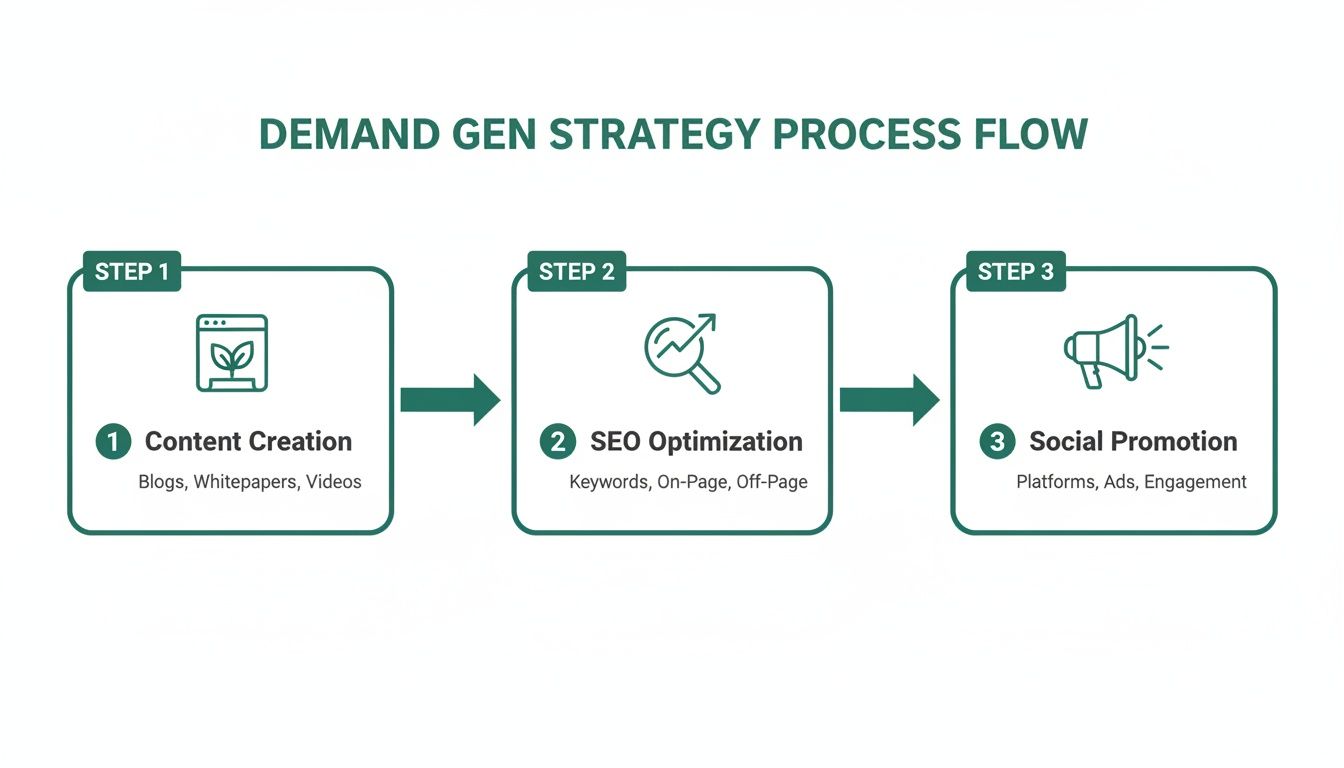
As you can see, it all starts with valuable content. SEO makes sure people can find it, and social media gets it in front of an even bigger, more targeted audience.
Amplifying Reach Through Social Media Engagement
Social media is the megaphone for your content. It’s where you share what you’ve created, jump into relevant conversations, and build a real community around your brand. Every platform—from LinkedIn to Twitter to TikTok—gives you a different way to connect with your audience.
But effective social media for demand gen isn't just about auto-posting links. It’s about:
- Sharing Insights: Pulling out the best tidbits from your long-form content and turning them into shareable graphics, threads, or short videos.
- Fostering Community: Asking questions, running polls, and actually participating in discussions to show there are real people behind your brand.
- Listening to Your Audience: Paying attention to what people are talking about to spot pain points and trends. This is often where your best content ideas come from.
Focusing Efforts With Account-Based Marketing
While the tactics above help you cast a wide net, Account-Based Marketing (ABM) is more like a spear. It’s a hyper-focused approach where your marketing and sales teams work together to go after a specific list of high-value dream clients. Instead of waiting for them to find you, you go directly to them with personalized campaigns.
ABM flips the traditional marketing funnel on its head. Instead of marketing to a huge audience to get a bunch of leads that you slowly filter down, you start by identifying your perfect-fit customers. Then, you build marketing and sales experiences specifically for them.
With an ABM strategy, your content isn't for everyone; it's tailored to solve the exact problems of a target company or industry. This is incredibly powerful for B2B companies with long sales cycles and big deal sizes, as it ensures your most intensive efforts are focused on the prospects who matter most.
Mapping Demand Generation To The Buyer Journey
Throwing content out there and hoping something sticks just doesn't work. Effective demand generation is more like a carefully choreographed dance, timed perfectly to the rhythm of your customer's own journey. To really succeed, you have to meet your audience right where they are, offering exactly what they need, at the moment they need it most.
This means every single tactic has to align with a specific stage of the buyer's journey. Think of yourself as a guide on a long hike. You wouldn't hand a map of the final peak to someone still lacing up their boots at the trailhead. You give them what they need for each step, building trust along the way. Understanding the process of consumer decision making is the key to mapping your efforts correctly.
Sparking Interest In The Awareness Stage
This is the trailhead. Your potential customers know they have a problem or a goal, but they don't have a name for the solution yet. And they probably have no idea who you are. Your job isn't to sell; it's to educate and attract.
You need to create content that speaks to their high-level frustrations in a helpful, no-strings-attached way. You're answering the big, broad questions that help them understand their own problem better. The goal here is to become a familiar, trusted voice they encounter during their initial research.
Top-of-funnel tactics for this stage include:
- Educational Blog Posts: Think articles optimized for problem-focused keywords, like "how to improve team productivity."
- Engaging Social Media Content: Short-form videos, useful infographics, and posts that get people talking.
- Podcasts and Webinars: In-depth conversations that establish your brand as an authority on the subject.
This is all about giving value away for free to build an audience that sees you as a helpful resource, not just another company trying to sell them something.
Building Trust During The Consideration Stage
Okay, now your prospect has moved on. They’ve defined their problem and are actively hunting for solutions. They've gone from "What's wrong?" to "What are my options for fixing this?" Now's your chance to guide them more directly toward what you offer.
Your content needs to shift gears from broad education to more specific, useful comparisons. It should help them weigh their options, understand the pros and cons, and see where a solution like yours fits into the picture.
This is where you go from being a general guide to a specialist. You’re no longer just pointing out the trail—you’re explaining why a particular path is the most effective one to take.
To nail this, you need to arm them with practical, detailed information that gives them confidence in their decision-making.
Mid-funnel tactics for the Consideration Stage include:
- In-Depth Guides and Ebooks: Comprehensive resources that go deeper than a standard blog post.
- Comparison Whitepapers: Unbiased breakdowns comparing different types of solutions or methods, positioning yours in a good light.
- Case Studies: Real-world proof showing how others solved the exact problem they’re facing.
Driving Action In The Decision Stage
We're at the final leg of the journey. The prospect has narrowed their choices and is ready to pick a specific provider. They are now comparing you against competitors, looking at features, and checking out pricing. Everything you create here needs to be laser-focused on one thing: why you are the best possible choice for them.
The goal is to crush any final doubts and make it incredibly easy to say "yes." This is where you show off tangible proof of your value. All the trust and authority you built in the earlier stages pay off right here.
Bottom-of-funnel tactics for the Decision Stage include:
- Free Trials or Demos: Let them experience the value firsthand. Nothing is more powerful.
- Detailed Pricing Pages: Be clear and transparent. Answer one of their biggest final questions without making them hunt for it.
- Customer Testimonials and Reviews: Use social proof to validate your claims and seal the deal.
By strategically mapping your efforts to each stage, you create a seamless journey that guides people from being vaguely curious to becoming confident customers.
How To Build Your Demand Generation Engine From Scratch

Alright, let's move from theory to action. This is where the real work begins. Building a powerful demand generation engine isn't about flipping a switch; it's about methodically piecing together a system that consistently finds, engages, and nurtures your ideal customers.
Think of this as your blueprint. If you follow these core steps, you’ll create a sustainable process that turns strangers into advocates and fuels predictable growth for your business. Let’s lay the first brick.
Define Your Ideal Customer Profile
Before you write a single blog post or spend a dollar on ads, you have to know exactly who you're talking to. Your Ideal Customer Profile (ICP) is a razor-sharp description of the perfect company you want to sell to—not just any company, but the ones that will get immense value from your solution.
Your ICP needs to go deeper than basic firmographics. It should detail the company's industry, size, revenue, and even the specific tech stack they use. A well-defined ICP is your north star, making sure every piece of content and every campaign is aimed squarely at the accounts most likely to convert and stick around.
An ICP stops you from wasting time and money marketing to everyone. It laser-focuses your efforts on high-value accounts that drive the most revenue and have the best retention rates.
Once you know the company, you need to pinpoint the key people inside—your buyer personas. Who are the decision-makers, the champions, and the influencers? Getting a handle on their individual pain points and motivations is the secret to creating content that actually connects.
Create Content That Solves Real Problems
With your ICP locked in, it’s time to create content that speaks directly to their biggest challenges. This is the fuel for your demand engine. Forget generic, surface-level articles; your content has to deliver genuine solutions and establish your brand as a credible expert.
Start by mapping out the main questions your ICP has at each stage of their journey. What are they Googling when they first realize they have a problem? What info do they need when they're comparing their options?
Here’s a simple way to structure your content creation:
- Top of Funnel: Think educational blog posts, podcasts, and social media content. Address high-level pain points without ever mentioning your product. Just be helpful.
- Middle of Funnel: This is where you develop in-depth guides, webinars, and case studies that help prospects evaluate different ways to solve their problem.
- Bottom of Funnel: Now you can roll out product comparisons, customer testimonials, and free trials that make the decision to choose you a no-brainer.
This layered approach ensures you’re providing the right value at the right time, building trust with every interaction.
Select The Right Distribution Channels
Creating amazing content is only half the battle. If no one sees it, it doesn't matter. Your distribution strategy needs to be just as thoughtful as your content plan, focusing only on the channels where your ICP actually hangs out.
Don't spread yourself thin trying to be everywhere at once. Instead, get really good at the one or two channels that matter most. For most B2B companies, that usually means a heavy focus on LinkedIn for social engagement and SEO for capturing search intent.
Getting your content out there means being proactive. This is where targeted outreach becomes a game-changer. Building a list of key decision-makers within your ICP accounts lets you drop your helpful content right into their inbox. For a deeper dive on this, check out our guide on how to generate B2B leads with precision.
Accelerate Outreach With The Right Tools
Let’s be honest: manually digging for contact information is a soul-crushing, inefficient process that will stall your momentum before you even get started. This is where the right tools become essential for scaling up your demand gen efforts.
Tools like EmailScout are built to speed this critical step up. Instead of burning hours hunting for email addresses, you can use it to build targeted lists in minutes. This frees up your team to focus on what they do best: building relationships and sharing great content.
By automating the discovery process, you can efficiently build a pipeline of relevant contacts to share your webinars, ebooks, and guides with. It turns a manual time-suck into a streamlined, repeatable part of your demand engine.
Measuring Success: What Demand Generation Metrics Matter Most
You can’t improve what you don’t measure. In demand generation, that’s not just a cliché—it’s the golden rule. While surface-level stats like social media likes and page views might look good in a report, they don’t tell you if your marketing is actually making an impact.
Real success is measured by how your efforts affect the bottom line. To prove your demand generation engine is working, you need to track the KPIs that tie your marketing activities directly to revenue. These are the numbers that get the C-suite to sit up and listen. They shift the conversation from, "We got a lot of clicks," to, "We generated X dollars in the sales pipeline."
Moving Beyond Surface-Level Metrics
The first step is moving your focus away from top-of-funnel noise and toward down-funnel results. Website traffic is a starting point, but it doesn't tell you if you're attracting the right people. The real story unfolds in metrics that track genuine interest, sales-readiness, and financial impact.
These deeper metrics show how well your strategy is guiding potential customers through their entire buying journey and contributing to real business growth. Let’s break down the ones that truly matter.
Marketing Qualified Leads (MQLs) And Sales Qualified Leads (SQLs)
One of the most foundational metrics is the Marketing Qualified Lead (MQL). This is a prospect who has engaged with your content in a way that signals they’re more likely to become a customer. Think of someone who downloaded a detailed guide or attended a webinar—they're showing more than just casual interest.
From there, we have the Sales Qualified Lead (SQL). This is an MQL that the sales team has reviewed and agreed is a legitimate potential customer worth their time and effort.
Tracking the MQL-to-SQL conversion rate is crucial. A high rate shows your marketing is attracting high-quality prospects that sales finds valuable. It’s a clear sign of strong marketing and sales alignment.
If that conversion rate is low, it’s a red flag. It might mean your definition of a "qualified" lead is off, or your content is attracting the wrong audience. This one simple ratio tells a powerful story about the health of your entire funnel.
Pipeline Velocity And Sales Cycle Length
Pipeline Velocity measures how fast deals are moving through your sales funnel. Think of it as the speedometer for your revenue engine. A higher velocity means you're closing deals faster and generating revenue more efficiently.
Closely related is the Sales Cycle Length, which is the average time it takes for a lead to become a paying customer. A great demand generation strategy should actively shorten this cycle. When leads come to the sales team already educated about their problem and your solution, deals just close faster.
- An effective demand gen program warms up leads before they ever talk to sales, which should reduce the time it takes to close a deal.
Customer Acquisition Cost (CAC) And Customer Lifetime Value (CLV)
Customer Acquisition Cost (CAC) is pretty straightforward: it’s the total cost of sales and marketing you spent to land one new customer. The goal, of course, is to keep this number as low as possible without sacrificing quality.
But CAC is meaningless without its counterpart: Customer Lifetime Value (CLV). This metric predicts the total revenue you can expect from a single customer over the entire course of their relationship with you.
A healthy business model always has a CLV that is much higher than its CAC. A strong demand gen strategy improves this ratio in two key ways:
- It attracts better-fit customers who are more likely to stick around and spend more, which increases CLV.
- It creates efficient, scalable ways to attract those customers, which reduces CAC.
To really understand how well your demand generation efforts are performing, you need a clear, data-driven picture. The table below breaks down the key metrics you should be tracking.
Key Demand Generation Metrics and Their Purpose
| Metric | What It Measures | Why It Matters |
|---|---|---|
| MQL-to-SQL Conversion Rate | The percentage of marketing-qualified leads that become sales-qualified leads. | Shows the quality of your leads and the alignment between marketing and sales. |
| Pipeline Velocity | The speed at which leads move through the sales pipeline from initial contact to closed deal. | Indicates the efficiency of your sales process and the overall health of your revenue engine. |
| Sales Cycle Length | The average time it takes to close a deal after the first touchpoint. | Helps you understand if your demand gen efforts are effectively educating and nurturing leads. |
| Customer Acquisition Cost (CAC) | The total marketing and sales cost required to acquire a new customer. | Measures the cost-effectiveness of your customer acquisition strategies. |
| Customer Lifetime Value (CLV) | The total revenue a business can expect from a single customer over their entire relationship. | Provides context for CAC and helps determine the long-term profitability of your customers. |
| Marketing-Sourced Revenue | The percentage of total company revenue that can be directly attributed to marketing efforts. | The ultimate proof of marketing's ROI and its direct contribution to the bottom line. |
Ultimately, tracking these metrics allows you to move beyond guesswork. You can make smarter strategic decisions, optimize your campaigns, and confidently show the powerful ROI of your marketing engine.
Ready to supercharge your outreach and start building high-quality lead lists in minutes? With EmailScout, you can find unlimited verified email addresses for free, automating one of the most time-consuming parts of demand generation. Try the free Chrome extension and start connecting with your ideal customers today.