
So, what exactly is B2B lead generation?
At its core, it’s the process of finding and attracting other businesses that could be a great fit for your products or services. Forget about casting a wide net and hoping for the best. This is about being a strategic matchmaker, connecting your company with other companies that are actively looking for the very solutions you provide. It’s the engine that fuels a predictable pipeline of future customers.
What B2B Lead Generation Is Really About
Let's move past the textbook definition. Think of B2B lead generation as the art of guiding potential customers on a journey. It’s far more than just grabbing a name and an email address. The real goal is to build awareness, earn trust, and nurture interest until a prospect is not just ready, but genuinely willing to have a conversation with your sales team.
This entire journey is often mapped out as a sales funnel.
The B2B Lead Generation Funnel
It all starts at the top of the funnel, where a complete stranger might stumble upon your brand through a helpful blog post or a social media update. As they move toward the middle, their interest deepens. They might sign up for a webinar or download a detailed case study, signaling they're looking for more specific answers.
By the time they reach the bottom, they're ready for a one-on-one demo or consultation. They've gone from a curious onlooker to a sales-ready opportunity.
A successful B2B lead generation strategy doesn't just find potential customers; it builds a bridge between their business challenges and your solutions, creating a foundation for a long-term partnership.
The whole system is designed to turn that initial spark of curiosity into a real business relationship. Without a steady stream of qualified leads, even the most talented sales teams will struggle. That’s why about 50% of marketers see lead generation as a top priority.
On average, companies bring in around 1,877 leads each month, with the typical cost per lead sitting at roughly $198. But it's not always easy—a staggering 97% of prospects ignore cold calls, which just goes to show how critical it is to use smarter, value-first strategies. You can dive into more lead generation statistics to see just how the industry is shifting.
To help you get a quick handle on these ideas, here’s a simple breakdown of the core concepts.
B2B Lead Generation Key Concepts at a Glance
This table sums up the essential components that make up the B2B lead generation process.
| Concept | Description |
|---|---|
| Lead | A potential business customer who has shown interest in your product or service. |
| Lead Qualification | The process of determining if a lead is a good fit and likely to become a paying customer. |
| Sales Funnel | A visual representation of the journey a prospect takes from initial awareness to making a purchase. |
| Marketing Qualified Lead (MQL) | A lead that marketing has deemed more likely to become a customer compared to others. |
| Sales Qualified Lead (SQL) | A lead that the sales team has accepted as ready for a direct sales follow-up. |
These terms form the building blocks of any effective lead generation system.
Ultimately, understanding B2B lead generation means seeing it for what it is: a repeatable, predictable system for growing revenue. It’s not just about filling your pipeline with names—it's about filling it with genuine opportunities.
Navigating the B2B Lead Generation Funnel
Every potential business customer goes on a journey, starting as a total stranger and ending as a confident buyer. The best way to map this path is with the B2B lead generation funnel. Think of it as a guide for your marketing—it helps you deliver the right message at the right time to build trust and keep things moving.
Instead of hitting prospects with one big sales pitch, the funnel breaks the process down into logical stages. Each stage matches a prospect's awareness and interest level, letting you tailor your approach to meet them where they are. This is how you turn a flicker of curiosity into a sales-ready relationship.
Top of the Funnel (TOFU): Building Awareness
The journey starts at the Top of the Funnel (TOFU). At this point, your audience probably isn't even looking for your specific solution. They just know they have a problem or a challenge and are starting to research it. Your goal here isn’t to sell; it's to educate and attract.
This is the widest part of the funnel, designed to cast a broad net. The content you create here should be easy to find and focused on answering common questions or hitting on industry pain points. The goal is simple: establish your brand as a helpful, knowledgeable resource.
Some of the most effective TOFU strategies include:
- SEO-Optimized Blog Posts: Articles that answer your audience's burning questions and show up when they search on Google.
- Informative Ebooks and Whitepapers: Deep-dive guides that offer serious value in exchange for an email address.
- Engaging Social Media Content: Posts, infographics, and short videos that grab attention and get your brand name out there.
- Helpful Checklists and Templates: Practical tools that solve a small, immediate problem for your audience.
The infographic below shows how different strategies fit into the customer's journey.
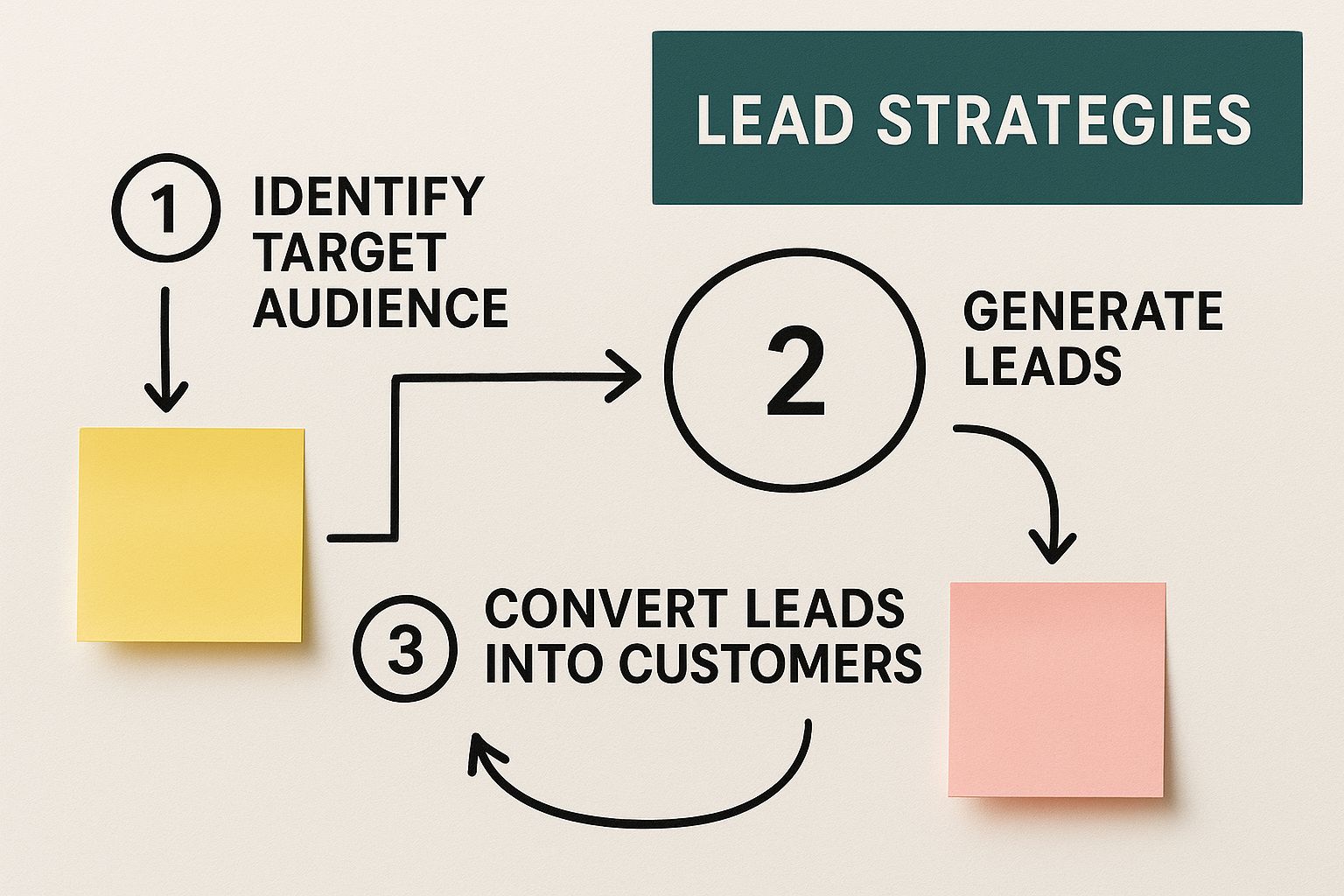
As you can see, the content has to change as you nurture leads from initial awareness all the way to a final purchase decision.
Middle of the Funnel (MOFU): Nurturing Interest
Once someone engages with your TOFU content—say, by downloading that ebook—they slide into the Middle of the Funnel (MOFU). Now, they know who you are and have shown a real interest in the problem you solve. Your job is to build on that trust and position your solution as a top contender.
MOFU content gets more specific. You’re no longer just talking about their problem; you're showing them how to solve it, with your company’s expertise front and center. This is where you start to separate the casual lookers from the serious potential buyers.
In the middle of the funnel, you shift from being an educator to becoming a trusted advisor. This is your chance to really show what you know and build the confidence a prospect needs to take you seriously.
Effective content for this stage includes:
- Detailed Case Studies: Real-world stories of how you helped businesses just like theirs hit their goals.
- Expert-Led Webinars: Live or on-demand sessions that go deep on a specific topic and showcase what your product can do.
- Email Nurturing Sequences: A series of automated emails that deliver more value and keep your brand on their radar.
If you're looking to sharpen your game here, exploring different B2B outreach tactics can give you great ideas for connecting with prospects at this critical stage.
Bottom of the Funnel (BOFU): Driving Action
Finally, the prospects who stick with you reach the Bottom of the Funnel (BOFU). These are highly qualified leads. They get their problem, they see your company as a potential fix, and now they're just weighing their options. Your goal is to turn their interest into a commitment.
The content and offers here are direct and all about your product. You need to give them a rock-solid reason to choose you over anyone else. This usually means showing a clear return on investment and making it incredibly easy for them to sign on the dotted line.
BOFU offers typically include:
- Free Trials or Product Demos: A hands-on test drive that lets them see the value for themselves.
- Personalized Consultations or Assessments: One-on-one calls to talk through their specific needs and how you can meet them.
- Pricing Sheets and Implementation Guides: The nitty-gritty details they need to make a final, informed decision.
By carefully matching your strategies to each stage of the B2B lead generation funnel, you create a smooth, logical path that turns strangers into customers.
Proven B2B Lead Generation Strategies and Channels
Knowing what a B2B lead generation funnel looks like is one thing. Actually filling it with high-quality prospects is a completely different beast. It demands a smart, well-rounded strategy that pulls from both inbound and outbound playbooks.
Think of it like fishing. Inbound methods are all about creating the perfect, irresistible habitat to attract fish to you. Outbound is about actively casting a line to catch the specific fish you want. A truly successful plan doesn’t pick a side—it blends them to create a constant, predictable stream of opportunities.
Mastering Inbound Lead Generation
Inbound marketing is the art of becoming a magnet for your ideal customers. It’s all about building such a strong, helpful online presence that when businesses start looking for solutions, they find you first. This approach is powerful because it builds trust right from the very first interaction.
Here are the cornerstones of a killer inbound strategy:
-
Content Marketing: This is the engine that drives everything. When you create blog posts, whitepapers, and videos that genuinely solve your audience's biggest problems, you stop being just a vendor and start becoming a thought leader. Great content doesn't just attract visitors; it educates them and walks them through their buying journey.
-
Search Engine Optimization (SEO): SEO is what makes sure your amazing content actually gets discovered. By optimizing your website and articles for the keywords your prospects are typing into Google, you capture high-intent traffic. These are people actively looking for what you sell, and they're landing right on your digital doorstep.
-
Social Selling: Platforms like LinkedIn aren't just for résumés anymore; they're bona fide channels for generating leads. Sharing insightful content, jumping into industry discussions, and building real connections can position your team as the go-to advisors in your space.
The core idea behind inbound is simple: provide value before you ask for anything in return. When you consistently help your audience, you earn their trust and, eventually, their business.
This approach is definitely a long game. It takes time to build momentum, but the leads it brings in are often much more qualified and easier to convert because they've already seen the value you provide. For a deeper look, you can explore various lead generation guides that dig into these concepts.
Executing Effective Outbound Strategies
While inbound builds that solid foundation, outbound strategies give you a direct, targeted way to fill your pipeline right now. Outbound is all about identifying your ideal customers and reaching out with a message that resonates. When you do it right, it’s not about spam—it’s about precision.
This is where you take control of the conversation.
-
Targeted Digital Advertising: Platforms like Google Ads and LinkedIn Ads are a game-changer. They let you put your message directly in front of key decision-makers, targeting them by job title, industry, company size, or even online behavior. It ensures every dollar you spend is aimed at the most relevant audience.
-
Personalized Email Outreach: Cold email gets a bad rap, but personalized outreach is a different world. Instead of a generic blast, it involves researching a prospect's real pain points and crafting a message that speaks directly to their needs. A well-written, relevant email can open doors that would otherwise stay shut.
-
Account-Based Marketing (ABM): ABM cranks the targeting up to eleven. Instead of going after individual leads, you treat an entire high-value company as a "market of one." This means creating hyper-personalized campaigns for key accounts, with sales and marketing working together to land those major deals.
LinkedIn, in particular, has become a powerhouse for B2B marketers. In fact, a whopping 40% of B2B marketers now see it as their most effective channel for finding top-tier leads. Its tools, like Lead Gen Forms, hit an average conversion rate of 13%—more than five times higher than what you'd see on a typical landing page.
At the end of the day, the strongest lead generation machine combines the pull of inbound with the push of outbound. By creating valuable content that attracts prospects and proactively reaching out to your ideal customers, you build a robust and predictable system to fuel real business growth.
Advanced Tactics for Attracting High-Value Leads

Once your foundational inbound and outbound strategies are humming along, it’s time to get a little more sophisticated. The goal shifts from catching more leads to attracting the right ones. This is where advanced tactics come in. They’re all about precision and focusing your energy on the accounts that can truly move the needle.
You’re basically graduating from broad-stroke marketing to surgical, high-impact campaigns. Two of the most powerful approaches you can use are Account-Based Marketing (ABM) and leveraging intent data. These methods help you find and engage your dream clients with messages so relevant, they feel like they were written just for them.
Adopting an Account-Based Marketing Mindset
Think of traditional lead generation like fishing with a wide net. You cast it out and catch a bunch of stuff, but then you have to spend ages sorting through it all to find the keepers.
Account-Based Marketing (ABM) is the complete opposite. It’s like spear fishing. You identify a specific, high-value fish, aim carefully, and focus all your energy on landing that one target.
Instead of shouting your message to a broad audience, ABM treats a single company as its own market. Your sales and marketing teams have to work together, creating hyper-personalized campaigns designed to click with key decision-makers at that specific account. You aren't just sending an email; you're crafting an entire experience for one company.
The real power of ABM is its focus. By zeroing in on best-fit accounts, you stop wasting money on leads that were never going to convert and seriously boost your chances of closing big, important deals.
This targeted approach gets results. It's why ABM has become such a dominant strategy in the B2B world. When done right, it can increase pipeline conversion rates by up to 14%. It also leads to a 28% improvement in account management and boosts the conversion of marketing-qualified leads into sales-accepted leads by 25%. You can dig deeper into top B2B lead generation trends to see how this strategy keeps evolving.
So, how does it work in practice? A solid ABM campaign usually involves these steps:
- Define Your Ideal Customer Profile (ICP): Get crystal clear on what your dream clients look like. Think about industry, company size, revenue, and even the tech they use.
- Build a Target Account List: Create a shortlist of high-value companies that are a perfect match for your ICP.
- Map Out the Key People: Figure out who the decision-makers, influencers, and potential roadblocks are inside each company.
- Create Personalized Content: Develop messages and offers that speak directly to the specific problems and goals of that one company.
- Run Coordinated Campaigns: Launch your campaign across multiple channels—email, social media, ads—making sure the message is consistent and personal everywhere.
To truly understand how ABM flips the traditional model on its head, it helps to see a side-by-side comparison.
Traditional Lead Generation vs Account-Based Marketing
The table below breaks down the fundamental differences between casting a wide net and spear fishing.
| Aspect | Traditional Lead Generation | Account-Based Marketing (ABM) |
|---|---|---|
| Approach | Volume-based (wide net) | Quality-based (spear fishing) |
| Targeting | Broad audience based on personas | Specific, named accounts |
| Focus | Attracting individual leads | Engaging the entire buying committee |
| Metrics | Cost per lead, lead volume | Account engagement, pipeline velocity |
| Sales & Marketing | Often operate in separate silos | Tightly aligned and collaborative |
| Outcome | Quantity of leads | Quality of high-value opportunities |
As you can see, ABM is a strategic shift. It prioritizes deep engagement with a few key accounts over shallow interactions with many.
Leveraging the Power of Intent Data
Now, what if you could know which businesses were actively researching solutions like yours right now? That's the magic of intent data. It’s basically a collection of online behavioral clues—like content downloads, article views, and specific search queries—that signal a company is in an active buying cycle.
Think of it as digital body language. A prospect might not have filled out your contact form, but their online activity is a giant flare telling you they're in the market. Tapping into this data lets you find warm prospects before your competitors even know they exist.
There are a few smart ways to use intent data:
- Prioritize Your Outreach: Aim your sales team's efforts at accounts showing strong buying signals. Your response rates will thank you.
- Personalize Your Messaging: If you know what topics a company is researching, you can tailor your emails and ads to match their interests perfectly.
- Discover New Opportunities: Uncover potential leads that weren't on your radar but fit your ICP and are actively looking for a solution.
When you combine the laser focus of ABM with the predictive power of intent data, you create a seriously formidable lead generation machine. You’re no longer just sitting back and waiting for leads to find you; you're proactively identifying and engaging your best future customers at the exact moment they need you.
Measuring Your B2B Lead Generation ROI
Launching a B2B lead generation strategy without tracking its performance is like driving with your eyes closed. You might be moving, but you have no idea if you're headed in the right direction. To really get better, you have to measure what’s working, what isn’t, and how much it all costs.
This isn’t about chasing vanity metrics like page views or social media likes. It’s about focusing on the key performance indicators (KPIs) that prove you're making a real impact on the business and justify every dollar you spend. When you can draw a straight line from your lead gen activities to actual revenue, you build a powerful case for your strategy.
Essential Metrics for B2B Success
To get a clear picture of your return on investment, you need to track a handful of core metrics. These KPIs cut through the noise and tell you the real story of your campaign's health and profitability.
Here are the non-negotiable metrics every B2B marketer should have on their dashboard:
-
Cost Per Lead (CPL): This one is as straightforward as it gets. It tells you exactly how much you're spending to get a single lead. Just divide your total campaign cost by the number of leads you generated. A low CPL means you’re running an efficient machine.
-
Marketing Qualified Lead (MQL) to Sales Qualified Lead (SQL) Conversion Rate: Not all leads are created equal. This metric tracks the percentage of leads marketing hands over to sales that actually get accepted as real opportunities. A high conversion rate here is a sign that marketing is delivering high-quality, well-nurtured leads that the sales team loves.
-
Lead-to-Close Ratio: This is the ultimate bottom-line metric. It measures what percentage of your leads actually turn into paying customers. This KPI shows how effective your entire funnel is, from the very first touchpoint to the final signed contract.
Tracking these numbers gives you a data-driven foundation to make smarter decisions and tune your campaigns for maximum impact.
Calculating Your Return on Investment
Beyond individual metrics, you need to see the bigger financial picture. Two crucial calculations connect your lead generation efforts directly to long-term business value.
Measuring ROI isn't just a reporting task; it's a strategic imperative. It transforms your marketing from a cost center into a documented revenue driver, giving you the clarity needed to scale your most successful initiatives.
First up is Customer Acquisition Cost (CAC). This is the total cost of your sales and marketing efforts needed to land one new customer. It includes everything—ad spend, salaries, software, you name it. The formula is simple: Total Sales & Marketing Costs / Number of New Customers Acquired.
Next is Customer Lifetime Value (CLV). This metric forecasts the total revenue you can expect from a single customer over the entire time they do business with you. It highlights the long-term value of the customers you’re bringing in. A simple way to estimate it is: (Average Annual Revenue per Customer x Customer Relationship in Years) – Customer Acquisition Cost.
The golden rule here is that your CLV should be significantly higher than your CAC. A healthy ratio, often cited as 3:1 or better, signals a sustainable and profitable business model.
Finally, none of this matters if your data is a mess. Bad data can skew all your metrics, leading you to the wrong conclusions. This is why it’s so important to understand how to validate an email address effectively, because clean contact lists are the bedrock of reliable outreach and accurate ROI calculations. By prioritizing data quality, you ensure every number you track is a true reflection of your performance.
Common B2B Lead Generation Mistakes to Avoid
Even a killer B2B lead generation strategy can fall flat if you’re making a few common, avoidable mistakes. Honestly, knowing what not to do is just as important as knowing which strategies to run with. Success often comes down to steering clear of the simple errors that drain your budget and stuff your pipeline with junk leads.
Too many companies jump straight into tactics without getting the foundation right. This leads to a messy, disjointed mess where marketing generates leads that sales can’t close, and genuinely interested prospects fall through the cracks because the follow-up is a disaster.
Targeting a Poorly Defined Audience
This is one of the biggest mistakes I see: casting a net that’s just way too wide. Without a crystal-clear Ideal Customer Profile (ICP), you end up creating content and ads that try to speak to everyone. The result? They resonate with no one. This approach might get you a high volume of contacts, but they’re low-quality leads that just create more work for your sales team, not more revenue.
For instance, a SaaS company selling project management software might target "all small businesses." That's way too vague. A much smarter approach is to target "tech startups with 20-50 employees who have recently hired a project manager." Now that lets you create specific, hard-hitting messaging.
A vague audience is the enemy of effective B2B lead generation. When you try to be everything to everyone, you become nothing to anyone, and your ROI suffers dramatically.
Do yourself a favor and invest time in building a detailed ICP. Base it on firmographic data and, more importantly, the traits of your absolute best customers. A precise target is the bedrock of every successful campaign.
Failing to Nurture Leads Properly
Another massive error is thinking lead generation is a one-and-done deal. So many businesses focus all their energy on just capturing a name and email, then immediately toss that cold lead over to sales for a hard pitch. This is a recipe for failure. Just look at the research—37.1% of marketers say generating high-quality leads is their biggest challenge, and this is a huge reason why.
Someone who just downloaded a whitepaper is almost never ready for a sales call. They need to be nurtured. You have to build trust and educate them with valuable content.
Here’s how to fix it:
- Implement Lead Scoring: Start assigning points to leads based on what they do (like visiting your pricing page) and who they are. This helps you spot who is actually sales-ready.
- Create Nurturing Workflows: Set up automated email sequences that deliver relevant case studies, webinar invites, and helpful articles over time. It keeps you top-of-mind without being pushy.
- Align Content to the Funnel: Make sure you have content that speaks to people at every stage, not just the top-of-funnel awareness phase.
Misalignment Between Sales and Marketing
Finally, nothing will sabotage your lead gen engine faster than a disconnect between your sales and marketing teams. When these two departments are stuck in their own silos, they end up with conflicting goals and different definitions of what a "good" lead even is. Marketing might be high-fiving over hitting a record MQL number, while the sales team is complaining that every single lead is junk.
All that friction just leads to wasted money and missed opportunities. The fix is to create a Service Level Agreement (SLA). This document clearly defines who is responsible for what, the exact criteria for a Sales Qualified Lead (SQL), and the handoff process. When sales and marketing work as one unified team, the whole funnel just works better. It's that simple.
B2B Lead Generation FAQs
As you start putting all this theory into practice, you'll probably run into a few common questions. Let's clear up some of the usual points of confusion so you can build your lead gen plan with confidence.
What’s the Difference Between a Lead and a Prospect?
Think of it like dating. A lead is anyone who’s shown a flicker of interest—maybe they downloaded your ebook or signed up for a webinar. They’re at the very top of your funnel, but you don't know much about them yet.
A prospect, on the other hand, is a lead you've actually vetted. Your team has qualified them and confirmed they fit your Ideal Customer Profile (ICP). They have the budget, the authority, and a real need for what you’re selling. They're the ones you're ready to ask on a second date.
How Long Does B2B Lead Nurturing Take?
This is the classic "it depends" answer, but for good reason. The B2B sales cycle is notoriously long, and nurturing is a marathon, not a sprint. For a simple, low-cost SaaS tool, you might be looking at a nurturing cycle of just a few weeks.
But for complex, big-ticket enterprise solutions, you should be prepared for a nurturing process that spans six to twelve months—sometimes even longer. The goal is to consistently deliver value and build trust without trying to rush the relationship.
What’s the Best First Step for a Small Business?
If you're a small business just dipping your toes into B2B lead generation, do this one thing first: define your Ideal Customer Profile (ICP). Seriously, don't spend a single dollar on ads or an hour creating content until you know exactly who you’re trying to talk to.
Once you have your ICP nailed down, pick one or two channels where that audience actually hangs out. For many, that means creating genuinely helpful blog content optimized for SEO and building a real presence on LinkedIn. Start small, figure out what works, and then you can scale.
Ready to supercharge your outreach and find decision-makers in a single click? EmailScout helps you build targeted marketing lists and enhance your sales pipeline effortlessly. Find unlimited emails for free and start connecting with the right contacts today at https://emailscout.io.