Tag: demand generation

  • What is demand generation marketing: what is demand generation marketing

    What is demand generation marketing: what is demand generation marketing

    Let's cut through the jargon. At its core, demand generation marketing is all about creating genuine awareness and interest in what you do. It's the long game—educating your market and building trust way before anyone is even thinking about making a purchase.

    What Is Demand Generation Marketing Without The Jargon

    People queue in a long line at an outdoor food stall with a "CREATE DEMAND" sign.

    Imagine you run a gourmet food truck. You could just park it on a random street corner and hope people wander by. That's passive.

    Or, you could set up at a huge downtown festival. You've got amazing smells wafting through the air, you're handing out free samples, and maybe you even have a local band playing nearby. You're not just selling tacos; you're creating an entire experience that pulls a crowd in.

    That festival is a perfect picture of demand generation. It’s the art of creating the whole vibe—the music, the buzz, the excitement—that makes people want what you're selling, sometimes before they even realized they were hungry. You’re building an audience that's excited about your brand and sees you as the only choice.

    The Foundational Pillars of Demand Generation

    A solid demand gen strategy isn't just one tactic. It’s a mix of different marketing efforts working together to attract, nurture, and build loyalty with the right people.

    The main idea is simple: give value first. This means creating content that actually helps people—whether it solves a problem, entertains them, or teaches them something new—without asking for a sale right away. This approach builds incredible trust and positions your brand as an authority. When a need finally pops up, you're the first one they think of.

    Demand generation is about giving value through content that educates, entertains, or solves problems. With this approach, your audience knows you, trusts you and comes back for more.

    This isn't just about the top of the funnel. It's a full-funnel strategy that covers every single stage of the buyer's journey, from the first "hello" to turning happy customers into your biggest fans. You're not just capturing existing demand; you're actively creating it.

    An effective strategy is built on a few key pillars. Understanding how they fit together is crucial.

    Pillar Primary Role Example Tactic
    Brand Awareness Introduce your brand and what you solve to a broad, relevant audience. SEO-optimized blog posts, social media
    Inbound Marketing Attract potential customers with valuable content they're actively searching for. Webinars, downloadable guides, free tools
    Audience Nurturing Build relationships and guide prospects as they make their decision. Personalized email sequences, retargeting
    Sales Enablement Give your sales team the tools and content they need to close deals effectively. Case studies, product one-pagers

    Each pillar props up the others, creating a powerful engine for growth. By focusing on the entire customer lifecycle, you build a more predictable and scalable way to bring in revenue. To dive deeper, you can explore more resources on marketing and outreach to round out your knowledge. This strategic foundation is what sets you up for everything that comes next.

    Demand Generation vs. Lead Generation: Uncovering The Critical Difference
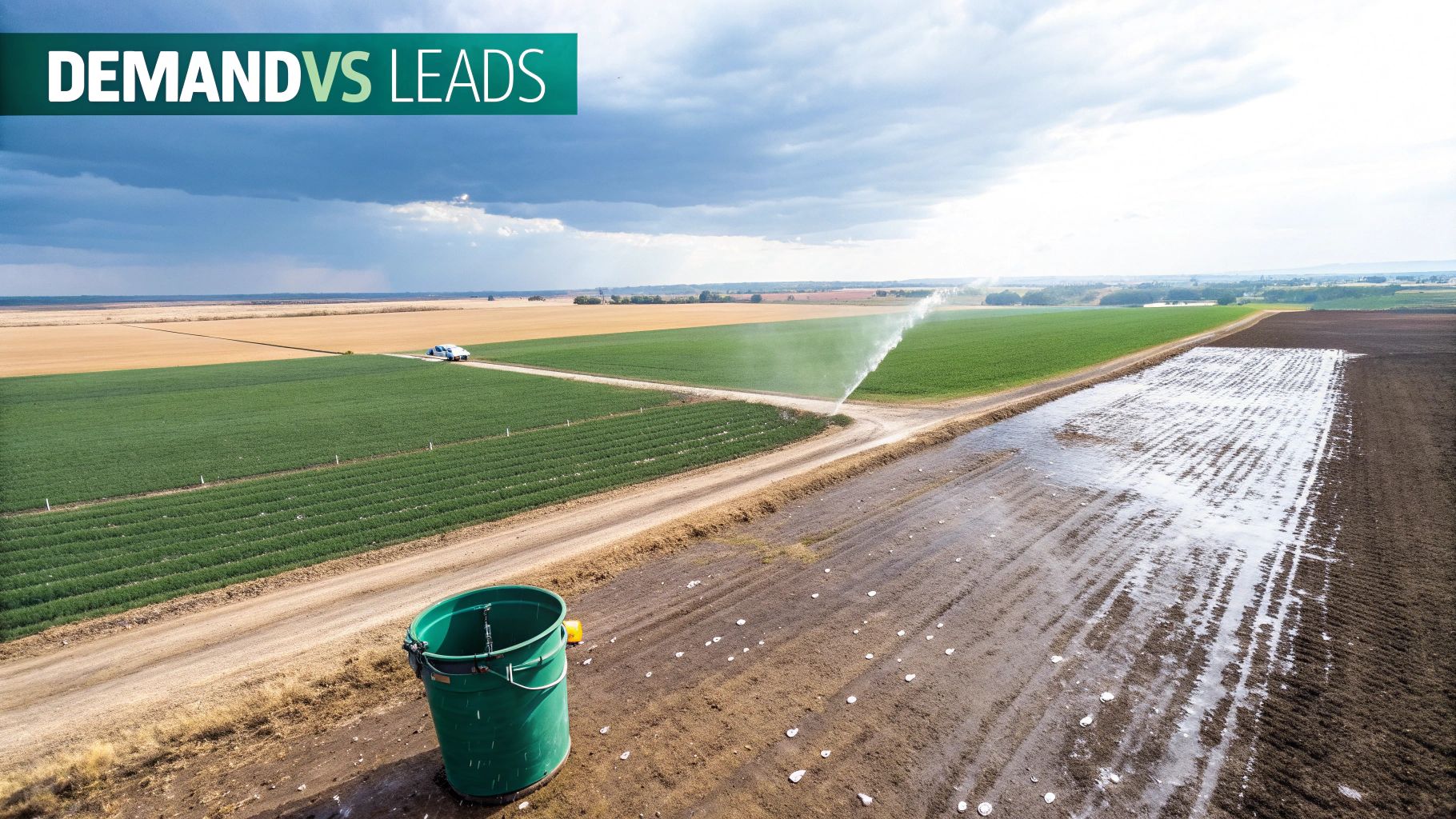
    Aerial view of green and dry farm fields, with one being irrigated, representing marketing demand.

    It’s a common mix-up in marketing circles: people use "demand generation" and "lead generation" like they're the same thing. They aren't. While they’re definitely related, understanding the distinction is crucial for building a marketing machine that actually works. Getting this right is how you allocate your budget, set achievable goals, and stop wondering why your pipeline feels empty.

    Let's use an analogy. Think of a huge, dry plot of farmland.

    Demand generation is the entire irrigation system. It’s the long game. You're enriching the soil, digging the canals, and making it rain to prepare the whole area for growth. The goal is to create a fertile, healthy ecosystem where crops can grow.

    Lead generation, on the other hand, is strategically placing buckets to catch that rain. It’s the direct, focused action of capturing the water (leads) from the ground you’ve already prepared. Without the rain, the buckets are useless. And without the buckets, the rain just soaks into the ground, uncaptured.

    This is the core difference. Demand generation creates the desire and educates the market on a problem and its solutions. Lead generation is the tactical move to convert that interest into a real, tangible contact.

    The Strategic Focus: Top Of Funnel vs. Mid-Funnel

    Demand generation lives at the top of the funnel. Its job is broad—create awareness, pique curiosity, and establish your brand as a trusted authority. It’s all about answering the "what" and "why" for people who might not even realize they have a problem yet.

    Lead generation takes the baton once that initial interest is there. It operates further down the funnel, targeting people who are now actively looking for answers. The focus shifts from educating an entire market to converting a specific audience. This is where you offer something valuable in exchange for an email address, which is central to understanding what is B2B lead generation.

    The simplest way to put it is this: demand generation creates the audience, while lead generation converts that audience into leads. One builds the playing field; the other plays the game on it.

    This is especially critical in the B2B world. A staggering 68% of B2B businesses say they struggle with lead generation. More often than not, the real culprit is a lack of investment in building demand in the first place. You can’t harvest crops from barren land.

    Key Differences In Goals And Metrics

    Because they serve different purposes, you can't measure demand gen and lead gen with the same yardstick. Judging a demand gen campaign by the number of leads it created is like judging a farmer on how many buckets of rain they collected during a drought—it completely misses the point of all the hard work they did to prepare the soil.

    To make this crystal clear, here’s a quick comparison of what separates these two powerful strategies.

    Demand Generation vs Lead Generation At A Glance

    Attribute Demand Generation Lead Generation
    Primary Goal Create awareness, interest, and educate the market. Capture contact information from interested prospects.
    Funnel Stage Top of Funnel (Awareness & Interest) Middle of Funnel (Consideration & Intent)
    Core Tactics SEO, blog posts, webinars, podcasts, social media. Gated content, free trials, demo requests, contact forms.
    Success Metrics Website traffic, brand mentions, engagement rate, MQLs. Conversion rate, Cost Per Lead (CPL), lead quality.
    Audience Focus Broad but relevant audience; entire target market. Specific individuals who have shown buying intent.
    Timeframe Long-term, ongoing strategy focused on brand building. Short-term, campaign-based with immediate goals.

    In the end, these two aren’t competitors for your marketing budget; they're partners. A powerful demand generation engine keeps your funnel full of an educated, engaged audience. This makes your lead generation efforts far more efficient because you're capturing contact info from people who already know, like, and trust you. For an even deeper dive, this piece on Demand Generation vs. Lead Generation is an excellent resource.

    The Core Components Of A Winning Demand Generation Strategy

    Knowing what demand generation is and actually building a machine that drives real growth are two different things. A winning strategy isn't about throwing one or two tactics at the wall and seeing what sticks. It's more like building a high-performance car—you need the engine, the transmission, and the wheels all working together perfectly to get any real forward momentum.

    In demand gen, these parts are content, SEO, and social media. When you combine genuinely helpful content with a smart SEO plan and then put it in front of the right people on social channels, you create a flywheel. Each piece feeds the others, turning your brand from just another option into the definitive solution.

    Creating Value With Content Marketing

    Content marketing is the engine of your entire demand generation program. But let's be clear: this isn't about dressing up sales pitches as blog posts. It's about creating genuinely useful, educational, and sometimes even entertaining material that actually solves your audience's problems. This could be a blog post, a detailed ebook, a webinar, or a podcast—whatever it is, its job is to build trust and show you know what you're talking about.

    The goal here is to become a trusted resource long before someone is even thinking about buying. When you consistently give away valuable insights without asking for anything in return, you build a powerful sense of goodwill. People remember who helped them, and when it’s time to make a purchase, that puts you right at the top of their list.

    This isn’t just a hunch; the data backs it up. Content marketing is consistently a top priority for marketers, with most saying it’s a key driver for bringing in new leads. If you want to see exactly how budgets are being spent, you can discover more insights on B2B demand generation stats.

    Ensuring Discoverability With SEO

    You could have the most amazing content in the world, but it’s completely useless if no one can find it. That's where Search Engine Optimization (SEO) comes in. If content is the engine, think of SEO as the GPS and the entire road network. It guides people who are actively looking for solutions straight to your digital front door, right at the moment they need you.

    Good SEO means that when your ideal customer types a problem into Google, your solution shows up. It’s about more than just stuffing keywords into a page; it’s about understanding what the searcher really wants, creating content that thoroughly answers their questions, and having a website that search engines can easily understand.

    This simple chart shows how these pieces fit together.
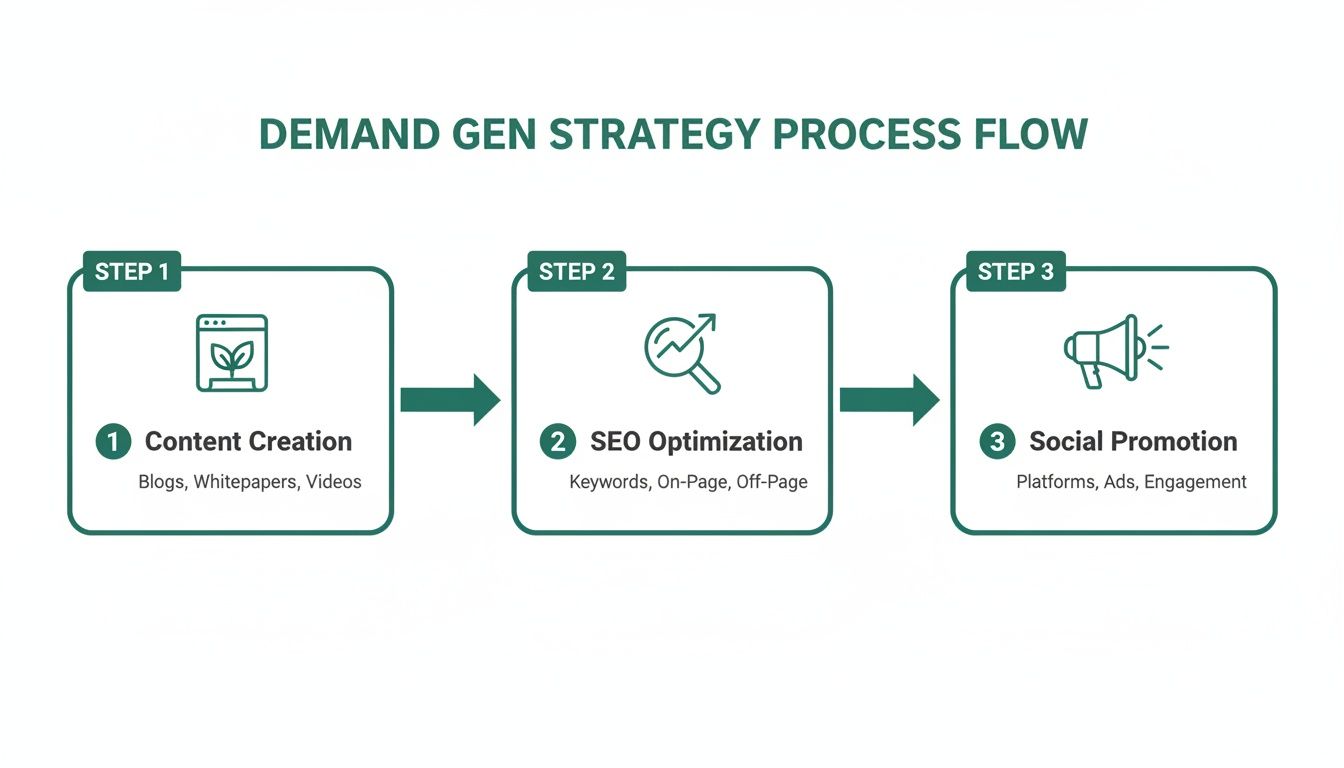
    Demand generation strategy process flow with three steps: content creation, SEO, and social promotion.

    As you can see, it all starts with valuable content. SEO makes sure people can find it, and social media gets it in front of an even bigger, more targeted audience.

    Amplifying Reach Through Social Media Engagement

    Social media is the megaphone for your content. It’s where you share what you’ve created, jump into relevant conversations, and build a real community around your brand. Every platform—from LinkedIn to Twitter to TikTok—gives you a different way to connect with your audience.

    But effective social media for demand gen isn't just about auto-posting links. It’s about:

    • Sharing Insights: Pulling out the best tidbits from your long-form content and turning them into shareable graphics, threads, or short videos.
    • Fostering Community: Asking questions, running polls, and actually participating in discussions to show there are real people behind your brand.
    • Listening to Your Audience: Paying attention to what people are talking about to spot pain points and trends. This is often where your best content ideas come from.

    Focusing Efforts With Account-Based Marketing

    While the tactics above help you cast a wide net, Account-Based Marketing (ABM) is more like a spear. It’s a hyper-focused approach where your marketing and sales teams work together to go after a specific list of high-value dream clients. Instead of waiting for them to find you, you go directly to them with personalized campaigns.

    ABM flips the traditional marketing funnel on its head. Instead of marketing to a huge audience to get a bunch of leads that you slowly filter down, you start by identifying your perfect-fit customers. Then, you build marketing and sales experiences specifically for them.

    With an ABM strategy, your content isn't for everyone; it's tailored to solve the exact problems of a target company or industry. This is incredibly powerful for B2B companies with long sales cycles and big deal sizes, as it ensures your most intensive efforts are focused on the prospects who matter most.

    Mapping Demand Generation To The Buyer Journey

    Throwing content out there and hoping something sticks just doesn't work. Effective demand generation is more like a carefully choreographed dance, timed perfectly to the rhythm of your customer's own journey. To really succeed, you have to meet your audience right where they are, offering exactly what they need, at the moment they need it most.

    This means every single tactic has to align with a specific stage of the buyer's journey. Think of yourself as a guide on a long hike. You wouldn't hand a map of the final peak to someone still lacing up their boots at the trailhead. You give them what they need for each step, building trust along the way. Understanding the process of consumer decision making is the key to mapping your efforts correctly.

    Sparking Interest In The Awareness Stage

    This is the trailhead. Your potential customers know they have a problem or a goal, but they don't have a name for the solution yet. And they probably have no idea who you are. Your job isn't to sell; it's to educate and attract.

    You need to create content that speaks to their high-level frustrations in a helpful, no-strings-attached way. You're answering the big, broad questions that help them understand their own problem better. The goal here is to become a familiar, trusted voice they encounter during their initial research.

    Top-of-funnel tactics for this stage include:

    • Educational Blog Posts: Think articles optimized for problem-focused keywords, like "how to improve team productivity."
    • Engaging Social Media Content: Short-form videos, useful infographics, and posts that get people talking.
    • Podcasts and Webinars: In-depth conversations that establish your brand as an authority on the subject.

    This is all about giving value away for free to build an audience that sees you as a helpful resource, not just another company trying to sell them something.

    Building Trust During The Consideration Stage

    Okay, now your prospect has moved on. They’ve defined their problem and are actively hunting for solutions. They've gone from "What's wrong?" to "What are my options for fixing this?" Now's your chance to guide them more directly toward what you offer.

    Your content needs to shift gears from broad education to more specific, useful comparisons. It should help them weigh their options, understand the pros and cons, and see where a solution like yours fits into the picture.

    This is where you go from being a general guide to a specialist. You’re no longer just pointing out the trail—you’re explaining why a particular path is the most effective one to take.

    To nail this, you need to arm them with practical, detailed information that gives them confidence in their decision-making.

    Mid-funnel tactics for the Consideration Stage include:

    • In-Depth Guides and Ebooks: Comprehensive resources that go deeper than a standard blog post.
    • Comparison Whitepapers: Unbiased breakdowns comparing different types of solutions or methods, positioning yours in a good light.
    • Case Studies: Real-world proof showing how others solved the exact problem they’re facing.

    Driving Action In The Decision Stage

    We're at the final leg of the journey. The prospect has narrowed their choices and is ready to pick a specific provider. They are now comparing you against competitors, looking at features, and checking out pricing. Everything you create here needs to be laser-focused on one thing: why you are the best possible choice for them.

    The goal is to crush any final doubts and make it incredibly easy to say "yes." This is where you show off tangible proof of your value. All the trust and authority you built in the earlier stages pay off right here.

    Bottom-of-funnel tactics for the Decision Stage include:

    • Free Trials or Demos: Let them experience the value firsthand. Nothing is more powerful.
    • Detailed Pricing Pages: Be clear and transparent. Answer one of their biggest final questions without making them hunt for it.
    • Customer Testimonials and Reviews: Use social proof to validate your claims and seal the deal.

    By strategically mapping your efforts to each stage, you create a seamless journey that guides people from being vaguely curious to becoming confident customers.

    How To Build Your Demand Generation Engine From Scratch

    A rustic wooden desk workspace with a laptop, plant, 'DEMAND ENGINE' notebook, gears, and blueprint.

    Alright, let's move from theory to action. This is where the real work begins. Building a powerful demand generation engine isn't about flipping a switch; it's about methodically piecing together a system that consistently finds, engages, and nurtures your ideal customers.

    Think of this as your blueprint. If you follow these core steps, you’ll create a sustainable process that turns strangers into advocates and fuels predictable growth for your business. Let’s lay the first brick.

    Define Your Ideal Customer Profile

    Before you write a single blog post or spend a dollar on ads, you have to know exactly who you're talking to. Your Ideal Customer Profile (ICP) is a razor-sharp description of the perfect company you want to sell to—not just any company, but the ones that will get immense value from your solution.

    Your ICP needs to go deeper than basic firmographics. It should detail the company's industry, size, revenue, and even the specific tech stack they use. A well-defined ICP is your north star, making sure every piece of content and every campaign is aimed squarely at the accounts most likely to convert and stick around.

    An ICP stops you from wasting time and money marketing to everyone. It laser-focuses your efforts on high-value accounts that drive the most revenue and have the best retention rates.

    Once you know the company, you need to pinpoint the key people inside—your buyer personas. Who are the decision-makers, the champions, and the influencers? Getting a handle on their individual pain points and motivations is the secret to creating content that actually connects.

    Create Content That Solves Real Problems

    With your ICP locked in, it’s time to create content that speaks directly to their biggest challenges. This is the fuel for your demand engine. Forget generic, surface-level articles; your content has to deliver genuine solutions and establish your brand as a credible expert.

    Start by mapping out the main questions your ICP has at each stage of their journey. What are they Googling when they first realize they have a problem? What info do they need when they're comparing their options?

    Here’s a simple way to structure your content creation:

    • Top of Funnel: Think educational blog posts, podcasts, and social media content. Address high-level pain points without ever mentioning your product. Just be helpful.
    • Middle of Funnel: This is where you develop in-depth guides, webinars, and case studies that help prospects evaluate different ways to solve their problem.
    • Bottom of Funnel: Now you can roll out product comparisons, customer testimonials, and free trials that make the decision to choose you a no-brainer.

    This layered approach ensures you’re providing the right value at the right time, building trust with every interaction.

    Select The Right Distribution Channels

    Creating amazing content is only half the battle. If no one sees it, it doesn't matter. Your distribution strategy needs to be just as thoughtful as your content plan, focusing only on the channels where your ICP actually hangs out.

    Don't spread yourself thin trying to be everywhere at once. Instead, get really good at the one or two channels that matter most. For most B2B companies, that usually means a heavy focus on LinkedIn for social engagement and SEO for capturing search intent.

    Getting your content out there means being proactive. This is where targeted outreach becomes a game-changer. Building a list of key decision-makers within your ICP accounts lets you drop your helpful content right into their inbox. For a deeper dive on this, check out our guide on how to generate B2B leads with precision.

    Accelerate Outreach With The Right Tools

    Let’s be honest: manually digging for contact information is a soul-crushing, inefficient process that will stall your momentum before you even get started. This is where the right tools become essential for scaling up your demand gen efforts.

    Tools like EmailScout are built to speed this critical step up. Instead of burning hours hunting for email addresses, you can use it to build targeted lists in minutes. This frees up your team to focus on what they do best: building relationships and sharing great content.

    By automating the discovery process, you can efficiently build a pipeline of relevant contacts to share your webinars, ebooks, and guides with. It turns a manual time-suck into a streamlined, repeatable part of your demand engine.

    Measuring Success: What Demand Generation Metrics Matter Most

    You can’t improve what you don’t measure. In demand generation, that’s not just a cliché—it’s the golden rule. While surface-level stats like social media likes and page views might look good in a report, they don’t tell you if your marketing is actually making an impact.

    Real success is measured by how your efforts affect the bottom line. To prove your demand generation engine is working, you need to track the KPIs that tie your marketing activities directly to revenue. These are the numbers that get the C-suite to sit up and listen. They shift the conversation from, "We got a lot of clicks," to, "We generated X dollars in the sales pipeline."

    Moving Beyond Surface-Level Metrics

    The first step is moving your focus away from top-of-funnel noise and toward down-funnel results. Website traffic is a starting point, but it doesn't tell you if you're attracting the right people. The real story unfolds in metrics that track genuine interest, sales-readiness, and financial impact.

    These deeper metrics show how well your strategy is guiding potential customers through their entire buying journey and contributing to real business growth. Let’s break down the ones that truly matter.

    Marketing Qualified Leads (MQLs) And Sales Qualified Leads (SQLs)

    One of the most foundational metrics is the Marketing Qualified Lead (MQL). This is a prospect who has engaged with your content in a way that signals they’re more likely to become a customer. Think of someone who downloaded a detailed guide or attended a webinar—they're showing more than just casual interest.

    From there, we have the Sales Qualified Lead (SQL). This is an MQL that the sales team has reviewed and agreed is a legitimate potential customer worth their time and effort.

    Tracking the MQL-to-SQL conversion rate is crucial. A high rate shows your marketing is attracting high-quality prospects that sales finds valuable. It’s a clear sign of strong marketing and sales alignment.

    If that conversion rate is low, it’s a red flag. It might mean your definition of a "qualified" lead is off, or your content is attracting the wrong audience. This one simple ratio tells a powerful story about the health of your entire funnel.

    Pipeline Velocity And Sales Cycle Length

    Pipeline Velocity measures how fast deals are moving through your sales funnel. Think of it as the speedometer for your revenue engine. A higher velocity means you're closing deals faster and generating revenue more efficiently.

    Closely related is the Sales Cycle Length, which is the average time it takes for a lead to become a paying customer. A great demand generation strategy should actively shorten this cycle. When leads come to the sales team already educated about their problem and your solution, deals just close faster.

    • An effective demand gen program warms up leads before they ever talk to sales, which should reduce the time it takes to close a deal.

    Customer Acquisition Cost (CAC) And Customer Lifetime Value (CLV)

    Customer Acquisition Cost (CAC) is pretty straightforward: it’s the total cost of sales and marketing you spent to land one new customer. The goal, of course, is to keep this number as low as possible without sacrificing quality.

    But CAC is meaningless without its counterpart: Customer Lifetime Value (CLV). This metric predicts the total revenue you can expect from a single customer over the entire course of their relationship with you.

    A healthy business model always has a CLV that is much higher than its CAC. A strong demand gen strategy improves this ratio in two key ways:

    1. It attracts better-fit customers who are more likely to stick around and spend more, which increases CLV.
    2. It creates efficient, scalable ways to attract those customers, which reduces CAC.

    To really understand how well your demand generation efforts are performing, you need a clear, data-driven picture. The table below breaks down the key metrics you should be tracking.

    Key Demand Generation Metrics and Their Purpose

    Metric What It Measures Why It Matters
    MQL-to-SQL Conversion Rate The percentage of marketing-qualified leads that become sales-qualified leads. Shows the quality of your leads and the alignment between marketing and sales.
    Pipeline Velocity The speed at which leads move through the sales pipeline from initial contact to closed deal. Indicates the efficiency of your sales process and the overall health of your revenue engine.
    Sales Cycle Length The average time it takes to close a deal after the first touchpoint. Helps you understand if your demand gen efforts are effectively educating and nurturing leads.
    Customer Acquisition Cost (CAC) The total marketing and sales cost required to acquire a new customer. Measures the cost-effectiveness of your customer acquisition strategies.
    Customer Lifetime Value (CLV) The total revenue a business can expect from a single customer over their entire relationship. Provides context for CAC and helps determine the long-term profitability of your customers.
    Marketing-Sourced Revenue The percentage of total company revenue that can be directly attributed to marketing efforts. The ultimate proof of marketing's ROI and its direct contribution to the bottom line.

    Ultimately, tracking these metrics allows you to move beyond guesswork. You can make smarter strategic decisions, optimize your campaigns, and confidently show the powerful ROI of your marketing engine.


    Ready to supercharge your outreach and start building high-quality lead lists in minutes? With EmailScout, you can find unlimited verified email addresses for free, automating one of the most time-consuming parts of demand generation. Try the free Chrome extension and start connecting with your ideal customers today.
  • 10 Lead Generation Best Practices for 2025

    10 Lead Generation Best Practices for 2025

    In today's competitive market, a steady stream of qualified leads is the lifeblood of any growing business. Simply casting a wide net and hoping for the best is an outdated strategy that wastes time and resources. The real challenge lies in consistently attracting the right prospects, engaging them effectively, and guiding them through a seamless conversion process. A haphazard approach leads to an unpredictable pipeline and leaves sales teams scrambling to meet their targets.

    This guide provides a definitive blueprint to overcome that challenge. We have compiled 10 essential lead generation best practices designed to build a robust and sustainable sales pipeline. Forget generic advice; we are diving deep into actionable strategies that deliver tangible results. From creating compelling lead magnets and mastering SEO to implementing sophisticated account-based marketing and leveraging automation, each point is a critical component of a modern growth engine.

    Throughout this comprehensive listicle, we will provide practical steps, real-world examples, and specific tool recommendations to help you execute these tactics flawlessly. You'll learn how to optimize every touchpoint in your outreach, ensuring your efforts are both efficient and effective. We will also explore how tools like EmailScout can be integrated to precisely target and connect with the key decision-makers who can truly move the needle for your business. Let's explore the foundational strategies that will fill your pipeline and drive revenue growth.

    1. Content Marketing and Lead Magnets

    Content marketing is the strategic foundation of modern lead generation, and lead magnets are its most powerful tool. Instead of directly asking for a sale, this approach focuses on providing genuine value upfront. By creating and offering high-quality, relevant resources like eBooks, whitepapers, or checklists, you attract potential customers who are actively seeking solutions to their problems.

    This method shifts the dynamic from an interruption to a welcome exchange. Prospects willingly provide their contact information, such as an email address, in return for content that helps them. This not only generates a lead but also positions your brand as a credible, trustworthy authority in your industry. It's a fundamental strategy for building an audience and nurturing relationships over time, making it one of the most effective lead generation best practices available.

    How to Implement This Strategy

    Implementing a lead magnet strategy involves more than just creating a PDF. It requires a thoughtful, user-centric approach.

    • Identify a Core Problem: Pinpoint a specific, urgent pain point your target audience faces. Your lead magnet should offer a direct, actionable solution to this single problem.
    • Create High-Value Content: Develop a resource that is genuinely useful. Companies like HubSpot excel at this by offering comprehensive marketing templates and guides that users can immediately apply to their work.
    • Design Compelling Landing Pages: Create a dedicated, distraction-free landing page for your lead magnet. Use a clear call-to-action (CTA) and a simple form to maximize conversions.
    • Promote Across Channels: Share your lead magnet on social media, in your email newsletter, through blog posts, and even via paid advertising to reach the widest possible audience.
    • Nurture New Leads: Once someone downloads your resource, don't stop there. Follow up with a targeted email nurture sequence that provides additional value and guides them further down the sales funnel.

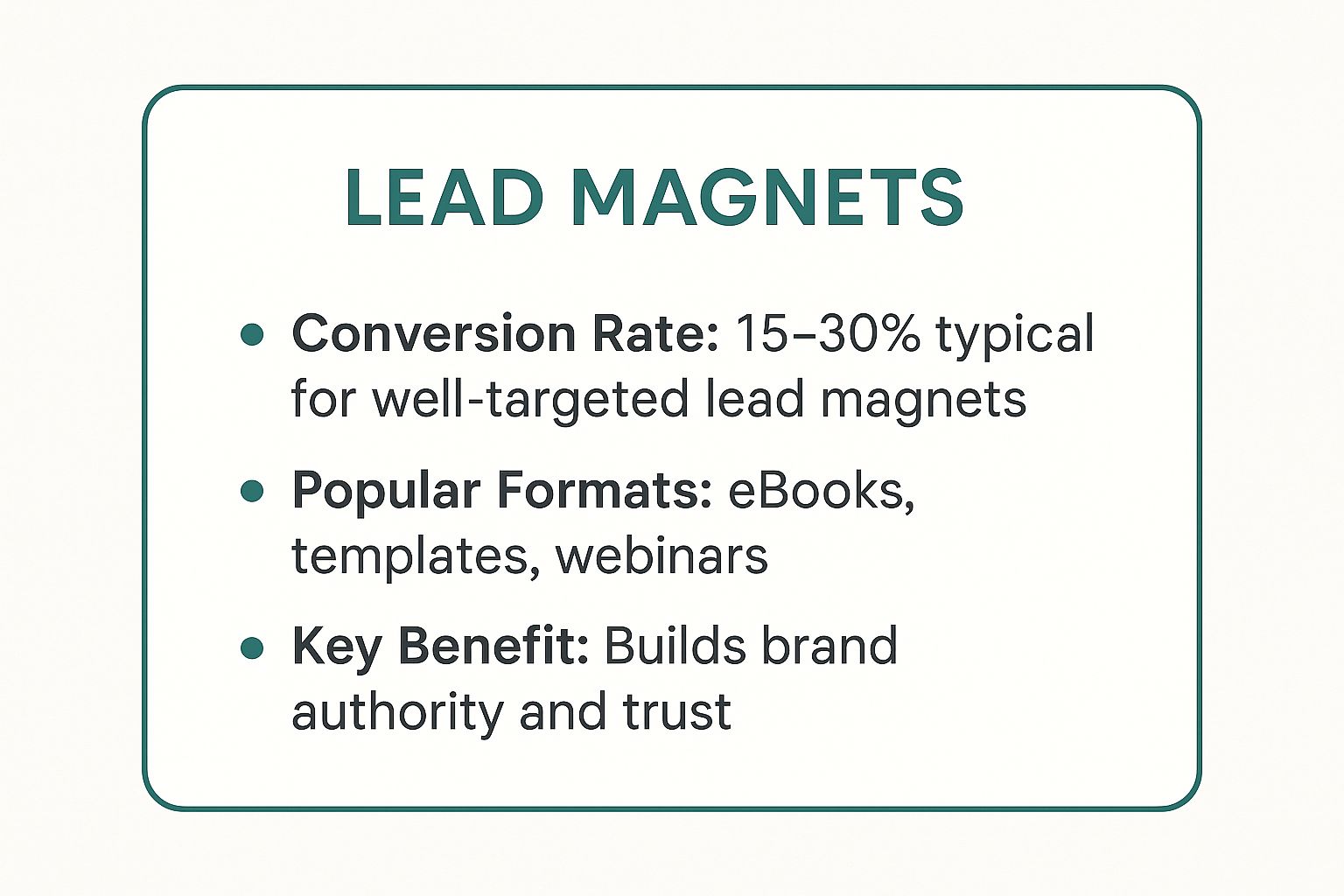
    The following infographic highlights key data points on the effectiveness of well-executed lead magnets.

    Infographic showing key data about Content Marketing and Lead Magnets

    As the data shows, a highly targeted lead magnet can achieve impressive conversion rates while simultaneously building brand authority. This combination makes it an indispensable tactic for sustainable growth.

    2. Search Engine Optimization (SEO) for Lead Generation

    Search Engine Optimization (SEO) is a powerful, long-term strategy that turns your website into a passive lead generation engine. It involves optimizing your site and content to rank highly in search engine results for keywords your ideal customers are using. This organic approach attracts high-intent prospects who are actively seeking answers and solutions that your business provides.

    Unlike paid advertising, SEO captures leads at every stage of the buyer's journey, from initial awareness to the final decision. By consistently appearing as the solution to their queries, you build immense credibility and trust. This makes SEO one of the most sustainable and cost-effective lead generation best practices for building a predictable pipeline of inbound inquiries.

    How to Implement This Strategy

    A successful SEO strategy requires a systematic approach that aligns content with user intent and technical performance. It's about more than just keywords; it's about creating a comprehensive user experience.

    • Target High-Intent Keywords: Focus on long-tail keywords that signal a user is close to making a purchase or inquiry, such as "best CRM software for small business" instead of just "CRM."
    • Create Topic Clusters: Build your authority by developing comprehensive content hubs around your core services. For example, Ahrefs creates extensive educational content covering all aspects of SEO, naturally attracting their target audience.
    • Optimize for Local Search: If you serve a specific geographic area, optimize your Google Business Profile and create location-specific pages to attract local customers actively searching for your services.
    • Embed Clear CTAs: Every piece of optimized content, from blog posts to service pages, must have a clear and relevant call-to-action (CTA) that guides the visitor on what to do next, like "Request a Demo" or "Download Our Guide."
    • Prioritize Technical Health: Ensure your website has fast page load speeds, is mobile-friendly, and has a logical structure. A poor user experience can negate even the best content efforts.

    3. Social Media Lead Generation

    Social media lead generation leverages platforms like LinkedIn, Facebook, and Instagram to identify and convert prospects where they actively spend their time. This strategy moves beyond simple brand awareness, using a mix of organic content, paid advertising, and direct engagement to capture leads directly within the platform.

    Social Media Lead Generation

    This approach is effective because it meets customers in a familiar, low-friction environment. Instead of directing them off-site, you can use features like Facebook Lead Ads or LinkedIn's lead gen forms to collect their information seamlessly. This makes it an essential part of modern lead generation best practices, allowing you to build a community, generate leads, and nurture relationships simultaneously.

    How to Implement This Strategy

    A successful social media strategy requires more than just posting updates; it demands a targeted, platform-specific approach to engage and convert your audience.

    • Choose the Right Platforms: Focus your efforts where your target audience is most active. B2B companies often find success on LinkedIn, while B2C brands may thrive on Instagram or Facebook.
    • Utilize Native Lead Forms: Leverage built-in tools like Facebook Lead Ads or LinkedIn Lead Gen Forms. These pre-filled forms simplify the submission process for users, dramatically increasing conversion rates.
    • Engage Before You Pitch: Join relevant groups, respond to comments, and participate in industry conversations. Building rapport and providing value first makes your eventual outreach feel more genuine and less intrusive.
    • Combine Organic and Paid Efforts: Use organic content to build authority and community, while using paid ads to target specific demographics with high-intent offers. Companies like Hootsuite effectively use this mix to promote their guides and webinars.
    • Showcase Social Proof: Share customer testimonials, case studies, and user-generated content to build trust. Positive reviews and success stories are powerful motivators that can turn a follower into a lead.

    4. Email Marketing and Nurturing Campaigns

    Email marketing is the engine that drives consistent lead nurturing, turning initial interest into long-term customer relationships. Instead of a one-off interaction, this approach uses strategic email sequences to guide prospects through their buying journey. It keeps your brand top-of-mind by delivering value-packed content, personalized offers, and relevant information directly to their inbox.

    This strategy excels at building trust and demonstrating expertise over time. By segmenting your audience and sending targeted messages, you can address specific needs and pain points, making each communication feel personal and relevant. This transforms your email list from a simple directory into a powerful asset for converting leads, making it one of the most reliable lead generation best practices for sustainable growth.

    How to Implement This Strategy

    A successful email nurturing strategy is more than just sending a weekly newsletter; it requires deliberate planning and automation to be effective.

    • Segment Your Audience: Group contacts based on their interests, behaviors (e.g., pages visited, content downloaded), and demographic data. This allows for highly personalized messaging. ActiveCampaign excels at creating complex behavioral automation workflows for this purpose.
    • Develop Nurture Sequences: Create automated email series for different segments. Common examples include welcome series for new subscribers, educational content sequences for early-stage leads, and abandoned cart reminders for e-commerce, a tactic perfected by platforms like Klaviyo.
    • Provide Consistent Value: Ensure every email offers something useful, whether it's an insightful article, a helpful tip, or an exclusive resource. Avoid making every message a sales pitch to maintain engagement.
    • Use a Clear Call-to-Action (CTA): Each email should have a single, clear objective. Whether you want them to read a blog post, book a demo, or make a purchase, guide them with an obvious and compelling CTA.
    • Test and Optimize: Continuously test elements like subject lines, send times, and content formats. Analyze open rates, click-through rates, and conversion data to refine your approach and improve performance.

    5. Landing Page Optimization

    Landing page optimization is the art and science of designing a web page with a single, focused goal: converting visitors into leads. Unlike a homepage with dozens of links and distractions, a dedicated landing page is built to support a specific marketing campaign. It guides a visitor toward a single call-to-action (CTA), dramatically increasing the likelihood they will complete the desired action, such as filling out a form or signing up for a trial.

    This strategy is one of the most crucial lead generation best practices because it directly impacts conversion rates. By removing navigation menus, sidebars, and other competing elements, you create a frictionless path from click to conversion. Every element on the page, from the headline to the form fields, is strategically chosen and tested to persuade the visitor to act, maximizing the return on your advertising spend and content marketing efforts.

    How to Implement This Strategy

    Effective landing page optimization is a continuous process of testing and refinement, not a one-time setup. A data-driven approach is essential for achieving the best results.

    • Design for a Single Goal: Ensure every element on the page supports one action. If the goal is an eBook download, the headline, copy, images, and CTA should all reinforce that objective. Tools like Unbounce and Leadpages offer templates designed for specific conversion goals.
    • Craft a Compelling Value Proposition: Your headline and subheadings must immediately answer the visitor’s question: "What's in it for me?" Clearly and concisely communicate the primary benefit of your offer.
    • Optimize Your Form: Keep forms as short as possible. Only ask for the information you absolutely need. Each additional field increases friction and can cause a potential lead to abandon the page.
    • Incorporate Trust Signals: Add social proof like testimonials, customer logos, case study links, or security badges (e.g., for privacy). These elements build credibility and reduce hesitation.
    • Test and Iterate: Continuously A/B test different elements. Test your headlines, CTA button copy and color, images, and even the length of your form. Platforms like Instapage and Optimizely make this process simple.

    The following infographic illustrates the key components of a high-converting landing page.

    Landing Page Optimization

    As shown, a well-optimized landing page aligns its message with the ad or link that brought the visitor there, creating a seamless and persuasive user experience that is fundamental to successful lead generation.

    6. Account-Based Marketing (ABM)

    Account-Based Marketing (ABM) flips the traditional lead generation funnel on its head. Instead of casting a wide net to capture as many leads as possible, ABM is a focused strategy where marketing and sales teams work together to target a specific set of high-value accounts. It involves creating hyper-personalized campaigns and content designed to resonate deeply with the key stakeholders at each target company.

    This approach treats each target account as a market of one, ensuring that all outreach is highly relevant and tailored to their specific needs and pain points. By concentrating resources on the accounts most likely to convert, businesses can achieve higher engagement rates, larger deal sizes, and a more significant return on investment. This makes it one of the most effective B2B lead generation best practices for companies aiming to land enterprise-level clients.

    How to Implement This Strategy

    A successful ABM strategy requires deep alignment between sales and marketing and a commitment to personalization at scale. It's about quality over quantity, focusing intensely on the right prospects.

    • Identify and Select High-Value Accounts: Begin by creating a detailed Ideal Customer Profile (ICP). Use this profile, along with firmographic and intent data, to build a list of target accounts that are the best fit for your solution.
    • Align Sales and Marketing: Both teams must agree on the target accounts, messaging, and goals. This alignment is critical for a cohesive experience, as seen with platforms like 6sense and Demandbase that facilitate this collaboration.
    • Create Account-Specific Content: Develop content and messaging that speaks directly to the challenges and goals of each target account. This could include personalized case studies, industry reports, or tailored sales presentations.
    • Launch Coordinated Campaigns: Use a multi-channel approach to engage key stakeholders within each account. Companies like Terminus specialize in running orchestrated campaigns across display ads, social media, and email to surround the buying committee.
    • Measure and Optimize: Track engagement across the entire account, not just individual leads. Measure metrics like account penetration, pipeline velocity, and deal size to gauge the effectiveness of your ABM efforts. For a deeper dive into similar B2B strategies, you can learn more about B2B lead generation on emailscout.io.

    7. Webinars and Virtual Events

    Webinars and virtual events are powerful, interactive platforms for lead generation that allow you to connect directly with a captive audience. By offering educational content, live Q&A sessions, or product demonstrations, you provide immense value in real-time. This format is ideal for showcasing deep expertise and building genuine relationships at scale.

    This approach transforms lead generation from a passive activity into an engaging experience. Attendees register with their contact details in exchange for access to exclusive insights, positioning your brand as an industry authority. It's a highly effective strategy for attracting qualified leads who are actively interested in your subject matter and solutions, making it a cornerstone of modern lead generation best practices.

    How to Implement This Strategy

    A successful webinar requires more than just a presentation and a webcam. It demands strategic planning, promotion, and follow-up to maximize its lead-generating potential.

    • Choose a High-Impact Topic: Focus on solving a specific, urgent problem for your target audience. Use customer feedback, keyword research, or sales team insights to identify pain points that will draw registrations.
    • Promote Extensively: Begin promoting your event at least 2-3 weeks in advance across all channels. Use email marketing, social media posts, paid ads, and partner collaborations to build a strong list of registrants.
    • Incorporate Interactive Elements: Keep your audience engaged throughout the event. Use live polls, Q&A sessions, and chat features to encourage participation and gather valuable feedback directly from potential customers.
    • Follow Up with All Registrants: Your work isn't over when the webinar ends. Create a segmented follow-up sequence for both attendees and those who registered but couldn't make it, sharing the recording and relevant resources to continue the conversation.
    • Offer an Exclusive Incentive: Encourage attendance and action by providing a special offer only for webinar participants. This could be a discount, an extended trial, or a free consultation.

    The following video provides further insights into creating webinars that not only educate but also convert attendees into qualified leads.

    By delivering tangible value and fostering direct interaction, webinars create a prime opportunity to guide interested prospects further down the sales funnel.

    8. Referral and Partner Programs

    Referral and partner programs are a powerful way to leverage your existing network of satisfied customers and strategic allies to drive growth. This approach transforms your happy customers, industry partners, and affiliates into a proactive, incentivized sales force. They generate leads through trusted, word-of-mouth recommendations, which are often more effective than traditional advertising.

    This strategy works because it's built on trust. A lead that comes from a known and respected source is inherently warmer and more qualified. By rewarding both the referrer and the new customer, you create a self-sustaining cycle of advocacy. This makes referral marketing one of the most cost-effective and highest-converting lead generation best practices for scaling a business.

    How to Implement This Strategy

    A successful referral or partner program requires more than just asking for introductions. It needs a clear structure, compelling incentives, and robust tracking to be effective.

    • Make Referring Effortless: The process should be incredibly simple. Provide referrers with a unique link or a simple form. Dropbox famously achieved 3900% growth by offering extra storage space through a one-click referral system.
    • Offer Meaningful Incentives: Reward both the referrer and the new lead. This dual-sided incentive, like Airbnb's travel credit system, encourages participation from all parties.
    • Equip Your Partners for Success: Provide your partners with a toolkit containing marketing materials, brand guidelines, and key messaging. HubSpot's partner program excels by offering agencies co-marketing resources and sales training.
    • Track and Optimize Performance: Use dedicated software like ReferralCandy or Ambassador to monitor which channels and individuals are driving the most valuable leads. This data is crucial for refining your program.
    • Celebrate Top Referrers: Publicly acknowledge and reward your most successful advocates. This recognition fosters loyalty and motivates others to increase their referral efforts, creating a virtuous cycle of lead generation.

    9. Lead Scoring and Qualification

    Not all leads are created equal, and lead scoring is the systematic process of separating high-potential prospects from the merely curious. This method involves assigning numerical values to leads based on their attributes and behaviors, such as demographic data, company information, and engagement with your brand. The higher the score, the more "sales-ready" the lead is considered to be.

    This data-driven approach allows your sales and marketing teams to work in perfect alignment. Instead of wasting valuable time chasing every inquiry, your sales team can focus its energy exclusively on leads that demonstrate a strong interest and fit your ideal customer profile. This prioritization is a cornerstone of efficient lead generation best practices, ensuring resources are allocated where they will have the greatest impact and dramatically shortening the sales cycle.

    How to Implement This Strategy

    Effective lead scoring requires a collaborative effort between marketing and sales to define what makes a lead valuable. A well-designed model provides clarity and streamlines the handoff process.

    • Define Your Criteria: Work with your sales team to identify the key demographic and behavioral indicators of a high-quality lead. This could include job title, company size, website pages visited, or content downloads.
    • Assign Point Values: Assign positive scores for desirable actions (e.g., requesting a demo) and negative scores for disqualifying ones (e.g., a student email address). For instance, a "VP of Marketing" might get +15 points, while a visit to the pricing page gets +10.
    • Set Scoring Thresholds: Establish clear score thresholds that define when a lead is considered Marketing Qualified (MQL) and ready to be passed to the sales team. This ensures a smooth and consistent handoff.
    • Utilize Automation Platforms: Implement scoring within your CRM or marketing automation platform. Tools like HubSpot, Marketo, and Salesforce Pardot have robust, built-in lead scoring functionalities that can automate this entire process.
    • Review and Refine Regularly: Lead scoring is not a "set it and forget it" task. Continuously analyze which leads convert to customers and adjust your scoring model to improve its accuracy over time.

    10. Marketing Automation and CRM Integration

    Marketing automation and CRM integration create a powerful, unified system for managing the entire customer lifecycle. By connecting your marketing automation platform (like HubSpot or ActiveCampaign) with your Customer Relationship Management (CRM) software (like Salesforce), you build a seamless bridge between your marketing and sales teams. This synergy ensures that every lead is captured, nurtured, and tracked efficiently, eliminating manual handoffs and data silos.

    This integrated approach automates repetitive tasks such as lead scoring, email follow-ups, and data entry, freeing up your teams to focus on high-value activities. When a lead takes a specific action, like downloading a resource, the automation platform can nurture them with a personalized email sequence. Once they reach a certain engagement level, their data and history are seamlessly passed to the CRM for the sales team to take over, fully informed. This alignment is a cornerstone of modern lead generation best practices, turning scattered data into actionable intelligence.

    How to Implement This Strategy

    Successfully merging these two systems requires a strategic approach to ensure data flows correctly and workflows are effective from day one.

    • Choose Compatible Platforms: Select marketing automation and CRM tools that offer robust, native integrations. Platforms like HubSpot offer an all-in-one solution, while others like Marketo and Salesforce are designed to work together seamlessly.
    • Map the Customer Journey: Define the exact stages a lead moves through, from initial contact to becoming a customer. Use this map to build your automation workflows, specifying the triggers and actions for each stage.
    • Ensure Data Hygiene: A successful integration relies on clean data. Implement a process for regular database maintenance and consider using tools for email address verification to keep your contact lists accurate and improve deliverability.
    • Start with Simple Workflows: Begin with basic automation rules, such as a welcome email series for new subscribers or a notification to sales when a lead visits the pricing page. Add complexity as your team becomes more comfortable with the system.
    • Train Both Teams: Ensure both marketing and sales departments understand how the integrated system works, what the data means, and what their respective roles are in the process. Proper training prevents misunderstandings and maximizes the ROI of your technology stack.

    Lead Generation Best Practices Comparison

    Lead Generation Method Implementation Complexity Resource Requirements Expected Outcomes Ideal Use Cases Key Advantages
    Content Marketing and Lead Magnets Medium to High (time-intensive content creation) Significant content development and promotion Builds brand authority; qualified leads; improves SEO B2B/B2C with specific buyer personas needing education Cost-effective; long-term asset; trust-building
    Search Engine Optimization (SEO) High (technical and ongoing) SEO expertise; content creation Sustainable organic traffic; high-intent lead capture Businesses targeting organic search visibility Low cost per lead over time; compound ROI
    Social Media Lead Generation Medium (platform-specific strategies) Content creation; paid ads; engagement Direct engagement; platform-specific conversions B2B (LinkedIn), B2C (Facebook, Instagram) Real-time interaction; advanced targeting
    Email Marketing and Nurturing Campaigns Medium (automation and content required) Email platform and content teams High ROI; personalized nurturing; measurable results Businesses with existing lists or inbound leads High ROI; automation at scale; direct communication
    Landing Page Optimization Medium (design and testing cycles) Design, copywriting, analytics Increased conversion rates; better campaign ROI Campaign-specific traffic sources Higher conversion; clear ROI tracking
    Account-Based Marketing (ABM) High (personalization and alignment) Marketing and sales coordination Higher deal sizes; shorter sales cycles Enterprise B2B with high-value accounts Focused resources; strong relationships
    Webinars and Virtual Events Medium to High (prep and tech setup) Hosting platform; content experts High engagement; valuable lead capture Thought leadership; product demos; educational content Direct interaction; scalable; repurposable content
    Referral and Partner Programs Medium (program setup and management) Incentives and tracking tools Higher quality leads; lower acquisition costs Customer networks and partner channels High conversion; self-sustaining growth
    Lead Scoring and Qualification High (data-driven model setup) Analytics and CRM integration Prioritized leads; improved sales efficiency Teams with CRM data needing lead prioritization Better sales focus; data-driven decisions
    Marketing Automation and CRM Integration High (complex setup and learning) Software investment; training Streamlined nurturing; improved productivity Businesses scaling personalized communications Scalable personalization; consistent follow-up

    From Strategy to Success: Activating Your Lead Generation Engine

    You've just navigated ten of the most powerful and effective lead generation best practices available to modern businesses. From the magnetic pull of a well-crafted lead magnet and the long-term pipeline value of SEO, to the targeted precision of Account-Based Marketing and the engaging power of webinars, each strategy represents a vital gear in your growth machinery. However, the true path to a full pipeline and predictable revenue doesn't come from simply knowing these tactics; it comes from implementing them with intention, consistency, and a commitment to continuous improvement.

    The journey from a passive approach to an active, thriving lead generation engine can feel daunting. The key is to avoid analysis paralysis and take decisive, focused action. Rather than attempting to overhaul your entire marketing and sales operation overnight, select one or two strategies from this list that align perfectly with your current business goals, available resources, and target audience.

    Building Your Action Plan: The First 90 Days

    To transform these concepts into tangible results, start by mapping out a clear plan. Your initial focus should be on building momentum and securing early wins that can justify further investment and team buy-in.

    • For Businesses Needing Quick Wins: If your primary goal is immediate pipeline growth, prioritize strategies like optimizing your high-traffic landing pages or launching a targeted social media lead generation campaign. These initiatives can often produce measurable results in a shorter timeframe.
    • For Businesses Focused on Long-Term, Sustainable Growth: If your focus is on building a foundational system, start with SEO and content marketing. While these efforts take longer to mature, they create an invaluable asset that generates high-quality, inbound leads for years to come.
    • For Businesses Targeting High-Value Accounts: If your sales cycle is complex and involves multiple stakeholders, an Account-Based Marketing (ABM) pilot program is the logical starting point. Focus on a small, well-defined list of target accounts to refine your approach before scaling.

    The Unifying Thread: Data-Driven Optimization

    Regardless of the path you choose, a common theme weaves through all of these lead generation best practices: the critical importance of data and technology. Your success hinges on your ability to identify the right prospects, understand their needs, and engage them with personalized, relevant messaging at the perfect moment.

    This is where the integration of your CRM, marketing automation platforms, and powerful data enrichment tools becomes non-negotiable. Implementing lead scoring helps your sales team focus their energy on the most qualified opportunities, preventing wasted effort on prospects who aren't ready to buy. Likewise, automating nurture sequences ensures that no lead falls through the cracks, keeping your brand top-of-mind until they are sales-ready.

    Ultimately, mastering lead generation is not a one-time project; it is an ongoing discipline. It requires a mindset of perpetual testing, learning, and refinement. A/B test your landing page headlines, analyze your email open rates, track your webinar attendance, and constantly ask: "How can we make this process more efficient and more effective?" By embracing this iterative process and consistently applying the foundational strategies we've covered, you will move beyond sporadic lead acquisition and build a truly predictable, scalable system that fuels your business's growth for the long haul.


    Ready to supercharge your outreach and ensure every email reaches a real, verified decision-maker? Stop wasting time on bounced emails and start building a high-quality lead list with EmailScout. Find and verify professional email addresses in seconds, directly integrating one of the most crucial lead generation best practices into your workflow. Try EmailScout for free today and connect with the people who matter most.