

In the competitive landscape of modern sales, simply reaching out to prospects isn't enough. The key to breaking through the noise and securing meetings lies in a well-orchestrated sequence of touchpoints. A sales cadence is more than just a schedule of follow-ups; it's a strategic framework that guides your communication, ensuring every email, call, and social touchpoint is purposeful, timely, and relevant. Mastering sales cadence best practices is the difference between a stalled pipeline and predictable revenue growth.
This guide moves beyond generic advice to provide a deep dive into eight powerful cadence models used by top-performing sales teams. You will learn actionable strategies to design, implement, and optimize cadences that not only capture attention but also build relationships and drive conversions. Forget inconsistent outreach and hello to a repeatable system for engaging your ideal customers.
We will explore specific, actionable frameworks, including:
- Multi-Channel vs. Single-Channel: Why a blended approach consistently outperforms email-only sequences.
- Structure and Timing: How to space your touchpoints for maximum impact without overwhelming prospects.
- Adaptive Strategies: Adjusting your cadence based on buyer stage, account type, and real-time engagement signals.
- Messaging and Value: Crafting compelling, personalized messages that offer genuine value at every step.
By the end of this article, you will have a comprehensive playbook of proven sales cadence best practices. You'll be equipped to build and refine a powerful outreach system that fills your calendar with qualified meetings and consistently drives revenue.
1. Multi-Channel Touch Strategy
A multi-channel touch strategy is a cornerstone of modern sales cadence best practices, moving beyond a single point of contact to engage prospects across multiple platforms. Instead of relying solely on cold emails or phone calls, this approach coordinates outreach across a strategic sequence of channels, including email, phone, LinkedIn, and other social media platforms. The goal is to create a persistent, yet non-intrusive, presence by delivering value through different mediums.
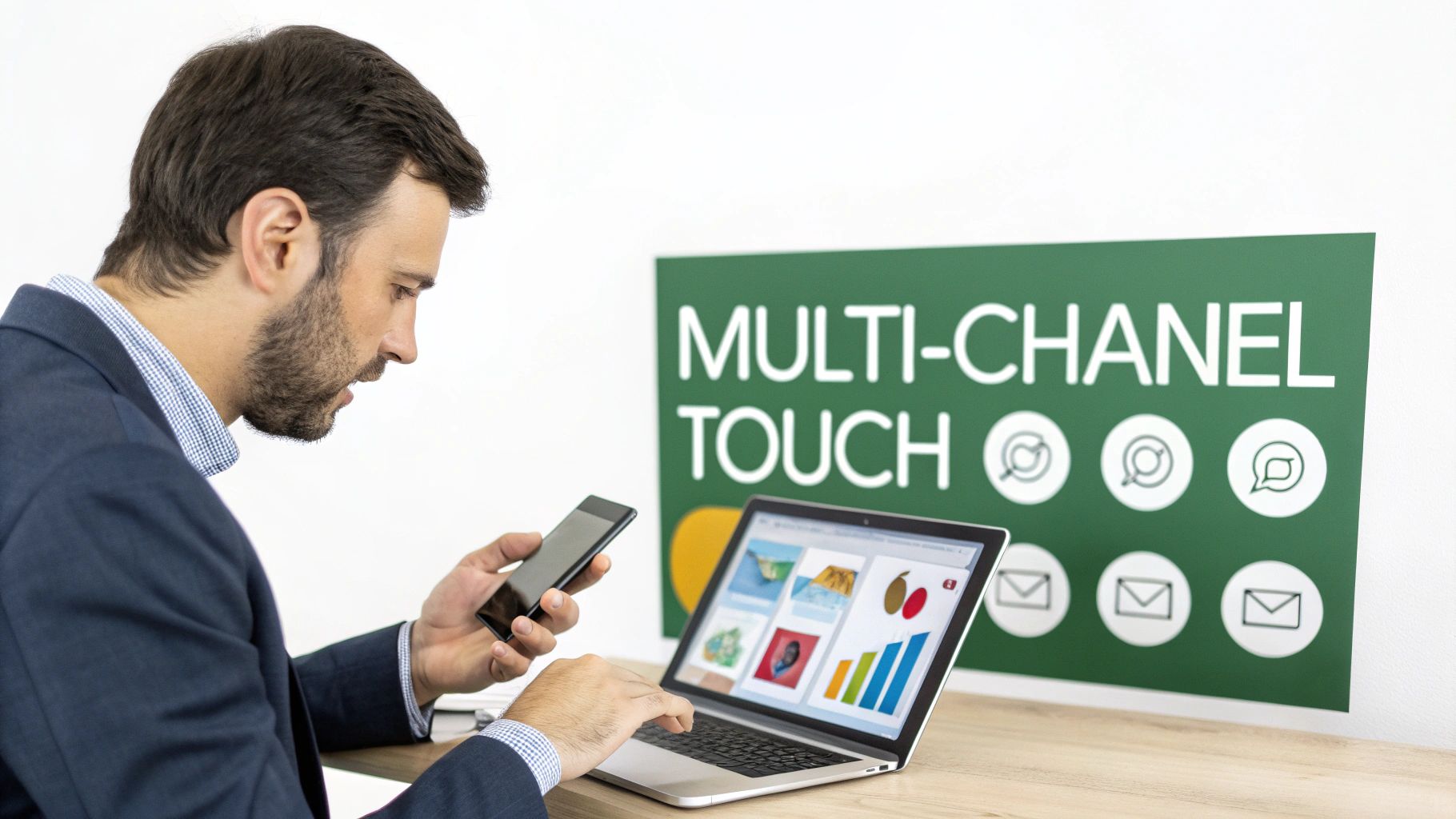
This method acknowledges that prospects live and work across various digital environments. A message that gets lost in a crowded email inbox might capture attention as a concise LinkedIn connection request or a well-timed voicemail. By diversifying touchpoints over a 2-4 week period, you increase the probability of connecting with your prospect on their preferred channel at the right moment.
How to Implement a Multi-Channel Strategy
Implementing this strategy requires thoughtful sequencing and personalization. Leading sales platforms like Outreach.io and Apollo.io have built their success on enabling teams to automate and track these complex sequences, proving the model's effectiveness at scale.
Here are actionable steps to build your own multi-channel cadence:
- Establish a Primary Channel: Start with email as your foundation. It allows for detailed, value-driven messaging and serves as the central pillar of the cadence. To effectively leverage email within your multi-channel approach, explore these 10 Cold Email Best Practices.
- Layer in Social Touches: Use LinkedIn to warm up the engagement. Before sending a connection request, view the prospect's profile or engage with one of their recent posts. This simple action increases name recognition before your first direct outreach.
- Integrate Phone Calls: Add phone calls strategically after the initial email or social touch. A call can be positioned as a follow-up to a specific piece of information you shared, making it feel less like a cold interruption.
- Vary Your Message: Do not just copy and paste the same message across every channel. Each touchpoint should offer a new angle, highlight a different pain point, or provide a unique piece of value. For example, your email might detail a case study, while your LinkedIn message references a mutual connection.
- Track and Optimize: Pay close attention to which channels generate the most engagement. Tools like Salesforce Einstein use engagement scoring to help identify which touchpoints resonate most, allowing you to refine your cadence for different segments.
2. The 5-Step Cadence Model
The 5-Step Cadence Model is a foundational framework in sales, providing a clear, structured sequence for prospect engagement. This approach organizes outreach into five distinct touchpoints over a 2-3 week period, where each step serves a specific, strategic purpose. It moves a prospect logically from initial awareness to a final decision point, ensuring no opportunity is left unaddressed.
This model brings discipline and predictability to the outreach process, making it one of the most reliable sales cadence best practices for teams needing a repeatable system. Instead of random follow-ups, each interaction builds upon the last, guiding the conversation forward with intent. It’s a proven method used by high-performing inside sales teams at companies like Salesforce and Microsoft to standardize their approach and ensure consistent messaging.
How to Implement the 5-Step Cadence Model
Implementing this model requires defining the purpose of each step and tailoring the content to your buyer personas. The structure is simple, but its effectiveness comes from the quality and relevance of the messaging at each stage. Many CRM and sales engagement platforms, like Outreach, even offer pre-built 5-step templates based on this proven methodology.
Here are the actionable steps to build your own 5-step cadence:
- Step 1: Initial Outreach & Value Statement: Your first touchpoint should be concise and focused on a single, powerful value proposition. State the problem you solve and how it relates directly to the prospect's role or industry. The goal is to pique curiosity, not overwhelm with details.
- Step 2: Provide Deeper Insight: In this step, expand on your initial value statement. Share a relevant statistic, a mini-case study, or a key insight that demonstrates your understanding of their challenges. This positions you as a knowledgeable resource.
- Step 3: Introduce Social Proof: Build credibility by sharing evidence of your success. This is the perfect time to link to a detailed case study, mention a well-known client in their industry, or include a powerful testimonial.
- Step 4: Create a Sense of Urgency: This touchpoint introduces a reason to act now. It could be a limited-time offer, an upcoming webinar, or a mention of a relevant industry event. The goal is to prompt a response without being overly aggressive.
- Step 5: The Breakup Email: This is the final, soft attempt before moving the prospect to a long-term nurture sequence. It’s a polite, no-pressure message that lets them know you won't be reaching out again for a while but leaves the door open. To craft this critical final touch, explore different templates for a follow-up email after no response.
3. Personalization-First Cadence
A personalization-first cadence is a highly strategic approach that prioritizes deep prospect research over high-volume outreach. Instead of sending semi-automated messages to a wide audience, this method invests significant time upfront to understand each prospect’s unique context, challenges, and goals. The core philosophy is that one deeply relevant message is more powerful than dozens of generic ones, making it a key component of modern sales cadence best practices.
This approach is particularly effective for high-value deals and account-based marketing (ABM) strategies, where the lifetime value of a single client justifies a greater initial investment. Success is measured not by the number of touches, but by the quality and depth of the engagement generated from each carefully crafted interaction.
How to Implement a Personalization-First Cadence
Executing a personalization-first cadence requires a shift from a quantity mindset to a quality-driven one. It’s less about automation and more about genuine, insightful communication. High-ticket SaaS companies like Slack and top consulting firms have mastered this by treating each prospect as a market of one.
Here are actionable steps to build your own personalization-first cadence:
- Allocate Research Time: Dedicate 30-45 minutes per prospect for deep research before the first touch. Look into their company’s recent news, funding rounds, leadership changes, and personal activity on platforms like LinkedIn.
- Leverage Intent Data: Use tools like 6sense, Demandbase, or Clearbit to identify prospects who are actively researching solutions like yours. This data provides a powerful, timely reason to reach out.
- Lead with Insight, Not a Pitch: Your initial message should offer genuine value or a unique perspective on a problem they are facing. Reference a specific point from a recent article they wrote or a challenge mentioned in their company’s annual report. To see how this translates into messaging, review these examples of how to write highly personalized cold emails.
- Reference Specific Triggers: Tailor your outreach to specific events. Mention a new product launch, a recent executive hire, or a direct quote from a podcast interview. This demonstrates you’ve done your homework and are not just sending a template.
- Focus on Fewer, Better Touches: Instead of a 12-step generic sequence, a personalization-first cadence might only have 3-5 highly relevant touchpoints. Each follow-up should build on the last, referencing previous information and adding new value.
4. Buyer-Stage Adaptive Cadence
A buyer-stage adaptive cadence is a dynamic outreach strategy that tailors the frequency, messaging, and channels to a prospect's current position in the buying journey. Instead of a one-size-fits-all sequence, this approach recognizes that a prospect in the "awareness" stage needs different information than someone in the "decision" stage. This method ensures your outreach is relevant, timely, and aligned with the prospect's mindset, making it one of the most effective sales cadence best practices.
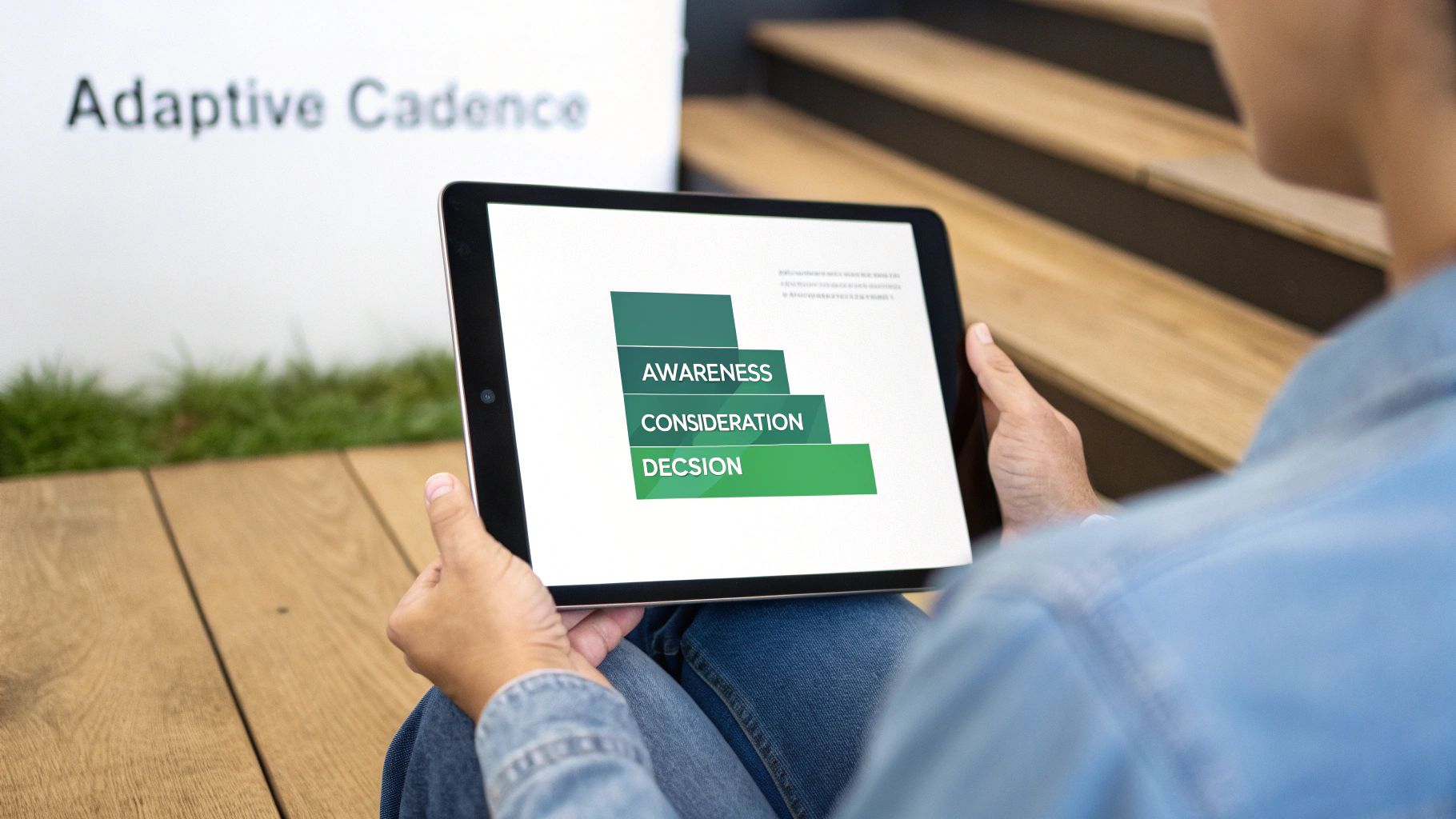
This strategy hinges on segmenting prospects into distinct phases such as Awareness, Consideration, and Decision. By aligning your cadence with these stages, you can deliver educational content to new leads, competitive insights to evaluating prospects, and compelling offers to those ready to buy. This prevents the common mistake of pushing for a demo when a prospect is still just identifying their problem.
How to Implement a Buyer-Stage Adaptive Cadence
Successful implementation requires a clear definition of each stage and automated triggers to move prospects between them. Platforms like HubSpot have popularized this through their lifecycle stage system, while tools like Salesforce Einstein use lead scoring to automate the process based on prospect engagement.
Here are actionable steps to build your own adaptive cadence:
- Define Clear Stage Criteria: In your CRM, establish what actions or attributes define each buying stage. For example, downloading a whitepaper might place a lead in the "Awareness" stage, while visiting a pricing page moves them to "Consideration."
- Create Stage-Specific Cadences: Design separate cadence templates for each stage. The Awareness cadence should be educational and have fewer touches, focusing on value. The Consideration cadence can introduce case studies and ROI data, while the Decision cadence should increase touch frequency with targeted testimonials and calls to action.
- Use Engagement Metrics to Automate Progression: Set up workflows that automatically advance a prospect to the next stage's cadence based on their behavior. A high email open rate or a specific link click can trigger this transition.
- Align Messaging with Intent: Ensure your messaging reflects the prospect's needs at each stage. An awareness-stage email might share a blog post about industry trends, while a decision-stage email could offer a direct comparison against a known competitor.
- Implement Behavioral Triggers: Allow specific high-intent actions, like requesting a demo, to immediately override the current sequence and route the prospect to a sales representative for immediate follow-up.
5. Account-Based Cadence (ABM)
An Account-Based Cadence, a core component of Account-Based Marketing (ABM), shifts the focus from individual leads to high-value target accounts. Instead of a one-to-one outreach, this advanced sales cadence best practice orchestrates a coordinated, multi-stakeholder approach. It aligns sales and marketing efforts to engage multiple decision-makers and influencers within a single organization, treating each account as its own market.
This method is designed for high-stakes, complex sales cycles typical in enterprise B2B environments. The goal is not just to book a meeting with one person but to build consensus and drive engagement across an entire buying committee. Messaging is deeply personalized to the target account’s specific challenges, industry, and strategic goals, creating a unified and highly relevant buying experience.
The power of an ABM cadence lies in its synchronized, multi-threaded nature. While a sales representative engages a VP of Operations, marketing might serve targeted digital ads to the CTO and send a personalized direct mail piece to the CEO. Platforms like 6sense, Demandbase, and Salesforce's Account Engagement (Pardot) are built to manage this level of coordinated outreach, proving its effectiveness for companies like Slack and ServiceNow in landing major enterprise deals.
How to Implement an Account-Based Cadence
Executing a successful ABM cadence requires deep research, tight internal alignment, and a long-term perspective. It's about quality over quantity, focusing dedicated resources on the accounts with the highest revenue potential.
Here are actionable steps to build your ABM cadence:
- Identify and Tier Target Accounts: Select a small, manageable list of high-value accounts (e.g., 20-50) based on your Ideal Customer Profile (ICP). Tier them based on revenue potential to determine the level of personalization and resources each will receive.
- Create Detailed Stakeholder Maps: For each target account, identify all key players in the buying committee. Map out their roles, reporting structures, influence levels, and potential pain points. Use LinkedIn Sales Navigator to uncover these connections.
- Develop Account-Specific Messaging: Craft value propositions and content tailored to the account's unique business needs, recent news, and strategic initiatives. This goes beyond personalizing a first name; it involves creating bespoke case studies, reports, or ROI calculators.
- Align Sales and Marketing: Establish a regular sync between sales and marketing teams to coordinate all touchpoints. Marketing can use intent data to identify buying signals and warm up accounts with targeted ads, content, and events, paving the way for sales outreach.
- Measure Success at the Account Level: Shift your metrics from individual lead conversions to account-level engagement. Track metrics like account penetration (number of engaged contacts), pipeline velocity, and ultimately, deal size and win rates for your target list.
6. Engagement-Based Cadence Acceleration
Engagement-based cadence acceleration transforms a static outreach plan into a dynamic, responsive system that capitalizes on a prospect's real-time interest. Instead of following a rigid, predetermined sequence, this approach automatically adjusts the frequency and nature of touchpoints based on specific prospect actions. When a lead shows buying intent by opening multiple emails, clicking a link, or visiting your pricing page, the cadence accelerates to engage them while their interest is highest.
This method is one of the most effective sales cadence best practices because it aligns your sales efforts directly with the buyer's journey. A prospect who is passively browsing receives a slower, nurturing sequence, while a highly engaged prospect is fast-tracked to a more direct, conversion-focused path. This ensures you invest your most valuable resource, your time, on the opportunities most likely to close.
How to Implement an Engagement-Based Cadence
Successful implementation requires clear triggers and distinct pathways for different engagement levels. Sales engagement platforms like Outreach and Salesloft, alongside automation hubs like HubSpot, are built to execute these conditional workflows, using prospect behavior to dictate the next best action. To further optimize your engagement-based cadences and ensure maximum impact, exploring broader strategies for Account Engagement Best Practice is essential.
Here are actionable steps to build your own engagement-based cadences:
- Define Engagement Thresholds: Establish clear rules that trigger an acceleration. For example, a prospect who opens three or more emails within 48 hours is automatically moved from a low-touch to a high-touch sequence.
- Track High-Intent Signals: Prioritize behaviors that signal strong interest. A visit to the pricing or demo page is a much stronger indicator than a single email open. Set up alerts to immediately notify reps of these high-value actions.
- Create Tiered Pathways: Develop at least two distinct cadence paths: a "low-engagement" track for passive prospects and a "high-engagement" track for active ones. The high-engagement path should include more frequent phone calls and personalized follow-ups.
- Use Behavioral Triggers for Channel Switching: Automate your next move based on specific actions. If a prospect clicks a case study link in your email, the next step in the sequence could be a call from the rep referencing that exact case study.
- Review and Refine Triggers: Monitor the performance of your engagement triggers quarterly. Are your thresholds too sensitive, causing premature acceleration? Or are they too high, causing you to miss opportunities? Adjust based on conversion data.
7. Value-Ladder Cadence Progression
A value-ladder cadence progression is a strategic framework that escalates the value offered to a prospect with each successive touchpoint. Instead of repeating the same core message, this approach systematically builds a compelling business case, moving prospects from initial awareness to a deep understanding of your solution's impact. Each step is designed to deliver increasing value, making it one of the most effective sales cadence best practices for complex B2B sales.
This method mirrors consultative selling principles, where the conversation deepens over time. The cadence begins by establishing relevance and credibility, then introduces a core benefit, demonstrates ROI with hard data, provides social proof, and finally, removes any remaining friction to a decision. This progressive revelation of value builds trust and educates the prospect on why they need to solve their problem now, with your help.
How to Implement a Value-Ladder Progression
Implementing this strategy requires a logical flow where each touchpoint naturally builds upon the last. The key is to map your value propositions to the prospect's buying journey, aligning your outreach with their evolving level of interest and understanding. This approach is central to methodologies like Keenan's Gap Selling, which focuses on progressively uncovering and solving business problems.
Here are actionable steps to build your own value-ladder cadence:
- Step 1: Establish Credibility & Relevance: Your first touchpoint should be low-friction and focused on establishing that you understand their world. Reference a recent industry trend, a competitor's move, or a common challenge relevant to their role to earn their attention.
- Step 2: Introduce the Primary Benefit: Once you have their attention, introduce the primary use case or benefit of your solution. Focus on a single, powerful outcome they can achieve. For example, "Imagine cutting your team's manual data entry by 15 hours a week."
- Step 3: Demonstrate Specific ROI: This is where you introduce quantifiable impact. Share a specific metric, a short case study, or a statistic that proves the business value. An example would be, "Companies like yours use our platform to reduce customer churn by 22% within six months."
- Step 4: Provide Social Proof: Mitigate perceived risk by showing that others trust you. This touchpoint could be a link to a G2 review, a testimonial from a well-known client in their industry, or a detailed case study.
- Step 5: Offer Risk Reversal: Your final value offer should make it easy to say yes. This could be a free trial, a pilot program, a money-back guarantee, or a simple diagnostic call to prove value upfront before any commitment is made.
8. Frequency Optimization Cadence
A frequency optimization cadence moves away from a one-size-fits-all schedule, embracing a data-driven approach to determine how often you should contact a prospect. Instead of relying on gut feelings or fixed intervals like "every two days," this advanced strategy uses historical performance analytics and A/B testing to tailor touchpoint frequency to specific audiences. The core principle is that different segments, industries, and personas respond best to different pacing.
This method transforms your outreach from a rigid script into a responsive, intelligent system. By analyzing what actually works, you can avoid common pitfalls like prospect fatigue from too many touches or losing momentum with too few. A data-backed cadence ensures your outreach feels timely and relevant, significantly improving one of the most critical elements of sales cadence best practices.
How to Implement a Frequency Optimization Cadence
Implementing this strategy requires a commitment to rigorous tracking and continuous testing. Modern sales engagement platforms like Outreach and Salesloft have built-in analytics that make this process accessible, allowing RevOps and sales leaders to pinpoint the optimal contact frequency that drives conversions.
Here are actionable steps to build your own frequency-optimized cadence:
- Establish a Baseline: Start with a standard cadence (e.g., a 10-touch sequence over 15 business days) and track all key metrics, including open rates, replies, meetings booked, and conversions. This becomes your control group.
- Isolate One Variable: Test one change at a time to ensure clear results. Create a variation of your baseline cadence by adjusting only the frequency. For example, test 2-day intervals against 3-day intervals, keeping the channel mix and messaging identical.
- Segment Your Tests: Run tests across different segments to uncover nuanced insights. An aggressive, fast-paced cadence might work for tech startups, while a slower, more deliberate frequency may be better for enterprise accounts in conservative industries like finance.
- Achieve Statistical Significance: Let your tests run for at least 4-6 weeks to gather enough data for a reliable conclusion. Making decisions based on a small sample size can lead to inaccurate assumptions.
- Analyze and Iterate: Go beyond surface-level metrics. A faster cadence might boost open rates but lower meeting quality. Analyze which frequency leads to the most valuable outcomes, like qualified meetings and closed deals.
- Document and Standardize: Once you identify a winning frequency for a specific segment, document it in your sales playbook. This ensures the entire team benefits from these data-driven learnings. Remember to re-test annually as market dynamics and buyer behaviors evolve.
8-Point Sales Cadence Best-Practices Comparison
| Cadence | Implementation complexity | Resource requirements | Expected outcomes | Ideal use cases | Key advantages |
|---|---|---|---|---|---|
| Multi-Channel Touch Strategy | Medium–High — coordinate multiple channels | Moderate–High — tools, content, automation | Higher response rates; better channel attribution | Volume outreach where prospects use multiple channels | Broad reach; improved brand recall; channel performance insights |
| The 5-Step Cadence Model | Low — fixed, repeatable sequence | Low — templates and basic tooling | Predictable baseline engagement and cadence metrics | SDR teams, repeatable outbound plays, training environments | Simple to implement; easy to measure and replicate |
| Personalization-First Cadence | High — deep research per prospect | High — skilled reps, research tools, time per lead | Higher-quality conversations, higher conversion and deal size | Enterprise/ABM, high-ticket sales, executive outreach | Strong relevance; relationship building; higher conversion rates |
| Buyer-Stage Adaptive Cadence | High — dynamic rules and stage logic | High — CRM, lead scoring, automation, monitoring | Improved conversion by matching messaging to stage | Complex B2B funnels with distinct buyer stages | Right message at right time; efficient resource allocation |
| Account-Based Cadence (ABM) | Very High — multi-stakeholder orchestration | Very High — cross-team planning, custom content, ABM tools | Higher win rates and larger deal sizes for target accounts | Strategic enterprise accounts and named account programs | Coordinated influence across stakeholders; account-level focus |
| Engagement-Based Cadence Acceleration | High — real-time triggers and rules | High — analytics, integrations, automation platform | Faster conversions on engaged prospects; better prioritization | Leads showing intent signals; event or content responders | Strikes while interest is high; prioritizes sales-ready leads |
| Value-Ladder Cadence Progression | Medium–High — careful sequencing of value | Medium — content and planning per step | Steady build of case; fewer objections; higher decision intent | Consultative selling and mid-to-high ticket offers | Progressive value delivery; reduces friction and objections |
| Frequency Optimization Cadence | High — A/B testing and analytics driven | High — historical data, analytics tools, test time | Optimized response rates and reduced prospect fatigue | Data-driven orgs with volume outreach and segmentation | Eliminates guesswork; continuous improvement; segment-specific pacing |
Bringing It All Together: Your Next Steps in Cadence Mastery
We've explored a comprehensive array of sales cadence best practices, moving from foundational structures like the 5-Step Model to sophisticated, dynamic approaches such as Engagement-Based Cadence Acceleration and the Value-Ladder Progression. The central theme connecting all these strategies is the shift from a one-size-fits-all, volume-based approach to a highly strategic, buyer-centric system of engagement. Your outreach is no longer a series of isolated shots in the dark; it's a choreographed conversation designed to build trust and guide prospects toward a solution.
The most critical takeaway is that a sales cadence is not a rigid, static script. It is a living, breathing framework that must adapt to your audience, your product, and the real-time feedback you receive from the market. Mastering these concepts means committing to a continuous cycle of implementation, measurement, and refinement.
Synthesizing the Strategies for Maximum Impact
The true power of these sales cadence best practices emerges when you begin to combine them. A world-class sales organization doesn't just pick one model and stick with it. Instead, they build a hybrid system tailored to their specific go-to-market motion.
Consider this practical application:
- For Tier 1 Target Accounts: You might deploy an Account-Based Cadence (ABM), incorporating deep research and the Personalization-First model for key decision-makers within that account.
- For Tier 2 Inbound Leads: An Engagement-Based Cadence is perfect here, allowing you to automatically accelerate outreach for leads who show high intent by opening emails or visiting your pricing page.
- For Tier 3 Broader Outreach: A refined 5-Step Cadence Model using a Multi-Channel Touch Strategy can be scaled effectively, ensuring consistent coverage without requiring intensive personalization for every single contact.
This tiered approach allows you to allocate your most valuable resource, time, to the opportunities with the highest potential return. It's about working smarter, not just harder, and letting data-driven insights guide your every move.
Your Action Plan for Cadence Optimization
Transforming theory into pipeline requires a clear plan. Here are the actionable next steps you can take to implement these sales cadence best practices and elevate your outreach game:
- Audit Your Current Process: Before building something new, understand what is and isn’t working. Analyze your current touchpoints, channel mix, and conversion rates at each stage. Identify the biggest drop-off points.
- Segment Your Audience: Don't try to build a universal cadence. Start by segmenting your total addressable market into logical tiers based on ideal customer profile (ICP) fit, potential deal size, or strategic importance.
- Select and Test Two Models: Choose two of the models discussed in this article that best fit your segments. For example, pilot a Personalization-First cadence for your top 20 target accounts and a Frequency Optimization Cadence for a broader list.
- Define Your Metrics for Success: Establish clear KPIs before you launch. Key metrics to track include reply rates, meeting booked rates, pipeline generated, and sales cycle length. This is non-negotiable for effective iteration.
- Leverage Technology for Foundation and Scale: The success of any cadence hinges on the quality of your data. A perfectly crafted message sent to the wrong person is wasted effort. Ensure every touchpoint has the maximum chance of success by starting with verified contact information.
Ultimately, adopting these sales cadence best practices is about creating a predictable and scalable engine for revenue growth. It's the difference between hoping for replies and engineering conversations. By moving beyond generic outreach and embracing a strategic, multi-layered approach, you empower your sales team to connect with more of the right people, in the right way, at the right time. The result isn't just more meetings; it's a stronger pipeline filled with better-qualified opportunities.
Before you build your next cadence, ensure every message has a chance to be read. Start with a foundation of accurate data using EmailScout, the essential tool for finding verified email addresses in seconds. Stop wasting time on bounced emails and start connecting with the decision-makers who matter by trying EmailScout today.