
Sending a follow up email after no response is a must. Why? Because most first attempts get lost in the noise. A single, well-timed nudge can nearly double your reply rate. The trick is to stop thinking of it as nagging and start seeing it as a helpful, professional reminder.
Why Your First Email Is Rarely Enough
Let's be honest—your first email probably landed in a packed inbox. It’s nothing personal; it’s just the reality of business today. Most professionals are swimming in dozens, if not hundreds, of emails every single day. The magic isn't in crafting one flawless message. It’s in the art of the persistent, value-driven follow-up.

This simple fact should dismantle any fear you have of being "annoying." When you do it right, a follow-up is a professional courtesy—a helpful signal in a sea of digital chaos. If you want to go deeper on this, there’s a great guide covering exactly how to follow up on an email with no response.
Understanding the Silence
People don't reply for all sorts of reasons, and most of them have absolutely nothing to do with you or what you're offering. Getting a handle on these reasons is the first step toward building a much smarter follow-up strategy.
Radio silence usually comes down to a few common culprits:
- A Buried Email: Your message simply got pushed down by a flood of more urgent tasks.
- Bad Timing: They saw it, but were walking into a meeting or putting out a fire.
- Needs More Info: They might not be the right person, or maybe they need to run it by their team first.
- They Just Forgot: It happens. They fully intended to reply, got pulled into something else, and it slipped their mind.
To help structure your approach, here’s a quick reference table.
Quick Guide to Effective Follow-Ups
This table breaks down the core principles for crafting follow-ups that actually get a response. Keep these in mind every time you hit "send."
| Principle | Actionable Tip |
|---|---|
| Provide Context | Always reply in the same email thread to keep the original message visible. |
| Add Value | Offer a new piece of information, a helpful resource, or a relevant article. Don't just ask "did you see this?" |
| Keep It Brief | Your follow-up should be shorter and more scannable than your first email. Think 2-3 sentences. |
| Be Politely Persistent | Space out your follow-ups over a few weeks. A gentle nudge is better than a constant barrage. |
| Know When to Stop | If you've sent 3-4 follow-ups with no reply, it's often best to move on and focus your energy elsewhere. |
Think of these tips as your fundamental playbook. Sticking to them will ensure your follow-ups feel helpful, not harassing.
A follow-up email after no response isn’t a sign of failure; it’s your biggest opportunity. It shows you're organized, persistent, and genuinely believe in the value you're offering.
The data really drives this home. A staggering 70% of initial cold emails are never followed up. That's a massive missed opportunity, especially when sending just one more message can boost reply rates by nearly 50%.
Despite this, about 48% of sales pros never send a second message. This gap between what works and what people actually do is precisely where you can get a huge advantage.
Getting Your Follow-Up Timing and Cadence Right
Knowing when to send a follow-up email after no response is more of an art than a science. Go in too hot, and you risk looking desperate or, even worse, annoying. But if you wait too long, whatever spark of interest was there will have gone cold, and you’re back to square one.
The real key is to move past generic advice like "wait three days." A truly effective follow-up schedule—or cadence—is all about context. A hot lead who just saw your product demo needs a much quicker, more persistent approach than a casual networking contact you met a month ago.
The Standard Follow-Up Cadence
For most situations, a simple, structured cadence is a great place to start. It’s designed to keep you on their radar without clogging up their inbox.
Here’s a common sequence that just works:
- Day 1: Your initial email goes out.
- Day 3: Time for the first follow-up. Keep it simple—a gentle bump in the same email thread is perfect for providing context.
- Day 7: Send your second follow-up. This time, add some new value. A link to a relevant case study or a helpful article works wonders.
- Day 14: The third follow-up lands. You can switch gears here, maybe ask if there's someone else on their team who would be a better fit for this conversation.
- Day 28: Still crickets? Send one last "break-up" email. This politely closes the loop and lets them know you won't be in touch again unless they reply.
This spaced-out approach shows polite persistence and helps you avoid inbox fatigue.
Why Persistence Actually Works
It can feel awkward sending email after email into the void, but the data doesn't lie: persistence pays off. Big time.
In fact, studies have shown that only about 2% of sales happen on the first contact. It's a shocking number, but it gets better. A whopping 80% of successful sales require at least five follow-up attempts. We've seen that campaigns with just two or three follow-ups, spaced a few days apart, hit a sweet spot with high reply rates and very few unsubscribe complaints.
The goal of a follow-up isn't just to get a reply; it's to stay top-of-mind so when the timing is right for them, you're the first person they think of.
At the end of the day, your cadence should feel natural, not like you're running an automated script. Look for the little clues. If you see an email was opened multiple times with no reply, that might signal interest but bad timing—a perfect reason to follow up. A smart strategy often goes beyond just email, incorporating different channels and consistent communication. To dig deeper into converting leads, check out these proven follow-up strategies for leads.
Knowing when to nudge and when to walk away is what protects your reputation and lets you pour your energy into prospects who are actually ready to talk.
Crafting Subject Lines That Actually Get Opened
Let's be real: your entire follow-up effort lives or dies in the subject line. If you send a follow up email no response is pretty much guaranteed when your subject line is a predictable snooze-fest.
We've all seen them. "Checking In." "Following Up." These are the digital equivalent of junk mail—they get deleted on sight. Your goal isn't to blend in; it's to spark just enough curiosity to earn a click.
A great subject line is your foot in the door. It should feel familiar, teasing a past conversation or hinting at new value. It needs to be short, punchy, and make perfect sense on a phone screen. Think of it as the headline for your pitch—it has to be compelling.
Here's a simple cadence to keep in mind for your follow-up sequence. It’s all about staying top-of-mind without becoming a nuisance.
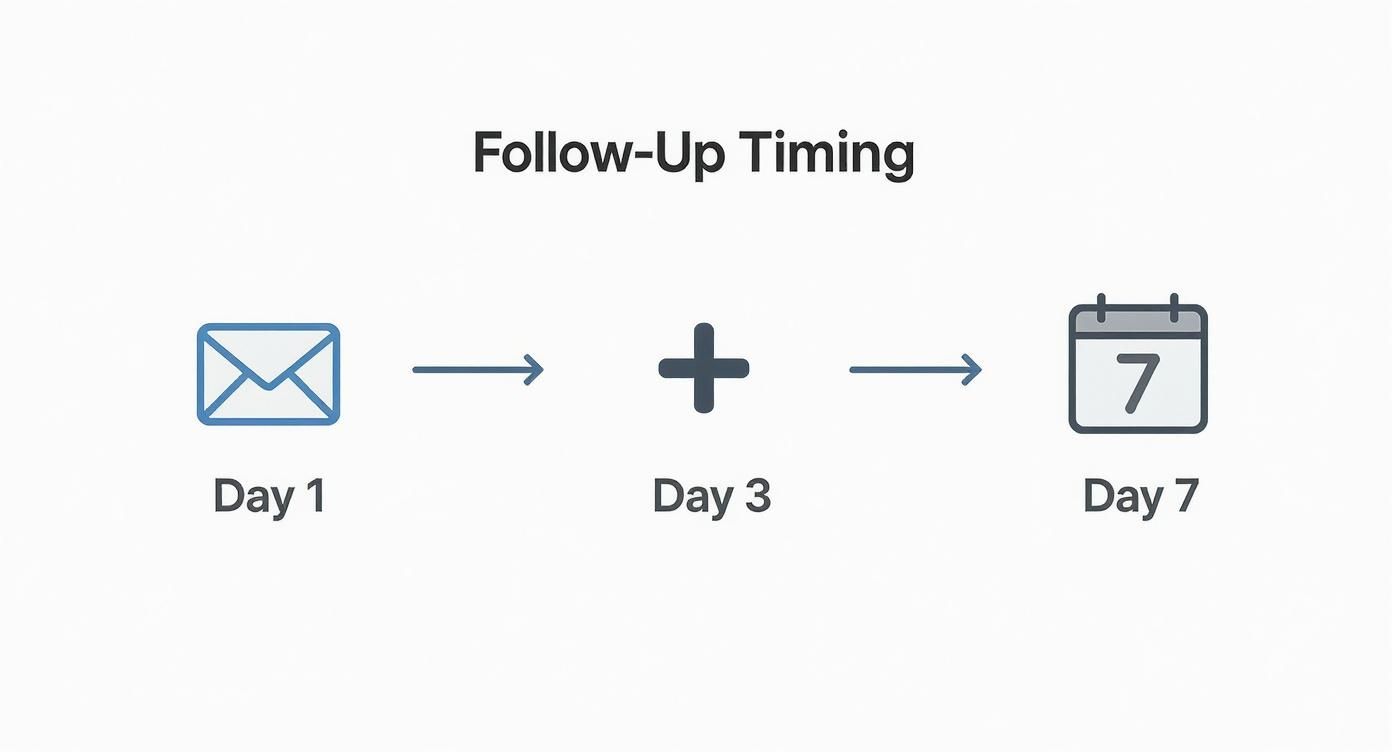
This visual breaks down a proven rhythm: the first email, a light touchpoint a couple of days later, and another value-add within a week. This structure prevents you from getting lost in the noise of a crowded inbox.
Formulas That Drive Opens
You don't need to reinvent the wheel every single time. Instead, lean on a few battle-tested formulas that you can adapt to pretty much any situation.
- Reference + Value: Kick things off with a quick reminder of your last chat, but immediately add a fresh piece of info. This proves you’re not just chasing them—you're offering something.
- Example: "Our chat about logistics + a resource I found"
- Question + Context: Drop a direct question that forces them to recall a specific challenge or goal you discussed. It makes them think, which is half the battle.
- Example: "Any thoughts on the Q3 marketing proposal?"
- Benefit-Driven: Lead with a clear win for them. This should speak directly to a pain point they mentioned or a goal you know they have.
- Example: "A quick idea to help [Company Name] with [pain point]"
The best subject lines feel less like an automated sequence and more like a personal note from a helpful colleague. They give context and create a bit of urgency without being obnoxious.
Ready-To-Use Subject Line Examples
Here are a few specific, no-fluff subject lines you can steal for your next follow up email no response scenario. Notice they're all short, to the point, and pique a little interest.
- Re: Our call on Tuesday
- Next steps for [Project Name]
- A thought about your team's goal
- Can you point me in the right direction?
- [Their Company] + [Your Company]
Each of these is designed to be instantly recognizable and relevant in a busy inbox. When you ditch the generic follow-up scripts and adopt these smarter approaches, you’ll see a real difference in your open rates.
To dive deeper, check out our complete guide on email subject line best practices for more advanced strategies. The trick is to always be clear, be concise, and add value—starting with the very first thing they see.
Field-Tested Follow-Up Email Templates
Staring at a sent email with no reply can feel… awkward. You need to follow up, but what do you even say? The last thing you want is to come across as a pushy pest.
The trick is to have a simple playbook you can pull from. Think of these less as rigid scripts and more as starting points you can tweak to fit your own voice and situation.

Each one has a specific job to do, from a quick and easy nudge to a polite, final check-in. The goal is always the same: keep it brief, keep it clear, and most importantly, keep it human.
The Gentle "Bump" Email
This is your first move, usually 2-4 days after your initial email went out. Its only purpose is to pop your original message back to the top of their inbox. That's it. No new information, no extra work for them.
Subject: Re: [Original Subject]
Hey [First Name],
Just wanted to follow up on my previous email. Is this something you've had a chance to think about?
Thanks,
[Your Name]
Why it works: It’s completely low-pressure. By replying in the same thread, you give them instant context without making them search for your first message. You're just making it easy for them to respond.
The Value-Add Follow-Up
Okay, the gentle bump didn't get a reply. Time for a new angle. About 3-5 days later, shift from "just checking in" to "genuinely trying to help." Find a resource—an article, a case study, maybe a cool tool—that speaks directly to a challenge you know they're facing.
Subject: A thought about [Their Goal/Challenge]
Hi [First Name],
I was thinking about our conversation around [topic] and came across this article on [relevant subject]. Thought you might find it useful.
[Link to Resource]
No need to reply, just wanted to share.
Best,
[Your Name]
Why it works: This move instantly reframes you as a helpful expert, not just another salesperson. That little "no need to reply" line is gold—it removes all pressure and builds goodwill, making them far more likely to engage later on.
The "Wrong Person" Redirect
Sometimes, radio silence just means you've knocked on the wrong door. It happens. This template is a simple, polite way to ask for directions without making your contact feel like they messed up.
Subject: Can you point me in the right direction?
Hi [First Name],
I'm writing to follow up on my previous email about [topic]. I haven't heard back and wanted to check if you're the right person to discuss this with.
If not, could you please let me know who might be?
Thanks for your help,
[Your Name]
The Final "Break-Up" Email
You've sent 3-4 follow-ups over a few weeks and heard nothing but crickets. It's time to politely close the loop. This email creates a little respectful urgency and, funny enough, often gets a response from people who were interested but just got buried in work.
Subject: Closing the loop
Hi [First Name],
I've reached out a few times regarding [topic] but haven't heard back, so I'll assume it's not a priority for you right now.
I'm closing your file on my end, but please feel free to reach out if anything changes in the future.
Wishing you and the [Company Name] team all the best.
Regards,
[Your Name]
Why it works: It's professional, it cleans out your pipeline, and it shows you respect their time. The psychology of "closing the file" is powerful; it often triggers a quick "Sorry, been swamped!" reply that can restart the conversation.
Follow-Up Template Selector
Not sure which template fits your situation? This quick table breaks down when to use each one and what you’re trying to accomplish.
| Template Type | Best For… | Key Objective |
|---|---|---|
| Gentle "Bump" | Your first follow-up (2-4 days after initial email). | Resurface the original message without pressure. |
| Value-Add | Your second or third follow-up. | Re-engage by offering something helpful and relevant. |
| "Wrong Person" | When you suspect you're not talking to the decision-maker. | Get a referral to the correct contact. |
| Final "Break-Up" | After multiple unanswered attempts. | Politely close the loop and prompt a final response. |
Ultimately, the best templates are the ones you make your own. For even more ideas, check out this great collection of proven cold email examples—many can be adapted for follow-up situations. The key is to build a sequence that feels organized on your end and authentic on theirs.
Personalizing Follow-Ups at Scale
Once you have a solid cadence and reliable templates, the real magic happens. It’s time to make your outreach feel less like a campaign and more like a one-on-one conversation.
Personalization is what separates a forgettable follow up email no response from one that actually sparks a connection. And the good news? You don’t have to manually craft every single message to pull this off.
The trick is to use technology to amplify human connection, not replace it. A great place to start is using simple triggers as a natural excuse to reconnect. Did your prospect just share a great article on LinkedIn? Did their company announce a new round of funding? These are perfect, non-intrusive reasons to pop back into their inbox with a message that feels timely and relevant.
Using Technology to Your Advantage
Let’s be real: manually tracking dozens of prospects for these kinds of triggers is a non-starter. This is where a few simple tools can make a massive difference, letting you personalize your approach without spending all day on research.
When you use the right platform, you can automate a huge chunk of this process. It saves you time and makes your follow-ups much, much smarter.
- Email Tracking: Always use tools that tell you when an email is opened or a link is clicked. This insight is gold. Multiple opens with no reply often mean they’re interested, but the timing is off. That’s your cue to follow up.
- Social Media Alerts: Set up alerts for key contacts or their companies. A quick note like, "Congrats on the recent launch—saw the news on TechCrunch!" is infinitely more powerful than a generic "just checking in" email.
- Automated Cadences: Don't mistake automation for being robotic. Good software can handle the timing of your sequence, so nobody falls through the cracks. This frees you up to focus on crafting those personalized snippets that make all the difference.
Personalization at scale isn't about faking a connection. It's about using data and triggers to find authentic moments to restart a conversation. It proves you're paying attention.
Finding the Right Outreach Platform
Choosing the right software is a critical piece of the puzzle. You need a tool that can juggle your sequences, track engagement, and—ideally—help you find new prospects in the first place. An integrated approach saves a ton of time you'd otherwise spend bouncing between different apps.
For anyone managing serious outreach, finding the best cold email software is a total game-changer. These platforms often bundle prospect discovery, sequence automation, and analytics into a single workflow.
This lets you build a sophisticated follow-up machine that runs efficiently in the background, giving you more time to focus on the high-value work: building relationships and closing deals.
Answering Your Top Follow-Up Questions
Let's be honest, navigating the world of follow-ups can feel a bit awkward. You want to be persistent, but you definitely don't want to be that person who clogs up someone's inbox. It's this gray area where most of us get stuck.
Below, I’ll clear up some of the most common questions that come up when a follow up email no response is what you're dealing with. The goal is to give you simple, direct answers so you can hit "send" with confidence.
How Many Follow-Up Emails Is Too Many?
There's no single magic number here, but my experience shows a sequence of 3-5 follow-ups, spaced out over a few weeks, is a solid baseline. The golden rule? Add a little bit of value with every single message.
If you've sent four or five emails and have gotten crickets—no opens, no clicks, nothing—that's a pretty clear sign. It’s time to send a polite "break-up" email to close the loop and move on. Your energy is better spent on prospects who are actually engaging.
Should I Reply in the Same Thread or Start a New One?
Always, always, always reply in the same email thread. This one isn't really up for debate.
Keeping everything in one continuous chain is a game-changer for two reasons:
- It provides instant context. Your recipient doesn’t have to dig through their inbox to remember who you are or what you first messaged them about. It’s all right there.
- It feels less aggressive. A new thread for every follow-up looks spammy and just clutters their inbox. It’s a bad look.
Replying in the same thread is a simple courtesy that makes it way easier for the other person to respond. You're respecting their time and their inbox, which goes a long way.
What Is the Best Time of Day to Send a Follow-Up?
While this can shift depending on the industry and someone's specific role, data consistently points to a few sweet spots during the workweek. Tuesdays, Wednesdays, and Thursdays almost always outperform Mondays and Fridays.
The best times of day are usually:
- Mid-morning (around 10 AM)
- Mid-afternoon (around 2 PM)
These windows tend to catch people after they’ve settled into their day but before they’ve started winding down. Definitely avoid sending important emails late at night or on the weekend—they're just going to get buried.
How Can I Follow Up Without Sounding Annoying?
The secret is to change your mindset from "just checking in" to "genuinely adding value." This is what separates a helpful professional from a pest. Instead of simply asking if they saw your last email, offer them something new and useful.
For example, you could share a link to a relevant article, pass along a helpful industry insight, or point them to a case study that solves a pain point you think they have. This simple shift positions you as a resource, not just another person asking for their time. Every message becomes a small, helpful gesture.
Ready to stop guessing and start connecting? With EmailScout, you can find the verified email addresses of decision-makers in seconds, directly from your browser. Build targeted outreach lists and streamline your workflow with our powerful Chrome extension. Find unlimited emails and supercharge your sales and marketing efforts today. Start for free at https://emailscout.io.