

Ever feel like your sales team is spinning its wheels? It’s a common frustration. But the problem usually isn't a lack of effort—it's a lack of focus.
When your reps are busy chasing down every single lead that comes in, they’re not really selling. They’re just staying busy. Chasing unqualified prospects wastes an incredible amount of time, tanks team morale, and throws your sales forecasts completely out of whack.
Let's fix that. We'll walk through how to qualify sales leads by defining exactly who you want to talk to, setting up a smart scoring system, and using proven frameworks to guide your sales conversations.
Why Qualifying Sales Leads Is a Non-Negotiable
Treating every inbound inquiry or contact form submission as a hot lead feels productive on the surface. In reality, it’s a fast track to burnout and missed quotas.
When sales reps spend their days calling prospects who have no budget, no authority to make a decision, or no genuine need for your solution, they aren’t closing deals. This inefficiency hits your bottom line hard, driving up what you spend to get each new customer. If you’re not sure how those costs add up, you can check out our handy guide on calculating customer acquisition cost to see just how much unqualified leads can hurt your numbers.
The data here is pretty stark. A staggering 67% of lost sales can be chalked up to reps not qualifying their leads properly. Let that sink in. Nearly two-thirds of deals that fall apart could have been saved if the right questions were asked from the get-go.
It doesn’t stop there. Roughly 75% of marketing leads are never a good fit for a sales conversation, and 79% of those will never convert. By simply learning to disqualify these poor-fit leads early, your team can reclaim about 32% of their time. That’s a huge chunk of the week they can now spend on leads that actually have potential.
Moving Beyond Busy Work
So, what’s the alternative to the "chase everything" approach? It’s all about creating a strategic filter that separates the real opportunities from the time-wasting distractions. This is what effective lead qualification is all about.
When you get this right, your sales team can finally prioritize their efforts with precision. They move from a scattergun approach to a focused strategy, dedicating their energy to building relationships with prospects who are a genuinely great fit for what you offer.
The benefits pop up almost immediately:
- Faster Sales Cycles: Reps spend less time on dead-end conversations and more time moving real deals through the pipeline.
- Happier, More Motivated Reps: Nothing kills motivation faster than constant rejection from unqualified prospects. Focusing on winnable deals keeps morale high.
- Forecasts You Can Actually Trust: When your pipeline is filled with properly vetted opportunities, your revenue predictions become far more reliable.
- Higher Close Rates: By engaging with prospects who have a clear need and the ability to buy, your team's conversion rate naturally goes up.
To give you a clearer picture, let's lay out the basic pillars of a solid qualification framework.
Your Lead Qualification Framework at a Glance
This table breaks down the core components of an effective lead qualification process, giving you a high-level overview of the strategy before we dive into the details.
| Framework Pillar | Key Objective | Primary Action |
|---|---|---|
| Ideal Customer Profile (ICP) | Define the "perfect" customer company | Analyze your best existing customers to identify common attributes (industry, size, revenue). |
| Buyer Persona | Understand the individual decision-makers | Create detailed profiles of the key roles involved in the buying process (e.g., goals, challenges). |
| Qualification Framework | Standardize the discovery process | Implement a proven model like BANT, MEDDIC, or CHAMP to ask consistent, targeted questions. |
| Lead Scoring | Prioritize leads based on fit and interest | Assign points to leads based on their demographic data and their actions (e.g., website visits). |
This framework provides the structure your team needs to stop guessing and start selling with intention.
The core idea is simple but powerful: stop treating every lead equally. By learning how to qualify sales leads effectively, you empower your team to work smarter, not just harder, transforming your entire sales operation from the ground up.
Define Your Ideal Customer Profile
Before your team even thinks about picking up the phone, the most critical work has already started. Effective lead qualification isn't just about asking good questions—it's about knowing exactly who you should be talking to in the first place.
This is where your Ideal Customer Profile (ICP) comes in.
Think of your ICP as a blueprint for the perfect company for your product. It’s not just a vague idea of your target market. It's a specific, data-driven definition that becomes the north star for your entire sales and marketing operation. Without a clear ICP, your team is flying blind, wasting time on leads that were never going to convert.
The best way to build this? Look at your existing customers. Who are your happiest, most successful clients? The ones who renew without a fuss and send you glowing testimonials? They hold all the answers.
Look for Common Threads in Your Best Customers
Start by listing your top 10-20 customers. Now, it's time to play detective and figure out what makes them so great. You're searching for shared attributes you can use to spot similar companies out in the wild.
A truly powerful ICP goes way beyond basic demographics. It's multi-dimensional.
- Firmographics: This is the basic company data. What do they have in common? Look at industry, company size, annual revenue, or location. You might find your sweet spot is B2B SaaS companies with 50-250 employees in North America.
- Technographics: What's in their tech stack? Do they all use Salesforce, HubSpot, or AWS? This tells you about their technical maturity and whether they can even integrate with your solution.
- Psychographics: Now you're getting into their heads. What were their biggest headaches before they found you? What goals were they trying to hit? Understanding their pain points helps you craft a message that resonates.
Analyzing these layers transforms a generic target into a crystal-clear picture of your ideal fit.
Build a Real-World ICP Example
Let's say you run a SaaS company that sells project management software to creative agencies. After digging into your best accounts, your ICP might look something like this:
| ICP Criteria | Ideal Profile Specification |
|---|---|
| Industry | Digital Marketing & Advertising Agencies |
| Company Size | 20-100 employees |
| Annual Revenue | $2 million – $15 million |
| Geography | United States, Canada, UK |
| Tech Stack | Uses Slack for comms, Google Workspace for collaboration, and HubSpot for their CRM. |
| Pain Points | Struggles with managing client feedback, tracking project profitability, and hitting deadlines. |
| Buying Triggers | Recently hired a "Head of Operations" or is actively posting jobs for Project Managers. |
This detailed profile becomes an invaluable filter. When a new lead from a 300-person manufacturing firm in Brazil comes in, your team knows instantly it's not a priority. That simple check saves them countless hours.
Your ICP isn't just a marketing document; it's a strategic sales tool. It empowers your reps to disqualify poor-fit leads confidently and quickly, freeing them to focus their energy where it matters most—on prospects who look just like your best customers.
Distinguish Between Fit and Intent
With your ICP defined, you can qualify leads on two critical axes: fit and intent.
- Fit is how well a lead matches your ICP. Do they check the boxes for industry, size, and tech? This is the first gate.
- Intent is all about their behavior. Have they visited your pricing page, requested a demo, or downloaded a case study? These actions signal they are actively looking for a solution.
A lead could be a perfect ICP fit but show zero buying intent. They're a great prospect to nurture for the future, but not a hot lead for today. On the flip side, someone might request a demo (high intent) but work for a company that's a terrible fit. That's a lead to disqualify quickly to avoid a frustrating sales process for everyone.
The sweet spot is where high fit meets high intent. These are the leads your sales team should jump on immediately. This is the first and most critical step in learning how to qualify sales leads effectively.
Implement a Practical Lead Scoring System
Knowing who your ideal customer is only half the battle. The other half is actually finding them in the flood of leads that come in every day. This is exactly where a lead scoring system shines. It’s a simple but powerful method of assigning points to leads, ranking them by how likely they are to actually become customers.
Instead of your sales team manually digging through every single form submission, a lead scoring model automatically pushes the hottest prospects right to the top. It’s a data-driven way to make sure your team consistently spends their time on leads with the highest chance of converting.
Think of it as a bouncer for your sales pipeline. A lead has to rack up enough points to get past the velvet rope and earn a conversation with a sales rep. This process is absolutely essential if you want to build a sales pipeline filled with real opportunities instead of just noise.
Differentiating Explicit and Implicit Data
A solid lead scoring system needs to balance two kinds of information: what people tell you directly, and what their actions tell you indirectly.
Explicit Scoring: This is all about the data a lead gives you willingly. It's the firmographic and demographic info that tells you if they're a good fit for your product.
- Job Title: A "Director of Marketing" might get +15 points, while an "Intern" gets 0.
- Company Size: If your sweet spot is businesses with 50-200 employees, leads in that range could get +20 points.
- Industry: A lead from a target industry like "B2B SaaS" could earn +10 points.
Implicit Scoring: This is all about behavior, which signals a lead's intent to buy. These are the digital breadcrumbs that show how engaged they are with your brand.
- Website Behavior: Visiting your pricing page is a huge sign of interest, easily worth +20 points.
- Content Engagement: Requesting a product demo? That's a massive buying signal, worth at least +25 points.
- Email Interaction: Just opening a marketing email might be worth +2 points, while clicking a link inside is a stronger signal worth +5.
The infographic below shows how these two types of criteria come together to qualify a lead.
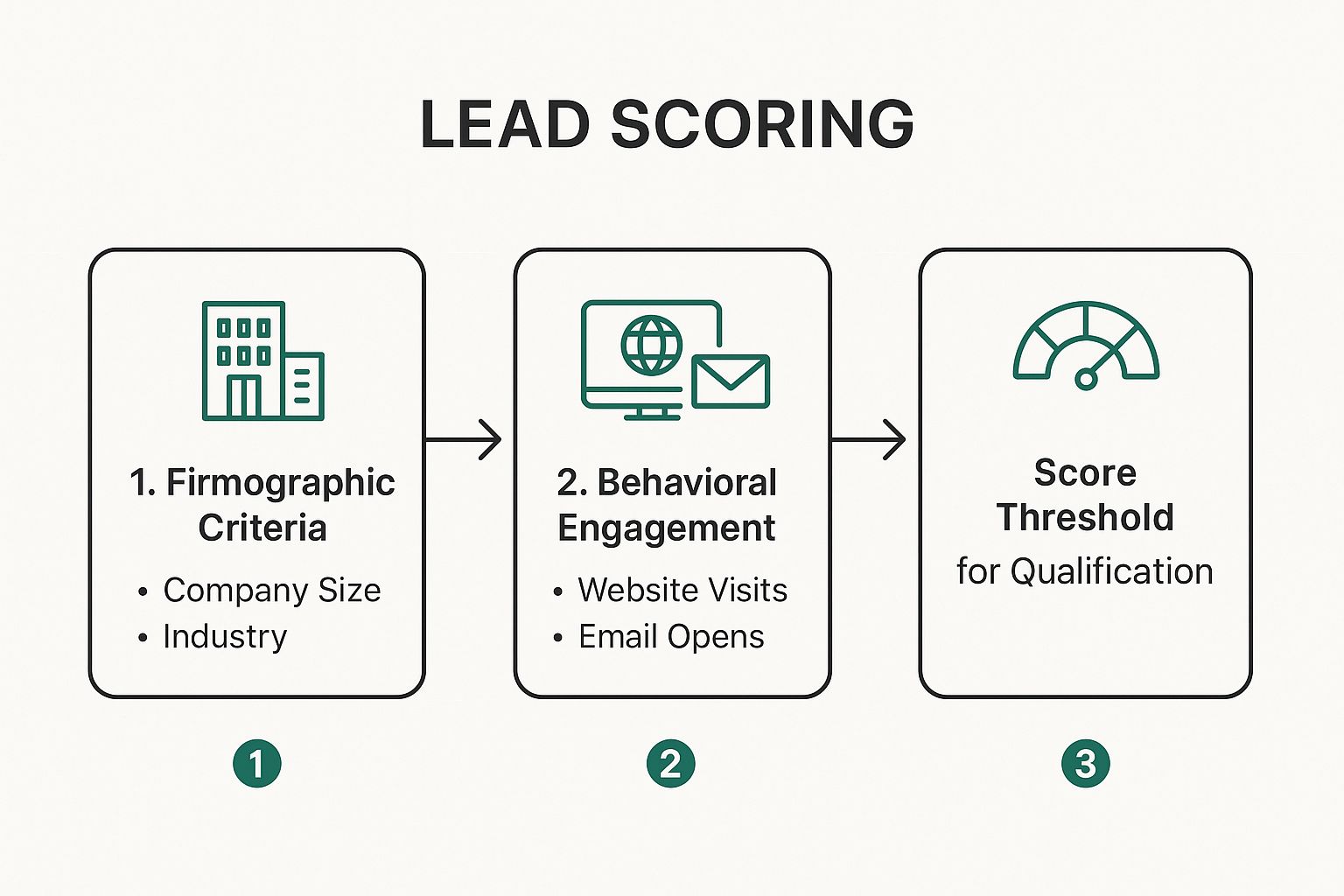
This simple flow highlights a powerful truth: the best leads are always a mix of a strong profile fit and active buying signals.
Let’s look at a concrete example. Here’s a sample model you could adapt for a B2B SaaS company trying to filter its inbound leads.
Sample Lead Scoring Model for a B2B SaaS Company
| Category | Criteria | Points Awarded |
|---|---|---|
| Explicit (Fit) | Job Title (Manager or above) | +15 |
| Company Size (50-500 employees) | +20 | |
| Industry (Technology, Marketing) | +10 | |
| Using a competitor's technology | +5 | |
| Implicit (Intent) | Visited Pricing Page | +20 |
| Requested a Demo | +25 | |
| Downloaded a Case Study | +10 | |
| Clicked a link in an email | +5 | |
| Negative Score | Email domain is "gmail.com" or "yahoo.com" | -10 |
| Unsubscribed from email list | -50 | |
| Job Title includes "Intern" or "Student" | -20 |
This table makes it clear how different attributes and actions can be weighted. A "Marketing Manager" from a 100-person tech company who requested a demo would quickly hit a high score, while a student with a Gmail address would be filtered out.
Setting Your Qualification Threshold
Once you start assigning points, you need to decide what score makes a lead "sales-ready." This magic number is your qualification threshold. For instance, you might decide that any lead who hits 75 points gets automatically sent to a sales development rep (SDR) for immediate follow-up.
This number shouldn't be pulled out of thin air. You'll need to analyze your past sales data to find the sweet spot. It's also important to remember that not all qualified leads are the same.
In fact, surveys show 46.4% of sales pros prefer Product Qualified Leads (PQLs)—people who have actually used the product—over any other type. Sales Qualified Leads (SQLs) come next at 37.5%, with Marketing Qualified Leads (MQLs) trailing at 16.1%. If you have a free trial or freemium model, your scoring should absolutely reflect this by giving more weight to in-product actions.
Using Negative Scoring to Filter Out the Noise
Just as you award points for good signs, you should also subtract them for red flags. This is called negative scoring, and it's your secret weapon for automatically disqualifying poor-fit leads before they ever reach your sales team.
Think of it this way:
Negative scoring is your system's immune response. It actively identifies and weeds out leads that would otherwise waste your sales team's valuable time, keeping your pipeline healthy and focused.
Here are a few classic examples where negative scoring is a lifesaver:
- Student or Personal Emails: A lead using a "gmail.com" or ".edu" email address might get -20 points.
- Competitor Snooping: If a lead's domain matches a known competitor, you can hit them with -50 points to keep them out of your pipeline.
- Going Cold: A lead who hasn't opened an email in 90 days could have -15 points applied to lower their priority.
- Wrong Department: If your software is for engineers, a lead with "Human Resources" in their title could get -10 points.
By combining positive and negative scores, you create a dynamic system that doesn't just rank leads—it actively cleans your database. This way, when a lead finally hits that qualification score, your sales team can engage with total confidence.
Master Qualification Frameworks Like BANT and MEDDIC

Once your ideal customer is defined and leads are scored, it’s time to talk. This is where a good qualification framework shifts from a "nice-to-have" to a must-have. Instead of just winging your discovery calls, a framework gives you a structured way to uncover the critical details you need to move a deal forward.
These aren't meant to be rigid scripts. Think of them more like conversational roadmaps. They guide you toward the right questions, helping you dig deep into a prospect’s world and ensuring you only spend your energy on deals with a real shot at closing.
The Classic Approach: BANT
Developed by IBM way back when, BANT is the OG of qualification frameworks. It's still incredibly popular today because it’s simple and it works. It boils everything down to four essential pillars for any successful deal.
- Budget: Can they actually afford what you're selling?
- Authority: Are you talking to the person who can sign the check?
- Need: Do they have a real, painful problem that your product solves?
- Timeline: How soon do they need to fix this problem?
The trick with BANT is to avoid sounding like you’re just going down a checklist. Asking a blunt question like, "Do you have the budget?" is a surefire way to kill the conversation. You have to weave these ideas into a natural dialogue.
For instance, instead of asking about budget directly, try something like, "What have you invested in similar tools before?" or "What kind of financial impact would solving this problem have?" These questions get you the answers you need without putting the prospect on the defensive.
Going Deeper with MEDDIC
For those in the trenches of complex, high-ticket B2B sales, a more robust framework like MEDDIC is often the answer. This model pushes you to go much deeper, focusing not just on the prospect's immediate needs but on their entire internal buying machine.
MEDDIC is an acronym that breaks down like this:
- Metrics: What are the hard numbers they want to achieve? Think increased revenue, lower operational costs, or better efficiency.
- Economic Buyer: Who holds the ultimate P&L responsibility for this? This is the person who can push a deal through even when others are hesitant.
- Decision Criteria: What specific, formal criteria will they use to judge vendors? This could be anything from technical specs to pricing models.
- Decision Process: What are the exact, literal steps they take to buy something? This includes the paper-pushing, the legal review, and all the internal sign-offs.
- Identify Pain: What business pain is so bad it’s forcing them to act? And, more importantly, what happens if they do nothing?
- Champion: Who on the inside is genuinely rooting for you? This is your advocate who will sell on your behalf when you're not in the room.
MEDDIC forces you to get past the surface-level stuff. It makes you understand the prospect’s world—the politics, the processes, the financial drivers—which is exactly the insight you need to navigate those big, complicated deals.
Choosing and Adapting Your Framework
There’s no single "best" framework. The right one for you comes down to your business, how long your sales cycle is, and your average deal size.
| Framework | Best For… | Key Focus |
|---|---|---|
| BANT | Shorter sales cycles, high-velocity teams, and less complex products. | Quickly spotting deal-breakers like budget and authority. |
| MEDDIC | Long, complex enterprise sales with high contract values. | Deeply understanding the customer's buying process and proving ROI. |
Here’s the thing: the most successful sales teams don't just pick one and stick to it blindly. They adapt. Start with a model like BANT or MEDDIC and then tweak it to fit your industry and your buyers.
Maybe "Timeline" in BANT is less critical for you than understanding their current tech stack. Fine. Create a "BANT-T" model where the second "T" is for Technology. The goal is to build a repeatable process that arms your reps with the info they need to qualify sales leads effectively and build a pipeline you can count on. This structure turns every discovery call from a simple chat into a strategic move.
Use Automation and Tools to Streamline Your Process
Let’s be honest: manual lead qualification doesn't scale. As you start bringing in more leads, your team will eventually hit a wall. They’ll spend more time sifting through contacts than actually selling.
This is where technology becomes your secret weapon. The right tools can turn a clunky, inconsistent process into a well-oiled machine, freeing your reps to focus on what they do best: building relationships and closing deals.
The goal isn’t to replace your sales team’s expertise, but to supercharge it. Automation handles the grunt work—the initial filtering, scoring, and data checks—so every lead that lands on a rep's desk is already warmed up and ready for a real conversation.
Build an Automated Qualification Engine
Your CRM is the best place to start. Most modern CRMs let you build simple workflows that trigger actions based on lead data and behavior. You can essentially put your lead scoring and initial qualification on autopilot.
Imagine a new lead fills out your demo request form. Instantly, an automated workflow can:
- Assign a score based on their job title, company size, and the high-intent action of requesting a demo.
- Verify their contact info to make sure the email is valid and deliverable.
- Route the lead to the right sales rep based on territory, industry, or even current workload.
This all happens in seconds, not hours. And that speed is everything. Research shows there’s a shocking 10-fold drop in your odds of qualifying a lead if you wait longer than five minutes to follow up. That's a tiny window, and manual processes almost guarantee you’ll miss it. You can see more on the importance of speed in these sales lead statistics.
Use Tools for Instant Data Verification and Enrichment
One of the biggest time-sinks in sales is chasing down leads with bad contact information. A lead can look perfect on paper, but if their email bounces, they’re useless. This is where specialized tools are non-negotiable.
Platforms like EmailScout are built to solve this exact problem before it even pollutes your pipeline. Instead of leaving data validation to chance, you can integrate tools that automatically verify and enrich lead data the moment it arrives.
This screenshot shows how EmailScout can instantly flag valid email addresses—a crucial first step.
By automating this check, you guarantee your sales team is working with clean, accurate outreach lists, which dramatically boosts their connect rates.
Automating data validation isn't just about efficiency; it's about protecting your team's most valuable asset—their time. Every minute spent on a bounced email is a minute not spent with a real buyer.
This is a fundamental part of building an effective sales process. If you want to explore more options, check out some of the other best lead generation tools that can work alongside your existing stack.
Let AI Uncover Hidden Patterns
Beyond simple, rule-based automation, AI can bring a whole new level of intelligence to your qualification process. AI-powered tools can analyze huge amounts of data to find subtle patterns and buying signals that a human would easily miss.
For instance, an AI model might analyze all your past closed-won deals and discover that prospects who visit your pricing page, a specific case study, and your integrations page are 80% more likely to buy.
That’s a game-changing insight you can feed right back into your lead scoring model to make it hyper-accurate. AI helps you move from qualifying leads based on what you think is important to what the data proves is important.
Here’s how AI can be applied:
- Predictive Lead Scoring: Goes beyond adding up points and instead calculates a lead's actual probability of converting.
- Sentiment Analysis: Scans email or chat conversations to gauge a lead's interest level and urgency.
- Lookalike Modeling: Finds new prospects in the market who share the key traits of your absolute best customers.
When you bring automation and smart tools together, you create a system that's not just faster, but also smarter. This ensures you never let a hot prospect go cold and empowers your sales team to perform at their absolute best.
Common Lead Qualification Questions Answered
Even with a solid framework, a few practical questions always pop up once you start digging in. This is your quick-reference guide for those "what if" scenarios that can kill your momentum. We'll tackle some of the most common hurdles I've seen teams face when they're learning how to qualify sales leads.
So, what do you do with leads that get disqualified? It’s tempting to just hit delete and move on, but that’s a huge mistake. A lead might be a poor fit today but turn into a perfect one in six months when their company lands a new round of funding or brings on a new VP.
Don't just discard them. Instead, drop them into a long-term nurture sequence. Send them your monthly newsletter or some high-value content that keeps your brand on their radar without being pushy. It's a simple strategy that makes sure you don’t lose out on future opportunities.
Differentiating MQLs from SQLs
Another common point of confusion is the whole MQL vs. SQL thing. They sound similar, but they represent completely different stages of the buying journey. Treating them the same is a recipe for wasted effort.
- An MQL (Marketing Qualified Lead) shows interest based on marketing engagement. Maybe they downloaded an ebook or attended a webinar. They’re curious, but they’re not knocking on your door asking for a sales call.
- An SQL (Sales Qualified Lead) has been properly vetted and confirmed as a genuine opportunity. They match your ICP, have shown clear buying intent (like requesting a demo), and are actually ready to talk to a sales rep.
That handoff from MQL to SQL is a make-or-break moment. Marketing’s job is to generate and nurture interest to create MQLs. Sales then has to validate that interest and intent to see if that MQL graduates into a true SQL.
How Often Should You Update Your Criteria?
Finally, remember that your qualification criteria should never be set in stone. Markets shift, products evolve, and your ideal customer profile will change right along with them. Your criteria have to keep up.
So, how often should you revisit your rules?
A good rule of thumb is to sit down and review everything at least once a quarter. This is your chance to analyze what's working and what's not. Take a hard look at your recent closed-won deals—what did they all have in common? Did a new type of customer start showing up?
And most importantly, talk to your sales team constantly. They’re on the front lines. They'll be the first to tell you if lead quality is dipping or if the current criteria are accidentally filtering out promising prospects. Keeping that feedback loop wide open is the key to maintaining a sharp, effective qualification process that works in the real world.
Ready to stop wasting time on bad leads and start automating your qualification process? EmailScout helps you instantly verify contact data and enrich lead profiles, ensuring your sales team only focuses on prospects who are ready to convert. Find your next customer with EmailScout today!