
It's the classic marketer's headache: you’ve poured hours into writing the perfect email, hit send, and then… crickets. When your open rates flatline, it’s easy to get frustrated, but the problem usually isn't as mysterious as it seems.
Most of the time, low open rates have nothing to do with the brilliant copy inside your email. It's all about the first impression you make in a crowded inbox.
Why Your Emails Get Ignored
Think about it from your subscriber's perspective. They’re scrolling through dozens, if not hundreds, of emails a day. What makes them stop and click on yours? It’s rarely a single thing, but a combination of a few key signals that are surprisingly easy to get right.
The problem almost always comes down to a weak opener. A generic subject line, an untrustworthy sender name, or sending the wrong message to the right person—these are the real culprits. Even the most valuable, well-crafted message is useless if it never gets seen.
The Three Pillars of a Must-Open Email
Before you start A/B testing a dozen different call-to-action buttons, you need to nail the fundamentals. A winning email strategy really boils down to three core supports: what you say, who you say it to, and when you say it. Get one of these wrong, and the whole thing comes tumbling down.
The goal is to create an experience that feels personal, relevant, and timely from the moment it lands in their inbox. This isn't about tricking people into opening your emails; it's about earning their attention.
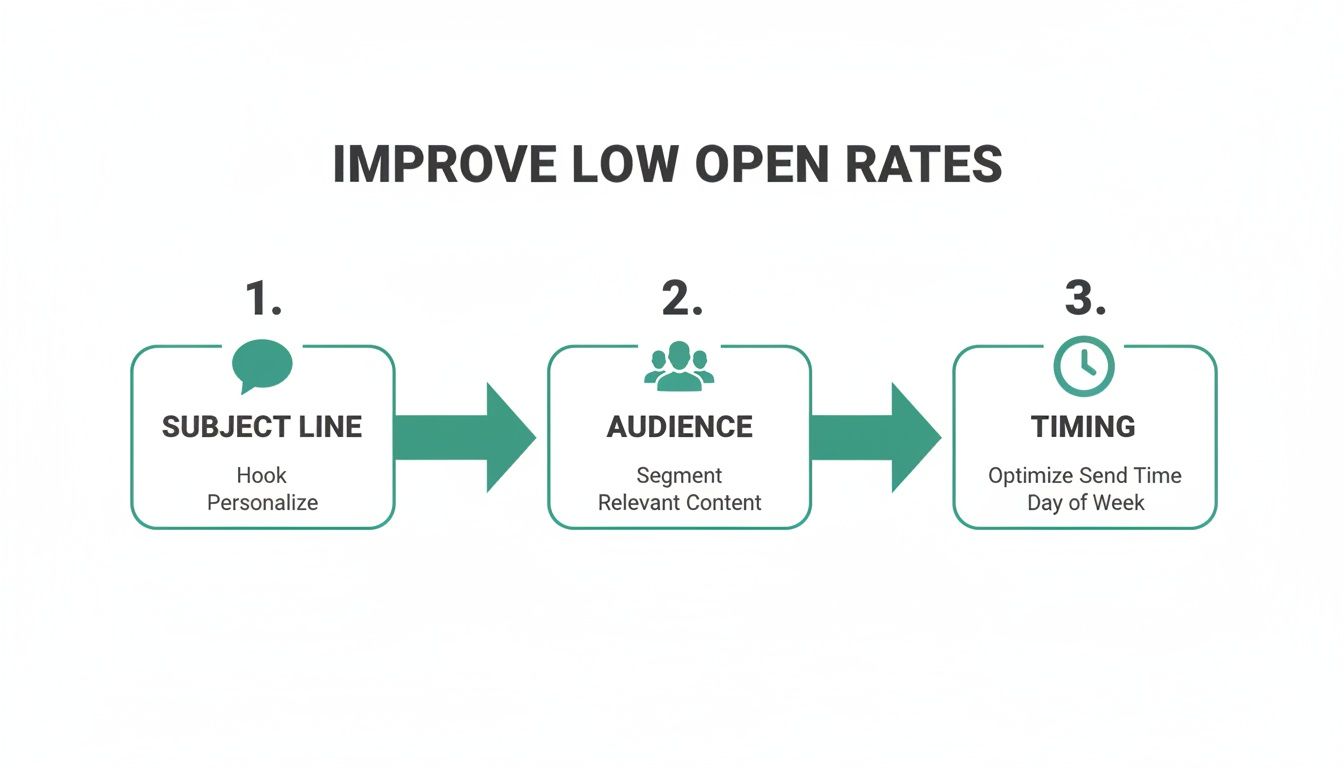
As you can see, it’s a logical flow. You start with the hook (your subject line), make sure it's reaching the right people (your audience), and deliver it when they’re most likely to be listening (your timing). Each step builds on the last.
Quickest Ways to Increase Email Open Rates
Feeling overwhelmed? Don't be. Here are some of the fastest ways to see a real jump in your open rates. Pick one or two and start experimenting today.
| Tactic | Immediate Impact | Best For |
|---|---|---|
| Personalize Subject Lines | High | Marketing emails, lead nurturing |
| Optimize Sender Name | High | All email types, especially cold outreach |
| A/B Test Send Times | Medium | Newsletters, promotional campaigns |
| Segment Your List | High | Targeted promotions, re-engagement |
| Improve Preview Text | Medium | All campaigns with a strong CTA |
These small tweaks can often deliver the biggest wins. The key is to start somewhere, measure the results, and keep refining your approach based on what your audience responds to.
Setting the Stage for Success
Ultimately, high open rates don't happen by accident. They’re the result of a solid, data-driven plan. Moving beyond guesswork is the first step toward building a campaign that consistently performs. To really dig in, exploring comprehensive email marketing best practices can give you the strong foundation you need.
This guide is your playbook. We’re going to walk through the actionable steps for mastering each of these core areas, including how to:
- Craft subject lines that create genuine curiosity and urgency.
- Build and segment high-quality email lists for laser-focused relevance.
- Pinpoint the absolute best time to send emails to your specific audience.
By focusing on these high-impact areas first, you're not just hoping for better open rates—you're systematically engineering them. Every unopened email is a missed opportunity to connect, inform, and convert. Let's fix that.
Before anyone even sees your brilliant email copy, they’ve already judged it. That split-second decision happens based on just three things: who it's from, the subject line, and that little snippet of preview text.
This is your inbox first impression. Nail it, and you get the click. Get it wrong? You’re just another line item on the fast track to the trash folder.
Think of these elements as your email's headline and sub-headline. They have one job: to answer the reader's unspoken question, "Is this worth my time?" If the answer isn't a loud, clear "yes" in a matter of seconds, they're already moving on.
Crafting Subject Lines That Demand a Click
Your subject line is arguably the most critical piece of the puzzle. It's the gatekeeper to your entire message. In fact, a study found that a staggering 47% of recipients open an email based on the subject line alone. This isn’t about tricking people with clickbait; it’s about making a compelling, honest promise about the value waiting inside.
Let's skip the generic advice and get into a few psychology-backed formulas that just plain work.
- The Curiosity Gap: This is all about teasing information without giving everything away. It sparks just enough curiosity to make someone need to know more. Instead of a flat "Our New Features Are Here," try something like, "The one feature our customers wouldn't let us launch." See the difference?
- The Urgency Driver: Nothing moves people to action quite like a deadline. Tapping into a little FOMO (fear of missing out) can work wonders. A subject line like "Last chance: 25% off ends tonight" creates a sense of scarcity that encourages an immediate open.
- The Value Proposition: This is the direct approach. No fluff, just a clear benefit. For a B2B audience, something like "Cut your meeting time in half with this template" is way more powerful than a generic newsletter title. It speaks directly to a pain point.
The best subject lines do more than just describe what’s in the email; they trigger an emotional response. Whether it's curiosity, urgency, or the feeling of being understood, that's the connection that drives someone to click. For a deeper dive, check out our guide on email subject line best practices.
The Strategic Use of Emojis and Preview Text
In a crowded inbox filled with black-and-white text, a single, well-placed emoji can make your subject line jump off the screen. It’s not just for looks—it gets results. Adding emojis to subject lines can boost open rates by a massive 56%, according to an analysis of over 30 billion emails.
For sales and marketing folks using tools like EmailScout to find direct decision-maker contacts, this is a huge opportunity. When you combine hyper-targeted lists with an emoji-powered subject line, you can turn the 22.7% industry average open rate into something closer to 40% for your B2B campaigns. You can dig into more of these email marketing statistics on Emailchef.
Just don't go overboard. One or two relevant emojis look modern and engaging. A whole string of them looks like spam.
Your preview text—that little line of text that follows the subject line—is just as important. It’s prime real estate. Wasting it with something generic like "View this email in your browser" is a massive missed opportunity.
Think of your preview text as the supporting actor. It should add context, continue the story from the subject line, or offer a sneak peek of the call to action.
Subject Line & Preview Text Combinations
| Subject Line | Preview Text | Why It Works |
|---|---|---|
| Did you see this? 👀 | Your weekly progress report is ready. | The subject line creates curiosity, and the preview text delivers a clear, valuable reason to open. |
| Your cart expires in 3 hours… | Don't miss out on free shipping. | This one-two punch combines urgency with a compelling extra incentive. |
| A quick question for you | I noticed you're in the SaaS space and… | It feels personal and shows you’ve actually done a bit of homework. |
This combination is your best shot at grabbing attention and is a fundamental part of learning how to increase email open rates.
Optimizing Your Sender Name for Trust
While the subject line gets all the attention, your sender name is what builds trust. An email from a vague sender like "marketingteam@company.com" is far more likely to get ignored than one from a name that feels human and recognizable.
You've got a few solid options here, and the right one really depends on your brand and your audience.
- Personal Name from Company: A format like "James from EmailScout" is often the gold standard. It has the credibility of the company name but the personal touch of a real person. It just feels less corporate.
- Company Name: For big, well-known brands, simply using the company name (e.g., "EmailScout") works perfectly well. This is great for newsletters and general updates where the brand itself is the main draw.
- Hybrid Approach: You might use something like "The EmailScout Team" for more official announcements, like product updates or policy changes. It strikes a nice balance between professional and approachable.
Whatever you choose, the key is consistency. Your subscribers should recognize you in their inbox instantly. Changing your sender name all the time just creates confusion and can erode the trust you’ve worked so hard to build.
Building High-Quality Lists and Segments

Let’s be honest: even the world's best subject line will fall flat if it lands in the wrong inbox. The quality of your email list is everything. Firing off emails to a generic, unvetted list is a fast track to abysmal engagement, sky-high bounce rates, and a permanent home in the spam folder.
If you really want to boost your open rates, you need a fundamental shift in mindset. Ditch the "more is better" approach and get obsessed with quality. A small, hyper-engaged list of 1,000 subscribers will run circles around a bloated list of 10,000 people who couldn't care less.
Start with Targeted List Building
A high-quality list starts with finding the right people from day one. For anyone in sales or B2B marketing, this means zeroing in on the key decision-makers at your target companies. Forget about guessing games or buying stale, outdated lists—using a tool built for precision is a much smarter play.
For example, the EmailScout Chrome extension lets you find verified email addresses directly from professional networking sites. This ensures you’re reaching out to people who are actually relevant to what you offer, which gives your open rate a serious leg up. It’s about surgical precision, not spray and pray. For a deeper dive, check out our guide on how to build an email list from scratch.
The Power of Smart Segmentation
Once you have your contacts, the real magic happens: segmentation. This is just a fancy word for splitting your list into smaller, more focused groups based on specific criteria. It lets you send ridiculously relevant messages that speak directly to a person's needs, interests, or past actions.
Segmented email campaigns have been shown to drive 30% more opens compared to unsegmented ones. It's one of the most powerful levers you can pull because it’s all about relevance.
Sending the same email to your entire list is like shouting into a packed stadium and hoping the right person hears you. Segmentation is like walking right up to them and starting a real conversation.
Actionable Segmentation Strategies
Theory is nice, but let's get practical. Here are a few real-world ways you can use segmentation to transform your open rates.
Segmentation Based on Behavior
This is probably the most potent way to slice up your list. You’re grouping people based on how they actually interact with you.
- Unengaged Subscribers: Create a segment of anyone who hasn't opened your emails in the last 90 days. Hit them with a targeted re-engagement campaign using a subject line like, "Is this goodbye?" to grab their attention.
- Active Users: These are your fans—the people who open and click on everything. Put them in a special group and reward them with exclusive content or early access to keep them happy and loyal.
- Cart Abandoners: An absolute must for e-commerce. Segment users who bailed after adding something to their cart. A gentle reminder email, maybe with a small discount, can work wonders.
Segmentation Based on Demographics or Firmographics
Grouping people by their personal or professional details allows for some seriously effective personalization.
- Job Title: A sales team could create one segment for "VPs of Marketing" and another for "Sales Managers." The messaging for each group would be tailored to their unique challenges and goals.
- Geographic Location: A retail brand could send an announcement about a new store opening only to subscribers living within a 50-mile radius. Why bother anyone else?
- Industry: A B2B software company can send case studies and content that are hyper-relevant to a subscriber's specific field, whether that's healthcare, finance, or manufacturing.
Maintaining List Hygiene
A healthy list is a clean list. People change jobs, email addresses become invalid, and some subscribers just tune out over time. Regularly cleaning your list is non-negotiable for keeping your deliverability high and your sender reputation intact.
Here are a few essential habits to adopt:
- Remove Hard Bounces Immediately: A hard bounce means the email address is dead. Your email service provider should handle this automatically, but make sure it's happening.
- Monitor Soft Bounces: A soft bounce is a temporary problem, like a full inbox. If an address soft-bounces a few times in a row, it's time to remove it.
- Implement a Sunset Policy: If someone hasn't engaged in 6 months, send them one last re-engagement campaign. If they still don't bite, it's time to say goodbye and remove them.
It might feel counterintuitive to shrink your list, but you're actually just cutting dead weight. What's left is an audience that genuinely wants to hear from you—and that’s the real secret to consistently high open rates.
Optimizing Your Send Time and Cadence
You can craft the perfect subject line for the most well-curated list, but if your email lands when no one's looking, it's dead on arrival. The "when" of your email strategy is every bit as important as the "what" and "who."
This isn’t about finding one secret hour that works for everybody. It’s about matching your send schedule to your audience’s daily rhythm.
For most people, that rhythm is pretty predictable. Year after year, data points to a sweet spot between 10 AM and 11 AM in the recipient's local time. It just makes sense—by then, people have settled in, dealt with the morning's urgent fires, and are actively clearing their inboxes. Hitting this window means you show up right when they’re paying attention.
Of course, a blanket rule never tells the whole story. Your audience might be different, and the only way to know for sure is to test, test, and test again.
Finding Your Audience's Sweet Spot
While general benchmarks are a great place to start, figuring out your specific audience’s best time requires a little detective work. You’re trying to pinpoint the hours when your subscribers are most likely to open and click.
- B2B Audiences: Professionals are creatures of habit. They're typically most active during business hours, with Tuesday, Wednesday, and Thursday mornings consistently coming out on top. Mondays are for catching up from the weekend, and Fridays are for winding down.
- B2C Audiences: Consumer behavior is all over the map. Evenings and weekends can be goldmines for retail promos when people have more downtime to browse. A Saturday morning email about a weekend sale? That can be a huge winner.
The most reliable way to figure this out is through methodical A/B testing. Send the exact same email to two different groups at two different times—say, 10 AM versus 2 PM—and track the results. Over time, a clear pattern will emerge.
The Delicate Balance of Sending Cadence
Just as crucial as when you send is how often. Your sending cadence is the rhythm of your communication, and it's a fine line to walk. Send too often, and you'll burn out your list and watch your unsubscribe rate climb. Send too rarely, and you risk being completely forgotten.
The goal is to stay top-of-mind without becoming a nuisance. You want to build anticipation, not dread.
Interestingly, less is often more. Businesses that send just two emails per month often see higher open rates than those blasting their lists weekly, according to 2025 benchmarks. This is especially true in B2B, where open rates can hit nearly 40% compared to the 24% overall average. With 99% of people checking email daily, you don't need to shout to be heard. You can dive into more insights about email marketing on CodeCrew.us.
Managing Time Zones and Automation
If you have a global audience, sending everyone an email at 10 AM EST is a recipe for poor performance. For your subscribers in London, that’s mid-afternoon. For those in Sydney, it’s the middle of the night.
This is where your email service provider’s automation tools are your best friend.
Almost every modern email platform lets you schedule sends based on the recipient's local time zone. It's a simple, set-it-and-forget-it feature that ensures your message always arrives in that prime morning window, no matter where your subscriber is. This is a foundational step for anyone serious about increasing open rates with a geographically diverse list.
Ensuring Your Emails Are Seen and Delivered
An email can't be opened if it never makes it to the inbox. It also won't be opened if it looks like a jumbled mess on a smartphone.
You can craft the world's best subject line and segment your list perfectly, but those efforts are only half the battle. If your emails aren't technically sound, all that strategic work goes right down the drain.
Two often-overlooked pillars support every single successful email campaign: mobile optimization and email deliverability. Getting these right is non-negotiable. It ensures your message not only arrives safely but also gives your reader a great experience, which dramatically increases the odds it'll actually be read.
Prioritizing the Mobile Experience
Thinking of mobile optimization as an afterthought is one of the biggest mistakes I see people make. Mobile isn't just another channel; for most people, it is their inbox. If your email is a pain to read on a small screen, it's getting deleted in seconds.
The numbers here are staggering. Projections show that in 2025, mobile is where 65% of all email opens will happen. Let that sink in. If your emails aren't designed for mobile-first, you're basically ignoring the majority of your audience and leaving up to 65% of potential opens on the table.
So, what does a truly mobile-friendly email look like? It’s all about simplicity and scannability.
- Embrace the Single-Column Layout: This is the golden rule. A single column ensures your content flows logically down the screen, eliminating that frustrating pinching and zooming we all hate.
- Keep Subject Lines Short: Mobile email apps love to cut off long subject lines. Try to stick to under 50 characters so your main point is always visible at a glance.
- Use Large, Tap-Friendly Buttons: Tiny text links are a nightmare on a touchscreen. Design your CTAs as big, obvious buttons with plenty of breathing room around them.
- Optimize Your Images: Huge image files are a recipe for slow load times, especially for someone checking email on the go. Compress your images so they're lightweight but still look sharp.
A subscriber who has a poor mobile experience is far less likely to open your future emails, even if the subject line is perfect. The memory of that frustration sticks.
Demystifying Email Deliverability
Email deliverability is a simple concept: it's the measure of how successfully your emails land in the primary inbox instead of the spam or promotions folder. A low deliverability rate is a silent killer of open rates because it means your messages are being filtered out before anyone even has a chance to see them.
Internet Service Providers (ISPs) like Gmail and Outlook are constantly judging your sender reputation. This is like a credit score for your email domain, and it's based on things like how many people open your emails, how many mark you as spam, and your bounce rate. A bad reputation tells ISPs your emails are unwanted, and they'll start shoving them into the junk folder.
Protecting Your Sender Reputation
Maintaining a positive sender reputation is something you have to work on constantly. It requires a proactive approach to how you manage your list and send your campaigns. Before you can consistently bypass spam filters, you have to understand the fundamentals of email deliverability.
Your first line of defense is authentication. Think of these protocols as your email’s passport—they prove to ISPs that you are who you say you are.
- SPF (Sender Policy Framework): This is a technical record that lists all the mail servers authorized to send email on behalf of your domain.
- DKIM (DomainKeys Identified Mail): This adds a digital signature to your emails. The receiving server can check it to make sure the message wasn't faked or altered in transit.
Beyond the technical setup, consistent list hygiene is crucial. Regularly cleaning out inactive subscribers and immediately removing addresses that hard bounce shows ISPs you're a responsible sender. It also helps to avoid spam trigger words (like "free," "act now," or using ALL CAPS) in your subject lines and body copy so you don't get flagged by automated filters. If you want to dive deeper, you can learn how to improve your email deliverability with our in-depth guide.
Frequently Asked Questions About Email Open Rates
Even after you've built a solid email strategy, there are always a few lingering questions that pop up. This section is designed to give you quick, no-fluff answers to the things we get asked most often about boosting open rates. Think of it as your go-to reference for troubleshooting common issues.
What Is a Good Email Open Rate
Honestly, "good" is a moving target. But if you're looking for a solid benchmark, aiming for 35% to 40% is a great goal.
Keep in mind this number can swing wildly based on your industry. A hyper-specific B2B newsletter might naturally see higher engagement than a massive B2C ecommerce blast. The real key is to stop chasing some universal number and start benchmarking against yourself. If you're seeing steady, incremental growth from your past campaigns, you're on the right track.
How Can I Improve My Subject Lines Quickly
Want an immediate lift? Focus on two things: clarity and curiosity. A personalized subject line that hints at a subscriber's past interest ("Still thinking about those running shoes?") is almost always going to beat a generic one like "Check out our new sale."
Here are three simple tactics you can try right now:
- Keep it short. Aim for under 50 characters so it doesn't get cut off on mobile.
- Ask a question. Something like "Did you see this?" creates a natural curiosity gap that people want to fill.
- Use one relevant emoji. A single, well-placed emoji helps you stand out in a sea of text.
Ultimately, a subject line is a promise about the value waiting inside the email. A/B testing is hands-down the fastest way to learn what promises your specific audience responds to.
Should I Resend Emails That Weren’t Opened
Yes, but with a few ground rules. Resending a campaign to non-openers is a brilliant tactic that can bump your total opens by an extra 30%. It’s a simple way to catch people who were just too busy the first time around.
Here’s how to do it right: only resend your most important emails, like a big announcement or a limited-time offer. Wait at least 24-48 hours, and—this is critical—always write a new subject line. If someone doesn't open after two tries, leave them be. Pestering them will only hurt your sender reputation in the long run.
What Other Metrics Should I Track Besides Open Rate
Open rate is a great starting point, but it only tells you if your subject line worked. To get the full story on your email performance, you need to look at a few other key numbers.
- Click-Through Rate (CTR): This is the gold standard. It tells you what percentage of people actually clicked a link in your email, showing how compelling your content and call-to-action really were.
- Conversion Rate: This tracks who completed the desired action—like making a purchase or booking a demo. It’s the metric that ties your email campaigns directly to business results.
- Unsubscribe Rate: A sudden jump here is a huge red flag. It’s an early warning system that tells you something about your content or sending frequency is turning people off.
Looking at these metrics together gives you a much clearer picture. For instance, a high open rate with a low CTR means you wrote a killer subject line, but the email body didn't deliver. That tells you exactly where to focus your efforts next time.
Ready to build hyper-targeted email lists and connect with the right decision-makers? EmailScout streamlines your outreach with a powerful email finder that works in a single click. Start building higher-quality lists today and see what a difference relevance makes to your open rates. Discover more at https://emailscout.io.