Author: EmailScout

  • 7 Proven Cold Email Template for Sales Examples to Boost Replies in 2025

    7 Proven Cold Email Template for Sales Examples to Boost Replies in 2025

    In sales, a cold email isn't just a message; it's your digital handshake, your first impression, and often your only shot at starting a valuable conversation. Yet, the vast majority of cold emails are deleted on sight. They're generic, self-serving, and completely disconnected from the recipient's actual business challenges. If your outreach efforts feel like you're shouting into a void, you've landed in the right place.

    This guide moves beyond simplistic, fill-in-the-blank scripts. We are providing a strategic breakdown of seven powerful cold email template for sales frameworks proven to get replies. For each one, we'll dissect the underlying psychology that makes it effective, pinpoint the exact scenarios where it shines, and give you actionable tactics to personalize it for maximum impact. You won't just get templates; you'll understand the science behind them.

    We will cover a range of proven approaches, including:

    • The Problem-Agitate-Solve (PAS) Framework
    • The Value-First Approach
    • The Pattern Interrupt Method
    • The Social Proof and Authority Template
    • The Question-Based Discovery Email
    • The Multi-Step Campaign Sequence
    • The Personalized Data-Driven Outreach

    By the end of this article, you will have a comprehensive playbook to transform your cold outreach from ignorable spam into a must-read message. You'll learn how to craft irresistible subject lines, structure compelling arguments, and build campaigns that open doors, book meetings, and generate real pipeline. Let’s get started.

    1. The Problem-Agitate-Solve (PAS) Cold Email Template

    The Problem-Agitate-Solve (PAS) framework is a classic copywriting formula that excels in cold outreach by tapping directly into a prospect's pain points. This powerful cold email template for sales works by first identifying a problem the prospect likely faces, then amplifying the negative consequences of that problem (agitation), and finally positioning your product or service as the ideal solution. It’s effective because it creates an emotional connection by validating the prospect's struggles before offering relief.

    A business man looking frustrated at his laptop, searching for a solution at his desk.

    This method moves beyond just listing features; it frames your offer as a necessary fix to a pressing issue, making it much more compelling.

    The PAS Template Breakdown

    Here’s a look at the structure and a practical example.

    Subject Line Options:

    • Question about [Prospect's Goal]
    • An idea for [Company Name]'s [Specific Department]
    • [Pain Point] at [Company Name]?

    Email Body:

    Hi [First Name],

    (Problem) Noticed on your LinkedIn that you manage the sales development team at [Company Name]. Many SaaS sales leaders I speak with are struggling to maintain personalized outreach at scale, especially since manual research for each prospect can take up to 20 minutes.

    (Agitate) This often leads to reps defaulting to generic templates, which kills reply rates and ultimately results in missed quotas and a shrinking pipeline. It's a frustrating cycle where more effort doesn't always equal better results.

    (Solve) We built EmailScout to solve this exact issue. Our AI-powered platform automates prospect research, finding unique personalization points in seconds, not hours. This allows your team to send highly relevant emails that actually get replies.

    Would you be open to a brief 15-minute chat next week to explore how we could help your team exceed its Q4 targets?

    Best,

    [Your Name]

    Strategic Analysis & Why It Works

    The PAS formula is a masterclass in emotional and logical persuasion. It works because it mirrors the prospect’s internal monologue about their business challenges.

    • Builds Instant Rapport: The "Problem" statement shows you've done your homework and understand their world. Referencing a specific, relevant challenge makes the email feel less like a generic blast and more like a peer-to-peer conversation.
    • Creates Urgency: The "Agitate" phase is crucial. By highlighting the negative consequences (missed quotas, wasted time), you transform a minor inconvenience into an urgent business problem that needs solving.
    • Provides Clear Value: The "Solve" section doesn't just list features; it presents your offering as the direct antidote to the pain you just agitated. The value proposition is crystal clear: we eliminate this specific negative outcome.

    Key Insight: The agitation step is the emotional engine of the PAS model. Without it, the "Problem" is just an observation and the "Solution" is just another sales pitch. Agitation connects the two by making the problem feel real and pressing.

    Actionable Takeaways

    To effectively implement this cold email template for sales, follow these steps:

    1. Deep Research is Non-Negotiable: Use tools like LinkedIn Sales Navigator or industry reports to identify a highly specific pain point relevant to your prospect's role and company.
    2. Keep Agitation Concise: Limit the agitation to one or two sentences. You want to highlight the pain, not dwell on it excessively, which can come across as negative or condescending.
    3. Bridge to the Solution Seamlessly: Use transition phrases like "We built [Product] to solve this," or "This is a common challenge we help with." This makes your solution feel like a natural next step.

    2. The Value-First Cold Email Template

    The Value-First approach flips the traditional sales script on its head. Instead of asking for a prospect's time, this cold email template for sales leads by giving something genuinely useful away for free. This strategy focuses on establishing credibility and building goodwill by providing valuable insights, resources, or advice relevant to the prospect's role or industry before making any request for a meeting. It’s effective because it disarms the recipient and positions you as a helpful expert, not just another salesperson.

    Two people's hands exchanging white documents over a counter with 'Lead With Value' on a green wall.

    This method makes your outreach memorable and welcome, paving the way for a more receptive conversation when you eventually make an ask.

    The Value-First Template Breakdown

    Here’s a look at the structure and a practical example.

    Subject Line Options:

    • Idea for improving [Company Name]'s [KPI]
    • A resource for your [Prospect's Department] team
    • Thought you'd find this useful, [First Name]

    Email Body:

    Hi [First Name],

    I was just reading your recent interview on TechCrunch about [Company Name]'s push into the enterprise market and was really impressed by your strategy.

    Based on your focus on reducing customer acquisition costs, I thought you might find this case study on how [Similar Company] cut their CAC by 22% useful. It details the specific outbound framework they implemented, which seems highly relevant to the goals you mentioned.

    You can access the full breakdown here: [Link to resource]

    No pitch or ask here, just thought it might spark an idea for your team.

    Best,

    [Your Name]

    Strategic Analysis & Why It Works

    The Value-First template operates on the principle of reciprocity. By providing a gift with no strings attached, you create a positive impression and a subtle social obligation.

    • Builds Instant Credibility: Sharing a relevant, high-quality resource demonstrates that you understand the prospect's challenges and have expertise in their field. It shows you've done your research beyond just their name and title.
    • Lowers Defensive Barriers: Since there's no immediate ask for a demo or a call, the prospect's natural "sales shield" doesn't go up. They are more likely to engage with the content because it feels like a genuine attempt to help.
    • Creates a Positive First Impression: This approach frames you as a giver, not a taker. It sets a collaborative tone for the relationship and makes your follow-up emails much more likely to be opened and read.

    Key Insight: True value isn't just a link to your latest blog post. It's a curated piece of information, insight, or tool that directly addresses a specific priority or challenge you've identified through research. The more tailored the value, the more powerful the impression.

    Actionable Takeaways

    To effectively implement this cold email template for sales, follow these steps:

    1. Identify a High-Value "Give": Your value offering could be a data-driven report, a concise case study, a free tool, or a quick analysis of a competitor. Ensure it's something the prospect can't easily find themselves.
    2. Connect the Value to a Trigger: Reference a specific company announcement, a recent hire, a post they shared on LinkedIn, or an industry trend to make your outreach timely and relevant.
    3. Resist the Urge to Pitch: The power of this template lies in its patience. The initial email should be purely about giving value. The "ask" for a meeting can come in a subsequent follow-up email after you've earned their attention.

    3. The Pattern Interrupt Cold Email Template

    The Pattern Interrupt template is designed to slice through the noise of a crowded inbox. This approach uses an unexpected opening, a surprising question, or unconventional formatting to break the recipient's routine of deleting sales emails. The goal is to jolt the prospect out of autopilot, grab their attention through novelty, and earn a few extra seconds of consideration for your pitch. It’s a bold cold email template for sales that works by being different.

    This method intentionally sidesteps traditional, formal introductions to create curiosity and compel the reader to continue. When done right, it feels refreshingly honest and direct.

    The Pattern Interrupt Template Breakdown

    Here’s a look at the structure and a practical example.

    Subject Line Options:

    • You're probably going to hate this email
    • Quick question about [Company Name]'s marketing
    • Wrong person?

    Email Body:

    Hi [First Name],

    You're probably going to delete this. Most people see an email from a stranger and hit delete in under three seconds.

    But on the off chance you're still reading, I noticed your team at [Company Name] just launched a new ad campaign on LinkedIn. Congrats. The problem is, driving traffic is only half the battle. Converting that traffic into qualified leads is where most B2B companies leak revenue.

    Our tool, ConvertFlow, helps companies like yours add interactive lead capture forms and personalized CTAs to their landing pages, typically boosting conversion rates by 40-50%.

    Worth a 10-minute chat to see if we can get you more leads from your existing ad spend?

    Best,

    [Your Name]

    Strategic Analysis & Why It Works

    The Pattern Interrupt template leverages psychology to gain an edge. It short-circuits the brain's filtering process and makes your email stand out.

    • Creates Instant Intrigue: The unconventional opening or subject line defies expectations. A subject like "You're probably going to hate this email" is so counterintuitive that it practically begs to be opened out of sheer curiosity.
    • Disarms the Prospect: By acknowledging the unsolicited nature of the email ("You're probably going to delete this"), you show self-awareness. This candid approach can lower the prospect's natural defensiveness and make them more receptive to your message.
    • Earns You More Time: The primary goal is to stop the immediate "scan and delete" habit. By being different, you earn a few crucial extra seconds of attention, giving your core value proposition a chance to land.

    Key Insight: A pattern interrupt's success depends on the pivot. The creative opening must be followed immediately by a concise, relevant, and high-value proposition. The novelty gets their attention; the substance keeps it.

    Actionable Takeaways

    To effectively implement this cold email template for sales, follow these steps:

    1. Align Interrupt with Value: Ensure your creative hook isn't just random. It should logically transition into the problem you solve. The element of surprise must serve a strategic purpose.
    2. Test Your Subject Lines Rigorously: What works for one audience may fall flat with another. A/B test your creative subject lines against more traditional ones to find what resonates. For more guidance, explore these email subject line best practices.
    3. Keep the Body Lean and Direct: After the interrupt, get straight to the point. The prospect gave you their attention; don't waste it with fluff. State the problem and your solution clearly and quickly.

    4. The Social Proof and Authority Cold Email Template

    The Social Proof and Authority template leverages a core psychological principle: people trust what others already trust. Instead of leading with a pain point, this powerful cold email template for sales establishes immediate credibility by showcasing impressive results, well-known clients, or industry recognition. It's designed to disarm skepticism and build trust from the very first sentence, making the prospect more receptive to your pitch.

    A framed 'PROVEN RESULTS' sign, a document with a checkmark logo, and a stack of brochures on a wooden desk.

    By using third-party validation, you shift the focus from "what we say about ourselves" to "what our success with others proves." This makes your outreach feel less like a cold pitch and more like an invitation to join an exclusive group of successful companies.

    The Social Proof Template Breakdown

    Here’s a look at the structure and a practical example.

    Subject Line Options:

    • Helping [Competitor Name] with [Result]
    • [Result] for companies like [Client Name]
    • Idea for [Company Name] (as seen in Forbes)

    Email Body:

    Hi [First Name],

    We recently helped [Similar Company/Client Name] in the [Prospect's Industry] industry reduce their customer support ticket volume by 35% in just 60 days using our AI-powered knowledge base.

    Given your role leading customer success at [Company Name], I thought you might be interested in achieving similar results. Our platform integrates directly with your existing help desk to deflect common inquiries and empower users to find answers instantly.

    Are you available for a quick 15-minute call next Tuesday to discuss how we could replicate this success for your team?

    Best,

    [Your Name]

    Strategic Analysis & Why It Works

    This template is effective because it bypasses the typical "who are you and why should I care?" barrier by providing an immediate, compelling reason to pay attention.

    • Borrows Credibility: Mentioning a successful client, especially a well-known brand or a direct competitor, instantly positions you as a proven, low-risk solution. It's a powerful shortcut to establishing authority.
    • Creates FOMO (Fear of Missing Out): When prospects see that similar companies or competitors are already benefiting from your solution, it creates a sense of urgency. They begin to wonder if they are falling behind by not using your service.
    • Provides Tangible Value: Leading with a specific, quantifiable result (e.g., "35% reduction in tickets") immediately demonstrates your value proposition. It’s not a vague promise; it’s a proven outcome.

    Key Insight: Social proof works best when it is highly relevant. Citing a huge enterprise client won't resonate with a small startup, and vice-versa. The power lies in showing the prospect that you solve problems for companies just like them.

    Actionable Takeaways

    To effectively implement this cold email template for sales, follow these steps:

    1. Curate Your Proof Points: Maintain a list of your best case studies, testimonials, and client logos. Segment them by industry, company size, and the specific problem they solved.
    2. Be Specific and Quantifiable: Vague claims like "we improve efficiency" are weak. Use hard numbers: "increased lead conversion by 42%" or "saved 20 hours per week."
    3. Ensure Relevance: Before sending, double-check that the social proof you're using is relevant to the prospect. Use a client from their industry, of a similar size, or who faced a similar challenge.

    5. The Question-Based Discovery Cold Email Template

    The Question-Based Discovery approach flips the traditional cold email on its head. Instead of leading with a pitch, this powerful cold email template for sales uses strategic, open-ended questions to engage the prospect in a conversation. This consultative method positions you as a curious expert rather than just another salesperson, encouraging the prospect to reflect on their own challenges and needs.

    This technique is highly effective because it prompts the prospect to articulate their own pain points, making your eventual solution feel like a natural and collaborative discovery, not a hard sell.

    The Question-Based Discovery Template Breakdown

    Here’s a look at the structure and a practical example.

    Subject Line Options:

    • Question about [Company Name]'s approach to [Process]
    • Your thoughts on [Industry Trend]?
    • Handling [Specific Challenge]

    Email Body:

    Hi [First Name],

    I was looking at the recent project announcements for [Company Name] and was impressed by your team's expansion into the APAC region.

    As you scale your customer support operations, I'm curious:

    1. How are you currently managing multilingual support requests to ensure consistent brand voice across different markets?
    2. What's the biggest bottleneck you've found when onboarding new support agents for region-specific products?

    Teams I work with in the enterprise software space often find these two areas become major hurdles during rapid international growth.

    Best,

    [Your Name]

    Strategic Analysis & Why It Works

    This template succeeds by shifting the focus from your product to the prospect's world. It’s a low-pressure way to start a high-value conversation.

    • Sparks Genuine Engagement: Unlike a pitch that can be quickly dismissed, a relevant question demands a cognitive response. It makes the prospect think, which is the first step toward a meaningful dialogue.
    • Positions You as a Consultant: Asking insightful questions demonstrates your expertise and genuine interest in their business. It frames the interaction as a peer-level discussion about industry challenges, not a sales transaction.
    • Qualifies the Prospect: The prospect's answer (or lack thereof) provides immediate insight into their awareness of the problem, their current priorities, and whether they are a good fit for your solution.

    Key Insight: People are more likely to engage when they feel their expertise is being sought. A well-crafted question respects the prospect's knowledge and invites them to share, lowering their defensive barriers.

    Actionable Takeaways

    To effectively implement this cold email template for sales, follow these steps:

    1. Ask Open-Ended Questions: Avoid simple yes/no questions. Use formulations like "How do you…", "What's your process for…", or "What's the biggest challenge with…" to encourage a detailed response.
    2. Limit Your Questions: Stick to one or two well-researched, highly relevant questions. Overwhelming the prospect with too many questions will kill your reply rate.
    3. Ensure Questions are Easy to Answer: Your questions should be specific enough to demonstrate knowledge but broad enough that the prospect can answer in a sentence or two without needing to consult data or colleagues.
    4. Connect Questions to a Trigger Event: Base your questions on recent company news, a new hire, a LinkedIn post, or an industry trend to make them timely and highly contextual.

    6. The Multi-Step Campaign Cold Email Template

    Most cold emails fail because they are treated as a one-shot attempt. The Multi-Step Campaign approach transforms outreach from a single lottery ticket into a strategic, value-driven conversation spread across several touchpoints. This powerful cold email template for sales is a sequence of 3-7 emails sent over a few weeks, with each message building on the last. It respects the prospect's busy schedule while creating multiple opportunities to capture their attention with different value propositions.

    This method acknowledges that timing is everything. A prospect who is too busy for your first email might find your second email, which shares a valuable case study, perfectly timed to address a new priority.

    The Multi-Step Campaign Template Breakdown

    Here’s a look at the structure of a 4-step sequence.

    Email 1: The Personalized Hook

    • Subject: Idea for [Prospect's KPI] at [Company Name]
    • Body: Start with a highly personalized observation about their company or role. Introduce a problem and a soft call-to-action, like asking if it's a priority.

    Email 2: Value-Add Follow-Up

    • Subject: Re: Idea for [Prospect's KPI] at [Company Name]
    • Body: Provide a valuable resource, like a relevant case study or a blog post that addresses their potential pain point. No hard ask, just building credibility.

    Email 3: The Direct Pitch

    • Subject: [Your Company] <> [Their Company]
    • Body: Now that you've established context and provided value, make your pitch. Clearly state your solution and how it directly solves their problem. Ask for a brief meeting.

    Email 4: The Breakup Email

    • Subject: Closing your file
    • Body: A final, polite message stating you won't follow up again. This often creates a sense of urgency and can trigger a response from prospects who were interested but busy.

    Strategic Analysis & Why It Works

    A multi-step campaign is effective because it mirrors natural human interaction, building trust over time rather than demanding it upfront.

    • Increases Impressions: In a crowded inbox, persistence pays off. This method ensures your name and company are seen multiple times, increasing brand recall and the likelihood of a response.
    • Delivers Value Incrementally: Instead of overwhelming the prospect with everything in one email, you deliver value in digestible pieces. This positions you as a helpful expert, not just another salesperson.
    • Adapts to Prospect's Timeline: Your first email might land on a busy day. Your third might arrive just as they begin researching solutions for the exact problem you solve. The sequence maximizes your chances of perfect timing.

    Key Insight: The power of a campaign isn't just in the follow-ups; it's in the narrative you build. Each email should logically connect to the last, telling a cohesive story about the prospect's problem and your solution.

    Actionable Takeaways

    To effectively implement this cold email template for sales, follow these steps:

    1. Map Your Sequence: Plan the purpose of each email before you write a single word. What value will each touchpoint provide? What is the CTA for each step?
    2. Vary Your Angles: Don't just "check in" or "follow up." Introduce new information in each email: a different pain point, a customer testimonial, a relevant industry stat, or a unique feature.
    3. Keep Threads Intact: Reply to your previous email to keep the entire conversation in one thread. This provides the prospect with immediate context without them having to search their inbox. For a deeper dive into follow-up strategies, you can explore more about how to write a follow-up email after no response.
    4. Automate Intelligently: Use sales engagement platforms to schedule the sequence, but ensure you are personalizing each step. Automation should handle the sending, not the thinking.

    7. The Personalized Data-Driven Cold Email Template

    The Personalized Data-Driven template transforms a cold email from a generic pitch into a highly relevant, one-to-one conversation. This powerful cold email template for sales is built on specific, timely data points about the prospect or their company, such as a recent promotion, a new funding round, or a strategic initiative mentioned in a press release. It immediately signals that the sender has done their research and has a legitimate reason for reaching out, instantly separating them from the noise.

    This approach proves you aren't just sending another blast. You've specifically chosen them for a reason, which dramatically increases the likelihood of getting a reply.

    The Personalized Data-Driven Template Breakdown

    Here’s a look at the structure and a practical example.

    Subject Line Options:

    • Congrats on the Series B funding!
    • Question about your recent [Product/Feature] launch
    • [Company Name] + [Your Company Name]

    Email Body:

    Hi [First Name],

    Congratulations on your recent promotion to VP of Sales at [Company Name]! It’s an exciting move, especially with the company’s push into the enterprise market this quarter.

    As you step into this new role, leaders are often tasked with scaling their sales team's efficiency without sacrificing the personalization that closes bigger deals. Juggling new KPIs while onboarding reps can make this a significant challenge.

    We help new sales leaders at companies like [Similar Company] solve this by automating personalized outreach. Our platform, EmailScout, integrates with your CRM to identify key data points and craft hyper-relevant messaging, so your team can focus on selling, not on manual research.

    Would you be open to a 15-minute call next week to discuss how you're planning to arm your team for the enterprise push?

    Best,

    [Your Name]

    Strategic Analysis & Why It Works

    This data-driven approach is effective because it’s rooted in genuine relevance and respect for the prospect's time. It flips the script from "What I want to sell you" to "I see what you're doing, and I have something that can help."

    • Breaks Through the Noise: Referencing a specific, recent event (like a promotion or funding round) acts as a pattern interrupt. It’s not a message that could have been sent to anyone, making it nearly impossible to ignore.
    • Demonstrates Genuine Interest: Thorough research shows you value the prospect as an individual and their company's journey. This builds immediate credibility and rapport before you even mention your product.
    • Creates a Natural Bridge: The data point isn't just a gimmick; it serves as the perfect, logical bridge to introduce your solution. The transition from their achievement to the problem you solve feels seamless and contextual.

    Key Insight: The data point is the "key" that unlocks the conversation. Without it, your email is just another locked door. A relevant piece of data proves you belong in their inbox and have something valuable to say.

    Actionable Takeaways

    To effectively implement this cold email template for sales, follow these steps:

    1. Become a Research Expert: Use tools like LinkedIn Sales Navigator, Crunchbase, and Google Alerts to monitor target accounts for "trigger events" like new hires, funding, product launches, or mentions in the news.
    2. Make the Connection Explicit: Don't just mention the data point and move on. Clearly state how that event relates to the challenge you solve. For example, "With your new funding, scaling operations is likely a top priority…"
    3. Keep It Fresh: Data gets stale quickly. A trigger event from six months ago has far less impact than one from last week. Prioritize recent, relevant information to maximize your email's impact. For more in-depth strategies, explore our guide on how to write cold emails that convert.

    7 Sales Cold Email Templates Compared

    Template Implementation Complexity Resource Requirements Expected Outcomes (Response Rate / Effect) Ideal Use Cases Key Advantages
    The Problem-Agitate-Solve (PAS) Cold Email Template Medium–High — needs tailored pain framing and restrained agitation Moderate research and personalization time per prospect 8–15% reported response rates; high emotional engagement SaaS addressing inefficiencies; recruitment; B2B service providers Strong emotional resonance; clear problem→solution flow
    The Value-First Cold Email Template High — requires creating genuinely useful content up front High: research, content/insight creation, possible assets/links 10–20% typical response rates; builds trust and credibility Enterprise sales, marketing agencies, consultancies Positions sender as expert; lowers spam perception; higher-quality leads
    The Pattern Interrupt Cold Email Template Medium — creative copywriting and careful balance needed Low–Moderate: creative testing, subject-line experimentation Typically higher open rates; response varies widely (attention-driven) Crowded inboxes; innovative audiences; startups seeking differentiation Cuts through clutter; memorable and highly attention-grabbing
    The Social Proof and Authority Cold Email Template Medium — assemble and present credible proof without boasting Low–Moderate: case studies, testimonials, metrics, collateral 15–25% reported response rates; reduces skepticism Competitive markets; enterprise sellers; brands with notable clients Builds instant credibility; reduces perceived risk; persuasive social proof
    The Question-Based Discovery Cold Email Template Medium — requires craft of insightful, open-ended questions Moderate: targeted research to craft relevant questions Increases engagement and qualifies leads; longer sales cycles typical Consultative sales; complex B2B deals; discovery-focused outreach Drives dialogue and discovery; shows genuine interest; improves qualification
    The Multi-Step Campaign Cold Email Template High — sequence design, timing, and orchestration required High: content for multiple touches, automation/tracking tools 25–40% reported response rates with proper execution; cumulative ROI Account-based outreach; long sales cycles; high-value lists Multiple entry points; narrative build; higher conversion through persistence
    The Personalized Data-Driven Cold Email Template Very High — extensive, prospect-specific research and tailoring Very High: tools (LinkedIn Navigator, Crunchbase), time per prospect 15–30% reported response rates; very high-quality conversations High-touch enterprise outreach; targeted executive-level outreach Highly relevant and hard-to-ignore; builds strong initial rapport and trust

    Your Next Steps: From Template to Trusted Advisor

    You now have a complete playbook of proven, powerful cold email templates for sales. We've dissected everything from the classic Problem-Agitate-Solve framework to sophisticated, data-driven approaches. Yet, the most critical takeaway isn't found in any single template.

    The true secret lies in understanding that a cold email template for sales is a starting point, not a final destination. These frameworks provide the structure, but your success will be defined by the personalization, strategy, and genuine human connection you weave into them. Think of them as blueprints for a conversation, not a script to be recited.

    Key Insights to Carry Forward

    As you move from reading this guide to actively implementing these strategies, keep these core principles at the forefront of your mind:

    • Context is King: The most effective cold email is one that feels like a warm introduction. This means understanding the prospect's industry, recent company news, and individual role-specific challenges. A template without context is just spam.
    • Clarity Over Cleverness: While a unique opening line can grab attention, your message's core value must be immediately clear. Prospects are busy and will not spend time deciphering a confusing or overly clever pitch. Be direct, be relevant, and be respectful of their time.
    • The Goal is a Conversation, Not a Close: The primary objective of your initial email is rarely to make a sale. It’s to earn a reply. Focus your call to action on starting a dialogue, such as asking a thoughtful question or offering a specific, high-value resource.

    Your Actionable Roadmap to Cold Email Mastery

    Memorizing templates is easy; mastering the art of outreach takes deliberate practice. Here are the precise steps you should take next to turn this knowledge into tangible results:

    1. Select Two Templates: Don't try to implement all seven at once. Choose two distinct templates from this guide that best align with your ideal customer profile and value proposition. For example, start with the Value-First Template for relationship-building and the PAS Template for prospects with a clear, urgent pain point.
    2. Define Your Personalization "Triggers": For each campaign, create a short checklist of personalization points you must find for every prospect. This could include a recent LinkedIn post, a quote from a podcast, a new company initiative, or a shared connection. This structured approach ensures every email is unique.
    3. Build Your Tech Stack for Efficiency: Manual research is the biggest bottleneck in personalized outreach. The time you spend hunting for accurate email addresses is time you aren't spending on strategy and writing compelling copy. Integrating a tool like an email finder is non-negotiable for scaling your efforts effectively.
    4. Track the Right Metrics: Go beyond just open and reply rates. Monitor metrics like positive reply rate (prospects who express interest), meeting booked rate, and conversion rates from your cold email efforts. This data will tell you which cold email template for sales is truly driving revenue.

    Ultimately, your journey is about evolving from a salesperson who sends emails into a trusted advisor who solves problems. Each template in this guide is a tool to help you build that bridge. It's about showing your prospect, from the very first interaction, that you have done your homework, you understand their world, and you are here to provide value, not just to sell a product.

    By combining these strategic frameworks with genuine curiosity and a commitment to personalization, you will not only fill your pipeline but also build a reputation as a resource your prospects are genuinely happy to hear from.


    Stop wasting hours on manual prospecting and ensure your perfectly crafted emails land in the right inbox. EmailScout helps you find verified email addresses with a single click, directly from LinkedIn or company websites, so you can focus on personalizing your cold email templates for sales, not just searching for contacts. Build your high-quality lead lists faster and start more conversations today by visiting EmailScout.

  • How to improve email deliverability: A definitive guide

    How to improve email deliverability: A definitive guide

    You hit 'send,' but the real work has just begun. Getting your email to land in the primary inbox—not spam, not promotions—is the name of the game. The secret isn't one magic bullet, but a handful of core principles: solid technical authentication (SPF, DKIM, DMARC), squeaky-clean list hygiene, a rock-solid sender reputation, and content people actually want to open.

    Nail these, and you're well on your way to beating the spam folder for good.

    Your Blueprint for Landing in the Inbox

    Let's cut right to it. Email deliverability isn't some set-it-and-forget-it task. It's a constant, living strategy that has a direct line to your revenue and ROI. For any serious sales pro or marketer, it’s a non-negotiable skill.

    Think about it: an email that lands in spam might as well have never been sent. This guide is your playbook for spotting the problems and putting real, lasting fixes in place.

    It all boils down to a few simple truths: prove you are who you say you are, only email people who expect to hear from you, and give them content that makes them want to click, reply, or engage.

    The Core Deliverability Workflow

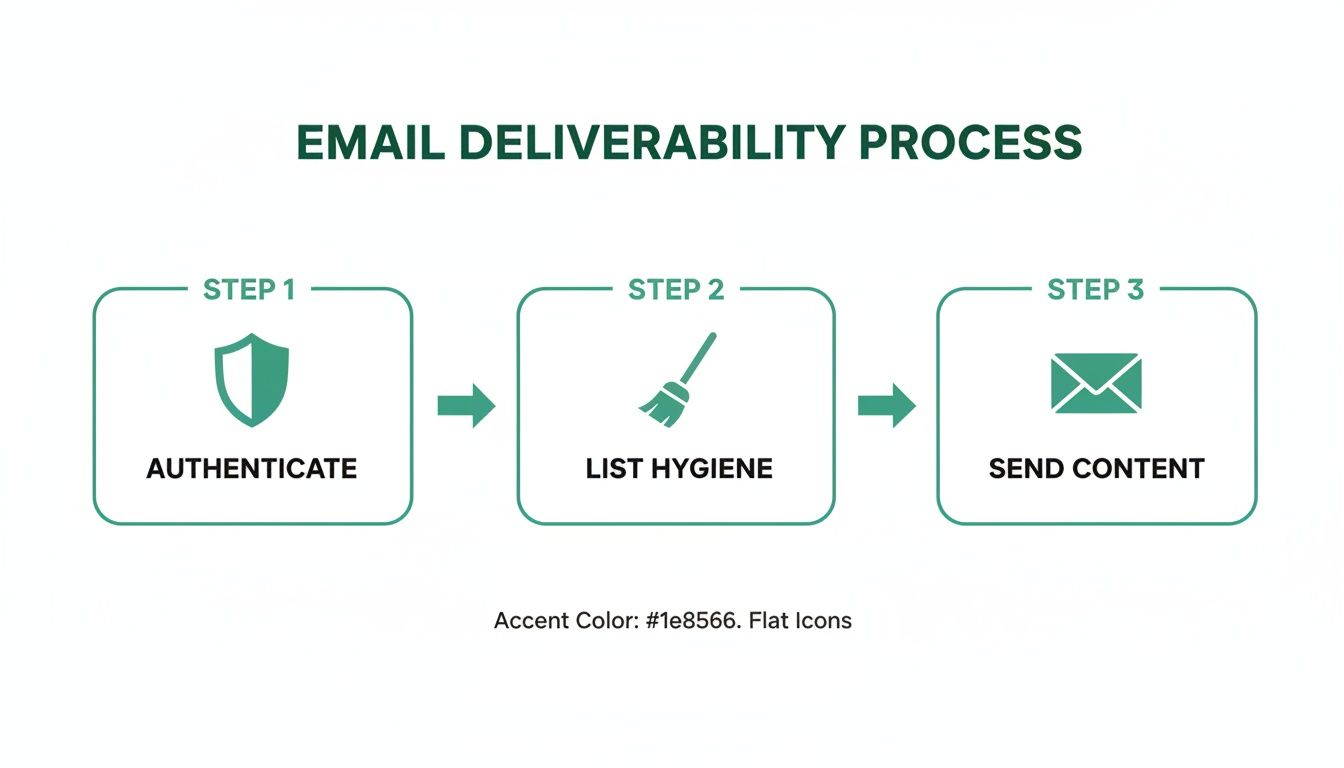
    The path from your outbox to a customer's inbox is surprisingly straightforward if you know the steps. It’s a strategic flow, and if you get the fundamentals right, your odds of success skyrocket.

    Diagram showing the email deliverability process in three steps: Authenticate, List Hygiene, and Send Content.

    This process makes it clear: it all starts with technical trust (Authentication), moves to the quality of your audience (List Hygiene), and is sustained by user engagement (Send Content).

    Before we dig into the nitty-gritty of each pillar, here’s a quick checklist to keep in mind. Think of it as your pre-flight check before launching any campaign.

    Email Deliverability Quick Fix Checklist

    Pillar Key Action Why It Matters
    Authentication Set up SPF, DKIM, and DMARC records correctly. Proves to inbox providers that your emails are legitimate and not spoofed, building foundational trust.
    Sender Reputation Warm up your domain/IP slowly and consistently. A gradual warm-up shows ISPs you're a trustworthy sender, preventing them from flagging your emails as suspicious.
    List Hygiene Regularly clean your list and only email opted-in contacts. Reduces bounce rates and spam complaints, which are major red flags that damage your sender score.
    Engagement Send valuable content that encourages opens and clicks. Positive user signals (like replies and forwards) tell inbox providers that your content is wanted and valued.

    This table covers the absolute must-dos. Getting these four things right will solve the majority of deliverability problems people face. Now, let's explore why this is so critical.

    The stakes are higher than you might think. On average, only 83.1% of emails make it to an inbox globally. That means nearly 17% of all emails just vanish. A huge chunk of those (10.5%) go straight to spam, while 6.4% bounce and are never delivered at all.

    Proper email authentication is a huge piece of this puzzle. It's how senders in places like the UK hit deliverability rates of 98.8%—their verification standards are just higher. You can learn more about these email deliverability statistics and see how they impact campaigns just like yours.

    The goal isn't just to avoid the spam folder; it's to consistently earn a spot in the primary inbox. That's where the magic happens—where relationships are built and conversions are made. Every other tab is second place.

    Mastering Your Technical Email Authentication

    Think of email authentication as your domain's digital passport. When you send an email, inbox providers like Gmail and Outlook act like border control, and their first question is, "Are you who you say you are?" If you don't have the right credentials, your message gets flagged as suspicious. It's sent straight to the spam folder or, even worse, blocked entirely.

    This is where three critical acronyms come into play: SPF, DKIM, and DMARC. Getting these set up isn't just a "nice-to-have" anymore; it's a non-negotiable foundation for anyone serious about landing in the inbox.

    A man's hand points to a laptop screen displaying "SPF/ DKM" and "EMAIL AUTHENTICATION" concepts.

    These records live in your domain's DNS settings and work as a team to build trust. They prove to receiving mail servers that your email platform (like Google Workspace, Mailchimp, or Apollo) has your explicit permission to send emails on your behalf. It’s your first and best defense against being mistaken for a phisher or spammer.

    Decoding SPF: The Authorized Sender List

    SPF (Sender Policy Framework) is the most straightforward of the three. It’s basically a public list of all the servers and services you’ve approved to send email from your domain. When an email arrives, the receiving server glances at your SPF record to see if the sending IP address is on that approved list.

    If it is, you pass the first check. If not, it’s a major red flag. This simple check is incredibly effective at preventing spammers from "spoofing" your domain—making it look like an email came from you when it really didn't.

    Think of it this way: your company's security guard has a list of approved visitors. Anyone not on that list gets stopped at the gate. No exceptions. A classic mistake I see all the time is when a team starts using a new email tool but forgets to add it to their SPF record. Their legitimate sales and marketing emails suddenly start failing authentication.

    Understanding DKIM: The Digital Tamper-Proof Seal

    Next up is DKIM (DomainKeys Identified Mail). While SPF verifies the sender, DKIM verifies the message itself. It adds a unique digital signature to the header of every single email you send, created using a private key that only your sending server knows.

    When your email reaches its destination, the receiving server uses a public key (which you publish in your DNS records) to check that signature. If the signature is valid, it confirms two crucial things:

    • The email genuinely originated from your domain.
    • The content of the email hasn't been altered or tampered with in transit.

    If a fraudster intercepted your email and changed something—even just swapping out a link—the DKIM signature would break. The email fails the check. This provides a vital layer of security and trust.

    DMARC: The Rulebook for Authentication Failures

    Finally, there’s DMARC (Domain-based Message Authentication, Reporting, and Conformance). DMARC ties SPF and DKIM together by telling receiving mail servers exactly what to do if an email fails either of those checks. It’s your instruction manual for handling unauthenticated mail.

    A DMARC record can give servers one of three commands:

    1. Monitor (p=none): Do nothing to the email, but send detailed reports back to you about which emails are passing and failing authentication. This is the perfect place to start.
    2. Quarantine (p=quarantine): Send any failing emails directly to the recipient's spam or junk folder. This is the next logical step once you've monitored things for a bit.
    3. Reject (p=reject): Block the email entirely. This is the strictest, most secure policy.

    The real power of DMARC is in the reporting. Even with a p=none policy, you get incredibly valuable data showing who is sending email from your domain—both authorized and not. This insight is essential for spotting configuration errors or even malicious activity.

    A Practical Approach to Getting Started

    Setting up these records might sound intimidating, but it's a very manageable process. You don't need to be a DNS wizard to get it right. Your email service provider will give you the exact values you need to copy and paste.

    The best first step is to start with a DMARC policy of p=none. This lets you gather data without any risk of your legitimate emails being blocked. You can use free DMARC report analyzers to see if your SPF and DKIM are correctly aligned for all your sending services.

    For example, your marketing team might use Mailchimp while your sales team uses Outreach. If the sales team's DKIM key is missing from the DNS, DMARC reports will highlight that problem immediately. You can then fix it before it hurts your sender reputation. After monitoring for a few weeks and confirming all your legitimate mail is passing, you can confidently move to a p=quarantine policy to better protect your domain.

    Alright, once you've nailed down the technical authentication, it's time to shift your focus from servers and DNS records to the people who actually get your emails. Your email list is, without a doubt, the biggest factor shaping your sender reputation. A bloated, old, or unengaged list is a massive red flag for Internet Service Providers (ISPs), telling them your content is probably unwanted.

    When it comes to deliverability, it often boils down to a simple, golden rule: send emails to people who want them. A giant list is just a vanity metric. A clean, engaged list? That's a real asset. Providers like Gmail and Microsoft are constantly watching how people interact with your messages. High bounce rates, abysmal open rates, and spam complaints are the fastest tickets to the spam folder.

    A tablet displaying a digital checklist with green checkmarks, orange, and red squares, emphasizing a clean email list.

    Prioritize Quality Over Sheer Quantity

    I get it—the appeal of a huge list is strong, but it's a trap. One of the most common mistakes I see is people clinging to every single contact, no matter how old or unengaged they are. This is where active, ongoing list hygiene becomes your secret weapon.

    You need to know your numbers. A healthy bounce rate should always be under 2%. Staggering, right? Some data shows that a whopping 16.9% of marketing emails globally never even make it to the inbox, mostly because of bad list management. It's interesting to see that in places like Europe, where GDPR forces cleaner B2B lists, inbox placement is way better than in North America. You can dig into more of these email deliverability statistics to see how things stack up globally.

    Being proactive here is everything. If you're building from scratch, our guide on how to build an email list is a great starting point for gathering quality subscribers from day one.

    Implement a Double Opt-In Process

    The single best way to keep your list clean from the get-go is to use a double opt-in. It's simple: when someone signs up, they get a confirmation email and have to click a link to officially join your list.

    This one step works wonders:

    • Verifies Real Emails: It confirms the address is valid, deliverable, and belongs to a real person.
    • Confirms Intent: It's definitive proof the subscriber actually wants to hear from you, which kills spam complaints.
    • Filters Out Typos: It stops bad addresses (like "jane@gnail.com") from ever polluting your list.

    Some people worry this adds friction, but trust me, the long-term boost to your sender reputation and engagement metrics is worth way more than the few sign-ups you might lose.

    Use Email Validation Services Wisely

    For any existing list—especially if you're in sales or doing cold outreach—running it through an email validation service is non-negotiable. These tools are great for catching syntax errors, checking if the domain is real, and even pinging the server to confirm the mailbox is active.

    But here's the catch: it's not a one-and-done fix. You have to do it regularly.

    Scenario in Action: A B2B SaaS company I worked with saw their open rates tanking while their bounce rate crept from 1% to nearly 5%. Their email provider started throttling them. The problem? List decay. They’d been adding leads for two years without ever cleaning out old, dead contacts.

    The Fix: They ran their entire list through a validation service and instantly cut over 15% of contacts flagged as invalid. They also set up a quarterly re-validation process for anyone who hadn't engaged in 90 days. Within a month, their bounce rate was back under 1.5% and their open rates started climbing.

    Create a Sunset Policy for Inactive Subscribers

    Here's a hard truth: not every valid email address deserves a spot on your active list. Subscribers who haven't opened or clicked one of your emails in months are just dead weight. They drag down your engagement rates and signal to ISPs that your content isn't hitting the mark.

    This is where a sunset policy is a lifesaver. It’s a formal process for identifying and saying goodbye to chronically inactive subscribers.

    A simple sunset workflow looks like this:

    1. Identify Inactive Contacts: Set your criteria. This could be no opens or clicks in the last 90 or 180 days.
    2. Launch a Re-engagement Campaign: Send a few emails trying to win them back. Think compelling subject lines like, "Is this goodbye?" or a special offer.
    3. Say Goodbye: If they still don't bite, it's time to remove them from your active sending list. For good.

    It feels wrong to shrink your list, I know. But it's one of the most powerful things you can do for your deliverability. Every unengaged contact you remove makes your list stronger and more valuable to inbox providers.

    Creating Content That Earns Inbox Placement

    Once your technical house is in order and your list is clean, it's time to focus on the final—and most important—piece of the puzzle: your email content itself.

    Internet Service Providers (ISPs) are way more sophisticated than they used to be. They aren't just checking your authentication records anymore. They're actively watching how real people interact with your messages.

    Think of it this way: positive signals like opens, clicks, replies, and even how long someone spends reading your email tell ISPs that people want your messages. On the flip side, quick deletes, ignores, or—worst of all—spam complaints send the exact opposite message.

    In short, creating engaging content isn't just a marketing nice-to-have; it's a core deliverability strategy. When you consistently send emails people find valuable, you build a positive sender reputation that earns you a ticket to the primary inbox.

    Crafting Subject Lines That Spark Curiosity

    Your subject line is the gatekeeper. If it doesn't get opened, nothing else you've done matters. The goal is to be intriguing without resorting to cheap clickbait or spammy tactics that get you flagged before you even start.

    Ditch the generic, salesy phrases that scream "mass marketing email." Words like "Free," "Sale," "Discount," or "Limited Time Offer" are often instant triggers for promotional filters. Instead, focus on creating a bit of curiosity or highlighting a clear benefit for the person on the other end. And personalization here means more than just dropping in a first name.

    A few tactics that work well:

    • Ask a Question: A subject line like "A question about your team's workflow" feels like a one-to-one conversation, not a blast.
    • Keep it Short and Natural: Mobile devices will chop off long subject lines anyway. Aim for something concise and human.
    • Hint at Value: "A better way to find prospect emails" immediately tells the recipient what they stand to gain.

    For a deeper dive, exploring proven email subject line best practices can give you a serious edge in boosting those all-important open rates.

    Beyond the First Name: True Personalization

    Personalization is so much more than a {{first_name}} merge tag. Real personalization means tailoring the entire message to the recipient's context, needs, or past actions. This is what drives replies and clicks—the strongest positive signals you can send to ISPs.

    For example, instead of a generic pitch, reference something specific they did, like downloading a resource from your site. A message that kicks off with, "Saw you downloaded our guide on cold outreach…" is infinitely more powerful. It shows you're paying attention and not just blasting a canned template to thousands of people.

    The most effective emails feel like they were written by a human, for a human. When your content genuinely solves a problem or provides value, people respond positively. That engagement is the ultimate vote of confidence in the eyes of Gmail and Outlook.

    Designing Emails for Deliverability

    Even the best copy can be sabotaged by bad email design. Certain design choices are known red flags for spam filters and can sink your deliverability before you know what hit you.

    Here are some common design pitfalls to steer clear of:

    1. Image-to-Text Ratio: An email that's just one big image with hardly any text is a classic spammer move. Always aim for a healthy balance, with at least 60-70% text.
    2. Too Many Links: Packing your email with a dozen links can look sketchy. Stick to one clear call-to-action and only include links that are absolutely essential.
    3. URL Shorteners: While great for social media, URL shorteners (like bit.ly) are often used by spammers to hide shady links. Always use the full, descriptive URL.

    The deliverability world is always changing. Current stats show that average inbox placement hovers around 83-85%, which means a big chunk of emails never even get seen. To stand out, you need to aim for an unsubscribe rate under 0.1% and a bounce rate under 2%. It's also worth noting how recent rule changes from providers like Gmail and Yahoo are rewarding senders who focus on quality content. You can find more email deliverability statistics on Verified.email to stay ahead of the curve.

    Managing Your Sender Reputation and Volume

    Trying to send a huge email blast from a brand-new domain is a recipe for disaster. It’s like trying to go from a dead stop to 100 mph in one second—you’re going to crash, and you’re going to crash hard. To successfully scale any email program, you have to nail the operational side of deliverability first. This all comes down to managing your sender reputation and slowly increasing your sending volume to build trust with mailbox providers like Gmail and Outlook.

    Think of your sender reputation as a credit score for your email domain. Every single thing you do—from the number of emails you send to the engagement you get—either builds that score up or tears it down. Sending way too many emails, way too fast, from a domain nobody has ever heard of is the biggest red flag you can raise.

    An organized office desk with a computer displaying a positive trend graph and a 'Warm-Up Schedule'.

    This is where your sending infrastructure and a controlled volume plan become absolutely critical. You have to establish a predictable, trustworthy sending pattern before you even think about scaling up.

    Shared Vs Dedicated IP: Your Sending Foundation

    One of the first big decisions you'll make is whether to use a shared or dedicated IP address. An IP address is just the unique identifier for the server sending your emails, and its reputation is directly linked to whether your emails land in the inbox or the spam folder.

    A shared IP means you're using the same IP address as other senders. The reputation is a mix of everyone's sending habits, which makes it cost-effective and perfect for lower-volume senders, since the combined volume keeps the IP "warm."

    On the other hand, a dedicated IP is all yours. You have 100% control over its reputation, but that’s a double-edged sword. It gives you total autonomy but demands consistent, high-volume sending to keep it in good standing.

    Choosing the right IP is a foundational step. Here's a quick comparison to help you decide which path makes sense for your sending needs.

    Shared IP vs Dedicated IP: A Quick Comparison

    Factor Shared IP Dedicated IP
    Control Low—reputation is shared with others. High—your reputation is entirely your own.
    Cost Lower—often included with your ESP plan. Higher—typically an add-on expense.
    Volume Needs Ideal for < 50,000 emails/month. Best for > 100,000 emails/month.
    Maintenance Low—managed by your email provider. High—requires a strict warm-up and consistent sending.

    For most businesses just getting started with outreach, especially in sales, a shared IP from a reputable provider like Mailgun or SendGrid is the smart move. It's a lower-risk way to get started while you focus on the other critical parts of your deliverability puzzle.

    The Critical IP and Domain Warm-Up Process

    You can't go from sending zero emails one day to 50,000 the next. That kind of sudden spike is incredibly suspicious to ISPs and is the fastest way to get your domain blacklisted.

    The answer is a domain and IP warm-up. This is a methodical process of gradually increasing your sending volume over several weeks.

    The whole point is to show ISPs that you’re a legitimate sender establishing a normal, healthy pattern. This builds a positive history and proves your emails are actually wanted. A slow and steady start is non-negotiable. This is also the perfect time to make sure your list is spotless. If you want to learn more, check out our guide on how to verify emails to ensure your first sends are hitting real inboxes.

    A typical warm-up schedule might look like this:

    • Week 1: 50-100 emails per day, sent to your most engaged contacts.
    • Week 2: 200-400 emails per day.
    • Week 3: 800-1,500 emails per day.
    • Week 4: 3,000-5,000 emails per day, and so on.

    During the warm-up, you have to watch your metrics like a hawk. High open rates and low bounce rates are the green lights you're looking for—they tell ISPs you're a good sender. If you see trouble, pull back on the volume immediately and figure out what's wrong before you ramp up again.

    This gradual increase builds a solid reputation from day one. It's a foundational step you absolutely cannot skip if you're serious about your email program's success.

    You can’t fix what you can’t see. Proactive monitoring is really the only thing that separates a minor hiccup from a full-blown reputation crisis. It's easy to just glance at open rates, but the real story is in the metrics that signal the true health of your email program.

    This means you need to be regularly checking your bounce rates, spam complaint rates, and inbox placement rates. A sudden jump in any of these is your first red flag that something’s off. Most email platforms have a dashboard for this, but a few free tools can give you a much deeper look under the hood.

    Using Key Monitoring Tools

    If you're serious about deliverability, Google Postmaster Tools is non-negotiable. It’s a free service directly from Google that tells you exactly how Gmail is treating your domain. You get a clear look at your domain reputation, IP reputation, spam complaint rate, and whether your authentication is working.

    Setting it up is a no-brainer. It gives you an insider's view into one of the biggest inbox providers on the planet. If you see your domain reputation slide from "High" to "Medium," you know you've got a problem that needs immediate attention.

    Don’t wait for your open rates to tank before you do something. The data in Postmaster Tools and your ESP's analytics are leading indicators—they warn you about problems before they do real damage to your sender score.

    A Quick Troubleshooting Checklist

    So you've noticed a problem—maybe engagement just dropped off a cliff, or worse, you landed on a blocklist. Don't panic. Just work through the problem systematically.

    • Check Authentication Records: First things first, go verify your SPF, DKIM, and DMARC records are still passing. It’s surprisingly common for a simple DNS change somewhere else to break them without anyone noticing.
    • Review Recent Campaigns: Did you just hit a new list or an old, cold segment? A bad list is almost always the prime suspect when bounce and complaint rates spike.
    • Analyze Your Content: Take a hard look at what you sent. Did you introduce new links, use any words that sound a little too salesy, or mess with your image-to-text ratio? Anything new or different could be the trigger.

    Frequently Asked Questions About Email Deliverability

    Even with a solid game plan, you're bound to run into a few tricky situations. Let's tackle some of the most common questions that pop up for sales and marketing teams trying to nail their deliverability.

    Why Do My Emails Keep Landing in the Promotions Tab?

    First off, landing in the Promotions tab isn't a total disaster—it’s not the spam folder. But it definitely hurts your visibility. Inbox providers like Gmail are constantly analyzing your emails, looking for clues to categorize them.

    Things like multiple links, classic sales words ("Sale," "Discount"), and heavy HTML formatting are dead giveaways for a commercial email.

    If you want to boost your odds of hitting the primary inbox, try this:

    • Keep It Simple: Lean into plain-text style emails. They feel more personal and are less likely to get flagged.
    • Use a Real Name: An email from "Jenna from Company" just feels more human than one from the "Marketing Team."
    • Ask for a Little Help: When someone new subscribes, ask them to drag your first email from Promotions to their Primary tab. It’s a powerful signal that tells their inbox you’re a priority.

    How Long Does It Really Take to Warm Up a Domain?

    I get this one a lot. Everyone wants a shortcut, but a proper domain warm-up is a marathon, not a sprint. You should plan for anywhere from four to twelve weeks, all depending on how many emails you eventually want to send.

    Trying to rush this process is the single fastest way to get your domain blacklisted before you even start.

    The whole point is to gradually increase your sending volume, starting with a small group of your most engaged contacts. This slow, steady ramp-up proves to inbox providers that you're a legitimate sender with a predictable, positive pattern. There are no shortcuts that work.

    A patient warm-up builds a foundation of trust that will pay dividends for years. A rushed one can poison your reputation before you've even sent your first real campaign.

    What's the Difference Between Deliverability and Delivery?

    People throw these terms around like they're the same thing, but they are worlds apart. It's a critical distinction.

    Email delivery is purely technical. It’s a simple "yes" or "no"—did your server successfully hand off the email to the recipient's server? That’s it. It says nothing about whether anyone will ever see it.

    Email deliverability, on the other hand, is the real prize. It’s all about where your email ends up after it's been delivered. Did it make it to the primary inbox, get shuffled to promotions, or get buried in the spam folder? Your goal is always, always to maximize deliverability.


    Ready to build high-quality contact lists that boost your deliverability? With EmailScout, you can find verified email addresses for key decision-makers in just one click, ensuring your outreach starts on the right foot. Find unlimited emails for free and supercharge your sales pipeline by visiting https://emailscout.io.

  • Find Email Address by Name: A Practical Guide to Ethical Outreach

    Find Email Address by Name: A Practical Guide to Ethical Outreach

    Before you pull out your credit card for a fancy email-finding tool, it’s worth spending a few minutes on the old-school manual approach. Seriously. You’d be surprised how often a little bit of clever guesswork is all it takes to find the right email address.

    Think of it as the foundational skill of email hunting. It's perfect when you only need a few key contacts, and it teaches you the logic behind how most companies structure their email addresses. Mastering this makes every other tool you use, including EmailScout, that much more effective.

    Guessing Based on Common Email Patterns

    Most organizations stick to a simple, standardized format for their employee emails. This is great news for us. If you know someone’s first name, last name, and the company they work for, you have all the pieces you need to make a solid, educated guess.

    Desk setup with laptop, notebook, pen, magnifying glass, plant, and a banner saying 'EMAIL PATTERNS'.

    Let’s say you’re trying to reach "Jane Doe" at a company with the domain "examplecorp.com". You'd simply start testing the most likely combinations.

    Here are a few you'd try first:

    This tactic is simple, free, and surprisingly effective. If you want to dive deeper, you can check out a huge list of the different email address formats that companies use to get even more ideas.

    Common Corporate Email Address Patterns

    To give you a head start, here's a quick reference table of the most common email patterns I've seen in the wild. You'll find that the majority of businesses use one of these formats.

    Pattern Format Example Commonality
    firstname.lastname@ jane.doe@ Very High
    flastname@ jdoe@ Very High
    firstname@ jane@ High
    firstinitial.lastname@ j.doe@ Medium
    firstname.lastinitial@ jane.d@ Medium
    lastname.firstname@ doe.jane@ Low

    Trying the "Very High" and "High" commonality patterns first will give you the best shot at getting it right on the first or second try.

    Using Search Engines and Social Media

    Google’s advanced search operators can be your best friend here. A simple search like “Jane Doe” email examplecorp.com can sometimes unearth an email address tucked away on a company’s "About Us" page, in a press release, or on an old blog post.

    And don’t forget about social networks, especially LinkedIn. It’s not just for confirming someone’s job title. You can often find contact details in their profile, and if not, a well-crafted connection request can open the door to a conversation where you can ask for their email directly.

    Key Takeaway: The whole point of a manual search isn't just to find an email. It's to understand the logic behind how companies assign them. Once you get a feel for the patterns, every search you do—whether by hand or with a tool—gets faster and more accurate. You start to think like an email finder yourself.

    Ditch the Guesswork: Using Email Finder Tools for Better Results

    When you've exhausted the manual tricks or you're trying to find contacts at scale, it's time to bring in the pros. I'm talking about dedicated email finder tools. These platforms are built for one purpose: to find an email address by name and company, saving you a mind-numbing amount of time. You'll go from making educated guesses to getting solid, data-driven answers.

    A laptop displaying an email management tool with data lists on a wooden desk, emphasizing the use of email tools.

    So, how do they work? Most of these tools combine a few powerful techniques. They tap into massive private databases of professional contacts, run algorithms to predict common email patterns for any given domain, and often ping the server in real-time to see if the address is actually live. This combination gives you a huge leg up in both speed and accuracy.

    The real game-changer here is scale. You can ramp up your outreach efforts without having to hire a team of researchers. For a sales rep building a pipeline or a marketer scouting for new partners, that kind of efficiency is gold.

    Choosing the Right Type of Tool

    Not all email finders are the same, and they usually fall into a few camps. Knowing the difference will help you pick the right one for your specific needs and budget.

    • Browser Extensions: These are light and nimble tools, like EmailScout, that live right in your browser. They're perfect for grabbing emails on the fly as you browse LinkedIn or company "About Us" pages.
    • Web Applications: Think of these as a more robust home base. You can run single searches or, more powerfully, upload an entire spreadsheet of names and companies to get emails in bulk.
    • All-in-One Outreach Platforms: These are the full package. They bundle email finding with verification, automated outreach sequences, and performance analytics into one comprehensive suite for serious sales and marketing teams.

    It's helpful to see where these tools fit into the broader ecosystem of Marketing SaaS Companies, as it gives you a better sense of how they can plug into your existing tech stack. For a head-to-head comparison, check out our deep dive into the best email finder tools on the market.

    Pro Tip: If you're just getting started, begin with a browser extension. The convenience for day-to-day lookups is incredible, and it's often the most cost-effective way for individuals or small teams to get going.

    Understanding the Market and Accuracy

    The world of email finders has absolutely exploded. As outreach has become more data-focused, these specialized tools have popped up everywhere, with some vendors claiming their databases now hold over 400+ million records.

    This growth means you have a ton of options, from free plans for casual use to enterprise-level subscriptions that can handle thousands of searches a month. But here's the catch: accuracy isn't a given. Independent tests show find-rates can swing wildly, from 74% to over 92%, depending on the tool you use and the quality of your input data.

    Alright, let's get from theory to a real-world example. Seeing an email finder in action is the best way to understand how it slots into your workflow. These tools are built to be dead simple, turning what used to be a tedious research project into a few quick clicks.

    I'll show you the typical process, from a quick install to making sense of the results you get back.

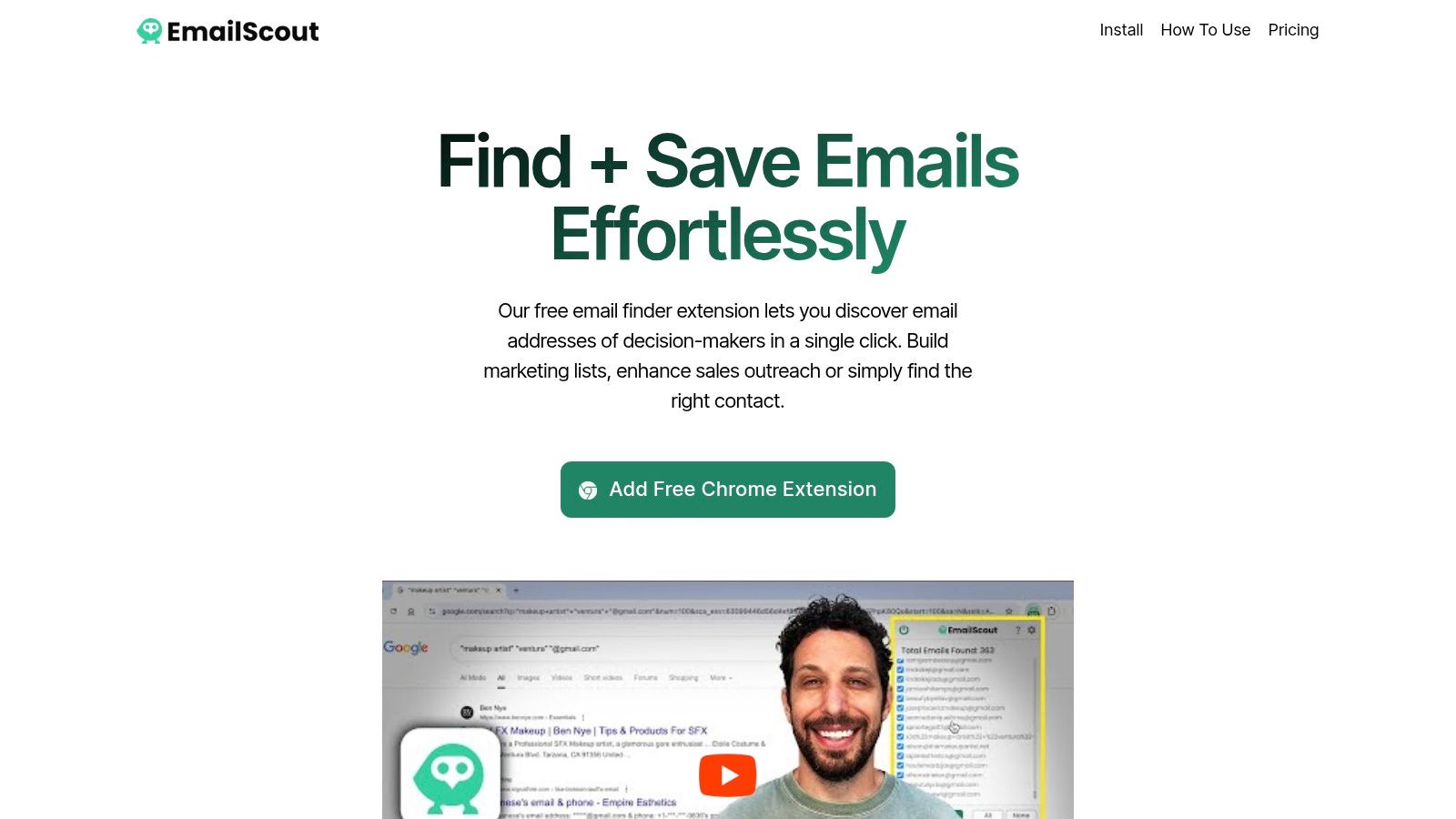
    Most people start with a browser extension. A tool like EmailScout plugs right into your browser, so you can find an email address by name while you're already looking at someone's LinkedIn profile or company website. It's usually just a one-click install from the Chrome Web Store, and you're good to go.

    Running Your First Search

    Let's say you're trying to reach "Sarah Chen," a marketing manager at "Innovate Inc."

    With an email finder extension running, you’d just pull up the Innovate Inc. website or Sarah’s LinkedIn page. The extension’s icon in your browser usually lights up, signaling that it's ready to work its magic.

    Click the icon, and a small window pops up asking for her name and the company domain. You plug that in, and the tool starts its hunt, checking databases and common email patterns in the background. Seconds later, it should serve up a potential email.

    Here’s what that interface typically looks like.

    As you can see, it's a straightforward form: first name, last name, and the company's domain. That’s all the tool needs to get started.

    Understanding Confidence Scores and Verification

    A solid email finder doesn't just hand you an address and walk away. It gives you some intel on whether that email is any good. Look for a confidence score (like 95%) or a simple colored dot next to the result.

    This is what those statuses mean:

    • Green/Verified: This is the jackpot. The tool successfully pinged the email server and got a confirmation that the address is real and can receive mail.
    • Yellow/Uncertain: This is a bit of a gray area. The server might be a "catch-all," which means it accepts mail for any address at that domain. Direct verification is impossible in this case, but the email is probably correct based on known patterns. It’s a calculated risk.
    • Red/Invalid: Steer clear. The email is bogus, and sending a message to it will bounce right back.

    This part is crucial. Just because an email is "found" doesn't mean it's "deliverable." Always prioritize verified, green-lit results to protect your sender reputation and make sure your outreach actually gets read.

    Performing Bulk Searches

    When you need to find more than one person's email, the bulk search feature is your best friend. This is where you can upload a CSV file with a list of names and company domains.

    You’ll just need to map the columns in your file—First Name, Last Name, Company—so the tool knows what to look for.

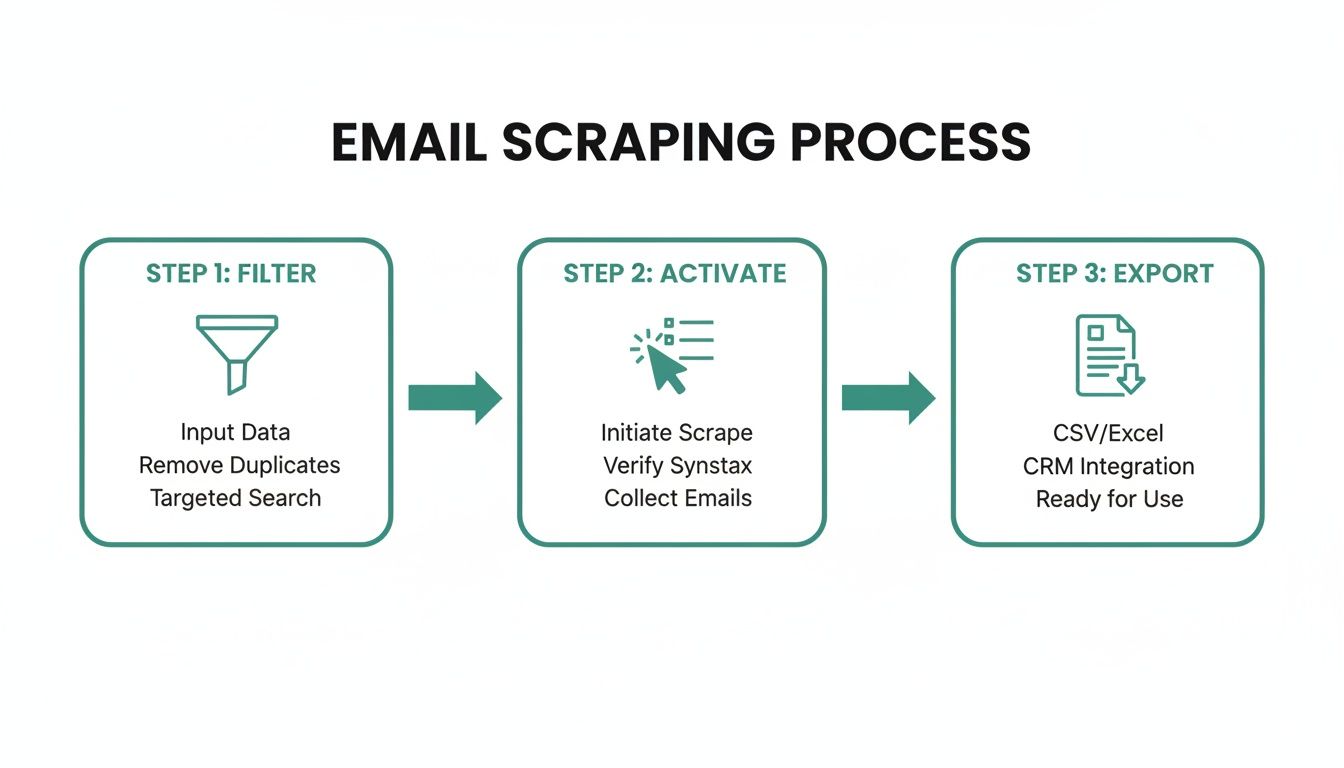
    Once you upload the list, the system chugs through it, adding the emails it finds and their verification statuses right into your file. It's the kind of feature that turns hours of mind-numbing manual work into a task you can knock out in minutes. For anyone trying to scale a sales or marketing campaign, this is an absolute must-have.

    Verifying Emails to Protect Your Reputation

    Finding a potential email address is just the first step. The real challenge is making sure it’s actually valid, because shooting messages into the void doesn't just waste your time—it actively hurts your ability to reach anyone at all.

    Think of every bounced email as a small ding against your sender reputation. If you get too many, email providers like Google and Microsoft will start seeing you as spam. Suddenly, your carefully written outreach lands in junk folders, or worse, never arrives. Verification is your insurance policy against this.

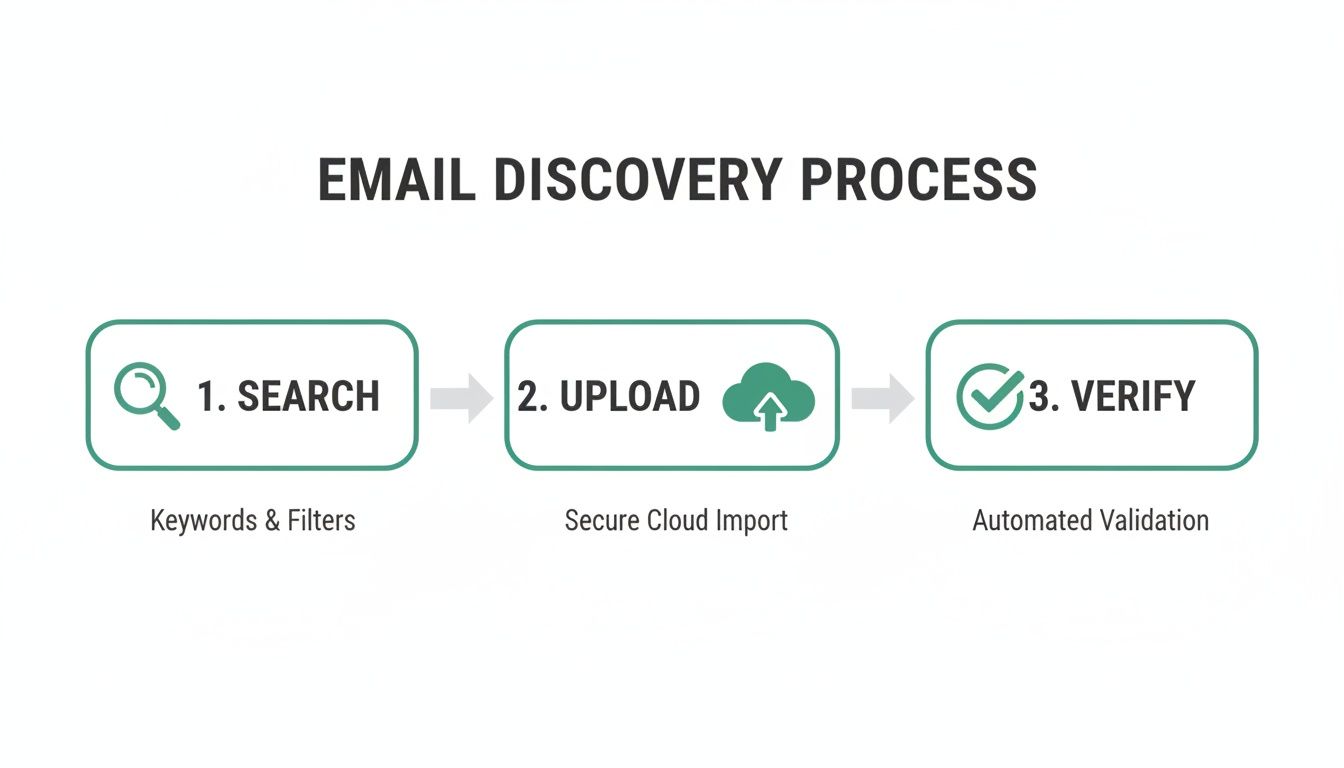
    This simple workflow is the core of any effective email discovery process.

    Infographic illustrating the 3-step email discovery process: search, upload, and verify with icons and descriptions.

    As you can see, verification isn't some optional final step. It’s a critical part of a healthy, sustainable outreach strategy.

    How Verification Actually Works

    When you verify an email, you're doing a lot more than just checking for a typo. A solid verification process runs through several layers of checks to confirm an address is real and ready to receive mail.

    • Syntax Check: This is the most basic part, making sure the email follows the right format, like name@domain.com. No weird characters or missing "@" symbols.
    • Domain Check: The system then confirms that the domain (@company.com) is legit and has active mail servers set up to receive email.
    • SMTP Ping: Here's the magic. The verifier sends a tiny, invisible "handshake" request to the recipient's mail server. It essentially asks, "Hey, does this specific inbox exist?" without actually sending an email. A "yes" back from the server confirms the address is valid.

    This multi-step process is what separates a high-quality list from one that will get you blacklisted. For a more technical look under the hood, our complete guide on email address verification breaks down every component.

    Don't Confuse Find Rate with Bounce Rate

    It's so important to understand the difference between a tool's "find rate" and your campaign's "bounce rate." A tool might boast a 91% find rate, which sounds great—it found an email for nine out of ten prospects. But that doesn't mean all nine are deliverable.

    Key Insight: Your goal should always be a bounce rate below 2%. A high find rate is totally useless if it leads to a high bounce rate. Always prioritize tools and processes that deliver verified contacts you can trust.

    Modern email finders combine everything from pattern analysis to web scraping to get those high discovery rates. Still, accuracy can vary. Some services will guarantee 95% or higher validation on their results, which is what you should be aiming for.

    To be extra safe, many pros (myself included) will run their lists through a second, dedicated verification service. It’s an extra layer of certainty that pays for itself by ensuring your messages actually land where they belong: in the inbox.

    Ethical Considerations and Legal Compliance

    Having the power to find just about anyone's email address is a huge advantage, but it’s not a free-for-all. Just because you can find an email doesn't mean you have an unrestricted license to use it however you want. A solid outreach strategy is built on a foundation of respect for privacy and a clear understanding of the rules.

    Ignoring these rules isn't just sloppy—it's expensive. Breaking laws like the CAN-SPAM Act in the US can lead to fines of over $50,000 for a single email. And beyond the financial hit, a reckless approach can destroy your brand's reputation, making it nearly impossible to connect with anyone down the road.

    This isn't meant to scare you off. It's about showing you how to do outreach the right way—ethically, legally, and effectively.

    Navigating Key Regulations

    While the laws can differ from place to place, a few principles are pretty much universal. Two of the big ones you absolutely need to know are the CAN-SPAM Act and Europe's General Data Protection Regulation (GDPR). It doesn’t matter where you're based; if you're emailing people in these regions, you have to follow their rules.

    These regulations aren't just a bunch of legal jargon. They actually provide a common-sense framework for how to communicate respectfully.

    Here’s what you need to do for every commercial email you send:

    • Be Honest: Your "From" name, reply-to address, and subject line can't be deceptive. They have to accurately reflect who you are and what the email is about.
    • Identify Your Message: You have to make it clear that the email is an advertisement. No hiding the ball.
    • Provide Your Location: A valid physical postal address must be included in every email.
    • Offer an Easy Opt-Out: Give people a simple, no-hassle way to stop receiving emails from you in the future.

    These aren't just for B2C marketing, either. The rules apply to all commercial messages, including business-to-business outreach.

    Adopting an Ethical Outreach Mindset

    Getting the legal stuff right is the bare minimum. Truly successful outreach comes from an ethical approach that flips the script from "what can I get?" to "what value can I offer?"

    The goal is to be a welcome guest in someone's inbox, not an intruder. Legitimate interest is key; your reason for contacting someone should be relevant and potentially beneficial to them. Never purchase email lists and always be transparent about who you are and why you're reaching out.

    This mindset also means knowing when to back off. If someone unsubscribes or replies asking you to stop, you have to honor that request immediately. Under CAN-SPAM, you have 10 business days to process it, but the faster, the better. Ignoring an opt-out is a surefire way to get reported for spam and burn a bridge for good.

    When you treat people's inboxes with respect and stick to the rules, you're not just avoiding fines. You're building a foundation for real, long-term relationships instead of just chasing a quick win.

    Common Questions About Finding Email Addresses

    Even with the best tools, you’ll run into questions. When you're trying to find someone's email, the "how" is only half the battle—the other half is knowing the rules of the road.

    Let's clear up a few of the most common things people ask. Getting this right from the start helps you build a smarter and more effective outreach strategy.

    Are Email Finder Tools Legal to Use?

    Yes, the tools themselves are perfectly legal. They work by pulling together publicly available information or using smart algorithms to predict common email formats. The real question isn't about the tool, but about how you use the information you get.

    It’s on you to follow anti-spam laws like the CAN-SPAM Act in the U.S. and GDPR in Europe.

    The bottom line is legitimate interest. You need a valid business reason to reach out, be clear about who you are, and always give people an easy way to opt out.

    What Is a Realistic Success Rate?

    This can vary wildly depending on the tool, the industry, and where your contacts are located. A good, professional-grade email finder often claims a 70-90% success rate for finding potential emails at established companies.

    But don't get too hung up on the "find rate." What really matters is your bounce rate—the percentage of emails that never get delivered.

    A healthy, verified list should have a bounce rate under 3%. Anything higher than that is a huge red flag that can get your domain flagged by email providers like Gmail and Outlook.

    Can I Find Personal Email Addresses?

    Most professional email finders are built to find corporate addresses (jane.doe@company.com), not personal ones from Gmail or Yahoo. And that's by design.

    Trying to use someone's personal email for a cold business pitch is a bad look. It feels invasive, gets marked as spam way more often, and can do some real damage to your brand’s reputation. Keep it professional.

    What If I Still Cannot Find Their Email?

    It happens. Sometimes, an email is just not out there to be found. When you hit a wall, don't just keep digging the same hole. It's time to pivot.

    Instead of getting fixated on email, try a different approach:

    • Connect on LinkedIn: Send a simple, personalized connection request. Don't pitch right away—just a quick note on why you want to connect is all you need.
    • Engage with Their Content: Jump into the conversation. Liking, commenting on, or sharing their posts shows you're paying attention and have a genuine interest.
    • Look for a Mutual Connection: A warm intro from someone you both know is worth ten cold emails. It’s almost always the most effective way in.

    Sometimes the best conversations start by building a relationship, not by finding an email address.


    Ready to stop guessing and start finding verified emails in seconds? EmailScout is the free Chrome extension that helps you find anyone's email with just one click. Install EmailScout for free and supercharge your outreach today.

  • A Practical Guide: scrape email from linkedin with ethical, compliant methods

    A Practical Guide: scrape email from linkedin with ethical, compliant methods

    So, you need to pull emails from LinkedIn. Whether it's for sales, marketing, or recruiting, you already know LinkedIn is a goldmine of professional contacts. But getting those email addresses? That’s a whole different ball game.

    This guide is designed to cut through the noise and show you how to get the data you need professionally and ethically.

    The Reality of LinkedIn Lead Generation

    Person typing on a laptop showing a LinkedIn profile, aiming for high-quality leads on a green desk.

    Let's be real: finding high-quality leads is the lifeblood of any growing business. With over a billion users, LinkedIn is the single largest pool of professional contacts on the planet. Naturally, the platform knows how valuable its data is and has built a fortress to protect it.

    This has sparked a constant cat-and-mouse game. LinkedIn's anti-scraping defenses are aggressive and sophisticated, reportedly blocking over 99% of naive web scrapers with multi-layered fraud detection. It's smart, too—using behavioral analysis and request fingerprinting to spot automated patterns.

    Despite this, an entire lead generation industry thrives on this data. It's estimated that a staggering 80% of all B2B leads originate from scraped LinkedIn data, with specialized tools still managing to extract millions of emails every single day.

    Why Scraping Emails Is a Game Changer

    Let's face it, manually hunting for contact info is slow, mind-numbing, and just doesn't scale. If you want to compete, your sales and marketing teams need a way to build targeted prospect lists without wasting countless hours. Learning how to properly scrape emails from LinkedIn bridges that gap, turning a painful manual task into an efficient, automated process.

    This efficiency is everything for successful B2B lead generation. Instead of burning daylight searching for one email, you can focus on what actually moves the needle:

    • Crafting outreach that actually gets a reply.
    • Building real relationships with your ideal prospects.
    • Closing deals and driving revenue.

    The goal isn't just to collect a massive list of emails. It's about getting the right contact information for the right people, so you can start valuable conversations at the right time. That’s the core of modern outreach.

    Finding Your Path Forward

    This guide will walk you through everything, from simple manual tricks to powerful automated tools. We'll lay out a clear roadmap so you can find a strategy that fits your needs, budget, and technical skills.

    To get a feel for the bigger picture, you might want to check out a modern playbook for generating leads with LinkedIn. By the time you're done here, you'll know exactly what's possible and how to get started without getting your account flagged.

    Know the Rules: Staying Out of Trouble with LinkedIn Scraping

    A desk with legal books, scales of justice, documents, and a laptop displaying 'KNOW THE RULES' for legal compliance.

    Before we even get to the "how," we need to have a serious talk about the rules of the road. Trying to pull emails from LinkedIn isn't just a technical challenge—it’s a minefield of platform policies and real-world laws.

    This isn’t about scaring you off. It’s about making sure you’re smart, protecting your business, and keeping your LinkedIn account from getting shut down.

    LinkedIn's Side of the Story

    Let's be crystal clear: LinkedIn's User Agreement explicitly forbids automated data collection. Any tool, bot, or scraper that pulls information without their direct permission is a violation.

    And they don't take this lightly. LinkedIn has sophisticated systems designed to sniff out and block automated activity. If your account suddenly starts acting like a robot—viewing hundreds of profiles an hour or sending out connection requests at an impossible speed—you're going to set off red flags.

    The fallout can be swift and severe:

    • A Slap on the Wrist: First, you might get a temporary account restriction, forcing you to prove you're a human.
    • The Permanent Ban: Keep it up, and they won't think twice about banning your account for good. That means your network, your recommendations, your entire professional brand on the platform—gone.
    • Bringing in the Lawyers: For large-scale data harvesting, LinkedIn has a history of taking companies to court.

    This isn't some empty threat. They restrict or ban thousands of accounts every single month for activity that doesn't look human. It's a risk you have to manage from the very start.

    The Bigger Picture: Laws and Ethics

    Beyond what LinkedIn wants, you have to answer to actual laws. Privacy regulations like Europe's General Data Protection Regulation (GDPR) and the California Consumer Privacy Act (CCPA) don't care about a platform's terms of service. They care about protecting people's personal data.

    Under these laws, an email address is personal information. If you collect, store, or use data from people in these regions, you are legally on the hook to comply. The fines for getting it wrong can be astronomical—enough to put a company out of business. Your responsibility doesn't end when you get an email; it’s just getting started.

    Key Takeaway: Compliance is not optional. Every email you collect is a potential liability. The convenience of a scraped list is never worth the risk of crippling legal penalties.

    The potential for misuse here is massive. One researcher famously uncovered an unprotected database containing 4.3 billion records scraped from LinkedIn. This 16TB data dump exposed the personal details of over 732 million unique profiles, leaking everything from names and emails to phone numbers. As Esecurityplanet.com reported, this kind of leak opens the door for hyper-personalized phishing scams on a global scale.

    Your best defense is to operate ethically. Be transparent, respect people's privacy, and make sure every message you send offers real value. Never sell scraped data, don't spam, and always give people an easy way to opt out. Handling data responsibly isn't just a legal checkbox—it's how you build a brand people can trust.

    Choosing the Right LinkedIn Email Scraper

    Picking the right tool to pull emails from LinkedIn is a make-or-break decision for your outreach. The market is packed with options, but they really boil down to two types: lightweight browser extensions and heavy-duty, cloud-based platforms.

    Browser extensions are usually the first stop for individuals or small teams just getting their feet wet. You install them right into Chrome, and they pop up on LinkedIn profiles or search pages. Their biggest draw is simplicity. You find a profile you like, click a button, and the tool gets to work finding an email right then and there.

    Cloud-based platforms, on the other hand, are built for bigger jobs. These are the go-to for sales departments or anyone running large, coordinated campaigns. Instead of running on your computer, they do all the heavy lifting on their own servers. This makes them faster, more scalable, and a whole lot less likely to get your account flagged by LinkedIn.

    Key Factors in Your Decision

    It's easy to get bogged down in feature lists when you're comparing tools. To keep things simple, just focus on three things that actually matter: accuracy, integration, and safety. A tool can promise you the world for cheap, but if half the emails it finds bounce, you've just wasted your time and money.

    Accuracy is everything. Look for tools that don't just find emails but also verify them on the fly. A high accuracy rate means fewer bounces, which is critical for protecting your domain's reputation and making sure your messages actually get delivered.

    Integration is all about efficiency. Can the tool sync with your CRM? Does it export data into a clean CSV file? A scraper that plays nice with your current tech stack will save you from hours of soul-crushing manual data entry.

    Finally, don't overlook safety. A good scraper should mimic human behavior to avoid setting off LinkedIn’s alarm bells. This means it needs features like randomized delays between actions and sensible daily limits. Cloud tools often have an advantage here because they can route their activity through different proxies, making them harder to detect.

    Top LinkedIn Email Scraper Tool Comparison

    To help you navigate the options, here's a detailed comparison of the leading LinkedIn email scraping tools. This table breaks down their features, pricing, and accuracy so you can make an informed choice that fits your needs.

    Tool Name Type Key Feature Pricing Model Claimed Accuracy
    EmailScout Browser Extension Real-time email verification and enrichment Credits / Subscription 95%
    Wiza Cloud-Based Platform Bulk export from Sales Navigator searches Credits / Subscription 97%
    Skrapp.io Browser Extension Simple single-profile email finding Credits / Subscription 89%
    AeroLeads Browser Extension List building from search results Subscription 90%
    Phantombuster Cloud-Based Platform Workflow automation & API integrations Subscription Varies by "Phantom"

    Each tool has its strengths. Browser extensions like EmailScout and Skrapp.io are great for quick, targeted lookups, while cloud platforms like Wiza and Phantombuster are built for high-volume, automated workflows. Your choice really depends on the scale and complexity of your outreach goals.

    A Closer Look at Browser Extensions

    Browser extensions are fantastic for their speed and convenience. Say you’re a recruiter who’s just stumbled upon the perfect candidate for a tricky role. With an extension, you can grab their email directly from their profile in a couple of clicks and start a conversation immediately. No need to export a list or wait for a big batch process to finish.

    Let's look at a few popular choices:

    • Skrapp.io: Known for its clean and simple interface, Skrapp is a great pick for grabbing an email from a single profile you're already looking at.
    • AeroLeads: This one is a step up, letting you build smaller, targeted lists directly from LinkedIn search results before finding contact info.

    While convenient, these tools have their limits. Because they operate right in your browser, they are more exposed to LinkedIn's detection systems. If you go overboard, you risk getting a warning on your account, so it’s best to use them in moderation.

    Expert Insight: Think of browser extensions like speedboats—they're fast and nimble for quick trips and targeted tasks. But if you need to cross an entire ocean of data, you'll want a bigger ship. That's where cloud platforms shine.

    The impact of these tools is undeniable. Email scrapers built for LinkedIn now support outreach for over 70 million companies across the globe. The best ones deliver verified B2B emails with accuracy rates climbing above 90%. Some platforms even boast 92% verified email accuracy, which can push campaign open rates 25% above the industry average. The math is simple: outreach to verified lists can cut wasted effort by as much as 70%.

    Diving Into Cloud-Based Platforms

    Cloud-based platforms are engineered for scale and safety. Imagine you're a sales manager who just used Sales Navigator to create a list of 500 ideal customer profiles. Trying to scrape each one manually with an extension would be a slow, painful, and risky process.

    This is exactly the kind of job a cloud tool like Wiza was built for. You can export your entire Sales Navigator search, upload it, and let the platform do the work behind the scenes. Wiza finds and verifies emails for everyone on your list, then hands you a clean, enriched file ready for your outreach campaign. It’s not just faster—it’s much safer, since the platform handles all the scraping on its own secure infrastructure.

    If you want to start without an upfront cost, check out our guide on using a free email scraping tool. And for a wider look at the market, this list of the best tools for scraping LinkedIn offers a great overview. Ultimately, the right platform is the one that aligns perfectly with your workflow and helps you get from prospect to conversation without any friction.

    Alright, let's put theory into practice. Reading about a tool is one thing, but seeing it work is how you really learn. We'll walk through the whole process right now—from installation to exporting your first batch of contacts—using a browser extension like EmailScout as our example.

    This hands-on approach shows you just how fast you can start pulling in valuable contact info.

    The best part about a solid browser extension is that it fits right into your current workflow. It lives directly on LinkedIn, so you don't have to jump between different apps or mess around with uploading and downloading CSV files. Everything happens right where you need it.

    By the time we're done here, you'll be able to confidently find a profile, fire up the scraper, and start building a high-quality lead list.

    Getting Your Scraper Set Up

    Before you can find any emails, you need to get the tool installed. Don't worry, this is the easy part and usually takes less than a minute.

    1. Find the Extension: First, head over to the Chrome Web Store and search for your email scraper of choice. We're using EmailScout for this walkthrough.
    2. Add to Chrome: Just click the "Add to Chrome" button. Your browser will ask for a couple of permissions, which it needs to read the data on a LinkedIn page.
    3. Pin for Easy Access: Once it’s installed, I always recommend "pinning" it to your toolbar. Click the little puzzle piece icon in Chrome, find the scraper, and click the pin icon. This keeps it visible and ready to go.

    With the extension installed, you’re ready to hunt down your first prospect. But here’s a crucial tip: the magic isn't just in the tool itself. It's in how you set up your search before you even think about clicking that "scrape" button.

    Building a Laser-Focused Prospect List

    This is where so many people go wrong. They try to scrape thousands of random LinkedIn profiles, and they end up with a useless list.

    A list of 10,000 random contacts is junk. A list of 50 perfectly targeted prospects? That's a goldmine. The quality of your outreach always starts with the quality of your list.

    This is where you lean on LinkedIn’s own search filters. They are your best friend. Use them to dial in your audience with serious precision.

    • Job Titles: Don't just search for "Manager." Get specific. Think "Director of Demand Generation" or "Head of Talent Acquisition."
    • Industry: Filter by niche industries like "Computer Software" or "Financial Services" so your message is always relevant.
    • Company Size: Are you targeting scrappy startups (11-50 employees) or going after enterprise giants (10,000+)?
    • Geography: Zero in on prospects in a specific city, state, or country.

    For instance, if you're a B2B SaaS company selling marketing software, you might build a search for "Marketing Directors" at "Software companies" with "51-200 employees" located in "Texas." Now that is a hyper-targeted list ready for scraping.

    Running Your First Scrape

    Once your filtered search results are on the screen, the rest is simple. You have two main ways to approach this.

    Scraping a Single Profile

    Let's say one person in your search results looks like a perfect match. You click on their profile to get a better look.

    Once you're on their page, your email scraper's icon will light up or a new button will appear. Just click it. The tool will start working its magic in the background, hunting for and verifying a professional email for that person. In a few seconds, it should pop up with a verified email.

    Pro Tip: This one-by-one method is perfect for your highest-value targets. While you're on their profile, look for personal details—a recent post, a shared connection, a university—that you can mention in your email. This personal touch can make a huge difference in your reply rates.

    Bulk Scraping from a Search Page

    If you want to build a list faster, bulk scraping is the way to go. Instead of clicking into every single profile, you can pull contact info from the entire search results page at once.

    Most extensions will add a button right on the LinkedIn search page, usually saying something like "Find emails on this page." Click it, and the tool will run through every profile on that page (typically 10-25 people) and find their info at the same time.

    The results get collected in the extension's dashboard, where you can export everything as a clean CSV file.

    This method gives you the perfect mix of speed and safety. You aren't scraping thousands of profiles at once (a big red flag for LinkedIn), but you're also not stuck doing everything manually. You can easily build a targeted list of 100-200 prospects in one sitting, all without ever leaving LinkedIn.

    Scraping Safely to Protect Your Account

    Using a tool to scrape emails from LinkedIn is the easy part. The real art is doing it without setting off LinkedIn’s alarms and getting your main account nuked. Pros who pull data at scale have this down to a science, using specific strategies to stay under the radar so they can keep operating long-term.

    This isn't about trying to outsmart the system. It's about blending in. You need to mimic human behavior so well that your automated activity looks completely normal. LinkedIn's detection algorithms are sharp, constantly scanning for patterns that scream "robot"—like visiting profiles way too fast, being active at weird hours, or making requests from sketchy IP addresses. Those are all massive red flags.

    This simple workflow breaks down the core process.

    A flowchart detailing the three-step email scraping process: filter, activate, and export data.

    The biggest takeaway here? Smart scraping starts way before you hit "go" on any tool. It begins with laser-focused filtering to make sure you’re only grabbing high-value, relevant data.

    Mimic Human Behavior to Avoid Detection

    The golden rule of safe scraping is to act like a person, not a piece of software. Real people don't look at 500 profiles in an hour or work 24/7. To avoid an instant ban, your scraping activity needs to look just as random and paced as a regular user's.

    This means putting the brakes on your scraping tools. Instead of just letting them run wild, you need to configure them to pause and introduce random delays between actions. Any decent tool will let you tweak these settings.

    • Profile Visits: Keep your daily profile visits in check. For a properly warmed-up account, a safe range is between 80 to 150 profiles per day. Pushing past that, especially on a newer account, is just asking for trouble.
    • Action Delays: Always set delays of 30-60 seconds between each profile visit. This little bit of randomness makes your activity look far more natural than hitting a new profile every two seconds.
    • Operating Hours: Only run your scraper during normal business hours for your time zone. An account that’s grinding away at 3 AM is a dead giveaway for automation.

    Stick to these limits, and you dramatically lower the odds of your account getting flagged.

    The Power of Proxies and Dedicated Accounts

    One of the most obvious ways LinkedIn catches scrapers is by tracking IP addresses. If thousands of requests are hammering their servers from a single data center IP, it's game over. This is where proxies become non-negotiable.

    A residential proxy is your best friend here. It routes your traffic through an IP address that belongs to a real home internet connection, making your activity look like it's coming from a regular person browsing from their couch. It's a critical layer of defense for any serious scraping operation.

    Key Takeaway: Never, ever scrape from your personal IP address if you care about your main LinkedIn account. The small cost of a quality residential proxy service is the best insurance policy you can buy against a permanent ban.

    On top of that, you should always use a dedicated, secondary LinkedIn account just for scraping. This tactic completely isolates your data gathering from your primary professional profile. If the scraping account gets restricted or banned, your personal network, reputation, and content are all safe and sound.

    Think of this second account as your "burner" profile. Its only job is to handle the risky work of data extraction, acting as a firewall between the tools and your real identity. While you still need to warm it up properly, losing it is a calculated risk, not a catastrophe. Many people also use different email search engines to find more data, creating a much stronger lead generation machine.

    Warm Up Your Account Before Scaling

    You can't just spin up a new LinkedIn account and immediately start scraping 100 profiles a day. A brand-new account with a sudden burst of high-volume activity is the reddest flag you can wave. You have to "warm up" the account over a few weeks to build a history of normal, human-like behavior.

    Here’s a sample warm-up routine:

    1. Week 1: Fill out the profile completely. Add a professional photo, a solid headline, and a summary. Start sending 5-10 connection requests per day to people you might know.
    2. Week 2: Begin engaging. Like and comment on a few posts each day. Bump up your connection requests to 10-15 per day.
    3. Week 3: Time for some light scraping. Start by visiting just 20-30 profiles per day with your tool, while still doing your normal engagement activities.
    4. Week 4 and beyond: Slowly increase your daily scraping volume by about 10-20 profiles each week, but never go over the safe daily limits.

    This slow, steady approach builds a baseline of normal activity, making your eventual scraping far less likely to trigger an alert. Patience in the warm-up phase is what separates the successful, long-term operations from the ones that get shut down within a week.

    Your Top Questions About LinkedIn Scraping, Answered

    Alright, we've walked through the "how-to" of finding emails on LinkedIn. But let's be real—the technical side is only half the story. You probably have some nagging questions about the risks and rules. Let's tackle them head-on.

    Is It Legal to Scrape Emails from LinkedIn?

    This is the big one, and the answer is… it's complicated. Scraping emails lives in a legal gray area, and the rules change depending on where you are and what you do with the data.

    LinkedIn’s own terms of service are crystal clear: they absolutely forbid any kind of automated data scraping. On the other hand, several court rulings have suggested that scraping publicly available data isn’t illegal in itself.

    The real minefield is privacy law. Regulations like GDPR in Europe are incredibly strict about how personal data (like email addresses) is gathered and used. Getting this wrong can lead to some seriously painful fines.

    Crucial Takeaway: Don't guess. Before you start any project, talk to a legal professional. You need to be 100% sure your process respects all the data privacy laws that apply to you and the people you're contacting.

    Can My LinkedIn Account Get Banned?

    Yes, without a doubt. This is probably the most immediate risk you'll face. LinkedIn has poured a ton of resources into smart systems that are constantly on the lookout for bot-like activity that violates their user agreement.

    You can easily raise a red flag by:

    • Flying through an unnatural number of profiles in a short time.
    • Firing off connection requests way too fast.
    • Using a scraping tool from a single IP address that screams "automation!"

    The slap on the wrist can be anything from a temporary time-out (where they make you prove you're human) all the way to a permanent, no-questions-asked ban. To avoid this, stick with trusted tools that mimic human behavior, keep your activity at a slow, realistic pace, and seriously consider using a separate, secondary account just for scraping. It's cheap insurance for your primary professional profile.

    What Is the Most Effective Way to Find Verified Emails?

    The best approach isn't just about finding emails—it's about finding correct emails that actually work. The most effective strategy is a one-two punch: highly specific LinkedIn searching followed by a top-notch verification tool.

    First, get surgical with LinkedIn's search filters. If you have it, Sales Navigator is even better for building a hyper-targeted list of ideal prospects.

    Once you have that list, run it through a reputable scraping and verification tool that checks emails on the fly. This two-step process is a game-changer. It ensures your final list is not only perfectly aligned with your campaign goals but also has a super low bounce rate, which is key to protecting your email reputation and getting your messages seen.


    Ready to build high-quality lead lists without the guesswork? With EmailScout, you can find and verify emails directly from LinkedIn profiles in one click. It's the smart, efficient way to make sure your outreach hits the mark. See how EmailScout can upgrade your lead generation today!

  • 12 Best Chrome Extensions for Productivity in 2025: Sales & Marketing Tools

    12 Best Chrome Extensions for Productivity in 2025: Sales & Marketing Tools

    Chrome extensions can transform routine sales, marketing, and biz-dev tasks into powerful automated workflows. From capturing leads on the fly to managing dozens of tabs without losing context, the right toolkit helps outreach teams do more with less effort.

    In this guide we’ve hand-picked the 12 best chrome extensions for productivity. Each tool includes real-world use cases, honest pros and cons, pricing details, integration tips, and direct links. You’ll learn to skip trial and error by choosing platforms proven in sales, marketing, and biz-dev workflows.

    • Automate cold email campaigns with EmailScout for faster follow ups
    • Organize research and assets across campaigns with tab managers
    • Secure and auto-fill credentials in one click
    • Record quick video demos for async collaboration
    • Pin important tabs with Workona for focused project sessions

    Every entry includes screenshots and direct links for quick access. We also highlight practical implementation notes so you can:

    1. Identify extensions that fit your workflow
    2. Balance free features versus paid plans
    3. Integrate tools into CRMs and project boards

    Whether you’re a sales professional chasing quotas, a marketer juggling campaigns, or a founder flying solo, this list will point you to the best chrome extensions for productivity. Let’s dive in and supercharge your outreach.

    1. EmailScout

    EmailScout is a lightweight, one-click Chrome extension that turns any website or Google search into a lead generation source for sales teams, marketers, and entrepreneurs. Its Zero-config setup and intuitive interface position it as one of the best chrome extensions for productivity in outreach workflows. Its minimal learning curve and responsive support team reduce onboarding friction. Support is available via live chat or email.

    EmailScout

    Key Features

    • AutoSave background captures emails as you browse
    • URL Explorer scans batches of URLs (up to 1,500)
    • One-click extraction directly from page source or search results
    • Export options: CSV or TXT with unlimited free-tier exports

    Typical Use Cases

    1. Building targeted B2B contact lists during market research
    2. Automating bulk lead collection for cold email campaigns

    Pricing & Plans

    Feature Free Tier Premium ($9/mo)
    URL Explorer Manual Bulk up to 1,500 URLs
    AutoSave Not available Background capture
    Monthly Exports Unlimited 5,000 emails

    Pros and Cons

    • Pros
      • Free, unlimited email finding and exports
      • Easy setup, click-and-go interface
      • Affordable scaling to 1M emails per month
    • Cons
      • No built-in verification; results depend on public data
      • Users must manage GDPR and CAN-SPAM compliance

    Quick Tip

    Pin the extension to your toolbar and activate AutoSave before hitting industry directories to streamline lead capture.

    Learn more about EmailScout on emailscout.io

    2. Chrome Web Store – Productivity Collection

    The Chrome Web Store is Google’s official marketplace for discovering and installing browser add-ons. Its “Your productivity toolkit” collection features top-rated extensions vetted by Google’s editorial team. Automatic updates and detailed permissions make it a trusted hub for sales and marketing professionals.

    Chrome Web Store – Productivity Collection

    Navigating the productivity collection gives real user reviews, install counts, and enterprise controls. A Google account and Chrome browser suffice for access. Pricing is free for most extensions; some premium tools offer paid tiers.

    Key Features

    • One-click install to Chrome with automatic updates
    • Curated productivity collections edited by Google’s team
    • Granular permissions and user rating transparency
    • Enterprise controls for managed users in Chrome Enterprise

    Pricing and Access

    • Free to use for most extensions; paid tiers for advanced features
    • Accessible via Chrome browser and Google account
    • Enterprise licensing required for managed controls

    Pros and Cons

    Pros

    • Safest direct source for Chrome extensions
    • Automatic updates and permission prompts

    Cons

    • Overwhelming selection may hinder discovery
    • Extensions can change ownership over time

    Quick Tip

    Use starred collections to save high-value extensions and monitor update notes for best performance.

    Learn more about Chrome Web Store – Productivity Collection on emailscout.io.

    3. Product Hunt – Chrome Extensions Category

    Product Hunt is a product-discovery platform with a dedicated Chrome Extensions category that surfaces recent launches and top-reviewed productivity tools. Community rankings and discussion threads help sales and marketing teams evaluate emerging extensions before they hit mainstream lists.

    Product Hunt – Chrome Extensions Category

    Browsing this category lets you filter by “Top reviewed” and “Newest” to find cutting-edge tools. Each listing links directly to vendor sites and the Chrome Web Store, while user comments and upvotes reveal real usage insights.

    Key Features

    • Community upvotes and aggregate review scores
    • Filters for Top reviewed, Trending, and New launches
    • Direct links to Chrome Web Store and developer websites
    • Comment threads for hands-on feedback and use cases

    Pricing and Access

    • Completely free to browse and use
    • Requires a Product Hunt account for upvoting and commenting
    • No premium tiers; extensions may include paid features separately

    Pros and Cons

    Pros

    • Great for discovering early-stage, innovative tools
    • Honest community feedback highlights strengths and pain points

    Cons

    • Quality varies; some launches may be experimental
    • Fewer enterprise controls compared to official marketplaces

    Quick Tip

    Follow the Chrome Extensions category and enable email alerts to spot high-potential productivity tools before competitors do.

    Learn more on Product Hunt – Chrome Extensions Category.

    4. G2 – Best Chrome Extensions Roundup

    G2 is a leading B2B review and editorial platform that curates top Chrome extensions by productivity use case. Its “Best Chrome Extensions Roundup” offers contextual summaries, buyer guidance, and real user ratings to help sales, marketing, and business development pros discover tools that match their workflows.

    G2 – Best Chrome Extensions Roundup

    The roundup groups extensions by function – task management, ad-blocking, email automation – with pros, cons, and installation links. G2’s verified reviews and scoring system provide honest insights, while detailed buyer guides explain which features matter most for your team’s goals.

    Key Features

    • Curated lists organized by productivity use cases
    • In-depth editorial summaries and buyer guidance
    • Verified user reviews with star ratings and comments
    • Direct links to Chrome Web Store for each extension
    • Comparison tables highlighting feature differences

    Pricing and Access

    • Free access to all articles and roundups
    • No account required for browsing reviews
    • Installations occur via Chrome Web Store links

    Pros and Cons

    Pros

    • Trusted community reviews for workplace adoption
    • Clear buyer guidance streamlines decision making
    • Easy primer for newcomers to extension ecosystems

    Cons

    • Not a direct storefront – redirects to Chrome Web Store
    • May not cover niche or very new extensions

    Quick Tip

    Bookmark G2’s roundup and subscribe to update alerts so you never miss newly published productivity extension reviews.

    Learn more about G2 – Best Chrome Extensions Roundup on G2.

    5. Zapier Blog – “Best Productivity Extensions for Chrome”

    Zapier’s annual guide to the best chrome extensions for productivity offers a vendor-neutral, workflow-focused roundup of proven tools. It highlights clear “best for” labels, up-to-date pricing snapshots, and direct links to official extension pages, making it ideal for sales professionals and digital marketers.

    Zapier Blog – “Best Productivity Extensions for Chrome”

    Each entry is organized by use case, from task management to ad-blocking, with annual refreshes that keep recommendations current. No login or subscription is required to access the full guide, and readers can click through to vendors’ pages for detailed feature and pricing information.

    Key Features

    • “Best for” labels categorizing each extension by workflow need
    • Annual update cycle with fresh insights on new releases
    • Pricing callouts for popular free and paid tools
    • Direct links to official extension pages for quick install

    Pricing and Access

    • Free to read on Zapier Blog, no account needed
    • Vendor pricing varies; links direct to latest plans
    • Bookmark or subscribe to RSS feed for update alerts

    Pros and Cons

    Pros

    • Credible, vendor-neutral editorial perspective
    • Workflow-focused recommendations tailored to roles

    Cons

    • Not exhaustive; prioritizes widely used tools
    • Pricing and features may change between updates

    Quick Tip

    Subscribe to Zapier’s RSS feed or email alerts to catch new extension reviews as they publish each year.

    Learn more about Zapier Blog – “Best Productivity Extensions for Chrome” on emailscout.io.

    6. Android Police – “Essential Chrome Productivity Extensions”

    Android Police is a trusted tech publication delivering hands-on picks for the best chrome extensions for productivity with practical usage notes and real world tips. You get clear, tested recommendations tailored to both desktop and mobile Chromebook users.

    Android Police – “Essential Chrome Productivity Extensions”

    Navigating this curated guide links directly to official listings. Each extension is tested in plain English with performance observations on page load, resource use, and UI. Free access, no sign-up required, works in any Chrome or Chromium based browser.

    Key Features

    • Practical usage notes based on hands-on testing
    • Mobile and Chromebook perspective for on-the-go workflows
    • Direct links to Chrome Web Store entries
    • Plain-English explanations of setup and best practices

    Pricing and Access

    • Completely free to read and implement
    • No account or subscription needed
    • Compatible with Chrome, Edge, Brave, and other Chromium browsers

    Pros and Cons

    Pros

    • Real-world performance insights
    • Advice on when each tool shines on mobile or desktop

    Cons

    • Selections may update over time
    • Not a full extension marketplace

    Quick Tip

    Bookmark key extension notes as a cheat sheet, then test alongside your cold email and outreach tools for smooth integration.

    Learn more about Android Police – “Essential Chrome Productivity Extensions” on Android Police.

    7. SlashGear – “Best Chrome Extensions to Boost Productivity”

    SlashGear curates concise collections of leading Chrome add-ons for productivity, perfect for sales reps and marketers needing a quick shortlist of high-impact tools. Its editorial picks include top-rated options with direct install links and brief pros for swift decision making. SlashGear’s interface is minimalist and easy to scan on the go, helping busy entrepreneurs find tools in seconds.

    SlashGear – “Best Chrome Extensions to Boost Productivity”

    Key Features

    • Short lists of popular extensions with clear pros and pricing context
    • Direct links to Chrome Web Store for one-click install
    • Editor notes on use cases for sales, marketing, ecommerce
    • Mobile-friendly summaries optimized for quick reading
    • Regular updates reflecting newest and top-rated tools

    Pricing and Access

    • Free to browse and read on SlashGear
    • Extensions may offer free or paid tiers on the Web Store
    • No registration required to access lists
    • Compatible with any desktop or mobile Chrome browser
    • Accessible worldwide without geo restrictions

    Pros and Cons

    Pros

    • Fast insight into best chrome extensions for productivity
    • Clear pricing and usage takeaways
    • Editorial curation reduces decision fatigue

    Cons

    • Not a purchase portal – must click through to install
    • Editorial bias may skip emerging niche tools

    Quick Tip

    Bookmark the SlashGear list and enable Chrome sync to keep your productivity toolkit consistent across all devices.

    Learn more on SlashGear: https://www.slashgear.com/1621931/best-chrome-extensions-productivity-boost/

    8. The Keyword (Google Blog) – “5 Chrome extensions to increase productivity”

    The Keyword is Google’s official blog highlighting a select group of Chrome extensions that streamline everyday workflows. Each post offers detailed examples of how to integrate tools like tab managers or grammar checkers directly into your browser.

    The Keyword (Google Blog) – “5 Chrome extensions to increase productivity”

    With clear screenshots and direct links you can install recommended extensions in seconds. Posts include real world scenarios such as using a screenshot tool for sales demos or a time tracker for freelance billing. No third party marketing fluff, just hands on advice that aligns with Chrome features.

    Key Features

    • Official curation by Google’s editorial team
    • Practical use case scenarios for each extension
    • Direct links with install and permission details
    • In-post screenshots showing real interface steps

    Pricing and Access

    • Free to read with no login required
    • Extensions often free or freemium via Chrome Web Store
    • Requires Chrome browser for direct install

    Pros and Cons

    Pros

    • Trusted source with deep UX insights
    • Examples tailored to common sales and marketing tasks

    Cons

    • Limited to five extensions per post
    • Not a marketplace for paid tier tools

    Quick Tip

    Subscribe to The Keyword RSS feed to catch new extension roundups as soon as they publish.

    Learn more about The Keyword (Google Blog) – “5 Chrome extensions to increase productivity” on The Keyword.

    9. Workona – Tab Manager & Workspaces (official site)

    Workona is the official site for a leading tab and workspace manager with a Chrome extension that helps sales and marketing teams keep projects organized. With its intuitive interface users can group tabs into workspaces, suspend idle tabs to reduce memory usage, and search across sessions from any new tab.

    Workona – Tab Manager & Workspaces (official site)

    On the Workona platform teams can share workspaces, assign tasks, and sync context across devices. Its powerful search engine surfaces open tabs, pinned resources, and saved projects in seconds. A clean dashboard offers quick access to current workflows without clutter.

    Key Features

    • Spaces and workspaces for project-based tab organization
    • Tab suspension to free up RAM and speed up Chrome
    • Cross-tab search and new-tab integration for rapid retrieval
    • Collaboration options for shared team workspaces

    Pricing and Access

    • Free plan includes 10 workspaces and up to 20 tabs synced
    • Paid plans start at $10 per user per month for unlimited workspaces
    • Requires Chrome browser and a free Workona account

    Pros and Cons

    Pros

    • Noticeable performance and focus gains for heavy tab users
    • Business-friendly features enabling team collaboration

    Cons

    • Advanced collaboration features are locked behind a paid plan
    • Some users may face a learning curve with complex workspace setups

    Quick Tip

    Pin your most critical workspaces to the sidebar and use custom labels to switch contexts quickly between client outreach and content research.

    Learn more about Workona – Tab Manager & Workspaces on workona.com.

    10. Todoist – Official Plans (Todoist for Chrome extension)

    Todoist’s official pricing page outlines everything you need to maximize the Todoist for Chrome extension, a top-rated task manager that captures to-dos on any webpage and syncs seamlessly across devices. You can compare plan levels to unlock features like labels, filters, and project templates.

    Todoist – Official Plans (Todoist for Chrome extension)

    Browsing the pricing table presents side-by-side comparisons of the Free, Premium, and Business tiers, with clear notes on user limits. A Todoist account and Chrome installation are all you need to get started and adjust your plan at any time.

    Key Features

    • Quick-add tasks from web pages or email with a single click
    • Labels, filters, priorities, and project sections for granular organization
    • Real-time cross-platform sync with desktop, mobile, and calendar apps
    • Integration with tools like Google Calendar, Slack, and Zapier

    Pricing and Access

    • Free plan with core task creation and basic labels
    • Premium starts at $4 per user per month billed annually
    • Business plan with team administration, projects, and priority support
    • Requires registration on Todoist and Chrome browser

    Pros and Cons

    Pros

    • Polished interface optimized for both solo users and teams
    • Extensive integration ecosystem boosts productivity
      Cons
    • Key power features such as reminders require paid tiers
    • Pricing tiers and renewal terms may change without notice

    Quick Tip

    Enable keyboard shortcuts (Ctrl+Shift+A) to add tasks instantly from any tab.

    Learn more about Todoist – Official Plans on Todoist Pricing.

    11. 1Password – Official Pricing (Chrome extension included)

    The 1Password pricing page lays out subscription tiers and features for its award-winning password manager with a Chrome extension included. Users get autofill for passwords, passkeys, and 2FA codes alongside secure item storage and cross-device sync. This resource centralizes details to help teams and individuals boost productivity by speeding logins and credential management.

    1Password – Official Pricing (Chrome extension included)

    Browsing plans on 1Password.com is intuitive; each tier lists user seats, shared vault options, and enterprise controls. Clear comparisons help decision makers evaluate cost against features like automated security alerts, dedicated support, and custom role assignments. Its polished interface and responsive customer service set it apart from open-source alternatives.

    Key Features

    • Autofill for passwords, passkeys, and 2FA codes
    • Cross-device sync and shared vaults for teams and families
    • Security alerts (Watchtower) for weak or compromised credentials

    Pricing and Access

    • Subscription plans start at $2.99 per user per month (billed annually)
    • Team and Business tiers include activity logs and custom roles
    • Chrome extension free with any paid plan

    Pros and Cons

    Pros

    • Highly regarded security model and independent audits
    • Streamlines daily logins and account switching

    Cons

    • Subscription-based pricing, no free open-source option
    • Exact pricing varies by plan and region—confirm at checkout

    Quick Tip

    Enable Watchtower notifications in browser settings to receive real-time alerts on compromised credentials.

    Learn more about 1Password – Official Pricing on 1Password.

    12. Loom – Official Pricing (Chrome recorder for async collaboration)

    Loom’s pricing page offers transparent subscription layers for its Chrome recorder, enabling users to assess which plan meets their async video messaging needs. From single-click screen captures to AI summarization, it breaks down feature access by tier.

    Loom – Official Pricing (Chrome recorder for async collaboration)

    Navigating loom.com/pricing, you can compare Free, Business, and Enterprise plans, review team management tools, and upgrade within the browser. The intuitive interface and clear feature matrix ensure sales and marketing teams invest in relevant capabilities.

    Key Features

    • One-click screen, camera, and audio capture directly in Chrome
    • Auto-generated titles, summaries, and chapters powered by AI
    • Shared video libraries with timestamped comments for collaboration
    • Inline embed options for emails and documentation

    Pricing and Access

    • Free tier includes 5-minute recordings with basic editing
    • Business plan unlocks unlimited recordings and AI enhancements
    • Enterprise tier adds advanced security, SSO, and dedicated support

    Pros and Cons

    Pros

    • Speeds up explanations compared to long emails or calls
    • Robust AI features enhance clarity and accessibility
    • Browser-based updates ensure newest features immediately

    Cons

    • Free tier imposes recording length limits
    • Advanced AI and team features require higher-tier plans

    Quick Tip

    Embed Loom videos in cold email campaigns to boost engagement and clarify product demos without leaving your inbox.

    Learn more about Loom – Official Pricing on loom.com/pricing.

    Top 12 Chrome Productivity Resources — Quick Comparison

    Product Core features UX & Quality Price & Value Best for Standout point
    EmailScout (recommended) One‑click email finder; AutoSave; URL Explorer; CSV/TXT export Easy Chrome install; instant results; browser‑based workflow Free unlimited find/exports; Premium from $9/mo (5K/mo) – plans to 1M; 200‑email trial Sales, marketers, founders, freelancers, biz‑dev AutoSave + bulk URL scanning for automated list building
    Chrome Web Store – Productivity Collection One‑click install; auto‑updates; ratings & reviews Trusted, secure source; granular permissions shown Free marketplace; extensions may be free or paid General users & IT admins Official storefront with enterprise controls
    Product Hunt – Chrome Extensions Category Rankings; community reviews; filters Good discovery UX for new launches Free to browse Early adopters, makers, product hunters Spot emerging tools and early traction
    G2 – Best Chrome Extensions Roundup Curated lists by use case; buyer guidance B2B review ecosystem; contextual summaries Free editorial content Teams evaluating tools for work use Review‑driven buyer guidance for workplace adoption
    Zapier Blog – “Best Productivity Extensions” “Best for” labels; pricing snapshots; links Workflow‑focused editorial; practical guidance Free editorial content Workflow/automation focused users Vendor‑neutral, task‑oriented recommendations
    Android Police – “Essential Chrome Productivity Extensions” Hands‑on picks; mobile/Chromebook notes Practical, tested reviews and tips Free editorial content Chromebook and mobile users Mobile/Chromebook perspective with real‑world tips
    SlashGear – “Best Chrome Extensions to Boost Productivity” Concise lists; quick pros & pricing Consumer‑friendly, easy scanning Free editorial content Casual users making a quick shortlist Fast shortlist creation with pricing context
    The Keyword (Google Blog) – “5 Chrome extensions…” Official Google picks; practical examples High trust; aligned with Chrome features Free editorial content General users seeking starter tools Google‑endorsed selection and examples
    Workona – Tab Manager & Workspaces Spaces/workspaces; tab suspension; search Improves focus & memory usage; team features Freemium; advanced features paid Heavy tab users, teams, project managers Workspace organization + tab suspension for performance
    Todoist – Official Plans (Chrome extension) Quick‑add tasks; labels, filters; sync Polished UX; cross‑platform sync Freemium; paid tiers for advanced features Personal productivity and small teams Deep integrations and powerful task organization
    1Password – Official Pricing (Chrome extension) Autofill, passkeys, shared vaults; alerts Secure, audited; smooth autofill UX Subscription plans; team/family tiers Security‑conscious individuals & teams Strong security model and team vaults
    Loom – Official Pricing (Chrome recorder) One‑click screen/camera recording; AI summaries Fast async communication; shareable libraries Freemium with recording limits; paid AI/team tiers Remote teams, support, product demos Rapid async video with AI enhancements

    Ready to Supercharge Your Workflow?

    You have just explored a curated list of the best chrome extensions for productivity that address every stage of your sales and marketing funnel. From email automation with EmailScout to advanced tab management with Workona, these tools are designed to streamline outreach and free you to focus on closing deals.

    Key Takeaways

    • EmailScout – Automate follow-ups, track opens, and sync with your CRM for consistent engagement
    • Chrome Web Store Productivity Collection – Discover community-rated tools for time tracking, focus modes, and more
    • G2 Roundup – Use peer insights to compare features and user satisfaction before committing
    • Zapier Blog Picks – Integrate Chrome extensions with your favorite apps for seamless automation
    • Android Police & SlashGear Guides – Find niche enhancers like quick note clipping and Pomodoro timers
    • Google Blog Recommendations – Leverage Chrome team tips on shortcuts and built-in features
    • Official Extensions (Workona, Todoist, 1Password, Loom) – Rely on vendor support, security updates, and direct integrations

    Choosing the Right Extension

    1. Define your primary goal – lead generation, task organization, or secure credential management
    2. Map features to your workflow – prioritize email templates for outreach, workspaces for client research, or video messaging for demos
    3. Align team size and budget – mix free tiers with premium plans based on usage and value
    4. Test compatibility – ensure extensions integrate smoothly with your CRM, project boards, and browser settings

    Implementing Extensions Effectively

    • Audit daily routines that can be automated or simplified
    • Pilot two or three extensions at a time to prevent overload
    • Customize permissions, shortcuts, and notification settings for faster execution
    • Monitor performance – track time saved, error reduction, and team satisfaction
    • Iterate – gather feedback, refine workflows, and swap out underperforming tools

    Next Steps

    • Schedule a 30-minute kickoff to train your team on newly adopted extensions and share productivity best practices
    • Set quarterly review sessions to analyze usage metrics and refine your Chrome extension toolkit

    Important Considerations

    • Security and Permissions – Review data access requests to protect client information
    • Browser Performance – Disable or remove extensions that cause lags or conflicts
    • Team Onboarding – Provide quick reference guides and live demos
    • Cost Management – Evaluate ROI periodically and adjust subscription levels

    By applying these insights, you can unlock the full potential of the best chrome extensions for productivity. Start small, measure impact, and scale your toolkit as your needs evolve. Every optimized click brings you closer to higher conversion rates and a more efficient workflow.


    Boost your sales productivity with EmailScout. EmailScout integrates seamlessly with your Chrome browser to automate outreach, track engagement, and enhance your existing productivity extensions. Try it today to watch your email campaigns convert at a higher rate.

  • Email Extractor for Chrome: Fast Lead Capture That Converts

    Email Extractor for Chrome: Fast Lead Capture That Converts

    Think of a Chrome email extractor as a smart magnet for professional contacts. It's a simple browser add-on that does one thing incredibly well: as you browse websites, it automatically finds and collects publicly listed email addresses. This turns what used to be hours of tedious, manual searching into a quick, automated process.

    How a Chrome Email Extractor Actually Works

    Four colorful smart contact magnets on a wooden desk with a laptop and green notebook.

    At its heart, an email extractor is just a specialized browser extension that does the heavy lifting for you.

    Imagine you're a detective looking for clues in a massive library. Instead of reading every single book yourself, you send in a highly trained assistant who knows exactly what a clue looks like. They can scan the entire library in minutes and come back with a neat list. That's exactly what these tools do.

    They don’t “see” a website the way you and I do. Instead, they read the page's source code—the underlying HTML that tells your browser what to display.

    Decoding the Digital Page

    Every time you land on a website, your browser gets a text file full of code. An email extractor is programmed to dig through this code for very specific patterns. The most common pattern it hunts for is called a regular expression (or regex), which is just a fancy term for a defined search pattern.

    For email addresses, the pattern is pretty simple: a string of characters, an "@" symbol, another string, a dot, and a final string of characters (like name@domain.com). The extension zips through the entire HTML document, looking for any text that matches this exact structure.

    Here’s how that plays out in real-time:

    • Page Scan: You head over to a website, maybe an industry directory or a company's "About Us" page.
    • Code Analysis: You click the extractor's icon in your toolbar, telling it to start scanning the page's source code.
    • Pattern Matching: The tool instantly identifies anything that looks like text@text.text.
    • Data Collection: It pulls all these matches into a clean, organized list and usually gets rid of any duplicates on its own.

    The real magic of a Chrome email extractor is its ability to turn messy, unstructured web data into a clean, actionable contact list. It accomplishes in seconds what would take a person hours to do by hand.

    From Raw Data to Actionable Leads

    This automated process is a huge piece of modern sales and marketing outreach. Before we get any deeper, understanding the fundamental lead generation concepts will put the tool's role into perspective. The extractor is your first step—it efficiently gathers the raw material (potential contacts) for your campaigns.

    But this technology isn't just about grabbing addresses from a single page. The better tools can run bulk extractions across a whole list of URLs or even crawl an entire website. For a closer look, you can read our complete guide on how an email extractor from websites works.

    This level of automation is what makes an email extractor an essential tool for sales pros, marketers, and recruiters. It helps them build targeted contact lists fast, turning the wide-open web into a manageable source of real connections.

    Key Features of a High-Performing Email Extractor

    A laptop on a wooden table displays 'Top Features' including Bulk Export, Delupe, and Veriffication.

    Choosing an email extractor for Chrome is a lot like picking a car. Some are just basic models—they get you from point A to point B. Others are high-performance machines packed with features that make the entire trip faster, smoother, and way more efficient. If you want a real lead generation asset, you have to look beyond simple extraction.

    A great tool doesn’t just find emails. It delivers clean, verified, and ready-to-use data that actually powers your outreach. Without the right features, you're just signing up for hours of manual data cleaning and risking your sender reputation on bad contacts. Let's walk through the checklist of features that really matter.

    Speed and Efficiency Boosters

    The whole point of an extractor is to save you time. Advanced features are designed to multiply that efficiency, letting you scale your efforts without getting buried in repetitive tasks. Think of these as the engine of your lead-gen machine.

    A real game-changer is the ability to do bulk extraction from multiple URLs. Instead of scraping pages one by one, you can just paste a list of websites and let the extension handle the heavy lifting. This is a massive time-saver for anyone researching conference attendee lists, business directories, or dozens of company pages at once.

    Another must-have is automatic duplicate removal. When you scrape from multiple sources, you're bound to get overlapping emails. A smart tool finds and gets rid of these duplicates on the fly, giving you a clean list right from the start. No more manual scrubbing in spreadsheets.

    A powerful email extractor should do more than just collect addresses. Its true value is in automating the entire data prep process—finding, cleaning, and verifying—so you can spend your time actually reaching out to people.

    Data Quality and Verification

    Let’s be honest: a long list of emails is completely useless if half of them bounce. High bounce rates don't just waste your time; they can get your email account flagged as spam, destroying your sender reputation. This is where data quality features become non-negotiable.

    The most critical feature here is integrated email verification. The best Chrome extensions check if an email is valid the moment it’s extracted. This real-time check confirms the address actually exists and can receive mail, keeping your deliverability rates high and making your campaigns effective from day one. Many tools even use a simple color-code system (like green for verified, red for invalid) to make it obvious.

    This proactive approach to data quality protects your domain and makes sure every email you send has the best chance of landing. It's a feature that users clearly value. For example, one of the most popular extensions on the Chrome Web Store holds 4.7 stars from over 53,500 ratings, in large part because its extraction and verification are so reliable. You can discover more about how top-rated tools integrate these advanced features.

    Seamless Workflow and Export Options

    The final piece of the puzzle is how easily the tool fits into the way you already work. A great extractor should feel like a natural part of your process, not some clunky app you have to fight with.

    • Flexible Export Formats: The ability to export your list as a CSV or TXT file is standard. This lets you easily import your new leads into any spreadsheet, CRM, or email marketing platform you use.
    • Direct CRM Integration: Even better are tools that connect directly with popular CRMs like Salesforce or HubSpot. With just a click, you can push verified contacts straight into your sales pipeline and skip the manual data entry.
    • Cloud Storage and Autosave: Some modern extractors save your lists to the cloud automatically. This is a lifesaver if you accidentally close a browser tab, and it lets you access your lead lists from anywhere.

    Comparing Basic vs Advanced Email Extractor Features

    To make it even clearer, let's break down what separates the free, basic tools from the premium, advanced ones. While a free tool can get you started, a premium one is built for serious, scalable outreach.

    Feature Basic (Free) Tools Advanced (Premium) Tools
    Email Extraction Extracts from a single active web page. Bulk extraction from multiple URLs at once.
    Duplicate Removal Usually requires manual cleaning after export. Automatic, real-time duplicate removal during extraction.
    Email Verification None. You get raw, unverified emails. Integrated real-time verification to check email validity.
    Export Options Basic formats like TXT or copy-to-clipboard. Multiple formats (CSV, TXT) and direct CRM integrations.
    Data Organization Limited or no organization features. Cloud storage, project folders, and advanced filtering.
    Speed & Volume Slower, designed for small-scale, occasional use. Fast and optimized for handling thousands of contacts daily.
    Customer Support Limited to none. Dedicated customer and technical support.

    Ultimately, choosing the right tool comes down to your goals. If you just need a handful of emails once in a while, a basic tool might be fine. But if you're building a real pipeline for sales or marketing, investing in an advanced tool with these key features will pay for itself almost immediately in time saved and results gained.

    Getting Your Hands Dirty: Installing and Using Your First Email Extractor

    A person's hand points to a Chrome web browser displaying 'Quick Set Up' on a laptop.

    Knowing the theory is one thing, but putting an email extractor for Chrome to work is where you’ll see the magic happen. This is your hands-on guide to getting started. We're moving past the concepts and into the practical skills you can use right away.

    Let's walk through the whole process, from finding a solid extension to exporting your first clean list of contacts. Think of it like a first driving lesson—we'll show you how to start the engine and take your new tool for a spin. It’s surprisingly simple, and after you do it once, it'll feel like second nature.

    For anyone involved in Modern B2B Prospecting, an email extractor is a game-changer. It automates the most tedious part of lead generation so you can spend your time crafting the perfect outreach message and building real connections.

    Step 1: Find and Install the Extension

    Your journey starts at the Chrome Web Store, the official hub for all browser extensions. Finding the right tool is easy, but it’s smart to pick one with strong user ratings and a high download count. Those numbers are a good sign of reliability and trust from other users.

    Let's use a popular choice, EmailScout, as our example to walk through the setup:

    1. Open the Chrome Web Store: Just search for it on Google or head there directly.
    2. Search for an Extractor: In the search bar, type "EmailScout" or a general term like "email extractor."
    3. Select the Extension: Find the official EmailScout extension in the results and click on it.
    4. Add to Chrome: Hit the big blue “Add to Chrome” button. A little pop-up will appear asking for permissions.
    5. Confirm Installation: Click “Add extension” on that pop-up. The install takes just a few seconds, and you’ll see a new icon pop up in your browser’s toolbar.

    Pro Tip: After installing, click the puzzle piece icon (your Extensions menu) in your toolbar. Find your new email extractor and click the pin icon next to it. This keeps the tool visible right on your toolbar for one-click access, saving you a ton of time.

    Step 2: Run Your First Extraction

    With the extension installed and pinned, you're ready to start building that contact list. The best way to learn is by doing.

    Let's say you're a sales rep for a SaaS company and you're targeting marketing managers at tech startups. Your goal is to find contacts from a handful of promising companies. Here’s how you’d do it:

    • Navigate to a Target Page: Go to a website where you’d expect to find contact info. This could be a company’s "About Us" page, a blog with author bios, or even an online directory.
    • Activate the Extension: Once the page is fully loaded, just click the email extractor’s icon in your toolbar.
    • Run the Scan: The tool instantly gets to work, scanning the page's visible content and its underlying code for anything that looks like an email address.

    The process is almost immediate. The extension’s window will open, showing you a neat list of every email address it found on that page. No more manual scanning or digging through source code.

    Step 3: Export and Organize Your Data

    Finding emails is only half the battle. How you manage them is what really sets you up for success. A messy list is a useless list. Thankfully, good extractors make this final step a breeze.

    Once the scan is done, you'll see options to manage your new contacts. The best move is to export them so you can use them in your other marketing tools.

    1. Review the List: Take a quick look at the emails. A good tool will have already filtered out any duplicates from the page.
    2. Choose an Export Format: Look for an export button. The most useful format is CSV (Comma-Separated Values) because it works with any spreadsheet software like Google Sheets or Microsoft Excel. You might also see options for a TXT file or just copying the list to your clipboard.
    3. Save Your File: Click to export as a CSV and save it to your computer. That's it—you now have a structured list ready to go.

    This exported file can be dropped right into your CRM, uploaded to an email marketing platform, or used to build a targeted cold outreach campaign. If you just need a quick, one-off extraction without installing anything, you can also try a free email extractor online.

    You’re now officially ready to build lead lists with confidence.

    Why Verified Emails Are a Game Changer for Outreach

    Pulling a long list of emails can feel like a huge win, but that's really just the starting line. The true success of any outreach campaign boils down to one critical detail: the quality of those contacts. If you skip this part, all your hard work can backfire, turning a promising campaign into a massive waste of time and money.

    This is where email verification becomes an absolute must. An unverified list is just a list full of risks. Every time you send a message to a dead or outdated address, you get a "bounce," which is a major red flag for email providers like Google and Microsoft.

    Think of it like mailing a package. You wouldn't just scribble a vague address on the box and hope for the best, right? You’d double-check everything—the street, the house number, the zip code—to make sure it gets where it's going. Email verification does the exact same thing for your digital messages, confirming an inbox is active before you ever hit "send."

    Protecting Your Most Valuable Asset: Your Sender Reputation

    Every bounced email sends a bad signal to internet service providers. While a few bounces are normal, a high bounce rate—and that's typically anything over 2%—makes you look like a spammer. This tanks your sender reputation, which is the score that decides whether your emails land in the primary inbox or get exiled to the promotions tab or, worse, the dreaded spam folder.

    Once your reputation is damaged, it’s incredibly difficult to fix. Your deliverability will plummet, and even your most important emails to real customers might never be seen. In serious cases, your entire domain can get blacklisted, effectively cutting you off from one of your most important communication channels.

    This is why top-tier email extractor for Chrome tools with built-in, real-time verification are your best line of defense. They act as a gatekeeper, automatically weeding out the bad addresses—the typos, the fakes, the old ones—before they ever contaminate your list.

    The goal isn't just to send more emails; it's to start more conversations. Verified emails are the foundation of effective outreach because they guarantee your message has a chance to be read by a real person.

    This commitment to quality pays off in every campaign metric you care about.

    • Higher Deliverability: Your emails actually make it to the inbox.
    • Improved Open Rates: More delivered emails mean more chances to get opened and read.
    • Increased ROI: You stop wasting time and money on contacts that go nowhere.
    • Stronger Sender Score: You build and maintain a healthy reputation that email providers trust.

    From Data Points to Meaningful Connections

    The pressure on sales and marketing teams to deliver results is always on. This is especially true in email marketing, where campaigns are still known to generate an incredible $36 return for every dollar invested. That kind of potential is what drives the need for smart tools like Snov.io, which combines extraction with verification and plugs right into platforms like LinkedIn—all while keeping bounce rates under 1%.

    Ultimately, verification shifts your whole mindset from quantity to quality. Instead of just blasting a huge, unvetted list and hoping for the best, you’re building a smaller, more powerful list of people you know you can actually reach. It's a simple step that transforms a spreadsheet of data into a real opportunity to build genuine connections.

    For a deeper look into how it all works, check out our guide on how to validate an email address effectively. It’s the key to making sure every bit of effort you put into outreach has the highest possible chance of success.

    Ethical Guidelines for Using Extracted Emails

    Laptop screen displaying 'USE Ethically' with a handshake shield icon and a completed checklist.

    An email extractor for Chrome is an incredibly powerful tool. But like any tool, its real value comes down to how you use it. Just scraping thousands of addresses to blast with a generic message is a fast track to a trashed brand reputation and a bone-dry sales pipeline.

    The goal isn't just mass outreach. It's about building real, valuable connections.

    Think about it: every email you pull belongs to a person. Ethical outreach means respecting their inbox, offering something of genuine value, and being totally transparent. It’s the difference between being a helpful resource and getting immediately marked as spam.

    Navigating Privacy Laws and Compliance

    Jumping into email outreach without understanding data privacy laws is a huge risk. The two big ones you absolutely need to know are the CAN-SPAM Act in the U.S. and the General Data Protection Regulation (GDPR) in the European Union. They have different details, but their core message is the same.

    The essence of these laws is simple: be honest, don't use misleading information, and give recipients a clear way to say "no, thank you." Getting this wrong can lead to massive fines and do permanent damage to your brand’s credibility.

    These rules aren't just legal red tape; they're a blueprint for good business. Sticking to them forces you to be a smarter, more considerate marketer. That's why many tools operating in the US and EU have built-in verifiers to keep you compliant, with some even claiming 99%+ deliverability. You can read the full research about B2B email compliance to dig deeper into the specifics.

    Core Principles of Ethical Outreach

    To keep your campaigns both effective and respectful, you need to build these practices into your workflow from day one. This isn't just about dodging penalties—it's about building a sustainable strategy that people actually respond to.

    1. Focus on Public Business Information
    There’s a massive difference between scraping a publicly listed business email off a company website and grabbing someone’s private, personal email without their permission. Ethical use of an email extractor for Chrome is strictly about B2B outreach using professional contact info that’s already public. Never, ever target personal email addresses.

    2. Personalize Your Communication
    Don't be the person who sends a generic, one-size-fits-all template. Your first message has to show you’ve done your homework. Mention their company, their specific role, or even a recent article they published. That small bit of personalization proves you respect their time and will radically improve your chances of getting a reply.

    3. Provide Immediate and Clear Value
    Your first email needs to answer the recipient's silent question: "What's in it for me?" Forget the hard sales pitch. Instead, lead by offering a valuable resource, a useful insight, or a solution to a problem you know they have.

    4. Make Opting Out Effortless
    Every single email must have a clear, easy-to-find unsubscribe link. This is a non-negotiable requirement under both CAN-SPAM and GDPR. Hiding the opt-out link or making it a complicated process is a breach of trust and the law. Respecting someone’s choice to unsubscribe is a cornerstone of ethical marketing.

    Of course. Here is the rewritten section, crafted to sound like it was written by a human expert, following all your requirements.


    Got Questions? Let's Clear Things Up.

    Diving into a tool like a Chrome email extractor always brings up a few questions. It's smart to be curious. These extensions are incredibly useful, but knowing the ins and outs is what separates a pro from a novice. We're going to tackle the most common questions head-on so you can use these tools confidently and, more importantly, correctly.

    Think of this as your quick-start FAQ. We'll get straight to the point, cut through the jargon, and give you the clear, practical answers you need to get started without any second-guessing.

    Are Email Extractors Even Legal to Use?

    This is usually the first question on everyone's mind, and for good reason. The short answer is yes, using an email extractor is perfectly legal. But there's a huge "if" attached: it all comes down to how you use the emails you find. The tool itself is just a scraper; it's what you do next that matters.

    Legality really boils down to a few core ideas:

    • Public vs. Private Info: Stick to publicly available business contact information. Grabbing an email like hello@company.com from a corporate website is fair game. Digging a personal email out of a private social media profile without permission? That's crossing a line.
    • Respect Anti-Spam Laws: You absolutely have to play by the rules of laws like the CAN-SPAM Act (in the US) and GDPR (in the EU). That means being upfront about who you are, having a good reason to reach out, and making it dead simple for someone to opt-out.
    • "Legitimate Interest" is Key: In the B2B world, this is a big one. It just means your reason for contacting someone should actually make sense for their job. A sales tool provider emailing a VP of Sales? That’s legitimate interest. Blasting a random marketing pitch to anyone and everyone? Not so much.

    The bottom line is this: the tool isn't the problem, your process is. Use an extractor for targeted, relevant B2B outreach, and you're golden. Use it to build a giant spam list, and you're asking for trouble that can seriously damage your reputation.

    Can an Extractor Find Emails on Literally Any Website?

    While a great email extractor for Chrome can feel like a superpower, it does have its limits. No, it won't be able to find an email on every single site you visit. Its success depends on how the tool is built and, just as importantly, how the website is built.

    Some websites go out of their way to hide email addresses from automated tools to cut down on spam. They might display an email as an image or use some clever JavaScript to piece it together in a way that fools basic scrapers.

    But the best extensions are designed to get around these common tricks. They work best on sites where contact info is meant to be found, like:

    • Professional Networks: Sites like LinkedIn are a goldmine, but always be sure to use a tool that respects their terms of service.
    • Business Directories: Think online yellow pages or member lists for professional associations.
    • Corporate "Contact Us" Pages: These pages exist for the sole purpose of providing contact details.
    • Conference Speaker Lists: Industry event websites are fantastic for finding professionals in a specific field.

    Basically, if a human can see the email on the page or it’s sitting in the site's plain HTML code, a good extractor has a very strong chance of finding it.

    How Do I Avoid High Bounce Rates from My Extracted Lists?

    Finding a list of emails is only half the battle. Making sure they actually land in an inbox is what counts. A high bounce rate—and anything over 2% is considered high—is a huge red flag for email providers. It’s a fast track to getting your emails flagged as spam and wrecking your sender reputation.

    The single best way to avoid this is to use an email extractor for Chrome that comes with a built-in, real-time email verification feature.

    This feature is your quality control. As the tool pulls an email, it instantly checks with the mail server to confirm the address is real and can accept mail. It's like having a bouncer for your email list, kicking out the invalid, old, or typo-ridden addresses before they cause any problems.

    If your tool doesn't have this built-in, you have one more critical step to take. Before you even think about hitting "send," you must run your exported list through a separate bulk email verification service. It might feel like an extra chore, but it’s an non-negotiable part of any serious outreach campaign. Skipping verification is a risk that just isn't worth taking.

    What’s the Best Way to Organize the Emails I Find?

    Good organization is what turns a random list of contacts into a pipeline of opportunities. Just dumping every email you find into one massive spreadsheet is a recipe for chaos and lazy, generic outreach that nobody responds to.

    The process starts the second you hit export. Always save your list as a CSV file, since it’s the universal format that plays nice with every spreadsheet program and CRM out there. From there, it's all about segmentation.

    Break your lists down based on criteria that actually matter:

    • Source: Keep lists from different websites separate (e.g., "SaaS Conference Speakers" vs. "Local Marketing Agency Directory").
    • Industry: Group contacts by their field (e.g., FinTech, E-commerce, Real Estate).
    • Job Title: Create targeted lists for the specific roles you're after (e.g., VPs of Marketing, CTOs, Founders).

    Organizing like this lets you craft messages that speak directly to each group. A personalized email that references a person's industry and job title will always outperform a generic blast, every single time. The final step is to import these neat, segmented lists into your CRM to track conversations and manage your follow-ups like a pro.


    Ready to build high-quality, verified contact lists in seconds? EmailScout is the ultimate email extractor for Chrome, designed for sales professionals, marketers, and entrepreneurs who need reliable data without the hassle. Find unlimited emails for free and start connecting with the right people today.
    Get Started with EmailScout for Free

  • Unmask Senders With a Reverse Search on Email Address

    Unmask Senders With a Reverse Search on Email Address

    Ever gotten an email from a name you don't recognize and wondered, "Who is this?" That's exactly where a reverse email search comes in handy. It's the digital equivalent of looking up a mysterious phone number, giving you a way to connect an email address to a real person, a company, or even just a social media profile.

    Think of it as digital detective work. The process can be as simple as a quick Google search or as advanced as using specialized tools that dig through massive databases. The goal is always the same: turn a single email address into a more complete picture of who's on the other end. It’s a technique used every day for everything from vetting sales leads and preventing fraud to simply making sure the person you're about to reply to is legitimate.

    What a Reverse Email Search Actually Reveals

    A laptop displaying an email inbox, a smartphone, and a notebook on a wooden desk, with 'WHO SENT IT' text overlay.

    So, what can you realistically expect to find? The amount of information you uncover really depends on the email's digital footprint and the methods you use.

    At its core, a reverse search scours public records, social media databases, and domain registration data to piece together a profile. It’s amazing what you can often find just floating around on the public web.

    The Spectrum of Discoverable Information

    A successful search can pull back the curtain on a surprising amount of detail. While you won't get a full dossier every time, here's what's typically on the table:

    • The Basics: The full name of the email's owner is usually the first and easiest piece of the puzzle to find.
    • Professional Life: You can often discover their job title, the company they work for, and maybe even a glimpse into their career history.
    • Social Footprint: This is a big one. You'll frequently find links to their profiles on LinkedIn, X (formerly Twitter), Facebook, and sometimes even more niche platforms like GitHub.
    • Location Clues: It's not going to give you a home address, but a search can often narrow things down to a city or state.
    • Online Accounts: An email address is a digital key. You might find it linked to forum accounts, personal blogs, or other online services.

    A reverse email search isn’t just for satisfying your curiosity. For anyone in a professional role, it's a game-changer. It helps you vet new leads, double-check job applicants, and—critically—protect yourself from phishing scams by confirming a sender's identity before you click anything.

    Powering Professional Outreach

    For sales and marketing teams, these tools are indispensable. Top-tier services boast access to databases with over 270 million email records, giving professionals the power to instantly find names, job titles, and social profiles.

    This isn't just about data; it's about results. One report showed these tools helped clients generate a staggering $312 million in pipeline revenue and $51.2 million in closed deals. When you can quickly and accurately identify your target, your outreach becomes dramatically more effective. You can read more about the impact these tools have on sales outreach.

    To give you a clearer picture, here’s a quick breakdown of the common methods you can use.

    Reverse Email Search Methods at a Glance

    Method Best For Cost Information Found
    Search Engines Quick, basic checks on public information Free Name, associated websites, social profiles
    Social Media Search Finding a person's social media presence Free Profiles, posts, public personal details
    Specialized Tools In-depth, professional-grade searches Freemium / Paid Name, job title, company, location, phone
    Domain Lookup (WHOIS) Identifying the owner of a custom domain Free Registrant name, organization, contact info

    Each approach has its place, from the free and fast checks to the more comprehensive paid services. In this guide, we’ll walk through all of them, showing you the simple tricks and the advanced techniques used by the pros to get the information they need.

    Finding Clues with Free Manual Search Techniques

    A close-up of a desk with a laptop showing text, a spiral notebook, and a green book titled "FIND CLUES".

    Before you even think about paid tools, you can dig up a surprising amount of information for free. A smart reverse search on an email address always starts with the basics. Think of yourself as a digital detective—your first move is to sweep the public web for any breadcrumbs the person might have left behind.

    Often, people use their email to sign up for public forums, comment on a blog, or list it on a professional profile. If you can find those digital footprints, you can often connect the dots without spending a dime.

    Kicking Things Off with Search Engines

    Your first stop should always be a major search engine like Google or DuckDuckGo. Just dropping the email into the search bar is a rookie move, though. It's too broad. The real trick is using search operators to force an exact match.

    Wrap the entire email address in quotation marks. For example, searching for "jane.doe@example.com" tells Google to only show you results containing that exact string of text. This one move cuts through the noise and immediately shows you where that email has been posted publicly. We cover these tactics in more detail in our guide on doing a Google reverse email lookup.

    Pro Tip: Don't just search for the email itself. If you find a name or username connected to it, try searching for that name along with the domain (e.g., "Jane Doe" + "example.com"). This can pull up company bios, articles, or other mentions where the full email wasn't listed.

    You can also play the long game. Instead of just searching once, you can utilize tools like Google Alerts to get an email notification whenever that email address pops up on a new website or forum. It’s a great passive way to keep an eye out for new information.

    Checking Social Media and Professional Sites

    Social media platforms are goldmines for this kind of work, but you need a strategy. Many platforms have a "people search" feature where you can try plugging in an email address directly to find an account.

    For any professional inquiries, LinkedIn is your best bet. If you have a corporate email like "firstname.lastname@company.com," you can usually find their profile just by searching for their name and the company they work for.

    For personal emails (like from Gmail or Yahoo), you’ll need to get a bit more creative.

    • Facebook & Instagram: Direct email searches are usually locked down by privacy settings. Your best shot is checking the "About" section of any profiles you think might belong to the person.
    • X (formerly Twitter): The advanced search feature is your friend here. Use it to look for tweets that mention the email address. You’d be surprised how often people share contact info in public replies.
    • Niche Platforms: Think outside the box. Is the person a developer? Check GitHub. A designer? Try Behance. A forum enthusiast? Look on Reddit. Their email might be right in their profile or mentioned in a post.

    Digging into Domains and Public Records

    If the email address uses a custom domain (like contact@janedoewrites.com), the domain itself is a massive clue. Run it through a free WHOIS lookup tool.

    While many domain owners hide behind privacy services these days, you can sometimes strike gold and find a name, an organization, or even a physical location. This is especially effective for finding info on freelancers, consultants, or small business owners. The details you get from the domain can then fuel more targeted searches back on Google and social media.

    Just remember the limits. A free reverse search on an email address is only as good as the person's public digital footprint. If they’ve kept their email totally private and separate from their public accounts, you’re probably going to hit a wall. When that happens, it’s usually the sign that it’s time to call in the heavy hitters: the specialized lookup services.

    Using Professional Reverse Email Lookup Services

    When your own detective work comes up empty, it’s time to call in the professionals. A manual reverse search on an email address relies on breadcrumbs people leave publicly. Professional services, on the other hand, play in a completely different league. They’re built on massive, private databases that can pull together a detailed profile in seconds.

    Think of these services less like a simple search engine and more like a powerful data-linking machine. They grab bits of information from all over the place—public records, business directories, social media data, and their own web crawlers—and connect the dots. The result is a clean, actionable profile tied to a single email address.

    Why Paid Services Deliver More

    The biggest edge a professional tool has is its access to data that Google just can't see. Your free search might turn up a random blog comment, but a paid service can uncover a full name, their current job title, company details, and a handful of social media profiles.

    This kind of depth is a game-changer for professionals. Recruiters, for example, depend on these tools to turn a generic applicant email into a rich candidate profile. They use services that pull from over 270 million records to instantly find professional histories and LinkedIn profiles—details often hidden behind privacy settings that a normal search would miss. While free methods are hit-or-miss, the best paid tools can hit a 91% accuracy rate, often providing a certainty score so you know how reliable the info is. You can discover more insights about these recruitment tools and their accuracy.

    Comparing Top Reverse Email Search Tools

    The market for these services is packed, and each platform brings something different to the table. Big names like Hunter.io and Tomba.io are well-known for their B2B data, which makes them perfect for sales and marketing teams trying to find the right person to contact.

    For instance, here’s a peek at what you’d see using a tool like Hunter to find emails at a specific company.

    As you can see, the interface is straightforward. You pop in a domain name, and it spits out a list of known contacts at that company. It’s a common feature but incredibly useful for pinpointing specific people inside an organization.

    These platforms usually give you more than just a name. You can expect to find:

    • Job Title and Company: See exactly where they work and what they do.
    • Social Media Links: Get direct links to their LinkedIn, X (formerly Twitter), or other professional profiles.
    • Data Sources: Some of the better tools will even show you where they found the information, which adds a nice layer of trust.

    The right service really comes down to what you need. If you're building large contact lists or running high-volume searches, a subscription is almost always the way to go. For a deeper dive, check out our guide on the best email lookup tools available.

    Understanding Confidence Scores

    One of the most valuable features you'll find in professional lookup tools is the confidence score. This is a simple metric, usually a percentage or a colored dot, that tells you how sure the service is about the information it found.

    A high score—like 95% or a green "Verified" tag—means the tool has confirmed the data across multiple reliable sources. It's a strong signal that the email is correct and active. A lower score suggests the data might be older or came from a less dependable source.

    Key Takeaway: Don't treat every result the same. The confidence score is your cheat sheet for reliability. Focus your energy on contacts with high scores and be a bit more skeptical of the ones with lower scores—they might need a little extra verification before you reach out.

    This one feature is a lifesaver for anyone doing outreach. It helps slash your bounce rates and makes sure you're talking to the right person. It turns a simple piece of data into real, actionable intelligence.

    Going Deeper with Advanced Search and Verification

    Sometimes, a quick reverse search just doesn't cut it. You get a name, maybe a social profile, but you're left wondering if the info is legit or if the email is even active. When you need to be absolutely sure, it's time to go deeper.

    This is especially true for high-stakes situations. A marketing team on the verge of launching a big campaign needs to know their contact list is clean. A high bounce rate could crush their sender reputation. Likewise, if you're trying to verify who's behind a sensitive email, you need total confidence in your results.

    Professional tools follow a simple but powerful process: they take the email, run it through their databases, and give you back a verified profile. It makes a complex job feel simple.

    A three-step professional lookup process flowchart, showing email, search, and profile with green icons.

    Investigating the Email Domain

    One of the most powerful—and often forgotten—clues is right in front of you: the email domain. That's the part after the "@" symbol. If you have an email like jane.doe@acmecorp.com, the domain acmecorp.com is your first stop.

    Hop over to the company's website. Look for an "About Us" or "Team" page. You can often find employee lists that will confirm if the person works there and what their role is. It’s a simple but effective way to cross-reference what a lookup tool told you.

    You can also take that company name straight to LinkedIn. Search for the company's page and then browse its employees. Not only can this verify your contact, but it might also give you a glimpse into their team structure—invaluable context for any sales or B2B outreach.

    Understanding Email Verification vs. Lookup

    People often mix up lookup services and verification tools, but they do two very different jobs. It's crucial to know the difference.

    • Lookup Service: This tells you who is behind an email. It’s all about identity.
    • Verification Tool: This confirms if an email address is active and can actually receive mail. It's all about deliverability.

    A lookup might tell you an email belongs to John Doe, but a verifier confirms John's inbox is open for business. If you're doing any kind of outreach, this step is non-negotiable.

    Why? Because sending emails to dead addresses creates bounces. Internet service providers are watching, and if your bounce rate climbs over 2%, they'll start flagging your domain as spam. Suddenly, none of your emails are getting through.

    To make sure your messages actually land, you need a dedicated email address verification tool. If you're curious about the technical side, you can learn more about how email address verification works and see why it’s a must-have.

    Cross-Referencing Data for Accuracy

    Ultimately, the goal is to build a profile you can trust. No single tool is perfect, which is why the pros always cross-reference their findings across multiple sources.

    If a lookup service gives you a name and a company, go find them on LinkedIn to confirm it. If you find a social media profile, look for other public mentions of that same email address, maybe on a personal blog or in a forum signature. Every piece of matching information adds another layer of confidence.

    This approach transforms a simple reverse search into a full-blown verification process. It takes you from uncertainty to actionable intelligence, giving you data you can actually rely on.

    Navigating the Ethics of Your Email Search

    Having the ability to perform a reverse search on an email address is powerful, but that power comes with some serious responsibility. Just because you can find something out doesn't always mean you should. Knowing where the legal and ethical lines are is absolutely critical for building trust and staying out of hot water.

    The guiding principle here is simple: use what you find for legitimate, respectful reasons. Are you trying to verify a sales lead's company? Confirming a job applicant's professional background? Or maybe just protecting yourself from a potential scammer? These are all solid, acceptable uses.

    But if the goal is harassment, stalking, or building a list for unsolicited spam, you've crossed a line. It all comes down to your intent. Your objective should always be to verify and understand, never to intrude or exploit someone's information.

    Understanding the Rules: Privacy Regulations

    You don't need a law degree, but a basic grasp of major privacy laws like Europe's General Data Protection Regulation (GDPR) and the California Consumer Privacy Act (CCPA) is a must. These regulations are all about giving people rights over how their personal data gets collected, stored, and used.

    In plain English, these laws boil down to consent and legitimate interest. If you gather personal info through a reverse email search, you're on the hook to handle it responsibly. That means keeping the data secure, using it only for your stated purpose, and never, ever sharing or selling it without permission.

    A key takeaway is that these laws apply based on the individual's location, not yours. If you're in New York and look up an email belonging to someone in Germany, GDPR rules apply. When in doubt, always err on the side of caution.

    As you consider the ethics of these searches, it's also helpful to be familiar with broader ethical guidelines for online information gathering. This gives you a bigger-picture framework for a responsible approach.

    The Legitimate Role in Cybersecurity

    Beyond sales or recruiting, reverse email lookups are a vital tool in the fight against fraud. With a shocking 48% of all emails being spam across nearly five billion users, tools that can unmask an unknown sender are more important than ever.

    Figuring out who is behind a suspicious email is often the first line of defense against sophisticated phishing attacks. This protective use is a textbook example of a legitimate interest. When you verify a sender to prevent a security breach, you’re using the tool exactly as intended—for protection, not intrusion.

    A Practical Checklist for Ethical Searching

    To keep your searches on the right side of the line, just follow these simple guidelines. Think of it as your ethical compass for every reverse search on an email address you run.

    • Clarify Your Intent: Before you even type in the email, ask yourself why you need this info. Is it for a valid business purpose, like lead qualification or fraud prevention? If you can't nail down a good reason, stop right there.
    • Respect Privacy Boundaries: Treat any information you find like it's confidential. Don't post it publicly or share it with anyone who doesn't have a right to see it. The goal is to inform your own decisions, not to broadcast someone's details.
    • Verify, Don't Assume: Information you dig up online can be old or just plain wrong. Always cross-reference your findings with other sources before you act on it. A single data point is a clue, not a confirmation.
    • Adhere to the Terms of Service: Every lookup tool has terms of service that spell out what's allowed. Read them. Follow them. Breaking the rules can get your account banned and might even have legal blowback.
    • Prioritize Data Security: If you save any of the data you find, make sure it's locked down. Protect it with strong passwords and access controls, just like you would with any other sensitive business information.

    By sticking to these principles, you can use reverse email search tools effectively while holding yourself to a high ethical standard. It’s all about being a responsible digital citizen—using technology to build connections and protect yourself, not to break trust.

    Frequently Asked Questions About Reverse Email Searches

    When you start digging into reverse email searches, a few questions always pop up. It's natural to wonder about the legal lines, what to do when you hit a dead end, or how to handle those generic Gmail addresses.

    Let's clear up the most common questions so you can search with confidence.

    Is It Legal to Perform a Reverse Search on an Email Address?

    Yes, in most cases, running a reverse email search is perfectly legal. These tools are essentially just very good at gathering publicly available information.

    Think of it as advanced-level Googling. The software scours social media profiles, company websites, public records, and forums for any mention of the email address. This is all part of what experts call Open Source Intelligence (OSINT).

    The real question isn't about the search itself, but your intent. Using what you find for legitimate business reasons is fine. For example:

    • Verifying a sales lead to make sure they are who they say they are.
    • Flagging potential fraud by checking out a suspicious email.
    • Running due diligence on a potential business partner.

    You cross the line when you use the information for anything malicious. Stalking, harassment, or building spam lists is illegal and unethical, period. You also have to be mindful of privacy laws like GDPR and CCPA. The golden rule is simple: act responsibly.

    Can I Find Someone with Just a Gmail or Yahoo Address?

    It’s definitely harder than with a corporate email, but not impossible. An address like jane.doe@company.com gives you a huge head start because it points directly to a business. A generic address from Gmail, Yahoo, or Outlook forces you to be a bit more of a detective.

    Your success hinges entirely on the owner's digital footprint. You’re hunting for places where they’ve used that email address in public.

    For example, if a freelance designer uses their johndesigns@gmail.com address for their public Behance portfolio or to comment on design blogs, a search will probably link the email to their name and work. But if they only use it for private messages, you'll likely come up empty.

    This is where paid services sometimes have an edge. They can cross-reference the email against massive private databases. The hit rate is lower than with corporate emails, but a connection can often be found if the person has left even a small public trace.

    What Should I Do If My Search Returns No Results?

    Getting zero results is frustrating, but it’s not a failure—it's a clue. It usually means the email address is new, kept totally private, or has never been associated with any public account.

    Before you throw in the towel, run through this quick checklist:

    1. Check for Typos: This is the #1 reason for a failed search. A single wrong letter is all it takes. Double-check, then triple-check the address.
    2. Try a Different Method: If a simple Google search gave you nothing, try a specialized lookup service. Different tools have access to different data sets, so one might catch what another missed.
    3. Broaden Your Search: Instead of just the email, try searching for any associated usernames or names you have. You might find a profile that leads you back to the email.

    If you’ve tried a couple of solid methods and still come up with nothing, it’s a pretty strong signal that the owner keeps a very low digital profile. At that point, the best move is to respect their privacy and end the search. Pushing further is unlikely to work and starts to feel a bit invasive.


    Ready to turn email addresses into actionable leads with unmatched ease? EmailScout offers a powerful Chrome extension that helps you discover contact information in a single click. Start building your marketing lists and enhancing your sales outreach today. Find unlimited emails for free by visiting https://emailscout.io.

  • Email Address Formats A Guide to Successful Outreach

    Email Address Formats A Guide to Successful Outreach

    Ever wonder how some sales reps seem to have a magic key for reaching anyone? It’s not magic—it's just a solid understanding of corporate email address formats.

    At its core, an email format is the simple, repeatable pattern a company uses for its professional email accounts. Think things like firstname.lastname@company.com. Getting a handle on these common structures is a game-changer for anyone in sales or marketing. It stops you from just guessing and hoping for the best, drastically cutting down your bounce rates and getting your message seen by the right people.

    Why Email Formats Are Your Outreach Superpower

    A person's hands on a laptop keyboard, pointing at a green 'OUTREACH SUPERPOWER' sign.

    Let's cut through the jargon. For those of us on the front lines of sales and marketing, knowing email formats is a seriously underrated skill. It’s the difference between your message disappearing into the ether and it landing squarely in your ideal prospect's inbox.

    Think of it this way: you could knock on a random wall, or you could have the right key to the right door. When you can accurately predict a company’s email pattern, you're not just finding an address; you’re building a smarter, more efficient outreach machine.

    The Foundation of Modern Communication

    The basic local-part@domain syntax has been the standard since RFC 822 was published way back in 1982. This simple structure—up to 64 characters for the local part and 255 total—is still the backbone of all modern email. It's how the world is projected to handle over 408 billion daily emails by 2027.

    This isn't just a fun fact; it's a strategic advantage. When you can spot these patterns, you can:

    • Slash Your Bounce Rates: Sending emails to bad addresses tanks your sender reputation. Getting it right from the start protects your domain.
    • Connect Faster: You get to skip the gatekeepers and generic inboxes and go straight to the decision-makers.
    • Personalize Better: Using someone's correct, direct email shows you did your homework. It adds a layer of credibility right off the bat.

    Understanding the logic behind corporate email formats turns cold outreach from a guessing game into a calculated science. It’s one of the fastest ways to improve your campaign's ROI.

    From Format to Conversation

    Of course, finding the right email is just the first step. The real magic happens when you pair that accurate address with a message that actually connects. For a deep dive into crafting outreach that gets replies, the Strategic Cold Outreach Personalization Blueprint has some fantastic templates and insights.

    At the end of the day, mastering email formats isn't some technical chore. It's a foundational strategy to make every single email you send count, laying the groundwork for real business relationships.

    Cracking the Code on Corporate Email Patterns

    Figuring out a corporate email address is less about wild guessing and more about understanding the simple, logical patterns most companies use. Whether it's a small startup or a massive enterprise, organizations almost always stick to a standard format for their emails. It just makes things easier and more consistent.

    Once you get a handle on these common structures, you can turn a prospect's name and their company's website into a solid, educated guess for their email. This isn't just a neat trick for salespeople—it's a core skill that directly helps you connect with the right people. The best approach? Start with the most common patterns and work your way down the list.

    The Most Common Email Address Formats

    Let's dive into the patterns you'll run into most often. I'd wager these account for over 80% of all corporate emails out there, so they are absolutely the best place to begin.

    • First Name Only: john@company.com
      You see this one a lot with smaller companies and tech startups. It's personal, easy to remember, and usually reflects a more modern, less formal culture.

    • First Initial + Last Name: jdoe@company.com
      This is a classic for a reason. Mid-sized to large companies love this format because it's short, professional, and helps clear up confusion when you have two people with the same first name.

    • First Name + Last Name Initial: johnd@company.com
      While not as common as the first two, you'll still see this one a fair bit. It's often the go-to alternative when a company has already assigned the jdoe@company.com version to someone else.

    These three patterns are your bread and butter. When you're trying to find someone's email, always start by testing these variations. If you're looking for more advanced ways to track down emails, our guide on mastering domain email lookup in 2024 goes into much greater detail.

    Just remember, the goal isn't just to find an email address—it's to find the right one. Sticking to the highest-probability formats first saves you a ton of time and, more importantly, keeps you from sending emails into the void, which can tank your sender reputation.

    The Separator Patterns: Dot and Underscore

    If the basics don't work, the next logical step is to check for formats using separators. Dots and underscores are the most popular additions, and you'll typically find them at larger, more traditional corporations that prefer a more structured look.

    I've put together a quick table that breaks down these patterns with some real-world context.

    Common Corporate Email Formats and Real-World Examples

    Email Format Pattern Example Common Use Case
    First Name . Last Name john.doe@company.com Extremely common in large, established corporations across all industries, from finance to manufacturing. It's considered the standard for formal B2B communication.
    First Initial . Last Name j.doe@company.com A variation often used when the company wants a shorter format but still desires the formal separation that a dot provides.
    First Name _ Last Name john_doe@company.com While less frequent than the dot, the underscore serves the same purpose. It's sometimes seen in older tech companies or organizations with legacy systems.

    These separator-based formats are your next best bet after you've exhausted the most common patterns. They're a staple in the corporate world for a reason.

    Why Company Size and Culture Matter

    Believe it or not, a company's email format can tell you a lot about its age, size, and even its culture. A hip tech startup might go with the casual firstname@company.com to seem more approachable and modern. On the flip side, a Fortune 500 law firm will almost certainly use the formal firstname.lastname@company.com to project a traditional, professional image.

    Thinking about this context gives you a real strategic advantage. Before you even start guessing, take a second to consider the company you're targeting. Is it a fast-moving SaaS business or a hundred-year-old bank? A little bit of analysis upfront can help you prioritize which formats to try first and dramatically boost your odds of getting it right on the first shot.

    Your Workflow for Finding and Verifying Emails

    Knowing the most common email patterns is like having a map, but you still need a car to get where you're going. A solid workflow for finding and verifying emails is that car—it saves you countless hours and, more importantly, protects your sender reputation from getting trashed. It’s all about moving from educated guesses to confirmed contacts before you even think about hitting send.

    The whole process starts with a bit of smart, manual digging using tools you already have. Your goal is to find clues left on a company's digital footprint. A quick scan of their website, especially the "About Us" or "Team" page, can be a goldmine. Sometimes, you'll find an employee's email right there, instantly revealing the company's pattern. No luck? LinkedIn is your next stop. Just finding the names of the right people in your target department is a huge first step.

    This visual shows the simple but powerful loop of identifying, testing, and confirming corporate email patterns.

    A three-step diagram illustrating corporate email pattern analysis to identify security threats like phishing and data leakage.

    This really drives home the point that successful outreach isn't about finding one email. It’s about building a repeatable system to spot patterns, generate the right variations, and then prove they're legit.

    Manual Techniques and Smart Tools

    Once you have a name (say, Jane Doe) and the company domain (acmecorp.com), you can start generating a list of likely combos based on the formats we've already covered. Your first-pass list might look something like this:

    • jane.doe@acmecorp.com
    • jdoe@acmecorp.com
    • janed@acmecorp.com
    • jane@acmecorp.com

    But here's the critical part: don't just blast emails to all of them and hope for the best. That's where specialized tools come into play. Email finders and verification platforms are built to test these possibilities without actually sending a message. They ping the mail server to see which address is valid and ready to receive. For a seriously effective method, you should look into what's known as waterfall enrichment for finding B2B emails.

    The golden rule for any good workflow is verify, then send. A bounce rate of even 5% is enough to start damaging your sender reputation with providers like Gmail and Outlook. Once that happens, it gets a lot harder for your future emails to ever see the light of day in a primary inbox.

    Choosing Your Verification Arsenal

    The market is flooded with tools, from simple browser extensions to powerful, all-in-one platforms. The right one for you really just depends on your needs and how many contacts you're working with.

    Browser Extensions

    These are perfect for quick, on-the-fly lookups. When you're prospecting on LinkedIn, a good extension can often find and verify an email with a single click, fitting right into your research process. They're all about speed and convenience for one-off or small-batch searches.

    Full-Scale Verification Platforms

    If you're staring down a list of hundreds or thousands of contacts, a bulk verification platform is non-negotiable. You can just upload a CSV file with all your generated email guesses, and the platform will scrub the entire list, telling you which ones are valid, risky, or flat-out invalid. This is an absolute must for any large-scale marketing campaign.

    The Verification Step Is Non-Negotiable

    No matter which method you use, that final verification step is what separates professional outreach from spammy guesswork. Using a reliable service gives your messages the best possible chance of actually getting delivered. A well-built workflow that combines manual research with powerful verification tools turns your outreach from a game of chance into a predictable system for connecting with the right people.

    If you want to dive deeper into the technical side, check out our complete guide to email address verification.

    Using Email Formats to Power Your Marketing

    A bearded man using a tablet to review lists on a wooden table with a 'Clean Lists' notebook.

    While sales teams are often the ones hunting down individual emails, marketers can turn this same knowledge into a massive strategic advantage. It’s the secret sauce for building cleaner, more accurate lists right inside your marketing automation platform, and it directly moves the needle on the metrics that matter most.

    When your contact database is pristine, every campaign you launch has a much better shot at success. You’ll see higher open rates, more click-throughs, and, ultimately, stronger conversion numbers. This isn't just about finding an email; it's about making sure your hard work actually lands in the right inbox.

    List Hygiene and Campaign Performance

    A clean marketing list is a high-performing asset, plain and simple. When you proactively use what you know about email formats to scrub your database, you’re not just removing bad contacts—you're protecting your sender reputation and boosting deliverability for everything you send.

    Think about it. Every bounced email sends a negative signal to inbox providers like Gmail and Outlook. Rack up too many bounces, and your messages can get flagged as spam, even for your most engaged subscribers. Regular list maintenance is your first line of defense against that.

    This proactive approach is critical in an email marketing ecosystem projected to hit $36.3 billion by 2033. With an average ROI of $36 for every $1 spent, you can’t afford to have your messages go missing because of sloppy data.

    Turning Data Into a Reliable Asset

    Your marketing database should be a source of truth, not a source of bounces. When you combine your understanding of email formats with the right tools, you can transform a messy, unreliable list into a powerful growth engine.

    Here’s a practical workflow I've used for ongoing list maintenance:

    • Segment and Analyze: First, break down your main list into smaller chunks based on how people signed up or how engaged they are. Look for patterns in your bounce reports. Are they all coming from a specific company or lead source?
    • Apply Format Logic: Let’s say you notice a high bounce rate for contacts at "acmecorp.com" using the firstname@acmecorp.com format. Time to test a different pattern. Run a verification test using firstname.lastname@acmecorp.com just for that segment.
    • Use Enrichment Services: For your most valuable segments—like high-intent leads or key accounts—it's worth using data enrichment tools. These services can automatically find and verify correct contact info, filling in the gaps and fixing outdated emails for you.

    Your marketing automation platform is only as good as the data you feed it. By actively managing your list hygiene with an understanding of email address formats, you ensure your brilliant campaigns don’t just get sent—they get delivered.

    Ongoing Maintenance for Peak Performance

    List maintenance isn't a "one-and-done" task; it's a habit. I recommend setting a recurring schedule—either monthly or quarterly—to run your lists through a verification process. This helps you catch issues as they happen, like when contacts change jobs or companies update their email patterns.

    Better yet, integrate format-checking directly into your lead capture process. This prevents bad data from ever entering your system in the first place and saves you a ton of cleanup time down the road. Our guide on how to get email addresses for marketing dives deeper into strategies for building a quality list from day one.

    When you prioritize list hygiene powered by an understanding of corporate email patterns, you turn your database from a simple contact list into your most reliable, high-performing marketing asset.

    How Major Email Providers Influence Your Outreach

    Figuring out the right corporate email format is a huge first step, but the job isn't done. The real challenge, the final boss, is always the inbox itself. These days, a few giants like Google and Apple act as the gatekeepers for a staggering amount of all email traffic.

    Their power over your outreach is massive. Think of them less as passive mailboxes and more as active, intelligent systems built to shield users from spam. Understanding how they operate is just as crucial as getting the email address right in the first place.

    The Impact of Advanced Filtering

    The old days of simple, keyword-based spam filters are long gone. Today's providers use sophisticated algorithms that look at everything—your sender reputation, how people engage with your emails, and what your message actually says.

    If you send to a list with even a small number of bad addresses (which is exactly what happens when you guess formats without checking them), you can get your domain flagged in a hurry. A single sloppy campaign can have lasting damage, making it harder for even your best emails to land in the primary inbox down the road.

    Your sender reputation is your most valuable asset in email outreach. Major providers track it relentlessly, and protecting it begins with sending emails only to verified, valid addresses. A clean list is the foundation of deliverability.

    Navigating Tabbed Inboxes and Rendering Engines

    Even when your email gets through, you're not in the clear. You still have to deal with the inbox layout itself. Gmail's tabbed inbox, for instance, completely changed the game by sorting mail into folders like Primary, Social, and Promotions. If your outreach email looks too much like a generic marketing blast, it's getting filtered away from your prospect's main view.

    On top of that, how your email actually looks can vary wildly from one client to another. Apple Mail and Gmail process HTML and CSS differently, which can easily break your formatting and make you look unprofessional.

    It's absolutely essential to design clean, simple emails that look good everywhere. You want to make sure your call-to-action is always clear and easy to find. With Gmail boasting over 2.5 billion active users and Apple Mail owning 54.04% of the email client market share, you can't afford to ignore either of them. You can dive deeper into Gmail's dominance here.

    At the end of the day, knowing the right email format gets your foot in the door. But it's respecting the rules and design of the major providers that lets you step inside and actually start a conversation.

    Common Questions About Email Address Formats

    Even with the best tools, you're going to run into questions when you're hunting down email formats. It just happens. Let's walk through some of the most common ones that sales and marketing pros ask.

    Think of this less as a set of rules and more as a field guide. The goal is to understand the logic so you can think on your feet and adapt to whatever a company throws at you.

    What Is the Most Common Email Format for Businesses?

    Hands down, the format you'll see most often is firstname.lastname@company.com. It's the default for a reason—it’s clean, professional, and scales well, which is why you see it everywhere in larger, more established companies.

    But don't stop there. A few other patterns are incredibly common and should be the first ones you test:

    • f.lastname@company.com (first initial, last name)
    • firstname@company.com (just the first name)

    Your best bet is to always start with these top three when you're looking for a new contact. A little context goes a long way, too—a tech startup might lean toward firstname@company.com, while a law firm will almost certainly use firstname.lastname@company.com.

    How Can I Check an Email Format Without Sending a Message?

    Simple: use a dedicated email verification tool. This is non-negotiable for anyone doing serious outreach, because it’s the only way to protect your sender reputation.

    These services run a bunch of technical checks behind the scenes to see if an address is actually live and can receive mail. The whole process happens instantly without sending a single email. That means you get confirmation without the bounces that tell Gmail and Outlook you're a spammer.

    Never, ever "test" an email by sending your pitch to it. Even one bounce is a red flag for inbox providers. A good verification tool does the check safely and instantly, keeping your sender score intact.

    Are There Legal Rules for Using Guessed Email Formats?

    Yes, and you absolutely need to know them. Regulations like GDPR in Europe and the CAN-SPAM Act in the U.S. set the rules for all commercial email. Finding a business email address for legitimate B2B outreach is standard practice, but your job isn't done once you find it.

    The law is clear: your message has to be relevant to their job, you must provide an obvious and easy way to opt out, and you have to follow all local requirements. Before you launch any campaign, make sure you've consulted with a legal professional to ensure you’re fully compliant. It’s just not worth the risk.


    Ready to stop guessing and start connecting? EmailScout's powerful Chrome extension helps you find and verify the right email addresses in a single click, right from your browser. Find unlimited emails for free and build your outreach lists faster with EmailScout.

  • Your Practical Guide to a Free Email Finder Tool

    Your Practical Guide to a Free Email Finder Tool

    Let's be honest, building a solid outreach list when you're on a tight budget can feel like an uphill battle. But this is where a free email finder tool completely changes the game for sales teams, marketers, and founders. These tools are the great equalizer, giving you a way to do smart, effective prospecting without the enterprise-level price tag.

    How to Start Finding Leads for Free

    The biggest headache in modern outreach isn't a lack of potential customers. It's figuring out how to actually get in touch with them. We've all been there—spending hours digging for an email address, only to have it bounce back because the information was outdated. Those bounces don't just waste time; they actively hurt your sender reputation. This is the exact problem free email finders were built to solve.

    A laptop, notebook, pen, and blue book on a wooden desk with a 'Find Leads Free' speech bubble.

    This guide is all about practical, real-world workflows. I'm going to show you how to weave a free email finder tool into your daily routine, turning a mind-numbing task into a real strategic advantage. The goal is simple: save time, get better data, and connect with the people who matter.

    The Rise of Accessible Prospecting Tools

    The need for smarter B2B prospecting has caused this space to explode. Think about it: back in 2020, you had a handful of options. By 2025, the market had at least 20 widely used tools, marking a nearly 66% increase in just five years. It's now standard for major providers to offer anywhere from 25 to 200 free searches a month, making them a no-brainer for any small-sales tech stack.

    Of course, finding the email is just the first step. For a deeper dive into the overall strategy, this guide on mastering outbound lead generation is a fantastic resource.

    This shift has been a massive win for small teams and solo entrepreneurs. It gives you access to the same kind of critical contact data that was once locked behind expensive subscriptions. Instead of guessing email patterns or manually scouring websites, you can spot a prospect on LinkedIn and have their verified email in seconds.

    If you're looking for more ways to track down contact info, we've covered a ton of different approaches in our guide on how to find email addresses for free. It all comes down to spending less time searching and more time building relationships that actually lead to deals.

    To really nail down why these tools are so essential, let's break down the core benefits.

    Core Benefits of Using a Free Email Finder

    This table summarizes the main advantages you'll see when you start using a free email finder tool in your prospecting workflow.

    Benefit Impact on Your Workflow
    Cost-Effective Lead Gen Build a quality prospect list without touching your marketing budget.
    Increased Efficiency Automate the tedious task of manual email hunting, freeing up hours per week.
    Improved Data Accuracy Reduce bounce rates and protect your sender reputation with verified emails.
    Scalable Outreach Quickly gather contacts in bulk to support larger, more ambitious campaigns.
    Competitive Advantage Access the same level of contact data as larger companies, leveling the playing field.

    Essentially, these tools take one of the biggest bottlenecks in sales and marketing and turn it into a streamlined, efficient process.

    Setting Up Your Email Finder Chrome Extension

    The absolute fastest way to get started with a free email finder tool is by using a browser extension. If you're like me and spend half your day bouncing between LinkedIn profiles and company websites, a Chrome extension is a game-changer. It puts your prospecting tools right inside your browser, saving you from the endless cycle of clicking and switching tabs.

    Let's walk through getting your first one up and running.

    Your first stop is the Chrome Web Store, the official marketplace for all things Chrome. A quick search for "email finder" will bring back a ton of options. My advice? Don't just grab the first one you see. Look for tools with a high user count and plenty of positive, recent reviews. This is your best indicator of a reliable and effective tool that people are actually using right now.

    Here's what you'll see when you search—pay attention to the star rating and user numbers.

    See how each one clearly shows its rating and how many people use it? These are the vital signs of a healthy, trustworthy tool.

    From Installation to First Use

    Once you've picked a winner, getting it installed is a breeze. Just hit the "Add to Chrome" button, and the browser does all the heavy lifting. A confirmation will pop up, and you'll spot the tool's new icon in your browser toolbar, right up by the address bar.

    Next, nearly every tool will ask you to create a free account. This usually just means connecting your work email (like a Google or Microsoft account) and picking a password. This isn't just for show—it's how the tool keeps track of your monthly free credits. Your account dashboard is where you'll manage your lists, see your usage, and tweak settings.

    Pro Tip: The very first thing you should do after installing is pin the extension to your toolbar. Click the little puzzle piece icon in Chrome, find your new email finder, and click the pin icon next to it. This keeps it visible and ready to go with a single click.

    With your account set up and the extension pinned, you're officially ready to start prospecting.

    The next time you land on a juicy LinkedIn profile or a company's "About Us" page, just click that little icon. The extension will automatically get to work, scanning the page for any contact info it can find. This simple workflow is what turns your browser from a passive tool into a lead-gen powerhouse.

    If you want to check out a few solid options, our roundup of the best email extractor Chrome extensions is a great place to start your search.

    Finding and Verifying Emails That Actually Deliver

    Okay, so you've got a free email finder tool installed. That's a great start, but it's only half the battle. Now comes the real work: using it to build a clean, reliable contact list that actually gets your emails delivered.

    Your day-to-day prospecting will probably boil down to two main activities. First, there's the precision strike—finding a single email for a key decision-maker you've spotted on LinkedIn. Then there's the wider net—running a bulk search on a list of promising companies.

    The Two Primary Prospecting Workflows

    Let's walk through a real-world scenario. You're a B2B marketer trying to line up sponsors for an upcoming virtual summit, and LinkedIn is your primary hunting ground. With your email finder extension pinned to your browser, you head over to the profile of a "VP of Marketing" at a company on your target list.

    You click the extension icon, and it gets to work. The tool scans public data linked to that person and their company domain, and within seconds, it serves up a verified email. This surgical approach is perfect for high-value, targeted outreach.

    Now for the bulk approach. Let's say your team came back from a trade show with a spreadsheet of 100 promising companies. Instead of looking them up one by one (what a time sink!), you use the tool’s bulk finder. Just upload the list of names and company domains, and the system finds and verifies the emails for you in the background. It's a massive time-saver for scaling your campaigns.

    This visual guide shows just how simple it is to get set up for these workflows in minutes.

    Three-step guide for email finder extension setup: find, install, and pin.

    It really is that easy: find the tool on the web store, install it, and pin it to your browser so it's always ready to go.

    Why Verification Is Non-Negotiable

    Here’s a hard truth: finding an email is only the first step. If you send a message to an invalid address, it results in a hard bounce. This is a huge red flag for email providers like Google and Outlook.

    Rack up too many bounces, and your sender reputation gets torched. Soon enough, even your legitimate emails will start landing in spam folders. This is where email verification becomes your best friend. Any good free email finder tool should have this built right in. It checks if an address is active and can receive mail before you hit send.

    Key Takeaway: Never, ever skip the verification step. A slightly smaller list of verified, deliverable emails is infinitely more valuable than a huge list riddled with bounces. It protects your domain and makes sure your message actually gets seen.

    Industry benchmarks show that finder tools can have accuracy rates anywhere from ~74% to ~91%. By running every email through a verification pass, you can slash your campaign bounce rates from over 10% down to a much healthier 2–5%.

    This simple find-then-verify process is the foundation of clean list building. It turns raw prospect data into a reliable asset for any outreach campaign. For a deeper dive, check out our comprehensive guide on email address verification to really master the process.

    Building and Organizing Your Prospect Lists

    Grabbing a bunch of emails with a free email finder tool is a good start, but let's be honest—a random list of contacts is not a sales strategy. The real magic happens when you turn that raw data into an organized, actionable asset. This is where you graduate from simply collecting data to building a strategic pipeline.

    Flat lay of a desk with notebooks, a pen, a plant, and a tablet displaying a prospects organization interface.

    Most email finders come with built-in list management features. Seriously, don't sleep on these. Instead of dumping every email you find into one giant, messy spreadsheet, get into the habit of segmenting your contacts right from the get-go. This one simple move will make your outreach so much more effective later on.

    Imagine you're targeting two completely different industries. You’d never send them the same message, right? So, create separate lists to keep your outreach sharp and relevant.

    • Q4 SaaS Prospects: A list just for decision-makers at software companies you want to hit up before the year ends.
    • HR Manager Outreach: A dedicated list for contacts in human resources, letting you craft a pitch that speaks directly to their unique headaches.

    This kind of segmentation is the difference between a personalized message that gets a reply and a generic, one-size-fits-all email that goes straight to the trash.

    Maintaining Data Hygiene and Quality

    As you build your lists, keeping them clean is non-negotiable. Not every email you scrape will be a winner, and that's perfectly fine. Your tool will probably flag some contacts as "risky" or "unverifiable." It's tempting to just keep them on the list, but trust me on this: separate them.

    Key Insight: A clean list is a powerful list. It's way better to have 100 solid, deliverable contacts than 200 questionable ones that cause your emails to bounce. A high bounce rate absolutely tanks your sender reputation, making it harder for any of your emails to land in the inbox.

    I always recommend creating a separate list or tag for these unverified contacts. You can always circle back later and try to find better info for them, but for now, keep them far away from your main outreach campaigns to protect your domain.

    And while you're at it, think beyond just verification. A list of emails is okay, but a list of emails with names, job titles, and company info is where the money is. Many tools pull this data automatically, but if yours doesn't, take the extra five minutes to add it manually or run it through an enrichment tool. A little context goes a long, long way when it's time to personalize.

    Exporting for Your Outreach Workflow

    Once your lists are segmented and squeaky clean, the final step is to get them into whatever outreach platform you're using. Pretty much every free email finder tool worth its salt lets you export your lists as a CSV (Comma-Separated Values) file. This is the universal format that plays nice with virtually every CRM and email marketing platform out there, from HubSpot to Mailchimp.

    The export process is usually dead simple. Just select the list you want, hit "Export," and choose the CSV format. That simple file is the bridge connecting all your hard prospecting work to your sales or marketing engine, setting you up for a targeted and effective campaign.

    When to Upgrade from a Free Plan

    A free email finder tool is a fantastic way to get your outreach engine running without spending a dime. Most of these tools work on a simple credit system—think of one credit as one email lookup. It's the perfect setup when you're just dipping your toes in the water. But what happens when you start trying to swim?

    That tipping point usually shows up faster than you'd expect.

    Let's say you're a freelancer trying to land 20 solid prospects every week. If your free plan only gives you 50 credits a month, you'll be out of gas in under three weeks. Just like that, your prospecting comes to a screeching halt until your credits refresh. This is the classic sign that your outreach ambition has outgrown your free plan's constraints.

    You're not just "testing things out" anymore; you're building a real pipeline. When you find yourself hoarding credits or stopping your prospecting mid-month, the free plan has officially become a bottleneck.

    Recognizing the Limits of Free Tiers

    It's not just about the credit count, either. The real limitations of a free plan are the features they intentionally leave out—the very tools designed to make you more efficient as you scale. Free tiers are great for surgical, one-off searches, but they're not built for volume or automation.

    The real cost of staying on a free plan too long isn't money—it's lost opportunity. Every week you delay scaling your outreach is a week a competitor is connecting with prospects you can't reach.

    Think about it: when you're manually hunting for each contact and then exporting them one by one, you're spending more time on tedious admin work than on actually connecting with people. That manual grind is the second major red flag telling you it's time to look at an upgrade.

    What a Paid Plan Actually Unlocks

    Upgrading isn't just about getting more credits; it's about unlocking a smarter, faster workflow. Entry-level paid plans are designed to remove the friction that’s slowing you down. For a small monthly investment, you get access to features that directly boost your productivity and, ultimately, your results.

    A typical free email finder might offer you 25–200 credits per month. But for around $24–$59 a month, paid plans open up a whole new world with bulk lookups, API access, and slick CRM integrations. If you're serious about growth, that small monthly fee can pay for itself almost immediately. You can dig deeper into email finder pricing and features on Topo.io to see how different tools stack up.

    Here’s a practical look at what that upgrade gets you:

    • Bulk Search Capabilities: Forget one-by-one lookups. You can upload an entire spreadsheet of names and company domains and get back a list of verified emails in minutes.
    • CRM Integrations: This is a huge time-saver. New leads and all their contact info can be automatically synced right into your CRM, cutting out manual data entry for good.
    • Advanced Data Enrichment: You get more than just an email. Paid plans often pull in job titles, company info, and social profiles, giving you the context you need for truly personalized outreach.

    Free vs. Entry-Level Paid Plan Features

    To really see the difference, it helps to put the features side-by-side. Free plans get you started, but paid plans are built to help you grow.

    Feature Typical Free Tier Typical Paid Plan ($24-$59/mo)
    Monthly Credits 25–200 1,000–5,000+
    Bulk Email Finder Not included or very limited Yes, upload CSVs of prospects
    CRM Integrations Not included Yes (HubSpot, Salesforce, etc.)
    API Access No Yes, for custom workflows
    Data Enrichment Basic (email only) Advanced (job title, social, etc.)
    Export Options Manual copy/paste or basic CSV Full CSV export with all data points
    Support Email/Community only Priority email and chat support

    At the end of the day, the decision to upgrade is simple math. Calculate how much time you'd save with automation and how many more deals you could close with a bigger pipeline. If that value is higher than the small monthly fee, then making the leap isn't an expense—it's a strategic investment in your growth.

    Once you get the hang of finding and organizing contacts with a free email finder, the real fun begins: building a scalable outreach engine. This is all about moving past manual exports and creating an automated workflow that saves a ton of time and stops good leads from slipping through the cracks.

    This is where integrations come into play.

    Hooking your tool directly into a CRM like HubSpot or Salesforce is a total game-changer. Forget about messy CSV files and manual uploads. With a solid integration, new leads sync automatically. Find a promising prospect on LinkedIn, click a button, and their verified email and profile data get zapped straight into your CRM. It's that simple.

    Upholding Ethical Outreach and Compliance

    As you start to scale up, it's critical to be responsible. Grabbing emails is just step one; how you use them is what really defines your outreach. You absolutely have to understand and follow data privacy regulations.

    Two of the big ones you need to know are:

    • GDPR (General Data Protection Regulation): This is the major one for anyone contacting people in the European Union. It lays down strict rules on getting consent and handling personal data.
    • CAN-SPAM Act: This is a U.S. law that governs all commercial emails. It requires you to be transparent about who you are, include a physical address, and give people a dead-simple way to opt out.
    Key Takeaway: Compliance isn't a "nice-to-have." Always include a clear unsubscribe link in every single outreach email and make sure you honor those opt-out requests instantly. This protects your sender reputation and keeps your outreach both ethical and sustainable for the long haul.

    Troubleshooting Common Finder Issues

    Look, even the best tools aren't perfect. You’re going to run into situations where an email just can't be found or, worse, it gets flagged as "risky."
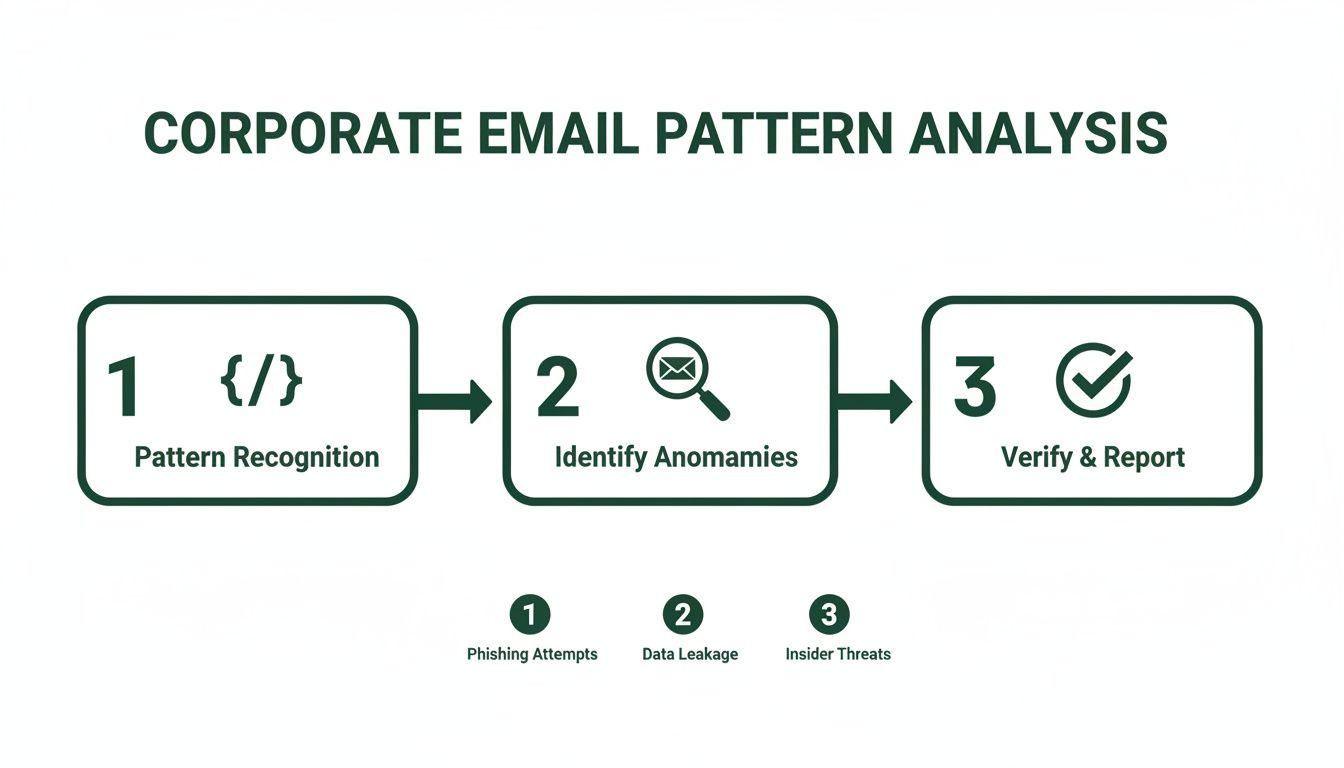
    A risky status usually means the company’s email server has a catch-all setting, which makes it nearly impossible to verify a specific address. My advice? Just avoid sending to these. It’s not worth the hit to your bounce rate.

    If you can't find a contact at all, get creative. Try a few different name variations or find another employee at the same company. Once you see their email format, you can often figure out the pattern and deduce the right address for your prospect.

    Common Questions About Free Email Finders

    Even with a solid workflow, you're bound to run into a few questions. When you're working with a new piece of tech like a free email finder tool, it’s always smart to get ahead of the common hurdles. Let's clear up some of the things people ask me about most often.

    One of the first questions is always about the legal side of things. Are these tools legit? Absolutely. They work by pulling publicly available data from the web, so using them is perfectly legal. The real question is how you use that information. Your outreach needs to follow the rules, like the GDPR in Europe and the CAN-SPAM Act in the U.S.

    Crucial Reminder: Always, always include a clear, one-click way for people to opt out of your emails. This isn't just about staying on the right side of the law; it's about building a trustworthy brand and keeping your sender reputation in good shape.

    Accuracy and Dealing with Limits

    "How accurate are these free tools, really?" is a question I get all the time. The honest answer is that it varies, but most of the reputable services will get you somewhere in the 70% to 90% accuracy range. Many will even give you a confidence score for each email they find, which is a huge help. To be safe, always run your list through the built-in email verification feature. It's your best defense against a high bounce rate.

    So, what happens when you inevitably hit your monthly credit limit? You've got a few options:

    • Wait it out: Your free credits will reset at the start of the next cycle. A little patience goes a long way.
    • Try another tool: There's a whole world of these tools out there, and most have their own free plans you can hop onto.
    • Think about an upgrade: If you're consistently hitting that limit and seeing good results, that's a pretty strong signal. It might be time to invest a small amount into a paid plan to really scale up your outreach without any interruptions.

    Ready to stop guessing and start connecting? EmailScout gives you the power to find unlimited verified emails for free. Install the free Chrome extension and start building your outreach list in minutes!

  • What is Sales Automation? what is sales automation explained

    What is Sales Automation? what is sales automation explained

    Let's be honest, most sales reps didn't get into this business to do paperwork. They got into it to connect with people, solve problems, and close deals. So what if you could give your team a crew of digital assistants to handle all the tedious, repetitive stuff?

    That's the big idea behind sales automation: using smart technology to take over the manual tasks that eat up your team's day. We're not talking about replacing salespeople with robots. It's about empowering them by automating things like data entry, sending basic follow-up emails, and keeping the CRM updated.

    The Shift From Manual Effort To Automated Power

    For any sales pro, the daily grind can feel more like being an administrator than a strategic closer. Sales automation completely flips that dynamic. By offloading the tasks that take up the most time but bring in the least direct revenue, your team gets to focus their energy where it actually counts—building relationships, understanding a customer's real needs, and navigating those tricky negotiations.

    A man working on a laptop at a desk with 'Digital Sales Assistants' text and sales-related icons.

    This shift is why the market is exploding. The global sales automation market was already valued at around $9.3 billion in the early 2020s and is on track to more than double by 2033. It's clear businesses are catching on, especially with predictions that digital channels will handle 80% of B2B sales interactions by 2025.

    What Does This Look Like In Practice?

    Instead of spending an hour every afternoon logging calls and emails, an automated system just does it for you, instantly. Instead of that nagging feeling you forgot to follow up with a warm lead, an automated email sequence keeps the conversation going without you lifting a finger.

    This strategic use of technology builds a sales engine that's more efficient, scalable, and ultimately, more successful. This whole ecosystem is often referred to as SaaS for sales, which includes a whole suite of tools designed to sharpen every single part of your sales process.

    The goal is simple: let technology handle the repeatable tasks so your sales team can focus on the human connections that drive revenue. Automation provides the consistency and scale, while your team provides the expertise and personality.

    A Day in the Life Before and After Sales Automation

    To really see the difference, just look at the daily to-do list of a typical salesperson. The table below shows just how dramatic the change is when you move from clunky manual processes to a smooth, automated workflow.

    Manual Sales Task Automated Workflow Primary Benefit
    Manually sending welcome emails to new leads An automated sequence sends an email the moment a lead enters the CRM. Immediate engagement and a consistent first impression.
    Updating CRM records after every call The system automatically logs call details, duration, and outcomes. Saves a ton of time and ensures 100% data accuracy.
    Setting calendar reminders for follow-ups A smart sequence sends follow-ups based on prospect engagement. Prevents valuable leads from falling through the cracks.
    Researching lead data one by one Lead enrichment tools automatically populate contact and company info. Gives reps crucial context right when they need it.

    As you can see, it's not about working harder; it's about working smarter. Automation frees up your team's most valuable asset—their time—to do what they do best: sell.

    The Core Parts of a Sales Automation System

    Thinking about sales automation can feel a bit overwhelming, but it’s really just a high-performance engine for your sales team. Each part has a specific job, and when they all work together, they create a smooth, powerful machine that drives revenue. Once you understand these core components, you’ll see exactly how the technology turns manual work into real momentum.

    Let's pop the hood and look at the essential gears and pistons. While different platforms have their own bells and whistles, almost every effective sales automation system is built around a few key functions that handle everything from finding new leads to analyzing what works.

    Lead Capture and Enrichment

    The first part of any sales engine is the fuel intake—how you get potential customers into your pipeline. This starts with lead capture, which automatically pulls in leads from places like your website forms, webinars, or social media. No more copy-pasting names from a spreadsheet.

    As soon as a lead is captured, lead enrichment kicks in. Instead of your reps spending hours digging through Google and LinkedIn for details, automation tools instantly go to work, finding and adding valuable data. This could be anything from a person's job title and company size to their industry or even recent company news.

    • Here's how it works: Someone downloads an ebook from your website. The system instantly creates a new contact record for them.
    • Then, the magic happens: An enrichment tool automatically adds their title ("Marketing Manager"), their company's employee count (250), and its location (New York).

    Just like that, your salesperson has critical context before they even think about picking up the phone.

    Automated Outreach and Sequencing

    With enriched leads in the system, the engine's pistons start firing. Automated outreach sequences are a series of pre-written emails, social media messages, or even texts that are sent to prospects over time. This guarantees consistent, timely follow-up without anyone having to set a reminder.

    And these aren't just generic email blasts. Modern sequences are smart. They can be programmed with "if/then" logic. For example, if a prospect clicks a link in the first email, they might get a completely different follow-up than someone who didn't open it at all.

    The real power here is consistency. A study found it can take an average of eight touchpoints to even get an initial meeting. Automation makes sure those touches happen, every single time, so no lead ever falls through the cracks.

    CRM Integration and Data Management

    The central computer running this whole operation is your Customer Relationship Management (CRM) platform. Any sales automation tool worth its salt has to integrate seamlessly with your CRM, making it the single source of truth for every customer interaction.

    This integration automatically logs every activity—every email sent, every call made, every meeting booked. This doesn't just eliminate one of the most hated tasks for salespeople (manual data entry); it ensures your customer data is always accurate and up-to-date. Clean data is everything when it comes to making good decisions and forecasting. For a deeper look at keeping this data organized, exploring the best contact management software can give you some great ideas.

    Analytics and Reporting Dashboards

    Finally, every engine needs a dashboard with all the gauges. Analytics and reporting dashboards give you a clear, real-time view of what’s working and what isn’t. They track key performance indicators (KPIs) so you can understand the health of your entire sales pipeline at a glance.

    You can instantly see metrics like:

    • Email open and reply rates for different outreach sequences.
    • Conversion rates at each stage of your sales funnel.
    • Which lead sources are actually bringing in the most revenue.

    This data-driven feedback loop is what lets you tune your sales process. You can double down on strategies that are crushing it and fix bottlenecks before they become serious problems, keeping your sales engine running at peak performance.

    Why Sales Automation Is a Game Changer for Growth

    It’s one thing to understand the moving parts of sales automation, but it’s another thing entirely to see how they come together to fuel real business growth. This isn't just about convenience; it's about building a powerful engine to scale your sales, ramp up efficiency, and directly fatten your bottom line. Automation turns vague ideas into hard, measurable results that everyone in the company can see.

    The most immediate win? A huge boost in team productivity. Think about all the tedious, soul-crushing tasks that eat up a salesperson's day—logging calls, updating the CRM, sending the fifth follow-up email. Automation takes all of that off their plate, freeing them up to do what they do best: build relationships, understand customer problems, and actually close deals.

    Maximizing Efficiency and Shortening Sales Cycles

    When your team can offload all that manual grunt work, their capacity to sell just explodes. It’s no surprise that organizations using modern sales automation see productivity jump by an average of 14–15%. That efficiency means more calls, faster deals, and better win rates. It's proof that working smarter really does pay off. You can discover more insights about automation statistics to see just how big these gains can be.

    This diagram shows how all the core pieces of a sales automation system click together to get these kinds of results.

    Diagram illustrating the core parts of a sales automation system, including outreach, leads, CRM, and reporting.

    As you can see, leads, outreach, CRM data, and reporting all feed into each other. It’s a self-improving cycle where every automated step makes the next one stronger, lifting the whole system's performance.

    Another massive advantage is a much shorter sales cycle. With instant, consistent follow-up sequences running in the background, no lead ever goes cold because someone simply forgot. Automation guarantees every prospect gets the right touchpoint at the right time, keeping the momentum going and moving them through the funnel way faster.

    Achieving Scalable Growth with Data-Driven Decisions

    Beyond making individual reps more productive, sales automation builds a rock-solid foundation for growth. As your business gets bigger, you can't just keep hiring more people to do more manual work—that's a recipe for bloated costs and inefficiency. Automation lets your sales process handle a much higher volume of leads without needing a bigger headcount to match.

    The secret sauce here is the mountain of clean, accurate data that automation creates.

    • Improved Data Quality: By automatically logging every single interaction, you get rid of human error. Your CRM becomes a trusted source of truth for every customer relationship.
    • Actionable Insights: When your data is solid, your analytics dashboards become your superpower. You can see exactly which outreach strategies are killing it, find the bottlenecks in your process, and make smart, informed decisions to get better.
    • Predictable Forecasting: Clean data leads to sales forecasts you can actually count on. This lets leadership plan resources, set realistic targets, and steer the ship with confidence.

    Ultimately, sales automation is a game changer because it creates a repeatable, predictable, and scalable sales machine. It turns your sales process from a series of disjointed manual tasks into a cohesive system that consistently drives revenue and supports sustainable business growth.

    This systematic approach doesn't just bump up this quarter's numbers; it builds a more resilient and adaptable sales organization that’s ready for whatever comes next.

    High-Impact Automation Workflows You Can Build Now

    Knowing the theory behind sales automation is great, but putting it into practice is where you’ll actually see results. Let’s get into a practical playbook of proven workflows that can deliver value right away.

    We'll break down a few common scenarios using a simple "Trigger > Action" format. This approach makes automation feel a lot less intimidating and gives you clear, actionable strategies you can copy and paste. Think of them as simple recipes for success.

    Digital tablet displaying 'ACTION' in an automation playbook next to a notebook and pen on a desk.

    The Inbound Lead Welcome Sequence

    When someone fills out a form on your website, speed is everything. A fast, relevant response can be the difference between a conversation and a lost opportunity. This workflow makes sure no inbound lead is left hanging.

    • Trigger: A prospect submits a "Contact Us" or "Download Ebook" form on your website.
    • Action 1: Your system instantly creates a new lead in your CRM, then enriches it with public data like job title and company size.
    • Action 2: At the same time, it fires off a personalized "welcome" email from the assigned sales rep confirming their request.
    • Action 3: A task is automatically created in the CRM, reminding the rep to make a follow-up call within 24 hours.

    This simple sequence guarantees a professional first impression, every single time. Hot leads get the immediate attention they deserve without anyone lifting a finger.

    The Post-Demo Follow-Up Series

    The hours and days right after a product demo are critical. You have momentum on your side, but it can fade fast without a solid follow-up plan. This automated workflow keeps the conversation warm and gently guides the prospect toward a decision.

    Trigger: A sales rep marks a meeting as "Completed Demo" in the CRM.

    Action Sequence:

    1. Immediately: Send a thank-you email with a quick summary of what you discussed and links to a few relevant case studies.
    2. 2 Days Later: Follow up with a short email asking if they have any initial questions.
    3. 5 Days Later: If you haven’t heard back, send another email that touches on a common pain point from your demo, maybe with a link to a helpful blog post.
    4. 10 Days Later: Send one final, gentle nudge offering to jump on a quick call to answer any final questions.

    This takes the burden of manual follow-up off your rep’s plate and ensures the prospect gets timely, valuable information that keeps the deal moving.

    The High-Intent Visitor Alert

    Some actions are just clear buying signals. When a prospect keeps coming back to your pricing page or re-watching a case study video, they’re deep in the evaluation phase. This workflow flags these moments so your team can strike while the iron is hot.

    This type of behavioral trigger is a perfect example of sales automation acting as a digital scout for your team. It flags opportunities that would otherwise be invisible, allowing reps to engage at the exact moment of peak interest.

    • Trigger: A known lead in your CRM visits your pricing page for the third time in a week.
    • Action 1: The system pings the assigned sales rep with a real-time notification via Slack or email.
    • Action 2: The lead's score in the CRM is automatically bumped up, pushing them higher on the priority list.
    • Action 3: An hour later, an automated but highly personalized email is sent from the rep. Something casual like, "Noticed you were checking out our plans—happy to walk you through which option might be the best fit for your team."

    By automating these alerts and outreach, you give your team the power to act on strong buying signals the second they happen.

    To take it a step further, exploring the best cold email software can give you tools that plug right into these workflows. Something as simple as automating email scheduling in Outlook can be a foundational piece of the puzzle, ensuring your communication always lands at the right time.

    A Smart Approach to Implementing Sales Automation

    Jumping into sales automation without a plan is like buying a high-performance engine without a car to put it in. Success comes from a smart strategy, not just powerful software. A thoughtful implementation roadmap helps you sidestep common headaches and ensures your team actually embraces the new tools.

    The right approach begins not with technology, but with your current process. Before you even look at any platforms, you need to map out your existing sales workflow from start to finish. This exercise reveals the real bottlenecks and biggest time-wasters your team faces every day.

    The goal is to automate a good process, not to simply make a broken one move faster. Identifying where reps lose the most time on manual tasks points you directly to where automation will have the biggest and most immediate impact.

    Start with a Clear Blueprint

    Once you’ve pinpointed the problem areas, the next step is to define what success looks like. Setting clear, measurable goals is essential. Don’t just aim to "improve efficiency"; set a specific target, like "reduce time spent on CRM data entry by 50%" or "increase outbound meeting bookings by 15%."

    With these goals in hand, you can start evaluating tools. Look for solutions that integrate smoothly with your existing tech stack, especially your CRM. A clunky integration will only create more work for your team, defeating the entire purpose of automation. Your new tool should feel like a natural extension of your current systems, not a frustrating add-on.

    Build Momentum with a Pilot Program

    Instead of a company-wide rollout that can feel disruptive, start small with a pilot project. Select a few tech-savvy reps and one specific workflow to automate. This controlled test allows you to work out the kinks, gather valuable feedback, and prove the tool's value on a smaller scale.

    For instance, you could pilot a lead routing system or a post-demo follow-up sequence. This approach helps you build an internal case for the technology, armed with real data and success stories. It's much easier to get buy-in from the rest of the team when they can see the tangible benefits their colleagues are experiencing.

    Train for Adoption, Not Just for Usage

    Finally, focus your training on the "why" behind the change, not just the "how." Show your team how automation will free them up to focus on higher-value activities—like building relationships and closing bigger deals. When they understand that the goal is to make their jobs easier and more rewarding, they’re more likely to become advocates rather than skeptics.

    This strategic rollout also strengthens your overall process. A well-implemented automation plan is a key component when learning how to build a sales pipeline that is both efficient and scalable. By mapping, testing, and training with purpose, you transform sales automation from a simple software purchase into a true strategic advantage for your entire organization.

    Frequently Asked Questions About Sales Automation

    It's natural to have questions when you're thinking about a big shift like sales automation. It changes how a team works, and it’s smart to get a few things cleared up before jumping in. We get asked the same handful of questions all the time, so let's tackle them head-on.

    Getting into any new technology can feel like a leap, but once you cut through the noise, it's a lot less intimidating. Let's dig into the most common concerns we hear.

    Will Sales Automation Replace My Sales Team?

    This is, without a doubt, the number one fear. But the reality is actually the complete opposite. Sales automation doesn't replace great salespeople; it makes them even better.

    Think about all the tedious, time-sucking tasks that bog down a rep's day—manually logging calls, scheduling follow-ups, typing out the same "just checking in" email for the tenth time. Automation takes care of all that grunt work.

    This frees your team up to do what they do best: sell. They can spend their time building real relationships, solving tricky customer problems, and navigating complex negotiations. Those are the things that actually close deals.

    Think of sales automation as the elite support crew for your star players. It handles the background noise so they can stay focused on the high-stakes conversations that drive revenue.

    It’s not about replacing people. It’s about letting your best people shine.

    How Much Does Sales Automation Software Cost?

    The price tag on sales automation software is all over the map, which is why you have to think about value, not just cost. There are solid options out there for just about any budget.

    For example, many popular CRMs like HubSpot or Zoho bundle basic automation features into their standard plans, which might run you anywhere from $20 to $50 per user, per month. If you need something more powerful, dedicated sales automation platforms usually land in the $100 to $500 per month range, based on your contact list size and feature needs. And of course, enterprise-level systems with all the bells and whistles can get into the thousands.

    But here’s the right way to frame it: think in terms of ROI. If a $150/month tool helps your team close just one extra deal they would have otherwise missed, it’s already paid for itself for the entire year, and then some. Always, always use the free trials to make sure a tool actually fits your team’s workflow before you sign a contract.

    What Are the Biggest Mistakes to Avoid When Starting Out?

    You can save yourself a ton of headaches by learning from the mistakes others have made. Getting sales automation right usually means sidestepping a few common pitfalls right from the start.

    Here are the three biggest tripwires we see:

    1. Automating a Broken Process: If your current sales process is a disorganized mess, automating it will just help you make the same mistakes, only faster and on a much bigger scale. Before you touch any software, map out your existing process. Find the bottlenecks and broken steps, and fix them first.

    2. Forgetting There's a Human on the Other End: It's easy to get carried away and over-automate your outreach until it feels cold and robotic. Use automation for scale and consistency, but always leave room for genuine human interaction, especially at key moments. Personalization has to feel real, not like a mail merge.

    3. "Set It and Forget It" Mentality: Sales automation isn't a slow cooker. You can't just set it up and walk away. You have to constantly check your analytics, A/B test your email copy, and tweak your sequences to make sure they’re still hitting the mark with your audience.

    Dodge these traps, and you'll be on the right track to building an automation strategy that actually helps your team win more deals.


    Ready to supercharge your outreach and find the right contacts in a single click? EmailScout is the powerful email finder extension designed to build your marketing lists and accelerate your sales outreach effortlessly. Start finding unlimited emails for free and connect with decision-makers today. Visit us at https://emailscout.io to learn more.