

Let’s start with a simple idea: multichannel marketing is all about meeting your customers where they already are. Think of it like a musician trying to get their music heard. They wouldn't just play on a single stage—they'd get on the radio, drop tracks on streaming services, and book live shows to reach as many fans as possible.
That's the core of this strategy. You use multiple, separate channels to interact with people.
Understanding the Core Concept
At its heart, multichannel marketing is about presence. It’s a mix of direct and indirect communication channels, all designed to make sure your brand’s message is out there, broadcast across different platforms your potential buyers use every day.
A great way to visualize this is the hub-and-spoke model. Picture your business as the central hub of a wheel. Every marketing channel you use—your email newsletter, social media accounts, a brick-and-mortar store, your mobile app—is a separate "spoke" leading back to that hub. Each one offers a different path for a customer to find you.
The Hub-and-Spoke Model
This model really nails what multichannel marketing is all about. The key thing to remember is that while every spoke connects back to your brand (the hub), they don't necessarily connect to each other.
- The Brand is the Hub: Your company, with its products and core message, sits right in the middle.
- Channels are the Spokes: Each channel operates with its own strategy and goals. Think of them as independent pathways for customers to engage with you.
- Operations are Siloed: An interaction on one spoke, like a comment on a social media post, usually just stays there. It doesn't really influence or connect with what happens on another spoke, like a customer's visit to your physical store.
This approach is built to maximize your reach and give customers options. You're casting a wide net to make sure your brand is visible and easy to find across multiple touchpoints, even if those touchpoints aren't perfectly integrated.
And this strategy is exploding in popularity. The global multichannel marketing market was valued at $9.25 billion, but it shot up to $11.67 billion in just one year. Projections show it could hit $29.17 billion by 2029. That kind of growth tells you just how critical this has become. You can dig deeper into the market's expansion and future trends to see the full picture.
To pull this off effectively, businesses usually start by getting a solid handle on their marketing tools, often beginning with a good multi channel communication platform to keep all those different conversations in one place.
To break it down even further, here's a quick look at the core ideas behind multichannel marketing.
Key Characteristics of Multichannel Marketing at a Glance
| Characteristic | Description |
|---|---|
| Channel-Centric | The focus is on optimizing performance within each individual channel. |
| Broad Reach | Aims to make the brand available on as many platforms as the customer might use. |
| Customer Choice | Gives customers the freedom to engage on their preferred channel. |
| Siloed Management | Channels are often managed independently, without much data sharing between them. |
| Independent Interactions | A customer's journey on one channel doesn't typically affect their experience on another. |
This table sums it up nicely: multichannel is about being everywhere your customers are, giving them the choice of how to connect with you.
Multichannel vs. Omnichannel: Unpacking The Key Difference
Many marketers use the terms ‘multichannel’ and ‘omnichannel’ interchangeably, but they’re actually two very different ways to think about customer engagement. Getting this distinction right is the first step toward building a strategy that actually works for your business.
The easiest way to see the difference is with a simple analogy. Think of your brand as hosting a party.
Multichannel marketing is like having separate conversations in different rooms. You might be chatting with guests on social media in one room, sending out email invitations from another, and talking to people at your physical store in a third. Your brand is present in every room, but the conversations are completely separate—they don't connect or influence each other.
Omnichannel marketing, on the other hand, is like one continuous conversation that flows with the customer as they move from room to room. What someone talked about in the social media room is remembered and brought up when they move into the email room. It's a single, unified experience.
This diagram shows the multichannel approach perfectly. Each channel is a separate spoke that leads back to the brand, but not to each other.
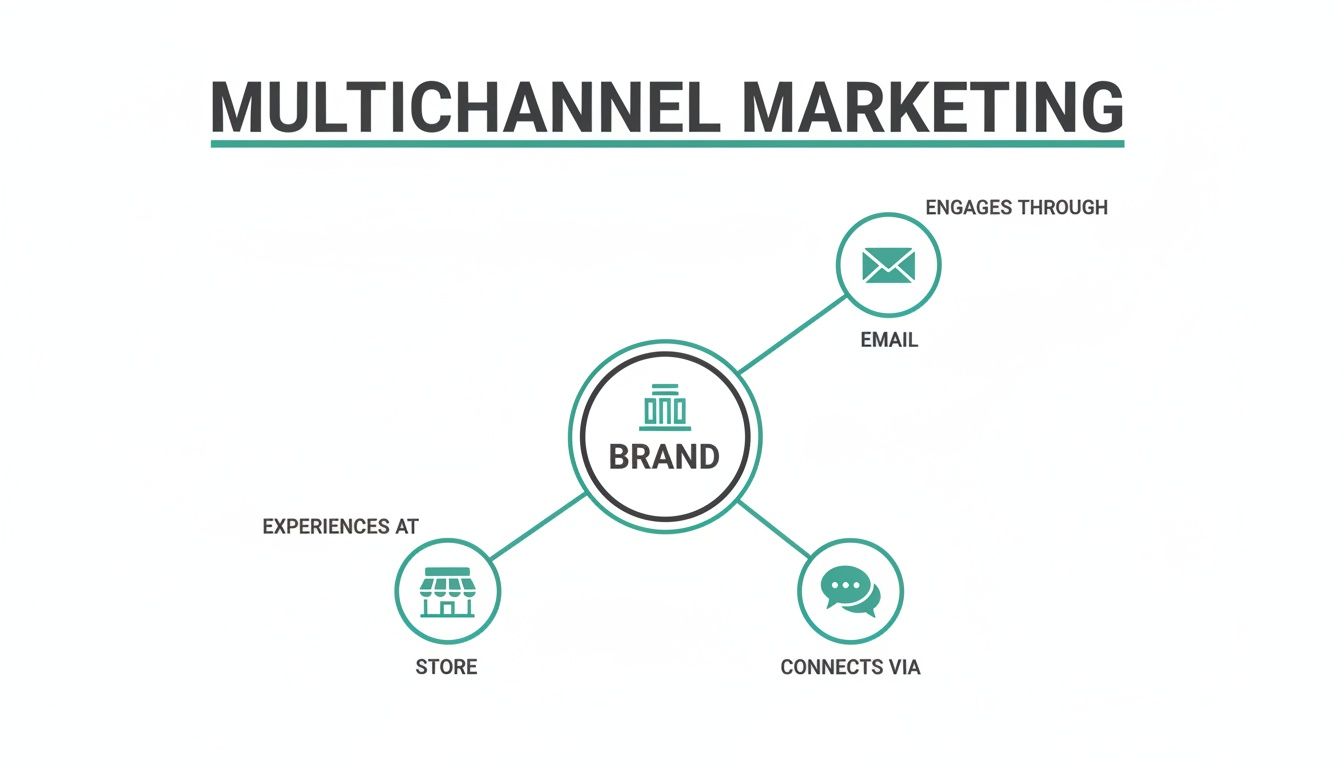
The key takeaway here is that the pathways are all brand-focused, not customer-focused. That’s the core of the strategy.
Core Strategic Differences
At its heart, the difference comes down to what you put at the center of your strategy. Multichannel marketing places the brand or product at the center, pushing messages out through various channels. Each channel is usually managed in its own silo, with its own goals and metrics.
Omnichannel flips that entirely and puts the customer at the center. All the channels work together to create one smooth journey. Data from a customer’s interaction on your mobile app informs the ads they see on social media, which in turn influences the next email they receive. It’s all connected.
A multichannel approach asks, "What channels can we use to reach our customers?" An omnichannel approach asks, "How can we create one seamless experience for our customers across all our channels?" It's a fundamental shift from thinking about channels to thinking about the customer.
To really nail down the distinction, let's put them side-by-side.
Multichannel vs. Omnichannel Head-to-Head Comparison
This table breaks down the core differences to help you see exactly how these two strategies operate.
| Feature | Multichannel Marketing | Omnichannel Marketing |
|---|---|---|
| Primary Focus | The brand and its products are the central focus. | The customer and their experience are the central focus. |
| Channel Integration | Channels operate independently with minimal data sharing. | All channels are fully integrated and share data in real-time. |
| Customer Experience | Inconsistent; the experience can vary greatly from one channel to another. | Consistent and seamless, regardless of the channel used. |
| Business Strategy | Aims to maximize the reach and performance of each individual channel. | Aims to create a unified customer journey across all touchpoints. |
Ultimately, a multichannel strategy is about giving customers more choices on where to engage. An omnichannel strategy is about making sure that engagement is continuous and consistent, no matter where it happens. Deciding which one is right for you will depend on your team’s resources, your tech stack, and what you’re trying to achieve as a business.
Exploring the Most Powerful Marketing Channels
Alright, you've got the "what" and "why" of multichannel marketing down. Now it's time for the "where"—the actual channels you'll use to connect with people.
The real key here isn't to be everywhere at once. That's a surefire way to burn out your team and your budget. Instead, the goal is to show up consistently in the right places, which means you have to know where your customers are already hanging out.
If you haven't already, take a step back and define who you're talking to. Our guide on how to create buyer personas is a great place to start building that foundation.
Core Digital Marketing Channels
For most businesses today, the journey starts online. These digital channels give you a direct line to your audience and a treasure trove of data to see what’s working.
- Email Marketing: Don't let anyone tell you email is dead. It’s still one of the best ways to nurture leads and keep existing customers in the loop. Think personalized offers, company news, and content sent directly to people who want to hear from you.
- Social Media: This is where you bring your brand's personality to life. Each platform has its own vibe—Instagram is perfect for visual brands, while LinkedIn is the undisputed king for B2B networking and expertise.
- Content Marketing: Your blog, videos, podcasts, and guides are your long-term assets. Great content builds trust, positions you as an expert, and draws people in long before they’re ready to buy.
By mixing and matching these channels, you start building a web of touchpoints. The idea is to make your brand familiar and accessible, so when a customer needs what you offer, you're the first one they think of.
Expanding Your Reach with Paid and Physical Channels
Organic digital marketing is great, but sometimes you need to give your message a boost. Paid and physical channels can deliver faster, more measurable results, connecting you with entirely new segments of your audience.
Paid advertising is a classic for a reason. Google ads put you in front of people actively searching for a solution, while social media ads let you get hyper-specific with who you're targeting.
We're also seeing some interesting shifts in the paid space. Retail media networks (RMNs) are exploding, with forecasts predicting a 14.38% CAGR through 2035. A net 38% of marketers are already upping their investment there. Social commerce is also taking off, as 26% of marketers now plan to sell products right on platforms like Instagram.
And don't count out the old-school channels—they're making a comeback with a modern spin.
- SMS Marketing: When you need to get a message seen now, text is hard to beat. It's perfect for flash sales and urgent alerts.
- Direct Mail: In a world of overflowing inboxes, a well-designed piece of physical mail can really stand out. It's a fantastic way to cut through the noise for high-value B2B outreach or local campaigns.
So, Is a Multichannel Strategy Really Worth the Investment?
Putting your resources into a multichannel approach isn't just another box to check—it’s a direct investment in your brand's visibility and connection with customers. In a noisy market, showing up on multiple platforms makes you a familiar, reliable presence in your audience's daily life. You're simply meeting them where they already hang out, which builds trust almost effortlessly.
This strategy naturally blows the doors open on your customer reach. Instead of crossing your fingers and hoping people find your one main channel, you're actively putting your brand in their path on social media, in their inbox, and through their search results. Think of each channel as a new doorway inviting a different slice of your audience to come in and look around.
Boost Engagement and Build Stronger Connections
When you give people the freedom to connect with you on their own terms, on their favorite platforms, you don't just reach them—you get them to actually engage. And this isn't just a hunch; the numbers are pretty staggering. Campaigns running across three or more channels see a 494% higher engagement rate than those sticking to a single channel.
That kind of interaction has a real impact on your bottom line. That same coordinated approach also drives 37% higher conversion rates. On top of that, customers who interact with you across multiple touchpoints are just plain more valuable. Multi-channel shoppers spend 4% more in-store and a whopping 10% more online than single-channel customers. If you want to dig into the data, you can see how channel diversity affects spending by checking out the latest omnichannel statistics.
A multichannel strategy is really about creating more chances. More chances for customers to see you, more chances for them to interact, and ultimately, more chances for them to buy.
Get Deeper Insights into Your Customers
Every single interaction—a like, a click, an email open—is a piece of the puzzle. A solid multichannel strategy hands you a treasure trove of data about what your customers do, what they like, and where they get stuck.
- Social media tells you what content gets people talking and what trends matter to them right now.
- Email marketing shows you which messages get them to act and which offers they can't resist.
- Website analytics give you a clear map of their journey, from the first click to the final purchase.
By piecing all this data together, you get a much richer, more complete picture of your audience. This lets you sharpen your messaging and fine-tune your entire game plan. If you're looking to build out your campaigns, our guide on modern marketing and outreach strategies is a great place to start. These insights are the fuel for smarter marketing that actually works.
How to Build Your Multichannel Marketing Strategy

Knowing what multichannel marketing is and actually building a strategy that works are two different things. A winning approach isn't about showing up everywhere—it's about showing up on the right channels with a message that actually connects with people.
Breaking it down into a few key steps makes the whole process feel less overwhelming. At its core, a solid strategy rests on four pillars: knowing your audience, picking your channels, unifying your message, and measuring what matters. This simple framework keeps your efforts focused and effective.
Define Your Target Audience
Everything flows from this one simple truth: you have to know who you’re talking to. If you don't have a crystal-clear picture of your ideal customer, your messaging will fall flat, and you'll be picking channels based on guesswork instead of data.
You need to go deeper than just age and location. What social media apps do they open every morning? Do they prefer short, punchy blog posts or detailed video walkthroughs? Nailing these answers is the first step to creating a strategy that feels like it was made just for them. For a great starting point, check out our guide on how to identify your target audience.
Select Your Optimal Channel Mix
Once you know who your audience is, picking the right channels becomes a whole lot easier. The biggest mistake you can make is spreading your team too thin trying to be active on every platform. Instead, focus your energy on the places where your audience already hangs out.
- For B2B companies, that might mean doubling down on LinkedIn for industry insights and using targeted email to nurture leads.
- For B2C brands, a visual-first platform like Instagram or TikTok is likely the right move, backed by email marketing for sales and promotions.
No matter the industry, email is almost always a key player. To make it work, you need a steady pipeline of quality contacts. That’s where a tool like the EmailScout Chrome extension comes in handy. It lets your team find verified email addresses for decision-makers right from their browser, cutting down on list-building time and making sure your message lands in the right inbox.
Your channel mix is never set in stone. It should grow and adapt as you collect data and as your audience's habits shift. The goal is a focused presence that delivers real impact.
Craft Consistent Brand Messaging
Your brand’s voice needs to be the same everywhere. A customer who reads a professional, data-backed article on your blog shouldn't be confused by a completely different tone on your social media feed. Inconsistency erodes trust and makes your brand feel disjointed.
Create a simple messaging guide that outlines your mission, value proposition, and tone of voice. This ensures every tweet, email, and whitepaper sounds like it came from the same team. To keep everything running smoothly, a well-designed marketing automation workflow can be a huge help in keeping your messaging coordinated across all your touchpoints.
Set Up Analytics to Measure Success
Here’s the bottom line: you can't improve what you don't measure. Before you launch anything, decide on the key performance indicators (KPIs) you'll track for each channel. This is the only way to know what's working, what's not, and where to put your budget next.
Keep a close eye on metrics like conversion rates, customer acquisition cost (CAC), and engagement. These numbers will give you a clear, honest picture of your return on investment.
Common Multichannel Mistakes to Avoid
Jumping into a multichannel strategy is exciting, but it’s easy to stumble if you’re not careful. The difference between a campaign that truly connects and one that just makes noise often comes down to sidestepping a few common traps. Knowing what to watch out for from the start helps you build a much stronger, more resilient plan.
One of the biggest blunders is inconsistent brand messaging. This is what happens when your Instagram feed is all memes and casual chats, but your email newsletter reads like a corporate memo. That kind of disconnect creates confusion and chips away at the trust you're trying to build.
Another classic mistake? Working in silos. When your email team, social media manager, and content writers don’t talk to each other, you end up with a fractured customer experience. It’s like different departments are running their own separate companies, and the customer is caught in the middle. You never get a clear picture of how people really interact with your brand.
Sidestepping Strategic Failures
The good news is you don’t need a massive overhaul to fix this. A few smart, preventative steps can get everyone on the same page and pulling in the same direction.
- Develop a Central Brand Guide: Make this your team's bible. It should nail down your brand’s voice, tone, and visual identity so every tweet, email, and blog post feels like it came from the same team.
- Break Down Internal Silos: Get your channel managers talking. A shared content calendar is a great start. So are quick weekly check-ins to make sure everyone's efforts feel connected and cohesive.
The real problem with most multichannel strategies isn't the channels. It's the lack of a single, unifying vision that ties them all together. A customer shouldn't feel like they're meeting a different company every time they switch from your website to your social media.
The Problem of Fragmented Data
Maybe the most damaging mistake of all is messy data. When you don’t have a central system, customer information gets stranded on different islands. Your email platform knows one thing, your website analytics knows another, and neither has a clue what the other is doing.
This fragmentation gives you a blurry, incomplete picture of your customer. You’re blind to their full journey, which means you miss golden opportunities to connect. A customer who ditched their shopping cart might get a generic "welcome" email instead of a helpful reminder—all because the data wasn't connected.
The fix here is to invest in a tool that can pull it all together. A solid Customer Relationship Management (CRM) system or a customer data platform is built for this. It unifies information from all your channels into a single 360-degree view, giving you the clarity needed to make much smarter marketing moves.
Frequently Asked Questions
Even with a solid plan, you're bound to have questions as you figure out what multichannel marketing looks like for your business. Here are a few of the most common ones we hear from sales and marketing teams.
How Do I Choose the Right Channels for My Business?
It all starts with your audience. You have to go where they are. Dig into your existing data from Google Analytics, check your social media insights, and don’t be afraid to just ask your customers with a simple survey.
For example, a B2B software company will probably get the most mileage out of LinkedIn and a highly targeted email outreach. A direct-to-consumer fashion brand, on the other hand, is built for visual platforms like Instagram and TikTok. The trick is to pick two or three channels where your audience is already hanging out and go all-in there first.
The goal isn’t to be everywhere. It's to be incredibly effective where it counts. Build a strong presence on the platforms your ideal customers actually use every day.
Can a Small Business Realistically Manage a Multichannel Strategy?
Absolutely. The secret is to start small and be smart about how you scale. Don't even think about trying to launch on ten platforms at once. Just pick two channels you know you can handle consistently, like email marketing and one social media account you can really nail.
You can use scheduling tools to get your social posts out automatically and lean on marketing automation software for your email campaigns. That frees you up to think about strategy and create great content. Consistency beats complexity every time. Once you start seeing results and have more resources, you can slowly add another channel to the mix.
What Are the Most Important Metrics to Track?
You need to focus on the numbers that actually tie back to your business goals. Things like follower counts feel good, but they don't pay the bills.
Here are the KPIs that really matter:
- Overall Conversion Rate: This tells you if your whole strategy is actually turning lookers into buyers.
- Customer Acquisition Cost (CAC) per Channel: Find out which channels are the most cost-effective so you know where to put your budget.
- Customer Lifetime Value (CLV): This measures the long-term profitability and shows you the real impact of your work.
- Channel-Specific Engagement: Keep an eye on metrics like email open rates or social media shares to see what’s grabbing your audience's attention.
Ready to supercharge your outreach on one of your most critical channels? EmailScout helps you find verified emails for key decision-makers in a single click. Start building your high-quality contact list today at https://emailscout.io.