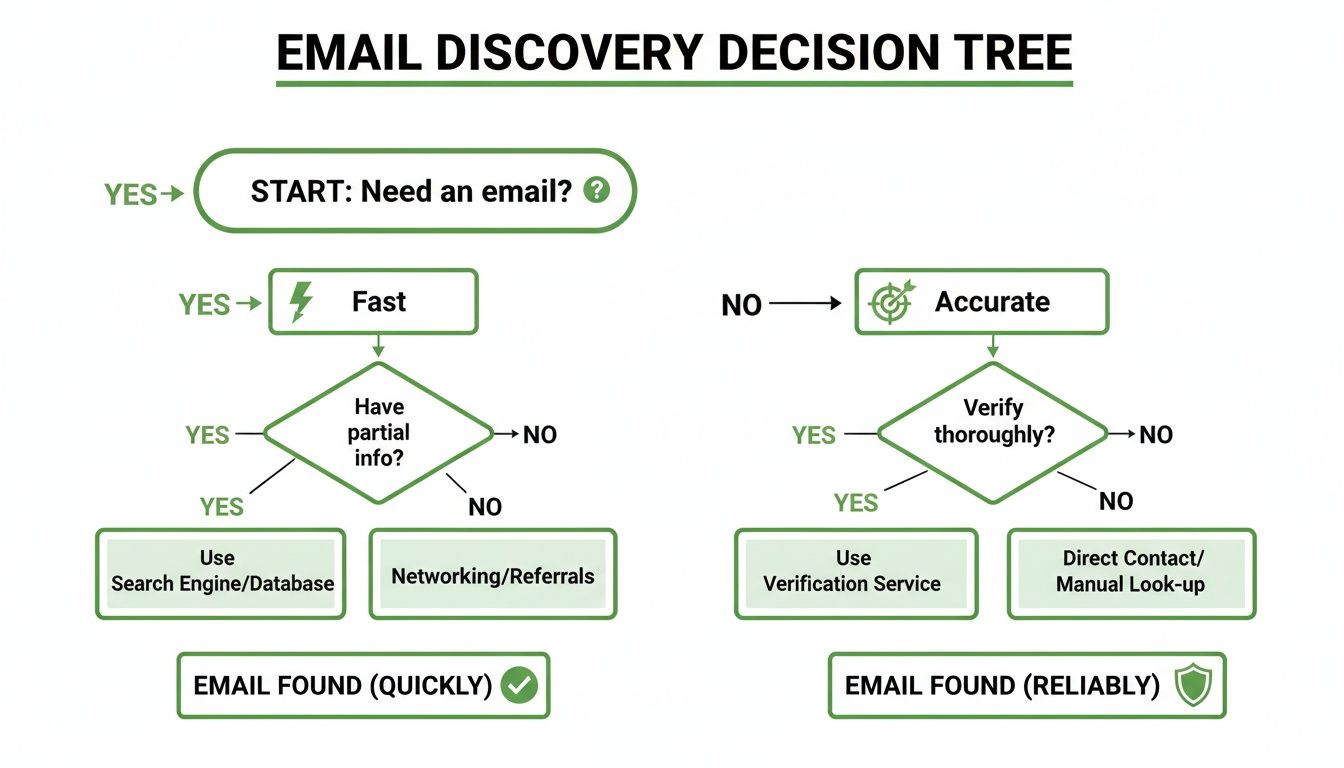
Tag: sales prospecting

  • How to Find Email Addresses Free (Proven Methods)

    How to Find Email Addresses Free (Proven Methods)

    Finding an email address for free is a bit like being a digital detective. It's a skill you build by combining clever Google searches, sifting through social media profiles for clues, and knowing which specialized tools to use. Once you get the hang of it, you can build a killer contact list without ever pulling out your wallet.

    Why Manual Email Prospecting Still Wins

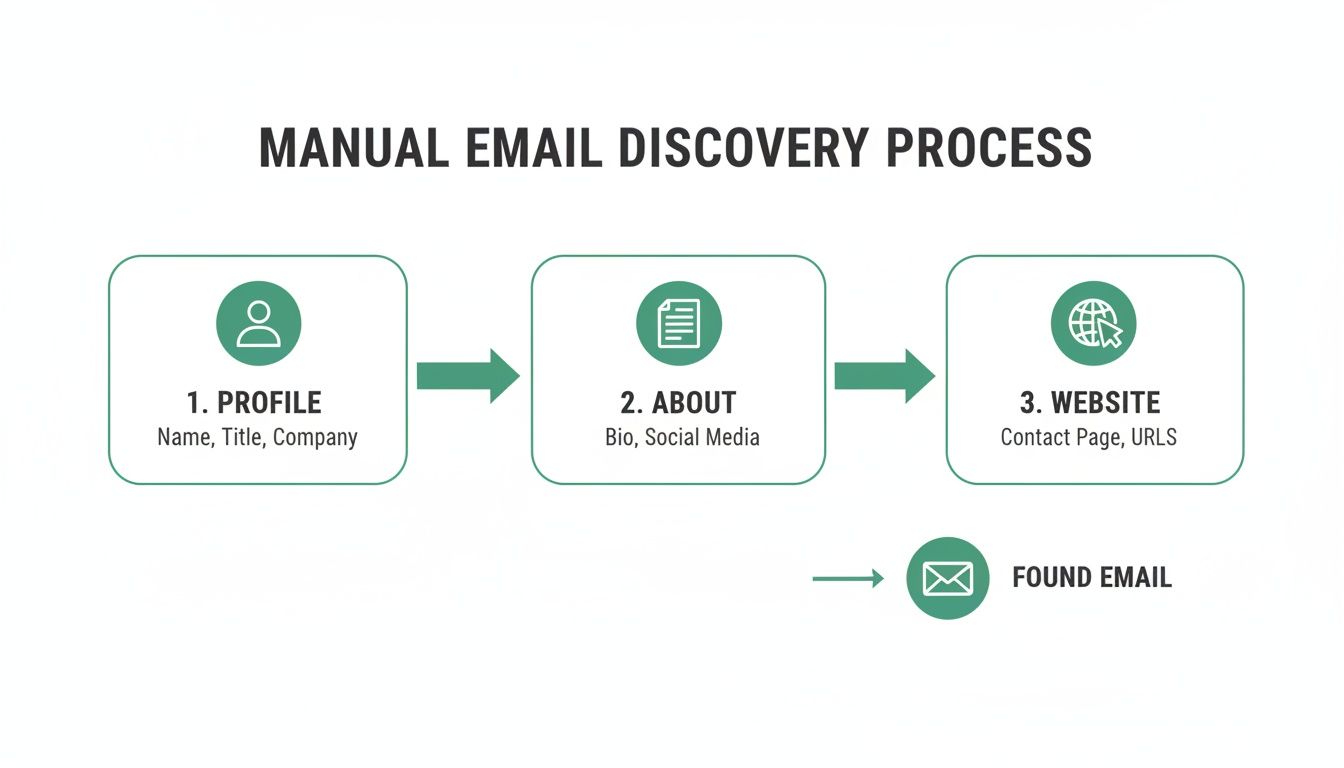
    Image

    Before you jump into all the shiny automated tools and Chrome extensions, it's worth taking a moment to appreciate the raw power of just doing it yourself. I know, I know—in a world obsessed with automation, going manual feels a bit backward. But when you're trying to connect with high-value contacts, it's the secret weapon that separates a successful campaign from one that falls flat.

    Automated tools are fantastic for casting a wide net, but they simply can't replicate human intuition.

    When you need the direct email of a specific decision-maker, manual prospecting is your best bet. It’s how you bypass those generic info@company.com black holes and land your message right where it needs to be. That precision alone can make a huge difference in your response rates.

    The Contextual Advantage of Manual Searches

    Here's the thing: when you're manually looking for an email, you're not just hunting for a string of text. You're gathering intelligence. You might stumble upon their latest blog post, a project they shared on GitHub, or a professional group where they're active. That context is pure gold for personalizing your outreach.

    Automation finds the "what" (the email address), but manual prospecting uncovers the "why" (the reason to connect). This insight is the foundation of any effective outreach campaign.

    This deeper understanding lets you craft an opening line that actually resonates. A message that kicks off with, "I saw your recent talk on marketing analytics…" is infinitely more powerful than a generic template. It shows you've actually done your homework, a level of detail that automation just can't touch.

    The Budget-Friendly and Accurate Foundation

    Let's be real—the best part about manual methods is that they're free. Mastering these skills means you can build a high-quality list from the ground up without spending a dime. On top of that, verifying contact info yourself often leads to much higher accuracy, which helps lower your bounce rate and protects your all-important sender reputation.

    It's entirely possible because of the sheer scale of email use. With an estimated 4.83 billion active email users worldwide by 2025, countless addresses are scattered across public websites, social profiles, and forums. These digital breadcrumbs are exactly what you're looking for, making this a surprisingly reliable way to find the info you need. If you're curious, CloudHQ has some great insights on the global email ecosystem.

    Uncovering Emails with Advanced Search Tactics

    Image

    If manual prospecting is your game, then Google is your most valuable player. It's the ultimate free email finder, but only if you know how to talk to it. With the right commands, you can slice right through the internet's noise and pull email addresses from deep within company websites, online articles, and digital portfolios.

    This is about more than just typing a name into the search bar and hoping for the best. We're talking about using search operators—special commands that act like super-filters for your search. They tell Google exactly what to look for and where, giving you a level of precision that a basic search just can't touch.

    Think about it: a standard search might throw hundreds of irrelevant pages at you. But a sharp, well-crafted query using operators can pinpoint the exact page where a person's email is hiding in plain sight.

    Mastering Basic Search Operator Formulas

    The best way to get started is by combining a few core operators. Think of them as your building blocks for crafting some seriously powerful searches. The most effective ones, time and again, are site:, intext:, and good old-fashioned quotation marks ("").

    Here’s a quick look at what each one does:

    • site: This is your sniper rifle. It restricts your search to a single website, which is perfect for zeroing in on a specific company's domain.
    • intext: This command tells Google to hunt for specific text inside the body of a webpage, like the "@company.com" part of an email address.
    • "" Wrapping a name or phrase in quotation marks forces Google to search for that exact phrase. No more mixed results for people with common names.

    Let's put this into action. Say you're trying to track down the email for "Jane Doe" at a company called "ExampleCorp," and their website is examplecorp.com.

    Pro Tip: Your go-to search string would look like this:
    site:examplecorp.com intext:"@examplecorp.com" "Jane Doe"

    This query tells Google to search only on the examplecorp.com website for pages containing both the exact phrase "Jane Doe" and the text "@examplecorp.com".

    This single command is a workhorse. It regularly uncovers emails listed on team pages, in press releases, or tucked away in author bios. It's a simple formula that works an astonishing amount of the time.

    Expanding Your Search Beyond Company Websites

    While targeting a company’s own website is a solid first step, people leave digital breadcrumbs all over the web. Their contact info could be on personal blogs, social media profiles, or industry forums. The trick is to adapt your search queries to these different platforms.

    Let's say your target is active on Twitter. You can tweak your search to look for clues there, since many professionals drop their contact details or a link to their personal site right in their bio.
    A couple of creative search strings for this might be:

    • "Jane Doe" twitter email
    • site:twitter.com "Jane Doe" contact

    These broader searches can help you stumble upon a personal blog or online portfolio you didn't even know existed. Once you find it, you can run another site: search on their personal domain—a goldmine for finding direct email addresses.

    Finding Common Email Patterns

    What happens when direct searches come up empty? Don't give up. Instead, use Google to play detective and figure out the company's email format. Most organizations use a consistent pattern, like firstname.lastname@company.com or firstinitiallastname@company.com.

    To crack the code, you can run a more general search on their domain.

    Example Search Query:
    site:examplecorp.com intext:"@examplecorp.com" email

    This type of search often pulls up the "Contact Us" or "Team" pages, revealing the email addresses of other employees. Once you see a couple of examples, you'll know the company's preferred format. From there, you can piece together your target's likely email and pop it into a verification tool to see if it's valid. It's a powerful one-two punch of smart guesswork and confirmation.

    This same operator-driven approach is also fantastic for finding contacts on professional networks. If you want to take it to the next level, you can learn more about how to scrape thousands of LinkedIn contacts from Google search, which applies these same principles at scale. Once you master these simple commands, you've effectively turned Google into a powerful, free tool for building your contact list.

    Finding Contact Info on Social Networks

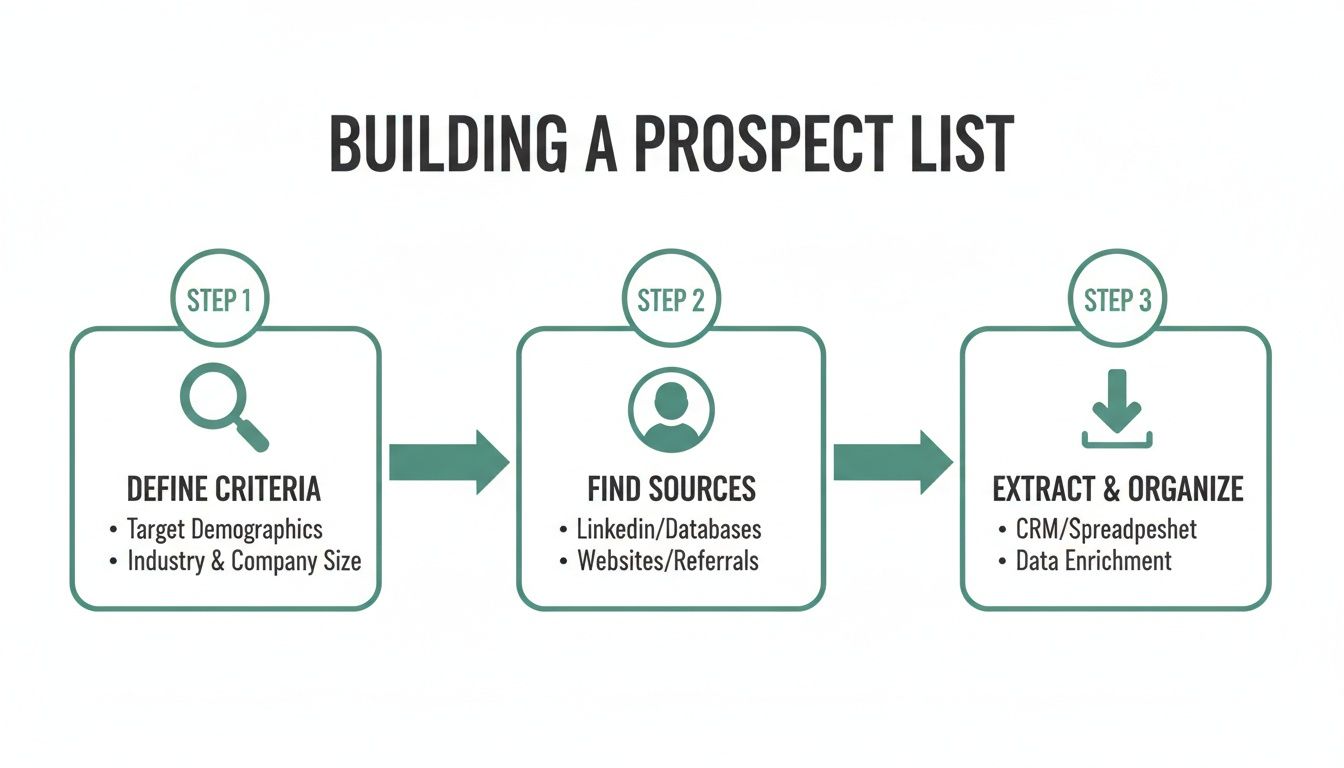
    Image

    Think of social and professional networks as more than just places to connect. They're massive, public databases overflowing with contact information. The key is to approach them like a digital detective, piecing together clues that others overlook.

    LinkedIn is the obvious place to start, but you can't stop there. Platforms like GitHub and even niche industry forums are goldmines where professionals often share more than they realize. This isn't about mindless scrolling; it's about systematically analyzing profiles to find the info you need.

    Your LinkedIn Profile Analysis Checklist

    LinkedIn is the undisputed champ for B2B prospecting, but most people only scratch the surface of what’s available for free. Before you even think about paying for a tool, a deep dive into someone's profile can often get you exactly what you're looking for.

    Start with the most obvious spot: the "Contact Info" section. It sounds basic, but you'd be surprised how many people just list their email address right there. If it's empty, your real detective work begins.

    Next, turn your attention to these key areas:

    • The About Section: Professionals, especially freelancers and consultants, often drop a call-to-action or a link to their personal website right in their summary. I’ve found direct email addresses hidden in plain sight here countless times.
    • The Banner Image: This is prime real estate that almost everyone ignores. Founders and marketers frequently customize their banner with their company name, website, and sometimes, a direct email.
    • Recent Activity and Posts: Quickly scan what your prospect has recently shared or commented on. They might have posted a link to a personal blog or a guest article that contains their contact details in the author bio.
    Your goal is to find any digital breadcrumb that leads away from LinkedIn to a place the person actually controls, like a personal website or portfolio. That’s usually where the direct contact info is hiding.

    This whole process takes just a few minutes but can dramatically boost your success rate. For a more detailed breakdown, our guide on how to find emails on LinkedIn covers even more advanced tricks.

    Decoding Clues on GitHub and Niche Forums

    While LinkedIn is buttoned-up and corporate, platforms like GitHub are where developers and tech folks actually work. This environment reveals a completely different set of clues that can lead straight to an email address.

    A developer's GitHub username is often a huge hint. It frequently mirrors the first part of their work email. For instance, a user with the handle jdoe-dev could very likely have the email jdoe-dev@company.com.

    Another powerful, slightly more technical trick is to check their commit history. When developers push code to a public project, their email address is sometimes embedded directly in the commit data itself. It's a surprisingly effective way to find a verified email.

    Don't forget about niche industry forums. Whether it’s a community for marketers, designers, or engineers, people often create profiles with signatures. These signatures are a fantastic source for clues:

    • Links to personal blogs or portfolios.
    • Direct mentions of their company website.
    • Sometimes, the email address itself, but slightly disguised to fool spam bots (e.g., jane [at] company [dot] com).

    Piecing Together the Puzzle for an Educated Guess

    Ultimately, all this social media snooping is about gathering enough puzzle pieces to make a highly accurate guess. You might not find the email address spelled out for you, but you can find all the building blocks you need.

    Let’s walk through a real-world scenario. You're looking for "John Smith," a marketing manager at "Innovate Inc."

    1. From LinkedIn: You confirm his full name and current company. His profile also links out to a personal blog he runs.
    2. From His Blog: You click over to his blog, and on the "About" page, you find a contact email: johnsmith.writes@gmail.com. It’s a personal one, but it's a solid start.
    3. From Google: A quick search for other employees at Innovate Inc. reveals their company email format seems to be firstinitial.lastname@innovateinc.com.

    Putting it all together, you can now construct his work email with a high degree of confidence: j.smith@innovateinc.com. This multi-source approach turns simple guesswork into a repeatable system for finding almost anyone's email.

    Putting Free Email Finder Tools to the Test

    While manual detective work is a powerful skill, free email finder tools can seriously speed things up. Think of them as a turbo-boost for your prospecting, not a total replacement for your own skills. I'm going to give you an honest, no-fluff look at the best free and freemium tools out there today, focusing on how you can get the most out of their free plans without spending a dime.

    These tools are so effective because we're all swimming in a sea of digital communication. By 2025, it's estimated that a staggering 376.4 billion emails will fly across the internet every single day. This explosion means more email addresses are documented on public websites, company pages, and social networks—exactly where these free tools go hunting.

    Understanding the Freemium Model

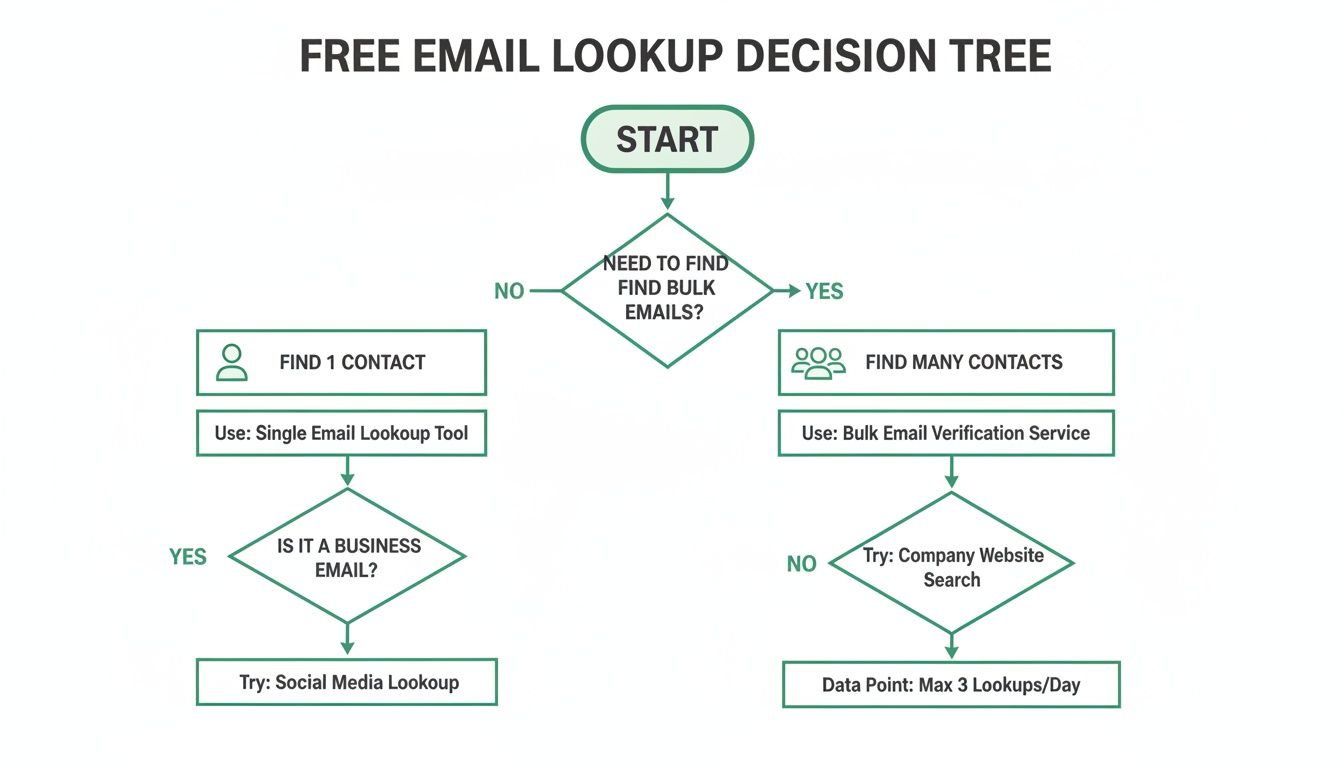
    Most of the top-tier email finders work on a "freemium" basis. In plain English, that means you get a certain number of free "credits" each month. Typically, one credit gets you one successful email lookup.

    This limited supply forces you to be smart.

    Instead of burning through your credits on every random contact, save them for when your manual searches hit a dead end or when you absolutely need to find a specific decision-maker, and fast. Managing these credits wisely is the secret to getting consistent value from these tools.

    And they do work. Here’s a quick breakdown of what you can generally expect from free tools in terms of performance.

    Image

    As you can see, even the free options deliver solid accuracy, slash your bounce rates, and find emails in just a few seconds.

    Top Free Email Finder Tools Head-to-Head

    So, let's dive into some of the most reliable options on the market. Each one has its own strengths, so the right choice really depends on how you work.

    Choosing the right tool is key to maximizing your free prospecting efforts. This table breaks down the essential features of the top free email finders to help you decide which one fits your workflow best.

    Top Free Email Finder Tool Comparison

    Tool Name Free Plan Limit Primary Use Case Browser Extension Available
    EmailScout Unlimited Building lists at scale while browsing Yes (Chrome)
    Hunter 25 searches/month Finding company-wide email patterns Yes (Chrome, Firefox)
    Skrapp 20 searches/month LinkedIn-focused prospecting Yes (Chrome, Firefox)

    Ultimately, your choice depends on your specific needs. For high-volume list building, a tool with an unlimited plan is a game-changer, while for targeted, occasional searches, a limited plan can be perfectly adequate.

    Now, let's look a little closer at each one.

    EmailScout

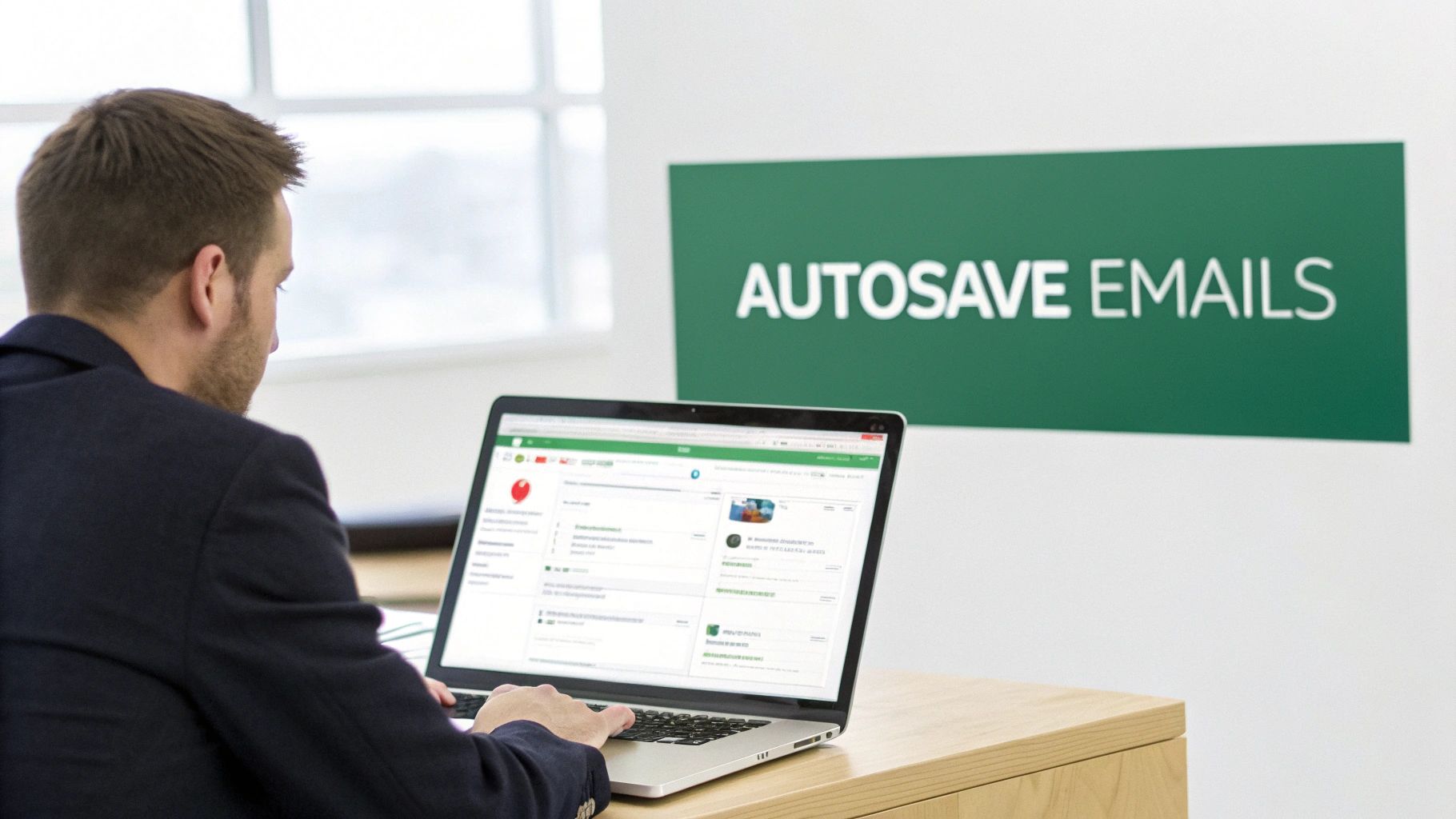
    EmailScout really stands out with its generous free plan and a super clean Chrome extension. It's built for efficiency, letting you grab emails right from LinkedIn profiles or company sites with a single click. The AutoSave feature is a personal favorite for building lists on the fly as I browse.

    • Free Plan: Unlimited free email lookups.
    • Best For: Sales pros and marketers who need to build lists quickly without constantly worrying about credit limits.
    • Pro Tip: The URL Explorer feature is a beast. You can feed it a list of company websites, and it will pull all available emails for you, saving a massive amount of manual work.

    Hunter

    Hunter is one of the most well-known names in the game, and for good reason. Its domain search is fantastic for quickly figuring out the common email pattern at any company (like firstname.lastname@company.com). The free plan is a bit tight, but it’s still incredibly valuable for targeted searches.

    • Free Plan: 25 free searches per month.
    • Best For: Finding the email format for a specific company or running a few high-priority individual searches.
    • Pro Tip: Use Hunter’s domain search first to get the company's email pattern. Then, try to construct the email yourself using manual methods. This saves your precious credits for when you truly need them.

    Skrapp

    Skrapp is another heavy hitter, especially for anyone living on LinkedIn. Its browser extension plugs right into LinkedIn profiles and Sales Navigator, which makes finding and saving prospect info incredibly smooth.

    • Free Plan: 20 free searches per month.
    • Best For: Sales teams who rely heavily on LinkedIn for their prospecting.
    • Pro Tip: Create separate lists inside Skrapp for different campaigns. This helps keep your free lookups organized and focused on your most important outreach.

    The right tool really comes down to your primary goal. If you're building bigger lists, a tool with a generous free plan like EmailScout is your best bet. For those occasional, high-stakes lookups, the limited plans from Hunter or Skrapp will get the job done.

    A Practical Workflow for Using Free Tools

    Knowing how to find email addresses for free is all about having a smart, repeatable process. Don't just click the extension button on every profile you stumble upon. Instead, weave these tools into your manual workflow.

    Here’s an approach that has worked well for me:

    1. Manual First, Always. Start with the simple Google and social media searches we covered earlier. You’ll be surprised how often you find what you need without using a single credit.
    2. Find the Pattern. If a direct search comes up empty, use a tool like Hunter to find the company's email pattern. This gives you the formula to build the email yourself.
    3. Use Your Credits Strategically. When all else fails, then you can use a credit from EmailScout or Skrapp on that high-value prospect's LinkedIn profile. Make this your final step.

    This tiered approach ensures you never waste your limited free resources. For a deeper dive into comparing different options, check out our guide on the best free email finder tool to see which one aligns perfectly with your needs.

    By combining your own ingenuity with the speed of these free tools, you can build a powerful and completely cost-effective system for connecting with just about anyone.

    How to Verify Emails Without Sending Anything

    Finding what you think is the right email address is only the first part of the puzzle. The real test is whether it actually works. Hitting 'send' on a bad email is more than just a waste of time—it hurts your sender reputation and can get your future messages flagged as spam.

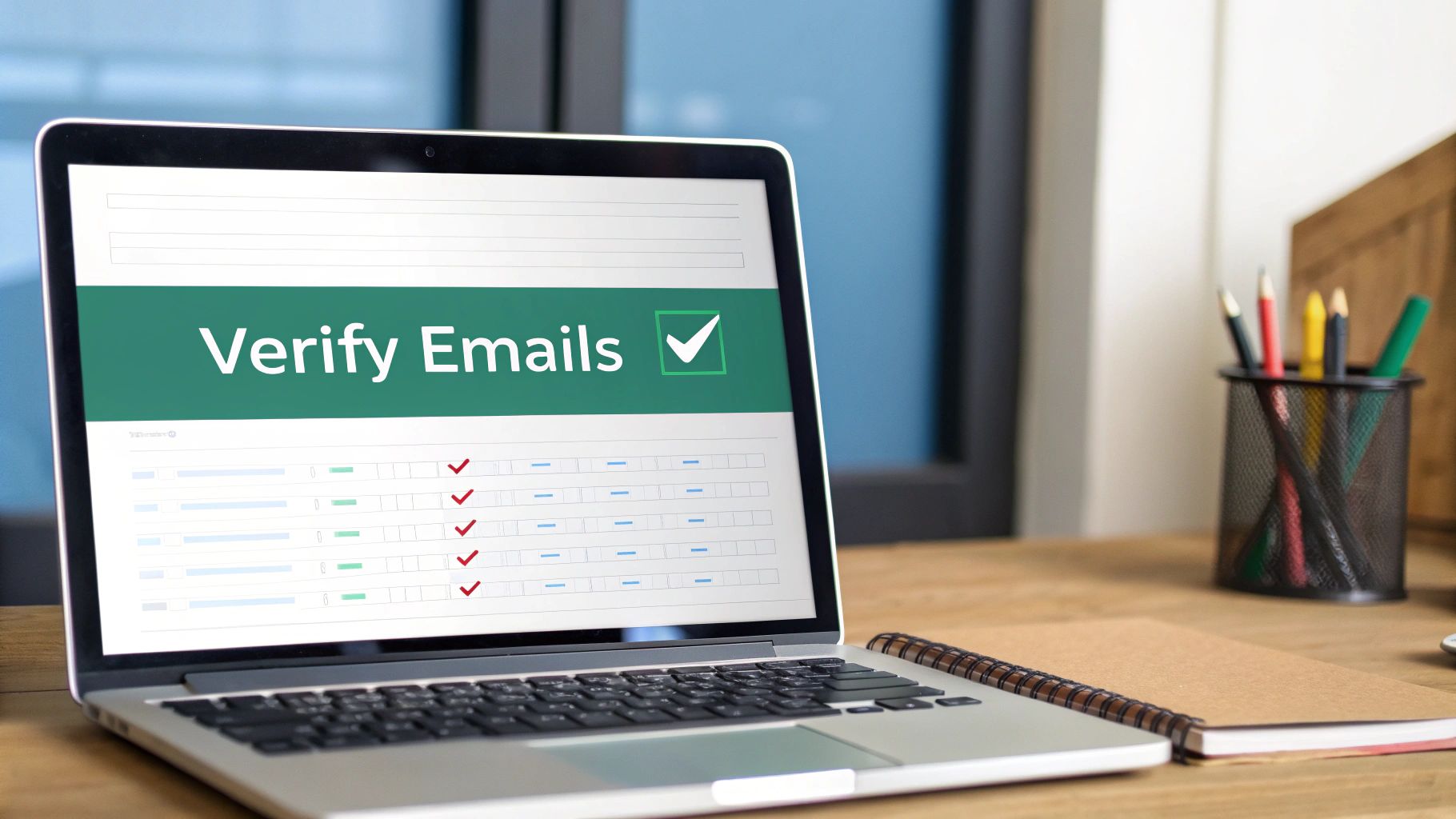
    Verification is the step that separates the pros from the amateurs. The great news is you can do it for free without ever sending a single test email and tipping off your prospect. The whole point is to confirm an email is real before you reach out, keeping your strategy clean and your contact list full of high-quality, deliverable addresses.

    Using Free Online Email Verifiers

    The fastest way to run a quick spot-check is with a free online email verifier. There are tons of them out there. You just pop the email into a search bar, and the tool runs a few instant checks behind the scenes.

    Most of these free tools will look at a few key things:

    • Syntax Check: Is the format right? It sounds basic, but a quick check for name@domain.com structure and illegal characters weeds out simple typos.
    • Domain Check: It confirms the domain (@company.com) actually exists and is set up to receive mail.
    • Role-Based Detection: It flags generic addresses like info@, support@, or contact@. These are rarely useful for targeted outreach, so it's good to know upfront.

    While these tools won't give you a 100% "deliverable" guarantee, they are perfect for a first pass to get rid of the obvious duds. It takes seconds and costs nothing.

    Verification isn't just about avoiding a bounce. It's about protecting your sender reputation. Every bounce tells email providers like Gmail that you might be a spammer, making it more likely your future messages go straight to junk.

    The Password Recovery Trick

    Here’s a slightly unconventional but incredibly effective trick that works for emails hosted on major platforms like Gmail and Outlook. You're basically using their own account recovery system to see if an address is active.

    This method is so powerful because of how many people use these services. Gmail alone holds about 27.76% of the email client market share, with around 1.8 billion active users. Chances are, a good chunk of the emails you find will be hosted there. You can dig deeper into these numbers with these insights on email provider statistics.

    Here’s how it works—it's surprisingly simple.

    1. Head over to the provider's login page (like Gmail.com or Outlook.com).
    2. Click the "Forgot Password" or "Can't access your account?" link.
    3. Type in the email address you're trying to verify.

    Now, just watch the platform's response.

    • If it says something like "Couldn't find your Google Account" or "That Microsoft account doesn't exist," bingo. The email is fake.
    • If it moves on to the next step, asking for a recovery phone number or an old password, the account is real.

    That’s all you need to know. Just close the window. You’ve just confirmed the email exists without sending a single thing or alerting the owner. You're using the provider's own infrastructure to get a clear yes-or-no answer, making this one of the most reliable free tricks in the book.

    Your Questions on Finding Emails Answered

    Even with the best tools and a solid game plan, you're going to hit some snags. It’s just part of the process. This section is all about tackling the most common questions that pop up when you're trying to find someone's email for free.

    Think of this as your personal cheat sheet for handling those tricky situations, from the legal stuff to what to do when you just can't find that one crucial address.

    Is It Legal to Find and Use Someone's Email for Outreach?

    This is the big one, and it's a fair question. The short answer is: Yes, it's generally legal, but with some important caveats. You have to be working with publicly available information and, crucially, follow email compliance laws like GDPR and CAN-SPAM.

    These rules aren't just red tape; they're there to stop people from getting buried in spam. The key is to be responsible. Your message has to be relevant to their professional role, and you must always give them an obvious, easy way to opt out.

    Ethical prospecting is more than just staying on the right side of the law. It’s about respecting that you’re landing in someone’s personal workspace. As long as your intent is genuine professional communication, you're doing it right.

    What Should I Do If I Still Cannot Find an Email?

    It’s going to happen. Some people are digital ghosts, keeping their email address under lock and key. When all the usual tricks fail, don't just throw in the towel. It's time to get a little creative.

    Here are a few moves I make when I hit a dead end:

    • Engage on Social Media: Don't just send a bland LinkedIn connection request and hope for the best. Drop a thoughtful comment on their latest post or reply to something they shared. Start a real conversation before you even think about asking for an email.
    • Use the Company Contact Form: A lot of people ignore these, but a short, sharp message sent through a company's general contact form can work wonders. They often get routed to exactly the right person.
    • Ask for an Introduction: This is the gold standard. Check for mutual connections on LinkedIn. A warm intro from someone you both know is a thousand times more effective than the best cold email you could ever write.

    Are Free Email Finder Tools Better Than Manual Methods?

    This isn't really an "either/or" question. The smartest prospectors use both. Free email finders and manual sleuthing have their own strengths, and they work beautifully together.

    Doing it by hand—like digging through Google search results—is incredible for finding context. It helps you understand the person you’re trying to reach, which is key for writing an email that actually gets a response.

    But when you need speed and volume, that's where the tools shine. They can track down and verify emails in seconds, a task that would take ages manually. The best workflow is often to use manual tricks to get started, then bring in a tool to confirm what you've found or to scale up your search.

    How Accurate Are the Emails Found with Free Tools?

    You might be surprised. The accuracy of good free email finders is actually pretty high, often landing somewhere in the 85-95% range. These tools aren't just guessing; they use smart algorithms to scrape public data, spot common email patterns, and check in real-time if an address is active.

    Of course, no tool is foolproof. People switch jobs, companies restructure their email formats, and data gets old. That’s precisely why verification is a non-negotiable final step. Before you send anything, run your list through a verification check to weed out the duds. It protects your sender reputation and makes sure all your hard work doesn't just end up as a bounce-back.


    Ready to stop guessing and start finding? EmailScout gives you the power to discover unlimited email addresses for free, directly from your browser. Our intuitive Chrome extension helps you build high-quality contact lists in minutes, not hours. Find your next lead with EmailScout today!

  • How to Find Emails on LinkedIn

    How to Find Emails on LinkedIn

    You might think finding someone's email on LinkedIn is a huge hassle, but it's actually way simpler than you'd expect. It really just comes down to having the right tool for the job. A good Chrome extension can pull professional contact info right from a person's profile, letting you skip the crowded world of InMail altogether.

    This lets you connect with people where they spend most of their day: their inbox. The real goal is to move the conversation off the platform so you can build a direct, more meaningful connection.

    Why Email Is Your LinkedIn Outreach Superpower

    Image

    Sure, LinkedIn InMail is fine for a first touchpoint, but a direct email is the gold standard for any serious professional conversation. Think about it this way: LinkedIn is like the world's biggest B2B directory, but email is your private, direct line to the people listed in it. Dropping a message into a cluttered InMail folder is like trying to have a conversation in a packed stadium. An email, on the other hand, is a one-on-one meeting.

    This difference is huge in the real world. Let's say you're a sales rep trying to reach a VP of Engineering at a hot tech startup. Your InMail is probably going to get buried under a dozen other pitches. But a sharp, well-written email lands in a space they reserve for important business. It lets you attach detailed proposals, book meetings without the back-and-forth, and keep a clean record of your conversation.

    The Strategic Advantage of Email

    The real power of email goes way beyond just getting your message seen. It puts you in complete control of your outreach. You’re not stuck with LinkedIn’s character limits or clunky interface. Instead, you can format your message exactly how you want, track when it's opened, and follow up with precision.

    This level of control is a game-changer for a lot of roles:

    • Recruiters: If you're sourcing a highly specialized candidate, like a machine learning expert, you need to send over detailed job specs and company info. Email is perfect for this, letting you share documents and keep the conversation professional, away from the noise of a social media platform.
    • Marketers: For a marketer launching a new B2B service, an email list built from targeted LinkedIn profiles is an absolute goldmine. It's the ideal way to nurture leads, announce product updates, and build a real audience.
    • Founders: An entrepreneur looking for strategic partners can use email to send formal introductions and detailed proposals that just carry more weight than a quick LinkedIn message ever could.

    LinkedIn is your discovery engine. You use it to find the right people. Email is your action engine. You use it to start and build the relationships that actually grow your business.

    Tapping into a Professional Goldmine

    LinkedIn has become the center of the professional universe, boasting over 1.2 billion members as of early 2025. This massive, active user base makes it an incredible resource for anyone who needs to find emails on LinkedIn. With a huge chunk of its users aged 25 to 34, you have a direct line to a whole generation of decision-makers. You can see the complete statistics to get a better sense of LinkedIn's powerful user base.

    When you boil it down, combining LinkedIn's search power with direct email outreach gives you the best of both worlds. You get the rich data and context from LinkedIn, but with the reliability and professionalism of email. This strategy turns a simple connection request into a genuine business conversation, setting you up for real, lasting professional relationships.

    Alright, let's move from theory to practice. You know why you need emails from LinkedIn, but now it's time to get the right tool in your hands. Setting up EmailScout is incredibly simple—the whole point is to get you from zero to finding your first verified email in minutes.

    The journey starts at the Chrome Web Store. Just a quick search for "EmailScout" gets you right where you need to be. This is where you'll add the email-finding power directly into your browser, making it a core part of your LinkedIn prospecting workflow.

    Installing the Extension

    First things first, you need to add the extension to your Chrome browser. Don't worry, this isn't some clunky software install. It’s a one-click process that weaves the tool right into your browser.

    Here's the official EmailScout listing on the Chrome Web Store.

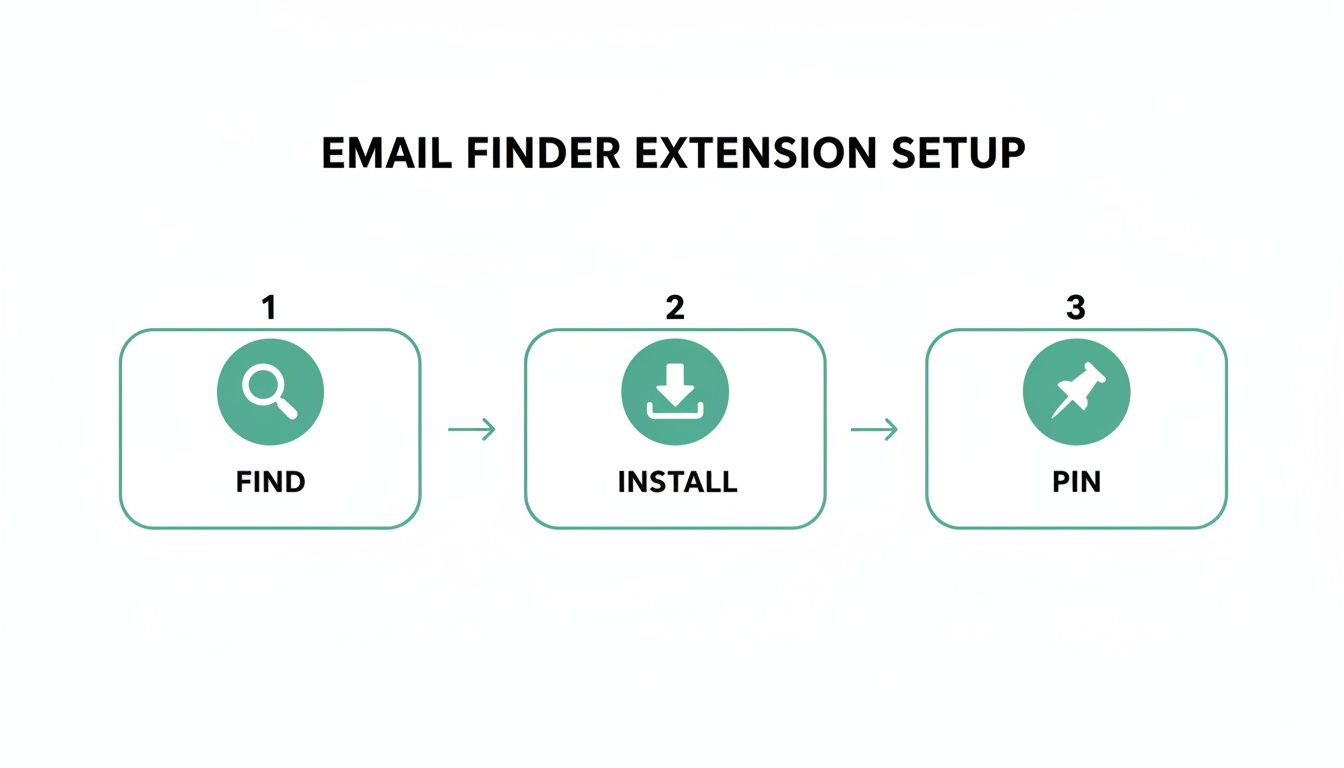
    Just hit that big "Add to Chrome" button. Once it's installed, I highly recommend "pinning" the EmailScout icon to your toolbar. It keeps it handy for whenever you're browsing profiles.

    With the extension ready, you'll notice a small EmailScout widget appearing on LinkedIn profiles. It’s designed to be subtle, giving you the functionality you need without getting in your way. Now, let's get your account set up.

    The best tools are the ones that feel like a natural extension of your existing process. A good Chrome extension should work with your LinkedIn workflow, not against it, making data accessible right where you need it.

    Creating Your Account and First Search

    The first time you use the widget, EmailScout will ask you to create a free account. It's a quick registration that unlocks all the features. Once you're signed up and logged in, the extension is live and ready to start digging up contact info.

    There’s no complicated setup. Just head over to any LinkedIn profile you're interested in. You'll spot the EmailScout widget on the side of the page, waiting for you.

    • Activation: Click the "Find Email" button inside the widget.
    • Processing: The tool instantly gets to work, searching its database and running its algorithms to find and verify the professional email for that person.
    • Results: In just a few seconds, the verified email address pops up right there on the page.

    That’s the core process for nabbing single emails. If you're looking for broader, company-level strategies, our guide on how to find company email addresses digs much deeper into that side of prospecting.

    The real beauty here is the simplicity. You're not flipping between tabs or exporting data to another tool just to find one person's contact details. It all happens right on the LinkedIn profile, which makes prepping for outreach incredibly fast. This immediate access is what turns LinkedIn from a networking site into a genuine lead-generation machine.

    Finding Single vs. Bulk Emails on LinkedIn

    How you approach finding emails on LinkedIn really boils down to your goal. Are you hunting for one specific, high-value contact? Or are you building a targeted list for a bigger campaign? Let’s break down how to handle both the surgical, single-profile search and the efficient, bulk-extraction method.

    The Sniper Approach: Finding a Single Email

    Imagine you’re trying to reach the Marketing Director at a hot SaaS company you've been tracking. This isn't a time for a generic email blast; your outreach has to be sharp and personal. This is the perfect use case for a single-profile search.

    Once you land on their LinkedIn profile, the process with EmailScout is almost laughably simple. The widget just appears on their page. You click “Find Email,” and the tool does the heavy lifting.

    Within seconds, you have their verified professional email, ready to be copied and dropped into your carefully crafted message.

    This method is all about precision and speed. It completely removes the guesswork and the tedious manual searching that used to eat up so much time. Instead of spending 15 minutes digging for one email, you get it instantly.

    Scaling Up: The Power of Bulk Email Extraction

    Now, let's switch gears. Let's say your goal is broader—you want to connect with every Product Manager in Austin for a networking event you’re hosting. Visiting hundreds of profiles one by one is a non-starter. This is where bulk extraction becomes your best friend.

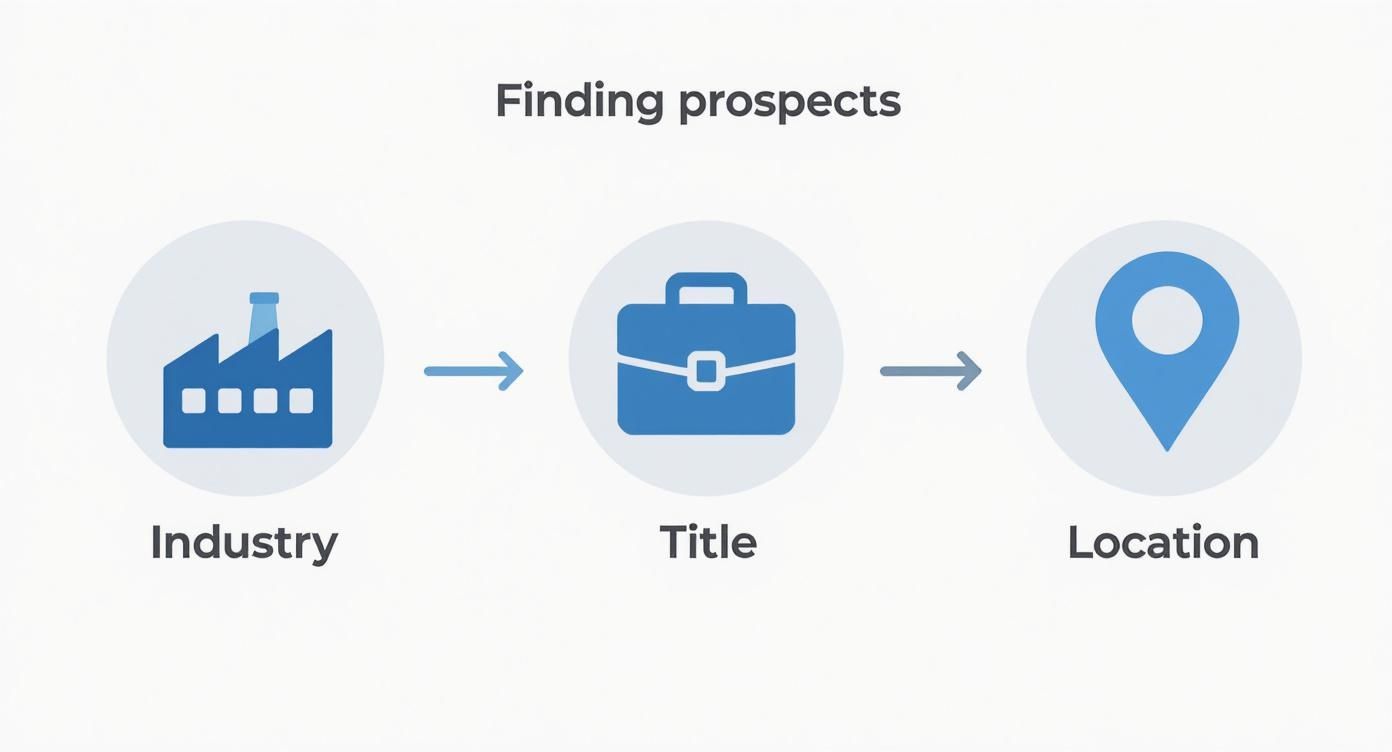
    It all starts with a smart LinkedIn search. Using LinkedIn's filters is the key to creating a high-quality list. Don't just type "Product Manager" and call it a day. Get specific:

    • Geography: "Austin, Texas Metropolitan Area"
    • Industry: "Computer Software" or "Information Technology and Services"
    • Company Size: "51-200 employees" if you're targeting startups

    With your search results page loaded up with ideal prospects, EmailScout’s bulk feature is ready to go. You'll see an option right on the page to "Export Emails from Search." When you click it, the extension gets to work, systematically going through the profiles on the page to find and verify each person's email address.

    This is how modern, efficient prospecting works—moving smoothly from discovery to outreach.

    Image

    By automating the collection process, you turn what would have been a soul-crushing, multi-hour manual task into a simple background workflow. This frees you up to focus on what actually moves the needle: writing a message that gets a response.

    Comparing Email Finding Methods

    Deciding between a single search and a bulk search is all about your immediate objective. Neither is better than the other; they're just different tools for different jobs.

    Think of it this way: the single-profile search is your sniper rifle for high-value targets. The bulk search is your wide net for gathering a qualified audience. Knowing when to use each is crucial for prospecting efficiently.

    This table should make the choice clear.

    Feature Single Profile Search Bulk Search
    Best For Targeting specific, high-value individuals like key decision-makers or a dream client. Building segmented lists for marketing campaigns, event invitations, or sales cadences.
    Speed Instantaneous, providing one email in seconds. Efficient, collecting dozens of emails from a search results page in minutes.
    Workflow Integrated directly into the profile you are viewing for immediate action. Runs as a process on a search results page, compiling data into an exportable list.
    Primary Goal Precision and immediate personalization. Scale and audience building.

    For example, a business development rep working on enterprise accounts will live in the single-search world for their account-based marketing efforts. On the other hand, a startup founder who wants to announce a new feature to a specific user persona will get massive value from a bulk search.

    By matching the method to the mission, you can dramatically improve how you find emails on LinkedIn.

    Pro Tips to Maximize Your Success Rate

    Image

    Having a powerful tool is a great start, but truly mastering it is what separates the pros from everyone else. Once you start finding emails on LinkedIn, you'll quickly see that not all results are created equal.

    Understanding the subtle differences is the secret to building high-quality, effective outreach lists. Let's move beyond just clicking a button and get into the real strategy. That means knowing exactly what to do when an email isn't immediately verified and how to fine-tune your searches to pull the best possible contacts.

    Understanding Email Verification Statuses

    When EmailScout pulls a result, it comes with a status. This small detail is incredibly important—it tells you how confident you should be in that address and what your next move should be.

    Here's a quick breakdown of what you'll see:

    • Verified: This is the gold standard. The tool has confirmed the email address is active and ready to receive your message. You can use these with high confidence, knowing your email will actually land in their inbox.
    • Risky: This means the tool found a likely email but couldn't get a 100% confirmation. It often follows a known company pattern but might be a catch-all address or just couldn't be definitively pinned down. Use these, but with caution.
    • Not Found: The tool simply couldn’t locate a professional email. This often happens with consultants, freelancers, or people at companies with unusual email structures.

    A 'Not Found' result isn't a dead end—it's a cue to do a little detective work. Check their profile for a personal website or look at the company's 'About Us' page for clues on their email format.

    Smart Searching for Better Bulk Results

    When you’re exporting emails in bulk, the quality of your initial LinkedIn search directly impacts your success rate. A sloppy search will give you a list full of irrelevant contacts and messy data. Tightening up your filters makes a world of difference.

    Instead of just a broad search like "Sales Manager," try targeting profiles more likely to have accessible contact info. People who are highly active on LinkedIn—those who post content, comment frequently, or have a ton of connections—often have more public-facing data available.

    Don't be afraid to target second-degree connections, either. Sometimes these profiles are less locked down than your direct network, which can lead to a higher email find rate. Refining your search is a critical first step; for more advanced methods, check out our guide on how to find anyone's email.

    Cross-Referencing for Those Tough-to-Find Contacts

    For a high-value prospect, sometimes you have to go the extra mile. When EmailScout returns a 'Risky' or 'Not Found' status on someone you absolutely need to reach, cross-referencing is your best move.

    Just take the person's name and company and pop it into a quick Google search. You might find them mentioned in a press release, on a company blog, or in an industry publication with their contact details listed right there.

    This extra step takes only a minute, but it can be the difference between connecting with a key decision-maker and giving up on a lead. By combining automated tools with smart manual checks, you build a much more robust and effective outreach process.

    Using LinkedIn Data Responsibly

    Just because you can find emails on LinkedIn doesn't mean you should immediately blast them with a generic sales pitch. That’s a surefire way to get ignored or marked as spam.

    The real art of outreach is turning a cold contact into a warm conversation, and that journey starts with a healthy dose of responsibility and respect. Every email you find belongs to a real person, so treating their data with care isn't just good practice—it's non-negotiable.

    You have to shift your mindset from "collecting emails" to "earning conversations." The goal isn't just to build the biggest list; it's to build the most relevant one. So, before you even think about hitting send, let's talk about the rules of the road.

    Navigating Privacy and Regulations

    Operating like a professional means you have to play by the rules, and that includes major data privacy regulations. These aren't just polite suggestions; they're laws designed to protect people from getting buried in unsolicited messages. Ignoring them can wreck your sender reputation and cause real headaches for your business.

    Two big ones you absolutely need to know are:

    • GDPR (General Data Protection Regulation): If you're contacting anyone in the European Union, you need a legitimate reason to do so. Your outreach has to be genuinely relevant to their professional role. No exceptions.
    • CAN-SPAM Act: This is a U.S. law with clear requirements. Your commercial emails must be honest, provide an obvious way for people to opt out, and include your physical address.

    The big idea behind these rules is simple: provide value and be transparent. Your first message should feel like a helpful introduction, not a sales ambush. This approach not only respects their privacy but also dramatically increases your odds of getting a positive response.

    From Contact Info to Conversation

    Once you have a verified email, the real work begins: crafting an initial message that actually adds value.

    Sure, LinkedIn DMs get a respectable 10.3% response rate, but a well-personalized cold email can be just as potent. The challenge? A staggering 64% of sales reps are expected to miss their quotas in 2025 because decision-making is taking longer than ever. This is exactly why a sharp, well-crafted email is so critical for breaking through the noise.

    Using a tool like EmailScout helps you operate safely from the get-go. It’s designed to align with LinkedIn's terms by mimicking human behavior, which helps keep your account in good standing.

    By focusing on targeted, respectful communication, you can confidently find business emails and use them to build the kind of genuine professional relationships that actually lead somewhere.

    Even with the best tools in your corner, a few questions are bound to pop up when you start digging for emails on LinkedIn. Knowing the lay of the land—what's legal, what to do when you hit a wall, and how accurate the data is—is the difference between a successful outreach campaign and a frustrating one.

    Let's clear up some of the most common sticking points right away.

    Is It Legal to Find and Use These Emails?

    Yes, but with a huge asterisk. Finding and using publicly available contact info for B2B outreach is generally fine, as long as you play by the rules. You must comply with regulations like GDPR and the CAN-SPAM Act.

    This isn't about blasting a marketing list. It's about responsible, professional communication. Your outreach has to be relevant to the person's job, and you always need to give them a dead-simple way to opt out. The line between legitimate outreach and spam is all about relevance and respect.

    What If an Email Finder Cannot Find an Address?

    It happens. No tool is a mind-reader, and sometimes you'll get a "Not Found." This usually just means the person keeps a tight lid on their profile or their company uses an unconventional email format. Don't sweat it—it's not a dead end.

    You've still got a couple of moves:

    • Make an educated guess: Try common patterns like first.last@company.com or f.lastname@company.com. You'd be surprised how often this works.
    • Warm them up first: Go engage with their content on LinkedIn. A thoughtful comment or a direct message can open the door far more effectively than a cold email ever could, especially if they're a high-value contact.

    A "Not Found" result isn't a failure. It’s a signal to switch from an automated approach to a more personal, hands-on one for that particular lead.

    How Accurate Are the Found Emails?

    This is where a good tool really shows its worth. Reputable finders like EmailScout don't just guess; they run multi-step verification checks. You’ll often see emails tagged as "Verified," which means the tool has confirmed the address is live and ready to receive mail.

    While nothing is ever 100% foolproof, using a verified source dramatically slashes your bounce rate. It’s worlds better than buying some dusty, unverified list—a surefire way to wreck your sender reputation and get your domain blacklisted.

    Can My LinkedIn Account Get Banned?

    LinkedIn's main concern is aggressive, high-volume scraping that messes with their platform. Smart Chrome extensions are built to fly under the radar by mimicking normal human behavior.

    As long as you’re using the tool responsibly and not trying to pull thousands of contacts in a few minutes, the risk to your account is incredibly low. The goal is to work smarter, not just faster.


    Ready to find verified emails with confidence and precision? EmailScout gives you the power to connect directly with key decision-makers, turning LinkedIn into your most powerful lead generation tool. Start finding unlimited emails for free today.

    Get Started with EmailScout for Free

  • A Guide to Find Business Emails with EmailScout

    A Guide to Find Business Emails with EmailScout

    If you're trying to find business emails, just guessing is a shot in the dark. The smart play is to use a dedicated tool—an email finder—to actually check if an address is legit. This simple shift moves you from hopeful prospecting to predictable, effective communication and protects your all-important sender reputation.

    Why Accurate Emails Are Your Greatest Sales Asset

    Ever spent a week perfecting a sales sequence only to watch half your emails bounce? It’s not just frustrating; it’s a massive waste of resources that kills your momentum.

    In B2B sales and marketing, your contact list is everything. Without good data, even the most brilliant message is just shouting into the void.

    Sending emails to dead addresses does more than waste your time. It actively trashes your sender reputation, which is the score email providers like Google and Microsoft give your domain. A high bounce rate makes you look like a spammer, and pretty soon, all your emails—even the ones to good addresses—start landing in junk folders.

    The Real Cost of Bad Data

    Bad data also makes personalization impossible. A generic "To Whom It May Concern" email is a one-way ticket to the trash folder.

    But when you can find the actual business email for a specific person, like the Head of Product or the VP of Marketing, you can speak directly to their problems. You can tailor your pitch to what they care about.

    That’s how you build real business relationships. It’s the difference between a cold email that gets ignored and a warm reply that kicks off a real conversation.

    The heart of good outreach isn’t just what you say. It’s making sure the right person actually hears you. An accurate email is the key that unlocks that door.

    Fueling Growth with Reliable Contacts

    Solid contact info has a ripple effect across your whole business. It lets you build laser-focused marketing campaigns, nurture leads that actually convert, and create a sales pipeline you can count on.

    Email marketing isn't going anywhere. In fact, the global market is on track to hit $36.3 billion by 2033. This growth is all about its proven ROI, especially in B2B, where 70% of marketers swear by email newsletters for nurturing leads. If you want to dig deeper, you can explore more about these trends and how they’re shaping modern marketing.

    Getting Your EmailScout Account Ready for Action

    Before you can start finding business emails at lightning speed, you’ve got to get your tools in order. Don’t worry, setting up your EmailScout account is a breeze and only takes a few minutes. Think of it as laying the groundwork for a much, much smoother prospecting workflow.

    First things first, pop over to the EmailScout website and create your account. You'll see a few different plans. The right one for you really just depends on how much outreach you're doing. A solo consultant might be perfectly happy with a free or basic plan, but a growing sales team will probably want the higher credit limits and team features that come with a premium plan.

    Image

    This dashboard is basically your mission control. It gives you a quick, clean look at all your prospecting activity and how many credits you have left.

    Installing the Browser Extension

    Okay, account active? Awesome. The next move is the most important one: installing the EmailScout Chrome extension.

    This little tool is the magic ingredient. It plugs EmailScout right into your browser, letting you find email addresses on the fly without ever leaving a prospect's LinkedIn profile or company website. It’s the difference between prospecting feeling like a chore and making it a seamless part of your research.

    Your goal is to reduce friction in your workflow. The browser extension eliminates the need to copy-paste names and domains, turning a multi-step process into a single click.

    With the extension installed, take a second to get familiar with how it looks and feels. When you're ready to move beyond just single lookups, our guide on how to find company email addresses is packed with deeper strategies for building out entire lists.

    The last step is just logging into the extension with your new account details. And that's it—you're fully equipped. The next time you land on a potential lead’s profile, that EmailScout icon will be waiting in your browser, ready to pull the contact info you need. You've officially streamlined the first, and often most tedious, part of your outreach.

    How to Find Specific Emails with Precision

    Alright, with the setup out of the way, it's time to put EmailScout to work. The real magic of a tool like this isn't just digging up any email; it's about nailing the right email with speed and accuracy. This is where you graduate from prospecting guesswork to a sharp, repeatable process.

    Let's walk through a super common scenario. Say you need to connect with the Head of Partnerships at a hot new SaaS company. You've found the perfect contact on a site like LinkedIn, but in the past, that's where the trail might have gone cold.

    With EmailScout, this becomes the easy part. While you're on their profile page, just click the EmailScout extension icon in your browser. The tool immediately gets to work, scanning for public data and cross-referencing it with known company email patterns.

    This is what that simple, one-click process looks like in action:

    Image

    As you can see, the tool just slides right into your existing research flow. No new tabs, no complicated steps.

    Interpreting the Results for Maximum Impact

    Within seconds, EmailScout serves up one or more potential email addresses. But here's the most important part: each one comes with a confidence score. This percentage is your cheat sheet for how likely the email is to be correct and, more importantly, deliverable.

    A high score, usually 95% or more, means the email has been verified. It’s good to go.

    A lower score doesn’t automatically mean it's a dud. It just suggests the tool is making an educated guess based on common formats (like first.last@company.com). In these cases, I always prioritize the higher-scored emails first and keep the lower-scored ones as a backup.

    To make it crystal clear, here’s a quick breakdown of what those scores mean for your outreach strategy.

    EmailScout Confidence Score Explained

    A quick reference to understand what each confidence level means for your outreach strategy.

    Confidence Score Meaning Recommended Action
    95% – 100% Verified: The email address is confirmed to be active and deliverable. Safe to Send: Use this email for your primary outreach with high confidence.
    70% – 94% Likely: Based on common patterns, but not fully verified. Use with Caution: Good secondary option. Consider a low-risk "warm-up" email.
    Below 70% Best Guess: A calculated guess with a higher chance of bouncing. Last Resort: Avoid using for cold outreach to protect your sender reputation.

    Think of the confidence score as more than just a number—it’s a strategic filter that protects your sender reputation by cutting down your bounce rate.

    Sticking to verified emails is one of the most important habits you can build for long-term outreach success. It keeps your domain healthy and your messages in the inbox.

    And getting this right matters more than ever. The effectiveness of email just isn't slowing down. With global email users projected to hit 5.61 billion by 2030, the inbox remains the heart of business communication. Plus, email marketing still pulls in an average ROI of $36 for every $1 spent, which you can explore in more detail with these email usage statistics.

    The best part? This entire process—from landing on a profile to snagging a verified contact—usually takes less than a minute.

    Scaling Your Prospecting with Bulk Searches

    Searching for emails one by one is great when you're zeroing in on a specific person, but it's a real bottleneck when you need to build a serious lead list. You just can't scale that way. That's when you need to switch gears from a surgical approach to a volume-based one, and bulk searches are how you get there.

    EmailScout is built for this exact scenario. Instead of just grabbing one contact, you can pull entire lists of people from a company you're targeting. Need to reach the whole marketing team at a key account? A bulk search can hand you that list in minutes, not hours or days.

    From a Single Company to an Entire List

    The process couldn't be simpler. You can start broad—just plug in a company's website domain, and EmailScout will get to work generating a list of employees. This is an absolute game-changer for anyone doing account-based marketing, where mapping out the entire organization is half the battle.

    But the real magic happens when you bring your own data to the table. Most of us have a spreadsheet somewhere with a list of prospects—names and company names, but not much else. It's a list of who you want to contact, but it's missing the how. That's where you can upload your own CSV file.

    The point of a bulk search is to turn that static list of names into a pipeline of real conversations. It closes the gap between knowing who your targets are and actually getting your message in front of them.

    EmailScout lets you map the fields from your file (first name, last name, company domain), and then it enriches your list with verified email addresses. Suddenly, that static spreadsheet becomes an actionable outreach list. This is how you process hundreds or even thousands of contacts without the mind-numbing manual labor.

    In a world where email volume is exploding, that efficiency is everything. The number of emails sent daily is expected to hit 376.4 billion by 2025, a huge leap from 281.1 billion in 2018. You can discover more key email usage trends to see just how critical this channel continues to be.

    Streamlining Your Workflow

    By automating the data enrichment part of your process, you get to spend your time on what actually drives results: writing great emails and building relationships.

    If you're focused on a specific geographic area, you can also find thousands of local business emails in minutes, adding another powerful layer to your strategy. At the end of the day, bulk searching isn't just about moving faster—it's about making your entire lead generation engine smarter.

    Advanced Strategies for Smarter Prospecting

    Finding business emails is a great first step, but turning that raw data into actual revenue requires a smarter strategy. It's not just about collecting a huge list of contacts; it’s about creating a seamless workflow that plugs your prospecting directly into your sales and marketing engines.

    Image

    This is where integrating EmailScout into your existing tech stack comes into play. The real goal is a smooth handoff—from the moment you find an email to the second you enroll that prospect into an outreach sequence. Thankfully, most modern CRMs and sales platforms accept CSV imports, which makes this process incredibly simple.

    After you've wrapped up a prospecting session, just export your verified list from EmailScout and upload it straight into your CRM. This one simple habit keeps your pipeline organized and makes sure no lead ever falls through the cracks.

    Organizing Your Leads for a Smooth Handoff

    Look, disorganized data is just as useless as bad data. Before you even think about exporting, take a minute to organize your contacts inside EmailScout using the lists feature. This is one of those small habits that has a massive payoff down the road.

    I recommend creating lists based on the specific criteria that actually matter to your campaigns. For example:

    • By Industry: Group all your SaaS, healthcare, or e-commerce leads together.
    • By Job Title: It's super helpful to have separate lists for "VPs of Marketing" or "Heads of Engineering."
    • By Campaign: If you're running a specific promotion or webinar, keep all those leads in a dedicated list.

    Sorting your leads ahead of time makes the import into your CRM a clean, painless process. You can instantly map your lists to the right campaigns or sales cadences, saving yourself hours of tedious manual cleanup later.

    A well-organized lead list is the foundation of any successful outreach campaign. It’s what allows for the precise targeting and personalization you need to cut through the noise and actually get a response.

    Navigating the Ethics of Cold Outreach

    Finally, let's touch on the ethics of all this. Just because you can find someone's email doesn't always mean you should use it without a second thought. Building and protecting your brand's reputation is everything.

    Always be transparent about who you are and why you're reaching out. Your very first email should provide genuine value—not just a sales pitch—and make it dead simple for the person to opt out. Respecting their inbox is non-negotiable. It's how you build long-term trust and potentially turn a cold contact into a warm relationship.

    A Few Common Questions About Finding Emails

    Diving into the world of email prospecting usually brings up a few questions. It's totally normal. Getting clear answers helps you move forward with confidence, making sure your outreach is both effective and above board.

    Let's clear the air on some of the most common things people ask when they start hunting for business emails.

    Is It Actually Legal to Find Business Emails for Outreach?

    Yes, it's generally legal to find and use publicly available business emails for B2B communication. The big thing to remember is staying compliant with regulations like CAN-SPAM in the U.S. and GDPR over in Europe.

    These laws aren't there to kill legitimate business conversations. Their main job is to make sure you're transparent about who you are and give people a super easy way to opt out if they're not interested.

    The real focus of these rules is to shield consumers from spam, not to block professional B2B outreach where there's a genuine business interest.

    What’s an Email Confidence Score?

    You'll see this metric in a lot of email finder tools. A confidence score is just a percentage that tells you how certain the tool is that an email address is correct and won't bounce.

    A high score, say 95% or more, is your green light. It means the email has been checked out and is safe to add to your campaigns. This little number is a huge deal for protecting your sender reputation—sending to bad addresses all the time is a quick way to get your domain flagged as spam. For a deeper look at this, you can check out our complete guide on how to find anyone's email.

    How Do Tools Like EmailScout Actually Find These Addresses?

    It’s not magic, just a really smart, layered process.

    Most email finders start by pulling data from public sources. Then, they analyze common email patterns for a company's domain (like firstname.lastname@company.com or f.lastname@company.com). The final, most important step is a real-time server check to confirm the address is active and can receive mail. It's this multi-step approach that makes the results so solid.


    Ready to stop guessing and start connecting? EmailScout gives you the tools to find verified business emails in seconds, right from your browser. Start finding unlimited emails for free today and build your next great sales list.

    Article created using Outrank

  • Find a Business Email Address Instantly & Easily

    Find a Business Email Address Instantly & Easily

    The goal isn't just to find an email address; it's to find the right one. You want to bypass those generic inboxes like info@company.com and connect directly with a decision-maker.

    This direct line of communication is a game-changer. It can dramatically boost your response rates, shrink your sales cycle, and let you personalize your outreach in a way that actually gets noticed. It’s the difference between shouting into a void and starting a real conversation.

    Why Direct Email Access Transforms Your Outreach

    Sending a cold email to a generic company address is like putting a letter in the mail addressed to "Current Resident." Sure, it might get delivered, but the odds of it landing in the right hands are slim to none.

    I learned this the hard way early in my career. I spent weeks pitching a major client through their 'contact us' form, and all I got was radio silence. Frustrated, I tried a simple pattern-guessing trick to figure out the VP of Marketing’s direct email. One personalized message later, I had a meeting on the books.

    That single experience drove home a critical lesson: direct access is a massive strategic advantage.

    Cut Through the Noise and Get Noticed

    Decision-makers are absolutely flooded with messages every single day. A generic inbox is usually managed by an administrative assistant or, even worse, an automated system designed to filter out anything that looks like a sales pitch.

    By finding a direct business email address, you instantly sidestep all of that. Your message lands exactly where it needs to be, giving you a fair shot at making a genuine first impression with the one person who can actually say "yes."

    Key Takeaway: Bypassing the gatekeepers isn't about being sneaky—it's about being efficient. You respect everyone's time by taking your proposal directly to the person most qualified to evaluate it.

    Enable True Personalization and Build Relationships

    You can't really personalize a message for "info@." A direct email, on the other hand, lets you address someone by name, reference their specific role, or mention a recent company win. That level of detail shows you’ve done your homework and aren't just blasting out a generic template.

    This is more important than ever because email remains a dominant force in business.

    Despite the rise of social media and messaging apps, global email usage is projected to grow from 4.83 billion users in 2025 to 5.61 billion by 2030. That continued reliance on email underscores its power, especially when you consider that personalized campaigns can deliver an average ROI of $36 for every $1 spent.

    When you connect directly, you stop being just another salesperson. You become a potential partner starting a real conversation. You can find more insights on these email trends from cloudhq.net.

    Your Toolkit for Instant Email Discovery

    Let’s be honest: guessing email patterns and manually digging through websites is slow and unreliable. It has its place, but when you need to find a business email address right now, you need a dedicated tool. These platforms are built to do the heavy lifting, pulling from massive databases and using smart algorithms to give you accurate contact info in seconds.

    For anyone in sales, marketing, or biz dev, an email finder like EmailScout is an absolute game-changer. It’s the difference between crossing your fingers and hoping your outreach lands, and knowing it will.

    Putting an Email Finder to the Test

    Let’s walk through a real-world example. Say you need to get in touch with the Head of Marketing at a SaaS company called "Innovate Solutions." You know their name is Jane Doe, but that’s it.

    With a tool like EmailScout, you just plug in her name and the company's domain (innovatesolutions.com). The tool then gets to work, checking common email formats and verifying them against its data sources. In just a few moments, you get a result.

    The platform will likely return an address like jane.doe@innovatesolutions.com, but here’s the important part: it also gives you a confidence score. This little number is gold—it tells you how likely it is that the email is correct and active. A high score (think 95% or more) means you can hit "send" with confidence, knowing you won't get an immediate bounce-back.

    For a more detailed look at the mechanics behind this, check out our guide on how to find company email addresses.

    This is the kind of clean, no-fuss interface you'll be working with to find contacts in seconds.

    Image

    The sheer simplicity of the process is what makes it so powerful. You can build highly targeted lists without spending hours on manual grunt work.

    Choosing the Right Tool for the Job

    While a primary tool like EmailScout is your workhorse, a smart outreach strategy always includes a few complementary options. Different tools have different strengths, so having a couple in your arsenal means you can cross-verify information and track down even the most elusive contacts.

    Pro Tip: Never rely on a single source. If one tool comes up empty or gives a low confidence score, run the same search in another. Cross-verification is the secret to maintaining a high-quality, bounce-free contact list.

    So, with so many tools out there, how do you pick the right one? I've spent countless hours testing these platforms, and here’s a quick breakdown of the top players to help you decide.

    Comparing Top Email Finder Tools

    A head-to-head comparison of popular email-finding tools based on key features, accuracy, and ideal use cases to help you choose the best fit.

    Tool Name Best For Key Feature Accuracy Rate
    EmailScout All-around performance and ease of use Real-time verification and confidence scoring 95%+
    Hunter Finding emails associated with a specific domain Domain search and bulk email finder ~90%
    Voila Norbert Lead enrichment and verification at scale Integrations with CRMs and marketing platforms ~92%
    Snov.io Sales teams needing an all-in-one outreach suite Email drip campaigns and CRM functionality ~88%
    FindThatLead Social media prospecting and finding local leads Prospector tool for LinkedIn and Twitter ~85%

    Ultimately, the best tool depends entirely on your workflow. If you just need quick, accurate lookups, a focused tool like EmailScout is perfect. But if you need a full sales automation suite, something like Snov.io might be a better fit. The key is to find the one that slots seamlessly into how you already work.

    Getting Your Hands Dirty With Manual Search Techniques

    Sometimes, the automated tools just don't cut it. When you hit a wall, it’s time to roll up your sleeves and do some good old-fashioned detective work. Manual searching might feel a bit old school, but trust me, it’s an incredibly effective way to unearth a business email address that the tools might have missed.

    The whole game is about recognizing patterns and knowing exactly where to poke around.

    Image

    Most companies use a predictable formula for their email addresses. All you need is one verified email from the organization, and you can usually decode the pattern for everyone else. This is your first and most powerful manual tactic.

    Decoding Common Email Patterns

    Start by hunting for any publicly available email on the company's website. Press releases or a "Meet the Team" page are often goldmines. Let's say you find an email like j.smith@company.com. It’s a pretty safe bet that your target, Jane Doe, will be j.doe@company.com.

    You'll run into the same few formats over and over again:

    • First Name: jane@company.com
    • First Initial, Last Name: jdoe@company.com
    • First Name, Last Initial: janed@company.com
    • Full Name with a Dot: jane.doe@company.com
    • Full Name with an Underscore: jane_doe@company.com

    Once you have a handful of educated guesses, run them through a free email verifier. This quick check confirms which ones are valid without you having to send a single email and risk a bounce.

    My Experience: I was once trying to reach an elusive CEO whose contact info was completely scrubbed from the web. After digging into their company blog's source code, I found a developer's comment that included their email (first.last@company.com). I applied that same pattern to the CEO's name, sent my pitch, and landed a meeting the very next day. The clues are often hiding in the most unexpected places.

    Using Advanced Search Operators

    Google is more than a search engine; it's a powerful investigative tool if you know the right commands. These "search operators" are simple prefixes that let you narrow down search results with surgical precision.

    For example, you can tell Google to only search a specific website for your target's name along with the word "email." To go even deeper on this, check out our comprehensive guide on how to find anyone's email address.

    Give these powerful search strings a try—just swap out the bracketed info with your own:

    1. Find contact pages or staff directories:
      site:[companywebsite.com] (contact | staff | directory)
    2. Search for a person's name and email:
      "[Jane Doe]" + email site:[companywebsite.com]
    3. Uncover documents containing contact info:
      site:[companywebsite.com] filetype:pdf "Jane Doe"

    Strategic LinkedIn Sleuthing

    LinkedIn is a treasure trove of professional information, but not always in the most obvious way. People rarely list their email address publicly on their profile, but their activity can drop some serious breadcrumbs.

    Always check the "Contact info" section on their profile first. If that comes up empty, look at their recent posts, articles, or comments. A person might mention a personal blog or a side project in their bio, and their contact information is often more accessible there. This kind of indirect approach is frequently the key to finding what you need.

    What To Do When You Can’t Find Their Email

    So, you’ve run through your usual tools, done the manual checks, and still come up empty. It’s easy to throw in the towel here, but don't. The truth is, the most valuable contacts are often the hardest to find for a reason, and a little creative thinking is all you need to get past the roadblocks.

    Image

    This is where we graduate from simple searching to some real strategic sleuthing. The mission? To track down those less-obvious digital breadcrumbs that lead straight to your target's inbox.

    Look Beyond the Company Website

    Your prospect's digital life doesn't start and end on their company's "About Us" page. Professionals are often active participants in their industry, which means they're leaving clues all over the place. You just have to know where to look.

    • Industry Publications: Has your contact ever penned an article for a trade journal or an industry blog? The author bio at the top or bottom of the page is a goldmine. It frequently includes a direct email address for feedback or inquiries.

    • Press Releases: It's worth digging through a company's press releases, especially older ones. The media contact listed on a release from a few years back might just be the very person you're trying to reach now.

    These spots are often overlooked, which makes them incredibly valuable for anyone willing to do a little extra digging.

    Check Out Social Media Bios and Company Newsletters

    Social media is another fantastic resource, but again, you need to know where to poke around. A LinkedIn profile probably won't have an email listed publicly, but a personal Twitter or Mastodon bio just might—especially for founders, marketers, or anyone building a personal brand.

    Here's another trick that works surprisingly well: subscribe to the company's newsletter. I know it sounds a bit counterintuitive, but many of these aren't sent from a generic "no-reply" address.

    When you hit 'reply' on a welcome email or a new campaign, your message can sometimes land directly in the marketing manager's personal inbox. This gives you an incredibly warm and direct entry point.

    This tactic is brilliant because it bypasses the usual gatekeepers and starts a conversation in a context they already own. It also shows you have a genuine interest in their company before you even think about making your pitch.

    Why All This Effort Still Matters

    These creative methods are worth your time because email remains the undisputed king of business communication. Projections show that the number of global email users is set to grow from nearly 4.6 billion in 2025 to over 4.8 billion by 2027.

    And it’s not just about numbers. With 60% of consumers saying they prefer to be contacted by brands via email, it's the channel where people actually expect to receive professional outreach. The engagement rates speak for themselves, with 88% of users checking their inbox multiple times a day. A well-placed email is almost guaranteed to be seen.

    You can dive deeper into these compelling email statistics over at Porch Group Media.

    Using Your Newfound Contacts Ethically

    Okay, so you've got a list of business emails. The hard part is over, right? Not exactly. Finding the contact info is just the first step—how you use it is what separates a successful campaign from a one-way ticket to the spam folder.

    Let's be real: great power comes with great responsibility. Misusing a direct line to someone's inbox is the fastest way to burn a bridge before you've even had a chance to build it.

    The goal isn't just to get a response. It’s to start a meaningful conversation. That means shifting your entire mindset from "What can I get?" to "What can I give?"

    The Golden Rule of Cold Outreach

    Before you even think about hitting 'send,' your email needs to pass one simple test: is it genuinely helpful to the person receiving it?

    Your very first message has to provide immediate value. I don't mean offering a discount or a free trial. I mean sharing a relevant insight, a useful resource, or a thoughtful observation about their company or work.

    Instead of a generic pitch, try sending a link to an interesting case study that applies to their industry. Or, mention a recent project they launched and offer a genuine compliment. This approach respects their time and instantly positions you as a helpful peer, not just another salesperson trying to make a buck. Personalization is everything here.

    The modern inbox is a minefield, and people are rightfully wary. In fact, roughly 25% of all emails in recent years were flagged as malicious or spam. Your outreach has to cut through that noise and immediately signal that it’s legitimate and valuable, or it’s getting deleted.

    The Litmus Test: Read your draft out loud from your prospect's point of view. Would you be annoyed to get this, or would you be a little intrigued? If you hesitate for even a second, go back and inject more value.

    Respecting Privacy and Regulations

    Ethical outreach isn't just a nice idea—it's the law. You have to understand and follow the legal frameworks designed to protect personal data. Rules like GDPR in Europe and the CAN-SPAM Act in the U.S. aren't optional guidelines. They're requirements.

    Here are the core principles you absolutely have to live by:

    • Be Transparent: Clearly state who you are and why you're reaching out. No mystery meat emails.
    • Provide an Opt-Out: Every single email must include a clear, easy-to-find way for the person to unsubscribe.
    • Honor Requests Promptly: If someone asks to be removed, do it immediately. No questions asked.

    Building a solid professional reputation is a long-term game. When you use a business email to offer genuine value, you're doing more than just generating a lead; you're building trust.

    For some more specific strategies, like contacting property managers, check out our guide on finding hundreds of emails from a simple Google search.

    A Few Common Questions About Finding Emails

    Even when you've got the right tools and a solid game plan, a few questions always seem to pop up when you're on the hunt for business emails. Let's walk through some of the most common ones I hear.

    Is It Actually Legal to Email Someone I Don’t Know?

    This is a big one. The short answer is yes, it's generally legal to send cold emails for business purposes, but you absolutely have to play by the rules. In the U.S., the main regulation is the CAN-SPAM Act, and it lays out some clear, non-negotiable guidelines.

    The whole thing boils down to being transparent and respectful. You have to be honest about who you are, include a legitimate physical mailing address, and—this is the most critical part—provide a super simple way for people to opt out. If you ignore these, you're not just being unprofessional; you could be facing some hefty fines.

    The bottom line: The law allows for cold outreach, but it demands accountability. Always, always include an unsubscribe link and make sure you honor those requests immediately. It keeps you compliant and protects your reputation.

    What if I Send an Email to the Wrong Address?

    Mistakes happen. Sending an email to an address that doesn't exist will almost always trigger a "bounce-back" notification. It's just an automated message from the server letting you know the email couldn't be delivered.

    One or two of these isn't a big deal. But if you're getting a lot of them, your email service provider will notice. A high bounce rate is a red flag that can damage your sender reputation, making it more likely that your future emails land in the spam folder. This is exactly why running your list through a verification tool first is a non-negotiable step.

    How Accurate Are These Email Finder Tools, Really?

    Their accuracy can be all over the place, but the top-tier tools are incredibly reliable. A platform like EmailScout, for example, consistently hits an accuracy rate of 95% or even higher. How? They don't just pull data from one place; they check against multiple public sources and run real-time verification checks to confirm an address is active before they give it to you.

    These tools are lightyears ahead of manual guesswork. They use smart algorithms to figure out the most likely email format for a company and then test it on the spot.

    That said, no tool is perfect. People change jobs, and companies restructure their email patterns. A small percentage of emails will always go out of date. That's why it's a good idea to pick a tool that gives you a confidence score along with the email address.

    Should I Actually Pay for an Email Finder?

    If you're serious about sales, marketing, or even just networking, then yes—a paid tool is an investment that pays for itself almost immediately. Free tools might seem tempting, but they're often hobbled by major limitations, like giving you only a handful of searches, serving up old data, or skipping verification entirely.

    Think about the ROI. How much is your time worth? A good paid tool eliminates hours of tedious manual searching and verifying. You can build a clean, targeted list in minutes, which frees you up to focus on the stuff that actually drives results: writing a compelling message and starting a real conversation.

    The monthly cost is usually a drop in the bucket compared to the value of landing just one meeting with a key decision-maker.


    Ready to stop guessing and start connecting? EmailScout gives you the power to find verified business email addresses in a single click. Try EmailScout for free and supercharge your outreach today.

    Article created using Outrank

  • How to Find Company Email Addresses Fast and Easily

    How to Find Company Email Addresses Fast and Easily

    Finding the right company email address is what separates a cold outreach campaign that falls flat from one that opens up real, meaningful business conversations.

    The most reliable way to do this? It’s almost always a combination of two things: a little manual digging using free resources like LinkedIn and Google search, paired with a specialized email finder tool to automate the heavy lifting and verify that the address is actually legit. This one-two punch ensures you not only find an address but the right address—one that won't bounce and will land your message in front of the person who matters.

    Why Finding the Right Email Is a Game Changer

    Image

    Before we jump into the nitty-gritty tactics, let’s get the strategy straight. Finding a direct and accurate email isn’t just about dodging a bounce-back notification. It's the first—and most critical—step in building a genuine connection that actually drives results.

    Sending a message to a generic inbox like info@company.com is the modern equivalent of shouting into a crowded room and just hoping the right person hears you. It rarely works. A direct email, on the other hand, puts your message exactly where it needs to be.

    This kind of precision opens doors that would otherwise stay firmly shut. Think about it in real-world terms:

    • For Sales Professionals: A well-crafted email to a VP of Marketing can kickstart a conversation about a major software deal. You get to bypass the usual gatekeepers, potentially shaving weeks off your sales cycle.
    • For Marketers: Reaching out to a specific editor with a personalized pitch is infinitely more effective than chucking it into a general content portal. Your odds of getting a story published skyrocket.
    • For Job Seekers: Contacting a hiring manager directly makes your application leap out from the hundreds of others languishing in an automated applicant tracking system.

    The Tangible Impact on Your Bottom Line

    At the end of the day, effective outreach is a numbers game, and finding the right contact info dramatically stacks the odds in your favor. All the personalization and targeted marketing strategies in the world depend on one thing: accurate data.

    With email marketing delivering an insane ROI of $36 to $42 for every dollar spent, the quality of your contact list has a direct line to your profitability. It's no surprise that by 2025, an estimated 81% of small and medium-sized businesses will be relying on email as their main channel for winning new customers. If you're curious, you can dig into even more email marketing statistics to get the full picture.

    The difference between a generic and a direct email is the difference between being ignored and being heard. One gets lost in the noise; the other starts a conversation that can lead to real business growth.

    Ultimately, mastering how to find company email addresses is so much more than a technical skill. It's a strategic advantage that pays for itself over and over by boosting campaign performance, lowering customer acquisition costs, and helping you build a network of valuable professional contacts.

    Getting Your Hands Dirty with Manual Email Search Techniques

    Image

    While powerful tools can save you a ton of time, you don't always need a paid subscription to get the job done. Honestly, mastering the art of manual email hunting is a skill every good prospector should have. It turns you into a digital detective, piecing together clues from all corners of the web.

    This old-school approach costs nothing but a bit of your time, and it genuinely sharpens your instincts for finding information. It all starts with a simple, targeted Google search—but there's a trick to it.

    Unlocking Google for Email Discovery

    Your first move should be to use specific search strings that dig up contact info buried on a company’s website or in public documents. Just typing a name and a company into Google is a rookie mistake. You need to think like an investigator and use advanced search operators to force Google to show you things that aren't immediately obvious.

    It’s surprisingly effective for finding details that companies have made public, sometimes without even realizing it.

    Here are a few of my go-to search combinations:

    • "John Doe" + "Acme Corp" + email
    • site:acmecorp.com "John Doe" contact
    • "John Doe" "@acmecorp.com"

    For example, a search like site:acmecorp.com filetype:pdf "contact" can unearth old press releases or marketing PDFs that happen to contain direct email addresses. By playing around with different combinations, you can often find a lead's email in places most people never think to look.

    To see this in action, check out our guide on how to find hundreds of property manager emails using a few clever searches.

    Using LinkedIn and Common Email Patterns

    LinkedIn is your next best friend for any manual search. While it won't just hand you an email address on a silver platter, it gives you the two most critical pieces of the puzzle: the person's full name and their company's domain name.

    Once you have those two things, you can start making an educated guess.

    Most companies use a standardized format for their email addresses. Your job is to figure out that pattern and apply it to your target.

    A manual search is like solving a puzzle. You gather pieces from Google and LinkedIn, then assemble them using common email patterns until you find the perfect fit.

    The most common corporate email patterns usually look something like this:

    • First Name: john@acmecorp.com
    • First Name.Last Name: john.doe@acmecorp.com
    • First Initial Last Name: jdoe@acmecorp.com
    • First Name Last Initial: johnd@acmecorp.com

    The trick is to find a confirmed email for anyone at that company. Let's say you find a support email like support.team@acmecorp.com. That's a huge clue that the company probably uses the first.last format. Apply that pattern to your prospect's name—john.doe@acmecorp.com—and you've just made a highly educated guess.

    The final step? Plug that email into a free, single-use email verifier to confirm it’s valid before you hit send.

    Manually digging for emails is a useful skill, no doubt. But it has its limits. If you need more than just a few contacts, you’ll quickly hit a wall.

    Picture a sales team trying to pull together a lead list of 200 prospects for a new campaign. Searching for each one by hand? That's a direct route to burnout and a massive time-sink. This is exactly where dedicated email finder tools come in and completely change the game.

    These platforms automate the entire discovery and verification process, turning what would have been hours of tedious grunt work into a few simple clicks. They're built for one thing: finding accurate company email addresses at scale, quickly and reliably. For anyone in sales, marketing, or recruiting, the value is obvious from day one.

    How Email Finder Tools Work

    Instead of playing a guessing game with email patterns, these tools tap into massive databases and smart algorithms to figure out the correct email format for any given company. They cross-reference data from public sources, historical records, and even perform direct server checks to give you a verified result.

    This is precisely how a tool like EmailScout operates. You can pop in a company's domain, and it gets to work analyzing common patterns and known contacts to pull up valid addresses tied to that business. It’s the difference between being a lone detective and having a full forensics team on the case.

    For instance, a marketing team looking to flesh out its contact database can upload a list of names and company domains. The tool then works its magic, appending the correct, verified email addresses to each contact. This not only saves the team from a soul-crushing data entry project but also ensures their next campaign has a high deliverability rate.

    The process is designed to be dead simple, as you can see below. You're just a company URL away from finding the emails you need.

    Image

    This kind of workflow gets you from prospect to contact in seconds, not hours.

    The Power of Bulk Searching and Verification

    The real magic of these tools is their ability to handle bulk requests. Imagine a recruiter sourcing candidates for multiple roles. They can upload a list of LinkedIn profile URLs and extract hundreds of potential email addresses in a matter of minutes.

    But more importantly, the best tools don't just find emails—they verify them. This step is absolutely critical for protecting your sender reputation. A high bounce rate is a huge red flag for email providers, and it can get your domain flagged as spammy, torpedoing the effectiveness of all your future outreach efforts.

    Using an email finder isn't just about moving fast; it's about being accurate. A verified email list makes sure your messages actually land in the inbox, protecting your sender score and maximizing your campaign's impact.

    Most top-tier verification services use a multi-step check to confirm an address is active and ready to receive mail. They filter out everything from simple typos to defunct inboxes, leaving you with a clean, high-quality list ready for outreach.

    Weighing the Trade-Offs: Cost, Time, and Accuracy

    Sure, premium email finders come with a subscription fee, but it’s a mistake to view it as just another expense. It’s an investment.

    Think about it this way:

    • Time Saved: What's an hour of your sales team's time worth? If a tool saves each rep five hours a week, the productivity boost alone often pays for the subscription many times over.
    • Increased Accuracy: Manual methods are a recipe for bounced emails. High bounce rates can kill a campaign's ROI. Verification tools keep your deliverability high, ensuring your message actually gets read.
    • Scalability: You can spin up targeted lists for new markets or campaigns whenever you need them. This lets your business pivot and grow much faster than the competition.

    Ultimately, deciding how to find company email addresses at scale comes down to this trade-off. For a few one-off searches, you can probably get by with manual methods. But for anyone serious about building a predictable pipeline for sales, marketing, or outreach, an email finder is a non-negotiable part of a modern tech stack.

    Creative Strategies for Hard-to-Find Emails

    Sometimes, the standard playbook for finding company emails just doesn't cut it. You’ve run through the common patterns, plugged the name into your favorite tool, and still come up empty. This is where you have to get creative and start looking for clues where most people don't bother.

    When you hit a dead end, it's time to think like a digital detective. Companies leave breadcrumbs all over the web, and if you know where to look, they can lead you right to the contact you need. The trick is to stop searching for the email directly and start hunting for these hidden clues.

    Mining Unconventional Digital Spaces

    Let's start with social media, but go deeper than a quick glance at a LinkedIn profile. Check a person's bio or recent posts on X (formerly Twitter). Professionals in fields like tech and marketing often drop their work email for networking opportunities or speaking gigs. It's a long shot, but it only takes a few seconds to check.

    Another goldmine is often hiding in plain sight on the company’s own website.

    • Press Releases: These are fantastic. They almost always include a direct email for a media relations contact. This person might not be your target, but they're usually helpful and can forward your message to the right department.
    • Author Bios: If the person you're after has written for the company blog, check their author bio. It’s common for companies to include a mailto: link right there.
    • Website Source Code: This sounds technical, but it’s surprisingly simple. Right-click on any webpage and select "View Page Source." Then, just hit CTRL+F (or CMD+F on a Mac) and search for "@" or "mailto:". You’d be surprised how often developers leave contact emails behind in comments or code snippets.

    The most elusive emails are rarely found with a single search. They’re discovered by piecing together small clues from unexpected sources until a clear picture emerges.

    Strategic Use of Forms and Newsletters

    What about that generic "Contact Us" form on every website? Most people write it off, assuming it goes straight to a digital black hole. But you can use it strategically. Instead of sending a cold pitch, send a clear, concise request asking to be connected with the person handling a specific area (e.g., "the marketing manager responsible for partnerships"). A human operator often routes these, and they'll get your message to the right inbox.

    Signing up for a company’s newsletter can also be a clever move. Sure, the first confirmation email is automated. But any follow-up messages or special announcements might come from a real person's address, instantly revealing the company’s email format. This tactic is especially useful when you're trying to connect with smaller, local businesses. If you're building a local lead list, you might find our guide on how to find thousands of local business emails helpful.

    These creative tactics matter more than ever. By 2025, an estimated 41.6% of emails will be opened on mobile devices, and 75% of users already check email primarily on their smartphones. This means your message not only needs to reach the right person but also has to look good on a small screen to make an impact. You can read more about the latest compelling email statistics and why mobile optimization is so critical.

    How Email Verification Protects Your Reputation

    Image

    Finding what looks like a great email address is only half the battle. If you hit “send” without making sure it’s valid, you're setting yourself up for failure. Sending messages to dead-end addresses isn't just a waste of effort—it actively poisons your sender reputation.

    Every single bounced email sends a bad signal to providers like Google and Microsoft. Once you rack up enough bounces, they’ll start flagging your domain and sending your messages straight to spam, even the ones addressed to perfectly good contacts. It’s a rookie mistake that can completely derail an otherwise solid outreach campaign.

    The Real Cost of a Bad Email List

    A high bounce rate is way more than a minor annoyance; it's a direct threat to your domain's health. The moment your bounce rate creeps above 2%, you’ve entered the danger zone. Your deliverability will plummet, meaning fewer of your carefully written emails will ever even see an inbox.

    And the problem is only getting bigger. With projections showing over 376 billion emails sent and received daily in 2025, inbox providers are more aggressive than ever about filtering what they think is junk. The competition for inbox space is fierce.

    Verification isn't an optional step you take when you have extra time. It's an essential, non-negotiable part of any professional outreach process. Neglecting it is like driving with your eyes closed—sooner or later, you're going to crash.

    How Verification Works and Why It Matters

    So, what exactly happens during verification? It’s a multi-step process designed to confirm an address is real and ready to receive mail. It’s not just one check, but several.

    • Syntax Check: This is the most basic step. It just confirms the address follows the right format, like name@domain.com.
    • Domain/MX Record Check: Next, the system checks that the domain actually exists and has mail servers configured to accept emails.
    • Server Ping (SMTP Handshake): This is the most important part. The verification tool communicates directly with the recipient's mail server to ask if that specific user mailbox exists—all without actually sending an email.

    Tools like EmailScout build this entire verification process right into their workflow. When you find an email, you already know it has passed these critical checks, which is a huge relief for protecting your sender score. For marketers trying to connect with influencers and content creators, that kind of reliability is a game-changer.

    Making verification a standard habit is the best insurance policy for your outreach. It keeps your campaigns looking professional, ensures high deliverability, and most importantly, makes sure your messages actually get seen.

    Frequently Asked Questions

    When you're digging for B2B contacts, a few questions always seem to pop up. Let's tackle the big ones so you can move forward with confidence and build your outreach lists the right way.

    Is Finding Company Emails for Outreach Legal?

    Yes, for the most part. Finding and using publicly available business emails for legitimate B2B outreach is generally legal in most places. But you absolutely have to play by the rules, like the CAN-SPAM Act in the U.S. and GDPR in Europe.

    What does that mean in practice? Your message has to be relevant to their job, you need to say who you are, and you must give them an easy, obvious way to opt out. The line is drawn at genuine business interest versus spammy, unsolicited junk.

    What Is the Most Accurate Email Finding Method?

    There's no single magic bullet. The most reliable approach is always a hybrid one, mixing the best of a few different techniques to get the most accurate results.

    I always recommend starting with a powerful email finder tool to do the heavy lifting and build your initial list quickly. Then, use manual checks—like a quick look at a contact's LinkedIn profile—to confirm their current role and company. Finally, and this is crucial, run your list through an email verification service before you send anything. This mix of automation and a quick human sanity check is the gold standard.

    The most successful outreach strategies don't rely on a single trick. They blend automated tools for scale with manual verification for precision, ensuring every email has the best possible chance of landing in the right inbox.

    How Can I Find Emails for a New Startup?

    New startups can be tough since they don't have a big digital footprint yet. Your best bet is almost always LinkedIn. It's the perfect place to find the names of founders or early hires.

    Once you have a name and the company domain (like newstartup.com), you can test out the most common email patterns. Think firstname@newstartup.com or first.last@newstartup.com. Use a free, single-use email verifier to check your guesses before you hit send.

    What Should I Do If My Emails Keep Bouncing?

    A high bounce rate is a huge red flag that can wreck your sender reputation with email providers. If you start seeing bounces, you need to act fast.

    First, delete those bouncing addresses from your list immediately. Then, run your entire list through a dedicated email verification service to scrub any other dead contacts. For the specific people whose emails bounced, you'll have to go back to square one and find their new, correct address. Proactive list hygiene isn't just a good idea—it's non-negotiable for any serious outreach.


    Ready to stop guessing and start connecting? With EmailScout, you can find verified email addresses for your ideal prospects in seconds. Build targeted lists, enrich your data, and supercharge your outreach with our powerful Chrome extension. Start finding emails for free with EmailScout today.

    Article created using Outrank