Tag: sales outreach

  • Using a Free Email Extractor Online

    Using a Free Email Extractor Online

    Let's be real, hunting for email addresses one by one is a mind-numbing task that drains hours from your day. This is exactly where a free email extractor online becomes a lifesaver for anyone in sales, marketing, or research. These tools are designed to do the heavy lifting for you, automatically scanning web pages or text to pull out email addresses. It's the difference between building a contact list in minutes instead of hours.

    Why a Free Email Extractor Is Your Secret Weapon
    Image

    The biggest win here is just pure efficiency. Think about it: you need to build a prospect list for a new campaign. The old way involves spending an entire afternoon slogging through industry blogs and online directories, copying and pasting every email you find. An extractor automates that whole mess, freeing you up to focus on what actually matters—writing a killer outreach message.

    For sales reps, that means more time closing deals and less time digging for leads. For marketers, it means quickly building targeted lists for hyper-specific campaigns. Even researchers can use it to gather contacts for surveys or academic outreach in a fraction of the time.

    Making Data Collection Easy for Everyone

    What's really great is how simple these tools are now. The best free online email extractors run right in your browser, so there’s no clunky software to download or install.

    They work by scanning raw text, website source code, or specific URLs to spot and pull out valid email addresses. They're smart, too—most use pattern recognition to automatically ditch duplicates, so you get a clean list right off the bat. Plus, since many are browser-based, they don't store or share your data, which is a nice peace of mind. You can get more insight into how these in-browser tools operate from leaders in email verification.

    The real power of a free email extractor isn't just about finding emails. It’s about reclaiming the time you’d otherwise lose to tedious, manual work. It turns a chore into a simple, automated step.

    At the end of the day, these tools give you a serious leg up. You can kickstart any outreach effort without spending a dime or wasting your valuable time.

    How to Choose the Right Free Extractor
    Image

    With so many free tools out there, picking the right free email extractor online can feel like a shot in the dark. The secret is to stop looking for the "best" tool and start looking for the right tool for your specific mission.

    Not all extractors are built the same. Some are great at sifting through a giant wall of text, while others are designed to crawl live websites.

    Think about what you're actually trying to do. Are you a sales rep needing to pull a few emails from an industry report? Or are you a marketer building a list from a dozen different online forums? Where your data comes from will immediately tell you which tool is going to work best.

    Evaluate Key Features and Capabilities

    When you start comparing options, cut through the noise and focus on the practical features that will actually speed up your workflow. A tool might have a flashy interface, but it's useless if it can't handle the type of content you're working with.

    Here’s what I always look for:

    • Input Method: Can you just copy and paste raw text, or does it let you plug in URLs? A simple text box is fine for a one-off job, but you’ll need URL support for anything more serious.
    • Export Options: How do you get the emails out? A simple "copy to clipboard" is okay, but a clean CSV or TXT download saves you a ton of time on reformatting later.
    • Data Cleaning: Does the extractor automatically get rid of duplicates? This is a non-negotiable for me. It’s a huge time-saver that gives you a clean list from the start.
    • Usage Limits: Let's be real—free tools always have a catch. Check if there are daily limits on how many pages you can scan or how many emails you can pull in one go.

    The goal isn't to find the single "best" extractor on the market. It's about finding the right one for the task you have right now. A tool that’s perfect for pulling emails from a blog post is probably the wrong choice for analyzing a list of company domains.

    For example, if you're a marketer trying to extract contacts from a long PDF you've copied, you'll want a tool with a high character limit and solid duplicate removal. But if you're a researcher hunting for leads on company websites, you absolutely need a tool that can process URLs.

    And if you’re trying to find specific company email addresses, that’s a whole different game. Our guide on how to find company email addresses gives you a bunch of strategies that work perfectly alongside these tools.

    Comparing Popular Free Email Extractor Tools

    To make your decision easier, I've put together a quick comparison table. This breaks down the most common types of free extractors to help you see which one fits your needs at a glance.

    Tool Name Primary Use Case Input Method Export Format Key Feature
    Text-Based Extractor Scraping emails from raw text, articles, or source code. Copy & Paste Plain Text, Copied List Simplicity and speed for text blocks.
    URL-Based Extractor Pulling contacts from specific web pages or a list of URLs. Single or Bulk URLs CSV or TXT File Great for targeted website scraping.
    Browser Extension Extracting emails in real-time as you browse websites. Live Web Page Copy to Clipboard, CSV Convenience for on-the-fly collection.

    Ultimately, having one of each type bookmarked can be a lifesaver. You never know when you'll need to quickly grab emails from a block of text versus an entire website. Choose the one that solves today's problem, and keep the others in your back pocket.

    A Practical Guide to Extracting Emails

    Talking about a free email extractor is one thing, but seeing it in action makes all the difference. Let's walk through a common scenario using EmailScout's extractor to see how it turns a messy data-gathering task into a simple, repeatable process.

    Imagine you're a sales rep who just stumbled upon an online directory of local businesses—a goldmine for your product. The page lists dozens of companies, but all the contact info is scattered everywhere. Your goal is to pull every single email address from that page without spending the next hour manually copying and pasting.

    The good news is that most modern extractors are built to get you from that jumbled data to a clean list in just a few clicks.

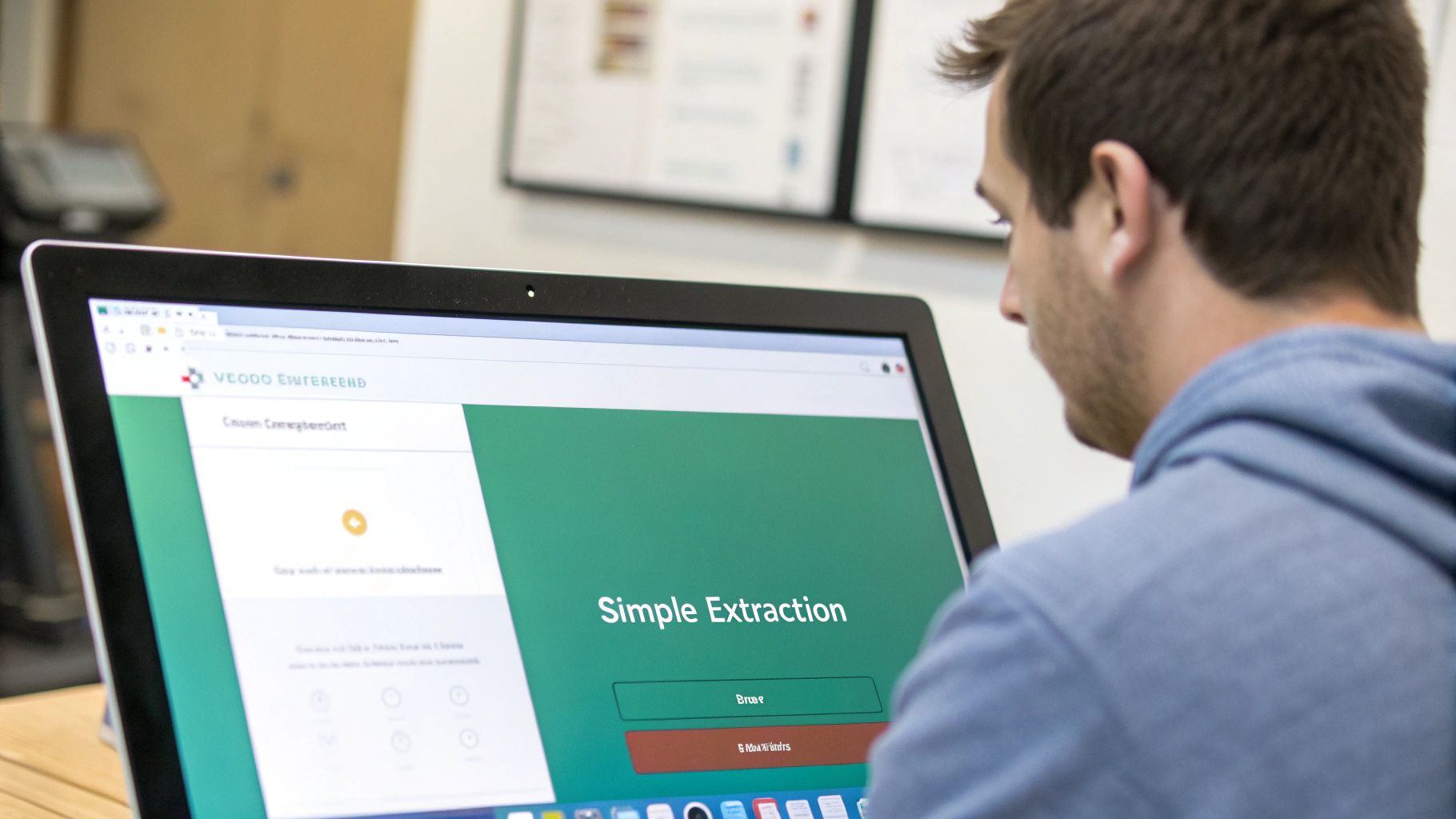
    This visual shows just how simple the three-stage process really is.
    As you can see, the path from a messy web page to a usable contact list has been stripped down to the bare essentials, making it accessible to anyone.

    Getting Your Source Data Ready

    First thing's first: you need to decide what you're extracting from. The beauty of these tools is their flexibility, so you can tackle this in a couple of different ways.

    • Pasting Raw Text: If you’re working with a document, a PDF, or just one section of a website, this is your go-to. Just highlight the text you want, copy it (Ctrl+C or Cmd+C), and you're ready to paste it directly into the tool.
    • Using a URL: Got an entire public webpage you want to scrape? Don't bother copying anything. Simply grab the URL from your browser's address bar. This works perfectly for articles, directories, or company "contact us" pages.

    A little pro tip from experience: The quality of your results is directly tied to the quality of your source. You'll always get better contacts from a well-structured, relevant website than you will from some random, outdated forum thread.

    Running the Extraction and Getting Your List

    Once you have your source data, the rest is a breeze. The interface for tools like EmailScout is designed to be dead simple, so you can get started immediately without a learning curve.

    Here’s a peek at a typical, clean interface where you'll plug in your data.
    The layout is all about function—a big input box for your text or URL and a clear button to kick things off. No guesswork needed.

    Just paste your content or URL into the field and hit the "Extract" button. The tool instantly gets to work, scanning the information and using pattern recognition to spot anything that looks like an email address. Within seconds, it spits out a clean, deduplicated list.

    From there, you have two main options: copy the list to your clipboard for a quick paste somewhere else, or download it as a CSV file. I almost always go for the CSV. It's perfect for importing directly into a CRM or email marketing platform, saving a ton of formatting headaches later.

    For more advanced B2B strategies, check out our guide on how to find thousands of local business emails in minutes.

    Verifying and Managing Your New Contact List

    Image

    Grabbing a list of emails with a free online extractor is a great start, but don't pop the champagne just yet. The job’s not finished. Real success comes from making sure the addresses you just collected are actually deliverable. I’ve seen countless people skip this step, and it almost always ends in disaster for their outreach campaigns.

    Here’s the problem: when you send emails to a list packed with invalid addresses, your bounce rate goes through the roof. Internet Service Providers (ISPs) like Google and Microsoft pay very close attention to this metric. If they see too many of your emails bouncing, they'll flag your entire domain as spam. This move absolutely tanks your sender reputation and crushes the deliverability of every email you send from that point on.

    The Importance of List Hygiene

    Think of your freshly extracted list as raw data—it needs to be cleaned up before it’s useful. This cleanup process is often called "verification," and it's all about weeding out the junk: invalid addresses, temporary emails, and even dangerous spam traps. A clean list is the bedrock of any solid email marketing or sales outreach strategy.

    You don't need a huge budget for this, either. Plenty of services offer free or freemium plans that are more than capable of cleaning up the lists you generate. These tools work by scanning each email and checking its validity without ever sending a message.

    A good verifier will help you filter out a few key types of bad emails:

    • Invalid Emails: These are addresses with typos or ones that just don't exist anymore.
    • Disposable Addresses: Think of these as temporary, self-destructing inboxes.
    • Spam Traps: These are addresses used by ISPs specifically to catch and block spammers.

    As more and more marketers and sales pros turn to email generators for lead gen, we're seeing a rise in platforms that build verification right into their workflow. It just makes sense—they want to improve delivery outcomes and keep bounce rates low for their users. You can discover more about these integrated tools and their impact.

    A raw, unverified email list is a liability, not an asset. Taking the time to clean your contacts protects your sender reputation and ensures your message actually reaches a real person.

    Once your list is sparkling clean, you have one final step: segmentation. Don’t just blast the same generic message to everyone. Group your contacts by how you found them, their industry, or what they might be interested in. This simple action transforms a raw data dump into a powerful, targeted asset for your next campaign.

    What Not to Do: Common Mistakes With Free Extractors

    Getting your hands on a free email extractor online can feel like a major win, but it's surprisingly easy to trip up if you're not paying attention. The biggest mistake I see people make is treating their new list like a blank check, completely ignoring the legal and ethical lines that govern email outreach.

    Just because you have an email doesn't mean you have permission to spam. Seriously. Regulations like GDPR in Europe and the CAN-SPAM Act in the U.S. aren't messing around. Sending unsolicited commercial emails without a crystal-clear way to opt-out can get you into a world of trouble, from massive fines to a trashed sender reputation that's hard to recover from. Your outreach should always provide real value and make it dead simple for recipients to unsubscribe.

    Overlooking Data Quality and Verification

    Another classic blunder is assuming every single email the tool scrapes is good to go. I can tell you from experience, that's almost never the case. Many free tools are designed to just grab anything that looks like an email address, which means you'll end up with a mix of outdated, inactive, or straight-up fake ones.

    Using that raw, unverified data is a recipe for a sky-high bounce rate. Email providers see that as a huge red flag, and it can tank your deliverability.

    Skipping the verification step is like trying to build a house on a shaky foundation—it’s just not going to work. Before you even think about sending your first message, you absolutely must clean your list. This is the crucial step that weeds out the junk, protects your sender score, and makes sure your hard work doesn't go to waste.

    It's easy to think more emails automatically means better results. The reality? A smaller, clean list of 100 verified and interested contacts is infinitely more valuable than a messy list of 10,000 unverified, random addresses.

    At the end of the day, using these tools smartly and ethically is what separates the pros from the amateurs. When you pair a good extractor with solid list hygiene and respectful outreach, you turn a simple free tool into a powerful lead-generation asset. For a deeper look into doing this the right way, check out our guide on how to find anyone's email address for more advanced techniques.

    FAQs

    When you're first dipping your toes into the world of email extraction, it's natural to have a few questions. Let's clear up some of the most common ones I hear about legality and capabilities.

    Is Email Scraping Legal?

    Yes, collecting publicly available email addresses is generally fine. The real question isn't about the collecting—it's about the sending.

    How you use those emails is what matters. You absolutely must comply with regulations like the CAN-SPAM Act and GDPR. The golden rule? Always provide value, be respectful, and make it incredibly easy for people to opt out.

    Can You Extract Emails From Social Media Sites?

    Most free, browser-based tools are built to read the code on a standard website. That means they usually can't get behind the login wall of social media platforms like LinkedIn.

    Scraping data from those closed networks requires much more specialized (and often paid) software. For general web scraping, a tool like EmailScout is perfect.

    Here's something to remember: The strength of any email list comes down to two things—where you got it from and whether you've cleaned it. Start with relevant sources, then run your list through a verification tool. This simple process will do wonders for your campaign results and keep your sender reputation safe.


    Ready to stop hunting and start building? Grab the EmailScout Chrome extension today and see how fast you can build a targeted contact list. Get started for free.

  • How to Find Anyone’s Email Address

    How to Find Anyone’s Email Address

    Finding the right email is often the first domino to fall, unlocking a major opportunity. When it comes to the hunt, you really have two paths: old-school manual detective work or firing up a dedicated email finder tool. Which way you go usually depends on whether you're tracking down one VIP contact or building a list of hundreds.

    Why Finding the Right Email Is Still a Game Changer

    Image

    In a world drowning in social media DMs and push notifications, the humble email inbox remains one of the last bastions of direct, focused communication. Sure, other platforms are great for a quick back-and-forth, but a well-crafted email to the right person just hits different. It signals professionalism and serious intent.

    Think of it as the difference between shouting into a crowded room and sitting down for a real, one-on-one conversation.

    Knowing how to find anyone's email address is more than just a party trick; it's a legitimate strategic advantage. It lets you sidestep gatekeepers, bypass clunky contact forms, and escape the dreaded info@company.com black hole. When your message lands directly in the inbox of a decision-maker, your odds of getting a response go through the roof.

    The Strategic Value of a Direct Connection

    A verified email address is your key to unlocking meaningful professional opportunities. It doesn't matter if you're in sales, marketing, recruiting, or just trying to network—direct access is everything.

    Here’s why this skill matters so much:

    • Sky-High Response Rates: An email sent to a specific person is infinitely more likely to be opened and read than one blasted to a generic inbox.
    • Bypassing the Gatekeepers: You get a direct line to founders, hiring managers, or potential partners without getting screened out by assistants or automated filters.
    • Building Real Relationships: A direct email is the start of a personal conversation. It's the foundation for a future partnership, a sales deal, or a career-changing opportunity.

    The inbox is one of the few digital spaces left where you can command someone's undivided attention. Unlike a social media feed designed for distraction, an email invites a focused, thoughtful response.

    Email Is More Relevant Than Ever

    Despite all the new ways we have to communicate, email isn't going anywhere. In fact, it's bigger than ever. The user base is massive and still climbing.

    Projections show that by 2025, there will be 4.59 billion email users globally. That's over half the world's population! This number has exploded from just 10 million users back in 1997, and with an average of 1.86 accounts per user, the total number of inboxes is just staggering. You can dig into more data on global email usage and see for yourself why it remains a critical channel.

    At the end of the day, learning how to find an email address isn't about being sneaky. It’s about being resourceful. It's about valuing the other person's time by making sure your message is relevant, personal, and delivered to the one place it's guaranteed to be seen. It’s the first—and most important—step in making a real connection.

    Mastering Manual Email Discovery Techniques

    Image

    Before you fire up an automated tool, it’s worth trying a bit of old-fashioned digital detective work. Manual email discovery is a solid skill that often gets you the address you need with just some clever thinking. It’s all about piecing together clues that are usually hiding in plain sight.

    The best place to start? Figuring out the company's email pattern. Most organizations use a standard format for their employee emails, which makes them surprisingly predictable. Once you crack the code, you can guess an individual's address with a pretty high degree of accuracy.

    Decode the Company Email Pattern

    Your first stop should be the company's website. The goal here is simple: find just one email address from anyone at that company. That single address will almost always reveal the pattern they use for everyone.

    Common places to look include:

    • The "Contact Us" or "Team" page. Smaller companies, in particular, often list direct emails for key people.
    • Press releases or media kits. These usually have a direct contact email for media inquiries.
    • Blog author bios. If the company has a blog, the author's bio at the end of a post is a great place to check.

    Once you find an example, say j.doe@company.com, you can be pretty confident that firstinitial.lastname@company.com is the format. This simple trick is surprisingly effective and should always be your first move.

    Pro Tip: Don't just look for email addresses. Sometimes, you'll find a person's guest post or an interview on another site. Their author bio in those places often contains the direct contact info you're looking for.

    Use Advanced Google Search Operators

    When a company website comes up empty, Google is your next best friend. But a simple search probably won’t cut it. You need to use search operators—special commands that narrow your search to pinpoint exactly what you need.

    Let's say you're looking for Jane Smith at ExampleCorp. Instead of just typing her name, try these powerful queries:

    • site:examplecorp.com "Jane Smith" email
    • "Jane Smith" contact filetype:pdf
    • intitle:"team" site:examplecorp.com

    The site: operator tells Google to only search that specific website. Putting the name in quotes ensures it searches for that exact phrase. These simple tweaks can uncover resumes, staff directories, or press mentions that a basic search would have buried.

    Sift Through Social and Professional Profiles

    Professional networks are absolute goldmines for contact details. LinkedIn is the obvious starting point; always check the "Contact Info" section on a person's profile. A lot of people keep their email private, but you’d be surprised how many don’t.

    Twitter (now X) is another fantastic resource. Use its advanced search to look for tweets where your target might have shared their email. Try searching for terms like (from:username) "email" or (from:username) "contact". It happens more often than you think.

    Don't forget to check if they have a personal website or portfolio linked from their social media—the email is almost always listed there. For creators, this information is often on their YouTube channel, too. If you’re trying to connect with influencers, our guide on how to get YouTube leads from Google search has more strategies for that. These manual checks only take a few minutes but can quickly get you the direct line you need.

    Using Smart Guesses and Permutation Tools

    Image

    When you've hit a dead end with manual searches, it's time to get a little more strategic. This is where smart guessing—powered up by an email permutation tool—really shines. It’s the perfect middle ground between a simple shot in the dark and full-blown automation.

    The idea here is pretty straightforward. Most companies follow a standard, predictable pattern for their email addresses. Your goal is to crack that pattern.

    Instead of sitting there typing out a dozen different combinations by hand, a free email permutation tool does the heavy lifting for you. All you need is a first name, last name, and the company's domain, and it'll spit out a list of the most common variations instantly.

    Generating Your List of Likely Emails

    Let's run through a quick scenario. Say you’re trying to connect with "Maria Garcia" at a company called nextgen.io.

    An email permutator would generate a list that looks something like this:

    • maria.garcia@nextgen.io
    • mgarcia@nextgen.io
    • maria@nextgen.io
    • mariag@nextgen.io
    • maria_garcia@nextgen.io

    This gives you a solid list of the most probable formats companies use, covering your bases so you don’t miss the right one. It's a fantastic way to turn just a few bits of info into a real list of possibilities. But what you do with that list is what really matters.

    Hold on before you start blasting out messages to every address on that list. That's a one-way ticket to getting your domain flagged as spam, which torpedoes your sender reputation. The whole point is to find the one valid email before you even think about hitting "send."

    Verifying Your Guesses Without Sending an Email

    So, you have your list. Now what?

    There's a slick little trick you can use right inside Gmail to see which address is the real deal—without ever sending a single email. It works by taking advantage of Google's user profile feature.

    Here’s how you do it:

    1. Pop open a "New Message" window in your Gmail account.
    2. Copy and paste one of the email addresses from your list into the "To" field.
    3. Now, just hover your mouse over that address and give it a second.

    If a little pop-up appears with a profile picture and name, you've almost certainly found an active Google account tied to that email. Bingo. If you see nothing, or just a generic grey icon, that address is probably a dud. You can work through your whole list in a minute or two this way to pinpoint the right contact.

    Getting this right is more important than ever. The number of emails sent and received daily is expected to jump from 392 billion in 2025 to a staggering 523 billion by 2030. It’s still the backbone of business communication. To dive deeper into why this channel is so critical, check out the latest trends in email statistics.

    When your manual digging and educated guesses just aren't cutting it, it's time to call in the specialists. Email finder tools are built specifically to automate the discovery process. They'll save you countless hours of grunt work and deliver verified contacts with impressive accuracy.

    These aren't just simple search bots. Think of them as sophisticated platforms that scan public data, proprietary databases, and company websites to pinpoint the right inbox.

    It's a bit like this: searching manually is like panning for gold in a river. Sure, you might find a nugget here and there, but it's slow, tedious work. Using an email finder tool is like having a high-tech scanner that tells you exactly where the gold is buried.

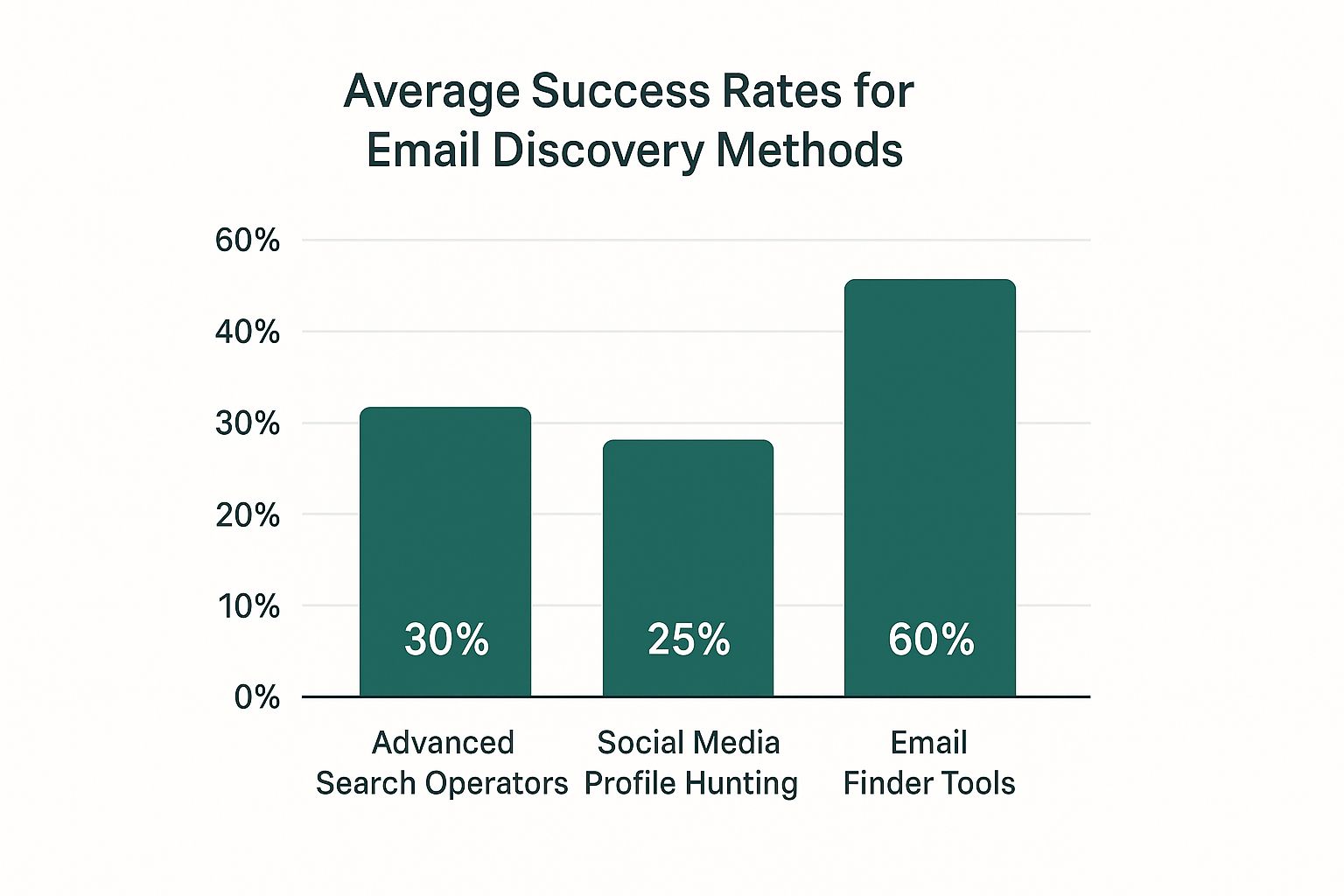
    This chart shows just how much more effective these tools are compared to hunting down emails by hand.

    Image

    The numbers make it pretty clear. While manual techniques have their place for a quick one-off search, dedicated tools give you a dramatically higher success rate. They're an absolute must-have for any serious outreach campaign.

    Types of Email Finder Tools

    Not all email finders are created equal. They generally fall into a few categories, and knowing the difference helps you pick the right tool for the job.

    • Browser Extensions: These are lightweight tools that live right in your browser, often designed to work seamlessly on sites like LinkedIn. They're perfect for on-the-fly searches when you're targeting one or two specific contacts. For instance, a tool like EmailScout lets you find an email with a single click while you're browsing someone's profile.
    • Web Applications: These are more powerful, standalone platforms. They're built for bulk email finding, letting you upload a list of names and company domains to find hundreds—or even thousands—of emails at once.
    • API-Based Services: This one's for the tech-savvy crowd. APIs allow you to plug email-finding capabilities directly into your own apps or CRM, putting your lead generation workflow on autopilot.

    The best approach often involves a combination. I'll use a browser extension for my daily prospecting on LinkedIn, then switch over to a web application when I need to build a big, targeted list for a major campaign.

    How Do These Tools Actually Work?

    At their core, these tools work by combining several techniques to triangulate the correct email address. It starts by identifying a company's email pattern—just like we did manually, but on a massive scale.

    Then, they cross-reference that information with huge databases of publicly available professional data.

    The best tools take it a step further with a real-time verification check. This "ping" confirms that an email address is active and can actually receive mail. This is crucial for protecting your sender reputation and keeping your bounce rate low. If you want to go deeper on this, you can learn more about how to find company email addresses in our detailed guide.

    Choosing the right method can feel overwhelming, so let's break it down.

    Email Finding Methods At a Glance

    This table compares the different approaches we've covered, looking at everything from speed to cost. It's a quick way to see which method best fits your specific needs and resources.

    Method Speed Typical Accuracy Cost Best For
    Manual Guess & Check Slow Low (20-30%) Free Finding a single, high-value contact when you have time.
    Social Media & Web Search Slow to Moderate Low to Medium (30-50%) Free Quick, targeted searches for individuals with a public presence.
    Email Permutator Tools Moderate Medium (50-70%) Free to Low-Cost Generating and testing multiple patterns for a specific company.
    Dedicated Email Finders Fast High (85-98%) Subscription-Based Bulk searches, building large lists, and ensuring high deliverability.

    As you can see, while free methods have their place, nothing beats the speed and accuracy of a dedicated tool when you need reliable results at scale. This efficiency is what makes these platforms indispensable for modern sales and marketing teams.

    Email Outreach Ethics and Best Practices

    Knowing how to find anyone's email is a powerful skill. But as the old saying goes, with great power comes great responsibility.

    Finding an email address is just the starting line. Using it correctly is what separates a professional from a spammer. Before you even think about hitting "send" on that first cold email, you need to understand the ethical and legal lines you should never cross.

    The goal isn't just to get a response; it's to start a real, professional relationship built on respect. That means treating the contact information you've worked so hard to find with care.

    Complying with Email Regulations

    Let's get the legal stuff out of the way first. Regulations like the CAN-SPAM Act in the U.S. and GDPR in Europe aren't just polite suggestions—they're laws with very real penalties.

    While they have their differences, the core principles are all about transparency and consent.

    Here are the non-negotiable rules you have to follow:

    • Be Truthful: Your "From" name, subject line, and the content of your message must be honest. No tricks.
    • Provide a Physical Address: You have to include a valid physical postal address for your business.
    • Offer an Easy Opt-Out: Every single email needs a clear and simple way for the recipient to unsubscribe.

    The golden rule of outreach is simple: if you wouldn't want to receive the email you're about to send, don't send it. Respecting the inbox is the first step to earning a response.

    Best Practices for Professional Cold Outreach

    Beyond the legal minimums, ethical outreach is really about one thing: providing value. Your first email should never, ever be a hard sell. Instead, your job is to show that you've done your homework and have a legitimate reason for getting in touch.

    Personalization is everything. A generic, copy-pasted message is a one-way ticket to the trash folder or, worse, the spam filter.

    Mention a recent project they worked on, a blog post they wrote, or a connection you share. This simple step shows you have a genuine interest and immediately sets you apart from the noise. It’s a common tactic for digital marketers engaging with content creators—and it works because it’s authentic.

    The impact of getting this right is huge. The global email marketing market is on track to grow from $14.8 billion in 2025 to a massive $36.3 billion by 2033. And it's no surprise when you see that 54% of marketers are using personalization to drive engagement. You can find more stats on the growth of email marketing on hostinger.com.

    Ultimately, successful outreach is a long game. Focus on building bridges, not just sending messages.

    Even with the best tools in your arsenal, you're going to hit a few snags when you're learning how to track down anyone's email. Let's walk through some of the most common questions and roadblocks I see people run into.

    Is It Actually Legal to Find and Use Emails for Outreach?

    Yes, it’s generally above board to find and use publicly available business emails for outreach, as long as you play by the rules. The big ones you need to know are the CAN-SPAM Act in the U.S. and GDPR in Europe.

    These laws aren't there to stop you from making legitimate professional connections. They’re really about transparency and being respectful.

    To make sure you're always in the clear, just stick to these core principles:

    • Be Honest: Your "From" name and subject line can't be misleading. They have to accurately represent who you are and what the email is about.
    • Give an Easy Out: Every single email needs a clear, simple way for someone to opt out of future messages. No hoops to jump through.
    • Include Your Address: You have to put a valid physical postal address for your business somewhere in the email.

    Follow these, and your outreach will be professional, ethical, and, most importantly, compliant.

    How Can I Check If an Email Address Is Even Valid?

    Once you think you've found the right email, you absolutely have to verify it before hitting send. Firing off an email to a bad address jacks up your bounce rate, which is a huge red flag for email providers and can wreck your sender reputation.

    An email verification tool is your best bet here. These services ping the server to see if an address can receive mail without actually sending a full message. They usually sort emails into a few buckets:

    • Valid: The green light. This address is active and safe to send to.
    • Risky: This means the server is a "catch-all," so it accepts mail for any address at that domain. These can be a bit of a gamble and have a higher chance of bouncing.
    • Invalid: The address is a dead end. Never send to these.

    I can't stress this enough: verifying an email before you send is non-negotiable. It protects your sender score, boosts your deliverability, and gives your message the best possible shot at actually being seen.

    What Should I Do When I've Tried Everything and Still Can't Find It?

    It happens. Sometimes, no matter how deep you dig, you come up empty. Some people are just really private, or their details aren't floating around on public channels. When you've exhausted all the usual tricks, it’s time to pivot.

    First, try a different channel. A polite, quick message on LinkedIn can work wonders. Just mention you were hoping to connect via email about a specific topic and ask if they'd be open to it.

    Another great move is to try connecting with one of their colleagues. A friendly note to someone in a similar department could get you a warm introduction or at least a nudge in the right direction. Remember, the goal is to make a professional connection. The most direct path isn't always the only one.


    Ready to stop guessing and start connecting? EmailScout is the powerful, easy-to-use Chrome extension that finds verified email addresses in a single click. Build your lists, supercharge your outreach, and connect with decision-makers effortlessly. Find unlimited emails for free and see the difference for yourself. Get started with EmailScout today

    Article created using Outrank