Tag: lead qualification

  • What Is Lead Scoring and How Does It Drive Sales Growth

    What Is Lead Scoring and How Does It Drive Sales Growth

    If you've ever felt like your sales team is chasing every lead with the same level of urgency, you know how inefficient that can be. Lead scoring is the system that fixes this. It’s a method for ranking your potential customers based on their value to your company, essentially creating a priority list so your sales team can focus on the hottest prospects first. It turns guesswork into a data-backed strategy.

    Grasping Lead Scoring Fundamentals

    Think of your sales pipeline like a heat map. Instead of a long, flat list of names, lead scoring assigns points to each person based on who they are (job title, company size) and what they do (download a whitepaper, visit your pricing page). Suddenly, that messy list transforms into a clearly prioritized queue.

    This process highlights the leads that are most engaged and best fit your ideal customer profile, guiding your sales team to the prospects most likely to convert.

    Of course, the whole system hinges on good data. If your information is inaccurate, your priorities will be misplaced.

    It's a powerful tool when done right. In fact, 73% of teams report that lead scoring boosted their sales efficiency within just three months.

    Key Data Pillars

    A solid lead scoring model is built on three main pillars of data. Each one gives you a different piece of the puzzle about a lead's quality and intent.

    • Demographics: This is all about who the lead is. Think job title, location, or level of experience.
    • Firmographics: This focuses on the company they work for. Are they in the right industry? Is their company the right size?
    • Behavioral Signals: These are the actions the lead takes. They're the digital footprints they leave behind, like visiting your website, opening your emails, or downloading a case study.

    To make this crystal clear, here's a quick breakdown of how these components work together.

    Lead Scoring At a Glance

    This table summarizes the fundamental components that make up a typical lead scoring system.

    Component Description Example
    Demographics Information about the individual lead. Title: VP of Sales
    Firmographics Details about the lead’s organization. Company size: 100 to 500
    Behavioral Actions taken on your website or in emails. Downloaded pricing guide

    Using these building blocks, you can start to translate raw data and online interactions into a simple, powerful numeric score. We'll get into how to assign specific point values a little later.

    A Heat Map in Action

    The image below gives you a great visual of what this looks like in practice. It's a typical lead scoring dashboard where different colors represent different score ranges.
    A person works on a laptop, prioritizing leads on a management software screen, with a pen in hand.

    You can immediately see how leads in that 70 to 100 point range—colored in red—are flagged for immediate follow-up. That's the power of visual prioritization.

    A Simple Scoring Analogy

    Still trying to wrap your head around it? Think of lead scoring like grading an exam.

    Every correct answer (a positive signal) adds points to the final grade. A lead with the right job title and company size gets points, just like answering the first few questions correctly. Behavioral signals, like requesting a demo, are like bonus questions that can seriously boost their score.

    Only the top-scoring "students" get an 'A' and are sent straight to the sales team. Leads with lower scores might just need a little more study time—in other words, more marketing nurture.

    The upcoming sections will walk you through exactly how to choose the right signals and build your first scoring model from the ground up. If you want to see how this works inside a specific tool, this What Is Lead Scoring in HubSpot? A Practical Guide is a great resource.

    Just remember a few key things as you get started:

    • Keep your initial scoring criteria simple. You can always add complexity later.
    • Review and adjust your point values based on what's actually closing.
    • Get sales and marketing in a room together. This only works if everyone agrees on what makes a "good" lead.

    With this foundation, you're ready to dive deeper. Let's get to it.

    Why Prioritizing Leads Is a Game Changer for Sales

    Without a smart way to prioritize leads, most sales teams are just spinning their wheels. It's organized chaos. They jump on every new inquiry with the same urgency, sinking hours into prospects who were never going to buy in the first place. This "first in, first out" mentality doesn't just waste time and kill morale; it lets your best deals go cold.

    Think about it. A sales rep could spend all morning chasing a student who downloaded a whitepaper for a school project. Meanwhile, a C-level exec from a perfect-fit company just checked out your pricing page and gets completely ignored. That’s not just inefficient—it’s a straight line to missed quotas and lost revenue.

    Lead scoring cuts through the noise. It installs a strategic filter that turns that chaotic process into a focused, data-driven machine. It’s the ultimate bridge between marketing and sales, finally putting an end to the endless arguments over lead quality.

    From Volume to Value

    The real magic of lead scoring is how it shifts the team’s entire mindset from the quantity of leads to the value of each one. Instead of chasing down every name that fills out a form, reps can pour their energy into prospects who show they're a great fit and are actively showing interest.

    This targeted approach creates a massive ripple effect. When your sales team trusts that the leads hitting their desk are actually qualified, their productivity skyrockets. They stop wasting time on dead-end calls and start building real relationships with people who are already warmed up and ready to talk.

    This isn't a new concept—it became a go-to tool in the early 2000s, and the results speak for themselves. By 2010, companies using lead scoring were 22% more likely to hit their sales targets, all because their teams weren't stuck chasing ghosts. The system is simple: you assign points for key attributes—say, +15 for a director-level title and +10 for downloading a case study—to create a clear ranking of who's ready for a sales call.

    Shortening the Sales Cycle

    Another huge win is a much shorter sales cycle. By engaging leads right when their score hits a certain threshold, you're catching them at the peak of their interest. Timing is everything.

    A well-implemented lead scoring system doesn't just tell you who to talk to; it tells you when. This precision can slash nurturing time by up to 33%, accelerating deals through the pipeline.

    This efficiency means sales teams can close more deals in the same amount of time, giving a direct boost to the bottom line. You end up with a predictable, repeatable engine for growth instead of just relying on brute force and a bit of luck. For a deeper dive into this, check out our guide on how to qualify sales leads effectively.

    Enabling Hyper-Personalized Outreach

    Finally, knowing a lead's score gives your team priceless context for personalization. When a rep sees that a prospect has visited the pricing page three times and downloaded a specific case study, they can craft an outreach message that's instantly relevant.

    The conversation immediately moves past a generic pitch and becomes a helpful discussion about the prospect's actual interests and pain points.

    • For high-scoring leads: Reps can kick off the conversation by referencing their activity (e.g., "I saw you were interested in our enterprise features…") to show they've done their homework.
    • For mid-scoring leads: Marketing can step in with targeted content designed to answer their questions, boost their score, and get them ready for a sales call.

    This isn't just about improving conversion rates. It creates a far better customer experience from the very first touchpoint, setting the stage for a strong, long-term relationship.

    Decoding the Signals: Key Lead Scoring Criteria

    A great lead scoring model is built on great data. Think of it like a detective gathering clues—some are obvious, others are subtle, but they all help build a complete picture of a suspect's intent. In lead scoring, these clues are signals that tell you how closely a lead matches your ideal customer and how interested they are in what you’re selling.

    These signals typically fall into three buckets: demographics, firmographics, and behavior. By understanding and assigning weight to each, you can turn a flat contact list into a dynamic, prioritized pipeline that points your sales team directly to the hottest opportunities.

    Demographic Data: Who the Lead Is

    Demographic information tells you about the individual. It helps you answer a crucial question: is this the right person to talk to? This data provides essential context and often serves as the first filter.

    • Job Title/Seniority: A "VP of Sales" or "Chief Technology Officer" is likely a decision-maker and should get a high score. An "Intern," on the other hand, might even get negative points.
    • Role/Function: A lead working in a department you sell to (like marketing or IT) is a much better fit than someone in an unrelated field like HR.
    • Location: If you only serve specific regions, a lead's country, state, or city is a non-negotiable qualifying factor.

    This kind of explicit data is foundational. It tells you if the lead even fits the basic profile of your best customers. For a deeper dive into building these profiles, check out our guide on how to create detailed buyer personas.

    Firmographic Data: The Company They Work For

    While demographics look at the person, firmographics zoom out to look at their company. This is especially important in B2B, where the organization's profile is just as critical as the individual's role.

    • Company Size: Do you sell to scrappy startups or huge enterprises? Assign points based on employee count or annual revenue to match your ideal customer profile.
    • Industry: A lead from an industry you specialize in (like SaaS or healthcare) is far more valuable than one from a sector you don’t serve.
    • Technology Stack: If your product integrates with specific software (like Salesforce or HubSpot), knowing a lead’s company already uses it is a massive green flag.

    Firmographic data ensures you’re not just talking to the right person but to the right person at the right company.

    Behavioral Data: What the Lead Does

    This is where the real story unfolds. While demographic and firmographic data show fit, behavioral data reveals intent. It’s the digital body language that tells you a lead is actively thinking about making a purchase. These actions should carry the most weight in your model.

    In fact, engagement frequency is the number one criterion for lead scoring for nearly 73% of companies. It’s not just a hunch—highly engaged leads are proven to convert 47% better. Why? Because their actions, like repeatedly visiting your pricing page or requesting a demo, are clear buying signals. This focus on behavior has helped some businesses achieve a baseline conversion rate of 14%, just by paying attention to what leads do. You can find more of these lead generation benchmarks on Databox.com.

    Key Takeaway: A lead's actions often speak louder than their job title. A manager who has downloaded three case studies and attended a webinar is likely a hotter prospect than a CEO who only subscribed to your newsletter.

    Common behavioral signals include:

    • Website Activity: Visiting high-value pages like pricing, case studies, or product features.
    • Content Engagement: Downloading whitepapers, ebooks, or attending webinars.
    • Email Interaction: Opening emails and clicking on links within them.
    • Direct Engagement: Filling out a "Contact Us" form or requesting a product demo.

    Here's a quick look at how you might assign points to these different signals.

    Common Scoring Signals and Sample Point Values

    Scoring Category Signal Example Sample Score
    Demographic Job Title: C-Level/VP +20
    Job Title: Manager +10
    Job Title: Intern/Student -10
    Firmographic Industry: Target Industry +15
    Company Size: Ideal Range +10
    Uses a Key Integration Partner +15
    Behavioral Requested a Demo +25
    Visited Pricing Page +10
    Downloaded a Whitepaper +5
    Unsubscribed from Email -25
    Negative Visited Careers Page -15
    Used a Free Email Provider -5
    Inactive for 90 Days -20

    Remember, these are just examples. The right values depend entirely on what signals have historically led to closed deals for your business.

    The Role of Negative Scoring

    It’s just as important to subtract points for red flags as it is to add them for positive signals. Negative scoring is your pipeline’s immune system—it filters out poor-fit leads and keeps things clean.

    Common red flags that should deduct points include:

    • Visiting your careers page (they’re probably looking for a job, not a solution).
    • Using a personal email address (e.g., Gmail, Yahoo).
    • Listing their industry as "student" or "unemployed."
    • Long periods of inactivity (this is often called "score decay").

    By using negative scoring, you prevent scores from getting artificially inflated and make sure your sales team only spends time on prospects who are genuinely qualified.

    How to Build Your First Lead Scoring Model

    Turning the theory of lead scoring into a working system might feel like a huge leap, but it’s actually pretty straightforward when you break it down. Building your first model is less about fancy algorithms and more about getting your teams on the same page. It all starts with a simple, honest conversation between marketing and sales.

    The whole point is to create a unified definition of a "hot" lead. When everyone agrees on what that means, marketing can stop guessing and start delivering a steady stream of prospects that sales is genuinely excited to call.

    Let’s walk through how to build a basic model, using a B2B software company as our example.

    Define Your Sales-Ready Lead

    Before you can assign a single point, you have to define the finish line. What does a sales-ready lead actually look like for your business? This is the most important step, and it absolutely requires a partnership between your marketing and sales departments.

    Get both teams in a room and hammer out the specific traits of leads who have turned into your best customers.

    Take a look at your happiest clients. What do they have in common?

    • Job Titles: Are they typically VPs, Directors, or Managers?
    • Company Size: Do you do best with scrappy startups of 20 people or enterprises with over 1,000?
    • Industry: Which sectors get the most value out of what you sell?
    • Behaviors: What did they do right before they signed on? Did they request a demo, visit the pricing page three times, or download a specific case study?

    This single conversation can end the classic tug-of-war over lead quality. By agreeing on these criteria upfront, you’re basically creating a Service Level Agreement (SLA) that aligns both teams around one goal.

    For our B2B software company, they might agree that a sales-ready lead is a Marketing Director at a SaaS company with 50-250 employees who has requested a product demo. Simple, clear, and actionable.

    The diagram below shows how these different data points—demographics, firmographics, and behavior—all come together to build a complete picture of a lead.
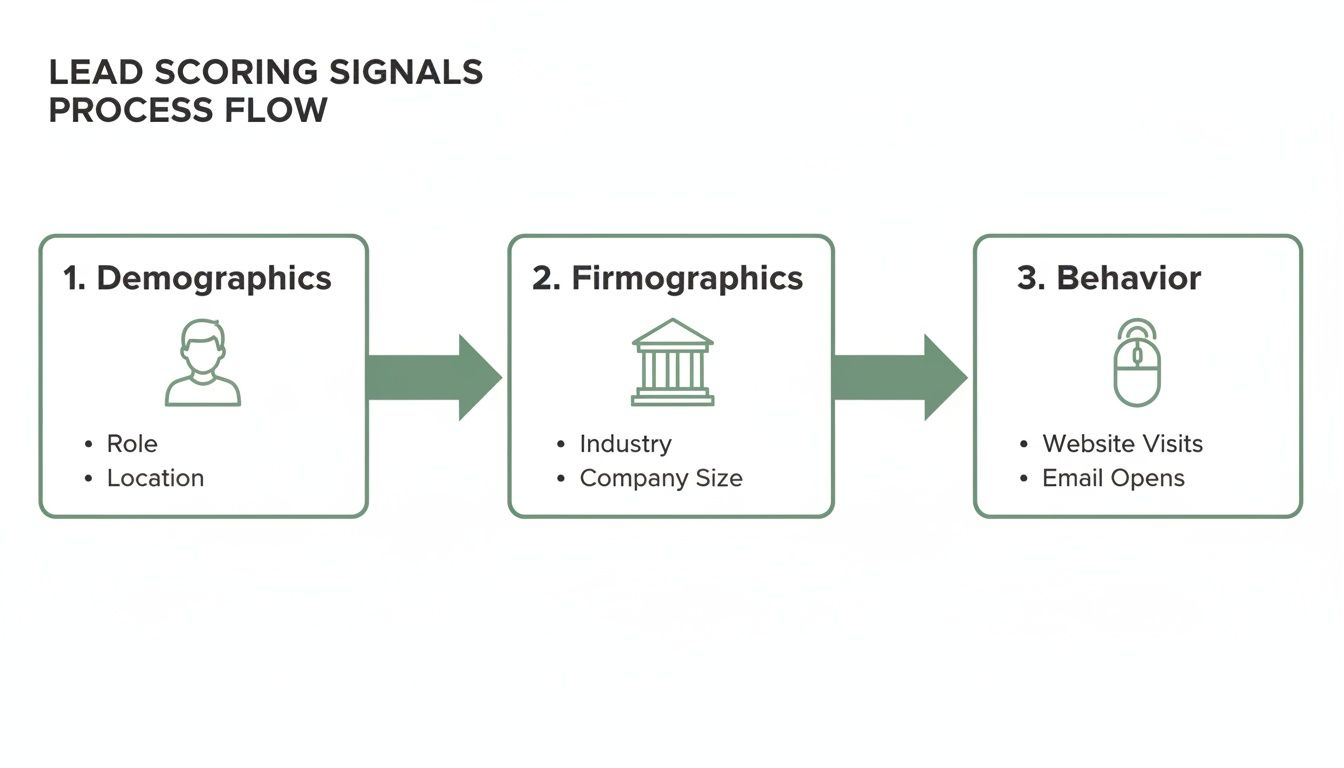
    Flowchart illustrating lead scoring signals process flow: Demographics, Firmographics, and Behavior categories.

    This shows how information about the person, their company, and their actions all feed into the model.

    Assign Point Values to Key Criteria

    Once you have your ideal profile sketched out, it’s time to assign points. The key here is to give more weight to signals that show someone is ready to buy. A good rule of thumb? Actions should almost always be worth more than static attributes.

    Here’s a simple framework our B2B software company could start with:

    1. Firmographic & Demographic Points (The "Fit" Score):

    • Industry is SaaS: +15 points
    • Company Size is 50-250 employees: +10 points
    • Job Title is Director or above: +20 points
    • Job Title is Manager: +10 points

    2. Behavioral Points (The "Interest" Score):

    • Requested a Demo: +30 points (This is a huge buying signal!)
    • Visited Pricing Page: +15 points
    • Attended a Webinar: +10 points
    • Downloaded a Whitepaper: +5 points

    3. Negative Points (The "Red Flags"):

    • Visited Careers Page: -15 points (Probably a job seeker, not a buyer.)
    • Used a personal email (e.g., Gmail): -5 points
    • Inactive for over 60 days: -10 points (This is called score decay.)

    Pro Tip: Don't get hung up on perfection with your first model. Start with a simple system that makes sense. You can—and should—tweak these values later on based on which leads actually convert into customers.

    Set Your Score Thresholds

    The final piece of the puzzle is deciding what happens when a lead hits a certain score. These thresholds are the triggers that automate your workflow, telling your system when to pass a lead from marketing to sales.

    A common approach is to create two main tiers: the Marketing Qualified Lead (MQL) and the Sales Qualified Lead (SQL).

    Using our software company's model:

    • MQL Threshold (50+ points): Any lead scoring 50 points or more becomes an MQL. They're a good fit and they’re showing interest, but they might not be ready for a sales call just yet. Marketing will keep nurturing them.
    • SQL Threshold (80+ points): A lead scoring 80 points or more graduates to an SQL. Their high score flags them as a hot prospect. The system should automatically assign this lead to a sales rep for immediate follow-up.

    Let's see it in action. A Marketing Director (+20) at a 100-employee SaaS company (+10, +15) downloads a whitepaper (+5). Their score is now 50, making them an MQL.

    A week later, they visit the pricing page (+15) and attend a webinar (+10), bumping their score to 75. Then, they finally request a demo (+30), and their score jumps to 105. Boom—they instantly become an SQL and land in a sales rep's queue.

    This structured process moves you from a reactive guessing game to a proactive, data-driven strategy.

    How EmailScout Supercharges Your Lead Scoring Efforts

    A lead scoring model is only as smart as the data it’s built on. If you’re feeding it incomplete or inaccurate information, you’ll get unreliable scores—a classic case of "garbage in, garbage out." The entire system’s success really hinges on high-quality, verified contact data. Think of it as the bedrock for every point you assign.

    This is where the right tools make all the difference. Accurate demographic and firmographic data are crucial for the first part of your scoring equation, which is all about establishing whether a lead is a good fit for your business. Without knowing a prospect’s job title, company size, or industry, your model is basically flying blind.

    A person's hand uses a white mouse next to a laptop displaying business profiles and "Find Decision Makers" text.

    Fueling Your Model with Accurate Data

    EmailScout provides the essential fuel you need to kickstart a powerful lead scoring workflow. It’s designed to give you instant access to the exact data points that earn a lead their initial score, making sure your pipeline is filled with qualified prospects from the jump.

    Imagine you land on the LinkedIn profile of a promising contact. Instead of guessing, the EmailScout Chrome extension lets you find their verified email and key details in a single click. This isn't just about finding an email; it's about qualifying a lead right on the spot.

    With verified data, you can immediately assign points based on reliable criteria. This means a lead enters your system with an accurate baseline score, not a zero, giving them a head start in the qualification process.

    This simple step completely changes how you build your sales pipeline. Instead of importing a long list of unvetted contacts and just hoping for the best, you’re adding pre-qualified, high-potential individuals who already fit your ideal customer profile.

    Scoring Leads at the Point of Discovery

    The real power comes from weaving this data collection directly into your prospecting. When your team can find and qualify decision-makers right from a company website or social profile, they are essentially doing the first step of lead scoring in real-time.

    Here’s how this gives your efforts a serious boost:

    • Instant Qualification: Find a VP of Sales at a 200-person tech company? With EmailScout, you can grab their email and immediately apply your scoring rules (+20 for title, +15 for industry, +10 for company size) inside your CRM.
    • Clean Data Foundation: By starting with verified emails, you drastically cut down on bounce rates. This ensures your behavioral scoring (opens, clicks) is based on real engagement, not dead ends.
    • Increased Sales Velocity: Sales reps can build targeted lists of high-scoring prospects without ever leaving their browser. It dramatically shortens the time from discovery to outreach.

    At the end of the day, effective lead scoring isn’t just about having a model; it's about having a reliable way to feed it. By providing the critical firmographic and demographic data needed for that first score, EmailScout acts as the crucial first step in a smarter, data-driven funnel. If you want to see how it works, you can learn more about how to find business emails quickly and accurately. This helps your sales team start with a list of valuable prospects from day one.

    Common Lead Scoring Mistakes and How to Avoid Them
    Laptop showing test results with red X marks, pen, and document, emphasizing avoiding scoring mistakes.

    Putting a lead scoring system in place is a smart move, but it’s easy to stumble into common traps that can completely derail your efforts. Even the best-laid plans can fall flat if the model isn't built and maintained with a bit of foresight.

    Knowing these pitfalls ahead of time is your best defense. It's the key to building a system that actually cleans up your pipeline and makes your sales team more effective.

    One of the most common mistakes is trying to build a monster model right out of the gate. Teams get excited and want to track dozens of different attributes, leading to a system so complicated that nobody can manage it, let alone understand it. The whole point is to create clarity, not confusion. If sales can't make sense of it, they'll just ignore it.

    Instead, start simple. Pinpoint the 5-10 key signals that your sales team agrees are the strongest signs of a good lead. You can always add more complexity later, once you’ve proven the basic framework actually works.

    Setting It and Forgetting It

    Maybe the biggest mistake of all is treating lead scoring like a one-and-done project. Your business, your market, and your customers are always in motion. A model you built last year is already becoming obsolete, which means your scores will get less accurate and you'll start missing opportunities.

    A "set it and forget it" mindset is a recipe for a useless system. Think of your model as a living thing that needs regular check-ups to stay healthy.

    Solution: Schedule a mandatory quarterly review with people from both marketing and sales. In these meetings, dig into which high-scoring leads actually became customers and which ones went nowhere. That feedback loop is absolutely critical for tweaking point values and making sure the model reflects who you're successfully selling to today.

    This ongoing maintenance keeps your scoring system tied to actual sales results.

    Poor Sales and Marketing Alignment

    A lead scoring model built by marketing alone is doomed from the start. If the sales team doesn’t trust the scores or understand how they’re calculated, they won’t use the system. Period.

    This disconnect is why a staggering 61% of marketers send every single lead straight to sales, even though only 27% of those leads are qualified.

    To sidestep this disaster, you have to build the model together from day one.

    • Co-create the Definitions: Sales and marketing need to sit down and agree on the exact definition of a Marketing Qualified Lead (MQL) and a Sales Qualified Lead (SQL).
    • Agree on Point Values: Get direct feedback from sales on which actions and attributes they see as most valuable. Their real-world experience is what makes the model work.
    • Establish a Handoff Process: Get specific about what happens when a lead hits the SQL threshold. Who gets the notification? What’s the expected follow-up time?

    When you make sales an equal partner in building the system, you create shared ownership and trust. The goal is to build a single, unified engine for growth—not to have two departments pointing fingers at each other.

    Frequently Asked Questions About Lead Scoring

    Even with a great model built, you're bound to have questions once you start putting lead scoring into practice. Let's tackle some of the most common ones that pop up.

    How Often Should I Update My Lead Scoring Model?

    Your lead scoring model isn't something you can just set and forget. To keep it sharp and effective, you should get into a rhythm of reviewing it regularly—a quarterly basis is a great place to start.

    That said, some business events should trigger an immediate review, no matter where you are in the cycle. Watch out for these:

    • A new product launch: The signals that define a perfect lead for your new offering might look completely different from your existing ones.
    • A shift in your ideal customer profile (ICP): If you suddenly start targeting a new industry or company size, your scoring has to change with it.
    • Changes in marketing campaigns: That big industry report you just launched? It's a high-value piece of content and needs a score that reflects its importance.

    What Is the Difference Between an MQL and an SQL?

    Think of MQLs and SQLs as two crucial milestones in a lead's journey. Your score thresholds are what separate them, essentially "graduating" a lead from one stage to the next.

    A Marketing Qualified Lead (MQL) is a prospect who’s raised their hand. They’ve shown some interest and tick a few of the basic boxes, landing them in the "warm" category. They're a good fit, but they aren't quite ready for a sales call.

    A Sales Qualified Lead (SQL), on the other hand, is someone who has hit a much higher score. Their combined demographics, company profile, and recent actions scream "buying intent." They are primed and ready for a direct conversation with a salesperson.

    Can a Small Business Benefit from Lead Scoring?

    Absolutely. You don't need a massive enterprise software suite to see the benefits. Even a simple scoring system built in a spreadsheet can be a total game-changer for startups and small teams.

    For a small business, the biggest win is focus. When you only have a few people, you can't afford to waste time. By assigning points to leads, you can instantly see the top 5-10 opportunities that deserve your team's immediate attention, making sure every minute is spent on deals most likely to close.

    What Tools Do I Need to Implement Lead Scoring?

    Most companies run their lead scoring through a Customer Relationship Management (CRM) platform or a dedicated marketing automation tool like HubSpot or Marketo. These systems are brilliant at tracking behaviors and updating scores automatically.

    But here's the catch: those platforms are only as good as the data you put into them. Foundational tools that provide clean, accurate contact information are non-negotiable. For instance, a tool like EmailScout can supply the verified demographic and firmographic data you need to assign that crucial initial score, making sure your entire system is built on a solid foundation.


    Ready to fuel your lead scoring model with accurate, verified contact data? EmailScout helps you find decision-maker emails in a single click, providing the essential information to qualify leads and build a high-quality sales pipeline from day one. Get started with EmailScout for free.


  • What is a sales qualified lead? A Clear Guide to Qualification and Conversion

    What is a sales qualified lead? A Clear Guide to Qualification and Conversion

    Let's cut through the jargon. A Sales Qualified Lead (SQL) is someone who has moved past the "just browsing" phase and is now actively looking for a solution. Think of it like a shopper who goes from casually window-shopping to walking into your store and asking, "Can you tell me more about this specific model?" They're ready for a real conversation.

    Unpacking the Value of a Sales Qualified Lead

    Two smiling colleagues, a man and a woman, collaborate on a laptop with a 'Sales Qualified Lead' sign on the wall.

    Imagine trying to find a needle in a haystack of potential leads every single day. That’s what it feels like without a solid qualification process. This is where understanding the power of an SQL becomes a complete game-changer for any sales team.

    An SQL isn't just another name on a list. They're a prospect who marketing has nurtured and the sales team has personally vetted, confirming they're a genuine opportunity.

    This vetting process is the secret sauce for an efficient sales machine. It makes sure your sales reps spend their valuable time and energy on people who are actually likely to buy, instead of chasing down every single person who downloaded a free whitepaper.

    Why SQLs Are Your Most Valuable Prospects

    Focusing on SQLs isn't just about saving time—it’s about closing more deals and building a predictable pipeline you can count on. These leads are your most valuable because their actions signal they have a real problem that your product or service can solve. They're ready to talk specifics.

    This distinction is also crucial for getting your marketing and sales teams on the same page. When both teams agree on what an SQL looks like, it creates a smooth handoff and stops high-potential leads from slipping through the cracks. It turns a messy process into a strategic one.

    A Sales Qualified Lead represents a critical moment in the customer's journey. It’s that perfect point where their demonstrated interest lines up with a salesperson's expertise, creating the ideal conditions for a successful sale.

    The Numbers Behind Lead Qualification

    The journey from a curious visitor to a sales-ready prospect is a steep one. While the average lead-to-MQL (Marketing Qualified Lead) conversion rate is a decent 31%, the jump from MQL to SQL is much tighter, sitting at a global average of just 13%.

    That means for every 100 initial leads you get, only about four will become truly sales-qualified and ready for a direct conversation.

    However, teams that nail their qualification process see incredible results. Some B2B teams are converting SQLs at rates nearly 4x higher than their unqualified counterparts. That’s a massive difference. You can learn more about these conversion benchmarks and see how you stack up.

    The Real Difference Between MQLs and SQLs

    Knowing the difference between a Marketing Qualified Lead (MQL) and a Sales Qualified Lead (SQL) is where countless growth strategies either hit their stride or fall flat. It's the critical handoff point where a flicker of interest becomes a real sales opportunity. If you get this wrong, you're just burning through leads and wasting everyone's time.

    Think of it like a relay race. Your marketing team is running the first leg, warming up prospects with blog posts, webinars, and other helpful content. An MQL is the runner who grabs the baton by showing some initial engagement—maybe they downloaded an ebook or signed up for your newsletter. They're interested in your ideas.

    An SQL, on the other hand, is the runner who is sprinting toward the finish line, actively looking for a coach to help them win. They've moved past just consuming content and are now signaling a direct interest in your product. This person has asked for a demo, checked out your pricing, or keeps coming back to high-intent pages on your site.

    From Warm Interest to Purchase Intent

    The leap from MQL to SQL doesn't just happen on its own. It’s a deliberate process that demands total alignment between your marketing and sales departments. Without a clear agreement—often called a Service Level Agreement (SLA)—the baton gets dropped. Marketing passes over leads who are still "just browsing," and the sales team gets frustrated trying to talk to people who simply aren't ready to buy.

    This kind of misalignment is expensive. A shocking 87% of MQLs never turn into sales opportunities, usually because they're handed off way too early. But when that handoff is timed just right, the conversion rate can jump dramatically. The secret is creating a shared definition of what makes a lead truly "sales-ready."

    A Sales Qualified Lead isn't just an interested contact. It's a prospect who has been properly vetted and confirmed by the sales team as having a genuine need, the authority to buy, and a timeline that shows they're ready for a direct sales conversation.

    Defining the Handoff Criteria

    To make the transition seamless, both teams need to agree on the specific triggers that promote a lead from MQL to SQL status. These triggers are based on real actions that signal strong buying intent.

    • Behavioral Triggers: Actions like requesting a demo, starting a free trial, or spending a lot of time on your pricing page are dead giveaways.
    • Demographic Fit: The lead has to match your Ideal Customer Profile (ICP). This means they're in the right industry, their company is the right size, and they have a relevant job title.
    • Explicit Interest: This is the most obvious signal. They filled out a "Contact Sales" form or are asking direct questions about features and how to get started.

    Getting this handoff right is everything. When sales and marketing are on the same page, the whole revenue engine runs smoother, turning more quality leads into happy customers. Historically, the SQL has become the gold standard for B2B sales for a reason: qualified leads convert at a rate nearly 4x higher than unqualified ones. You can dive deeper into the history and impact of sales qualified leads to see just how critical this process is.

    How to Reliably Identify a Sales Qualified Lead

    Figuring out when a prospect is ready to talk to sales isn't just a gut feeling. If you want to stop wasting time on dead-end leads, you need a solid process. Without a clear framework, you're just guessing, and that leads to a leaky pipeline and a frustrated sales team.

    The trick is to combine what a prospect does online with what they say in a conversation. You need to read their digital body language and then ask the right questions to confirm their interest. This is where tried-and-true qualification frameworks come in handy—they give you a script to uncover what really matters.

    Using Qualification Frameworks Like BANT

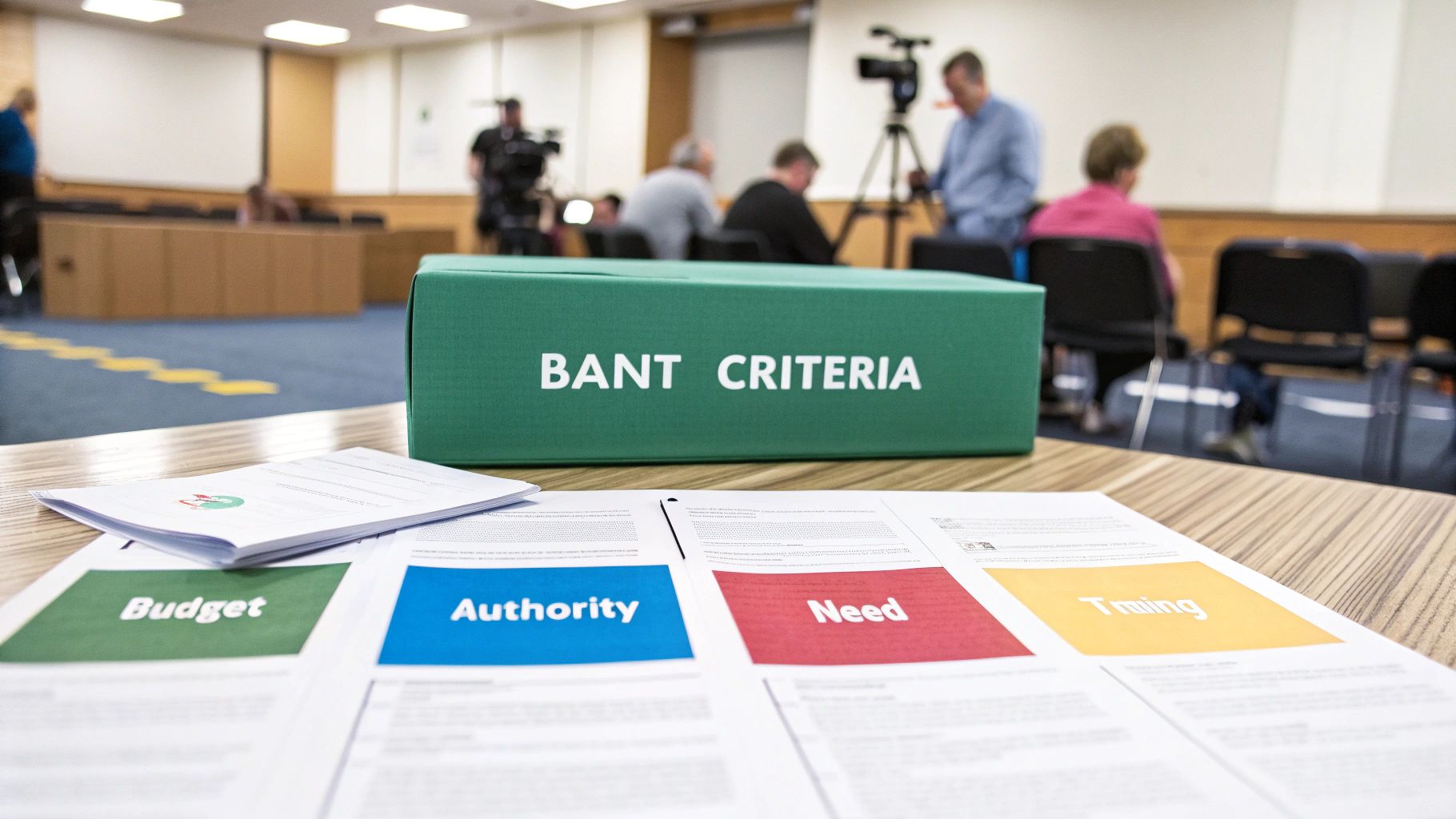
    One of the oldest and most reliable frameworks out there is BANT. It’s incredibly straightforward and forces you to focus on the four pillars that signal a prospect is ready for a real sales conversation.

    BANT stands for:

    • Budget: Do they actually have the money to buy what you're selling?
    • Authority: Are you talking to the person who can sign the check, or just an influencer?
    • Need: Is there a real, nagging business problem that your solution can fix?
    • Timeline: Do they need to solve this problem now, or is it a "some day" project?

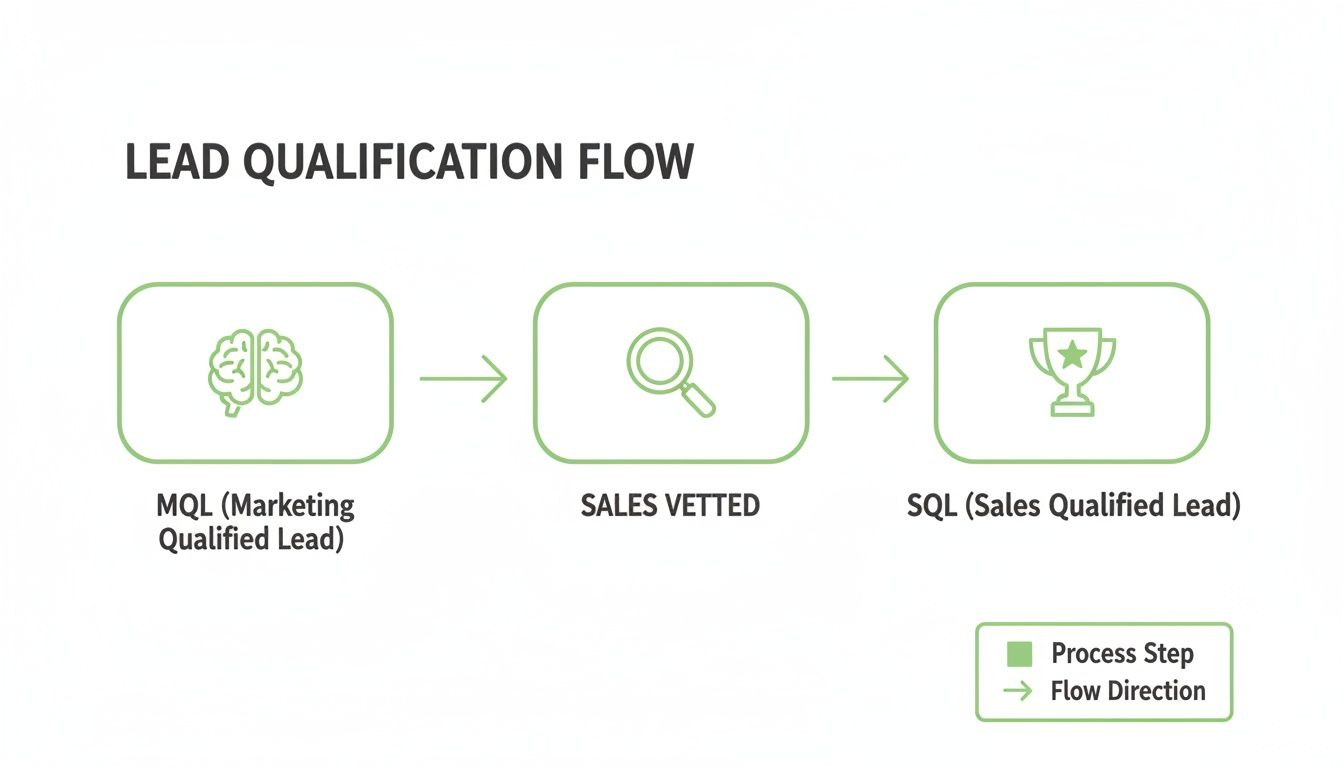
    This simple flowchart shows how a lead moves through the funnel, from a marketing-generated spark of interest to a fully vetted sales opportunity.

    A flowchart illustrating the lead qualification process, showing steps from Marketing Qualified Lead to Sales Vetted to Sales Qualified Lead.

    Think of this process as a filter. It ensures that only the leads who meet your specific criteria make it to your sales team's calendar.

    A lead has to check off all four BANT boxes to be considered a true SQL. If they have a burning need and the budget, but no authority to make the final call, they're not an SQL. Not yet, anyway. Your job then is to work with them to get in front of the actual decision-maker.

    For a more detailed look at this, check out our full guide on how to qualify sales leads effectively.

    Modern Alternatives for Complex Sales

    While BANT is a fantastic workhorse, it’s not always the perfect fit for long, complicated sales cycles. When you're dealing with big enterprise deals and a whole committee of decision-makers, you might need something with a bit more horsepower.

    Frameworks like MEDDIC (Metrics, Economic Buyer, Decision Criteria, Decision Process, Identify Pain, Champion) provide a more detailed roadmap. It's especially useful for high-ticket sales where you need to understand every moving part of the buyer's internal process.

    No matter which framework you land on, the mission is always the same: collect enough intel to confidently say, "Yes, this lead has a high chance of becoming a customer."

    The best qualification conversations feel less like an interrogation and more like a consultation. You're not just checking boxes; you're diagnosing a problem and exploring whether you have the right cure.

    Reading Digital Body Language

    Beyond what a lead tells you, their online behavior screams volumes about their intentions. Someone who keeps coming back to your pricing page is sending a much stronger signal than someone who just downloaded a fluffy ebook a few months ago.

    Keep an eye out for these high-intent digital breadcrumbs:

    • Requesting a demo or free trial. This is the digital equivalent of walking into a store and asking to test drive a car. It's a huge buying signal.
    • Visiting high-value pages. If you see them lurking on your pricing, case study, or feature comparison pages, they're in evaluation mode.
    • Asking specific product questions. When a lead hits up your support chat to ask detailed questions about a specific feature, they're well past the initial research phase.

    When you pair a structured qualification framework with a keen eye for a lead's digital behavior, you create a reliable system for identifying true Sales Qualified Leads. This lets your sales team stop chasing ghosts and start focusing their energy where it will make a real impact.

    Your Action Plan After Finding an SQL

    A desk with an 'Immediate Outreach' sign, laptop with a calendar, and mobile phone, symbolizing planning.

    Okay, marketing has just handed you a hot sales qualified lead. The clock is officially ticking, and every single minute matters now. This isn't the time to drop them into your weekly newsletter queue. Nope. You need immediate, personalized, and persistent outreach if you want to turn that initial spark of interest into a real conversation.

    Speed is your number one weapon here. An SQL is screaming, "I'm ready to buy right now." If you don't jump on it, you can bet your competitors will. In fact, research shows that contacting a new SQL within the first hour boosts your odds of actually qualifying them by a staggering 7x. Wait a day, and that opportunity might as well be dust in the wind.

    This sense of urgency is a cornerstone of any high-performing sales machine. If you want to dig deeper into building this kind of system, check out our full guide on how to build a sales pipeline that turns these qualified leads into predictable cash flow.

    Your First 48-Hour Outreach Cadence

    Look, a single email or one missed call isn't going to cut it. You need a simple, multi-touch plan that keeps you on their radar without being annoying. The only goal for the first 48 hours is to make a connection. That's it.

    Here’s a sample cadence you can steal and start using today:

    • Hour 1 (The First Touch): Send a personalized email that directly references what they did. Something like, "Thanks for requesting a demo of our XYZ feature." Keep it short, sweet, and focused on one thing: scheduling a quick call.
    • Hour 4 (The Follow-Up Call): Time to pick up the phone. Don't leave a bland, generic voicemail. Say something that connects the dots: "Hi [Name], I just sent you a quick email about your interest in [Product]. Just wanted to connect briefly."
    • Hour 24 (The LinkedIn Touch): Find them on LinkedIn and send a connection request. Be sure to add a short, custom note: "Hi [Name], saw you were looking into [Solution Area]. Would be great to connect here."
    • Hour 48 (The Second Email): Follow up again, but this time, bring something valuable to the table. A relevant case study or a short video explaining a key benefit works wonders here.

    Tailoring Your Opening Lines

    "Just following up" is the fastest way to get your email deleted. Your first line has to prove you've done at least a little bit of homework. Personalization is what turns a cold outreach into a warm discovery call.

    The best outreach connects the prospect's recent action to a potential solution. It’s not about what you're selling; it's about why they are looking for it right now.

    Here are two quick templates you can adapt based on what they did on your site:

    Example 1: For a Demo Request

    • Subject: Next Steps for Your Demo
    • Body: Hi [Name], I saw you requested a demo to see how we solve [Pain Point]. I have a few spots open tomorrow to walk you through it and answer any questions. Does [Time] or [Time] work for a quick 15-minute call?

    Example 2: For a Pricing Page Visit

    • Subject: Quick Question about [Their Company Name]
    • Body: Hi [Name], I noticed you were checking out our pricing page. Many teams in the [Their Industry] space use our platform to [Achieve Outcome]. Are you facing similar challenges?

    Accelerate Your SQL Outreach with EmailScout

    Identifying a Sales Qualified Lead is a massive win, but it’s only half the battle. You know who you need to talk to—the "Authority" from your BANT analysis—but what happens when you can't find their direct contact info? That red-hot lead starts to cool down. Fast.

    This is where the real friction happens. Without verified contact data, sales reps lose hours digging for the right email address, often ending up with a generic "info@" inbox that gets ignored. Every minute spent searching is a minute you're not selling, giving competitors an open window to swoop in and start the conversation.

    EmailScout slams that window shut. Instead of playing detective, you can turn a promising SQL into a real conversation in seconds.

    Find Decision-Makers in One Click

    Picture this: your marketing team flags an SQL from a target company that just hit your pricing page. You know the decision-maker is probably the VP of Sales, but their contact details are nowhere to be found. With EmailScout, you just find their LinkedIn profile and get their verified email with a single click.

    This screenshot shows just how simple the EmailScout extension is, right on a professional profile.

    The tool slips right into your existing workflow, pulling the exact email you need without you ever having to leave the page. What used to be a research project is now a one-second action.

    Turn SQL Lists into Real Conversations

    Or let's say you just wrapped up a webinar and have a list of attendees who fit your SQL criteria perfectly. The problem? You only have their names and companies. EmailScout's URL Explorer can take that raw list and quickly find the direct emails for each person, turning your data into a ready-to-use outreach list.

    This lets you jump straight from identification to personalization.

    Finding the right person is step one. Reaching them before anyone else is how you win the deal. A sales qualified lead is most valuable in the first hour after they show intent.

    Once you have the right contact information, you can focus on what actually matters—crafting a message that gets a response. For more on that, our guide on how to write cold emails gives you actionable templates and strategies to book more meetings. By pairing a powerful outreach strategy with the right contact data, you build a repeatable system for turning your best SQLs into paying customers.

    Common Lead Qualification Mistakes to Avoid

    Even the most buttoned-up sales orgs stumble when it comes to defining a sales qualified lead. A few common—and costly—mistakes can completely derail your pipeline, leading to wasted effort and missed revenue targets. Getting ahead of these pitfalls is key for consistent growth.

    One of the biggest errors is a blurry line between marketing and sales. When the MQL-to-SQL handoff lacks a crystal-clear, agreed-upon definition, good leads either get passed over too early or sit stagnant for too long. In both cases, they go cold.

    Another frequent misstep? Waiting too long to engage. The moment a prospect signals they're sales-ready—by requesting a demo or hitting your pricing page—the clock starts ticking. Data consistently shows that leads contacted within the first hour are exponentially more likely to convert. Don't let a hot lead cool off.

    Overlooking Personalization and Persistence

    Sending a generic, one-size-fits-all outreach email is a recipe for being ignored. An SQL has already shown you what they care about through their actions. If you don't reference that context in your first email or call, you sound uninformed and waste the rapport marketing already built. Your outreach has one job: connect their problem to your solution.

    A Sales Qualified Lead isn’t a guarantee; it's an opportunity. Treating it like just another name on a list is the fastest way to lose the deal to a competitor who treats it with the urgency it deserves.

    Finally, giving up too early is the silent killer of conversion rates. So many reps abandon a lead after just one or two unanswered attempts. The reality is, persistent, multi-channel follow-up is almost always required to break through the noise. A well-structured cadence with calls, emails, and social touches is essential to capitalize on the opportunity an SQL represents.

    A Few Lingering Questions About SQLs

    To wrap things up, let's tackle a couple of common questions that always seem to pop up when teams start working with sales qualified leads. Think of this as the final polish to help you turn all this knowledge into action.

    How Do You Know If Your SQL Process Is Working?

    Measuring the success of your SQL process is key. Otherwise, you're just guessing. While every business is a little different, there are a few key performance indicators (KPIs) you should absolutely keep an eye on to see what’s hitting the mark.

    • MQL to SQL Conversion Rate: This is your most direct measure of how well marketing and sales are aligned. A healthy rate, often somewhere between 10-20%, is a great sign that marketing is handing over genuinely qualified prospects.
    • SQL to Opportunity Rate: This one tells you how many of your vetted leads actually morph into real, pipeline-worthy sales opportunities. It's a fantastic reflection of your sales team's effectiveness in those first conversations.
    • Lead Response Time: Like we've touched on, speed is everything in this game. Tracking how quickly your team jumps on a new SQL is a powerful leading indicator of future success. You can't close a deal you never got to first.

    Can a Lead Go from SQL Back to MQL?

    Absolutely. In fact, it happens all the time. The customer journey is rarely a straight line from A to B. A prospect might get tagged as an SQL, but during that initial discovery call, it becomes painfully obvious they aren't ready to pull the trigger just yet.

    Maybe their budget got slashed, their project timeline was pushed into the next quarter, or a new company priority just jumped the line. When that happens, the smartest move is to de-qualify them as an SQL and hand them back to the marketing team for more nurturing. This keeps your sales pipeline clean and ensures the lead keeps getting helpful content until they're ready to talk business again.

    A lead's qualification status is fluid, not final. The goal is to engage them at the right stage, whether that's a sales conversation today or a marketing nurture campaign for tomorrow.

    This approach stops you from burning a bridge with a promising—but not-yet-ready—prospect. It also lets your sales reps focus their energy exclusively on deals that have a realistic shot of closing soon.


    Ready to stop searching and start selling? EmailScout finds the verified email addresses of your key decision-makers in a single click, turning your SQLs into real conversations, faster. Find unlimited emails for free today.

  • How to Qualify Sales Leads and Boost Conversions

    How to Qualify Sales Leads and Boost Conversions

    Ever feel like your sales team is spinning its wheels? It’s a common frustration. But the problem usually isn't a lack of effort—it's a lack of focus.

    When your reps are busy chasing down every single lead that comes in, they’re not really selling. They’re just staying busy. Chasing unqualified prospects wastes an incredible amount of time, tanks team morale, and throws your sales forecasts completely out of whack.

    Let's fix that. We'll walk through how to qualify sales leads by defining exactly who you want to talk to, setting up a smart scoring system, and using proven frameworks to guide your sales conversations.

    Why Qualifying Sales Leads Is a Non-Negotiable

    Treating every inbound inquiry or contact form submission as a hot lead feels productive on the surface. In reality, it’s a fast track to burnout and missed quotas.

    When sales reps spend their days calling prospects who have no budget, no authority to make a decision, or no genuine need for your solution, they aren’t closing deals. This inefficiency hits your bottom line hard, driving up what you spend to get each new customer. If you’re not sure how those costs add up, you can check out our handy guide on calculating customer acquisition cost to see just how much unqualified leads can hurt your numbers.

    The data here is pretty stark. A staggering 67% of lost sales can be chalked up to reps not qualifying their leads properly. Let that sink in. Nearly two-thirds of deals that fall apart could have been saved if the right questions were asked from the get-go.

    It doesn’t stop there. Roughly 75% of marketing leads are never a good fit for a sales conversation, and 79% of those will never convert. By simply learning to disqualify these poor-fit leads early, your team can reclaim about 32% of their time. That’s a huge chunk of the week they can now spend on leads that actually have potential.

    Moving Beyond Busy Work

    So, what’s the alternative to the "chase everything" approach? It’s all about creating a strategic filter that separates the real opportunities from the time-wasting distractions. This is what effective lead qualification is all about.

    When you get this right, your sales team can finally prioritize their efforts with precision. They move from a scattergun approach to a focused strategy, dedicating their energy to building relationships with prospects who are a genuinely great fit for what you offer.

    The benefits pop up almost immediately:

    • Faster Sales Cycles: Reps spend less time on dead-end conversations and more time moving real deals through the pipeline.
    • Happier, More Motivated Reps: Nothing kills motivation faster than constant rejection from unqualified prospects. Focusing on winnable deals keeps morale high.
    • Forecasts You Can Actually Trust: When your pipeline is filled with properly vetted opportunities, your revenue predictions become far more reliable.
    • Higher Close Rates: By engaging with prospects who have a clear need and the ability to buy, your team's conversion rate naturally goes up.

    To give you a clearer picture, let's lay out the basic pillars of a solid qualification framework.

    Your Lead Qualification Framework at a Glance

    This table breaks down the core components of an effective lead qualification process, giving you a high-level overview of the strategy before we dive into the details.

    Framework Pillar Key Objective Primary Action
    Ideal Customer Profile (ICP) Define the "perfect" customer company Analyze your best existing customers to identify common attributes (industry, size, revenue).
    Buyer Persona Understand the individual decision-makers Create detailed profiles of the key roles involved in the buying process (e.g., goals, challenges).
    Qualification Framework Standardize the discovery process Implement a proven model like BANT, MEDDIC, or CHAMP to ask consistent, targeted questions.
    Lead Scoring Prioritize leads based on fit and interest Assign points to leads based on their demographic data and their actions (e.g., website visits).

    This framework provides the structure your team needs to stop guessing and start selling with intention.

    The core idea is simple but powerful: stop treating every lead equally. By learning how to qualify sales leads effectively, you empower your team to work smarter, not just harder, transforming your entire sales operation from the ground up.

    Define Your Ideal Customer Profile

    A team collaborating around a whiteboard, mapping out customer profiles with sticky notes and diagrams, illustrating the process of defining an ideal customer.

    Before your team even thinks about picking up the phone, the most critical work has already started. Effective lead qualification isn't just about asking good questions—it's about knowing exactly who you should be talking to in the first place.

    This is where your Ideal Customer Profile (ICP) comes in.

    Think of your ICP as a blueprint for the perfect company for your product. It’s not just a vague idea of your target market. It's a specific, data-driven definition that becomes the north star for your entire sales and marketing operation. Without a clear ICP, your team is flying blind, wasting time on leads that were never going to convert.

    The best way to build this? Look at your existing customers. Who are your happiest, most successful clients? The ones who renew without a fuss and send you glowing testimonials? They hold all the answers.

    Look for Common Threads in Your Best Customers

    Start by listing your top 10-20 customers. Now, it's time to play detective and figure out what makes them so great. You're searching for shared attributes you can use to spot similar companies out in the wild.

    A truly powerful ICP goes way beyond basic demographics. It's multi-dimensional.

    • Firmographics: This is the basic company data. What do they have in common? Look at industry, company size, annual revenue, or location. You might find your sweet spot is B2B SaaS companies with 50-250 employees in North America.
    • Technographics: What's in their tech stack? Do they all use Salesforce, HubSpot, or AWS? This tells you about their technical maturity and whether they can even integrate with your solution.
    • Psychographics: Now you're getting into their heads. What were their biggest headaches before they found you? What goals were they trying to hit? Understanding their pain points helps you craft a message that resonates.

    Analyzing these layers transforms a generic target into a crystal-clear picture of your ideal fit.

    Build a Real-World ICP Example

    Let's say you run a SaaS company that sells project management software to creative agencies. After digging into your best accounts, your ICP might look something like this:

    ICP Criteria Ideal Profile Specification
    Industry Digital Marketing & Advertising Agencies
    Company Size 20-100 employees
    Annual Revenue $2 million – $15 million
    Geography United States, Canada, UK
    Tech Stack Uses Slack for comms, Google Workspace for collaboration, and HubSpot for their CRM.
    Pain Points Struggles with managing client feedback, tracking project profitability, and hitting deadlines.
    Buying Triggers Recently hired a "Head of Operations" or is actively posting jobs for Project Managers.

    This detailed profile becomes an invaluable filter. When a new lead from a 300-person manufacturing firm in Brazil comes in, your team knows instantly it's not a priority. That simple check saves them countless hours.

    Your ICP isn't just a marketing document; it's a strategic sales tool. It empowers your reps to disqualify poor-fit leads confidently and quickly, freeing them to focus their energy where it matters most—on prospects who look just like your best customers.

    Distinguish Between Fit and Intent

    With your ICP defined, you can qualify leads on two critical axes: fit and intent.

    • Fit is how well a lead matches your ICP. Do they check the boxes for industry, size, and tech? This is the first gate.
    • Intent is all about their behavior. Have they visited your pricing page, requested a demo, or downloaded a case study? These actions signal they are actively looking for a solution.

    A lead could be a perfect ICP fit but show zero buying intent. They're a great prospect to nurture for the future, but not a hot lead for today. On the flip side, someone might request a demo (high intent) but work for a company that's a terrible fit. That's a lead to disqualify quickly to avoid a frustrating sales process for everyone.

    The sweet spot is where high fit meets high intent. These are the leads your sales team should jump on immediately. This is the first and most critical step in learning how to qualify sales leads effectively.

    Implement a Practical Lead Scoring System

    Knowing who your ideal customer is only half the battle. The other half is actually finding them in the flood of leads that come in every day. This is exactly where a lead scoring system shines. It’s a simple but powerful method of assigning points to leads, ranking them by how likely they are to actually become customers.

    Instead of your sales team manually digging through every single form submission, a lead scoring model automatically pushes the hottest prospects right to the top. It’s a data-driven way to make sure your team consistently spends their time on leads with the highest chance of converting.

    Think of it as a bouncer for your sales pipeline. A lead has to rack up enough points to get past the velvet rope and earn a conversation with a sales rep. This process is absolutely essential if you want to build a sales pipeline filled with real opportunities instead of just noise.

    Differentiating Explicit and Implicit Data

    A solid lead scoring system needs to balance two kinds of information: what people tell you directly, and what their actions tell you indirectly.

    Explicit Scoring: This is all about the data a lead gives you willingly. It's the firmographic and demographic info that tells you if they're a good fit for your product.

    • Job Title: A "Director of Marketing" might get +15 points, while an "Intern" gets 0.
    • Company Size: If your sweet spot is businesses with 50-200 employees, leads in that range could get +20 points.
    • Industry: A lead from a target industry like "B2B SaaS" could earn +10 points.

    Implicit Scoring: This is all about behavior, which signals a lead's intent to buy. These are the digital breadcrumbs that show how engaged they are with your brand.

    • Website Behavior: Visiting your pricing page is a huge sign of interest, easily worth +20 points.
    • Content Engagement: Requesting a product demo? That's a massive buying signal, worth at least +25 points.
    • Email Interaction: Just opening a marketing email might be worth +2 points, while clicking a link inside is a stronger signal worth +5.

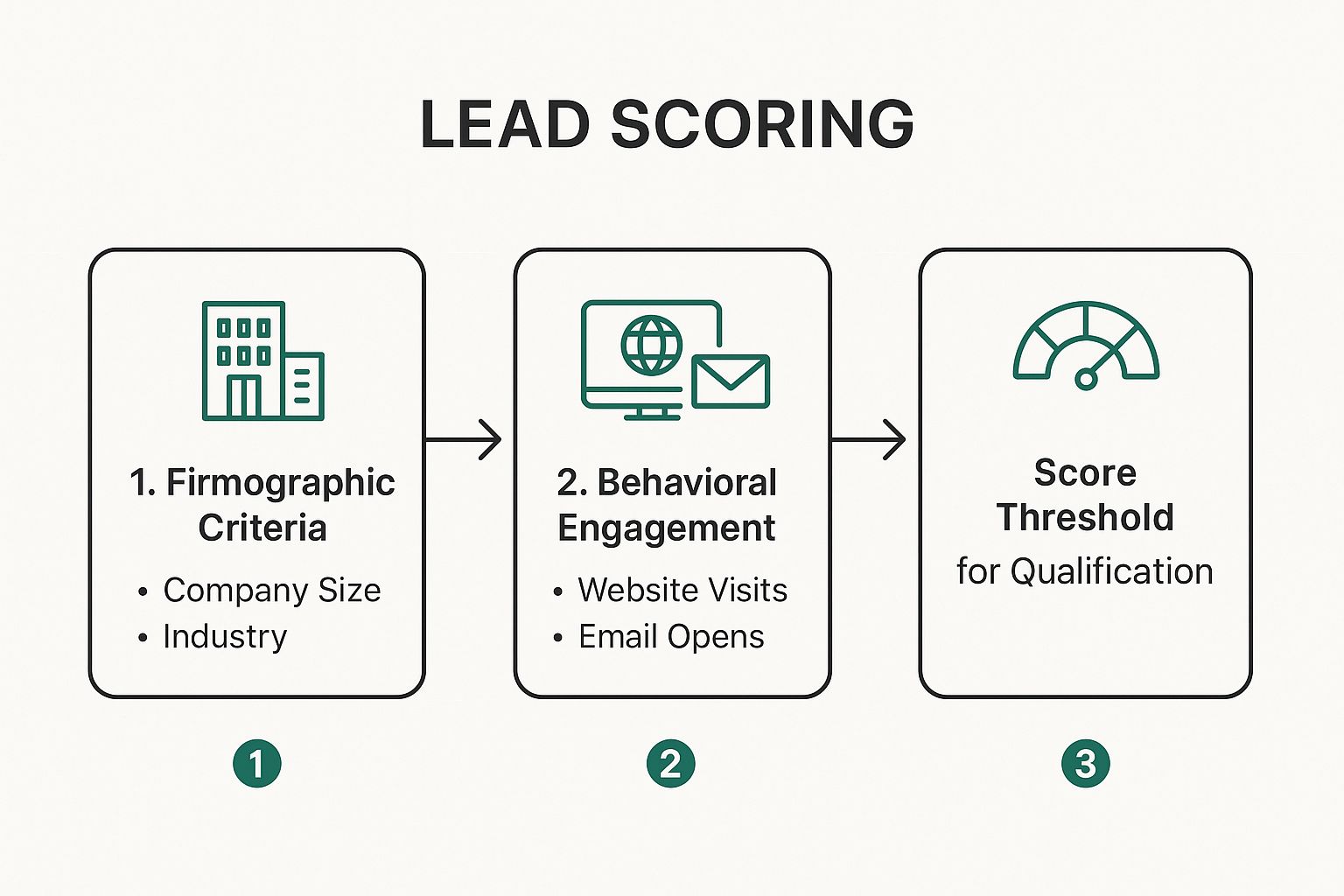
    The infographic below shows how these two types of criteria come together to qualify a lead.

    Infographic showing the lead scoring process from firmographic criteria to behavioral engagement and finally to the qualification threshold.

    This simple flow highlights a powerful truth: the best leads are always a mix of a strong profile fit and active buying signals.

    Let’s look at a concrete example. Here’s a sample model you could adapt for a B2B SaaS company trying to filter its inbound leads.

    Sample Lead Scoring Model for a B2B SaaS Company

    Category Criteria Points Awarded
    Explicit (Fit) Job Title (Manager or above) +15
    Company Size (50-500 employees) +20
    Industry (Technology, Marketing) +10
    Using a competitor's technology +5
    Implicit (Intent) Visited Pricing Page +20
    Requested a Demo +25
    Downloaded a Case Study +10
    Clicked a link in an email +5
    Negative Score Email domain is "gmail.com" or "yahoo.com" -10
    Unsubscribed from email list -50
    Job Title includes "Intern" or "Student" -20

    This table makes it clear how different attributes and actions can be weighted. A "Marketing Manager" from a 100-person tech company who requested a demo would quickly hit a high score, while a student with a Gmail address would be filtered out.

    Setting Your Qualification Threshold

    Once you start assigning points, you need to decide what score makes a lead "sales-ready." This magic number is your qualification threshold. For instance, you might decide that any lead who hits 75 points gets automatically sent to a sales development rep (SDR) for immediate follow-up.

    This number shouldn't be pulled out of thin air. You'll need to analyze your past sales data to find the sweet spot. It's also important to remember that not all qualified leads are the same.

    In fact, surveys show 46.4% of sales pros prefer Product Qualified Leads (PQLs)—people who have actually used the product—over any other type. Sales Qualified Leads (SQLs) come next at 37.5%, with Marketing Qualified Leads (MQLs) trailing at 16.1%. If you have a free trial or freemium model, your scoring should absolutely reflect this by giving more weight to in-product actions.

    Using Negative Scoring to Filter Out the Noise

    Just as you award points for good signs, you should also subtract them for red flags. This is called negative scoring, and it's your secret weapon for automatically disqualifying poor-fit leads before they ever reach your sales team.

    Think of it this way:

    Negative scoring is your system's immune response. It actively identifies and weeds out leads that would otherwise waste your sales team's valuable time, keeping your pipeline healthy and focused.

    Here are a few classic examples where negative scoring is a lifesaver:

    • Student or Personal Emails: A lead using a "gmail.com" or ".edu" email address might get -20 points.
    • Competitor Snooping: If a lead's domain matches a known competitor, you can hit them with -50 points to keep them out of your pipeline.
    • Going Cold: A lead who hasn't opened an email in 90 days could have -15 points applied to lower their priority.
    • Wrong Department: If your software is for engineers, a lead with "Human Resources" in their title could get -10 points.

    By combining positive and negative scores, you create a dynamic system that doesn't just rank leads—it actively cleans your database. This way, when a lead finally hits that qualification score, your sales team can engage with total confidence.

    Master Qualification Frameworks Like BANT and MEDDIC

    Two business professionals in a modern office, using a transparent whiteboard to map out a sales framework like BANT or MEDDIC.

    Once your ideal customer is defined and leads are scored, it’s time to talk. This is where a good qualification framework shifts from a "nice-to-have" to a must-have. Instead of just winging your discovery calls, a framework gives you a structured way to uncover the critical details you need to move a deal forward.

    These aren't meant to be rigid scripts. Think of them more like conversational roadmaps. They guide you toward the right questions, helping you dig deep into a prospect’s world and ensuring you only spend your energy on deals with a real shot at closing.

    The Classic Approach: BANT

    Developed by IBM way back when, BANT is the OG of qualification frameworks. It's still incredibly popular today because it’s simple and it works. It boils everything down to four essential pillars for any successful deal.

    • Budget: Can they actually afford what you're selling?
    • Authority: Are you talking to the person who can sign the check?
    • Need: Do they have a real, painful problem that your product solves?
    • Timeline: How soon do they need to fix this problem?

    The trick with BANT is to avoid sounding like you’re just going down a checklist. Asking a blunt question like, "Do you have the budget?" is a surefire way to kill the conversation. You have to weave these ideas into a natural dialogue.

    For instance, instead of asking about budget directly, try something like, "What have you invested in similar tools before?" or "What kind of financial impact would solving this problem have?" These questions get you the answers you need without putting the prospect on the defensive.

    Going Deeper with MEDDIC

    For those in the trenches of complex, high-ticket B2B sales, a more robust framework like MEDDIC is often the answer. This model pushes you to go much deeper, focusing not just on the prospect's immediate needs but on their entire internal buying machine.

    MEDDIC is an acronym that breaks down like this:

    1. Metrics: What are the hard numbers they want to achieve? Think increased revenue, lower operational costs, or better efficiency.
    2. Economic Buyer: Who holds the ultimate P&L responsibility for this? This is the person who can push a deal through even when others are hesitant.
    3. Decision Criteria: What specific, formal criteria will they use to judge vendors? This could be anything from technical specs to pricing models.
    4. Decision Process: What are the exact, literal steps they take to buy something? This includes the paper-pushing, the legal review, and all the internal sign-offs.
    5. Identify Pain: What business pain is so bad it’s forcing them to act? And, more importantly, what happens if they do nothing?
    6. Champion: Who on the inside is genuinely rooting for you? This is your advocate who will sell on your behalf when you're not in the room.

    MEDDIC forces you to get past the surface-level stuff. It makes you understand the prospect’s world—the politics, the processes, the financial drivers—which is exactly the insight you need to navigate those big, complicated deals.

    Choosing and Adapting Your Framework

    There’s no single "best" framework. The right one for you comes down to your business, how long your sales cycle is, and your average deal size.

    Framework Best For… Key Focus
    BANT Shorter sales cycles, high-velocity teams, and less complex products. Quickly spotting deal-breakers like budget and authority.
    MEDDIC Long, complex enterprise sales with high contract values. Deeply understanding the customer's buying process and proving ROI.

    Here’s the thing: the most successful sales teams don't just pick one and stick to it blindly. They adapt. Start with a model like BANT or MEDDIC and then tweak it to fit your industry and your buyers.

    Maybe "Timeline" in BANT is less critical for you than understanding their current tech stack. Fine. Create a "BANT-T" model where the second "T" is for Technology. The goal is to build a repeatable process that arms your reps with the info they need to qualify sales leads effectively and build a pipeline you can count on. This structure turns every discovery call from a simple chat into a strategic move.

    Use Automation and Tools to Streamline Your Process

    Let’s be honest: manual lead qualification doesn't scale. As you start bringing in more leads, your team will eventually hit a wall. They’ll spend more time sifting through contacts than actually selling.

    This is where technology becomes your secret weapon. The right tools can turn a clunky, inconsistent process into a well-oiled machine, freeing your reps to focus on what they do best: building relationships and closing deals.

    The goal isn’t to replace your sales team’s expertise, but to supercharge it. Automation handles the grunt work—the initial filtering, scoring, and data checks—so every lead that lands on a rep's desk is already warmed up and ready for a real conversation.

    Build an Automated Qualification Engine

    Your CRM is the best place to start. Most modern CRMs let you build simple workflows that trigger actions based on lead data and behavior. You can essentially put your lead scoring and initial qualification on autopilot.

    Imagine a new lead fills out your demo request form. Instantly, an automated workflow can:

    • Assign a score based on their job title, company size, and the high-intent action of requesting a demo.
    • Verify their contact info to make sure the email is valid and deliverable.
    • Route the lead to the right sales rep based on territory, industry, or even current workload.

    This all happens in seconds, not hours. And that speed is everything. Research shows there’s a shocking 10-fold drop in your odds of qualifying a lead if you wait longer than five minutes to follow up. That's a tiny window, and manual processes almost guarantee you’ll miss it. You can see more on the importance of speed in these sales lead statistics.

    Use Tools for Instant Data Verification and Enrichment

    One of the biggest time-sinks in sales is chasing down leads with bad contact information. A lead can look perfect on paper, but if their email bounces, they’re useless. This is where specialized tools are non-negotiable.

    Platforms like EmailScout are built to solve this exact problem before it even pollutes your pipeline. Instead of leaving data validation to chance, you can integrate tools that automatically verify and enrich lead data the moment it arrives.

    This screenshot shows how EmailScout can instantly flag valid email addresses—a crucial first step.

    By automating this check, you guarantee your sales team is working with clean, accurate outreach lists, which dramatically boosts their connect rates.

    Automating data validation isn't just about efficiency; it's about protecting your team's most valuable asset—their time. Every minute spent on a bounced email is a minute not spent with a real buyer.

    This is a fundamental part of building an effective sales process. If you want to explore more options, check out some of the other best lead generation tools that can work alongside your existing stack.

    Let AI Uncover Hidden Patterns

    Beyond simple, rule-based automation, AI can bring a whole new level of intelligence to your qualification process. AI-powered tools can analyze huge amounts of data to find subtle patterns and buying signals that a human would easily miss.

    For instance, an AI model might analyze all your past closed-won deals and discover that prospects who visit your pricing page, a specific case study, and your integrations page are 80% more likely to buy.

    That’s a game-changing insight you can feed right back into your lead scoring model to make it hyper-accurate. AI helps you move from qualifying leads based on what you think is important to what the data proves is important.

    Here’s how AI can be applied:

    • Predictive Lead Scoring: Goes beyond adding up points and instead calculates a lead's actual probability of converting.
    • Sentiment Analysis: Scans email or chat conversations to gauge a lead's interest level and urgency.
    • Lookalike Modeling: Finds new prospects in the market who share the key traits of your absolute best customers.

    When you bring automation and smart tools together, you create a system that's not just faster, but also smarter. This ensures you never let a hot prospect go cold and empowers your sales team to perform at their absolute best.

    Common Lead Qualification Questions Answered

    Even with a solid framework, a few practical questions always pop up once you start digging in. This is your quick-reference guide for those "what if" scenarios that can kill your momentum. We'll tackle some of the most common hurdles I've seen teams face when they're learning how to qualify sales leads.

    So, what do you do with leads that get disqualified? It’s tempting to just hit delete and move on, but that’s a huge mistake. A lead might be a poor fit today but turn into a perfect one in six months when their company lands a new round of funding or brings on a new VP.

    Don't just discard them. Instead, drop them into a long-term nurture sequence. Send them your monthly newsletter or some high-value content that keeps your brand on their radar without being pushy. It's a simple strategy that makes sure you don’t lose out on future opportunities.

    Differentiating MQLs from SQLs

    Another common point of confusion is the whole MQL vs. SQL thing. They sound similar, but they represent completely different stages of the buying journey. Treating them the same is a recipe for wasted effort.

    • An MQL (Marketing Qualified Lead) shows interest based on marketing engagement. Maybe they downloaded an ebook or attended a webinar. They’re curious, but they’re not knocking on your door asking for a sales call.
    • An SQL (Sales Qualified Lead) has been properly vetted and confirmed as a genuine opportunity. They match your ICP, have shown clear buying intent (like requesting a demo), and are actually ready to talk to a sales rep.

    That handoff from MQL to SQL is a make-or-break moment. Marketing’s job is to generate and nurture interest to create MQLs. Sales then has to validate that interest and intent to see if that MQL graduates into a true SQL.

    How Often Should You Update Your Criteria?

    Finally, remember that your qualification criteria should never be set in stone. Markets shift, products evolve, and your ideal customer profile will change right along with them. Your criteria have to keep up.

    So, how often should you revisit your rules?

    A good rule of thumb is to sit down and review everything at least once a quarter. This is your chance to analyze what's working and what's not. Take a hard look at your recent closed-won deals—what did they all have in common? Did a new type of customer start showing up?

    And most importantly, talk to your sales team constantly. They’re on the front lines. They'll be the first to tell you if lead quality is dipping or if the current criteria are accidentally filtering out promising prospects. Keeping that feedback loop wide open is the key to maintaining a sharp, effective qualification process that works in the real world.


    Ready to stop wasting time on bad leads and start automating your qualification process? EmailScout helps you instantly verify contact data and enrich lead profiles, ensuring your sales team only focuses on prospects who are ready to convert. Find your next customer with EmailScout today!