Tag: email verification

  • How to Verify Email and Boost Deliverability

    How to Verify Email and Boost Deliverability

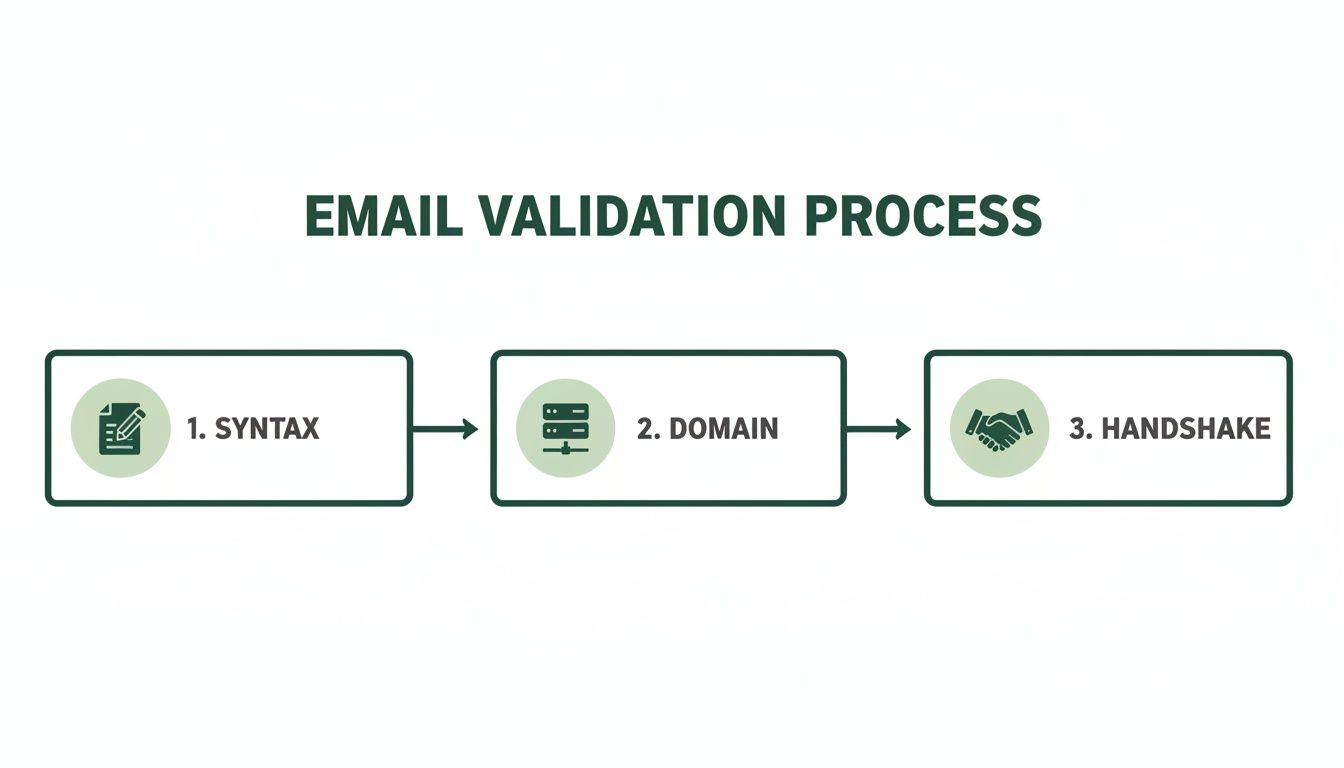
    Let's be clear: verifying an email means confirming that an address is real, active, and can actually receive messages. It’s not just about a quick syntax check. A proper verification process involves looking at the domain, checking for MX records, and even pinging the mail server to see if a specific inbox exists.

    Why Email Verification Is a Must-Have Strategy

    Before we get into the "how," it’s crucial to understand the "why." Email verification isn't just some technical chore you knock off a list; it's a fundamental part of a smart business strategy that directly impacts your bottom line.

    Think about it this way: an unverified email list is like a leaky bucket. No matter how much time and money you pour into your marketing campaigns, you're just going to lose resources, miss opportunities, and damage your brand's credibility.

    Imagine you're about to launch a huge sales campaign. You've spent weeks crafting the perfect message and designing slick graphics, ready for the revenue to start rolling in. But if a big chunk of your list is invalid, those emails will bounce right back. The fallout is fast and painful.

    • Damaged Sender Reputation: High bounce rates are a massive red flag for email providers like Gmail and Outlook. They start to think you're a spammer, which means all your emails—even the ones going to valid addresses—are more likely to end up in the junk folder.
    • Wasted Marketing Spend: Every single email sent to a dead address is money down the drain. This includes your email service provider costs and, just as importantly, the time and effort your team put into the campaign.
    • Inaccurate Analytics: A list full of bad data completely messes up your metrics. Your open rates, click-through rates, and conversion numbers become meaningless, making it impossible to know what's actually working.

    This visual breaks down the simple but powerful journey from a messy, low-performing list to a clean, high-performing one.

    Infographic about how to verify email

    Ultimately, being proactive with verification turns an unreliable list into a powerful asset that drives real engagement and ROI.

    The Growing Importance of Clean Data

    The demand for clean email data has absolutely exploded. The global email verification software market was valued at USD 1.2 billion in 2023 and is on track to hit USD 2.8 billion by 2032. Why the massive growth? Because businesses are finally realizing how essential it is to reduce bounce rates and protect their sender reputations.

    A clean email list isn’t a one-time achievement; it’s an ongoing commitment to data quality. Think of it as essential maintenance for your most valuable communication channel.

    When you start treating verification as an investment instead of a cost, everything changes. You protect your marketing ROI, make sure your messages actually reach real people, and stay on the good side of email providers. For a much deeper dive into this, check out this complete guide to email verification and how it impacts marketing.

    Before we jump into the tools, let's look at a few manual methods you can use. They won't work for a list of 10,000 emails, but they're great for one-off checks or understanding the process.

    Manual Verification Methods At a Glance

    Verification Method Primary Goal Complexity Level
    Syntax Check Catch obvious typos and formatting errors Low
    Domain/MX Lookup Confirm the domain exists and can receive mail Medium
    SMTP Ping Directly ask the server if the inbox exists High

    These manual steps give you a good sense of what's happening behind the scenes when an automated tool does the work. Now, let's explore each one.

    Performing Manual Email Verification Checks

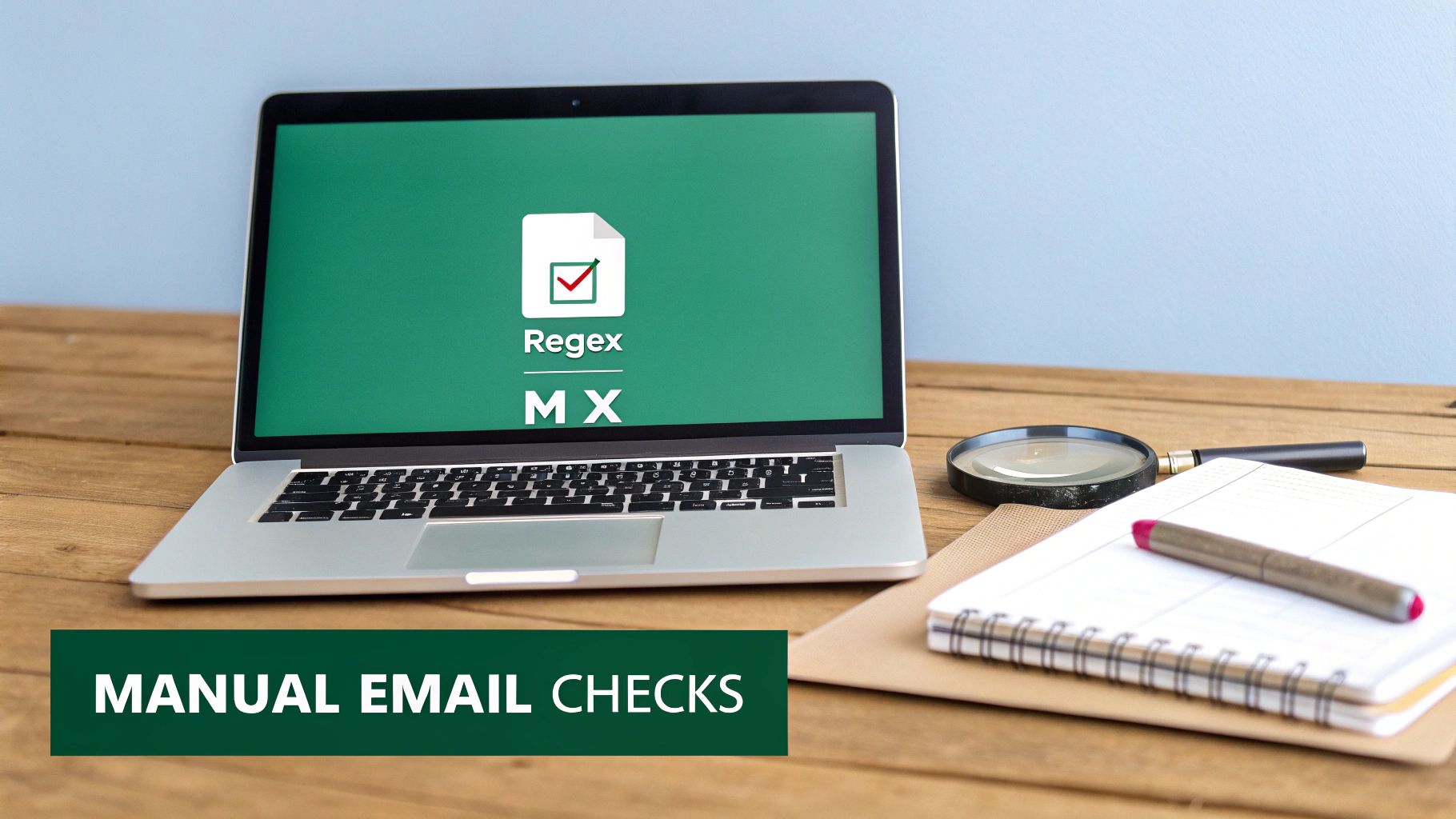
    A person at a desk manually inspecting a list of emails on a computer screen.

    Before you jump into automated tools, it’s incredibly helpful to understand what’s actually happening under the hood. Getting your hands dirty with a few manual checks gives you a real appreciation for the complexities of email verification.

    These techniques are the fundamental building blocks of the entire process. While they aren't practical for massive lists, they’re perfect for investigating a single high-value contact or just learning the ropes. Let's break down three core methods.

    The Foundational Syntax Check

    First up is the simplest check of all: syntax. This is purely about looking at the structure of the email address itself. Every valid email has to follow a specific format, and any deviation is an immediate red flag.

    You’re basically hunting for obvious typos or formatting errors that would make an address undeliverable right out of the gate. All you need is a keen eye.

    Common syntax mistakes to watch for include:

    • Missing "@" symbol: An address like johndoedomain.com is an instant fail.
    • Multiple "@" symbols: Something like john@doe@domain.com will never work.
    • Spaces or invalid characters: Things like parentheses, commas, or spaces aren't allowed.
    • Consecutive dots: An address such as john..doe@domain.com is invalid.
    • Domain formatting issues: The part after the "@" can't start or end with a hyphen or a dot.

    Think of this as the proofreading stage. You wouldn't send a letter to an address with a jumbled street name. The same logic applies here, and it's the fastest way to weed out basic data entry mistakes.

    Investigating the Domain and MX Records

    Once an email passes the initial sniff test, the next step is to make sure its domain is legitimate and actually set up to receive mail. This is done with a domain and MX record lookup.

    An MX (Mail Exchanger) record is a type of DNS record that tells the internet where to deliver email for that specific domain. If a domain doesn’t have a valid MX record, it simply can’t get email. It’s like having a street address with no mailbox.

    You can use free online tools for this. Just pop in the domain (like "emailscout.io"), and it'll show you the MX records. If it comes back with valid results, you know the domain is set up for email. Of course, doing this for more than a handful of addresses gets old fast, which is why most people rely on a dedicated service to validate an email address for them.

    This check confirms the "building" (the domain) exists and has a "mailroom" (a mail server). But it doesn't tell you if your specific recipient has an "office" there. For that, we need to go one step further.

    The SMTP Ping: A Technical Handshake

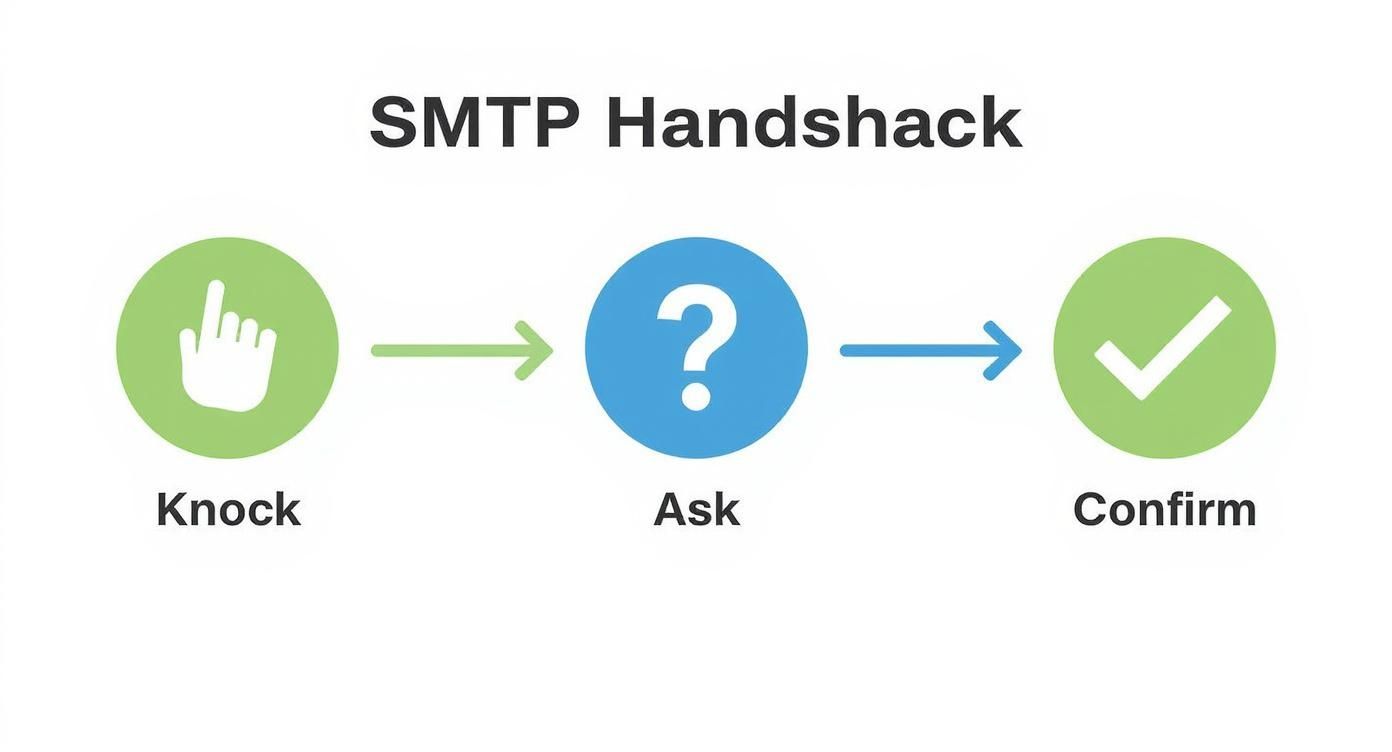
    The final manual method is the most technical but also the most definitive: the SMTP ping. This process involves talking directly to the recipient's mail server to ask if an address exists, all without sending an actual email.

    It works like a digital handshake. Your system connects to the mail server from the MX records and starts a conversation using a series of commands. You essentially say, "Hi, I have a message for user@domain.com," and the server's response tells you what you need to know.

    Here are the typical server responses:

    • OK / 250: This is a green light. It means the email address is valid, and the server is ready to accept mail for it.
    • Invalid / 550: This is a hard no. The server is telling you that user doesn't exist. The email is bad.
    • Catch-All Server: This is the tricky one. Some servers are configured to accept mail for any address at their domain. It's a defense mechanism to stop spammers from guessing valid emails, but it makes definitive verification much harder.

    An SMTP ping gives you the clearest answer on whether an inbox is real, but it's a complex process best left to automated systems that can properly interpret all the nuances of server responses.

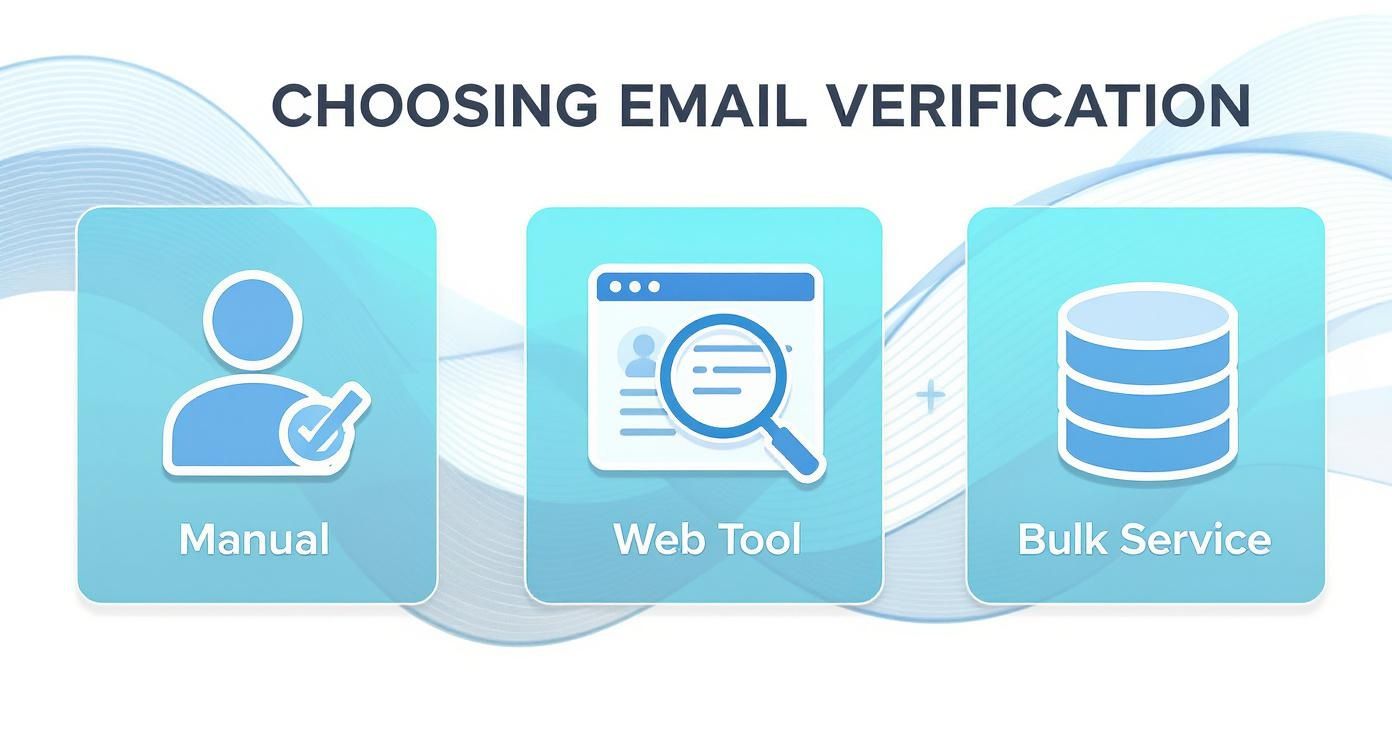
    Choosing Your Verification Approach

    A person comparing two options on a split-screen, representing manual vs. automated email verification.

    Knowing how to check an email address by hand is a great skill to have, but you’ll quickly hit a wall. It’s one thing to check a single email, but what happens when you have dozens, hundreds, or even thousands? It just doesn’t scale.

    This is where you hit a fork in the road. Do you stick with the free, hands-on method, or do you bring in an automated service to do the heavy lifting? The best choice really boils down to your specific needs, the size of your list, and frankly, how much you value your time.

    The Scalability Dilemma

    Let's get practical for a moment. Imagine you're a small business owner fresh from a trade show with a list of 200 new leads. Verifying each one manually is a slog, but it's doable. You might lose a few hours, but you can get it done without spending a dime.

    Now, picture a larger company with a subscriber database of 50,000. Trying to manually check that list isn't just a bad idea—it’s impossible. The time commitment would be insane, human error would creep in everywhere, and the final results would be questionable at best. This is where the line between manual and automated verification becomes crystal clear.

    For any real-scale operation, an automated email verification service isn't a luxury; it's a must-have. It turns a mind-numbing, error-prone chore into a fast, accurate, and strategic part of your workflow.

    When you’re weighing these options, it helps to think about implementing an email verification program that formalizes your strategy and tool choices based on these very factors.

    Speed, Accuracy, and Cost

    The trade-offs between manual checks and automated tools like EmailScout really come down to three things. Getting a handle on them will point you toward the right solution.

    • Speed: Manual verification is painfully slow. You're looking at minutes per email. In contrast, automated tools can rip through thousands of addresses in that same amount of time.
    • Accuracy: A quick manual check will catch typos and obviously fake domains. But it won't spot the trickier stuff like spam traps, disposable email addresses, or "catch-all" servers designed to accept any email you send. Automated services are built to sniff out these subtle threats with near-perfect precision.
    • Cost: Manual methods are "free" if you don't count your time. But time is money. Automated tools have a subscription fee, but the return on investment from saved hours, better deliverability, and a protected sender reputation usually pays for itself.

    To make the decision even easier, let's put these two approaches side-by-side.

    Manual Verification vs Automated Services

    A head-to-head comparison shows just how different these two methods are in practice. One is a quick-fix for tiny tasks, while the other is a professional solution built for results.

    Feature Manual Verification Automated Service (e.g., EmailScout)
    Ideal For One-off checks, very small lists (under 50) Lists of any size, ongoing list hygiene
    Time Investment High (minutes per email) Low (minutes for thousands of emails)
    Error Detection Basic syntax and domain issues only Detects spam traps, disposables, catch-alls
    Scalability Extremely poor Excellent
    Cost Free (but high time cost) Subscription-based (high ROI)

    At the end of the day, learning manual verification is more of an educational exercise. For any serious effort to keep your email list clean, healthy, and effective, automation is the only way to go.

    Using Automation to Verify Emails at Scale

    A clean dashboard showing an email list being processed, with clear status indicators like 'valid', 'invalid', and 'risky'.

    While manual checks are a great way to wrap your head around how email verification works, they just don't scale. Once your list grows beyond a few dozen contacts, checking each one by hand becomes a massive time sink.

    That’s where automation stops being a "nice-to-have" and becomes an absolute necessity. Tools built for this, like our own EmailScout, are designed to do the heavy lifting, turning what used to be a tedious manual task into a quick background process. You get the accuracy without the hours of mind-numbing work.

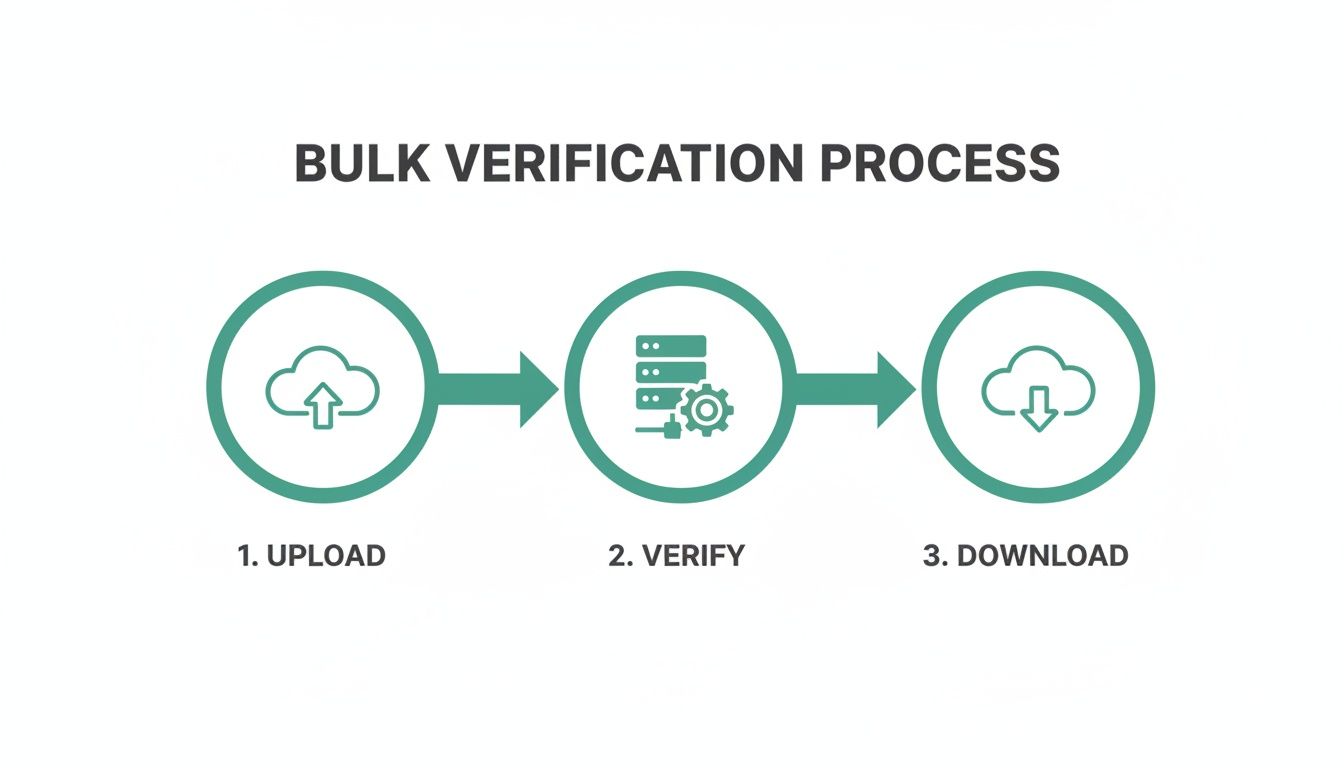
    The real magic of automation is its ability to chew through thousands of emails with a speed and consistency that a human just can't match. Instead of pecking away at individual lookups, you can just upload your entire list and get a full health report back in minutes.

    From List Upload to Actionable Results

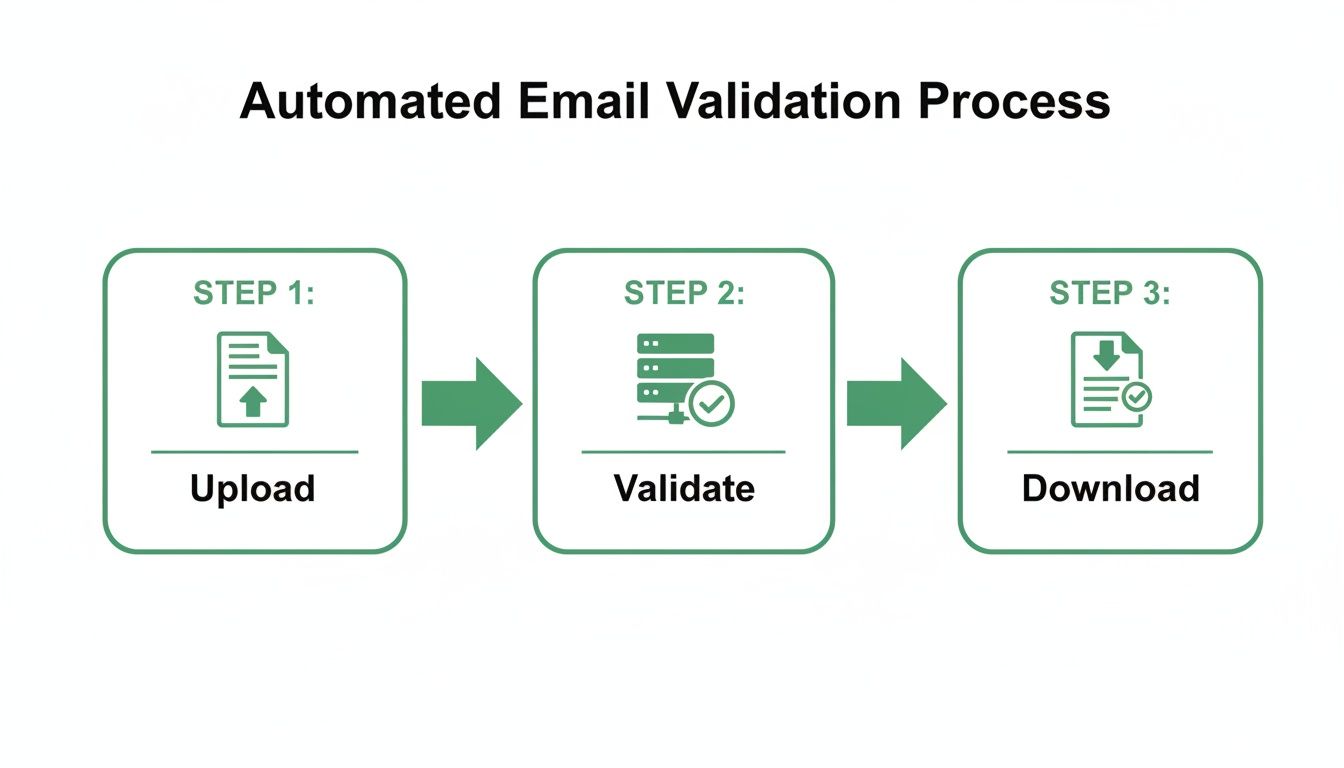
    Getting started with a service like this is dead simple. You typically just upload a CSV or a plain text file of your email list. That's it. The platform takes it from there, putting every single address through a series of checks that go way deeper than anything you could do by hand.

    We're talking about more than just basic syntax and domain checks. Bulk verification services are your front-line defense against dormant accounts, fraudulent sign-ups, and other list-killers. Many now lean on AI and machine learning to spot tricky issues like spam traps, disposable email addresses, and shady domains—things that are nearly impossible to catch manually. In fact, the market for these cloud-based tools is growing precisely because they've gotten so smart.

    Once the gears stop turning, you get a clean, detailed breakdown of your list. It’s not just a simple "good" or "bad." You get the kind of nuanced results that let you make smart decisions about your data.

    Decoding Your Verification Results

    The real value isn't just in the speed; it's in the detailed feedback. A good verification tool will neatly segment your list into clear categories, giving you the exact info you need to clean house.

    You’ll see statuses like these:

    • Valid: Green light. The email is active and safe to send to.
    • Invalid: The address is flat-out wrong—it either doesn’t exist or has a typo. These need to be deleted immediately to stop bounces.
    • Catch-All: This one is tricky. The server is set up to accept all mail sent to that domain, so you can't be 100% sure the specific inbox exists. They're a bit of a gamble.
    • Risky or Unknown: The server timed out or the address is from a known disposable email provider. These have a much higher chance of bouncing.

    By breaking your list down like this, you can get strategic. You'll want to scrub all the invalid and risky contacts right away. For catch-all addresses, you might be more cautious and send them a gentle re-engagement campaign first.

    This kind of detailed insight is a complete game-changer for keeping your list healthy. While paid tools will always offer the most powerful features, you can get a feel for how it all works by trying out some of the best free email verification tools on the market.

    Ultimately, automation flips the script on email verification. It’s no longer a reactive chore you do after a campaign bombs but a proactive strategy to protect your sender score and get the most out of every email you send.

    Building a Long-Term List Hygiene Strategy

    Running your email list through a verifier is a great start, but it's not a one-and-done fix. If you want to see real, lasting results, you have to treat data quality as an ongoing commitment, not a one-off project.

    Think about it: your list is a living thing. People change jobs, ditch old inboxes, and make typos all the time. Your strategy has to keep up.

    The smartest move you can make is to stop bad emails from ever making it onto your list. This is where real-time API verification is a game-changer. By plugging a verification API right into your signup forms, you can check an address the second a user hits "submit," blocking invalid entries before they can ever pollute your database.

    Create a Policy for Ambiguous Results

    After you verify a list, you'll always find some results that aren't a clean "valid" or "invalid." These are the tricky ones, often flagged as 'catch-all' or 'risky.' A catch-all server is set up to accept mail for any address at that domain, which means you can't be sure the specific inbox actually exists.

    Figuring out what to do with these emails requires a clear plan:

    • High-Value Contacts: If a lead comes from a key target company, you might decide to keep the catch-all address. You’ll engage with it knowing the risk is higher, but the potential reward is worth it.
    • Newsletter Subscribers: For a general newsletter, you're better off quarantining or removing catch-all emails. Prioritizing deliverability over sheer list size is the smarter play here.
    • Risky Emails: Addresses flagged as risky, especially from disposable email services, should almost always be deleted on sight.

    This kind of proactive management is a must for anyone serious about growing their audience. For a deeper dive, check out our guide on how to build an email list that stays clean right from the start.

    Schedule Regular List Maintenance

    Even with the best preventative measures, lists decay over time. It's a natural process called email churn. The only way to fight it is by scheduling regular, full-list verifications.

    For most businesses, running a full cleaning every quarter or twice a year is a solid rhythm. It helps you catch old and inactive emails before they start hurting your deliverability.

    Your email list is a dynamic asset; it needs continuous maintenance to retain its value. Regular cleanings are the best way to protect your sender reputation and maximize ROI.

    The world of email verification is always changing, right alongside digital communication itself. The eDiscovery market, which includes these tools, is expected to jump from USD 14.27 billion in 2024 to USD 22.5 billion by 2029, thanks to growing privacy rules and security needs. You can learn more about the future of email verification at superagi.com. Building a long-term hygiene strategy is how you stay ahead of the curve.

    Unpacking Common Email Verification Questions

    As you start cleaning up your email lists, you're bound to run into a few recurring questions. I see them all the time. Getting these sorted out will help you build a much more solid and effective strategy for keeping your lists healthy. Let's dig into a few of the most common ones.

    How Often Should I Verify My Email List?

    This is probably the number one question people ask. There's no single magic number, since it really hinges on how fast your list is growing.

    A good baseline for most lists is a full cleaning at least quarterly. But if you're in high-growth mode and adding hundreds or thousands of new subscribers every month, you'll want to ramp that up. For fast-growing lists, verifying monthly is a much safer bet to stay ahead of natural email churn.

    What Can I Realistically Expect from Verification?

    Another big one: "Does verification guarantee 100% deliverability?"

    The short answer is no, but it gets you incredibly close. Think of it as clearing a massive roadblock. Verification dramatically boosts your deliverability by weeding out all the invalid, risky, and flat-out non-existent addresses that cause hard bounces and tank your sender score.

    But other factors are still in play once you hit "send." These include:

    • Your Content: Emails stuffed with spammy keywords or broken formatting can still get flagged by filters.
    • Sender Reputation: Your domain's entire sending history matters a lot to email providers.
    • Engagement Signals: If people aren't opening or clicking your emails, providers take that as a sign your content isn't wanted.

    Verification makes sure the mailing address is correct, but it's up to you to make sure the package is something the recipient actually wants to open.

    Email verification is the single most impactful action you can take to improve deliverability. But it’s one critical piece of a larger ecosystem that also includes your content, reputation, and audience engagement.

    What About Privacy and Security?

    Finally, people get (rightfully) concerned about data privacy when using a third-party service. It’s a huge deal. When you upload your list, you're handing over sensitive customer data.

    Any verification service worth its salt will have a crystal-clear privacy policy. Look for providers who are GDPR compliant and explicitly state they won't share, sell, or do anything with your data. Secure handling, including encryption both in transit and at rest, is absolutely non-negotiable.

    Always do your homework before uploading a single contact. It's the only way to know how to verify email addresses without putting user trust or security on the line.


    Ready to stop guessing and start cleaning your lists with confidence? EmailScout gives you a powerful, secure way to protect your sender reputation and make sure your messages land in front of real people. Find unlimited emails and keep your data clean with EmailScout today!

  • How to Check a Valid Email Address and Why It Matters

    How to Check a Valid Email Address and Why It Matters

    Sending an email to a dead address is the digital equivalent of mailing a letter to a house that was torn down years ago. It’s a complete waste of time, money, and effort. Before we even get into the how of checking an email address, we need to talk about why.

    Getting this right is the difference between actually connecting with your audience and just shouting into the void.

    Why You Absolutely Must Validate Every Email Address

    Whether you're a startup launching your first product or a nonprofit running a fundraiser, the quality of your email list is everything. Firing off messages to invalid, misspelled, or old addresses doesn't just miss the target—it actively works against you.

    Every single failed delivery, known as a bounce, sends a little red flag to email service providers like Gmail and Outlook. It tells them you might not be a legitimate sender.

    As your bounce rate creeps up, these providers start seeing you as a potential spammer. This tanks your sender reputation, which is basically an invisible credit score that determines where your emails land. A bad score sends you straight to the promotions tab or, even worse, the spam folder.

    When that happens, even your perfectly crafted emails to valid addresses might never see the light of day. Your entire engagement strategy just got crippled.

    The Real Cost of a Dirty Email List

    Letting a bad email list fester has real, tangible consequences that go way beyond just deliverability. The damage to your finances and operations is no joke, especially when you’re trying to scale.

    • Wasted Resources: Every email sent to a bad address costs you money, either in platform fees or the time your team spent on it. For a big campaign, this can easily run into thousands of dollars in lost marketing spend.
    • Skewed Analytics: Bad data leads to bad decisions. High bounce rates mess with your campaign metrics, making it impossible to get a true read on your open rates, click-throughs, and overall ROI.
    • Brand Damage: Consistently sending emails that bounce is a fast track to getting your domain or IP address blacklisted. Once that happens, reaching anyone becomes an uphill battle.

    Here’s a look at the different ways ignoring email validation can come back to bite you.

    Risks of Ignoring Email Validation

    Risk Area Impact on Your Business Real-World Example
    Sender Reputation Email providers (Gmail, Outlook) will flag your domain as spam, sending future emails directly to the junk folder. A small e-commerce store sees its promotional emails go from a 25% open rate to under 5% after its bounce rate exceeds 10%.
    Financial Waste You pay for every email sent, so sending to invalid addresses is literally throwing money away on your email marketing platform. A B2B company sending 100,000 emails per month discovers 15% of its list is invalid, wasting over $1,000 annually on platform fees.
    Inaccurate Data High bounce rates distort your campaign metrics, making it impossible to know what’s actually working. A marketing team thinks a campaign failed due to poor copy, but the real issue was a 20% bounce rate from an outdated contact list.
    Blacklisting Your domain or IP address can be added to global blacklists, blocking all your emails from being delivered across multiple networks. A nonprofit organization's fundraising appeal is blocked entirely because its IP address was blacklisted due to poor list hygiene.

    Failing to validate your email list puts your entire communication strategy at risk. These problems compound over time, making it harder and harder to recover your sender reputation and campaign effectiveness.

    The bottom line is this: without a clean list, you're playing with a handicap. Proper email address verification isn't just a "best practice"; it's a foundational step for anyone who’s serious about making their communication count.

    There are around 4.6 billion active email users globally, with a mind-boggling 376 billion emails flying around every single day. That massive volume means providers are more aggressive than ever about filtering out senders who look sloppy. Every bad contact on your list is a risk you just can't afford to take.

    Before you even think about firing up a fancy validation tool, your first line of defense is a simple, old-fashioned visual inspection. It's surprisingly effective. You can learn how to spot the most obvious fakes in just a few seconds, saving you a ton of time and keeping bad data out of your systems from the get-go.

    A magnifying glass hovering over an email address to check its validity.

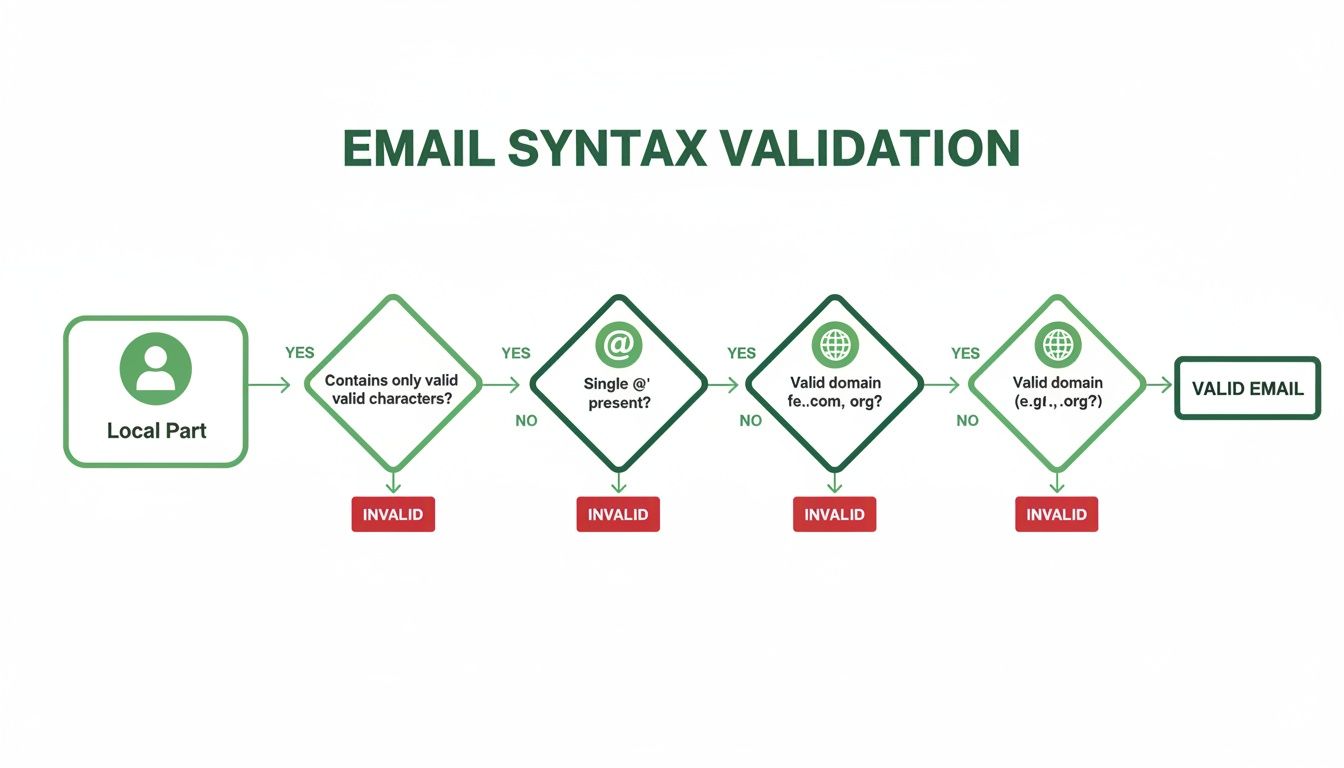
    Think of it this way: every email address needs three things to work. There's the local part (the username before the "@"), the "@" symbol itself, and the domain name (the part after the "@"). A "syntax check" is just a quick scan to make sure all those pieces are present and playing by the rules. If anything looks off, the address is dead on arrival.

    I see this all the time with user-submitted forms. Someone types "john.doe gmail.com" and completely forgets the "@" symbol. Or you might find an address riddled with weird characters that email servers will reject instantly.

    Common Syntax Red Flags

    Keep an eye out for these immediate deal-breakers. If you spot even one of these issues, the address is guaranteed to bounce. Don't waste any more time on it.

    • Missing "@" Symbol: This is the big one. An email needs one, and only one, "@" symbol. No exceptions.
    • Illegal Characters: You can't have spaces, commas, or backslashes (/ ) in an email address. Something like "jane doe"@example.com is a definite no-go.
    • Consecutive Dots: Two periods in a row (..) aren't allowed anywhere in the address. So, jane..doe@example.com will fail every time.
    • Invalid Domain Format: The domain name has to include a dot (like gmail.com, not gmailcom). It also can't start or end with a hyphen.

    I always tell people to think of a syntax check like proofreading a sentence. If the basic punctuation is a mess, the sentence doesn't make sense. The same goes for an email address—if its basic structure is broken, it’s completely undeliverable.

    Getting in the habit of spotting these errors manually is the fastest way to clean up a list, especially after importing new data or right before you launch a small campaign.

    Confirming the Domain and Mail Server Actually Exist

    A diagram showing an email traveling from a sender to a mail server.

    An email address can look perfectly fine and still be completely undeliverable. Just because contact@somecompany.com passes a quick visual check doesn't mean the "somecompany.com" domain actually exists or is set up to receive emails.

    This is where we go a layer deeper to separate the plausible fakes from the real deal. We need to check if the domain has a Mail Exchange (MX) record.

    Think of an MX record as the domain's official postal address for email. It's a public signpost on the internet that essentially says, "Yep, I accept email here. Send it to this specific server." If a domain doesn't have an MX record, no emails can be delivered to it. Period. This check is a powerful way to weed out bad addresses early.

    What Is an MX Record Check?

    An MX record check is like looking up a business in a directory before you drive there. You’re simply confirming that a mail server is officially listed for that domain. It’s a quick, non-intrusive lookup that gives you a clear "yes" or "no" on whether a domain can even receive mail.

    • Valid Domain: A domain like gmail.com will have several MX records. This tells you it’s a robust system ready to handle incoming mail.
    • Invalid Domain: A typo like gmaiil.com (with two 'i's) almost certainly has no MX records. Any email address using this domain is instantly invalid.

    This check is fundamental. It's the first real test of deliverability. An email address can’t be valid if its domain isn’t even equipped to catch the message you’re trying to send.

    The Polite Knock on the Door

    Once you've confirmed an MX record exists, the final step is to see if the specific mailbox is available. This is where a process called an SMTP handshake, or a "ping," comes in.

    Imagine you've found an apartment building (the mail server). Now you need to ask the doorman if "John Smith" actually lives there. You're not trying to deliver a package yet—you’re just confirming he has an apartment.

    That's exactly what an SMTP ping does. A verification tool communicates with the mail server and politely asks, "Hey, do you have a mailbox for john.smith@example.com?" The server will respond with a yes or no, all without an actual email ever being sent. This confirms the individual mailbox exists, giving you the final piece of the validation puzzle.

    Using Automated Tools for Accurate Verification

    Manual checks are great for catching obvious typos, but they only scratch the surface. To really know if an email is deliverable, you need to bring in the big guns: automated email validation services. They're the fastest and most reliable way to get high-accuracy results, especially when you're dealing with more than a handful of addresses.

    These tools do so much more than a simple syntax check. They run a whole series of tests, like verifying the domain exists, confirming it has valid MX records, and even safely pinging the mail server to see if a specific mailbox is active. The whole process takes a fraction of a second. For anyone relying on email for marketing or sales, this kind of deep-dive verification is non-negotiable.

    Imagine an e-commerce store with a real-time validation API on its checkout page. A customer accidentally types john.doe@gamil.com, and the tool instantly flags the typo. It prompts them for a correction before that bad data ever pollutes their database. That proactive approach is a total game-changer for keeping a clean list from day one.

    Understanding the Verification Results

    When you run a list through a validation service, you don’t just get a simple “good” or “bad” verdict. The results are much more nuanced, which helps you make smarter decisions about who to email and who to remove.

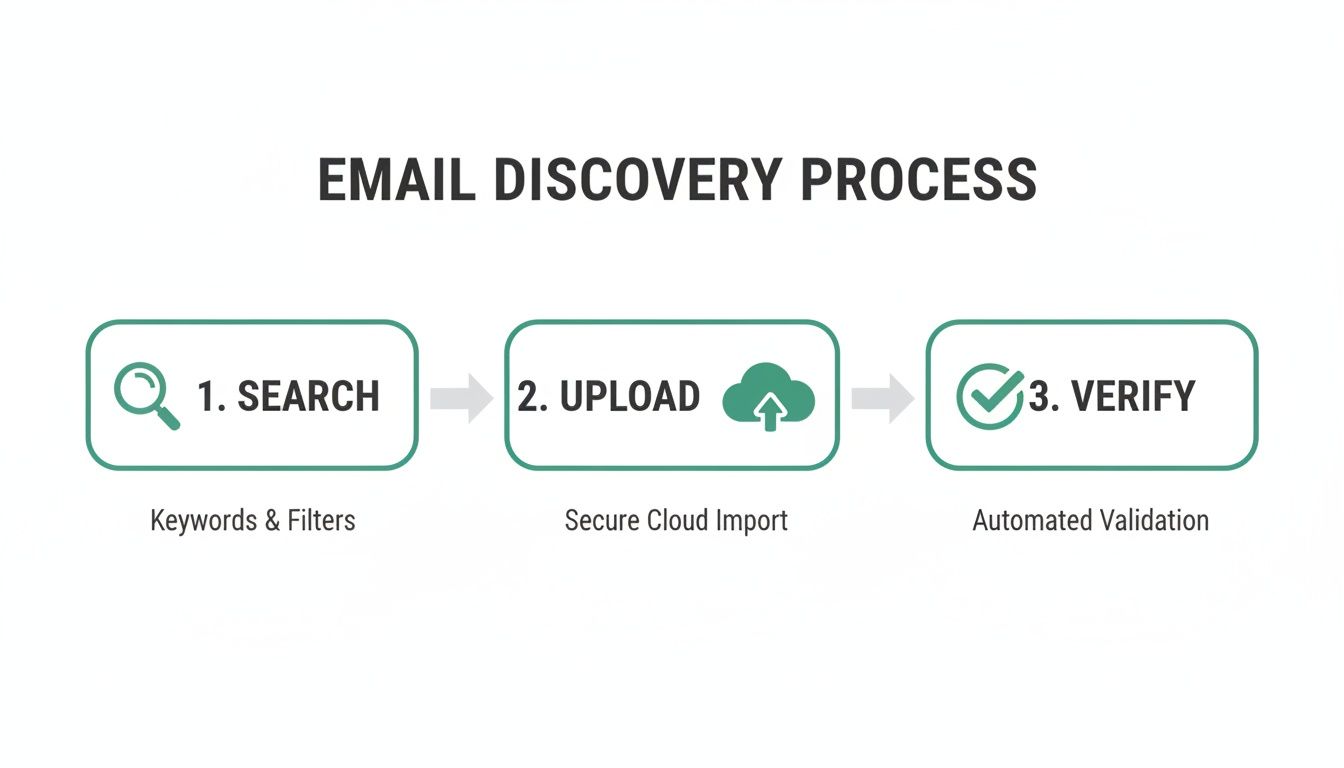
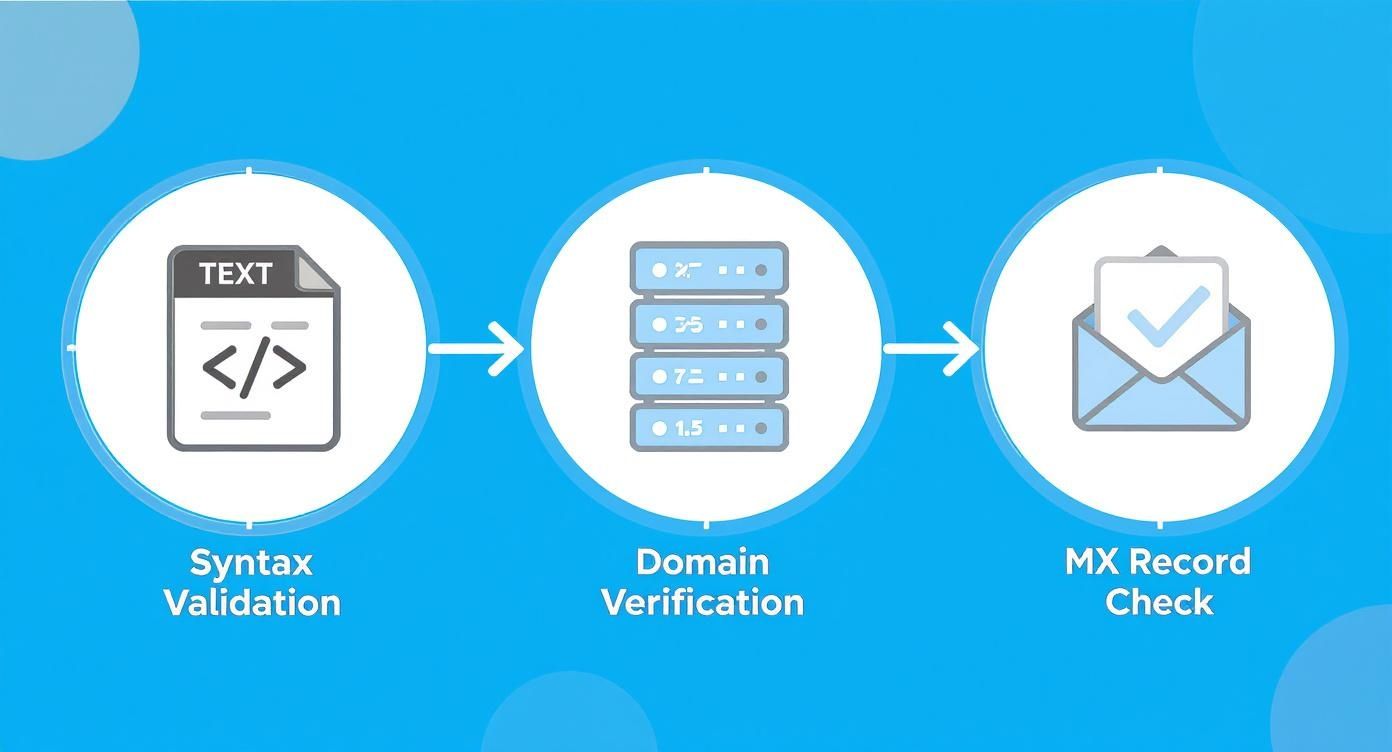
    The infographic below gives a high-level look at the first few checks these tools perform to make sure a domain is even capable of receiving mail.

    Infographic about how to check a valid email address

    This initial step confirms the mail servers are set up correctly, which is the foundation of any valid address. From there, the tools dig deeper and assign a specific status code to each email.

    Here’s a quick rundown of the common statuses you'll encounter:

    • Valid: This is the gold standard. The address has perfect syntax, a live domain, and an active mailbox waiting to receive your email. Green light to send.
    • Invalid: This address failed at least one critical check. It could be a typo, a dead domain, or a mailbox that no longer exists. These need to be removed from your list immediately.
    • Risky or Catch-All: This one's tricky. The domain is set up to accept email for any address, so it’s impossible to confirm if the specific person’s mailbox is real. It’s best to treat these with caution, as they can have a higher bounce rate.

    To make it even clearer, here's a quick reference table breaking down what these common verification results mean and how you should handle them.

    Email Verification Status Codes Explained

    Verification Status What It Means Recommended Action
    Valid The email address exists and can safely receive mail. Keep on your mailing list and send with confidence.
    Invalid The email address does not exist or has a critical error. Remove from your list immediately to avoid a hard bounce.
    Risky (Catch-all) The server accepts all emails, so the specific address can't be confirmed. Send with caution or segment them for low-priority campaigns.
    Unknown The tool couldn't get a definitive response from the mail server. Treat as risky. You can try verifying again later or remove.
    Spam Trap A known spam trap address used to identify spammers. Remove from your list immediately. This is critical for your sender reputation.

    Understanding these codes helps you clean your list with precision, not just a sledgehammer.

    The industry is always evolving, and many modern tools now use AI to predict the deliverability of an email based on historical data, going far beyond the basic checks. With an average email bounce rate of just 0.7%, going even slightly above that can land you in the spam folder.

    If you’re ready to clean up your list, plenty of great options are out there. Check out our guide on the best free email verification tools to find a service that fits your budget and needs.

    Best Practices for Long-Term List Health

    A person tending to a healthy, growing plant, symbolizing email list maintenance.

    Knowing how to spot a valid email address is one thing. But the real secret to great deliverability is shifting from occasional, reactive clean-ups to consistent, proactive list maintenance.

    Think of your email list as a powerful business asset. Like any valuable asset, it needs regular care to prevent decay and protect your all-important sender reputation.

    The best place to start? Implement a double opt-in process right away. This is where a new subscriber gets an automated email asking them to click a link to confirm their subscription. It’s a simple but incredibly effective step that proves genuine interest and verifies the address is correct from the get-go.

    Create a Regular Cleaning Schedule

    Don't wait until you start seeing high bounce rates or other deliverability problems. Get ahead of the curve by setting a routine for cleaning your entire list.

    Here’s a practical schedule that works for most businesses:

    • Quarterly Validation: Run your full list through a verification tool every three to four months. This is a solid benchmark for keeping things fresh.
    • Pre-Campaign Check: Always, always validate any list segment that’s been dormant for a few months before hitting "send" on a big campaign.
    • Monitor Engagement: Keep a close eye on subscribers who never open your emails. After a set time—say, six months—you can either try a re-engagement campaign or simply remove them.

    This kind of disciplined approach ensures you’re constantly weeding out bad or inactive contacts before they can do any damage to your sender score.

    Proactive validation is all about future-proofing your deliverability. When your list is pristine, your messages consistently land in front of the people who actually want to hear from you. That’s how you maximize impact and ROI.

    It’s also worth remembering that deliverability can vary a lot by location. For example, Europe boasts an impressive 91% average inbox placement rate, while the Asia-Pacific region is closer to 78%. These kinds of regional differences show why a universally clean list is non-negotiable for any global marketing.

    Of course, starting with a quality audience is half the battle. Our guide on how to build an email list walks you through the steps to attract engaged and deliverable subscribers from day one.

    Common Email Validation Questions Answered

    When you're first learning how to check if an email address is valid, a lot of questions pop up. It’s a critical part of email marketing, but the technical details can feel a bit overwhelming and sometimes stop people from doing anything at all.

    Let's clear up some of the most common ones I hear.

    Clarifying Common Misconceptions

    One of the biggest questions is how often you should clean your list. A good rule of thumb is to run a full validation check every three to six months. This keeps your list fresh without becoming a huge chore.

    The best strategy, though, is to stop bad emails from getting on your list in the first place. Setting up a real-time validation API on your signup forms is the most effective way to do this. And if you're about to send a major campaign to a list that's been sitting around for a while? Always validate it first.

    Another idea I see floated is just sending a test email to see if it bounces. Please don't do this. Sending to even a handful of invalid addresses can tank your sender reputation with email providers like Gmail almost immediately. Automated tools check deliverability without ever sending a message, which is the only safe way to protect your score.

    You'll also run into "catch-all" servers. These are set up to accept any email sent to a domain, so they won't hard bounce. The problem is, you have no idea if a real person is on the other end. Your best bet is to segment these addresses and keep a close eye on their engagement.

    At the end of the day, consistent and safe validation isn't optional. It’s what keeps your list healthy and ensures your emails actually make it to the inbox.


    Ready to build powerful outreach lists with verified emails? EmailScout's Chrome extension helps you find and save decision-maker emails in a single click. Start finding unlimited contacts for free at https://emailscout.io.

  • How to Verify If an Email Address Is Valid

    How to Verify If an Email Address Is Valid

    To figure out if an email address is any good, you need to run it through a gauntlet of checks. It starts simple, with a basic syntax check, but quickly moves to more serious tests like SMTP verification. This whole process confirms that an email is not only formatted correctly but that its domain can actually receive mail and that a specific inbox is real and waiting.

    Why Email Verification Is So Important for Growth

    Sending an email seems easy, right? But its success is completely tied to the quality of your contact list. Every time you skip verification, you're taking a direct hit to your marketing budget, your sender reputation, and your overall shot at growth. An unverified list is just a minefield of dead ends—typos, old addresses, and throwaway accounts that only hurt your campaigns.

    This isn't just about a few minor hiccups; it's about protecting your brand's reputation. When your bounce rate starts climbing, the big players like Google and Microsoft notice. They start to see you as a potential spammer, which is the fast track to getting your messages filtered, blocked, or worse, having your domain blacklisted entirely.

    The Real Cost of a Dirty Email List

    The fallout from a poorly maintained list goes way beyond a few bounced emails. Every single "undeliverable" message chips away at your sender score—a critical metric that basically decides if your emails land in the inbox or get tossed into the spam folder. A low score means even your most loyal subscribers might never see your messages.

    Think about the ripple effect:

    • Wasted Money: You pay your email service provider for every email you send, whether it gets delivered or not. Sending to bad addresses is literally throwing money in the trash.
    • Messed-Up Analytics: High bounce rates completely skew your performance metrics. This makes it impossible to know what’s actually working or to make smart, data-driven decisions for your next campaign.
    • Trashed Sender Reputation: Internet Service Providers (ISPs) are always watching. If you keep sending emails to mailboxes that don't exist, it signals that you don't care about your list hygiene, which tanks your future deliverability across the board.

    A clean email list isn't just a 'nice-to-have'—it's the foundation of any email marketing strategy that actually works. Taking the time to verify your list ensures your message has a fighting chance to be heard, protecting both your investment and your brand.

    You can see how modern tools are designed to tackle this problem head-on. The screenshot from EmailScout's homepage shows an interface built for one thing: efficiency. It lets you process and clean your lists fast, so you can avoid the pitfalls of bad data.

    What Email Verification Means for Your Business Metrics

    Let’s take a look at the real-world impact of keeping your email list clean. The table below shows a clear 'before and after'—the risks you run with an unverified list versus the rewards you get from a clean one.

    Impact of Email Verification on Key Marketing Metrics

    Metric Without Verification (The Risk) With Verification (The Reward)
    Deliverability Rate Plummets as bounces and spam complaints rise. Stays high (98%+), ensuring messages reach the inbox.
    Bounce Rate Climbs above 2%, damaging sender reputation. Remains low (well below 0.7%), signaling a healthy list.
    Sender Reputation Degrades quickly, leading to blacklisting. Strengthens, improving inbox placement with major ISPs.
    Campaign ROI Decreases due to wasted sending costs and missed opportunities. Increases as more emails reach engaged, real customers.
    Engagement Rates Skewed and unreliable due to invalid data. Accurate and actionable, reflecting genuine user interest.

    As you can see, the benefits are immediate and directly tied to performance. All the hard work you put into building your email list deserves to be protected.

    If you're already focused on smart tactics like lead magnets and sign-up forms, you need to be just as focused on making sure those addresses are valid. For more on this, check out our detailed guide on how to build an email list.

    Ultimately, proactive verification is what fuels the metrics that matter. With over 347 billion emails sent every day and average open rates hovering around 24%, every single send counts. Keeping your bounce rate below the industry benchmark of 0.7% is non-negotiable; go over that, and you're telling email servers you can't be trusted. By making sure your emails reach real people, you create more opportunities for opens, clicks, and sales—turning your list into a reliable engine for growth.

    Understanding the Layers of Email Validation

    Image

    When you want to verify if an email address is valid, it's not a single check. Think of it more like a quality control line in a factory. Each station looks for a different problem, and an email only gets the "valid" stamp after passing every single inspection.

    This layered approach is absolutely critical. It systematically weeds out bad emails at different stages, catching everything from obvious typos to much sneakier issues hiding on the server side. If you skip a layer, you’re letting bad data slip through, which will wreck your sender reputation and drain your marketing budget.

    The First Filter: Syntax and Formatting Checks

    The first and most basic layer is the syntax check. This is your first line of defense, a quick grammar check for the email address format itself. It’s an automated process that spots fundamental mistakes right away.

    This initial pass asks a few simple but vital questions:

    • Is there exactly one "@" symbol?
    • Are there any illegal characters, like spaces or two dots in a row?
    • Does it have a local part (before the "@") and a domain part (after the "@")?
    • Is the domain part followed by a valid top-level domain (TLD) like ".com" or ".org"?

    For instance, an address like john.doe@.com or jane doe@company.com would fail this check instantly. Catching these simple errors is the low-hanging fruit of email validation, stopping the most obvious data entry mistakes from ever making it onto your list.

    Domain and MX Record Validation

    Once an email passes the syntax check, the next job is to see if its digital "street address" is actually real. This is where we check the domain and its Mail Exchange (MX) records. An MX record is just a public directory that tells the internet which mail servers are set up to receive email for that specific domain.

    If there's no valid MX record, an email has nowhere to go. It’s like trying to mail a package to a house that doesn't exist. This check confirms two crucial things:

    1. Domain Existence: It makes sure "company.com" is a real, registered domain.
    2. Mail Server Configuration: It verifies that the domain is actually set up to receive mail.

    Verifying MX records is a non-negotiable step. A syntactically perfect email like contact@nonexistentdomain123.com is still completely useless if the domain itself isn’t configured to handle mail. This check filters out addresses linked to expired or misspelled domains.

    These two foundational checks—syntax and domain validation—work together to knock out a huge chunk of invalid emails. They lay the essential groundwork for more advanced methods, like SMTP verification. By understanding how these layers work, you can see just how thorough you need to be to truly verify if an email address is valid and give your messages the best shot at landing in a real inbox.

    Using SMTP Checks for Ultimate Accuracy

    After you've weeded out the obvious errors with syntax and domain checks, it's time to bring out the big guns: the SMTP check. This is the most definitive test you can run to verify if an email address is valid.

    Think of it like a digital "knock on the door." Your verification tool opens a direct line to the recipient's mail server, but it hangs up before actually sending anything.

    This quick conversation, often called an SMTP handshake, is incredibly revealing. It essentially asks the server, "Hey, do you have an inbox for jane.doe@company.com?" The server's response is a straight yes or no. All of this happens without a single email ever being sent, which is why it's the gold standard for accuracy.

    How the SMTP Handshake Works

    The SMTP check is designed to catch the sneaky problems that other methods miss. A classic example is a correctly formatted email for an employee who no longer works at a company.

    An address like john.smith@company.com might look perfect. It would sail through syntax and MX record checks. But the SMTP handshake would get a firm "user unknown" response from the server, instantly telling you it's a dead end.

    It’s a discreet but highly effective way to confirm an inbox is active and ready to receive your messages. It simulates the first few steps of an email delivery, then stops just short.

    This infographic breaks down the foundational checks that pave the way for an SMTP test, showing how each layer builds on the last.

    Image

    As you can see, an email has to pass the basic structural tests before a more advanced SMTP verification even makes sense.

    Navigating Tricky Server Responses

    Things aren't always so black and white, though. Some mail servers are set up with a "catch-all" (or "accept-all") configuration. This means the server is programmed to accept email for any address at that domain, even gibberish like asdfghjkl@company.com.

    A catch-all server will give a positive response to an SMTP check for any username you throw at it. This makes it impossible to know if a specific inbox actually exists.

    This is where a smart tool like EmailScout really shines. It helps interpret these ambiguous server responses for you:

    • Valid: The server confirmed the specific user inbox exists. Green light.
    • Invalid: The server confirmed the specific user inbox does not exist. Dead end.
    • Risky / Catch-All: The server accepts all emails, so we can't be sure about this specific inbox. Proceed with caution.

    A "catch-all" status doesn't mean the email is bad—it just means the server is playing its cards close to its chest. For a high-value lead, it might be worth the risk of sending, but just know it could bounce.

    Understanding these nuances is what separates amateurs from pros. If you're blasting out a massive marketing campaign, you’ll probably want to skip the "Risky" addresses to protect your sender reputation. But for a handful of targeted sales emails? The potential reward of reaching the right person might easily outweigh the small risk. It's all about making strategic choices to keep your list clean while still chasing down important opportunities.

    How to Automate Verification with Modern Tools

    Image

    Knowing the theory behind email verification is great, but trying to do it all by hand is a whole different story. Let's be real: attempting to verify if an email address is valid one by one is just not feasible for any list that's big enough to matter.

    That's exactly where automated tools like EmailScout come into play. They transform what would be a monumental chore into a quick, almost effortless process.

    The workflow is refreshingly simple. You typically start by uploading your entire contact list, usually as a straightforward CSV file, right into the platform. From there, the service does all the heavy lifting. It runs every single address through that multi-layered validation gauntlet we talked about, from basic syntax checks all the way to advanced SMTP handshakes.

    Within minutes, you get back a detailed report that neatly segments your list into clear, actionable categories. No more guesswork.

    Making Sense of the Results

    The real magic of these tools isn't just the verification itself—it's how they translate the raw data. Instead of cryptic server codes, you get plain-English statuses that tell you exactly what to do next. This clarity is everything when it comes to protecting your sender reputation and getting the most out of your campaigns.

    Most verification tools use a similar set of statuses. Here's what you need to know:

    Understanding EmailScout Verification Results

    Interpreting the output from your verification tool is the final, crucial step. This table breaks down the common status codes, what they mean for your list, and the best course of action for each.

    Verification Status What It Means Recommended Action
    Valid The email address is confirmed to exist and the mailbox is active. Green light! Send your campaigns to these contacts with confidence.
    Invalid The email address definitively does not exist or was rejected by the server. Remove immediately. Sending to these will cause a hard bounce.
    Risky / Catch-All The server is set up to accept all mail, so the specific inbox can't be confirmed. Proceed with caution. These have a higher chance of bouncing or being a spam trap.
    Unknown The server didn't respond or timed out during the verification check. It's best to treat these like "Risky" emails. Set them aside for now.

    By segmenting your list based on these results, you can finally make smart, data-driven decisions.

    For a massive marketing blast, sticking to just the 'Valid' group is your safest bet. But for a highly targeted sales email? Sending to a 'Risky' address could be a calculated gamble that pays off.

    A Look Ahead at Verification Tech

    And this space is only getting smarter. Industry experts predict that by 2025, automated email verification systems will routinely use AI to not just validate an address, but to predict its likelihood of being engaged. These next-gen systems go beyond simple pings and checks by analyzing behavioral patterns and historical data to spot potential problems before they even happen.

    Ultimately, automation is the only practical path forward for managing email list hygiene at any kind of scale. While there are plenty of services out there, finding one that clicks with your workflow is key.

    If you're just dipping your toes in the water, a great place to start is by exploring the 12 best free email verification tools. It's the perfect entry point for building a cleaner, more powerful contact list from day one.

    Making Email Verification Part of Your Daily Grind

    Good email hygiene isn't something you do once a year. It's a constant, ongoing process that you bake right into your day-to-day operations. The real goal is to shift from reactive cleanups to proactive, always-on maintenance. This ensures your marketing and sales efforts are always built on a solid foundation of real, deliverable email addresses.

    This means looking beyond the occasional scrub of your master list. The real wins come when you embed verification at every single point where you collect an email. The most effective way to do this? A real-time verification API on all your signup forms, lead magnets, and checkout pages.

    Think of it as an instant gatekeeper. When someone types in their email, the API does a lightning-fast check behind the scenes. If it's a dud—whether from a simple typo or a bogus domain—it gets rejected on the spot. Bad data never even gets a chance to pollute your system.

    Creating a Routine for List Maintenance

    Even with real-time checks in place, you still need to do periodic list scrubs. It's just a fact of life: people change jobs, companies merge, and old email addresses get abandoned. Data decay is a real thing, with marketing databases losing around 22.5% of their accuracy every single year.

    To fight back, set up a simple, repeatable schedule for cleaning your entire database. For most businesses, a quarterly deep clean is the perfect rhythm.

    • The Quarterly Scrub: Once a quarter, export your entire contact list and run it through a bulk verification service. This is your chance to catch any addresses that have gone stale since they were first added.
    • The Pre-Campaign Check: Got a major campaign coming up? Before you hit send, run that specific segment through one last verification. It’s a crucial final step to boost deliverability and protect your sender score when it matters most.

    Proactive verification is a mindset. When you build these checks into your daily and quarterly workflows, you stop treating data hygiene as a chore and start seeing it for what it is: a core part of your growth strategy.

    Automating How You Find and Clean New Contacts

    Your workflow also needs to cover how you source new leads. When you're building lists from professional networks or company websites, you need a smart way to find and validate contacts at the same time. This is where a couple of good tools can really make a difference.

    For instance, after you’ve found some promising leads, you can use a free email extractor online to quickly pull any publicly listed addresses from their websites. But here’s the critical part: you immediately run those new emails through a verification tool before they ever touch your CRM.

    This simple two-step process—extract, then verify—makes sure every new contact you add is both relevant and reachable from day one. By making this your standard procedure, you consistently verify if an email address is valid as a natural part of your outreach, not as a separate, annoying task you have to deal with later.

    Common Questions About Email Verification

    Image

    Even when you have a solid game plan, a few questions always seem to pop up once you start digging into email verification. Let's clear the air and tackle the most common ones I hear.

    Getting these details right is about more than just cleaning a list. It's about making sure your process is effective, compliant, and built to last.

    Is Verifying Emails Legal?

    Yes, it's not only legal—it's a marketing best practice. Verifying an email address is a technical process of checking public records and communicating with mail servers. It doesn’t involve snooping on private information or sending a single unsolicited message.

    In fact, verification helps you stay on the right side of regulations like the CAN-SPAM Act. This law mandates that you handle opt-outs correctly and maintain a clean list. The penalties for non-compliance are no joke, with potential fines reaching up to $53,088 for a single email violation.

    How Often Should I Clean My Email List?

    This depends on how fast your list is growing, but a good rule of thumb for most businesses is to do a thorough cleaning at least once a quarter. Email data goes stale faster than you'd think. Some studies show that lists lose over 22% of their accuracy every year as people switch jobs, change providers, or just abandon old inboxes.

    If you're a high-volume sender or adding new subscribers daily, moving to a monthly verification schedule is an even smarter move. The real secret is consistency.

    Don't wait for your bounce rate to shoot through the roof before you act. Think of regular verification as preventative maintenance for your most valuable marketing channel. It’s a proactive habit that protects your sender reputation and keeps your deliverability sky-high.

    Can I Verify a Single Email Address?

    Absolutely. While bulk verification is your go-to for cleaning entire databases, there are plenty of times when you just need to check one high-value contact before hitting "send." Nearly every quality verification service has a tool for single email checks.

    This is a lifesaver for people like:

    • Sales Reps: Double-checking a key prospect's email before sending that crucial first pitch.
    • Account Managers: Making sure an important client update actually reaches the right person.
    • Recruiters: Validating a top candidate’s contact info before an offer goes out.

    It’s a small, quick step that prevents embarrassing bounces on communications that really matter.

    Will Verification Hurt My Sender Reputation?

    This is one of the biggest myths out there. When done correctly, email verification will not harm your sender reputation. The methods we've discussed, like the SMTP handshake, are designed to be non-intrusive. They open a conversation with the mail server but hang up before actually trying to send an email.

    The server just sees a quick, harmless query. What really tanks your reputation is repeatedly sending emails to bad addresses and racking up hard bounces. In that light, verification isn't the problem—it's the solution.


    Ready to stop guessing and start connecting? EmailScout gives you the tools to clean your lists, find fresh leads, and make sure your message lands in the right inbox, every time. Try our email finder and verification tools for free and see what a difference a clean list makes.

  • Find Owner of an Email Address: Easy Step-by-Step Guide

    Find Owner of an Email Address: Easy Step-by-Step Guide

    When you need to find out who's behind an email address, your first move is often a reverse email lookup tool like EmailScout. These services are designed to scan public records and social media profiles, piecing together a digital footprint that can connect an email to a name, a job title, and other useful details. This isn't about shady snooping—it's about smart, professional diligence.

    Why Verifying an Email Owner Matters

    Image

    Ever get a crucial email and feel that tiny flicker of doubt about who actually sent it? Knowing how to find the owner of an email address is a non-negotiable skill for anyone doing business online. It’s what separates a real connection with a genuine lead from getting tangled in a sophisticated phishing net.

    Let's get practical. Say you're in sales and an inquiry from jane.d@megacorp.com lands in your inbox. Before you pour hours into crafting the perfect proposal, you absolutely need to confirm that Jane is a real decision-maker at that company. In the same way, a project manager has to be certain that a new stakeholder's email is legit before sharing a link to sensitive project files.

    This isn’t about being nosy. It’s about exercising due diligence to protect your time, your resources, and your company's data.

    Beyond Simple Outreach

    The need to verify an email goes way beyond sales and project management. The global email system is swimming with security risks. In 2023, about 25% of all fraud reports in the U.S. started with an email, cementing its place as a top channel for cybercrime. You can dig into more of these email security stats on Statista. That number really drives the point home.

    Knowing the true identity behind an email address is no longer just a nice-to-have. It’s a core security practice.

    This one simple step helps you:

    • Avoid Phishing Scams: Confirming that email from a supposed vendor or colleague can stop a costly security breach before it starts.
    • Validate Business Contacts: Make sure your outreach is hitting the right people, maximizing your efficiency and impact.
    • Build Trust: When you verify contacts before engaging, you’re building professional relationships on a solid foundation of certainty.

    Uncovering Email Owners with Reverse Lookup Tools

    When you've got an email address but no name, a reverse email lookup tool is your most direct route to an answer. Think of services like EmailScout as a specialized search engine for people. They dig through a massive web of public records, social media data, and professional databases to connect the dots.

    In many cases, this process can instantly link an email to a full name, a job title, or even social media profiles. It's often the quickest way to turn a mysterious address into a real, identifiable person. Just keep in mind that the results depend entirely on the individual's public digital footprint—some people are ghosts online, while others are open books.

    Making Sense of the Results

    After you plug in the email, you'll get a report back. Don't just grab the first name you see and run with it. The real skill is in looking for patterns and corroborating the details.

    Does the name you found match the format of the email address (e.g., john.smith@domain.com for John Smith)? Does the company listed in the report match the email's domain? Piecing these clues together helps you build a much more reliable picture of who you're dealing with.

    The journey to identify an email owner usually follows a few logical steps, starting broad and then zeroing in. This is a pretty common workflow I've used myself countless times.

    Image

    As you can see, after some initial legwork, a dedicated lookup tool is often the final step that ties everything together and confirms an identity. Sticking to a structured approach like this saves a ton of time and prevents you from chasing dead ends.

    Key Takeaway: The goal isn't just to find a name; it's to build a confident profile. Treat the data from a lookup tool as your foundation, then use other public information to put a few more bricks on top for verification.

    For instance, if a tool tells you the email belongs to "Jane Doe" at "Acme Inc.," your next move should be a quick search on LinkedIn to see if you can find her profile there. The more data points that align, the more certain you can be. This is super valuable in B2B sales or marketing, where you absolutely need to know you're talking to the right person.

    If you find yourself doing this at scale, it's also worth learning how to find company email addresses to make the whole process even more efficient.

    Information You Can Uncover with Reverse Email Lookup

    A good reverse email search tool doesn't just give you a name. It often pulls together a whole profile of publicly available information. Here’s a quick breakdown of what you can typically expect to find and how you can use it.

    Data Type What It Tells You Use Case Example
    Full Name The most direct identifier for the email owner. Addressing outreach emails personally instead of using "To Whom It May Concern."
    Job Title & Company Professional context, including their role and place of work. Verifying you're contacting a decision-maker for a B2B sales pitch.
    Location General geographic area (city/state) of the individual. Segmenting a marketing list for a location-specific promotion or event.
    Social Media Profiles Links to public profiles on platforms like LinkedIn, Twitter, or Facebook. Gaining insight into their professional background or personal interests for rapport-building.
    Associated Websites Personal blogs, portfolios, or company websites linked to the email. Understanding their expertise or business focus before making contact.

    Putting these pieces together gives you a much richer understanding of the person behind the email, allowing for smarter, more personalized communication. It’s about turning a simple email address into a real connection.

    Connecting the Dots on Social and Professional Networks

    Image

    So, you’ve run an email through a lookup tool and got a name or username back. Great starting point, but the real detective work is just getting started. This is where you connect the dots—cross-referencing that scrap of information across social and professional networks to build a complete, verified picture of who you're trying to reach.

    Think of it this way: the tool gave you a clue, not a conclusion. Let's say it links j.doe@techsolutions.com to a "Jane Doe." Your immediate next step should be a quick search on a professional platform like LinkedIn. If a profile for a Jane Doe at TechSolutions pops up, you’ve just added a huge layer of validation.

    This kind of cross-checking is non-negotiable, especially when you consider the sheer number of email accounts out there. By 2025, there will be nearly 4.48 billion email users globally, and plenty of them juggle multiple accounts. Trusting a single source is just too risky. You can dig into more email user trends on 99firms.com if you're curious.

    Advanced Search Techniques for Confirmation

    Instead of just scrolling endlessly through social media feeds, you can use advanced search operators to find the owner with surgical precision. These are simple commands that tell a search engine exactly what to look for and where.

    A targeted Google search, for example, can instantly surface profiles where an email address is listed publicly. It’s an incredibly effective way to find professionals who’ve shared their contact details on their profiles or in public posts.

    Pro Tip: Try this exact search operator in Google: "<emailaddress>" site:linkedin.com. Just swap <emailaddress> with the one you're checking. This scans all of LinkedIn for any public mention of that address and often takes you straight to the owner's profile.

    From Data to a Complete Profile

    This whole process is about much more than just matching a name to an email. It’s about building context and confidence so you know you're reaching out to the right person.

    • Confirm Professional Standing: Does the LinkedIn profile show a role that lines up with why you’re contacting them?
    • Gauge Expertise: Do their posts on X (formerly Twitter) or other industry forums show they have knowledge in a relevant field?
    • Verify the Connection: Does the company domain from their email match the employer listed on their profiles?

    When you connect these dots, you move way beyond just knowing a name. You create a verified, multi-dimensional profile that ensures your communication is accurate, professional, and lands exactly where it should.

    How to Decode an Email Address for Clues

    Before you jump into any tools, take a hard look at the email address itself. It’s surprising how much you can piece together just by breaking it down. This is always my first move when trying to figure out who's behind an email.

    Start with everything after the "@" symbol. The domain name is your biggest tell. An address like j.smith@gmail.com doesn't give you much to work with, but j.smith@summitpeakcorp.com is a goldmine. Right away, that domain points to a specific company.

    A quick search for summitpeakcorp.com will tell you what the business does. This instantly provides context. You now know their industry and can make some educated guesses about the sender's role. You’ve just narrowed your search from the entire internet down to the employees of one organization.

    Unpacking the Username

    Once you've got a likely company, the part before the "@" becomes a lot more useful. Most businesses don't get too creative with their email formats; they stick to standardized patterns.

    You'll see common formats again and again:

    • firstname.lastname@company.com (like john.smith)
    • firstinitial.lastname@company.com (like j.smith)
    • firstname@company.com (like john)

    So, if your email is j.smith@summitpeakcorp.com, you can be pretty confident the owner’s name is something like "J. Smith." Combine that name with the company, and you have a solid lead to start verifying on professional networks.

    This isn't about getting a 100% positive ID right away. It's about building a strong, logical hypothesis. You’re creating a profile based on evidence before you even run a single tool.

    This quick manual analysis turns an anonymous string of text into a probable name and workplace. It’s a super-efficient way to gather your initial intel, which makes your next steps with a tool like EmailScout far more effective. You're no longer shooting in the dark—you're working to confirm a theory you've already built.

    Navigating Ethical and Legal Boundaries

    Image

    Knowing how to find the person behind an email address is a powerful skill, but it's one that comes with some serious responsibility. The methods we’ve gone over are meant for legitimate, professional goals—not for prying into someone's personal life. It's absolutely crucial that your actions always stay within legal and ethical lines.

    Regulations like the General Data Protection Regulation (GDPR) in Europe and the CAN-SPAM Act in the U.S. have strict rules about how you can collect and use personal data, including email addresses. Breaking these rules can lead to hefty fines and can seriously damage your professional reputation. It all boils down to consent and having a legitimate reason for your search.

    Email is a huge part of modern life. A staggering 99% of users check their personal inbox every single day, and 60% of consumers say they prefer getting promotional messages from brands via email. This just goes to show how powerful this channel is when you use it the right way.

    Legitimate Use Cases

    Your objective should always be to use this information responsibly. Here are a few clear-cut examples of when it's appropriate:

    • Fraud Prevention: Verifying a new customer's identity to stop a potential chargeback or fraudulent transaction.
    • Lead Verification: Making sure that a new sales lead who signed up on your website is a real person at the company they claim to work for.
    • Professional Networking: Identifying the correct contact person at a company before sending a business proposal or partnership request.

    Your goal is professional verification, not personal surveillance. Keeping this mindset is crucial for staying on the right side of the law and maintaining your integrity.

    Always steer clear of using any uncovered information for harassment, doxxing, or any kind of personal snooping. The tools and techniques we outline in our complete guide to finding the owner of an email address are designed to support ethical business practices, helping you make sure your outreach is both effective and respectful.

    Common Questions About Finding Email Owners

    Even with the best tools, you'll eventually hit a wall. Let's walk through some of the most common questions that pop up when you're trying to figure out who owns an email address. Getting these right will help you navigate the trickier situations with a bit more confidence.

    One I hear all the time is, "What if the reverse lookup tool comes up empty?" It happens more than you'd think, especially with brand-new accounts or emails people keep locked down. When you hit this dead end, it’s your cue to circle back to the fundamentals.

    Don't just give up. Start by looking at the email address itself. What clues does it offer? If it's a custom domain, that's your first lead. For generic ones, look at the username pattern. This kind of manual detective work is often what breaks a case open.

    Can I Find the Owner of a Generic Email Address?

    This is the tough one. Trying to identify the person behind coolsurfer88@gmail.com is a whole different ballgame than a corporate email. These addresses are unmoored from any organization, which strips away your most valuable clues.

    A good lookup tool might still find a link to a social media profile, but the odds are definitely lower. Your best bet here is to get back to basics: search for the full email address in quotation marks ("coolsurfer88@gmail.com") across Google and various social media platforms. You might just get lucky and find it listed on an old forum, a personal blog, or a forgotten profile. That’s often all you need to get a name.

    Remember, the goal is to find a public connection. If an individual has kept their digital footprint clean, no tool can magically produce information that isn't publicly available. Respecting privacy is paramount.

    Another critical question is about trust: "How reliable is the information I find?" The data from lookup tools is usually solid, but you should always treat it as a lead, not a fact. A tool might pull a name from a public record that's five years old. Always cross-reference what you find on a professional network like LinkedIn before you take any action.

    If you're looking for more general strategies, our guide on how to find anyone's email address offers additional techniques.

    Ultimately, think of it like building a case. Every piece of information is a clue. Your confidence in the result should grow as you find more and more evidence that all points to the same person.


    Ready to stop guessing and start connecting? With EmailScout, you can uncover the people behind the emails in a single click. Get started with EmailScout for free.