

The formula for landing your first clients is deceptively simple: focus first, act second. It boils down to knowing exactly who you’re selling to, crafting a message that solves their single biggest problem, and then showing up where they already are.
Get this foundation right, and everything else—from cold emails to closing deals—gets a whole lot easier.
Building Your Foundation for Client Acquisition
Jumping straight into outreach without a clear plan is like driving blind. You might eventually get somewhere, but you’ll waste a ton of time, energy, and money on dead ends. The most successful founders I know all start here, by getting crystal clear on who they serve and the unique value they bring to the table.
This isn't about writing a 50-page business plan nobody will ever read. It's about answering a few critical questions with surgical precision. When you know your ideal customer inside and out, every decision you make becomes sharper and more effective.
Define Your Ideal Customer Profile
Your Ideal Customer Profile (ICP) is a snapshot of the perfect client for your business. This goes way beyond basic demographics. A strong ICP gets into the nitty-gritty: their specific pain points, professional goals, and the exact characteristics that make them a perfect fit for what you offer.
Without an ICP, you're just shouting into the void. With one, you're having a direct conversation with someone who's actively searching for a solution like yours. For a deeper dive, check out our guide on how to identify your target audience.
Key Takeaway: Think of your ICP as a strategic compass. It stops you from wasting resources trying to sell to everyone and instead points you directly toward the prospects most likely to buy, stay, and rave about you to others.
Craft a Compelling Value Proposition
Once you know who you're talking to, you need to nail what you're going to say. Your value proposition is a short, punchy statement that explains the tangible results a client gets from you. It needs to immediately answer their unspoken question: "What's in it for me?"
A powerful value proposition is:
- Specific: It names the primary benefit. Instead of "we improve marketing," try "we increase lead generation for B2B SaaS companies by 30% in 90 days."
- Pain-Focused: It hits on a major frustration your ideal customer is dealing with right now.
- Differentiating: It subtly explains why you're the better choice over any alternatives.
Validate Your Ideas with Low-Budget Research
You don't need a huge budget to figure out if you're on the right track. Before you go all-in on outreach, you have to validate your assumptions. This early-stage research can also reveal new opportunities; for instance, learning about small business video marketing might open up a whole new way to connect with your audience.
Here are a few simple ways to get started:
- Survey Your Network: Ping a few colleagues or contacts on LinkedIn. Ask if they know anyone who fits your ICP. A quick 15-minute chat can give you more insight than hours of guesswork.
- Lurk in Online Communities: Find the forums, Slack channels, or Facebook groups where your target audience hangs out. Pay close attention to the questions they ask and the problems they complain about.
- Analyze Your Competitors: Go read the customer reviews and testimonials for your competitors. What do their clients love? What do they hate? This is a goldmine for positioning your own offer.
Finding Your First Clients with Targeted Prospecting
So you’ve got a crystal-clear picture of who you're targeting. Now what? The next step is actually finding them, and this is where most new businesses get completely bogged down. It's easy to fall into the trap of either spraying and praying to everyone or spending countless hours on manual, dead-end research.
Let's get one thing straight: the goal isn't to build the biggest list. It's to build the right list.
Effective prospecting is a system, not a scramble. It’s about creating a repeatable process that consistently unearths qualified leads who perfectly match your Ideal Customer Profile. This isn't just a one-off task; it's a core business activity that will keep your pipeline full long after you land that first client.
The whole process boils down to a few key stages: defining your ideal profile, understanding what they actually care about, and then figuring out where to find them.
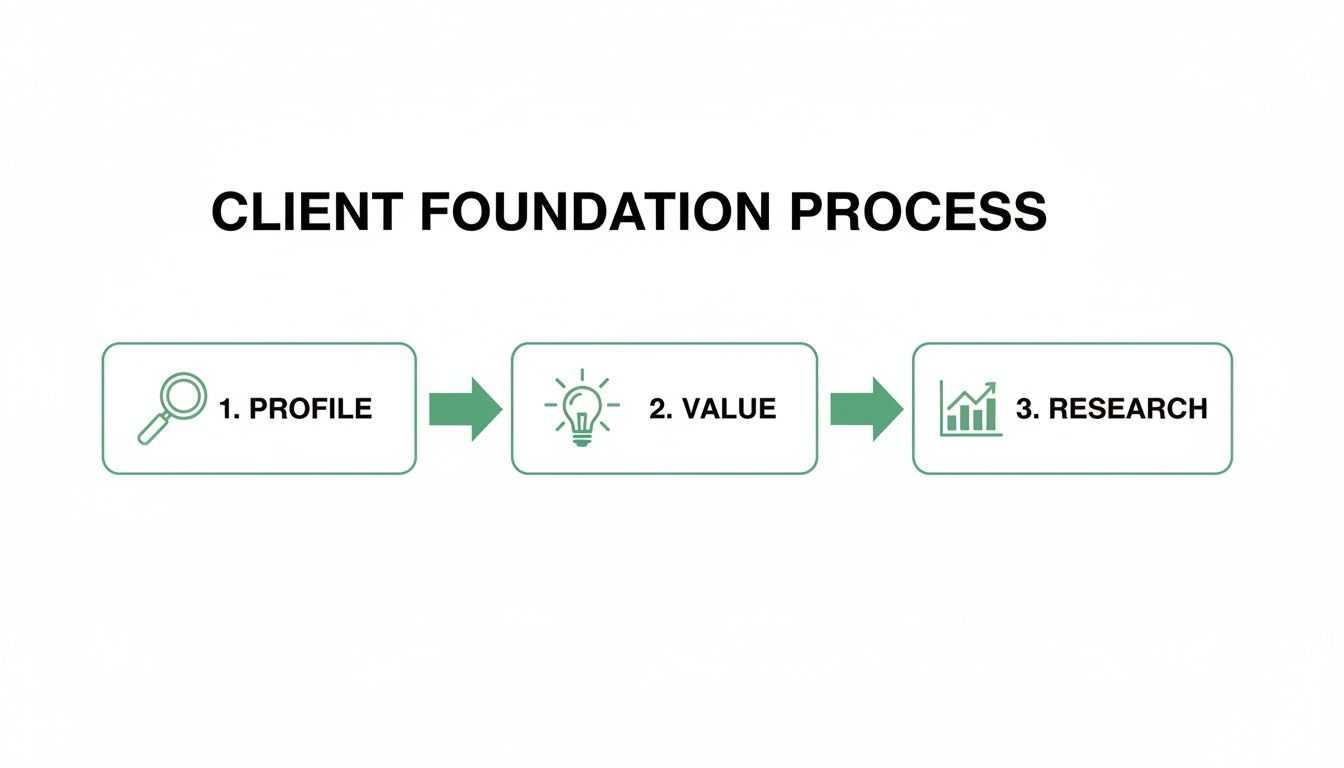
As you can see, every successful outreach campaign starts with a deep understanding of your target and the value you bring to the table. That foundation guides every single thing you do next.
Locating Decision Makers
You've defined the type of person you need to reach, but where do they hang out online? LinkedIn is the obvious starting point, and for good reason. It’s a massive, searchable database of professionals that’s invaluable for any B2B business.
But just searching for job titles won't cut it. You have to put on your detective hat and look for buying signals—those little clues that tell you a person or company might be ready to buy right now.
- Recent Job Changes: A new exec is almost always looking to make a quick impact. That often means bringing in new tools, services, or agencies.
- Company News: Did a company just announce a big funding round or a new product launch? Events like these create new problems and, more importantly, open up new budgets.
- Content Engagement: Who's liking, sharing, or commenting on articles related to the problem you solve? These people are actively thinking about your space.
When you focus on these triggers, you’re no longer just another cold prospector. You’re reaching out to someone with a potential, immediate need, which instantly makes your message more relevant.
A classic mistake is targeting a company instead of a person. You don't sell to a logo; you sell to a human being who has a specific, frustrating problem. Your number one job is to find the individual who feels that pain the most.
A Practical Workflow Using EmailScout
Building a list based on these signals can be a huge time sink if you do it all by hand. This is where you bring in the right tools to work smarter, not harder. An email finder is a non-negotiable part of your tech stack, turning a name and a company into a direct line of communication.
Let’s walk through a real-world scenario. Imagine you're a new design agency targeting early-stage tech startups. Your ICP is the "Head of Marketing" at a SaaS company with 20-50 employees that just landed a Series A funding round.
Here’s a simple, repeatable workflow:
- Find Target Companies: Use a platform like Crunchbase or LinkedIn Sales Navigator to filter for companies that fit your specific criteria (e.g., SaaS, 20-50 employees, Series A funding in the last 6 months).
- Pinpoint the Right Person: Once you have your list of companies, pop over to their website or LinkedIn page. Your mission is to find the person with the "Head of Marketing" title or something similar.
- Get the Email Address: Here’s the magic step. With the EmailScout Chrome extension installed, you just go to their LinkedIn profile or the company website and find their verified professional email with a single click. No more guessing games with
first.last@company.com. - Segment and Organize: As you find contacts, EmailScout lets you save them directly into organized lists. You could create a list called "Series A SaaS – Marketing Heads" to keep your outreach hyper-focused.
This straightforward process turns abstract research into an actionable list of qualified prospects. To go even deeper, check out our full guide on sales prospecting techniques. This system ensures every email you send has the best possible shot at reaching the right person, at the right company, with the power to say "yes." This is how you stop guessing and start getting clients systematically.
Crafting Cold Emails That Actually Get Replies
Let's be honest: cold email gets a bad rap. That's because most people do it terribly. Our inboxes are graveyards for spammy, self-serving outreach that gets deleted on sight.
But when you approach it with a little precision and empathy, a well-written email is one of the most direct and effective ways to land your first clients.
The secret is to stop "selling" and start a conversation. Your only job with that first email is to earn a reply. That's it. Every single word should serve that one goal.
The Anatomy of an Irresistible Subject Line
Before anyone reads your perfectly crafted email, they have to open it. Your subject line is the gatekeeper, and its only mission is to spark just enough curiosity to get a click, without feeling like bait.
The best subject lines are specific, relevant, and feel like they were written by a human.
Ditch the generic, salesy stuff like "Quick Question" or "Introductory Offer." Instead, tie your subject line directly to something happening in their world.
- Reference a recent event: "Congrats on the new funding round"
- Mention a mutual connection: "Jane Smith suggested I reach out"
- Ask a highly specific question: "Question about [Their Company]'s marketing stack"
You want it to feel like it could have come from a colleague, not an automated sequence. Keep it short—ideally 5-7 words—so it doesn't get cut off on a phone, where almost half of all emails get read.
Pro Tip: Your subject line should be the start of a story that the first line of your email immediately continues. This creates a seamless flow that pulls the reader right in.
Structuring the Email Body for Impact
Once the email is open, you have about ten seconds to hook them. Long, chunky paragraphs are the fastest way to get your email sent to the trash. Make it scannable, keep it concise, and focus everything on the person reading it.
A simple, four-part structure consistently gets replies:
- The Opening: Kick things off with a personalized line that proves you did your homework. This is where you mention their recent blog post, a company award, or a specific challenge you noticed. Make it clear this email is for them and only them.
- The Problem: Briefly state a problem you know their role or company is dealing with. Show them you understand their world and the headaches that come with it.
- The Solution (Your Value Prop): Frame your service as the answer to that problem. Don't just list features; talk about the tangible result or outcome they'll get.
- The Call-to-Action (CTA): End with a simple, low-effort question. Instead of asking for a 30-minute call, try something like, "Is this something on your radar right now?" This makes it incredibly easy for them to give a quick yes or no.
When done right, email marketing is still one of the most cost-effective ways to get clients. Data shows the average email marketing conversion rate can be as high as 15.22%, with top automated campaigns reaching almost 5%.
The Art of the Follow-Up
Here's the hard truth: most replies don't come from the first email. Not even close. People are busy, inboxes are chaotic, and your message can easily get lost in the noise. A persistent but respectful follow-up plan is an absolute must.
A simple three-step cadence works like a charm:
- Email 2 (3 days later): This is just a gentle "bump." Reply to your original email with something short and sweet like, "Just wanted to bring this to the top of your inbox. Any thoughts?"
- Email 3 (7 days later): Now, add some value. Share a relevant article, a case study, or a quick insight related to their business. The CTA is softer here: "Thought you might find this interesting."
- Email 4 (14 days later): Time for the breakup email. Politely close the loop. "Assuming this isn't a priority right now, so I won't follow up again. Feel free to reach out if that changes." This often triggers a response because of good old-fashioned FOMO.
Each follow-up should be shorter than the last—just a quick, easy-to-read nudge. This strategy respects their time while keeping your name top-of-mind. If you need more inspiration, check out these proven examples of cold emails that actually get results.
Using Personalization to Build Real Connections
In a world drowning in generic, automated outreach, genuine personalization is your single greatest advantage. Moving beyond the simple {first_name} tag isn’t just a nice-to-have anymore; it's the only way to cut through the noise.
This is how you land clients when you can't compete on brand recognition or a massive marketing budget. You compete on thoughtfulness. The goal is to make every email feel like a one-to-one conversation, even when you're working at scale.
And it pays off. Personalized emails are proven to boost click-through rates by 14% and conversion rates by 10%. Even better, they can achieve transaction rates 6 times higher than generic messages. If you want to dig into the numbers, you can explore more data on the impact of targeted email outreach here.
Quick Research for Maximum Impact
Good personalization doesn’t mean you need to spend hours stalking a single prospect. It's about being smart and efficient. In just five minutes, you can find more than enough ammo to craft a message that feels genuinely personal.
Before you hit send, do a quick scan of these key areas:
- LinkedIn Activity: Did they just share an interesting article, post an update, or get a promotion? A quick mention shows you're actually paying attention.
- Company News: Hit their company's "News" or "Blog" section. A recent product launch, funding round, or award is a perfect, timely hook.
- Personal Interests: Sometimes a LinkedIn profile mentions a specific hobby, volunteer work, or their alma mater. Finding even a small point of common ground can build instant rapport.
This isn't about being creepy. It's about finding an authentic reason to start a real conversation.
Crafting Messages That Resonate
Once you have a few specific details, the trick is to weave them naturally into your email. You need to connect what you learned about them to the problem you solve. This simple act transforms your message from a cold pitch into a helpful suggestion.
Let’s look at a real-world example.
Generic Opening:
"Hi Sarah, I saw you're the Head of Marketing at InnovateTech and wanted to reach out."
Personalized Opening:
"Hi Sarah, I saw your recent post on LinkedIn about the challenges of scaling content creation for InnovateTech's new product line. Your point about maintaining quality under pressure really stood out."
See the difference? The second example immediately proves you understand her specific world. It shows you’ve done your homework and aren't just blasting out another template. You’ve earned her attention for the next few sentences.
Key Takeaway: Personalization isn't just a tactic; it’s a strategy. It shows respect for the recipient's time and makes them far more likely to see you as a potential partner instead of just another salesperson.
Moving Beyond the First Name
True personalization goes much deeper than surface-level details. It’s about tailoring your entire value proposition to their specific situation. This is where you connect the dots between their world and your solution.
Here’s how to put this into practice:
- Reference Their Role: Speak their language. A CMO cares about different KPIs than a Marketing Manager. Tailor your pitch accordingly.
- Align with Company Goals: If their company just announced a global expansion, frame your service as the tool to help them get there faster.
- Address a Recent Trigger: Did they just hire a new sales team? Position your lead generation service as the perfect way to keep that new team fed with qualified opportunities.
This level of customization demonstrates a deep understanding of their business. It shifts the entire dynamic from you asking for something to you offering a solution to a problem they already have. That’s how you build real, lasting client relationships.
Expanding Your Reach with Networking and Partnerships

While targeted outreach is an absolute beast for getting clients, putting all your eggs in that one basket can be a bit risky. If you want to build a truly resilient client-getting machine, you have to diversify. That’s where networking and strategic partnerships come in.
Think of it this way: cold outreach is your offense, the direct play you run to score. Networking and partnerships are your defense and special teams. They create long-term assets that feed you a steady stream of warm, high-converting leads, often when you least expect them. This is how you stop chasing every single client and start having them come to you.
Master Authentic Digital Networking
Let's be clear: networking is not about hoarding business cards or machine-gunning connection requests on LinkedIn. It's about building real relationships and positioning yourself as a helpful expert. Today, that happens almost entirely online.
The secret sauce? Give before you ask. Instead of launching into a sales pitch, start by engaging with the content your ideal clients and potential partners are already posting. A genuinely thoughtful comment that adds to the conversation is worth a hundred generic "Great post!" messages.
Here’s how it plays out: Say you're a freelance writer targeting SaaS marketing managers. You spot a post from a marketing leader in your niche. Instead of a cold pitch, you drop a comment with a unique insight or a relevant stat. Do this consistently, and you become a familiar, respected name in their world.
Engage in High-Value Online Communities
Your ideal clients are already hanging out together online, talking about the very problems you can solve. Your job is to find these digital watering holes—specialized Slack channels, niche subreddits, private Facebook groups—and become a fixture.
The rules of engagement are simple:
- Listen first. Get a feel for the community's vibe and rules before you jump in.
- Answer questions. Share your expertise freely, without a sales pitch attached. Offer real, actionable advice.
- Be a resource. If someone needs a tool or an article recommendation in your field, be the one who provides it.
This slow-burn approach positions you as a trusted advisor. Down the road, when someone in that group needs the exact service you offer, guess who they'll think of first? It’s a subtle but incredibly powerful way to build trust long before a sales call ever happens.
Forge Strategic Referral Partnerships
One of the absolute fastest ways to get more clients is to team up with other businesses that serve the same audience but aren't your competitors. A solid referral partnership can easily become your single best source of qualified leads.
Think about complementary services. For example:
- A web designer could partner with a copywriter and an SEO specialist.
- A financial advisor could team up with an accountant and an estate planning lawyer.
When you find the right partner, you're plugging directly into their existing trust and credibility. The leads they send your way are pre-qualified and already warm, which dramatically shortens your sales cycle.
When you reach out, have a clear, mutually beneficial proposal ready. Explain how you’ll add value for their clients and what you can offer in return. This isn’t a one-way street; it's about creating a win-win that fuels growth for both of you.
From First Conversation to First Paying Client
Getting a positive reply is a huge milestone, but it's really just the starting line. Now the real work begins: turning that initial spark of interest into a signed contract. This is your chance to shift from being a prospector to a trusted advisor, guiding the conversation from a casual chat to a closed deal.
Your first call isn't about selling—it's about diagnosing. Think of it as a "discovery call." The entire goal is to understand their specific pains, their goals, and what they've already tried. You should let them do 80% of the talking. Ask open-ended questions that get to the heart of their problem and listen for the specific challenges your service is built to solve.
Nailing the Discovery Call
To make sure every first client interaction is a home run, you need to master some basic call handling best practices. It's all about creating a professional and comfortable experience from the moment they pick up the phone.
Here’s a simple flow for that first conversation:
- Build Rapport: Kick things off with a moment of genuine connection. Referencing that personalized point from your email shows you remember who they are and that they aren't just another name on a list.
- Set the Agenda: Quickly outline the call's purpose. Something as simple as, "I'd love to learn more about your goals and see if we might be a good fit to help," works perfectly.
- Ask Diagnostic Questions: This is where you dig in. Focus on their "why." Why is this a priority now? What does success look like for them in six months?
- Confirm Understanding: Before you wrap up, summarize their key challenges back to them. This proves you were listening and, just as importantly, reinforces their pain points in their own mind.
From Call to Compelling Proposal
Once you've confirmed their problem and feel like you're a good fit, the next step is sending a proposal. This isn’t a generic brochure; it's a direct response to everything you just learned on the call. Keep it simple, clear, and laser-focused on outcomes, not just a list of activities.
A great proposal doesn’t just list what you'll do; it clearly outlines the tangible value the client will receive. Frame everything in terms of their goals, using their own words back to them to show you've truly understood their needs.
How you follow up is just as important as the proposal itself. After you send it over, suggest a specific time to review it together. This gives you a chance to answer questions, handle objections in real-time, and keep the momentum going.
A simple, "Does Thursday at 2 PM work to walk through this and answer any questions?" keeps the ball in your court and moves you one step closer to landing your first paying client.
Ready to build a reliable pipeline of qualified leads for your new business? EmailScout's Chrome extension makes it simple to find the verified email addresses of key decision-makers, so you can focus on starting conversations that lead to paying clients. Find unlimited emails for free and start your outreach today at https://emailscout.io.