Author: EmailScout

  • The 12 Best Data Enrichment Tools for Marketers in 2026

    The 12 Best Data Enrichment Tools for Marketers in 2026

    Your CRM is filled with potential, but outdated or incomplete data is a silent killer of opportunity. Every bounced email, every generic outreach attempt, and every missed connection can be traced back to a single problem: you don't have the full picture. This leads to wasted effort, frustrated sales teams, and, ultimately, lost revenue. The fix isn't more data, it's better data. This is where data enrichment comes in.

    Data enrichment is the process of enhancing your existing customer records by appending missing information from reliable third-party sources. It transforms a basic contact list into a powerful strategic asset. Instead of just a name and an email, you gain access to job titles, company firmographics, social profiles, and technographic data. This allows for hyper-targeted segmentation, deeply personalized messaging, and more accurate lead scoring. To truly fix the problem of incomplete data costing you leads, it's crucial to understand what defines a qualified lead and how to attract more of them.

    Finding the right tool, however, can be a challenge. The market is crowded with options, each with different strengths, pricing models, and integration capabilities. This guide is designed to cut through the noise. We've compiled a comprehensive list of the best data enrichment tools available, from all-in-one platforms like EmailScout and Apollo.io to specialized API-first solutions like People Data Labs. We’ll analyze each one with screenshots, key features, pricing, and practical use cases to help you choose the perfect solution for your specific workflow, budget, and technical needs.

    1. EmailScout

    Best For: Frictionless email discovery for sales, marketing, and recruiting.

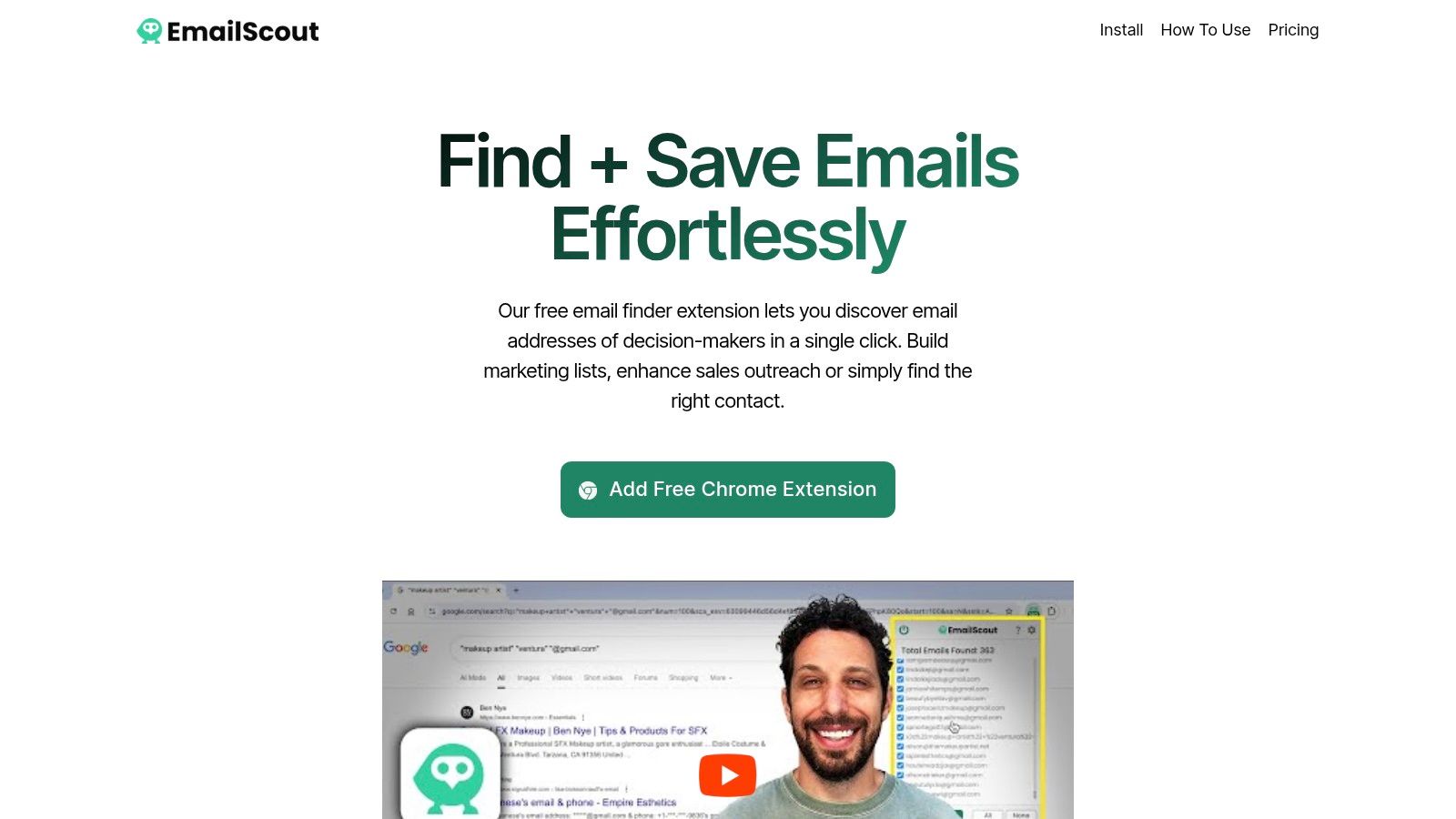
    EmailScout secures the top spot as a featured choice due to its remarkable simplicity and powerful, scalable approach to email discovery. Positioned as one of the best data enrichment tools for prospecting, it operates as a lightweight Chrome extension that transforms any website or Google search into a lead generation asset. With a single click, it scrapes publicly available email addresses from a page’s source code, instantly providing actionable contact data for outreach campaigns.
    EmailScout

    What truly sets EmailScout apart is its accessibility and automation. The free version offers unlimited email finds with manual exports, a feature almost unheard of in this space. For professionals looking to scale, its premium tiers introduce game-changing features like AutoSave, which passively collects emails in the background as you browse, and the URL Explorer, a bulk-scanning tool that can process up to 1,500 URLs at once. This combination makes it ideal for building targeted lists quickly, whether from a curated list of company domains or a simple Google search like “plumbers in Chicago email.”

    Key Features & Use Cases

    • Unlimited Free Email Finds: The free plan allows users to discover and manually export an unlimited number of emails, perfect for budget-conscious freelancers or teams testing new markets.
    • AutoSave (Premium): Automates email collection while you browse multiple sites, eliminating repetitive clicks and manual exports. Ideal for market researchers and sales reps building prospect lists.
    • URL Explorer (Premium): Bulk-processes a list of URLs to extract emails at scale. A powerful tool for lead generation agencies and B2B marketers targeting specific industries.
    • One-Click Workflow: The user experience is incredibly straightforward. Navigate to a site, click the extension icon, and instantly see a list of found emails ready for export to CSV or TXT.

    Pricing Snapshot

    EmailScout offers a uniquely generous model that scales with user needs.

    Plan Key Features Best For
    Free Forever Unlimited email finds, manual exports Individuals and startups testing outreach.
    Premium Trial 200 emails/month, URL Explorer (10 URLs) Evaluating premium automation features.
    Paid Plans Starting at ~$9/month for 5,000 emails/month Scaling teams needing automation and bulk processing.

    Pros & Cons

    Pros:

    • Generous Free Tier: Unlimited email discovery without a monthly cap is a significant advantage.
    • Powerful Automation: AutoSave and URL Explorer drastically reduce manual prospecting time.
    • Simplicity: The one-click Chrome extension workflow is intuitive and requires no technical setup.
    • Affordable Scalability: Premium plans are cost-effective, and the no-credit-card trial removes barriers to entry.

    Cons:

    • Public Data Only: It only finds publicly listed emails, which may require further verification for deliverability.
    • Compliance Responsibility: Users must ensure their outreach complies with regulations like CAN-SPAM and GDPR.

    Website: https://emailscout.io

    2. ZoomInfo – Enrich

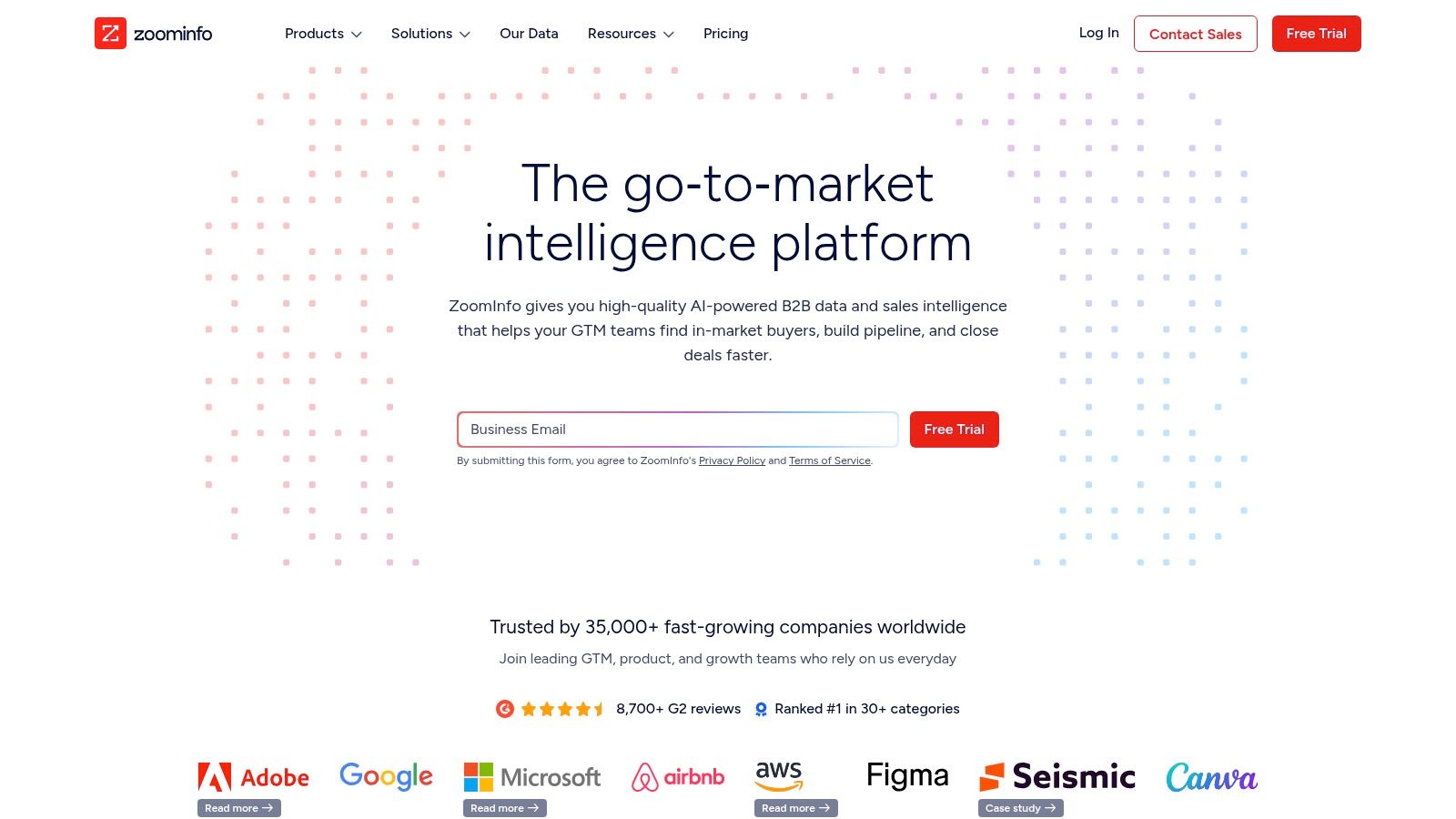
    ZoomInfo offers an enterprise-grade data enrichment solution that excels in providing deep, comprehensive B2B contact and company information. It's a powerhouse for sales and marketing teams needing to append over 200 data attributes, including detailed firmographics, technographics, and individual contact details, directly into their existing workflows. This platform is particularly effective for organizations that require robust data governance and sophisticated integration capabilities.
    ZoomInfo – Enrich

    Unlike many competitors, ZoomInfo’s strength lies in its expansive, frequently updated database and advanced add-ons. Users can layer on intent signals to identify accounts actively researching solutions and receive job-change alerts, creating timely outreach opportunities. These features make it a strategic asset for sophisticated B2B lead generation campaigns. Find out more about how this impacts effective B2B lead generation. The platform’s administrative controls also allow for precise field mapping and rule-setting, ensuring data consistency across large teams.

    Key Features & Use Case

    • Automated Data Cleansing: Continuously updates and cleanses CRM records to maintain data hygiene.
    • Native Integrations: Seamlessly connects with major platforms like Salesforce, HubSpot, and Marketo.
    • Flexible Enrichment: Supports batch, real-time, and scheduled data appends to fit any workflow.
    • Intent Data Add-on: Identifies companies showing purchase intent for targeted outreach.

    Best for: Enterprise sales and marketing teams needing a comprehensive, highly integrated B2B data solution with advanced controls.

    Pros Cons
    Extensive B2B dataset with strong company and contact coverage Premium pricing model requires annual contracts and a sales process
    Advanced admin controls for data governance and mapping Some integrations may require manual workflow design to remove old data
    Numerous native integrations with major CRMs and MAPs Can be overly complex for small businesses or simple use cases

    Website: https://www.zoominfo.com

    3. Clearbit (Breeze Intelligence) via HubSpot

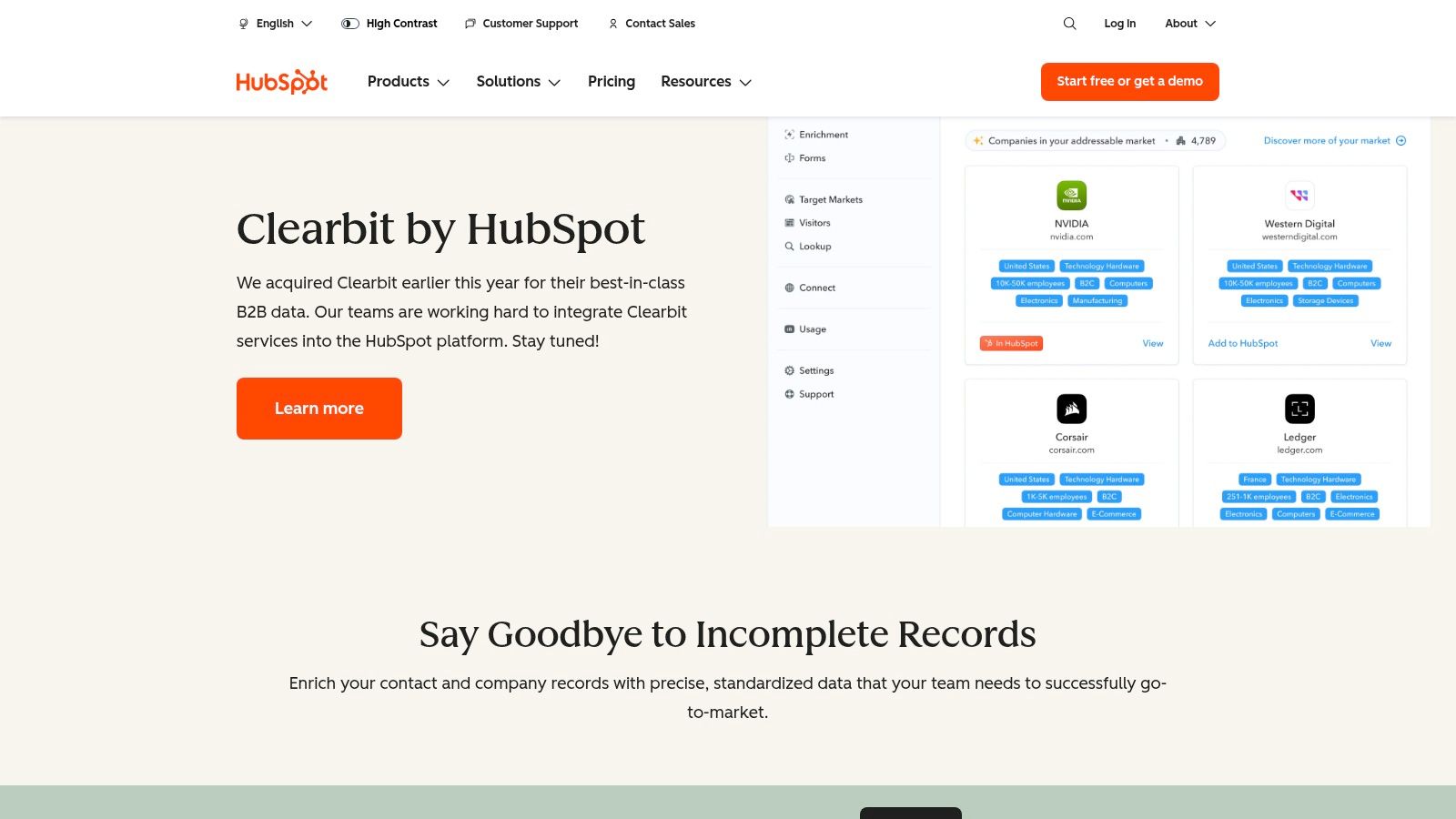
    Clearbit, now integrated into HubSpot as Breeze Intelligence, brings powerful firmographic and contact data enrichment directly into the HubSpot ecosystem. This native solution is designed for marketing and sales teams that live inside HubSpot and want to automate data appending without complex third-party integrations. It excels at turning a simple email address into a full contact and company profile, enabling better segmentation, lead scoring, and personalization from the moment a lead enters the CRM.
    Clearbit (Breeze Intelligence) via HubSpot

    What makes this one of the best data enrichment tools for HubSpot users is its seamless workflow enhancement. Beyond just appending data, it powers features like form shortening to reduce friction and improve conversion rates. It also identifies anonymous website visitors, turning unseen traffic into actionable company-level leads. As legacy free Clearbit tools have been sunset, this HubSpot-centric model offers a fully supported, deeply embedded alternative, though access and pricing are now tied to HubSpot's subscription plans.

    Key Features & Use Case

    • Real-Time Enrichment: Automatically appends over 100 data points to new contacts and companies inside HubSpot.
    • Form Shortening: Increases lead capture rates by enriching partial form submissions with complete data.
    • Website Visitor Identification: Reveals the companies visiting your website, even if they don't fill out a form.
    • Attribute-Based Lead Routing: Uses enriched data like company size or industry to instantly route leads to the correct team.

    Best for: B2B companies heavily invested in the HubSpot platform looking for a native, all-in-one enrichment and intent solution.

    Pros Cons
    Deeply native to HubSpot, eliminating integration complexities Access and pricing are dependent on HubSpot plans and add-ons
    Provides standardized and precise B2B data attributes Less flexible for companies not using HubSpot as their primary CRM
    Powers advanced HubSpot features like lead routing and scoring Legacy free Clearbit tools are no longer available

    Website: https://www.hubspot.com/products/clearbit

    4. Apollo.io – Data Enrichment

    Apollo.io offers a unified sales intelligence and engagement platform where data enrichment is a core component of a broader prospecting workflow. It stands out by combining a vast B2B database with enrichment, sequencing, and analytics tools, making it a comprehensive solution for sales and marketing teams. The platform supports enriching both company and contact data directly within its ecosystem or by syncing with an existing CRM, providing a seamless operational flow from data acquisition to outreach.
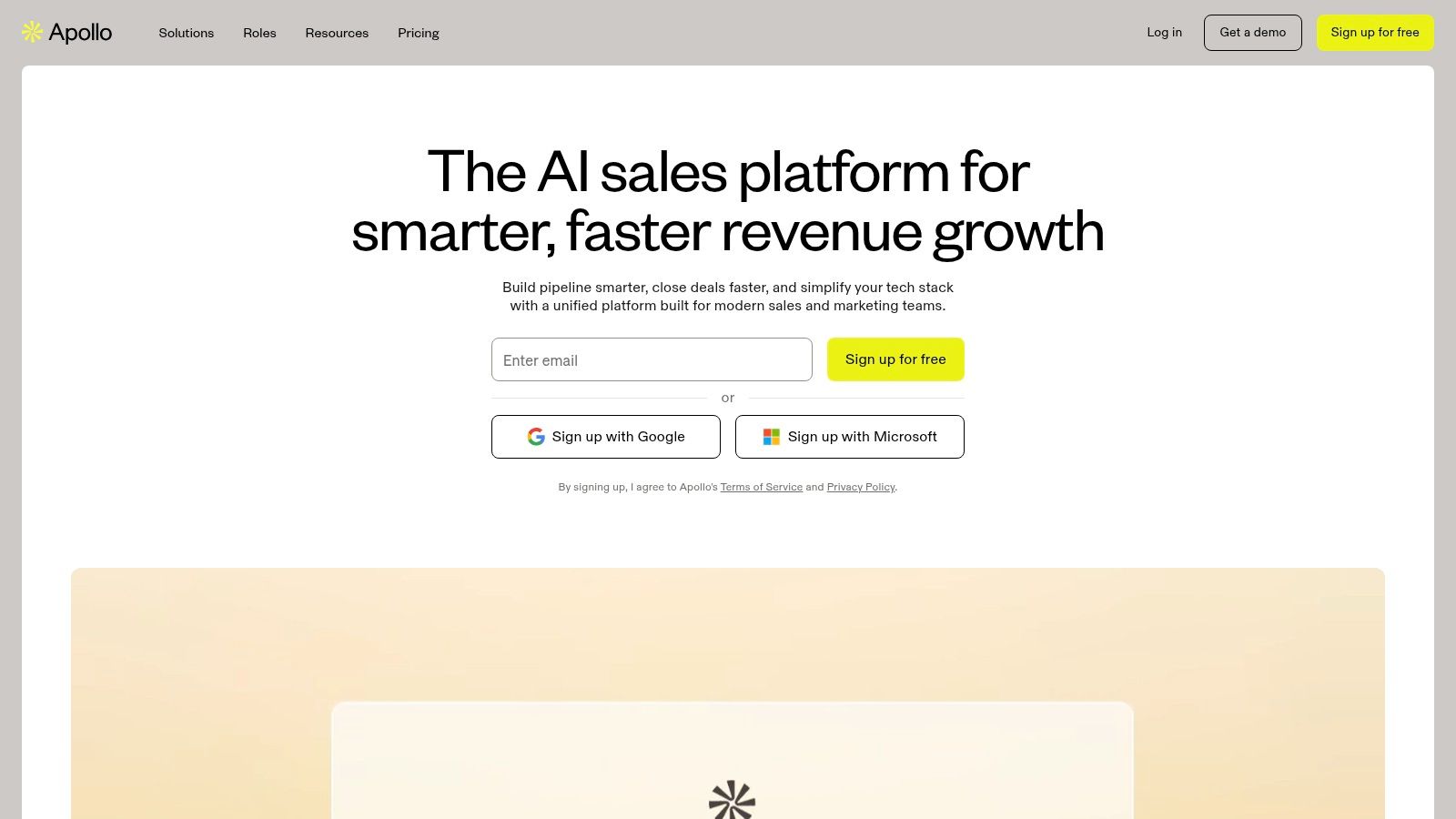
    Apollo.io – Data Enrichment

    Unlike standalone data enrichment tools, Apollo.io’s value lies in its all-in-one nature and transparent, self-serve model. A key differentiator is its waterfall enrichment capability, which can query multiple data sources to find the most accurate information, ensuring a higher fill rate. This flexibility allows users to leverage Apollo's native data or even integrate their own preferred providers. This makes it one of the best data enrichment tools for teams that need both a powerful data source and the tools to act on that data immediately.

    Key Features & Use Case

    • CSV Enrichment: Bulk enrich contact and company lists by uploading files with up to 100,000 rows.
    • Real-time & Scheduled CRM Enrichment: Automatically keep Salesforce and HubSpot records up-to-date with real-time or scheduled jobs.
    • Waterfall Enrichment: Increases data accuracy and fill rates by checking multiple providers, including native and third-party options.
    • Integrated Sales Engagement: Combine enriched data with built-in sequencing, dialer, and analytics for a full-cycle prospecting solution.

    Best for: Sales and growth teams looking for an all-in-one platform that integrates robust data enrichment with prospecting and engagement tools.

    Pros Cons
    Self-serve onboarding and comprehensive documentation Credit consumption can vary depending on the data source being used
    Combines enrichment with sequencing and dialer capabilities in one tool Advanced features like waterfall enrichment may require higher-tier plans
    Transparent, flexible pricing plans suitable for various team sizes The sheer number of features can present a learning curve for new users

    Website: https://www.apollo.io

    5. Lusha

    Lusha is a popular data enrichment tool known for its simplicity and ease of use, making it a favorite among sales professionals and recruiters. It primarily operates through a browser extension, API, and a dedicated platform, allowing users to quickly find B2B contact and company data directly from social media profiles, company websites, or their own CRM. Its credit-based model is straightforward, with users spending credits to reveal contact details like email addresses and direct phone numbers.
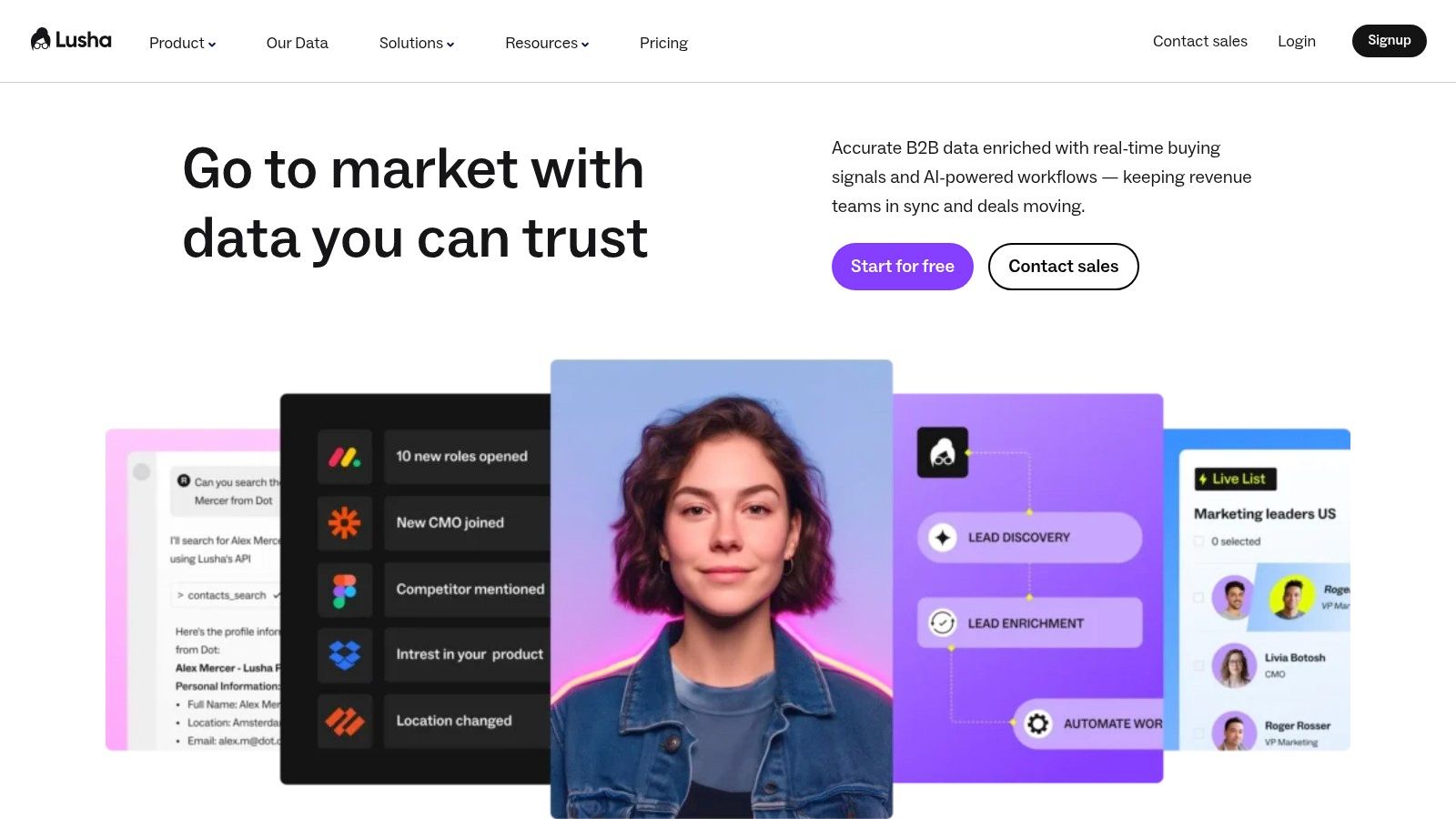
    Lusha

    What sets Lusha apart is its accessibility and speed, designed for individuals and teams who need on-the-spot enrichment without complex configurations. While many of the best data enrichment tools focus on large-scale, automated database cleansing, Lusha excels at providing immediate, actionable data for prospecting and outreach. The platform’s API allows for programmatic enrichment, but its core strength lies in empowering end-users to enrich contacts one by one or in small batches, directly within their prospecting workflow.

    Key Features & Use Case

    • Chrome Extension: Enables real-time contact data reveals on LinkedIn and other websites.
    • Usage-Based API: Provides programmatic enrichment where you pay per successful data result using credits.
    • CRM Integrations: Connects with popular platforms like Salesforce and HubSpot to enrich existing records.
    • In-Platform Prospecting: Users can search for and export company and contact data using credits.

    Best for: Sales teams and individuals who need a fast, user-friendly tool for on-demand contact and company data enrichment.

    Pros Cons
    Very easy to adopt with quick reveals directly on profiles Advanced filters and key CRM features are limited to higher-priced plans
    Clear credit-based pricing model for API and platform usage The credit math for different API requests can add overhead to planning
    Strong focus on providing direct-dial phone numbers Data accuracy can vary, particularly for smaller or niche industries

    Website: https://www.lusha.com

    6. People Data Labs (PDL)

    People Data Labs (PDL) offers a developer-first approach to data enrichment, focusing on robust APIs for person, company, and IP data. It stands out with a transparent, usage-based pricing model that appeals to engineering teams and businesses wanting granular control over their spending. The platform provides a powerful suite of tools designed for programmatic integration, allowing users to build data enrichment directly into their applications and workflows with precision.
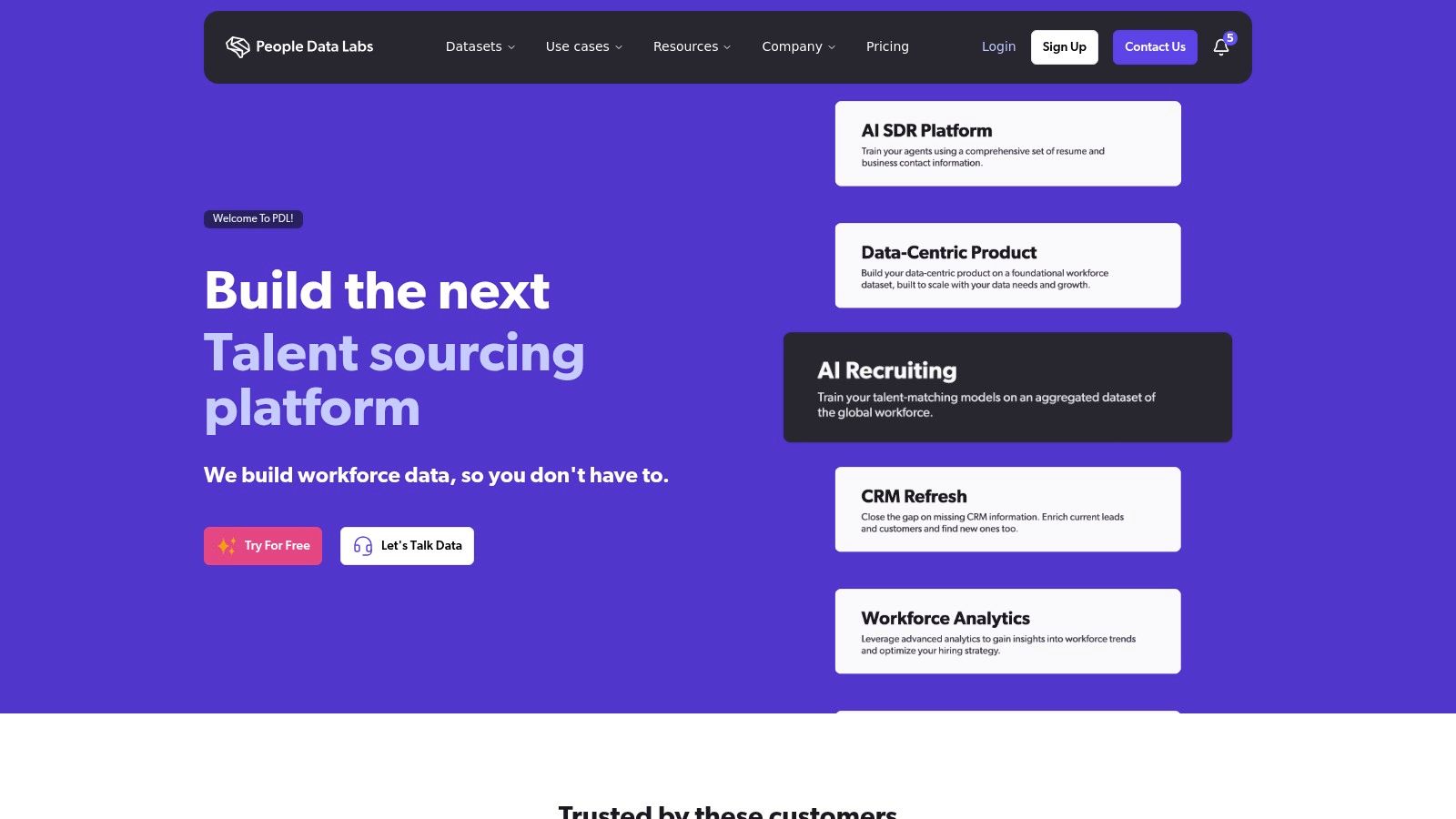
    People Data Labs (PDL)

    Unlike all-in-one platforms, PDL’s strength lies in its flexibility and extensive documentation, empowering developers to query a massive dataset of over 3 billion profiles. This makes it one of the best data enrichment tools for custom projects, such as powering recruiting platforms, verifying user identities, or building sophisticated lead-scoring models. While its core is API-centric, PDL also offers a Batch Enrich UI, enabling non-technical users to enrich CSV files without writing any code.

    Key Features & Use Case

    • Person & Company Enrichment APIs: Access detailed profiles using inputs like email, social URLs, or company domains.
    • IP Enrichment API: Reveal company firmographics associated with an IP address for website personalization.
    • Usage-Based Credits: A transparent pricing model where you only pay for the data you use.
    • Batch Enrich UI: A no-code option for enriching large contact or company lists via CSV upload.

    Best for: Engineering teams and data-driven businesses that need flexible, API-first data enrichment with transparent, predictable pricing.

    Pros Cons
    Transparent, per-credit pricing model avoids large contracts API-centric approach may be less friendly for non-technical users
    Generous 30-day free trials with starter credits to test APIs Per-match pricing requires careful volume planning to manage costs
    Extensive, well-documented APIs for easy integration Focus on raw data may require more internal development to operationalize

    Website: https://www.peopledatalabs.com

    7. Dun & Bradstreet – D&B Optimizer / D&B Connect for Salesforce

    Dun & Bradstreet offers an enterprise-grade data enrichment solution directly within Salesforce, built on its foundational D‑U‑N‑S Number system. D&B Connect is designed for organizations that prioritize master data management, providing authoritative firmographic data and clear corporate hierarchies. This tool excels at cleansing, standardizing, and enriching account records, ensuring a single source of truth for global sales teams.

    What sets D&B apart is its legacy and focus on verified, structured business identity. The platform uses the D&B Data Cloud to match and append over 1,000 data attributes, including corporate linkage, revenue, industry codes, and risk indicators. This makes it one of the best data enrichment tools for complex enterprises needing to map large, interconnected accounts and maintain impeccable data hygiene at scale. The platform is less focused on individual contact details like personal emails and more on creating a rock-solid, verifiable account foundation.

    Key Features & Use Case

    • D-U-N-S Number Matching: Matches accounts to a unique nine-digit identifier for high-confidence data accuracy and deduplication.
    • Hierarchical Account Views: Maps corporate family trees, showing parent companies and subsidiaries for strategic account planning.
    • Data Stewardship Dashboards: Provides tools for data governance, monitoring data quality, and managing cleansing rules.
    • Continuous Enrichment: Automatically updates and maintains account data within Salesforce to prevent data decay.

    Best for: Large enterprises using Salesforce that require authoritative, globally consistent firmographic data and corporate linkage.

    Pros Cons
    Strong match rates and clear data lineage via D-U-N-S Numbers Enterprise-oriented pricing and a lengthy procurement process
    Excellent for global B2B firmographics and account hierarchies Primarily focused on account-level data; less emphasis on personal emails/phones
    Robust data governance and stewardship tools Can be complex to implement without dedicated data management resources

    Website: https://www.dnb.com/products/marketing-sales/salesforce-data-management/.html

    8. Dropcontact

    Dropcontact offers a unique approach to data enrichment, focusing heavily on finding and validating professional email addresses through sophisticated algorithms rather than a static database. This makes it an excellent choice for businesses, particularly SMBs in the EU and US, that prioritize high email deliverability and want to minimize bounce rates. The platform is designed for simplicity, offering straightforward enrichment from just a first name, last name, and company website.
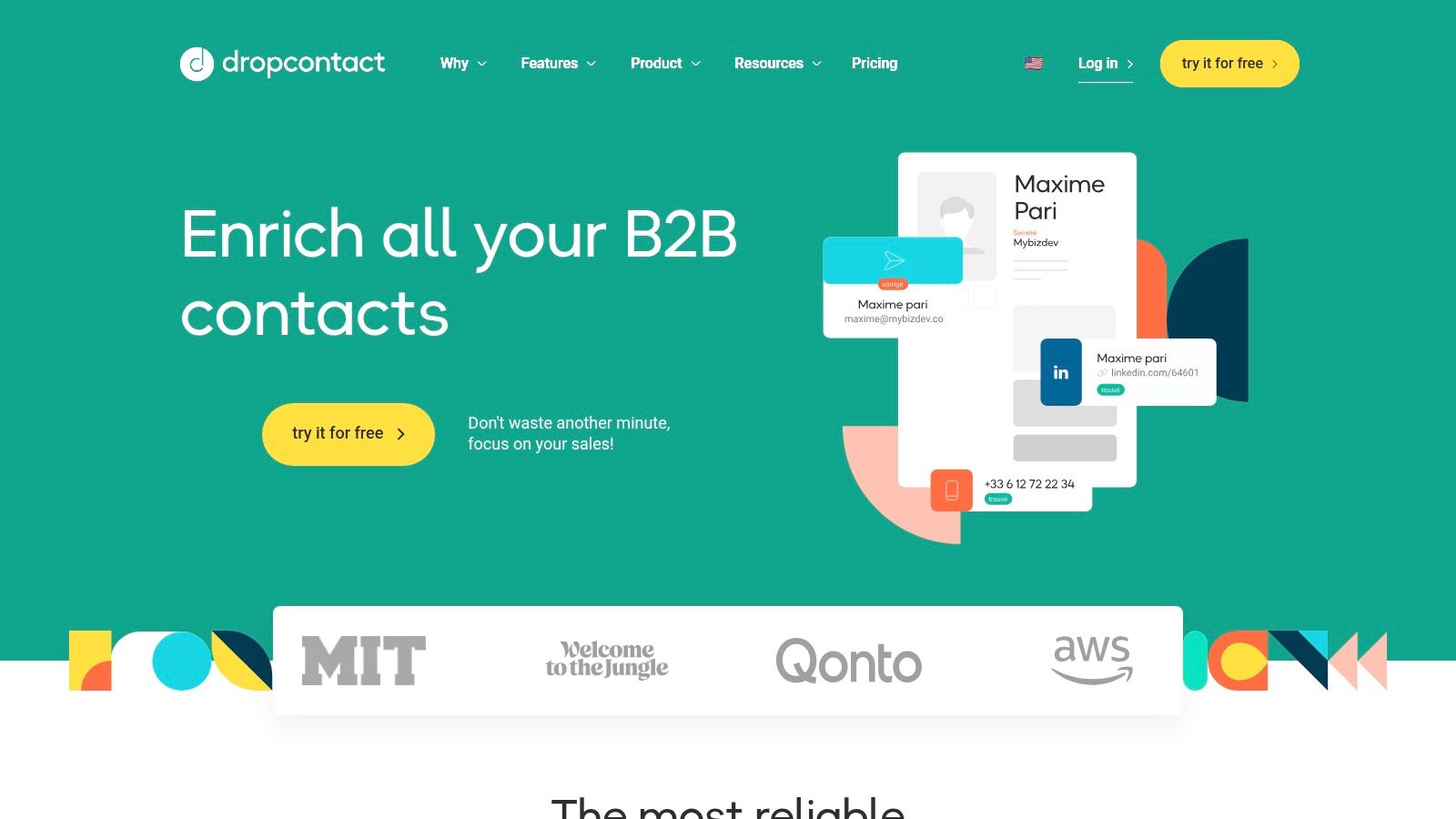
    Dropcontact

    Unlike database-driven tools, Dropcontact’s real-time verification process ensures the data provided is fresh and accurate at the moment of the request. Its pricing model is also a key differentiator; users are only charged for successfully found and verified emails, with credits for unsuccessful searches being returned to their account. This transparent, performance-based model appeals to teams looking for one of the best data enrichment tools without complex contracts or wasted spend on incomplete data.

    Key Features & Use Case

    • Algorithmic Email Finding: Uses proprietary algorithms to find and verify emails in real time.
    • Native CRM Enrichment: Directly integrates with HubSpot and Pipedrive to enrich contacts automatically.
    • Flexible Enrichment Options: Supports enrichment via file upload, single lookup, and a robust API.
    • Credit Carryover: Unused credits roll over, and credits for unfound contacts are returned.

    Best for: SMBs and sales teams that need highly accurate, verified email addresses and prefer a simple, pay-for-performance pricing model.

    Pros Cons
    You pay only for emails found, and unfound lookups are re-credited Focus is primarily on email; limited phone number and other data coverage
    Built-in verification improves email validity and reduces bounces CRM enrichment is offered as a separate plan from the Email Finder
    Simple and transparent pricing with credit carryover option Less comprehensive firmographic data compared to enterprise platforms

    Website: https://www.dropcontact.com

    9. Hunter.io

    Hunter.io is widely known for its email discovery and verification capabilities, but it also offers a straightforward lead enrichment service. It’s an ideal tool for teams prioritizing email-centric outreach, providing a simple way to append names, job titles, and social profiles to an existing list of email addresses or domains. The platform's strength lies in its simplicity and transparent, credits-based pricing model, making it accessible for startups and SMBs.
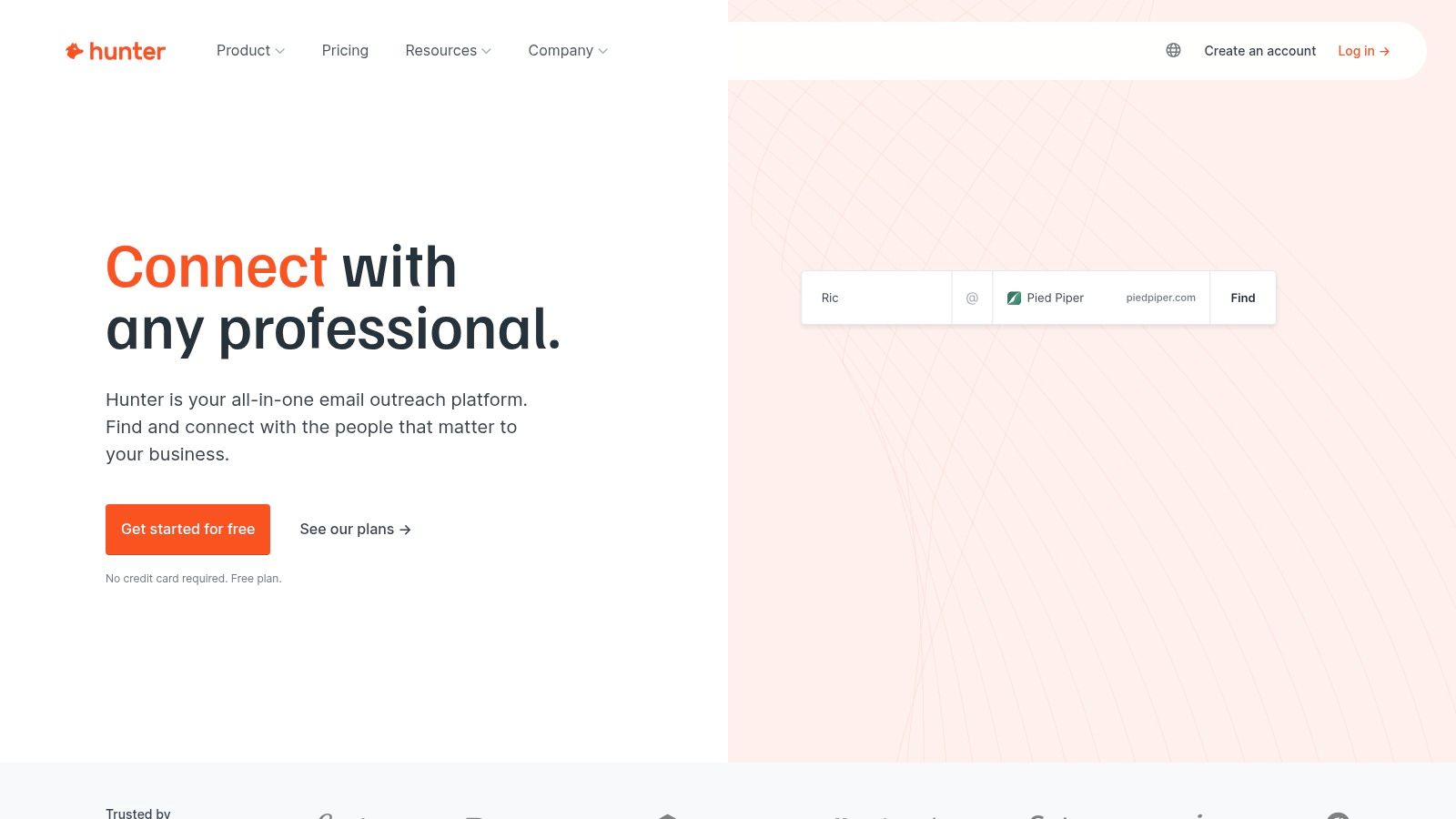
    Hunter.io

    Unlike more complex platforms, Hunter.io focuses on the core data points most essential for personalized email campaigns. Users can enrich data in bulk by uploading a CSV file or use the Google Sheets add-on for seamless workflow integration. Its API and Chrome extension also allow for on-the-fly lookups, making it a highly practical tool for daily prospecting tasks. While its enrichment data is less extensive than enterprise solutions, its built-in email verification is a major advantage, ensuring list quality and deliverability. You can learn more about how tools like this help you find company email addresses.

    Key Features & Use Case

    • Email-First Enrichment: Appends full names, job titles, social links, and company info from an email address.
    • Bulk Enrichment Tools: Supports CSV uploads and a Google Sheets add-on for processing large lists.
    • Integrated Verification: Every enriched email comes with a verification status to reduce bounce rates.
    • API & Browser Extension: Enables real-time enrichment directly within your browser or custom applications.

    Best for: Sales and marketing teams that need a simple, cost-effective tool for email-focused lead enrichment and verification.

    Pros Cons
    Transparent, scalable pricing plans based on a credits model Enrichment is email‑centric with very limited phone or firmographic data
    Built-in email verification helps maintain data hygiene Advanced filters and features are gated behind higher-priced tiers
    Simple interface with easy-to-use bulk and API tools Not as comprehensive for deep B2B account profiling as other tools

    Website: https://hunter.io

    10. Clay

    Clay positions itself as a powerful metaplatform, integrating over 100 data providers into a single, automated workflow builder. Instead of relying on one enrichment source, Clay allows users to "waterfall" requests across multiple providers, ensuring the highest possible data coverage. This unique approach lets you build custom enrichment sequences, chaining sources like Clearbit, PeopleDataLabs, and others until you find the information you need, all within one credit system.
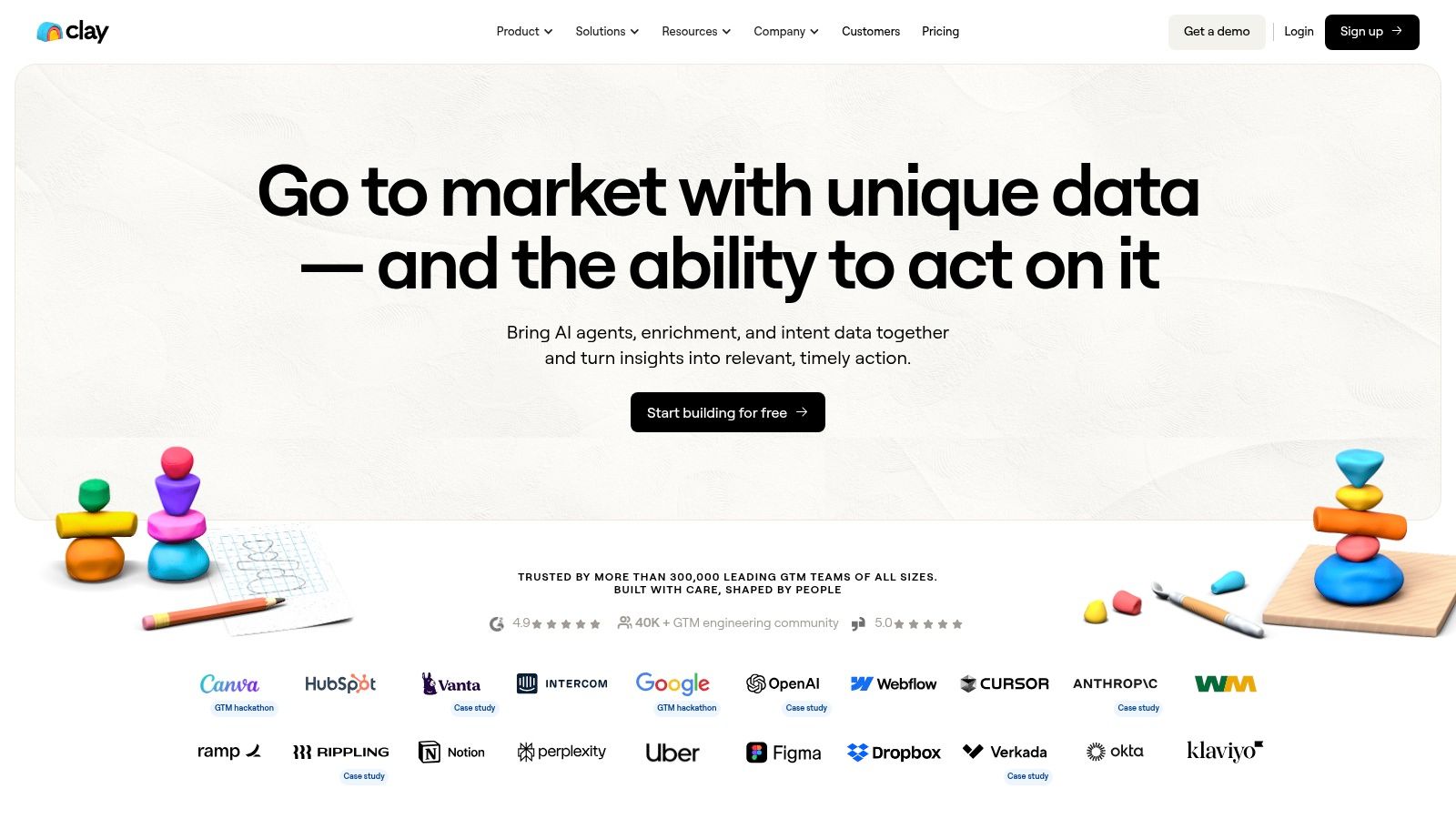
    Clay

    The platform’s core strength is its flexibility. Users are not locked into a single ecosystem; they can even bring their own API keys for providers they already subscribe to. This makes Clay an ideal hub for orchestrating complex data workflows and controlling costs. By leveraging conditional logic and AI agents to research missing data, it goes beyond simple appending to become a comprehensive prospecting and research tool. It’s one of the best data enrichment tools for teams that need to customize their data-gathering process from the ground up.

    Key Features & Use Case

    • Data Provider Waterfalling: Sequentially queries multiple data sources to maximize fill rates for any data point.
    • Bring-Your-Own-Keys (BYOK): Allows users to integrate their existing provider subscriptions using their own API keys.
    • AI-Powered Research: Uses AI agents to find information that traditional databases miss, such as specific project details.
    • Flexible Integrations: Connects to sources via built-in providers, HTTP/API connectors, and webhooks.

    Best for: Tech-savvy sales and operations teams who need maximum data coverage and want to build custom, multi-step enrichment workflows.

    Pros Cons
    Unmatched flexibility with access to over 100 data sources The credit system and workflow setup can be complex for new users
    Credit-based pricing allows for precise cost control Key CRM and sequencing integrations are limited to higher-priced tiers
    Supports unlimited users and offers rollover credits Requires a more hands-on, technical approach than all-in-one platforms

    Website: https://www.clay.com

    11. Salesforce AppExchange – Data Enrichment Apps

    The Salesforce AppExchange is not a single tool but rather a centralized marketplace where Salesforce users can discover, evaluate, and install a wide range of data quality and enrichment applications. It serves as a vetted ecosystem, offering native solutions from providers like Dun & Bradstreet, ZoomInfo, and niche vendors that plug directly into a Salesforce environment. This makes it an essential resource for companies that have built their operations around the Salesforce platform and require tools that are pre-approved for security and compatibility.
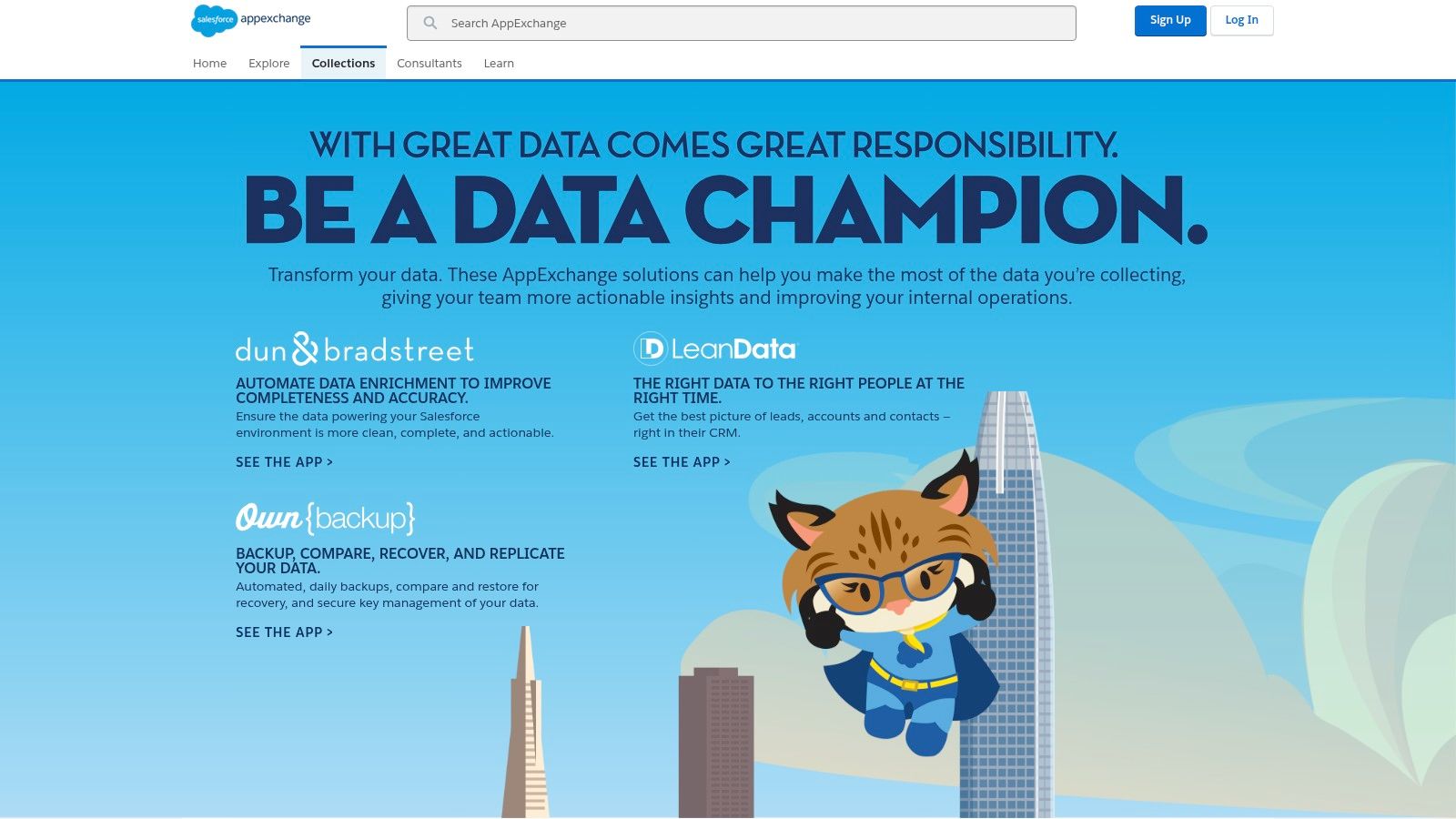
    Salesforce AppExchange – Data Enrichment Apps

    Unlike standalone platforms, the AppExchange’s primary advantage is its seamless integration model. Apps can often be installed with just a few clicks, eliminating complex API configurations. Users can leverage customer reviews, security documentation, and curated collections to find the perfect fit, from broad firmographic enrichers to specialized vertical data providers. This direct-to-CRM approach streamlines workflows and ensures that enriched data immediately populates the right fields, which is a core benefit for any team managing their customer data within Salesforce. If you're exploring how to manage this data effectively, you can learn more about the best contact management software.

    Key Features & Use Case

    • Vetted and Curated Apps: All listings are reviewed by Salesforce for security and quality standards.
    • Click-to-Install Functionality: Enables easy deployment of apps directly into a Salesforce organization.
    • User Reviews and Ratings: Provides social proof and real-world feedback to guide purchasing decisions.
    • Broad Selection: Offers everything from global B2B data providers to niche industry-specific data sources.

    Best for: Companies heavily invested in the Salesforce ecosystem looking for vetted, native data enrichment solutions without complex integration projects.

    Pros Cons
    Seamless single-sign-on and native Salesforce installation Functionality and data quality can vary widely between different apps
    Wide selection of vertical and region-specific providers Many app listings require contacting the vendor directly for pricing
    Vetted solutions with clear security and compliance notes Can be overwhelming to navigate without a clear set of requirements

    Website: https://appexchange.salesforce.com/mktcollections/curated/datachampion?utm_source=openai

    12. AWS Marketplace – Data Enrichment Solutions

    AWS Marketplace offers a unique approach to data enrichment by acting as a procurement hub rather than a single tool. It allows organizations already within the AWS ecosystem to find, subscribe to, and deploy a wide variety of third-party data enrichment and quality solutions with simplified billing and governance. This platform is ideal for teams that need to integrate enrichment services directly into their cloud infrastructure and prefer a consolidated, pay-as-you-go or private offer procurement model.
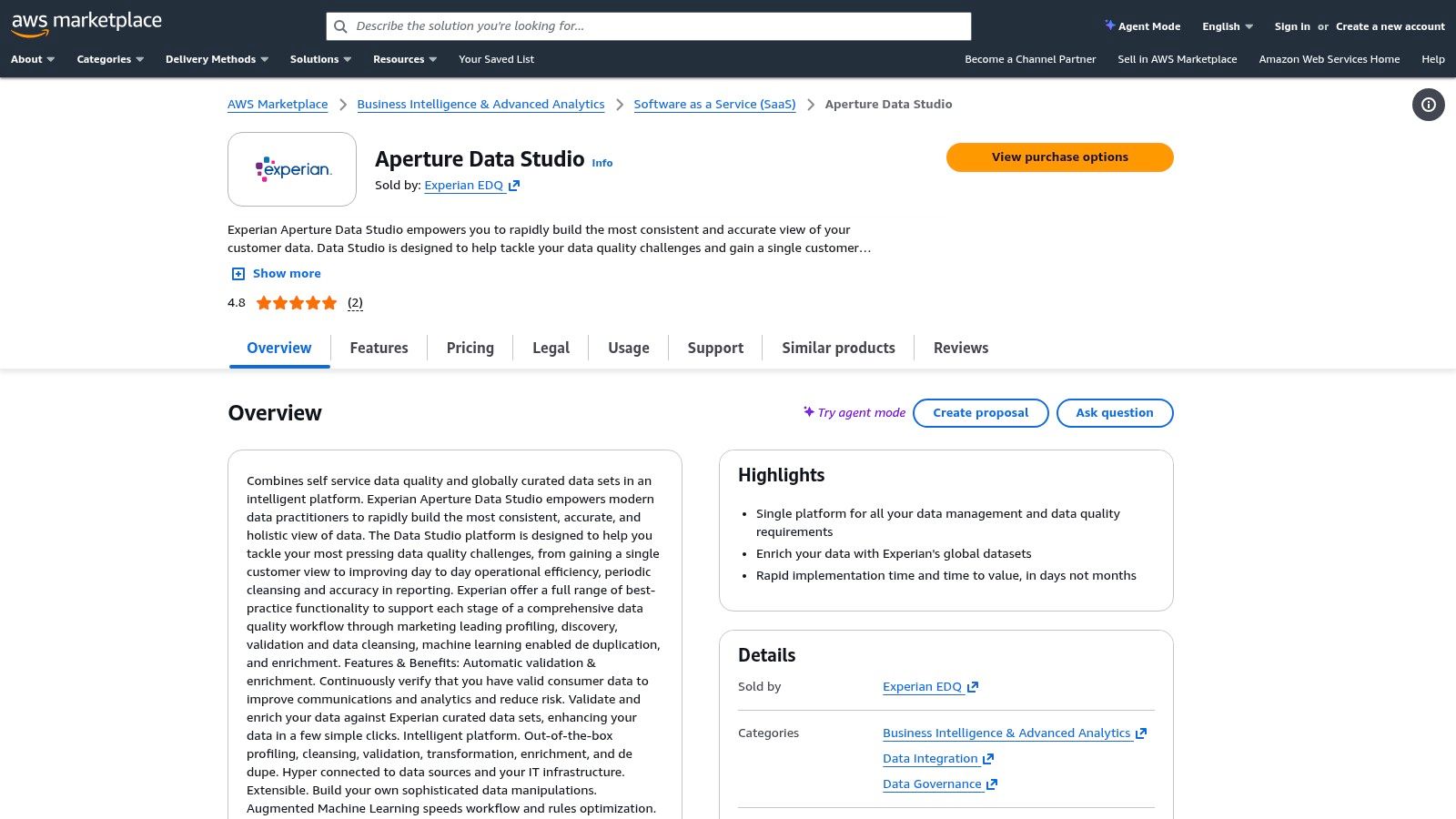
    AWS Marketplace – Data Enrichment Solutions

    Unlike standalone vendors, the marketplace's value is in its flexibility and integration with the AWS environment. Users can find specialized tools like Experian for address validation or LeadiQ for sales intelligence and deploy them as SaaS or machine images that work with AWS services. This centralized model streamlines security reviews, compliance, and billing, which is a major advantage for enterprise-level operations looking for some of the best data enrichment tools that fit their existing cloud strategy.

    Key Features & Use Case

    • Consolidated Billing: All procured services are billed through a single AWS account.
    • Flexible Deployment: Offers both SaaS subscriptions and Amazon Machine Image (AMI) options.
    • Integrated Governance: Leverages existing AWS security and compliance frameworks.
    • Varied Pricing Models: Supports metered usage, trials, and private offers for many listings.

    Best for: Organizations deeply integrated with AWS seeking a streamlined procurement process for various data solutions.

    Pros Cons
    Cloud-ready deployment and enterprise security benefits Discovery requires evaluating multiple listings to find the right vendor
    Wide range of products from data quality to sales enrichment Pricing, coverage, and features vary widely by individual vendor listing
    Simplified procurement and consolidated billing Quality and support are dependent on the specific third-party seller

    Website: https://aws.amazon.com/marketplace/pp/prodview-rsn4tn5e5isno?utm_source=openai

    Top 12 Data Enrichment Tools: Side-by-Side Comparison

    Tool Target audience Core features Unique selling point Pricing Best use
    EmailScout (Recommended) Sales reps, marketers, freelancers, entrepreneurs Chrome extension; AutoSave; URL Explorer; CSV/TXT export; unlimited free finds One‑click scraping + free unlimited searches; fast list building from visited pages Free core; premium from ≈ $9/mo (5k emails/mo); free premium trial Quick, budget-friendly email discovery and exports
    ZoomInfo – Enrich Enterprise sales & marketing teams 200+ firmographic/technographic fields; CRM connectors; scheduled & real‑time enrichment Broad B2B dataset, intent add‑ons, governance controls Custom enterprise pricing (annual) Large orgs needing rich firmographics & data governance
    Clearbit (Breeze via HubSpot) HubSpot users / inbound teams Real‑time enrichment in HubSpot; form shortening; visitor reveal Native HubSpot integration reduces integration overhead Pricing tied to HubSpot plans/add‑ons HubSpot‑centric teams wanting in‑CRM enrichment
    Apollo.io – Data Enrichment SMBs and midmarket sales teams CSV & CRM enrichment; waterfall providers; sequencing & dialer All‑in‑one prospecting + self‑serve plans and docs Transparent self‑serve plans; credits; paid tiers for advanced features Prospecting plus outreach automation and enrichment
    Lusha Sales teams needing fast contact reveals Chrome extension; CRM integrations; per‑result credits for email/phone Quick profile reveals with simple credit model Credit‑based tiers (per result) Fast on‑page contact lookups and simple API use
    People Data Labs (PDL) Engineering teams / developers Person, company, IP enrichment APIs; bulk endpoints; CSV UI Developer‑first APIs with transparent per‑credit pricing Usage‑based credits; 30‑day trial credits API-driven enrichment at scale with predictable pricing
    Dun & Bradstreet – D&B Optimizer Large enterprises with account data needs Continuous account enrichment; D‑U‑N‑S matching; stewardship dashboards Strong company match rates and hierarchical account intelligence Enterprise procurement & pricing Master‑data hygiene and account hierarchy intelligence
    Dropcontact EU/US SMBs focused on deliverability Email finder + verification; API; CRM enrichment; CSV Pay only for found emails; built‑in verification reduces bounces Credit/pricing plans with carryover option Low‑bounce email lists and verified enrichment
    Hunter.io Marketers and sales teams Domain search; email finder & verifier; bulk CSV; Chrome & API Widely adopted, strong auto‑verification and simple pricing Credit/plans scalable by usage Email discovery + verification with bulk tools
    Clay Teams wanting max coverage & flexibility 75–100+ data sources; BYO provider keys; webhooks & CRM connectors Large source marketplace and flexible enrichment recipes Credit‑based pricing; higher tiers for CRM/advanced features Chaining providers to maximize coverage and control costs
    Salesforce AppExchange – Data Apps Salesforce admins & customers Curated enrichment apps; click‑to‑install trials; vendor reviews Vetted marketplace + native installs inside Salesforce Varies by vendor; many require contacting sales Discover and install Salesforce‑native enrichers
    AWS Marketplace – Data Solutions Enterprises with AWS procurement SaaS/AMI listings; metered pricing; AWS integrations (RDS, Snowflake) Consolidated billing and cloud deployment integration Pay‑as‑you‑go, private offers, vendor dependent Procurement of cloud‑ready enrichment tools and billing consolidation

    Turning Enriched Data Into Revenue: Your Next Steps

    Navigating the landscape of data enrichment tools can feel overwhelming, but the journey from raw data to actionable intelligence is a critical one for any modern sales or marketing team. Throughout this guide, we've explored a diverse range of platforms, from the hyper-focused efficiency of EmailScout to the enterprise-grade power of Dun & Bradstreet and the versatile, API-first approach of People Data Labs. The core takeaway is clear: data enrichment is not merely an act of data acquisition. It is the strategic process of transforming incomplete contact lists into comprehensive, revenue-generating assets.

    The true value isn't in having more data points; it's in having the right data points that illuminate the path to a personalized conversation. It’s the difference between a cold, generic email and a tailored outreach that references a prospect’s recent job change, company funding round, or specific tech stack. This level of detail, once a luxury, is now a fundamental requirement for cutting through the noise and building meaningful relationships.

    How to Choose the Right Data Enrichment Tool for Your Team

    The central question is no longer if you should enrich your data, but how. The "best data enrichment tools" are not one-size-fits-all. The ideal solution for your business hinges on a thoughtful evaluation of your unique circumstances. To make the right choice, move beyond feature lists and focus on these critical factors:

    • Workflow Integration: How seamlessly does the tool fit into your existing processes? A powerful tool that disrupts your team’s daily routine will struggle with adoption. Consider native integrations with your CRM (like Salesforce or HubSpot), sales engagement platforms, and marketing automation systems. Tools like Apollo.io and Lusha excel here with their deep CRM synergy.
    • Data Needs & Specificity: What specific information gaps are you trying to fill? If your primary goal is verifying email deliverability and gathering social profiles for cold outreach, a specialized tool like EmailScout or Hunter.io is incredibly efficient. If you require deep firmographic data, technographics, and buying intent signals, a more comprehensive platform like ZoomInfo or Clearbit becomes necessary.
    • Scalability and Pricing: Your needs today may not be your needs tomorrow. Evaluate each tool's pricing model carefully. Pay-as-you-go or credit-based systems offer flexibility for startups and smaller teams, while enterprise-level subscriptions provide predictability for large-scale operations. Always ask about overage costs and how pricing scales as your contact database grows.
    • Data Quality and Compliance: Where does the data come from, and how is it verified? Ensure the provider adheres to global data privacy regulations like GDPR and CCPA. Reliable vendors are transparent about their data sourcing and verification methodologies, which is crucial for maintaining both your sender reputation and legal compliance.

    Your Action Plan: From Evaluation to Implementation

    Information alone doesn't drive results; action does. Use this guide as your launchpad. The next step is to move from theoretical analysis to practical application.

    1. Shortlist Your Top 3: Based on the criteria above, select three tools from our list that appear to be the best fit for your team’s budget, workflow, and data requirements.
    2. Sign Up for Free Trials: This is the most critical step. Nearly every provider, from EmailScout to ZoomInfo, offers a free trial or a freemium plan. Use this opportunity to run a small, controlled test with a segment of your own data. This real-world test is the ultimate evaluation.
    3. Measure the Impact: Compare the results. Which tool provided the most accurate and useful data? Which was easiest for your team to use? Did the enriched data lead to a measurable lift in response rates or meeting bookings?

    By systematically testing these solutions, you replace guesswork with evidence. You’re not just buying a software subscription; you’re investing in a system designed to fuel every stage of your customer lifecycle. To truly maximize the impact of your enriched data and transform it into revenue, consider exploring advanced topics like AI-powered sales intelligence, which leverages comprehensive data for deeper insights and more effective sales strategies. Ultimately, the right data enrichment tool empowers you to work smarter, engage more meaningfully, and turn every contact into a potential opportunity for growth.


    Ready to stop guessing and start connecting? EmailScout provides the fast, accurate, and affordable data enrichment you need to supercharge your outreach. Turn a simple name and company into a verified email, LinkedIn profile, and more in seconds, ensuring your message always lands in the right inbox. Start your free premium trial with EmailScout today and see the difference verified data makes.


  • Reverse Lookup on Email Address to Find Names and Companies

    Reverse Lookup on Email Address to Find Names and Companies

    So, you have an email address, but that’s it. What can you actually do with it?

    That’s where a reverse lookup on an email address comes in. It's the process of taking that single piece of information and uncovering the details behind it—like the owner’s name, the company they work for, and even their social media profiles.

    This isn't just about satisfying curiosity. For professionals, it's about turning an unknown email into a real, actionable contact you can use for outreach, verification, or qualifying a new lead.

    What a Reverse Email Lookup Actually Reveals

    A laptop showing a profile page with a man, coffee, and a "REVEAL CONTACT" speech bubble on a wooden desk.

    Let's cut through the noise. At its core, a reverse email lookup is about building a more complete picture of the person on the other side of the screen. Think of it as a fundamental first step in modern business communication.

    Imagine you get an inquiry from "sales_inquiry@acmecorp.com." On its own, it’s just another message in your inbox. But with a quick lookup, you might discover it belongs to Jane Doe, the Director of Marketing at Acme Corp. Suddenly, that generic inquiry transforms into a high-value lead.

    From Anonymity to Actionable Insight

    This whole process is about turning anonymity into opportunity. For sales and marketing folks, the benefits are immediate and obvious. When you can find a person's name, role, and professional background, your outreach becomes incredibly personalized and relevant—which is always more effective than a generic blast. We actually dive deep into the specific methods in our guide on performing a detailed email address lookup.

    This simple shift from unknown to known is a game-changer in a few key areas:

    • Sales Prospecting: Pinpoint the key decision-makers you need to talk to.
    • Lead Qualification: Quickly verify if an inbound lead is legit and fits your ideal customer profile.
    • Recruitment: Get a better sense of a candidate’s professional footprint before you even reach out.
    • Risk Assessment: Check if an email is valid to avoid falling for potential scams or phishing attempts.

    The goal here isn't about digging into private lives. It's about gathering publicly available information to make smarter business decisions and build more meaningful professional relationships.

    The Driving Force Behind Modern Outreach

    The need for these tools has exploded. It’s no surprise, considering that around 59% of B2B marketers say email is their top revenue-generating channel. This heavy reliance on email has fueled the demand for tools that can quickly flesh out a contact profile from a single address.

    A good lookup on a business email can instantly give you a prospect’s full name, job title, LinkedIn profile, and current employer. This is the kind of data that powers tools like EmailScout and makes modern outreach possible. It's a trend that's only growing, as detailed in the full OSINT report here.

    Finding Clues with Manual Search Methods

    A desk setup with a laptop, magnifying glass, and notebooks, illustrating a manual search process.

    Before you jump to specialized tools, you can actually uncover a surprising amount of information with just a few clever manual searches. These are the no-cost, foundational steps for any reverse lookup on an email address.

    Think of it as some old-school digital detective work. Your best friend here is a standard search engine, but the real trick is knowing how to use it with precision.

    Leveraging Search Engine Operators

    Simply pasting an email address into Google often returns a messy, useless pile of results. You need to tell the search engine exactly what you're looking for.

    The easiest and most effective first move is to wrap the entire email address in quotation marks. For example, searching for "jane.doe@acmecorp.com" forces the search engine to find that exact string of text. This one simple command can instantly unearth mentions on:

    • Forums and Message Boards: Places where someone might have registered or posted publicly.
    • Conference Speaker Lists: If they've ever presented at an industry event.
    • Publicly Available Documents: Think PDFs of reports or newsletters where they were credited.

    This technique cuts through the noise and zeroes in on the places where the email owner has left a public footprint.

    Exploring Professional and Social Networks

    The next logical place to look is on professional networking sites, but there's a better way than just searching for the email itself. A more discreet—and often more successful—approach is to search for the email's domain on platforms like LinkedIn.

    If the email is jane.doe@acmecorp.com, a quick search for "Acme Corp" on LinkedIn will pull up their company page. From there, you can browse through employee profiles, looking for someone named Jane or anyone in a role that fits the context of why you're searching. This way, you can often connect a name and face to the email without tipping them off.

    Key Takeaway: Manual searches are all about piecing together publicly available clues. You're not breaking into anything; you're just connecting the dots that are already out there on the web.

    It also helps to understand how data brokers aggregate this kind of information. If you're curious about managing your own data, this guide to opting out of people-search sites like FastPeopleSearch is incredibly helpful.

    These manual methods won't always give you the full story, but they provide a fantastic starting point. If you come away with a potential name and company, you've gathered more than enough intel to decide if it's worth using an automated tool for a deeper dive.

    Automating Lookups with Browser Extensions

    Doing a manual search every now and then is fine for a one-off check, but it just doesn't work when you need to scale up. If you need to reverse lookup on an email address often, browser extensions are your best friend. They bake the whole process right into your web browser, turning what used to be a multi-step chore into a single click.

    Think about it. You’re on a company’s website or scrolling through a LinkedIn profile. Normally, you'd have to copy the email, open a new tab, paste it into a search bar, and wait. An extension does all that heavy lifting for you, right on the page you're already on. This is less about data collection and more about making it a natural, real-time part of your workflow.

    The Power of In-Browser Enrichment

    The real magic of using an extension is context. You're already looking at a page full of valuable info—a blog post, a team page, a social media profile. A tool like EmailScout acts like an intelligent layer on top of that page, instantly adding more detail to the contacts you find.

    This isn't just about saving a few minutes here and there; it’s about making smarter decisions, faster. You can qualify a sales lead, pinpoint a key decision-maker, or just verify someone’s role without ever losing your momentum.

    Here’s a peek at what the EmailScout extension looks like when it uncovers contacts on a webpage.

    The whole thing is designed to be powerful but stay out of your way, letting you build lists and gather intel without any friction.

    A Real-World Workflow Example

    Let's run through a scenario I see all the time. Say you're in sales and need to build a list of marketing managers at software companies.

    1. Head to a Target Company's Website: First, you pull up the site of a software company that looks promising.
    2. Fire Up the Extension: You click the EmailScout icon in your browser. It immediately gets to work scanning the page for any contact info it can find.
    3. Reveal Profiles Instantly: The extension might pick up a generic email like contact@company.com, but more importantly, it cross-references public data to find employee profiles, revealing names, job titles, and LinkedIn profiles.
    4. Save to Your List: You spot the "Marketing Manager," see their verified professional details pop up, and add them straight to your prospecting list right inside the extension.

    This whole thing takes seconds, not minutes. When the lookup happens right where you're already browsing, you can build incredibly targeted lists at a speed that just wasn't possible before. If you're looking to get started, checking out an effective email extractor for Chrome is a great first move.

    By automating these lookups, you shift your focus from tedious data entry to high-value activities like crafting personalized outreach and building relationships. The tool handles the "who," so you can focus on the "how."

    The efficiency boost is huge. Instead of spending hours piecing together contact details by hand, you can build a rich, verified list of dozens of prospects in the time it used to take to research just a handful. For anyone in sales, marketing, or recruiting, this kind of automation is a game-changer for working smarter, not harder.

    Going Deeper With Advanced Contact Enrichment

    Finding a name and title is a solid start, but the real magic happens when you turn that one piece of data into a full professional picture. This is where advanced contact enrichment comes in. You're using the initial details from a reverse lookup on an email address to build a profile that gives you a genuine advantage. It's all about connecting the dots to see the bigger picture—who this person is, what they do, and where they fit in their company.

    Once you have a name and a LinkedIn profile, don't stop there. Cross-reference it. LinkedIn might say "Senior Manager," but a quick look at the company's 'About Us' page could show they actually lead a major department. This simple check confirms their role in the company hierarchy and tells you if they're the right person to talk to.

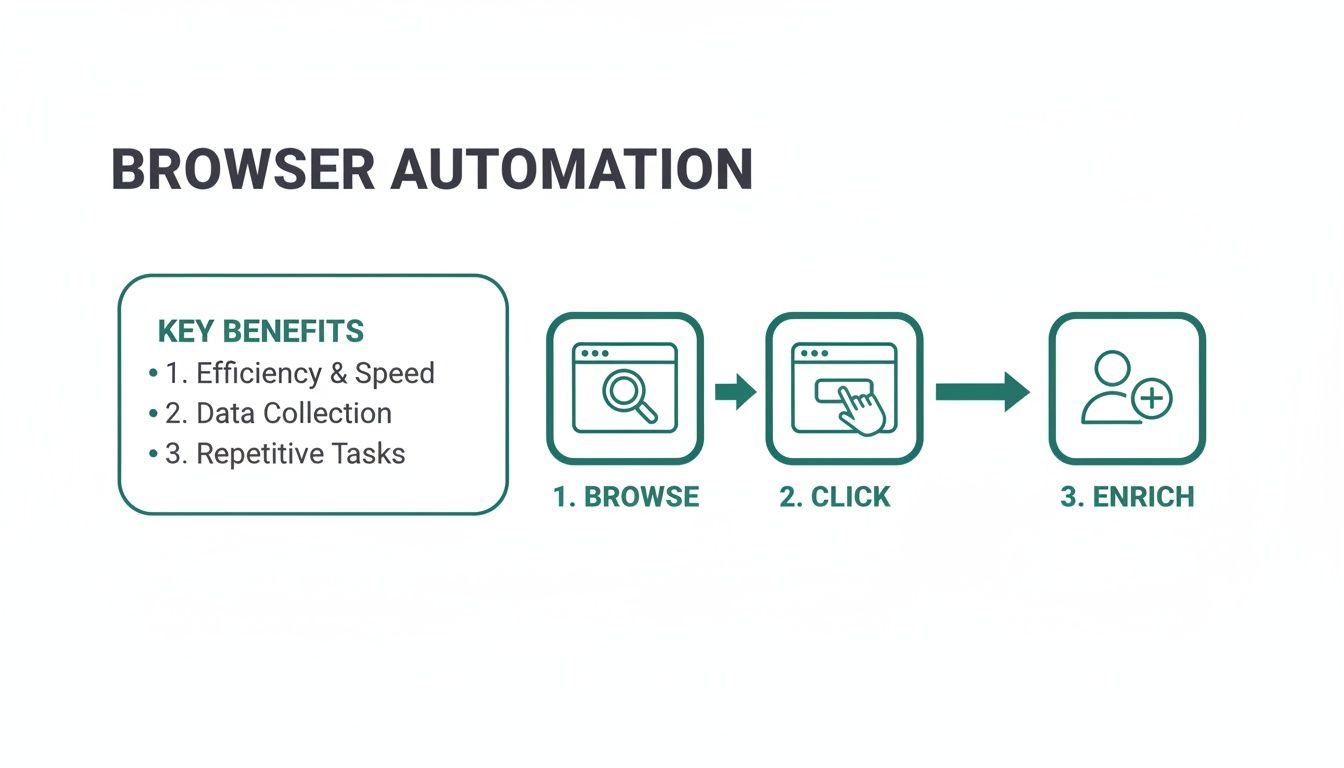
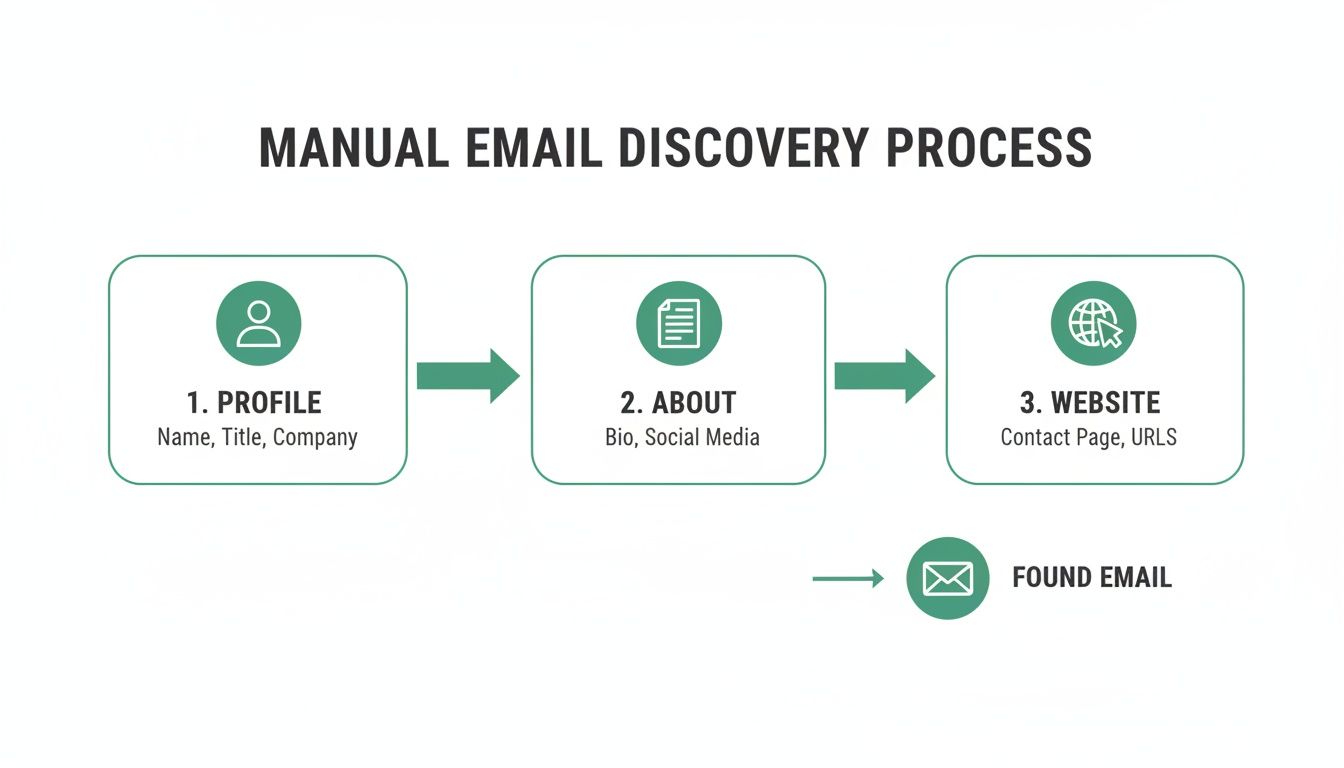
    This quick diagram shows just how simple and automated this process can be with the right tools.

    Diagram illustrating browser automation benefits: efficiency, data collection, and repetitive tasks with a browse, click, and enrich process.

    It perfectly visualizes how you can turn a passive browsing session into an active intelligence-gathering mission.

    Transforming Data Into Conversational Fuel

    Don't forget about the email's domain—it’s a goldmine. If you have jane.doe@techstartup.com, the domain is your next clue. A bit of research on "TechStartup Inc." can uncover critical context:

    • Industry and Niche: Do they operate in a sector you know well?
    • Company Size: Are you dealing with a nimble startup or a massive corporation?
    • Recent News: Have they just landed a huge funding round or launched a new product?

    This isn't just random trivia. It’s the raw material for crafting a message that actually gets read. Mentioning their latest funding round shows you've done your homework and aren't just blasting out another generic email.

    Manual vs Automated Reverse Lookup Methods

    While manual searching has its place, automated tools dramatically speed up the process and often deliver richer data. Here’s a quick comparison.

    Feature Manual Search (e.g., Google, Social Media) Automated Tool (e.g., EmailScout)
    Speed Slow and time-consuming; one contact at a time. Fast and efficient; can process multiple contacts at once.
    Data Quality Variable; depends on public information and search skills. High; aggregates data from multiple sources for accuracy.
    Information Depth Often limited to name, company, and basic social profiles. Comprehensive; provides roles, company details, social links, and more.
    Scalability Not scalable for large lists. Highly scalable; designed for bulk enrichment.
    Ease of Use Requires significant effort and cross-referencing. Simple and user-friendly, often a one-click process.

    Ultimately, while manual methods are free, the time you save and the quality of information you gain from an automated tool often provide a much better return.

    Choosing the Right Tools and Staying Secure

    Automated enrichment tools are powerful, but they often need to connect with your other platforms. Before you jump in, it’s smart to think about security. Taking a few minutes for understanding the safety of connecting third-party apps to your email is a crucial step to keep your data safe and compliant.

    Key Insight: Advanced enrichment is about building a 360-degree view of your contact. It’s the difference between saying, "Hi Jane," and saying, "Hi Jane, congrats on the recent product launch—I saw it featured in TechCrunch."

    This deeper level of research turns a simple email address into a real strategic asset. It gives you the context you need to write messages that resonate, build rapport, and start conversations that actually go somewhere.

    Protecting Your Reputation with Email Verification

    So, you've successfully run a reverse lookup on an email address and found the person you were looking for. Great. But that's only half the battle.

    Figuring out who an email belongs to is useless if sending a message to them tanks your credibility. This is where email verification becomes an absolute must-do.

    Think about it. You spend hours crafting the perfect outreach campaign, hit send, and then watch as a chunk of your messages bounce right back. Every single one of those bounces is a little red flag to email providers like Gmail and Outlook, making you look like a potential spammer.

    Rack up enough of those, and your sender reputation goes down the drain.

    The Hidden Dangers of High Bounce Rates

    Your sender reputation is one of your most valuable assets online. Once it's damaged, even your legitimate emails to real, interested people are far more likely to get buried in the spam folder. In the worst-case scenario, your entire domain can get blacklisted, completely shutting down your email marketing.

    The fallout is more than just poor deliverability:

    • You Get Flagged as Spam: Internet Service Providers (ISPs) watch bounce rates like a hawk. A high rate is one of the fastest ways to get your domain flagged.
    • You Waste Resources: Every bounced email is a sunk cost. It’s time, effort, and money you spent on outreach that never even had a chance to be seen.
    • Your Domain Gets Blacklisted: If you keep sending to bad addresses, you can land on public blacklists, making it almost impossible for anyone to get your emails.

    Verification isn't just a technical chore; it's a strategic move to make sure your messages actually get delivered. It protects your ability to communicate and maximizes the ROI of your entire outreach effort.

    Combining Lookup and Verification for a Clean List

    Thankfully, modern tools get this. They often bundle lookup and verification features into one smooth workflow. This approach makes sure that every contact you find is not only identified but also confirmed to be active and deliverable. You end up with a clean, high-quality list that’s ready for a successful campaign.

    This two-in-one punch is critical for protecting your sender reputation. Fake addresses, invalid emails, and spam traps are everywhere. Major providers like Google and Microsoft have reputation systems that heavily penalize senders who hit these bad addresses. A tool that confirms an email is both real and deliverable helps you dodge these landmines, keep your list clean, and maintain a high sender score.

    This simple practice ensures the intel you gain from a reverse email lookup actually leads to successful conversations, not a trashed reputation. Before you launch anything, you can verify any email address to make sure your list is pristine. It’s the final, crucial step in turning raw data into real opportunities.

    Common Questions About Email Lookups

    When you first dive into the world of a reverse lookup on an email address, a few questions always pop up. It’s smart to get these sorted out before you start, just so you know what’s possible and how to go about it responsibly.

    Let’s clear up some of the most common uncertainties people have.

    Is It Legal to Perform a Reverse Email Lookup?

    The short answer is yes, it's generally legal. The key here is that you're gathering information from publicly available sources. This is a common practice known as Open Source Intelligence (OSINT), which is all about piecing together data that’s already out there on the web.

    Tools like EmailScout work by pulling this public information from places like professional networks, company websites, and online directories. The critical part isn’t the lookup itself, but how you use the information you find.

    Always make sure you’re playing by the rules, especially with privacy regulations like:

    • GDPR (General Data Protection Regulation) if you're dealing with contacts in the EU.
    • CCPA (California Consumer Privacy Act) for anyone based in California.

    As long as you’re using the data for legitimate business reasons—like qualifying a lead or doing professional outreach—and not for harassment or personal snooping, you're in the clear.

    What Information Can I Realistically Find?

    This really depends on the type of email you're looking up. You'll get the most useful professional data from a business email address.

    The main takeaway: You’re aiming to build a professional picture for legitimate communication, not uncover sensitive personal details. Consumer emails from services like Gmail or Yahoo are much more private and will give you far less information.

    For a business address (like jane.doe@company.com), you can often expect to find:

    • The person's full name
    • Their current job title and role
    • The company they work for
    • A direct link to their LinkedIn profile

    Sometimes, you might also find a general location or links to other professional social media accounts, which can be great for adding context to your outreach.

    How Accurate Are Reverse Email Lookup Tools?

    Good tools are highly accurate, especially for business contacts, because they draw from massive, constantly updated databases. But let's be realistic—no tool is 100% infallible. People change jobs, companies rebrand, and roles evolve. The professional world moves fast.

    That's why the best practice is always a two-step process: look up, then verify. The top-tier tools will offer email verification right alongside their lookup features. This final check confirms the email is still active and can receive messages, which protects you from bounces and keeps your sender reputation intact, even if a contact’s job title has changed since the data was last updated.


    Ready to turn anonymous emails into real, actionable leads? EmailScout gives you the tools to perform accurate lookups and enrich your contact data in seconds. Find unlimited emails for free and start building your marketing lists today.

  • 10 Proven Small Business Growth Strategies to Scale in 2026

    10 Proven Small Business Growth Strategies to Scale in 2026

    Moving a small business from survival to significant scale requires more than just hard work; it demands a strategic playbook. Many entrepreneurs and sales leaders hit a frustrating plateau where initial momentum wanes, leaving them unsure which levers to pull next for consistent expansion. The critical shift is moving from random, reactive tactics to a focused, repeatable system for acquiring and retaining high-value customers. This transition is the foundation of all effective small business growth strategies.

    This guide is designed to provide that system. We break down 10 proven, actionable frameworks that deliver measurable results across the entire customer lifecycle. You won't find vague advice here. Instead, we dive into the specific mechanics of hyper-targeted outreach, building powerful partner ecosystems, and leveraging customer advocacy for exponential growth.

    Each strategy is presented as a practical roadmap, complete with implementation steps, key performance indicators (KPIs) to track success, and brief examples. We'll cover everything from precision-targeted Account-Based Marketing (ABM) and cold email outreach to scalable content marketing engines and product-led growth models. Whether you're in B2B SaaS, a professional service firm, or a startup looking to scale, these frameworks will provide the clarity and direction needed to fuel your next stage of expansion. We'll also provide practical notes on how tools like EmailScout can accelerate your outreach and lead generation efforts within these strategies.

    1. Cold Email Outreach & Lead Generation

    Cold email outreach is a powerful direct marketing strategy for businesses aiming to connect with potential clients who have not previously engaged with their brand. This approach involves sending targeted, unsolicited emails to a carefully curated list of prospects. It's a proactive method for generating leads, particularly effective in the B2B space where identifying key decision-makers is crucial for success.

    This strategy works by combining precision targeting with compelling, personalized messaging. Tools like EmailScout are essential for discovering and verifying the email addresses of specific individuals within target companies, ensuring your message reaches the right inbox. When executed correctly, cold email serves as a direct line to potential customers, enabling you to start conversations and book meetings at scale.

    How to Implement This Strategy

    Successful cold email outreach requires a systematic approach rather than just sending mass emails. Start by defining your ideal customer profile (ICP) to build a hyper-targeted prospect list.

    • Build a Targeted List: Use an email finder to identify contacts who fit your ICP. Focus on roles, industries, and company sizes that align with your solution.
    • Craft Personalized Messages: Generic emails are ignored. Personalize your outreach by referencing the prospect's company, recent achievements, or industry-specific challenges. A compelling subject line is your first and most important hurdle.
    • Develop a Follow-up Sequence: Most responses come from follow-up emails. Plan a sequence of 3-4 polite, value-driven messages sent over two to three weeks. For a deeper dive, explore these proven techniques for writing effective cold emails.
    • A/B Test and Optimize: Continuously test different subject lines, body copy, and calls-to-action to see what resonates with your audience.

    Key Insight: The goal of a cold email isn't to make an immediate sale; it's to start a conversation. Focus on providing value and sparking curiosity with a single, clear call-to-action, like scheduling a brief call.

    This method stands out among small business growth strategies because it is highly scalable and cost-effective. While social platforms are valuable, combining your email efforts with the Top LinkedIn Lead Generation Strategies can create a multi-channel outreach system that significantly amplifies your pipeline and accelerates growth.

    2. Account-Based Marketing (ABM)

    Account-Based Marketing (ABM) is a focused growth strategy where marketing and sales teams collaborate to target a select list of high-value accounts. Instead of casting a wide net with broad marketing campaigns, ABM treats individual accounts as unique markets, delivering highly personalized experiences to key decision-makers within them.

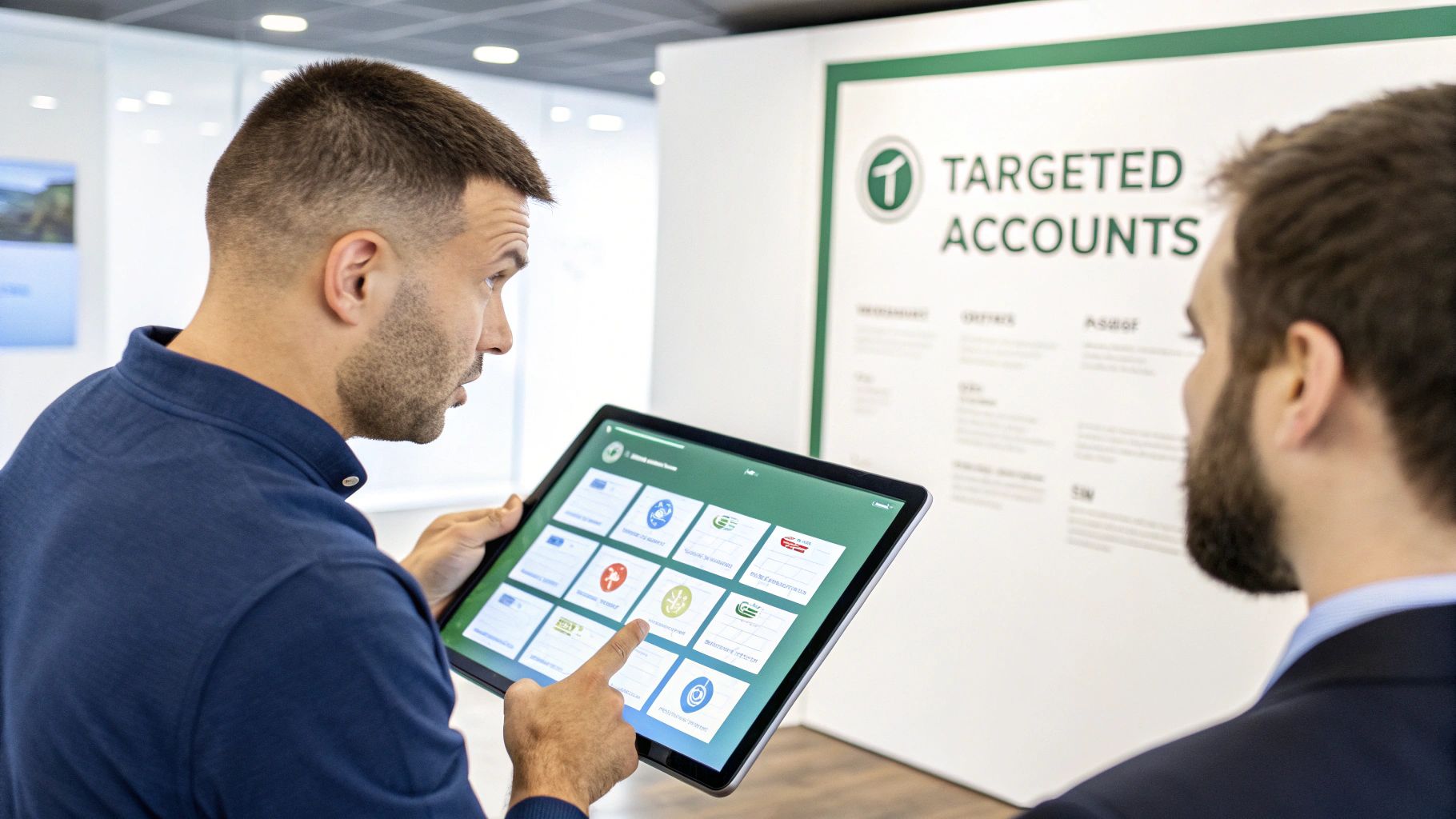
    Two men discuss business strategies, viewing targeted accounts on a digital tablet in a modern office.

    This strategy works by concentrating resources on prospects that are most likely to convert into significant, long-term customers. It’s particularly effective for B2B companies with complex sales cycles and high-ticket solutions, as it aligns outreach directly with the specific pain points and goals of each target organization. Platforms like 6sense and Terminus have popularized this data-driven approach, enabling businesses to orchestrate multi-channel campaigns with precision.

    How to Implement This Strategy

    A successful ABM campaign requires deep research, tight sales-marketing alignment, and a commitment to personalization. The process begins with identifying and prioritizing your most valuable potential accounts.

    • Identify Target Accounts: Define your ideal customer profile (ICP) based on firmographics like industry, company size, and revenue. Build a shortlist of high-value target accounts that match this profile.
    • Map Key Stakeholders: Use an email finder to identify and verify the key decision-makers and influencers within each target account. Focus on building a comprehensive picture of the buying committee.
    • Create Personalized Content: Develop bespoke messaging, content, and offers that speak directly to the unique challenges and objectives of each account. Generic pitches will not work in an ABM context.
    • Coordinate Multi-Channel Outreach: Execute a synchronized campaign across multiple channels, such as email, LinkedIn, targeted ads, and even direct mail, to engage stakeholders consistently.

    Key Insight: ABM flips the traditional marketing funnel. Instead of generating a large volume of leads to nurture, you start with a specific list of target accounts and work to engage them deeply, ensuring higher conversion rates and deal sizes.

    This approach is one of the most effective small business growth strategies for companies aiming to land larger, more strategic clients. By focusing your efforts, you eliminate wasted marketing spend and create a more relevant and impactful buying experience, which significantly shortens sales cycles and boosts revenue.

    3. Social Selling & LinkedIn Engagement

    Social selling is a modern sales approach where professionals leverage social media platforms, primarily LinkedIn, to find, connect with, and nurture prospects. This strategy moves beyond traditional cold outreach by focusing on building authentic relationships through valuable content, personal engagement, and targeted communication. It transforms the sales process from a direct pitch into a consultative conversation.

    This strategy works by establishing credibility and trust before a sales conversation even begins. Sales teams engage with prospects' content, share relevant industry insights, and provide value upfront. Research shows that 78% of social sellers outperform their peers who don't use social media, making this one of the most effective small business growth strategies for building a strong sales pipeline.

    Hand holding a smartphone displaying a social media profile, with 'Social Selling' text, a notebook, and coffee on a desk.

    How to Implement This Strategy

    A successful social selling strategy requires consistency and genuine engagement, not just automation. Start by optimizing your own LinkedIn profile to clearly communicate your value proposition to potential clients.

    • Engage Before Connecting: Interact with a prospect's posts by liking or leaving thoughtful comments before sending a connection request. This warms up the interaction.
    • Personalize Your Outreach: Always personalize your connection requests and initial messages. Mention a mutual connection, a shared interest, or a piece of content they recently published.
    • Share Valuable Content: Regularly post content that addresses your target audience's pain points. To maximize your social selling efforts, mastering the art of crafting engaging LinkedIn posts is essential for connecting with your audience.
    • Create a Multi-Channel Approach: Use LinkedIn to build the initial relationship, then use a tool like EmailScout to find their verified email for a more formal follow-up. You can learn how to find professional emails from LinkedIn profiles to streamline this process.

    Key Insight: Social selling is a long-term play focused on relationship-building. Your primary goal should be to become a trusted resource in your industry, not just a vendor. Sales will follow naturally from the trust you build.

    This method is powerful because it allows you to build rapport with key decision-makers in a less intrusive way than traditional methods. By combining social engagement with targeted email follow-ups, you create a comprehensive outreach system that warms up leads and significantly increases conversion rates.

    4. Strategic Partnerships & Channel Partnerships

    Strategic partnerships are a powerful growth lever where businesses collaborate with non-competing companies to tap into new markets and share resources. This strategy involves creating mutually beneficial relationships, such as co-marketing campaigns, referral programs, or technology integrations, to reach a broader audience than either company could alone.

    This approach works by leveraging the established trust and customer base of a partner. For example, a SaaS company could partner with a complementary software provider to offer an integrated solution, instantly gaining credibility and access to the partner's users. It’s an efficient way to scale customer acquisition and enhance your product's value proposition simultaneously.

    How to Implement This Strategy

    Building effective partnerships requires a clear vision and a structured approach. It's about finding the right fit and creating a win-win scenario that drives tangible results for both parties.

    • Identify Complementary Partners: Use tools like LinkedIn and industry directories to find companies whose customer base aligns with your ideal customer profile but who aren't direct competitors.
    • Define the "Win-Win": Clearly articulate the mutual benefits. This could be a revenue share from referrals, access to a new audience through co-branded content, or an enhanced product offering via an integration.
    • Start with a Pilot Project: Begin with a small, manageable initiative like a joint webinar or a limited-time co-promotion. This allows you to test the partnership dynamics and measure initial results before committing to a larger-scale agreement.
    • Establish Clear KPIs: Define success from the outset. Track key metrics like partner-sourced leads, referral conversion rates, and the overall revenue generated from the collaboration.

    Key Insight: The most successful partnerships are built on a foundation of shared value for the end customer. Focus on collaborations that genuinely solve a bigger problem for your target audience, making the combined offering more compelling than the individual parts.

    This method is one of the most effective small business growth strategies because it creates an exponential reach that is difficult to achieve through solo marketing efforts. For example, an email verification tool like EmailScout could partner with a CRM platform, providing the CRM's users with a seamless way to clean their contact lists, thereby adding value to both products and driving cross-promotional growth.

    5. Content Marketing & SEO-Driven Lead Generation

    Content marketing is the strategic creation and distribution of valuable, relevant, and consistent content to attract and retain a clearly defined audience. When combined with Search Engine Optimization (SEO), it becomes a powerhouse for generating inbound leads. Instead of you finding customers, they find you when searching for solutions to their problems.

    This strategy works by establishing your business as an authority in its niche. By creating high-quality blog posts, guides, and case studies that answer your audience's questions, you build trust and organically attract prospects. When potential customers find your content through search engines like Google, they are already qualified and actively seeking information, making them highly receptive to your message.

    A laptop showing a content marketing page, an open notebook with a pen, and a green notebook on a wooden desk.

    How to Implement This Strategy

    A successful content and SEO strategy requires a long-term commitment to creating exceptional content that serves your audience's needs. The goal is to become the go-to resource in your industry.

    • Target High-Intent Keywords: Focus on long-tail keywords (phrases of 3-4 words) that indicate a user is close to making a purchase decision or seeking a specific solution.
    • Create Problem-Solving Content: Develop blog posts, guides, and videos that directly address the pain points of your ideal customer. Use data and original research to add authority.
    • Optimize for On-Page SEO: Ensure every piece of content has optimized title tags, meta descriptions, and header tags. Internally link to other relevant content on your site to build a strong topic cluster.
    • Capture Leads with Gated Assets: Create downloadable resources like checklists, templates, or whitepapers that require an email address for access. This turns your website traffic into a tangible lead list.

    Key Insight: SEO and content marketing are not about short-term wins; they are about building a sustainable asset. A single well-ranked article can generate qualified leads for years with minimal ongoing effort, delivering one of the highest ROIs among all growth strategies.

    This method is one of the most effective small business growth strategies for building brand equity and a predictable lead flow. While creating content, you can use EmailScout to find contact information for industry experts you want to quote or collaborate with, adding further credibility and reach to your efforts. Combining this inbound approach with proactive outreach creates a powerful, multi-faceted growth engine.

    6. Referral Programs & Customer Advocacy

    Referral programs are a powerful growth engine that incentivizes existing customers to become brand advocates, recommending your product or service to their network. This strategy transforms your happiest customers into an active, motivated sales force, driving high-quality leads through trusted, word-of-mouth marketing. It capitalizes on the principle that people trust recommendations from friends and colleagues far more than traditional advertising.

    This strategy works by creating a simple, rewarding system for both the referrer and the new customer. Companies like Dropbox famously used this model, offering extra storage space to both parties, which fueled explosive user growth. When implemented effectively, referral programs generate leads with significantly lower acquisition costs and higher lifetime value, making it one of the most efficient small business growth strategies.

    How to Implement This Strategy

    A successful referral program is built on simplicity and value. The easier it is for customers to share, and the more compelling the reward, the more effective it will be. Start by identifying your most satisfied customers and making them an offer they can't refuse.

    • Make Sharing Effortless: Design a simple, one-click sharing process. Provide customers with a unique referral link or code that is easy to find within your app, website, or email communications.
    • Offer Compelling Incentives: The reward must be valuable to both the referrer and the new customer. This could be a discount, a monetary bonus, account credits, or access to exclusive features.
    • Track and Automate Rewards: Use referral marketing software or a built-in system to automatically track referrals and distribute rewards instantly. Immediate gratification reinforces the desired behavior.
    • Nurture New Leads: Once a referral comes in, use a tool like EmailScout to find their professional contact details and send a personalized welcome email that acknowledges the person who referred them.

    Key Insight: Your most valuable marketing asset is a happy customer. A well-designed referral program doesn't just acquire new users; it deepens the loyalty of your existing ones by rewarding them for their advocacy.

    This method stands out because it leverages social proof and trust to drive growth. Referred customers are often a better fit for your business and tend to be more loyal over time. By systematically encouraging and rewarding word-of-mouth, you can build a sustainable, cost-effective acquisition channel that scales alongside your customer base.

    7. Email Segmentation & Personalized Nurture Campaigns

    Email segmentation is the practice of dividing your email list into smaller, more targeted groups based on specific criteria. Instead of sending a generic message to everyone, this strategy allows you to send highly relevant content to subscribers who share common characteristics, such as industry, job title, purchase history, or engagement level. Personalized nurture campaigns then guide these segments through the buyer's journey with a sequence of tailored messages.

    This approach works by acknowledging that not all customers are the same. By delivering content that directly addresses a segment's specific needs and pain points, you dramatically increase relevance. This leads to higher open rates, better engagement, and more conversions, transforming your email list from a simple broadcast tool into a sophisticated sales and relationship-building engine.

    How to Implement This Strategy

    Effective segmentation and nurturing require a data-driven approach. Start by analyzing your audience to identify meaningful groups, then build automated workflows to deliver personalized experiences.

    • Define Your Segments: Use data from tools like EmailScout to segment your list by job title, company size, and industry. Also, consider behavioral data like website activity or past email engagement.
    • Create Tailored Content: Develop unique content, offers, and messaging for each key segment. An email for a marketing manager in the tech industry should address different challenges than one for a CEO in manufacturing.
    • Build Automated Nurture Sequences: Set up automated email workflows (nurture campaigns) triggered by specific actions, such as a new subscriber joining a particular segment. These sequences should deliver value over time and guide prospects toward a purchasing decision.
    • Track and Optimize Performance: Monitor key metrics like open rates, click-through rates, and conversion rates for each segment. Use this data to refine your messaging and improve campaign effectiveness.

    Key Insight: Personalization goes beyond using a contact's first name. True personalization involves delivering the right message to the right person at the right time, based on data-driven segments. This makes your audience feel understood, not just marketed to.

    This method is one of the most effective small business growth strategies for maximizing the value of your existing audience. By moving from a one-size-fits-all approach to a segmented one, you build stronger relationships, increase customer loyalty, and drive significantly higher revenue from your email marketing efforts.

    8. Product-Led Growth (PLG) & Free Trial Strategy

    Product-Led Growth (PLG) is a go-to-market strategy where the product itself serves as the primary driver of customer acquisition, conversion, and expansion. Instead of relying on traditional sales-led motions, this approach allows users to experience the product's value firsthand through free trials or freemium models, creating a frictionless path to adoption. Companies like Slack and Figma have demonstrated its power, achieving massive scale by letting the product's quality speak for itself.

    This model works by aligning user value directly with business growth. When customers can self-serve and discover the product's benefits on their own terms, acquisition costs decrease, and user engagement deepens. It's one of the most effective small business growth strategies for modern SaaS companies, as it builds a loyal user base that can be nurtured into paying customers over time.

    How to Implement This Strategy

    A successful PLG motion hinges on a seamless user experience that quickly demonstrates your product's core value. The goal is to make the journey from sign-up to "aha!" moment as short as possible.

    • Design a Value-Driven Free Tier: Offer a freemium plan or free trial that showcases your product’s essential features. Limit usage in a way that encourages an upgrade once users become reliant on the value provided, like Calendly’s limit on event types.
    • Optimize User Onboarding: Guide new users with in-product tooltips, tutorials, and checklists to help them achieve a key outcome during their first session. A strong onboarding experience is critical for retention.
    • Nurture Free Users: Use automated email sequences to educate users on advanced features and share success stories. Verifying contact information with a tool like EmailScout ensures your onboarding and upgrade-focused messages land in the right inbox.
    • Identify Upgrade Triggers: Track user behavior to pinpoint when they hit usage limits or attempt to access premium features. These moments are perfect opportunities to prompt an upgrade.

    Key Insight: In a PLG model, your product is your best salesperson. Every feature, from onboarding flows to in-app notifications, should be designed to guide users toward realizing value and ultimately converting to a paid plan.

    This strategy is particularly powerful because it creates a scalable, low-friction acquisition channel. By letting users try before they buy, you build trust and demonstrate ROI upfront, making the sales conversation much easier. It turns your user base into a self-sustaining engine for growth.

    9. LinkedIn Ads & Retargeting Campaigns

    LinkedIn advertising allows B2B companies to reach key decision-makers with precision-targeted sponsored content, InMail, and display ads. The platform's extensive professional data enables hyper-specific targeting by job title, company size, industry, and skills, making it an invaluable tool for reaching high-value prospects. This strategy combines paid reach with audience intelligence for highly efficient lead generation.

    This approach works by placing your message directly in front of the professionals who matter most to your business. When combined with retargeting, it becomes even more powerful. You can serve tailored ads to warm prospects, such as recent website visitors or individuals who have engaged with your content, nurturing them through the sales funnel. For instance, B2B SaaS companies using LinkedIn ads often see conversion rates between 3-5% for high-quality leads.

    How to Implement This Strategy

    A successful LinkedIn Ads strategy requires a deep understanding of your audience and a structured approach to campaign management. It's not just about boosting posts; it's about building a predictable lead-generation machine.

    • Build Custom Audiences: Upload a list of contacts from an email finder like EmailScout to create a Matched Audience. This allows you to retarget a specific list of high-intent prospects or create lookalike audiences to find similar professionals.
    • Segment and Personalize: Don't run one generic ad campaign. Segment your audiences by job title, company size, or industry and craft ad copy that speaks directly to their unique pain points.
    • Use Lead Gen Forms: Implement LinkedIn Lead Gen Forms to capture prospect information directly within the platform. This reduces friction and often pulls pre-filled data from user profiles, increasing conversion rates.
    • Create Multi-Stage Campaigns: Develop separate campaigns for different funnel stages. Run brand awareness campaigns to a broad audience and conversion-focused retargeting campaigns to warmer prospects who have already shown interest.

    Key Insight: The power of LinkedIn ads is in the follow-up. Once a lead is captured, use a verified email from EmailScout to immediately send a personalized welcome or follow-up sequence, converting platform engagement into a direct sales conversation.

    This method is one of the most effective small business growth strategies for B2B companies due to its unparalleled targeting capabilities. It ensures your marketing budget is spent reaching individuals with purchasing power, delivering a higher ROI compared to broader advertising platforms.

    10. Sales Automation & CRM Integration

    Sales automation is a transformative strategy that uses technology to streamline and automate repetitive sales tasks, such as email follow-ups, data entry, lead scoring, and meeting scheduling. By integrating automation tools with a Customer Relationship Management (CRM) platform like HubSpot or Salesforce, businesses can centralize prospect data and create efficient workflows. This frees up sales teams from administrative burdens, allowing them to focus on high-value activities like building relationships and closing deals.

    This strategy works by creating a seamless system where technology handles the manual, time-consuming parts of the sales process. For example, platforms like Outreach.io or Salesloft can trigger automated email sequences, score leads based on their engagement, and log every interaction in the CRM without human intervention. This approach accelerates sales cycles, improves lead nurturing, and ensures no opportunities fall through the cracks, making it one of the most impactful small business growth strategies for scaling sales operations.

    How to Implement This Strategy

    Effective sales automation requires a thoughtful setup that aligns technology with your sales process. The goal is to enhance, not replace, the human element of selling.

    • Integrate Your Tools: Connect your email outreach tools directly with your CRM. For instance, import validated contact lists from EmailScout into your CRM to ensure clean data from the start and power your automated campaigns.
    • Automate Initial Outreach: Develop automated email sequences for initial contact and follow-ups. Use personalization tokens to maintain a human touch while reaching prospects at scale.
    • Implement Lead Scoring: Set up rules to automatically score leads based on their behavior (e.g., opening an email, clicking a link, visiting your pricing page). This helps your team prioritize the most engaged and sales-ready prospects.
    • Create Trigger-Based Workflows: Build smart campaigns that are triggered by specific prospect actions. If a prospect downloads a whitepaper, an automated workflow can send them a series of relevant follow-up emails.

    Key Insight: The most effective sales automation doesn't just save time; it creates a more intelligent sales process. Use automation to gather data on what messaging, timing, and sequences work best, and use those insights to continuously refine your approach for better conversion rates.

    This strategy is essential for any small business looking to scale its sales efforts without exponentially increasing its headcount. By systemizing outreach and follow-up, you can manage a larger pipeline more effectively. To get a comprehensive overview, explore this guide on what is sales automation and how it can drive revenue growth.

    Top 10 Small Business Growth Strategies Comparison

    Strategy Implementation complexity Resource requirements Expected outcomes Ideal use cases Key advantages
    Cold Email Outreach & Lead Generation Low–Medium: list building, sequence setup, compliance Email data, copywriting, automation tools; low upfront cost Scalable meetings/leads; variable response rates B2B outbound prospecting, early-stage SaaS growth Cost-effective, direct access to decision-makers, measurable
    Account-Based Marketing (ABM) High: research, coordination, multi-channel personalization Sales + marketing alignment, CRM/ABM tools, account research High conversion and deal size; fewer targeted accounts Enterprise or high‑ticket B2B sales Highly personalized outreach, higher win rates, shorter cycles
    Social Selling & LinkedIn Engagement Medium: profile strategy, consistent engagement Time for content and networking; LinkedIn tools Warm relationships and qualified leads; slower conversions Relationship-driven sales, professional services, enterprise Builds trust and credibility; warm introductions; targeted outreach
    Strategic & Channel Partnerships Medium–High: partner selection, agreements, integrations Legal, integration work, co‑marketing resources Access to new segments, shared revenue, faster penetration SaaS integrations, reseller/channel expansion Rapid reach expansion, shared costs, credibility via partners
    Content Marketing & SEO-Driven Lead Gen Medium: content strategy, SEO optimization Content creators, SEO expertise, ongoing time investment Qualified inbound leads; compounding long-term traffic Thought leadership, inbound lead generation, brand building Low long-term CPL, authority building, sustainable traffic
    Referral Programs & Customer Advocacy Low–Medium: program design, tracking and rewards Incentives, tracking system, customer success resources High-quality, low-cost leads; improved retention Products with happy customers; viral growth strategies Lowest CAC, high conversion and retention, organic growth
    Email Segmentation & Personalized Nurture Campaigns Medium–High: data modeling, workflows, testing CRM/marketing automation, quality data, content variants Higher open/click rates and conversions from email Lead nurturing, onboarding, retention campaigns Improved engagement, personalized journeys, better ROI
    Product-Led Growth (PLG) & Free Trial Strategy Medium: UX optimization, onboarding flows Product development, analytics, customer support Self-qualified users, lower CAC, viral adoption Self‑serve SaaS, developer tools, freemium models Faster time-to-value, natural virality, data-driven expansion
    LinkedIn Ads & Retargeting Campaigns Medium: audience setup, creative, optimization Ad budget, creative assets, analytics, LinkedIn tools Targeted paid leads and conversions; good mid-funnel performance Account targeting, event promotion, retargeting warm audiences Precise professional targeting, lead gen forms, retargeting ability
    Sales Automation & CRM Integration Medium–High: integration, workflow design, governance CRM, automation platform, data hygiene, training Increased sales productivity; consistent follow-up; better forecasting Scaling sales teams, high-volume outreach, complex pipelines Efficiency gains, centralized data, consistent nurturing and tracking

    Putting Your Growth Engine into Action

    Navigating the landscape of small business growth strategies can feel overwhelming. We've explored ten powerful avenues, from the direct impact of cold email outreach and the precision of Account-Based Marketing to the long-term value generated by content marketing and strategic partnerships. The core lesson is clear: sustainable growth isn't born from a single magic bullet. It’s the result of building a dynamic, interconnected growth engine.

    True momentum is achieved when these strategies work in concert. Your LinkedIn social selling efforts become exponentially more effective when you can seamlessly transition high-value conversations into a personalized email sequence. Your content marketing acts as the fuel for your nurture campaigns, providing the value that keeps leads engaged. Similarly, a well-executed referral program can supercharge your sales pipeline, feeding it with the highest quality leads imaginable.

    This interconnectedness is the secret to scaling efficiently. Each component supports and amplifies the others, creating a system that is far greater than the sum of its parts.

    From Strategy to Execution: Your Actionable Next Steps

    The journey from knowledge to results begins with a single, decisive step. Don't try to implement all ten strategies at once. Instead, adopt a focused, methodical approach to build your growth engine piece by piece.

    • Audit and Prioritize: Begin by evaluating your current resources, team skills, and business model. Which one or two strategies from this list offer the lowest barrier to entry and the highest potential impact for your specific business right now? A B2B service company might prioritize ABM and LinkedIn engagement, while a SaaS startup could focus on Product-Led Growth and targeted retargeting ads.

    • Implement and Measure: Dedicate your focus to executing your chosen strategies flawlessly. Define clear Key Performance Indicators (KPIs) from the start. For cold outreach, this could be your reply rate and meeting booked rate. For content, it might be organic traffic and lead magnet downloads. Meticulous tracking is non-negotiable; it's the only way to know what's working.

    • Iterate and Expand: Once you have a proven, repeatable process generating positive results from your initial strategies, it's time to layer on the next. Use the insights gained from your first experiments to inform your next move. Perhaps the data shows your ideal customers are highly responsive to case studies, signaling that a more robust content strategy is the logical next step.

    The Unifying Thread: Efficient Outreach

    A common thread weaving through many of these powerful small business growth strategies is the need for efficient, accurate, and scalable outreach. Whether you are executing a targeted cold email campaign, building a list for a new partnership announcement, or following up with leads from a LinkedIn ad, your success hinges on your ability to connect with the right person.

    This is where the friction often lies for small businesses. Manually finding and verifying contact information consumes precious hours that could be spent on strategy, relationship-building, and closing deals. By automating this foundational step with tools designed for precision and speed, you reclaim your most valuable asset: time. This allows you to focus your energy on the high-level thinking and human connection that truly drive business growth, turning your strategic plans into tangible revenue. The path to scalable success is not about working harder, but about working smarter and equipping your team with the right tools to execute with precision.


    Ready to stop searching for emails and start building relationships? EmailScout provides the verified contact data you need to fuel your outreach, connect with key decision-makers, and implement these growth strategies with speed and accuracy. Find any email in seconds and build your growth engine on a foundation of reliable data at EmailScout.

  • A Guide to Search Engines for Emails to Find Key Contacts

    A Guide to Search Engines for Emails to Find Key Contacts

    Specialized tools designed to find email addresses are a complete game-changer for anyone in sales or marketing. Unlike a general Google search that casts a wide net across the entire internet, these tools are built to zero in on professional contact information by digging through public data, figuring out company email patterns, and checking against professional networks.

    What Are Email Search Engines and Why Do They Matter?

    Ever tried to find a specific book in a massive library without a catalog? That’s what prospecting feels like without the right tools. You could wander the aisles for hours, hoping to get lucky, but it's a slow, frustrating grind. Using a general search engine like Google is like asking the librarian for "a book on business"—you'll get a million results, but not the exact one you need.

    An email search engine is your specialized digital catalog. It's a focused tool built for one thing: finding the direct contact info of key professionals. Think of it as a digital detective that knows exactly where to look for clues, piecing together the right email address from company websites, social profiles, and public databases.

    To put it in perspective, let's look at how these specialized tools differ from your everyday web search.

    Email Search Engines vs General Web Search

    Feature Search Engines for Emails General Web Search (e.g., Google)
    Purpose Find specific, verified professional email addresses. Index and retrieve information from the public web.
    Scope Narrow and deep: focused on contact and company data. Broad and wide: covers all types of web content.
    Output A direct email address, often with verification status. A list of web pages that may or may not contain an email.

    This table shows why a targeted approach is so much more effective. You're not just searching; you're discovering.

    The Power of a Direct Connection in a Crowded Inbox

    In a world drowning in digital noise, these tools aren't just a nice-to-have; they're a strategic must. Their value comes from the sheer power of email as a business channel. With an estimated 376 billion emails flying around the globe every day, getting your message seen by a real decision-maker is everything.

    The payoff is huge. Email marketing continues to deliver one of the best returns on investment out there. Some reports show an average ROI of up to 4,200%, and 89% of marketers count on email as their main source for lead generation.

    This is where search engines for emails really shine. They give you a direct line to the people who matter, letting you:

    • Bypass Gatekeepers: Forget generic inboxes like info@company.com and connect straight with the person who can say "yes."
    • Accelerate Sales Cycles: Slash the time it takes to get a response and book that critical first meeting.
    • Improve Outreach Personalization: Craft a message for a specific person, leading to way higher engagement.

    By turning a tedious manual chore into a quick, automated process, these tools free you up to do what you do best: build relationships and close deals.

    At the end of the day, these specialized search tools transform prospecting from a game of guesswork into a precise, data-driven strategy. They hand you the keys to unlock direct conversations and make email your most powerful tool for growth. To get a better handle on how these systems work under the hood, check out our full guide on email search engines.

    How These Tools Uncover Contact Information

    Ever wonder how an email search engine pulls the right contact out of a digital hat? It’s not magic, but it’s close. Think of these tools as tireless digital investigators, piecing together clues scattered all over the web to find a direct line to your prospect.

    They don’t just take a wild guess. Instead, they use a clever, multi-step approach that combines data scraping, pattern analysis, and verification to deliver a solid result.

    This diagram breaks down the basic process of turning a name and a company into a verified email address you can actually use.

    A diagram illustrating a 3-step process for finding new contacts: Prospect, Filter, and Connect.

    It’s a simple flow that shows how a broad search gets systematically narrowed down to a single, actionable contact. Let's break down what's happening behind the scenes.

    Following Digital Footprints Across the Web

    The whole process usually kicks off with data scraping. It sounds technical, but the concept is simple. Imagine a bot that can read millions of public web pages—company "About Us" pages, press releases, or author bios on blogs—in seconds, looking for any mention of a name alongside an email address.

    This information is then collected and stored. For tools focused on professional contacts, this often means understanding how to source data from platforms like LinkedIn, with some using methods for scraping LinkedIn data ethically to build their databases. This ensures the information is both relevant and responsibly sourced.

    An effective email finder doesn’t just look in one place. It pulls together data from dozens of public channels to build a complete profile, which dramatically increases the odds of finding the correct, up-to-date contact info.

    This first step casts a wide net, gathering all the raw data needed for the more refined steps that follow.

    Cracking the Code with Pattern Matching

    Here’s where it gets interesting. Once a tool knows a person's name and the company they work for, it can use pattern matching to make a very educated guess. Most companies use a standard format for their email addresses. Just think about your own company—chances are, everyone’s email follows a predictable structure.

    The tool then tests all the common corporate email patterns, like:

    • First Name: john@company.com
    • First Initial + Last Name: jdoe@company.com
    • First Name + Last Name: johndoe@company.com
    • First Name . Last Name: john.doe@company.com

    It quickly generates these potential combinations and gets them ready for testing. If you’re ever curious about a specific company, you can run an email lookup by domain to see these patterns in action for yourself.

    Verifying and Validating the Findings

    Coming up with a list of possible emails is only half the battle. The final, and most critical, step is verification. An unverified email is just a bounce waiting to happen, and too many of those will wreck your sender reputation.

    To make sure an address is the real deal, email search engines perform a quick check with the company's mail server. It’s like a technical handshake that confirms whether the server recognizes the email address as a valid recipient, all without actually sending a message. Only after an email passes this test is it handed over to you with a high confidence score, giving you peace of mind that your outreach will actually land in the right inbox.

    Diving Into the Different Types of Email Search Tools

    Not all email search engines are built the same. They come in all shapes and sizes, each designed for a specific job. Think of them like different kinds of fishing gear—you wouldn't use a massive net to catch one specific fish, and you definitely wouldn't use a simple rod and reel to supply a whole restaurant. The right tool always depends on your goal.

    Picking the best email finder really comes down to matching its format to how your team works. Whether you're a sales rep needing a quick contact on the fly or a marketing team building a massive campaign list, understanding these differences is the key to working smarter, not harder.

    Browser Extensions for On-the-Fly Prospecting

    Browser extensions are the nimble speedboats of email discovery. They live right in your web browser (like Chrome or Firefox) and spring into action when you're on a prospect's website or LinkedIn profile. With just a click, they scan the page and public data sources for any associated email addresses, serving them up instantly.

    This type is perfect for:

    • Sales Development Reps: Instantly find a decision-maker's contact info while you're researching their company online.
    • Recruiters: Quickly grab a candidate's professional email directly from their social media profile.
    • Freelancers: Snag a potential client's email from their company site without breaking your research flow.

    The big win here is speed and convenience, making extensions the go-to for high-volume, targeted prospecting.

    Web Applications for Bulk List Building

    If extensions are the speedboats, then web applications are the big fishing trawlers. These are powerful, dashboard-based platforms built to find hundreds or even thousands of emails at once. You just upload a list of names and company domains, and the app chugs away in the background to find and verify all the matching emails.

    These platforms are built for scale. They shift the focus from finding one email at a time to building comprehensive, campaign-ready contact lists with minimal manual effort.

    Web apps are best for large-scale operations. For example, a marketing team getting ready for a new product launch can upload a list of 500 target companies and get back verified contact lists for their entire outreach in just a few hours.

    API Services for Custom Integrations

    Finally, API services are the most flexible and technical option of the bunch. An API (Application Programming Interface) lets you plug an email search engine’s core power directly into your own software, like a CRM or a custom-built sales tool. This creates a completely seamless workflow where finding an email is just another feature inside the system you already use every day.

    And for those times when you already have an email and need to find out more about its owner, learning how to reverse search an email address can be a huge help. Some of the more advanced APIs even offer this reverse-lookup function.

    The Strategic Advantage of Finding Direct Emails

    Knowing how a tool works is one thing. Seeing what it does for your bottom line is another story entirely. Let’s move past the technical "how" and get straight to the tangible results that a good search engine for emails can deliver. The core benefit is simple but incredibly powerful: they open up direct, relevant lines of communication that fuel real growth.

    A person views an email or calendar app on a smartphone at a busy office desk.

    Think about a sales rep trying to reach a VP of Marketing at a major tech company. The old way meant navigating a maze of gatekeepers, generic contact forms, and dead-end info@ inboxes. That process could drag on for weeks with nothing to show for it. With an email finder, that same rep can get the VP's direct email in minutes, write a personalized message, and maybe even book a demo within a couple of days.

    Real-World Scenarios and Business Impact

    This ability to cut through the noise creates a serious competitive advantage across the board. It’s not just about finding an address; it’s about opening a direct line to opportunity.

    Here’s how that plays out in the real world:

    • Accelerated Sales Cycles: Sales teams can go straight to the decision-makers, cutting out the middlemen who gum up the works. This means faster responses, quicker demos, and shorter sales cycles.
    • Boosted Marketing ROI: Marketers can build hyper-targeted lists for account-based marketing (ABM) or personalized campaigns. They can be sure their message is landing in front of the right people, which dramatically improves engagement rates and ROI.
    • Streamlined Recruitment Efforts: Recruiters can find and contact top-tier candidates who aren't even looking for a new job. This gives them access to a passive talent pool their competitors will likely miss.

    The real value of these tools comes from shifting your outreach from a volume game to a precision one. When you can ensure your message reaches the right person every time, you make every communication count. You save time and see drastically better results.

    The Proven Power of Direct Email

    This whole emphasis on finding direct emails isn't just a hunch; it's backed by cold, hard data. Email remains one of the most effective channels for actually driving revenue, which is why these tools are in such high demand.

    Research shows that email traffic converts to sales at a much higher clip than other channels. For instance, about 4.24% of visitors from email make a purchase. Compare that to just 2.49% from search engines and a tiny 0.59% from social media. On top of that, customers who buy something through an email offer tend to spend 138% more.

    For sales teams, this makes email a high-leverage channel that is 40 times more effective than social media for acquiring new customers. If you want to dive deeper, you can explore more of the compelling statistics behind email marketing on Porch Group Media. At the end of the day, a great email search tool simply acts as the key to unlocking this powerful, high-ROI system.

    How to Choose the Right Email Search Engine

    Picking the right search engine for emails feels a lot like choosing a critical tool for a big job. Get it right, and your work flows smoothly. Get it wrong, and you're in for a world of frustration. With so many options out there, it’s easy to get lost in the marketing noise.

    To cut through it all, you need to focus on a few core things that actually impact your results. The goal isn’t just to find a tool that spits out data, but one that delivers accurate contacts and fits right into how your team already works.

    Evaluate Data Accuracy and Verification

    Let’s be clear: the single most important factor is accuracy. An email finder that gives you bad or old information isn't just a waste of money—it's actively working against you. Every single bounced email hurts your sender reputation, making it tougher for your future messages to even land in an inbox.

    Look for tools that offer these essentials:

    • Real-Time Verification: This is a non-negotiable. The best email search engines don’t just pull from a dusty old database. They actively check if an email is valid in real time, right before they give it to you.
    • Confidence Scores: Some tools will give you a percentage score showing how sure they are that an email is correct. This is a huge help for prioritizing your outreach to the most solid contacts first.
    • Diverse Data Sources: A platform that cross-references info from multiple public sources—think company websites, professional networks, and public records—is always going to be more reliable.

    Don’t get fooled by a tool that brags about a massive database without proving the data is fresh. A smaller, highly accurate list of contacts is infinitely more valuable than a giant list of unverified junk.

    Consider Workflow Integration and Usability

    Even the most powerful tool is worthless if your team finds it too clunky to use. The best solution should feel like a natural part of your sales or marketing process, not another complicated platform you have to wrestle with.

    Think about how it plugs into your current setup. Does it have a simple browser extension so you can grab emails on the fly? Can it connect directly with your CRM, like Salesforce or HubSpot, and sync new contacts automatically?

    Finally, take a look at the price. Some work on pay-as-you-go credits, while others are a monthly subscription. Find a plan that matches how much outreach you actually do, so you get the best return on your investment without paying for a bunch of features you’ll never touch.

    Navigating Privacy and Compliance

    Let's be clear: using a powerful email finder tool comes with a responsibility to be smart and ethical about it. While these search engines are designed to find business information that's already out there, how you use that data is what really counts. Getting this right is crucial for protecting your brand's reputation.

    A laptop displaying a shield with an open padlock icon on a green screen, emphasizing privacy first.

    You’ve probably heard of regulations like GDPR in Europe and the CAN-SPAM Act in the U.S. These laws aren’t there to kill B2B communication; they exist to stop spam and protect people's data. It’s all about finding professional data the right way, something we cover in our guide on how to responsibly scrape email from LinkedIn.

    Best Practices for Responsible Outreach

    The secret is to approach your outreach with respect and a genuine offer of value. Think of it less like a cold blast and more like starting a professional conversation.

    To stay on the right side of the rules and build trust from the get-go, stick to these core principles:

    • Provide an Easy Opt-Out: Every single email needs a clear, one-click way for people to unsubscribe. No exceptions.
    • Be Transparent: Say who you are. Your company's name and physical address should be right there in your email footer.
    • Ensure Relevance: Make sure your message actually relates to the person's professional role or industry. Random pitches are just spam.

    The most effective—and ethical—outreach is always rooted in personalization and respect. When you focus on delivering real value to a relevant audience, you’re not just following the rules; you’re building a stronger, more trusted brand.

    At the end of the day, using an email finder ethically just means respecting the person on the other end. Treat the contact information you find as an opportunity to start a real professional dialogue. Do that, and you'll sidestep privacy issues while getting far better results.

    Still Have Questions?

    Even with the best tools in hand, a few questions always pop up. Let's tackle some of the most common ones about using a search engine for emails to clear up any lingering confusion.

    How Accurate Are These Email Finders, Really?

    This is the big one, and the answer varies a lot. The best tools on the market consistently hit an accuracy rate between 85% and 95%. They pull this off by running real-time verifications and checking an address against multiple public data sources to make sure it's not just valid, but actively in use.

    You absolutely want to stick with a tool that has a proven track record for accuracy. It’s not just about minimizing bounced emails—it’s about protecting your sender reputation, which is gold.

    Is It Legal to Use These Tools for Cold Outreach?

    Yes, for B2B outreach, you're generally in the clear. Regulations like the CAN-SPAM Act in the U.S. and GDPR in Europe allow for professional communication, but you have to do it responsibly. It's not a free-for-all.

    The secret is staying compliant. Your email has to be relevant to their job, you need to say who you are, and you must give them an easy, no-hassle way to opt out.

    Can I Find Personal Emails With an Email Search Engine?

    The reputable tools are built specifically to find professional email addresses—the kind that looks like first.last@company.com. They intentionally avoid personal emails from providers like Gmail or Yahoo. This keeps your outreach squarely in a professional context and respects privacy norms.

    Trying to hunt down personal emails with these platforms is a bad idea. You'll likely violate the tool's terms of service and run into data privacy laws. Just don't do it.


    Ready to stop guessing and start connecting? With EmailScout, you can find unlimited verified email addresses for free and build your outreach lists in minutes. Try the powerful Chrome extension today and see the difference for yourself. Get started for free at https://emailscout.io.

  • How to Find Clients and Build a Predictable Pipeline

    How to Find Clients and Build a Predictable Pipeline

    Hoping for the best isn't a strategy. If you're tired of the feast-or-famine cycle, it's time to stop guessing and start building a real, repeatable system for finding clients.

    This playbook cuts through the generic advice and lays out a modern blueprint that actually works: Pinpoint your ideal customer, build a targeted list of decision-makers, write outreach that gets a response, and scale what's working.

    Forget waiting for referrals. This is about taking control and creating a predictable pipeline of high-quality leads.

    Beyond Luck: Finding Clients With a Modern Blueprint

    Let's be real. The old ways of finding clients—endless social media posts, networking events, and just hoping someone stumbles upon your website—are scattered and unreliable. It’s like waiting for lightning to strike. Sure, it might happen, but you can't build a sustainable business on maybes.

    We're going to shift from that passive, hopeful approach to active, strategic outreach. It’s about being intentional. It's about knowing exactly who you're contacting and why they should care, turning a game of chance into a predictable process.

    The Four Pillars of Client Acquisition

    This entire system boils down to four critical stages. Nail these, and you'll turn client acquisition from a frustrating art into a data-driven science.

    • Pinpoint Your Ideal Client: Before you write a single email, you have to know exactly who you're looking for. This goes way beyond basic demographics. What are their biggest headaches? What goals keep them up at night?
    • Build Targeted Lists: Once you have that crystal-clear picture, it’s time to find them. This is where you'll efficiently gather contact information for the right people at the right companies.
    • Write Compelling Outreach: A perfect list is worthless if your message falls flat. Crafting personalized, value-first emails is the key to starting actual conversations, not just getting ignored.
    • Scale Your System: Finally, you'll build a process to manage and grow your outreach. This is how you turn one-off campaigns into a consistent engine for new business.

    For a deeper dive, this actionable playbook on how to generate leads for B2B is packed with proven strategies.

    This simple flowchart breaks down the entire process.

    A clear flowchart outlining a four-step client acquisition process: pinpoint, build, write, and scale.

    Each step builds on the last, creating a logical flow from high-level strategy to day-to-day execution. Whether you’re a freelancer, an agency owner, or a B2B sales pro, you’re about to get a clear system for keeping your pipeline full.

    Pinpointing Your Ideal Client to Stop Wasting Time

    Chasing every possible lead is a surefire way to burn out fast. If you want to find the right clients, you have to first define, with crystal clarity, exactly who they are. This is where building an Ideal Client Profile (ICP) becomes the single most important thing you can do for your outreach.

    And I'm not talking about vague descriptions like "small businesses" or "startups." We need to get way more specific than that. A truly effective ICP is a detailed snapshot of the exact person, at the exact company, who desperately needs what you're selling and actually has the power to buy it.

    Moving Beyond Basic Demographics

    A powerful ICP digs past the surface-level data and gets into the human and business drivers behind a purchasing decision. The goal is to understand their world so intimately that your outreach email feels less like a cold pitch and more like a genuinely helpful tip from someone who gets it.

    To build out this profile, you need to answer a few key questions:

    • What are their biggest day-to-day frustrations? Think about the bottlenecks, the clunky processes, and the recurring headaches that are stopping them from hitting their targets.
    • What KPIs are they on the hook for? Are they trying to boost lead gen by 15% this quarter? Or maybe their main goal is cutting customer churn. Their performance metrics are your way in.
    • What’s their exact job title? Don’t just aim for "marketing." Are you after a "Marketing Director," a "VP of Demand Generation," or a "Content Marketing Manager"? Precision is everything.

    The sharper your ICP, the more effective every other step becomes. A well-defined profile means you’re not just spamming inboxes; you’re starting relevant conversations with people actively looking for the very solution you offer.

    A Real-World ICP Example

    Let's make this real. Say you run a B2B SaaS company with a project management tool built for content teams. A weak, fuzzy ICP would be something like "marketing teams at tech companies." That's way too broad to be useful.

    Now, here’s what a strong, actionable ICP looks like:

    • Company: E-commerce brands with 50-200 employees.
    • Target Title: Marketing Director or Head of Content.
    • Pain Points: They’re constantly blowing past content deadlines, the team is struggling with version control on creative files, and there’s zero visibility into project status, causing last-minute chaos.
    • Goals: They need to increase content output by 25% quarter-over-quarter and make the team more efficient to handle upcoming product launches.
    • Watering Holes: They follow top marketing influencers on LinkedIn and hang out in private Slack groups for e-commerce marketers.

    See the difference? Now you know exactly who to search for, which problems to mention in your emails, and even where to find them online. This kind of specificity turns a vague hunt for clients into a targeted mission.

    How to Uncover These Critical Details

    So, where do you find all this juicy information? It’s time to put on your detective hat. Professional networking platforms are your best friend here.

    LinkedIn is an absolute goldmine for this kind of research. You can search for specific job titles within certain industries and company sizes. Once you find them, dig into their profiles. Pay attention to the language they use, the skills they list, and the articles they share. It's a direct window into their priorities and pain points. For a deeper dive, our guide on how to identify a target audience lays out even more advanced strategies.

    By taking the time to build a detailed ICP upfront, you stop wasting cycles on prospects who were never going to be a good fit. Every email you send becomes more relevant, your messaging hits harder, and your chances of starting a real sales conversation go through the roof.

    Building High-Quality Prospect Lists Without the Grind

    Okay, so you've nailed down your Ideal Client Profile. You're no longer just guessing who to talk to. Now comes the fun part: turning that profile into a real, actionable list of companies and decision-makers who are a perfect match for what you offer. This is where your client search gets serious.

    Traditionally, this step was a soul-crushing grind. I'm talking about endless hours spent copying and pasting names from LinkedIn into a spreadsheet, followed by a frustrating hunt for contact info that often led nowhere. That kind of manual work doesn't just eat up your time; it completely kills your momentum before you even send the first email.

    Thankfully, the tools we have today have completely changed the game.

    From Manual Labor to Automated Precision

    Let's get one thing straight: the goal isn't just to build a list. It's to build a high-quality list, and to do it efficiently. Quality beats quantity every single time. A focused list of 100 perfect-fit prospects is worth infinitely more than a spray-and-pray list of 10,000 who probably don't need your help.

    This is where a tool like the EmailScout Chrome extension becomes your secret weapon. Instead of seeing list-building as a chore, you can turn it into a swift, almost effortless process. Imagine scrolling through a LinkedIn search for "Marketing Directors in SaaS" and having a tool quietly find and save their verified emails for you in the background.

    That's the leap from manual to automated. You let the tech do the heavy lifting, which frees you up to focus on what really matters—writing a killer outreach message.

    Harnessing Professional Networks Intelligently

    Professional networks are the primary hunting ground for B2B prospects. LinkedIn, in particular, is a goldmine with its powerful search filters. You can zero in on people by industry, company size, job title, and location—the very same criteria you just defined in your ICP.

    Here’s how to tackle it with a smart, tool-assisted workflow:

    1. Run a Targeted Search: Use LinkedIn's filters to get super specific. Think "Head of Content" at "E-commerce companies" with "51-200 employees."
    2. Activate AutoSave: With a tool like EmailScout, you flip on the AutoSave feature. As you scroll through the search results, the extension gets to work finding and verifying email addresses for the people on your screen.
    3. Build Your List on Autopilot: Every valid contact gets automatically dropped into a designated list. What used to take hours of tedious clicking and searching now takes a few minutes of casual scrolling.

    This approach completely transforms a boring task into an efficient data-gathering mission.

    Exploring Company Websites at Scale

    Sometimes, your best prospects are all in one place—a specific company's website. Maybe you’re targeting the entire marketing team at a fast-growing startup. Finding each person's email one by one is a huge time-sink.

    This is a perfect job for a URL Explorer feature. Instead of hunting down contacts individually, you just plug in the company’s domain (like company.com) and let the tool scan the entire site for any publicly available email addresses. It pulls every contact it can find, saving you a massive amount of time.

    Building a solid prospect list is the foundation of any great outreach campaign. When you get this part right, every email you write has the highest possible chance of landing in front of someone who can actually say "yes."

    This strategic approach to list-building is why email is still a dominant force. By 2025, there will be 4.6 billion global email users, and the ROI can be an incredible 3600%—that's $36 back for every dollar you spend. By automating the list-building, you tap into that power so much more effectively.

    Here’s a look at how you can pull emails directly from a website using the EmailScout extension.

    A modern desk with a laptop showing client profiles, a notebook, and a pen, under an 'Ideal Client' banner.

    With a simple interface like this, you can instantly see and save the emails found on any page, turning a company's "About Us" or "Team" page into a ready-made prospect list.

    These kinds of efficient sales prospecting techniques are absolutely essential for building a predictable pipeline of new clients. When you shift from manual drudgery to smart automation, you’re not just saving time—you’re building a stronger, more accurate foundation for your entire client acquisition strategy.

    Writing Outreach Emails People Actually Reply To

    Having a perfect list of verified emails is a huge win, but it’s only half the battle. An email address is just an entry point; a compelling message is what actually starts a conversation and helps you find clients.

    This is where we move past the cringey, self-absorbed templates that flood every inbox. Instead, we'll focus on writing outreach that people genuinely want to answer.

    The difference between an email that gets deleted and one that gets a reply often comes down to one thing: relevance. Your prospect doesn't care about your company's history or your long list of services. They only care about their problems. A great outreach email proves you understand their world before you ask for their time.

    A desk setup featuring a laptop with client profiles, a smartphone, and a 'Prospect List' sign.

    The Anatomy of a Reply-Worthy Email

    Every successful outreach email has a few core components working together. It’s not about finding some magic template, but rather understanding the principles behind why certain messages work.

    Get these right, and you'll have a framework for crafting effective emails every single time.

    • A Subject Line That Sparks Curiosity: Ditch the generic, salesy phrases like "Quick Question" or "Intro Call?" Instead, make it specific and intriguing. Mentioning a competitor, a shared connection, or a recent company event can work wonders.
    • An Opening Line That Shows You've Done Your Homework: The first sentence must prove this isn't a mass blast. Reference a recent LinkedIn post they wrote, a podcast they were on, or a new initiative their company announced. This instantly builds rapport.
    • A Value Proposition That Solves a Problem: Clearly and concisely connect what you do to a problem they are likely facing (based on your ICP research). Don't just list features; explain the outcome.
    • A Low-Friction Call to Action (CTA): Make it easy for them to say yes. Instead of "Are you free for a 30-minute demo next week?", try something softer like, "Is this a priority for you right now?" This opens a dialogue, not a calendar commitment.

    To make this even clearer, I've broken down these elements into a simple checklist.

    Key Outreach Email Components for Higher Response Rates

    This table acts as a quick reference to ensure every email you send is optimized to start a conversation, not just pitch a product.

    Email Component Purpose Best Practice Example
    Subject Line Grab attention and earn the open. "Your thoughts on the [Competitor] acquisition"
    Opening Line Show personalization and build rapport. "Just read your article on Forbes about scaling teams—great stuff."
    Value Proposition Connect your solution to their specific pain point. "Saw you're hiring SDRs. We help teams like yours cut ramp time by 50%."
    Call to Action (CTA) Make the next step easy and low-commitment. "Open to learning more if this is a focus for you?"

    Following this structure helps you move from a generic pitch to a message that feels like a one-to-one conversation.

    From Generic Pitch to Personalized Solution

    Let's look at the difference in action. Imagine you're pitching a social media management tool to the Head of Marketing at a growing B2C brand.

    The Generic (and Bad) Approach:

    Subject: Social Media Solution

    Hi Jane,

    I'm John from SocialPro. We offer an all-in-one social media scheduling, analytics, and reporting platform. Our tool helps businesses save time and increase ROI.

    Would you be open to a 15-minute demo next week to see how it works?

    Best,
    John

    This email is all about the sender and will be deleted in seconds. It shows zero research and provides no specific value.

    Now, let's try a personalized, problem-solving approach.

    The Personalized (and Good) Approach:

    Subject: Your recent Shopify Plus podcast episode

    Hi Jane,

    Loved your insights on the Shopify Plus podcast about scaling customer acquisition. Your point about leveraging user-generated content was spot-on.

    I noticed your team is manually collecting and posting customer photos on Instagram. Many marketing heads at brands like yours find this eats up about 10 hours a week that could be spent on strategy.

    We built a tool that automates this, freeing up your team to focus on bigger wins.

    Is improving that workflow a priority for you currently?

    Best,
    John

    See the difference? This version works because it's about them. It leads with a genuine compliment, identifies a specific, observable pain point, and connects the solution directly to that pain. The CTA is just a simple, low-pressure question.

    This is how you start a conversation. For a deeper dive, our guide on how to write cold emails that get replies is an excellent resource.

    The core of effective outreach is empathy. Put yourself in their shoes and ask: "Would I reply to this?" If the answer is no, start over.

    The numbers back this up. Email marketing can deliver an astonishing ROI of 3600%, and for sales teams, automated outreach boasts a 42.1% open rate. This proves that when done right, email is an incredibly powerful channel for finding new clients.

    The goal isn't just to send emails; it's to start conversations. By focusing on personalization, value, and a genuine understanding of your prospect's world, you'll write messages that don't just get opened—they get answered.

    Putting Your Outreach System to Work and Scaling Up

    A laptop on a wooden desk displays an email with a green banner reading 'REPLY-WORTHY EMAIL'.

    You’ve done the hard work. You've built a killer prospect list and figured out how to write a genuinely personal email. Now it’s go-time. This is where you start turning all that prep into a predictable pipeline of client conversations.

    But hitting "send" is just the starting line. A single, perfect email almost never breaks through the noise of a busy inbox. The real results come from what you do next.

    The magic is in the follow-up. A smart sequence keeps you on their radar without being annoying, showing persistence while adding a little more value each time you pop up. This is how you build a repeatable, scalable machine that consistently brings in new opportunities.

    Crafting a Follow-Up Sequence That Gets Replies

    Here’s a hard truth: most of your positive replies will come from a follow-up, not the first email. Your prospects are busy. Your message probably landed while they were putting out a fire or jumping into a meeting. A multi-touch sequence just gives them more chances to engage when the time is right.

    The trick is to avoid that cringe-worthy "just checking in" email. Nobody likes those. Instead, each follow-up needs to bring something new to the table.

    • Follow-Up 1 (2-3 days later): Come at it from a different angle. Briefly touch on a different pain point you solve or a benefit you didn't mention before.
    • Follow-Up 2 (4-5 days later): Share something genuinely useful. This could be a link to a case study, a helpful blog post you wrote, or an interesting industry report that shows you know your stuff.
    • Follow-Up 3 (about a week later): Send the "breakup" email. Politely close the loop and let them know you won't bother them about this again. You'd be surprised how often this creates a little urgency and gets a response.

    A thoughtful follow-up sequence shows you're serious about helping, not just serious about selling. It transforms your outreach from a single shot in the dark into a strategic campaign that builds familiarity and trust over time.

    Tracking the Numbers That Actually Move the Needle

    If you want to get better at outreach, you have to measure what you're doing. It’s super easy to get bogged down in vanity metrics like open rates, but let’s be honest—opens don’t pay the bills. You need to focus on the data that directly translates to business.

    These are the KPIs you should be obsessing over:

    • Reply Rate: This is your north star. It tells you if your message is interesting enough to even start a conversation. If this number is low, your subject lines, opening hooks, or your core offer needs a tune-up.
    • Positive Reply Rate: Of the people who reply, how many are actually interested? This number separates the polite "no, thanks" from the real leads.
    • Meetings Booked: This is the ultimate goal, right? Tracking this shows you how well you're turning initial interest into real sales opportunities.

    Focusing on these three metrics helps you pinpoint exactly where your process is breaking down. Low reply rate? Your emails need work. High reply rate but no meetings? Your call to action or how you handle the first response needs rethinking.

    Knowing When It's Time for Automation

    As you start getting traction, sending every email by hand becomes a bottleneck. Automation is how you scale, but you have to be smart about it. The goal is to automate the repetitive grunt work while keeping the personal touch that gets you replies in the first place.

    You should start thinking about automation once you're consistently sending 50-100+ personalized emails every week. At that point, a sales engagement platform can take over your follow-up sequences, making sure no prospect ever falls through the cracks. This frees you up to do what you do best: writing great first-touch emails and talking to interested people.

    To really put your growth on autopilot, you might even delegate remote appointment setting tasks to free up even more of your time for closing. Suddenly, you've got a powerful system that’s constantly generating leads and moving them down the pipeline. Your process goes from a bunch of manual tasks to a well-oiled machine that finds clients for you.

    Common Questions About Finding Clients

    As you dive into building an outreach system, you're bound to run into a few classic questions. I see them pop up all the time. Getting these sorted out early will save you a ton of headaches and help you sidestep the common mistakes people make when trying to find clients.

    Let's get right into the big ones.

    How Many Follow-Up Emails Should I Send?

    Everyone wants a magic number, but the truth is, there isn't one. What we do know from the data is that sequences with 3 to 5 follow-ups tend to hit the sweet spot.

    The real key here isn’t the number, but what you do with those follow-ups. Don't just send another "just checking in" email. Each message needs to add a little more value. Share a link to a relevant article, mention a recent win their company posted on LinkedIn, or offer a slightly different angle on their problem. Your goal is polite persistence, not pestering. Think of each email as another chance to be genuinely helpful.

    What Is the Best Time and Day to Send Outreach Emails?

    You've probably heard the old advice: "Send it on Tuesday at 10 AM." While that's a decent starting point, the honest-to-goodness answer is that it depends entirely on who you're trying to reach.

    A C-level executive might be clearing their inbox at 7 AM before the chaos starts, while a creative director might not really dig in until after lunch.

    Use the "best practice" times as your first guess, but then you have to test, test, and test again. Your own open and reply rates are the only data that matters. Let that be your guide to what actually works for your ideal client.

    How Can I Avoid My Emails Landing in Spam?

    Keeping your emails out of the spam folder is part technical, part behavioral. On the technical side, make sure your domain is set up correctly. But most of your deliverability comes down to good sending habits.

    Stay away from spammy trigger words like "free trial" or "guarantee," and don't go crazy with flashy formatting or a dozen images. Those are all red flags for spam filters.

    But the most important thing? Send personalized, relevant emails to people who might actually want to hear from you. When your recipients open and reply to your messages, it sends a powerful signal to email providers that you're one of the good guys. This positive engagement builds your sender reputation over time, which is what keeps you landing in the primary inbox.


    Ready to stop grinding and start building high-quality prospect lists in minutes? EmailScout gives you the tools to find verified emails, automate list-building, and connect with decision-makers effortlessly. Find unlimited emails for free.

  • How to Create Buyer Personas: A Practical Guide to Better Targeting

    How to Create Buyer Personas: A Practical Guide to Better Targeting

    Look, creating a buyer persona isn't just about making up a fictional character. It's about digging into your audience's demographics, their goals, and what keeps them up at night. You're turning cold, hard data into a relatable human profile, so every email you send feels like it’s for a real person—not just another number on a spreadsheet.

    Why Generic Outreach Is Costing You Leads

    Two smiling businessmen engaging in targeted outreach with phones and a laptop in an office.

    Let's be blunt: that generic, one-size-fits-all marketing you're doing? It's a dead end.

    Blasting the same email to your entire list and crossing your fingers is like shouting into a hurricane. Nobody hears you. This approach doesn't just feel lazy; it actively tanks your lead generation and eats into your revenue.

    Think about it. Imagine you send a generic email about "our amazing software" to two completely different prospects. One is "SaaS Founder Sarah," who's scrambling to scale her new sales team and desperately needs a simple, effective solution yesterday. The other is "Enterprise Evan," a VP buried in corporate red tape, whose main concerns are security and complex integrations.

    A generic message speaks to neither of them. It's instantly deleted.

    This is exactly where understanding how to create buyer personas flips the script. You stop guessing and start knowing.

    The Real-World Business Impact of Personas

    When you take the time to build detailed personas, you stop marketing to a vague "audience" and start talking to individuals. It's a simple shift, but it has a massive ripple effect across your entire company. Suddenly, your sales, marketing, and even product teams are all on the same page, working from a shared understanding of who your customer is and what they actually need.

    The results speak for themselves. This isn't just theory; it's about seeing tangible improvements in your metrics.

    • Sky-High Engagement: When your message hits on a persona's specific pain point, your open and click-through rates will jump.
    • Better Lead Quality: You start attracting prospects who are a perfect fit, which means shorter sales cycles because they're already convinced.
    • A Healthier Bottom Line: Personalized marketing isn't a "nice-to-have." It's a revenue driver, plain and simple.

    The core difference is empathy. A buyer persona forces you to step into your customer's shoes and see the world from their perspective. When you do that, your marketing stops being an interruption and starts being a solution.

    The data backs this up, and the numbers are pretty staggering. For starters, using buyer personas can boost your email open rates by two to five times the average. While a typical campaign might limp along with a 21% open rate, companies using well-defined personas see explosive growth.

    But it gets even better. Personalized emails deliver 18 times more revenue than broadcast emails, and customer-centric companies are a whopping 60% more profitable.

    The Impact of Persona-Driven Outreach

    Here's a quick breakdown of what this looks like in practice.

    Metric Traditional Outreach Persona-Driven Outreach
    Engagement Low open/click rates High open/click rates
    Lead Quality Broad, often unqualified High-fit, qualified leads
    Sales Cycle Long, high friction Short, low friction
    Conversion Rate Low, unpredictable High, consistent
    Customer Loyalty Weak, transactional Strong, relationship-based

    The difference is night and day. One approach is a shot in the dark; the other is a targeted, strategic move that consistently delivers results.

    From Vague Audiences to Precise Targets

    Without personas, you're just making educated guesses. You might know your general target audience, but you’re missing the granular details that make a campaign truly connect. Personas add that crucial layer of insight.

    Building personas isn't just another box to check on your marketing to-do list. It's a foundational business strategy. It makes every single thing you do—from writing a subject line to developing a new feature—more focused, efficient, and ultimately, more successful.

    It's the first real step in turning anonymous prospects into your biggest fans.

    Finding the Clues Your Data Already Holds

    A desk setup with a laptop showing data charts, a notebook, pen, magnifying glass, and a plant.

    Before you ever schedule a single interview, you're already sitting on a goldmine of information. Seriously. The most powerful buyer personas start by looking inward, at the clues hidden within the systems you use every day.

    Think of this existing data as your treasure map. It points you toward the core truths of who your customers are and what they actually need from you.

    Uncover What You Already Know (Internal Sources)

    Your Customer Relationship Management (CRM) system is way more than a glorified contact list. It’s a living record of every interaction, revealing purchase patterns, customer lifecycle stages, and clear demographic trends. Start digging for common threads among your best customers.

    What industries are they in? What are their job titles? How did they find you in the first place?

    Your customer support tickets are another goldmine. They offer a direct line to your users' biggest frustrations and show you where your product or messaging might have gaps. Look for recurring questions or issues—these are the real-world challenges your personas are grappling with.

    But the real qualitative gold? That's with your sales team. They’re on the front lines every single day, hearing the unfiltered objections, motivations, and goals of your prospects. Don't just ask for general feedback; get specific with them.

    Probing Questions to Ask Your Sales Team

    • The 'Aha!' Moment: "Walk me through the exact moment a prospect's eyes light up in a demo. What feature or benefit makes that happen?"
    • The Happiness Signal: "What's the one thing our happiest, most successful customers consistently say about us?"
    • The Unspoken Need: "What's a challenge prospects mention that we don't directly solve, but is part of their bigger picture?"
    • The Obstacle Course: "What are the top 3 objections you hear, and who on their team usually brings them up?"

    These questions get you past the surface-level data and straight to the emotional triggers that drive buying decisions.

    Sift Through the Public Conversation

    Once you’ve squeezed every last drop of insight from your internal data, it's time to head out into the wild. You need to see where your potential customers hang out online to validate what you think you know and discover things you never would have guessed.

    Start by lurking in industry-specific forums, Slack communities, or LinkedIn Groups. Pay close attention to the language they use, the questions they ask, and the solutions they recommend to each other. Their unprompted discussions are incredibly revealing.

    Analyzing competitor reviews is another killer tactic. Go read the 5-star and 1-star reviews for products in your space.

    The 5-star reviews tell you exactly what the market values most. The 1-star reviews highlight critical pain points and unmet needs. This is free, unfiltered market research that can directly inform your persona's biggest challenges and goals.

    This whole process is about gathering clues—both hard data and human stories. You’re looking for patterns, common themes, and recurring language. This is the raw material you'll use to build a persona that feels less like a marketing document and more like a real person.

    For a deeper dive into turning these conversations into solid findings, check out this great guide on how to analyze interview data.

    By combining the hard numbers from your CRM with the stories from your sales team and the public chatter online, you build a rock-solid foundation for the next step: actually talking to your customers.

    Mastering the Art of the Customer Interview

    Two women engaged in a customer interview, with one holding a microphone and the other a clipboard.

    Quantitative data tells you what your customers are doing, but it almost never tells you why. For that, you have to actually talk to them. Direct customer interviews are where you’ll find those game-changing insights that truly bring your buyer personas to life.

    These conversations go way beyond simple metrics. They give you a direct line into the motivations, frustrations, and goals that drive every single purchasing decision. It's the difference between looking at a data point and hearing a real story.

    Finding the Right People to Interview

    Your first instinct might be to cherry-pick your happiest, most loyal customers. And while their feedback is gold, it's just one piece of the puzzle. To build a genuinely useful persona, you need a mix of different perspectives.

    Try to recruit a varied group that includes:

    • Loyal Advocates: These are your power users. They love your product and can tell you exactly what you're doing right.
    • New Customers: Their onboarding experience is still fresh in their minds. They’re perfect for spotting initial hurdles or the exact "aha!" moment that sold them.
    • Recent Churns: I know, these conversations can be tough. But they are incredibly valuable for getting an unfiltered look at your product's weaknesses.
    • Qualified Prospects: Talk to leads who fit your ideal profile but haven’t pulled the trigger yet. Understanding their hesitation helps you learn how to qualify sales leads much more effectively.

    Getting this mix helps you avoid confirmation bias. Your personas will be grounded in the complete reality of your business—not just the highlight reel.

    Asking Questions That Uncover Real Insights

    The secret to a great interview? Ask open-ended questions that get people talking. You want to avoid simple yes/no answers and encourage them to walk you through their experiences in their own words.

    Don't ask, "Was our product easy to set up?" That just gets you a one-word reply.

    Instead, try something like, "Can you walk me through the day you realized you needed a solution like ours?" This simple shift opens the door to a story filled with specific challenges and the real emotions behind them.

    The goal isn't just to gather facts; it's to understand the context. Listen for the exact language they use to describe their problems. These phrases are pure gold for your marketing copy.

    To get those rich, detailed answers, you need the right questions. We've compiled a few essential ones to get you started, broken down by the type of insight they'll give you.

    Essential Questions for Persona Interviews

    Category Sample Question
    Professional Background "Can you tell me about your role and what a typical day looks like for you?"
    Goals & Success "What does success look like for you, and how does our solution fit into that picture?"
    Challenges & Pain Points "Think back to before you used us. What was your process for handling [the problem we solve]?"
    Buying Process "What were the biggest roadblocks you faced when trying to get approval for this purchase?"
    Value & Impact "If our product disappeared tomorrow, what would be the biggest change in your workflow?"

    These questions are just a starting point. The key is to listen carefully and let the conversation flow naturally, digging deeper whenever you hear something interesting.

    Capturing and Analyzing Interview Data

    Always, always ask for permission to record your interviews. This frees you up to actually listen and engage in the conversation instead of frantically trying to take notes. Plus, it ensures you capture verbatim quotes—the actual language your customers use.

    Once you have a handful of recordings, the real work begins. You'll need to transcribe them and start looking for patterns. Are there recurring themes, common pain points, or shared goals that keep popping up? A solid understanding of how to analyze interview data is what turns a bunch of conversations into actionable strategy.

    This is how you connect the dots between individual stories and the broader trends that define your buyer personas.

    Scaling Your Findings with Surveys

    Interviews give you depth; surveys give you scale.

    Once you've identified key themes from your interviews, you can build short, effective surveys to see if those findings hold true across a larger audience.

    Use multiple-choice questions based on what you've learned. For instance, if your interviews uncovered 3 common challenges, list them in a survey and ask people to rank them. This quantitative data adds statistical weight to the stories you've collected, giving you a powerful, data-backed foundation for your personas.

    Bringing Your Buyer Persona to Life

    A laptop screen shows a smiling woman, next to a cork board with a 'Persona Profile' document.

    You've done the heavy lifting—the interviews, the surveys, the data dives. Now it’s time to shape that raw information into a living, breathing document your whole team can actually get behind. This isn't just about listing off demographics. It's about building a story that turns an abstract idea into a relatable person.

    A truly great persona is more than a list of facts. It’s a narrative that shines a light on their motivations, fears, and goals. The aim is to build a profile so vivid your team feels like they genuinely know this person and want to help them. This is the moment your research turns into real-world action.

    Crafting a Compelling Narrative

    To make your persona feel real, start by giving them an identity. It's a small step, but it’s surprisingly powerful. Pick an alliterative name that’s easy to remember, like "Startup Founder Sam" or "Marketing Manager Maria."

    Next, find a stock photo that matches your persona's general description. Putting a face to the name makes an immediate difference, helping your team visualize who they're talking to in every email, ad, and sales call.

    With a name and face in place, write a quick "Day in the Life" summary. This is where you bring their professional world into focus.

    • What are their first tasks when they get to work?
    • What meetings are always on their calendar?
    • Which tools can't they live without?
    • What’s the single most frustrating part of their day?

    This summary isn't just fluff; it's a strategic tool for building empathy. When your content team understands that Founder Sam starts his day drowning in a messy lead list, they can write blog posts that speak directly to that pain.

    Key Insight: The best personas aren't just static documents; they're empathy-building tools. They should make your customer's challenges feel real and immediate, sparking ideas for how your product can genuinely solve their problems.

    When you make their struggles concrete, you create a clear roadmap for your team to follow.

    Defining Core Motivations and Frustrations

    Once you have the story, it's time to boil down your research into clear, scannable bullet points. This part of the document should let anyone on your team grasp the persona's core drivers in just a few seconds.

    Focus on these key areas:

    • Goals: What does a "win" look like in their role? Get specific. Instead of "grow the business," try "Increase MQLs by 20% this quarter."
    • Challenges: What specific roadblocks are in their way? Details matter. "Struggling with manual lead data entry" is way more actionable than "needs better processes."
    • Motivations: What's the why behind their goals? This could be anything from earning a big promotion to being seen as an innovator in their industry.
    • Fears/Frustrations: What keeps them up at night? It might be the fear of falling behind competitors or frustration with clunky tools wasting their team's time.

    The power of this approach is hard to overstate. In fact, a staggering 36% of companies shortened their sales cycles just by using well-defined buyer personas. The impact can be huge; Thomson Reuters, for example, saw a 72% reduction in lead conversion time and a 175% revenue jump after implementing personas. As some fascinating buyer persona statistics show, this happens because clear personas let you pinpoint motivations and tailor your message with incredible precision.

    Building the Complete Persona Profile

    To pull it all together, let’s look at a quick example. Here's a condensed profile for "Startup Founder Sam," showing how all these pieces combine to create a genuinely useful tool.

    Example Persona: Startup Founder Sam

    Section Details
    Identity Startup Founder Sam, Age 34, Founder of a B2B SaaS company (10-50 employees).
    Day in the Life Sam juggles investor meetings, product demos, and sales calls. His biggest time-sink is manually building and verifying lead lists for his small sales team, which pulls him away from high-level strategy.
    Goals To find a scalable lead generation process that doesn’t require hiring a full-time researcher and to hit his aggressive Q3 revenue targets.
    Challenges His team wastes hours on dead-end leads. He lacks a reliable way to find the direct email addresses of decision-makers at his target accounts.
    Motivations Proving his business model to investors and building a company with a strong, positive culture.
    Frustrations Generic contact databases with outdated information and the high cost of enterprise-level sales tools that are overkill for his small team.

    This complete profile gives your sales and marketing teams everything they need. They get Sam's daily reality, his primary goals, and exactly what's holding him back. Now, when they create a campaign, they're not just selling a tool; they're offering Sam a direct solution to his biggest headache. This is how you create buyer personas that drive real results.

    Putting Your Personas to Work Every Day

    So, you've done the hard work. You’ve built a masterpiece—a detailed, data-backed buyer persona that feels like a real person. Now what?

    The most important step is making sure it doesn't end up as a forgotten file gathering digital dust on a server. A persona is only valuable when it’s actively shaping your day-to-day work.

    This is where your research turns into revenue. Every insight you’ve gathered is a tool waiting to be used to make your marketing smarter, your sales pitches sharper, and your entire outreach strategy more effective. Activating your personas means embedding them so deeply into your workflows that they become second nature.

    For marketers, this is a game-changer. It’s the difference between a generic subject line like "Our Newest Features" and a targeted one like "Stop Wasting Time on Bad Leads." The second one speaks directly to a known pain point, making it almost impossible to ignore.

    Infusing Personas into Your Marketing Engine

    Your personas should be the driving force behind every piece of content you create. Before your team writes a single word for a blog post, social media update, or email campaign, the first question should always be: "Who are we talking to?"

    Answering this simple question guides everything that follows.

    • Content Creation: If you know "Startup Founder Sam" is overwhelmed by manual tasks, you create blog posts about automation. You film short video tutorials showing him how to solve his specific problem in minutes.
    • Email Marketing: Segment your email lists by persona. Send "Marketing Manager Maria" case studies that prove ROI, while "VP of Sales Victor" gets content about hitting aggressive revenue targets.
    • Paid Advertising: Use persona details to build hyper-specific audiences for your ad campaigns. You can target ads based on job titles, industry challenges, and even the software tools they likely use, making sure your budget is spent reaching the right people.

    The real power of a buyer persona is that it turns marketing from a monologue into a dialogue. You stop broadcasting messages at an audience and start having relevant conversations with real people who have real problems.

    This targeted approach doesn't just improve engagement—it significantly boosts lead quality. When your marketing resonates on a deeper level, you attract prospects who are already a perfect fit for your solution.

    Arming Your Sales Team with Persona Insights

    For your sales team, personas are a strategic playbook. They provide the context needed to move beyond a generic product pitch and have a conversation that truly connects with a prospect's individual needs.

    When a salesperson understands they’re talking to "VP of Sales Victor," they're not just selling software; they’re offering a solution to his biggest professional headaches.

    Practical Sales Applications:

    1. Refine Your Pitch: Instead of leading with a laundry list of features, a sales rep can open a call by addressing a persona-specific challenge. For Victor, that might be, "I see you’re hiring SDRs rapidly. Many sales leaders I speak with find it challenging to keep new reps supplied with high-quality leads."
    2. Anticipate Objections: Good personas should outline common pushback. If Victor is always worried about integration with his CRM, your team can prepare a proactive response and have a relevant case study ready to share.
    3. Prioritize Your Lead List: Not all leads are created equal. By scoring leads based on how well they match your key personas, your sales team can focus their energy on the opportunities most likely to close. It's a massive efficiency boost.

    Real-World Scenario: Targeting VP of Sales Victor

    Let's walk through a tangible example. Your goal is to connect with "VP of Sales Victor," who we know struggles with lead quality and equipping his growing team for success.

    First, you use a tool like EmailScout to build a hyper-targeted list. You aren’t just looking for any sales leader; you’re searching for VPs of Sales at B2B tech companies with 50-200 employees who are actively hiring sales development representatives. This precision ensures you only reach out to prospects who fit Victor’s profile perfectly. The strategies outlined in our guide on how to generate leads for B2B can provide an excellent framework here.

    Next, you craft a personalized outreach sequence. The first email doesn’t even mention your product. Instead, it hits on a common challenge for Victor: "Saw your team is growing—ramping new SDRs is tough. Here’s a resource we put together on a framework for quick, effective onboarding."

    This approach immediately establishes value and shows you understand his world. By consistently applying these persona-driven tactics, you transform your outreach from a numbers game into a strategic, empathy-led process that builds trust and drives real business results.

    Got Questions About Buyer Personas?

    Even with the best roadmap, a few questions always pop up when you're getting your hands dirty building buyer personas. Let's tackle the most common ones I hear from teams to clear things up.

    Getting these answers straight from the jump can save you a ton of headaches and wasted effort down the line.

    How Many Buyer Personas Do I Actually Need?

    This is easily the question I get asked most often. The answer isn't some magic number—it's about clarity, not quantity. Most businesses hit their sweet spot with three to seven personas.

    If you're just starting, I'd suggest aiming for two or three that represent your most valuable customer segments. Trying to build ten different personas right out of the gate is a recipe for disaster; you'll spread yourself too thin and won't be able to serve any of them well.

    The trick is to have enough personas to cover your major customer groups without them becoming redundant. If "Marketing Manager Maria" and "Content Strategist Chris" have almost identical goals and challenges, you can probably merge them into one, more powerful persona.

    How Often Should I Update My Personas?

    Your buyer personas aren't a "set it and forget it" project. Think of them as living documents. Markets change, customer habits evolve, and your own product grows. Because of that, you should plan on giving your personas a good look-over at least once a year.

    That said, some events should trigger an immediate review:

    • A major product launch: A new feature or product could easily attract a totally new type of customer.
    • Entering a new market: Expanding into a new industry or country means you're talking to new people.
    • Big industry shifts: A major trend can completely change your customers' priorities and pain points overnight.

    Your personas are like the GPS for your marketing and sales. An annual update keeps the map fresh so you’re not navigating with last year’s info and sending your strategy down a dead-end street.

    Regular check-ins are what keep your personas sharp and effective.

    What's a Negative Buyer Persona?

    While your standard persona paints a picture of your ideal customer, a negative persona defines who you don't want as a customer. This is an incredibly powerful tool for sharpening your targeting and boosting lead quality.

    Negative personas could be people like:

    • Students or researchers who love your content but will never actually buy your product.
    • Price-obsessed shoppers who have zero brand loyalty and churn the second a cheaper offer comes along.
    • Customers whose businesses are too small (or even too big) to get real value from what you offer.

    Once you identify these groups, you can actively exclude them from your ad campaigns and lead nurturing. This saves your team a ton of time and makes sure your budget is spent on prospects who are actually a great fit.

    B2B vs. B2C Personas: What’s the Difference?

    The fundamental process for building personas is the same whether you're selling to businesses or consumers, but the focus of your research will be different.

    For B2C personas, you'll dig deep into personal motivations, lifestyle choices, and individual goals. Think "Sustainable Sarah," who makes all her purchasing decisions based on her ethical values.

    With B2B personas, the lens shifts to their professional world. You’ll be exploring their job duties, career ambitions, what frustrates them at work, and the internal buying committees they have to deal with. Their decisions are driven by things like ROI, efficiency, and making their team look good.


    Ready to stop guessing and start targeting the right decision-makers? EmailScout helps you build hyper-targeted lead lists by finding the verified email addresses of professionals who perfectly match your buyer personas. Find your ideal customers in a single click at EmailScout.

  • What is demand generation marketing: what is demand generation marketing

    What is demand generation marketing: what is demand generation marketing

    Let's cut through the jargon. At its core, demand generation marketing is all about creating genuine awareness and interest in what you do. It's the long game—educating your market and building trust way before anyone is even thinking about making a purchase.

    What Is Demand Generation Marketing Without The Jargon

    People queue in a long line at an outdoor food stall with a "CREATE DEMAND" sign.

    Imagine you run a gourmet food truck. You could just park it on a random street corner and hope people wander by. That's passive.

    Or, you could set up at a huge downtown festival. You've got amazing smells wafting through the air, you're handing out free samples, and maybe you even have a local band playing nearby. You're not just selling tacos; you're creating an entire experience that pulls a crowd in.

    That festival is a perfect picture of demand generation. It’s the art of creating the whole vibe—the music, the buzz, the excitement—that makes people want what you're selling, sometimes before they even realized they were hungry. You’re building an audience that's excited about your brand and sees you as the only choice.

    The Foundational Pillars of Demand Generation

    A solid demand gen strategy isn't just one tactic. It’s a mix of different marketing efforts working together to attract, nurture, and build loyalty with the right people.

    The main idea is simple: give value first. This means creating content that actually helps people—whether it solves a problem, entertains them, or teaches them something new—without asking for a sale right away. This approach builds incredible trust and positions your brand as an authority. When a need finally pops up, you're the first one they think of.

    Demand generation is about giving value through content that educates, entertains, or solves problems. With this approach, your audience knows you, trusts you and comes back for more.

    This isn't just about the top of the funnel. It's a full-funnel strategy that covers every single stage of the buyer's journey, from the first "hello" to turning happy customers into your biggest fans. You're not just capturing existing demand; you're actively creating it.

    An effective strategy is built on a few key pillars. Understanding how they fit together is crucial.

    Pillar Primary Role Example Tactic
    Brand Awareness Introduce your brand and what you solve to a broad, relevant audience. SEO-optimized blog posts, social media
    Inbound Marketing Attract potential customers with valuable content they're actively searching for. Webinars, downloadable guides, free tools
    Audience Nurturing Build relationships and guide prospects as they make their decision. Personalized email sequences, retargeting
    Sales Enablement Give your sales team the tools and content they need to close deals effectively. Case studies, product one-pagers

    Each pillar props up the others, creating a powerful engine for growth. By focusing on the entire customer lifecycle, you build a more predictable and scalable way to bring in revenue. To dive deeper, you can explore more resources on marketing and outreach to round out your knowledge. This strategic foundation is what sets you up for everything that comes next.

    Demand Generation vs. Lead Generation: Uncovering The Critical Difference

    Aerial view of green and dry farm fields, with one being irrigated, representing marketing demand.

    It’s a common mix-up in marketing circles: people use "demand generation" and "lead generation" like they're the same thing. They aren't. While they’re definitely related, understanding the distinction is crucial for building a marketing machine that actually works. Getting this right is how you allocate your budget, set achievable goals, and stop wondering why your pipeline feels empty.

    Let's use an analogy. Think of a huge, dry plot of farmland.

    Demand generation is the entire irrigation system. It’s the long game. You're enriching the soil, digging the canals, and making it rain to prepare the whole area for growth. The goal is to create a fertile, healthy ecosystem where crops can grow.

    Lead generation, on the other hand, is strategically placing buckets to catch that rain. It’s the direct, focused action of capturing the water (leads) from the ground you’ve already prepared. Without the rain, the buckets are useless. And without the buckets, the rain just soaks into the ground, uncaptured.

    This is the core difference. Demand generation creates the desire and educates the market on a problem and its solutions. Lead generation is the tactical move to convert that interest into a real, tangible contact.

    The Strategic Focus: Top Of Funnel vs. Mid-Funnel

    Demand generation lives at the top of the funnel. Its job is broad—create awareness, pique curiosity, and establish your brand as a trusted authority. It’s all about answering the "what" and "why" for people who might not even realize they have a problem yet.

    Lead generation takes the baton once that initial interest is there. It operates further down the funnel, targeting people who are now actively looking for answers. The focus shifts from educating an entire market to converting a specific audience. This is where you offer something valuable in exchange for an email address, which is central to understanding what is B2B lead generation.

    The simplest way to put it is this: demand generation creates the audience, while lead generation converts that audience into leads. One builds the playing field; the other plays the game on it.

    This is especially critical in the B2B world. A staggering 68% of B2B businesses say they struggle with lead generation. More often than not, the real culprit is a lack of investment in building demand in the first place. You can’t harvest crops from barren land.

    Key Differences In Goals And Metrics

    Because they serve different purposes, you can't measure demand gen and lead gen with the same yardstick. Judging a demand gen campaign by the number of leads it created is like judging a farmer on how many buckets of rain they collected during a drought—it completely misses the point of all the hard work they did to prepare the soil.

    To make this crystal clear, here’s a quick comparison of what separates these two powerful strategies.

    Demand Generation vs Lead Generation At A Glance

    Attribute Demand Generation Lead Generation
    Primary Goal Create awareness, interest, and educate the market. Capture contact information from interested prospects.
    Funnel Stage Top of Funnel (Awareness & Interest) Middle of Funnel (Consideration & Intent)
    Core Tactics SEO, blog posts, webinars, podcasts, social media. Gated content, free trials, demo requests, contact forms.
    Success Metrics Website traffic, brand mentions, engagement rate, MQLs. Conversion rate, Cost Per Lead (CPL), lead quality.
    Audience Focus Broad but relevant audience; entire target market. Specific individuals who have shown buying intent.
    Timeframe Long-term, ongoing strategy focused on brand building. Short-term, campaign-based with immediate goals.

    In the end, these two aren’t competitors for your marketing budget; they're partners. A powerful demand generation engine keeps your funnel full of an educated, engaged audience. This makes your lead generation efforts far more efficient because you're capturing contact info from people who already know, like, and trust you. For an even deeper dive, this piece on Demand Generation vs. Lead Generation is an excellent resource.

    The Core Components Of A Winning Demand Generation Strategy

    Knowing what demand generation is and actually building a machine that drives real growth are two different things. A winning strategy isn't about throwing one or two tactics at the wall and seeing what sticks. It's more like building a high-performance car—you need the engine, the transmission, and the wheels all working together perfectly to get any real forward momentum.

    In demand gen, these parts are content, SEO, and social media. When you combine genuinely helpful content with a smart SEO plan and then put it in front of the right people on social channels, you create a flywheel. Each piece feeds the others, turning your brand from just another option into the definitive solution.

    Creating Value With Content Marketing

    Content marketing is the engine of your entire demand generation program. But let's be clear: this isn't about dressing up sales pitches as blog posts. It's about creating genuinely useful, educational, and sometimes even entertaining material that actually solves your audience's problems. This could be a blog post, a detailed ebook, a webinar, or a podcast—whatever it is, its job is to build trust and show you know what you're talking about.

    The goal here is to become a trusted resource long before someone is even thinking about buying. When you consistently give away valuable insights without asking for anything in return, you build a powerful sense of goodwill. People remember who helped them, and when it’s time to make a purchase, that puts you right at the top of their list.

    This isn’t just a hunch; the data backs it up. Content marketing is consistently a top priority for marketers, with most saying it’s a key driver for bringing in new leads. If you want to see exactly how budgets are being spent, you can discover more insights on B2B demand generation stats.

    Ensuring Discoverability With SEO

    You could have the most amazing content in the world, but it’s completely useless if no one can find it. That's where Search Engine Optimization (SEO) comes in. If content is the engine, think of SEO as the GPS and the entire road network. It guides people who are actively looking for solutions straight to your digital front door, right at the moment they need you.

    Good SEO means that when your ideal customer types a problem into Google, your solution shows up. It’s about more than just stuffing keywords into a page; it’s about understanding what the searcher really wants, creating content that thoroughly answers their questions, and having a website that search engines can easily understand.

    This simple chart shows how these pieces fit together.

    Demand generation strategy process flow with three steps: content creation, SEO, and social promotion.

    As you can see, it all starts with valuable content. SEO makes sure people can find it, and social media gets it in front of an even bigger, more targeted audience.

    Amplifying Reach Through Social Media Engagement

    Social media is the megaphone for your content. It’s where you share what you’ve created, jump into relevant conversations, and build a real community around your brand. Every platform—from LinkedIn to Twitter to TikTok—gives you a different way to connect with your audience.

    But effective social media for demand gen isn't just about auto-posting links. It’s about:

    • Sharing Insights: Pulling out the best tidbits from your long-form content and turning them into shareable graphics, threads, or short videos.
    • Fostering Community: Asking questions, running polls, and actually participating in discussions to show there are real people behind your brand.
    • Listening to Your Audience: Paying attention to what people are talking about to spot pain points and trends. This is often where your best content ideas come from.

    Focusing Efforts With Account-Based Marketing

    While the tactics above help you cast a wide net, Account-Based Marketing (ABM) is more like a spear. It’s a hyper-focused approach where your marketing and sales teams work together to go after a specific list of high-value dream clients. Instead of waiting for them to find you, you go directly to them with personalized campaigns.

    ABM flips the traditional marketing funnel on its head. Instead of marketing to a huge audience to get a bunch of leads that you slowly filter down, you start by identifying your perfect-fit customers. Then, you build marketing and sales experiences specifically for them.

    With an ABM strategy, your content isn't for everyone; it's tailored to solve the exact problems of a target company or industry. This is incredibly powerful for B2B companies with long sales cycles and big deal sizes, as it ensures your most intensive efforts are focused on the prospects who matter most.

    Mapping Demand Generation To The Buyer Journey

    Throwing content out there and hoping something sticks just doesn't work. Effective demand generation is more like a carefully choreographed dance, timed perfectly to the rhythm of your customer's own journey. To really succeed, you have to meet your audience right where they are, offering exactly what they need, at the moment they need it most.

    This means every single tactic has to align with a specific stage of the buyer's journey. Think of yourself as a guide on a long hike. You wouldn't hand a map of the final peak to someone still lacing up their boots at the trailhead. You give them what they need for each step, building trust along the way. Understanding the process of consumer decision making is the key to mapping your efforts correctly.

    Sparking Interest In The Awareness Stage

    This is the trailhead. Your potential customers know they have a problem or a goal, but they don't have a name for the solution yet. And they probably have no idea who you are. Your job isn't to sell; it's to educate and attract.

    You need to create content that speaks to their high-level frustrations in a helpful, no-strings-attached way. You're answering the big, broad questions that help them understand their own problem better. The goal here is to become a familiar, trusted voice they encounter during their initial research.

    Top-of-funnel tactics for this stage include:

    • Educational Blog Posts: Think articles optimized for problem-focused keywords, like "how to improve team productivity."
    • Engaging Social Media Content: Short-form videos, useful infographics, and posts that get people talking.
    • Podcasts and Webinars: In-depth conversations that establish your brand as an authority on the subject.

    This is all about giving value away for free to build an audience that sees you as a helpful resource, not just another company trying to sell them something.

    Building Trust During The Consideration Stage

    Okay, now your prospect has moved on. They’ve defined their problem and are actively hunting for solutions. They've gone from "What's wrong?" to "What are my options for fixing this?" Now's your chance to guide them more directly toward what you offer.

    Your content needs to shift gears from broad education to more specific, useful comparisons. It should help them weigh their options, understand the pros and cons, and see where a solution like yours fits into the picture.

    This is where you go from being a general guide to a specialist. You’re no longer just pointing out the trail—you’re explaining why a particular path is the most effective one to take.

    To nail this, you need to arm them with practical, detailed information that gives them confidence in their decision-making.

    Mid-funnel tactics for the Consideration Stage include:

    • In-Depth Guides and Ebooks: Comprehensive resources that go deeper than a standard blog post.
    • Comparison Whitepapers: Unbiased breakdowns comparing different types of solutions or methods, positioning yours in a good light.
    • Case Studies: Real-world proof showing how others solved the exact problem they’re facing.

    Driving Action In The Decision Stage

    We're at the final leg of the journey. The prospect has narrowed their choices and is ready to pick a specific provider. They are now comparing you against competitors, looking at features, and checking out pricing. Everything you create here needs to be laser-focused on one thing: why you are the best possible choice for them.

    The goal is to crush any final doubts and make it incredibly easy to say "yes." This is where you show off tangible proof of your value. All the trust and authority you built in the earlier stages pay off right here.

    Bottom-of-funnel tactics for the Decision Stage include:

    • Free Trials or Demos: Let them experience the value firsthand. Nothing is more powerful.
    • Detailed Pricing Pages: Be clear and transparent. Answer one of their biggest final questions without making them hunt for it.
    • Customer Testimonials and Reviews: Use social proof to validate your claims and seal the deal.

    By strategically mapping your efforts to each stage, you create a seamless journey that guides people from being vaguely curious to becoming confident customers.

    How To Build Your Demand Generation Engine From Scratch

    A rustic wooden desk workspace with a laptop, plant, 'DEMAND ENGINE' notebook, gears, and blueprint.

    Alright, let's move from theory to action. This is where the real work begins. Building a powerful demand generation engine isn't about flipping a switch; it's about methodically piecing together a system that consistently finds, engages, and nurtures your ideal customers.

    Think of this as your blueprint. If you follow these core steps, you’ll create a sustainable process that turns strangers into advocates and fuels predictable growth for your business. Let’s lay the first brick.

    Define Your Ideal Customer Profile

    Before you write a single blog post or spend a dollar on ads, you have to know exactly who you're talking to. Your Ideal Customer Profile (ICP) is a razor-sharp description of the perfect company you want to sell to—not just any company, but the ones that will get immense value from your solution.

    Your ICP needs to go deeper than basic firmographics. It should detail the company's industry, size, revenue, and even the specific tech stack they use. A well-defined ICP is your north star, making sure every piece of content and every campaign is aimed squarely at the accounts most likely to convert and stick around.

    An ICP stops you from wasting time and money marketing to everyone. It laser-focuses your efforts on high-value accounts that drive the most revenue and have the best retention rates.

    Once you know the company, you need to pinpoint the key people inside—your buyer personas. Who are the decision-makers, the champions, and the influencers? Getting a handle on their individual pain points and motivations is the secret to creating content that actually connects.

    Create Content That Solves Real Problems

    With your ICP locked in, it’s time to create content that speaks directly to their biggest challenges. This is the fuel for your demand engine. Forget generic, surface-level articles; your content has to deliver genuine solutions and establish your brand as a credible expert.

    Start by mapping out the main questions your ICP has at each stage of their journey. What are they Googling when they first realize they have a problem? What info do they need when they're comparing their options?

    Here’s a simple way to structure your content creation:

    • Top of Funnel: Think educational blog posts, podcasts, and social media content. Address high-level pain points without ever mentioning your product. Just be helpful.
    • Middle of Funnel: This is where you develop in-depth guides, webinars, and case studies that help prospects evaluate different ways to solve their problem.
    • Bottom of Funnel: Now you can roll out product comparisons, customer testimonials, and free trials that make the decision to choose you a no-brainer.

    This layered approach ensures you’re providing the right value at the right time, building trust with every interaction.

    Select The Right Distribution Channels

    Creating amazing content is only half the battle. If no one sees it, it doesn't matter. Your distribution strategy needs to be just as thoughtful as your content plan, focusing only on the channels where your ICP actually hangs out.

    Don't spread yourself thin trying to be everywhere at once. Instead, get really good at the one or two channels that matter most. For most B2B companies, that usually means a heavy focus on LinkedIn for social engagement and SEO for capturing search intent.

    Getting your content out there means being proactive. This is where targeted outreach becomes a game-changer. Building a list of key decision-makers within your ICP accounts lets you drop your helpful content right into their inbox. For a deeper dive on this, check out our guide on how to generate B2B leads with precision.

    Accelerate Outreach With The Right Tools

    Let’s be honest: manually digging for contact information is a soul-crushing, inefficient process that will stall your momentum before you even get started. This is where the right tools become essential for scaling up your demand gen efforts.

    Tools like EmailScout are built to speed this critical step up. Instead of burning hours hunting for email addresses, you can use it to build targeted lists in minutes. This frees up your team to focus on what they do best: building relationships and sharing great content.

    By automating the discovery process, you can efficiently build a pipeline of relevant contacts to share your webinars, ebooks, and guides with. It turns a manual time-suck into a streamlined, repeatable part of your demand engine.

    Measuring Success: What Demand Generation Metrics Matter Most

    You can’t improve what you don’t measure. In demand generation, that’s not just a cliché—it’s the golden rule. While surface-level stats like social media likes and page views might look good in a report, they don’t tell you if your marketing is actually making an impact.

    Real success is measured by how your efforts affect the bottom line. To prove your demand generation engine is working, you need to track the KPIs that tie your marketing activities directly to revenue. These are the numbers that get the C-suite to sit up and listen. They shift the conversation from, "We got a lot of clicks," to, "We generated X dollars in the sales pipeline."

    Moving Beyond Surface-Level Metrics

    The first step is moving your focus away from top-of-funnel noise and toward down-funnel results. Website traffic is a starting point, but it doesn't tell you if you're attracting the right people. The real story unfolds in metrics that track genuine interest, sales-readiness, and financial impact.

    These deeper metrics show how well your strategy is guiding potential customers through their entire buying journey and contributing to real business growth. Let’s break down the ones that truly matter.

    Marketing Qualified Leads (MQLs) And Sales Qualified Leads (SQLs)

    One of the most foundational metrics is the Marketing Qualified Lead (MQL). This is a prospect who has engaged with your content in a way that signals they’re more likely to become a customer. Think of someone who downloaded a detailed guide or attended a webinar—they're showing more than just casual interest.

    From there, we have the Sales Qualified Lead (SQL). This is an MQL that the sales team has reviewed and agreed is a legitimate potential customer worth their time and effort.

    Tracking the MQL-to-SQL conversion rate is crucial. A high rate shows your marketing is attracting high-quality prospects that sales finds valuable. It’s a clear sign of strong marketing and sales alignment.

    If that conversion rate is low, it’s a red flag. It might mean your definition of a "qualified" lead is off, or your content is attracting the wrong audience. This one simple ratio tells a powerful story about the health of your entire funnel.

    Pipeline Velocity And Sales Cycle Length

    Pipeline Velocity measures how fast deals are moving through your sales funnel. Think of it as the speedometer for your revenue engine. A higher velocity means you're closing deals faster and generating revenue more efficiently.

    Closely related is the Sales Cycle Length, which is the average time it takes for a lead to become a paying customer. A great demand generation strategy should actively shorten this cycle. When leads come to the sales team already educated about their problem and your solution, deals just close faster.

    • An effective demand gen program warms up leads before they ever talk to sales, which should reduce the time it takes to close a deal.

    Customer Acquisition Cost (CAC) And Customer Lifetime Value (CLV)

    Customer Acquisition Cost (CAC) is pretty straightforward: it’s the total cost of sales and marketing you spent to land one new customer. The goal, of course, is to keep this number as low as possible without sacrificing quality.

    But CAC is meaningless without its counterpart: Customer Lifetime Value (CLV). This metric predicts the total revenue you can expect from a single customer over the entire course of their relationship with you.

    A healthy business model always has a CLV that is much higher than its CAC. A strong demand gen strategy improves this ratio in two key ways:

    1. It attracts better-fit customers who are more likely to stick around and spend more, which increases CLV.
    2. It creates efficient, scalable ways to attract those customers, which reduces CAC.

    To really understand how well your demand generation efforts are performing, you need a clear, data-driven picture. The table below breaks down the key metrics you should be tracking.

    Key Demand Generation Metrics and Their Purpose

    Metric What It Measures Why It Matters
    MQL-to-SQL Conversion Rate The percentage of marketing-qualified leads that become sales-qualified leads. Shows the quality of your leads and the alignment between marketing and sales.
    Pipeline Velocity The speed at which leads move through the sales pipeline from initial contact to closed deal. Indicates the efficiency of your sales process and the overall health of your revenue engine.
    Sales Cycle Length The average time it takes to close a deal after the first touchpoint. Helps you understand if your demand gen efforts are effectively educating and nurturing leads.
    Customer Acquisition Cost (CAC) The total marketing and sales cost required to acquire a new customer. Measures the cost-effectiveness of your customer acquisition strategies.
    Customer Lifetime Value (CLV) The total revenue a business can expect from a single customer over their entire relationship. Provides context for CAC and helps determine the long-term profitability of your customers.
    Marketing-Sourced Revenue The percentage of total company revenue that can be directly attributed to marketing efforts. The ultimate proof of marketing's ROI and its direct contribution to the bottom line.

    Ultimately, tracking these metrics allows you to move beyond guesswork. You can make smarter strategic decisions, optimize your campaigns, and confidently show the powerful ROI of your marketing engine.


    Ready to supercharge your outreach and start building high-quality lead lists in minutes? With EmailScout, you can find unlimited verified email addresses for free, automating one of the most time-consuming parts of demand generation. Try the free Chrome extension and start connecting with your ideal customers today.

  • What Are Outbound Sales and How Do They Drive Growth

    What Are Outbound Sales and How Do They Drive Growth

    Outbound sales is all about making the first move. Instead of waiting for customers to find you, your sales team actively seeks them out through channels like cold calls, targeted emails, and social media. It's the art of starting the conversation yourself.

    Defining Outbound Sales: The Proactive Growth Engine

    A man plans outbound sales strategy, looking at a map and using a laptop at his desk.

    Think of your business like a fishing boat. You could drop a net and wait for fish to swim into it—that's inbound. Or, you could use a fish finder to locate the most promising spots, head directly there, and cast your line. That’s outbound sales. You don't wait for opportunities; you create them.

    This strategy hinges on identifying potential customers who perfectly match your Ideal Customer Profile (ICP), even if they've never heard of you. Your team initiates every single interaction.

    The Core Philosophy of Modern Outbound

    Outbound has come a long way from the old-school, aggressive sales tactics. Today, it’s about intelligent, value-driven outreach. The goal isn't just to close a deal on the first call but to start a real conversation by showing you understand a prospect’s problems and have a solution that can genuinely help.

    At its heart, this is a "push" strategy—you’re pushing your message out to a carefully selected audience. Understanding the difference between push and pull marketing for B2B demand generation is key to building a smart, effective outbound plan.

    At its core, outbound sales is about precision and control. It gives you the power to choose exactly which markets and companies you want to pursue, rather than leaving growth entirely to chance.

    Key Outbound Activities

    While the methods can vary, they all share one thing: proactive engagement. The most common activities include:

    • Cold Calling: Picking up the phone and calling prospects to introduce your business and qualify their needs.
    • Cold Emailing: Sending personalized emails to get a foot in the door with key decision-makers.
    • Social Selling: Using platforms like LinkedIn to connect with potential clients and build relationships.

    This proactive engine is a must-have for any business serious about growth. By actively hunting for new opportunities, companies can build a predictable and scalable revenue stream that perfectly complements the leads coming in from other channels.

    The Modern Outbound Sales Process From Target to Close

    A winning outbound sales strategy isn't just a series of random acts—it's a structured, repeatable process. Think of it like building a high-performance engine. Every single part has to be perfectly tuned and work in harmony to generate real momentum. This methodical approach is what separates the top-performing teams from everyone else just spinning their wheels.

    The whole process is designed to take someone from being a complete stranger to a happy customer. It starts with laser precision—knowing exactly who to talk to—and ends with a closed deal, creating a predictable stream of revenue.

    Stage 1: Building Your Ideal Customer Profile

    Before you even think about sending an email or making a call, you have to know who you’re talking to. This is the foundation of the entire outbound process, and honestly, it’s the most important part. If you don't have a clear target, you're just shooting in the dark.

    This is where your Ideal Customer Profile (ICP) comes in. An ICP is a super-detailed description of the exact type of company that gets the most value from what you sell. It goes way beyond industry and company size, digging into things like their revenue, the tech they use, and the specific headaches they're trying to solve.

    A solid ICP is your North Star, guiding every single decision you make from here on out. To really nail this crucial first step, check out our guide on how to identify your target audience.

    Stage 2: Prospecting and List Building

    Once you know who you're looking for, it's time to actually find them. This is where you build a list of specific companies that match your ICP and pinpoint the key decision-makers inside those organizations. Data accuracy here is completely non-negotiable.

    An inaccurate list will kill your outbound campaign faster than anything else. You'll get bounced emails, call the wrong people, and waste a ton of time, all while making your brand look bad. This is exactly why tools like EmailScout are so essential—they help sales teams find verified contact info for the right people, making sure your outreach actually gets delivered.

    A successful outbound campaign is built on a foundation of high-quality data. Spending extra time here to ensure your prospect list is clean, accurate, and perfectly aligned with your ICP will pay massive dividends later in the process.

    Stage 3: Crafting and Launching Outreach Sequences

    With a solid list of prospects in hand, it's go-time. Modern outbound isn't about a single email or call; it's about using multi-channel, multi-touch sequences. That means you're engaging prospects across different platforms—like email, phone, and LinkedIn—over a specific period.

    A typical sequence might look something like this:

    1. Day 1: Send a highly personalized email that mentions a specific trigger event or company challenge.
    2. Day 3: Connect on LinkedIn with a short, non-salesy note.
    3. Day 5: Follow up with another email, this time offering something valuable like a case study or a relevant report.
    4. Day 7: Pick up the phone for a cold call to try and have a real conversation.

    The trick is to add value with every single touchpoint, not just beg for a meeting. For teams wanting to scale these efforts, it's worth understanding how outbound sales automation can manage these sequences and free up your reps' time.

    Stage 4: Qualifying and Running Discovery Calls

    When a prospect finally replies, the next goal is to qualify them. A discovery call isn't a sales pitch. It's a conversation where you dig in to understand their needs, challenges, and goals on a deeper level.

    During this call, your Sales Development Reps (SDRs) ask smart questions to figure out if the prospect actually has a problem you can solve. If the lead is a good fit, the SDR books a more in-depth meeting or demo with an Account Executive (AE). This handoff is critical because it makes sure your AEs only spend their time on opportunities that have a real shot at closing.

    Stage 5: Closing and Onboarding

    The final stage belongs to the Account Executive. They're the ones running the product demo, handling objections, negotiating the contract, and getting the deal across the finish line. This requires a deep understanding of the customer’s business and the ability to show exactly how your solution makes their life better.

    But the work doesn't stop when the contract is signed. A smooth handoff to the customer success or onboarding team is crucial. This makes sure new customers have a great first experience and are set up to get the value they were promised, turning that closed deal into a long-term, successful partnership.

    Mastering Key Outbound Channels and Strategies

    Once you’ve mapped out your outbound sales process, it’s time to get your hands dirty with the actual channels you'll use to connect with prospects. Modern outbound isn't about throwing everything at one channel; it’s about creating a coordinated effort across several touchpoints. Each one has its own rules of engagement.

    Think of your outreach channels like a carpenter's toolkit. You wouldn't use a hammer to cut a piece of wood, right? In the same way, a cold call might be perfect for one prospect, while another will respond better to a well-crafted email. The real magic happens when you know which tool to use and when.

    This simple diagram breaks down how the whole process flows, from identifying the right people to reaching out and, finally, closing the deal.

    Diagram illustrating the three key steps of an outbound sales process: target, outreach, and close.

    As you can see, great outreach starts with precise targeting, and a closed deal is the natural result of effective outreach.

    The Art of the Modern Cold Call

    Don’t believe the rumors—cold calling is far from dead. It’s just evolved. Today’s best cold calls aren't about sticking to a rigid script. They're about using a flexible framework to guide a natural, human conversation. The goal isn’t to sell on that first call; it’s simply to book a proper meeting.

    Telemarketing is still a huge global industry. The outbound telemarketing market is expected to hit USD 11,524.8 million by 2025, proving it's here to stay. Europe is leading the charge with over 30% market share, thanks to new tech making calls smarter and more effective. You can dig into the numbers in this in-depth market report on outbound telemarketing.

    Here’s a simple framework for a better cold call:

    1. The Permission Opener: Start with your name and company, then immediately ask for permission to talk. Something like, "Hi [Prospect Name], this is [Your Name] from [Your Company]. I know I'm calling you out of the blue, do you have 27 seconds for me to tell you why I called?"
    2. Quick, Value-Driven Context: Show you did your homework. "I saw your company recently expanded its logistics division, and we help businesses like yours cut shipping costs."
    3. A Problem-Focused Question: Ask an open-ended question that gets them talking. "How are you currently managing the increase in outbound freight?"
    4. A Clear Next Step: If you sense interest, don't push for the sale. Secure the next meeting. "Sounds like it might be worth a longer chat. Are you open to a 15-minute call next Tuesday?"

    Crafting Cold Emails That Actually Get Replies

    Cold email is easily the most scalable outbound channel, but it's also the most crowded. Your message is fighting for attention in an inbox flooded with hundreds of others. To have any chance, your email needs two things: personalization and value. Every single email should feel like you wrote it for one person, not a mailing list.

    Of course, the foundation of any email campaign is having the right contact info. A perfectly written email is worthless if it lands in the wrong inbox. This is where tools like the EmailScout Chrome extension become essential. It helps you find verified email addresses for key decision-makers with a single click, making sure your messages actually get delivered.

    Your subject line has one job: get the email opened. That's it. Ditch the generic, clickbait titles and focus on being specific, relevant, and a little intriguing.

    To really level up your email game, focus on these three things:

    • A Hyper-Personalized Opening Line: Prove you've done your research. Mention a recent blog post they wrote, a company milestone, or a mutual connection.
    • A Clear Value Proposition: In one or two sentences, explain how you solve a problem they probably have.
    • A Low-Friction Call-to-Action (CTA): Instead of asking for a 30-minute demo, try an interest-based question like, "Are you open to learning more about how we solved this for [Competitor]?"

    For a deeper dive, check out our complete guide on how to write cold emails that convert.

    Building Relationships with Social Selling

    Social selling, especially on a platform like LinkedIn, is the long game of outbound sales. It’s all about building credibility and starting relationships before you ever ask for anything. This approach "warms up" a cold prospect, so when you finally do reach out, you’re not a total stranger.

    But let’s be clear: effective social selling is not about spamming connection requests or sliding into DMs with a sales pitch. It's about consistently adding value for your target audience.

    Start by identifying your top accounts and following the key people there. Engage with their content—and I don't just mean "liking" their posts. Leave thoughtful comments that add to the conversation. Share articles you think they'd find interesting and offer your own perspective on industry trends. When you do this, you slowly position yourself as a trusted advisor, not just another salesperson. Then, when you finally send that direct message, they're far more likely to listen.

    Best Practices for a Winning Outbound Playbook

    Knowing the outbound process is one thing, but actually mastering it is a whole different ballgame. The real difference between teams that just spin their wheels and those that actually scale is their playbook—a core set of principles that guides every single interaction. Building a winning strategy isn't about grinding harder; it's about working smarter with a repeatable, value-first approach.

    The top sales teams don't just get lucky. They operate from a clear playbook that turns cold outreach into real conversations and, most importantly, predictable revenue.

    Embrace Hyper-Personalization at Scale

    Let's be honest—prospects are drowning in generic, templated messages. In this environment, personalization is your most powerful weapon. And I don't mean just slotting in a {first_name} tag. Real personalization shows you've done your homework and actually understand their world.

    This means finding specific triggers that make your outreach feel timely and genuinely relevant.

    • Company News: Did they just announce a funding round, a new product, or a big hire? Mention it. "Saw your recent Series B announcement on TechCrunch—congratulations. As companies scale post-funding, they often face [challenge you solve]."
    • LinkedIn Activity: Reference something they recently posted or commented on. "I really liked your take on the future of supply chain logistics in your post yesterday."
    • Job Postings: If a company is hiring for a specific role, it's a huge clue about their priorities. "Noticed you're hiring for a new data security lead, which usually means managing [problem] is a top priority."

    This kind of detail proves you see them as more than just another name on a list. It cuts through the noise and dramatically boosts your reply rates.

    Design a Multi-Touchpoint Strategy

    If you're only using one channel, you're setting yourself up to fail. Your prospects are busy, and they all have different communication preferences. A solid outbound playbook coordinates a multi-channel sequence to stay on their radar without being annoying.

    A well-designed sequence feels less like a series of cold interruptions and more like a helpful, persistent conversation happening across different platforms.

    A typical strategy might blend email, phone calls, and social selling over a few weeks. Each touchpoint should build on the last, creating one cohesive story. For example, a LinkedIn connection request can reference an email you sent a couple of days ago. This reinforces your message and makes it much more likely they'll engage. You have to meet buyers where they are.

    Master the Art of Polite Persistence

    Newsflash: most deals are not won on the first try. Or the second. Or even the third. Studies show it can take eight or more touchpoints just to get a meeting. This is where the follow-up becomes absolutely critical. But let’s be clear: persistence should never feel like pestering.

    The trick is to add value with every single follow-up. Ditch the lazy "just checking in" emails and offer them something useful instead.

    • Share a case study that’s relevant to their industry.
    • Send them a link to a new industry report you found insightful.
    • Invite them to a webinar you’re hosting on a topic they care about.

    This value-first approach immediately positions you as a helpful resource, not just another salesperson. It flips the follow-up from an "ask" to an "offer," making people far more willing to talk when the timing is right for them.

    Maintain Impeccable Data Hygiene

    Your entire outbound engine runs on data. If that data is bad, your results will be too. Inaccurate or outdated contact info is the silent killer of sales productivity. It leads to bounced emails, wasted calls, and can even get your domain blacklisted.

    Making data hygiene a priority is non-negotiable. This means regularly cleaning your CRM, verifying contact information, and ensuring everything is up to date. Using reliable data validation tools is the only way to maintain this accuracy at scale. Clean data ensures your perfectly personalized messages actually land in the right inbox, maximizing the ROI of every single outreach effort.

    Building Your Essential Outbound Sales Tech Stack

    Modern sales tech stack on a wooden desk with a laptop, tablet, and smartphone showing data.

    A great outbound strategy isn't just about hard work—it runs on the right technology. Think of your tech stack as the engine that powers everything your sales team does, transforming repetitive manual tasks into a smooth, automated process. This frees up your reps to do what they do best: build relationships and close deals.

    Without the right tools, your team is essentially flying blind. They'll waste countless hours on administrative work that software can knock out in seconds. The right combination of platforms creates a single, powerful system where data moves effortlessly from one stage to the next.

    Let's break down the three pillars of a modern outbound tech stack.

    Prospecting and Data Accuracy Tools

    This is ground zero for any outbound motion. Before you can draft an email or pick up the phone, you need one thing above all else: accurate contact information for the right people. Bad data is the fastest way to kill a campaign, leading to bounced emails, wasted calls, and a ding to your sender reputation.

    Tools in this category are your first line of defense.

    • Email Finders: You absolutely need a tool like EmailScout to uncover the verified email addresses of decision-makers. It’s the difference between your message landing in the right inbox or getting lost in the ether.
    • Data Enrichment: These platforms take your basic prospect lists and add layers of valuable context, like company size, industry, and the tech they already use. This is crucial for personalization.

    For a deeper dive, check out this guide to the best sales prospecting tools on the market.

    Sales Engagement Platforms

    Okay, so you have a clean list of prospects. Now what? You need a system to manage your outreach without driving yourself crazy. A Sales Engagement Platform (SEP) is your command center for automating and tracking multi-channel communication.

    Platforms like Outreach or Salesloft let you build and run sequences that weave together emails, calls, and social media touchpoints over a set period. They provide a clear framework for following up, ensuring no prospect ever falls through the cracks. It's this systematic approach that turns outbound from a guessing game into a predictable revenue machine.

    An SEP transforms your outbound strategy from a series of random actions into a disciplined, measurable process. It provides the automation needed for volume and the analytics required for continuous improvement.

    Customer Relationship Management Systems

    The Customer Relationship Management (CRM) system is the heart of your entire sales operation. It's the central database, the single source of truth for every single interaction you have with prospects and customers. Think Salesforce or HubSpot.

    While your SEP handles the top-of-funnel outreach, the CRM tracks the entire journey from the first touchpoint to a closed deal. Every email, call log, and meeting note lives here, giving anyone in the company a complete history of the relationship. This integration is non-negotiable—it ensures that sales, marketing, and support are all working from the same playbook.

    How to Measure Outbound Sales Success

    You can't improve what you don't measure. Running an outbound sales strategy without clear metrics is like trying to navigate a ship in the dark—you're moving, but you have no clue if you’re heading toward your destination or a rocky shore.

    To get a real pulse on how your program is doing, you have to track the numbers that actually matter. This means ditching the vanity metrics and zeroing in on the indicators that show how efficient and effective your team really is. By tracking the right data, you can spot problems early, double down on what’s working, and actually prove the ROI of your outbound efforts.

    Top of Funnel Activity Metrics

    Think of these as the early warning signs for your entire outbound campaign. They tell you right away if your targeting is on point and if your messaging is hitting home with your audience. If these numbers are tanking, nothing else down the funnel is going to work.

    Here’s what to watch:

    • Reply Rate: This is simply the percentage of prospects who actually write back to your emails. A low reply rate is a huge red flag, usually pointing to a problem with your subject lines, your personalization, or the value you're offering.
    • Meetings Booked: This is the name of the game for most top-of-funnel outreach. Tracking how many qualified meetings your SDRs are setting is a direct measure of their ability to turn a cold prospect into a warm conversation.

    Great outbound teams are obsessive about their top-of-funnel metrics. They know that even a 1% bump in reply rates can create a massive ripple effect, leading to a lot more closed deals down the line.

    Bottom of Funnel Business Metrics

    While activity metrics are crucial, these are the numbers that tie your outbound efforts directly to the bottom line. They answer the big question: Are the meetings we're booking actually turning into real business?

    These metrics paint the clearest picture of your success:

    • Conversion Rate: What percentage of those booked meetings become qualified opportunities? And of those, how many turn into closed-won deals? This is the ultimate stress test for both your lead quality and your sales process.
    • Sales Cycle Length: This tracks the average time it takes to go from that first touchpoint to a signed contract. A shorter sales cycle means you're bringing in revenue faster and more efficiently.
    • Customer Acquisition Cost (CAC): This is the total cost—salaries, tools, everything—it takes to land one new customer. A healthy outbound program must have a CAC that is way lower than the lifetime value (LTV) of the customers it acquires.

    Common Questions About Outbound Sales

    As you start to build or fine-tune your outbound sales engine, a few key questions almost always come up. Getting straight answers is the first step to sidestepping common pitfalls and building a solid foundation for growth.

    Here are the no-fluff answers to the questions we hear most often from sales teams just like yours.

    Is Outbound Sales Even Still a Thing?

    Absolutely. While inbound is fantastic, outbound remains one of the most direct ways to land high-value accounts, crack into new markets, and build a revenue stream you can actually predict.

    The secret isn't about blasting more emails or making more calls. It's about shifting from the old-school "spray and pray" tactics to a smarter, personalized approach that genuinely helps your prospect. Done right, outbound is a powerful growth lever for any B2B company.

    An outbound strategy puts you in the driver's seat. Instead of waiting for leads to hopefully find you, your team gets to decide exactly who they want to work with.

    What's the Single Biggest Hurdle in Outbound?

    The obvious challenge is cutting through the insane amount of noise to get a busy decision-maker's attention. That takes a message that’s sharp, relevant, and personal. But before you even get to write that message, you hit a much bigger, more fundamental roadblock: finding accurate contact data.

    Think about it—the most perfectly crafted email or sales script is completely useless if it never reaches the right person. This is exactly why getting reliable data is the make-or-break first step of the entire outbound process.

    How Fast Can We Expect to See Results?

    This really depends on your industry and how complex your typical sales cycle is. You should start seeing early signs of life—like positive replies and meetings getting booked—within the first few weeks of consistent, focused outreach.

    But turning that initial buzz into closed deals and a measurable ROI? That usually takes somewhere between two and six months. This is especially true in B2B, where deals often need buy-in from multiple people and the decision-making process just takes longer.


    Finding accurate contact info shouldn't be the hardest part of your job. EmailScout gives you the verified emails you need to fuel your outreach and connect with the right decision-makers in a single click. Start building better prospect lists today at https://emailscout.io.

  • How to find someone’s email from linkedin: A practical outreach guide

    How to find someone’s email from linkedin: A practical outreach guide

    If you’re trying to find someone’s professional email, LinkedIn is almost always the best place to start. You just have to know where to look.

    The most common ways are pretty straightforward: check their profile’s Contact Info section, use a smart browser extension like EmailScout, or figure out their company’s email pattern. Usually, it takes a combination of a quick manual search and the right tool to get the job done.

    Why You Should Always Start With LinkedIn

    Before we get into the nitty-gritty, let’s talk about why LinkedIn is the undisputed king of professional directories. It’s not just another social network; it’s a massive, searchable database packed with decision-makers, potential clients, and industry insiders.

    While a LinkedIn InMail has its place, getting a direct email address gives you a serious advantage.

    A laptop on a wooden desk displays 'Start with LinkedIn' with profiles, alongside a notebook and pen.

    A Direct Email Gives You Control

    When you have someone's direct email, you move the conversation off LinkedIn's turf and into a channel you own. This is huge. It lets you build your own marketing lists and create outreach sequences that aren’t capped by connection requests or InMail credits.

    A direct email just feels more personal and professional. It shows you put in the effort to find their contact info, which can make your message stand out from the endless stream of generic connection requests. This personal touch is often a key ingredient in the top LinkedIn lead generation strategies.

    If you’re deciding between sending a direct email and an InMail, here’s a quick breakdown of how they stack up.

    Direct Email vs LinkedIn InMail: A Quick Comparison

    This table breaks down the key differences between using a direct email and LinkedIn's InMail, helping you decide which is right for your outreach goals.

    Outreach Method Best For Ownership of Contact Key Advantage
    Direct Email Personalized outreach, building marketing lists, and multi-channel campaigns. You own the contact info and can use it independently. Higher perceived professionalism and full control over communication.
    LinkedIn InMail Reaching contacts with private emails or when you want to keep the conversation on-platform. Contact is tied to the LinkedIn platform and your account. Easy to send directly from a profile; no need to search for an email.

    Ultimately, having both options is ideal, but the direct email is the real prize for long-term relationship building.

    The Big Problem: Hidden Emails

    Here’s the catch: most people don't list their email publicly. This is where a smart strategy comes into play. You could spend hours searching manually, but modern tools have made this process almost instant.

    Think about it. You find the perfect person to pitch your idea to, but their email is nowhere in sight. It’s a classic roadblock. With over 1 billion members, LinkedIn is a goldmine, driving an estimated 75-85% of all B2B leads from social media. The good news is that top email finder tools now have accuracy rates between 85-95% for verified emails, turning those profiles into real, actionable contacts.

    The real power of finding an email from LinkedIn is converting a passive profile view into an active conversation. It’s the first step in building a relationship outside the confines of the platform's ecosystem.

    This guide will walk you through practical, no-fluff solutions to this problem. We'll cover everything from the simple profile check to powerful tools like EmailScout, built to make this process a breeze for sales pros, marketers, and founders.

    Finding Emails on LinkedIn Without Any Tools

    Before you jump to an automated tool, it’s worth spending a few minutes on the old-school manual methods. You’d be surprised how often these foundational techniques work, uncovering contact details that most people just skim past. It takes a little detective work, but learning these skills makes you a far more resourceful prospector.

    The most obvious place to start is often the one people forget. Head over to your prospect's profile and click the "Contact Info" link right under their name and headline. If you're already a first-degree connection, their email might be sitting right there, plain as day, assuming they've made it visible.

    Scour the Profile for Clues

    Even if the "Contact Info" section is a dead end, the profile itself is a goldmine. Pay close attention to the About section. A lot of professionals—especially consultants, founders, and freelancers—will drop their email directly in their summary as a call to action.

    Look for simple phrases like "You can reach me at…" or just the email address sitting at the end of the text. This is a pretty common move for anyone actively looking for new opportunities.

    Beyond the summary, keep an eye out for other links they’ve shared:

    • Personal Blog or Portfolio: If they link out to their personal site, the contact or about page is your next best bet.
    • Company Website: A link to their company’s site can give you the clues needed to figure out the corporate email pattern.
    • LinkedIn Cover Photo: Some people get creative and use their cover image as a digital business card, complete with contact info.

    The whole point of manual searching is to follow the breadcrumbs someone has already left behind. Every little piece of information—a company name, a personal blog, a past project—is a potential key to finding their direct email.

    Decode the Company Email Pattern

    If the profile itself doesn't give you what you need, it's time to zoom out and look at the company level. Most organizations stick to a standard format for their email addresses, and that consistency is your best friend here.

    Pop over to the company’s official website. The "Contact Us," "About Us," or "Press" pages are often where you’ll strike gold. You might find a general inbox (like info@company.com) or even the email of a specific team member, which is all you need to crack the code.

    Common corporate email formats usually look something like this:

    Once you’ve got a good idea of the pattern, you can make an educated guess for your target. For instance, if you see that John Smith's email is jsmith@acmecorp.com, you can be pretty confident that Jane Doe's is jdoe@acmecorp.com.

    Mastering this manual approach gives you a real feel for the prospecting landscape. LinkedIn is a monster for lead generation, and while InMail response rates can be 300% higher than standard email, a solid cold email to a direct address is still a cornerstone of outreach. While a personalized LinkedIn connection request can hit a 20-25% acceptance rate, relying only on manual hunting is slow and you’re bound to make mistakes, which is exactly why more efficient methods exist. For more on the numbers, check out these LinkedIn outreach stats.

    Using an Email Finder Tool for Instant Results

    Let's be real: the manual methods have their place, but they’re slow and you often hit a dead end. When you need to build a targeted list yesterday, you need a faster, more accurate approach. This is where a good email finder tool—especially one that works as a browser extension—completely changes the game.

    Imagine landing on the perfect LinkedIn profile and getting a verified professional email address with a single click. That's what these tools do. They cut out all the guesswork and hours of digital detective work, essentially turning LinkedIn into your personal, searchable contact database.

    The One-Click Advantage of Browser Extensions

    The single most efficient way to pull an email from a LinkedIn profile is with a dedicated browser extension. Tools like EmailScout plug right into your workflow, usually popping up on the side of a profile as you browse.

    The beauty of this is how seamless it is. You're not flipping between tabs or copy-pasting names into some other app. The info you need shows up right where you are, right when you need it. For anyone in sales, marketing, or recruiting who practically lives on LinkedIn, this is a massive time-saver.

    Flowchart illustrating the manual email discovery process, detailing steps from profile research to finding emails.

    This kind of visual integration means you can qualify a prospect and grab their contact details in one fluid motion. It just makes your list-building so much faster.

    How It Works in a Real-World Scenario

    Let’s walk through a practical example. Say you’re an SDR who needs to build a list of 50 marketing managers in the software industry.

    Doing it manually means a whole lot of steps for every single person. You’re checking their profile, looking for clues, trying to figure out the company email format, and then verifying it. It's a grind.

    Now, let's replay that scenario with an email finder extension running.

    You run your search on LinkedIn and start clicking into profiles. As each page loads, the extension gets to work. You click the "Find Email" button, and the tool scours its databases and runs its algorithms. Seconds later, a verified email appears, ready to go. What could have taken you 10-15 minutes per contact now takes less than 30 seconds.

    The real value here isn't just finding an email; it's the opportunity cost it saves. All those hours you get back can be poured into what actually moves the needle: writing personalized outreach and building real relationships.

    Advanced Features for Power Users

    The best tools go way beyond just finding one email at a time. They have features built for prospecting at scale, designed to solve the common bottlenecks. Knowing what these are can help you pick from the best email finder tools out there.

    Two features are absolute must-haves for anyone serious about prospecting:

    • AutoSave: This is for when you're in research mode. As you browse LinkedIn profiles, the tool can automatically find and save the person's details and verified email to a list in the background. You can stay focused on finding the right people without constantly stopping to save their info.
    • URL Explorer: This is a bulk-finding beast. Instead of visiting profiles one by one, you just paste a whole list of LinkedIn profile URLs into the tool. It processes the entire list at once, finding and verifying emails for everyone on it.

    Putting Advanced Features into Practice

    Think about a founder getting ready for a product launch. They've identified 100 key industry influencers on LinkedIn. Going through each profile manually would take days of mind-numbing work.

    Instead, they can use the URL Explorer. They just need to gather the 100 profile URLs, paste them in, and let the tool do its thing. In a few minutes, they have a clean, verified email list ready for their launch announcement. A project that would have taken a week is now done in less than an hour.

    Or consider a sales manager breaking into a new market. They can use the AutoSave feature while researching key decision-makers on LinkedIn. The tool just quietly builds their prospect list in the background as they work. By the time they're done with the research, a ready-made outreach list is waiting for them. No extra effort required.

    Here’s a quick breakdown of how these features stack up:

    Feature Best Use Case Key Benefit Time Saved (vs. Manual)
    Single Lookup Grabbing a specific contact's email right now. Instant results on individual profiles. High (minutes per contact)
    AutoSave Building a list while actively researching profiles. Seamless, background collection of contacts. Very High (hours per list)
    URL Explorer Processing a pre-existing list of LinkedIn profiles. Bulk enrichment for maximum efficiency. Extremely High (days per large list)

    At the end of the day, a specialized email finder is the most reliable way to get contact info from LinkedIn. Manual skills are good to have as a backup, but the speed, accuracy, and powerful features of a good extension give you a serious edge. You end up spending far less time hunting and a lot more time connecting.

    Crafting Your Outreach Email After Finding the Address

    Okay, you've got a verified email address. That's a huge win, but it’s only half the battle. How you actually approach someone determines whether you get a reply or just get ignored.

    Let’s be honest: a generic, mass-blasted email is the fastest way to burn a good lead. You’ll completely waste all the effort you just put into finding their contact info.

    The real secret to getting a response is showing you’ve done your homework. This isn't about empty flattery; it’s about proving your message is relevant. Your email needs to immediately answer their unspoken question: "Why are you emailing me, and why should I care?"

    A woman personalizing outreach campaigns on a laptop and desktop computer, showing a user profile with a photo.

    The Art of the Personalized Opening

    Your first sentence is everything. Referencing their LinkedIn profile is the perfect way to prove this isn't just another automated blast.

    Instead of a tired opener like, "Hope you're having a great week," get specific. Did they just share an insightful article? Did their company announce a new milestone? Mention it.

    Here are a few examples of strong, personalized openers:

    • "I saw your recent post on LinkedIn about scaling customer success teams and completely agree with your take on proactive onboarding."
    • "Congratulations on the recent launch of [Product Name] at [Company]—the new UI looks incredibly intuitive."
    • "Your comment on the future of AI in marketing really stood out to me, especially your point about data privacy."

    This approach instantly gives you context and shows you’re actually paying attention.

    The goal of personalization is to build a bridge from their world to yours. A quick mention of their recent activity or a shared interest makes your email feel less like a sales pitch and more like the start of a genuine conversation.

    Writing Subject Lines That Earn an Open

    Your subject line is the gatekeeper. It doesn't matter how brilliant your email is if it never gets opened. Generic lines like "Quick Question" or "Following Up" are dead on arrival in a crowded inbox.

    A good subject line needs to be short, specific, and compelling. It should hint at the value inside without giving away the whole story. Think of it as a headline for your email.

    Try one of these formulas that consistently work well:

    • Reference a Connection: "Idea about [Topic from their LinkedIn post]"
    • Intrigue and Relevance: "[Their Company] + [Your Company]"
    • Direct and Value-Driven: "Quick thought on your [Project/Initiative]"

    A subject line like "Thought on your recent article" is far more likely to get a click than "Introduction from [Your Name]." The first one is about them; the second is about you. Always make it about them.

    Keeping Your Message Short and Respectful

    Once they open your email, you have just a few seconds to hold their attention. Decision-makers are busy people, and nobody wants to read a wall of text. Keep your message brief, scannable, and focused on a single call to action.

    A simple, effective structure looks like this:

    1. The Personalized Hook: Your opening line referencing their LinkedIn profile.
    2. The Value Proposition: One sentence explaining what you do and why it matters to them.
    3. The Ask: A clear, low-friction next step. Don't ask for a 30-minute call right away; instead, ask for their thoughts or if they're the right person to talk to.

    Mastering this flow is a core skill. For anyone looking to dive deeper, there are some great guides on how to write cold emails that convert.

    Staying Compliant and Ethical

    Finally, your outreach has to be both ethical and compliant. Regulations like GDPR (in Europe) and the CAN-SPAM Act (in the U.S.) have strict rules for commercial emails. While the details vary, the main principles are the same: be transparent and be respectful.

    Always be clear about who you are and why you're reaching out. Most importantly, provide a clear and easy way to opt out. For a simple one-to-one email, a line like, "If you're not the right person or not interested, just let me know" is often enough. For any scaled campaigns, a clear unsubscribe link is non-negotiable.

    This isn't just about avoiding hefty fines; it's about protecting your brand's reputation and building trust from the very first touchpoint.

    Why Verifying Emails Is a Non-Negotiable Step

    Finding a potential email address is a great start, but it's not the finish line. Firing off your carefully crafted outreach to a dead address is more than just a waste of time—it actively harms your ability to reach anyone else.

    This is why email verification isn't an optional tune-up. It's an absolutely essential step for any serious outreach campaign.

    Your Sender Reputation is Everything

    Think of your domain's sender reputation like a credit score for your email account. Every time you send a message that "bounces" because the address is invalid, your score takes a hit.

    Email providers like Gmail and Outlook are always watching. If your bounce rate creeps too high, their algorithms start flagging you as a potential spammer. That's when things go downhill, fast.

    A high bounce rate, which is usually anything over 2%, is a major red flag. Once you're on their radar, a few damaging things start to happen:

    • Your emails land in spam: Even messages to valid, interested prospects get filtered into the junk folder where they’ll never be seen.
    • Your domain gets blocklisted: In serious cases, ISPs can block your entire domain, making it nearly impossible for any of your emails to get through.
    • Engagement tanks: When fewer emails make it to the primary inbox, your open rates, click-throughs, and replies will inevitably collapse.

    This entire chain reaction starts with one simple, avoidable mistake: sending to an unverified email list. A list full of bad addresses effectively poisons your entire outreach engine from the get-go.

    Your sender reputation is one of your most valuable marketing assets. Protecting it by verifying every single email isn't just a best practice; it's essential for long-term success. A clean list gives your messages the best possible chance of being read.

    How Verification Actually Works

    So, what’s going on behind the scenes during verification? It’s a quick but technical check to confirm an address is active and can receive mail. Modern tools like EmailScout often build this right in, but you can find standalone services to clean older lists, too.

    The process usually involves a few key checks:

    1. Syntax Check: First, the tool makes sure the format is right (e.g., name@domain.com). This catches obvious typos immediately.
    2. Domain Check: Next, it confirms the domain (@company.com) is real and has mail servers ready to accept email.
    3. Server Ping (SMTP Check): Finally, the verifier sends a technical "ping" to the recipient's mail server and asks if the user (name@) actually exists. This happens without sending a real email, confirming the address is deliverable.

    This quick technical handshake confirms deliverability with a high degree of certainty. Building this into your workflow transforms a list of guesses into a list of confirmed, reachable contacts.

    To really get into the weeds, you can learn more about how to verify emails and why each of these steps matters. At the end of the day, a verified email is the only kind worth having.

    Advanced Strategies for Hard-to-Find Contacts

    Sometimes, the usual methods just don't cut it. You're going to run into prospects with common names, confusing corporate email structures, or profiles locked down tighter than Fort Knox. This is where you need to get creative.

    When you hit a wall, it’s time to think beyond the profile page. A great first move is to tap into your mutual connections. Instead of a cold, out-of-the-blue ask, shoot a polite message to a shared contact. Briefly explain why you want to connect and ask if they’d be comfortable making a warm introduction. This approach almost always works better than a direct, unsolicited email.

    Another solid strategy is to look beyond LinkedIn altogether. People leave digital breadcrumbs scattered all over the web.

    • Conference Speaker Lists: Has your prospect ever spoken at an industry event? Conference organizers often publish speaker bios that include direct contact info.
    • Company Press Releases: Dig into the "Media Contacts" section of press releases on their company’s website. You might just find a direct line to someone in their department or a related one.
    • Other Social Platforms: Don't forget about personal blogs, a GitHub profile, or even a professional Twitter bio. You'd be surprised how often an email address is hiding in plain sight.

    Thinking Like a Prospector

    For those truly elusive contacts, you’ll need to put on your detective hat. It’s all about piecing together small clues to solve the bigger puzzle. When you're really stuck, it can be helpful to see how a professional lead prospector virtual assistant handles these challenges, as they often use next-level research techniques.

    The key is persistence without being invasive. Your goal is to find publicly available information, not to dig into private details. Respecting this boundary is crucial for maintaining professional integrity.

    These advanced strategies definitely take more effort, but they're invaluable for connecting with those high-value, hard-to-reach individuals. They turn prospecting from a simple lookup task into a genuine skill of strategic investigation.

    Got Questions About Finding LinkedIn Emails?

    Even with the best tools, a few questions always pop up. Let's clear up some of the most common ones so you can find emails with confidence.

    Is It Legal to Find and Use These Emails?

    This is a big one. Finding a publicly available or professionally derived email address is generally not the issue—it's how you use it that matters. Regulations like the GDPR in Europe and the CAN-SPAM Act in the U.S. set the rules for outreach.

    The bottom line is to keep your communication professional and relevant. Your message should be a one-to-one note related to their professional role, not a mass-market blast. And always, always include a clear way for them to opt out.

    How Accurate Are LinkedIn Email Finder Tools, Really?

    Accuracy definitely varies. The good news is that reputable tools often hit a success rate of over 90%. That’s a world of difference from manual guesswork, which can saddle you with a high bounce rate and hurt your sender reputation over time.

    A tool with real-time verification isn't just a nice-to-have; it's essential. An unverified email is a risk, but a verified one is a solid asset for your outreach and list-building.

    Can Using These Tools Get My Account Restricted?

    This is a valid concern. Well-designed browser extensions are built to be safe and don't violate LinkedIn's terms of service. They work by analyzing public data on the page you're viewing, not by automating actions on the platform itself.

    Where you can get into trouble is with tools that automate a high volume of connection requests, profile views, or messages. That kind of activity looks like a bot and can absolutely get your account flagged. Stick to tools that are designed simply to find and verify contact info.


    Ready to stop guessing and start connecting? EmailScout gives you instant access to verified email addresses directly from any LinkedIn profile. Try it for free and build your outreach list in minutes. Find out more at https://emailscout.io.