Author: EmailScout

  • Look Up Email Addresses for Free A Practical Guide

    Look Up Email Addresses for Free A Practical Guide

    Sure, you can find a ton of email addresses for free, but what's the point if they're not the right ones? Firing off a brilliant outreach message to the wrong contact is like meticulously wrapping a gift and mailing it to an old address. It’s a complete waste of time and effort.

    Why Accurate Email Finding Is Non-Negotiable

    A person at a desk analyzing data on multiple screens, symbolizing the importance of accurate email finding.

    We live in a world of digital noise, but a direct email can still cut through and create a powerful connection. That is, if it actually gets there. Sending messages to bad or outdated addresses doesn't just mean a missed opportunity—it actively sabotages your future outreach.

    Think about it: high bounce rates are a massive red flag for email service providers like Gmail and Outlook. When too many of your emails bounce back, your sender reputation takes a serious hit. Before you know it, even your perfectly valid emails start getting flagged as spam and buried where no one will ever see them.

    The Real Cost of Bad Data

    Every single bounced email is a sunk cost. It represents the time you spent researching, writing, and hitting "send," all for nothing. But the problem is bigger than that. You're also dealing with email list decay. People change jobs, companies rebrand, and old inboxes get shut down. Even a pristine list will become less effective over time.

    And this isn't just a small dip. The numbers are pretty sobering. Research shows that only 62% of submitted email addresses are still valid after just one year. In 2024 alone, overall list validity dropped by another 1.9%. This decay is what drives up bounce rates and tanks your sender reputation. You can dig into more of the data in ZeroBounce's 2025 report.

    Taking a few extra moments to verify an address is the difference between shouting into the void and starting a meaningful conversation. It elevates your strategy from hopeful guesswork to professional, effective communication that actually gets results.

    At the end of the day, making accuracy a priority is about protecting your brand. It ensures your message actually has a fighting chance of being seen by the right person.

    Finding Emails Manually Without Spending a Dime

    Before you fire up an automated tool, let’s talk about some old-school detective work. These manual tricks still work surprisingly well and are perfect when you need to find just a few high-value contacts without burning through your tool credits.

    At the heart of this method is a simple truth: most companies use a consistent formula for their email addresses. All you have to do is figure out the pattern. It starts with finding the company's domain name, like company.com.

    Uncovering Common Email Patterns

    Got the domain? Great. Now you can start plugging in a few standard formats. Your goal is to guess the structure the company uses for everyone, from the CEO down to the interns.

    Here are the most common patterns I see:

    • First Name: john@company.com
    • First Initial, Last Name: jdoe@company.com
    • First Name, Last Name: johndoe@company.com
    • First Name.Last Name: john.doe@company.com

    This approach is incredibly effective, especially if you already know your contact's full name. If you want to go deeper on this, our guide on finding email addresses by name breaks down even more advanced tactics.

    Using Advanced Search to Find Clues

    Another killer technique is leaning on advanced Google search operators. These simple commands turn a basic Google search into a high-precision tool, digging up emails that might be hiding on company websites, in press releases, or tucked away in author bios.

    For instance, a search like ("john doe" AND "email") site:company.com can instantly show you where that person's contact info is listed publicly on their company's site.

    Don't forget about social media, either. Platforms like LinkedIn are a goldmine. Check the "Contact Info" section on someone's profile or scan their professional bio on Twitter. You'd be surprised how often people share their email address right out in the open.

    A bit of manual digging can often yield the exact email you need. Combining pattern guessing with smart searching is a reliable, cost-free strategy for targeted outreach.

    Of course, before you can even start looking for an email, you need to know who you’re looking for. The first step is always building a solid prospect list. You can explore some really effective methods for Finding Prospects in the Digital Age to get started on the right foot. Putting in this hands-on effort ensures your outreach is focused and way more effective.

    The Best Free Email Finder Tools on the Market

    When you need to find more than just a handful of contacts, doing the manual detective work yourself becomes a serious time sink. This is where automated tools come in, turning a tedious task into something you can knock out quickly. But with so many options out there promising the world, how do you find the right one to help you look up email addresses for free?

    The trick is to look past the marketing hype and focus on what really matters: how many free searches you get, how accurate the results are, and whether the tool is actually easy to use. The world of free email lookup tools is pretty diverse, and each one is built for slightly different needs.

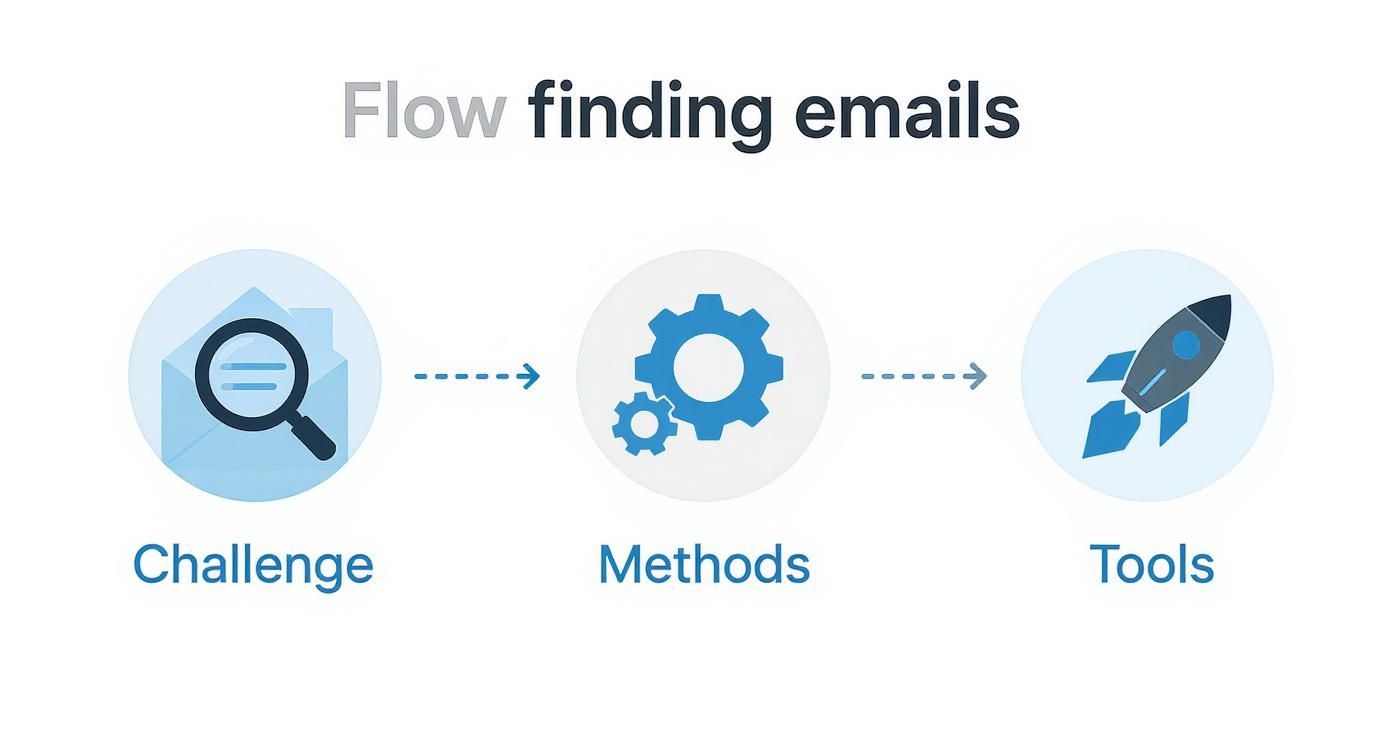
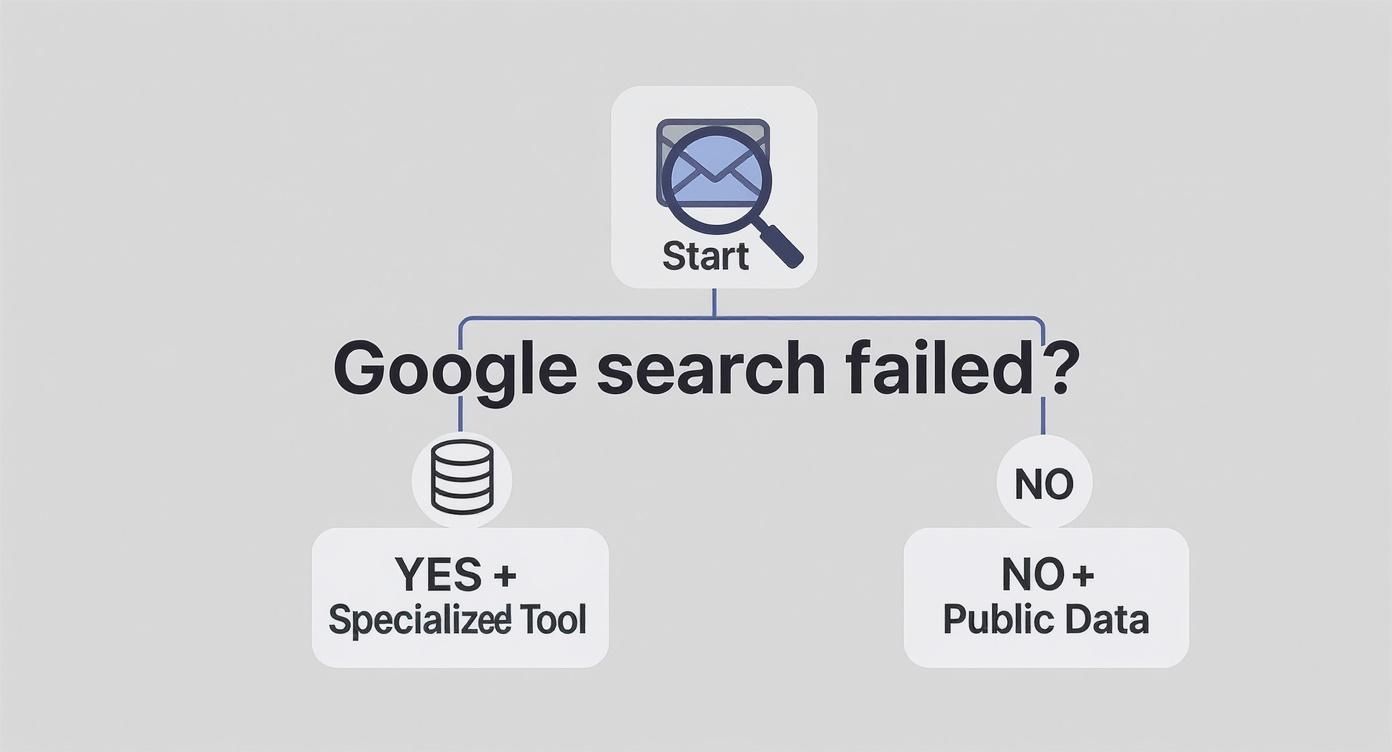
    This visual guide breaks down the simple but effective flow of manual email discovery—from digging for initial clues to spotting patterns and tapping into your network.
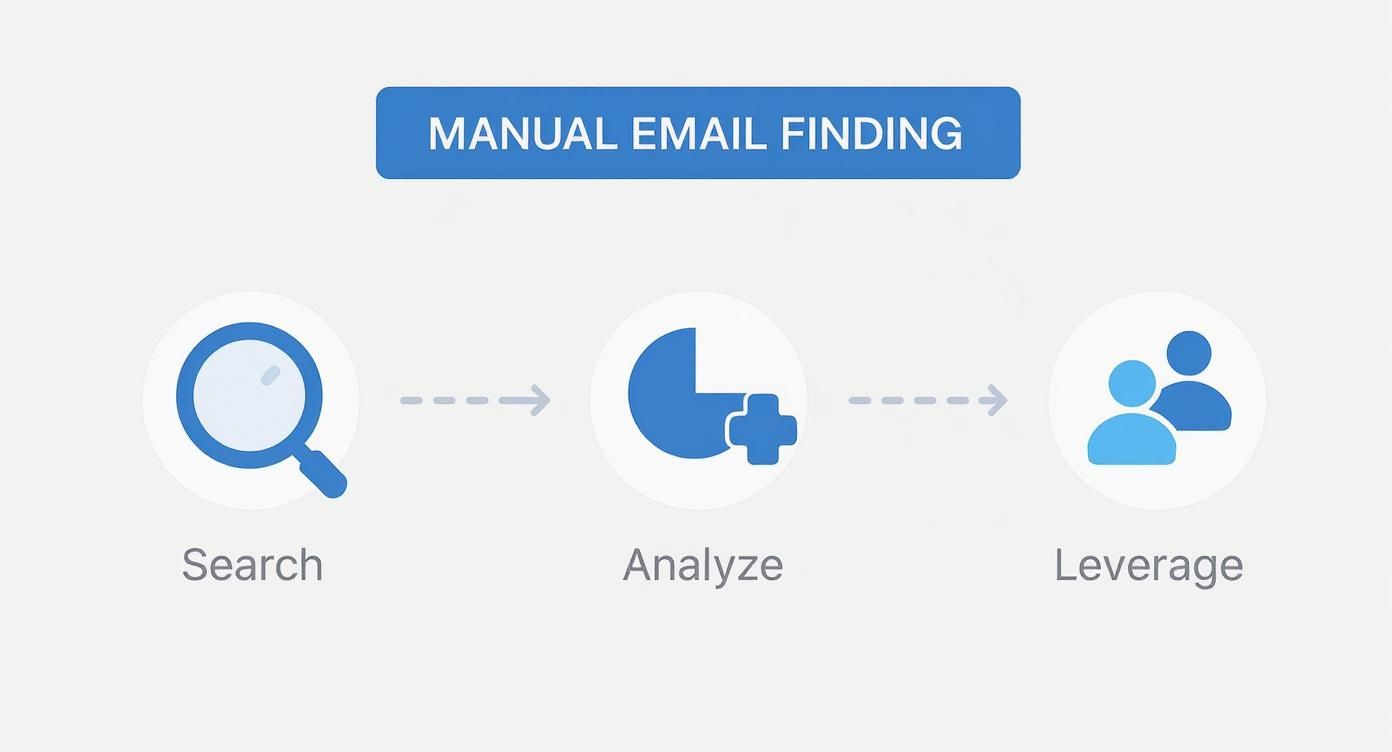
    Infographic about look up email addresses for free

    This process shows how mixing different manual strategies gives you a powerful, no-cost way to find high-value contacts when you don't need full-blown automation.

    Comparing the Top Free Email Lookup Tools

    Many of the big-name services offer surprisingly generous free plans. They're perfect for small-scale outreach, freelancers, or anyone just starting to build a contact list. Here's a side-by-side look at the features, free credits, and accuracy of leading email finders to help you choose the best fit for your needs.

    Tool Name Free Searches Per Month Reported Accuracy Best For
    Hunter.io 25 Searches, 50 Verifications ~95% Beginners needing a reliable and straightforward domain search.
    Snov.io 50 Credits 98% Users who want a full suite of tools (finder, verifier, drip campaigns).
    Voila Norbert 50 Searches 98% Sales teams looking for highly accurate, targeted leads.
    GetProspect 50 Searches 97% Finding and verifying emails directly from LinkedIn profiles.

    For instance, Hunter.io is a solid starting point with 25 free searches and 50 verifications each month. Snov.io gives you 50 monthly credits you can use across its entire suite of tools, which is great value.

    Others like Voila Norbert and GetProspect also hand out 50 free searches, making them excellent choices for targeted prospecting. For a deeper dive, check out our complete comparison of the best free email finder tools available right now.

    The best free tool for you depends entirely on your workflow. Someone building a large sales pipeline has different needs than a founder making a few strategic connections.

    Key Features to Look For

    Beyond the number of free credits, you should look for features that make your life easier. A good email finder should slot right into your existing process without a fuss.

    Here are a few features that I've found provide the most value:

    • Browser Extension: This is a must. It lets you find emails directly from someone's LinkedIn profile or company website, saving you from constantly switching tabs.
    • Confidence Score: This is usually a percentage that tells you how likely an email is to be correct. It's a lifesaver for prioritizing outreach and keeping your bounce rate down.
    • Bulk Finder: If you have a list of names and companies, a bulk feature lets you upload a CSV and get all the emails back in one go. Huge time-saver.

    Ultimately, the goal is to find a tool that not only gives you accurate data but also smooths out your process. You want to spend less time searching and more time actually connecting with people.

    A Practical Walkthrough with EmailScout

    Theory is great, but let's get our hands dirty. I'm going to walk you through exactly how to use EmailScout, a seriously effective (and free) tool, to find your first email address. We'll take the abstract steps we've talked about and turn them into real results using just a name and a company.

    The browser extension is where the real magic happens. Once you have it installed, you can pull contact info right from a LinkedIn profile with a single click. No more tab-switching or manual data entry. You’re just browsing a prospect’s profile and—bam—you’ve captured their verified email.

    Here’s a look at the EmailScout dashboard after grabbing a few contacts from LinkedIn.

    See how cleanly it organizes everything? You get the name, company, position, and the all-important verified email, creating a ready-to-use list you can export in seconds.

    Finding and Verifying Emails in One Go

    One of the best things about EmailScout is the built-in verification. It doesn't just guess at email formats; it actually checks to see if they're deliverable. This is a huge deal for protecting your sender reputation and making sure your emails actually land in someone's inbox.

    Getting that "Verified" check next to an email gives you the confidence to hit send. You know you're not just shouting into the void. It’s a small detail that makes a massive difference in your campaign's success.

    The effectiveness of tools like this shows a bigger trend. In 2025, free email finders have become remarkably powerful, leveling the playing field for small businesses and solo operators. For instance, tools like Voila Norbert claim a 98% verification rate even on free plans. Others integrate right into LinkedIn to make prospecting seamless.

    This easy access to high-accuracy tools, often with a good number of free credits, has made it easier than ever to look up email addresses for free and build outreach campaigns that work, even without a big budget. You can find more great options in this roundup of the best free email lookup tools on skrapp.io.

    With these practical steps, EmailScout stops being just another tool and becomes a core part of your daily outreach toolkit.

    Outreach That People Actually Want to Read

    A person smiling while reading an email on their laptop, representing effective and well-received outreach.

    Finding someone's email is only half the battle. Now comes the real work: writing a message that actually gets a reply instead of a one-way ticket to the trash folder. After you look up email addresses for free, the quality of your outreach is what separates success from silence.

    The secret is genuine personalization, and I’m not just talking about a [First Name] mail merge. Before you even think about hitting send, take two minutes to see who you’re actually talking to. A quick scan of their LinkedIn profile can tell you everything you need to know—a recent project they’re proud of, a shared connection, or an interesting post they just shared.

    Mentioning one of those small details shows you’ve done your homework. It proves you aren't just blasting a generic template to a faceless list. That simple effort can make a massive difference in your response rate.

    Crafting a Value-First Message

    Your opening line needs to offer value right away, not ask for a favor. Flip the script: instead of leading with what you want, focus on what you can give them.

    Here are a few ways to do that:

    • Offer a specific insight: "I saw your company is expanding into the APAC region, and I thought our recent market entry report might have some useful data for you."
    • Provide a helpful resource: "I really enjoyed your article on lead generation. It reminded me of a case study we did on a similar campaign that I thought you'd appreciate."
    • Share a genuine compliment: "Your keynote on sustainable tech was fantastic, especially your point on circular economies. It really stuck with me."

    This approach completely changes the dynamic. It’s no longer a cold pitch; it’s the start of a professional, mutually beneficial conversation.

    The goal isn't just to get your email opened; it's to start a genuine dialogue. By leading with value and demonstrating authentic interest, you build the foundation for a professional relationship, not just a one-off transaction.

    Finally, always play by the rules. Laws like the CAN-SPAM Act have strict guidelines for commercial emails, like including a physical address and an easy way to opt-out. With penalties reaching over $50,000 per violation, compliance isn't just good practice—it's essential.

    Once you’ve made contact, your follow-up game needs to be just as strong. For some great ideas on how to craft compelling messages, check out these perfect follow-up email strategies. A little professional persistence goes a long way.

    Common Questions About Email Lookups

    Even with the best tools and tricks up your sleeve, a few questions always pop up when you're digging for email addresses. It's totally normal. Let's clear the air on some of the most common ones I hear about legality, accuracy, and what to do when you hit a wall.

    Is It Legal to Look Up an Email Address?

    Short answer: Yes, it's generally legal to find and use a publicly available business email for legitimate professional outreach. The real issue isn't how you find the email, but how you use it.

    Your outreach has to play by the rules, like the CAN-SPAM Act here in the U.S. That means your message needs to be professional, relevant to the person you're contacting, and—this is a big one—give them a clear way to opt out. Mess this up, and the penalties can be steep, potentially hitting over $50,000 for a single non-compliant email. It’s all about being respectful and transparent.

    The legality really hinges on responsible use. As long as your outreach is for a legitimate business purpose and you honor opt-out requests right away, you're staying on the right side of the law.

    How Accurate Are Free Tools?

    You'd be surprised. Many free email lookup tools are pretty solid, often claiming accuracy rates in the 85-98% range. They run on smart algorithms and do real-time checks to see if an email will actually deliver. But let's be realistic—no tool is perfect. People change jobs all the time, so email data gets stale fast.

    To protect your sender reputation, I always recommend using tools that provide a confidence score. And if a contact is super important? It's worth running their email through a separate verifier as a backup. We have a whole guide on the importance of confirming email address validity that digs deeper into this. That extra step can save you a ton of bounced emails.

    What If a Tool Cannot Find an Email?

    If your favorite automated tool comes up empty, don't throw in the towel. This is exactly when you fall back on those manual detective skills we talked about earlier.

    Give these backup strategies a shot:

    • Guess the Pattern: Start experimenting with common formats. Think firstname.lastname@company.com or f.lastname@company.com. You'll often strike gold this way.
    • Search Smart: Fire up Google and use advanced search operators. You can often find an email address tucked away in a company blog post, a press release, or an author bio.
    • Connect Directly: Sometimes, the simplest plan is the best one. A polite and personalized connection request on LinkedIn can open the door far better than a cold email ever could.

    Ready to stop guessing and start connecting? With EmailScout, you can find unlimited verified emails for free, right from your browser. Try EmailScout today.
  • Top free email finder tools for 2025: Boost Outreach

    Top free email finder tools for 2025: Boost Outreach

    In the world of sales, marketing, and business development, a strong contact list is the foundation of any successful outreach campaign. Manually searching for professional email addresses is a time-consuming task that drains valuable resources. This is precisely the problem that email finders solve, automating the discovery of crucial contact information and allowing you to focus on building relationships.

    The good news is that you don't need a significant budget to access this powerful technology. We have thoroughly tested and analyzed the most effective free email finder tools available today to help you select the right platform for your specific goals. This guide moves beyond generic feature lists, offering a practical deep dive into each tool's free tier limitations, ideal use-case scenarios, and overall data accuracy. For a deeper dive into modern approaches, including artificial intelligence, in building effective outreach lists, consider reading about AI-Powered Lead Generation.

    Whether you're a freelancer building your first client list, a startup founder seeking investors, or a sales professional trying to hit your quota, this comprehensive breakdown will equip you to start prospecting effectively without any initial investment. Each entry includes detailed analysis, screenshots, and direct links so you can get started immediately.

    1. EmailScout

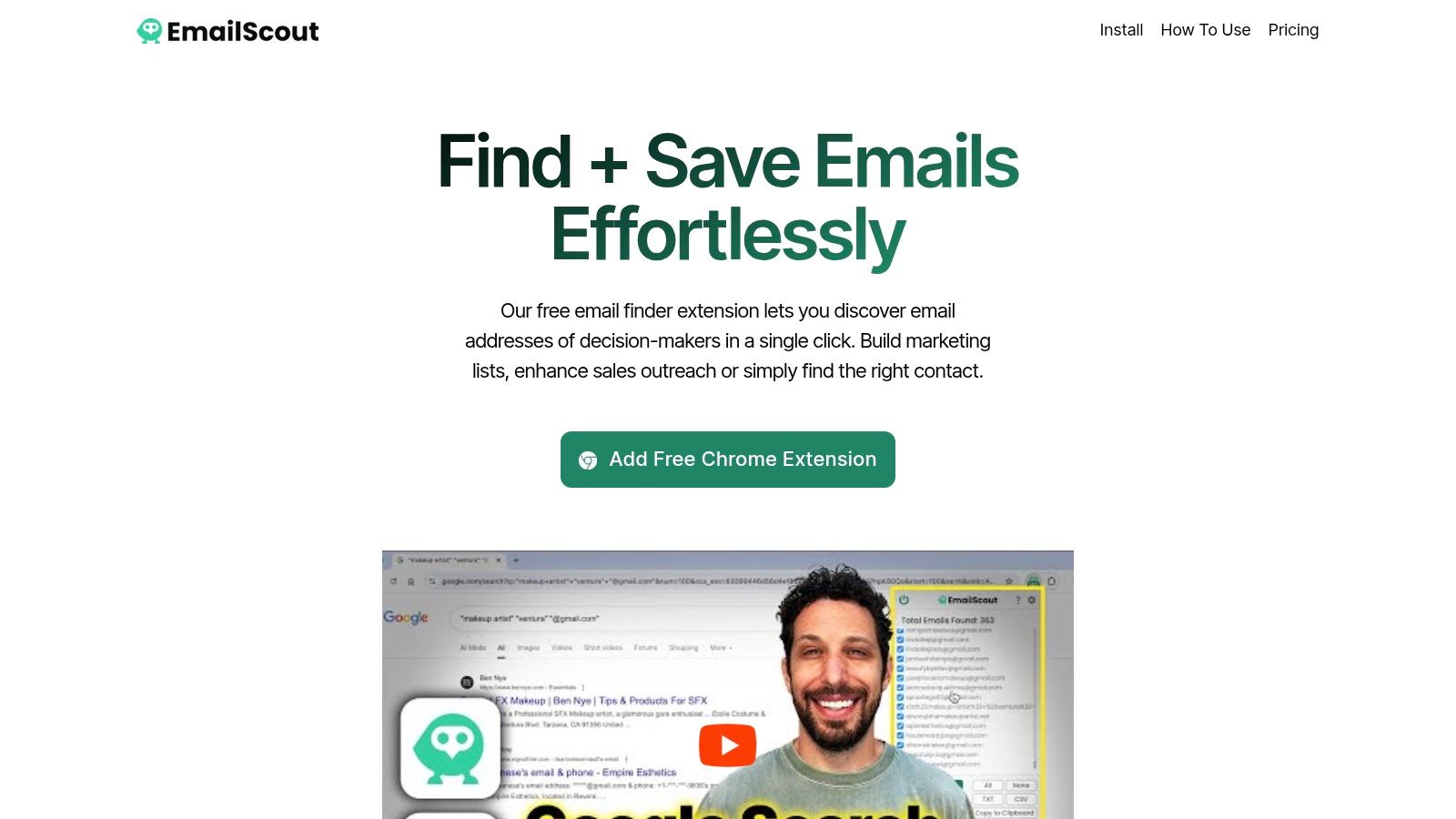
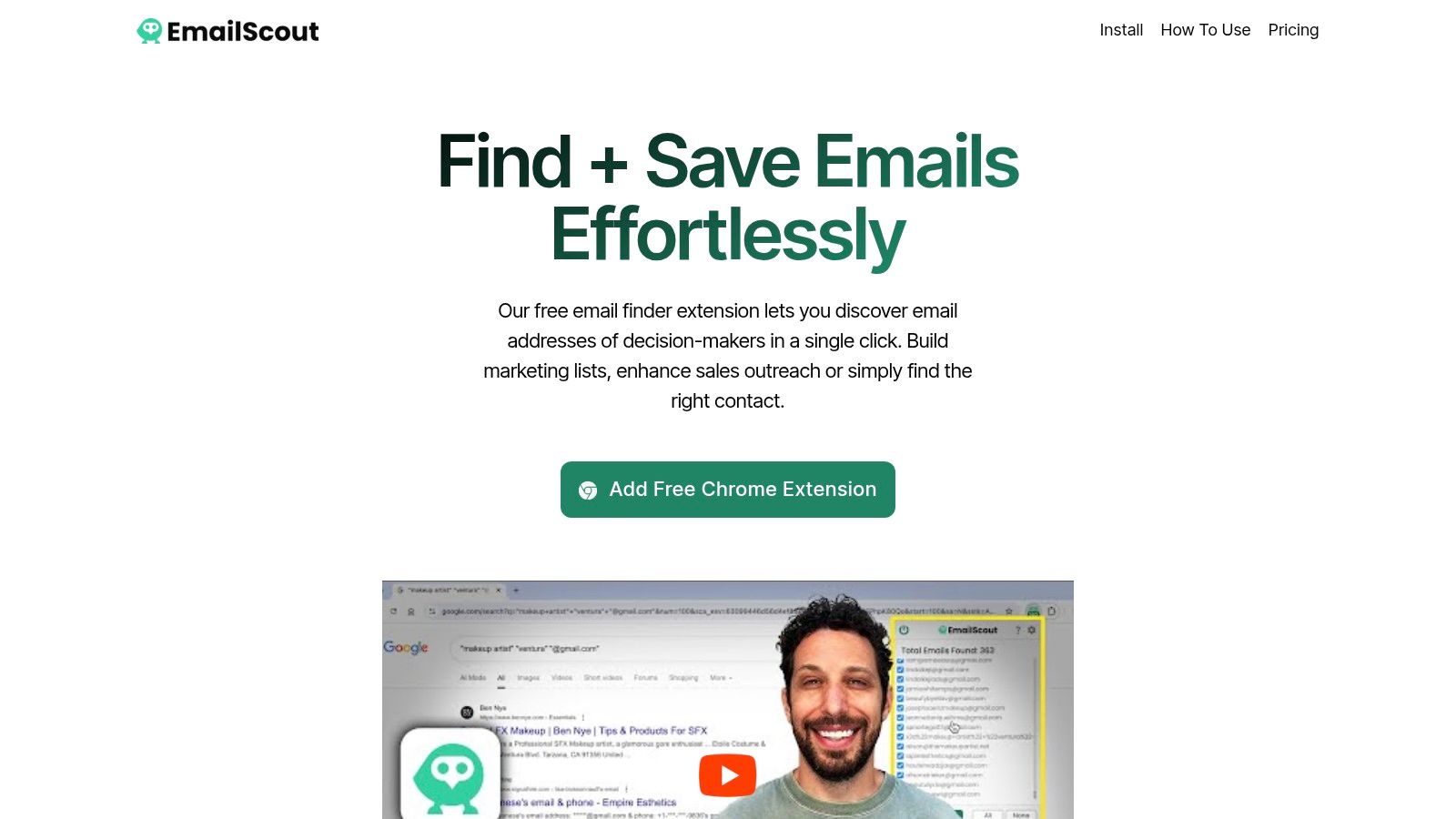
    EmailScout distinguishes itself among free email finder tools with its exceptionally generous free tier and streamlined, one-click Chrome extension workflow. It provides an immediate, no-cost solution for users who need to quickly gather publicly available email addresses directly from websites. Simply visit a site, click the extension icon, and export the discovered emails as a CSV or TXT file.

    This tool’s core strength lies in its simplicity and accessibility. Unlike many competitors that gate their core functionality behind paid plans or restrictive credit systems, EmailScout’s free version allows for unlimited manual email searches and exports. This makes it an ideal starting point for freelancers, startups, and small sales teams building their initial outreach lists without any financial commitment.

    EmailScout

    Key Features and Use Cases

    • One-Click Email Extraction: Instantly find and collect emails from any website’s public source code, perfect for quick lead generation.
    • Unlimited Free Tier: Its standout feature is offering unlimited manual searches and exports, providing significant value without a subscription.
    • AutoSave (Premium): This feature automatically captures emails in the background as you browse, eliminating manual clicks and accelerating lead collection.
    • URL Explorer (Premium): A powerful bulk scraping tool that processes up to 1,500 URLs at once, ideal for high-volume prospecting campaigns.

    Pricing and Tiers

    EmailScout offers a clear path for users to scale their efforts. While the free tier is robust, the premium plans unlock powerful automation features. A no-credit-card trial is available, offering a risk-free way to test the AutoSave and URL Explorer capabilities with a 200 email per month limit. Premium plans start at an accessible $9/month for 5,000 emails, scaling up to 1,000,000 emails per month for enterprise-level needs.

    • Best for: Freelancers, sales professionals, and small teams needing a powerful, cost-effective tool to build initial lead lists quickly.
    • Website: https://emailscout.io

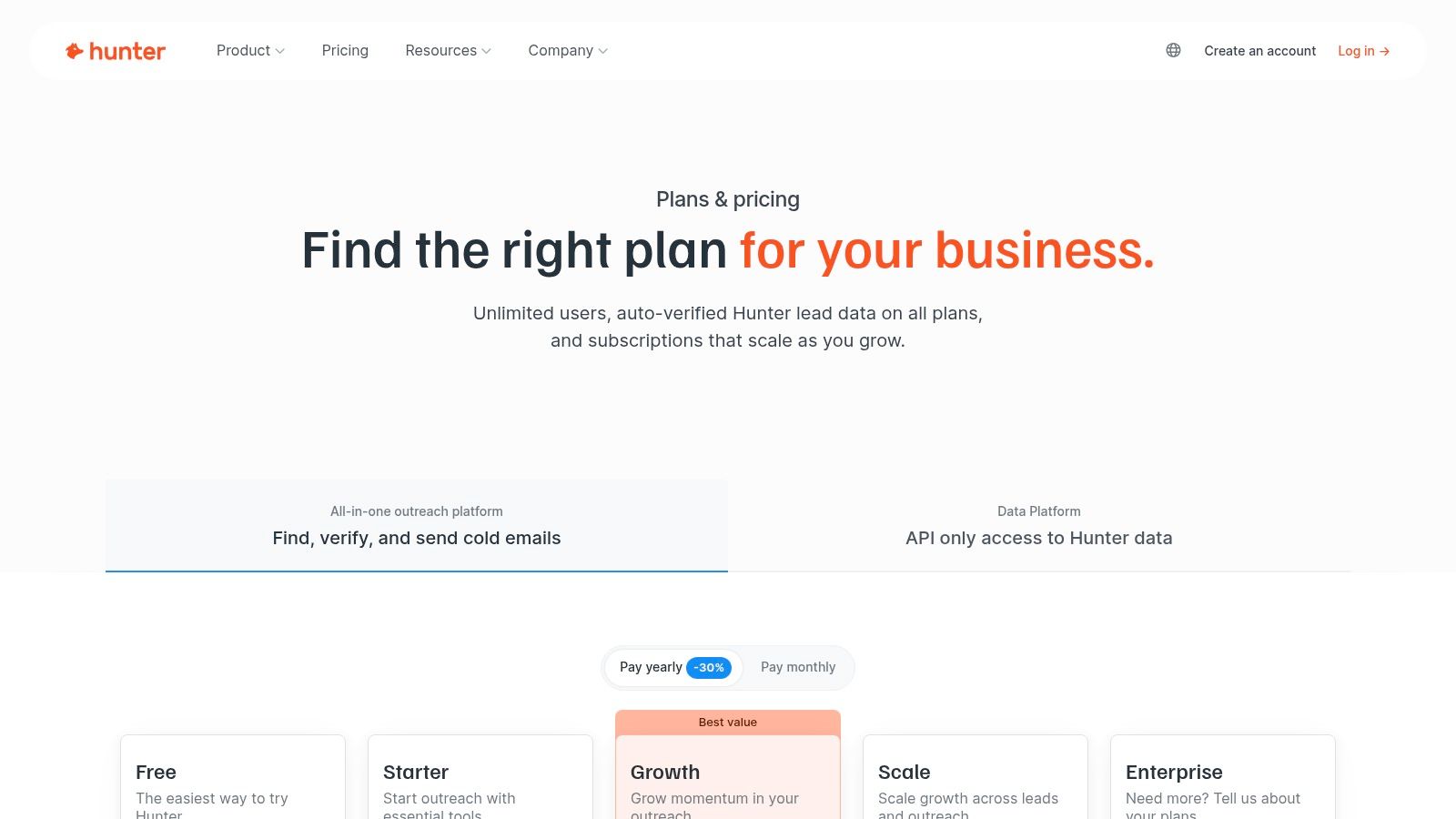
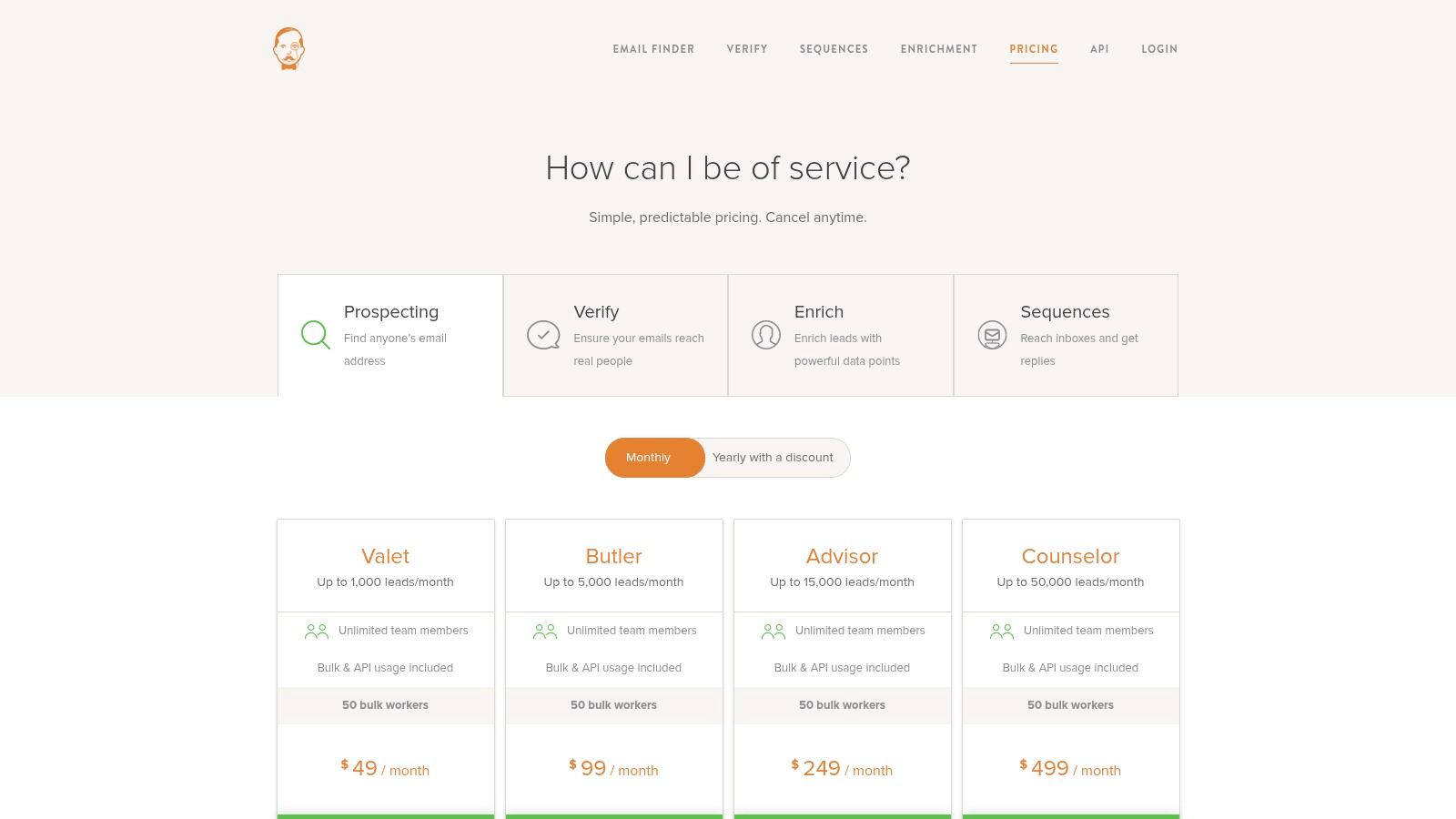
    2. Hunter

    Hunter is a dominant player in the B2B prospecting space and earns its spot as one of the best free email finder tools due to its generous free tier and transparent credit system. It’s an ideal starting point for anyone new to email outreach or needing to verify a small list of contacts without a financial commitment. The platform’s user interface is clean and straightforward, making it easy to jump right in.

    Hunter

    Its "Domain Search" feature is particularly effective for mapping out key contacts within a target company. You simply enter a company's domain, and Hunter returns all publicly indexed email addresses associated with it, complete with confidence scores. This is a powerful tool for building initial prospect lists for cold email campaigns.

    Key Features & Limitations

    What We Like:

    • Generous Free Plan: Offers 25 free searches and 50 free verifications per month.
    • Transparent Credits: Credits are typically only consumed when a verifiable email is found, which is a fair and user-friendly policy.
    • Integrations: A robust Chrome extension and Google Sheets add-on streamline the prospecting workflow significantly.

    Where It Could Improve:

    • Email-Only Focus: The platform does not provide phone numbers or other direct-dial data.
    • Limited Free Filters: Advanced search filters and bulk tasks are reserved for paid tiers.

    Hunter provides a solid foundation for email prospecting. For a deeper analysis of how its features compare, you can learn more about Hunter's capabilities in various email lookup scenarios.

    Website: https://hunter.io/pricing

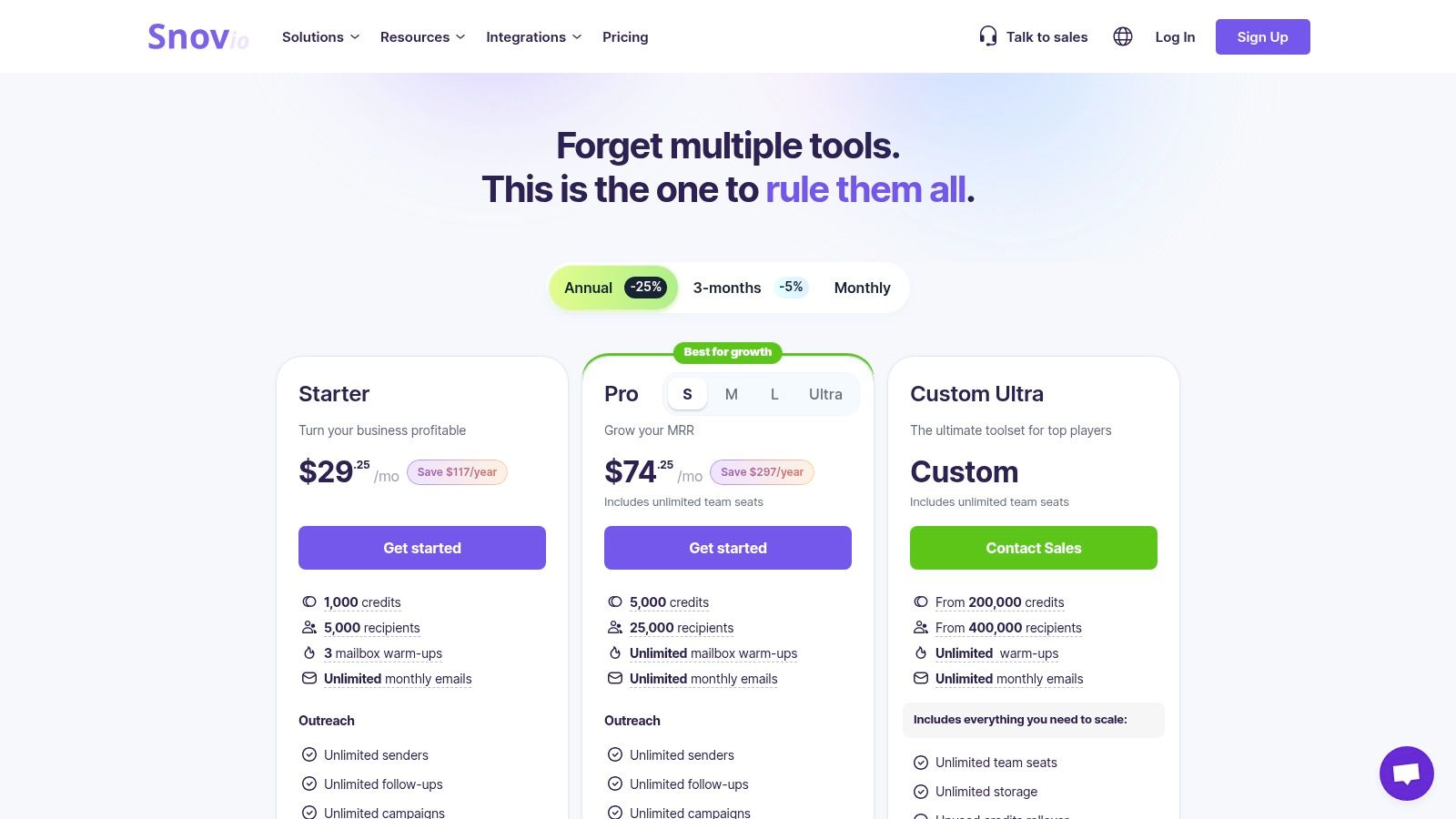
    3. Snov.io

    Snov.io positions itself as more than just an email finder; it's an all-in-one cold outreach automation platform. This makes it one of the most versatile free email finder tools available, as its free "Trial" plan provides recurring monthly credits not just for finding emails, but for verifying them and even launching drip campaigns. It’s an excellent choice for users looking to manage a lightweight, end-to-end prospecting workflow from a single dashboard.

    Snov.io

    The platform's strength lies in its integrated toolset. You can use the Chrome extension to find emails on company websites or LinkedIn profiles, add them to a prospect list, verify their deliverability, and immediately enroll them into a multi-step email sequence. This seamless integration saves significant time compared to using separate tools for each step.

    Key Features & Limitations

    What We Like:

    • Recurring Free Credits: The free plan resets with 50 credits each month, allowing for continuous, low-volume prospecting.
    • All-in-One Platform: Includes an email finder, verifier, and drip campaign functionality even in the free tier.
    • Flexible Credits: Unused paid credits roll over to the next month, preventing waste.

    Where It Could Improve:

    • Gated Features: Advanced bulk search and export capabilities are reserved for paid subscriptions.
    • Add-On Costs: LinkedIn automation features require separate add-on purchases, which can increase the overall cost.

    Snov.io is a powerful suite for those who need more than just email discovery. To ensure your outreach is effective, you can explore how Snov.io helps validate email addresses.

    Website: https://snov.io/pricing

    4. Apollo.io

    Apollo.io is more than just an email finder; it's a comprehensive sales intelligence platform with one of the largest B2B contact databases available. It secures a top spot among free email finder tools because its free plan provides access to this vast dataset, integrating email finding, enrichment, and basic engagement features into a single workflow. The platform is designed for users who want to not only find contacts but also manage initial outreach within the same system.

    Apollo.io

    Its strength lies in its all-in-one approach. Users can leverage its powerful Chrome extension directly on LinkedIn to find verified emails and mobile numbers for prospects. This seamless integration allows for quick list-building and a more efficient prospecting process, making it ideal for sales professionals who need a robust tool without an initial investment.

    Key Features & Limitations

    What We Like:

    • Robust Dataset: Provides access to a massive database for finding both verified emails and direct-dial mobile numbers.
    • Clear Credit Logic: Credits are typically only consumed when a verified email is successfully revealed, ensuring you don’t waste your free allotment.
    • Workflow Integrations: The powerful Chrome and LinkedIn extension creates a smooth and efficient prospecting workflow.

    Where It Could Improve:

    • Variable Free Credits: The exact number of free credits offered can change, making it slightly less predictable than competitors with fixed plans.
    • Complex for Beginners: With features like sequencing and a dialer, the platform can be overwhelming for users who only need a simple email finder.

    Apollo.io is an excellent free option for users who anticipate needing a full suite of sales engagement tools in the future.

    Website: https://www.apollo.io/pricing/about-credits

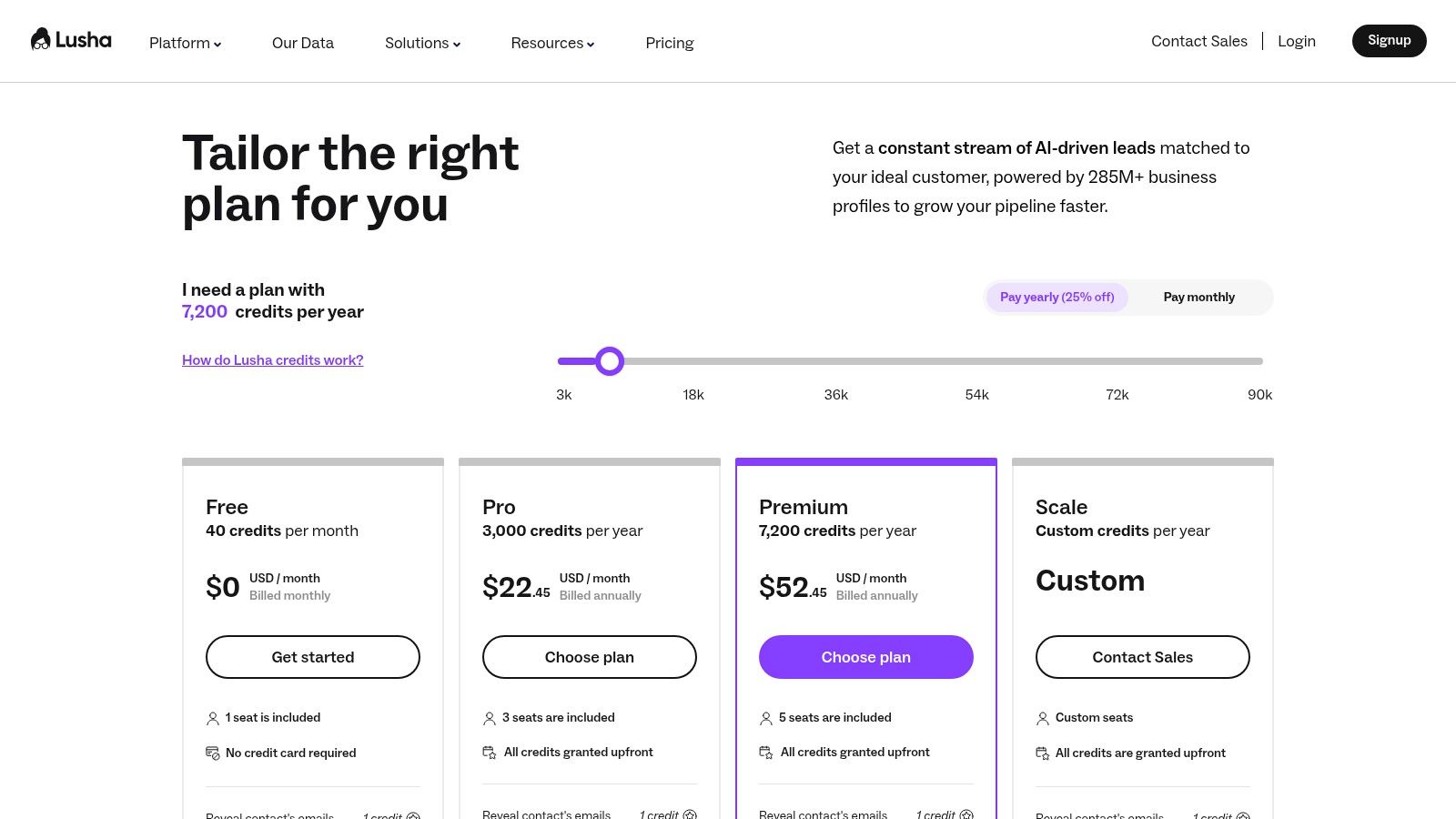
    5. Lusha

    Lusha is a well-known B2B contact finder favored by sales development teams, and its inclusion in a list of free email finder tools is well-earned thanks to a generous free tier. The platform stands out by offering both email addresses and direct-dial phone numbers, all managed through a unified credit system that works across its web app, browser extension, and API. This makes it a versatile tool for multi-channel outreach.

    Lusha

    The user experience is smooth, particularly with its browser extension, which seamlessly overlays contact data on platforms like LinkedIn and company websites. Lusha’s unified credit system simplifies resource management, as you don't have to track different allowances for different features. A single credit reveals an email, making it straightforward to budget your free allowance for prospecting activities.

    Key Features & Limitations

    What We Like:

    • Generous Free Plan: Provides a notable monthly credit allotment for finding emails and phone numbers.
    • Unified Credit System: Credits work across the app, extension, and API, simplifying usage.
    • Credits Roll Over: Unused credits on monthly plans can roll over to the next month, up to a certain cap.

    Where It Could Improve:

    • Costly Phone Numbers: Revealing phone numbers consumes significantly more credits than emails.
    • Gated Features: API access and bulk data exporting capabilities are reserved for higher-tier paid plans.

    Lusha provides an excellent free starting point for teams that need both email and phone contact information for their outreach efforts.

    Website: https://www.lusha.com/pricing/

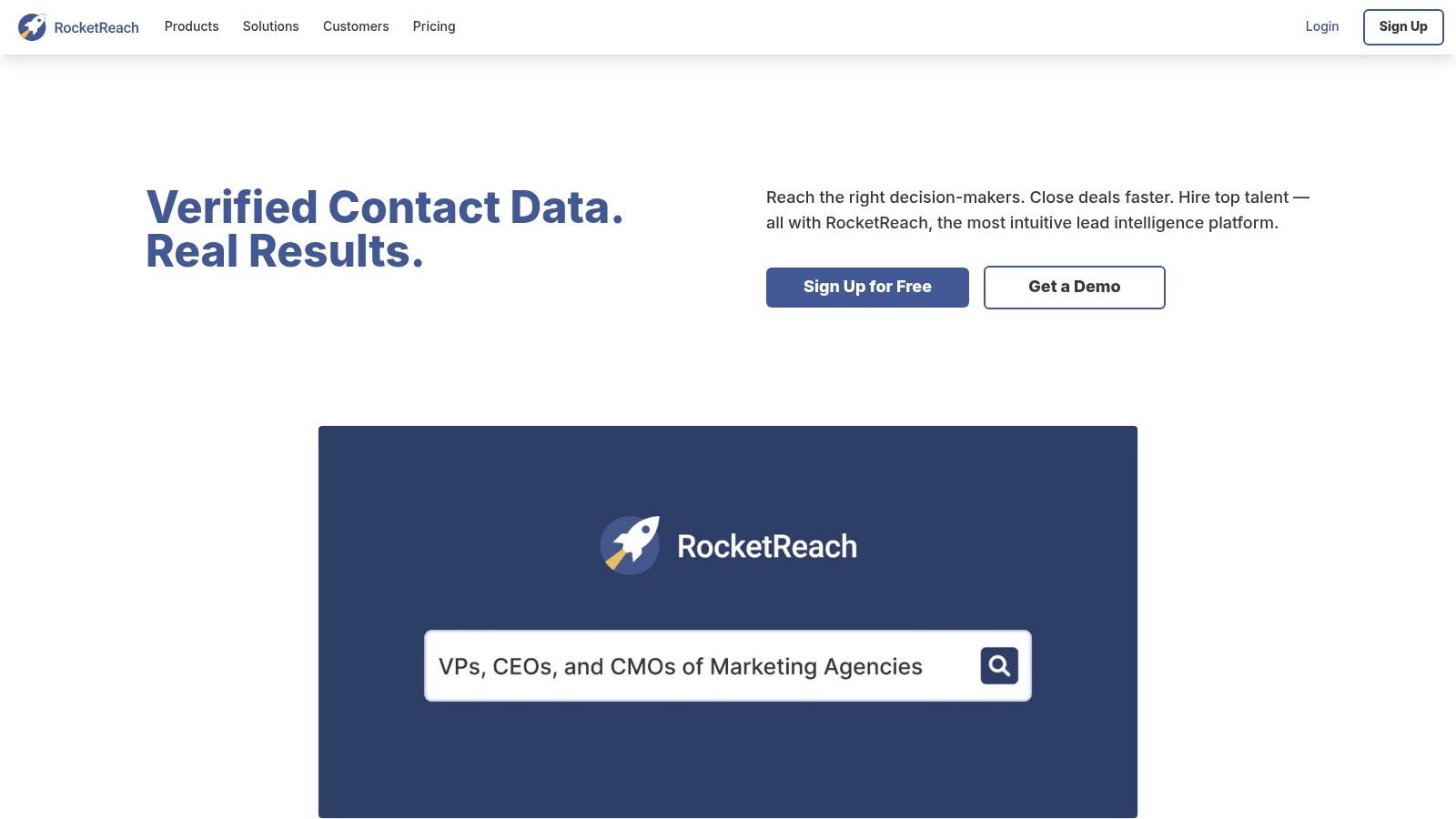
    6. RocketReach

    RocketReach is a well-established contact lookup platform known for its extensive database covering a wide range of industries and professional roles. It secures its place on this list of free email finder tools by offering a small but consistent monthly allowance of free lookups, making it a reliable option for users who need to find a few key contacts without any upfront cost. Its browser extension is a notable feature, allowing for quick profile lookups on social platforms like LinkedIn.

    RocketReach

    The platform provides both personal and professional email addresses, which can be valuable for multi-channel outreach strategies. While its free tier is primarily for testing its data accuracy and coverage, it's sufficient for entrepreneurs or freelancers with very low-volume prospecting needs. The interface is straightforward, focusing on quick searches and contact retrieval.

    Key Features & Limitations

    What We Like:

    • Broad Data Coverage: Offers access to a large database of professional and personal emails across various sectors.
    • Simple Free Trial: The recurring free monthly quota provides a simple way to test its accuracy and find a handful of contacts.
    • Browser Extension: The extension simplifies finding contact information directly from professional networking sites.

    Where It Could Improve:

    • Limited Free Tier: The number of free lookups is very restrictive and intended more as a trial than a functional free plan.
    • Pricing Confusion: Paid plans and credit policies can sometimes be unclear, with some users reporting variations in quotas.

    Website: https://rocketreach.co/

    7. Skrapp

    Skrapp carves out its niche by focusing heavily on LinkedIn integration, making it one of the most practical free email finder tools for sales professionals and recruiters. Its generous free plan and fair credit policy make it an attractive option for users who need a consistent monthly allowance of email lookups without an upfront investment. The platform is designed to seamlessly integrate into a LinkedIn-based prospecting workflow.

    Skrapp

    The core strength of Skrapp lies in its powerful browser extensions for LinkedIn Basic, Sales Navigator, and Recruiter. These tools allow users to find verified email addresses directly from profiles, saving significant time. The platform also includes a domain search feature to uncover emails associated with a specific company, broadening its utility beyond just social media prospecting.

    Key Features & Limitations

    What We Like:

    • Generous Free Plan: Provides 100 free email credits per month, which roll over if unused.
    • Fair-Credit Policy: Credits are only deducted for emails found with a "deliverable" status, not for invalid or unknown results.
    • Strong LinkedIn Integration: Excellent extensions make it a top choice for sourcing contacts directly from LinkedIn.

    Where It Could Improve:

    • Email-Only Focus: Does not provide direct-dial phone numbers or other contact data.
    • Limited Advanced Features: Deeper verification checks and automation capabilities are reserved for higher-tier paid plans.

    Skrapp is an excellent starting point for anyone whose prospecting is centered around LinkedIn. Its straightforward credit system and generous free tier offer substantial value for building targeted email lists.

    Website: https://skrapp.io/pricing

    8. Voila Norbert

    Voila Norbert positions itself as a straightforward and highly accurate email finder, earning its place among the best free email finder tools with a simple, results-oriented trial. The platform grants every new user their first 50 email finder credits completely free, allowing for a robust test drive of its core functionality. It operates on a "pay for results" model, which builds trust right from the start.

    Voila Norbert

    The user experience is clean and focused on a single task: finding the correct email address. You input a person's full name and their company domain, and Norbert gets to work. This simplicity is its strength, making it ideal for sales professionals or recruiters who need reliable contact data quickly without navigating complex dashboards or features they don't need.

    Key Features & Limitations

    What We Like:

    • Free Trial Credits: The initial 50 free search credits offer a genuine opportunity to test the tool's accuracy and workflow.
    • Pay-for-Success Model: Credits are only deducted for successful, verifiable email finds, which is a fair and transparent system.
    • Scalability: Supports bulk CSV uploads, API access, and integrations for users who decide to upgrade to a paid plan.

    Where It Could Improve:

    • One-Time Freebie: The 50 free credits are a one-time grant upon signup and do not refresh monthly like some competitors.
    • Paid-Only Features: Key tools for scaling outreach, such as bulk finding and verification, require a paid subscription.

    Voila Norbert is an excellent choice for users who value accuracy and want a no-risk trial to confirm a platform's effectiveness before committing.

    Website: https://www.voilanorbert.com/pricing/

    9. Seamless.AI

    Seamless.AI positions itself as a real-time search engine for B2B contacts, making it a powerful addition to our list of free email finder tools. Its AI-driven platform provides not only emails but also direct-dial phone numbers, offering a more comprehensive contact profile than many competitors. The free plan provides a set number of credits, allowing users to test its core search and enrichment capabilities before committing.

    Seamless.AI

    The platform’s strength lies in its real-time data verification, which aims to reduce bounce rates by checking contact information at the moment of search. Its Chrome extension is also highly effective for finding contact details directly from LinkedIn profiles or company websites, streamlining the prospecting workflow for sales and marketing professionals.

    Key Features & Limitations

    What We Like:

    • Multi-Channel Data: Provides both verified emails and direct-dial phone numbers, even on the free testing tier.
    • Real-Time Verification: The AI-powered engine verifies contact information in real-time to ensure accuracy.
    • Robust Chrome Extension: Enables easy prospecting directly from LinkedIn and corporate websites.

    Where It Could Improve:

    • Complex Credit System: The credit system and pricing can be confusing, often requiring a sales call for clarity.
    • Limited Free Tier: The free credits are primarily for evaluation and are quickly exhausted with active use.

    Website: https://seamless.ai/pricing

    10. GetProspect

    GetProspect is a powerful B2B platform that earns its spot by tightly integrating with LinkedIn, making it a go-to choice for sales and marketing professionals who source leads primarily from the social network. As one of the top free email finder tools, its free plan is a standout for offering recurring monthly credits that also roll over, providing excellent long-term value for users with modest, ongoing needs.

    GetProspect

    Its core strength lies in its LinkedIn extension, which allows users to find and save verified email addresses directly from LinkedIn profiles and search results. The platform follows a "pay only for valid emails" logic, ensuring you don't waste your limited credits on bad data. This transparent approach, combined with advanced filters and data export options, makes it a robust tool for building targeted lead lists.

    Key Features & Limitations

    What We Like:

    • Renewing & Rollover Credits: The free plan offers 50 monthly credits, and unused credits can roll over, which is a rare and valuable feature.
    • Transparent Credit Rules: The platform clearly defines how credits are used, charging only for successfully found and verified emails.
    • API Access: Even the free tier includes API access, allowing for custom integrations and automated workflows.

    Where It Could Improve:

    • Complex Interface: The UI and help documentation are geared more toward experienced users and can be less intuitive for beginners.
    • Limited Phone Credits: Finding phone numbers requires separate credits, which are very limited on lower-tier plans.

    GetProspect is an excellent free option for users who need a reliable LinkedIn-based email finder with fair credit policies.

    Website: https://getprospect.com/pricing

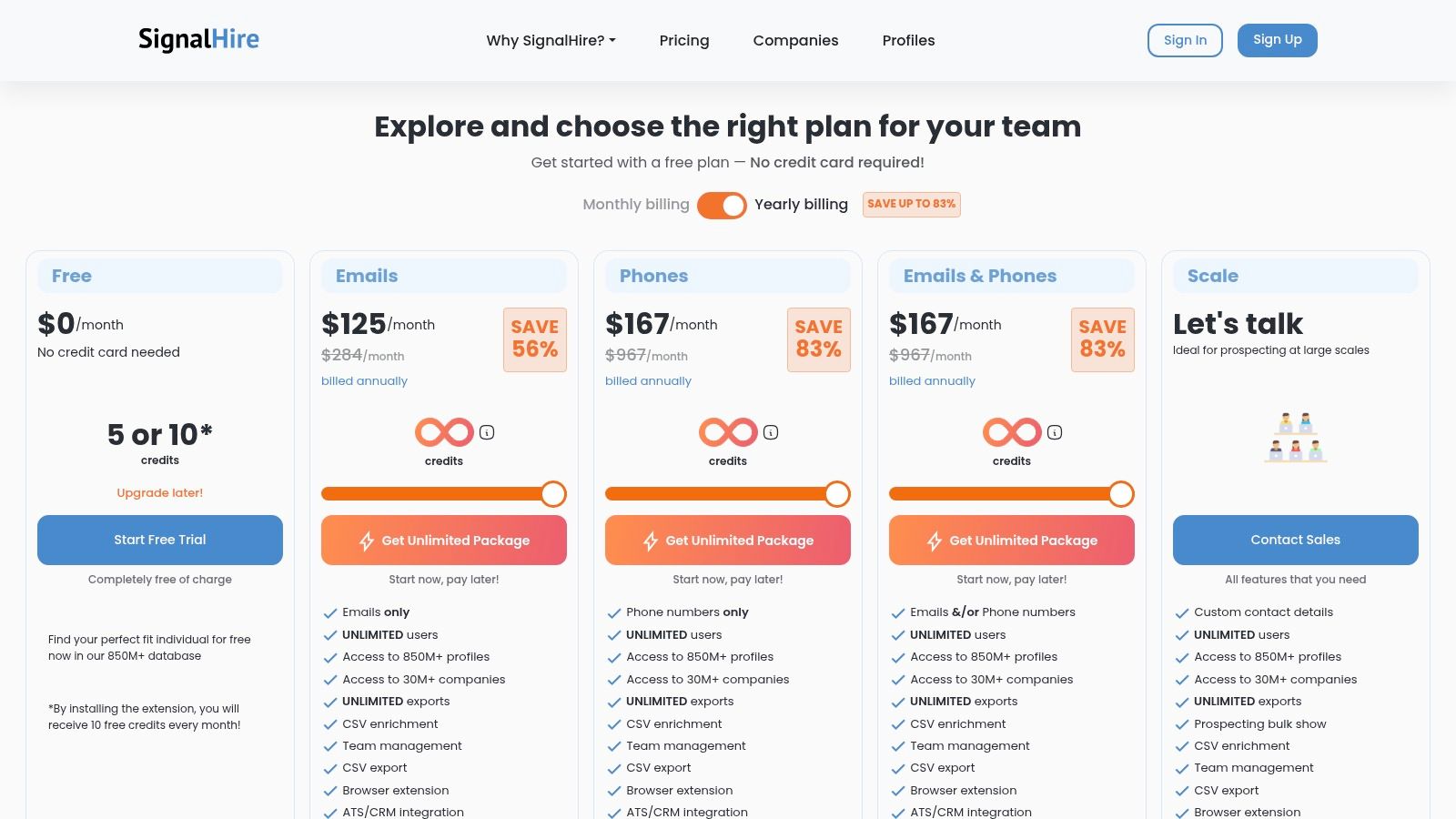
    11. SignalHire

    SignalHire is a recruitment-focused platform that doubles as a powerful free email finder tool for sales and marketing professionals. It provides a small but recurring free monthly credit allowance, making it suitable for users with very targeted, low-volume prospecting needs. The platform's standout feature is its versatile browser extension, which seamlessly integrates with professional networks like LinkedIn to find contact information directly on a prospect's profile page.

    SignalHire

    The user experience is straightforward, and the simple credit system applies across its entire suite of tools, including the main platform, extension, and API. This consistency makes it easy to understand and manage your usage without having to learn different rules for different features. While its primary audience is recruiters, the tool is equally effective for SDRs building highly specific contact lists.

    Key Features & Limitations

    What We Like:

    • Browser Extension: Works effectively across LinkedIn and other social networks to find emails and phone numbers in-context.
    • Simple Credit Model: A single credit type is used for finding emails, whether through the site, extension, or API.
    • Team-Friendly Paid Plans: Many paid plans have no per-seat limits, making them scalable for growing teams.

    Where It Could Improve:

    • Limited Free Tier: Only 5 free credits per month (10 if the extension is installed) is very restrictive.
    • Aggressive Upsells: Users may encounter prominent upsells, and phone numbers require purchasing separate credit packs.

    Website: https://www.signalhire.com/pricing

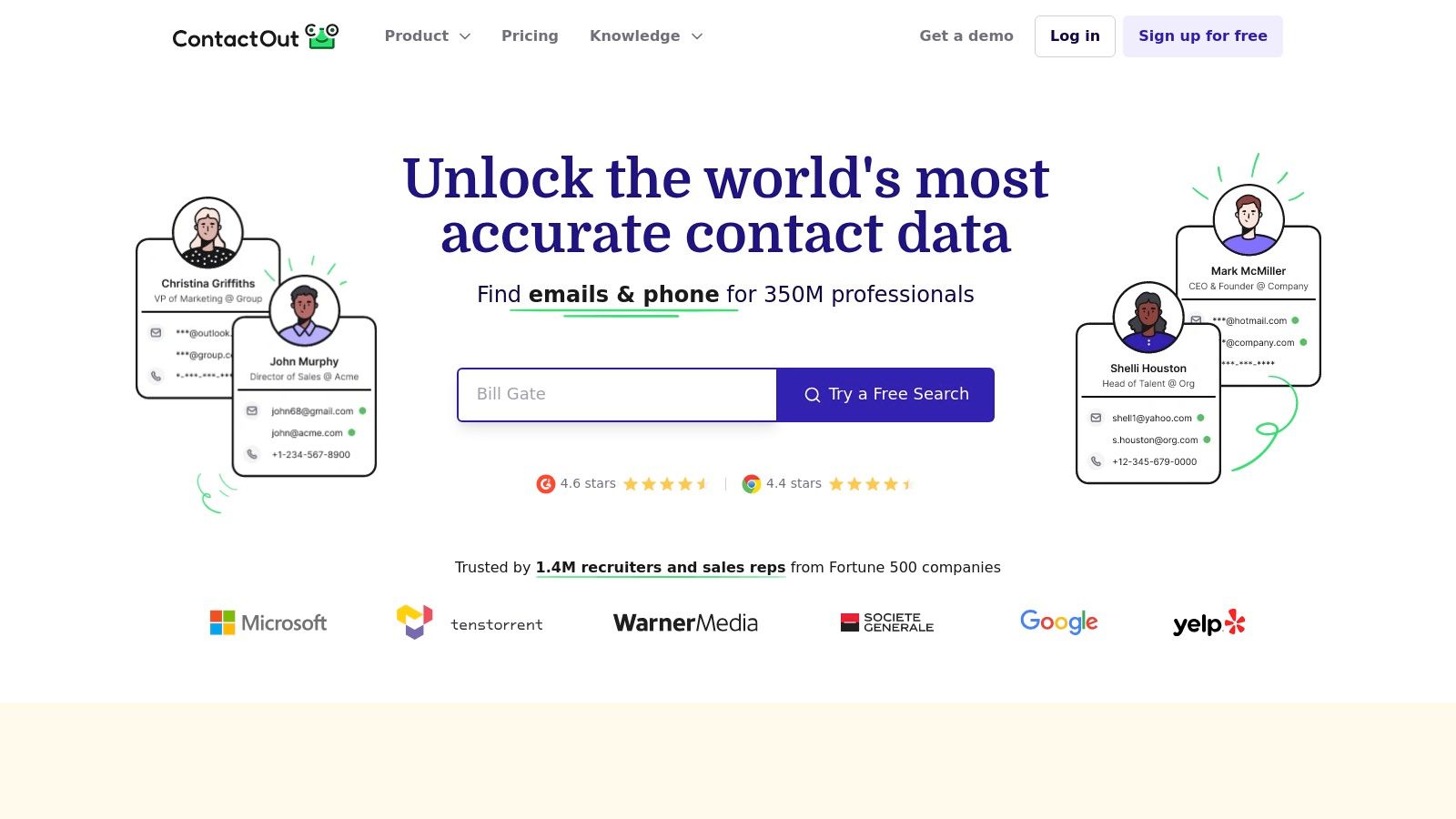
    12. ContactOut

    ContactOut is a powerful recruiting and sales intelligence platform that has carved out a niche as one of the most effective free email finder tools for LinkedIn-based prospecting. It excels at uncovering both work and personal emails, along with phone numbers, directly from social profiles, making it a favorite among recruiters and B2B sales professionals who need deep contact data. The recurring daily credits on its free plan provide a great way to test its capabilities or handle light, ongoing prospecting needs.

    ContactOut

    Its primary strength lies in its Chrome extension, which seamlessly integrates with LinkedIn, Sales Navigator, and Recruiter Lite. This allows users to find contact information for profiles with a single click, streamlining the process of building highly targeted outreach lists without ever leaving the LinkedIn ecosystem. The interface is clean and presents data clearly, which is a major plus.

    Key Features & Limitations

    What We Like:

    • Recurring Free Credits: The free plan offers a daily allowance of credits, which is great for consistent, low-volume use and testing.
    • LinkedIn Integration: The Chrome extension is robust and works across various LinkedIn platforms, making it highly efficient.
    • Rich Data: Often provides both work and personal emails, plus mobile phone numbers, offering multiple contact points.

    Where It Could Improve:

    • Limited Free Tier: Advanced features like CRM integrations and bulk exports are gated behind paid plans.
    • Pricing Variations: Pricing information can sometimes vary across different sections of their site, which can be confusing.

    ContactOut is a fantastic tool for users who live on LinkedIn. For a more detailed guide on leveraging such tools, you can discover different methods to find emails on LinkedIn.

    Website: https://contactout.com/

    Top 12 Free Email Finder Tools Comparison

    Product Key Features UX & Accuracy Value / Pricing Best For / USP
    EmailScout Chrome extension, one‑click finder, AutoSave, URL Explorer, CSV/TXT export Fast, simple workflow; finds publicly exposed addresses (verify deliverability) Unlimited free manual finds/exports; premium 5K–1M/mo from $9; trial 200/mo Freelancers/startups & small sales teams; instant list-building and bulk URL scrape
    Hunter Email Finder, Domain Search, Verifier, Chrome & Sheets add‑on Clear UI; reliable verification; transparent credit use Generous free plan; credits often charged only on success Verification-focused users; easy credit logic
    Snov.io Finder, Verifier, Bulk tools, Drip campaigns, trackers Multichannel sequencing; decent accuracy; Google integrations Recurring trial credits; paid plans for bulk & automation Teams needing outreach + sequencing
    Apollo.io Verified email & mobile reveals, enrichment, sequences, extensions Large dataset; robust integrations; charged for verified reveals Free testing credits; paid tiers for advanced engagement Scaling sales orgs needing enrichment + engagement
    Lusha Email & phone reveals, CRM integrations, unified credits Very simple UX; generous monthly credit allotment High free credits; phones cost more credits SDRs/recruiters needing phone + email lookups
    RocketReach Email & phone lookup, browser extension, bulk/API Wide coverage across roles/companies; testable with free quota Small recurring free allowance; paid plans vary Broad coverage and cross-checking contacts
    Skrapp LinkedIn & domain finder, verifier, LinkedIn extensions LinkedIn‑focused; fair credit policy; rollovers Free 100 credits/mo; affordable entry plans LinkedIn prospecting with fair credit rules
    Voila Norbert Pay‑for‑results finder, bulk CSV, API, Chrome Simple flow; only pay for successful finds 50 free one‑time credits; pay per valid result Pay‑per-result simplicity; good for ad‑hoc lookups
    Seamless.AI Email & phone, real‑time enrichment, Chrome extension Fast enrichment; includes phone data even on free tier Free test credits; paid pricing less transparent Teams wanting phone + email enrichment in real time
    GetProspect LinkedIn extension, database search, API, exports Power‑user UI; transparent per‑feature credit rules Recurring free credits; rollovers and team sharing LinkedIn-heavy prospecting with API/export needs
    SignalHire Email & phone finder, extension, team features, CSV export Recruiter-friendly; small free quota; team tools on paid tiers Free 5 (10 with extension); phones sold separately Recruiters and SDR teams needing team access
    ContactOut LinkedIn Chrome extension, daily free credits, exports Simple UI; mixture of work & personal emails Recurring daily free credits; paid for integrations Recruiters focused on LinkedIn sourcing and light daily use

    Choosing the Right Free Tool for Your Growth

    Navigating the landscape of free email finder tools can feel overwhelming, but as we've explored, the right choice ultimately hinges on your specific, day-to-day workflow. The "best" tool isn't a one-size-fits-all solution; it's the one that integrates seamlessly into your prospecting process and provides the most value within its free-tier limitations.

    By now, you should have a clear picture of the different models available. From the generous monthly credits offered by platforms like Hunter and Snov.io, ideal for structured, periodic outreach campaigns, to the robust, all-in-one CRM and engagement features of Apollo.io, perfect for teams looking to centralize their sales stack without an initial investment. Each tool offers a unique pathway to connecting with your ideal prospects.

    How to Make Your Final Decision

    To select the right tool, move beyond feature lists and focus on your operational needs. Ask yourself these critical questions:

    • What is my search volume? If you only need a handful of verified emails each month, a tool like Lusha or Voila Norbert might suffice. If you perform frequent, one-off searches, a tool with unlimited manual lookups like EmailScout offers unparalleled long-term value.
    • Where do I do my prospecting? Do you live on LinkedIn? A tool with a powerful Chrome extension, such as Skrapp or GetProspect, is non-negotiable. If you work from company websites, a domain search feature is your priority.
    • Do I need more than just emails? For roles that require direct-dial phone numbers and broader company intelligence, platforms like RocketReach, SignalHire, and ContactOut provide more comprehensive data, though their free credits are often more limited.
    • What is my long-term strategy? Consider the scalability of the tool. A free plan is a great entry point, but if you anticipate your needs growing, evaluate the paid tiers of your top contenders to ensure they align with your future budget and feature requirements.

    Final Takeaways and Next Steps

    The most powerful takeaway is that you don't have to rely on a single solution. A savvy professional can build a cost-effective "prospecting stack" by combining the strengths of multiple free email finder tools. Use one for its LinkedIn integration, another for its data accuracy, and a third for its generous credit allowance.

    Your immediate next step is to choose two or three tools from this list that best match your profile and sign up for their free plans. Spend a week actively using them in your real-world tasks. This hands-on experience is the only true way to gauge their accuracy, user-friendliness, and overall impact on your productivity. By testing them head-to-head, you'll quickly discover which free email finder tool will become an indispensable part of your growth engine.


    Ready to start finding verified emails without credit limits holding you back? While many tools restrict your monthly searches, EmailScout provides unlimited manual searches for free, forever. Get started with EmailScout today and experience the freedom of limitless, on-demand email lookups.

  • Find Business Email: Locate Any Address Fast

    Find Business Email: Locate Any Address Fast

    So, how do you actually find a business email address? You really have three solid options: you can do it the old-fashioned way by manually digging through company websites and social media, you can try guessing common email patterns like firstname.lastname@company.com, or you can use a dedicated email finder tool to get it done fast.

    The best approach? A mix of all three, capped off with a solid verification step.

    Why Finding the Right Email Is a Game Changer

    A person holding a large golden key with an email '@' symbol on it, representing access to new opportunities.

    Before we jump into the how-to, let's talk about the why. Honestly, this isn't just about ticking a box on your to-do list. Finding the right person's email is your foot in the door for building real professional relationships. It's the key to bypassing gatekeepers and starting conversations that actually go somewhere.

    Sure, LinkedIn is fantastic for making that initial connection, but when it's time for a serious business conversation, email is still king. And it's not going anywhere. The number of emails sent daily is projected to jump from 376.4 billion in 2025 to a massive 408.2 billion by 2027. If you want to see the full picture, check out these email usage trends.

    The Power of a Direct Connection

    Think about it. When was the last time you felt a personal connection to an email sent to "info@" or "sales@"? Probably never.

    Having someone’s direct email address changes everything. It lets you personalize your message—mention their latest project, a recent blog post, or a shared interest. That's what makes the difference between an email that gets an instant reply and one that gets instantly deleted.

    The goal isn’t to build a massive, unverified list of contacts. The real value comes from creating a smaller, highly accurate list that enables genuine, one-to-one communication.

    Nailing this skill pays off in so many ways. You'll see the impact across the board:

    • Sales Prospecting: You can finally talk directly to the person with the authority to say "yes."
    • Networking: It’s your direct line to industry peers, mentors, or future collaborators—no middleman needed.
    • Marketing Outreach: Share your stuff with people who will actually find it useful, not a generic inbox.
    • Career Growth: Want a new job? Contact the hiring manager or team lead directly and stand out from the crowd.

    At the end of the day, every successful outreach campaign, every big sale, and every game-changing partnership starts with one thing: the right email address.

    Before you drop a single dollar on a fancy tool, it's always worth trying some good old-fashioned digital detective work. These manual methods are surprisingly effective, especially when you just need to track down a few key business emails and aren't ready to commit to a paid service.

    It takes a little more legwork, sure, but the payoff can be huge.

    Think of it like a scavenger hunt. Your first stop should always be the company's own website—but don't just glance at the homepage and give up. You need to dig into the pages most people ignore.

    • The "About Us" Page: This is often a goldmine. You can usually find the names and titles of key team members here.
    • A "Meet the Team" Page: Even better. Some companies will list their entire leadership team, sometimes with direct contact info right there.
    • Press Releases or News Section: Scan these for a media contact. Companies often list a specific person's email to prevent journalists from guessing and flooding their inboxes.
    • Blog Author Bios: If your target has written for the company blog, check their bio at the end of the post. It might have an email or a social media link you can follow up on.

    Wielding Advanced Search Like a Pro

    If the website itself is a dead end, your next move is to put Google to work. A standard search isn't going to cut it, but a few advanced search operators can uncover emails that are hiding in plain sight.

    Try this simple but powerful query in the Google search bar: site:company.com "Jane Doe" email

    This little command tells Google to search only within that specific company's website for the person's name alongside the word "email." You can also swap "email" for "contact" to mix things up.

    It's a fantastic trick for digging up contact details buried in old PDF reports, forgotten event pages, or obscure staff directories that aren't linked from the main navigation.

    I’ve found this manual search method works wonders for finding contacts at non-profits, universities, and government organizations. They often publish documents with full staff directories or contact lists that a targeted Google search can easily find.

    The Art of the Educated Guess

    Once you have a name and a company domain, you can often make a highly educated guess. Why? Because most businesses use a standardized pattern for their email addresses to keep things simple. It’s all about finding that pattern.

    Here are the most common formats I always test first:

    But guessing isn’t enough. You need to quickly check if you’re right without sending a test email that might bounce and make you look unprofessional.

    A slick little trick inside Gmail can help you out.

    Just compose a new email and type one of your guessed addresses into the "To" field. Do not hit send. Just hover your mouse over the email address for a second. If a Google profile picture or name pops up, you’ve almost certainly found a valid, active address.

    It’s not 100% foolproof, but it’s a quick, free check that works remarkably well, since so many people link their work email to a Google account these days.

    Using Email Finder Tools to Work Smarter

    Let's be honest, manual detective work is great for a handful of high-value targets, but it just doesn't scale. When you're staring down the barrel of building a prospect list for a new sales campaign or finding dozens of media contacts before a launch, you need to bring in the big guns. This is where technology does the heavy lifting, turning a soul-crushing task into a surprisingly fast one.

    The smartest way to scale your email discovery is with specialized Email Finder tools. These platforms are built for one purpose: finding business email addresses quickly. All they usually need is a name and a company domain. They can save you countless hours, freeing up your team to focus on what actually matters—outreach and building relationships, not tedious data entry.

    How Email Finder Tools Put Your Outreach on Fast-Forward

    Picture this: your sales team needs to target marketing managers at every SaaS company in a specific niche. Searching for each contact one by one could take an entire week. An email finder tool, on the other hand, can knock this out in minutes.

    Take a tool like EmailScout, for example. Its Chrome extension plugs right into your browser. When you're on a prospect's LinkedIn profile, you just click a button to instantly pull their verified business email. No more juggling tabs or playing the guessing game with email patterns. The info you need is delivered right where you're already working. If you're weighing your options, our guide on the best email finder tools breaks down the top players on the market.

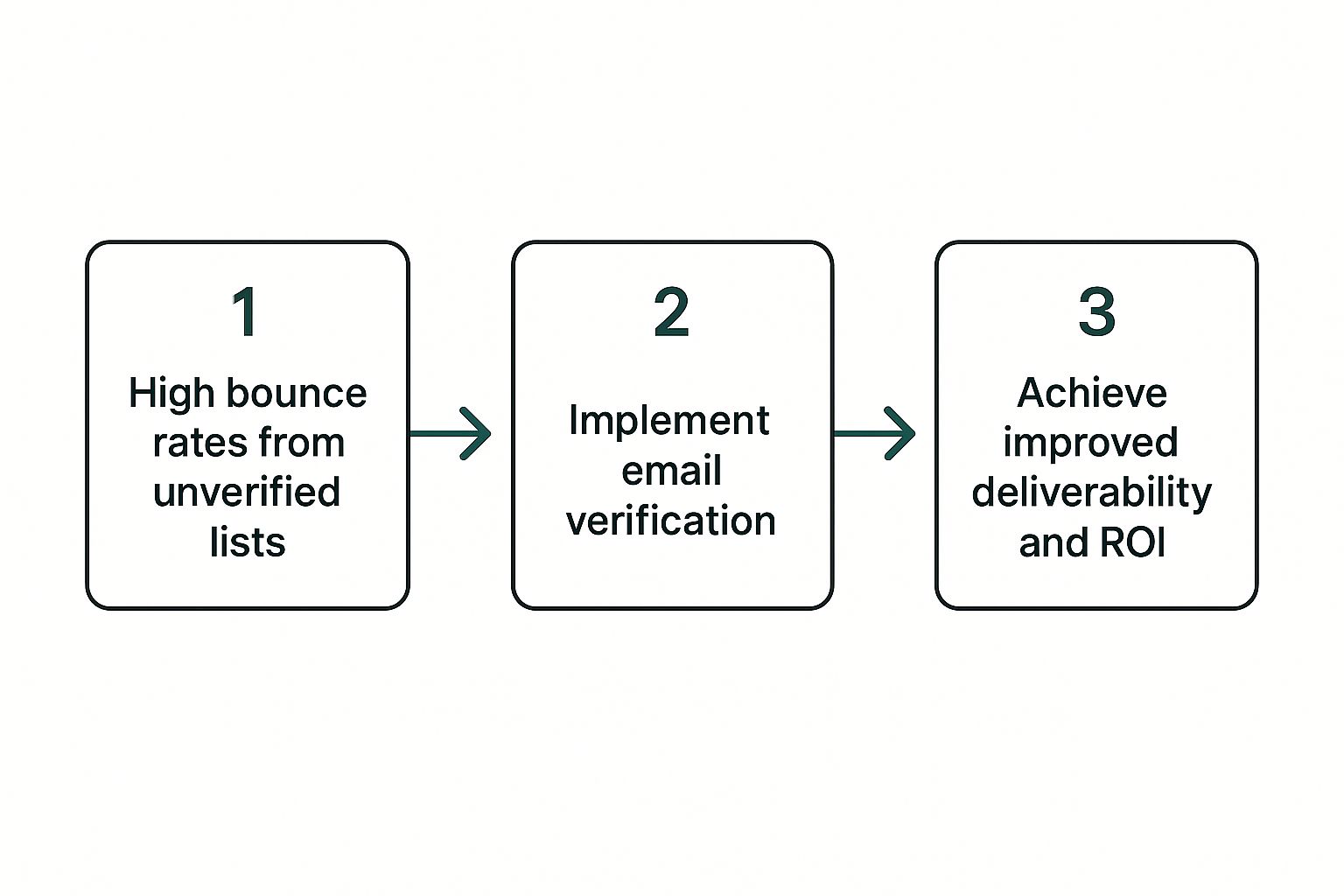
    This process essentially automates the manual guesswork and verification steps, giving you a massive boost in both speed and accuracy.

    Infographic about find business email

    Building Lists in Bulk for Maximum Impact

    But the real magic happens when you need to find contacts at scale. Imagine a PR pro who needs a list of every tech journalist covering AI. Instead of hopping from one publication's website to another, they can use a bulk search feature.

    With EmailScout, you can upload a list of company domains (like techcrunch.com or wired.com) and it spits back a list of emails associated with them. This is an absolute game-changer for:

    • Account-Based Marketing: Quickly map out all the key stakeholders at your target accounts.
    • Recruitment: Pinpoint potential candidates across multiple competitor companies.
    • Partnership Building: Find the right people to talk to for business development.

    The interface is dead simple, making it easy for anyone to find business emails without needing a degree in data science.

    The edge you get isn't just about speed; it's about momentum. When your team can build a targeted list in minutes instead of days, they can launch campaigns faster, pounce on leads quicker, and ultimately close more deals.

    By automating the most time-sucking part of outreach, these tools liberate your team. The focus shifts from mind-numbing data collection to the high-value work that actually moves the needle: crafting killer personalized messages and building real professional connections. It's all about working smarter, not just harder.

    The Underrated Power of Email Verification

    A magnifying glass hovering over a computer screen, with a green checkmark appearing on a valid email address.

    Finding what looks like the perfect business email can feel like a win, but it’s only half the battle. If you send a brilliant message to a dead inbox, you’ve wasted your time and—even worse—damaged your sending reputation. This is where so many outreach campaigns quietly fail.

    Think of your sender reputation like a credit score. Every time an email bounces back from an invalid address, your score takes a hit. Email providers like Google and Outlook are watching. If your bounce rate creeps up, their servers start flagging you as a potential spammer.

    Suddenly, your emails start landing in the junk folder, even the ones sent to perfectly good addresses.

    Why Verification Is Non-Negotiable

    A clean email list is the bedrock of any solid outreach strategy. It’s what ensures your messages actually reach real people, giving you a fighting chance at getting a reply. Skip this step, and you’re setting yourself up for problems that will sabotage all your hard work.

    Without verification, you're flying blind and opening yourself up to:

    • High Bounce Rates: Too many hard bounces (from emails that don't exist) can get your email account or even your entire domain blacklisted.
    • Wasted Resources: Every undelivered email is a missed opportunity. It skews your campaign metrics and makes it impossible to know what’s actually working.
    • Inaccurate Data: An unverified list is full of junk data, leading to bad sales forecasts and marketing analytics you can't trust.

    Verification isn't just about avoiding penalties; it's about protecting the integrity of your entire outreach process. A clean list delivers better results, provides clearer data, and preserves your ability to communicate effectively in the long run.

    How To Check If an Email Is Valid

    The good news is you don't have to send a test email and cross your fingers. Modern tools make verification fast and reliable, running multiple checks behind the scenes. For a deeper look, this guide to email address verification breaks down the nitty-gritty.

    To make sure the business emails you find are legit, it’s worth looking at the top email verification tools on the market. These services do more than just a basic check; they perform a multi-point inspection that usually includes:

    • Syntax Check: Makes sure the address is formatted correctly (e.g., name@domain.com).
    • Domain Check: Confirms the domain is real and has active mail servers ready to receive email.
    • Server Ping: Sends a harmless signal to the mail server to ask if a specific user mailbox exists—all without actually sending an email.

    This process gives you a clear "deliverable," "risky," or "invalid" status for every contact. By making this a standard part of your workflow, you ensure every email you find is one you can confidently use.

    Crafting Outreach That Actually Gets a Reply

    You've done the hard part and found a valid business email. Awesome. The temptation now is to blast off a generic template and call it a day, but that's a surefire way to get your message ignored or, worse, marked as spam.

    The real work starts now: crafting a message that feels like it was written by one human for another. One single, thoughtful email will always outperform a hundred generic blasts. And I don’t just mean using {FirstName}. True personalization shows you’ve actually done your homework.

    Personalization That Builds Bridges

    We can all spot a generic, copy-pasted email a mile away, and our first instinct is to hit delete. If you want to stand out, your message has to connect directly to their world. This small act of effort shows you respect their time and signals that you aren't just another number in a sequence.

    Here are a few simple ways I’ve seen work wonders for adding genuine personalization:

    • Reference a recent project: "I was really impressed with the new feature your team launched for [Product Name] last month."
    • Mention a company announcement: "Congratulations on your company's recent series B funding—it's exciting to see your growth in the fintech space."
    • Find a shared connection: "I noticed we both follow [Industry Influencer] on LinkedIn and enjoyed their recent post on AI."
    • Cite their content: "Your latest blog post about cold email strategies really resonated with me, especially your point on subject lines."

    This simple tweak transforms your email from an interruption into the beginning of a relevant conversation.

    A Simple Framework for Authentic Outreach

    Templates are a good starting point, but they should never be the final product. The best outreach emails I've seen all follow a simple, human-centric framework that you can adapt for anything—sales, networking, or link building. For a much deeper dive, our guide on how to write cold emails that work has more advanced techniques.

    A solid, repeatable framework usually includes these four parts:

    1. A Compelling, Specific Subject Line: Ditch the clickbait. Something like "Quick question about your [Project Name]" is far more effective than "A revolutionary idea for you."
    2. A Personalized Opening: This is where you use the research from the previous step. Make that immediate, genuine connection.
    3. A Clear Value Proposition: Get straight to the point. In one or two sentences, explain what’s in it for them. How can you solve a problem or help them hit a goal?
    4. A Simple, Low-Friction Call-to-Action: Don't ask them to book a 30-minute demo right away. Instead, ask a simple yes/no question like, "Is this something you’re currently focused on?"

    The goal is to make replying feel easy and natural. If your email requires them to think too hard or commit too much, it’s destined for the archive folder.

    Staying Professional and Ethical

    Finally, remember that effective outreach is always ethical outreach. Following legal guidelines isn't just about avoiding fines; it's about being a professional who respects people's inboxes. Make sure you're familiar with regulations like CAN-SPAM in the U.S. and GDPR in Europe.

    These laws require transparency, a clear way for people to opt out, and honesty in your messaging. It all comes down to using the access you've gained responsibly and building a foundation of trust from the very first email you send.

    Common Questions About Finding Emails

    Even with the best tools, you're going to run into questions when you start hunting for business emails. It's just part of the process. Let's tackle a few of the most common ones I hear so you can get back to your outreach with confidence.

    Is It Legal to Find and Use a Business Email Address?

    Yes, in most places, it's perfectly legal to find and use a business email for legitimate professional reasons. But—and this is a big but—you must follow anti-spam laws.

    In the United States, for example, the CAN-SPAM Act lays down the law for commercial email. Ignore it, and you could face penalties up to $53,088 per email. The bottom line is to be professional and respectful.

    That means every single email you send should include:

    • Transparency: Be upfront about who you are and who you work for.
    • Value: Make sure your message offers something genuinely relevant to them.
    • An Opt-Out: Give them a dead-simple way to unsubscribe. No hoops to jump through.

    Following these rules isn't just about staying out of trouble; it's how you build trust from the very first hello.

    The moment you treat outreach like a pure numbers game and bend the rules, you're putting your brand's reputation on the line and risking getting your domain blacklisted. Always lead with ethical, respectful communication.

    What Is the Most Accurate Email Finding Method?

    Honestly, there’s no single "best" way. The highest accuracy almost always comes from a hybrid approach—combining the speed of a great tool with the final check of verification.

    I always start with a reliable email finder to get a likely address in seconds. But for those high-value prospects, the ones you absolutely cannot afford to have bounce? I run that email through a separate verification service. This quick two-step process confirms the email is deliverable before I ever hit send, and it slashes my bounce rates.

    How Can I Find Emails for an Entire Company at Once?

    This is exactly what a "Domain Search" or "Bulk Find" feature is for. Most top-tier email finders, including EmailScout, have this built right in.

    You just plug in a company's website (like company.com), and the tool will pull a list of all known or predicted email addresses tied to that domain. It's an incredibly efficient way to build targeted lists for things like account-based marketing or sales prospecting without losing days to manual digging.

    What If I Still Cannot Find Their Email Address?

    It happens. Some people are just tough to track down online. If you've tried everything and are still coming up empty, it's not time to give up—it's time to pivot.

    Change your approach. Try connecting with them on LinkedIn and send a short, personalized message. A great tactic is to engage with their posts for a bit to get on their radar before you slide into their DMs.

    Another option is to try a general company inbox like 'info@' or 'contact@' and politely ask to be pointed in the right direction. Sometimes a creative, indirect approach works just as well as a direct email.


    Ready to stop guessing and start connecting? EmailScout gives you the power to find verified business emails in seconds, directly from your browser. Try EmailScout for free and supercharge your outreach today!

  • Your Ultimate Guide to Clean Makeup

    Your Ultimate Guide to Clean Makeup

    So, what exactly is clean makeup? Think of it like this: it's the beauty equivalent of choosing whole, fresh foods for your body instead of heavily processed junk. It’s a deliberate choice to focus on ingredient safety and transparency in your daily routine.

    What Exactly Is Clean Makeup

    At its heart, clean makeup is a philosophy. It’s all about creating cosmetics with ingredients that are non-toxic and genuinely good for your skin. While conventional products often have a laundry list of synthetic chemicals, clean formulas are defined more by what they leave out—parabens, phthalates, synthetic fragrances, and other questionable additives.

    But it's not just about avoiding the "bad stuff." It's also about embracing beneficial, nourishing ingredients that actually work with your skin, not against it.

    Imagine your skin is a sponge, soaking up a good portion of whatever you put on it. The whole idea behind clean makeup is that whatever it's absorbing should be as safe and wholesome as possible. It's a huge shift from just covering up imperfections to actively nurturing your skin with the products you use every single day.
    The Driving Force Behind the Movement

    So, why is this happening now? A big part of the push for cleaner options comes from the simple fact that the beauty industry isn't very tightly regulated. With fuzzy terms like "natural" and "eco-friendly" thrown around without any real standards, consumers have had to become their own advocates.

    People are demanding to know what's in their products, and they want safer formulas. This movement is getting a massive boost from the power of social media influencers in shaping consumer behavior who are educating their followers and calling for better options.

    And this consumer-led demand is making a real dent. The global clean beauty market was valued at about USD 8.25 billion in 2023 and is expected to skyrocket to around USD 21.29 billion by 2030. That kind of growth sends a clear message: shoppers are voting with their wallets for products they can actually trust. You can read more about these market trends on StellarMR.com.

    The essence of clean makeup is empowerment. It's about giving you the knowledge and tools to make informed decisions about your health and wellness, transforming your beauty routine from a daily chore into a deliberate act of self-care.

    Ultimately, choosing clean makeup means you’re no longer just a passive consumer. You become an active participant in your own well-being, carefully curating a collection of products that don't just make you look good, but make you feel good about what you’re putting on your body. This guide will give you everything you need to do just that.

    How to Read a Makeup Label Like a Pro

    Stepping into the world of clean makeup can feel a little like trying to learn a new language. You flip over a bottle of foundation, scan the tiny print, and see a wall of intimidating, multi-syllable words. It’s easy to feel lost, but you don’t need a chemistry degree to become a confident label reader.

    Think of an ingredient list like a recipe—it’s always ordered from the largest quantity to the smallest. The first five or six ingredients usually make up the bulk of the entire formula. This simple rule is your first and most powerful tool for decoding what’s really inside that bottle.

    Becoming your own label detective is the single most empowering step you can take on your clean beauty journey. It lets you see past the flashy marketing on the front of the package and get to the truth of what you're putting on your skin.

    Breaking Down the Ingredient List

    Instead of trying to memorize dozens of chemical names, it's way more effective to just understand the categories of ingredients to watch out for. These are the usual suspects that clean beauty advocates recommend avoiding due to potential health or skin concerns.

    Here’s a quick rundown of what some of these ingredients do and why they get flagged:

    • Preservatives (Parabens & Formaldehyde-Releasers): These are added to stop bacteria and mold from growing in your products. The problem is, some parabens (like methylparaben) are potential endocrine disruptors, meaning they can mess with your hormones. Formaldehyde is a known carcinogen.
    • Plasticizers (Phthalates): Often sneakily hidden under the generic term "fragrance," phthalates are chemicals used to make plastics more flexible. In makeup, they help scents last longer and stop nail polish from chipping, but they are also linked to endocrine disruption.
    • Fillers (Talc): Talc is used to absorb moisture and create that soft, silky texture in powders like blush and eyeshadow. The main concern here is that talc deposits can be contaminated with asbestos, a substance known to cause cancer.
    • Foaming Agents (Sulfates): Sodium lauryl sulfate (SLS) and sodium laureth sulfate (SLES) create that satisfying lather in cleansers. Unfortunately, they're so good at their job that they can strip the skin of its natural oils, leading to irritation, dryness, and breakouts, especially for sensitive skin types.

    Once you know these functional groups, you can spot the red flags much more easily. A confusing list suddenly becomes a clear set of information.

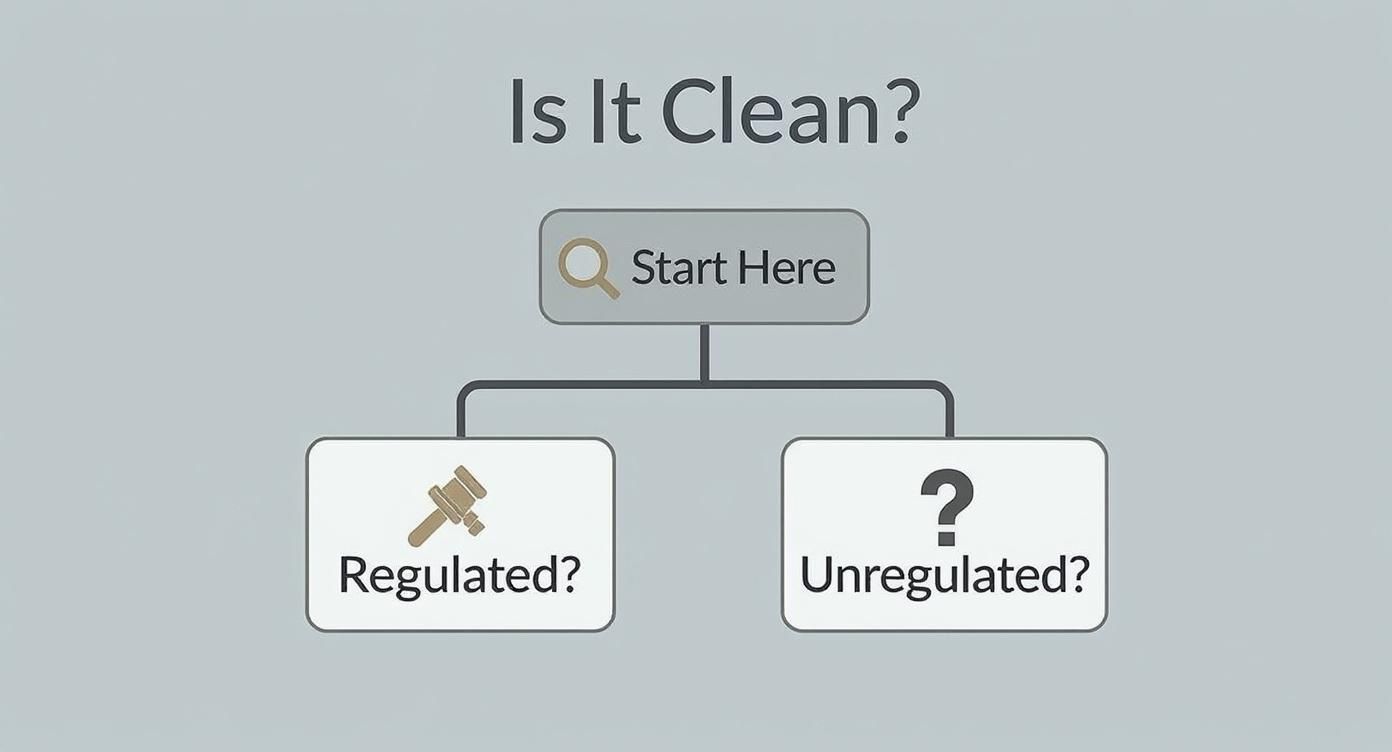
    This decision tree infographic gives you a simple framework for figuring out if a product truly aligns with clean beauty principles, focusing on the gap between regulated terms and empty marketing buzzwords.

    Infographic about clean makeup

    The visual makes it clear: a product's "clean" status often comes down to your own vigilance. So many marketing terms are unregulated, which puts the power back in your hands to read the label and decide for yourself.

    The Challenge of Fragrance

    One of the trickiest parts of reading any label is navigating the word "fragrance" or "parfum." Thanks to trade secret laws, companies don't have to disclose the individual chemicals that make up a specific scent. This one innocent-looking word can hide a cocktail of hundreds of synthetic chemicals, including phthalates and other potential allergens.

    In the world of clean makeup, an undisclosed "fragrance" is almost always a major red flag. Truly transparent brands will either skip synthetic fragrances entirely or list the specific essential oils they use for scent, like "lavandula angustifolia (lavender) oil."

    When you see "fragrance-free" on a label, it means no scents have been added at all. But "unscented" often means a masking fragrance was added to cover up the chemical smell of the other ingredients. For the cleanest option, fragrance-free is always the better choice.

    Your Quick Reference Guide to Common Culprits

    To make your next shopping trip a little easier, here's a quick guide to some of the most common ingredients to avoid, where they hide, and what cleaner alternatives you can look for instead. Think of it as a cheat sheet to help you audit any product and make a more informed choice.

    Common Ingredients to Avoid in Conventional Makeup

    Ingredient to Avoid Why It's a Concern Often Found In Look for This Instead
    Parabens Potential endocrine disruptors that can mimic estrogen in the body. Foundations, concealers, lipsticks, and moisturizers. Natural preservatives like grapefruit seed extract, vitamin E (tocopherol), or phenoxyethanol (in low concentrations).
    Phthalates Often hidden in "fragrance," these are also linked to hormone disruption. Perfumes, nail polish, hairspray, and lotions. Products that are "fragrance-free" or scented only with named essential oils.
    Synthetic Fragrance Can contain hundreds of undisclosed chemicals, including allergens and irritants. Nearly all types of conventional makeup and skincare products. Unscented products or those that list specific plant-based oils for aroma.
    Talc Can be contaminated with asbestos, a known carcinogen. Face powders, eyeshadows, blushes, and bronzers. Arrowroot powder, cornstarch, mica, or rice powder for a soft, absorbent finish.
    Lead & Heavy Metals Neurotoxins that can accumulate in the body over time; often contaminants. Lipsticks (as color additives) and some eyeliners. Brands that test for heavy metals and use natural mineral pigments like iron oxides.

    Armed with this knowledge, you can approach any ingredient list with confidence. It’s not about being perfect, it's about making progress. Each time you choose a product based on its formula rather than its marketing, you're taking a powerful step toward a healthier beauty routine.

    Decoding Clean Beauty Seals and Certifications

    Walking down the beauty aisle can feel like trying to crack a code. You'll see words like "natural," "eco-friendly," and "non-toxic" splashed across packaging, but here’s the problem: most of these terms aren’t regulated. This is where third-party certifications come in.

    Think of these seals as an unbiased expert giving a product their stamp of approval. While any brand can make a claim on its label, a certification from a respected organization means it has been independently tested and verified against a strict set of standards. They cut right through the marketing fluff.

    Learning to spot these logos is a total game-changer. It helps you quickly tell which brands are truly committed to safety and transparency, and which ones are just "greenwashing"—using vague claims to look better than they really are.

    Key Certifications to Look For

    Not all seals are the same. Each one focuses on a different part of what makes a product "clean," whether it's ingredient safety, organic content, or ethical sourcing. Knowing what each logo stands for helps you pick products that line up with what you care about most.

    Here are a few of the most trustworthy certifications you'll find on clean makeup:

    • EWG Verified™: This mark from the Environmental Working Group is a big one. It means the product avoids EWG's massive list of concerning ingredients and commits to full transparency. It’s pretty much the gold standard for health and safety.
    • USDA Organic: This seal guarantees that at least 95% of a product's ingredients are certified organic. That means they were grown without synthetic pesticides or fertilizers. It’s one of the toughest certifications to get for natural sourcing.
    • Leaping Bunny Certified: This is the go-to global standard for cruelty-free products. A Leaping Bunny logo ensures that no animal testing happened at any point in development—from the raw ingredients to the final formula.

    Looking for these seals is your shortcut to making a confident choice. They offer a layer of proof that goes way beyond a brand's own promises.

    Your most powerful tool is always the ingredient list. Certifications are an excellent guide, but understanding the ingredients themselves gives you the ultimate control over what you put on your skin.

    Regulation and The Future of Clean Beauty

    Things are slowly starting to change as more people demand safer products. In the U.S., the Modernization of Cosmetics Regulation Act (MoCRA) of 2022 was the first major FDA update since 1938. It brought in new safety rules for cosmetics, including clean makeup.

    While some critics say the rules could be stronger, it’s a clear sign that regulators are paying more attention to product safety and environmental impact. You can find more details on the evolving sustainable beauty market on InsightAce Analytic.

    Ultimately, decoding clean beauty comes down to combining your own knowledge with the credibility of these third-party seals. Use both, and you can build a makeup routine that you know is safe, effective, and truly right for you.

    The Real-World Benefits of Going Clean

    Switching to clean makeup is way more than just jumping on the latest trend. Think of it as a long-term investment in your skin’s health and your overall well-being. Sure, avoiding questionable ingredients is a great start, but the real magic is in the tangible results you can see and feel every day. It’s about ditching short-term cosmetic fixes for genuine, lasting skin vitality.
    Let's break it down. Conventional makeup often acts like a temporary patch, covering up issues while potentially causing underlying irritation with harsh chemicals and synthetic fillers. Clean makeup, on the other hand, is like a nourishing meal for your skin. It’s packed with ingredients that actually soothe, hydrate, and protect, actively improving your complexion every time you wear it.
    The benefits aren't just theoretical, either. So many people who make the switch report a noticeable drop in redness, sensitivity, and random irritation. When you remove common triggers like synthetic fragrances and harsh preservatives, you’re giving your skin a chance to finally calm down, rebalance, and just breathe.

    A person applying clean makeup with a brush, with fresh ingredients in the background

    Experience a Calmer, Clearer Complexion

    One of the biggest wins people talk about after going clean is the impact on acne and breakouts. Traditional foundations are often loaded with silicones and comedogenic (pore-clogging) oils that can trap sweat, bacteria, and dead skin cells—basically creating a perfect storm for blemishes.

    Clean foundations typically use breathable, non-comedogenic ingredients like jojoba oil or mineral pigments. These formulas give you beautiful coverage without suffocating your skin, which for many people, leads to a dramatic decrease in breakouts. It’s a simple change that can be a game-changer for acne-prone skin.

    Beyond just preventing new blemishes, clean makeup often includes ingredients with bonus skin-loving properties:

    • Soothing Botanicals: Things like chamomile and calendula are famous for their anti-inflammatory powers, helping to calm existing redness and irritation.
    • Nourishing Oils: Plant-based oils such as sunflower or rosehip seed oil are rich in antioxidants and fatty acids that help strengthen your skin’s natural protective barrier.
    • Pure Mineral Pigments: Using iron oxides for color instead of synthetic dyes reduces the risk of allergic reactions and sensitivity for a lot of people.

    This "skin-first" approach is a huge reason the industry is booming. In fact, clean skincare alone made up 41.7% of the global clean beauty revenue in 2023, proving that people want products that are both effective and safe.

    Long-Term Wellness and Environmental Impact

    The perks of clean makeup go far beyond your reflection in the mirror. Every single day, we're exposed to a cocktail of chemicals from our environment, food, and personal care products. This cumulative exposure is often called our "body burden." By choosing clean makeup, you’re actively reducing the number of questionable chemicals your body has to deal with.

    Choosing clean products is a powerful act of preventative care. By minimizing your daily exposure to potential endocrine disruptors and carcinogens, you are making a proactive choice for your long-term health and well-being.

    On top of that, the clean beauty movement is all about a more sustainable and ethical way of doing things. Brands that are truly committed to clean principles often prioritize:

    • Eco-Friendly Packaging: Using recyclable or biodegradable materials to cut down on waste.
    • Sustainable Sourcing: Responsibly harvesting ingredients to protect biodiversity.
    • Cruelty-Free Practices: Making sure no animal testing happens at any point.

    When you support these brands, your purchase creates a positive ripple effect that contributes to a healthier planet. Understanding the bigger picture helps explain why so many people are drawn to these more conscious choices. You can explore more actionable beauty industry trends to see just how much sustainability is shaping the future. Making the switch isn't just a beauty decision—it's a lifestyle choice that aligns your daily routine with your values.

    Building Your First Clean Makeup Kit

    Ready to make the switch? The thought of going "clean" with your makeup is exciting, but it can also feel a little intimidating. The good news is you don't have to toss your entire makeup bag overnight.

    A slow and steady approach is way more manageable and won't break the bank. Think of it less like a frantic purge and more like a thoughtful curation project. You'll simply replace your old products with cleaner, healthier options as they run out. It lets you discover what you truly love without feeling pressured to do a massive overhaul.

    The whole point is to build a core collection of clean makeup that you genuinely enjoy using every day. It's a journey, not a race.

    A collection of clean makeup products arranged neatly on a surface

    Start with a Simple Audit

    First things first: take stock of what you already have. Grab your makeup bag and use your new label-reading skills to see what's really inside your current products.

    You don't have to get rid of everything with a questionable ingredient right away. Just sorting your products into a "keep for now" pile and a "replace next" pile is a fantastic starting point. This quick inventory gives you a clear roadmap and turns an overwhelming task into a simple, actionable plan.

    Prioritize Your First Swaps

    So, where do you start? A great rule of thumb is to focus on products that cover the largest surface area of your skin or that you might accidentally ingest. These are the items that have the biggest impact on your daily exposure.

    Consider swapping these out first:

    1. Foundation or BB Cream: This stuff sits on your skin all day, covering a lot of ground. Switching to a clean foundation can dramatically cut down your skin's exposure to pore-clogging silicones and synthetic preservatives.
    2. Lipstick or Lip Gloss: Let's be real, you end up eating a little bit of whatever you put on your lips. Choosing a clean lipstick ensures you aren't swallowing things like heavy metals along with your color.
    3. Mascara: The skin around your eyes is incredibly thin and absorbent. A clean mascara made without harsh chemicals can prevent irritation in this super-sensitive area.

    Focusing on these key products delivers the most bang for your buck right away. It's an efficient way to kick off your clean beauty journey and often where you'll see the most immediate positive effects.

    What to Look for in Key Categories

    As you start shopping, knowing which beneficial ingredients to look for is just as important as knowing which ones to avoid. Clean makeup isn't just about what's left out; it's about what's put in.

    Many of today's best clean formulas are basically skincare and makeup hybrids. They do more than just cover things up—they actively nourish your skin.

    Look for foundations with ingredients like jojoba oil or sunflower seed oil. These mimic your skin's natural sebum, offering hydration that won't clog your pores. For lipsticks, seek out nourishing butters like shea butter or cocoa butter for a creamy, moisturizing feel that lasts.

    The best clean makeup products do more than just provide color. They are formulated with high-performance botanicals and pure minerals that actively improve your skin's health and appearance over time.

    This dual-purpose approach is what makes the transition so rewarding. You're not just applying makeup; you're actually caring for your skin.

    Your Clean Makeup Starter Kit

    To give you a more concrete idea of what to look for, I've put together a few examples of popular and effective products. Think of this table as a jumping-off point to help you recognize what high-quality clean makeup looks like on the shelf.

    Product Category What to Look For Example Product (Brand) Key Clean Ingredient
    Foundation A lightweight, breathable formula with nourishing plant-based oils and mineral pigments for color. INIKA Organic Serum Foundation Baobab Seed Oil is rich in vitamins and helps promote skin elasticity.
    Concealer A creamy, hydrating formula that won't crease and includes soothing botanicals for delicate areas. ILIA True Skin Serum Concealer Vitamin C helps to brighten the under-eye area and protect against environmental stressors.
    Mascara A gentle, non-irritating formula that lengthens and defines without using harsh carbon black or coal tar. Tower 28 MakeWaves Mascara Castor Oil is known for nourishing and conditioning lashes to support healthy growth.
    Lipstick A pigmented, long-lasting formula that uses fruit pigments and moisturizing butters instead of synthetic dyes. RMS Beauty Legendary Serum Lipstick Kakadu Plum Seed Oil is a potent source of antioxidants that helps protect and hydrate lips.
    Blush A powder or cream blush made with natural mineral pigments and free of talc. Mineral Fusion Blush Pomegranate Oil provides antioxidant protection while adding a healthy, natural-looking flush.

    Building your first clean makeup kit is all about mindful selection. Each product you choose is a step toward a healthier routine that supports your skin and aligns with your values. Take your time, enjoy discovering new brands, and celebrate every conscious choice you make along the way.

    Common Questions About Clean Makeup

    Dipping your toes into the world of clean makeup is exciting, but it's totally normal to have a few questions pop up. Will the products actually work? Is this going to break the bank? Where do I even start?

    We’ve rounded up the questions we hear most often and answered them straight up. Think of this as your practical guide to navigating the real-world side of clean beauty, designed to clear up any doubts and show you how simple and rewarding making the switch can be.

    Does Clean Makeup Perform as Well as Conventional Brands?

    Yes, absolutely. The old idea that "natural" makeup just doesn't cut it is officially a myth. A few years back, you might have found formulas that didn't have the pigment or staying power of the big mainstream brands, but the industry has come a long way since then.

    Today, innovations in green chemistry are fueling a new generation of seriously high-performance clean makeup. Brands are using incredible botanical extracts, skin-friendly oils, and pure mineral pigments to create products that not only compete with conventional makeup but often blow it out of the water. You can easily find clean foundations with a flawless, lasting finish, lipsticks with vibrant color that won't budge, and mascaras that give you major volume. In fact, many pro makeup artists now prefer to stock their kits with clean brands for their superior performance and skin-loving ingredients.

    The best clean makeup doesn't make you choose between results and safe ingredients. It delivers both, giving you a beautiful look with formulas that actively nourish your skin.

    Is Clean Makeup More Expensive?

    While there are definitely some luxe clean beauty brands out there, the market has exploded with amazing, affordable options. You can now find fantastic clean products right in the aisles of your local drugstore, Target, or Whole Foods.

    It helps to think about cost in terms of value, not just the price tag. Many clean makeup formulas are basically skincare and cosmetics in one, packed with high-quality ingredients that actually improve your skin over time. For instance, a clean foundation might contain sunflower seed oil for moisture or vitamin C to brighten your complexion—perks you won't get from simple coverage.

    When you add up the long-term benefits for your skin's health and the peace of mind from using non-toxic ingredients, the price often makes perfect sense. A great way to transition on a budget is to simply replace your old products with clean alternatives one by one as they run out.

    How Can I Spot Misleading Greenwashing Claims?

    "Greenwashing" is just a fancy term for when brands use fuzzy, eco-friendly marketing language to make their products seem safer or more natural than they really are. Your best defense is to become a smart, skeptical shopper.

    Here are two easy ways to see past the marketing hype:

    1. Ignore the Front, Read the Back: Claims like "natural," "pure," or "eco-friendly" on the front of a package mean almost nothing because they aren't regulated. The real truth is always on the back, in the full ingredient list. Flip it over and scan for red-flag ingredients like parabens, phthalates, and the vague term "fragrance."
    2. Look for Trusted Third-Party Seals: Independent certifications are your shortcut to finding brands you can trust. Keep an eye out for official logos like EWG Verified, USDA Organic, or Leaping Bunny Certified. These seals are unbiased proof that a product has met strict standards for ingredient safety, organic sourcing, or cruelty-free practices.

    By focusing on the ingredient list and credible certifications, you can confidently tell the difference between genuinely clean products and the fakes.

    Where Are the Best Places to Shop for Clean Makeup?

    Finding and buying clean makeup has never been easier, thanks to a ton of retailers who are committed to carrying safer products. Whether you like to shop in-store or online, there are great options everywhere.

    Retailers dedicated to clean beauty have already done the vetting for you, so you can shop without worry:

    • Specialty Stores: Places like Credo Beauty and The Detox Market have incredibly strict standards. If a product is on their shelves, you know it's been thoroughly checked for safety.
    • Mainstream Retailers: Big stores now have curated clean beauty sections to make shopping simple. Look for the "Clean at Sephora" seal or browse the "Conscious Beauty at Ulta" program to find vetted brands easily.
    • Accessible Options: You can also find a growing selection of clean makeup at stores like Whole Foods and Target, making it super convenient to grab non-toxic products during your regular shopping trips.

    With so many trustworthy places to shop, you'll have no trouble finding clean makeup that fits your budget, style, and values.


    Are you a sales professional, marketer, or entrepreneur looking to expand your network and generate leads more effectively? EmailScout is the tool you need. Our powerful Chrome extension helps you find the email addresses of key decision-makers with just one click, so you can build marketing lists and enhance your sales outreach effortlessly. Start finding unlimited emails for free and see how simple lead generation can be.

    Discover more at https://emailscout.io

  • Your Guide to an Email Extractor From Website

    Your Guide to an Email Extractor From Website

    Let's be honest, hunting for email addresses one by one is a soul-crushing task. It's a massive time sink, draining hours that could be better spent on work that actually moves the needle—like closing deals or building marketing campaigns. An email extractor from website is designed to completely automate this grind, scanning web pages to quickly pull publicly available contact info.

    This simple shift can turn your lead generation from a slow, manual crawl into an efficient, scalable machine.

    Why Smart Prospecting Starts with Email Extraction

    A person using a laptop with icons representing data and email flowing out, symbolizing email extraction.

    Here’s a hard truth: no sales or marketing team can scale if they're stuck in the digital trenches, manually copying and pasting contact details. This isn't just tedious; it's a real bottleneck that holds back growth and kills team morale.

    Every minute someone spends digging for an email is a minute they aren't building a relationship, personalizing an outreach message, or moving a deal forward. That opportunity cost adds up fast. It's not uncommon for a team member to burn half their day just to build a tiny, often unverified, list of prospects. This is exactly why automation has become a non-negotiable for any modern team.

    The True Cost of Manual Prospecting

    The problem runs deeper than just lost time. When you rely on manual prospecting, you're opening the door to inconsistent and low-quality data. Human error is unavoidable. Typos, outdated info, and poorly targeted lists creep in, and that directly poisons your results:

    • Sky-High Bounce Rates: Sending emails to bad addresses tanks your sender reputation.
    • Wasted Effort: Your carefully crafted messages hit a dead end and never even reach their audience.
    • Lower Engagement: Poor targeting means your outreach falls on deaf ears, leading to dismal open and reply rates.

    By automating the initial data collection, you free up your team to focus on high-value tasks. Instead of being data miners, they become strategists, relationship builders, and closers.

    The Power of Automated Extraction

    With 4.6 billion email users worldwide and an average ROI of up to $42 for every dollar spent, email is still king. An email extractor is your key to tapping into this massive audience without the manual headache. To see just how powerful this channel is, you can discover more about these email marketing statistics and use them to shape your strategy.

    The difference between manual and automated methods is night and day. A quick look at the numbers makes it obvious.

    Manual Prospecting vs Automated Extraction

    Metric Manual Prospecting Using an Email Extractor
    Time to Find 100 Emails 4-6 hours 5-10 minutes
    Data Accuracy Prone to human error (typos) High, pulls data directly
    Scalability Very low, limited by manpower Extremely high
    Team Morale Low (tedious, repetitive work) High (focus on engaging tasks)

    As you can see, the efficiency gains are massive. Shifting to an automated tool isn't just a small improvement; it fundamentally changes what your team is capable of achieving.

    Choosing the Right Email Extractor for Your Goals

    Not every email extractor from website is created equal. I've seen teams pick tools based on a long feature list, only to realize half of them are useless for their actual workflow. The trick isn't finding the most powerful tool, but the right one for what you're trying to accomplish.

    A simple, free extractor might be perfect for a quick, one-off project. But if you're serious about scaling your outreach, you'll need something more robust.

    The one feature I consider non-negotiable? Built-in email verification. Any tool that just scrapes raw, unverified emails is handing you a list of potential bounces. That’s a fast track to damaging your sender reputation and getting your domain blacklisted.

    Distinguishing Key Features

    When I'm vetting a new tool, I zero in on a few critical elements that separate the good from the great:

    • Data Accuracy and Verification: Does the tool check if emails are valid in real-time? A platform like EmailScout focuses on verified contacts, which means your outreach actually has a chance of landing in an inbox.
    • Ease of Use: A clunky, complicated interface just wastes time. You want an intuitive design that lets you get straight to finding leads without a massive learning curve.
    • Scalability: Can it handle bulk extractions from hundreds of URLs, or is it stuck doing single-page lookups? For any serious lead generation effort, you need a tool that can grow with you.

    A great email extractor doesn't just give you data; it gives you clean, actionable data. It saves you the downstream headache of list cleaning and protects your ability to communicate with prospects.

    The demand for these tools is exploding—the global market is expected to hit $1.4 billion by 2025. This growth is driven by the need for smart, cloud-based solutions with advanced features that actually solve problems.

    Pricing Models and Your Needs

    Finally, you need to match the pricing model to how you'll actually use it. Pay-as-you-go plans are fantastic for occasional use, but a subscription is almost always more cost-effective for teams running consistent outreach campaigns.

    If you're weighing different options, a complete guide to AI lead generation tools can offer some valuable perspective. Better yet, try a free email extractor online to get a feel for the process before you commit to a paid plan.

    How to Extract Emails From Any Website

    Theory is one thing, but let's walk through a real-world scenario. This is where you'll see how an email extractor from website tool actually works and build the confidence to do it yourself.

    Imagine you need to build a list of potential partners. Your target? The 'Content Managers' or 'Partnerships Leads' at the top blogs in your industry. This isn't just about grabbing any email you can find; it's about finding the right one.

    Your first move is to gather a list of target URLs. For this example, you'd pull together 10-20 influential blogs in your niche. Instead of visiting each one and hunting for a contact page, a tool like EmailScout lets you do this at scale.

    Setting Up Your Extraction Task

    Once you have your list of websites, the process is pretty simple. You'll drop these URLs into the tool's bulk search feature. This is a massive time-saver compared to the old-school, one-by-one manual approach.

    But here’s the crucial part: a raw dump of emails is almost useless. You need to refine the search. You can filter the results by specific job titles or keywords, which is where the magic happens.

    For our partnership-building scenario, you’d filter for terms like:

    • "Content Manager"
    • "Editor"
    • "Partnerships"
    • "Collaborations"

    This step immediately weeds out all the generic info@ or support@ addresses, leaving you with a clean, actionable list of decision-makers.

    Launching the Search and Analyzing Results

    With your URLs loaded and filters set, you hit "go." The tool gets to work in the background, crawling the source code and contact pages of every site on your list. In just a few minutes, you’ll start seeing a list fill up with names, job titles, and—most importantly—their email addresses.

    This infographic breaks down the thinking process for choosing the right tool for the job.

    Infographic about email extractor from website

    As you can see, it all starts with what you need to accomplish. A good platform should make this whole process feel intuitive, guiding you from inputting URLs to getting your final list without needing a complicated user manual.

    Key Takeaway: The real power of a modern email extractor isn't just about finding emails. It’s about finding the right emails, at scale. Using job role filters transforms a broad search into a precise lead generation machine.

    Turning Raw Data into a High-Quality Lead List

    A diagram showing raw data points being filtered and organized into a clean, structured list.

    Pulling a list of emails from a few websites is just the starting line. The real work—and the real value—is turning that raw data into a clean, organized asset you can actually use for outreach.

    A lot of people skip this part, and honestly, it’s a huge mistake. Diving straight into sending emails with an unverified list is a surefire way to get high bounce rates, which can seriously damage your sender reputation.

    The first thing you always have to do is verify the emails. Just because an email is listed publicly doesn't mean it’s active, spelled correctly, or not a spam trap. Sending messages to bad addresses is a major red flag for email providers, and it’s the fastest way to get your domain blacklisted.

    Pro Tip: Never assume an extracted email is good to go. A quick verification check is the best insurance against major deliverability headaches down the road. It ensures your hard work actually pays off and your emails land in the inbox.

    Organizing Your List for Effective Outreach

    Once your list is clean, it's time to get organized. A flat list of contacts is practically useless compared to a well-segmented one. Grouping your leads is what allows you to personalize your outreach at scale—and personalization is what gets replies.

    I always recommend segmenting contacts by a few key criteria:

    • Source Website: Grouping leads by the site where you found them gives you immediate context for a warmer opening line.
    • Job Title: You wouldn't talk to a CEO the same way you'd talk to a Marketing Manager. Segmenting by title lets you tailor your message to their specific role and pain points.
    • Industry: Speaking the language of their industry shows you’ve done your homework. It proves you aren't just sending another generic email blast.

    This kind of organized data can be imported directly into your CRM, making your follow-up process seamless. The demand for smart data is why the market for AI and machine learning tools that integrate with sales platforms is growing so fast.

    If you want to automate and sharpen your lead qualification, looking into the best lead scoring software can be a game-changer. For a deeper dive on why this all matters, check out our guide on the importance of email address verification.

    Ethical Outreach That Actually Gets Replies

    So you've used an email extractor from a website to build a powerful list of contacts. Now comes the part where most people crash and burn. It's tempting to see a big list and just start blasting, but that's a surefire way to get ignored, or worse, blacklisted.

    Just because an email is public doesn't give you a free pass to send generic, spammy outreach. You have to think about regulations like GDPR and the CAN-SPAM Act. Messing this up can lead to some pretty hefty fines and kill your domain's sending reputation, making that whole list you just built completely worthless. The real key is to stop thinking about "blasting" and start thinking about starting actual conversations.

    Your goal isn't just to get your email opened; it's to get a reply. That only happens when you provide immediate, tangible value to the person on the other end.

    Crafting a Compelling First Touch

    First things first: ditch the generic templates. Anything that starts with "I hope this email finds you well" is getting deleted on sight. Your first message has to prove you've done your homework. This isn't optional.

    Before you even think about hitting send, spend just two minutes researching each person. Seriously, that's all it takes.

    Look for a nugget of context you can use as an opener:

    • Did they just publish a new blog post?
    • Did their company announce a milestone on LinkedIn?
    • Were they quoted in an industry article?

    Mentioning something specific right away shows you see them as a person, not just another name on a spreadsheet. Instead of a bland pitch, try something like, "I really enjoyed your recent article on AI in marketing—your point about data privacy was particularly insightful."

    That small bit of effort instantly separates you from the 90% of cold emails that are just noise. The goal is to start a real dialogue, not just talk at them. If you want to master this, take a look at this detailed guide on how to write cold emails that turn prospects into clients. A well-crafted message respects their time and gives them a damn good reason to write back.

    Common Questions About Finding Emails on Websites

    Let's tackle a few of the questions that always seem to come up when people start looking into email extractors. Getting straight answers helps you move forward with confidence and use these tools the right way.

    Is It Legal To Extract Public Emails?

    This is easily the most common question, and the answer isn't a simple yes or no. In most cases, pulling email addresses that are publicly listed on a website isn't illegal. The real issue is what you do with that information afterward.

    Regulations like GDPR in Europe and the CAN-SPAM Act in the U.S. have strict rules about commercial outreach. The bottom line? Focus on legitimate business interest and responsible communication. Don't just blast out spam. You always need to give people an easy way to opt-out and make sure your message is actually relevant to them.

    How Accurate Are the Extracted Emails?

    It’s important to set realistic expectations here. No tool that extracts emails from a website can guarantee 100% accuracy. Why? Because information online gets old and outdated all the time.

    But the best tools out there have a secret weapon: built-in email verification. This feature checks if an email address is actually active and can receive mail, which is a game-changer for reducing your bounce rate and protecting your sender reputation. A smaller, verified list is always more valuable than a huge, unchecked one.

    Here's what really matters: A tool's true value isn't just in finding emails, but in finding deliverable emails. Always look for platforms that include verification so your outreach efforts don't go to waste.

    Can These Tools Be Used on Social Media?

    This is a big one. You absolutely should not use these kinds of scrapers on most social media platforms, especially professional networks like LinkedIn. Their terms of service explicitly forbid automated scraping, and trying to get around that is a fast way to get your account suspended.

    For social networks, your best bet is to stick with their official tools (like Sales Navigator) or use compliant browser extensions that are designed to play by the rules. Always respect the platform's policies.


    Ready to build high-quality, targeted lead lists in minutes? Try EmailScout and see how effortless email extraction can be. Get started for free at emailscout.io.

  • Finding Email Addresses by Name The Smart Way

    Finding Email Addresses by Name The Smart Way

    Connecting with the right person often hinges on a single email. But let's be honest, finding that email address can feel like searching for a needle in a digital haystack. It’s a make-or-break task for anyone in sales, marketing, or networking, and it’s only getting tougher.

    This guide gives you a playbook of real, actionable methods to find email addresses starting with just a name, so you can connect more effectively.

    Why Finding the Right Email Is Harder Than Ever

    You’d think in an age of non-stop digital communication, an email address would be easy to find. The reality is quite the opposite. The job has become a frustrating puzzle for anyone whose success depends on solid outreach.

    It’s not just one thing, either. The sheer volume of online noise makes it hard to cut through and find accurate info. At the same time, a growing focus on privacy means people are much more guarded with their contact details. Poking around on company websites or LinkedIn profiles often leads to a dead end or, even worse, an email address that’s been out of commission for years.

    The Rise of Specialized Solutions

    This very challenge has created a massive industry. The global email lookup tool market was valued at $2.5 billion in 2025 and is projected to grow by 15% annually through 2033. This isn't just a random statistic; it highlights a critical shift. Successful outreach now requires more than just a lucky guess.

    Today’s challenge isn’t just about finding an email address—it’s about finding the right one and making sure it's actually deliverable. A bad email wastes your time and can seriously ding your sender reputation.

    To win this game, you need a smart, multi-faceted strategy. That means combining clever manual techniques with powerful, specialized tools.

    This guide will walk you through the most effective methods out there, including:

    • Using dedicated finders like EmailScout for quick, accurate results.
    • Mastering the art of the educated guess with common email patterns.
    • Digging deep with advanced search operators to uncover hidden contact details.

    Finding email addresses by name is a skill, plain and simple. Once you master these strategies and understand the importance of proper email address verification, you’ll spend less time digging and more time building the connections that matter.

    Using Email Finders for Fast and Accurate Results

    Sure, you can sometimes find an email address with a bit of manual digging, but let’s be real—when you need speed and accuracy, nothing beats a dedicated email lookup tool. These platforms are built for one thing: finding and verifying professional contact information. They can turn a frustrating, time-sucking task into a simple click.

    Think about it. You need to connect with a new product manager at a key tech company. Instead of spending the next hour hunting through their website or sifting through social media profiles, an email finder like EmailScout does all the heavy lifting for you. Just plug in their full name and company domain, and let the tool work its magic.

    These tools are much more than just fancy search engines. They scan a massive web of public records, social profiles, and their own proprietary data to pull potential email addresses. More importantly, they run real-time verification checks to make sure the address is active and deliverable. This is absolutely critical for protecting your sender reputation.

    Interpreting the Results

    After a quick search, you'll usually see a list of possible emails. The best tools will include a confidence score—a percentage that tells you how likely it is that an email is correct. If you see a score of 95% or higher, you can feel pretty confident that your message will hit the right inbox.

    If you get a few different results, here’s how I’d approach it:

    • Trust the Confidence Score: Always start with the email that has the highest percentage. It’s your best bet.
    • Look for a Pattern: Does the email format (firstname.lastname@company.com, for example) match other known emails from that company? Consistency is a great sign.
    • Double-Check the Domain: Make sure the email uses the company's current, official domain, not an old one or a subsidiary's.

    For anyone doing serious outreach, finding someone's email on LinkedIn is another great skill to have, and it often works hand-in-hand with what you find using a dedicated tool.

    This visual gives you a quick breakdown of the whole process, from identifying the target to using the right tools to get the contact info you need.

    Infographic about finding email addresses by name

    As you can see, while the challenge can seem complicated, a smart combination of methods and powerful tools will almost always get you the results you’re looking for.

    Choosing the Right Email Finder

    Not all email finders are the same. Some are packed with features, while others are laser-focused on speed or data accuracy. The trick is finding one that fits your specific needs and budget.

    The real value of an email finder isn't just the time it saves you. It’s the confidence of knowing your outreach is built on a solid foundation of accurate, verified data. That leads directly to better engagement and more replies.

    A solid tool helps you build clean, effective contact lists and makes your prospecting so much smoother. If you want to get a better sense of what's out there, I'd recommend checking out a comparison of the best email finder tools. It's a great way to make an informed decision based on features, accuracy, and pricing, ensuring you pick a solution that actually helps you hit your goals.

    The Art of the Educated Guess

    A person working on a laptop, illustrating the process of finding email addresses by name.

    Sometimes, the best tool for the job isn't a tool at all—it's your own intuition. When email finders come up empty, mastering the educated guess can be your most valuable skill. Think of it like being a detective, piecing together small clues to crack the email puzzle.

    This hands-on approach works surprisingly well because most companies stick to a standard formula for their email addresses. Once you figure out that company's specific pattern, you can predict almost anyone's email with a high degree of confidence. The trick is knowing which patterns are most common and how to test your theories.

    Decoding Common Corporate Email Formulas

    Your first move is to get familiar with the most popular email address structures out there. While there are countless variations, a small handful pop up over and over again. Your goal is to create a short list of likely candidates based on these go-to formats.

    Let's say you're trying to find Jane Doe at "acmecorp.com." You'd start by testing a few logical combinations:

    • First Initial + Last Name: jdoe@acmecorp.com
    • First Name . Last Name: jane.doe@acmecorp.com
    • First Name Only: jane@acmecorp.com
    • Full Name (No Separator): janedoe@acmecorp.com

    This method’s real power is its simplicity. You’re not scouring the entire web; you’re just testing a few logical guesses against a domain you already know. It’s a focused, efficient play for when other tactics fall short.

    The sheer number of emails flying around the globe actually forces companies into these predictable patterns. It’s estimated that in 2025, over 376.4 billion emails will be sent and received daily. With that kind of volume, organizations need simple, repeatable structures to manage it all.

    To help you get started, here's a look at the top corporate email formats I see most often in the wild.

    Top 5 Common Corporate Email Formats

    This table breaks down the most frequent email patterns used by businesses, giving you a solid starting point for your educated guesses.

    Format Type Example (Name John Smith) Common Use Case
    First Initial, Last Name jsmith@company.com Extremely common in large corporations to keep addresses short and uniform.
    First Name . Last Name john.smith@company.com Popular in mid-sized to large companies, especially in Europe. Very readable.
    First Name john@company.com Often found in smaller companies or startups where name overlap is rare.
    First Name, Last Initial johns@company.com A solid alternative to the "first initial, last name" format.
    Full Name johnsmith@company.com Simple and direct, frequently used by tech companies and smaller businesses.

    Memorizing these five patterns will give you a massive head start. More often than not, one of them will be the right one.

    Verifying Your Guesses Without Getting Blacklisted

    Okay, you've got your list of potential emails. The absolute worst thing you can do now is just blast a message to all of them. This is a surefire way to get a bunch of bounces, which torpedoes your sender reputation and can get you flagged as a spammer.

    So, the final, critical step is verification.

    Before you even think about hitting "send," run your guesses through a free email verification tool. These services ping the mail server to check if an address is valid without actually sending an email. Just paste in your list, and the tool will tell you which ones are good to go.

    Here's another great trick: perform an email lookup by domain for your target company. If you can find just one other employee's email—maybe on a press release or their LinkedIn profile—you've likely found the company's format. Apply that same pattern to your contact's name, and you can turn a wild guess into a near-certainty.

    Advanced Search Hacks for Digital Sleuths

    A magnifying glass over a computer screen, symbolizing advanced searching for contact details.

    While dedicated tools are great for speed, sometimes the email you need is hiding in plain sight. With a few smart techniques, you can turn Google into a powerful, free email-finding machine. This isn't about basic searching; it's about using specific operators to cut through the noise online.

    Think of Google search operators as special commands that give your search superpowers. They tell Google exactly how to look for information, filtering out all the irrelevant junk. For finding emails, the most useful operators are easily quotation marks (" ") and the site: command.

    Using quotation marks tells Google to search for that exact phrase—perfect for a person's full name. The site: operator is just as crucial, as it limits your search to a single website, like a specific company's domain.

    Mastering Search Operator Combinations

    The real magic happens when you start combining these operators. Let's say you're looking for Jane Doe, a marketing manager at Acme Corporation, whose website is acmecorp.com. Just Googling her name is a shot in the dark. A smarter query is what you need.

    A highly effective search string would be:

    "Jane Doe" email site:acmecorp.com

    This command tells Google to look only on the acmecorp.com website for pages that contain the exact phrase "Jane Doe" and the word "email." This simple string can instantly pull up contact pages, staff directories, or press releases where her email is listed.

    The goal isn't just to search harder; it's to search smarter. A well-crafted query with the right operators can deliver in seconds what might take an hour of manual digging.

    Don't be afraid to get creative, either. Try swapping "email" with "contact" or even just the "@" symbol to see if you get different results. The key is to experiment. For a more complete look at professional contact discovery, check out this guide on how to find business email addresses.

    Uncovering Emails on Social Platforms

    Professional networks like LinkedIn and Twitter are also goldmines for information, but you have to be strategic. LinkedIn often hides direct contact info behind connections, but many pros link to their personal blogs or portfolio sites right on their profiles. These external sites almost always have a contact page.

    Twitter can be even more direct. It's common for consultants, freelancers, and even executives to put their email right in their Twitter bio to encourage people to reach out. You can also use Twitter's advanced search to look for words like "email" or "contact" within a specific user's past tweets.

    Here are a few actionable tips I always follow:

    • Check Twitter Bios First: Always start with the person's Twitter bio. It's the most common place to find a direct email address.
    • Dig into LinkedIn "Contact Info": It sounds basic, but always click the "Contact Info" link on a LinkedIn profile. You might get lucky.
    • Follow the Breadcrumbs: Look for personal website or portfolio links on any social profile. Those links are often your best path to an email address.

    By adding these digital sleuthing hacks to your process, you build a much more complete toolkit. It’s all about persistence and knowing which strategy to pull out for the situation.

    Using Your Newfound Power Responsibly

    Okay, so you've learned how to find just about anyone's email address. That's a powerful skill. But what you do next is what really counts.

    These techniques are incredibly effective, but they come with a huge responsibility to be respectful, ethical, and legally compliant. Misusing this information isn't just annoying for the person on the receiving end—it can seriously tarnish your reputation and even get you into legal hot water.

    The line between professional outreach and spam is a lot thinner than most people realize. It all boils down to your intent and how relevant your message is. Finding a corporate email to send a personalized, well-researched business proposal is one thing. Scraping a huge list of personal emails for a generic marketing blast? That’s something else entirely.

    Regulations like GDPR in Europe and the CAN-SPAM Act in the U.S. have laid down some very clear rules for commercial emails. These aren't just polite suggestions; they're laws with steep penalties. At their core, they’re designed to protect an individual’s right to privacy and give them control over who gets to land in their inbox.

    Respecting Privacy and Building Trust

    Your goal should always be to start a conversation, not just to blast your message into the void. This means adopting a mindset that puts respect and value first.

    Before you ever hit "send," ask yourself: is this message actually helpful to them? Is it tailored to their specific role and their company’s challenges? Or is it a cookie-cutter pitch you could send to anyone?

    A great outreach email feels like a helpful suggestion, not an interruption. When you prove you’ve done your homework and genuinely believe you can offer value, people are much more likely to listen.

    Just think about the sheer volume of email we all get. With services like Gmail now serving around 1.8 billion active users, inboxes are more crowded than ever. This massive user base, which includes 90% of startups, makes finding emails by name a bit trickier, but it also highlights just how critical responsible communication is. Your message has to stand out for the right reasons. You can learn more about the impact of Gmail’s massive market share to see just how competitive the inbox has become.

    Key Guidelines for Ethical Outreach

    To make sure your efforts stay on the right side of that line, stick to a few core principles. Following these guidelines will not only keep you out of trouble but will also help you build real trust and get far better results.

    • Prioritize Business Emails: For any kind of commercial outreach, stick to professional, corporate email addresses. Personal emails are off-limits unless you have explicit permission.
    • Personalize Your Message: This is non-negotiable. Address the person by name and reference something specific—their role, their company, or a recent achievement. Show them you’ve put in the effort.
    • Provide Clear Value: Get straight to the point. What’s in it for them? How does your message help them solve a problem or reach a goal? Don't make them guess.
    • Offer an Easy Opt-Out: Every single commercial email you send must include a clear, simple way for the recipient to unsubscribe from future messages. No exceptions.

    By following these simple rules, you can ensure that all your hard work finding the right contact leads to positive interactions and meaningful connections—not just another trip to their trash folder.

    Got Questions? We've Got Answers

    Even the slickest email-finding strategies can hit a snag. Let's tackle some of the most common questions that come up. Here are a few practical answers to keep you on track.

    Are Email Finders Legal? And How Accurate Are They Anyway?

    Yes, using an email finder is perfectly legal. These tools work by collecting publicly available data from across the web, which is a totally legitimate practice. The real responsibility falls on you to use that information correctly—in line with privacy laws like GDPR and the CAN-SPAM Act. Think legitimate business outreach, not spam.

    Accuracy is the other big question, and it really depends on the service. A solid tool like EmailScout consistently hits accuracy rates over 95%. This isn't luck; it's the result of cross-referencing multiple data sources and running real-time verification checks. My advice? Always go with a tool that gives you a "confidence score" so you can gauge how reliable an email is before hitting send.

    What if I Find Multiple Emails for the Same Person?

    This happens all the time, especially with people at bigger companies. Whatever you do, don't just blast an email to all of them. That's a quick way to get bounces and tank your sender reputation.

    Instead, here’s a smarter approach:

    1. Focus on the Current Company: Start with the email address tied to their current employer's domain. It's usually the most up-to-date.
    2. Check for Company Patterns: If you have other contacts at that company, look at the email format. Does one of your options match the standard firstname.lastname@ or f.lastname@ structure?
    3. Verify Before You Send: Run your top choice through a free email verification tool. This confirms it's deliverable without you having to risk a bounce.

    How Can I Find an Email for a Freelancer or Solopreneur?

    Tracking down an email for someone who isn't part of a large organization takes a slightly different tack. Without a corporate domain to guide you, you have to look at their personal brand and online footprint.

    Here are your best bets:

    • Their Personal Website: Most freelancers have a portfolio site. Check the contact page or the footer—the email is often right there.
    • LinkedIn Profile: Don't just glance at it. Click the "Contact Info" section. Many self-employed pros list their business email publicly.
    • Social Media Bios: Professionals on platforms like Twitter often put their email directly in their bio to invite collaboration.

    If you strike out, sending a polite direct message on LinkedIn is a great backup plan. Just explain why you want to connect and ask for their best business email. It's professional and often gets a quick response.

    What’s the Best Way to Write That First Outreach Email?

    You’ve done the hard work and found the right email. Don't mess it up now. A sloppy first email can waste all that effort.

    The goal of your first message is to be a welcome guest, not an unwanted intruder. Personalization, brevity, and a clear focus on providing value are what separate a successful outreach from one that gets instantly deleted.

    Keep it short and sweet. Start by stating why you're reaching out, but quickly make it about them. Mention a recent project, a post they wrote, or a challenge their company might be facing. Offer a helpful insight or resource—give before you ask.

    Finish with a simple, no-pressure call to action. Something like, "Are you open to a brief chat next week?" works wonders.


    Ready to stop guessing and start connecting? EmailScout gives you the power to find verified email addresses in a single click, so you can focus on building relationships that grow your business. Try EmailScout for free today!

  • Google Reverse Email Lookup Uncovered

    Google Reverse Email Lookup Uncovered

    You might have heard the term Google reverse email lookup, but it's not some official, standalone feature Google offers. Instead, it’s a clever technique that uses Google’s own powerful search engine to find any public information tied to a specific email address. Think of it as a bit of digital detective work, using Google to trace an email’s footprint across the internet.

    How a Google Reverse Email Lookup Actually Works

    A magnifying glass hovering over a computer screen, symbolizing the process of a digital search or lookup.

    Imagine Google's search engine as a massive, ever-growing library of the public web. When you pop an email address into that search bar, you're essentially asking Google: "Show me every public page you've ever indexed where this exact email address shows up."

    This isn't some backdoor trick to peek into someone's private inbox. Far from it. It's simply a way to piece together the public trail a person has left online. The success of this method depends entirely on how publicly the owner of that email has used it.

    Connecting an Email to a Digital Footprint

    An email address acts like a unique key that people use all over the web. We use them for just about everything, like:

    • Setting up social media: Think LinkedIn, X (formerly Twitter), or even public-facing Facebook pages.
    • Joining online communities: Posting on forums, dropping comments on blogs, or engaging in discussion boards.
    • Publishing content: Writing for personal blogs, company websites, or contributing to online articles.
    • Showing up in public records: Getting listed in business directories, public documents, or press releases.

    Anytime an email is used in these public-facing scenarios, Google's crawlers are likely to find and index it. By searching for that email, you can unearth a surprising amount of associated data—from professional profiles to social media accounts and even news articles. You can learn more about the kind of data you can find on fullenrich.com.

    To give you a clearer picture, here’s a quick rundown of what this Google method can typically dig up, along with its inherent limitations.

    Google Reverse Email Lookup at a Glance

    Information You Can Find Key Limitations
    Social Media Profiles: Public accounts on platforms like LinkedIn, X, or Facebook. Only public profiles will appear; private accounts remain hidden.
    Professional Information: Company websites, staff directories, or personal portfolios. Often depends on the individual's role and their company's online presence.
    Online Posts: Forum comments, blog posts, or public discussions. Relies on the email being used openly in these public forums.
    Public Mentions: News articles, press releases, or public records. Finding these mentions can be hit-or-miss.
    Website Ownership: If the email is listed in a website's contact details. Many webmasters use generic or private contact information.

    As you can see, this technique is great for uncovering public-facing information, but it hits a wall when it comes to private data.

    Key Takeaway: A Google reverse email lookup is only as powerful as the email's public exposure. For private or rarely used emails, your search may yield very few results, if any at all.

    This investigative approach is a fantastic starting point. It helps you connect what might seem like an anonymous email address to a real person, a company, or an online identity, paving the way for more advanced search techniques.

    Using Search Operators for a Deeper Dive

    Screenshot of a Google search for a specific email on LinkedIn, showing targeted results.

    Just dropping an email into Google is a start, but it's only scratching the surface. The real magic in a Google reverse email lookup happens when you start using specific commands—search operators—to tell Google exactly what you’re looking for.

    Think of them as filters. The most basic and powerful one is putting the email in quotation marks. For example, "jane.doe123@email.com". This forces Google to search for that exact string of characters, instantly cutting out all the noise from pages that might mention "jane.doe123" or "@email.com" separately. It's the difference between a wild guess and a targeted query.

    Combining Operators to Pinpoint Profiles

    This is where things get really useful. Let's say you're trying to find a professional profile, but your search keeps bringing up a personal blog or old forum posts. This is where the site: operator becomes your best friend.

    It lets you restrict your search to just one website. If you're hunting for a LinkedIn profile, you can combine it with the exact-match quotes like this:

    "jane.doe123@email.com" site:linkedin.com

    This command tells Google, "Only show me results where this exact email is found somewhere on linkedin.com." Suddenly, all the irrelevant results vanish. You can swap linkedin.com for twitter.com, github.com, or any other site to focus your search.

    Pro Tip: You can also exclude a site by adding a minus sign. For instance, -site:companywebsite.com will remove any results from that domain, which is great for finding where an email appears outside of someone's own company pages.

    The screenshot above shows this in action. The combined search for an exact-match email on LinkedIn delivers a clean, relevant result—exactly what you need to see a person's professional footprint.

    Real-World Scenarios and Other Tricks

    Imagine a hot sales lead emails you. With this technique, you can quickly verify their role and company without ever leaving the search bar. It's an incredibly fast way for sales and marketing pros to do a bit of recon.

    If you need to do this at a larger scale, we've covered more advanced methods in our guide on how to scrape thousands of LinkedIn contacts from Google search. It takes this idea from a one-off lookup to a serious data-gathering strategy.

    A few other operators are worth keeping in your back pocket:

    • filetype: This one is great for finding documents. “jane.doe123@email.com” filetype:pdf could turn up a public resume, a conference speaker list, or an academic paper.
    • intext: This ensures the email is in the actual body text of the page, not just hiding in a URL or title tag.

    Once you get comfortable with these simple commands, you'll start seeing Google as less of a search engine and more of a powerful investigation tool.

    So, you know the basic mechanics of a Google reverse email lookup, but when do you actually use it? That's where this skill goes from a neat trick to a genuinely powerful tool for everyday problem-solving, both for personal security and professional due diligence.

    Think about that unexpected email offer that lands in your inbox—the one that seems just a little too good to be true. Before you even think about clicking a link, a quick lookup on the sender's address can tell you a lot. Does it connect back to a legitimate company profile, or does it have zero digital footprint? The answer can instantly flag a potential phishing scam, acting as your first line of defense.

    Vetting Professional Contacts

    This technique is just as valuable in a professional setting. Let’s say you’re about to hop on a call with a potential business partner or a new client you've never met. A quick search can link their email to a LinkedIn profile, a company bio, or even articles they’ve published online. This gives you crucial context and talking points for your conversation.

    This isn't about being nosy; it’s about being prepared. Verifying a contact’s identity and professional background helps build trust from the get-go and ensures you’re dealing with a credible person. For a deeper dive, our guide on how to find the owner of an email address walks through even more strategies.

    One of the most important reasons to run an email lookup is to see if it's been compromised. You can learn how to check for email data breaches and protect your own information—a quick search often reveals if an email has been exposed in public leaks.

    With online fraud on the rise, the demand for these verification skills has shot up. This has pushed the industry to adopt smarter tech, like AI, to get better and faster at identifying who's behind an email. You can read more about this trend and its impact on SEON's security blog.

    Knowing When to Call in the Experts (Specialized Lookup Tools)

    A manual Google reverse email lookup is a fantastic first move, but let's be honest—it has its limits. Think of it as scratching the surface. Since Google can only show you what's publicly available, you'll often hit a dead end if an email address has been kept private or is brand new.

    This is exactly when you need to switch gears and bring in a specialized lookup tool.

    These services do way more than just run a fancy Google search. They tap into entirely different data sources, like private databases, social media APIs, and public records that search engines never touch. Instead of a few scattered mentions, you get a clean, comprehensive profile.

    When Google Just Isn't Enough

    I've learned from experience that there are a few clear signs it's time to move beyond a simple search.

    You'll want to reach for a dedicated tool when:

    • You Get Zero Google Results: If your search comes up completely empty, it means the email has no public footprint. A specialized service is pretty much your only option at this point.
    • You're Gathering Business and Sales Intel: For lead enrichment, you need more than a name. These tools can pull job titles, company info, and social profiles, all neatly organized for you.
    • You're Vetting High-Stakes Contacts: When you're dealing with a potential business partner, investor, or a critical new hire, you need a level of certainty that Google simply can't provide.

    While basic Google searches are a starting point, security professionals often rely on more advanced penetration testing tools for comprehensive information gathering, including email-related reconnaissance.

    Specialized platforms are also essential for businesses that need to keep their email lists clean and effective. For example, many services offer automated email verification that slashes bounce rates and flags bogus accounts—a must for protecting your marketing ROI.

    The right service really depends on your goal, whether it's for sales, security, or just simple verification. To help you sort through the options, take a look at our detailed guide on the best email lookup tool.

    Troubleshooting Your Email Search Efforts

    Hitting a brick wall during a google reverse email lookup is frustrating, but it happens all the time. It doesn't mean the trail has gone cold—it just means you need to switch up your tactics. Sometimes, an email is simply too new or private to have left any digital footprints.

    Other times, you're dealing with an email like "john.smith@email.com," which can pull up thousands of totally useless results. When this happens, stop trying to find the person and start investigating the domain. A quick search for just "@companydomain.com" can often reveal the company's internal structure and give you solid clues about their standard email format.

    This decision tree gives you a clear path forward when your first search comes up empty.

    Infographic about google reverse email lookup

    The real takeaway here is knowing when to pivot. You need to recognize when your manual searching has hit its limit and it's time to bring in a dedicated tool for a deeper dive.

    Rethinking Your Search Strategy

    If you have a name that might be connected to the email, use it. Try a search like ("John Smith" OR "J. Smith") "email@example.com". This simple adjustment can cut through a massive amount of noise by forcing Google to connect the name and the email.

    And don't forget to check the obvious. An email signature can be a goldmine of information:

    • Job Titles: Searching the title along with the company name can lead you straight to a LinkedIn profile.
    • Phone Numbers: A reverse phone lookup can open up a completely different avenue for your investigation.
    • Company Slogans: A unique tagline can sometimes link back to a specific marketing campaign or landing page where the email was originally used.

    Remember, the goal is to think like a detective. Every piece of information is a potential clue. If one angle fails, pivot to another and combine different pieces of data to build a clearer picture.

    This methodical process of elimination and creative searching will dramatically improve your success rate. But when all else fails and the email remains a mystery, it’s a strong signal that the information you need isn't publicly indexed. That’s your cue to bring in a more powerful, specialized tool.

    Common Questions About Reverse Email Lookups

    When you first start digging into reverse email lookups with Google, a few questions always pop up. It's a simple process, but it's good to know the lay of the land before you dive in. Let's tackle some of the most common ones.

    Is This Legal and Ethical?

    Yes, using Google for a reverse email lookup is perfectly legal. You're just using a search engine to find information that's already public. It's no different than searching for a person's name.

    The ethics, though? That comes down to your intent. If you're verifying a business contact or trying to figure out who that mysterious sender is, you're on solid ground. Using what you find to harass or stalk someone is obviously a different story. The golden rule is to always be respectful and use the information responsibly.

    How Reliable Is the Information?

    Honestly, it’s a mixed bag. Reliability really depends on the source.

    If your search pulls up an official LinkedIn profile or a corporate "About Us" page linked to the email, you can feel pretty confident that the information is accurate. But if the only hit is a random comment on a forgotten forum from ten years ago, take it with a huge grain of salt. That information could be wildly outdated or just plain wrong.

    Key Insight: Always try to cross-reference what you find. A single data point isn't proof—it's just a clue. Think of your initial findings as a starting point, not the final answer.

    What if I Find Nothing at All?

    Hitting a dead end is more common than you'd think. It doesn't mean you've failed; it just means the email address probably isn't plastered all over the public web.

    This usually happens for a few reasons:

    • The email address is brand new.
    • The owner is extremely private and keeps a low digital profile.
    • The email is only used for private conversations, never for public accounts or forums.

    When your manual search comes up empty, that's your cue to bring in a specialized tool. Services like these have access to different datasets that Google's crawlers can't index. It’s like going from searching the public library to getting access to the private archives.


    Ready to stop hitting dead ends and move past what a manual search can do? EmailScout is built to find the verified email addresses and professional data you can't uncover on your own. Start building meaningful connections instead of chasing down leads. Try our powerful email finder for free.

  • How to Verify Email and Boost Deliverability

    How to Verify Email and Boost Deliverability

    Let's be clear: verifying an email means confirming that an address is real, active, and can actually receive messages. It’s not just about a quick syntax check. A proper verification process involves looking at the domain, checking for MX records, and even pinging the mail server to see if a specific inbox exists.

    Why Email Verification Is a Must-Have Strategy

    Before we get into the "how," it’s crucial to understand the "why." Email verification isn't just some technical chore you knock off a list; it's a fundamental part of a smart business strategy that directly impacts your bottom line.

    Think about it this way: an unverified email list is like a leaky bucket. No matter how much time and money you pour into your marketing campaigns, you're just going to lose resources, miss opportunities, and damage your brand's credibility.

    Imagine you're about to launch a huge sales campaign. You've spent weeks crafting the perfect message and designing slick graphics, ready for the revenue to start rolling in. But if a big chunk of your list is invalid, those emails will bounce right back. The fallout is fast and painful.

    • Damaged Sender Reputation: High bounce rates are a massive red flag for email providers like Gmail and Outlook. They start to think you're a spammer, which means all your emails—even the ones going to valid addresses—are more likely to end up in the junk folder.
    • Wasted Marketing Spend: Every single email sent to a dead address is money down the drain. This includes your email service provider costs and, just as importantly, the time and effort your team put into the campaign.
    • Inaccurate Analytics: A list full of bad data completely messes up your metrics. Your open rates, click-through rates, and conversion numbers become meaningless, making it impossible to know what's actually working.

    This visual breaks down the simple but powerful journey from a messy, low-performing list to a clean, high-performing one.

    Infographic about how to verify email

    Ultimately, being proactive with verification turns an unreliable list into a powerful asset that drives real engagement and ROI.

    The Growing Importance of Clean Data

    The demand for clean email data has absolutely exploded. The global email verification software market was valued at USD 1.2 billion in 2023 and is on track to hit USD 2.8 billion by 2032. Why the massive growth? Because businesses are finally realizing how essential it is to reduce bounce rates and protect their sender reputations.

    A clean email list isn’t a one-time achievement; it’s an ongoing commitment to data quality. Think of it as essential maintenance for your most valuable communication channel.

    When you start treating verification as an investment instead of a cost, everything changes. You protect your marketing ROI, make sure your messages actually reach real people, and stay on the good side of email providers. For a much deeper dive into this, check out this complete guide to email verification and how it impacts marketing.

    Before we jump into the tools, let's look at a few manual methods you can use. They won't work for a list of 10,000 emails, but they're great for one-off checks or understanding the process.

    Manual Verification Methods At a Glance

    Verification Method Primary Goal Complexity Level
    Syntax Check Catch obvious typos and formatting errors Low
    Domain/MX Lookup Confirm the domain exists and can receive mail Medium
    SMTP Ping Directly ask the server if the inbox exists High

    These manual steps give you a good sense of what's happening behind the scenes when an automated tool does the work. Now, let's explore each one.

    Performing Manual Email Verification Checks

    A person at a desk manually inspecting a list of emails on a computer screen.

    Before you jump into automated tools, it’s incredibly helpful to understand what’s actually happening under the hood. Getting your hands dirty with a few manual checks gives you a real appreciation for the complexities of email verification.

    These techniques are the fundamental building blocks of the entire process. While they aren't practical for massive lists, they’re perfect for investigating a single high-value contact or just learning the ropes. Let's break down three core methods.

    The Foundational Syntax Check

    First up is the simplest check of all: syntax. This is purely about looking at the structure of the email address itself. Every valid email has to follow a specific format, and any deviation is an immediate red flag.

    You’re basically hunting for obvious typos or formatting errors that would make an address undeliverable right out of the gate. All you need is a keen eye.

    Common syntax mistakes to watch for include:

    • Missing "@" symbol: An address like johndoedomain.com is an instant fail.
    • Multiple "@" symbols: Something like john@doe@domain.com will never work.
    • Spaces or invalid characters: Things like parentheses, commas, or spaces aren't allowed.
    • Consecutive dots: An address such as john..doe@domain.com is invalid.
    • Domain formatting issues: The part after the "@" can't start or end with a hyphen or a dot.

    Think of this as the proofreading stage. You wouldn't send a letter to an address with a jumbled street name. The same logic applies here, and it's the fastest way to weed out basic data entry mistakes.

    Investigating the Domain and MX Records

    Once an email passes the initial sniff test, the next step is to make sure its domain is legitimate and actually set up to receive mail. This is done with a domain and MX record lookup.

    An MX (Mail Exchanger) record is a type of DNS record that tells the internet where to deliver email for that specific domain. If a domain doesn’t have a valid MX record, it simply can’t get email. It’s like having a street address with no mailbox.

    You can use free online tools for this. Just pop in the domain (like "emailscout.io"), and it'll show you the MX records. If it comes back with valid results, you know the domain is set up for email. Of course, doing this for more than a handful of addresses gets old fast, which is why most people rely on a dedicated service to validate an email address for them.

    This check confirms the "building" (the domain) exists and has a "mailroom" (a mail server). But it doesn't tell you if your specific recipient has an "office" there. For that, we need to go one step further.

    The SMTP Ping: A Technical Handshake

    The final manual method is the most technical but also the most definitive: the SMTP ping. This process involves talking directly to the recipient's mail server to ask if an address exists, all without sending an actual email.

    It works like a digital handshake. Your system connects to the mail server from the MX records and starts a conversation using a series of commands. You essentially say, "Hi, I have a message for user@domain.com," and the server's response tells you what you need to know.

    Here are the typical server responses:

    • OK / 250: This is a green light. It means the email address is valid, and the server is ready to accept mail for it.
    • Invalid / 550: This is a hard no. The server is telling you that user doesn't exist. The email is bad.
    • Catch-All Server: This is the tricky one. Some servers are configured to accept mail for any address at their domain. It's a defense mechanism to stop spammers from guessing valid emails, but it makes definitive verification much harder.

    An SMTP ping gives you the clearest answer on whether an inbox is real, but it's a complex process best left to automated systems that can properly interpret all the nuances of server responses.

    Choosing Your Verification Approach

    A person comparing two options on a split-screen, representing manual vs. automated email verification.

    Knowing how to check an email address by hand is a great skill to have, but you’ll quickly hit a wall. It’s one thing to check a single email, but what happens when you have dozens, hundreds, or even thousands? It just doesn’t scale.

    This is where you hit a fork in the road. Do you stick with the free, hands-on method, or do you bring in an automated service to do the heavy lifting? The best choice really boils down to your specific needs, the size of your list, and frankly, how much you value your time.

    The Scalability Dilemma

    Let's get practical for a moment. Imagine you're a small business owner fresh from a trade show with a list of 200 new leads. Verifying each one manually is a slog, but it's doable. You might lose a few hours, but you can get it done without spending a dime.

    Now, picture a larger company with a subscriber database of 50,000. Trying to manually check that list isn't just a bad idea—it’s impossible. The time commitment would be insane, human error would creep in everywhere, and the final results would be questionable at best. This is where the line between manual and automated verification becomes crystal clear.

    For any real-scale operation, an automated email verification service isn't a luxury; it's a must-have. It turns a mind-numbing, error-prone chore into a fast, accurate, and strategic part of your workflow.

    When you’re weighing these options, it helps to think about implementing an email verification program that formalizes your strategy and tool choices based on these very factors.

    Speed, Accuracy, and Cost

    The trade-offs between manual checks and automated tools like EmailScout really come down to three things. Getting a handle on them will point you toward the right solution.

    • Speed: Manual verification is painfully slow. You're looking at minutes per email. In contrast, automated tools can rip through thousands of addresses in that same amount of time.
    • Accuracy: A quick manual check will catch typos and obviously fake domains. But it won't spot the trickier stuff like spam traps, disposable email addresses, or "catch-all" servers designed to accept any email you send. Automated services are built to sniff out these subtle threats with near-perfect precision.
    • Cost: Manual methods are "free" if you don't count your time. But time is money. Automated tools have a subscription fee, but the return on investment from saved hours, better deliverability, and a protected sender reputation usually pays for itself.

    To make the decision even easier, let's put these two approaches side-by-side.

    Manual Verification vs Automated Services

    A head-to-head comparison shows just how different these two methods are in practice. One is a quick-fix for tiny tasks, while the other is a professional solution built for results.

    Feature Manual Verification Automated Service (e.g., EmailScout)
    Ideal For One-off checks, very small lists (under 50) Lists of any size, ongoing list hygiene
    Time Investment High (minutes per email) Low (minutes for thousands of emails)
    Error Detection Basic syntax and domain issues only Detects spam traps, disposables, catch-alls
    Scalability Extremely poor Excellent
    Cost Free (but high time cost) Subscription-based (high ROI)

    At the end of the day, learning manual verification is more of an educational exercise. For any serious effort to keep your email list clean, healthy, and effective, automation is the only way to go.

    Using Automation to Verify Emails at Scale

    A clean dashboard showing an email list being processed, with clear status indicators like 'valid', 'invalid', and 'risky'.

    While manual checks are a great way to wrap your head around how email verification works, they just don't scale. Once your list grows beyond a few dozen contacts, checking each one by hand becomes a massive time sink.

    That’s where automation stops being a "nice-to-have" and becomes an absolute necessity. Tools built for this, like our own EmailScout, are designed to do the heavy lifting, turning what used to be a tedious manual task into a quick background process. You get the accuracy without the hours of mind-numbing work.

    The real magic of automation is its ability to chew through thousands of emails with a speed and consistency that a human just can't match. Instead of pecking away at individual lookups, you can just upload your entire list and get a full health report back in minutes.

    From List Upload to Actionable Results

    Getting started with a service like this is dead simple. You typically just upload a CSV or a plain text file of your email list. That's it. The platform takes it from there, putting every single address through a series of checks that go way deeper than anything you could do by hand.

    We're talking about more than just basic syntax and domain checks. Bulk verification services are your front-line defense against dormant accounts, fraudulent sign-ups, and other list-killers. Many now lean on AI and machine learning to spot tricky issues like spam traps, disposable email addresses, and shady domains—things that are nearly impossible to catch manually. In fact, the market for these cloud-based tools is growing precisely because they've gotten so smart.

    Once the gears stop turning, you get a clean, detailed breakdown of your list. It’s not just a simple "good" or "bad." You get the kind of nuanced results that let you make smart decisions about your data.

    Decoding Your Verification Results

    The real value isn't just in the speed; it's in the detailed feedback. A good verification tool will neatly segment your list into clear categories, giving you the exact info you need to clean house.

    You’ll see statuses like these:

    • Valid: Green light. The email is active and safe to send to.
    • Invalid: The address is flat-out wrong—it either doesn’t exist or has a typo. These need to be deleted immediately to stop bounces.
    • Catch-All: This one is tricky. The server is set up to accept all mail sent to that domain, so you can't be 100% sure the specific inbox exists. They're a bit of a gamble.
    • Risky or Unknown: The server timed out or the address is from a known disposable email provider. These have a much higher chance of bouncing.

    By breaking your list down like this, you can get strategic. You'll want to scrub all the invalid and risky contacts right away. For catch-all addresses, you might be more cautious and send them a gentle re-engagement campaign first.

    This kind of detailed insight is a complete game-changer for keeping your list healthy. While paid tools will always offer the most powerful features, you can get a feel for how it all works by trying out some of the best free email verification tools on the market.

    Ultimately, automation flips the script on email verification. It’s no longer a reactive chore you do after a campaign bombs but a proactive strategy to protect your sender score and get the most out of every email you send.

    Building a Long-Term List Hygiene Strategy

    Running your email list through a verifier is a great start, but it's not a one-and-done fix. If you want to see real, lasting results, you have to treat data quality as an ongoing commitment, not a one-off project.

    Think about it: your list is a living thing. People change jobs, ditch old inboxes, and make typos all the time. Your strategy has to keep up.

    The smartest move you can make is to stop bad emails from ever making it onto your list. This is where real-time API verification is a game-changer. By plugging a verification API right into your signup forms, you can check an address the second a user hits "submit," blocking invalid entries before they can ever pollute your database.

    Create a Policy for Ambiguous Results

    After you verify a list, you'll always find some results that aren't a clean "valid" or "invalid." These are the tricky ones, often flagged as 'catch-all' or 'risky.' A catch-all server is set up to accept mail for any address at that domain, which means you can't be sure the specific inbox actually exists.

    Figuring out what to do with these emails requires a clear plan:

    • High-Value Contacts: If a lead comes from a key target company, you might decide to keep the catch-all address. You’ll engage with it knowing the risk is higher, but the potential reward is worth it.
    • Newsletter Subscribers: For a general newsletter, you're better off quarantining or removing catch-all emails. Prioritizing deliverability over sheer list size is the smarter play here.
    • Risky Emails: Addresses flagged as risky, especially from disposable email services, should almost always be deleted on sight.

    This kind of proactive management is a must for anyone serious about growing their audience. For a deeper dive, check out our guide on how to build an email list that stays clean right from the start.

    Schedule Regular List Maintenance

    Even with the best preventative measures, lists decay over time. It's a natural process called email churn. The only way to fight it is by scheduling regular, full-list verifications.

    For most businesses, running a full cleaning every quarter or twice a year is a solid rhythm. It helps you catch old and inactive emails before they start hurting your deliverability.

    Your email list is a dynamic asset; it needs continuous maintenance to retain its value. Regular cleanings are the best way to protect your sender reputation and maximize ROI.

    The world of email verification is always changing, right alongside digital communication itself. The eDiscovery market, which includes these tools, is expected to jump from USD 14.27 billion in 2024 to USD 22.5 billion by 2029, thanks to growing privacy rules and security needs. You can learn more about the future of email verification at superagi.com. Building a long-term hygiene strategy is how you stay ahead of the curve.

    Unpacking Common Email Verification Questions

    As you start cleaning up your email lists, you're bound to run into a few recurring questions. I see them all the time. Getting these sorted out will help you build a much more solid and effective strategy for keeping your lists healthy. Let's dig into a few of the most common ones.

    How Often Should I Verify My Email List?

    This is probably the number one question people ask. There's no single magic number, since it really hinges on how fast your list is growing.

    A good baseline for most lists is a full cleaning at least quarterly. But if you're in high-growth mode and adding hundreds or thousands of new subscribers every month, you'll want to ramp that up. For fast-growing lists, verifying monthly is a much safer bet to stay ahead of natural email churn.

    What Can I Realistically Expect from Verification?

    Another big one: "Does verification guarantee 100% deliverability?"

    The short answer is no, but it gets you incredibly close. Think of it as clearing a massive roadblock. Verification dramatically boosts your deliverability by weeding out all the invalid, risky, and flat-out non-existent addresses that cause hard bounces and tank your sender score.

    But other factors are still in play once you hit "send." These include:

    • Your Content: Emails stuffed with spammy keywords or broken formatting can still get flagged by filters.
    • Sender Reputation: Your domain's entire sending history matters a lot to email providers.
    • Engagement Signals: If people aren't opening or clicking your emails, providers take that as a sign your content isn't wanted.

    Verification makes sure the mailing address is correct, but it's up to you to make sure the package is something the recipient actually wants to open.

    Email verification is the single most impactful action you can take to improve deliverability. But it’s one critical piece of a larger ecosystem that also includes your content, reputation, and audience engagement.

    What About Privacy and Security?

    Finally, people get (rightfully) concerned about data privacy when using a third-party service. It’s a huge deal. When you upload your list, you're handing over sensitive customer data.

    Any verification service worth its salt will have a crystal-clear privacy policy. Look for providers who are GDPR compliant and explicitly state they won't share, sell, or do anything with your data. Secure handling, including encryption both in transit and at rest, is absolutely non-negotiable.

    Always do your homework before uploading a single contact. It's the only way to know how to verify email addresses without putting user trust or security on the line.


    Ready to stop guessing and start cleaning your lists with confidence? EmailScout gives you a powerful, secure way to protect your sender reputation and make sure your messages land in front of real people. Find unlimited emails and keep your data clean with EmailScout today!

  • 12 Best Contact Management Software Options for 2025

    12 Best Contact Management Software Options for 2025

    In today's fast-paced business world, managing relationships is everything. A scattered collection of business cards, spreadsheet chaos, and a simple address book just won't do. Effective contact management is the backbone of successful sales, marketing, and networking. It’s about more than just storing names and numbers; it’s about understanding relationships, tracking interactions, and never letting a valuable connection fall through the cracks. But with so many options, how do you find the right tool?

    We've analyzed the market to bring you the definitive guide to the best contact management software available. This list cuts through the marketing noise to focus on what truly matters: real-world performance, practical use cases, and honest limitations. Each review is structured for quick scanning, complete with direct links and screenshots to give you a clear view of the user experience.

    Whether you're a solopreneur managing freelance clients, a sales team tracking leads, or a startup building its network, this guide will help you find the perfect system. We'll examine top solutions like HubSpot, Pipedrive, and specialized tools like EmailScout, helping you select a platform to centralize your contacts and supercharge your professional relationships.

    1. EmailScout

    EmailScout distinguishes itself not as traditional contact management software, but as a premier lead generation and contact discovery tool that serves as the crucial first step in any effective contact management strategy. It operates as a powerful Chrome extension designed to find and collect email addresses from virtually any website, making it an indispensable asset for sales, marketing, and business development professionals. Its core function is to streamline the prospecting process, allowing users to build targeted contact lists with remarkable efficiency and precision.

    The platform excels by automating what is often the most time-consuming part of outreach: finding the right person to contact. By extracting verified emails with a single click, it ensures your database is populated with high-quality, relevant leads from the outset. This focus on accurate data acquisition makes it a foundational tool that enhances the value of any downstream CRM or contact management system.

    EmailScout

    Standout Features and Practical Use Cases

    EmailScout’s feature set is engineered for maximum efficiency. The AutoSave function, available on premium plans, passively collects emails as you browse, while the URL Explorer allows for bulk extraction from up to 1,500 URLs at once. This transforms lead generation from a manual chore into a scalable, automated process.

    • For Sales Teams: Quickly build prospect lists by targeting company websites, industry directories, or professional networks.
    • For Marketers: Gather contacts for targeted email campaigns, PR outreach, or influencer collaborations.
    • For Freelancers & Startups: Identify key decision-makers for partnership opportunities or to pitch services without a large budget.

    Key Advantage: The most significant benefit is its unlimited free email finding and exporting capability. This removes the financial barrier to entry, allowing users to build robust contact lists before committing to a paid plan, making it some of the best contact management software for initial prospecting.

    Pricing and Onboarding

    EmailScout offers a uniquely accessible pricing model. The free tier provides unlimited email searches and manual exports, which is perfect for users with smaller-scale needs. For those requiring automation and bulk processing, paid plans are highly competitive:

    • Starter: $9/month for 5,000 emails/month
    • Growth: $29/month for 50,000 emails/month
    • Pro: $99/month for 1,000,000 emails/month

    Getting started is seamless. Simply install the Chrome extension from their website; no credit card is required for the free version. The interface is intuitive, minimizing the learning curve and allowing you to start finding contacts immediately.

    Pros:

    • Unlimited free email searches and exports with no monthly limits.
    • AutoSave feature automatically collects emails while browsing, saving time.
    • URL Explorer supports bulk email extraction from up to 1,500 URLs.
    • Scalable pricing plans starting at just $9/month.
    • User-friendly Chrome extension integrates seamlessly into daily workflow.

    Cons:

    • Free version lacks AutoSave and bulk email extraction features.
    • Premium plans are email-volume based, which may not suit very infrequent users.

    Website: https://emailscout.io

    2. HubSpot CRM

    HubSpot CRM is an industry-leading platform that offers a powerful, free-forever core CRM, making it one of the best contact management software options for businesses of all sizes. It excels at providing a single source of truth, unifying contact records with detailed interaction histories, including website activity, email opens, and call logs. This comprehensive view allows sales and marketing teams to have contextual conversations.

    What sets HubSpot apart is its scalability. You can start with its generous free tools, which include contact management, deal pipelines, and a shared inbox, and then add paid "Hubs" for Marketing, Sales, or Service as your business needs evolve. The user interface is clean and intuitive, significantly lowering the learning curve for new teams. The platform's true power is unlocked when you start exploring its vast app marketplace, which boasts thousands of integrations.

    Key Features & Use Cases

    • Best For: Startups and SMBs needing a free, robust system that can scale into an all-in-one marketing and sales platform.
    • Unified Contact Timeline: Automatically logs emails sent from Gmail or Outlook, tracks website visits, and records sales calls, giving you a complete history of every interaction.
    • List Segmentation: Create static or dynamic lists based on contact properties and behaviors to personalize marketing campaigns and sales outreach.
    • Pricing: The core CRM is free for unlimited users and up to 1 million contacts. Paid hubs start at around $18/month (billed annually).
    • Website: https://hubspot.com

    Pro Tip: To maximize its effectiveness, ensure your contact data is accurate before importing. Utilizing tools to find verified company email addresses will significantly improve your outreach success rates within the HubSpot ecosystem.

    3. Zoho CRM

    Zoho CRM is a powerhouse platform known for its extensive feature set and competitive pricing, making it a top choice for the best contact management software. It provides a comprehensive solution that combines contact organization, sales automation, and performance analytics into one system. The platform is highly customizable, allowing businesses to adapt everything from page layouts to entire modules to fit their specific operational workflows.

    What truly makes Zoho CRM stand out is its value proposition and seamless integration within the extensive Zoho ecosystem. It offers advanced features like AI-powered sales assistance (Zia) and customer journey orchestration, which are often reserved for much more expensive competitors. For businesses already using other Zoho products like Books or Campaigns, the CRM acts as a central hub, creating a deeply interconnected and efficient business management environment.

    Key Features & Use Cases

    • Best For: SMBs and mid-market companies seeking a highly customizable, all-in-one CRM at an affordable price point.
    • Workflow Automation: Automate routine tasks such as sending follow-up emails, updating contact records, and assigning tasks based on specific triggers and rules.
    • Zia AI Assistant: Get predictions on the best time to contact a lead, detect sales anomalies, and use voice commands to manage your CRM data.
    • Pricing: Offers a free plan for up to 3 users. Paid plans start at $14/user/month (billed annually), with more advanced features in higher tiers.
    • Website: https://www.zoho.com/crm

    Pro Tip: Take advantage of Zoho's sandbox environment (available in Enterprise plans) to test complex customizations and workflows before deploying them to your live system. This minimizes disruption and ensures your new processes work as intended.

    4. Pipedrive

    Pipedrive is a sales-focused CRM renowned for its visual pipeline management, which makes it an excellent choice for teams that want to track deals from start to finish. Its design philosophy centers on activity-based selling, prompting users to focus on the actions that close deals. While its core strength is sales pipeline visualization, its contact management features are robust, providing a clear, centralized hub for all contact information, communication history, and associated deals.

    What makes Pipedrive stand out is its simplicity and intuitive user interface. It’s incredibly easy for sales teams to get started with minimal training, and the platform’s visual nature helps everyone understand the sales process at a glance. It also offers powerful email synchronization and tracking, and its marketplace features over 500 integrations, allowing you to connect it with the other tools in your stack. The flexible add-on model means you only pay for the advanced features you need.

    Pipedrive

    Key Features & Use Cases

    • Best For: SMBs and sales teams looking for a user-friendly, visually-driven CRM to manage deals and contacts effectively.
    • Visual Sales Pipeline: A drag-and-drop interface to track deal progress, which is directly linked to contact records for full context.
    • Activity-Based Selling: Prompts and reminders for scheduled activities (calls, emails, meetings) to ensure no lead falls through the cracks.
    • Pricing: Plans start at $14.90/user/month (billed annually). A 14-day free trial is available. Add-ons are priced separately.
    • Website: https://www.pipedrive.com

    Pro Tip: Enhance Pipedrive's effectiveness by pairing it with its LeadBooster add-on. This feature helps capture inbound leads directly from your website, which is a key component of the best lead generation tools available to grow your sales pipeline.

    5. Contacts+

    Contacts+ is a specialized personal CRM designed to master the art of contact management by unifying and enriching your address book across multiple platforms. It stands out by focusing purely on contacts, synchronizing them seamlessly between your Google, Apple, and Microsoft accounts. This ensures you have a consistent, up-to-date contact list on every device you use, from your phone to your desktop.

    The platform's strength lies in its intelligent data enrichment. It automatically scans for and merges duplicate contacts, corrects outdated information, and even captures contact details from email signatures to keep your database clean and current. For teams, its shared address book feature is a simple yet powerful way to ensure everyone has access to the same key contacts without the complexity of a full-blown sales CRM.

    Contacts+

    Key Features & Use Cases

    • Best For: Individuals, freelancers, and small teams who need a powerful, dedicated tool to organize and enrich personal and shared contacts across devices.
    • Multi-Platform Sync: Keep a single, unified address book by synchronizing contacts across Google, iCloud, and Microsoft Exchange/Office 365.
    • Automatic Enrichment: Scans email signatures and social profiles to add photos, job titles, and company information, while also de-duplicating records.
    • Pricing: A basic free plan is available for individuals. Paid plans for advanced features and team sharing start at $9.99/month (billed annually).
    • Website: https://www.contactsplus.com

    Pro Tip: Regularly use the "Scan for Updates" feature to allow Contacts+ to refresh your contact information. This ensures you're always working with the most accurate data, which is crucial for maintaining professional relationships.

    6. Streak CRM for Gmail

    Streak is a unique customer relationship manager built directly inside your Gmail inbox, effectively turning your email client into a flexible and powerful CRM. This makes it one of the best contact management software choices for individuals and teams who live in their inbox and want to avoid switching between different applications. It allows you to track sales pipelines, support tickets, and hiring processes right alongside your emails, grouping all interactions with a contact into a single, organized view.

    What makes Streak stand out is its native Gmail integration, which dramatically reduces the friction of CRM adoption. The interface is familiar because it’s part of an environment you already use daily. You can create custom pipelines, track email opens and clicks, and use mail merge features to send personalized bulk emails without ever leaving Gmail. Its lightweight Chrome extension is easy to install, making setup nearly instantaneous.

    Streak CRM for Gmail

    Key Features & Use Cases

    • Best For: Freelancers, startups, and small teams that operate primarily within the Google Workspace ecosystem and want a CRM with no learning curve.
    • Gmail-Native Pipelines: Manage contacts and deals through customizable stages directly within your inbox. All related emails are automatically linked to the right contact or deal.
    • Email Power Tools: Includes email tracking, snippets for frequently used text, and mail merge capabilities to streamline outreach and follow-ups.
    • Pricing: A free plan is available for personal use. Paid plans with more features like shared pipelines start at $15/user/month (billed annually).
    • Website: https://start.streak.com

    Pro Tip: Use Streak's "Snippets" feature to create and save templated email responses. This saves significant time on repetitive communication and ensures consistent messaging across your team for common inquiries.

    7. Nimble

    Nimble presents itself as the relationship-focused CRM, designed for individuals and small teams who operate heavily within Google Workspace or Microsoft 365. It automatically builds contact profiles by unifying communication histories, calendar appointments, and social media details into a single, enriched record. This focus on automatic data enrichment makes it one of the best contact management software options for users who want to spend less time on data entry and more time building relationships.

    What makes Nimble stand out is its "work-everywhere" philosophy, embodied by the Nimble Prospector browser extension. This tool allows you to access and update contact information from anywhere on the web, including social media platforms and in your inbox. It brings the power of the CRM directly into your daily workflow, reducing the need to constantly switch tabs and applications. The platform’s seamless two-way sync with major email and calendar providers ensures your data is always current across all your tools.

    Nimble

    Key Features & Use Cases

    • Best For: Solopreneurs and small teams deeply integrated with Microsoft 365 or Google Workspace who need strong social profile enrichment.
    • Unified & Enriched Profiles: Automatically combines contact details with social media profiles and interaction history from emails, calendars, and social signals.
    • Nimble Prospector Extension: A powerful browser extension that lets you view, create, and update contact records from within your inbox, on social networks, or any website.
    • Pricing: Starts at $29.90/user/month (billed monthly) or $24.90/user/month (billed annually).
    • Website: https://www.nimble.com

    Pro Tip: Heavily utilize the Nimble Prospector extension during your daily browsing. When you encounter a potential lead on LinkedIn or a company website, you can instantly create or enrich their contact record without leaving the page, dramatically streamlining your prospecting efforts.

    8. Copper

    Copper is the go-to CRM for teams deeply embedded in the Google Workspace ecosystem. It stands out by eliminating manual data entry, automatically capturing contacts, emails, and files directly from Gmail and Google Drive. This native integration creates a seamless workflow, allowing users to manage customer relationships without ever leaving their inbox. The platform is designed for rapid deployment and user adoption, making it a strong contender for the best contact management software for Google-centric businesses.

    What makes Copper unique is its focus on user experience within a familiar environment. It functions like an extension of your Google tools, not a separate, clunky system. The Chrome extension is particularly powerful, surfacing contact details and deal history right inside Gmail. This approach ensures high adoption rates and keeps teams focused on relationships rather than administrative tasks. The platform scales well from basic contact organization to more complex sales and project management.

    Copper

    Key Features & Use Cases

    • Best For: Businesses that run entirely on Google Workspace (Gmail, Calendar, Drive) and need a CRM that feels like a natural extension of their existing tools.
    • Automatic Data Capture: Scrapes contact information from Gmail conversations and automatically links files from Google Drive to the relevant records, minimizing manual work.
    • Visual Sales Pipelines: Manage deals and projects with customizable, drag-and-drop pipelines that provide a clear view of your entire sales process.
    • Pricing: Plans start at $29/user/month for the Basic tier. A Professional tier with more automation is available for $69/user/month.
    • Website: https://www.copper.com

    Pro Tip: Heavily utilize the Copper Chrome extension. It transforms your Gmail interface, allowing you to update contact records, track email opens, and add new deals on the fly without switching tabs, which dramatically boosts productivity.

    9. Google Workspace (Contacts)

    For businesses deeply integrated into Google's ecosystem, Google Workspace offers a surprisingly effective, built-in contact management solution. While not a standalone CRM, Google Contacts acts as a centralized address book that syncs seamlessly across Gmail, Calendar, and mobile devices. It provides a foundational layer of organization, allowing teams to create shared contact labels and access a company-wide directory, ensuring everyone has the most up-to-date information.

    The primary advantage of using Google Contacts is its native integration and simplicity. There is virtually no setup required for teams already using Gmail and Android. It excels at basic organization and ensures contact data is instantly available wherever you're working, from drafting an email to scheduling a meeting. While it lacks advanced features like sales pipelines, its strength lies in its frictionless, no-cost inclusion within a platform millions already use daily, making it a great starting point for contact management.

    Google Workspace (Contacts)

    Key Features & Use Cases

    • Best For: Solopreneurs and small teams heavily reliant on the Google ecosystem who need a simple, free, and integrated contact hub.
    • Centralized Directory: Provides a company-wide directory and the ability to share contacts through Google Groups, streamlining internal communication.
    • Seamless Syncing: Automatically syncs contact information across all logged-in devices and Google applications like Gmail and Calendar.
    • Pricing: Included with all Google Workspace plans, which start at $6/user per month.
    • Website: https://workspace.google.com

    Pro Tip: Enhance Google Contacts' capabilities by exploring the Google Workspace Marketplace. Add-ons like Shared Contacts for Gmail can transform the basic tool into a more powerful, collaborative database without leaving the Google environment.

    10. Microsoft 365 (Outlook People/Contacts)

    For organizations deeply embedded in the Microsoft ecosystem, Microsoft 365’s built-in contact management, primarily through Outlook's "People" hub, is a surprisingly capable solution. It excels at unifying contacts across Outlook, Teams, and other Microsoft services, providing a shared address book and detailed contact cards that are accessible wherever your team works. This native integration eliminates the need for a separate system, streamlining workflows within a familiar environment.

    What makes this a strong contender is its foundation in enterprise-grade security and administration. Features like Exchange Online global address lists and shared contacts are managed with robust controls, ensuring data integrity and compliance. While it's not a full-featured CRM out of the box, it serves as an excellent, secure starting point for contact organization, with the ability to expand its capabilities through Power Apps or third-party integrations as your business needs for advanced sales and marketing workflows grow.

    Key Features & Use Cases

    • Best For: Businesses already standardized on Microsoft 365 who need a secure, integrated, and no-cost-added solution for centralizing contact information.
    • Deep Ecosystem Integration: Contacts are natively available and synchronized across Outlook, Teams, and mobile devices, providing a seamless user experience.
    • Centralized Administration: Utilizes Exchange Online for powerful tools like global address lists and shared contacts, simplifying management for IT admins.
    • Pricing: Included with Microsoft 365 Business plans, which start at $6.00 per user/month.
    • Website: https://www.microsoft.com/microsoft-365

    Pro Tip: Leverage shared mailboxes and contact folders to create centralized contact lists for specific departments (e.g., "Sales Leads," "Vendor Contacts"). This keeps individual inboxes clean while providing team-wide access to crucial information.

    11. Insightly

    Insightly carves out a unique space in the CRM market by seamlessly integrating powerful project management capabilities directly into its contact management software. This makes it an excellent choice for businesses whose sales cycle extends into post-sale delivery and implementation. The platform excels at creating and visualizing complex relationship links between contacts, organizations, and projects, providing a 360-degree view that other systems often miss.

    What distinguishes Insightly is its unified approach, offering optional Marketing and Service modules that create a true "all-in-one" platform. This bundling helps businesses reduce vendor sprawl and data silos. The user interface is clean, with dashboards that provide clear, actionable insights into sales performance and project progress. For teams that manage detailed customer journeys from lead to project completion, Insightly provides the necessary tools without being overly complex.

    Insightly

    Key Features & Use Cases

    • Best For: Service-based businesses, agencies, and B2B companies that need to manage client relationships and subsequent projects within a single system.
    • Relationship Linking: Go beyond standard contact records by mapping intricate relationships between contacts, organizations, partners, and vendors.
    • Integrated Project Management: Create, manage, and track projects tied directly to CRM records, ensuring a smooth handoff from sales to delivery.
    • Pricing: Offers a free plan for up to 2 users. Paid plans start at $29/user/month (billed annually), with bundled "All-in-One" options available.
    • Website: https://www.insightly.com

    Pro Tip: Use Insightly's workflow automation (on Professional+ plans) to automatically create a project shell once a deal is marked as "won." This helps teams build a sales pipeline that flows directly into project execution, eliminating manual data entry.

    12. Nutshell

    Nutshell is a sales-focused CRM designed for simplicity and effectiveness, making it an excellent contact management software choice for small and medium-sized businesses. It provides a clean, user-friendly interface that helps teams manage leads and customer relationships without a steep learning curve. The platform's strength lies in its straightforward approach, offering unlimited contacts and data storage on all plans, which is a significant advantage for growing companies.

    What makes Nutshell stand out is its combination of robust CRM features with built-in sales and marketing automation, all backed by accessible, award-winning live support. It centralizes communication by syncing emails and calendars, creating a unified timeline for every contact. This ensures sales reps have the full context they need for every conversation, streamlining their workflow and improving customer engagement. The optional add-ons for quoting and prospecting provide flexibility without forcing users into a higher-priced tier.

    Nutshell

    Key Features & Use Cases

    • Best For: SMBs looking for an affordable, all-in-one CRM with excellent support and built-in sales automation capabilities.
    • Unlimited Contacts: All pricing tiers include unlimited contacts and data storage, removing a common growth barrier found in other CRMs.
    • Sales Automation: Design and automate sales processes to guide reps, send timed emails, and ensure no lead falls through the cracks.
    • Pricing: Starts at $16/user/month (billed annually) for the Foundation plan. The Pro plan with advanced features is $42/user/month.
    • Website: https://www.nutshell.com

    Pro Tip: Take full advantage of Nutshell's pipeline automation features early on. By defining your sales stages and setting up automated tasks or email drips for each stage, you can standardize your sales process and significantly improve follow-up consistency across your team.

    Top 12 Contact Management Software Comparison

    Product Core Features User Experience & Quality Value Proposition Target Audience Price Points
    EmailScout Unlimited free email search, AutoSave, URL Explorer Easy, fast, intuitive Chrome extension Free unlimited emails; scalable paid plans Marketers, sales pros, startups Free & Premium from $9/month
    HubSpot CRM Contact tracking, list segmentation, integrations Generous free tier, large ecosystem Free core CRM; paid automation Growing sales & marketing teams Free + paid hubs
    Zoho CRM Contact/workflows, AI (Zia), customization Broad functionality, moderate learning Competitive pricing, extensive features SMBs to enterprises User-based tiers
    Pipedrive Pipeline, email sync, AI reports, lead add-ons User-friendly, quick setup Flexible add-ons for sales focus SMB sales teams Paid plans, free trial
    Contacts+ Multi-account sync, enrichment, shared books Strong contact management Dedicated contact manager Small teams, individuals Tiered plans
    Streak CRM for Gmail Gmail-native CRM, mail merge, shared pipelines Seamless Gmail integration Simple pricing; Gmail focused Gmail users, small teams Free + Pro tiers
    Nimble Contact/social profiles, templates, two-way sync Flat pricing, good onboarding Enrichment focused, add-ons available Small teams, solopreneurs Paid plans only
    Copper Google Workspace native, pipeline, task mgmt Simple UX, deep Google integration Google-native CRM Google Workspace users Tiered paid plans
    Google Workspace (Contacts) Shared directory, labels, syncing Native Gmail/Android experience Built-in contact management Google Workspace users Part of Workspace pricing
    Microsoft 365 (Outlook People) Shared contacts, org info, Outlook/Teams integration Enterprise-grade security Solid contact mgmt, add-ons needed for CRM Microsoft 365 organizations Part of Microsoft 365 plans
    Insightly Contact/linking, automation, project mgmt Combined CRM & project mgmt Value bundles for CRM + projects SMBs to enterprises Tiered paid pricing
    Nutshell Unlimited contacts, email sync, reporting Simple, affordable, live support Sales-focused with useful add-ons SMB sales teams Tiered paid plans

    Choosing the Right System for Your Connections

    Selecting the best contact management software is far more than an administrative task; it's a strategic decision that directly fuels your business's growth engine. Throughout this comprehensive guide, we've explored a diverse landscape of tools, each with its own distinct strengths, target audiences, and operational philosophies. The right choice is not a one-size-fits-all solution but a tailored fit for your specific circumstances.

    Your ideal platform depends entirely on your existing ecosystem and future goals. For instance, a sales team living inside their Gmail inbox will find the seamless integration of a tool like Streak or Copper revolutionary. In contrast, a rapidly scaling enterprise demanding a unified system for sales, marketing, and service will gravitate toward the all-in-one powerhouses like HubSpot CRM or Zoho CRM.

    How to Make Your Final Decision

    The key takeaway is to move beyond feature lists and focus on your core workflow. Before committing, take a moment to map out your daily processes and identify the most significant bottlenecks. Is your primary challenge lead prospecting? Or is it nurturing long-term client relationships?

    Consider these critical questions to guide your selection:

    • Ecosystem Integration: How critical is native integration with your existing tools like Google Workspace or Microsoft 365? A tool like Pipedrive or Insightly might offer robust features, but a native app could save your team hours each week.
    • Scalability: Where do you see your business in two years? A free tool like Google Contacts is perfect for a freelancer, but a growing team will quickly need the advanced automation and reporting found in platforms like Nutshell.
    • Primary Use Case: Are you a marketer focused on segmentation, a salesperson managing a pipeline, or an entrepreneur needing a simple, unified contact database? Your primary function should dictate your choice.
    • Ease of Adoption: How much time and resources can you dedicate to implementation and training? A simple, intuitive interface like Contacts+ requires minimal ramp-up time compared to a more complex, feature-rich CRM.

    Putting Your New System to Work

    Once you've narrowed down your options, the most crucial step is to test them in a real-world environment. Nearly every provider on this list offers a free trial or a freemium plan. Use this opportunity to import a small segment of your contacts and run through your daily tasks. This hands-on experience is invaluable and will reveal usability quirks and integration strengths that a feature comparison chart simply cannot.

    Ultimately, the best contact management software for you is the one that your team will actually use consistently. It should feel less like a chore and more like a powerful ally, transforming a static list of names and emails into a dynamic network of valuable relationships that drives your business forward.


    Ready to kickstart your outreach without the complexity of a full CRM? If your immediate goal is to find accurate contact information and build targeted prospect lists, EmailScout is the perfect starting point. It provides a powerful, user-friendly platform to discover and verify professional email addresses, helping you build a high-quality contact database from the ground up. Get started for free at EmailScout and see how quickly you can grow your network.