

To really nail an email introduction, you need to focus on three things: a subject line that makes them stop scrolling, a personalized opening that shows you're not a robot, and a clear, direct purpose that gets straight to the point. This simple formula is the difference between a cold email that gets ignored and one that actually starts a conversation.
The Foundation of a Memorable Email Introduction

Before you even think about writing, you have to get inside the head of someone with a crowded inbox. Your goal isn't just to get noticed; it's to be understood and valued in a matter of seconds.
A great intro email isn’t your life story. It’s a quick, strategic message designed to build a bridge, showing you’re a professional who respects their time and has a good reason for reaching out.
The Three Pillars of a Strong Introduction
Every introductory email that actually works is built on a simple framework. Think of it as a three-part system designed to grab attention and earn a reply. If you can master these components, you’ll see a huge difference in your response rates.
- A Compelling Subject Line: This is your digital handshake. It’s often the only thing your recipient will see, so it has to be interesting enough to earn a click without feeling like spammy clickbait.
- A Personalized Opening: This is where you prove you’ve done your homework. Mentioning a mutual connection, a recent company win, or something they wrote shows you’ve put in the effort.
- A Clear Purpose: The body of your email needs to answer "why?" right away. Why are you reaching out? What’s in it for them? What’s the next step? Getting to the point quickly is a non-negotiable sign of respect.
To give you a clearer picture, here’s how each piece of the puzzle fits together.
Key Elements of a High-Impact Email Introduction
This table breaks down the core components of your introductory email and the specific job each one has to do to get you a response.
| Email Component | Purpose | Key To Success |
|---|---|---|
| Subject Line | To spark curiosity and earn an open. | Keep it short, specific, and intriguing. |
| Opening Line | To create an immediate, personal connection. | Reference a shared interest or recent event. |
| Email Body | To quickly state your value and purpose. | Be concise and focus on "what's in it for them." |
| Call to Action (CTA) | To guide the recipient on what to do next. | Make it a single, clear, and easy ask. |
| Sign-Off | To provide your contact info and end professionally. | Include your name, title, and a link (like LinkedIn). |
Getting these elements right ensures your message feels less like an interruption and more like a welcome opportunity.
Why Your Subject Line Is Your Most Important Asset
You can’t overstate how critical the subject line is. The data doesn't lie: a staggering 47% of people open emails based on the subject line alone.
Even more telling? A whopping 69% will report an email as spam based on a bad subject line. It’s the gatekeeper to the rest of your message.
The bottom line is simple: your email introduction has to deliver value before it asks for anything. Whether that value is a smart insight, a potential solution, or a relevant opportunity, it needs to be obvious from the first glance.
This mindset is crucial for any kind of outreach, especially if you're trying to figure out how to write cold emails that actually get replies. By focusing on these core elements, you stop just sending messages and start opening doors.
Writing Subject Lines That Actually Get Opened
Think of your subject line as the gatekeeper to your entire email. In an inbox overflowing with noise, it's the very first hurdle you have to clear. A great one piques just enough curiosity to earn a click, all without resorting to cheap clickbait or empty promises.
The best approach is to be clear, specific, and above all, human. Ask yourself: what would make you open an email from a total stranger? It's usually a subject line that feels personal and directly relevant to what you're working on.
Formulas That Build Intrigue
Instead of just winging it, it helps to start with a proven structure. The goal is to signal immediate value in just a few words, making it a no-brainer for the recipient to see what's inside.
Here are a few frameworks I’ve seen work wonders for introductory emails:
- Mention a Mutual Connection: "[Mutual Connection Name] suggested I reach out" — This is pure gold. It instantly borrows trust from someone they already know and transforms your cold email into a warm introduction.
- Ask a Thoughtful Question: "Question about [Their Recent Project/Article]" — This approach shows you’ve actually done your homework. It positions you as an engaged peer, not just another random person hitting "send."
- Offer Clear Value: "Idea for improving [Specific Company Goal]" — Lead with what’s in it for them. A subject line that promises a tangible benefit is incredibly difficult to ignore.
A personalized subject line can boost open rates by over 22%. That small bit of effort signals you’ve put real thought into why you’re contacting them, making your email feel less like a mass blast and more like a one-to-one conversation.
Avoiding the Spam Folder
Of course, even the most brilliantly crafted subject line is useless if it never lands in the inbox. Spam filters are notoriously twitchy and can flag your email for using certain words or phrases that scream "sales pitch."
To keep your deliverability high, you have to steer clear of those classic spam trigger words. Seriously, even the best subject line won't matter if it gets filtered out. It’s worth exploring some effective strategies to avoid spam filters to make sure your message actually gets seen.
For a more detailed breakdown of what works (and what doesn't), our guide to email subject line best practices offers a much deeper dive. Mastering the subject line is the very first step in learning how to introduce yourself effectively over email.
Crafting an Email Body That Builds Connection

So, your subject line worked, and they clicked open. Now the real work begins. The body of your email is where you turn that initial flicker of curiosity into a genuine connection.
It's a delicate balance. You need to provide just enough information to be credible but not so much that you overwhelm their already-packed inbox. The goal isn’t to tell your life story; it’s to quickly state who you are, why you’re reaching out, and what’s in it for them. Being brief is a sign of respect, and a concise message is far more likely to get a response.
The Power of a Personalized Opening Line
That very first sentence is everything—it sets the entire tone. A generic opener like "I hope this email finds you well" is a complete waste of digital real estate. Your opening line has one job: to prove this email was written specifically for the person reading it.
Personalization is your best friend here. It goes way beyond just dropping their name into a template. Find a real point of connection, and you’ll see your response rates jump.
- Mention a recent win: "I was really impressed with your team's recent launch of the new analytics dashboard."
- Reference their work: "Your recent article on LinkedIn about remote team management really resonated with me, especially your point on asynchronous communication."
- Find a shared interest: "I noticed from your bio that you're also a volunteer at the local animal shelter—it's such a rewarding experience."
This little bit of effort shows you've done your homework and actually value what they do. That makes them far more receptive to whatever you have to say next.
Structure Your Message for Readability
Nobody wants to stare down a massive wall of text. We're all scanners now. With people spending an average of just 10 seconds reading a brand email, you have to make your message incredibly easy to digest. Think short paragraphs and clean formatting.
A great email body follows a simple, three-part flow:
- The Hook: Your personalized opening line that builds instant rapport.
- The Purpose: One or two clear sentences explaining who you are and why you're writing. Get straight to the value.
- The Ask: A single, easy-to-manage call to action that tells them exactly what to do next.
This structure respects their time and gets your point across immediately.
Pro Tip: Before you hit send, read your email out loud. Does it sound like something a real person would say? If it's clunky, overly formal, or confusing, it's time for a rewrite. You want to sound like a human having a professional chat, not a robot spitting out a template.
The Art of the Low-Friction Ask
Your call to action (CTA) is where the rubber meets the road. A vague CTA like "Let me know what you think" just puts more work on their plate. You have to make your ask specific and incredibly easy to say "yes" to.
Whatever you do, don't ask for a 30-minute meeting right out of the gate. That's a huge commitment from a stranger. Start small.
- Good: "Are you open to a brief 15-minute call next week to discuss this further?"
- Better: "Would you be open to me sending over a few bullet points on how we helped a similar company achieve [specific result]?"
- Best: "If this sounds interesting, does Tuesday or Thursday afternoon work for a quick 10-minute chat?"
This approach lowers the barrier to entry and dramatically increases your odds of getting a positive response. Ultimately, learning how to introduce yourself on email is less about finding a magic script and more about making the whole interaction easy and valuable for the other person.
Real-World Introduction Templates You Can Actually Use
Knowing the theory is great, but seeing how it all comes together in practice is what really makes it click. The templates below aren't meant for a simple copy-paste job. Think of them more like flexible frameworks—a solid starting point you can mold to fit your own voice and unique situation.
Each one is built around a common scenario you’ll likely face. They put the core principles of personalization, clarity, and value into action so you can see what a great introduction looks like on the screen.
Template 1: The Problem-Solving Sales Intro
Forget the generic product pitch. This approach is all about focusing on a problem you have good reason to believe your prospect is dealing with right now. It immediately shows you've done your homework and you're there to help, not just to hit a quota.
Subject: Idea for [Specific Goal, e.g., improving user onboarding]
Hi [Name],
I saw your company's recent feature in [Publication/Blog] celebrating your growth—congratulations. I noticed you’re hiring several new customer success managers, which often means user onboarding is a top priority.
Companies like yours often struggle to reduce churn in the first 30 days. At [Your Company], we help B2B SaaS teams solve this by [One-Sentence Value Prop, e.g., implementing interactive product tours that boost initial engagement by 40%].
Would you be open to a 15-minute call next week to discuss how you're approaching this?
Best,
[Your Name]
This works because it leads with an educated guess about their current challenges. You instantly make your outreach relevant, shifting the conversation from "what I sell" to "how I can solve your problem."
Template 2: The Respectful Networking Request
When you're reaching out to someone you admire, the goal is to be respectful, specific, and incredibly easy to say "yes" to. This template is designed to show genuine appreciation for their work while making a very light, low-commitment ask.
Subject: Quick question about your [Talk/Article/Project]
Hi [Name],
I'm a huge admirer of your work on [Specific Project, e.g., the Acme Corp rebranding]. Your recent talk on building brand voice was particularly insightful, especially your point about emotional resonance.
As someone navigating a similar path in [Your Industry/Field], I had a quick question about how you approached stakeholder buy-in during the early stages.
I know you're incredibly busy, but any brief insight you could share would be immensely valuable.
Thanks for your time,
[Your Name]
Template 3: The Standout Job Inquiry
This email is for when you're going after a role, whether it's publicly posted or you're making a proactive inquiry. It cuts through the fluff of a standard cover letter and gets straight to the point, showing your value and initiative from the very first sentence.
Subject: Inquiry re: [Job Title] Role – [Your Key Skill]
Hi [Hiring Manager Name],
I'm writing to introduce myself and express my interest in the [Job Title] position I saw advertised on [Platform]. With over five years of experience in [Your Field], I've helped companies like [Previous Company] achieve [Specific Accomplishment, e.g., a 25% increase in lead generation] through my expertise in [Key Skill].
I was particularly drawn to [Recipient's Company]'s work in [Specific Area]. I’ve attached my resume for a more detailed look at my background.
Would you be open to a brief chat next week?
Kind regards,
[Your Name]
Template 4: The Freelancer's Strategic Client Pitch
As a freelancer, you have to build trust and prove your value fast. This template positions you not just as a hired hand, but as a strategic partner who already understands the client’s brand and has ideas to bring to the table.
To make sure your introduction lands perfectly, it's worth checking out proven cold outreach email templates and platforms that can help you refine your messaging.
Subject: A few ideas for [Client Company]'s blog
Hi [Name],
I've been following [Client Company]'s journey for a while and was really impressed by your recent [Mention a specific campaign, product launch, or piece of content].
My name is [Your Name], and I'm a freelance [Your Role, e.g., B2B content writer] specializing in helping SaaS companies create content that drives qualified leads. I noticed your blog primarily focuses on [Current Topic], and I have a few ideas for content that could attract a more senior-level audience, including a piece on [Specific Idea].
If you're open to it, I'd love to send over a brief outline.
Best regards,
[Your Name]
A quick look at the templates above shows some clear differences in strategy. Depending on your goal, certain approaches will naturally perform better than others.
Email Template Effectiveness Comparison
| Template Type | Best For | Typical Reply Rate | Key Feature |
|---|---|---|---|
| Problem-Solving Sales | Cold sales outreach | 5-10% | Leads with research-based pain points |
| Respectful Networking | Building industry connections | 15-30% | Low-commitment, value-first ask |
| Standout Job Inquiry | Applying for specific roles | 10-20% | Highlights a quantifiable achievement |
| Strategic Freelancer Pitch | Winning new clients | 8-15% | Offers unsolicited, high-value ideas |
Ultimately, the best template is the one that feels authentic to you and is tailored to the person you're contacting. Use these as a launchpad to craft introductions that open doors.
Streamline Your Outreach with Smart Tools
Even the most thoughtfully written introduction is dead on arrival if it lands in the wrong inbox. You can learn how to introduce yourself on email perfectly, but that’s only half the battle. The other half is building an efficient workflow to connect with the right people at scale—without sacrificing that crucial personal touch.
This is where smart tools change the game. Let's be honest: the most draining part of outreach isn't writing the email. It’s the endless, frustrating hunt for a verified email address for the exact decision-maker you need to reach. That manual guesswork can burn hours of your day.
Turning Guesswork into a Repeatable System
An email finder tool completely flips the script on your outreach process. Instead of digging through company websites or making educated guesses, you can weave the tool directly into your research workflow.
This transforms a manual, often frustrating chore into a simple, repeatable action. The whole point is to spend your valuable time personalizing your message, not chasing down contact details that might be wrong anyway.
The most effective outreach campaigns are built on a solid foundation of accurate data. Using a verified email address from a reliable tool not only increases your deliverability but also shows a level of professionalism that sets you apart from the start.
A Practical Workflow That Actually Works
Think about this all-too-common scenario: you’ve found the perfect contact on LinkedIn. Their role and experience align perfectly with what you offer. Instead of hitting a wall, your workflow becomes dead simple.
- Identify Your Target: You find the profile of the Head of Marketing at a company you want to work with.
- Find the Email Instantly: With an email finder extension like EmailScout, you can grab their verified corporate email address in a single click, right from their LinkedIn profile.
- Craft Your Introduction: Now you can immediately put all the personalization and value-driven techniques we’ve discussed to work and write a killer intro email.
This simple, three-step process removes the single biggest bottleneck in outreach. It turns what was once a time-consuming guessing game into a predictable system for building your network, generating leads, and opening doors.
And for those managing multiple campaigns, looking into the best cold email software can automate and organize this process even further, letting you focus on the human side of your introductions. This systematic approach is the real key to scaling your efforts without burning out.
Common Questions About Email Introductions
Even with the best templates, you're going to run into specific questions when you're trying to master the art of the email introduction. Little details and outreach etiquette can make a huge difference in your reply rates. Let's dig into some of the most common ones.
The whole process really boils down to three core stages.
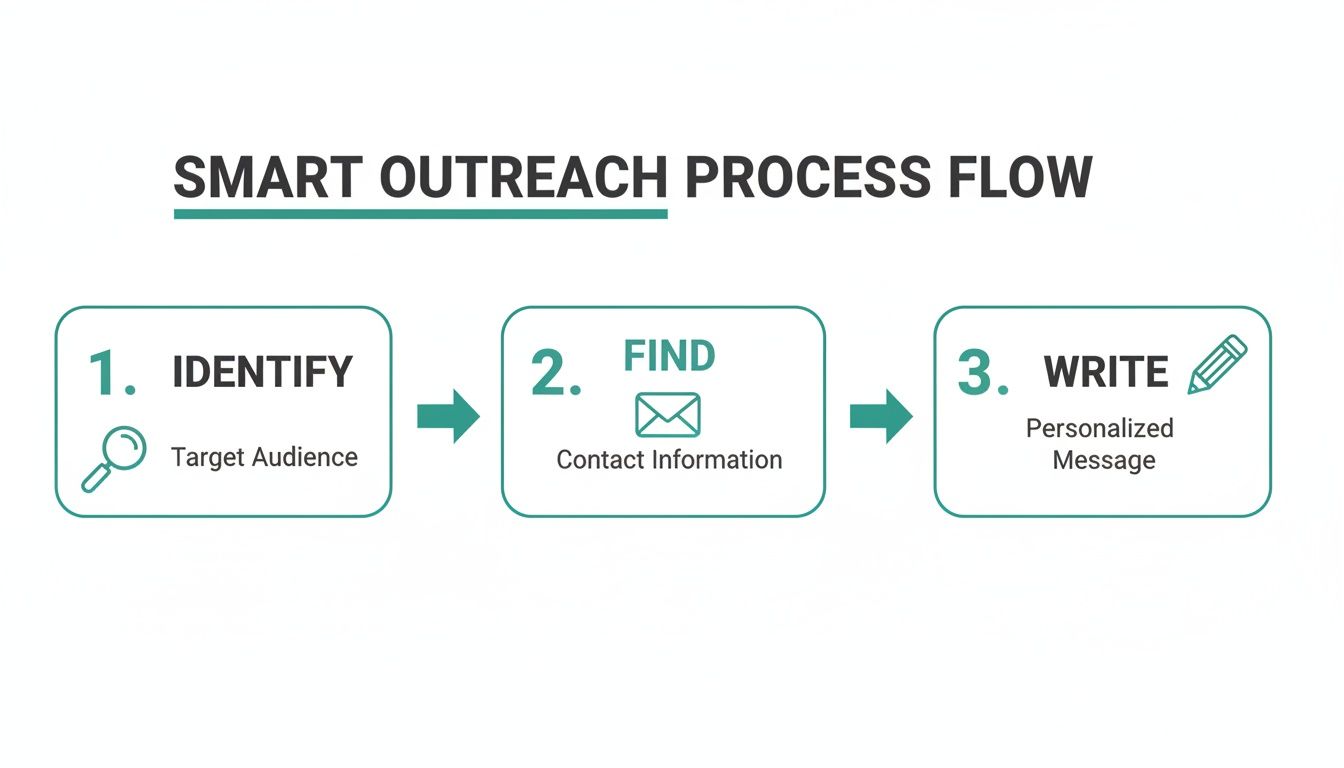
Before you even think about writing, you have to know who you're targeting. Only then can you find their contact info and craft a message that actually resonates.
How Should I Introduce Myself if We Have a Mutual Connection?
This is the golden ticket of introductions. If a mutual contact sent you their way, put that person's name in your very first sentence. Seriously. It’s your most powerful asset, instantly borrowing trust and turning a cold email into a warm one.
Start with something direct, like "Our mutual colleague, Jane Doe, suggested I reach out." From there, immediately explain why Jane thought the connection made sense. This gives your message instant context and relevance.
A referral-based introduction feels less like an interruption and more like a pre-vetted opportunity. Research shows that leads generated through referrals have a 30% higher conversion rate, which just goes to show how powerful a shared network can be.
What’s the Best Way to Follow Up on an Introduction Email?
So you sent your email and… crickets. It happens. A gentle follow-up is completely fine, and often necessary. The key is to wait 3-5 business days before sending your next message. That polite nudge can actually increase your chances of getting a reply by more than 20%.
Your follow-up needs to be short, sweet, and ideally, add a little value. Don't just ask, "Did you see my last email?" Instead, try forwarding your original message with a simple note on top.
For example:
- "Hi [Name], just wanted to gently bump this in your inbox in case you missed it."
- "Hi [Name], following up on my previous note. I also came across this article on [Relevant Topic] and thought you might find it interesting."
This approach comes across as helpful, not demanding, and it keeps the conversation moving forward professionally.
Ready to stop guessing and start connecting? The EmailScout Chrome extension finds verified email addresses in a single click, turning your outreach process into a streamlined, effective system. Find unlimited emails and build your marketing lists for free at https://emailscout.io.