
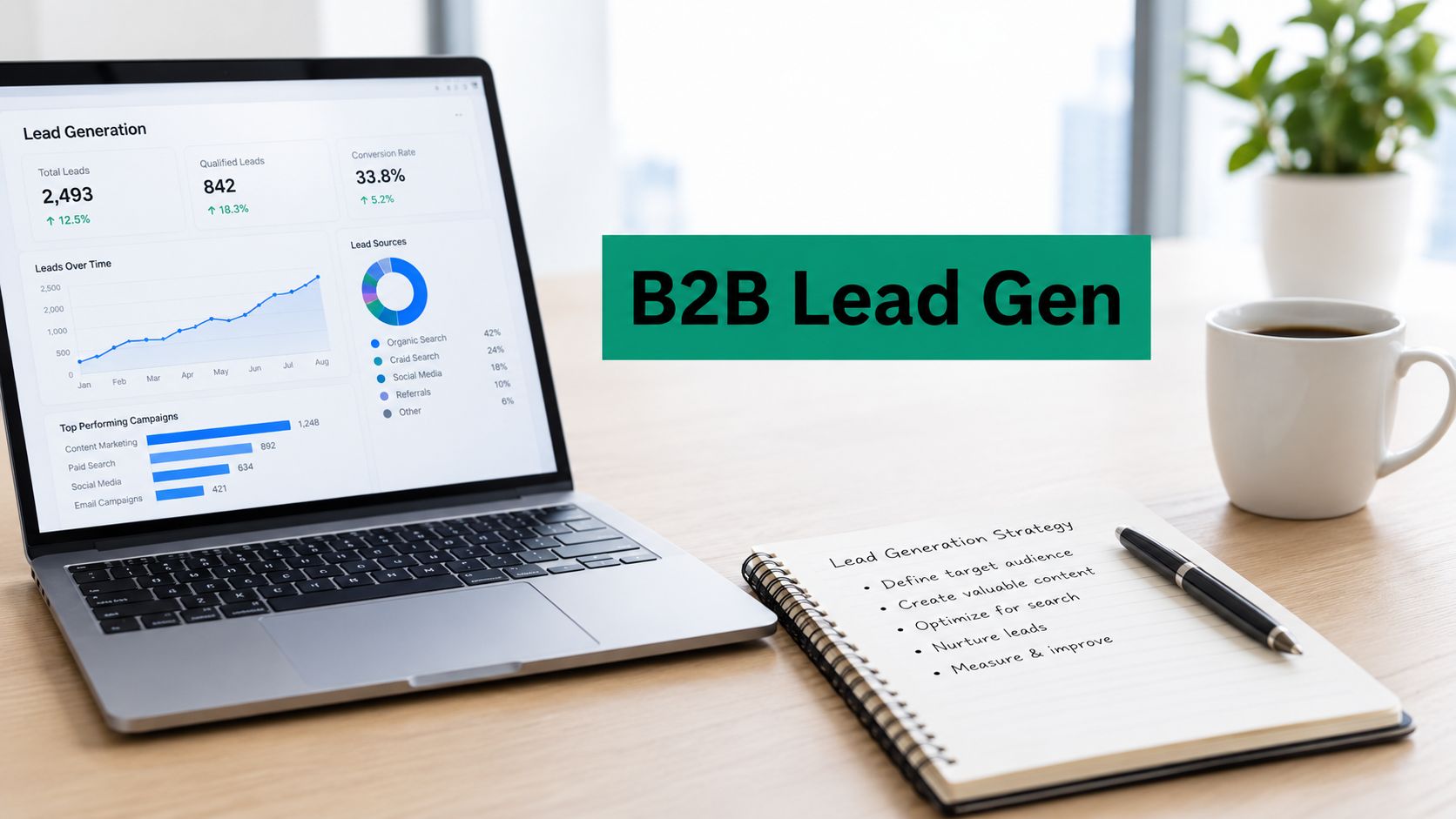
B2B lead generation often loses more prospects before qualification than you might expect. One benchmark compilation places average B2B website conversion at roughly 2.5% to 3%, with only about 13% of leads becoming qualified opportunities. These benchmark figures point to a practical conclusion: increasing traffic or contact volume won't fix a weak operating system. Targeting, data quality, messaging, follow-up, and measurement have to work together.
The strongest B2B lead generation best practices begin by defining the account and the people inside it. They then move through clean data capture, relevant personalization, coordinated channels, thoughtful nurturing, and pipeline measurement. This guide covers ten practices with implementation steps, trade-offs, realistic scenarios, and ways to use tools such as EmailScout without treating contact collection as a substitute for relevance, permission, or compliance.
The objective isn't to run every channel at once. It's to build a lead engine that sales can trust, then improve it through evidence. A freelancer may start with one segment and one outreach motion. A larger sales team may coordinate account research, content, intent signals, automation, and CRM reporting. In both cases, the operating logic stays the same: identify the right buyer, give that buyer a credible reason to engage, and make the next step easy to manage.
1. Email List Building and Database Segmentation
A large contact list isn't automatically a useful prospecting asset. A useful list tells you which company the contact belongs to, what role they hold, whether they fit your ideal customer profile, and why your message might matter now.
Start with account-level filters such as industry, location, business model, and company size. Then add contact-level fields including job title, seniority, department, and likely influence over the purchase. Finally, record the evidence behind the segment, such as a relevant product page, hiring activity, public announcement, or content interaction. This context gives sales a reason to contact someone instead of relying on a generic introduction.
EmailScout can support research by finding publicly available business email addresses from websites and search results. Its AutoSave feature can collect addresses while you browse, while URL Explorer can help extract contacts from company pages. Use those features to accelerate research, not to bypass consent or send indiscriminately.

Build segments sales can act on
A practical segmentation structure might include:
- Industry segment: Adjust the problem statement to the operating realities of each market.
- Role segment: Separate economic buyers, technical evaluators, users, and internal champions.
- Company segment: Change the offer based on complexity, resources, and buying process.
- Intent segment: Distinguish researched accounts from contacts with no visible buying signal.
- Data-status segment: Separate verified, unverified, outdated, and opted-out records.
Email remains measurable, but performance depends on list quality and audience relevance. A benchmark covering 4.4 billion messages sent in 2023 reported an all-industry 39.64% open rate and 3.25% click-through rate, while a B2B benchmark found email contributed about 1.3% of MQLs and 2.24% of revenue. The email benchmark data supports disciplined segmentation rather than indiscriminate volume.
For a deeper process, use this guide to segment email lists. Review records regularly, suppress invalid or inactive contacts, and keep a clear audit trail for consent and opt-out preferences.
2. Account-Based Marketing with Personalized Outreach
Account-based marketing earns its place when the team can explain why particular companies deserve attention. The account becomes the planning unit, while outreach coordinates the people involved in the purchase. Personalization starts with account selection, not with adding a first name to an email.
Set the account hypothesis
Define selection criteria before researching contacts. Check commercial fit, operational need, timing, current technology, and the likely value of winning the account. Then map the buying group. A finance leader may focus on cost control, an operations leader on workflow reliability, and a technical evaluator on integration and security. Each role needs a relevant reason to engage.
Build the research record around one testable hypothesis. EmailScout can help identify and verify publicly available business contact details for multiple stakeholders. Combine those details with company pages, product documentation, job postings, leadership changes, and customer-facing language. The result might be: “This team is expanding its sales operation and may be reviewing its prospecting workflow.”
A useful ABM brief should answer five questions:
- Account situation: What changed or creates urgency?
- Business consequence: What problem could that change create?
- Stakeholder perspective: Why would this role care?
- Relevant proof: Which capability or insight addresses the issue?
- Low-friction next step: What can the recipient evaluate without entering a sales process?
Decide where personalization pays
Research time is the main trade-off. ABM can improve relevance, but it becomes wasteful when the team studies accounts that fail its commercial criteria. Start with a small target group. Record the time spent on each account, then compare pipeline quality with broader outreach. If the team cannot explain why an account belongs in the target set, more personal copy will not fix the campaign.
Use URL Explorer to review relevant pages across target companies. Pull out evidence, not compliments. A new website alone says little. A combination of changed hiring needs, product positioning, or leadership priorities can support a credible message tied to a business problem.
Coordinate the sequence across stakeholders. Give each person a distinct angle, keep the account hypothesis consistent, and record responses against the account rather than treating every contact as a separate opportunity. That creates cleaner handoffs between research, outreach, and pipeline measurement.
3. LinkedIn Sales Navigator, Prospecting, and Direct Company Research
LinkedIn research should produce an account hypothesis, not a longer contact list. Sales Navigator helps define the people and companies worth investigating, while direct company research shows how the business describes its priorities, customers, products, and market position.
Start by setting the account criteria before opening individual profiles. Filter Sales Navigator by company, industry, role, seniority, geography, and recent job changes. Review the company website and relevant public sources after that first pass. Look for several consistent signals, such as a leadership change combined with new hiring or a shift toward larger customers. One isolated detail rarely proves buying intent.
A software company provides a practical example. A business development representative may find a new sales leadership appointment, open commercial roles, and product pages aimed at larger customers. Together, those signals support a question about scaling the sales process. They do not support a claim that the company is definitely buying.
Use the research to guide a measured sequence:
Observe relevant company or prospect activity before pitching. Engage only when you can add a specific, useful comment. Connect with a short request that explains the relevance. Research the company website and use URL Explorer or EmailScout to identify the appropriate business contact and add account context. Email only when the message contributes information that LinkedIn cannot. Record the research note, signal, and response in the CRM.
Keep the account hypothesis consistent across channels. A LinkedIn interaction should inform the email, and the email response should update the account record rather than create an isolated contact note. This improves handoffs between research, outreach, and pipeline measurement.
Your own profile affects response quality. State clearly which audience you serve, which business problems you understand, and what outcomes you support. A prospect checking your profile should find evidence of relevant work, not vague claims.
Social prospecting requires time and does not guarantee replies. It performs poorly when every comment hides a pitch. It works better when the seller builds familiarity, tests the account hypothesis, and uses email as a relevant continuation rather than a disconnected interruption.
4. Cold Email Outreach with Personalization and Follow-up Sequences
Cold email earns a place in the lead-generation system when the market is narrow, the problem is clear, and the sender can explain why the recipient is relevant. It wastes time when a purchased or scraped list replaces account research.
Use a simple send/no-send check before drafting. Confirm the account fits the target market, the contact owns or influences the problem, and the record contains a verified address and useful company context. Then define one message premise. A clean record supports better personalization, clearer handoffs, and fewer deliverability problems.
Build the email around one business issue. Open with a specific observation about the company or role. Follow with a useful resource, relevant example, or concise hypothesis. Ask for one next step, such as confirming whether the issue is relevant. Avoid several questions or decisions in the same message.
Recent benchmark coverage reported that cold B2B reply rates fell from 6.8% in 2023 to 5.8% in 2024, with typical reply rates around 5.1% and meeting-booked rates near 1.0%. The cold outreach benchmarks show the trade-off: personalization can improve relevance, but it cannot compensate for a poor fit, weak offer, or bad timing.

A follow-up sequence should add information rather than repeat the first email:
- Change the angle: Share a new observation, example, or resource.
- Respect attention: Keep messages concise and remove background the recipient does not need.
- Use one CTA: Ask whether the issue applies, offer a short discussion, or provide the resource.
- Stop responsibly: End outreach after continued silence or an opt-out.
- Protect deliverability: Use verified records, controlled sending volumes, and clear suppression rules.
EmailScout supports researched business-contact discovery through its cold email follow-up sequence workflow. Review the contact, address, account context, legal basis, and jurisdiction before sending. This cold email guide provides further practical context.
Reduce email priority when the audience is saturated, the offer requires extensive trust, or intent data points to another channel. Content, partnerships, events, or account-based engagement may create a better first interaction in those situations.
5. Content Marketing and Thought Leadership for Lead Attraction
Content earns leads when it helps a defined buyer make measurable progress. A broad article about “business growth” may attract attention, while a guide that helps a revenue operations leader diagnose broken lead routing creates a clearer connection to a product or service.
Build the program around buyer stage. Early readers need definitions, frameworks, and problem diagnosis. Prospects comparing solutions need evaluation criteria, implementation guidance, and evidence. Decision-stage buyers need product details, risk information, resources for internal stakeholders, and a clear route to an informed conversation.
Sales conversations provide a practical source of topics. Ask representatives which objections delay deals, which terms prospects misunderstand, and which stakeholders need reassurance. Convert those answers into articles, comparison pages, webinars, templates, and customer education. This keeps content tied to account and contact needs rather than publishing volume.
A useful content workflow gives each asset several jobs:
A search asset: Optimize the article around one specific question and related terminology.
A sales asset: Give representatives a concise resource to share after a relevant conversation.
An email asset: Turn one useful insight into a targeted newsletter or nurture message.
A social asset: Extract practical observations instead of repeating promotional statements.
A research asset: Interview relevant practitioners and use their perspectives with permission.
These roles should shape production from the start. Before drafting, define the target account type, buyer role, problem, evidence required, and next action. After publication, assign distribution owners across search, sales, email, and social channels. A strong article with no distribution plan will rarely create consistent demand.
EmailScout can support the research stage by helping identify publicly available business contacts and potential expert sources. Contact people because their experience fits the topic, not just because their address is available. Explain the request, describe how their contribution will be used, and provide a clear way to decline.
The trade-off is speed. Content usually requires more preparation than a direct email, and results may accumulate gradually. It also underperforms when the audience is undefined or the conversion path is missing. Choose a next step that matches intent, such as a diagnostic conversation, useful template, webinar registration, or deeper product resource, then track whether engagement progresses into qualified pipeline.
6. Strategic Partnerships and Referral Programs
Partnerships generate qualified conversations when both companies serve similar customers without competing for the same purchase. Suitable partners may include agencies, consultants, technology providers, associations, or specialist communities. Their existing credibility can shorten the path from account research to a relevant introduction.
Start by defining the shared target account and contact. List the industries, company characteristics, buyer roles, and problems that make a referral relevant. Then assess the relationship from both sides: what will improve for the partner's customers, how the partner benefits, and whether each team has capacity to support referrals after the introduction.
Set the operating rules before asking for introductions. Define a qualified referral, assign follow-up ownership, specify how quickly the recipient should respond, and decide how the partner receives progress updates. Check the CRM before accepting a referral and agree on the process when the prospect already exists there. Clear rules protect trust, even when referral volume remains modest.
A practical partner kit can include:
- A shared audience definition: State which accounts and roles fit, along with the problems that justify an introduction.
- A clear introduction script: Give the partner a short, accurate way to explain the situation you address.
- Useful collateral: Supply a concise overview, comparison resource, diagnostic, or implementation guide.
- A routing process: Name the owner, response standard, and required fields for every referral.
- Feedback: Report the outcome without sharing confidential customer information.
EmailScout may help research shared target accounts or identify relevant contacts. Contact discovery does not replace coordination. Agree on lawful data use, outreach ownership, consent expectations, and communication preferences before co-selling. Publicly available contact information still requires responsible handling.
Partnerships weaken when one company expects the other to create demand without contributing time, content, or access. A stronger arrangement gives both teams a useful campaign asset, such as a joint webinar, integration resource, customer workshop, or implementation guide. Measure referred accounts through qualification, opportunity creation, revenue, and retention, not introductions alone. That view shows whether the partnership contributes to the full pipeline rather than merely adding names to a database.
7. Trade Shows, Events, and Webinars for Lead Generation
Events generate pipeline only when the team treats them as a coordinated operating process, not a badge-collection exercise. Before anyone attends, define the target accounts, roles, problems, and next steps the event should support.
Research priority accounts and likely participants through company websites, speaker pages, exhibitor information, and EmailScout. Record useful contact details where appropriate, then prepare conversation prompts based on each prospect's role and business context. A product pitch rarely gives a representative enough flexibility to handle a specific business situation.
The event plan should answer four questions: who deserves time, what information must be captured, how interest will be qualified, and who owns follow-up.
Use the conversation to collect more than a name and email address. Note the problem discussed, the current approach, urgency, stakeholders involved, and agreed next step. A smaller set of contacts with documented needs is more actionable than a large badge file with no context.
Design the event workflow before launch
- Pre-event outreach: Give priority accounts a specific reason to meet, tied to their role or a relevant business problem.
- Live qualification: Record fit, the problem's business impact, authority, timing, and the next action the prospect accepted.
- Immediate notes: Write the context before starting another conversation, while details remain accurate.
- Relevant follow-up: Refer to the discussion and send only the resource promised. Assign an owner and due date.
- Pipeline tracking: Connect attendance and conversations to qualified opportunities, revenue, and later outcomes.
URL Explorer can help review exhibitor and speaker websites for additional account context. Use that research to prioritize people who fit the account criteria and have a credible connection to the topic, rather than contacting everyone associated with the event.
Webinars need the same operating discipline. Keep the registration form focused on information needed for routing and qualification, without adding unnecessary fields. Teach a useful, specific topic, then segment follow-up by behavior. Attendees who asked questions warrant a different message from registrants who never joined. Record those outcomes in the same system as event contacts so channel activity can be connected to pipeline impact.
8. Intent Data and Behavioral Targeting
Intent data should change the next action, not replace qualification. A pricing-page visit, content download, competitor search, or repeated engagement can indicate interest, but none proves that an account is ready to buy. Use these signals to set priorities, then confirm fit, role, and business context before outreach.
Start by defining the signals that matter in your market. Relevant examples include visits to pricing pages, repeated interaction with implementation content, research into a known problem, or activity from several people at one account. Combine behavioral activity with firmographic criteria and contact role. An account showing strong interest but operating outside your service area may still be unsuitable for the active pipeline.
A 2026 benchmark synthesis reported a median B2B website conversion rate of 2.9%, a median cost per lead of $213, and a lead-to-customer conversion rate of 0.94% across sources. It estimated organic content and SEO CPL at around $98, compared with about $487 for account-based marketing. The channel benchmark illustrates why teams should compare channel economics rather than optimize a single blended target.
Set the response before the signal arrives
Use three operating tiers:
- High priority: Strong account fit, several relevant signals, and a plausible business trigger. Research the right stakeholders and connect the first message to the observed problem.
- Medium priority: Good fit with one meaningful signal, but buying timing remains unclear. Add the account to a monitored sequence and look for confirming activity.
- Low priority: Weak fit, isolated activity, or no clear relationship to the offer. Keep it out of active sales outreach until the evidence changes.
Keep the claim proportional to the evidence. Content consumption does not reveal exactly what a prospect wants, so ask a useful question instead of presenting an assumption as fact.
Test whether intent-based prioritization increases qualified conversations in your market. Compare the approach with the existing workflow, control outreach volume, and review the quality of resulting opportunities. EmailScout can support contact research for accounts that meet your criteria. Store the intent evidence, chosen action, and pipeline outcome in the CRM so the team can assess whether the signal improved results.
9. Email Personalization and Dynamic Content
Personalization succeeds or fails at the data layer. Check the contact's name, role, company association, segment, and buying context before adding dynamic fields. An incorrect title or outdated company detail can damage trust more quickly than a plainly generic email.
Personalize the business case, not only the greeting. A finance leader may prioritize cost control and risk, while a sales operations manager may focus on process visibility and adoption. Build each message around the recipient's responsibilities, likely objections, and most useful next step. Technical readers may need implementation detail. Executives may prefer a concise view of business impact and risk.
A practical message matrix can include these variations:
- Industry: Use the sector's operating language, constraints, and common priorities.
- Company profile: Adjust the context for smaller teams, growing companies, or complex organizations.
- Role: Connect the offer to outcomes within the recipient's responsibilities.
- Buying stage: Educate early researchers and provide decision support for active evaluators.
- Intent signal: Reference a relevant topic, page, or public business change when it directly supports the message.
EmailScout's verified contact data can help populate basic fields and support account research. Review those fields before sending. A public detail should earn its place by clarifying the business problem, not by proving that the sender researched the prospect. Remove personal information that feels intrusive or unrelated.
Test one meaningful variable at a time, such as the opening insight, offer, CTA, or segment. Review replies, qualified conversations, opportunities, and negative responses together. Open rates can reflect technical conditions, so they cannot establish pipeline value on their own.
Dynamic content needs an operational safeguard. Create a fallback version for every variable, and check what happens when a field is missing, outdated, or assigned to the wrong segment. A useful email usually answers three questions quickly: why the message is relevant, what the sender noticed, and which next step is available. Simple, specific relevance is more credible than a catalogue of prospect details.
10. Marketing Automation and Lead Nurturing Workflows
A workflow should make the next sales decision clearer. It should also protect the quality of your data and give prospects a relevant path from first response to qualified conversation.
Start with one segment and one buying stage. Define the entry condition, the sequence, the exit condition, the owner, and the CRM status change before activating anything. A contact who downloads an introductory guide may need education. Someone who requests pricing needs a faster, more direct response. Route those contacts separately rather than forcing both into one sequence.
Build the workflow around explicit decisions:
- Entry rules: Trigger the sequence from a defined segment, action, or intent signal.
- Progressive profiling: Request more information only when it improves routing or message relevance.
- Scoring logic: Combine fit, engagement, role, and intent. A single click should not carry the same weight as repeated activity from a suitable account.
- Sales handoff: Set the qualification threshold, response time, and named owner.
- Suppression rules: Remove opted-out, invalid, inactive, and converted contacts.
Replies, information requests, unsubscribes, and sales qualification should stop the automated path or send the record to the right owner. Review these rules in the CRM, not only in the marketing platform, so sales can see why a contact changed status.
AI and lead scoring are becoming more common in larger B2B teams. A 2026 benchmark reported AI adoption rising from 42% at companies with 50 to 200 employees to 84% at companies with more than 1,000 employees, while lead-scoring implementation rose from 28% to 73% across those company bands. The same AI lead-generation benchmark reported a 73% increase in qualified leads within six months among companies using AI-powered lead generation. Use these figures as context for planning, not as a forecast for your team.
EmailScout can help teams research accounts and build contact lists before appropriate records enter an automation platform. Its lead nurturing best practices can guide sequence planning, but the workflow still needs a controlled test segment.
Keep the first version simple. Check replies, qualified conversations, routing errors, and unsubscribes, then change one element at a time. Fix data, messaging, and ownership before adding more branches.
Top 10 B2B Lead-Gen Best Practices Comparison
| Approach | Implementation complexity | Resource requirements | Expected outcomes | Ideal use cases | Key advantages |
|---|---|---|---|---|---|
| Email List Building and Database Segmentation | Medium, initial heavy effort, ongoing maintenance | Verification tools, CRM, data sources, moderate staff time | Higher deliverability, improved open/CTR, reusable segmented lists | Scalable email programs, targeted campaigns, A/B testing | Better targeting and deliverability; enables personalization |
| Account-Based Marketing (ABM) with Personalized Outreach | High, intensive research and cross-team coordination | Research teams, CRM/ABM tools, custom content, sales alignment | Higher ROI, larger deal size, shorter enterprise sales cycles | Enterprise sales, high-value target accounts | Focused resource allocation; multi-stakeholder engagement |
| LinkedIn Sales Navigator, Prospecting, and Direct Company Research | Medium, platform learning and manual research | Sales Navigator subscription, time for outreach, CRM integration | Warm introductions, richer prospect context, higher acceptance rates | Professional services, relationship-driven sales, stakeholder mapping | Credibility via network, context-rich personalization |
| Cold Email Outreach with Personalization and Follow-up Sequences | Medium, template and sequence setup; needs testing | Verified email lists, automation tools, copywriting resources | Scalable lead volume, measurable ROI; variable response rates | Early-stage outreach, volume-driven prospecting | Scalable, low cost per lead, direct access to decision-makers |
| Content Marketing and Thought Leadership for Lead Attraction | High, sustained content creation and SEO work | Content creators, SEO, promotion budget, time (months) | Long-term inbound leads, brand authority, improved organic traffic | Brand building, top-of-funnel education, SaaS & complex solutions | Sustainable traffic, trust building, higher-quality inbound leads |
| Strategic Partnerships and Referral Programs | Medium, partner sourcing and relationship management | Partner enablement materials, incentives, account management | Warm, high-converting leads; lower CAC | Channel expansion, complementary product ecosystems | High conversion via social proof; access to new segments |
| Trade Shows, Events, and Webinars for Lead Generation | Medium–High, event planning and follow-up required | Booth/travel budget, staff, lead capture tech, content | Immediate qualified leads and relationship opportunities | Product demos, industry conferences, demand generation pushes | Face-to-face credibility, concentrated access to target audience |
| Intent Data and Behavioral Targeting | High, data integration and signal interpretation | Intent platforms, analytics, CRM integration, budget | Prioritized hot leads, higher conversion rates, timely outreach | In-market buyer targeting, ABM acceleration, sales prioritization | Targets buyers at peak readiness; reduces wasted outreach |
| Email Personalization and Dynamic Content | Medium–High, needs clean data and template complexity | Dynamic email platform, accurate data, content variants | Significant lift in open/CTR and conversions when done right | Nurture sequences, ABM, segmentation-driven campaigns | Scales personalization; improves engagement and conversion |
| Marketing Automation and Lead Nurturing Workflows | High, mapping journeys and complex workflows | Automation platform, clean lists, content库, analytics | Scalable nurturing, consistent follow-up, higher conversions | Long sales cycles, high-volume lead management | Automates multi-step engagement; frees sales to focus on qualified leads |
Turn Best Practices Into a Repeatable Pipeline
These practices work as an operating system when the handoffs are explicit. Begin by defining the ideal customer profile, the account characteristics that matter, and the roles involved in a purchase. Write down the problem you solve, the situations that create urgency, and the evidence that qualifies an account for active outreach. Without this foundation, segmentation becomes labeling and personalization becomes decoration.
Next, build a clean database. Research the right companies and contacts, verify the information you plan to use, record the source and context, and remove invalid or unresponsive records from active campaigns. EmailScout can support contact discovery and URL-based company research, but the team still needs to decide whether a contact fits the segment, whether the outreach is appropriate, and how the data may be used.
Choose one primary acquisition channel before adding several secondary ones. A startup may begin with targeted cold email supported by LinkedIn research. A specialist consultancy may begin with content and referrals. A larger team may use intent data to prioritize accounts and events to create conversations. The right choice depends on audience behavior, available expertise, sales capacity, and the economics of the channel.
Then create a message and follow-up cadence that match the buyer's stage. An early researcher needs useful education. An active evaluator needs evidence, comparison criteria, and answers to implementation concerns. A high-intent prospect may need a direct response from sales. Don't send the same sequence to every contact just because your automation platform makes it easy.
Connect engagement data to the CRM and pipeline reporting. Track the movement from researched account to contacted person, engaged contact, qualified opportunity, and customer. Review conversion quality by segment and channel. Website and email benchmarks show why small changes can matter when baseline conversion sits in the low single digits, but a higher click rate isn't useful if sales receives poorly qualified conversations.
Improve the system through controlled changes
Use a practical review cycle:
- Check the audience: Are the accounts and roles still commercially relevant?
- Check the data: Are addresses valid, roles current, and opt-outs respected?
- Check the message: Does the opening reflect a real business issue?
- Check the handoff: Does a qualified response reach a human quickly?
- Check the pipeline: Does engagement lead to opportunities and revenue?
- Check the channel: Is this motion still more efficient than available alternatives?
Test one variable at a time whenever possible. Change the segment, opening, offer, or follow-up step, then give the result enough time to produce meaningful pipeline evidence. Avoid declaring success from a single campaign or a surface-level email metric.
Compliance belongs in the workflow, not at the end of it. Respect GDPR, CAN-SPAM, and other applicable requirements. Provide clear identification and opt-out options, honor suppression requests, document lawful data practices, and avoid treating publicly available information as unlimited permission to contact someone.
A dependable lead engine doesn't maximize activity. It creates a clear chain from account definition to useful conversation to measurable pipeline. Teams that keep that chain clean can use email, content, partnerships, events, intent data, automation, and research tools without losing sight of the person on the receiving end. For teams considering a broader operating approach, this guide to driving ROI with AI-powered B2B leads offers another perspective on connecting technology with commercial outcomes.
EmailScout helps sales professionals, marketers, business development teams, entrepreneurs, freelancers, and startups discover publicly available business email addresses while researching target accounts. Use its Chrome extension, AutoSave, and URL Explorer to support a defined prospecting workflow, then visit EmailScout to build cleaner contact research into your B2B lead generation process.