

Ever felt like you're talking to ghosts? You have a name and an email, but that’s it. No context, no company, no clue if they're a dream customer or a dead end. This is the reality for most sales and marketing teams swimming in raw, incomplete data.
Data enrichment services are the cure. Think of them as a private investigator for your CRM. They take that one lonely piece of information—like an email address—and turn it into a full-color portrait of your ideal customer, complete with their job title, company details, and even recent buying signals.
What Are Data Enrichment Services

Imagine your CRM is a stack of business cards where half the ink has faded. You’ve got a name, maybe an email, but the rest is just a blank space. Data enrichment services are the tools that fill in those critical gaps for you.
Here’s how it works: you provide a single known data point, like a LinkedIn profile or an email address. The service cross-references it against massive, constantly updated databases and appends (or "enriches") your record with a ton of valuable new information.
The Transformation From Raw Data To Actionable Intelligence
This isn't magic; it's about connecting the dots that are already out there. The service finds a match and pulls in all the associated details, turning a skeletal lead into a well-rounded prospect you can actually talk to.
Let’s walk through a common scenario. Someone with a personal email address downloads an ebook from your site. Without enrichment, they're a nobody. With it, that single email can instantly pull in their professional details, including:
- Current Company: Where do they actually work?
- Job Title: Are they an intern or a VP?
- Industry: Do they operate in a sector you sell to?
- Company Size: Is it a 10-person startup or a 10,000-person enterprise?
- Location: Where is their office located?
Just like that, a vague, anonymous lead becomes a qualified prospect. You now know if they're a decision-maker in your target industry. Your sales team can stop sending generic, cold emails and start crafting outreach that actually resonates.
The Growing Importance Of Enriched Data
The days of spray-and-pray marketing are over. The demand for this level of hyper-personalized engagement is exploding. The global data enrichment market was valued at USD 2.39 billion in 2023 and is on track to hit USD 6.27 billion by 2033.
That’s a growth rate of 10.13% year-over-year, which shows just how essential these services have become for any serious business. You can find more details on this market trend over at Vision Research Reports.
At its core, data enrichment is the process of enhancing your existing data with contextual information from external sources. It’s the difference between knowing a person’s name and understanding their professional world.
To really see the difference, let’s look at a side-by-side comparison. This table shows how a basic lead transforms into a high-value prospect right before your eyes.
Raw Data vs Enriched Data: A Sales Perspective
| Data Point | Before Enrichment (Raw Data) | After Enrichment (Actionable Intelligence) |
|---|---|---|
| Contact Info | jane.doe@email.com |
jane.doe@techcorp.com |
| Job Title | Unknown | VP of Marketing |
| Company Name | Unknown | TechCorp Inc. |
| Industry | Unknown | B2B SaaS |
| Company Size | Unknown | 500-1000 Employees |
| Technology Used | Unknown | Uses Competitor X's software |
| Sales Context | Low-quality, anonymous lead | High-value, qualified decision-maker |
This is the kind of upgrade that empowers your team to prioritize the right leads, personalize every single message, and ultimately shorten the entire sales cycle.
Instead of guessing, they can walk into every conversation with a foundation of knowledge, building genuine rapport from the first hello. Data enrichment services are the engine that powers this smarter, more efficient approach to growing your business.
The Most Valuable Types of Enrichment Data
Once you get how data enrichment services work, the next logical question is: what kind of information actually moves the needle? Not all data points are created equal. Their value depends entirely on what you’re trying to achieve.
For sales and marketing teams, enrichment data falls into a few powerful categories. Think of them as different lenses you can use to look at a prospect. Each one gives you a unique perspective, and combining them creates the sharpest, most complete picture possible.
Firmographic Data: The Blueprint of a Business
Firmographic data is the bedrock of B2B intelligence. It covers the core attributes of a company—much like demographics describe a person. This is your first line of defense for qualifying leads and segmenting your market, helping you answer the question, “Is this company even a good fit for us?”
By enriching your records with firmographics, you can instantly filter your entire lead database to match your ideal customer profile (ICP). For instance, you could isolate all software companies with 50-200 employees and over $10 million in annual revenue. No more guesswork.
Common firmographic data points include:
- Company Size: Based on employee count or annual revenue.
- Industry: Categorized using standard codes like NAICS or SIC.
- Geographic Location: Pinpointing the company’s headquarters and other offices.
- Company Type: Differentiating between public, private, or non-profit organizations.
Technographic Data: A Look Inside Their Tech Stack
Technographic data gives you a peek behind the curtain at the specific software and technologies a company uses. This is gold for creating highly relevant and competitive sales pitches. Knowing a prospect’s tech stack is like knowing what tools they already have in their workshop—you can see exactly where your solution fits.
Imagine you sell a marketing platform that integrates beautifully with Salesforce. An enrichment service can tag a lead’s record to show they’re an active Salesforce user. Now, your sales team can skip the generic pitch and lead with a hyper-relevant message about your seamless integration.
Technographic data lets you position your product not just as a solution, but as the perfect next piece in their existing technology puzzle.
This data is also a game-changer for competitive displacement campaigns. If you know a prospect is using a rival’s software, you can tailor your messaging to highlight your unique advantages and hit on the pain points they’re likely experiencing with their current provider.
Intent Data: Reading the Buying Signals
Intent data is arguably the most valuable type for timing your outreach because it reveals active buying interest. It tracks a prospect’s online behavior—like the articles they read, the webinars they attend, and the topics they research—to signal when they’re in the market for a solution like yours.
Think of it this way: firmographics and technographics tell you who is a good fit, but intent data tells you who is a good fit right now. This information is often gathered from B2B publisher networks that monitor content consumption across millions of websites.
For example, if key decision-makers at a target account suddenly start researching “best CRM for small businesses,” that’s a massive buying signal. Your team can then swoop in with perfectly timed content, knowing they are addressing an immediate need. This proactive approach ensures you connect with prospects during their critical evaluation phase, dramatically increasing your odds of winning the deal.
How Data Enrichment Actually Drives Business Growth
The whole point of a data strategy is to connect the dots between raw information and real revenue. This is where data enrichment stops being a tech-y tool and starts acting as a powerful growth engine. When you turn incomplete records into full customer profiles, you give your sales and marketing teams the intel they need to work faster, smarter, and way more effectively.
It all starts by completely changing how you see and prioritize your leads. A complete data profile makes your lead scoring incredibly accurate, grading prospects on how well they actually fit your ideal customer profile.
Transform Your Lead Scoring
Without enrichment, lead scoring is usually just a guess based on limited behavior, like someone downloading a single ebook. That’s not much to go on. With enriched data, scoring becomes a multi-dimensional analysis, pulling in critical details about a prospect’s company and the technology they use. This makes sure your sales team is only spending their valuable time on prospects with the highest statistical chance of closing.
Think about the kind of factors you can suddenly bake into your scoring model:
- Company Revenue: Is this company even big enough to afford what you sell?
- Employee Count: Does their team size match your sweet spot?
- Industry: Are they in a vertical where you’ve already got a proven track record?
- Technology Stack: Do they already use software that makes your product a perfect fit?
This refined process stops your best reps from wasting time on dead-end leads. They can focus only on accounts that are essentially pre-qualified and ready for a real conversation, which directly shortens the sales cycle.
Fuel Hyper-Personalization at Scale
Generic, "one-size-fits-all" outreach is a guaranteed way to get ignored. Data enrichment gives you the specific, contextual details you need to personalize every single interaction, from the first email to the final proposal. In fact, one study found that personalized campaigns can generate up to a 20% increase in sales.
Imagine a sales rep who knows the following about a lead before they even reach out:
- Their exact job title and what they're responsible for.
- The company’s recent funding rounds or hiring sprees.
- The competitor's software they're currently using.
Instead of a boring "just checking in" email, the rep can write a message that hits on the prospect's actual challenges and goals. This kind of context-aware approach dramatically boosts reply rates and the number of meetings booked. Getting this right often relies on smart marketing and data analytics, which are supercharged by enriched data.
Data enrichment isn’t just about adding more fields to your CRM; it's about adding more context to your conversations. It allows you to move from "who you are" to "what you need" much faster.
This shift turns your outreach from an annoying interruption into a valuable consultation. You’re no longer just another salesperson—you're a well-informed partner who actually understands their business.
Shorten the Sales Cycle and Increase Velocity
When you add up accurate lead scoring and deep personalization, the result is a much shorter sales cycle. It's simple: when reps connect with the right people at the right companies with the right message, the path from first contact to a signed deal gets a whole lot shorter.
Let’s look at a sales team's journey. Before enrichment, they blasted out thousands of generic emails, got almost no replies, and slogged through a long, messy sales process full of unqualified leads. After implementing data enrichment services, their entire workflow changed.
- Automated Qualification: New leads are automatically enriched and scored in the CRM. The best ones get sent straight to account executives.
- Context-Driven Outreach: Sales reps use the enriched data to craft personal emails that reference the prospect’s industry, tech stack, and recent company news.
- Faster Conversations: Because the first email is so relevant, conversations move past the basic discovery questions and straight into problem-solving, speeding up the whole sales motion.
This strategic shift proves that data enrichment isn't just another operational cost—it's a critical investment. By making your teams more efficient and effective across the board, these services deliver a clear, measurable return for any company serious about predictable growth.
Integrating Data Enrichment Into Your Workflow
Having powerful data is one thing. Making it a seamless part of your team's daily rhythm is a whole different ballgame. Great intelligence is useless if it's buried in a separate platform or requires a dozen manual steps to access. The goal is to build a system where enriched data flows directly to your sales and marketing teams exactly when they need it, turning raw information into a real-time competitive edge.
This means moving beyond one-off data cleanses and thinking about a continuous, automated process. By embedding data enrichment right into your core tools—like your CRM and prospecting platforms— you eliminate friction and empower your team to act on insights instantly.
From Discovery To Action: An Example Workflow
Let's walk through a practical, real-world scenario. Picture a sales development representative (SDR) prospecting on LinkedIn. They find a promising decision-maker at a target company. The old way involved a ton of manual work: searching for an email, guessing formats, and then plugging incomplete information into the CRM by hand.
An integrated workflow changes this completely. Using a tool like the EmailScout Chrome extension, the SDR can find and verify the contact's email address in a single click, right there on the LinkedIn page. But the real magic is what happens next.
This is where data enrichment services kick in to automatically complete the picture. The workflow looks something like this:
- Find the Contact: The SDR uses EmailScout to instantly find the decision-maker's professional email.
- Trigger Enrichment: That new contact is automatically sent to your data enrichment service.
- Append Key Details: The service fills in the blanks with firmographic data (company size, industry), technographic data (what software they use), and other crucial context.
- Sync to CRM: The complete, enriched profile is pushed directly into your CRM, creating a new, fully detailed lead record without anyone lifting a finger.
This streamlined process takes what used to be a 15-minute task and condenses it into seconds. For businesses looking to get their data house in order, robust data integration services are often a foundational first step.
The Power of CRM Integration
The true magic of making data enrichment work for you lies in its direct integration with your Customer Relationship Management (CRM) system. When your enrichment tool and CRM are talking to each other, you create a self-sustaining loop of data accuracy.
Every new lead that enters your system—whether from a web form, a trade show, or manual prospecting—can be automatically enriched in real time. This ensures that from the very first touchpoint, your sales team has a 360-degree view of who they're talking to. The benefits are immediate and substantial.
By automating data enrichment within your CRM, you eliminate the single greatest source of data decay and inaccuracy: human error. It creates a single source of truth that your entire revenue team can actually rely on.
This visualization shows how enriched data fuels a smarter growth process, starting with better lead scoring and leading to more effective personalization.
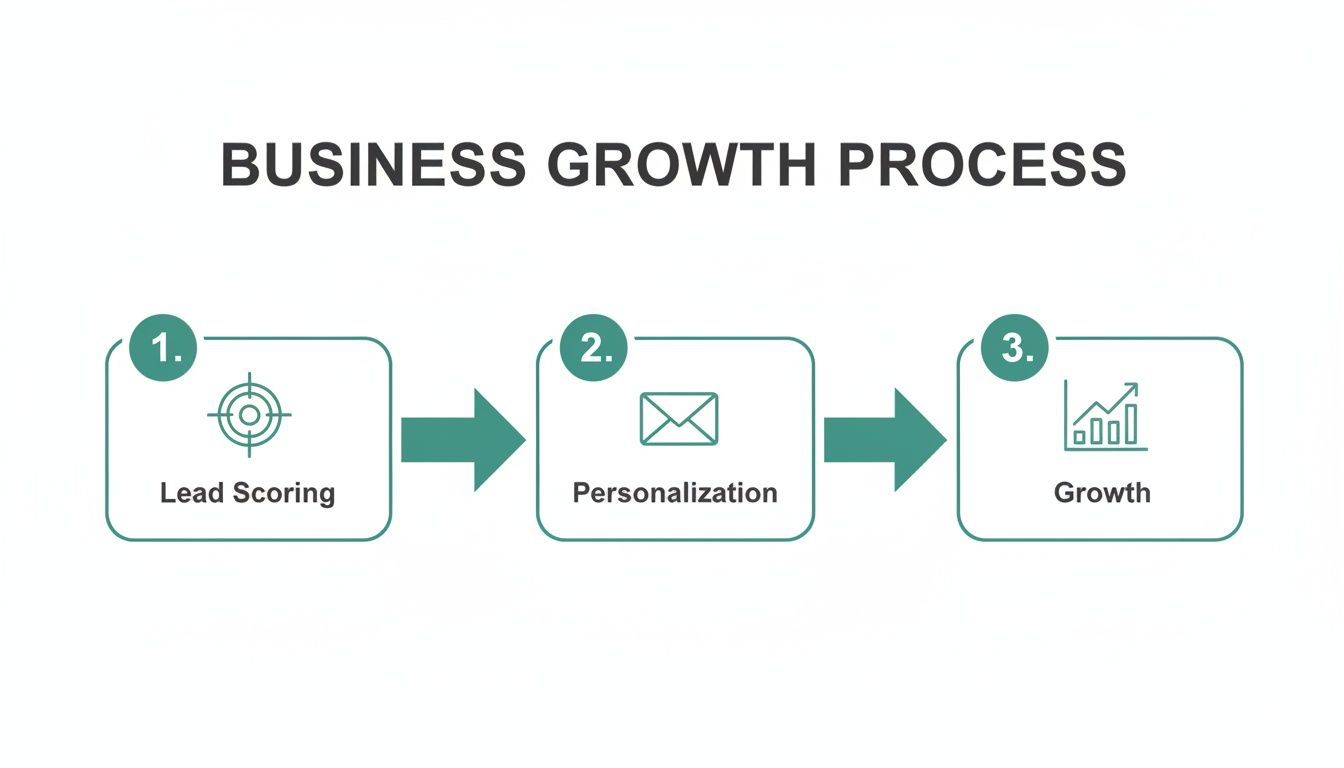
The takeaway here is that growth isn't a single event. It's the result of systematically applying better data at key stages of the customer journey.
Building a Frictionless System
An integrated workflow does more than just save time; it changes how your team operates. When data is reliable and instantly accessible, reps become more strategic. They can quickly segment lists, prioritize the hottest leads, and craft personalized outreach with confidence. Building a solid foundation for this is key, and understanding the principles of effective contact management can provide a significant advantage.
Ultimately, integrating data enrichment into your workflow is about turning data into an active asset rather than a passive database. It ensures your team has the intel they need at their fingertips, empowering them to build stronger relationships and close deals faster. It’s the difference between owning a library of books and having a personal librarian who hands you the exact page you need, right when you need it.
Choosing the Right Data Enrichment Service
With so many vendors out there, picking the right partner for data enrichment services can feel like a shot in the dark. But it doesn't have to be. Once you have a solid framework for evaluation, making a confident choice is actually pretty straightforward. The trick is to look past the flashy marketing and focus on what will genuinely move the needle for your sales and marketing teams.
Your decision needs to line up with your specific goals, your tech stack, and, of course, your budget. This isn't about finding a magical one-size-fits-all tool—it's about finding the right fit for your business. A good choice becomes a powerful engine for growth. A poor one just leads to wasted money and data that's more frustrating than helpful.
Evaluating Data Accuracy and Freshness
Let's be blunt: the single most important thing to look at is the quality of the data. Inaccurate or old information is worse than having no information at all. It leads to bounced emails, awkward outreach calls, and a serious hit to your credibility. Always dig into how a potential vendor sources, verifies, and updates its data.
A good provider will be completely open about its data hygiene practices. Ask them for an accuracy guarantee or a service-level agreement (SLA) that puts their commitment in writing. And remember, data goes stale fast—people switch jobs, companies get acquired. A vendor relying on static lists is always going to be a step behind one that uses a mix of sources and real-time signals to keep their information fresh.
Assessing Dataset Breadth and Relevance
Beyond just being accurate, the data has to be relevant to you. A gigantic database is worthless if it's thin on details for your specific industry or target market. Before you sign anything, make sure the provider has deep coverage of the companies and contacts you actually care about.
Here are a few questions to ask yourself when looking at a vendor's dataset:
- Industry Focus: Do they have solid firmographic and technographic data for your main verticals?
- Geographic Coverage: If you’re selling overseas, does their data cover your target regions?
- Contact Depth: Can they actually give you direct dials and verified emails for the C-level execs or VPs you need to reach?
Most reputable vendors will let you run a small sample of your own list through their system. Take them up on it. It’s the best way to see the quality and relevance of their data with your own eyes before you commit.
The Rise of AI-Powered Enrichment
The whole data enrichment game is changing, and AI is at the center of it. Modern AI-powered platforms are leaving legacy data brokers in the dust. This isn't just hype; it’s a major driver of growth, with the global data enrichment tool market expected to jump from USD 697 million in 2024 to USD 1,087 million by 2032. Why the explosion? Because it gets results. Marketing teams using AI-powered tools are seeing 22% higher conversion rates. You can find out more about this market's impressive growth trajectory.
AI-driven services don’t just match data points; they actually interpret them. By spotting patterns and signals, they can deliver insights that are more predictive, helping you figure out not just who a prospect is, but what they’re likely to need next.
Prioritizing Seamless Integration Capabilities
Finally, the world's best data is useless if your team can't easily access it where they already work. Smooth integration with your tech stack, especially your CRM, is an absolute must-have. Look for providers that offer native, easy-to-set-up integrations with platforms like Salesforce or HubSpot. They should also have a solid API available for any custom connections you need to build.
The goal is to create a hands-off, automated workflow where enrichment happens in the background. That way, every new lead that comes in is instantly fleshed out with complete, accurate data, letting your team pounce on opportunities right away.
To help you narrow down your options, we've put together a practical checklist to guide your evaluation process.
Vendor Selection Checklist for Data Enrichment Services
| Evaluation Criteria | What to Look For | Why It Matters for Sales & Marketing |
|---|---|---|
| Data Accuracy & Freshness | SLA-backed accuracy guarantees, transparent data sourcing, and real-time update frequency. | Reduces bounce rates, prevents wasted outreach on wrong contacts, and protects brand credibility. |
| Dataset Relevance | Strong coverage in your specific industries, job titles, and geographic regions. | Ensures you're enriching leads that actually fit your Ideal Customer Profile (ICP), not just random data. |
| Integration Capabilities | Native CRM integrations (Salesforce, HubSpot, etc.) and a well-documented API. | Automates the data flow, putting enriched information directly into the hands of reps without manual work. |
| Compliance & Privacy | Clear adherence to GDPR, CCPA, and other regional data privacy regulations. | Avoids hefty fines and legal trouble, and builds trust with your prospects and customers. |
| Scalability & Pricing | Flexible pricing models (per record, subscription) that can grow with your needs. | Prevents you from overpaying for data you don't use and ensures the service can keep up as you scale. |
| Customer Support | Responsive support team, clear documentation, and a dedicated account manager (for larger plans). | Gets you back on track quickly if issues arise, ensuring minimal disruption to your sales and marketing engine. |
By carefully weighing these key areas, you can move beyond the sales pitches and choose a service that doesn't just clean up your data but actively fuels your growth. To see how some of the top players stack up, check out our guide on the best data enrichment tools on the market today.
Measuring Your Success and Ensuring Compliance
Getting data enrichment services up and running is just the start. The real test is proving its impact and making sure you’re handling all that new information responsibly. You have to connect the investment directly to business outcomes with hard numbers—not just vague promises.
At the same time, more data means more responsibility. Navigating the maze of privacy rules like GDPR and CCPA isn't just a good idea; it's essential for keeping your customers' trust. A winning strategy has to be both effective and ethical.
Key Performance Indicators to Track
To see if your enrichment efforts are actually working, you need to track metrics that tie directly to sales and marketing performance. You can't just hope for the best. Set a baseline before you start, then keep a close eye on these specific KPIs to measure the improvement.
Here are the essential metrics to start with:
- Lead-to-Opportunity Conversion Rate: Enriched leads should be better qualified, so this conversion rate should climb. When it does, you know your sales team is spending their time on prospects who are actually a good fit.
- Reduced Email Bounce Rate: This is one of the quickest wins. Good enrichment delivers clean, verified contact info, which means fewer bounced emails. Check out our guide on how to verify emails to see why this is so critical.
- Shorter Sales Cycle Length: When your reps have all the details they need from day one, they can jump straight into meaningful conversations. This cuts out the tedious discovery work and speeds up the entire process, from first touch to signed contract.
- Increased Meeting Book Rate: Personalized outreach works. When you arm your SDRs with rich firmographic and technographic data, their emails get noticed and get replies. Tracking how many meetings they book is a perfect way to measure that impact.
Proving the value of data enrichment isn't about guesswork. It's about connecting your investment to tangible improvements in core business metrics like conversion rates and sales velocity.
Navigating Data Privacy and Compliance
Using third-party data means you have to be serious about privacy. Regulations like Europe's GDPR (General Data Protection Regulation) and California's CCPA have strict rules about how personal data is handled. Getting it wrong can lead to massive fines and a serious blow to your reputation.
When you use a data enrichment service, it's on you to make sure the data was sourced ethically and that you're using it transparently. Any good vendor will be fully compliant and open about where their data comes from. Always read their privacy policy and make sure they can handle requests from people who want to see or delete their information. It’s a proactive way to build trust while getting the results you want.
Frequently Asked Questions
Got questions about putting data enrichment services to work? Let's clear up a few common ones so you can make the right moves for your business.
How Often Should I Enrich My Data?
Data goes stale faster than you'd think. People switch jobs, companies get acquired, and contact info changes. A solid rule of thumb is to run a full database refresh every quarter. This keeps your existing records accurate and reliable.
But for fast-moving sales teams, you can't wait that long. It’s critical to enrich new leads in real time the moment they hit your CRM. Doing so arms your reps with everything they need for a killer first conversation.
Can Enrichment Services Integrate With My CRM?
Absolutely. Most of the top data enrichment providers offer clean, native integrations with the big CRMs like Salesforce, HubSpot, and Zoho. This creates a seamless, automated flow that cuts out mind-numbing manual data entry.
And if you have a custom setup, they almost always provide APIs to build whatever you need. Just be sure to double-check that a provider connects smoothly with your tech stack before you sign up. It’ll save you a ton of headaches down the road.
Is Using Enriched Data GDPR Compliant?
Reputable data enrichment providers take privacy regulations like GDPR and CCPA very seriously. They build their businesses around sourcing data ethically and have clear processes for handling data subject requests.
That said, the responsibility is still on you. Always review a provider's privacy policy and data processing agreements. This is a non-negotiable step to ensure they meet your company's compliance standards and protect your business from legal trouble.
Ready to turn those half-baked leads into real opportunities? With EmailScout, you can find and verify professional contacts instantly, then enrich them with the details you need to start a meaningful conversation. Try it free and see the difference for yourself.