

A Sales Development Representative (SDR) is the person on the front lines of any modern sales team. Their entire job is to find and qualify potential customers.
Think of them as opportunity scouts. They’re the ones sifting through the market to identify promising leads, making sure the sales pipeline stays packed with high-quality prospects. The key thing to remember is their goal isn't to close deals—it's to generate that first spark of interest and book a meeting for someone else to take over.
The Modern Sales Team and the Rise of the SDR
The SDR role is the backbone of any efficient, scalable sales organization. It wasn't always this way. In the past, a single salesperson had to do everything, from cold prospecting all the way to signing the contract. This "full-cycle" model was a recipe for burnout and inefficiency, as your best closers were wasting precious time chasing down dead-end leads.

The solution? Specialization. Companies quickly figured out they could build a much more predictable revenue machine by splitting the sales process into distinct jobs.
The Power of Specialization
Imagine a detective agency where one person had to find the clues, analyze all the evidence, and make the final arrest. It would be chaos. A real agency has scouts gathering intelligence and detectives who actually solve the case. This is exactly how the best sales teams operate today.
The SDR is the "scout" or the prospector. Their world revolves around the very top of the sales funnel, and their day-to-day work includes:
- Prospecting: Actively hunting for potential customers who perfectly match the company’s Ideal Customer Profile (ICP).
- Outreach: Making that critical first contact, whether it's through a cold call, a well-crafted personalized email, or a message on social media. You can get a deeper look into these tactics by exploring what are outbound sales.
- Qualification: Asking smart, targeted questions to figure out if a prospect has a real need for the product, the budget to afford it, and the authority to sign off on a purchase.
By dedicating a role to these early stages, companies free up their Account Executives (AEs)—the closers—to do what they do best: hold conversations with well-vetted, high-potential leads. This simple separation of duties dramatically boosts efficiency and close rates.
To give you a clearer picture, here’s a quick breakdown of the SDR role.
The SDR Role at a Glance
| Key Aspect | Description |
|---|---|
| Primary Goal | Generate qualified leads and book meetings. |
| Position in Funnel | Top of the Funnel (ToFU). |
| Main Activities | Prospecting, outreach (calls, emails), lead qualification. |
| Success Metric | Number of Sales Qualified Leads (SQLs) or meetings booked. |
| Who They Hand Off To | Account Executives (AEs). |
This table shows how SDRs fit perfectly into the sales puzzle, handling the initial legwork so the rest of the team can focus on closing.
This strategic division of labor is no longer a nice-to-have; it's essential for scaling growth. To really understand how they build the foundation for the entire sales engine, you can explore in more detail What is a Sales Development Representative. This specialized approach allows for deeper expertise at each stage, turning a good sales process into a powerful, revenue-generating machine.
A Day in the Life of an SDR
Think of a Sales Development Representative's day as a structured sprint, not a random walk. It's a blend of disciplined routine and quick-thinking adaptability, all aimed at one thing: booking high-quality meetings for the sales team. You won't find an SDR just firing off emails into the void. Their work is a calculated process built on four key pillars: prospecting, outreach, qualification, and nurturing.
A huge chunk of any SDR's day is dedicated to prospecting—the art and science of finding the right people to talk to. This is way more than just scrolling through LinkedIn. It’s deep-dive research into target companies, figuring out who the key decision-makers are, and getting a handle on the challenges they're facing. SDRs use a whole suite of tools to hunt for contacts that perfectly match their company's Ideal Customer Profile (ICP), making sure their first message lands with relevance.
Executing Targeted Outreach
Once a list of solid prospects is built, it's time for outreach. This is where the SDR makes first contact, and it’s never a one-and-done deal. They use a multi-channel attack to cut through the noise:
- Cold Emails: Not spam, but carefully crafted messages that speak directly to a prospect's known pain points.
- Cold Calls: Picking up the phone to have a real, human conversation and see if there’s a spark.
- Social Selling: Using platforms like LinkedIn to connect, share useful content, and start building a genuine relationship.
This mix-and-match strategy dramatically increases the odds of getting a prospect's attention. Nailing these different sales prospecting techniques is absolutely fundamental to making it as an SDR.
The demand for good SDRs is always there. The US Bureau of Labor Statistics expects around 149,900 openings for sales reps each year between 2023 and 2033. But it’s a tough gig. Only about 25% of B2B reps hit their quota consistently, and it's no wonder when they're trying to juggle an average of eight different sales tools. You can see more on the career path and what to expect salary-wise in this detailed breakdown on Coursera.
Qualifying and Nurturing Future Customers
The final pieces of the puzzle are qualification and nurturing. When a prospect finally bites and responds, the SDR’s job is to ask smart questions to see if they're actually a good fit.
This qualification step is the gatekeeper of the sales pipeline. It ensures that Account Executives aren't wasting their time on calls that have no real chance of turning into business.
And what if a lead is a great fit but just isn't ready to buy right now? They go into a nurturing sequence. The SDR stays in touch, sharing helpful articles or checking in every so often. That way, when the time is right, their company is the first one that prospect thinks of. It's this constant balance of finding today's opportunities while planting seeds for tomorrow that really defines the daily rhythm of a top-performing SDR.
Understanding Key Roles in a Sales Team
The modern sales floor isn’t a one-person show. It's a well-oiled machine with specialists, each playing a crucial part in moving a deal from a simple spark of interest to a closed win. To really get a handle on what a Sales Development Representative does, you need to see how they fit in with two other key players: the Business Development Representative (BDR) and the Account Executive (AE).
It’s easy to get these roles mixed up, but they are fundamentally different.
Think of the sales process like a relay race. The SDR and BDR are the explosive sprinters at the start, grabbing the baton and building momentum. The AE is the anchor, the closer who takes that momentum and powers across the finish line. They’re all on the same team, but they run different legs of the race.
Differentiating SDR vs BDR vs AE
So, what separates these roles day-to-day? It boils down to where they hunt for opportunities.
An SDR lives in the world of inbound leads. These are prospects who’ve already raised their hand in some way—maybe they downloaded a whitepaper, requested a demo, or signed up for a webinar. The SDR’s job is to connect with these warm leads, qualify their interest, and determine if there’s a real, solvable problem the company can help with.
A BDR, on the other hand, is a pure outbound specialist. They are the trailblazers, prospecting into new accounts and cold territories where your company has zero existing footprint. Their entire focus is on generating new opportunities from scratch through things like cold calls, personalized emails, and LinkedIn outreach.
Once an SDR or BDR has a qualified prospect who's ready to talk seriously, they pass the baton.
The handoff to the Account Executive is the critical transfer of trust. The AE’s mission is to take that qualified lead, run deep discovery calls, deliver tailored product demos, negotiate the contract, and ultimately, close the deal.
This clean separation of duties is what makes a sales team truly efficient. It allows AEs to spend 100% of their time on what they do best: generating revenue.
The flowchart below breaks down the core tasks an SDR handles before ever passing a lead to an AE.
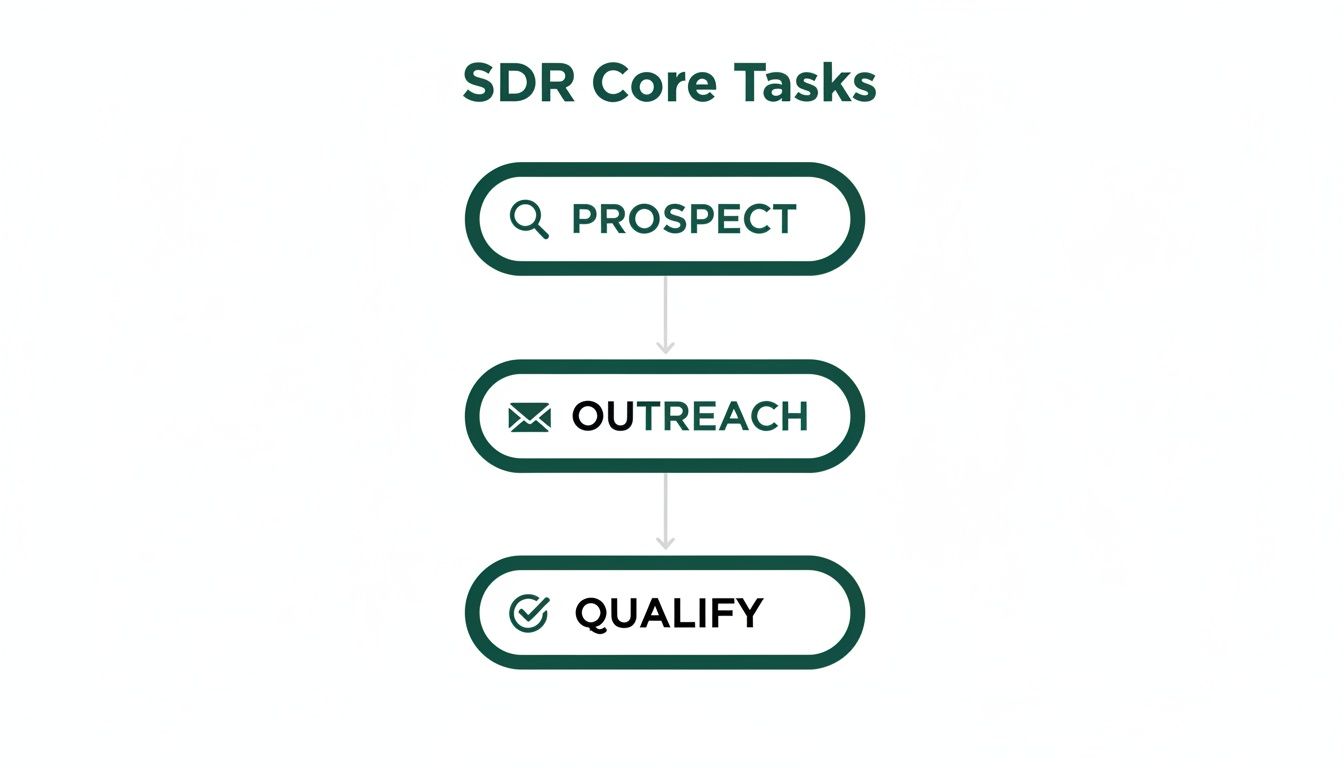
As you can see, the SDR’s world is a clear, focused process at the very top of the sales funnel. To dig deeper into how this role functions in today's teams, it’s worth exploring the SDR inside sales model, which highlights their specific operational environment.
For a clearer side-by-side view, this table breaks down the key differences.
Comparison of Key Sales Roles
| Role | Primary Focus | Key Activities | Main Goal |
|---|---|---|---|
| SDR | Inbound Leads | Responding to inquiries, qualifying marketing leads, nurturing warm prospects | Book qualified meetings for AEs |
| BDR | Outbound Prospecting | Cold calling, personalized emailing, social selling, identifying new accounts | Generate new opportunities from cold accounts |
| AE | Closing Deals | Running demos, discovery calls, negotiating contracts, managing sales pipeline | Close new business and generate revenue |
Each role is distinct, but they all depend on each other. A great AE can't close deals without a pipeline full of qualified opportunities, which is exactly what top-tier SDRs and BDRs provide.
The Skills and Metrics That Define SDR Success
So, what separates a good Sales Development Representative from a great one? It boils down to a specific blend of interpersonal skills, tech-savviness, and an obsession with the numbers that actually move the needle.
Being great in this role is about more than just having a friendly voice on the phone. It demands a unique mix of soft skills for building connections and hard skills for driving pure efficiency. These are the twin engines that power every successful SDR and build the foundation for a healthy sales pipeline.
The Essential Soft Skills for an SDR
The day-to-day grind of an SDR is packed with challenges. To survive and thrive, certain personality traits are non-negotiable. Technology can’t replicate these human elements.
- Resilience: Hearing "no" is part of the job description. Top SDRs don't just tolerate rejection; they bounce back fast, treating every conversation as a learning opportunity.
- Curiosity: The best SDRs are like detectives. They dig deeper with smart, open-ended questions to uncover a prospect’s real pain points instead of just rattling off a product pitch.
- Coachability: The sales world is always changing. A genuine willingness to take feedback, adapt your strategy, and constantly refine your approach is what separates the pros from the amateurs.
- Active Listening: This is about hearing what a prospect isn't saying. It lets an SDR read between the lines, tailor the message in real-time, and build authentic rapport.
These soft skills are the bedrock, but they need to be paired with some serious technical competence to make a real dent.
Hard Skills and Critical KPIs
While soft skills open doors, it's the hard skills and a laser focus on metrics that deliver measurable results. A top-performing SDR is fluent in their tech stack and relentlessly tracks their performance against key benchmarks, turning daily activities into predictable outcomes.
The strongest SDRs think like closers. Before passing a lead to an Account Executive, they ask themselves: "If I were the one responsible for closing this deal, would I take this call?" This mindset shifts the focus from just hitting a quota to creating real, high-quality opportunities.
Mastering tools like a CRM (think Salesforce) and Sales Engagement Platforms is crucial for managing high-volume outreach without losing your mind. These skills are what drive the KPIs that truly define success:
- Activity Metrics: These are the inputs. We're talking about the number of dials made, emails sent, and LinkedIn connections requested. They measure effort.
- Outcome Metrics: These are the results. This is where the magic happens—the number of meetings booked, Sales Qualified Leads (SQLs) generated, and ultimately, the pipeline value created. They measure effectiveness.
There are over 666,491 Sales Development Representatives currently employed in the United States alone, a number that really underscores how vital this role has become. To learn more about what the job entails, you can find more data about the SDR profession on Zippia.
And for a practical guide on turning those conversations into solid opportunities, check out our article on how to qualify sales leads.
Building the Ultimate SDR Tech Stack
A top-performing SDR doesn't work in a vacuum. They're backed by a smart set of tools—a tech stack—that acts as their command center, automating the grunt work and freeing them up to focus on what matters. Think of it this way: without the right tech, even the best SDR would be stuck in first gear, struggling to keep up.
The whole setup is built on a few core pillars. First, you have the Customer Relationship Management (CRM) platform, like Salesforce. The CRM is the brain of the operation, the single source of truth where every bit of prospect and customer info lives. It keeps the entire team on the same page.
Next up are the Sales Engagement Platforms (SEPs), like Outreach or Salesloft. These are the engines that drive an SDR's day-to-day. They let you build and run multi-channel campaigns, weaving together emails, calls, and social touches into a smooth, coordinated sequence.
The Non-Negotiable Tool for Prospecting
While CRMs and SEPs are great for managing the workflow, they don’t solve the biggest headache every SDR faces: finding the right person's contact info. This is where a killer email finder isn't just nice to have—it's the most critical piece of the prospecting puzzle. If you don't have verified emails, every other tool in your stack is working at half-power.
This is exactly why a tool like EmailScout is a game-changer. It goes right after the biggest time-suck in an SDR's day: the manual hunt for contact data. Forget spending hours digging through the internet for a single email address. Now, SDRs can find verified contacts in seconds.
An SDR's most valuable asset is time. A solid email finder hands that time back, letting them shift from mind-numbing data entry to high-impact activities that actually build pipeline: writing great messages and having real conversations.
A good email finder slips right into an SDR’s existing routine, making prospecting feel seamless. Take the EmailScout interface, for example. It’s built for quick, no-fuss discovery.
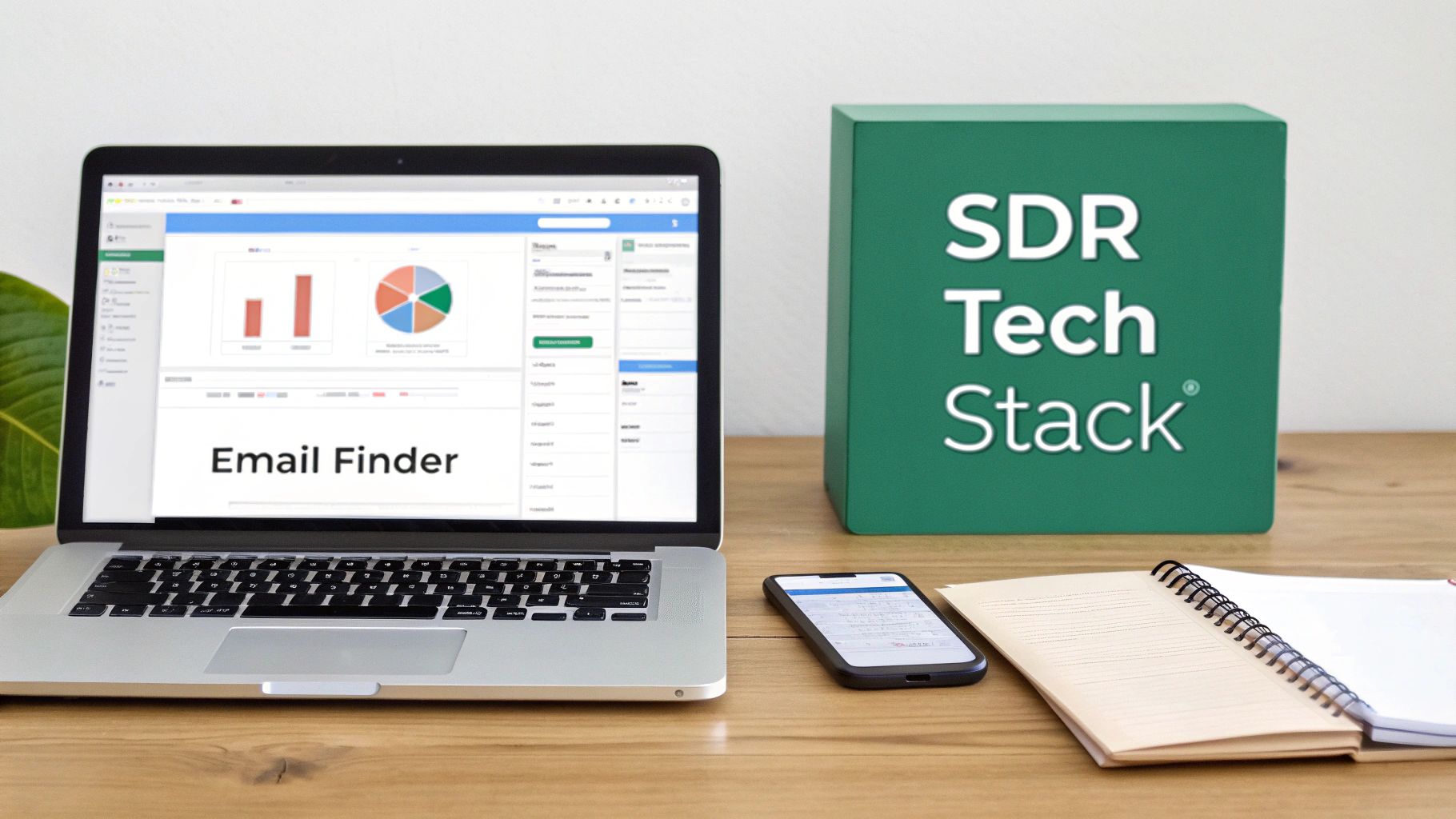
This screenshot shows how an SDR can use features like the URL Explorer to pull email lists straight from company websites. What used to be a tough research task becomes a simple click. This kind of instant access to good data is what really separates the top-performing teams from everyone else.
Key Tools in the SDR Stack
So, to wrap it up, a modern SDR tech stack is built around a few key types of software, each with a specific job.
- CRM (Customer Relationship Management): The central database for all lead and customer information.
- Email Finder: Your go-to for finding accurate contact info and building prospect lists fast.
- Sales Engagement Platform: Automates and keeps track of your multi-channel outreach.
- Data Enrichment Tools: Adds useful context to your leads, like company size or recent funding news.
- Conversation Intelligence: Records and analyzes calls to find coaching moments and what’s working.
When you arm an SDR with this combination of tools, you’re not just giving them software. You’re empowering them to work smarter, connect with more of the right people, and ultimately build a stronger, more predictable pipeline for the whole company.
Common Questions About the SDR Role
Even with a solid grasp of the day-to-day grind and tech stack, a few questions always pop up about the Sales Development Representative role. Let's tackle the most common ones I hear from aspiring SDRs, hiring managers, and founders to give you some practical insights into career paths, pay, and what the future holds.
What Is a Typical Career Path for an SDR?
The SDR position is hands-down one of the best launchpads for a career in tech sales. It’s where you cut your teeth on prospecting, communication, and good old-fashioned resilience—skills that are gold no matter where you end up.
The most well-trodden path is a promotion to Account Executive (AE), which usually happens after 12 to 24 months of solid performance. This is the jump from finding and qualifying opportunities to owning the entire sales cycle and closing the deals yourself.
But the AE route isn't the only game in town. Other popular moves include:
- SDR Team Lead or Manager: If you’ve got a knack for coaching and seeing the bigger picture, leading a team of SDRs is a natural next step.
- Customer Success Manager: Love building relationships that last? A move into customer success, where you’re focused on keeping clients happy and helping them grow, could be a perfect fit.
- Marketing Roles: Your frontline knowledge of what makes customers tick is incredibly valuable to a marketing team, especially for roles in demand generation or product marketing.
How Is an SDR's Compensation Structured?
An SDR's paycheck is almost always a mix of a fixed base salary and a variable piece, like a commission or bonus. This hybrid model gives you some financial stability while still rewarding you for crushing your numbers. A common setup is a 60/40 or 70/30 split, meaning 60-70% of your total target earnings is your base salary, and the other 30-40% is what you earn by hitting your goals.
That variable pay is tied directly to specific KPIs. The big one is usually the number of Sales Qualified Leads (SQLs) or qualified meetings you book that the Account Executive team accepts. This is a critical detail because it incentivizes SDRs to focus on quality over quantity—finding real opportunities that can actually turn into business, not just jamming calendars with low-quality appointments.
Is AI Going to Replace the SDR Role?
Not a chance. It's far more likely that AI will supercharge the SDR role, not replace it. Think of it this way: AI is fantastic at the repetitive, data-heavy tasks that can bog down an SDR's day. It can automate initial research, score leads based on buying signals, and even draft the first version of an email.
This automation frees up SDRs to focus on what humans do best—the stuff AI can't touch. We’re talking about genuine empathy, strategic thinking, building real rapport, and navigating the nuances of a complex conversation.
The SDR of the future will use AI as a co-pilot, making them way more efficient and strategic. The core skills of creative problem-solving and relationship-building will only become more valuable, ensuring the role evolves with technology instead of getting left behind by it.
What Are the Biggest Challenges for New SDRs?
New SDRs usually run into a few major hurdles right out of the gate. First and foremost is learning how to handle constant rejection. Hearing "no" over and over is just part of the job, and building the mental toughness to bounce back without getting discouraged is absolutely essential for survival.
Second is mastering time management. The role is a high-volume activity machine—calls, emails, social touches—and it’s easy to get swamped or burn out fast if you don't have a structured system for your day.
Finally, there's the steep learning curve of really understanding your company's product, its value in the market, and the specific headaches of your Ideal Customer Profile (ICP). Getting past these challenges takes a lot of persistence, a hunger to learn, and a supportive team with great coaching.
Finding the right contacts is the first and most crucial step for any SDR. EmailScout eliminates the guesswork and manual research by giving you a powerful email finder right in your browser. Build targeted prospect lists in minutes, not hours, and give your sales team the verified data they need to start meaningful conversations. Start finding unlimited emails for free with EmailScout.