Before you can even think about how to find startup investors, you need to build a business they can't afford to ignore. The most critical work you'll do happens long before the first outreach email is sent. It's about creating a compelling story backed by solid fundamentals, a clear financial model, and a value proposition that hits like a ton of bricks.
Getting this internal house in order is the real first step to securing funding.
Preparing Your Startup for Investor Scrutiny
Finding investors isn't a numbers game of sending out a thousand emails. It's about presenting a complete, de-risked opportunity that stands out. Before you even draft a prospect list, your company needs to be ready to withstand the intense scrutiny that every serious investor will apply.
Honestly, overlooking this stage is the number one reason I see promising startups get a swift "no."
Successful fundraising always starts with a bulletproof foundation. This means having clear, defensible answers to the toughest questions before they're even asked. The founders who land meetings quickly are the ones who’ve done their homework and can tell a story that is both incredibly ambitious and totally credible.
Defining Your Ask and Understanding the Stages
The first thing any investor wants to know is, "How much are you raising, and what are you going to do with it?" A vague answer here is a massive red flag. You need to know your exact funding stage and be able to articulate precisely how that capital will get you to specific, measurable milestones.
For instance, a seed round is typically about building an MVP, getting that first real market validation, and making a few key hires. A Series A, on the other hand, is for pouring fuel on a fire that's already burning—scaling a proven model, grabbing market share, and expanding the team. Your "ask" has to align perfectly with where you are on that journey.
To give you a ballpark, seed rounds in the UK generally fall between £500,000 and £2 million. By the time a startup hits Series A, that number jumps significantly. The average Series A was about £15 million in 2022. This context is crucial, especially when you learn that around 47% of Series A startups spend £400,000 or more every single month. It really highlights the need to raise enough capital to hit your next set of goals. If you want to dive deeper, you can read the full research on startup statistics to better position your ask.
To help you pinpoint where you are, it’s useful to understand the common funding rounds.
Typical Startup Funding Stages and Amounts
Here’s a quick breakdown of the most common funding rounds, what they're for, and the typical capital raised. This should help you identify which stage your startup is currently in.
| Funding Stage | Primary Purpose | Typical Amount Raised (GBP) |
|---|---|---|
| Pre-Seed | Concept validation, prototype development, market research | £10,000 – £250,000 |
| Seed | Product launch (MVP), initial market traction, key hires | £250,000 – £2,000,000 |
| Series A | Scaling operations, optimizing user base, expanding market | £2,000,000 – £15,000,000 |
| Series B | Business expansion, market leadership, new markets | £15,000,000 – £50,000,000+ |
| Series C+ | Scaling mature companies, acquisitions, global expansion | £50,000,000+ |
Knowing where you fit helps ensure your "ask" is realistic and aligns with investor expectations for your current level of traction and growth.
Solidifying Your Financial Narrative
A great story is what gets you in the door, but it falls apart fast without solid numbers to back it up. Your financial model isn't just a spreadsheet; it's the quantitative proof of your entire business strategy. It needs to clearly show your key assumptions, revenue projections, burn rate, and runway.
Investors will absolutely tear your model apart to test its integrity. They want to see that you intimately understand the levers of your business.
- Unit Economics: Do you know your Customer Acquisition Cost (CAC) and Lifetime Value (LTV) like the back of your hand? A healthy LTV/CAC ratio, typically 3:1 or higher, is a powerful signal of a sustainable business.
- Burn Rate and Runway: How much cash are you burning each month, and how long will this new funding last? Investors need to be confident that their capital gives you enough runway to hit the next major inflection point.
- Revenue Projections: Are your forecasts grounded in reality? Bottom-up projections built from market size, pricing, and realistic conversion rates are infinitely more convincing than ambitious top-down guesses.
The goal of your financial model is to demonstrate that you are a responsible steward of capital who understands how to turn an investment into exponential growth.
Crafting an Irresistible Value Proposition
Beyond the numbers, investors fund a vision. Your Unique Value Proposition (UVP) needs to be so clear and powerful that anyone can get it instantly. What massive problem are you solving, and why is your solution ten times better than anything else out there?
A strong UVP nails three questions, fast:
- Who is your customer?
- What is their biggest pain point?
- How does your product uniquely crush that pain?
Think about Slack’s early UVP: "Be less busy." It perfectly captured the agony of cluttered inboxes and positioned the product as the obvious cure. That’s the level of crystal-clear clarity you need to aim for.
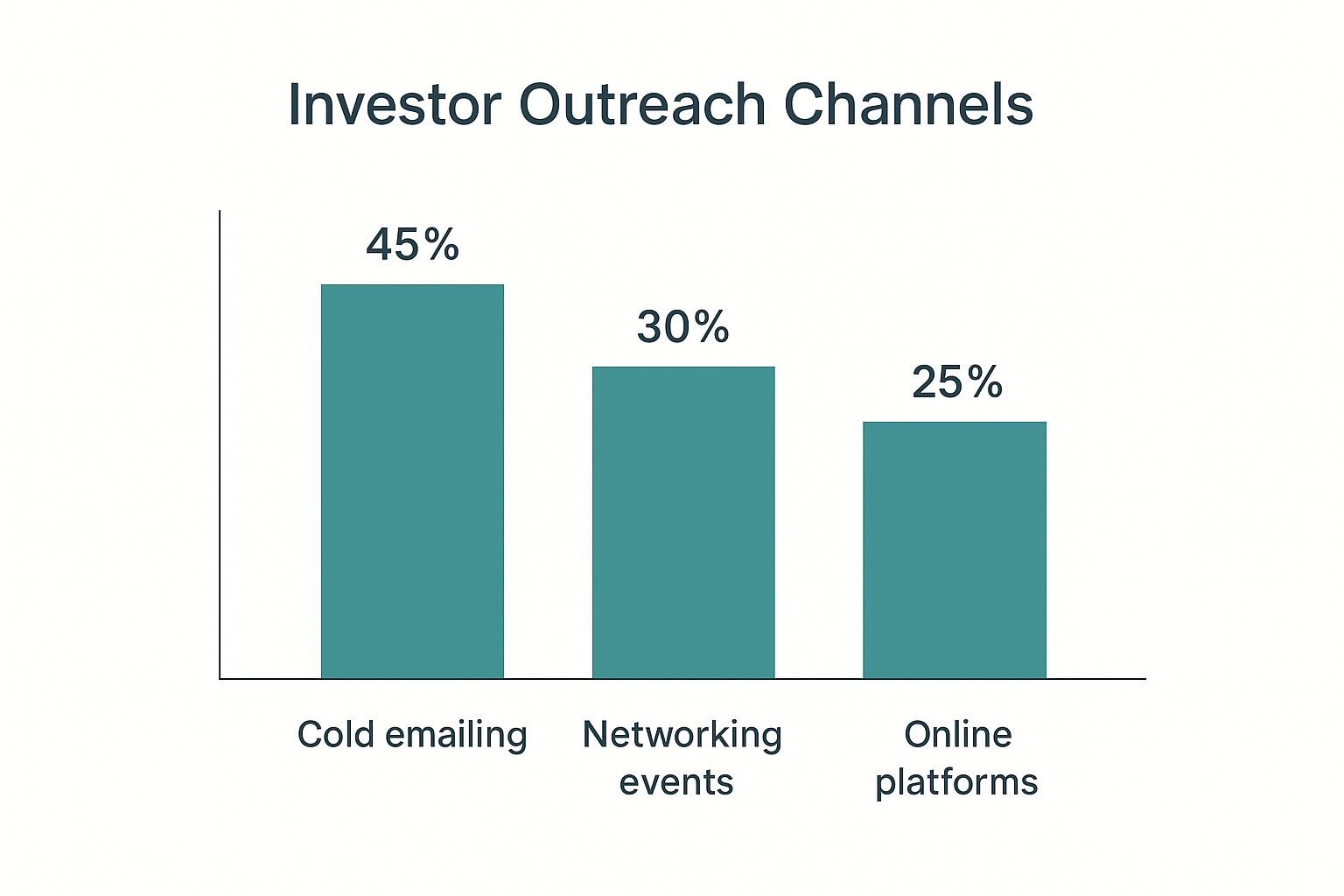
Once you have all this locked down, you can start thinking about outreach. The chart below shows how most founders get in front of investors.

As you can see, while cold emailing is a popular tactic, networking and online platforms are just as important. This just reinforces the need for a multi-channel approach once you’re truly ready.
Identifying and Researching the Right Investor Profile

Let’s be clear: securing capital is not a numbers game. It's a precision targeting mission. Spraying and praying your pitch deck across the internet is a rookie mistake.
Finding the right investor is about finding a strategic partner. The wrong one can do more damage to your startup's future than no funding at all. This means you need to move beyond a simple list of names and build a highly curated prospect list of people who are a perfect fit for your vision.
The goal is to find investors with a proven track record of backing companies just like yours. This focused approach is the only thing that works—it dramatically increases your odds of not just getting a meeting, but of finding a true partner who brings more than just a check to the table.
Understanding the Investor Landscape
Before you can even think about building a list, you have to know who you’re looking for. The world of startup investing is diverse, and each type of investor plays by a different set of rules. Pitching the wrong type for your stage is an immediate dead end.
- Angel Investors: These are high-net-worth individuals investing their own cash. They typically get involved in the earliest stages (pre-seed or seed) and can be incredibly valuable for their personal mentorship and industry connections.
- Venture Capitalists (VCs): VCs are professionals managing a fund of other people's money. They invest in a portfolio of startups with massive growth potential, usually coming in at the seed stage or later. Expect them to take a board seat and play an active role in steering the ship.
- Corporate Venture Capital (CVCs): These are the investment arms of large corporations. They invest for strategic reasons, not just financial returns—often looking for access to new tech or markets that align with the mothership's goals.
The right choice depends entirely on your startup's stage, industry, and where you want to go. A fintech startup should be chasing VCs with a strong portfolio in that space. A hardware company might get a huge leg up from a CVC's manufacturing and distribution power.
The most successful founders don't just find an investor; they find a strategic partner. They target individuals or firms whose portfolio, expertise, and network can accelerate their growth far beyond what capital alone could achieve.
How to Think Like an Investor
To find the right fit, you have to get inside their head. You need to think like a VC. This means digging into their past behavior to predict what they'll do next. Every investor has an investment thesis—a core strategy that guides their decisions. Your job is to find the investors whose thesis lines up perfectly with what you're building.
The best way to crack this code is by analyzing their existing portfolio. Tools like Crunchbase and PitchBook are your best friends here. Don't just glance at the company names; you're looking for patterns.
Key Questions to Answer During Research
- What industries do they consistently fund? If an investor only touches SaaS and biotech, your consumer hardware startup isn't a fit. Period.
- What funding stage is their sweet spot? A firm that only writes $10 million Series A checks is not going to look at your $500,000 seed round request.
- What's their typical check size? Knowing this helps you figure out if they can lead your round or if they're more likely to be a smaller participant.
- Are there competing companies in their portfolio? This is a deal-breaker. No investor will fund a direct competitor to one of their existing bets. It's a massive conflict of interest.
- What is their geographic focus? While many VCs invest globally, some have a strict mandate to only invest in a specific city, state, or region. Don't waste your time if you're not in their backyard.
By answering these questions, you can cut a list of thousands of potential investors down to a highly qualified handful. This targeted approach is the bedrock of any effective fundraising strategy. For startups ready to build this list efficiently, our guide on how to find VC emails in seconds offers practical tips for the contact discovery phase.
This meticulous research ensures that when you finally do reach out, your email lands in an inbox that's already primed to be interested in your business.
Think Bigger: Why Your Next Investor Might Be Halfway Across the World

It’s easy to get tunnel vision. Silicon Valley has this larger-than-life reputation, and many founders fall into the trap of thinking all the best investors are within a 50-mile radius of San Francisco. That’s a huge mistake.
The venture capital game isn't regional anymore; it's gone completely global. If you're only looking in the usual tech hubs, you are absolutely leaving money—and massive opportunities—on the table. Your perfect investor might be sitting in a cafe in Singapore or a high-rise in Berlin, totally off your radar.
Venture Capital Has Gone Global
The numbers don't lie. While the United States is still the biggest startup ecosystem, it's growing the slowest. Its growth rate is just 18.2%, which pales in comparison to what's happening elsewhere.
Take the Asia-Pacific region. Singapore's ecosystem is booming at 44.9% growth, and China is on another level at 45.9%. Cities like Shanghai, Guangzhou, and Hangzhou are all seeing growth over 30%. This isn't just a small shift; it's a massive surge in capital and investor activity. You can dig into more global startup ecosystem trends to see just how widespread this is.
This is critical information for anyone figuring out how to find startup investors today. It means you have to think beyond the obvious zip codes.
Why a Global Investor Search is a Game-Changer
Looking beyond your backyard gives you more than just a bigger list of potential checks. It offers real strategic advantages that can completely change your company's future.
- Unlock New Markets: An investor in a new region isn't just capital; they're your guide. They bring local knowledge and a network that can be your springboard for international growth. A European VC can open doors across the entire EU for a SaaS startup.
- Get Diverse Perspectives: Investors from different backgrounds bring entirely new ways of thinking. They'll challenge your assumptions and help you build a much stronger, more resilient business.
- Find Better Terms: In markets that aren't as ridiculously competitive, you might find investors offering more founder-friendly valuations. Less competition for great deals often means better terms for you.
Thinking globally from day one isn't just a fundraising tactic; it's a competitive advantage. The connections you build today could become the distribution channels and strategic partnerships of tomorrow.
How to Actually Build Global Relationships
You can't just hop on a plane or expect to get a meeting by showing up at a coffee shop in another country. Building relationships with investors in different time zones takes a smart, deliberate approach. The goal is to build credibility from afar before you ever ask for anything.
Your International Hit List
- Pinpoint Your Niche Hubs: Are you in fintech? London and Singapore should be at the top of your list. Building something in deep tech or cybersecurity? You need to be looking at Tel Aviv. Figure out which cities are the global centers of gravity for your specific industry.
- Use Digital Tools to Scope Things Out: Follow influential VCs from these regions on social media. Don't just be a lurker—engage with their posts. Use LinkedIn to see which funds are active in your space and what their portfolio companies look like.
- Show Up at Global Conferences (Even Virtually): Make it a priority to attend the big international conferences in your industry. A virtual ticket can still give you priceless networking opportunities and put you on the radar of investors who live and breathe your field.
When you take these steps, you're laying the groundwork. You're building familiarity. So when your email finally hits their inbox, you're not just another random founder. You’re the person who asked that sharp question on a panel or shared their article with a smart takeaway. That digital handshake makes all the difference.
Mastering the Art of the Warm Introduction

In the world of venture capital, how you get in the door matters just as much as what you’re pitching. Sure, a cold email might work now and then, but it's a low-percentage shot at best.
A warm introduction from a trusted source? That's the fundraising equivalent of a VIP pass. It lets you skip the digital slush pile and lands you right in front of an investor.
This isn't just about getting a meeting; it's about starting the conversation from a place of trust. When someone in an investor's network vouches for you, they're lending you their credibility. That single act can completely change the dynamic of your first interaction.
Mapping Your Network for Hidden Connections
It's time to become a detective of your own network. You probably have more connections to the right investors than you even realize. The key is to map these relationships methodically instead of just crossing your fingers for a lucky break.
Think of it as building a web. Your target investor is at the center. Your job is to find the threads that connect you to them, no matter how indirect they might seem.
- LinkedIn is Your Best Friend: Use the "mutual connections" feature religiously. Look up your target investor or their firm and see who you both know. You might be surprised to find a former colleague or a university classmate is just one degree away.
- Tap Your Alumni Network: University alumni databases are absolute goldmines. Many successful investors are proud alums who are often surprisingly open to helping out fellow graduates. A shared alma mater is a powerful starting point.
- Look to Your Existing Supporters: Don't forget the people already in your corner. Your advisors, early employees, and even your first customers can have surprisingly deep networks. It never hurts to ask who they know.
This whole process is about systematically uncovering every possible pathway to your target. Each mutual connection you find is a potential warm intro just waiting to happen.
The goal isn’t to find just any connection, but the strongest connection. An introduction from a founder the VC has previously backed is worth ten times more than one from a casual acquaintance they met at a conference.
How to Ask for an Introduction Without Being Awkward
Okay, you’ve found the perfect person to make the intro. The next part is crucial. You have to make it incredibly easy for them to say "yes" and follow through.
A vague request like, "Hey, can you introduce me to Investor X?" puts all the work on them. It’s lazy, and it’s likely to get ignored.
Instead, you need to hand them a "forwardable email." This is a short, self-contained message that your contact can simply forward to the investor with a quick personal note.
Crafting the Perfect Forwardable Email
This email is written from your perspective, addressed to your mutual contact, but it's really meant for the investor. It needs to be short, punchy, and compelling enough to get a response.
Here’s a simple structure that just works:
- The Hook (1 Sentence): Kick things off with a powerful one-liner that grabs attention immediately. For example: "We're building an AI platform that automates 90% of customer support inquiries for e-commerce brands."
- The Traction (1-2 Sentences): Hit them with a key metric or milestone that proves you're making real progress. Something like: "We've grown to $25k MRR in just six months and recently signed our first enterprise client."
- The "Why Them" (1 Sentence): Show you've actually done your homework. Mention a specific reason you want to talk to this particular investor. For instance: "I saw their investment in Company Y and believe our market approach is very similar."
- The Ask (1 Sentence): State your request clearly and simply. A good example is: "Would you be open to forwarding this along to see if they'd be interested in a brief chat?"
By doing all the heavy lifting, you remove any friction for your contact. You’re not asking them to write your pitch for you; you’re just asking them to hit the forward button. It's a small detail that dramatically boosts your odds of getting that coveted intro and finding the startup investors who can turn your vision into reality.
Crafting an Outreach That Commands Attention
Think of your first email and pitch deck as your first products. They have one job: to perform flawlessly and get you the next conversation. If you want to find startup investors who will actually write a check, you need to cut through the inbox noise with a story that sticks.
This isn't about buzzwords or flashy graphics. It's about clarity, conviction, and building a narrative so compelling that an investor feels they'd be missing out if they didn't take the meeting.
Let’s break down how to build an outreach machine that actually works.
The Anatomy of an Unforgettable Investor Email
An investor's inbox is a battlefield. Your email needs to be sharp, concise, and incredibly respectful of their time to survive. Long, rambling messages get deleted on sight. Your goal is maximum impact in minimum words.
The subject line is your first test. It has to be specific and intriguing. "AI-Powered Logistics for E-commerce" is miles better than "Intro & Pitch Deck" because it immediately tells them what you do and what industry you're in.
Inside the email, keep the structure simple:
- The Hook: Nail what you do in one powerful sentence. "We help D2C brands reduce return rates by 30% using predictive analytics."
- The Traction: Hit them with your most impressive metric. "We’ve onboarded 15 paying customers in our first quarter, hitting $20k MRR."
- The "Why You": Add a personal touch. "Your investment in [Relevant Portfolio Company] suggests you understand this space deeply."
- The Ask: Be direct and clear. "I've attached a brief deck and would love to find 15 minutes to discuss."
The entire email shouldn't be more than five or six sentences. Anything longer is just asking too much of a stranger. Once you've got their attention, you need their direct contact info. Our guide on how to find company email addresses can show you how to bypass generic inboxes and get right to the decision-maker.
Deconstructing a Pitch Deck That Sells the Vision
Your pitch deck is the visual story of your business—not a business plan. It's a narrative built to create excitement and conviction. Each slide should build on the last, painting a picture of a massive opportunity.
While every startup is different, a winning deck usually follows this flow:
- The Problem: Start with the pain point. Make it relatable and show just how big of a deal it is.
- The Solution: Introduce your product as the clear, undeniable answer.
- Market Size: Show them the size of the prize. How big can this really get?
- The Product: Use a quick demo or screenshots to show how your solution works in the real world.
- Traction: This is your proof. Flaunt your revenue, user growth, or key partnerships.
- The Team: Explain why you’re the only people on earth who can win this market.
- The Ask: State exactly how much you're raising and what milestones you'll hit with it.
Your deck’s job isn’t to answer every single question. Its job is to spark enough interest and credibility to land the meeting where you can answer all their questions. Keep it clean, visual, and story-driven.
Positioning Your Startup for a Major Round
To get the attention of top-tier VCs, you need to frame your startup as more than just a solid business. You have to be a market-disrupting force. The biggest checks don't go to incremental improvements; they go to companies tackling huge, technologically complex problems.
For instance, a review of the 13 largest global startup funding rounds in April 2025 revealed massive investments of up to $150 million. The money flowed into cutting-edge fields like AI, quantum computing, and fintech, with capital coming from giants like NVIDIA, Google, and BNP Paribas.
This proves that if you want to find startup investors with the deepest pockets, you have to be at the forefront of a major technological wave. Discover more insights about these global funding trends to see where the big money is heading.
By mastering your email and perfecting your pitch deck, you turn fundraising from a shot in the dark into a strategic campaign designed to land the right partners.
Answering The Tough Questions Investors Always Ask
You’ve done the hard work, landed the meeting, and now it's game time. The Q&A is where the rubber meets the road. This is when investors figure out if you're just a founder with a good idea, or a founder with a real, viable business.
Nailing these answers builds trust. Fumbling them can end the conversation right then and there. This isn’t just about having the right numbers; it's about showing you have the confidence and strategic mind to lead a company.
Why Is Your Team the Right One to Win?
Let's be clear: investors are betting on you and your team first, and your idea second. They need to believe you have some unique, almost unfair advantage. This question is designed to test your team's expertise, grit, and raw passion for solving this specific problem.
A forgettable answer is just a list of credentials. A great answer tells a compelling story.
- Show, Don't Just Tell: Don't say, "We have 20 years of combined experience." Instead, explain why that experience matters. "Our CTO spent five years at Google scaling data infrastructure just like this, which is why we can build faster and for a fraction of the cost of anyone else."
- Share Your Unique Insight: What do you see that everyone else is missing? Maybe your co-founder spent a decade as a customer in this industry and felt the pain you're solving every single day. That’s a powerful edge.
- Prove Your Scrappiness: Every investor loves a story about a team overcoming insane odds with barely any resources. It shows grit, and grit is what gets you through the tough times.
Leave them with the feeling that your team is the only group on the planet that could actually pull this off.
What Is Your Defensible Moat?
Every good idea gets copied. It's inevitable. Investors need to know what’s going to stop a bigger, better-funded competitor from crushing you down the line. And no, "first-mover advantage" is not a real moat—it’s just a head start that can vanish overnight.
You need to show them you're building a durable, long-term competitive advantage.
A true moat is a structural advantage that makes it hard for competitors to replicate your success. It’s what lets you maintain pricing power and protect your market share over the long haul.
So, what makes your business defensible?
- Network Effects: Does your product get stickier and more valuable as more people use it, like a social network or a marketplace?
- Proprietary Tech: Do you have a patent or a unique algorithm that’s genuinely difficult and expensive for someone else to build from scratch?
- Deep Integrations: Is your product so embedded in a customer's daily workflow that ripping you out would be a massive headache?
- Brand: Are you building a brand that people genuinely love and trust? That kind of emotional connection is incredibly hard to compete with.
Be specific. Tell them exactly which moat you're building and how their investment is going to help you dig it deeper and wider.
How Will You Get Your First 1,000 Customers?
This is a gut check on your go-to-market strategy. An investor wants to see a concrete, repeatable plan for getting customers, not a vague wish list like "we'll run some ads."
You have to get into the weeds here. Show them you've done the math on channels, costs, and conversions.
For example, a B2B SaaS founder might say: "Our plan is a highly targeted outbound campaign. We've already identified our first 500 ideal companies and we'll be reaching out directly to their VPs of Sales. We know exactly how to find anyone's email and have a system for tracking outreach. Our early tests are showing a 3% meeting booking rate, and we're projecting a Customer Acquisition Cost of around £450 per account."
An answer like that—specific and backed by data—proves you've already moved from idea to execution. It shows you actually understand the mechanics of growth.
Crafting a killer pitch and finding the right investors is a full-time job in itself. EmailScout helps you nail the most time-consuming part: finding the direct contact info for the partners you need on your side. Build your target list in a fraction of the time and get your pitch in front of the right people. See how it works at https://emailscout.io.
Article created using Outrank