
Tag: social selling

  • What is social selling? A Practical Guide to Boost Your Sales

    What is social selling? A Practical Guide to Boost Your Sales

    Let's cut through the noise. What really is social selling?

    Forget the buzzwords for a second. At its core, social selling is about using social media platforms to find the right prospects, build real connections, and ultimately, hit your sales goals. It’s a shift away from the old-school, interruptive cold-calling model.

    Instead of being just another unread email or an unwanted phone call, you become a valued resource.

    What Is Social Selling at Its Core

    A person uses a laptop and smartphone for social selling, interacting with social media profiles.

    Imagine you're at a big industry conference. You wouldn't just walk around the room, blindly shoving business cards into people's hands, right? Of course not. You'd join a conversation, offer a helpful insight, listen to what others are working on, and build a little rapport.

    That's exactly what social selling is, just in a digital space. You're building a reputation as a trusted, knowledgeable expert. When people in your network finally need the solution you offer, who do you think they’ll call? The random person who spammed their inbox, or the helpful expert they've been following?

    This strategy flips the script from aggressive, outbound pitching to a more organic, inbound pull. It's all about establishing credibility first. And it works—research shows that a staggering 78% of salespeople who use social media outsell their peers who don't.

    To give you a clearer picture, here’s a quick breakdown of what makes up a solid social selling strategy.

    Social Selling At a Glance

    Component Description
    Prospecting Using social platforms like LinkedIn to identify and research potential customers.
    Engagement Actively participating in conversations, liking, and commenting on prospects' posts.
    Content Sharing Posting valuable, relevant content that addresses your audience's pain points.
    Relationship Building Nurturing connections over time, moving from a stranger to a trusted advisor.
    Personal Branding Crafting your social media profile to showcase your expertise and value.

    This table shows how the different pieces work together to create a cohesive, relationship-driven sales process. It’s a marathon, not a sprint.

    From Cold Calls to Warm Conversations

    The fundamental change here is moving from pushing a product to pulling in customers. You accomplish this by consistently providing value long before you ever ask for anything in return.

    Here’s what that looks like in action:

    • Sharing relevant content: You find a great article that solves a common problem for your ideal customer. You don't just post it—you add your own two cents, explaining why it's so valuable.
    • Engaging with prospects: You see a prospect post about a recent company win. Instead of just hitting "like," you drop a thoughtful comment congratulating them and asking a genuine question.
    • Building a personal brand: You optimize your LinkedIn profile so that when someone lands on it, they don't see a resume. They see a resource—a person who understands their industry and can help them succeed.

    Social selling isn't about spamming your product link on social media. It's about using social platforms to build the trust that eventually leads to a sale. You're turning your profile from a static online resume into a dynamic lead-generation machine.

    This relationship-first model is a natural fit for professional platforms where people are already looking to network, learn, and grow. By becoming a familiar, helpful face in their feed, you stay top-of-mind. When the time is right, that sales conversation feels less like a pitch and more like the next logical step.

    The Core Principles of Building Relationships Online

    Close-up of a person in a green shirt reading an article on a tablet with a 'Build Trust' banner.

    Let's get one thing straight: social selling isn't just another buzzword or a new sales tactic. It’s a complete mindset shift. It’s about ditching the old playbook of cold calls and generic emails that interrupt people's days. Instead, you focus on building real connections and earning trust long before a pitch ever enters the picture.

    Think of it this way. You could be the street vendor shouting at everyone who walks by, hoping someone stops. Or, you could be the local expert everyone in the community seeks out for advice. The second approach is built on credibility and genuine helpfulness—and that’s the heart of social selling.

    This process is all about transforming yourself from a salesperson into a trusted advisor. You get there by consistently sharing content that actually helps people, joining in on industry conversations, and positioning yourself as a go-to source for valuable insights. It’s about being useful, first and foremost.

    The goal isn't to push a product. It's to pull in prospects by becoming an indispensable resource in their professional network. This is the essence of building digital trust.

    From Seller to Trusted Advisor

    Becoming that trusted advisor online really boils down to three key activities. Nail these, and you'll build the momentum you need to create a magnetic personal brand.

    • Establish Credibility: Start sharing insights, industry news, and expert opinions that speak directly to your prospects' biggest headaches. This isn't about you; it's about showing you understand their world.
    • Nurture Relationships: Don’t just be a passive observer. Engage thoughtfully with posts from people in your network. A meaningful comment or a shared article is a thousand times more powerful than a simple "like."
    • Listen Actively: Pay close attention to what people are talking about online. Social conversations are full of buying signals, like when a prospect asks for recommendations or announces a new project they're starting.

    These steps are all connected. Each one reinforces the others to help you build authentic, lasting connections. For a deeper dive, our guide on how to build rapport with clients offers even more strategies for creating these strong professional bonds. When you apply these principles day in and day out, you create a powerful attraction engine for your sales efforts.

    The impact is huge, especially on professional networks. On LinkedIn, for example, a staggering 75-85% of all B2B leads are generated from social media. It turns out that sales reps who get good at building relationships and engaging with insights create 45% more sales opportunities than those with weaker social selling skills. It's not just a "nice-to-have" anymore; it's a critical skill.

    Why Social Selling Is a Game Changer for Your Pipeline

    Let's be real—social selling isn't just another buzzword to throw around. It's a fundamental shift in how we build a strong, predictable sales pipeline. Instead of relying on disruptive cold calls and emails, you're building genuine connections that lead to real business. We're talking shorter sales cycles and better close rates.

    Think of it this way: a billboard screams at everyone, hoping for a glance. But a recommendation from a trusted friend? That’s delivered to the right person, at the exact right moment. That’s the power of social selling.

    This relationship-first approach creates a kind of momentum that old-school outreach just can't compete with. When you consistently show up and provide value, you stop being just another salesperson and start being a credible advisor.

    Amplify Your Revenue and Reach

    The numbers don't lie. Teams that get social selling right consistently crush their quotas. In fact, companies that lean into social selling see nearly 60% higher revenue growth compared to those that don't. And with 75% of B2B buyers now using social media to vet their purchasing decisions, can you really afford to sit on the sidelines?

    This is where smart tools give you a serious edge. Say you’ve built some great rapport with a prospect on LinkedIn. You can then use a tool like EmailScout to find their direct email address for a more personal follow-up. It's a simple, effective way to turn a warm social connection into a tangible business opportunity.

    Focusing on authentic engagement isn't just about lead gen. It's about building a foundation of trust that pays off in higher customer lifetime value and more predictable revenue. This is a huge piece of learning how to build a sales pipeline that’s both healthy and sustainable.

    At the end of the day, the real magic of social selling is its ability to help you generate leads on social media like an expert. It transforms your sales process from a numbers game into a relationship-building engine, creating benefits that ripple across your entire pipeline.

    See How the Pros Use Social Selling

    Theory is great, but let's be honest—the real learning happens when you see social selling in action. The best reps aren't just spamming connection requests and hoping for the best. They're running well-oiled plays that build genuine trust and, more importantly, drive revenue.

    Let's break down a couple of powerful examples. These mini-case studies show just how flexible social selling is, whether you're hunting for massive enterprise deals or building a loyal customer base from the ground up.

    The B2B Tech Strategist on LinkedIn

    Picture a SaaS salesperson trying to land a huge enterprise client. The old way? A cold email straight to the CIO's inbox that probably gets deleted. The new way is much smarter.

    She starts by mapping out the key decision-makers on LinkedIn Sales Navigator. For the next few weeks, she doesn't pitch a thing. Instead, she just engages. She'll share insightful articles about the exact problems that company is facing, maybe tagging a few industry experts (but never her targets directly—that's too aggressive).

    She also leaves thoughtful comments on her prospects' posts. Not just "great post!" but smart questions or genuine praise that shows she's actually paying attention. This subtle work positions her as a credible expert, not just another vendor trying to make a sale.

    When she finally sends that connection request, it’s warm and personalized: "Hi [Name], I've been following your work on [Project] and was seriously impressed. I found this article on [Topic] and thought your team might get some value out of it." The groundwork has already been laid. The conversation starts on the right foot, and when it's time to take it offline, it feels like the natural next step. This is the perfect time to use a tool like EmailScout to find their direct email and continue the conversation privately.

    The B2C Brand Builder on Instagram

    Now, let's switch gears to a direct-to-consumer wellness brand. Their game is all about building a community that buys. They use Instagram for more than just pretty pictures; it's a direct line to their customers.

    When a customer posts a photo using their product, the brand doesn’t just tap "like." They leave a meaningful comment and then slide into their DMs.

    That first message is never a sales pitch. It’s a simple thank you, maybe with a small discount code for their next purchase as a genuine token of appreciation. That one small act can turn a happy customer into a vocal brand advocate. They also use Instagram Stories to host live Q&As with the founder, building incredible trust by making themselves accessible.

    The big takeaway from both examples is this: lead with value, build a real relationship, and you'll earn the right to ask for the sale.

    This isn't just "good marketing"—it's about tapping into a massive shift in how people buy. The global social commerce market is expected to blow past $1.17 trillion by 2026. That number proves people are more than comfortable buying directly from the platforms where they already spend their time. You can explore more on these e-commerce trends to see how social media is becoming a core sales channel, making social selling a direct line to revenue.

    Your Five-Step Social Selling Implementation Plan

    Alright, let's get down to brass tacks. Moving from theory to action is where most people get stuck. A solid social selling program isn't about random likes and comments; it's a repeatable system designed to turn your social media activity into a predictable pipeline.

    This five-step framework will walk you through the process, breaking it down into manageable chunks. By following this roadmap, you can systematically build relationships, establish yourself as an authority, and gently guide prospects toward becoming paying customers.

    Step 1: Craft a Magnetic Social Profile

    Before you send a single message, your profile needs to do the heavy lifting for you. Think of it as your digital storefront. When a prospect lands on your page, it should scream, "This is who I help and this is the problem I solve."

    Your profile is a resource, not a resume.

    • Optimize Your Headline: Ditch the generic job title. Use a value-driven headline that grabs attention, like "Helping SaaS companies shorten their sales cycle with automation." It instantly tells people what you do for them.
    • Use a Professional Photo: It sounds basic, but a clear, high-quality headshot builds trust and makes you seem approachable. No blurry vacation pics.
    • Tell a Story in Your Summary: Your bio section is prime real estate. Use it to speak directly to your ideal customer's pain points and position yourself as the person with the solution.

    Step 2: Pinpoint and Connect with Ideal Customers

    With a polished profile, it’s time to find the right audience. Firing off connection requests to everyone is the digital version of cold calling from a phonebook—it just doesn't work. You have to be precise.

    Use the powerful search tools built into platforms like LinkedIn Sales Navigator. You can filter prospects by industry, company size, specific roles, and even recent job changes. As you start identifying the key decision-makers, you can build a highly targeted outreach list.

    This is where a tool like EmailScout comes in handy. It lets you find professional emails directly from social profiles, which is perfect for this stage. For a full walkthrough, check out our guide on how to find emails on LinkedIn. It'll really streamline your process.
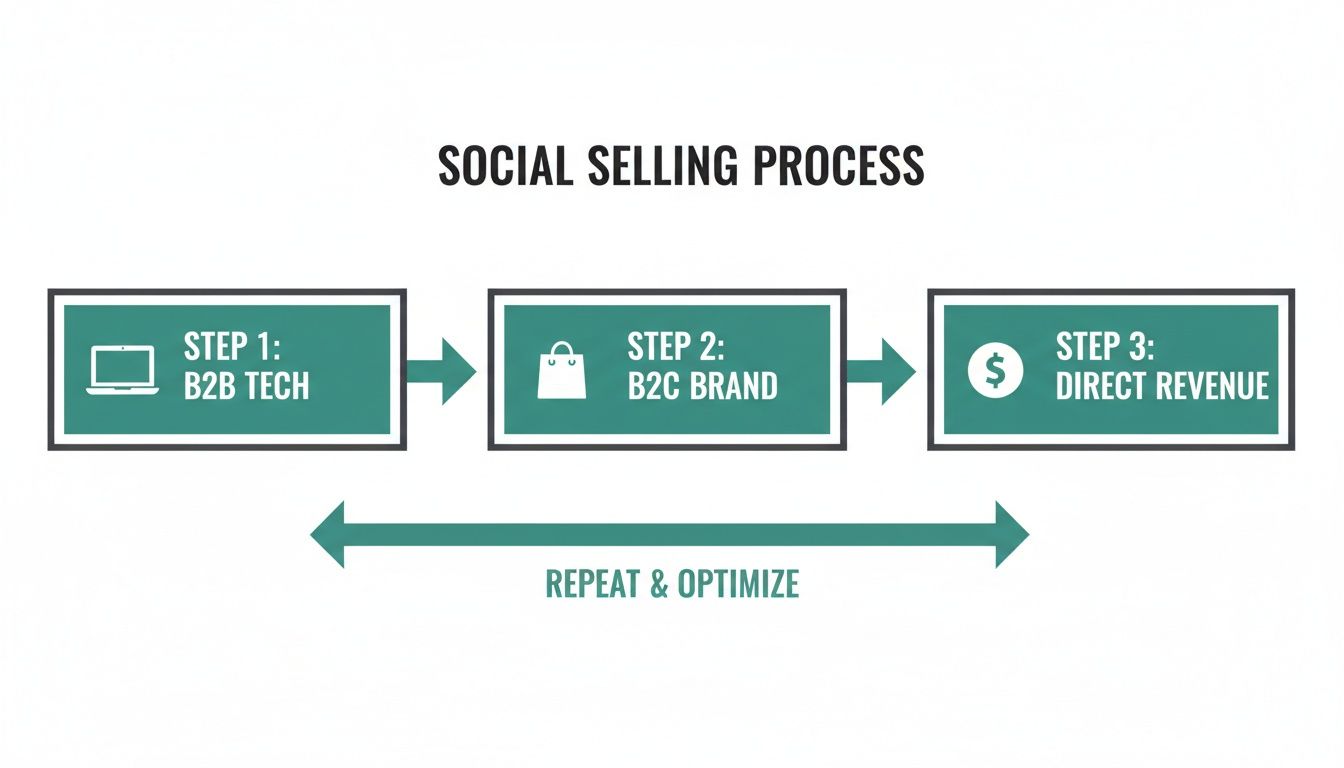
    Flowchart of the social selling process, featuring steps: B2B tech, B2C brand, direct revenue, plus repeat and optimize.

    As you can see, capturing a prospect's email can be as simple as a single click, integrating perfectly into your workflow.

    Step 3: Engage with Valuable Content

    Now that you've connected, the real work begins. The goal is to become a familiar, trusted name in their feed. You don’t do this by pitching your product every day. You do it by consistently providing value.

    Share articles you know they'll find interesting. Leave thoughtful comments on their posts that add to the conversation. Create your own content that tackles common problems in their industry. Think of every single interaction as a small deposit into the "trust bank." For more on this, check out this step-by-step guide to generating leads on Facebook for some proven tactics.

    A good rule of thumb is to give value 90% of the time and only ask for a conversation 10% of the time. This keeps you from being seen as just another salesperson.

    Step 4: Nurture Relationships into Opportunities

    As you build that rapport, you can start shifting conversations from public comments to private messages. This is the delicate transition from being just another connection to becoming a potential sales opportunity.

    Your direct messages should always be personalized. Reference a recent post of theirs or a shared interest. Ask open-ended questions to get a better feel for their needs. The idea is to gently guide the chat toward a discovery call, but only when the timing feels right.

    Step 5: Measure What Matters

    Finally, you have to track your efforts to see what’s actually working. Forget vanity metrics like likes and follower counts. They don't pay the bills. Instead, measure the things that directly impact your pipeline.

    • Connection Acceptance Rate: Are your personalized requests hitting the mark?
    • Engagement Rate: Are people actually interacting with the content you share?
    • Conversations Started: How many of your DMs are turning into real back-and-forth dialogue?
    • Meetings Booked: This is the big one. How many of your social interactions are turning into scheduled calls?

    If you're not measuring your social selling efforts, you're just guessing. Likes and follower counts are nice for the ego, but they don't exactly pay the bills. To prove your strategy is actually working, you have to connect your activity to the one thing that matters: your sales pipeline.

    True success isn't about going viral—it's about systematically turning conversations into conversions. That means drawing a clear line from your social media activity to real business results.

    Key Metrics That Actually Move the Needle

    To get a clear picture of what’s working, you need to track metrics that show progress at each stage of the relationship-building process. Start with these foundational KPIs to understand where your efforts are paying off and where you need to make some tweaks.

    Here are the essentials to keep an eye on:

    • Connection Acceptance Rate: This tells you how well your personalized outreach is landing. If the rate is low, it’s a good sign that your profile or your initial message needs some work.
    • Engagement Rate: Are people actually interacting with your content? This isn’t just about likes; it's about meaningful comments, shares, and direct messages that show you’re providing real value.
    • Pipeline Influence: This is the ultimate test. You need to track how many discovery calls, booked demos, and new CRM opportunities came directly from your social selling activities.

    A great starting point is LinkedIn's Social Selling Index (SSI). This free tool scores you on four key pillars: building a professional brand, finding the right people, engaging with insights, and nurturing relationships. A higher score often directly correlates with creating more sales opportunities.

    Proving Your Return on Investment

    When you track these metrics properly, you can draw a straight line from a simple LinkedIn comment all the way to a closed deal.

    Think about it. When you can walk into a meeting and show that your social selling activities led to a 20% increase in qualified leads last quarter, you're not just justifying your time—you're proving ROI. This data gives you the power to double down on what works and get even better results.

    Got Questions About Social Selling? Let's Clear Things Up

    Even with the best roadmap, a few questions always pop up when you're getting started. Let’s tackle the most common ones so you can move forward without any confusion.

    Social Selling vs. Social Media Marketing

    It’s easy to mix these two up. They both happen on social media, but their goals couldn't be more different.

    • Social Media Marketing is all about broadcasting. It’s a one-to-many game, like putting up a billboard on a busy highway. The aim is to build brand awareness and cast a wide net.
    • Social Selling is the polar opposite. It’s a one-to-one strategy focused entirely on building genuine relationships. Think of it as having a quiet, personal conversation at a coffee shop instead of shouting from a megaphone.

    Marketing sets the stage and builds the brand’s reputation. Social selling steps onto that stage to turn that reputation into real, one-on-one sales conversations.

    What Are the Best Tools for the Job?

    The right tech can make a massive difference. For finding and keeping tabs on the right people, LinkedIn Sales Navigator is an absolute powerhouse. It's built for precision prospecting.

    But what about when you’ve built that initial rapport and want to take the conversation to a more professional setting? That's where tools like EmailScout come in. Once you’ve connected and warmed up a prospect, you can find their direct email with a single click. It’s the perfect way to move from a casual chat to a more formal follow-up.

    The ultimate social selling toolkit isn’t just one thing. It’s a combination of platforms for building relationships and tools for making direct, personalized contact. The goal is to move smoothly from a public comment to a private conversation that delivers real value.

    How Do You Actually Measure ROI?

    This is the big one. Forget vanity metrics like likes and follower counts—they don't pay the bills. To measure the real return on investment, you have to track KPIs that are directly tied to sales.

    Focus on what moves the needle: your connection acceptance rate, how many DMs actually turn into meaningful conversations, and the most important metric of all—how many meetings get booked directly from your efforts on social media.


    Ready to turn those social connections into leads you can actually act on? EmailScout helps you find anyone's professional email in a single click, making your outreach smooth and effective. Start finding emails for free today.

  • 9 Powerful Sales Prospecting Techniques for 2025

    9 Powerful Sales Prospecting Techniques for 2025

    In today's competitive market, a full pipeline is the lifeblood of any successful business. However, relying on the same old methods is a surefire way to fall behind. The sales prospecting techniques that once guaranteed a steady flow of leads may no longer deliver the results you need. To thrive, sales professionals must master a diverse set of modern strategies designed for today’s discerning buyer. Sticking to a single approach limits your reach and leaves valuable opportunities on the table.

    This guide is designed to be your definitive resource for revitalizing your outreach efforts. We will break down nine distinct and powerful sales prospecting techniques, providing a comprehensive toolkit for building a resilient and high-performing pipeline. You will learn how to effectively implement everything from digital-first strategies like social selling and video prospecting to refined traditional methods such as cold calling and referral networking. Each section is packed with actionable steps, practical examples, and expert best practices tailored for the current sales environment.

    Forget generic advice and surface-level tips. Our focus is on providing you with the specific, detailed insights required to not just identify potential leads, but to meaningfully engage high-value prospects. By the end of this article, you will have a clear roadmap to diversify your prospecting activities, connect with more decision-makers, and ultimately, convert more opportunities into loyal customers. It's time to move beyond outdated tactics and supercharge your pipeline with strategies that consistently deliver.

    1. Cold Email Outreach: The Art of the Scalable First Touch

    Cold email remains a cornerstone of B2B sales prospecting techniques, offering a direct and scalable way to connect with high-value decision-makers. The modern approach, however, has evolved far beyond simple mass messaging. Success now hinges on delivering personalized value at scale, transforming a cold touch into a warm conversation. This method involves creating targeted, multi-step sequences that build familiarity and trust over time.

    Cold Email Outreach: The Art of the Scalable First Touch

    When executed correctly, cold email generates impressive results. Salesforce, for example, reportedly increased its sales pipeline by 40% using personalized campaigns. Similarly, outreach automation platform Outreach.io reports its clients achieving response rates between 8-12% with highly targeted sequences, proving that relevance trumps volume. The key is focusing on the recipient's world, not your own.

    How to Implement This Technique

    To make cold email work, you need a strategic, not a spammy, mindset. This starts with finding accurate contact details, a task simplified by tools like EmailScout, which allows you to focus your energy on crafting the perfect message. From there, your outreach should be concise, relevant, and centered on the prospect’s potential challenges.

    Here are actionable steps to get started:

    • Research and Personalize: Go beyond the prospect's name and title. Mention a recent company announcement, a shared connection, or a post they published on LinkedIn. This shows you’ve done your homework.
    • Craft a Compelling Subject Line: Keep it under 50 characters and make it intriguing. Avoid clickbait and focus on curiosity or relevance, such as "Question about [Their Company's Recent Project]" or "Idea for [Their Role]".
    • Write a Concise Message: Aim for under 150 words. A short, powerful email respects the recipient's time and is more likely to be read. Structure it with a clear opening, a value proposition, and a specific call-to-action (CTA).
    • Use a Clear, Low-Friction CTA: Instead of "Book a demo," try an interest-based question like, "Would you be open to learning more about how we helped [Similar Company] achieve [Result]?"
    • Follow Up Systematically: Don't give up after one email. A sequence of 3-5 follow-ups, each adding new value (like a case study or relevant article), is crucial.

    This technique is most effective when you need to reach specific decision-makers within a defined ideal customer profile (ICP). It provides a direct line of communication that, when used with precision and respect, can open doors to significant business opportunities. To dive deeper into crafting messages that get replies, you can explore these expert tips on how to write effective cold emails.

    2. Social Selling: Building Relationships Before the Pitch

    Social selling is a modern prospecting technique that shifts the focus from interruption to interaction. Instead of a cold pitch, it leverages social media platforms like LinkedIn to find, connect with, and nurture prospects. This method is about building genuine relationships by providing value, establishing credibility as an industry expert, and engaging in relevant conversations. It’s a long-term strategy that turns social networks into powerful lead-generation engines.

    Social Selling

    The impact of this approach is well-documented. LinkedIn reports that social sellers are 51% more likely to achieve their sales quotas. In a landmark case, IBM’s social selling program contributed to a staggering 400% increase in sales. These results highlight a fundamental shift: modern buyers are more informed and prefer to engage with salespeople who add value before asking for a sale.

    How to Implement This Technique

    Effective social selling requires a strategic and consistent presence, not just random connection requests. The goal is to become a familiar, trusted resource for your target audience. You can start by optimizing your social profiles to speak directly to your ideal customer’s pain points and then consistently share insights that help them.

    Here are actionable steps to get started:

    • Optimize Your LinkedIn Profile: Treat your profile like a landing page. Use a professional photo, a benefit-driven headline, and a summary that addresses your target audience’s challenges.
    • Share Valuable Content: Regularly post relevant articles, industry insights, and success stories. This establishes you as a thought leader and keeps you top-of-mind.
    • Engage Authentically: Like, comment on, and share your prospects' posts. Offer thoughtful comments that add to the conversation, showing you’re paying attention.
    • Use Advanced Search Tools: Leverage platforms like LinkedIn Sales Navigator to identify and monitor key decision-makers who fit your ideal customer profile.
    • Participate in Relevant Groups: Join and contribute to LinkedIn Groups where your prospects are active. Answer questions and share expertise to build your reputation.

    This technique is most effective for B2B sales cycles where trust and relationship-building are paramount. By consistently providing value, you warm up potential leads so that when you do reach out, it’s a natural next step in an existing conversation. For those looking to combine social selling with direct outreach, it's crucial to find the right contact information, and you can explore expert advice on how to find emails on LinkedIn.

    3. Cold Calling: The Power of the Direct Conversation

    Cold calling is the traditional sales prospecting technique of making unsolicited phone calls to potential customers. Despite the rise of digital channels, it remains one of the most direct and immediate ways to introduce your product, qualify leads, and secure meetings. Modern cold calling isn't about aggressive, high-pressure tactics; it’s a disciplined approach focused on research, relevance, and creating a genuine human connection in a matter of seconds.

    Cold Calling

    This method’s power lies in its immediacy and potential for real-time feedback. Legends in the industry were built on this foundation; Salesforce’s early growth was famously fueled by a relentless cold calling strategy. More recently, ZoomInfo reported that 82% of buyers still accept meetings from cold calls, proving its continued relevance. The key is transforming an interruption into a valuable, well-timed conversation.

    How to Implement This Technique

    Successful cold calling requires a blend of preparation, confidence, and adaptability. It’s less about a rigid script and more about a flexible framework that guides the conversation toward a specific objective. Your goal is to quickly establish credibility and pivot from your introduction to the prospect's potential pain points.

    Here are actionable steps to get started:

    • Research Before You Dial: Spend five minutes on LinkedIn to understand the prospect’s role, company initiatives, and recent activities. Mentioning a specific detail shows you’ve done your homework.
    • Use a Proven Call Framework: Don't read a script verbatim. Instead, structure your call with an introduction, a relevance statement (the "why you, why now"), your value proposition, and a clear call-to-action.
    • Time Your Calls Strategically: Studies show the best times to call are often between 8-10 AM and 4-6 PM in the prospect's time zone, catching them before or after the day's main rush.
    • Practice Active Listening: Pay close attention to the prospect's tone and responses. The best cold callers adapt their approach based on what they hear, not just what they plan to say.
    • Have a Clear Objective: Know what you want to achieve with each call. Is it to book a 15-minute discovery meeting, identify the right contact, or simply gather information?

    This technique is most effective when you need to break into new accounts quickly or when targeting industries where decision-makers are less active on digital channels. For sales professionals looking to master this skill, resources from experts like Jeb Blount in Fanatical Prospecting offer invaluable frameworks.

    4. Referral Prospecting: The Power of Warm Introductions

    Referral prospecting is a highly effective technique that leverages your existing network of satisfied customers, partners, and professional contacts to generate warm introductions to qualified leads. This method bypasses the initial friction of cold outreach by capitalizing on the trust and social proof established by a mutual connection, making it one of the most powerful sales prospecting techniques available. It transforms a cold call into a trusted recommendation.

    Referral Prospecting

    The impact of referrals is undeniable. Dropbox famously grew its user base by 3900% in 15 months through a simple referral program. Similarly, Tesla generates a significant portion of its sales through customer referrals, and American Express attributes 30% of its new customers to this channel. These examples highlight that a referral from a happy customer is often more persuasive than any marketing campaign.

    How to Implement This Technique

    Building a successful referral system requires a proactive and systematic approach, not a passive hope that clients will send business your way. The goal is to make it incredibly easy for your advocates to connect you with their network. This means being clear about who you want to meet and providing the tools to facilitate the introduction.

    Here are actionable steps to get started:

    • Be Specific with Your Ask: Instead of a generic "Do you know anyone who could use our service?", ask, "Do you know any other marketing managers in the SaaS industry who are focused on lead generation?" This helps your contact identify the right people.
    • Make Referring Easy: Provide your contacts with a pre-written email template or a short blurb they can easily forward. This removes the friction and effort required on their part.
    • Time Your Request Perfectly: The best time to ask for a referral is right after a major success or a moment of high satisfaction, such as after a positive quarterly business review or a successful project launch.
    • Thank and Reward Referrers: Always acknowledge the introduction, whether it leads to a sale or not. A simple thank-you note, a small gift card, or a discount can go a long way in encouraging future referrals.
    • Create a Formal Process: Don't leave referrals to chance. Integrate the referral ask into your customer lifecycle, making it a standard part of your process for all happy clients.

    This technique is most effective when you have a base of satisfied customers or a strong professional network. It's the ideal way to generate high-quality, high-conversion leads with a significantly shorter sales cycle, as the initial trust is already established.

    5. Account-Based Prospecting (ABP): Targeting High-Value Accounts

    Account-Based Prospecting (ABP) flips the traditional sales funnel on its head. Instead of casting a wide net, this strategic approach focuses on identifying a small number of high-value accounts and treating each as a market of one. It involves creating highly personalized, coordinated campaigns that engage multiple stakeholders within a target organization, turning prospecting into a team sport between sales and marketing.

    This targeted focus yields significant results. For example, ABM platform Terminus reported that its customers increased their average deal size by 73% by adopting these strategies. Similarly, 6sense, an account engagement platform, found that practitioners see a 208% increase in marketing-generated revenue. These outcomes highlight ABP's power as one of the most effective sales prospecting techniques for landing large, complex deals.

    How to Implement This Technique

    Successful ABP requires deep research and tight cross-functional alignment. The goal is to surround an account with relevant, valuable touchpoints across multiple channels, making your outreach feel less like a sales pitch and more like a tailored consultation. This starts with a deep understanding of the account's specific needs and internal structure.

    Here are actionable steps to get started:

    • Define Your Ideal Customer Profile (ICP): Before selecting accounts, clearly define the firmographic and technographic characteristics of your best customers. This ensures you target companies with the highest potential.
    • Identify and Research Target Accounts: Build a shortlist of high-value companies that fit your ICP. Use data sources to gather intelligence on their challenges, goals, and recent activities.
    • Map Stakeholders and Influencers: A single decision-maker is rare. Identify everyone involved in the buying process, from champions and influencers to budget holders and legal reviewers.
    • Coordinate Sales and Marketing Plays: Align both teams on messaging, content, and outreach channels. A unified front ensures a consistent and impactful experience for the prospect.
    • Create Account-Specific Content: Develop content that speaks directly to the target account's pain points. This could be a custom report, a tailored case study, or a personalized webinar invitation.
    • Engage Across Multiple Channels: Use a mix of email, social media, targeted ads, and direct mail to reach different stakeholders where they are most active.

    This technique is most effective when pursuing large, enterprise-level clients where a longer, more consultative sales cycle is expected. It requires more upfront investment than mass outreach, but the payoff in deal size and customer lifetime value is substantial. For a deeper understanding of building a targeted pipeline, explore these lead generation best practices.

    6. Video Prospecting: Building Human Connections in a Digital World

    Video prospecting is a modern sales technique that cuts through the noise of text-based communication. Instead of another plain email or message, this method involves sending short, personalized videos to prospects. It's a powerful way to humanize your outreach, build rapport instantly, and make your message memorable in a crowded inbox. This approach leverages the power of face-to-face interaction at scale.

    The impact of video is undeniable. Vidyard, a leading video platform, reports that emails with video can see an 8x higher response rate. Similarly, BombBomb users have experienced a 68% increase in click-through rates. The success of this technique lies in its ability to convey tone, personality, and genuine intent, something plain text often fails to do. It shows you're willing to go the extra mile.

    How to Implement This Technique

    Effective video prospecting is more about authenticity than high production value. A simple, genuine video recorded from your webcam or phone can be far more effective than a slick, corporate production. The goal is to create a one-to-one connection that feels personal and direct.

    Here are actionable steps to get started:

    • Keep it Short and Sweet: Aim for a video length of 60-90 seconds. Prospects are busy, so get straight to the point while maintaining a friendly and engaging tone.
    • Personalize the Opening: Mention the prospect's name and company within the first 10 seconds. Holding up a small whiteboard with their name on it for the video thumbnail is a popular and effective tactic.
    • Focus on Them, Not You: Structure your message around a specific challenge they face or a goal they have. Briefly explain how you can provide value, referencing something specific you learned from your research.
    • Ensure Good Quality: You don't need a professional studio, but clear audio and good lighting are essential. Make sure your face is visible and you're speaking clearly.
    • End with a Clear CTA: Guide them on what to do next. A simple "Reply to this email if this sounds interesting" or "Click the link below to see an example" works well.

    This sales prospecting technique is ideal for high-value accounts where personalization can make a significant difference. It’s perfect for breaking into a new account, re-engaging a cold lead, or following up after an initial conversation. When you need to stand out and build trust quickly, video is one of the most effective tools in your arsenal.

    7. Content-Based Prospecting: Becoming a Trusted Advisor

    Content-based prospecting is a strategic technique that shifts the sales dynamic from selling to helping. Instead of leading with a product pitch, this approach focuses on providing valuable, educational content that addresses a prospect's pain points and challenges. By sharing relevant insights, industry reports, and thought leadership, you position yourself as a trusted advisor, not just another salesperson.

    This method builds credibility and nurtures leads by attracting them with solutions. For example, HubSpot built its entire empire on inbound marketing, using blogs and free tools to draw in potential customers. Similarly, Salesforce generates thousands of leads through its Trailhead platform, which offers free training. The core principle is simple: answer your customers' questions before they even have to ask you directly.

    How to Implement This Technique

    Successful content-based prospecting involves creating and distributing resources that your ideal customer profile finds genuinely useful. It's about earning attention, not demanding it. The goal is to make your prospect smarter and better equipped to solve their problems, with your solution becoming the logical next step.

    Here are actionable steps to get started:

    • Identify Prospect Pain Points: Create content that directly solves your target audience's most pressing issues. Think blogs, whitepapers, or short video guides addressing common industry challenges.
    • Use Multiple Content Formats: Cater to different preferences by offering a mix of formats, including articles, webinars, case studies, and infographics. This widens your reach and appeal.
    • Gate High-Value Assets: Offer your most in-depth content, like comprehensive ebooks or exclusive reports, in exchange for contact information. This is a classic lead-generation tactic.
    • Share Third-Party Content: You don't have to create everything yourself. Share valuable articles or research from other industry leaders and add your own unique insights to start a conversation.
    • Track Engagement: Use tools to see who is interacting with your content. A prospect who downloaded a case study on a specific problem is a much warmer lead than a cold contact.

    This technique is especially effective for complex B2B sales with long cycles, where building trust and educating the buyer is paramount. It's a long-term play that nurtures relationships and establishes your authority, making it one of the most powerful sales prospecting techniques for sustainable growth.

    8. Event-Based Prospecting: Turning Handshakes into Opportunities

    Event-based prospecting leverages the concentrated gathering of industry professionals at conferences, trade shows, and webinars to build high-quality connections. This strategy moves beyond digital-only interactions, capitalizing on the natural networking environment events provide to engage prospects in a more personal and memorable context. The goal is to transform fleeting conversations into meaningful pipeline opportunities by being strategic, prepared, and timely.

    The power of this sales prospecting technique is evident in major industry gatherings. Salesforce famously generates a significant portion of its sales pipeline from its annual Dreamforce conference, while Adobe has reported creating over $100 million in pipeline from its Adobe Summit. These events demonstrate that a well-executed event strategy can dramatically accelerate the sales cycle by fostering trust and rapport face-to-face or in a shared virtual space.

    How to Implement This Technique

    Success in event prospecting hinges on preparation before, engagement during, and follow-up after the event. It’s about creating a plan to connect with the right people rather than just showing up and hoping for the best. This proactive approach ensures you maximize your return on the investment of time and resources.

    Here are actionable steps to get started:

    • Research and Plan: Before the event, research the attendee and speaker lists. Identify key prospects and set specific, realistic meeting goals. Use event apps or LinkedIn to schedule brief introductory meetings in advance.
    • Prepare Your Value Proposition: Craft a concise, compelling "event pitch" that explains who you are and what problem you solve. Focus on asking insightful questions to understand their needs rather than launching into a hard sell.
    • Engage Meaningfully: During the event, prioritize listening over talking. Attend relevant sessions, ask thoughtful questions, and participate in networking functions. Your goal is to build genuine connections, not just collect business cards.
    • Follow Up Promptly and Personally: The 48-hour window after an event is critical. Send a personalized follow-up email referencing a specific detail from your conversation. This shows you were paying attention and solidifies the connection.
    • Host Your Own Session: If possible, position yourself as an authority by hosting a small workshop, a dinner, or a speaking session. This draws qualified prospects directly to you.

    This technique is most effective for B2B companies with a clearly defined customer profile whose decision-makers regularly attend industry events. It provides an unparalleled opportunity to build personal relationships, gather market intelligence, and stand out from the competition in a crowded digital landscape.

    9. Trigger Event Prospecting: Seizing the Moment of Need

    Trigger event prospecting is a powerful, timing-based sales technique that focuses on identifying specific events within a prospect's company that signal an immediate need or an openness to change. Instead of reaching out randomly, you engage when a company is most likely to be receptive to a new solution. These triggers, such as new funding rounds, executive hires, or office relocations, create a compelling reason for your outreach and dramatically increase its relevance.

    This approach transforms a cold outreach into a timely, consultative conversation. For instance, a company announcing a major expansion is likely evaluating its operational software, while a new VP of Sales might be looking to overhaul their team's technology stack. According to research popularized by sales experts like Craig Elias, prospects are up to five times more likely to become a customer if you are the first to reach out after a trigger event occurs.

    How to Implement This Technique

    The key to successful trigger event prospecting is building a system to monitor for these opportunities and acting on them quickly. Your outreach must be fast, relevant, and directly tied to the event that prompted it. This proves you are paying attention and understand the prospect’s current situation, instantly differentiating you from the competition.

    Here are actionable steps to get started:

    • Identify Your Key Triggers: Determine which events are most likely to create a need for your product or service. Examples include new leadership, company acquisitions, poor financial reports, or regulatory changes.
    • Set Up Monitoring Systems: Use tools like Google Alerts, LinkedIn Sales Navigator, or specialized platforms like Owler to track news, press releases, and job postings related to your target accounts.
    • Craft a Trigger-Specific Message: Your outreach should directly reference the event. For example, "Congratulations on your recent Series B funding! As you scale your operations, ensuring [your solution's benefit] often becomes a top priority."
    • Prepare Relevant Content: Have case studies or resources ready that align with the specific trigger. If you're targeting a company that just hired a new CMO, have a guide ready on "Modernizing Your Martech Stack."
    • Act with Urgency: The window of opportunity after a trigger event is small. Aim to be one of the first vendors to reach out with a relevant, value-driven message.

    This sales prospecting technique is most effective for B2B sales where organizational changes directly impact purchasing decisions. By aligning your outreach with a prospect’s moment of need, you position yourself not as a salesperson, but as a timely problem-solver.

    Sales Prospecting Techniques Comparison

    Prospecting Method Implementation Complexity Resource Requirements Expected Outcomes Ideal Use Cases Key Advantages
    Cold Email Outreach Moderate (requires copywriting & tools) Low to moderate (email platform, CRM) Low response rates (~1-5%), scalable lead generation Broad outreach, scalable lead gen Low cost, scalable, measurable
    Social Selling High (content creation & relationship building) High (time, content, social media tools) Higher engagement than cold outreach, builds trust B2B networking, brand building, long sales cycle Builds authentic relationships, credible
    Cold Calling Moderate to high (training & call scripts) Moderate to high (dialing platforms, CRM) Immediate two-way communication, higher conversion with skill Direct sales, immediate qualification Real-time feedback, personal rapport
    Referral Prospecting Moderate (process and relationship management) Low to moderate (tools for tracking) Highest conversion rates (30-50%), faster sales cycles Businesses with strong networks/customers Warm leads, low acquisition cost
    Account-Based Prospecting High (account research and coordination) High (research, multi-channel tools, team alignment) Higher deal values, higher close rates Targeting high-value accounts Personalized, aligned sales & marketing
    Video Prospecting Moderate (video production skill & tools) Moderate (video software, editing tools) Higher engagement (16x text), memorable outreach Differentiated communication, building trust Visual engagement, builds personality
    Content-Based Prospecting High (content creation & distribution) High (content team, SEO, publishing tools) Builds credibility, attracts qualified long-term leads Inbound marketing, thought leadership Credibility, scalable, lasting impact
    Event-Based Prospecting High (event planning and participation) High (travel, booths, time, sponsorship) High-quality, in-person interactions Industry events, trade shows, networking Personal relationships, targeted audience
    Trigger Event Prospecting Moderate (monitoring & quick response) Moderate (monitoring tools, alerts) Higher conversion due to timely and relevant outreach Timing-sensitive sales opportunities Perfect timing, increased relevance

    Building Your Prospecting Engine: Combining Techniques for Unstoppable Growth

    We've explored a comprehensive suite of modern sales prospecting techniques, from the personalized precision of cold email and the relational power of social selling to the direct impact of a well-executed cold call. You’ve seen how to leverage referrals, implement targeted Account-Based Prospecting, and capture attention with dynamic video messages. Each method, whether it's content-driven, event-based, or triggered by a specific company action, is a powerful tool in its own right. However, the true masters of sales don't just pick one tool; they build an entire workshop.

    The ultimate takeaway is this: isolated prospecting efforts yield isolated results. A single channel can be easily ignored, but a multi-threaded, strategic approach is impossible to overlook. The goal is to move beyond thinking in terms of "which technique is best?" and instead ask, "which combination of techniques is best for this specific prospect, right now?" This strategic mindset transforms prospecting from a linear checklist into a dynamic, responsive engine that consistently generates high-quality leads.

    Synthesizing Your Strategy: From Theory to Pipeline

    The path from learning these techniques to implementing them successfully involves a strategic synthesis. It’s about creating a prospecting "playbook" where each method supports the others, creating a seamless and compelling experience for your potential customer.

    Imagine this practical workflow:

    1. Initial Connection (Social Selling): You first engage with a prospect on LinkedIn by thoughtfully commenting on a post they shared, establishing a flicker of familiarity.
    2. Precision Outreach (Email): Using a tool to find their verified email, you send a highly personalized message that references your social interaction and a recent company "trigger event," like a new funding round or product launch.
    3. Human Touch (Video Prospecting): Embedded in that email is a short, 30-second video of you, adding a human face to the name and briefly explaining the value you can provide in the context of their recent success.
    4. Strategic Follow-up (Cold Call): Two days later, you place a brief, well-timed call. It's no longer a "cold" call but a warm follow-up, referencing the previous touchpoints and asking for a brief conversation.

    In this scenario, no single action carries the full weight of the outreach. Instead, you've created a narrative of engagement that feels organic, respectful, and value-driven. This multi-channel approach demonstrates persistence without being pushy and showcases your genuine interest in their business.

    The Power of Continuous Optimization

    Building your prospecting engine is not a one-time setup. It's a continuous process of testing, measuring, and refining. Your most valuable asset in this journey is data. Track which sequences generate the highest response rates. Analyze which channels are most effective for different customer segments. Is your video outreach resonating more with tech startups, while referral prospecting works better for established enterprise clients?

    Answering these questions allows you to double down on what works and adapt your strategy as market dynamics shift. By embracing this analytical approach, you move from guesswork to data-driven decision-making, ensuring your pipeline remains robust and predictable. Mastering these diverse sales prospecting techniques isn't just about filling your calendar with meetings; it’s about building a resilient, adaptable system that fuels sustainable business growth and solidifies your position as a trusted, strategic advisor.


    Ready to power up your outreach? The most effective email and Account-Based Prospecting campaigns start with accurate contact data. EmailScout provides a powerful email finder and verifier to ensure your carefully crafted messages reach the right inbox every time, maximizing your deliverability and response rates. Find any email address you need and build your ideal prospect list with EmailScout.