Tag: sales tools

  • The Best Email Tracker Free Tools for Modern Sales Teams

    The Best Email Tracker Free Tools for Modern Sales Teams

    Yes, you can absolutely get a high-quality email tracker free of charge, and it's one of the best-kept secrets for smarter sales and outreach. These tools plug directly into your inbox, giving you a real-time heads-up the second a prospect opens your message or clicks a link. It's time to stop guessing and start knowing.

    Why Smart Sales Reps Use Free Email Trackers

    Man tracking email opens on a laptop in an office, with a green speech bubble overlay.

    Think about this: you just sent a crucial proposal to a high-value prospect. Instead of wondering if they even saw it, imagine getting a notification the exact moment they open it. That’s not just a cool feature; it’s actionable intelligence.

    Top-performing reps have moved past the old "send and hope" method. They use free email trackers to get real-time feedback that tells them exactly what to do next.

    So, how does it work? The technology is surprisingly simple. A tiny, invisible 1×1 pixel is embedded in your outgoing email. When your recipient opens the message, their email client requests and loads this pixel, which pings a server and sends a notification straight back to you. It’s a silent but incredibly effective way to gauge interest.

    Turning Clicks and Opens into Deals

    The real magic isn’t just knowing an email was opened; it's what you do with that information. That notification is your cue to act.

    For instance, timing your follow-up call just moments after a prospect re-opens your pricing sheet can be a total game-changer. You catch them at the peak of their interest, while your proposal is still fresh in their mind.

    This data gives you a much clearer picture of:

    • Who's Engaged: Quickly see which prospects are actually reviewing your materials and who’s gone cold.
    • What's Working: A/B test your subject lines or calls-to-action. The open and click data will tell you which versions resonate most.
    • Perfect Timing: Stop interrupting and start connecting. Reach out when you know they are actively thinking about your solution.

    The bottom line is that a good email tracker turns your "Sent" folder into a live dashboard of prospect activity. It gives you the context you need to make every single follow-up more relevant, timely, and effective.

    How to Choose the Right Free Tracker

    Before diving in, it helps to see what your main options are. Most free trackers fall into one of two categories: browser extensions that work with webmail like Gmail, or free CRM plans that include tracking as a feature.

    Here’s a quick breakdown of some of the top players to help you decide.

    Top Free Email Tracker Options at a Glance

    Tracker Type Primary Platform Key Free Feature Best For
    Browser Extension Gmail & Outlook Unlimited tracking & notifications Individuals and small teams wanting simple, direct inbox integration.
    Free CRM Web & Mobile Tracking plus contact management Sales reps who need to organize leads and track the entire sales pipeline.
    All-in-One Outreach Gmail Tracking with sequencing & templates Users focused on scaling cold outreach campaigns with basic automation.

    Each of these has its strengths, and the "best" one really depends on your specific workflow—whether you live in your Gmail inbox or need a more structured system to manage your contacts.

    Gaining a Competitive Edge Without the Cost

    The best part? You don't need a huge budget to get this kind of advantage. Many of the top email tracking tools offer powerful free plans with unlimited tracking, instant notifications, and link-click alerts.

    This really levels the playing field. It allows freelancers, startups, and individual sales reps to use the same data-driven tactics as massive corporations. Finding the right email tracker free for your workflow—whether you use Gmail, Outlook, or something else—is a simple move that makes your entire sales process smarter.

    Ready to stop guessing and start knowing who’s engaging with your emails? Getting a free email tracker set up in Gmail is your first real step toward data-driven outreach. The whole process is surprisingly simple—it's usually just a matter of installing a browser extension that works right inside your existing inbox.

    You’ll want to start by heading over to the Chrome Web Store. Think of it as the app store for your browser. This is where you can find a reputable email tracker free of charge, check out user reviews, and see its user count, which is always a good indicator of a trustworthy tool.

    Finding and Installing Your Extension

    Once you’re in the store, just type "free email tracker" into the search bar. You'll get a bunch of results. My advice? Zero in on the extensions with high ratings—I’m talking over four stars—and a significant number of users. It’s a quick way to sidestep the duds.

    When you've made your choice, hit the “Add to Chrome” button. You’ll get a pop-up asking for permissions, which can look a little scary, but it's a standard part of the process. The tool needs access to embed its tracking pixel and deliver your open notifications. Any solid provider will link to a clear privacy policy that spells out exactly how they handle your data.

    Pro Tip: As soon as it's installed, get comfortable with turning the tracking on and off. You absolutely don't need to track every email, like internal notes to your team or messages to your friends. Being selective saves your notifications for the prospects that actually matter.

    Navigating the New Gmail Interface

    After you’ve installed the extension and granted it permission, you’ll notice your Gmail looks a little different. Most trackers will add a few new icons right into your compose window, typically near the "Send" button. These are your new controls for activating or deactivating tracking on a per-email basis.

    Here's a glimpse of what that updated compose window might look like.

    Person typing on a laptop displaying an email interface with 'SET UP IN GMAIL' overlay.

    See those new icons? They give you a clear visual confirmation that you're about to track an email before you send it. It’s a simple but crucial checkpoint.

    With the tracker up and running, the real-time notifications will start rolling in. These alerts are where the magic happens, turning what was once a silent "send" into an actionable sales signal.

    • Open Notifications: You get an alert the second a prospect opens your message. If you see multiple opens, it’s a strong sign of high interest or that your email is getting passed around their team.
    • Click Notifications: This is an even more powerful signal. A click means your recipient didn't just glance at your email—they were intrigued enough to check out your website, book a meeting, or download your case study.

    By paying attention to these alerts, you can time your follow-up call or next email perfectly, catching your prospect right when your solution is on their mind. If you want to go even deeper, check out our complete guide to free email tracking. It’s a small tweak to your workflow that can make a huge difference in your results.

    Integrating a Free Email Tracker with Outlook

    If your world revolves around Microsoft Outlook, don't worry—you can get the same powerful tracking insights as your Gmail counterparts. Adding a free email tracker to your Outlook desktop app or web version is surprisingly simple and gives you that same critical data on opens and clicks.

    The magic happens in Microsoft AppSource, which is basically Microsoft's version of the Chrome Web Store. It’s a marketplace packed with add-ins that have been vetted for security and compatibility, so you know you're getting a tool that plays nice with Outlook.

    Finding and Installing Your Outlook Add-In

    Getting started is easy. Just open Outlook, either on your desktop or the web. On the "Home" tab, you'll see a "Get Add-ins" button on the ribbon. Clicking that opens up the AppSource marketplace without you ever having to leave your inbox.

    In the search bar, just type "email tracker" and see what comes up. Same as with browser extensions, I always recommend picking one with plenty of positive reviews and a high user count. Once you’ve found a winner, hit "Add," and it'll install in seconds. No restart needed.

    Once it's installed, you’ll find the tracker's features right in the window where you compose a new email. It might be a small icon in the bottom action bar or tucked away in the "…" (more options) menu, depending on the add-in.

    One thing to watch out for with Outlook is corporate IT policy. If the "Get Add-ins" button is grayed out or you hit a wall during installation, you’re probably running into a security restriction. You'll need to have a quick chat with your IT admin to get it approved.

    Using Your Tracker in the Outlook Interface

    With your new email tracker free add-in installed, the first thing you should do is send a test. Just compose a new email to one of your personal addresses and make sure the tracking icon or toggle is switched on before sending.

    Go open that email in your personal inbox. You should get a notification back in Outlook confirming the open. This little test is my go-to move to make sure everything is working perfectly before I rely on it for an important client email.

    Here are a few quick tips for using an Outlook tracker:

    • Desktop vs. Web: Most modern add-ins sync seamlessly between the desktop and web versions of Outlook. Your data will be there no matter how you access your email.
    • Locating Tracking Options: Can't find the tracking button? Click the "…" icon in your new message window. It opens up a list of all your add-ins, and you can activate the tracker from there.
    • Reading the Signals: An open is a good sign, but a click on a link is a fantastic one. Use these signals to figure out who's genuinely interested and prioritize who you follow up with first.

    By setting this up, you're equipping Outlook with the kind of real-time intelligence that turns your standard outreach into a much smarter, data-driven strategy.

    Building a Powerful Prospecting Workflow

    An email tracker tells you who is engaged with your emails, but that's only half the battle. First, you have to find high-value prospects to contact.

    This is where your workflow gets serious. By combining a free email tracker with an email finder like EmailScout, you can stop playing guessing games and start building a predictable lead generation system.

    The whole process kicks off with building a hyper-targeted list. Forget buying stale, outdated lists or spending hours manually scraping websites. An email finder extension lets you pull contact info directly from professional networks like LinkedIn.

    Let's say you've found the perfect company and need to reach their Head of Sales. A good email finder can grab their verified email address in a single click. You can build a quality list of decision-makers in minutes, not days.

    From Prospecting to Perfect Timing

    Once you have your list, you send out your outreach with the tracker running. This is where the magic happens—you’re not just firing cold emails into the dark anymore. You’re collecting instant feedback.

    Every open notification tells you which subject lines are actually working. Every click shows you who is genuinely interested in your offer. This data is gold, letting you tweak your messaging and strategy as you go.

    This workflow fundamentally changes the nature of cold outreach. You move from broadcasting a message to having a data-informed conversation, focusing your energy only on the prospects who show real intent.

    When you integrate free email trackers into a wider strategy for modern B2B sales prospecting, you can seriously boost your outreach effectiveness and conversion rates.

    Creating Your Feedback Loop

    This combination of tools creates a simple but incredibly effective cycle. For anyone using Outlook, getting the tracking piece set up is dead simple.

    Diagram showing three steps to set up an Outlook email tracker: AppSource, Install, and Track.

    This flow shows just how fast you can get a tracker up and running, closing the loop on your prospecting efforts. You find prospects with a tool like EmailScout, engage them with a tracked email, and then use that real-time data to guide your follow-up.

    Here’s a simple but powerful strategy you could put into action:

    • Initial Outreach: Send your first email to the new prospect list you built with EmailScout, making sure tracking is on.
    • First Follow-Up: A day later, send a follow-up email only to those who opened but didn’t click your link.
    • High-Priority Follow-Up: The moment someone clicks a link to your pricing page or demo calendar, call them or send a highly personalized message.

    This tiered approach makes sure you spend your valuable time on the leads who are already warm. To get more ideas for building out your outreach, check out these other powerful sales prospecting techniques. This entire method is designed to fill your pipeline with prospects who are genuinely interested and much closer to saying "yes."

    Using Email Tracking Ethically and Effectively

    Knowing when someone opens your email is a powerful piece of information. But how you use that data is what separates smart outreach from feeling like digital surveillance. The real value of an email tracker isn't just the open notification—it's the insight it gives you to communicate more effectively and respectfully.

    The biggest mistake I see people make is pouncing the second they get an "open" alert. An open isn't a sales meeting. It’s just a signal that your message was seen. It could mean the recipient is about to dive in, or they could have just opened it to clear a notification on their phone. Never assume intent.

    Instead, think of that open as a cue for a well-timed, low-pressure follow-up. For instance, if you see a prospect has opened your proposal twice in one day, that’s a great sign. Wait an hour or so, then send a casual follow-up: "Just wanted to check if you had any initial questions about the timeline I outlined. Happy to clarify anything." It's helpful, not pushy.

    Stay Compliant and Build Trust

    Using a free email tracker doesn’t give you a free pass on legal and ethical standards. Regulations like the General Data Protection Regulation (GDPR) in Europe have specific rules about data processing, and email tracking definitely falls under that umbrella.

    While the legal details can get complicated, transparency is always the best policy. For cold outreach, many professionals add a simple, low-key disclaimer to their email signature.

    Example Disclaimer: "To help provide relevant information, this email may contain a tracking pixel. It helps us know if our messages are being seen."

    A simple sentence like this changes the dynamic. It shifts from covert tracking to an open, professional approach. You're communicating that you use technology to be a better service provider, not a spy. Before you even think about tracking, it's also critical to make sure your contact list is solid. You can learn more about how to verify emails to improve your deliverability and protect your sender reputation.

    Best Practices for Ethical Tracking

    To make sure your tracker is a tool for building relationships, not burning bridges, keep these guidelines in mind:

    • Don't Overreact to an Open: An open is a cue, not a command. Use it to time your next move thoughtfully, not to ambush a prospect.
    • Prioritize Click Data: A click on a link is a much stronger signal of interest than a simple open. Focus your immediate attention on prospects who take that extra step.
    • Be Mindful of False Positives: Some email clients, like Apple Mail, can pre-load images, which triggers a false "open" notification. Don't put all your faith in a single open event.
    • Never Track Personal Emails: Reserve tracking for professional communication only. Using it for personal correspondence is an invasion of privacy and a quick way to destroy trust.

    Common Questions About Free Email Trackers

    Diving into a new sales tool always brings up a few questions, and free email trackers are no exception. Let's clear up some of the most common ones so you can start tracking your outreach with confidence.

    Can Recipients See I Am Tracking Them?

    Almost never. Free email trackers work by tucking a tiny, invisible 1×1 pixel into your email, usually in the signature or body of the message. It's completely hidden from your recipient.

    When their email client loads the images in your message, it also loads that invisible pixel. That's what sends a signal back to the tracker's server, which then pings you with an "open" notification. It’s a silent process they won't notice.

    The only real exception is if your prospect has disabled automatic image loading in their email settings. In that scenario, the email won't show as opened until they manually click to display images.

    Are Free Email Trackers Actually Safe?

    The reputable ones are, but it always pays to be cautious. A good tracker from a well-known company will have a transparent privacy policy that's easy to find. When you install any extension or add-in, take a second to review the permissions it's asking for.

    To play it safe, just follow these simple rules:

    • Stick to official marketplaces: Only download trackers from the official Chrome Web Store or Microsoft AppSource. These platforms have review processes to help weed out shady tools.
    • Check the reviews: Look for trackers with a high number of positive reviews and a large user base. This is usually a great sign of a trustworthy and well-supported product.
    • Avoid third-party sites: Never download tracking software from random, unverified websites.

    What Is the Difference Between an Open and a Click?

    An "open" just means your email was viewed. A "click," on the other hand, is a much stronger buying signal because it shows your prospect took a specific action.

    An open tells you they saw your message; a click tells you they were intrigued enough to learn more. Prioritize your follow-up efforts on prospects who click your links.

    Most trackers make this happen by converting any link in your email into a unique, trackable URL. When the recipient clicks it, they are instantly redirected through the tracker's server—which logs the click—before landing on the final webpage. The entire thing is instantaneous and invisible to them.

    Why Does an Email Show Multiple Opens?

    Seeing a bunch of opens can be a fantastic sign. It often means your prospect is re-reading your proposal, checking your pricing again, or even forwarding the email to a colleague or decision-maker. It’s a strong indicator of high engagement.

    However, sometimes it's just a technical quirk. Certain email clients, especially Apple Mail, use a feature called Mail Privacy Protection that pre-loads images on their own servers. This can trigger a false "open" alert before the person has even seen your email.

    My advice? View multiple opens as a positive but general signal of interest, not a precise count of how many times a human read your email. It's just one data point among many.


    Ready to stop guessing and start building a smarter outreach process? EmailScout is a powerful email finder that helps you build targeted prospect lists directly from LinkedIn. Combine it with your free email tracker to create a powerful workflow that fills your pipeline with engaged leads. Discover unlimited emails and streamline your sales efforts today by visiting https://emailscout.io.

  • Your Guide to the Skrapp Email Finder in 2026

    Your Guide to the Skrapp Email Finder in 2026

    Trying to find the right B2B prospect can feel like searching for a specific book in a library the size of a city. The Skrapp email finder is like your personal librarian, cutting through the chaos to find the professional email addresses you need to reach key decision-makers.

    Your Guide to Finding Contacts in a Crowded World

    In a world where every professional is buried under an avalanche of information, old-school manual prospecting just doesn't work anymore. It’s like shouting across a packed stadium and hoping the right person happens to hear you. This is exactly why tools built for lead generation are non-negotiable for any serious sales rep, marketer, or recruiter.

    The Skrapp email finder was designed to solve this very problem. Its main job is to take over the tedious, manual work of digging up professional contact information. Instead of wasting hours scrolling through websites and social profiles, you can build laser-focused prospect lists in minutes. That time saved goes right back into growing your business.

    By using a targeted tool like Skrapp, teams can stop the mind-numbing data entry and focus on what actually moves the needle: building relationships, personalizing outreach, and closing deals.

    This is more important than ever when you consider the sheer volume of digital noise. With daily email traffic expected to rocket past 392.5 billion messages by 2026, just getting seen is a huge hurdle. The email marketing industry is also booming, with revenues projected to hit over $105.5 billion by the end of 2026—all driven by tools that deliver this kind of precision and automation.

    Ultimately, plugging a specialized tool like Skrapp into your process gives you some clear, hard-hitting advantages:

    • Build Targeted Lists: Quickly pull together lists of your ideal prospects based on their industry, company, or job title.
    • Enhance Outreach Campaigns: Make sure your carefully crafted messages actually land in the right inbox, which dramatically boosts engagement.
    • Drive Revenue Growth: More connections mean more conversations, and more conversations directly fuel your sales pipeline.

    When you add a dedicated email finder to your workflow, you’re not just getting time back; you’re giving yourself a serious competitive edge. If you're currently weighing your options, check out our guide on the best email finder tools available today.

    How the Skrapp Email Finder Works

    So, how does the Skrapp email finder actually pull contact information from what seems like thin air? It’s not magic, and it doesn't tap into some secret, private database. Instead, think of it as a smart system that pieces together clues from the public web.

    The whole process is built on a foundation of data-driven prediction and verification. It all starts with the basic information you give it—like a person's name and the company they work for, which you might find on a LinkedIn profile. These two data points are the starting line.

    Predicting and Verifying Emails

    With a prospect’s name and company domain, Skrapp’s algorithm gets to work. It starts by generating a list of potential email addresses based on the most common patterns corporations use.

    It’s a bit like a locksmith who knows which key patterns are most likely to work for a certain brand of lock. The system will test combinations like:

    • {first}.{last}@company.com
    • {f}{last}@company.com
    • {first}@company.com

    But it doesn't stop there—it’s not just a guessing game. Once Skrapp has this list of potential emails, it moves into the verification stage. The system cross-references these predictions against public sources and runs a server check to confirm the address can actually receive mail. Only when it has high confidence that an email is live and correct does it get the verified stamp.

    This diagram shows you exactly where a tool like Skrapp slots into a modern B2B sales process.

    A B2B prospecting process flow diagram showing steps from prospecting to Skrapp and finally revenue, highlighting accuracy and ROI.

    As you can see, it acts as a crucial bridge. Skrapp helps turn your broad prospecting efforts into targeted outreach that actually drives revenue by making sure you're talking to the right person.

    The Role of Public Data Sourcing

    It’s really important to understand that Skrapp operates by finding data that’s already out in the open. It aggregates information from company websites, professional networks, and public directories where people have already shared their details.

    By relying exclusively on publicly available data, Skrapp ensures its methods remain compliant with major data privacy regulations. The tool finds existing information; it doesn't uncover private data.

    This approach is what makes the Skrapp email finder both powerful and ethical for sales and marketing teams. You can build out your prospect lists with confidence, knowing you’re getting the data you need without crossing any privacy lines.

    Exploring Skrapp's Core Features and Use Cases

    A laptop displaying a business application with profiles on a wooden desk, next to a notebook.

    Knowing what the Skrapp email finder does is the easy part. The real trick is understanding how its different tools fit together so you can stop wasting time on manual research and start connecting with the right people.

    Think of Skrapp not as a single tool, but as a small collection of specialized instruments. Each one is built to tackle a specific prospecting challenge, whether you're in sales, marketing, or recruiting. Let's dig into how they work in the real world.

    The LinkedIn Email Finder

    By far the most-used feature is Skrapp’s LinkedIn Email Finder, a simple Chrome extension that bolts directly onto your browser. It’s built for surgical precision.

    Imagine you're an SDR trying to connect with VPs of Marketing in the SaaS world. Without a tool, you'd be stuck hopping between profiles, guessing email formats, and wasting hours. With Skrapp installed, you just browse LinkedIn or Sales Navigator profiles like you normally would. When you land on a promising contact, you click the Skrapp icon, and it gets to work finding their verified email.

    This feature essentially turns LinkedIn from a passive networking directory into an active lead-sourcing machine. You spot a high-value contact, and in one click, you have the key to reaching them.

    Domain Search And Bulk Finder

    While the LinkedIn tool is for one-off finds, Skrapp’s other features are built for finding contacts at scale. The two main workhorses here are the Domain Search and the Bulk Email Finder.

    Here’s a quick look at how different roles might use each feature.

    Skrapp Feature Use Case Breakdown

    Feature Primary User Main Use Case
    LinkedIn Email Finder Sales Reps, Recruiters Grabbing a specific person's email directly from their profile.
    Domain Search Recruiters, ABM Marketers Finding all findable contacts at a specific target company.
    Bulk Email Finder Marketers, Growth Hackers Enriching a list of names/companies with verified email addresses.

    Each tool solves a different piece of the prospecting puzzle. Let's see how.

    How They Work In Practice

    • Domain Search: This is your go-to when you know the company but not the person. A recruiter could plug in a company’s domain (like company.com) and instantly get a list of employees, their roles, and their emails. It makes pinpointing the right hiring manager or department head incredibly simple.

    • Bulk Email Finder: This is all about enrichment. Say you just hosted a webinar and have a CSV file with attendees' names and companies, but no emails. You just upload that file to the Bulk Email Finder, and Skrapp appends verified emails to your list, turning warm leads into an actionable outreach campaign.

    Together, these tools create a flexible system. You can grab a single, critical email with the LinkedIn extension or enrich thousands of contacts for a major marketing push. It all depends on what you need to get done.

    Understanding Skrapp Pricing and Limitations

    A person points at papers with app mockups and a tablet during a design meeting.

    While the Skrapp email finder is a solid tool for many, it's smart to look at its pricing model and limits before you go all-in. Like any software, it has trade-offs. It might be the perfect fit for some, but a real bottleneck for others.

    Skrapp runs on a credit-based system. Just think of credits as tokens. You spend one every time you find and save a verified email. This model is pretty standard, but what really matters is how fast you'll burn through your monthly credits.

    Their pricing is tiered, built to grow with your team's prospecting needs.

    • Free Plan: This gives you just a few credits each month. It’s perfect for giving the platform a test run or for very light, occasional use.
    • Paid Plans (Starter, Seeker, Enterprise): These plans bump up your monthly credits and add features like bulk searches and CRM integrations.

    The trick is to match your team’s outreach goals with the right plan. Otherwise, you risk hitting a paywall right in the middle of a campaign.

    Looking Beyond the Price Tag

    Price isn't the whole story. Every email finder has its quirks, and knowing them upfront helps you set realistic expectations. Skrapp is powerful, no doubt, but it has a few constraints that can slow down fast-moving or high-volume teams.

    One of the big ones is data accuracy. No email finder on earth can promise 100% accuracy because contact info is always changing. Skrapp’s verification is pretty good, but you'll still run into some outdated or wrong emails, which leads to bounces. If you want to go deeper on this, check out our guide to email address verification.

    The biggest downside of a credit system is how it caps power users. When your team’s success hinges on high-volume outreach, running out of credits means your lead generation engine just stops. Dead in its tracks.

    This is a major pain point for sales and marketing teams trying to scale up quickly.

    Key Limitations of the Skrapp Email Finder

    Here are the most common hurdles users hit when they rely only on Skrapp for finding leads.

    • Inconsistent Accuracy: As we mentioned, accuracy isn't a sure thing. A small percentage of invalid emails is always part of the deal, which can hurt your sender reputation over time.
    • Credit Consumption: For teams running big campaigns, the credit limit feels restrictive and can get pricey fast. It makes passive or continuous lead generation tough when every find eats into a fixed budget.
    • Limited Automation: Skrapp is great for active, on-demand searching. What it doesn't have are advanced automation features, like being able to automatically save contacts from websites you browse without having to click anything.

    These things don't make Skrapp a bad tool at all. They just show it was designed for a specific kind of workflow. If your team needs more flexibility, higher volume, or smarter automation, these limits can become serious roadblocks to growth.

    Introducing EmailScout as a Smarter Alternative

    While the Skrapp email finder gets the job done for basic prospecting, ambitious teams often find its limitations create real bottlenecks. When you need to scale your outreach without hitting a wall, you'll want a more modern and flexible tool. This is exactly where EmailScout comes in, built from the ground up to solve common frustrations like credit limits and tedious manual workflows.

    EmailScout isn’t just another name in a crowded market; it’s a next-generation tool designed for users who need more power, better efficiency, and a smarter cost structure. It directly tackles the core headaches that come with traditional email finders.

    Say Goodbye to Credit Limits

    The biggest pain point with most tools, including Skrapp, is the restrictive credit system. The second you run out of credits, your lead generation grinds to a halt.

    EmailScout does away with this barrier completely by offering unlimited free email searches. You can find as many emails as your team needs without ever thinking about a monthly allowance. This frees you up to prospect continuously, a complete game-changer for high-volume sales and marketing operations.

    Imagine building prospect lists without constantly glancing at your credit balance. EmailScout’s model lets you focus on growth, not on rationing your resources.

    This freedom is crucial in today's market. Email is still the undisputed king of B2B outreach, with 81% of marketers calling it their number one channel. With the global email marketing market rocketing toward $17.9 billion by 2027, an unlimited tool gives you a serious competitive edge.

    Automate Your Lead Collection with AutoSave

    Another area where the typical Skrapp email finder workflow feels clunky is the constant need to click and save individual contacts. EmailScout smooths this out with its AutoSave feature.

    This function works quietly in the background, automatically capturing and saving contact info from websites and professional networks while you browse. It’s passive lead generation at its finest.

    Here’s how it changes your process:

    • Set it and forget it: Just flip on AutoSave, and it starts collecting leads for you.
    • Build lists effortlessly: Your prospect lists grow without any manual clicking or saving.
    • Capture every opportunity: You’ll never miss a potential lead while researching target accounts again.

    Unlock Bulk Extraction with URL Explorer

    For big campaigns, Skrapp’s Bulk Finder is helpful, but EmailScout’s URL Explorer takes the idea much further. This powerful feature lets you paste in a list of website URLs and pull all available email addresses from them in a single operation.

    It’s perfect for market research, competitor analysis, or building massive outreach lists from industry directories. You can find business emails on a scale that many other tools just can't match. As you look at alternatives like EmailScout, it's always a good idea to see what else is out there by checking out lists of the 30 Best Lead Generation Tools.

    How to Get Started with a Better Tool

    A laptop displaying 'Get Started' with a checklist icon, next to a clipboard and pen on a wooden desk.

    It’s clear that the Skrapp email finder has its place. It’s a solid tool for getting your feet wet with basic prospecting. But what happens when you need to move faster, build bigger lists, and stop worrying about restrictive monthly caps? For serious sales and marketing pros, you eventually hit a wall. This is where you can make a meaningful upgrade.

    EmailScout was built specifically to solve the headaches that high-growth teams run into. It’s designed to get the friction out of your prospecting workflow, giving you the freedom to scale outreach without constantly checking your credit balance. Instead of rationing your efforts, you can put all your energy into growth.

    The bottom line is simple: While Skrapp is a good place to start, EmailScout is the tool you grow into. It’s for teams who need efficiency, smart automation, and totally unrestricted access to leads.

    Making the switch is painless. You can be up and running with EmailScout in just a few minutes and see the difference for yourself, with no commitment.

    Your Simple Path to Better Prospecting

    Ready to stop counting credits and doing manual work? Here’s a quick guide to getting started with EmailScout today. The whole process is designed to deliver value right away.

    1. Install the Free Chrome Extension: Go to the EmailScout page on the Chrome Web Store and click "Add to Chrome." The installation is over in seconds—no complicated setup needed.

    2. Create Your Free Account: Once the extension is installed, you’ll be prompted to create a free account. This immediately unlocks all the core features, including unlimited email searches.

    3. Perform Your First Search: Head to a site like LinkedIn or any company website. Just click the EmailScout icon in your browser, and it will find verified emails for any prospect on the page.

    That's it. You’re now set up with a tool that works for you, not against you. Give the free plan a try and see how features like AutoSave and the URL Explorer can completely change your prospecting game, helping you connect with more decision-makers, faster.

    Frequently Asked Questions

    When you're looking at tools like Skrapp, a few key questions always come up. Let's tackle the big ones—legality, accuracy, and cost—so you know exactly what you're getting into.

    Is Using an Email Finder Like Skrapp Legal and Ethical?

    Yes, but it all comes down to how you use it. Email finders like Skrapp work by scanning and collecting data that's already out in the open on websites, social media, and business directories. They aren't hacking into private databases; they're just organizing public information for you.

    The real test of legality and ethics is what you do next. Regulations like GDPR and the CAN-SPAM Act exist to stop people from sending spam. As long as you’re reaching out to people with relevant, valuable information—not just blasting generic ads—you’re on the right side of the line.

    How Accurate Is the Skrapp Email Finder?

    No email finder on the market is 100% perfect, and anyone who tells you otherwise isn't being straight with you. A solid tool like Skrapp usually hits an accuracy rate between 80-95%. People change jobs, and companies update their email formats, so some data will always be out of date.

    Because you'll never get perfect accuracy, always pair your email finder with an email verification tool. This simple step cleans your list, protects your sender score, and keeps your bounce rate low before you ever hit "send."

    Can I Use Skrapp Completely for Free?

    Skrapp does have a free plan, which is decent for a quick test drive or if you only need a handful of emails each month. But it has a tight credit limit, and you'll burn through it fast if you're doing any real prospecting.

    This is where a different approach can make a huge difference. For anyone serious about building lists without hitting a paywall, a tool like EmailScout is built for you. It offers unlimited free email searches, so you can scale your outreach without ever worrying about running out of credits.


    Ready to stop counting credits and start building your prospect lists without limits? Try EmailScout today and experience how features like AutoSave and unlimited searches can transform your outreach. Get started for free at EmailScout.io.

  • Your Guide to Using the Hunter Email Check for Better Outreach

    Your Guide to Using the Hunter Email Check for Better Outreach

    There's nothing more frustrating than spending time crafting the perfect outreach email, hitting send, and immediately getting a bounce-back notification. It feels like a total waste of effort. A quick Hunter email check is your best defense against this, confirming an email address is actually valid before you ever send a message.

    This simple step does more than just save you a headache; it protects your sender reputation and makes sure your emails have a fighting chance of being read.

    Why Accurate Email Verification Is Your Secret Weapon

    Let’s be real—a high bounce rate can completely sabotage your outreach efforts. When you send emails to a bunch of invalid addresses, email providers like Gmail and Outlook see that as a major red flag. They start to think you might be a spammer.

    Once your sender reputation takes a hit, even your legitimate emails to valid contacts are more likely to end up buried in the spam folder.

    A person works on a laptop showing charts and data, with a green banner overlay stating 'CLEAN EMAIL LIST', pointing at the screen.

    Think of a Hunter email check as an insurance policy for your email campaigns. It scrubs your list clean, which massively boosts your deliverability and keeps your domain in good standing.

    The Foundation of Successful Outreach

    A clean email list isn't some minor technicality—it’s the absolute bedrock of any good sales or marketing campaign. I’ve personally managed campaigns where list hygiene was the single biggest factor separating success from failure.

    When your list is verified, you can expect:

    • Higher Open Rates: More of your emails land in the primary inbox where they belong.
    • Better Sender Reputation: You steer clear of the penalties that drag down your deliverability.
    • Increased ROI: Your time and budget are spent engaging with real people, not dead ends.

    Beyond just getting your emails delivered, proper verification is a game-changer for improving response rates to cold outreach emails. The market absolutely reflects this value. The email finder and verification space, where Hunter is a major player, is on track to hit $5.6 billion by 2032. That growth is all thanks to the incredible ROI of email marketing, which simply can't exist without clean contact lists.

    A clean email list is your most valuable asset in digital outreach. Verifying it isn't an optional step—it's the core activity that makes every subsequent action more effective.

    Decoding Hunter’s Verification Statuses

    To really put Hunter to work, you need to know what its results are telling you. Each status gives you a clear signal on what to do next, turning that raw data into a practical game plan.

    If you want a deeper dive into the mechanics, our guide on how to verify emails is a great primer. But for now, let's break down the different statuses you’ll see after running a Hunter email check.

    Understanding Hunter Verification Statuses

    This table gives you a quick rundown of what each status means and what you should do with it.

    Status Icon Meaning Recommended Action
    Valid Hunter is highly confident the email address exists and is safe to send to. Go for it! This is a safe email to include in your campaigns.
    Accept All The server accepts all emails for the domain, so it's impossible to confirm if a specific inbox exists. Proceed with caution. There's a risk of a bounce. Best for low-volume, high-value outreach.
    Invalid The email address does not exist or has a syntax error. Remove immediately. Sending to this will result in a hard bounce and hurt your reputation.
    Unknown Hunter couldn't get a definitive response from the email server. Avoid sending. It's too risky. Treat these like invalid emails to be safe.

    At the end of the day, these statuses are your guide to maintaining a healthy list. Pay attention to them, and you’ll keep your sender reputation strong and your outreach effective.

    A Practical Walkthrough of Hunter’s Verification Tools

    Alright, enough theory. Let's get hands-on with Hunter's verification tools. This is where you turn a messy prospect list into a clean, outreach-ready asset. Hunter gives you two main ways to check an email: a quick, single check for one-off needs and a powerful bulk tool for processing entire lists.

    Performing a Quick Single Email Check

    The single email verifier is perfect for those quick, "just to be sure" moments. Think about it: you're about to email a crucial proposal to a high-value lead. The last thing you want is a bounce-back. This is exactly what the tool is for.

    Just head over to the "Verifier" section in your Hunter dashboard, paste the email into the search bar, and click "Verify." In seconds, you get a clear status: valid, invalid, or risky. This kind of instant feedback is a lifesaver for daily sales and networking, helping you sidestep simple mistakes before they can cause problems.

    I probably use the single verifier a dozen times a day. Before I add a new contact to my CRM or reply to an inbound query that looks a little off, a quick check gives me instant peace of mind and keeps my main database clean from the get-go.

    Mastering the Bulk Email Verifier

    Checking emails one by one just won't cut it for bigger outreach campaigns. That's when you bring in the workhorse: the Bulk Email Verifier. It’s built to clean hundreds or even thousands of contacts all at once.

    Let's imagine a real-world scenario. You have a list of 500 prospects for a new product launch and need to make sure your emails will actually land.

    Here’s how you’d tackle it:

    • Get your file ready. Your prospect list should be in a spreadsheet. Make sure you have one column just for email addresses. It’s also smart to have columns for first names, last names, and companies to make personalization easier down the road. Save the file as a CSV.

    • Upload the list to Hunter. Inside the Verifier section, you’ll see a "Bulk" tab. You can drag and drop your CSV file right onto the page or browse your computer for it. I recommend giving your list a specific name, like "Q3 Product Launch Prospects," to keep things organized.

    • Map your data columns. This is a critical step. After the upload, Hunter needs to know which column actually contains the email addresses.

    The interface shows you a preview of your spreadsheet and asks you to match your columns to Hunter's fields. The screenshot below shows you exactly what this looks like.

    As you can see, you just pick "Email" from the dropdown for the right column. Once you’ve mapped it, click "Next" and let Hunter get to work.

    The system will then process your entire list, running its checks on every single email. The time it takes will depend on how big your list is, but you’ll get an email notification as soon as it's done. From there, you can download your freshly cleaned list, now with a verification status for every contact.

    Decoding Hunter’s Verification Results for Smarter Outreach

    Getting a report back from a Hunter email check is just the first step. The real magic happens when you interpret that data to build a smart outreach strategy—one that protects your sender reputation and gets your message in front of your best leads. Simply splitting your list into "valid" and "invalid" just doesn't cut it. The details are where you'll find your edge.

    Think of it like a funnel. You pour your prospect list in, and Hunter helps you sort it all out, whether you're doing quick single checks or a massive bulk verification.

    This flowchart gives you a great visual of how that decision-making process typically works.

    Flowchart detailing Hunter's tools for prospect lists, email verification, and bulk lead finding.

    As you can see, you can run your entire list through a comprehensive bulk check or just pop in a few emails for a quick spot-check, depending on what you need at the moment.

    Understanding Confidence Scores and Statuses

    Beyond a simple "valid" or "invalid," Hunter gives you a confidence score from 0 to 100. This number is your best friend for managing risk. Across a ton of different datasets, Hunter has proven its reliability, hitting a 70% overall accuracy rate. It performs especially well with small business domains (71.3% accuracy) and large enterprise domains (69.7% accuracy). For a deep dive into the numbers, you can explore Hunter's own analysis of top email verifiers.

    These scores give you a clear path forward for segmenting your list:

    • 80-100% Confidence (Valid): These are the keepers. They have the lowest risk of bouncing, so you can confidently add them straight into your primary campaign lists.
    • 50-79% Confidence (Accept All): This is where things get a bit tricky. An "accept-all" server will technically accept any email you send to its domain, so it's impossible to know for sure if the inbox actually exists. I treat these with caution and put them in a separate segment for a small, low-risk test campaign.
    • Below 50% Confidence (Unknown): For most campaigns, the risk here is just too high. An "unknown" status means the server was cagey and didn't give a clear yes or no. The safest move is to exclude these to protect your sender score.

    The goal isn’t to hit a 0% bounce rate—that’s pretty much a fantasy. The real goal is to minimize risk intelligently. You want your most important messages to land without trashing your sender reputation in the process.

    Practical List Segmentation Strategies

    Once your bulk Hunter email check is done, it's time to segment. Don't just hit delete on the bad emails; organize the uncertain ones so you can still get value from them.

    I recommend creating separate lists right inside your email marketing platform. Here’s a simple, effective setup:

    1. Primary Campaign List: This is your A-list, containing only emails marked as "Valid" with high confidence scores. Use this for all your important outreach.
    2. Test Campaign List: This list is for all the "Accept All" emails. It's perfect for testing new subject lines or sending less critical announcements. Keep a close eye on the bounce rate here.
    3. Suppression List: Add every "Invalid" and "Unknown" email to this list. This ensures you never accidentally mail them again, which is crucial for long-term deliverability.

    This tiered approach lets you maximize your reach without putting your sender reputation on the line. For another perspective on keeping your lists clean, you can also learn about different methods for email address validations.

    Integrating Email Checks into Your Daily Workflow

    Let’s be honest, running a Hunter email check manually for every single contact is a huge waste of time. It just doesn't scale. The real magic happens when you build verification directly into your daily routine, making it an invisible, automatic step that protects your data quality from day one.

    Instead of cleaning up messy lists after the fact, you're being proactive. Think about it: a new lead comes in from your website's contact form and gets instantly verified before it even hits your CRM. That means your sales team only ever works with genuine, deliverable contacts, which is a massive boost for both productivity and morale.

    Automating Verification with Hunter’s API

    The most effective way to make this happen is with Hunter's API. An API (Application Programming Interface) is just a bridge that lets different software tools communicate. By plugging Hunter's API into your systems, you can automate email checks at all the important moments.

    For instance, you can set it up so that:

    • New CRM entries are instantly verified. When someone on your team adds a new contact to Salesforce or HubSpot, an API call can automatically trigger a Hunter email check in the background.
    • Website form submissions are pre-screened. Before a "Request a Demo" lead even gets created, the API can validate their email in real-time. If it's bad, you can ask them to fix it right on the spot.
    • Marketing automation workflows get smarter. Your marketing platform can use the verification status to segment new subscribers, automatically flagging or suppressing any invalid addresses.

    Connecting Hunter's API to our CRM was a game-changer. It eliminated the "garbage in, garbage out" problem overnight. Our sales team now trusts the data they're given, which has directly led to better engagement rates on initial outreach.

    If you’re ready to build these kinds of automated systems, learning how to validate emails with an API is the perfect next step.

    Streamlining List Building with Browser Extensions

    Beyond automating your backend systems, another high-impact strategy is using a browser extension for on-the-fly verification. This is my go-to tactic when I'm actively prospecting and building lists from scratch. The most efficient teams I've worked with have this baked into their research process.

    As you’re browsing LinkedIn profiles or company websites, a good extension can find and verify an email address with a single click. This turns a clunky, multi-step chore into one smooth action. You’re not just finding a contact; you’re finding a verified contact.

    This approach helps you build a clean list from the very beginning, saving you from a massive bulk cleanup headache later on. It makes the Hunter email check an immediate, simple part of prospecting, not some task you have to remember to do later.

    Best Practices for Long-Term List Hygiene

    A clean email list isn't a one-and-done job. It's a continuous process. You have to treat your contact database like a valuable asset that needs regular upkeep, or its value will plummet. Over time, people switch jobs, companies rebrand, and perfectly good email addresses become dead ends.

    A smartphone on a stand displays an app, next to a green flipbook saying 'Maintain List Hygiene' on a wooden desk.

    Honestly, your email list is one of the most powerful tools your business has. It’s your direct line to prospects and customers. You wouldn't just ignore your company's financials, so why let your contact list fall into disrepair?

    Put List Verification on a Regular Schedule

    The single biggest mistake I see people make is verifying a list once and then forgetting about it for a year. Data decay happens way faster than you’d think. Some studies show B2B data degrades at a rate of over 2% every single month. After a year, nearly a quarter of your list could be totally useless.

    My advice? Run a full Hunter email check on your entire database at least once a quarter. If you have a really active list, like one you're using for daily sales prospecting, bump that up to a monthly scrub. This simple routine stops bad emails from piling up and destroying your sender reputation.

    This isn’t just busy work; it leads to real growth. Ahrefs, for example, used Hunter to find and verify prospect emails and saw a 25% increase in sales revenue. Dropbox experienced a 20% revenue lift just by keeping its outreach lists clean. These examples, often cited in reports comparing email finder tools, show a direct line between list maintenance and your bottom line.

    How to Handle Bounces and Unsubscribes

    What you do after you send an email is just as important as the prep work. Every hard bounce and unsubscribe is a direct signal from the internet, and ignoring those signals is a fast way to get flagged by email providers.

    Here’s how to manage them properly:

    • Automate Your Removals: Your first move should be to set up automation in your email platform. Create a rule that automatically removes any hard-bounced address from all your active lists. Don't put this off and try to do it manually.
    • Honor Unsubscribes Instantly: Make your unsubscribe process dead simple—one click and it's done. If someone can't figure out how to opt out, they’re much more likely to just hit the spam button, which is far more damaging to your sender score.
    • Keep an Eye on Soft Bounces: Soft bounces, like a full inbox or a temporary server glitch, are a different beast. I recommend tracking them. If an address soft-bounces three times in a row, it's time to treat it like a hard bounce and remove it.

    How you respond to a bounce or an unsubscribe reflects on your brand. A quick, no-hassle process shows you respect your contacts and is the mark of a pro.

    Always Remember Privacy and Compliance

    Finally, solid list hygiene is all about respecting people's privacy. Regulations like GDPR in Europe and CCPA in California aren't just legal hoops to jump through—they’re about building trust with your audience.

    Make sure you have a legitimate reason to contact someone, whether it's their explicit consent or a clear business interest. Regularly using a Hunter email check is a piece of this puzzle, as it ensures you’re contacting the right person at the correct address and minimizing data slip-ups. This isn’t just about dodging fines; it’s about building a reputation that people actually trust.

    Common Questions About the Hunter Email Check

    When you start using a tool like Hunter's email check, a few questions always come up. I’ve heard them from sales reps and marketers alike. Getting clear answers is key to using the tool effectively and trusting your results.

    Let's cut through the noise and tackle these common questions head-on.

    How Accurate Is the Hunter Email Check, Really?

    This is the million-dollar question. The short answer: no tool is 100% perfect. Email servers can be finicky. That said, Hunter is consistently one of the top performers out there, often hitting an accuracy rate of over 95% for valid emails.

    A few things can skew the results:

    • Server Setups: Some domains use "accept-all" servers. They'll give a green light to any email address at that domain, which makes it impossible to confirm if a specific person’s inbox actually exists.
    • Old Data: Emails go stale. People leave jobs, and inboxes get deactivated. Hunter’s real-time checks are a huge help, but the older an email is, the riskier it gets.
    • Server Downtime: Sometimes, a server is just temporarily offline or not responding. This can trigger an "unknown" status even if the email is perfectly fine.

    Even with these variables, running a Hunter email check is worlds better than sending emails into the void. It’s all about smart risk management.

    What Should I Do with 'Accept All' or 'Unknown' Emails?

    My approach here is simple and practical. Don't just toss these emails, but definitely don’t treat them like verified ones either.

    I treat "accept-all" emails as a calculated risk. The domain is real, but the specific inbox is a question mark. My go-to strategy is to segment these contacts into a separate list. I'll send them a low-stakes email first, like a newsletter. If the bounce rate is minimal, I’ll consider them for more direct outreach.

    For "unknown" emails, the best move is to get rid of them. This status means Hunter couldn’t get a straight answer from the server. If protecting your sender reputation is your top priority—and it should be—the risk of a hard bounce is just too high.

    An "accept-all" is a yellow light—proceed with caution. An "unknown" is a red light—stop and remove it to protect your sender score.

    Can I Use Hunter to Verify Free Email Addresses Like Gmail?

    Yep, absolutely. The Hunter email check is just as solid for free providers like Gmail, Yahoo, and Outlook as it is for corporate domains.

    The tool's job is to see if an inbox exists, period. It doesn't matter who the provider is. When you see a "webmail" tag in a report, it's just an FYI that it's a free account. It has no bearing on whether the email is valid or high-quality. The verification process is exactly the same.

    How Does a Tool Like EmailScout Compare for Building Lists?

    This is a great question because it highlights two different but complementary parts of the process: finding emails and cleaning them.

    Think of it this way:

    • A tool like EmailScout is built for the "discovery" phase. Its Chrome extension is perfect for grabbing new emails while you're browsing company websites or LinkedIn. It’s all about building a fresh prospect list fast.
    • A verifier like Hunter handles the "validation" phase. Once you have that list from a discovery tool, you run it through Hunter to make sure the emails are deliverable.

    The best workflow combines both. Use EmailScout to find the leads, then use Hunter to clean the list before you hit "send."


    Ready to build powerful prospect lists with just one click? EmailScout helps you find the right contacts effortlessly. Get started and find unlimited emails for free at https://emailscout.io.

  • The 12 Best Email Finder Tool Options for Sales and Marketing in 2026

    The 12 Best Email Finder Tool Options for Sales and Marketing in 2026

    In the world of sales and marketing, a direct line to the right person is everything. But finding a valid, professional email address has become a significant challenge. Data privacy regulations are tighter, people switch jobs more frequently, and generic contact forms often lead nowhere. This gap between needing to connect and actually connecting is where a high-quality email finder tool becomes essential.

    An effective email finder does more than just guess an address; it verifies it, reducing your bounce rate and protecting your domain's reputation. For sales teams, this means more conversations started. For marketers, it means better outreach campaign deliverability. For entrepreneurs and recruiters, it's about making crucial connections efficiently without wasting hours on manual searches. Simply put, the right tool turns a name and a company into a direct opportunity.

    This guide is designed to cut through the noise and help you select the best email finder tool for your specific needs. We've gone deep on 12 of the top platforms, from established names like Hunter and Apollo.io to powerful contenders like our own EmailScout.

    Inside, you will find:

    • Detailed breakdowns of each tool's core features.
    • Honest assessments of accuracy, data sources, and limitations.
    • Clear pricing comparisons and use-case recommendations.
    • Screenshots and direct links to get you started quickly.

    Our goal is to give you a clear, practical roadmap to choosing a tool that not only finds emails but also supports your growth strategy. Let's get started.

    1. EmailScout

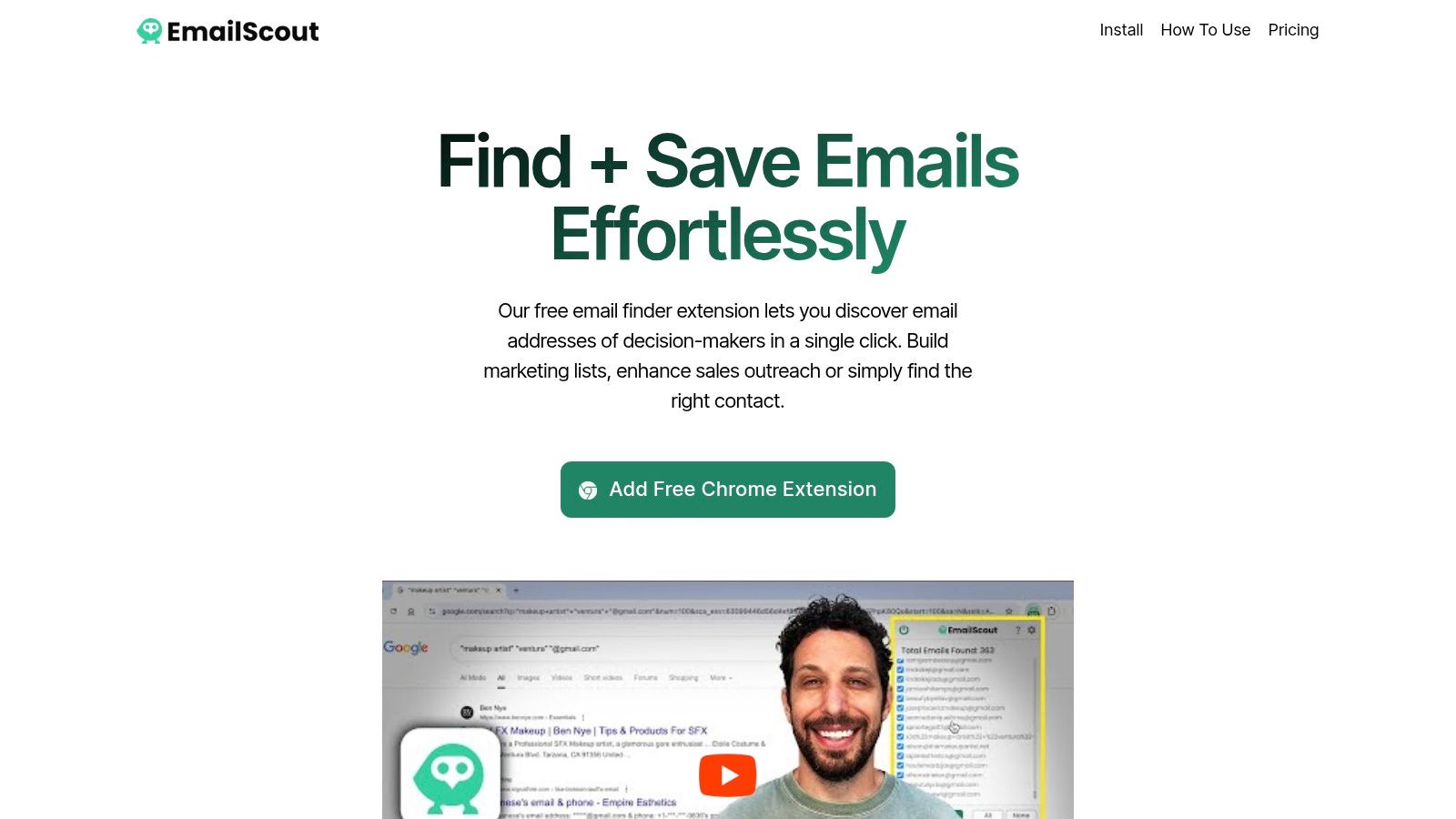
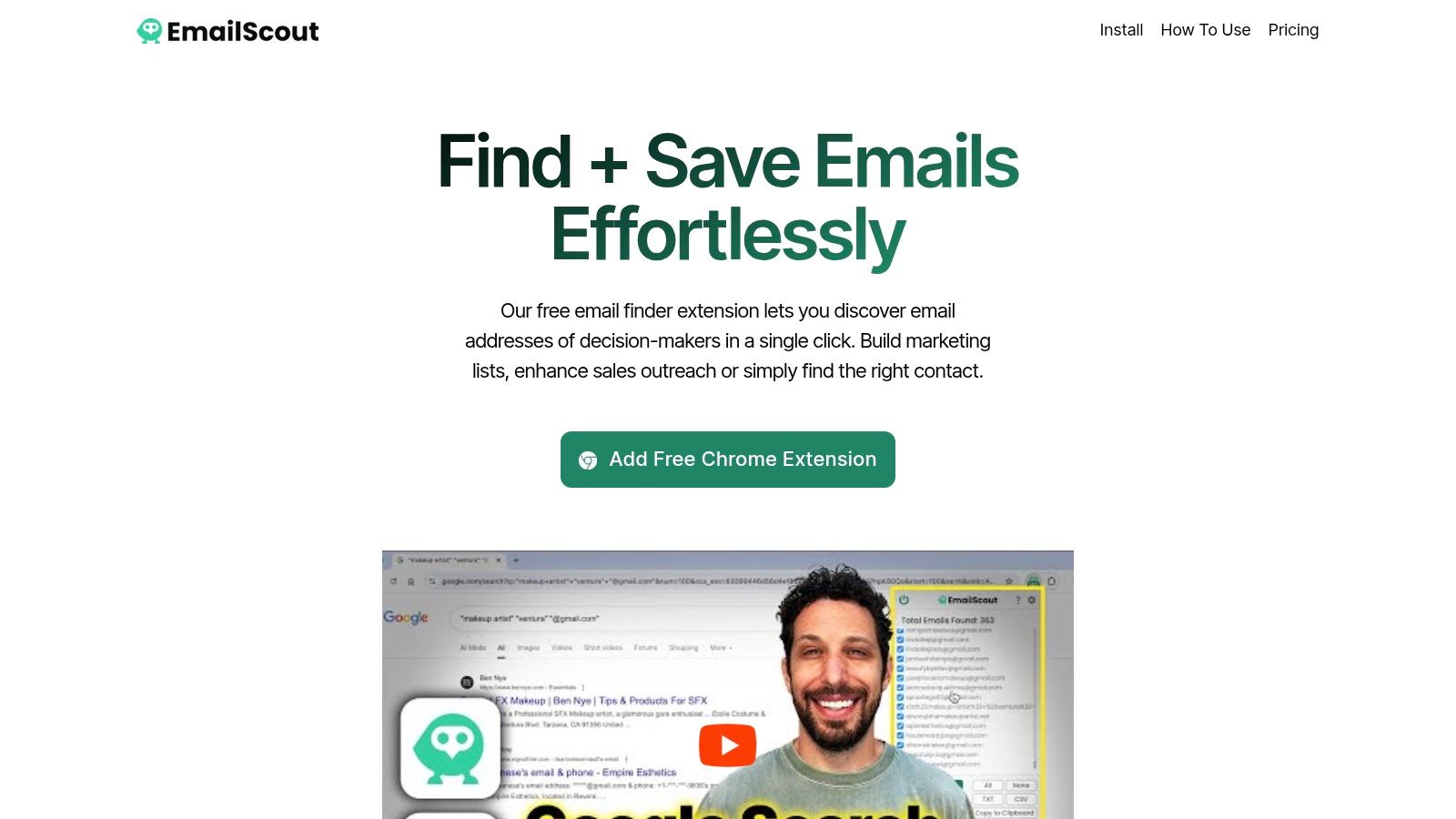
    EmailScout distinguishes itself as the best email finder tool for users who prioritize speed, simplicity, and a frictionless entry point. It operates as a lightweight Chrome extension that transforms any website or Google search results page into a direct source for contact information. With a single click, it scrapes and collects publicly available email addresses from a site's source code, making it exceptionally effective for sales professionals, marketers, and founders who need to build targeted outreach lists quickly.

    EmailScout

    The primary advantage of EmailScout lies in its generous free tier, which offers unlimited email discovery and exports. This allows users to validate its utility for their specific needs without any financial commitment, a significant benefit for startups and freelancers. For those requiring more advanced capabilities, premium plans introduce powerful automation features.

    Standout Features & Use Cases

    EmailScout’s functionality is built for immediate action. The one-click discovery from any webpage is perfect for quickly grabbing a contact from a company’s "About Us" page or a blog author’s profile.

    • AutoSave: This premium feature automatically collects emails in the background as you browse websites, building lists passively and efficiently. It’s ideal for market researchers or sales reps who are constantly visiting new company sites.
    • URL Explorer: For large-scale campaigns, you can upload a list of up to 1,500 URLs (on higher tiers) and let the tool bulk-scan them for contacts. This is a game-changer for lead generation specialists working from a predefined list of target companies.

    Practical Considerations

    The tool’s method of scraping source code means it finds what is publicly available. Consequently, results may include generic addresses (like info@ or support@) or outdated contacts. EmailScout does not include a built-in verification or deliverability score, so it is best practice to pair it with a separate email verification service before launching a large-scale campaign. To get the most out of your prospecting, you can learn more about how to find company email addresses and implement best practices for outreach.

    Pricing and Access

    • Free Plan: Unlimited email discovery and exports.
    • Premium Trial: 200 emails/month, no credit card required.
    • Paid Plans: Start around $9/month for 5,000 emails and scale up to 1 million emails/month for high-volume needs.

    EmailScout is a superb choice for users who want an uncomplicated, cost-effective tool to start finding email addresses immediately. While it requires users to perform their own verification and be mindful of data privacy, its ease of use and powerful free offering make it an indispensable asset for rapid lead generation.

    Visit EmailScout

    2. Hunter

    Hunter has long been a standard in the email lookup space, making it a reliable choice for sales teams and marketers who prioritize a clean, end-to-end workflow. Its core strength lies in its domain-based search functionality, allowing users to find all publicly available email addresses associated with a specific company domain. This approach is highly effective for B2B prospecting when you know the target company but not the specific contact.

    Hunter

    The platform’s credit system is transparent: one search equals one credit, and one verification equals one credit. This simple pricing model removes the guesswork often found with other tools. Additionally, Hunter includes built-in email verification for every address it finds, displaying confidence scores to help you gauge accuracy. To make sure you maintain a clean list, you can learn more about how to validate an email address and why it's a critical step before sending.

    Key Strengths & Use Cases

    • Best for: B2B sales development representatives (SDRs) and marketing teams building targeted outreach lists from a known set of companies.
    • Standout Feature: The "Domain Search" tool is a powerful way to quickly map out key contacts within an organization.
    • Practical Tip: Use the Chrome extension to find email addresses directly from a company’s website or a contact’s LinkedIn profile, saving significant time.

    Hunter offers a free plan with 25 monthly searches. Paid plans start at $49/month for 500 searches, and all paid tiers allow unlimited team members to share the same credit pool, making it a cost-effective option for collaborative teams.

    Website: https://hunter.io

    3. Apollo.io

    Apollo.io stands out as more than just an email finder; it's an end-to-end sales intelligence and engagement platform. Its primary advantage is bundling a massive B2B contact database with the tools needed to act on that data, such as sequencing, a built-in dialer, and analytics. This all-in-one approach is ideal for sales teams, especially in the US market, who want to reduce tool-stack complexity and manage their entire outbound process from a single dashboard.

    The platform operates on a credit system where finding a verified email or direct-dial phone number typically costs one credit. This unified model simplifies resource management for prospecting activities. While Apollo.io offers powerful features, its public pricing can be complex, with various add-ons and fair-use policies governing its "unlimited" plans. This means the total cost of ownership can vary, requiring careful evaluation based on your team's specific needs for data and engagement tools.

    Key Strengths & Use Cases

    • Best for: Sales teams that need an integrated solution for finding contacts, engaging them via email and phone, and analyzing performance without switching between multiple platforms.
    • Standout Feature: The combination of a high-quality B2B database with a built-in dialer and email sequencing engine makes it a complete outbound prospecting tool.
    • Practical Tip: Use the Chrome extension to enrich contact data directly from LinkedIn profiles, a method that aligns with modern B2B sales workflows. You can discover more about finding emails on LinkedIn to maximize your prospecting efficiency.

    Apollo.io provides a generous free plan with 60 email credits per year. Paid plans start at $49/user/month, offering more credits and advanced features like integrations and team governance.

    Website: https://www.apollo.io

    4. RocketReach

    RocketReach distinguishes itself by offering more than just email addresses; it provides a comprehensive contact profile, often including direct-dial phone numbers. This makes it a powerful asset for sales, recruiting, and partnership teams that rely on multi-channel outreach strategies. Its database is one of the largest available, drawing from public data sources to build detailed profiles for millions of professionals and companies worldwide.

    RocketReach

    The platform functions as a massive B2B directory where users can search for individuals or companies and export findings via CSV. While its broad coverage is a major advantage, the accuracy can sometimes be mixed, as it pulls from a wide array of unverified public sources. For teams needing a reliable email finder tool that also supports phone-based outreach, RocketReach serves a very specific and valuable purpose in their tech stack.

    Key Strengths & Use Cases

    • Best for: Sales and recruiting teams who need both emails and direct phone numbers for multi-touchpoint outreach campaigns.
    • Standout Feature: Its extensive database that includes a high volume of direct-dial and mobile phone numbers, a key differentiator from many email-only tools.
    • Practical Tip: Use the browser extension on social profiles to quickly pull contact details without navigating away from your prospect’s page, which speeds up lead gathering significantly.

    RocketReach offers a free trial with 5 lookups per month. Paid plans start at $59/month for 170 lookups, with higher-tier plans unlocking team features, API access, and more advanced integrations.

    Website: https://rocketreach.co

    5. Lusha

    Lusha has earned a strong reputation among B2B sales professionals, particularly for its straightforward credit-based model that separates email and phone number reveals. This platform is ideal for sales development (SDR) and account executive (AE) teams who need a simple, pay-per-reveal structure for both email and direct dial acquisition. Its ease of use makes it a popular choice for individuals to trial before scaling up to a full team plan.

    Lusha

    The platform's credit economics are clear: one credit typically reveals an email address, while phone numbers cost more. This transparency allows teams to manage their budgets effectively based on their specific outreach priorities. Lusha's browser extension integrates smoothly into daily workflows, especially on LinkedIn, allowing users to find contact details without switching tabs. This direct integration makes it an efficient and valuable part of any modern sales toolkit.

    Key Strengths & Use Cases

    • Best for: Sales teams that prioritize both email and direct phone numbers for their outreach and appreciate a flexible, pay-per-contact pricing model.
    • Standout Feature: The distinct credit system for different contact types (emails vs. phone numbers) gives users more control over their spending.
    • Practical Tip: Use the free monthly credits to test Lusha's data accuracy and coverage within your target industries before committing to a paid subscription.

    Lusha provides a free plan with 5 monthly credits for individuals to test its capabilities. Paid plans start at $29/user/month (billed annually) for 480 credits, with higher-tier plans offering more credits, CRM integrations, and advanced team features.

    Website: https://www.lusha.com

    6. Snov.io

    Snov.io is more than just an email finder; it’s a full-stack cold outreach automation platform designed for sales and marketing teams that want a unified workflow. It combines an effective email lookup tool with verification, drip campaigns, and even deliverability features, reducing the need to patch together multiple subscriptions. This all-in-one approach is ideal for teams that need to manage the entire prospecting pipeline, from finding a contact to warming up an inbox and launching an automated sequence, all within a single dashboard.

    Snov.io

    The platform operates on a transparent credit system where credits can be used for finding leads or verifying emails, providing flexibility in how you use your monthly allowance. While the core features are robust, it's important to note that certain advanced add-ons, like LinkedIn automation, are billed separately. This makes it a powerful but potentially more expensive option if you need every tool in its arsenal. Still, for its primary function as one of the best email finder tool choices integrated with outreach, it offers significant value.

    Key Strengths & Use Cases

    • Best for: Sales teams and marketers who need an integrated solution for prospecting, outreach automation, and email deliverability management.
    • Standout Feature: The "Email Drip Campaigns" tool allows you to build and automate complex, multi-touch outreach sequences directly with the contacts you find.
    • Practical Tip: Use the free email warm-up tool before launching any major campaigns to improve your sender reputation and ensure your emails land in the primary inbox.

    Snov.io offers a free-forever plan that includes 50 credits per month. Paid plans start at $39/month for 1,000 credits and 5,000 email recipients, scaling up to support larger teams and higher-volume needs.

    Website: https://snov.io

    7. UpLead

    UpLead positions itself as a data-first B2B prospecting platform, built on a foundation of high accuracy. Its core promise is a 95% data accuracy guarantee, which it supports with real-time email verification on every download. This focus on quality over sheer quantity makes it an excellent choice for teams that cannot afford high bounce rates and want to ensure their outreach is built on reliable contact information from the start.

    UpLead

    The platform goes beyond simple email finding, offering a rich dataset that includes mobile direct dials, technographics, and intent data on its higher-tier plans. UpLead's credit system is straightforward: one credit unlocks one full contact profile, including their verified email and phone number. This simple model makes it easy to manage usage and predict costs. While it's a powerful email finder tool, the additional data points allow for more layered and intelligent prospecting campaigns.

    Key Strengths & Use Cases

    • Best for: Sales and marketing teams at SMBs and SMEs that prioritize high-quality, verified data and require more than just email addresses for their outreach.
    • Standout Feature: The real-time verification process, which checks an email’s validity at the moment of download, significantly reduces the risk of list decay and bounces.
    • Practical Tip: Use the technographics filter to identify companies using specific software (like a competitor’s product) to create highly relevant and timely sales pitches.

    UpLead offers a free trial with 5 credits. Paid plans begin at $74/month for 2,040 annual credits (equivalent to 170 monthly), with access to CRM integrations and a Chrome extension.

    Website: https://www.uplead.com

    8. Skrapp

    Skrapp excels for sales teams and marketers whose lead generation workflows are heavily centered on LinkedIn. It provides a straightforward and effective solution for finding verified email addresses directly from LinkedIn profiles, including Sales Navigator. The platform’s strength is its tight integration with the professional network, allowing users to build targeted lists quickly without juggling multiple tabs or tools.

    Skrapp

    Its competitive pricing, especially for mid-to-high credit volumes, makes it an attractive option for growing teams. Unlike many competitors, Skrapp allows credits to roll over, ensuring you get the full value of your subscription. While it is an excellent email finder tool, it maintains a clear focus on email discovery and verification, so teams needing extensive phone data will need to look elsewhere.

    Key Strengths & Use Cases

    • Best for: Sales teams and recruiters who primarily use LinkedIn and Sales Navigator for prospecting and need an affordable way to find emails at scale.
    • Standout Feature: The multi-page enrichment on LinkedIn allows users to extract emails from entire search result pages in a single click, dramatically speeding up list-building.
    • Practical Tip: Organize your findings into distinct lists within the Skrapp dashboard. You can then export these clean, segmented lists directly to your CRM or as a CSV file for targeted campaign execution.

    Skrapp offers a free plan with 100 monthly credits. Paid plans begin at $49/month for 1,000 credits and 2,000 verifications, with options for teams to share a central credit pool, making it a flexible and cost-effective choice.

    Website: https://skrapp.io

    9. VoilaNorbert

    VoilaNorbert positions itself as a friendly and straightforward assistant for finding anyone's email address. Its clean user interface and simple, credit-based system make it an approachable choice, particularly for users who value clarity and predictability. The platform’s core promise is to only charge for successful email finds, which removes the risk of wasting credits on unverified or incorrect data.

    VoilaNorbert

    This tool is especially well-suited for individuals or teams that need a reliable email finder without the complexity of a full-suite sales platform. It offers separate pay-as-you-go options for email verification and data enrichment, allowing users to add these services on an as-needed basis rather than bundling them into a costly monthly subscription. This flexibility makes it a cost-effective option for specific, targeted campaigns where you only pay for the services you actually use.

    Key Strengths & Use Cases

    • Best for: Freelancers, small business owners, and sales teams who need a simple, accurate email finder tool with transparent, pay-for-success pricing.
    • Standout Feature: The "Pay only for successful finds" model provides a high degree of confidence and cost control, ensuring your budget is spent effectively.
    • Practical Tip: Use the Chrome extension to quickly find contact information while browsing LinkedIn or company websites, then use the pay-as-you-go enrichment feature to pull additional data for personalization.

    VoilaNorbert offers a free trial with 50 credits. Paid plans start at $49/month for 1,000 credits, with all finder plans including credit rollovers and unlimited team members, making it easy to collaborate.

    Website: https://www.voilanorbert.com

    10. ContactOut

    ContactOut carves out a specific niche as an email finder tool, with a strong focus on recruiting and sales workflows that require more than just a corporate email. It excels at uncovering personal email addresses and, in many cases, phone numbers directly from LinkedIn profiles. This makes it a powerful asset for recruiters needing to reach candidates outside of business hours or for sales professionals aiming for a more direct, personal outreach.

    ContactOut

    The platform operates primarily through a Chrome extension that integrates with LinkedIn and Sales Navigator, allowing users to find contact details in real-time. For larger teams, ContactOut offers a web portal with search capabilities, CSV exporting, and integrations with popular Applicant Tracking Systems (ATS) and CRMs. This dual functionality supports both individual prospectors and large-scale, coordinated outreach campaigns.

    Key Strengths & Use Cases

    • Best for: Recruiters, headhunters, and sales teams who prioritize finding personal contact details for direct communication.
    • Standout Feature: Its high success rate in finding personal emails and phone numbers sets it apart from many competitors focused solely on work addresses.
    • Practical Tip: Use the extension on LinkedIn Sales Navigator to build highly targeted lead lists, enriching them with direct contact information as you go.

    ContactOut's pricing can be opaque, with many of its advanced team and API plans requiring a sales demo. Individual plans start around $29/month, but be aware that some tiers marketed as "unlimited" may have fair-use policies.

    Website: https://contactout.com

    11. GetProspect

    GetProspect positions itself as an affordable, all-in-one prospecting solution, making it a strong contender for small to mid-sized businesses (SMBs) and startups. It combines an email finder and verifier with a LinkedIn extension and basic cold outreach capabilities, creating a cohesive workflow for users who need more than just data. The platform's "pay only for valid emails" policy is a key differentiator, ensuring users get maximum value from their credits.

    GetProspect

    One of its most appreciated features is the monthly rollover for unused credits, offering flexibility that budget-conscious teams need. While its interface and the depth of its data may be simpler compared to top-tier sales intelligence platforms, it provides a solid foundation for lead generation without a hefty price tag. For those looking for an effective yet straightforward email finder tool, GetProspect strikes a good balance between cost and functionality.

    Key Strengths & Use Cases

    • Best for: Startups, SMBs, and freelance sales professionals seeking an affordable, multi-functional tool with flexible credit usage.
    • Standout Feature: The combination of a generous free plan, credit rollover, and a "pay for valid emails" model makes it a very low-risk option.
    • Practical Tip: Use the LinkedIn Chrome extension to build prospect lists directly from searches and profiles, then export them as a CSV or sync them with your CRM to begin outreach.

    GetProspect offers a free plan with 50 valid emails per month. Paid plans begin at just $49/month for 1,000 valid emails, with options to add phone number credits and scale up as your team grows.

    Website: https://getprospect.com

    12. Findymail

    Findymail positions itself as a high-deliverability email finder by tying its billing model directly to successful outcomes. It's built for sales and marketing teams who are tired of paying for unverified or bounced emails. The platform’s core promise is simple: you only spend a credit when it successfully returns a verified business email address or a phone number, which helps to eliminate wasted spend on unreliable data.

    This outcome-based approach makes it a strong contender for anyone focused on maintaining a high sender reputation and minimizing bounce rates. Findymail integrates built-in verification into every search, ensuring the data you receive is ready for outreach. While it's a dedicated prospecting tool, it also offers a CRM enrichment add-on, allowing you to append contact data to your existing records.

    Key Strengths & Use Cases

    • Best for: Deliverability-conscious outreach teams and solo prospectors who want to pay only for verified, high-quality contact information.
    • Standout Feature: The "pay-per-verified-lead" credit system ensures you aren't charged for unsuccessful searches, aligning costs with results.
    • Practical Tip: Use the Chrome extension over LinkedIn Sales Navigator to build highly targeted lead lists. Since credits are only used for successful finds, you can prospect freely without worrying about wasting your monthly allowance on profiles without accessible contact details.

    Findymail offers a free trial for your first 10 verified emails. Paid plans begin at $49/month for 1,000 credits, with the unique benefit that unused credits roll over up to twice your monthly allotment, adding flexibility for fluctuating prospecting needs.

    Website: https://www.findymail.com

    Top 12 Email Finder Tools Comparison

    Tool Core features Verification & UX Best for Price & USP
    EmailScout Chrome extension, one-click scrape, AutoSave, URL Explorer, CSV/TXT export Ultra-simple UI, unlimited free finds/exports, no built-in deliverability scoring Marketers, SDRs, founders, freelancers who need fast lists Free unlimited discovery; Premium from ≈$9/mo (5K), trial 200/mo; USP: free unlimited searches, one-click workflow (Recommended)
    Hunter Domain search, Email Finder, bulk tools, outreach sequences, API Built-in email verifier, good accuracy, transparent credit rules SDRs, marketers, founders needing end-to-end workflow Credit-based plans; USP: reliable verification + outreach integration
    Apollo.io B2B contact DB + engagement, dialer, sequences, CRM integrations Verified emails/phones, unified credits, integrated engagement UX US outbound teams, sales orgs wanting one platform Tiered credit bundles; USP: all-in-one data + engagement stack
    RocketReach Person/company search, emails & direct dials, extension, API Broad coverage (email & phone), variable accuracy by contact Sales, recruiting, partnerships for multi-channel outreach Tiered/team plans; USP: wide phone + email coverage
    Lusha Credit-based reveals, extension, CRM sync Simple UX, free monthly credits to trial, basic verification SDRs/AEs wanting pay-per-reveal simplicity Pay-per-reveal credits; USP: straightforward credit economics (emails cheaper than phones)
    Snov.io Email finder, verifier, outreach sequences, warm-up tools Integrated deliverability/warm-up, transparent credit model Teams wanting find→verify→outreach in one dashboard Plan-based credits; USP: built-in warm-up + outreach automation
    UpLead Prospector, real-time verification, enrichment, technographics High-accuracy focus (95%+ claims), verification at download SMB/SME teams prioritizing data quality & integrations Credit tiers; USP: real-time verified downloads & enrichment
    Skrapp Email finder & verifier, LinkedIn/SalesNav integration, team credits LinkedIn-centric UX, credit rollover, competitive pricing LinkedIn-driven teams needing affordable volume Volume-friendly credits; USP: favorable pricing for LinkedIn workflows
    VoilaNorbert Individual & bulk finder, verification, extension, enrichment Pay-as-you-go verification, clear limits, credit rollover Users who prefer simple UI and predictable billing Pay-as-you-go + finder plans; USP: pay only for successful finds
    ContactOut LinkedIn-based personal/work email discovery, extension, API Strong personal email coverage, CSV export, team/API options Recruiters and sales targeting personal outreach Team/API tiers via sales; USP: high personal-email hit-rate
    GetProspect Email finder & verifier, LinkedIn extension, enrichment, cold-email module Budget-friendly UX, credit rollover, modest phone add-ons SMBs needing affordable prospecting + outreach Starter tiers with rollover; USP: cost-effective starter plans
    Findymail Outcome-based finder + verification, Chrome workflows, CRM add-ons Only charges when a verified email/phone is returned, built-in verification Deliverability-conscious teams wanting low-bounce lists Pay-per-verified result; USP: outcome-based billing reduces verification waste

    How to Choose the Best Email Finder Tool for Your Workflow

    Navigating the crowded market of email finders can feel daunting, but after reviewing the top contenders from EmailScout to Findymail, a clearer picture emerges. The core decision doesn't rest on finding a single "perfect" tool, but rather on identifying the one that aligns precisely with your team's specific objectives, scale, and budget. Your search for the best email finder tool should be guided by a practical assessment of your daily workflow.

    Throughout this guide, we've seen how tools like Hunter and VoilaNorbert excel in simplicity and single-search accuracy, making them great for freelancers or small teams. On the other end, platforms like Apollo.io and Snov.io offer robust, all-in-one sales engagement features that go far beyond simple email discovery, serving the needs of established sales and marketing departments.

    Key Factors to Guide Your Decision

    Making the right choice requires a look inward at your own processes. Before committing to a subscription, consider these critical factors:

    • Accuracy and Verification: How much risk can you tolerate? Tools like EmailScout and UpLead place a heavy emphasis on real-time verification, which is crucial for protecting your domain's sending reputation. If you're sending emails at scale, this non-negotiable feature prevents high bounce rates that could get you blacklisted.
    • Integration and Workflow: Where does this tool fit into your existing stack? A standalone Chrome extension might be enough for a recruiter, but a sales team will need seamless integration with their CRM (like Salesforce or HubSpot). Consider how much manual data entry you want to eliminate.
    • Data Source and Compliance: Do you need B2B data exclusively, or do you also need contact information from a broader range of sources? Understand where the tool pulls its data from and ensure its practices align with privacy regulations like GDPR and CCPA. Tools like RocketReach and ContactOut offer access to a massive database but require careful handling of that information.
    • Scalability and Pricing: Your needs today may not be your needs in six months. Evaluate pricing models carefully. Is a credit-based system (like Lusha or Skrapp) more cost-effective for your sporadic use, or does an unlimited plan better suit your high-volume outreach goals?

    Implementation Best Practices

    Once you've selected a tool, successful adoption depends on more than just handing out logins. To truly get value from your investment, you need a plan. Start by defining clear use cases for your team. Are they primarily using it for lead generation on LinkedIn, enriching an existing contact list, or finding key decision-makers for ABM campaigns?

    Training is also essential. Ensure everyone understands not just how to use the tool, but why certain features, like data verification, are important for the company's long-term goals. When considering how to integrate an email finder tool into your daily operations, it's also worth exploring related resources such as the best Gmail productivity tools, which can further streamline your entire workflow from prospect discovery to final outreach.

    Ultimately, the best email finder tool is the one that becomes an invisible, indispensable part of your growth engine. It should reduce friction, not create it. By matching a tool's strengths to your specific challenges, you can turn a simple software subscription into a powerful asset for building meaningful connections and driving business forward.


    Ready to find verified emails with confidence and stop wasting time on bounced messages? EmailScout was built to provide the highest accuracy by focusing on real-time verification, ensuring you connect with the right person every time. Try EmailScout today and see how reliable data can transform your outreach efforts.

  • 12 Best Chrome Extensions for Productivity in 2025: Sales & Marketing Tools

    12 Best Chrome Extensions for Productivity in 2025: Sales & Marketing Tools

    Chrome extensions can transform routine sales, marketing, and biz-dev tasks into powerful automated workflows. From capturing leads on the fly to managing dozens of tabs without losing context, the right toolkit helps outreach teams do more with less effort.

    In this guide we’ve hand-picked the 12 best chrome extensions for productivity. Each tool includes real-world use cases, honest pros and cons, pricing details, integration tips, and direct links. You’ll learn to skip trial and error by choosing platforms proven in sales, marketing, and biz-dev workflows.

    • Automate cold email campaigns with EmailScout for faster follow ups
    • Organize research and assets across campaigns with tab managers
    • Secure and auto-fill credentials in one click
    • Record quick video demos for async collaboration
    • Pin important tabs with Workona for focused project sessions

    Every entry includes screenshots and direct links for quick access. We also highlight practical implementation notes so you can:

    1. Identify extensions that fit your workflow
    2. Balance free features versus paid plans
    3. Integrate tools into CRMs and project boards

    Whether you’re a sales professional chasing quotas, a marketer juggling campaigns, or a founder flying solo, this list will point you to the best chrome extensions for productivity. Let’s dive in and supercharge your outreach.

    1. EmailScout

    EmailScout is a lightweight, one-click Chrome extension that turns any website or Google search into a lead generation source for sales teams, marketers, and entrepreneurs. Its Zero-config setup and intuitive interface position it as one of the best chrome extensions for productivity in outreach workflows. Its minimal learning curve and responsive support team reduce onboarding friction. Support is available via live chat or email.

    EmailScout

    Key Features

    • AutoSave background captures emails as you browse
    • URL Explorer scans batches of URLs (up to 1,500)
    • One-click extraction directly from page source or search results
    • Export options: CSV or TXT with unlimited free-tier exports

    Typical Use Cases

    1. Building targeted B2B contact lists during market research
    2. Automating bulk lead collection for cold email campaigns

    Pricing & Plans

    Feature Free Tier Premium ($9/mo)
    URL Explorer Manual Bulk up to 1,500 URLs
    AutoSave Not available Background capture
    Monthly Exports Unlimited 5,000 emails

    Pros and Cons

    • Pros
      • Free, unlimited email finding and exports
      • Easy setup, click-and-go interface
      • Affordable scaling to 1M emails per month
    • Cons
      • No built-in verification; results depend on public data
      • Users must manage GDPR and CAN-SPAM compliance

    Quick Tip

    Pin the extension to your toolbar and activate AutoSave before hitting industry directories to streamline lead capture.

    Learn more about EmailScout on emailscout.io

    2. Chrome Web Store – Productivity Collection

    The Chrome Web Store is Google’s official marketplace for discovering and installing browser add-ons. Its “Your productivity toolkit” collection features top-rated extensions vetted by Google’s editorial team. Automatic updates and detailed permissions make it a trusted hub for sales and marketing professionals.

    Chrome Web Store – Productivity Collection

    Navigating the productivity collection gives real user reviews, install counts, and enterprise controls. A Google account and Chrome browser suffice for access. Pricing is free for most extensions; some premium tools offer paid tiers.

    Key Features

    • One-click install to Chrome with automatic updates
    • Curated productivity collections edited by Google’s team
    • Granular permissions and user rating transparency
    • Enterprise controls for managed users in Chrome Enterprise

    Pricing and Access

    • Free to use for most extensions; paid tiers for advanced features
    • Accessible via Chrome browser and Google account
    • Enterprise licensing required for managed controls

    Pros and Cons

    Pros

    • Safest direct source for Chrome extensions
    • Automatic updates and permission prompts

    Cons

    • Overwhelming selection may hinder discovery
    • Extensions can change ownership over time

    Quick Tip

    Use starred collections to save high-value extensions and monitor update notes for best performance.

    Learn more about Chrome Web Store – Productivity Collection on emailscout.io.

    3. Product Hunt – Chrome Extensions Category

    Product Hunt is a product-discovery platform with a dedicated Chrome Extensions category that surfaces recent launches and top-reviewed productivity tools. Community rankings and discussion threads help sales and marketing teams evaluate emerging extensions before they hit mainstream lists.

    Product Hunt – Chrome Extensions Category

    Browsing this category lets you filter by “Top reviewed” and “Newest” to find cutting-edge tools. Each listing links directly to vendor sites and the Chrome Web Store, while user comments and upvotes reveal real usage insights.

    Key Features

    • Community upvotes and aggregate review scores
    • Filters for Top reviewed, Trending, and New launches
    • Direct links to Chrome Web Store and developer websites
    • Comment threads for hands-on feedback and use cases

    Pricing and Access

    • Completely free to browse and use
    • Requires a Product Hunt account for upvoting and commenting
    • No premium tiers; extensions may include paid features separately

    Pros and Cons

    Pros

    • Great for discovering early-stage, innovative tools
    • Honest community feedback highlights strengths and pain points

    Cons

    • Quality varies; some launches may be experimental
    • Fewer enterprise controls compared to official marketplaces

    Quick Tip

    Follow the Chrome Extensions category and enable email alerts to spot high-potential productivity tools before competitors do.

    Learn more on Product Hunt – Chrome Extensions Category.

    4. G2 – Best Chrome Extensions Roundup

    G2 is a leading B2B review and editorial platform that curates top Chrome extensions by productivity use case. Its “Best Chrome Extensions Roundup” offers contextual summaries, buyer guidance, and real user ratings to help sales, marketing, and business development pros discover tools that match their workflows.

    G2 – Best Chrome Extensions Roundup

    The roundup groups extensions by function – task management, ad-blocking, email automation – with pros, cons, and installation links. G2’s verified reviews and scoring system provide honest insights, while detailed buyer guides explain which features matter most for your team’s goals.

    Key Features

    • Curated lists organized by productivity use cases
    • In-depth editorial summaries and buyer guidance
    • Verified user reviews with star ratings and comments
    • Direct links to Chrome Web Store for each extension
    • Comparison tables highlighting feature differences

    Pricing and Access

    • Free access to all articles and roundups
    • No account required for browsing reviews
    • Installations occur via Chrome Web Store links

    Pros and Cons

    Pros

    • Trusted community reviews for workplace adoption
    • Clear buyer guidance streamlines decision making
    • Easy primer for newcomers to extension ecosystems

    Cons

    • Not a direct storefront – redirects to Chrome Web Store
    • May not cover niche or very new extensions

    Quick Tip

    Bookmark G2’s roundup and subscribe to update alerts so you never miss newly published productivity extension reviews.

    Learn more about G2 – Best Chrome Extensions Roundup on G2.

    5. Zapier Blog – “Best Productivity Extensions for Chrome”

    Zapier’s annual guide to the best chrome extensions for productivity offers a vendor-neutral, workflow-focused roundup of proven tools. It highlights clear “best for” labels, up-to-date pricing snapshots, and direct links to official extension pages, making it ideal for sales professionals and digital marketers.

    Zapier Blog – “Best Productivity Extensions for Chrome”

    Each entry is organized by use case, from task management to ad-blocking, with annual refreshes that keep recommendations current. No login or subscription is required to access the full guide, and readers can click through to vendors’ pages for detailed feature and pricing information.

    Key Features

    • “Best for” labels categorizing each extension by workflow need
    • Annual update cycle with fresh insights on new releases
    • Pricing callouts for popular free and paid tools
    • Direct links to official extension pages for quick install

    Pricing and Access

    • Free to read on Zapier Blog, no account needed
    • Vendor pricing varies; links direct to latest plans
    • Bookmark or subscribe to RSS feed for update alerts

    Pros and Cons

    Pros

    • Credible, vendor-neutral editorial perspective
    • Workflow-focused recommendations tailored to roles

    Cons

    • Not exhaustive; prioritizes widely used tools
    • Pricing and features may change between updates

    Quick Tip

    Subscribe to Zapier’s RSS feed or email alerts to catch new extension reviews as they publish each year.

    Learn more about Zapier Blog – “Best Productivity Extensions for Chrome” on emailscout.io.

    6. Android Police – “Essential Chrome Productivity Extensions”

    Android Police is a trusted tech publication delivering hands-on picks for the best chrome extensions for productivity with practical usage notes and real world tips. You get clear, tested recommendations tailored to both desktop and mobile Chromebook users.

    Android Police – “Essential Chrome Productivity Extensions”

    Navigating this curated guide links directly to official listings. Each extension is tested in plain English with performance observations on page load, resource use, and UI. Free access, no sign-up required, works in any Chrome or Chromium based browser.

    Key Features

    • Practical usage notes based on hands-on testing
    • Mobile and Chromebook perspective for on-the-go workflows
    • Direct links to Chrome Web Store entries
    • Plain-English explanations of setup and best practices

    Pricing and Access

    • Completely free to read and implement
    • No account or subscription needed
    • Compatible with Chrome, Edge, Brave, and other Chromium browsers

    Pros and Cons

    Pros

    • Real-world performance insights
    • Advice on when each tool shines on mobile or desktop

    Cons

    • Selections may update over time
    • Not a full extension marketplace

    Quick Tip

    Bookmark key extension notes as a cheat sheet, then test alongside your cold email and outreach tools for smooth integration.

    Learn more about Android Police – “Essential Chrome Productivity Extensions” on Android Police.

    7. SlashGear – “Best Chrome Extensions to Boost Productivity”

    SlashGear curates concise collections of leading Chrome add-ons for productivity, perfect for sales reps and marketers needing a quick shortlist of high-impact tools. Its editorial picks include top-rated options with direct install links and brief pros for swift decision making. SlashGear’s interface is minimalist and easy to scan on the go, helping busy entrepreneurs find tools in seconds.

    SlashGear – “Best Chrome Extensions to Boost Productivity”

    Key Features

    • Short lists of popular extensions with clear pros and pricing context
    • Direct links to Chrome Web Store for one-click install
    • Editor notes on use cases for sales, marketing, ecommerce
    • Mobile-friendly summaries optimized for quick reading
    • Regular updates reflecting newest and top-rated tools

    Pricing and Access

    • Free to browse and read on SlashGear
    • Extensions may offer free or paid tiers on the Web Store
    • No registration required to access lists
    • Compatible with any desktop or mobile Chrome browser
    • Accessible worldwide without geo restrictions

    Pros and Cons

    Pros

    • Fast insight into best chrome extensions for productivity
    • Clear pricing and usage takeaways
    • Editorial curation reduces decision fatigue

    Cons

    • Not a purchase portal – must click through to install
    • Editorial bias may skip emerging niche tools

    Quick Tip

    Bookmark the SlashGear list and enable Chrome sync to keep your productivity toolkit consistent across all devices.

    Learn more on SlashGear: https://www.slashgear.com/1621931/best-chrome-extensions-productivity-boost/

    8. The Keyword (Google Blog) – “5 Chrome extensions to increase productivity”

    The Keyword is Google’s official blog highlighting a select group of Chrome extensions that streamline everyday workflows. Each post offers detailed examples of how to integrate tools like tab managers or grammar checkers directly into your browser.

    The Keyword (Google Blog) – “5 Chrome extensions to increase productivity”

    With clear screenshots and direct links you can install recommended extensions in seconds. Posts include real world scenarios such as using a screenshot tool for sales demos or a time tracker for freelance billing. No third party marketing fluff, just hands on advice that aligns with Chrome features.

    Key Features

    • Official curation by Google’s editorial team
    • Practical use case scenarios for each extension
    • Direct links with install and permission details
    • In-post screenshots showing real interface steps

    Pricing and Access

    • Free to read with no login required
    • Extensions often free or freemium via Chrome Web Store
    • Requires Chrome browser for direct install

    Pros and Cons

    Pros

    • Trusted source with deep UX insights
    • Examples tailored to common sales and marketing tasks

    Cons

    • Limited to five extensions per post
    • Not a marketplace for paid tier tools

    Quick Tip

    Subscribe to The Keyword RSS feed to catch new extension roundups as soon as they publish.

    Learn more about The Keyword (Google Blog) – “5 Chrome extensions to increase productivity” on The Keyword.

    9. Workona – Tab Manager & Workspaces (official site)

    Workona is the official site for a leading tab and workspace manager with a Chrome extension that helps sales and marketing teams keep projects organized. With its intuitive interface users can group tabs into workspaces, suspend idle tabs to reduce memory usage, and search across sessions from any new tab.

    Workona – Tab Manager & Workspaces (official site)

    On the Workona platform teams can share workspaces, assign tasks, and sync context across devices. Its powerful search engine surfaces open tabs, pinned resources, and saved projects in seconds. A clean dashboard offers quick access to current workflows without clutter.

    Key Features

    • Spaces and workspaces for project-based tab organization
    • Tab suspension to free up RAM and speed up Chrome
    • Cross-tab search and new-tab integration for rapid retrieval
    • Collaboration options for shared team workspaces

    Pricing and Access

    • Free plan includes 10 workspaces and up to 20 tabs synced
    • Paid plans start at $10 per user per month for unlimited workspaces
    • Requires Chrome browser and a free Workona account

    Pros and Cons

    Pros

    • Noticeable performance and focus gains for heavy tab users
    • Business-friendly features enabling team collaboration

    Cons

    • Advanced collaboration features are locked behind a paid plan
    • Some users may face a learning curve with complex workspace setups

    Quick Tip

    Pin your most critical workspaces to the sidebar and use custom labels to switch contexts quickly between client outreach and content research.

    Learn more about Workona – Tab Manager & Workspaces on workona.com.

    10. Todoist – Official Plans (Todoist for Chrome extension)

    Todoist’s official pricing page outlines everything you need to maximize the Todoist for Chrome extension, a top-rated task manager that captures to-dos on any webpage and syncs seamlessly across devices. You can compare plan levels to unlock features like labels, filters, and project templates.

    Todoist – Official Plans (Todoist for Chrome extension)

    Browsing the pricing table presents side-by-side comparisons of the Free, Premium, and Business tiers, with clear notes on user limits. A Todoist account and Chrome installation are all you need to get started and adjust your plan at any time.

    Key Features

    • Quick-add tasks from web pages or email with a single click
    • Labels, filters, priorities, and project sections for granular organization
    • Real-time cross-platform sync with desktop, mobile, and calendar apps
    • Integration with tools like Google Calendar, Slack, and Zapier

    Pricing and Access

    • Free plan with core task creation and basic labels
    • Premium starts at $4 per user per month billed annually
    • Business plan with team administration, projects, and priority support
    • Requires registration on Todoist and Chrome browser

    Pros and Cons

    Pros

    • Polished interface optimized for both solo users and teams
    • Extensive integration ecosystem boosts productivity
      Cons
    • Key power features such as reminders require paid tiers
    • Pricing tiers and renewal terms may change without notice

    Quick Tip

    Enable keyboard shortcuts (Ctrl+Shift+A) to add tasks instantly from any tab.

    Learn more about Todoist – Official Plans on Todoist Pricing.

    11. 1Password – Official Pricing (Chrome extension included)

    The 1Password pricing page lays out subscription tiers and features for its award-winning password manager with a Chrome extension included. Users get autofill for passwords, passkeys, and 2FA codes alongside secure item storage and cross-device sync. This resource centralizes details to help teams and individuals boost productivity by speeding logins and credential management.

    1Password – Official Pricing (Chrome extension included)

    Browsing plans on 1Password.com is intuitive; each tier lists user seats, shared vault options, and enterprise controls. Clear comparisons help decision makers evaluate cost against features like automated security alerts, dedicated support, and custom role assignments. Its polished interface and responsive customer service set it apart from open-source alternatives.

    Key Features

    • Autofill for passwords, passkeys, and 2FA codes
    • Cross-device sync and shared vaults for teams and families
    • Security alerts (Watchtower) for weak or compromised credentials

    Pricing and Access

    • Subscription plans start at $2.99 per user per month (billed annually)
    • Team and Business tiers include activity logs and custom roles
    • Chrome extension free with any paid plan

    Pros and Cons

    Pros

    • Highly regarded security model and independent audits
    • Streamlines daily logins and account switching

    Cons

    • Subscription-based pricing, no free open-source option
    • Exact pricing varies by plan and region—confirm at checkout

    Quick Tip

    Enable Watchtower notifications in browser settings to receive real-time alerts on compromised credentials.

    Learn more about 1Password – Official Pricing on 1Password.

    12. Loom – Official Pricing (Chrome recorder for async collaboration)

    Loom’s pricing page offers transparent subscription layers for its Chrome recorder, enabling users to assess which plan meets their async video messaging needs. From single-click screen captures to AI summarization, it breaks down feature access by tier.

    Loom – Official Pricing (Chrome recorder for async collaboration)

    Navigating loom.com/pricing, you can compare Free, Business, and Enterprise plans, review team management tools, and upgrade within the browser. The intuitive interface and clear feature matrix ensure sales and marketing teams invest in relevant capabilities.

    Key Features

    • One-click screen, camera, and audio capture directly in Chrome
    • Auto-generated titles, summaries, and chapters powered by AI
    • Shared video libraries with timestamped comments for collaboration
    • Inline embed options for emails and documentation

    Pricing and Access

    • Free tier includes 5-minute recordings with basic editing
    • Business plan unlocks unlimited recordings and AI enhancements
    • Enterprise tier adds advanced security, SSO, and dedicated support

    Pros and Cons

    Pros

    • Speeds up explanations compared to long emails or calls
    • Robust AI features enhance clarity and accessibility
    • Browser-based updates ensure newest features immediately

    Cons

    • Free tier imposes recording length limits
    • Advanced AI and team features require higher-tier plans

    Quick Tip

    Embed Loom videos in cold email campaigns to boost engagement and clarify product demos without leaving your inbox.

    Learn more about Loom – Official Pricing on loom.com/pricing.

    Top 12 Chrome Productivity Resources — Quick Comparison

    Product Core features UX & Quality Price & Value Best for Standout point
    EmailScout (recommended) One‑click email finder; AutoSave; URL Explorer; CSV/TXT export Easy Chrome install; instant results; browser‑based workflow Free unlimited find/exports; Premium from $9/mo (5K/mo) – plans to 1M; 200‑email trial Sales, marketers, founders, freelancers, biz‑dev AutoSave + bulk URL scanning for automated list building
    Chrome Web Store – Productivity Collection One‑click install; auto‑updates; ratings & reviews Trusted, secure source; granular permissions shown Free marketplace; extensions may be free or paid General users & IT admins Official storefront with enterprise controls
    Product Hunt – Chrome Extensions Category Rankings; community reviews; filters Good discovery UX for new launches Free to browse Early adopters, makers, product hunters Spot emerging tools and early traction
    G2 – Best Chrome Extensions Roundup Curated lists by use case; buyer guidance B2B review ecosystem; contextual summaries Free editorial content Teams evaluating tools for work use Review‑driven buyer guidance for workplace adoption
    Zapier Blog – “Best Productivity Extensions” “Best for” labels; pricing snapshots; links Workflow‑focused editorial; practical guidance Free editorial content Workflow/automation focused users Vendor‑neutral, task‑oriented recommendations
    Android Police – “Essential Chrome Productivity Extensions” Hands‑on picks; mobile/Chromebook notes Practical, tested reviews and tips Free editorial content Chromebook and mobile users Mobile/Chromebook perspective with real‑world tips
    SlashGear – “Best Chrome Extensions to Boost Productivity” Concise lists; quick pros & pricing Consumer‑friendly, easy scanning Free editorial content Casual users making a quick shortlist Fast shortlist creation with pricing context
    The Keyword (Google Blog) – “5 Chrome extensions…” Official Google picks; practical examples High trust; aligned with Chrome features Free editorial content General users seeking starter tools Google‑endorsed selection and examples
    Workona – Tab Manager & Workspaces Spaces/workspaces; tab suspension; search Improves focus & memory usage; team features Freemium; advanced features paid Heavy tab users, teams, project managers Workspace organization + tab suspension for performance
    Todoist – Official Plans (Chrome extension) Quick‑add tasks; labels, filters; sync Polished UX; cross‑platform sync Freemium; paid tiers for advanced features Personal productivity and small teams Deep integrations and powerful task organization
    1Password – Official Pricing (Chrome extension) Autofill, passkeys, shared vaults; alerts Secure, audited; smooth autofill UX Subscription plans; team/family tiers Security‑conscious individuals & teams Strong security model and team vaults
    Loom – Official Pricing (Chrome recorder) One‑click screen/camera recording; AI summaries Fast async communication; shareable libraries Freemium with recording limits; paid AI/team tiers Remote teams, support, product demos Rapid async video with AI enhancements

    Ready to Supercharge Your Workflow?

    You have just explored a curated list of the best chrome extensions for productivity that address every stage of your sales and marketing funnel. From email automation with EmailScout to advanced tab management with Workona, these tools are designed to streamline outreach and free you to focus on closing deals.

    Key Takeaways

    • EmailScout – Automate follow-ups, track opens, and sync with your CRM for consistent engagement
    • Chrome Web Store Productivity Collection – Discover community-rated tools for time tracking, focus modes, and more
    • G2 Roundup – Use peer insights to compare features and user satisfaction before committing
    • Zapier Blog Picks – Integrate Chrome extensions with your favorite apps for seamless automation
    • Android Police & SlashGear Guides – Find niche enhancers like quick note clipping and Pomodoro timers
    • Google Blog Recommendations – Leverage Chrome team tips on shortcuts and built-in features
    • Official Extensions (Workona, Todoist, 1Password, Loom) – Rely on vendor support, security updates, and direct integrations

    Choosing the Right Extension

    1. Define your primary goal – lead generation, task organization, or secure credential management
    2. Map features to your workflow – prioritize email templates for outreach, workspaces for client research, or video messaging for demos
    3. Align team size and budget – mix free tiers with premium plans based on usage and value
    4. Test compatibility – ensure extensions integrate smoothly with your CRM, project boards, and browser settings

    Implementing Extensions Effectively

    • Audit daily routines that can be automated or simplified
    • Pilot two or three extensions at a time to prevent overload
    • Customize permissions, shortcuts, and notification settings for faster execution
    • Monitor performance – track time saved, error reduction, and team satisfaction
    • Iterate – gather feedback, refine workflows, and swap out underperforming tools

    Next Steps

    • Schedule a 30-minute kickoff to train your team on newly adopted extensions and share productivity best practices
    • Set quarterly review sessions to analyze usage metrics and refine your Chrome extension toolkit

    Important Considerations

    • Security and Permissions – Review data access requests to protect client information
    • Browser Performance – Disable or remove extensions that cause lags or conflicts
    • Team Onboarding – Provide quick reference guides and live demos
    • Cost Management – Evaluate ROI periodically and adjust subscription levels

    By applying these insights, you can unlock the full potential of the best chrome extensions for productivity. Start small, measure impact, and scale your toolkit as your needs evolve. Every optimized click brings you closer to higher conversion rates and a more efficient workflow.


    Boost your sales productivity with EmailScout. EmailScout integrates seamlessly with your Chrome browser to automate outreach, track engagement, and enhance your existing productivity extensions. Try it today to watch your email campaigns convert at a higher rate.

  • 12 Best Contact Management Software Options for 2025

    12 Best Contact Management Software Options for 2025

    In today's fast-paced business world, managing relationships is everything. A scattered collection of business cards, spreadsheet chaos, and a simple address book just won't do. Effective contact management is the backbone of successful sales, marketing, and networking. It’s about more than just storing names and numbers; it’s about understanding relationships, tracking interactions, and never letting a valuable connection fall through the cracks. But with so many options, how do you find the right tool?

    We've analyzed the market to bring you the definitive guide to the best contact management software available. This list cuts through the marketing noise to focus on what truly matters: real-world performance, practical use cases, and honest limitations. Each review is structured for quick scanning, complete with direct links and screenshots to give you a clear view of the user experience.

    Whether you're a solopreneur managing freelance clients, a sales team tracking leads, or a startup building its network, this guide will help you find the perfect system. We'll examine top solutions like HubSpot, Pipedrive, and specialized tools like EmailScout, helping you select a platform to centralize your contacts and supercharge your professional relationships.

    1. EmailScout

    EmailScout distinguishes itself not as traditional contact management software, but as a premier lead generation and contact discovery tool that serves as the crucial first step in any effective contact management strategy. It operates as a powerful Chrome extension designed to find and collect email addresses from virtually any website, making it an indispensable asset for sales, marketing, and business development professionals. Its core function is to streamline the prospecting process, allowing users to build targeted contact lists with remarkable efficiency and precision.

    The platform excels by automating what is often the most time-consuming part of outreach: finding the right person to contact. By extracting verified emails with a single click, it ensures your database is populated with high-quality, relevant leads from the outset. This focus on accurate data acquisition makes it a foundational tool that enhances the value of any downstream CRM or contact management system.

    EmailScout

    Standout Features and Practical Use Cases

    EmailScout’s feature set is engineered for maximum efficiency. The AutoSave function, available on premium plans, passively collects emails as you browse, while the URL Explorer allows for bulk extraction from up to 1,500 URLs at once. This transforms lead generation from a manual chore into a scalable, automated process.

    • For Sales Teams: Quickly build prospect lists by targeting company websites, industry directories, or professional networks.
    • For Marketers: Gather contacts for targeted email campaigns, PR outreach, or influencer collaborations.
    • For Freelancers & Startups: Identify key decision-makers for partnership opportunities or to pitch services without a large budget.

    Key Advantage: The most significant benefit is its unlimited free email finding and exporting capability. This removes the financial barrier to entry, allowing users to build robust contact lists before committing to a paid plan, making it some of the best contact management software for initial prospecting.

    Pricing and Onboarding

    EmailScout offers a uniquely accessible pricing model. The free tier provides unlimited email searches and manual exports, which is perfect for users with smaller-scale needs. For those requiring automation and bulk processing, paid plans are highly competitive:

    • Starter: $9/month for 5,000 emails/month
    • Growth: $29/month for 50,000 emails/month
    • Pro: $99/month for 1,000,000 emails/month

    Getting started is seamless. Simply install the Chrome extension from their website; no credit card is required for the free version. The interface is intuitive, minimizing the learning curve and allowing you to start finding contacts immediately.

    Pros:

    • Unlimited free email searches and exports with no monthly limits.
    • AutoSave feature automatically collects emails while browsing, saving time.
    • URL Explorer supports bulk email extraction from up to 1,500 URLs.
    • Scalable pricing plans starting at just $9/month.
    • User-friendly Chrome extension integrates seamlessly into daily workflow.

    Cons:

    • Free version lacks AutoSave and bulk email extraction features.
    • Premium plans are email-volume based, which may not suit very infrequent users.

    Website: https://emailscout.io

    2. HubSpot CRM

    HubSpot CRM is an industry-leading platform that offers a powerful, free-forever core CRM, making it one of the best contact management software options for businesses of all sizes. It excels at providing a single source of truth, unifying contact records with detailed interaction histories, including website activity, email opens, and call logs. This comprehensive view allows sales and marketing teams to have contextual conversations.

    What sets HubSpot apart is its scalability. You can start with its generous free tools, which include contact management, deal pipelines, and a shared inbox, and then add paid "Hubs" for Marketing, Sales, or Service as your business needs evolve. The user interface is clean and intuitive, significantly lowering the learning curve for new teams. The platform's true power is unlocked when you start exploring its vast app marketplace, which boasts thousands of integrations.

    Key Features & Use Cases

    • Best For: Startups and SMBs needing a free, robust system that can scale into an all-in-one marketing and sales platform.
    • Unified Contact Timeline: Automatically logs emails sent from Gmail or Outlook, tracks website visits, and records sales calls, giving you a complete history of every interaction.
    • List Segmentation: Create static or dynamic lists based on contact properties and behaviors to personalize marketing campaigns and sales outreach.
    • Pricing: The core CRM is free for unlimited users and up to 1 million contacts. Paid hubs start at around $18/month (billed annually).
    • Website: https://hubspot.com

    Pro Tip: To maximize its effectiveness, ensure your contact data is accurate before importing. Utilizing tools to find verified company email addresses will significantly improve your outreach success rates within the HubSpot ecosystem.

    3. Zoho CRM

    Zoho CRM is a powerhouse platform known for its extensive feature set and competitive pricing, making it a top choice for the best contact management software. It provides a comprehensive solution that combines contact organization, sales automation, and performance analytics into one system. The platform is highly customizable, allowing businesses to adapt everything from page layouts to entire modules to fit their specific operational workflows.

    What truly makes Zoho CRM stand out is its value proposition and seamless integration within the extensive Zoho ecosystem. It offers advanced features like AI-powered sales assistance (Zia) and customer journey orchestration, which are often reserved for much more expensive competitors. For businesses already using other Zoho products like Books or Campaigns, the CRM acts as a central hub, creating a deeply interconnected and efficient business management environment.

    Key Features & Use Cases

    • Best For: SMBs and mid-market companies seeking a highly customizable, all-in-one CRM at an affordable price point.
    • Workflow Automation: Automate routine tasks such as sending follow-up emails, updating contact records, and assigning tasks based on specific triggers and rules.
    • Zia AI Assistant: Get predictions on the best time to contact a lead, detect sales anomalies, and use voice commands to manage your CRM data.
    • Pricing: Offers a free plan for up to 3 users. Paid plans start at $14/user/month (billed annually), with more advanced features in higher tiers.
    • Website: https://www.zoho.com/crm

    Pro Tip: Take advantage of Zoho's sandbox environment (available in Enterprise plans) to test complex customizations and workflows before deploying them to your live system. This minimizes disruption and ensures your new processes work as intended.

    4. Pipedrive

    Pipedrive is a sales-focused CRM renowned for its visual pipeline management, which makes it an excellent choice for teams that want to track deals from start to finish. Its design philosophy centers on activity-based selling, prompting users to focus on the actions that close deals. While its core strength is sales pipeline visualization, its contact management features are robust, providing a clear, centralized hub for all contact information, communication history, and associated deals.

    What makes Pipedrive stand out is its simplicity and intuitive user interface. It’s incredibly easy for sales teams to get started with minimal training, and the platform’s visual nature helps everyone understand the sales process at a glance. It also offers powerful email synchronization and tracking, and its marketplace features over 500 integrations, allowing you to connect it with the other tools in your stack. The flexible add-on model means you only pay for the advanced features you need.

    Pipedrive

    Key Features & Use Cases

    • Best For: SMBs and sales teams looking for a user-friendly, visually-driven CRM to manage deals and contacts effectively.
    • Visual Sales Pipeline: A drag-and-drop interface to track deal progress, which is directly linked to contact records for full context.
    • Activity-Based Selling: Prompts and reminders for scheduled activities (calls, emails, meetings) to ensure no lead falls through the cracks.
    • Pricing: Plans start at $14.90/user/month (billed annually). A 14-day free trial is available. Add-ons are priced separately.
    • Website: https://www.pipedrive.com

    Pro Tip: Enhance Pipedrive's effectiveness by pairing it with its LeadBooster add-on. This feature helps capture inbound leads directly from your website, which is a key component of the best lead generation tools available to grow your sales pipeline.

    5. Contacts+

    Contacts+ is a specialized personal CRM designed to master the art of contact management by unifying and enriching your address book across multiple platforms. It stands out by focusing purely on contacts, synchronizing them seamlessly between your Google, Apple, and Microsoft accounts. This ensures you have a consistent, up-to-date contact list on every device you use, from your phone to your desktop.

    The platform's strength lies in its intelligent data enrichment. It automatically scans for and merges duplicate contacts, corrects outdated information, and even captures contact details from email signatures to keep your database clean and current. For teams, its shared address book feature is a simple yet powerful way to ensure everyone has access to the same key contacts without the complexity of a full-blown sales CRM.

    Contacts+

    Key Features & Use Cases

    • Best For: Individuals, freelancers, and small teams who need a powerful, dedicated tool to organize and enrich personal and shared contacts across devices.
    • Multi-Platform Sync: Keep a single, unified address book by synchronizing contacts across Google, iCloud, and Microsoft Exchange/Office 365.
    • Automatic Enrichment: Scans email signatures and social profiles to add photos, job titles, and company information, while also de-duplicating records.
    • Pricing: A basic free plan is available for individuals. Paid plans for advanced features and team sharing start at $9.99/month (billed annually).
    • Website: https://www.contactsplus.com

    Pro Tip: Regularly use the "Scan for Updates" feature to allow Contacts+ to refresh your contact information. This ensures you're always working with the most accurate data, which is crucial for maintaining professional relationships.

    6. Streak CRM for Gmail

    Streak is a unique customer relationship manager built directly inside your Gmail inbox, effectively turning your email client into a flexible and powerful CRM. This makes it one of the best contact management software choices for individuals and teams who live in their inbox and want to avoid switching between different applications. It allows you to track sales pipelines, support tickets, and hiring processes right alongside your emails, grouping all interactions with a contact into a single, organized view.

    What makes Streak stand out is its native Gmail integration, which dramatically reduces the friction of CRM adoption. The interface is familiar because it’s part of an environment you already use daily. You can create custom pipelines, track email opens and clicks, and use mail merge features to send personalized bulk emails without ever leaving Gmail. Its lightweight Chrome extension is easy to install, making setup nearly instantaneous.

    Streak CRM for Gmail

    Key Features & Use Cases

    • Best For: Freelancers, startups, and small teams that operate primarily within the Google Workspace ecosystem and want a CRM with no learning curve.
    • Gmail-Native Pipelines: Manage contacts and deals through customizable stages directly within your inbox. All related emails are automatically linked to the right contact or deal.
    • Email Power Tools: Includes email tracking, snippets for frequently used text, and mail merge capabilities to streamline outreach and follow-ups.
    • Pricing: A free plan is available for personal use. Paid plans with more features like shared pipelines start at $15/user/month (billed annually).
    • Website: https://start.streak.com

    Pro Tip: Use Streak's "Snippets" feature to create and save templated email responses. This saves significant time on repetitive communication and ensures consistent messaging across your team for common inquiries.

    7. Nimble

    Nimble presents itself as the relationship-focused CRM, designed for individuals and small teams who operate heavily within Google Workspace or Microsoft 365. It automatically builds contact profiles by unifying communication histories, calendar appointments, and social media details into a single, enriched record. This focus on automatic data enrichment makes it one of the best contact management software options for users who want to spend less time on data entry and more time building relationships.

    What makes Nimble stand out is its "work-everywhere" philosophy, embodied by the Nimble Prospector browser extension. This tool allows you to access and update contact information from anywhere on the web, including social media platforms and in your inbox. It brings the power of the CRM directly into your daily workflow, reducing the need to constantly switch tabs and applications. The platform’s seamless two-way sync with major email and calendar providers ensures your data is always current across all your tools.

    Nimble

    Key Features & Use Cases

    • Best For: Solopreneurs and small teams deeply integrated with Microsoft 365 or Google Workspace who need strong social profile enrichment.
    • Unified & Enriched Profiles: Automatically combines contact details with social media profiles and interaction history from emails, calendars, and social signals.
    • Nimble Prospector Extension: A powerful browser extension that lets you view, create, and update contact records from within your inbox, on social networks, or any website.
    • Pricing: Starts at $29.90/user/month (billed monthly) or $24.90/user/month (billed annually).
    • Website: https://www.nimble.com

    Pro Tip: Heavily utilize the Nimble Prospector extension during your daily browsing. When you encounter a potential lead on LinkedIn or a company website, you can instantly create or enrich their contact record without leaving the page, dramatically streamlining your prospecting efforts.

    8. Copper

    Copper is the go-to CRM for teams deeply embedded in the Google Workspace ecosystem. It stands out by eliminating manual data entry, automatically capturing contacts, emails, and files directly from Gmail and Google Drive. This native integration creates a seamless workflow, allowing users to manage customer relationships without ever leaving their inbox. The platform is designed for rapid deployment and user adoption, making it a strong contender for the best contact management software for Google-centric businesses.

    What makes Copper unique is its focus on user experience within a familiar environment. It functions like an extension of your Google tools, not a separate, clunky system. The Chrome extension is particularly powerful, surfacing contact details and deal history right inside Gmail. This approach ensures high adoption rates and keeps teams focused on relationships rather than administrative tasks. The platform scales well from basic contact organization to more complex sales and project management.

    Copper

    Key Features & Use Cases

    • Best For: Businesses that run entirely on Google Workspace (Gmail, Calendar, Drive) and need a CRM that feels like a natural extension of their existing tools.
    • Automatic Data Capture: Scrapes contact information from Gmail conversations and automatically links files from Google Drive to the relevant records, minimizing manual work.
    • Visual Sales Pipelines: Manage deals and projects with customizable, drag-and-drop pipelines that provide a clear view of your entire sales process.
    • Pricing: Plans start at $29/user/month for the Basic tier. A Professional tier with more automation is available for $69/user/month.
    • Website: https://www.copper.com

    Pro Tip: Heavily utilize the Copper Chrome extension. It transforms your Gmail interface, allowing you to update contact records, track email opens, and add new deals on the fly without switching tabs, which dramatically boosts productivity.

    9. Google Workspace (Contacts)

    For businesses deeply integrated into Google's ecosystem, Google Workspace offers a surprisingly effective, built-in contact management solution. While not a standalone CRM, Google Contacts acts as a centralized address book that syncs seamlessly across Gmail, Calendar, and mobile devices. It provides a foundational layer of organization, allowing teams to create shared contact labels and access a company-wide directory, ensuring everyone has the most up-to-date information.

    The primary advantage of using Google Contacts is its native integration and simplicity. There is virtually no setup required for teams already using Gmail and Android. It excels at basic organization and ensures contact data is instantly available wherever you're working, from drafting an email to scheduling a meeting. While it lacks advanced features like sales pipelines, its strength lies in its frictionless, no-cost inclusion within a platform millions already use daily, making it a great starting point for contact management.

    Google Workspace (Contacts)

    Key Features & Use Cases

    • Best For: Solopreneurs and small teams heavily reliant on the Google ecosystem who need a simple, free, and integrated contact hub.
    • Centralized Directory: Provides a company-wide directory and the ability to share contacts through Google Groups, streamlining internal communication.
    • Seamless Syncing: Automatically syncs contact information across all logged-in devices and Google applications like Gmail and Calendar.
    • Pricing: Included with all Google Workspace plans, which start at $6/user per month.
    • Website: https://workspace.google.com

    Pro Tip: Enhance Google Contacts' capabilities by exploring the Google Workspace Marketplace. Add-ons like Shared Contacts for Gmail can transform the basic tool into a more powerful, collaborative database without leaving the Google environment.

    10. Microsoft 365 (Outlook People/Contacts)

    For organizations deeply embedded in the Microsoft ecosystem, Microsoft 365’s built-in contact management, primarily through Outlook's "People" hub, is a surprisingly capable solution. It excels at unifying contacts across Outlook, Teams, and other Microsoft services, providing a shared address book and detailed contact cards that are accessible wherever your team works. This native integration eliminates the need for a separate system, streamlining workflows within a familiar environment.

    What makes this a strong contender is its foundation in enterprise-grade security and administration. Features like Exchange Online global address lists and shared contacts are managed with robust controls, ensuring data integrity and compliance. While it's not a full-featured CRM out of the box, it serves as an excellent, secure starting point for contact organization, with the ability to expand its capabilities through Power Apps or third-party integrations as your business needs for advanced sales and marketing workflows grow.

    Key Features & Use Cases

    • Best For: Businesses already standardized on Microsoft 365 who need a secure, integrated, and no-cost-added solution for centralizing contact information.
    • Deep Ecosystem Integration: Contacts are natively available and synchronized across Outlook, Teams, and mobile devices, providing a seamless user experience.
    • Centralized Administration: Utilizes Exchange Online for powerful tools like global address lists and shared contacts, simplifying management for IT admins.
    • Pricing: Included with Microsoft 365 Business plans, which start at $6.00 per user/month.
    • Website: https://www.microsoft.com/microsoft-365

    Pro Tip: Leverage shared mailboxes and contact folders to create centralized contact lists for specific departments (e.g., "Sales Leads," "Vendor Contacts"). This keeps individual inboxes clean while providing team-wide access to crucial information.

    11. Insightly

    Insightly carves out a unique space in the CRM market by seamlessly integrating powerful project management capabilities directly into its contact management software. This makes it an excellent choice for businesses whose sales cycle extends into post-sale delivery and implementation. The platform excels at creating and visualizing complex relationship links between contacts, organizations, and projects, providing a 360-degree view that other systems often miss.

    What distinguishes Insightly is its unified approach, offering optional Marketing and Service modules that create a true "all-in-one" platform. This bundling helps businesses reduce vendor sprawl and data silos. The user interface is clean, with dashboards that provide clear, actionable insights into sales performance and project progress. For teams that manage detailed customer journeys from lead to project completion, Insightly provides the necessary tools without being overly complex.

    Insightly

    Key Features & Use Cases

    • Best For: Service-based businesses, agencies, and B2B companies that need to manage client relationships and subsequent projects within a single system.
    • Relationship Linking: Go beyond standard contact records by mapping intricate relationships between contacts, organizations, partners, and vendors.
    • Integrated Project Management: Create, manage, and track projects tied directly to CRM records, ensuring a smooth handoff from sales to delivery.
    • Pricing: Offers a free plan for up to 2 users. Paid plans start at $29/user/month (billed annually), with bundled "All-in-One" options available.
    • Website: https://www.insightly.com

    Pro Tip: Use Insightly's workflow automation (on Professional+ plans) to automatically create a project shell once a deal is marked as "won." This helps teams build a sales pipeline that flows directly into project execution, eliminating manual data entry.

    12. Nutshell

    Nutshell is a sales-focused CRM designed for simplicity and effectiveness, making it an excellent contact management software choice for small and medium-sized businesses. It provides a clean, user-friendly interface that helps teams manage leads and customer relationships without a steep learning curve. The platform's strength lies in its straightforward approach, offering unlimited contacts and data storage on all plans, which is a significant advantage for growing companies.

    What makes Nutshell stand out is its combination of robust CRM features with built-in sales and marketing automation, all backed by accessible, award-winning live support. It centralizes communication by syncing emails and calendars, creating a unified timeline for every contact. This ensures sales reps have the full context they need for every conversation, streamlining their workflow and improving customer engagement. The optional add-ons for quoting and prospecting provide flexibility without forcing users into a higher-priced tier.

    Nutshell

    Key Features & Use Cases

    • Best For: SMBs looking for an affordable, all-in-one CRM with excellent support and built-in sales automation capabilities.
    • Unlimited Contacts: All pricing tiers include unlimited contacts and data storage, removing a common growth barrier found in other CRMs.
    • Sales Automation: Design and automate sales processes to guide reps, send timed emails, and ensure no lead falls through the cracks.
    • Pricing: Starts at $16/user/month (billed annually) for the Foundation plan. The Pro plan with advanced features is $42/user/month.
    • Website: https://www.nutshell.com

    Pro Tip: Take full advantage of Nutshell's pipeline automation features early on. By defining your sales stages and setting up automated tasks or email drips for each stage, you can standardize your sales process and significantly improve follow-up consistency across your team.

    Top 12 Contact Management Software Comparison

    Product Core Features User Experience & Quality Value Proposition Target Audience Price Points
    EmailScout Unlimited free email search, AutoSave, URL Explorer Easy, fast, intuitive Chrome extension Free unlimited emails; scalable paid plans Marketers, sales pros, startups Free & Premium from $9/month
    HubSpot CRM Contact tracking, list segmentation, integrations Generous free tier, large ecosystem Free core CRM; paid automation Growing sales & marketing teams Free + paid hubs
    Zoho CRM Contact/workflows, AI (Zia), customization Broad functionality, moderate learning Competitive pricing, extensive features SMBs to enterprises User-based tiers
    Pipedrive Pipeline, email sync, AI reports, lead add-ons User-friendly, quick setup Flexible add-ons for sales focus SMB sales teams Paid plans, free trial
    Contacts+ Multi-account sync, enrichment, shared books Strong contact management Dedicated contact manager Small teams, individuals Tiered plans
    Streak CRM for Gmail Gmail-native CRM, mail merge, shared pipelines Seamless Gmail integration Simple pricing; Gmail focused Gmail users, small teams Free + Pro tiers
    Nimble Contact/social profiles, templates, two-way sync Flat pricing, good onboarding Enrichment focused, add-ons available Small teams, solopreneurs Paid plans only
    Copper Google Workspace native, pipeline, task mgmt Simple UX, deep Google integration Google-native CRM Google Workspace users Tiered paid plans
    Google Workspace (Contacts) Shared directory, labels, syncing Native Gmail/Android experience Built-in contact management Google Workspace users Part of Workspace pricing
    Microsoft 365 (Outlook People) Shared contacts, org info, Outlook/Teams integration Enterprise-grade security Solid contact mgmt, add-ons needed for CRM Microsoft 365 organizations Part of Microsoft 365 plans
    Insightly Contact/linking, automation, project mgmt Combined CRM & project mgmt Value bundles for CRM + projects SMBs to enterprises Tiered paid pricing
    Nutshell Unlimited contacts, email sync, reporting Simple, affordable, live support Sales-focused with useful add-ons SMB sales teams Tiered paid plans

    Choosing the Right System for Your Connections

    Selecting the best contact management software is far more than an administrative task; it's a strategic decision that directly fuels your business's growth engine. Throughout this comprehensive guide, we've explored a diverse landscape of tools, each with its own distinct strengths, target audiences, and operational philosophies. The right choice is not a one-size-fits-all solution but a tailored fit for your specific circumstances.

    Your ideal platform depends entirely on your existing ecosystem and future goals. For instance, a sales team living inside their Gmail inbox will find the seamless integration of a tool like Streak or Copper revolutionary. In contrast, a rapidly scaling enterprise demanding a unified system for sales, marketing, and service will gravitate toward the all-in-one powerhouses like HubSpot CRM or Zoho CRM.

    How to Make Your Final Decision

    The key takeaway is to move beyond feature lists and focus on your core workflow. Before committing, take a moment to map out your daily processes and identify the most significant bottlenecks. Is your primary challenge lead prospecting? Or is it nurturing long-term client relationships?

    Consider these critical questions to guide your selection:

    • Ecosystem Integration: How critical is native integration with your existing tools like Google Workspace or Microsoft 365? A tool like Pipedrive or Insightly might offer robust features, but a native app could save your team hours each week.
    • Scalability: Where do you see your business in two years? A free tool like Google Contacts is perfect for a freelancer, but a growing team will quickly need the advanced automation and reporting found in platforms like Nutshell.
    • Primary Use Case: Are you a marketer focused on segmentation, a salesperson managing a pipeline, or an entrepreneur needing a simple, unified contact database? Your primary function should dictate your choice.
    • Ease of Adoption: How much time and resources can you dedicate to implementation and training? A simple, intuitive interface like Contacts+ requires minimal ramp-up time compared to a more complex, feature-rich CRM.

    Putting Your New System to Work

    Once you've narrowed down your options, the most crucial step is to test them in a real-world environment. Nearly every provider on this list offers a free trial or a freemium plan. Use this opportunity to import a small segment of your contacts and run through your daily tasks. This hands-on experience is invaluable and will reveal usability quirks and integration strengths that a feature comparison chart simply cannot.

    Ultimately, the best contact management software for you is the one that your team will actually use consistently. It should feel less like a chore and more like a powerful ally, transforming a static list of names and emails into a dynamic network of valuable relationships that drives your business forward.


    Ready to kickstart your outreach without the complexity of a full CRM? If your immediate goal is to find accurate contact information and build targeted prospect lists, EmailScout is the perfect starting point. It provides a powerful, user-friendly platform to discover and verify professional email addresses, helping you build a high-quality contact database from the ground up. Get started for free at EmailScout and see how quickly you can grow your network.

  • Top 12 Best Sales Prospecting Tools for 2025

    Top 12 Best Sales Prospecting Tools for 2025

    In the world of sales, speed and accuracy are everything. A missed opportunity can mean the difference between hitting your quota and falling short. Manual prospecting is no longer a viable strategy; it's slow, inefficient, and prone to error. This is where the best sales prospecting tools come in, acting as a force multiplier for your entire team.

    They automate the tedious work of finding verified contact information, provide critical insights into buyer intent, and streamline your outreach efforts from start to finish. This guide cuts through the noise to analyze the top 12 platforms of 2025. We provide a deep dive into what makes each one unique, where they excel, and, most importantly, how to choose the one that will transform your pipeline.

    We'll cover everything from comprehensive data providers like ZoomInfo and Seamless.ai to specialized email finders like Hunter.io and our own solution, EmailScout. Each review includes practical use cases, an honest look at pros and cons, screenshots, and direct links to help you make an informed decision quickly. Our goal is to equip you with the insights needed to select the right tool to accelerate your revenue growth.

    1. EmailScout

    EmailScout distinguishes itself as a premier sales prospecting tool, offering a potent combination of simplicity, power, and affordability directly within your browser. Its core function as a Chrome extension allows sales professionals and marketers to instantly extract validated email addresses from any website or Google search results page with a single click. This seamless integration into the daily workflow eliminates the friction often associated with traditional prospecting software, making lead generation a continuous, background activity rather than a disruptive task.

    EmailScout

    What truly sets EmailScout apart is its exceptionally generous free plan, which offers unlimited email discoveries and manual exports without a monthly cap. This makes it one of the most accessible and powerful free options on the market. For teams looking to scale, its premium features provide significant efficiency gains. The AutoSave function automatically collects contacts as you browse, while the URL Explorer can process up to 1,500 URLs in a single operation, transforming a list of company websites into a high-quality lead list in minutes.

    Key Features & Analysis

    • Browser Integration: Operates directly in Chrome, allowing for on-the-fly email extraction from websites, LinkedIn profiles, and search results without switching tabs or applications.
    • Bulk Processing: The URL Explorer is a standout for high-volume prospecting. Users can upload a CSV of domains and receive a list of associated professional emails, perfect for targeted account-based marketing campaigns.
    • Automated Collection: The premium AutoSave feature is a game-changer for passive lead generation. Simply activate it and let the tool build your prospect lists as you conduct your regular research.
    • Cost-Effectiveness: With a robust free tier and paid plans starting at just $9/month, EmailScout provides an ROI that is difficult for competitors to match, democratizing access to powerful prospecting capabilities.

    Pricing & Use Cases

    EmailScout’s pricing is structured to support everyone from individual freelancers to large sales organizations. The free plan is ideal for startups and solo entrepreneurs building their initial contact lists. Premium plans scale based on the number of emails you need to process, with features designed for high-velocity sales teams that require automation and bulk data processing.

    Plan Pricing (Monthly) Key Use Case
    Free $0 Individuals starting out, manual prospecting, small-scale campaigns.
    Starter $9 Sales reps needing automation and higher volume exports (up to 5,000 emails).
    Pro $29 Marketing teams running consistent outreach with bulk URL processing needs.
    Business Custom Enterprises requiring very large volume extraction (up to 1 million emails).

    Website: https://emailscout.io

    2. LinkedIn Sales Navigator

    LinkedIn Sales Navigator is the premium prospecting tool built directly on the world's largest professional network. It transforms the standard LinkedIn experience into a powerful B2B sales intelligence platform, allowing teams to find, track, and engage with the right people and companies.

    The platform excels at providing deep, relationship-based insights that you won't find with typical data brokers. Its advanced search filters, including company size, function, and seniority, allow for hyper-targeted list building. Sales Navigator also provides real-time alerts on job changes, company news, and buyer intent signals, helping you time your outreach perfectly. While it doesn't provide email addresses directly, its strength lies in identifying decision-makers and understanding their professional context. For those who need contact details, it's often paired with other tools. You can explore a detailed guide on how to find emails on LinkedIn to complement your workflow.

    Key Features & Considerations

    • Pros: Unmatched depth of professional network data, strong relationship context, and easy onboarding for most sales teams.
    • Cons: Limited direct contact information (emails/dials) and data export restrictions.
    • Best For: Sales teams focused on high-value, relationship-driven B2B sales who need contextual insights.
    • Pricing: Plans start with Core at approximately $99/user/month.

    Website: https://business.linkedin.com/sales-solutions/compare-plans

    3. ZoomInfo SalesOS

    ZoomInfo SalesOS is an enterprise-grade B2B intelligence platform known for its comprehensive and accurate contact and company data, particularly within the US market. It goes beyond basic contact lookup, providing a full suite of tools for outbound prospecting, data enrichment, and buyer intent signals, making it one of the best sales prospecting tools for teams needing a powerful, all-in-one solution.

    The platform's strength lies in its extensive database, which includes verified direct-dial phone numbers and email addresses, powered by advanced data collection and verification processes. Features like WebSights allow you to deanonymize your website visitors, while its intent data helps you identify accounts actively researching solutions like yours. With robust filtering and native integrations with major CRMs like Salesforce and HubSpot, it enables sophisticated segmentation and streamlined workflows for larger sales organizations. This data-rich environment is a cornerstone for effective outreach, aligning perfectly with modern lead generation best practices.

    Key Features & Considerations

    • Pros: Deep coverage of US contacts with powerful filtering options, mature integrations, and robust admin controls for large teams.
    • Cons: Pricing is not public and can be high with complex contracts; a trial or proof-of-concept is recommended.
    • Best For: Enterprise and mid-market sales teams requiring a high volume of accurate US contact data and advanced intent signals.
    • Pricing: Custom enterprise-level pricing, typically requiring an annual contract.

    Website: https://www.zoominfo.com/

    4. Apollo.io

    Apollo.io has emerged as a powerful all-in-one sales intelligence and engagement platform, combining a massive B2B contact database with a built-in suite for outreach. It consolidates multiple functions, allowing teams to find prospects, launch automated email sequences, make calls, and track performance without leaving the platform. This unified approach makes it one of the best sales prospecting tools for teams seeking efficiency and a single source of truth.

    The platform excels by integrating a robust prospecting database of over 200 million contacts with practical engagement features like a dialer and A/B testing. Its Chrome extension is particularly useful, enabling users to grab contact data directly from LinkedIn profiles and company websites. Apollo’s strength lies in offering a comprehensive, end-to-end workflow at a highly competitive price point, which is especially attractive for SMBs and mid-market companies aiming to scale their outreach operations without the cost of multiple separate tools.

    Key Features & Considerations

    • Pros: Strong value compared to legacy data providers, and an integrated workflow combining prospecting, engagement, and tracking.
    • Cons: Phone and direct-dial accuracy can vary by segment, and functionality with credit limits differs significantly by subscription plan.
    • Best For: US-based SMB and mid-market sales teams seeking a cost-effective, all-in-one tool to find and engage prospects efficiently.
    • Pricing: Offers a free plan with limited credits. Paid plans start at $49/user/month.

    Website: https://www.apollo.io/

    5. Crunchbase

    Crunchbase is a leading company intelligence platform designed to help sales teams discover, qualify, and track target accounts. It’s particularly powerful for account-based prospecting, providing deep insights into funding rounds, growth signals, and key company news that signal buying intent.

    The platform excels at identifying high-growth companies before they become mainstream targets, making it one of the best sales prospecting tools for teams seeking a competitive edge. SDRs and AEs use its advanced company search filters and real-time alerts to time their outreach perfectly, engaging prospects when they are most likely to invest in new solutions. While its core strength is company data, Crunchbase also offers paid add-ons for contact information, allowing users to build a more complete prospecting workflow within one ecosystem. Its AI-powered summaries provide quick, digestible insights to streamline research.

    Key Features & Considerations

    • Pros: Excellent resource for account discovery and timing signals, affordable Pro tier with a simple and fast user interface.
    • Cons: Limited contact data included; contacts require add-ons, and it is not designed for high-volume phone number discovery.
    • Best For: Sales teams focused on account-based sales, especially those targeting startups and high-growth tech companies.
    • Pricing: A limited free version is available. Paid plans start with the Starter plan at $29/user/month.

    Website: https://www.crunchbase.com/pricing

    6. Lusha

    Lusha is a popular B2B contact-finding platform known for its simplicity and transparent, credit-based system. It operates primarily through a browser extension that works on LinkedIn, company websites, and Salesforce, allowing users to quickly reveal verified email addresses and direct-dial phone numbers for individual prospects. This ease of use makes it a favorite for sales teams needing fast, accurate contact data without a steep learning curve.

    The platform's main appeal is its clear credit system, where one credit typically reveals one contact's full profile. This predictability helps teams manage their prospecting budget effectively. While its primary function is contact retrieval, Lusha also offers features like bulk enrichment, integrations with major CRMs, and buyer intent signals on higher-tier plans. It stands out as one of the best sales prospecting tools for teams that prioritize straightforward contact acquisition and predictable costs.

    Key Features & Considerations

    • Pros: Clear and transparent credit usage policies, generous free plan for initial evaluation, and high data accuracy.
    • Cons: Phone number credits can be more expensive, and data export or enrichment capabilities are limited on lower-tier plans.
    • Best For: Sales and recruiting teams who need a simple, fast tool for finding direct contact details on-demand.
    • Pricing: Offers a free plan with 5 credits/month. Paid plans start with Pro at $29/user/month.

    Website: https://www.lusha.com/

    7. Seamless.ai

    Seamless.ai is an AI-powered sales intelligence platform designed to accelerate B2B prospecting with real-time contact discovery. It leverages an artificial intelligence engine to find and verify email addresses and cell phone numbers, positioning itself as a high-volume data provider for outbound sales teams.

    The platform's core strength lies in its generous credit allowances and its real-time search capabilities, which help ensure data is fresh. Using its Chrome Extension, reps can find contact details directly from LinkedIn profiles or company websites, streamlining their workflow significantly. While it offers powerful discovery features, users should be prepared to validate the data against their ideal customer profile, as quality can sometimes vary. Seamless.ai is one of the best sales prospecting tools for teams needing a high quantity of contacts to fuel their sales pipeline.

    Key Features & Considerations

    • Pros: Generous free plan for testing, high daily and monthly credit limits on paid plans, and often aggressive discounts.
    • Cons: Pricing is not fully transparent as add-ons increase the total cost, and data accuracy can be inconsistent.
    • Best For: High-volume sales teams and SMBs that require a large number of contacts and prioritize speed in their prospecting process.
    • Pricing: A free plan is available. Paid plans are customized; users must contact sales for a quote.

    Website: https://seamless.ai/pricing

    8. Hunter.io

    Hunter.io is a widely recognized tool that excels at finding and verifying professional email addresses. It's built for speed and simplicity, making it a go-to for sales development representatives (SDRs) and marketers who prioritize email-first outreach. The platform allows you to find emails by searching for a specific professional, a company domain, or even by uploading a bulk list of names and companies.

    Hunter.io

    Its core strength lies in its accuracy and straightforward credit system, which is easy to understand and manage. While it’s one of the best sales prospecting tools for email discovery, it also includes a lightweight "Campaigns" feature for sending simple, tracked email sequences directly from the platform. The robust API and integrations, like the Google Sheets add-on and Chrome extension, make it easy to embed into existing workflows. However, its focus is almost entirely on email addresses, so teams needing direct dials will need to supplement it with another data provider.

    Key Features & Considerations

    • Pros: Transparent pricing and credit system, strong email verification, and ease of use for SMBs and agencies.
    • Cons: Focused on email without phone number data; best when paired with a CRM for multi-channel prospecting.
    • Best For: Teams that need a reliable, high-volume email finding and verification tool to fuel their top-of-funnel outreach.
    • Pricing: A free plan is available. Paid plans start at $49/month for 1,000 credits.

    Website: https://hunter.io/pricing

    9. LeadIQ

    LeadIQ is a sales prospecting tool designed to streamline the capture-to-outreach workflow with a heavy focus on contact data acquisition and automation. Its robust Chrome extension allows sales reps to capture verified email addresses and direct mobile numbers directly from LinkedIn profiles and other websites, significantly speeding up list-building efforts. The platform's goal is to minimize manual data entry and maximize seller efficiency.

    What sets LeadIQ apart is its "Signals" feature, which tracks triggers like job changes, recent podcast appearances, and company hiring activity to help reps personalize their outreach. The platform also includes an AI-powered message writer to quickly generate outreach copy, making it one of the more comprehensive solutions for teams wanting to move quickly from prospect identification to engagement. Its visible credit system makes it easy to understand usage and plan for data needs.

    Key Features & Considerations

    • Pros: Useful job-change alerts and an efficient Chrome-based capture workflow. Visible credit plans provide clear monthly allocations.
    • Cons: Phone number coverage and quality can vary by industry. Pricing increases significantly with higher credit and usage tiers.
    • Best For: Sales teams that prioritize a rapid, integrated workflow for capturing contact data and initiating outreach directly from their browser.
    • Pricing: Free plan available. Paid plans start at $39/user/month.

    Website: https://leadiq.com/pricing

    10. Clearbit

    Clearbit is a powerful B2B marketing and data intelligence platform, now part of HubSpot, designed to enrich your CRM data and identify high-intent accounts. It excels at transforming anonymous website traffic into actionable company profiles and providing deep firmographic and technographic data to qualify and route inbound leads automatically. This makes it one of the best sales prospecting tools for teams focused on optimizing inbound funnels.

    Unlike many tools that focus solely on outbound list building, Clearbit’s strength lies in enriching the leads you already have. By appending detailed company information (like size, industry, and technology stack) directly into Salesforce or HubSpot, sales teams can instantly prioritize the most valuable prospects. Its real-time API ensures that your data is always fresh, allowing for more accurate lead scoring, personalized outreach, and efficient territory assignment. This focus on data enrichment makes it a critical component for sophisticated sales and marketing operations.

    Key Features & Considerations

    • Pros: Strong data enrichment depth for precise routing and ICP management, and seamless platform alignment with HubSpot post-acquisition.
    • Cons: Free tools have been discontinued; only paid plans are available, and pricing is not public, typically requiring high-value contracts.
    • Best For: Marketing and sales operations teams that need to enrich, score, and route a high volume of inbound leads within their existing CRM.
    • Pricing: Custom pricing available upon request through enterprise-level plans.

    Website: https://clearbit.com/

    11. Salesforce AppExchange

    Salesforce AppExchange is not a single prospecting tool, but rather the official and highly curated marketplace for apps that extend the Salesforce platform. It acts as a one-stop shop for sales teams already embedded in the Salesforce ecosystem to discover, trial, and purchase powerful sales intelligence and prospecting applications. This makes it one of the best sales prospecting tools ecosystems for integrated workflows.

    The platform’s core value lies in its trust and integration. Every app is vetted for security and compatibility, eliminating the guesswork of integrating third-party software. You can browse extensive collections, read peer reviews, and often trial applications with a single click directly within your Salesforce org. While final pricing often requires a direct quote, many listings provide starting prices for tools like ZoomInfo or LeadIQ, helping you benchmark costs and find solutions that fit your budget and technical needs.

    Salesforce AppExchange

    Key Features & Considerations

    • Pros: Trusted platform with vetted apps for security and compatibility, seamless one-click installation, and helps benchmark quotes through visible starting prices.
    • Cons: Primarily beneficial for teams already using Salesforce, and final pricing still requires individual vendor quotes.
    • Best For: Sales organizations using Salesforce as their CRM who need to add integrated prospecting capabilities without complex procurement or IT hurdles.
    • Pricing: Varies by app; the AppExchange itself is free to browse.

    Website: https://appexchange.salesforce.com/

    12. HubSpot Sales Hub

    HubSpot Sales Hub is an all-in-one sales CRM that integrates prospecting, engagement, and reporting into a single platform. It’s designed to unify sales and marketing efforts, providing a seamless workspace where teams can manage their entire pipeline, from initial outreach to closing deals. This makes it one of the most cohesive sales prospecting tools for teams that value deep alignment across departments.

    The platform combines essential features like sales sequences, email tracking, and integrated calling with modern AI capabilities. Its AI Prospecting Agent automates prospect research and initial outreach drafts, saving significant time. The real power of Sales Hub lies in its deep integration with HubSpot's Marketing and Service hubs, giving sales reps a complete 360-degree view of every contact's journey. While it offers a robust free tier, accessing its more advanced automation and AI features requires moving to paid plans. For a deeper dive into its email capabilities, you can explore our list of the best cold email software.

    Key Features & Considerations

    • Pros: Low entry cost and fast implementation, strong reporting and automation features at higher tiers.
    • Cons: Advanced features require higher tiers with potential onboarding fees, and AI agent usage consumes credits.
    • Best For: SMB and mid-market teams seeking an integrated CRM and sales engagement platform with strong marketing alignment.
    • Pricing: Free tools are available. Paid plans for Sales Hub start at $15/user/month.

    Website: https://www.hubspot.com/products/sales

    Top 12 Sales Prospecting Tools Comparison

    Product Core Features User Experience / Quality Metrics Value Proposition Target Audience Price Points (Starting)
    EmailScout Unlimited email finding, AutoSave, URL Explorer Easy-to-use Chrome extension, positive feedback Free unlimited emails + affordable premium plans Marketers, Sales pros, Freelancers $9/month (5,000 emails)
    LinkedIn Sales Navigator Advanced lead search, CRM integration Strong relationship insights, widely adopted Deep LinkedIn network, real-time alerts Sales teams, B2B professionals Varies by plan
    ZoomInfo SalesOS Extensive US contacts, intent data, integrations Robust admin, advanced filtering Enterprise-grade data & segmentation Large sales teams Not public
    Apollo.io 200M+ contacts, engagement tools, CRM sync Integrated workflow, good value All-in-one prospecting + outreach SMB & mid-market sales teams Not specified
    Crunchbase Company search, funding alerts, AI summaries Simple UI, affordable Pro tier Account discovery & timing signals SDRs, AEs Paid plans from $29/month
    Lusha Verified emails & phones, credit system Transparent credits, easy to use Clear credit usage + generous free credits Sales teams, recruiters Free & paid plans available
    Seamless.ai Email/phone discovery, enrichment, AI signals High credit limits, free test plan AI-driven prospecting with flexible add-ons Sales teams needing volume Not fully transparent
    Hunter.io Email finder, verifier, campaigns Transparent pricing, strong verification Email discovery & hygiene for SMBs SDRs, agencies Free & paid plans
    LeadIQ Email/mobile capture, job-change signals Streamlined capture-to-outreach Credit plans with AI messaging Sales teams Not specified
    Clearbit Real-time enrichment, lead scoring, HubSpot sync Deep enrichment, strong CRM integration Precise lead routing & ICP management Mid-large sales & marketing Paid plans, not public
    Salesforce AppExchange Curated sales apps, reviews, one-click install Trusted platform, vetted apps Easy Salesforce integration, benchmark pricing Salesforce users Varies by app
    HubSpot Sales Hub Sequences, calling, AI prospecting agent Fast setup, strong automation CRM + sales workspace for SMBs SMB & mid-market teams Free & paid tiers

    Choosing Your Growth Engine: Final Thoughts on Prospecting Tools

    Navigating the crowded market of sales prospecting software can feel overwhelming, but making an informed choice is a critical step toward building a predictable and scalable revenue pipeline. The journey through the best sales prospecting tools reveals a clear truth: there is no single "best" tool for everyone. The ideal solution is the one that aligns perfectly with your team's specific workflow, budget, and strategic goals.

    We've explored a wide spectrum of options. All-in-one platforms like HubSpot Sales Hub and ZoomInfo SalesOS offer immense power by centralizing data, engagement, and analytics under one roof. These are fantastic for larger teams that need a single source of truth. In contrast, specialized tools like Hunter.io and Lusha excel at their core function of contact data retrieval, providing a more focused, and often more affordable, solution for teams with specific needs.

    How to Make Your Final Decision

    Your selection process should be a strategic exercise, not just a feature comparison. To ensure you choose a tool that empowers your team rather than complicating its process, consider these final factors:

    • Integration is Non-Negotiable: The most powerful tool is useless if it doesn't communicate with your existing CRM or sales engagement platform. Prioritize tools that offer seamless, native integrations with your core tech stack, like Salesforce, HubSpot, or your preferred outreach tool. This prevents data silos and manual data entry, which are significant productivity killers.
    • Evaluate Total Cost of Ownership (TCO): Look beyond the monthly subscription fee. Consider implementation costs, the need for paid add-ons, and the number of credits or contacts included in your plan. A tool like Apollo.io might seem cost-effective initially, but its credit-based system could become expensive as your team scales its outreach efforts.
    • User Adoption is Key: A complex tool with a steep learning curve will lead to low adoption and wasted investment. Before committing, take advantage of free trials and demos. Involve your sales reps in the evaluation process; they are the end-users who can provide the most valuable feedback on usability and workflow fit.

    Your Path Forward: From Tools to Connections

    Ultimately, the goal of adopting any of the best sales prospecting tools is not just to collect data but to forge meaningful connections. The right tool acts as a catalyst, removing friction from the top of your sales funnel so your reps can spend more time on high-value activities: building relationships, understanding customer pain points, and closing deals.

    Whether you need the deep firmographic data of Crunchbase, the unparalleled professional network of LinkedIn Sales Navigator, or the streamlined email-finding efficiency of EmailScout, the key is to choose a growth engine that fuels your specific strategy. Start small, test rigorously, and select the platform that will truly empower your team to not just meet, but exceed, their sales targets. Your next big opportunity is waiting; the right tool will help you find it.


    Ready to supercharge your email outreach with unparalleled accuracy and speed? EmailScout provides a powerful yet simple solution for finding verified email addresses, making it an essential component of any modern sales toolkit. Start building high-quality prospect lists today by trying EmailScout for free.

  • 12 Best Free Lead Generation Tools for Your Business in 2025

    12 Best Free Lead Generation Tools for Your Business in 2025

    Finding high-quality leads is the lifeblood of any growing business, but filling your sales pipeline shouldn't empty your wallet. The right set of free lead generation tools can automate prospecting, build targeted contact lists, and engage potential customers without the hefty price tag often associated with premium software. Today, an incredible array of freemium and permanently free platforms offers the core functionality you need to kickstart and scale your outreach efforts effectively.

    This guide cuts through the noise to deliver a detailed breakdown of the best free options available. We move beyond generic feature lists to provide an honest assessment of each tool’s strengths and, just as importantly, its limitations. You will discover practical use cases, see real-world screenshots, and get direct links to platforms like HubSpot, Apollo.io, and Hunter.io.

    Our goal is simple: to help you build a powerful, cost-effective growth stack. Whether you're a startup founder, a marketer on a tight budget, or a sales professional looking for an edge, this comprehensive resource will equip you with the free lead generation tools needed to find, connect with, and convert your ideal customers. Let’s dive into the platforms that can transform your prospecting from a costly chore into a streamlined engine for growth.

    1. EmailScout

    EmailScout distinguishes itself as a premier choice among free lead generation tools by offering a truly unlimited free plan for its core function: email discovery. This powerful Chrome extension integrates directly into your browser, allowing you to instantly find and export email addresses from any website you visit. Its standout feature is the absence of monthly search or export limits on the free tier, a significant advantage over competitors that often impose strict caps.

    EmailScout

    The user interface is exceptionally clean and intuitive, requiring virtually no learning curve. For sales professionals, marketers, and founders building initial outreach lists, EmailScout provides an unparalleled, cost-free starting point for building highly targeted contact lists directly from company websites, blogs, or online directories.

    Key Features and Use Cases

    • Unlimited Free Email Discovery: Unlike most tools, the free version doesn’t restrict how many emails you can find or export. This is ideal for startups and freelancers who need to build extensive prospect lists without a budget.
    • Seamless Chrome Integration: It operates as a simple, one-click extension. When you land on a target website, just click the EmailScout icon to instantly reveal all discoverable email addresses, which you can then export to a CSV file.
    • Advanced Bulk Processing (Premium): For scaling up, the premium plans unlock the URL Explorer, which extracts emails from up to 1,500 URLs simultaneously, and AutoSave, which passively collects emails as you browse.

    Practical Tip: Use EmailScout while researching industry blogs or competitor websites. You can quickly gather contacts for networking, partnership opportunities, or targeted marketing campaigns without ever leaving your browser.

    While its free offering is robust, the tool's effectiveness depends on emails being publicly available in the site's source code. For more advanced, automated, and large-scale lead generation, upgrading to a paid plan (starting at an affordable $9/month) is necessary to access its full potential.

    • Best for: Sales teams, digital marketers, and entrepreneurs needing a simple, effective, and completely free tool for initial list building.
    • Website: https://emailscout.io

    2. HubSpot Free Marketing + CRM

    HubSpot’s free platform is a powerhouse for businesses seeking an integrated system right from the start. Instead of patching together various free lead generation tools, HubSpot offers a unified solution where lead capture is directly connected to a robust, permanently free CRM. This means every lead from a form, pop-up, or live chat session is automatically organized and tracked in one central database.

    The real strength here is the seamless data flow. You can build simple landing pages, embed forms on your site, and deploy a chatbot without ever leaving the HubSpot ecosystem. This integration eliminates the manual work of exporting and importing contacts, giving you a complete view of a lead's journey from their very first interaction.

    HubSpot Free Marketing + CRM

    Key Features & Use Case

    • Best For: Startups and small businesses that want an all-in-one marketing and sales foundation without an initial investment. It’s perfect for users who anticipate scaling and want a smooth upgrade path.
    • Integrated Tools: Access free forms, pop-ups, landing pages, and live chat that all feed directly into the free CRM.
    • Contact Management: The CRM stores up to 1,000,000 contacts and provides detailed activity timelines for each lead.

    Pros & Cons

    Pros Cons
    Unified Data: Marketing and CRM data are connected from day one. HubSpot Branding: Free tools include "Powered by HubSpot" branding.
    Scalability: Easy to upgrade to paid plans for advanced features. Limited Automation: Complex workflows require a paid subscription.
    Generous Free Tier: A powerful set of tools without a time limit. Basic Reporting: Advanced analytics are reserved for paid tiers.

    Get started with HubSpot's free tools: HubSpot Free Marketing + CRM

    3. Mailchimp (Free plan)

    Mailchimp is a household name in email marketing, and its free plan offers a solid entry point for businesses focused on building an audience. It provides the essential tools for lead capture, primarily through landing pages and signup forms, making it one of the most straightforward free lead generation tools to get started with. The platform is designed for simplicity, allowing users to create and publish professional-looking assets without technical expertise.

    The core advantage of Mailchimp's free tier is its user-friendly interface combined with a suite of basic lead management features. You can design a dedicated landing page for a specific campaign or embed a pop-up form on your website, with all new subscribers feeding directly into a single audience list. This simplicity makes it ideal for users whose main goal is to collect email addresses and begin nurturing them right away.

    Mailchimp (Free plan)

    Key Features & Use Case

    • Best For: Solopreneurs, content creators, and small businesses who need a simple, reliable way to build an email list through landing pages and forms. It's perfect for those just starting with email marketing.
    • Lead Capture Tools: Includes free landing pages and pop-up/embeddable signup forms to capture visitor information.
    • Design & Management: Features a drag-and-drop editor with templates for easy design, plus basic audience management and reporting tools.

    Pros & Cons

    Pros Cons
    Very Easy Setup: Guided by extensive tutorials and a mature ecosystem. Strict Contact/Send Limits: Capped at 500 contacts and 1,000 sends/month.
    Native Landing Pages: Create and publish landing pages at no cost. Limited Automation: Advanced features like A/B testing are paid.
    Excellent User Experience: The platform is known for its clean UI. Mailchimp Branding: Free assets include Mailchimp's logo.

    Get started with Mailchimp's free plan: Mailchimp

    4. Brevo (formerly Sendinblue)

    Brevo (formerly Sendinblue) stands out in the crowded field of free lead generation tools by offering a generous multi-channel platform. While primarily known for email marketing, its free plan provides a solid foundation for businesses wanting to engage leads through consistent communication. Its main strength lies in a high daily sending limit, making it ideal for nurturing new leads without an immediate financial commitment.

    This approach allows startups and small businesses to build their initial email lists and run small, consistent campaigns from day one. Instead of just capturing leads, Brevo helps you immediately begin the nurturing process, turning a static list into an engaged audience.

    Brevo (formerly Sendinblue)

    Key Features & Use Case

    • Best For: Small businesses and solo entrepreneurs focused on building and nurturing an email list as their primary lead generation follow-up strategy.
    • Generous Sending Limit: The free plan allows you to send up to 300 emails per day (9,000 per month) to an unlimited number of contacts.
    • Multi-Channel Ready: While advanced channels are paid, the platform is built to integrate SMS and WhatsApp marketing as your business grows.

    Pros & Cons

    Pros Cons
    High Daily Email Limit: Excellent for daily or frequent newsletters. Daily Sending Cap: The 300/day limit can be restrictive for larger sends.
    Transactional Emails: Supports essential emails like password resets. Key Features Gated: Landing pages and advanced automation require an upgrade.
    Scalable Platform: Offers a clear path to add more marketing channels. Brevo Branding: Free emails include Brevo's logo in the footer.

    Get started with Brevo's free tools: Brevo

    5. MailerLite (Free plan)

    MailerLite shines as a free lead generation tool by bundling powerful email marketing capabilities with essential lead capture features. While many platforms separate these functions, MailerLite’s free plan allows you to create sign-up forms and pop-ups that feed directly into your email nurture sequences. This creates a smooth pathway from initial interest to ongoing engagement without needing multiple tools.

    Its strength lies in its user-friendly interface and the inclusion of a drag-and-drop website and landing page builder, even on the free tier. You can launch a simple lead magnet page, capture subscribers, and immediately begin sending automated welcome emails. This makes it an incredibly efficient solution for creators and small businesses focused on building an audience from day one.

    MailerLite (Free plan)

    Key Features & Use Case

    • Best For: Content creators, bloggers, and small businesses who need an easy-to-use tool to capture leads and nurture them through email marketing without a budget.
    • Generous Free Tier: Includes up to 500 subscribers and a high limit of 12,000 monthly emails, which is more than enough for those just starting out.
    • Integrated Builders: Comes with free website, landing page, and pop-up builders to create lead capture points quickly.

    Pros & Cons

    Pros Cons
    All-in-One Simplicity: Combines lead capture with email automation. MailerLite Branding: The free plan includes mandatory branding on assets.
    High Email Send Limit: 12,000 emails per month is generous for free. Limited Support: Free users have access to email support for 30 days only.
    User-Friendly Interface: The platform is clean and intuitive to navigate. Basic Automation: Complex, multi-step automations require a paid upgrade.

    Get started with MailerLite's free plan: MailerLite (Free plan)

    6. Kit (formerly ConvertKit) – Newsletter Free plan

    Kit, which was formerly known as ConvertKit, stands out in the email marketing space with one of the most generous free plans available, specifically tailored for creators and small businesses. Its primary strength lies in allowing users to build a substantial audience foundation without immediate cost. The platform lets you create unlimited landing pages and forms, making it one of the top free lead generation tools for capturing subscribers from your website, social media, or other channels.

    This creator-centric approach means the platform is designed not just for list-building but also for monetization from day one. Even on the free plan, you can sell digital products or run paid newsletters, directly connecting your lead generation efforts to revenue. This integrated functionality makes it an excellent choice for those wanting to quickly build and monetize an audience. To get the most out of it, understanding how to build an email list effectively is key.

    Kit (formerly ConvertKit) – Newsletter Free plan

    Key Features & Use Case

    • Best For: Content creators, freelancers, and authors who need to build and engage a large email list before investing in a paid tool. It's ideal for those focused on direct monetization.
    • Generous Subscriber Limit: The free plan supports up to 10,000 subscribers, a significantly higher limit than most competitors.
    • Unlimited Lead Capture: Build as many landing pages and forms as you need to support various campaigns and traffic sources.

    Pros & Cons

    Pros Cons
    High Subscriber Limit: Accommodates significant list growth for free. Limited Automation: Complex funnels and sequences require a paid plan.
    Creator-Centric Tools: Built-in monetization and segmentation. Basic Analytics: Advanced reporting is reserved for paid subscriptions.
    Simple, Clean Interface: Easy to navigate and use for beginners. No A/B Testing: Free users cannot A/B test email subject lines.

    Get started with Kit's free plan: Kit (formerly ConvertKit) – Newsletter Free plan

    7. Zoho CRM (Free Edition)

    Zoho CRM's Free Edition offers a surprisingly robust customer relationship management system for small teams. Unlike many free lead generation tools that focus solely on capture, Zoho provides the infrastructure to manage leads from acquisition through the entire sales pipeline. It’s built for businesses that need a central database to track interactions, manage contacts, and maintain momentum with new prospects.

    The key advantage is its focus on core CRM functionalities for up to three users at no cost. You can create web-to-lead forms to embed on your website, ensuring new inquiries are automatically funneled directly into your CRM. This direct integration streamlines the process of tracking a lead's journey from their first point of contact, making it a powerful foundation for building a structured sales process.

    Key Features & Use Case

    • Best For: Small businesses or startups with up to three team members who need a dedicated, free CRM to organize and track leads without the cost.
    • Web-to-Lead Forms: Capture visitor information directly from your website and auto-populate it into the leads module in your CRM.
    • Core CRM Functionality: Includes essential modules for leads, contacts, accounts, and deals, plus document storage and mobile app access.

    Pros & Cons

    Pros Cons
    Generous Free Tier: A full-featured CRM for three users is a great value. Complex Interface: Can feel overwhelming for absolute beginners.
    Scalability: Integrates with the extensive Zoho ecosystem as you grow. Gated Features: Marketing automation and advanced tools are paid.
    Direct Lead Capture: Web forms feed leads directly into the system. Limited Customization: Free plan has restrictions on customization.

    Get started with Zoho CRM's free tools: Zoho CRM (Free Edition)

    8. Apollo.io (Free plan)

    Apollo.io stands out in the B2B space by combining a massive contact database with sales engagement tools, all accessible on a limited free plan. Instead of just providing data, it allows you to find ideal prospects using advanced filters and then directly engage them with email sequences. This makes it an end-to-end solution for highly targeted outbound prospecting.

    The platform's strength lies in its integrated workflow. You can use the Chrome extension to find contact information directly on LinkedIn, verify emails, and enroll prospects into an outreach sequence without switching tabs. While the free credits are limited, they offer a powerful way for teams to test outbound strategies and generate initial high-value leads before committing to a paid plan.

    Apollo.io (Free plan)

    Key Features & Use Case

    • Best For: B2B sales teams, freelancers, and startups looking to execute targeted outbound campaigns with a high degree of precision. It's ideal for validating a new market or outreach message.
    • Contact Data Reveal: Access a vast B2B database and use free credits to unlock verified email addresses and direct-dial phone numbers for key decision-makers.
    • Basic Sequencing: Create and send automated, multi-step email sequences to engage prospects and book meetings directly from the platform.

    Pros & Cons

    Pros Cons
    Large B2B Database: Access to millions of verified contacts and companies. Limited Free Credits: The free tier is restrictive for high-volume outreach.
    Integrated Outreach: Find and engage leads within a single platform. Steep Learning Curve: Can be complex for beginners to master all features.
    Transparent Credit System: Clearly see the cost of each data reveal. Aggressive Upselling: Frequent prompts to upgrade to a paid plan.

    Get started with Apollo.io's free plan: Apollo.io Free Plan

    9. Hunter.io (Free plan)

    Hunter.io is a highly focused B2B tool designed for one core purpose: finding and verifying professional email addresses. It's an essential resource for sales and marketing teams building targeted outreach lists from scratch. Instead of guessing email formats, you can use its powerful Domain Search to uncover the common email pattern for a company and find specific contacts, making it one of the most efficient free lead generation tools for cold outreach.

    The platform operates on a simple credit-based system, providing a monthly allowance for searches and verifications. This straightforward approach allows users to quickly integrate email discovery into their prospecting workflow using tools like its handy browser extension or Google Sheets add-on, streamlining the process of building clean, reliable lead lists.

    Hunter.io (Free plan)

    Key Features & Use Case

    • Best For: B2B sales reps, recruiters, and marketers who need to build targeted cold email lists with verified contact information. It's a great starting point for anyone looking to master the techniques of finding professional emails.
    • Free Credits: The free plan includes 25 monthly searches and 50 monthly verifications.
    • Core Tools: Includes Domain Search, Email Finder, and an Email Verifier to ensure list accuracy.

    Pros & Cons

    Pros Cons
    High Accuracy: Provides reliable data with confidence scores. Strict Credit Limits: Free usage is very limited for volume outreach.
    Simple to Use: The interface is clean and incredibly user-friendly. B2B Focused: Less effective for finding generic or personal emails.
    Reduces Bounce Rates: Built-in verification cleans lead lists. Limited Campaign Features: Not a replacement for a full email service provider.

    Get started with Hunter's free plan: Hunter.io

    10. Snov.io (Free trial + forever-free Chrome tools)

    Snov.io is an SMB-friendly prospecting and outreach platform that offers a unique hybrid approach to its free tools. Its free trial provides a monthly credit allowance that can be used across its entire suite, from finding prospects to verifying email addresses. This flexibility lets you test its core lead generation capabilities without commitment.

    The real long-term value lies in its forever-free Chrome extensions. Even after the trial credits are used, the Email Tracker and Technology Checker remain fully functional. This makes Snov.io a valuable tool for continuous, albeit lightweight, sales intelligence and outreach monitoring long after you've evaluated its primary paid features.

    Snov.io (Free trial + forever-free Chrome tools)

    Key Features & Use Case

    • Best For: Sales teams and freelancers who need a flexible tool for B2B prospecting and want to test various functions like email finding and verification before committing to a paid plan.
    • Flexible Credits: The free plan provides monthly credits usable for prospect searches, email finding, and verification services.
    • Forever-Free Extensions: Includes a free Chrome Email Tracker and a Technology Checker to see what software a website uses.

    Pros & Cons

    Pros Cons
    Versatile Credit System: Use your free allowance on what you need most. Production Features Require Subscription: The free plan is for trial purposes.
    Useful Free Extensions: The tracker and checker add value indefinitely. LinkedIn Automation is a Paid Add-on: Not included in standard plans.
    Simple User Interface: Easy to navigate for finding and managing prospects. Low Credit Limit: The free monthly credit allowance is limited.

    Get started with Snov.io's free tools: Snov.io

    11. Lusha (Free Plan)

    Lusha provides B2B sales and marketing teams with a direct line to accurate contact data, making it one of the most efficient free lead generation tools for targeted prospecting. Its core function is to reveal verified email addresses and direct phone numbers for decision-makers while you browse professional networks like LinkedIn or company websites via its browser extension. This eliminates the guesswork and lengthy research often involved in finding the right person to contact.

    The platform operates on a credit-based system, offering a limited number of free credits each month. This model allows users to test the quality of the data and the simplicity of the workflow without any financial commitment. For small teams or individual prospectors, the free tier is an excellent way to supplement their outreach efforts by getting crucial contact details for high-priority leads on demand.

    Lusha (Free plan)

    Key Features & Use Case

    • Best For: Sales professionals and recruiters who need to quickly find direct contact information for specific B2B prospects they've identified online.
    • Credit System: The free plan provides monthly credits to reveal contact details (emails and phone numbers), which are consumed per successful lookup.
    • Browser Extension: Seamlessly integrates with LinkedIn and other sites, allowing you to find contact data with a single click without leaving your prospect’s profile.

    Pros & Cons

    Pros Cons
    High-Quality Data: Known for providing accurate, direct-dial phone numbers and verified emails. Limited Credits: The free monthly allowance can be used up quickly, especially for phone numbers.
    Simple Workflow: The browser extension makes contact discovery incredibly fast and intuitive. Export Limitations: Saving and exporting lists of contacts is a feature reserved for paid plans.
    No Time Limit: The free plan and its monthly credits are available indefinitely. API Access: Integration via API requires a premium subscription.

    Get started with Lusha's free plan: Lusha (Free plan)

    12. G2 – Free Lead Generation Software category (comparison)

    Instead of a single tool, G2's dedicated category for free lead generation software acts as a powerful discovery engine. It provides a comprehensive, filterable directory where you can find and compare dozens of tools based on real user reviews. This meta-tool is invaluable for quickly shortlisting options that offer genuine free-forever plans or substantial freemium tiers, saving you the effort of visiting countless pricing pages.

    The platform's strength lies in its aggregated peer feedback and side-by-side comparison tables. You can quickly see how different free lead generation tools stack up in terms of user satisfaction, specific features, and ease of use. This allows you to identify not just popular options, but niche solutions that might be a perfect fit for your specific lead capture strategy, all validated by a community of real-world users.

    Key Features & Use Case

    • Best For: Marketers and business owners in the research phase who want to compare a wide array of free tools using verified user reviews and data-driven comparisons.
    • Curated Directory: A constantly updated list focused specifically on lead generation software that offers a free plan or a free trial.
    • User-Sourced Insights: Access thousands of in-depth reviews, ratings, and feature comparisons from a community of verified business software users.

    Pros & Cons

    Pros Cons
    Saves Research Time: Aggregates top free-tier options in one place. Includes Free Trials: "Free" can include time-limited trials, so verify.
    Authentic User Reviews: Provides honest feedback and real-world insights. Sponsored Listings: Top-ranked results may be influenced by vendors.
    Side-by-Side Comparisons: Easily compare features across multiple tools. Can Be Overwhelming: The sheer number of options can be daunting.

    Explore the directory on G2: G2 Free Lead Generation Software

    Free Lead Generation Tools Feature Comparison

    Product Core Features User Experience / Quality Value Proposition Target Audience Price Points / Limits
    EmailScout Unlimited free email searches, AutoSave, URL Explorer Intuitive Chrome integration, bulk export Unlimited free usage, scalable premium Marketers, sales pros, freelancers Free unlimited; Premium from $9/month (up to 5K emails)
    HubSpot Free Marketing + CRM Lead capture forms, pop-ups, chatbots, CRM Unified data, easy CRM-marketing sync All-in-one free lead capture & basic CRM Businesses needing integrated CRM Free tier with branding and limits
    Mailchimp (Free plan) Landing pages, pop-ups, templates, basic reports Easy setup, drag-drop editor Established email marketing tool Small lists, email marketers 500 contacts, 1,000 emails/month free
    Brevo (formerly Sendinblue) Email, SMS, transactional emails Multi-channel messaging, reporting Generous daily sending limits SMBs starting multi-channel marketing 300 emails/day free
    MailerLite (Free plan) Email marketing, landing pages, pop-ups, automation Built-in site hosting, drag-drop builder Large email volume on free plan Early-stage lead capture & nurturing 500 subscribers, 12,000 emails/month free
    Kit (formerly ConvertKit) Unlimited landing pages/forms, newsletters Creator-focused, tagging & segmentation High subscriber limit for free Creators, newsletter builders Up to 10,000 subscribers free
    Zoho CRM (Free Edition) Lead/contact mgmt, web-to-lead forms Mature CRM, mobile apps Free CRM for small teams Small teams seeking CRM Free for 3 users
    Apollo.io (Free plan) Contact reveal credits, basic sequences Large B2B database, credit transparency Limited free credits for prospecting B2B sales teams, outbound pros Limited credits, upgrades needed for scale
    Hunter.io (Free plan) Email finder, verifier, 50 monthly credits Simple, reliable verification Trusted B2B email discovery B2B lead generation 50 free credits/month
    Snov.io (Free trial + Chrome) Prospecting credits, email tracking, multi-channel Flexible credit usage, useful free tools Free extensions for lightweight use SMBs, sales outreach Free trial and forever-free Chrome tools
    Lusha (Free plan) Email/phone reveals via credits, CRM integrations Straightforward workflow Steady credit rollover for contact reveals B2B sales and recruiting Monthly credits with paid tier upgrades
    G2 – Free Lead Generation Directory, user ratings, feature comparisons Helps shortlist tools with free tiers Saves research time, peer feedback Buyers searching lead generation tools Free to access, varies by product

    Building Your Free Lead Generation Stack

    Navigating the landscape of free lead generation tools can feel overwhelming, but as we've detailed, the goal isn't to find a single, perfect solution. Instead, the most effective strategy is to build a customized, cost-effective "stack" that addresses your unique business challenges. By strategically combining different platforms, you can create a powerful, end-to-end system for identifying, engaging, and nurturing prospects without spending a dime on software.

    The journey from a blank slate to a robust lead generation engine begins with a clear diagnosis of your primary bottleneck. Are you struggling with outbound prospecting and finding accurate contact information? Tools like Apollo.io, Hunter.io, and EmailScout are designed to solve that exact problem. Or perhaps your website traffic isn't converting? In that case, an all-in-one platform like HubSpot Free or a dedicated form and pop-up builder from MailerLite can help capture those valuable inbound leads.

    Assembling Your No-Cost Toolkit

    Think of this process like assembling a toolkit. You wouldn't use a hammer for every job, and the same logic applies here. A potent and completely free stack could look like this:

    • For Prospecting: Use a specialized tool like EmailScout or Lusha to find and verify the email addresses of key decision-makers in your target market.
    • For Lead Capture: Implement HubSpot Free on your website to manage contacts, create forms, and even deploy a live chat widget to engage visitors in real-time.
    • For Nurturing: Connect your captured leads to an email marketing platform like Mailchimp or Brevo to send automated welcome sequences and newsletters, building a relationship over time.

    Key Considerations for Success

    Before you dive in, remember that "free" often comes with limitations. Be mindful of contact caps, feature restrictions, and usage limits. The most successful approach is to start small. Identify your single biggest lead generation hurdle right now and select one or two free lead generation tools from this list that directly address it. Master their core functionalities, integrate them into your daily workflow, and measure their impact. As your business grows and your needs evolve, you can strategically expand your stack.

    Ultimately, the power of these tools lies not in their price tag, but in their application. By being deliberate and strategic, you can build a formidable lead generation machine that fuels your sales pipeline and drives significant growth. The path to a consistent flow of qualified leads is well within reach, and it starts with taking that first, informed step today.


    Ready to kickstart your outbound prospecting? EmailScout offers a powerful and accurate email finder and verifier to ensure your messages land in the right inbox every time. Sign up for EmailScout to start finding qualified leads for free and build your outreach list with confidence.

  • 12 Best Email Finder Tools for Sales & Marketing in 2025

    12 Best Email Finder Tools for Sales & Marketing in 2025

    In today's competitive landscape, connecting with the right decision-makers is the cornerstone of successful sales and marketing campaigns. Manually searching for email addresses is not just time-consuming; it's inefficient and often leads to dead ends. This is where email finder tools become indispensable, transforming your outreach process from a guessing game into a precise, data-driven strategy. But with a crowded market, how do you choose the right one?

    This guide cuts through the noise. We have meticulously analyzed the 12 best email finder tools available today, evaluating their unique strengths, ideal use cases, and practical limitations. We move beyond generic feature lists to provide a comprehensive resource designed for sales professionals, digital marketers, and business development teams who need reliable contact data to fuel their growth.

    Inside this detailed breakdown, you will find an honest assessment of top platforms like Hunter, Snov.io, Apollo.io, and RocketReach, among others. Each review includes a close look at key features, data accuracy, integration capabilities, and pricing structures to help you make an informed decision. We provide screenshots for visual context and direct links to get you started quickly.

    Whether you're a freelancer building a client list, a startup scaling its outreach, or an established enterprise refining its sales process, this guide will equip you to select the tool that perfectly aligns with your workflow, budget, and prospecting goals. Forget the guesswork; let's find the right tool to connect you with the contacts that matter most to your business. We will explore platforms built for bulk prospecting, those focused on hyper-targeted lead generation, and tools that integrate seamlessly into your existing sales stack.

    1. EmailScout

    EmailScout solidifies its position as one of the best email finder tools by combining powerful, high-volume data extraction with an exceptionally user-friendly Chrome extension. It's an ideal solution for sales professionals, marketers, and entrepreneurs who require a reliable stream of leads without a steep learning curve or prohibitive cost. The platform excels at simplifying the lead generation process, allowing users to effortlessly pull contact information directly from websites or Google search results with a single click.

    What truly sets EmailScout apart is its balance of accessibility and power. Its core value proposition lies in providing unlimited email searches even on its free plan, a feature that immediately lowers the barrier to entry for freelancers, startups, and budget-conscious teams. This allows anyone to start building targeted lists immediately.

    EmailScout

    Key Features & Use Cases

    EmailScout is more than just a simple scraper; its feature set is designed for efficiency at scale. The URL Explorer is a standout capability, empowering users to scan up to 1,500 URLs in a single batch. This is a game-changer for large-scale campaigns, such as a B2B SaaS company targeting a curated list of potential clients from a directory or a digital marketer building an outreach list from a series of industry blogs.

    Another powerful feature is AutoSave, which automatically captures emails in the background as you browse. This passive collection method is perfect for busy professionals who are constantly researching competitors or exploring new markets, ensuring no potential lead is missed.

    Analysis and Verdict

    Pros:

    • Generous Free Plan: Offers unlimited email searches and manual exports, making it perfect for getting started.
    • Automated Collection: The AutoSave feature streamlines lead gathering by capturing emails as you navigate the web.
    • Bulk Processing Power: URL Explorer is a massive time-saver for users needing to process large lists of domains simultaneously.
    • Affordable Scaling: Premium plans start at an accessible $9/month, providing a clear and cost-effective upgrade path.
    • Simple Integration: The Chrome extension is intuitive and integrates seamlessly into daily browsing habits.

    Cons:

    • Manual Exports on Free Tier: The free plan requires users to manually export lists after each search, which can slow down workflow.
    • Advanced Features May Be Overkill: Casual users may not need the high-volume capabilities offered in premium tiers.

    Ultimately, EmailScout is a versatile and robust choice that scales with your needs. It’s an indispensable tool for anyone serious about building targeted marketing lists and maximizing their outreach potential without complexity.

    Website: https://emailscout.io

    2. Hunter

    Hunter has long been a benchmark in the B2B prospecting space, establishing itself as one of the best email finder tools by combining simplicity with powerful data. Its core strength lies in its unified credit system, where one credit can be used for an email search, a verification, or as part of a bulk task. This approach simplifies resource management for sales and marketing teams.

    The platform excels at domain-level searches, allowing you to input a company website and receive a list of all publicly available email addresses associated with that domain. Each result is returned with a confidence score and source URLs, providing valuable transparency that many competitors lack.

    Hunter

    Key Features & Use Case

    Hunter is best suited for teams that need a reliable, all-in-one solution for lead generation and initial outreach. The integrated "Campaigns" feature allows users to send simple, personalized cold email sequences directly from the platform, complete with tracking and follow-ups. This makes it an excellent choice for startups or small sales teams looking to manage their entire top-of-funnel process without investing in separate, more complex sales engagement software. The robust API and integrations, including a popular Google Sheets add-on, also make it a favorite for teams that need to enrich data within their existing workflows.

    Pricing and Plan Structure

    Hunter offers a free plan with 25 monthly searches. Paid plans scale based on the number of "requests" (credits) you need per month:

    • Starter ($49/month): 500 monthly searches and 1,000 verifications.
    • Growth ($149/month): 5,000 monthly searches and 10,000 verifications.
    • Business ($499/month): 50,000 monthly searches and 100,000 verifications.

    All paid plans include team seats, allowing you to share credits across your organization.

    Pros:

    • Transparent credit usage and automatic verification reduce bounce rates.
    • Robust API and extensive third-party integrations.
    • Generous team/user credit-sharing model.

    Cons:

    • Shared credits across multiple features can be depleted quickly.
    • Higher volume plans can become pricey compared to competitors.

    Website: https://hunter.io/pricing

    3. Snov.io

    Snov.io positions itself as a comprehensive, all-in-one cold outreach automation platform, making it one of the best email finder tools for users who want to manage their entire prospecting and outreach workflow in a single place. Its strength lies in its integrated ecosystem, where you can find leads, verify their email addresses, and launch multichannel drip campaigns without ever leaving the platform. This unified approach eliminates the need to subscribe to and manage multiple disparate tools.

    The platform's versatility is a key differentiator, offering an Email Finder that works via domain, company name, or individual prospect names. Its powerful Chrome extension also allows users to capture leads directly from LinkedIn profiles and company websites, streamlining the lead generation process significantly.

    Snov.io

    Key Features & Use Case

    Snov.io is best suited for sales and marketing teams looking for a cost-effective, end-to-end solution that covers everything from lead discovery to conversion. The built-in Drip Campaigns feature is particularly robust, allowing for the creation of complex, automated email sequences with unlimited follow-ups. This makes it a powerful choice for businesses that need to scale their outreach efforts efficiently. The addition of an email warm-up tool helps ensure better deliverability, which is a critical component for anyone running cold email campaigns at volume.

    Pricing and Plan Structure

    Snov.io offers a forever-free plan with 50 monthly credits. Paid plans are structured by the number of credits and unique recipients you can contact:

    • Starter ($39/month): 1,000 credits and 2,000 unique recipients.
    • Pro ($99/month): 5,000 credits and 10,000 unique recipients.
    • Managed Service (From $3,999/month): A fully managed lead generation service.

    Unused credits from paid plans roll over to the next month, providing excellent value.

    Pros:

    • Comprehensive toolset covers prospecting, verification, and outreach.
    • Generous free plan with 50 credits per month.
    • Credits roll over on paid plans, ensuring you don't lose what you pay for.

    Cons:

    • The wide array of features can have a steeper learning curve for new users.
    • LinkedIn-specific automation features may require separate add-on purchases.

    Website: https://snov.io/pricing

    4. Apollo.io

    Apollo.io has evolved from a simple data provider into a comprehensive sales intelligence and engagement platform, making it one of the best email finder tools for teams wanting an all-in-one solution. Its primary strength lies in its massive B2B database, which offers not just email addresses but direct-dial phone numbers, company data, and buying intent signals. This integrated approach allows users to find prospects, enrich data, and execute outreach campaigns without leaving the platform.

    The platform distinguishes itself by combining lead discovery with powerful sales execution tools. Unlike many competitors that focus solely on data retrieval, Apollo.io includes a built-in sequencer, dialer, and analytics dashboard, effectively consolidating the a sales development representative's tech stack.

    Apollo.io

    Key Features & Use Case

    Apollo.io is best suited for sales development teams, particularly in the US market, who need a unified workflow for prospecting and outreach. The platform's built-in engagement features, like the email sequencer and power dialer, allow for high-volume, multi-channel outreach directly within the tool. As a comprehensive platform, Apollo.io is also highlighted as one of the best lead generation tools available. Native integrations with Salesforce and HubSpot ensure that all activity is synced back to the primary CRM, making it a powerful engine for top-of-funnel pipeline generation.

    Pricing and Plan Structure

    Apollo.io provides a generous free plan and scalable paid options. Credits are split between export credits (for sending data to a CRM) and mobile credits.

    • Free: 600 mobile credits and 120 export credits per year.
    • Basic ($59/month): 900 mobile credits and 600 export credits per year.
    • Professional ($99/month): 1,200 mobile credits and 1,200 export credits per year.

    Higher-tier plans unlock advanced features like intent data, call recording, and more integrations.

    Pros:

    • Comprehensive all-in-one platform for prospecting and outreach.
    • Generous free plan with access to core features.
    • Strong US market data coverage for emails and phone numbers.

    Cons:

    • The credit system for mobile vs. export can be confusing.
    • Key features like the dialer are locked behind more expensive tiers.

    Website: https://www.apollo.io

    5. RocketReach

    RocketReach has carved out a significant niche among the best email finder tools, particularly favored by recruiters and sales professionals who need more than just an email address. Its key differentiator is the ability to uncover both personal and professional contact details, including direct and mobile phone numbers, which provides a more holistic view of a prospect. The platform’s strength lies in its extensive database, which claims to have profiles on over 700 million professionals across 35 million companies.

    The user experience is streamlined through a powerful browser extension that works seamlessly on LinkedIn and other corporate websites. This allows for quick, on-the-fly lookups without disrupting your prospecting workflow. The tool's ability to pull multiple email formats and phone numbers for a single contact gives users a higher chance of successfully connecting.

    RocketReach

    Key Features & Use Case

    RocketReach is best for teams that require a multi-channel outreach strategy, extending beyond email to include phone calls. Recruiters find it invaluable for sourcing passive candidates by finding personal contact information, while sales teams use it to access direct dials and bypass gatekeepers. Its bulk lookup feature is also highly effective for enriching large lists of prospects with comprehensive contact data, making it a powerful tool for building targeted outreach campaigns from scratch or enhancing existing CRM records. The API allows for deeper integration into custom workflows and enterprise systems.

    Pricing and Plan Structure

    RocketReach offers individual and team plans with pricing that often varies. Phone number lookups are typically reserved for higher-tier plans.

    • Essentials ($39/month): 125 lookups/month (email only).
    • Pro ($99/month): 300 lookups/month (email & phone).
    • Ultimate ($249/month): 833 lookups/month (email & phone).

    Team and Enterprise plans offer pooled lookups and additional features. It's recommended to check their site for the most current regional pricing.

    Pros:

    • Excellent for finding both personal and professional emails, plus phone numbers.
    • Simple and intuitive browser extension for easy prospecting.
    • Team plans with pooled lookups are great for collaborative environments.

    Cons:

    • Access to mobile and direct phone numbers requires more expensive plans.
    • Pricing can be less transparent and may differ based on location.

    Website: https://rocketreach.co

    6. Lusha

    Lusha has carved out a strong niche in the B2B prospecting world by focusing on high-accuracy contact data, including both emails and direct phone numbers. Its credit-based system is straightforward, with clear policies on credit rollover that appeal to teams with fluctuating monthly needs. The platform is especially well-regarded for its browser extension, which seamlessly integrates with LinkedIn to provide contact details with a single click.

    This ease of deployment and simple user interface make it a popular choice for sales teams that need to get up and running quickly without a steep learning curve. The emphasis on both email and phone data positions it as a more comprehensive contact discovery tool compared to email-only solutions.

    Lusha

    Key Features & Use Case

    Lusha is best for sales development representatives (SDRs) and account executives who prioritize multi-channel outreach, particularly in the US B2B market. While finding an email costs a single credit, the platform’s value shines for those who also need direct-dial phone numbers to complement their email campaigns. Its CRM integrations allow for direct export of discovered contacts, streamlining the process of adding new leads into existing sales funnels. This makes it a powerful tool for teams focused on quickly building targeted prospect lists from platforms like LinkedIn and company websites.

    Pricing and Plan Structure

    Lusha offers a free starter plan with 5 credits per user per month. Paid plans scale based on credits per user and feature access:

    • Pro ($29/user/month): 40 credits per user per month.
    • Premium ($51/user/month): 80 credits per user per month.
    • Scale (Custom Pricing): Custom credit allowances, CRM integrations, and advanced analytics.

    Credit rollover is available on annual plans, which is a key differentiator.

    Pros:

    • High accuracy for both emails and direct-dial phone numbers.
    • Clear credit rollover policies and easy self-serve upgrades.
    • Simple to implement and use, especially the browser extension.

    Cons:

    • Phone numbers consume a significant number of credits.
    • Key features like CRM integrations are gated behind higher-tier plans.

    Website: https://www.lusha.com/pricing/

    7. Skrapp

    Skrapp carves out its niche as one of the best email finder tools by focusing on a value-driven, high-accuracy model. Its core differentiator is the promise to only charge credits for valid or catch-all email addresses, effectively eliminating waste on invalid or unfound contacts. This makes it an incredibly cost-efficient choice for teams conducting high-volume prospecting campaigns.

    The platform is heavily integrated with LinkedIn and Sales Navigator through its Chrome extension, allowing users to find verified email addresses directly from prospect profiles with a single click. This streamlined workflow is ideal for sales professionals who spend a significant amount of time building lead lists on these networks.

    Skrapp

    Key Features & Use Case

    Skrapp is best suited for individuals and teams that prioritize bulk email enrichment and lead generation directly from professional networks. Its strength lies in its ability to quickly process large lists of names and companies via its Bulk Email Finder, returning enriched data files ready for import into a CRM or outreach tool. The fact that credits roll over month-to-month provides flexibility for users with fluctuating prospecting needs, ensuring no investment is lost. While it lacks built-in email sending features, it excels as a pure data enrichment tool that integrates into a wider sales stack.

    Pricing and Plan Structure

    Skrapp offers a free plan with 100 credits/month. Paid plans are structured by the number of credits and user seats:

    • Starter ($49/month): 1,000 credits/month for 2 users.
    • Seeker ($149/month): 5,000 credits/month for 5 users.
    • Global ($299/month): 20,000 credits/month for 15 users.

    Annual subscriptions offer significant savings, and all paid plans include credit rollover.

    Pros:

    • Cost-efficient model that only charges for valid and catch-all results.
    • Excellent integration with LinkedIn and Sales Navigator for seamless prospecting.
    • Generous credit rollover and team sharing on paid plans.

    Cons:

    • Lacks integrated outreach and campaign management features.
    • Advanced integrations and API access are reserved for higher-tier plans.

    Website: https://skrapp.io/pricing

    8. Voila Norbert

    Voila Norbert positions itself as a friendly and highly accurate prospecting assistant, carving out a niche as one of the best email finder tools by focusing on simplicity and data quality. Its core appeal lies in its straightforward, credit-based system for finding leads, where users purchase a set number of credits upfront. This pay-as-you-go model is ideal for teams who prefer predictable spending without monthly subscription commitments.

    The platform is designed for one primary function: finding and verifying professional email addresses with high precision. It strips away the complexity of larger sales engagement platforms, focusing entirely on delivering reliable contact data. This lean approach makes it a fast and efficient tool for sales reps and marketers who need to quickly build targeted prospect lists.

    Voila Norbert

    Key Features & Use Case

    Voila Norbert is best suited for individuals or teams whose primary need is accurate email acquisition and verification, rather than a full-suite outreach tool. Its pay-as-you-go credit system for verification and enrichment allows users to only pay for the extra services they need, providing cost control. The Chrome extension is particularly useful for finding contacts on the fly while browsing LinkedIn or company websites. Its simple API and integrations with platforms like Zapier and Salesforce make it easy to enrich data within an existing tech stack. This focused functionality is perfect for those who want to master the basics of how to find anyone's email address without getting bogged down by superfluous features.

    Pricing and Plan Structure

    Voila Norbert offers prepaid, non-expiring credit packages for prospecting, with separate pay-as-you-go options for verification and enrichment.

    • Valet ($49/month): 1,000 leads.
    • Butler ($99/month): 5,000 leads.
    • Advisor ($249/month): 15,000 leads.
    • Counselor ($499/month): 50,000 leads.

    Verification is priced at $0.003 per email, and enrichment is $0.04 per email.

    Pros:

    • Straightforward, prepaid pricing model for prospecting credits.
    • Unlimited team member access even on lower-tier plans.
    • High emphasis on email accuracy and data quality.

    Cons:

    • Verification and enrichment services are priced separately from prospecting credits.
    • Lacks integrated outreach features like email campaigns found in competitors.

    Website: https://www.voilanorbert.com/pricing

    9. ContactOut

    ContactOut carves out its niche as a powerful email finder tool heavily optimized for LinkedIn, making it a favorite among recruiters and sales development representatives. Its primary strength lies in its ability to uncover personal email addresses and phone numbers directly from LinkedIn profiles via a seamless Chrome extension. The platform claims to have one of the largest databases of profiles, sourcing data from public records and its own AI-driven discovery engine.

    Unlike tools that focus solely on professional emails, ContactOut’s emphasis on finding personal contact details provides an alternative channel for outreach, which can be particularly effective in recruitment or highly competitive sales cycles. Its dedicated search portal also allows users to find candidates and leads outside of LinkedIn, adding another layer of versatility.

    ContactOut

    Key Features & Use Case

    ContactOut is best suited for recruiters and sales professionals who spend a significant amount of their prospecting time on LinkedIn. The platform’s ability to find both work and personal emails, along with mobile numbers, makes it invaluable for roles where direct and immediate contact is crucial. Higher-tier plans include features like data enrichment and direct integrations with Salesforce and various Applicant Tracking Systems (ATS), allowing teams to enrich their existing contact databases and streamline their hiring or sales workflows without manual data entry.

    Pricing and Plan Structure

    ContactOut offers several tiers, though custom pricing is common for larger teams.

    • Free Plan: Provides 40 credits per month.
    • Personal ($29/month): 1,800 credits per year for email discovery.
    • Professional ($99/month): 3,600 credits per year for email and phone numbers.
    • Recruiter & Teams: Custom pricing with advanced features like ATS/CRM integration and team management.

    Pros:

    • Excellent at finding personal emails and phone numbers from LinkedIn.
    • Strong focus on recruiting workflows with ATS integrations.
    • Generous free plan for occasional use.

    Cons:

    • "Unlimited" plans are subject to fair-use policies that can be restrictive.
    • Pricing for team and API plans requires contacting sales, lacking transparency.

    Website: https://contactout.com/pricing

    10. GetProspect

    GetProspect has carved out a niche as one of the best email finder tools by focusing on a "pay-for-verified" model, ensuring users only spend credits on valid, deliverable email addresses. Its core value proposition lies in its strong LinkedIn integration and transparent credit system, making it a reliable choice for sales teams and recruiters who source heavily from the professional network. The platform offers a multi-faceted approach, combining lead discovery with data enrichment and basic outreach functionalities.

    The tool’s powerful LinkedIn Chrome extension allows for one-click prospect capturing from profiles and search results, building targeted lists directly within your workflow. This efficiency, paired with its affordability, makes it an attractive option for teams that need to scale their lead generation efforts without a significant financial commitment.

    GetProspect

    Key Features & Use Case

    GetProspect is best suited for budget-conscious individuals or teams that require a high volume of verified B2B contacts, primarily sourced from LinkedIn. The ability to enrich CSV files and export data in multiple formats makes it highly adaptable for users who need to feed lead lists into external CRMs or sales engagement platforms. Its native integrations and team credit-sharing capabilities support collaborative prospecting efforts, allowing an entire team to work from a centralized pool of resources. While it includes basic email sending features, its primary strength is as a top-of-funnel data acquisition tool.

    Pricing and Plan Structure

    GetProspect offers a free plan with 50 valid emails per month. Paid plans are structured around the number of valid emails you can find:

    • Starter ($49/month): 1,000 valid emails and 2,000 verifications.
    • Growth ($99/month): 5,000 valid emails and 10,000 verifications.
    • Pro ($199/month): 20,000 valid emails and 40,000 verifications.

    It also offers separate, non-expiring credit packs for email verification, providing extra flexibility.

    Pros:

    • Transparent quotas that only charge for valid emails found.
    • Affordable and flexible verification packs that do not expire.
    • Excellent LinkedIn integration for efficient prospect sourcing.

    Cons:

    • Phone number credits are limited on lower-tier plans.
    • Outreach features are basic compared to dedicated sequencing tools.

    Website: https://getprospect.com/pricing

    11. Anymail Finder

    Anymail Finder carves out a unique niche among the best email finder tools by focusing on one simple promise: you only pay for verified, deliverable email addresses. This "pay-as-you-find" model eliminates the risk of wasting credits on invalid or risky contacts, making it a highly cost-effective solution for teams that prioritize data quality and deliverability above all else. Its system is straightforward: if an email isn't verified with a high degree of confidence, you don't get charged.

    The platform is built for directness, offering a powerful bulk finder, an API for integration, and a simple verifier. It stands out by not charging for duplicate searches within a 30-day period and allowing users to roll over unused credits, providing excellent budget control and flexibility for campaigns with fluctuating needs.

    Anymail Finder

    Key Features & Use Case

    Anymail Finder is best suited for users who have their own outreach or sales engagement platform and need a reliable, high-accuracy data source to fuel it. Its core strength is its direct approach to email address verification, which is baked into the discovery process itself. This makes it ideal for performance marketers and sales teams who measure success by deliverability and response rates, as it significantly reduces the chances of bounces that could harm sender reputation. The API is particularly useful for enriching existing CRMs or custom-built prospecting tools with verified contact data.

    Pricing and Plan Structure

    Anymail Finder offers a free trial with 20 verified emails. Paid plans are based on the number of verified emails you can find per month:

    • 1,000 Verified Emails ($49/month): Includes rollover for up to 2,000 credits.
    • 5,000 Verified Emails ($99/month): Includes rollover for up to 10,000 credits.
    • 10,000 Verified Emails ($149/month): Includes rollover for up to 20,000 credits.

    All plans include unlimited team members, a bulk finder, and API access.

    Pros:

    • Excellent cost control by only charging for verified, deliverable emails.
    • Generous credit rollover policy (up to 2x monthly cap).
    • Simple, uncluttered interface focused purely on data acquisition.

    Cons:

    • No built-in outreach or sequencing features.
    • Advanced searches, like finding decision-makers, can consume extra credits.

    Website: https://anymailfinder.com/pricing

    12. Clearbit (by HubSpot)

    Acquired by HubSpot, Clearbit has evolved from a popular email finder into an enterprise-grade data enrichment engine. It positions itself less as a standalone tool and more as a foundational data layer for your entire go-to-market strategy. Its core value lies in its ability to enrich existing records and reveal anonymous website traffic, turning partial data into actionable company and contact profiles.

    Clearbit’s strength is not just finding a single email but providing a comprehensive dataset, including firmographic, demographic, and technographic details. This makes it an indispensable asset for Revenue Operations teams aiming to automate lead routing, scoring, and personalization at scale.

    Clearbit (by HubSpot)

    Key Features & Use Case

    Clearbit is best suited for mature organizations that need high-quality data embedded directly into their CRM and marketing automation platforms, particularly HubSpot. Its APIs power features like form shortening, where a user only needs to enter their work email, and Clearbit populates the rest of their company data automatically. This deep integration makes it one of the best email finder tools for teams focused on building sophisticated, data-driven sales and marketing funnels rather than just performing manual lookups.

    Pricing and Plan Structure

    Clearbit operates on a sales-led, custom pricing model tailored to enterprise needs. There are no public pricing tiers. Prospective customers must contact their sales team for a quote based on usage, data volume, and specific product needs. Note that its popular free tools are being sunset as of April 30, 2025, solidifying its focus on the enterprise market.

    Pros:

    • Exceptional data quality for company and contact enrichment.
    • Deep, native integration with HubSpot and robust API support.
    • Powers advanced RevOps workflows like lead scoring and routing.

    Cons:

    • Significantly more expensive than SMB-focused tools.
    • No self-service or transparent pricing plans.
    • The sunsetting of its free tools limits accessibility for smaller teams.

    Website: https://clearbit.com

    Top 12 Email Finder Tools Comparison

    Tool Core Features User Experience & Quality Value Proposition Target Audience Price Points
    EmailScout Unlimited email search, AutoSave, URL Explorer (up to 1,500 URLs) User-friendly Chrome extension, quick access, AutoSave automated Free unlimited emails + affordable premium ($9+/mo) with bulk export Marketers, sales professionals, freelancers, entrepreneurs Free plan + premium from $9/month
    Hunter Domain & bulk search, email verification, campaigns, API Transparent credit usage, team sharing, solid integrations All-in-one prospecting & verification Teams needing integrated search & verification Paid plans, pricier for high volume
    Snov.io Email finder (bulk, domain, social), multichannel outreach, verifier 50 free monthly credits, comprehensive toolset Unified discovery to outreach platform Users wanting prospecting + outreach Free + paid, credits rollover
    Apollo.io Email & phone discovery, sequences, dialer, analytics, CRM integration Scalable, US-focused, complex pricing Full sales development workflow US sales teams, SDRs Free to enterprise pricing (complex)
    RocketReach Email & phone (mobile/direct on higher plans), bulk lookup, integrations Simple UX, team plans with pooled lookups Good for recruiters & sales teams Recruiters, sales pros Tiered pricing, unclear region-based costs
    Lusha Credit-based email/phone discovery, CRM integrations Clear credit rollover, easy team use Fast access for small US teams US B2B prospectors, small teams Credits-based, phones cost more
    Skrapp Pay for valid emails only, LinkedIn & Sales Navigator extensions Cost-efficient bulk use, credit rollover Affordable for high volume users Bulk email finders, budget users Credit-based, annual discounts
    Voila Norbert Email finder, verification, enrichment, API Simple prepaid credits, unlimited team members Basic email discovery & verification Users needing straightforward prospecting Pay-as-you-go credits
    ContactOut LinkedIn-centric email & phone finder, API, Salesforce integrations Strong recruiter focus, team controls Tailored for LinkedIn and recruiting Recruiters, ATS users Varies, team/API pricing on request
    GetProspect LinkedIn & domain search, verification, enrichment Transparent quotas, affordable verification Budget-friendly email finding Budget-conscious teams Pay-for-verified, affordable bundles
    Anymail Finder Pay only for verified emails, bulk finder & verifier, API Clear credit system with rollover Cost control for deliverability assurance Users prioritizing valid data Credit-based, pay per valid email
    Clearbit Data enrichment, firmographics, CRM integration (HubSpot) Enterprise-grade, strong support Embedded data for revenue ops teams Enterprise, Revenue Operations Sales-led pricing, no free plan

    Making Your Final Choice: Which Email Finder Is Right for You?

    Navigating the crowded market of email finders can feel overwhelming, but after breaking down the top contenders, a clear path forward emerges. The quest for the "best email finder tools" isn't about finding a single, universally perfect solution. Instead, it's about identifying the platform that aligns precisely with your unique operational needs, budget constraints, and strategic outreach goals.

    As we've explored, the landscape is diverse. All-in-one platforms like Apollo.io and Snov.io offer a complete sales engagement suite, bundling email finding with CRM capabilities, sequence automation, and analytics. These are powerhouses for sales and business development teams looking to consolidate their tech stack and manage the entire outreach lifecycle from a single dashboard. However, their complexity and higher price points might be overkill for individuals or teams with simpler needs.

    On the other end of the spectrum, specialized tools like Voila Norbert and Anymail Finder excel at one thing: finding verified emails with high accuracy. Their straightforward interfaces and pay-for-verified-email models offer a transparent, cost-effective approach for users who prioritize data quality above all else. Similarly, Hunter has established itself as a reliable industry standard, particularly for its domain search feature, making it a go-to for quick, company-level prospecting.

    Tailoring the Tool to Your Use Case

    Your final decision should be guided by your primary use case. A recruiter's needs differ significantly from a digital marketer's, and the ideal tool will reflect that.

    • For High-Volume Sales Prospecting: If your team sends hundreds or thousands of outreach emails weekly, you need a robust tool with bulk-finding capabilities, strong CRM integration (like Salesforce or HubSpot), and sequence automation. Apollo.io, Snov.io, and GetProspect are built for this scale.
    • For Precision-Based Recruitment: Recruiters often need highly accurate contact information for specific candidates, including phone numbers and social profiles. Tools like Lusha, ContactOut, and RocketReach excel here, providing rich, multi-channel contact data that is crucial for sourcing top talent.
    • For Budget-Conscious Startups and Freelancers: When every dollar counts, you need a tool that delivers maximum value without a hefty price tag. This is where EmailScout shines with its generous free plan offering unlimited searches. It removes the financial barrier to entry, allowing you to build lists and validate your outreach strategy without initial investment.
    • For Marketing and Link Building: Marketers looking for contacts for PR, content promotion, or collaboration will benefit from tools with strong browser extensions and simple interfaces. Hunter and Skrapp make it easy to quickly find contacts while browsing company websites or LinkedIn.

    Key Factors to Guide Your Decision

    Before you commit, create a checklist based on these critical factors. Rank them by importance to your workflow to clarify which tool is the best fit.

    1. Data Accuracy: What is the tool's verified email rate? Does it offer a confidence score? A tool with 98% accuracy is far more valuable than one with 70%, as it protects your domain reputation by reducing bounce rates.
    2. Integration Capabilities: Does the tool connect seamlessly with your existing CRM, sales engagement platform, or marketing automation software? Poor integration creates data silos and manual work.
    3. Pricing Model: Do you prefer a monthly subscription with a set number of credits (like Hunter or Lusha), a pay-as-you-go model, or a freemium offering? Calculate the cost per verified lead to understand the true ROI.
    4. Team Collaboration: If you're part of a team, does the tool offer shared credit pools, user management, and collaborative features? This is essential for maintaining consistency and managing budgets across an organization.
    5. Ease of Use: How intuitive is the platform? A complicated interface can slow down your prospecting efforts. Look for a tool with a clean UI and a minimal learning curve.

    Ultimately, choosing from the best email finder tools is a strategic investment in your growth engine. By carefully evaluating your needs against the features, pricing, and strengths we've discussed, you can select a partner that not only delivers accurate email addresses but also empowers your team to connect with the right people, at the right time, and drive meaningful results.


    Ready to start finding leads without the upfront cost? EmailScout offers one of the most generous free plans on the market, giving you unlimited email searches to kickstart your outreach. Sign up for free at EmailScout and see for yourself why it’s a top choice for startups and sales pros looking for the best email finder tools.

  • 12 Best Free Email Finder Tool Options for 2025

    12 Best Free Email Finder Tool Options for 2025

    In today's competitive environment, connecting with the right people is the backbone of successful sales, marketing, and networking. The primary challenge is often the first step: finding a verified email address. This process can be a significant drain on time and resources, directly impacting your outreach potential and slowing down your growth pipeline. This is precisely the problem a dedicated email finder tool solves, automating prospecting and ensuring your message reaches the intended inbox.

    The great news is that you don't need a significant budget to access this powerful technology. A high-quality, best free email finder tool can be a game-changer, helping you build targeted lists, verify contact data, and dramatically improve your outreach efficiency without any initial investment. However, the market is saturated with options, and navigating the limitations of free plans can be confusing. Each tool offers a different number of free credits, data accuracy levels, and feature sets, making it difficult to determine which one truly fits your specific workflow.

    This comprehensive guide is designed to eliminate that guesswork. We provide a detailed, hands-on analysis of the 12 best free email finders available today. For each tool, we'll dive into its real-world performance, practical use cases, and the genuine capabilities of its free tier. You'll find direct links and screenshots to guide you. Whether you're a freelancer building a client base, a startup founder seeking investors, or a sales professional aiming to crush your quota, this resource will equip you to select the perfect tool to fuel your outreach strategy.

    1. EmailScout

    EmailScout distinguishes itself as the best free email finder tool by offering a rare and highly valuable feature: unlimited email searches and exports at no cost. This single attribute makes it a powerful ally for sales professionals, marketers, and entrepreneurs who need to build substantial contact lists without an initial investment. Its streamlined Chrome extension integrates directly into your browser, allowing for one-click email extraction from any webpage you visit, making it incredibly efficient for on-the-fly lead generation.

    EmailScout

    While the free version is robust, EmailScout’s premium features are where it truly excels in scalability. For users needing to build massive lists, the URL Explorer is a game-changer, capable of scanning up to 1,500 URLs in a single operation. Another standout is the AutoSave feature, which passively collects emails in the background as you browse, creating a hands-free lead generation workflow.

    Key Features & Use Cases

    • Unlimited Free Searches: Build extensive email lists without ever hitting a monthly credit limit. This is ideal for startups and freelancers operating on a tight budget.
    • One-Click Extraction: Instantly pull all available email addresses from a webpage directly from the Chrome toolbar, saving significant manual effort.
    • URL Explorer (Premium): A perfect tool for large-scale campaigns. Simply paste a list of company websites, blog posts, or directory pages to extract thousands of potential leads in minutes.
    • AutoSave (Premium): Activate this feature during research sessions. As you browse competitor sites or industry forums, EmailScout automatically populates your lead list without any extra clicks.

    Why It Stands Out

    EmailScout’s core advantage is its frictionless entry point. The unlimited free plan provides immediate, tangible value, which is a significant differentiator in a market often limited by restrictive credit systems. The user interface is clean and intuitive, requiring virtually no learning curve. Upgrading is also straightforward, with plans starting at an accessible $9/month, ensuring the tool can grow with your outreach needs.

    Pros:

    • Completely free unlimited email searches and exports
    • AutoSave feature for hands-free, passive lead generation
    • URL Explorer can process up to 1,500 URLs at once
    • Affordable and flexible pricing plans for scaling up

    Cons:

    • Advanced automation features like AutoSave and URL Explorer are behind a paywall
    • Only scrapes emails from visited pages, so it may miss contacts hidden behind forms or in databases

    Website: https://emailscout.io

    2. Hunter.io

    Hunter is a giant in the B2B email prospecting world, widely recognized for its comprehensive domain search feature. It excels at finding all publicly available email addresses associated with a specific company domain, making it an ideal starting point for broad outreach campaigns or mapping out an organization's structure. Its straightforward interface and reliable data have cemented its place as a go-to tool for sales and marketing professionals.

    The platform's free plan is designed for light use and evaluation, offering a solid entry point for freelancers or small teams just beginning their prospecting efforts. While the tool is powerful, understanding its credit system is key to maximizing its free offering.

    Hunter.io

    Key Features & Use Cases

    Hunter's strength lies in its simplicity and direct approach to lead generation. It's not just a finder; it's a complete outreach toolkit.

    • Domain Search: The most popular feature, allowing you to input a company website (e.g., company.com) and retrieve a list of associated email addresses. This is perfect for identifying key contacts within a target account.
    • Email Finder: If you have a person's name and company, Hunter can find their specific email address. This is highly effective for targeted outreach to specific decision-makers.
    • Built-in Verification: Each email search also acts as a verification, helping to maintain a clean email list and protect your sender's reputation.
    • Browser Extension: Its Chrome extension allows you to find email addresses associated with the website you are currently visiting, streamlining your prospecting workflow.

    Pricing & Limitations

    Hunter's free plan provides 25 monthly searches and 50 monthly verifications. A "search" is counted for each domain search or individual email lookup. While generous for testing, these credits can be consumed quickly if you're building a large list. Advanced features like bulk tasks and advanced data exports are reserved for paid tiers, which start at $49/month.

    Practical Tip

    Use the Domain Search feature to get a general feel for a company's email pattern (e.g., firstname.lastname@company.com). You can then use this pattern to guess an email and use your free verifications to confirm it, saving your valuable search credits. For more strategies on finding email addresses, you can find a comprehensive guide on how to find someone's email address on EmailScout.io.

    Feature Best For Free Plan Limit
    Domain Search Broad company-level prospecting 25 searches/mo
    Email Finder Targeting specific individuals (Counts toward search limit)
    Email Verifier List cleaning and validation 50 verifications/mo
    Integrations CRM and workflow automation Available on free plan

    Website: https://hunter.io

    3. Snov.io

    Snov.io positions itself as an all-in-one cold outreach automation platform, and its email-finding capabilities are a core component of that suite. It's more than just a simple lookup tool; it's designed to support the entire prospecting workflow, from finding leads to verifying their emails and launching automated drip campaigns. This integrated approach makes it a strong contender for users looking to manage multiple aspects of their outreach from a single dashboard.

    The free plan is generous enough to give users a real feel for the platform's power, offering credits that can be used flexibly across its different tools. This makes it a great entry point for those wanting to test a more holistic prospecting solution without immediate financial commitment.

    Snov.io

    Key Features & Use Cases

    Snov.io's feature set is built for sales and marketing teams who need a cohesive, scalable system for lead generation and engagement.

    • Email Finder: Search for emails by individual name, company domain, or even in bulk by uploading a list of names and companies. This is ideal for building targeted prospect lists quickly.
    • LI Prospect Finder: A powerful Chrome extension feature that allows you to find and save leads directly from LinkedIn profiles and search results, complete with email addresses and other data.
    • Email Drip Campaigns: A standout feature that lets you build and automate email outreach sequences directly within the platform, a function often reserved for separate, dedicated tools.
    • Email Verifier: Clean your lists by verifying email addresses in bulk or one by one to reduce bounce rates and protect your sender reputation.

    Pricing & Limitations

    Snov.io's free "Trial" plan provides 50 monthly credits and allows you to add up to 100 recipients to an email campaign. Credits are consumed for different actions: 1 credit per single email found, and 0.5 credits per single verification. This flexible system lets you choose how to spend your allowance, but the credit accounting can feel complex at first. Paid plans with more credits and features start at $39/month.

    Practical Tip

    Leverage the LI Prospect Finder extension on LinkedIn Sales Navigator searches. You can build highly targeted lead lists and then use your free Snov.io credits to find their email addresses directly from the search results page, saving significant time compared to manual lookups.

    Feature Best For Free Plan Limit
    Email Finder Building lists by name or domain 50 credits/mo
    LI Prospect Finder Sourcing leads from LinkedIn (Counts toward credit limit)
    Email Verifier Validating email addresses (Counts toward credit limit)
    Email Drip Campaigns Small-scale automated outreach 100 recipients/mo

    Website: https://snov.io

    4. Apollo.io

    Apollo.io positions itself as more than just an email finder; it's an end-to-end sales intelligence platform. It boasts a massive B2B database, making it a powerful tool for users who need not only contact information but also deep prospecting and engagement features. Its strength lies in integrating the entire top-of-funnel sales process, from finding leads to enriching data and executing outreach sequences.

    The platform's generous "free forever" plan is a major draw, offering a taste of its enterprise-grade capabilities. While it operates on a credit system for revealing contact details, its comprehensive nature makes it one of the best free email finder tool options for those looking to build a full sales workflow.

    Key Features & Use Cases

    Apollo.io excels by combining a vast contact database with powerful sales engagement tools, all within a single interface.

    • Vast Prospecting Database: Access a huge B2B database with advanced filters (job title, company size, location, etc.) to build highly targeted lead lists directly within the platform.
    • Email & Phone Reveal: Use credits to unlock verified email addresses and direct-dial phone numbers for prospects, a key feature for multi-channel outreach.
    • Enrichment & Sequences: Automatically enrich your existing CRM contacts with fresh data or enroll prospects into automated email sequences to nurture leads at scale.
    • CRM Integrations: Seamlessly sync data with popular CRMs like Salesforce and HubSpot, ensuring your sales data remains consistent across your tech stack.

    Pricing & Limitations

    Apollo's free plan is quite robust, offering 60 email credits per year (5 per month) and 10 export credits per month. The monthly email credits are limited, which encourages strategic use for high-value prospects. The free plan also includes access to the Chrome Extension and basic sequencing. Paid plans unlock higher credit limits and advanced features, starting at $49/month.

    Practical Tip

    Use Apollo's advanced prospecting filters to build highly specific lists of your ideal customers first. Before spending your limited monthly email credits, save these lists. Then, strategically use your credits only on the highest-priority contacts in your saved lists to maximize the value of the free plan.

    Feature Best For Free Plan Limit
    Prospecting Database Building targeted lead lists Unlimited browsing, credit-based reveal
    Email & Phone Reveal Obtaining direct contact info 60 email credits/year (5/month)
    Data Enrichment Updating and completing CRM data (Uses export credits)
    Chrome Extension Finding contacts on LinkedIn/websites Included in free plan

    Website: https://www.apollo.io

    5. Skrapp

    Skrapp is a powerful B2B prospecting tool with a strong emphasis on LinkedIn integration, making it a favorite for sales professionals who live on the platform. It excels at extracting email addresses directly from LinkedIn profiles, Sales Navigator, and company websites through its versatile Chrome extension. Its focus on social prospecting workflows makes it a highly efficient tool for building targeted lead lists.

    The platform's free plan is designed for consistent, low-volume use, offering a recurring monthly credit allowance. This makes Skrapp an excellent choice for users who need a reliable, albeit limited, email finder to supplement their ongoing sales activities without a financial commitment.

    Skrapp

    Key Features & Use Cases

    Skrapp is built to streamline the process of finding verified B2B emails, integrating seamlessly into existing sales workflows.

    • LinkedIn & Sales Navigator Integration: The Chrome extension allows you to find emails from individual profiles or search result pages directly within LinkedIn, which is ideal for sales development representatives.
    • Company Email Finder: Use the extension on a company website to uncover email addresses associated with that domain, helping you map out potential contacts.
    • Bulk Email Finder: Upload a CSV file with names and company information to find corresponding email addresses in bulk, saving significant manual effort.
    • Built-in Verification: Each email found is cross-referenced against Skrapp's database to ensure a high level of accuracy and reduce bounce rates.

    Pricing & Limitations

    Skrapp’s free plan offers 20 credits per month. A single credit is used for one email lookup. While the monthly credit count is lower than some competitors, the simplicity of its one-credit-per-email system is a plus. Paid plans, which offer more credits and features like bulk exports, start at $49/month.

    Practical Tip

    Leverage the LinkedIn Sales Navigator extension to its fullest. Build highly targeted lead lists within Sales Navigator and then use Skrapp to enrich those lists with contact information in one go. This targeted approach ensures you use your limited free credits on the most promising prospects. To understand more about company-level searches, see this guide on how to find company email addresses on EmailScout.io.

    Feature Best For Free Plan Limit
    LinkedIn Extension Sales prospecting on LinkedIn 20 credits/mo
    Company Finder Website-based email discovery (Counts toward credit limit)
    Bulk Finder Enriching existing lead lists (Counts toward credit limit)
    Email Verification Data accuracy and validation Included with each search

    Website: https://skrapp.io

    6. Lusha

    Lusha has carved out a strong reputation as a premium sales intelligence platform, excelling at providing not just email addresses but also direct-dial phone numbers for B2B contacts. Its polished interface and seamless integration with platforms like LinkedIn make it a favorite among sales teams who need accurate, multi-channel contact information to close deals. The tool is designed for speed and accuracy, helping users bypass gatekeepers and connect directly with decision-makers.

    The free plan offers a taste of its powerful capabilities, providing a small number of credits each month. This makes it a great supplementary tool for high-value targets or for professionals who only need to find a few key contacts periodically.

    Lusha

    Key Features & Use Cases

    Lusha's primary strength is providing both email and phone contact details, offering a more holistic approach to prospecting than many competitors.

    • Email & Phone Number Reveal: With a single click on a contact's LinkedIn profile or in the web app, Lusha reveals verified email addresses and direct phone numbers.
    • Browser Extension: The Chrome extension is the core of the Lusha experience, allowing you to find contact details directly on LinkedIn, Salesforce, and company websites.
    • CRM Integrations: Seamlessly save and enrich contacts in your CRM (like Salesforce, HubSpot, etc.), reducing manual data entry and keeping your records up-to-date.
    • Team Management: Paid plans offer features for teams to share credits and manage user access, making it a scalable solution for growing sales organizations.

    Pricing & Limitations

    Lusha's free plan provides 5 credits per month. A credit is used to reveal one contact's full details (email and phone number). These credits are quickly consumed, making the free plan suitable for only highly targeted prospecting. Phone number reveals can sometimes cost more credits than emails on certain paid plans. Paid tiers start at $29/month per user (billed annually) for more credits and features.

    Practical Tip

    Reserve your limited free Lusha credits for your highest-value prospects where a direct phone call could make a significant difference. For general email finding, use another tool with more generous free credits and save Lusha for the critical contacts that warrant a multi-channel outreach approach.

    Feature Best For Free Plan Limit
    Email & Phone Reveal Multi-channel sales outreach 5 credits/mo
    Browser Extension Finding contacts on LinkedIn (Uses monthly credits)
    CRM Integrations Automating lead data entry Available on free plan
    Team Features Collaborative prospecting Paid plans only

    Website: https://www.lusha.com

    7. ContactOut

    ContactOut is a powerful email and phone number finder, heavily favored by recruiters and sales professionals for its direct integration with LinkedIn. It operates primarily through a Chrome extension, allowing users to uncover contact details from personal profiles with a single click. Its reputation is built on providing both professional and personal email addresses, offering multiple avenues for outreach.

    The platform's free plan is notable for providing a recurring daily allowance of credits, making it a sustainable option for consistent, low-volume prospecting. This model allows users to continuously test data quality and integrate the tool into their daily workflow without needing an immediate subscription, making it a strong contender for the title of best free email finder tool for LinkedIn-centric users.

    ContactOut

    Key Features & Use Cases

    ContactOut excels at enriching profiles directly where most prospecting happens: on LinkedIn. Its features are designed to quickly turn a social profile into an actionable lead.

    • LinkedIn Profile Enrichment: The core feature, its Chrome extension, adds a sidebar to LinkedIn profiles, revealing work emails, personal emails, and sometimes phone numbers.
    • Email & Phone Finder: Beyond LinkedIn, you can use its web app to search for contacts, although the extension-based workflow is its primary strength.
    • Data Accuracy: The tool claims a high accuracy rate by cross-referencing multiple data sources, which is particularly useful for recruiters trying to reach passive candidates.
    • Search Portal: Users can search for candidates within ContactOut’s own database of professional profiles, filtering by job title, skills, and location.

    Pricing & Limitations

    ContactOut's free plan offers 40 contacts per month, which is a solid starting point for individual users. The main limitation is that its full potential is realized only through its Chrome extension on LinkedIn. Full pricing details for paid plans are not publicly listed and often require a sales consultation. Advanced features like team management and API access are reserved for higher-tier paid plans.

    Practical Tip

    Since the free credits are limited, be strategic. Before using a credit on a LinkedIn profile, quickly assess if the person is the right decision-maker for your outreach. Prioritize high-value prospects to ensure every credit counts towards a meaningful connection.

    Feature Best For Free Plan Limit
    LinkedIn Extension Recruiters & sales reps on LinkedIn 40 contacts/mo
    Email Finder Sourcing both work & personal emails (Counts toward contact limit)
    Phone Number Search Multi-channel outreach (Included in contact limit)
    Search Portal Sourcing outside of LinkedIn Available on free plan

    Website: https://contactout.com

    8. GetProspect

    GetProspect is a highly regarded email finder that strikes a compelling balance between a generous free plan and powerful B2B prospecting features. It is particularly well-suited for users who need a reliable stream of verified contacts without an immediate financial commitment. The platform is designed for efficiency, focusing on providing valid email addresses and essential data points to fuel sales and marketing pipelines.

    The free plan is one of the most generous available, offering a substantial number of credits for both finding and verifying emails each month. This makes GetProspect an excellent choice for startups, freelancers, or sales teams looking to build their initial contact lists without incurring costs.

    GetProspect

    Key Features & Use Cases

    GetProspect combines a powerful LinkedIn extension with a robust web app to create a seamless prospecting workflow.

    • LinkedIn Prospecting: Its Chrome extension is a standout feature, allowing users to find email addresses and other contact data directly from LinkedIn profiles and search results.
    • Bulk & Single Finder: You can search for individual contacts by name and company or upload a CSV file with names and companies to enrich the list with emails in bulk.
    • Built-in Verification: The platform prioritizes data quality by including a verifier, ensuring the emails you find are valid and reducing bounce rates.
    • Basic Cold Emailing: GetProspect includes a simple sequence builder, allowing you to send basic cold email campaigns directly from the platform, which is a useful addition for small-scale outreach.

    Pricing & Limitations

    The GetProspect free plan provides 50 valid email credits and 100 verifications per month. A "valid email" credit is only consumed when a verified, valid email is found. This is a key distinction that makes its free offering particularly valuable. While the UI is clean and functional, it lacks the polish of some larger sales suites. Paid plans start at $49/month for 1,000 valid emails.

    Practical Tip

    Leverage the LinkedIn extension for targeted list-building. Identify key decision-makers on LinkedIn, and use your free credits to pull their verified contact information. This targeted approach ensures you use your monthly credits on the highest-value prospects.

    Feature Best For Free Plan Limit
    LinkedIn Extension Finding emails from LinkedIn profiles 50 valid emails/mo
    Email Finder Individual or bulk contact lookups (Counts toward email limit)
    Email Verifier Validating existing email lists 100 verifications/mo
    Data Export Saving prospects to CSV/XLSX Available on free plan

    Website: https://getprospect.com

    9. Voila Norbert

    Voila Norbert has built a strong reputation over the years for its simplicity and accuracy in finding corporate email addresses. It operates on a straightforward principle: you provide a name and a company domain, and Norbert finds the corresponding email. Its clean interface and "pay-for-what-you-find" philosophy make it an attractive option for users who need a reliable, no-frills email finder without a complex subscription.

    The platform offers a one-time trial for new users to test its capabilities. While not a recurring free plan, this initial credit pack is a great way to evaluate its accuracy and see if its pay-as-you-go model fits your workflow, making it a valuable contender for anyone testing the best free email finder tool options.

    Voila Norbert

    Key Features & Use Cases

    Voila Norbert focuses on doing one thing exceptionally well: finding emails. Its features are built around this core function to ensure high deliverability and user confidence.

    • Single & Bulk Email Finding: Ideal for both targeted searches for specific decision-makers and enriching larger prospect lists by uploading a CSV file.
    • High-Confidence Results: Norbert provides a confidence score for each email it finds, helping you prioritize the most likely valid addresses and reduce bounce rates.
    • Verification & Enrichment: Beyond just finding, it offers services to verify existing email lists and enrich contacts with additional data points like job titles and social profiles as add-ons.
    • Chrome Extension: The browser extension allows for quick prospecting directly from company websites and LinkedIn profiles, integrating smoothly into your research process.

    Pricing & Limitations

    Voila Norbert’s free offering consists of 50 free credits as a one-time trial for new sign-ups. Unlike other tools with recurring monthly limits, these credits do not renew. The key advantage is that you are only charged a credit for a successful find. After the trial, paid plans start at $49/month for 1,000 credits, with pay-as-you-go options also available.

    Practical Tip

    Use your 50 free trial credits strategically on high-value prospects where you are confident about the name and company domain. Since credits are only deducted for successful finds, you don't have to worry about wasting them on unsuccessful searches, allowing you to maximize the value of your trial.

    Feature Best For Free Plan Limit
    Email Finding High-accuracy individual lookups 50 credits (one-time)
    Confidence Score Ensuring list quality (Included with searches)
    Integrations Connecting with other sales tools Available on trial
    API Access Custom tool development Available on paid plans

    Website: https://www.voilanorbert.com

    10. Anymail Finder

    Anymail Finder distinguishes itself with an accuracy-first approach, built around a unique credit system that prioritizes deliverability. The platform charges users only for verified, high-confidence email addresses, making it an excellent choice for teams who cannot afford high bounce rates and need predictable costs for their outreach campaigns.

    While it doesn't offer a perpetual free plan, its trial provides a risk-free way to test its performance. This model is best suited for professionals ready to invest in a reliable tool after validating its effectiveness, ensuring every credit spent translates directly into a usable contact.

    Anymail Finder

    Key Features & Use Cases

    Anymail Finder’s core value is its promise of quality over quantity, with features designed to maximize the ROI of your prospecting efforts.

    • Pay-for-Verified Model: Its most significant feature is that credits are only consumed for emails with a 97%+ deliverability rating. Guessed or unverified emails are free, protecting your budget.
    • Bulk Finder & Verifier: Upload a list of names and companies to find or verify email addresses in bulk, saving significant manual effort.
    • Rollover Credits: Unused credits roll over each month, providing flexibility for fluctuating campaign needs without wasting your subscription value.
    • Duplicate Prevention: The system automatically detects and provides duplicates free of charge within a 30-day window.

    Pricing & Limitations

    Anymail Finder offers a free trial with 20 verified emails. After the trial, you must upgrade to a paid plan, which starts at $49/month for 1,000 verified emails. The primary limitation is the absence of a recurring free monthly plan, making it a "try-before-you-buy" tool rather than a long-term free email finder tool.

    Practical Tip

    Use the free trial to test the tool on your most difficult-to-find prospects. This will give you a clear indication of its data quality and accuracy before you commit to a paid subscription, ensuring it aligns with your specific industry or niche needs.

    Feature Best For Free Plan Limit
    Verified Email Search Ensuring high deliverability rates 20 verified emails (Trial)
    Bulk Finder Processing large prospect lists (Counts toward trial limit)
    Rollover Credits Flexible monthly usage Paid plans only
    Duplicate Prevention Cost-effective list building Included in all plans

    Website: https://anymailfinder.com

    11. AeroLeads

    AeroLeads is a versatile prospect and lead generation tool that excels at finding business emails and phone numbers, particularly from professional networks like LinkedIn. It operates primarily through a Chrome extension, integrating directly into your browsing workflow to capture contact information from profiles on platforms such as LinkedIn, Crunchbase, and AngelList. This makes it a strong contender for sales teams and recruiters who spend significant time on these sites.

    The platform offers a free trial that acts as its entry-level free plan, allowing users to test its capabilities without a credit card commitment. While many advanced features are gated, the trial provides a good sense of its core functionality, positioning it as an accessible, free email finder tool for initial prospecting needs.

    Key Features & Use Cases

    AeroLeads is built to streamline the data-gathering process from professional networking sites into a manageable, actionable list.

    • LinkedIn Prospecting: Its Chrome extension is the star feature, allowing you to find email addresses and other data from LinkedIn profiles with a single click. This is ideal for sales development representatives building targeted lists.
    • Data Enrichment: The tool finds not only emails but also company names, phone numbers, job titles, and locations, providing a more complete profile for each prospect.
    • CRM Integration: AeroLeads supports exporting data to popular CRMs like Salesforce, HubSpot, and Zoho, making it easy to transfer your newly found leads into your sales pipeline.
    • Data Export: You can export your collected data as a .csv file, which is useful for bulk uploads or further analysis in spreadsheets.

    Pricing & Limitations

    AeroLeads offers a free trial with 10 credits to find prospects. These credits are used each time you add a prospect to your list. While this is a small number, it's sufficient for evaluating the tool's accuracy and workflow. The free plan has significant limitations; for instance, exporting data requires a paid subscription. Paid plans offer more credits and features, starting at $49/month.

    Practical Tip

    Use your 10 free credits very strategically on high-value prospects you find on LinkedIn. Since the data is captured in real-time, prioritize decision-makers at your top target accounts. You can find more tips on how to validate an email address on EmailScout.io to ensure your limited credits are used on high-quality contacts.

    Feature Best For Free Plan Limit
    LinkedIn Prospecting Sales and recruitment on LinkedIn 10 credits (total)
    Data Enrichment Building complete prospect profiles (Counts toward credit limit)
    Data Export Transferring leads to other systems Paid feature
    Integrations Pushing leads to CRMs Paid feature

    Website: https://aeroleads.com

    12. FindThatLead

    FindThatLead positions itself as more than just an email finder, offering a suite of prospecting and outreach tools aimed at streamlining the entire sales process. It’s built for users who want to not only discover contacts but also engage with them directly from the same platform. The tool is particularly useful for building targeted lists based on specific criteria like industry and location.

    Its permanent free plan offers a sustainable option for individuals or small teams with very light, ongoing prospecting needs. While the limits are modest, it provides a genuine opportunity to integrate the tool into a workflow and evaluate its full potential before considering an upgrade.

    FindThatLead

    Key Features & Use Cases

    FindThatLead combines data discovery with simple campaign management, making it a balanced tool for sales and marketing startups.

    • Prospector Tool: Search and build targeted lists using filters for company, industry, job title, and location. This is ideal for defining a specific market segment and finding relevant leads within it.
    • Email Finder: Find individual email addresses by inputting a person's name and company domain, perfect for direct outreach to key decision-makers.
    • Built-in Outreach: Send simple email sequences directly from the platform, allowing you to quickly act on the leads you've just discovered.
    • Chrome Extension: Scrape contact information from LinkedIn profiles and company websites, adding a layer of convenience to your daily prospecting routine.

    Pricing & Limitations

    The free-forever plan provides 20 monthly credits, which are only consumed when a valid email is found. This makes it a great entry-level option. However, this credit limit is restrictive for any significant list-building efforts. Paid plans offer more credits and unlock advanced features like bulk processing, starting at different price points that can vary by region.

    Practical Tip

    Use the Prospector tool to build a highly targeted, small list of ideal contacts. Since credits are only used on successful finds, you can focus on quality over quantity without wasting your limited free allowance. This makes it a great free email finder tool for hyper-specific campaigns.

    Feature Best For Free Plan Limit
    Prospector Building targeted lead lists 20 successful finds/mo
    Email Finder Locating specific contacts (Counts toward credit limit)
    Outreach Basic email campaigns Available on free plan
    Chrome Extension LinkedIn and website prospecting Available on free plan

    Website: https://findthatlead.com

    Top 12 Free Email Finder Tools Comparison

    Product Core Features User Experience & Quality Value Proposition Target Audience Pricing & Plans
    EmailScout Unlimited email searches/exports; AutoSave; URL Explorer (up to 1,500 URLs) Easy Chrome toolbar integration; highly accurate; time-saving Free unlimited email searches; premium automation; flexible plans Marketers, sales pros, entrepreneurs, freelancers Free unlimited; Premium from $9/month (5,000 emails)
    Hunter.io Domain and person email finder; verifier; team sharing Robust integrations; browser & Sheets extensions Generous free plan; straightforward credit system B2B sales and marketing teams Free limited credits; paid tiers for bulk & advanced
    Snov.io Email finder/verification; LinkedIn sourcing; outreach No credit card signup; flexible credits All-in-one prospecting; free testing tier Small teams, sales & marketing Free tier; paid add-ons for automation
    Apollo.io Email/phone reveal; prospecting filters; CRM sync Large contact database; broad sales tools Free tier to test; integrated sales workflows Sales professionals and teams Free forever core features; paid plans for scale
    Skrapp LinkedIn & website email finder; verification; bulk exports Simple pricing; credit rollover Rolling free plan; good LinkedIn tools Recruiters & sales pros Limited free; paid plans with credit rollover
    Lusha Email & phone reveals; CRM integration; team features Polished UX; easy onboarding Flexible team options; scalable credits Sales teams and recruiters Free limited credits; paid scalable plans
    ContactOut Email & phone finder; LinkedIn-centric workflow Strong recruiting reputation; free daily credits Recurring free credits; Chrome required Recruiters, sales professionals Free daily credits; premium team/API options
    GetProspect Email finder by name/company; verifier; CSV enrichment Clear pricing; utilitarian UI Free email & verification credits; add-ons Small teams, startups Free 50 emails + 100 verifications; paid plans
    Voila Norbert Email finder & verification; pay-as-you-go pricing Transparent per-email pricing Only pay for successful finds; one-time free credits Sales & marketing individuals Pay-as-you-go; free trial credits
    Anymail Finder Person, domain, LinkedIn search; 97%+ delivery verifier Focus on accuracy; credits roll over Pay for valid emails only; risk-free trial Teams focused on deliverability Paid plans only after trial; credits rollover
    AeroLeads LinkedIn & other sources email/phone finder; CRM integration Competitive pricing; free trial Low-cost trial; CRM export Small teams, solo users Free trial; paid credit-based plans
    FindThatLead Email finder with filters; outreach sequences; Chrome extension Balanced toolset; free forever plan Ongoing free plan for light users Small teams, startups Free forever (20 emails/month); paid plans

    Start Building Your Connections Today

    Navigating the crowded landscape of outreach tools can feel overwhelming, but finding the right instrument to build your network doesn't have to be a costly endeavor. Throughout this comprehensive guide, we've explored a dozen of the top contenders, each offering a unique approach to uncovering the contact information essential for growth. The journey from a cold prospect to a warm lead begins with a single, accurate email address, and the tools we've detailed provide a powerful starting point for any sales, marketing, or business development professional.

    The primary takeaway is that there is no single, one-size-fits-all solution. The best free email finder tool is ultimately the one that seamlessly integrates into your specific workflow, respects your budgetary constraints, and consistently delivers the accurate data you need to make meaningful connections. Your ideal choice depends entirely on your strategy and operational needs.

    How to Choose the Right Tool for Your Needs

    To make the best decision, you must first define your primary use case. Are you a freelancer focused on targeted outreach for a handful of high-value clients each month, or are you a startup aiming to build a massive top-of-funnel list?

    Consider these key scenarios when making your selection:

    • For High-Volume Prospecting: If your strategy involves building large lists from various online sources without worrying about monthly credit limits, a tool with generous free search capabilities is paramount. EmailScout's unlimited free searches make it an exceptional choice for this purpose, allowing for extensive research without financial friction.
    • For Deep LinkedIn Integration: Sales professionals and recruiters who live on LinkedIn will benefit most from a tool with a robust and reliable Chrome extension. Solutions like Apollo.io, Snov.io, and ContactOut excel in this environment, offering rich profile data and seamless integration directly within the LinkedIn interface.
    • For All-in-One Sales Engagement: If you need more than just an email finder and are looking for a platform that includes sequencing, CRM integration, and analytics, a comprehensive tool is your best bet. Apollo.io stands out here, providing an entire sales intelligence platform, though its free tier is more limited for pure email finding compared to specialized tools.
    • For Domain-Level Searches: Marketers and business development teams often need to find key contacts within a specific company. Hunter.io has long been the gold standard for its powerful domain search feature, making it incredibly efficient for account-based marketing strategies.

    Final Considerations Before You Begin

    Before committing to a tool and integrating it into your daily operations, remember to consider a few critical factors. Data accuracy should always be a top priority; a large list of unverified emails is far less valuable than a smaller, highly accurate one. Test the verification features of any tool you consider.

    Furthermore, think about your long-term needs. While a free plan is an excellent starting point, evaluate the paid tiers to ensure the tool can scale with your success. Look at the cost per valid email and the additional features unlocked at each level. Finally, always respect data privacy regulations like GDPR and CCPA. Use these tools responsibly to build genuine professional relationships, not to spam.

    The power to connect with almost anyone is now more accessible than ever. By experimenting with the free plans of the tools listed in this article, you can identify the perfect fit for your outreach goals. The right technology will not only save you time but will also open doors to opportunities that can fundamentally transform your business. Start experimenting, find your ideal tool, and begin building the valuable connections that will drive your success forward.


    Ready to stop worrying about monthly credits and start building your prospect lists without limits? EmailScout offers unlimited free email searches, making it the most generous and truly free email finder tool available. Discover the freedom of limitless prospecting with EmailScout today!