
Tag: sales techniques

  • What is social selling? A Practical Guide to Boost Your Sales

    What is social selling? A Practical Guide to Boost Your Sales

    Let's cut through the noise. What really is social selling?

    Forget the buzzwords for a second. At its core, social selling is about using social media platforms to find the right prospects, build real connections, and ultimately, hit your sales goals. It’s a shift away from the old-school, interruptive cold-calling model.

    Instead of being just another unread email or an unwanted phone call, you become a valued resource.

    What Is Social Selling at Its Core

    A person uses a laptop and smartphone for social selling, interacting with social media profiles.

    Imagine you're at a big industry conference. You wouldn't just walk around the room, blindly shoving business cards into people's hands, right? Of course not. You'd join a conversation, offer a helpful insight, listen to what others are working on, and build a little rapport.

    That's exactly what social selling is, just in a digital space. You're building a reputation as a trusted, knowledgeable expert. When people in your network finally need the solution you offer, who do you think they’ll call? The random person who spammed their inbox, or the helpful expert they've been following?

    This strategy flips the script from aggressive, outbound pitching to a more organic, inbound pull. It's all about establishing credibility first. And it works—research shows that a staggering 78% of salespeople who use social media outsell their peers who don't.

    To give you a clearer picture, here’s a quick breakdown of what makes up a solid social selling strategy.

    Social Selling At a Glance

    Component Description
    Prospecting Using social platforms like LinkedIn to identify and research potential customers.
    Engagement Actively participating in conversations, liking, and commenting on prospects' posts.
    Content Sharing Posting valuable, relevant content that addresses your audience's pain points.
    Relationship Building Nurturing connections over time, moving from a stranger to a trusted advisor.
    Personal Branding Crafting your social media profile to showcase your expertise and value.

    This table shows how the different pieces work together to create a cohesive, relationship-driven sales process. It’s a marathon, not a sprint.

    From Cold Calls to Warm Conversations

    The fundamental change here is moving from pushing a product to pulling in customers. You accomplish this by consistently providing value long before you ever ask for anything in return.

    Here’s what that looks like in action:

    • Sharing relevant content: You find a great article that solves a common problem for your ideal customer. You don't just post it—you add your own two cents, explaining why it's so valuable.
    • Engaging with prospects: You see a prospect post about a recent company win. Instead of just hitting "like," you drop a thoughtful comment congratulating them and asking a genuine question.
    • Building a personal brand: You optimize your LinkedIn profile so that when someone lands on it, they don't see a resume. They see a resource—a person who understands their industry and can help them succeed.

    Social selling isn't about spamming your product link on social media. It's about using social platforms to build the trust that eventually leads to a sale. You're turning your profile from a static online resume into a dynamic lead-generation machine.

    This relationship-first model is a natural fit for professional platforms where people are already looking to network, learn, and grow. By becoming a familiar, helpful face in their feed, you stay top-of-mind. When the time is right, that sales conversation feels less like a pitch and more like the next logical step.

    The Core Principles of Building Relationships Online

    Close-up of a person in a green shirt reading an article on a tablet with a 'Build Trust' banner.

    Let's get one thing straight: social selling isn't just another buzzword or a new sales tactic. It’s a complete mindset shift. It’s about ditching the old playbook of cold calls and generic emails that interrupt people's days. Instead, you focus on building real connections and earning trust long before a pitch ever enters the picture.

    Think of it this way. You could be the street vendor shouting at everyone who walks by, hoping someone stops. Or, you could be the local expert everyone in the community seeks out for advice. The second approach is built on credibility and genuine helpfulness—and that’s the heart of social selling.

    This process is all about transforming yourself from a salesperson into a trusted advisor. You get there by consistently sharing content that actually helps people, joining in on industry conversations, and positioning yourself as a go-to source for valuable insights. It’s about being useful, first and foremost.

    The goal isn't to push a product. It's to pull in prospects by becoming an indispensable resource in their professional network. This is the essence of building digital trust.

    From Seller to Trusted Advisor

    Becoming that trusted advisor online really boils down to three key activities. Nail these, and you'll build the momentum you need to create a magnetic personal brand.

    • Establish Credibility: Start sharing insights, industry news, and expert opinions that speak directly to your prospects' biggest headaches. This isn't about you; it's about showing you understand their world.
    • Nurture Relationships: Don’t just be a passive observer. Engage thoughtfully with posts from people in your network. A meaningful comment or a shared article is a thousand times more powerful than a simple "like."
    • Listen Actively: Pay close attention to what people are talking about online. Social conversations are full of buying signals, like when a prospect asks for recommendations or announces a new project they're starting.

    These steps are all connected. Each one reinforces the others to help you build authentic, lasting connections. For a deeper dive, our guide on how to build rapport with clients offers even more strategies for creating these strong professional bonds. When you apply these principles day in and day out, you create a powerful attraction engine for your sales efforts.

    The impact is huge, especially on professional networks. On LinkedIn, for example, a staggering 75-85% of all B2B leads are generated from social media. It turns out that sales reps who get good at building relationships and engaging with insights create 45% more sales opportunities than those with weaker social selling skills. It's not just a "nice-to-have" anymore; it's a critical skill.

    Why Social Selling Is a Game Changer for Your Pipeline

    Let's be real—social selling isn't just another buzzword to throw around. It's a fundamental shift in how we build a strong, predictable sales pipeline. Instead of relying on disruptive cold calls and emails, you're building genuine connections that lead to real business. We're talking shorter sales cycles and better close rates.

    Think of it this way: a billboard screams at everyone, hoping for a glance. But a recommendation from a trusted friend? That’s delivered to the right person, at the exact right moment. That’s the power of social selling.

    This relationship-first approach creates a kind of momentum that old-school outreach just can't compete with. When you consistently show up and provide value, you stop being just another salesperson and start being a credible advisor.

    Amplify Your Revenue and Reach

    The numbers don't lie. Teams that get social selling right consistently crush their quotas. In fact, companies that lean into social selling see nearly 60% higher revenue growth compared to those that don't. And with 75% of B2B buyers now using social media to vet their purchasing decisions, can you really afford to sit on the sidelines?

    This is where smart tools give you a serious edge. Say you’ve built some great rapport with a prospect on LinkedIn. You can then use a tool like EmailScout to find their direct email address for a more personal follow-up. It's a simple, effective way to turn a warm social connection into a tangible business opportunity.

    Focusing on authentic engagement isn't just about lead gen. It's about building a foundation of trust that pays off in higher customer lifetime value and more predictable revenue. This is a huge piece of learning how to build a sales pipeline that’s both healthy and sustainable.

    At the end of the day, the real magic of social selling is its ability to help you generate leads on social media like an expert. It transforms your sales process from a numbers game into a relationship-building engine, creating benefits that ripple across your entire pipeline.

    See How the Pros Use Social Selling

    Theory is great, but let's be honest—the real learning happens when you see social selling in action. The best reps aren't just spamming connection requests and hoping for the best. They're running well-oiled plays that build genuine trust and, more importantly, drive revenue.

    Let's break down a couple of powerful examples. These mini-case studies show just how flexible social selling is, whether you're hunting for massive enterprise deals or building a loyal customer base from the ground up.

    The B2B Tech Strategist on LinkedIn

    Picture a SaaS salesperson trying to land a huge enterprise client. The old way? A cold email straight to the CIO's inbox that probably gets deleted. The new way is much smarter.

    She starts by mapping out the key decision-makers on LinkedIn Sales Navigator. For the next few weeks, she doesn't pitch a thing. Instead, she just engages. She'll share insightful articles about the exact problems that company is facing, maybe tagging a few industry experts (but never her targets directly—that's too aggressive).

    She also leaves thoughtful comments on her prospects' posts. Not just "great post!" but smart questions or genuine praise that shows she's actually paying attention. This subtle work positions her as a credible expert, not just another vendor trying to make a sale.

    When she finally sends that connection request, it’s warm and personalized: "Hi [Name], I've been following your work on [Project] and was seriously impressed. I found this article on [Topic] and thought your team might get some value out of it." The groundwork has already been laid. The conversation starts on the right foot, and when it's time to take it offline, it feels like the natural next step. This is the perfect time to use a tool like EmailScout to find their direct email and continue the conversation privately.

    The B2C Brand Builder on Instagram

    Now, let's switch gears to a direct-to-consumer wellness brand. Their game is all about building a community that buys. They use Instagram for more than just pretty pictures; it's a direct line to their customers.

    When a customer posts a photo using their product, the brand doesn’t just tap "like." They leave a meaningful comment and then slide into their DMs.

    That first message is never a sales pitch. It’s a simple thank you, maybe with a small discount code for their next purchase as a genuine token of appreciation. That one small act can turn a happy customer into a vocal brand advocate. They also use Instagram Stories to host live Q&As with the founder, building incredible trust by making themselves accessible.

    The big takeaway from both examples is this: lead with value, build a real relationship, and you'll earn the right to ask for the sale.

    This isn't just "good marketing"—it's about tapping into a massive shift in how people buy. The global social commerce market is expected to blow past $1.17 trillion by 2026. That number proves people are more than comfortable buying directly from the platforms where they already spend their time. You can explore more on these e-commerce trends to see how social media is becoming a core sales channel, making social selling a direct line to revenue.

    Your Five-Step Social Selling Implementation Plan

    Alright, let's get down to brass tacks. Moving from theory to action is where most people get stuck. A solid social selling program isn't about random likes and comments; it's a repeatable system designed to turn your social media activity into a predictable pipeline.

    This five-step framework will walk you through the process, breaking it down into manageable chunks. By following this roadmap, you can systematically build relationships, establish yourself as an authority, and gently guide prospects toward becoming paying customers.

    Step 1: Craft a Magnetic Social Profile

    Before you send a single message, your profile needs to do the heavy lifting for you. Think of it as your digital storefront. When a prospect lands on your page, it should scream, "This is who I help and this is the problem I solve."

    Your profile is a resource, not a resume.

    • Optimize Your Headline: Ditch the generic job title. Use a value-driven headline that grabs attention, like "Helping SaaS companies shorten their sales cycle with automation." It instantly tells people what you do for them.
    • Use a Professional Photo: It sounds basic, but a clear, high-quality headshot builds trust and makes you seem approachable. No blurry vacation pics.
    • Tell a Story in Your Summary: Your bio section is prime real estate. Use it to speak directly to your ideal customer's pain points and position yourself as the person with the solution.

    Step 2: Pinpoint and Connect with Ideal Customers

    With a polished profile, it’s time to find the right audience. Firing off connection requests to everyone is the digital version of cold calling from a phonebook—it just doesn't work. You have to be precise.

    Use the powerful search tools built into platforms like LinkedIn Sales Navigator. You can filter prospects by industry, company size, specific roles, and even recent job changes. As you start identifying the key decision-makers, you can build a highly targeted outreach list.

    This is where a tool like EmailScout comes in handy. It lets you find professional emails directly from social profiles, which is perfect for this stage. For a full walkthrough, check out our guide on how to find emails on LinkedIn. It'll really streamline your process.
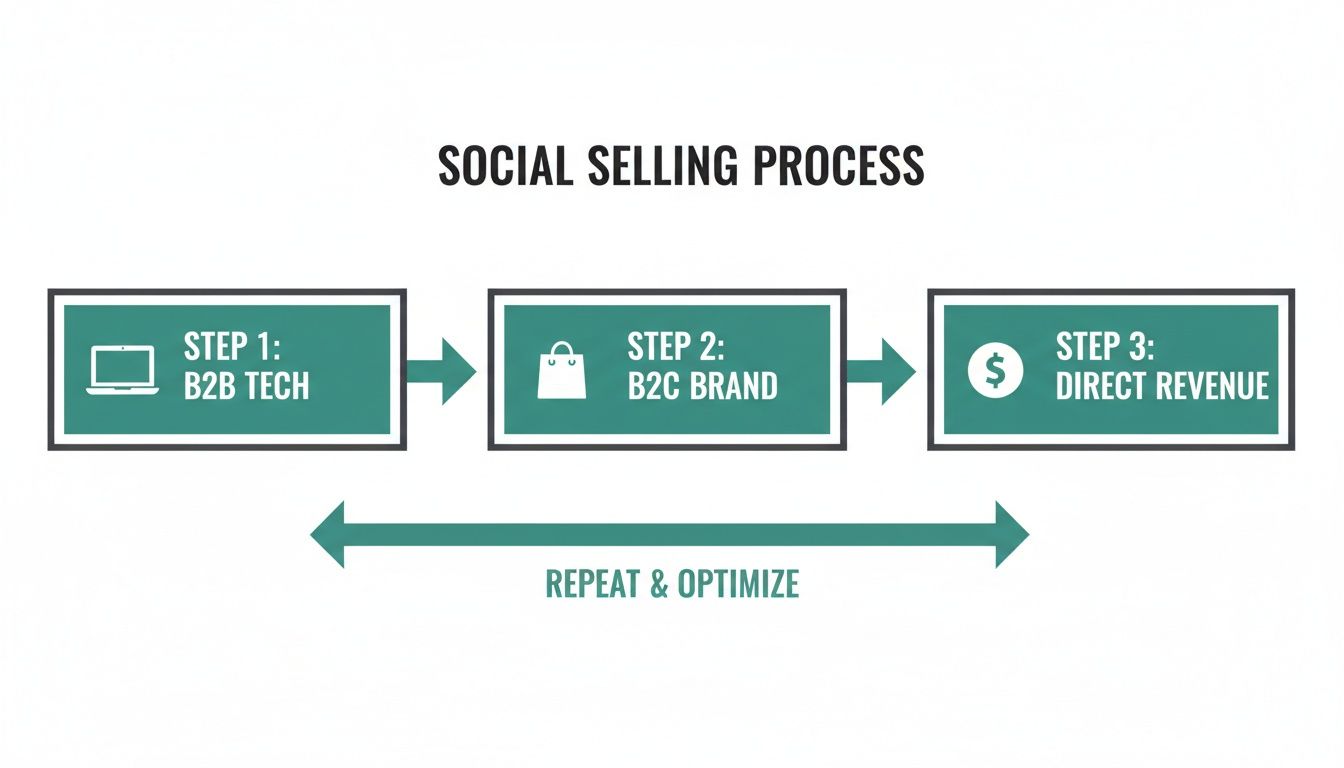
    Flowchart of the social selling process, featuring steps: B2B tech, B2C brand, direct revenue, plus repeat and optimize.

    As you can see, capturing a prospect's email can be as simple as a single click, integrating perfectly into your workflow.

    Step 3: Engage with Valuable Content

    Now that you've connected, the real work begins. The goal is to become a familiar, trusted name in their feed. You don’t do this by pitching your product every day. You do it by consistently providing value.

    Share articles you know they'll find interesting. Leave thoughtful comments on their posts that add to the conversation. Create your own content that tackles common problems in their industry. Think of every single interaction as a small deposit into the "trust bank." For more on this, check out this step-by-step guide to generating leads on Facebook for some proven tactics.

    A good rule of thumb is to give value 90% of the time and only ask for a conversation 10% of the time. This keeps you from being seen as just another salesperson.

    Step 4: Nurture Relationships into Opportunities

    As you build that rapport, you can start shifting conversations from public comments to private messages. This is the delicate transition from being just another connection to becoming a potential sales opportunity.

    Your direct messages should always be personalized. Reference a recent post of theirs or a shared interest. Ask open-ended questions to get a better feel for their needs. The idea is to gently guide the chat toward a discovery call, but only when the timing feels right.

    Step 5: Measure What Matters

    Finally, you have to track your efforts to see what’s actually working. Forget vanity metrics like likes and follower counts. They don't pay the bills. Instead, measure the things that directly impact your pipeline.

    • Connection Acceptance Rate: Are your personalized requests hitting the mark?
    • Engagement Rate: Are people actually interacting with the content you share?
    • Conversations Started: How many of your DMs are turning into real back-and-forth dialogue?
    • Meetings Booked: This is the big one. How many of your social interactions are turning into scheduled calls?

    If you're not measuring your social selling efforts, you're just guessing. Likes and follower counts are nice for the ego, but they don't exactly pay the bills. To prove your strategy is actually working, you have to connect your activity to the one thing that matters: your sales pipeline.

    True success isn't about going viral—it's about systematically turning conversations into conversions. That means drawing a clear line from your social media activity to real business results.

    Key Metrics That Actually Move the Needle

    To get a clear picture of what’s working, you need to track metrics that show progress at each stage of the relationship-building process. Start with these foundational KPIs to understand where your efforts are paying off and where you need to make some tweaks.

    Here are the essentials to keep an eye on:

    • Connection Acceptance Rate: This tells you how well your personalized outreach is landing. If the rate is low, it’s a good sign that your profile or your initial message needs some work.
    • Engagement Rate: Are people actually interacting with your content? This isn’t just about likes; it's about meaningful comments, shares, and direct messages that show you’re providing real value.
    • Pipeline Influence: This is the ultimate test. You need to track how many discovery calls, booked demos, and new CRM opportunities came directly from your social selling activities.

    A great starting point is LinkedIn's Social Selling Index (SSI). This free tool scores you on four key pillars: building a professional brand, finding the right people, engaging with insights, and nurturing relationships. A higher score often directly correlates with creating more sales opportunities.

    Proving Your Return on Investment

    When you track these metrics properly, you can draw a straight line from a simple LinkedIn comment all the way to a closed deal.

    Think about it. When you can walk into a meeting and show that your social selling activities led to a 20% increase in qualified leads last quarter, you're not just justifying your time—you're proving ROI. This data gives you the power to double down on what works and get even better results.

    Got Questions About Social Selling? Let's Clear Things Up

    Even with the best roadmap, a few questions always pop up when you're getting started. Let’s tackle the most common ones so you can move forward without any confusion.

    Social Selling vs. Social Media Marketing

    It’s easy to mix these two up. They both happen on social media, but their goals couldn't be more different.

    • Social Media Marketing is all about broadcasting. It’s a one-to-many game, like putting up a billboard on a busy highway. The aim is to build brand awareness and cast a wide net.
    • Social Selling is the polar opposite. It’s a one-to-one strategy focused entirely on building genuine relationships. Think of it as having a quiet, personal conversation at a coffee shop instead of shouting from a megaphone.

    Marketing sets the stage and builds the brand’s reputation. Social selling steps onto that stage to turn that reputation into real, one-on-one sales conversations.

    What Are the Best Tools for the Job?

    The right tech can make a massive difference. For finding and keeping tabs on the right people, LinkedIn Sales Navigator is an absolute powerhouse. It's built for precision prospecting.

    But what about when you’ve built that initial rapport and want to take the conversation to a more professional setting? That's where tools like EmailScout come in. Once you’ve connected and warmed up a prospect, you can find their direct email with a single click. It’s the perfect way to move from a casual chat to a more formal follow-up.

    The ultimate social selling toolkit isn’t just one thing. It’s a combination of platforms for building relationships and tools for making direct, personalized contact. The goal is to move smoothly from a public comment to a private conversation that delivers real value.

    How Do You Actually Measure ROI?

    This is the big one. Forget vanity metrics like likes and follower counts—they don't pay the bills. To measure the real return on investment, you have to track KPIs that are directly tied to sales.

    Focus on what moves the needle: your connection acceptance rate, how many DMs actually turn into meaningful conversations, and the most important metric of all—how many meetings get booked directly from your efforts on social media.


    Ready to turn those social connections into leads you can actually act on? EmailScout helps you find anyone's professional email in a single click, making your outreach smooth and effective. Start finding emails for free today.

  • How to Handle Sales Objections and Turn No Into Yes

    How to Handle Sales Objections and Turn No Into Yes

    The secret to crushing sales objections isn’t about having a slick comeback for everything. It's about getting ahead of them.

    This means shifting your entire approach from defense to offense. You need to address potential concerns before your prospect even has a chance to bring them up. With deep research and smart qualification, you can anticipate resistance and weave the answers right into your value proposition.

    This simple change turns a potentially tense, defensive conversation into a collaborative one.

    Shift Your Mindset From Reactive To Proactive

    Most sales reps are taught to handle objections as they come. A prospect mentions price, timing, or a competitor, and the salesperson digs into their script for the perfect rebuttal. That’s reactive.

    The real pros flip this dynamic on its head. They don't just react—they prevent.

    Instead of waiting for a prospect to say, "It's too expensive," you build such a powerful case for ROI that the price feels like a steal. Before they can say, "Now isn't a good time," you've already tied your solution to their most pressing business priorities.

    Anticipate Objections With Smart Research

    Proactive objection handling starts long before you ever make a call. It all begins with deep-dive research and qualification. Your mission is to understand your prospect's world so well that you can practically read their mind and predict their hesitations.

    A little digging can uncover a goldmine of information. Before you even think about picking up the phone, look into:

    • Company Health: Are they hiring? Did they just land a round of funding or launch a new product? Growth is a huge buying signal and often means they have the budget to solve new problems.
    • Industry Trends: What are the major headwinds their industry is facing? Frame your pitch to show exactly how you help them navigate those specific challenges.
    • Decision-Maker's Role: Check out their LinkedIn. What are their responsibilities? What are they proud of? This helps you speak their language and align your solution with their personal and professional wins.

    Using a tool to speed up contact discovery frees you up to focus on this high-value research. For more on this, our guide on sales prospecting techniques dives deeper into getting this right from the start.

    Weave Solutions Into Your Pitch

    Once you have this intel, you can strategically build answers to potential objections right into your sales narrative. You're not just pitching a product anymore; you're presenting a thoughtfully researched solution tailored to their specific problems.

    The Harvard Business Review found that 95% of purchasing decisions are made subconsciously. This means most objections start as an emotional gut feeling before the logical brain tries to justify it. The best reps know how to guide a customer from that emotional reaction to a logical one.

    This proactive approach is all about preparing for common roadblocks before you ever hit them. Here's a quick look at how you can get ahead.

    Quick Guide to Pre-Empting Common Sales Objections

    This table breaks down how you can proactively address some of the most frequent objections you'll hear.

    Common Objection Type Proactive Strategy Example Action
    Price/Budget Build an undeniable ROI case from the start. Share a case study of a similar company and highlight their 3x return on investment within the first six months.
    Timing Create a sense of urgency by linking your solution to their immediate priorities. "I saw you're expanding your team this quarter. Our platform can cut your new hire onboarding time by 50%, getting them productive faster."
    Authority/Decision-Maker Identify and engage all key stakeholders early in the process. "Based on my research, a project like this often involves both Marketing and IT. Could we invite your Head of IT to our next call?"
    Competitor Acknowledge competitors but differentiate on unique value. "While companies like [Competitor] are great, our customers choose us for our dedicated support and seamless integration with X."

    By anticipating these issues, you control the conversation and build credibility from day one.

    When you address their unstated concerns, you build massive trust. It shows you've done your homework, which immediately sets you apart from the dozens of other reps spamming their inbox. This proactive strategy doesn't just help you handle sales objections—it often makes them vanish completely.

    Use Proven Frameworks to Navigate Tough Conversations

    Even with perfect preparation, objections are a natural part of any sales conversation. The key isn't to avoid them, but to handle them gracefully. When a tough question comes up, relying on a proven framework is like having a GPS for the conversation. Instead of getting defensive, you can follow a structured path that keeps you calm and focused on the real issue.

    Think of these frameworks less as rigid scripts and more as conversational blueprints. They give you a reliable structure, which frees you up to listen more actively and respond with genuine thought. This is how you turn a moment of friction into an opportunity.

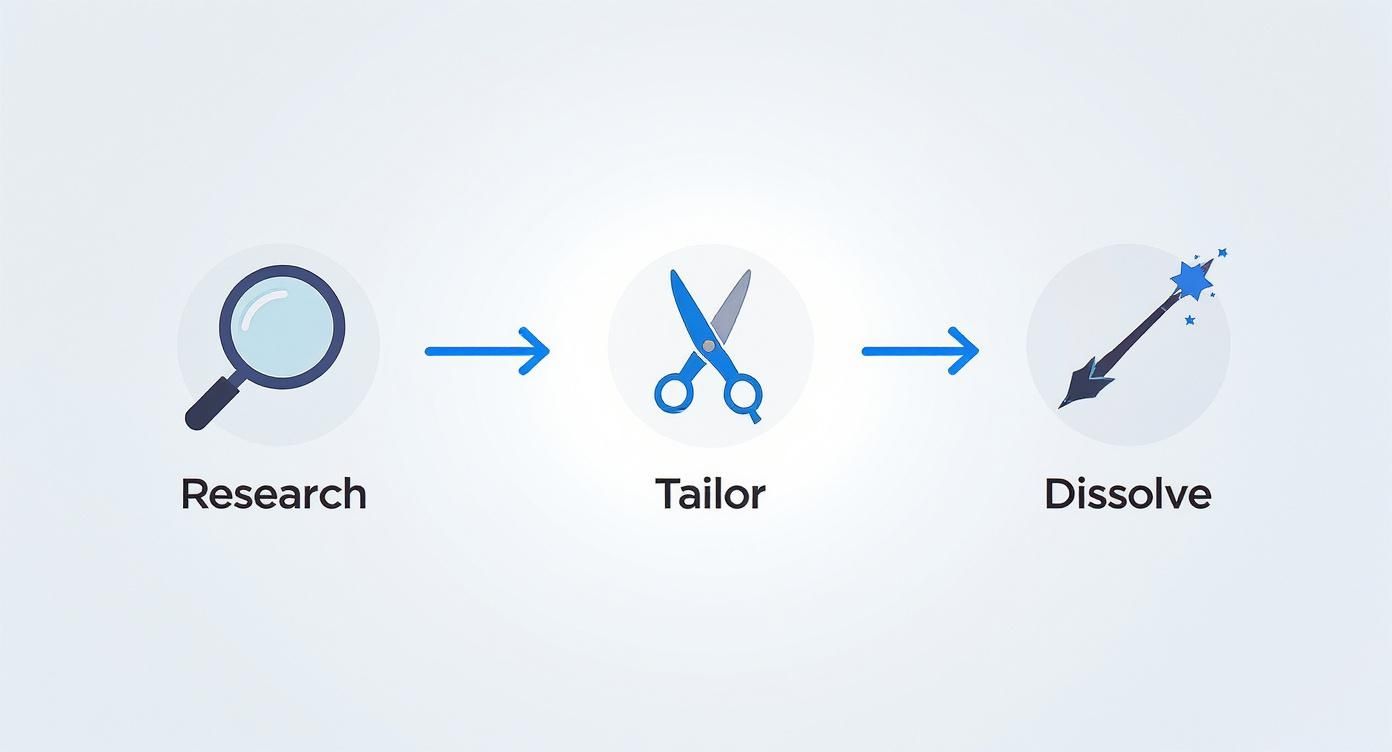
    The best reps I know handle objections before they even come up. It's a simple, three-part flow: research, tailor, and then dissolve.

    A three-step process diagram illustrating research, tailor, and dissolve with corresponding icons.

    This shows that the heavy lifting happens before the call. When you’ve done your homework on their needs and tailored your value prop, most objections melt away on their own.

    Build Empathy with Feel, Felt, Found

    One of the most effective tools in your arsenal is simple empathy. The Feel, Felt, Found method is all about building an instant connection by validating your prospect's concern instead of immediately trying to correct it. It’s a classic for a reason—it works.

    Here’s the simple breakdown:

    • Feel: First, show you get it. "I understand how you feel about that."
    • Felt: Then, normalize their concern by sharing that others have been in their shoes. "Plenty of other clients I've worked with have felt the same way when they first looked at the price."
    • Found: Finally, pivot to the positive outcome those others experienced. "But what they found was that the time they saved paid for the platform in less than six months."

    This approach completely changes the dynamic. You're not saying, "You're wrong." You're saying, "You're not alone, and here's how this usually plays out." It turns a personal worry into a common, solvable challenge.

    Uncover the Real Issue with LAER

    Let's be honest, the first objection you hear is often just a smokescreen. The LAER model—Listen, Acknowledge, Explore, Respond—is designed specifically to dig deeper. It's my go-to when an objection feels vague or like a brush-off.

    A sincere acknowledgment can build trust and have a calming effect. Sometimes, your customers just want to know that they are being heard.

    Let's walk through a common one: "Your platform seems too complicated."

    1. Listen: Just be quiet. Don't interrupt or start formulating your response. Absorb their words and their tone.
    2. Acknowledge: Validate what they said. "I appreciate you sharing that. It’s critical that any new tool is easy for the team to pick up."
    3. Explore: This is where the magic happens. Ask open-ended questions. "Could you tell me a bit more about that? When you say 'complicated,' what part are you thinking of? Is it the initial setup, or the day-to-day use?"
    4. Respond: Once you know the real concern (maybe they're worried about training new hires), you can give a specific, helpful answer instead of a generic one.

    Learning to explore objections is a core part of learning https://emailscout.io/how-to-qualify-sales-leads/ properly. It's also worth remembering that all of these frameworks depend on strong fundamentals, which is why ongoing effective communication skills training is a non-negotiable for any serious sales professional.

    Get to the Core with SPI

    For those complex, layered objections, you need a more advanced tool. The SPI (Seek, Probe, Identify) method is perfect for situations where you sense the real issue is buried under office politics or a hidden fear of change.

    The entire goal of SPI is to move the conversation from the surface-level problem to the actual business impact.

    • Seek Understanding: First, confirm you've heard them right. "So, the main concern here is the timeline for getting this implemented, is that correct?"
    • Probe for Details: Now, ask questions that uncover the context and consequences. "What's driving that tight timeline? What happens if this takes a few weeks longer but delivers a much better outcome for the team?"
    • Identify the Core Issue: By probing, you start connecting the dots. You might find out the "timeline" issue is really about their personal fear of missing a KPI tied to a project deadline.

    This technique requires real patience. You can't rush it. By carefully guiding the conversation, you stop being a vendor and start acting like a strategic consultant. That's what separates the top 1% from everyone else.

    Craft Winning Responses to Common Objections

    Knowing the frameworks is one thing, but actually using them when you're live on a call—that’s what separates the pros from the rookies. Let's get practical. Here are some battle-tested scripts and templates for the four big objections you'll hear over and over: price, timing, competition, and authority.

    A laptop on a wooden desk displaying a webpage, with documents and a green folder.

    Don't think of these as lines to memorize word-for-word. The real goal is to get the logic down so you can adapt on the fly. Whether you're thinking on your feet during a call or writing a careful email, these will give you a solid foundation.

    Handling Price and Budget Objections

    Let’s be honest, "it's too expensive" almost never means what it says. It's code for "I don't see the value yet." Your first instinct shouldn't be to offer a discount; it should be to anchor the conversation back to the return on their investment.

    On a Call: "Your price is higher than we expected."

    Acknowledge what they said, then pivot to find out what's really going on.

    • You: "I appreciate you sharing that. When you say it's higher than expected, are you comparing us to someone else, or is this more about fitting it into your budget right now?"

    That one question tells you everything. You’ll know immediately if you have a value gap or a real cash-flow problem to work with.

    • If it’s about budget: "Got it. A lot of our clients are in the same boat when we first talk. Let's put the price tag aside for a second. If we could fix [Problem X] and get you [Result Y], what would that actually be worth to you guys over the next year?"
    • If it’s about a competitor: "That makes sense. While some other tools might look cheaper upfront, businesses usually pick us because our [Unique Differentiator] helps them get [Specific Outcome] 30% faster. In the end, that saves them a lot more money."

    Email Template: Follow-up After a Price Objection

    Subject: Quick thought on our conversation

    Hi [Prospect Name],

    Thanks for being so transparent about the budget on our call today. I totally get making sure every dollar is working for you.

    I attached a quick case study from [Similar Company] to show you what this can look like in practice. They were dealing with the same issues you are with [Prospect's Pain Point].

    They ended up seeing a 250% ROI in just eight months because our platform cut out so much manual work for their team.

    Are you open to a quick 15-minute call next week to sketch out what a similar model would look like for you?

    Best,
    [Your Name]

    Overcoming Timing and Urgency Issues

    "Now isn't a good time" is just a polite way of saying your solution isn't a priority. To create urgency, you have to show them how your product connects directly to what they already care about.

    On a Call: "We have too much going on right now."

    Show them you understand, then challenge the status quo a bit.

    • You: "I hear you. It sounds like the team is completely swamped. A lot of times when I hear that, it's because big projects like [Project They Mentioned] are eating up all the bandwidth. That's actually the sweet spot for us. Our tool automates [Related Task], which could free your team up to focus on those priorities. What could you do with an extra 10 hours a week?"

    This move reframes your tool from "just another thing to do" to "the key to getting everything else done."

    Email Template: Creating Soft Urgency

    Subject: Following up from our chat

    Hi [Prospect Name],

    Great connecting with you earlier. I know Q3 is packed with [Mentioned Priority], so adding anything new to the mix is a tough ask.

    But I was thinking about your goal to [Achieve X] by the end of the year. If we get started now, you’d be fully ramped up by October—perfect timing to crush that target ahead of schedule.

    If we wait until Q4, you might not see the real impact until next year. No pressure, of course, just wanted to share that perspective.

    Let me know if you want to chat more about it.

    All the best,
    [Your Name]

    Equipping your team with ready-to-go answers and messaging is a game-changer. Consider developing sales enablement content that aligns with your sales process. When reps have these assets handy, their follow-ups are faster and way more effective.

    Navigating Competition and Authority Objections

    When a prospect brings up a competitor or tells you they're not the decision-maker, don't get discouraged. See it as an opening to show why you're different and to expand your influence in the company.

    Handling "We're happy with our current provider."

    Whatever you do, don't trash the competition. Use it as a chance to find a weakness.

    • On a Call: "That's great to hear! [Competitor] is a good company. We actually have a lot of customers who use both of us, but they use our platform specifically for [Your Unique Value Prop]. Just curious, how are you guys handling [Specific Area Where You Excel] right now?"

    Dealing with "I need to talk to my boss."

    This is your chance to turn your contact into a champion and get in front of the real decision-maker.

    • On a Call: "Of course, that's a smart move. To help you get ready for that conversation, what kind of pushback or questions do you think you'll get from your boss? We can put together a solid business case together."

    Persistence is everything here. A study by Invesp found that 60% of customers say "no" four times before they finally say "yes," but a shocking 44% of reps give up after the first "no." You have to be ready for multiple conversations.

    And if you send a proposal and just hear crickets? Knowing how to follow up is critical. Check out our guide on the perfect no response follow-up email to get that conversation going again.

    Master Your Skills Through Realistic Practice

    Knowing the frameworks and scripts is great, but that’s only half the battle. The real test comes when a prospect hits you with an unexpected objection on a live call. How you handle that pressure—calmly and confidently—is what separates a closed deal from a dead end.

    Two professionals with headsets engaged in a role-play practice session for sales training.

    This is where practice becomes your greatest weapon. When you consistently rehearse your responses, you build the muscle memory you need to navigate tough conversations without fumbling. It turns theory into instinct, freeing you up to actually listen to the prospect instead of just scrambling for what to say next.

    Structure Your Role-Playing for Maximum Impact

    Good role-playing isn't about reciting scripts. It's about simulating real-world pressure in a safe space. Pull your scenarios directly from the team's past lost deals—that’s where the best learning opportunities are. This keeps the practice grounded in reality and helps you patch the leaks in your process.

    To get the most out of it, assign clear roles: one person is the salesperson, another is the prospect with a specific objection, and a third is the observer.

    • The Salesperson: Your job is to actively use an objection-handling framework (like LAER or Feel/Felt/Found) to steer the conversation.
    • The Prospect: Be realistic. Embody the objection from a real past call. Don't be impossible, but don't give in too easily, either.
    • The Observer: This is a crucial role. Take notes on what worked and what didn't. Focus on tone, pacing, and how well the framework was used.

    Run the scenario for a few minutes, then pause. The observer should lead a quick, constructive feedback session. This cycle of practice and immediate feedback is how you get sharp, fast.

    The Power of Self-Review

    While team practice is essential, don't sleep on reviewing your own calls. Listening back to recordings gives you a perspective that’s impossible to get in the heat of the moment. You'll catch your own verbal tics, hear when your tone shifts under pressure, and see your patterns for how you react to certain objections.

    Recording and analyzing your own calls is like a pro athlete watching game tape. It shows you the blind spots and reveals the small tweaks that lead to massive improvements.

    Start by zeroing in on key moments. Did you cut the prospect off? Did you jump to a solution before fully understanding their concern? Identifying these habits is the first step to fixing them. It's this kind of hands-on review that builds the polish and resilience you need to turn any objection into a genuine conversation.

    Measure and Improve Your Performance

    You can't improve what you don't measure. After you've got the frameworks, scripts, and role-playing down, the last piece of the puzzle is tracking your performance. A data-driven approach is what turns handling sales objections from an unpredictable art into a repeatable science that actually grows revenue.

    Most sales teams are obsessed with their close rate. And while it's important, it doesn't tell you the whole story. To really get a grip on how effective you are, you need to dig into the metrics that show how well you navigate resistance and turn those "not right now" moments into closed deals.

    This is where you stop just reacting to objections and start systematically getting better.

    Key Metrics for Objection Handling Success

    When you start tracking the right data, you can pinpoint weaknesses, find coachable moments, and see which of your strategies are actually working. It also puts a number on your efforts. For example, getting good at this isn't a small win.

    Salespeople who effectively overcome objections can bump up their close rates by as much as 64%. This isn't just about closing more deals; it's about addressing concerns so well that you actually shorten the entire sales cycle. You can learn more about how these performance indicators connect to faster decision-making.

    Here’s a look at the essential metrics your team should start tracking today.

    | Key Metrics for Objection Handling Success |
    | :— | :— | :— |
    | Metric | How to Calculate It | What It Tells You |
    | Objection Resolution Rate | (Number of Objections Successfully Overcome / Total Objections Raised) x 100 | This is your core effectiveness score. It shows how often a conversation moves forward after a prospect raises a concern. |
    | Conversion Rate After Objection | (Number of Deals Closed After an Objection / Total Deals with Objections) x 100 | This metric directly ties your objection-handling skill to revenue. A low rate here points to a major gap in your process. |
    | Sales Cycle Length (with objections) | Average Time from First Contact to Close (for deals that had at least one major objection) | This tells you if your objection handling is speeding things up or slowing them down. Done right, it should resolve issues fast. |
    | Time to Resolution | Average Time Taken to Address and Move Past a Specific Objection | This measures your efficiency. Are you getting bogged down, or are you navigating friction smoothly and keeping the momentum going? |

    Tracking these numbers gives you a clear, honest picture of where you stand.

    Using Your CRM to Spot Trends

    Your CRM is so much more than a digital Rolodex; it's a goldmine for analysis. The real magic happens when you get into the habit of tagging and categorizing every single objection that pops up. This simple change unlocks a ton of actionable insights.

    Just create a few custom fields or tags in your CRM for the common objections you hear all the time:

    • Price/Budget: For anything related to cost, ROI, or budget constraints.
    • Timing/Urgency: For the classic "not now" or "check back in a few months."
    • Competitor: Any time they mention an existing provider or a competing offer.
    • Authority: When you realize you're not talking to the final decision-maker.
    • Product Fit: Concerns about specific features, complexity, or integration headaches.

    Once you start tagging every interaction, you can run reports to see which objections are most frequent, which reps are struggling with certain types, and whether there are any seasonal or industry-specific trends you're missing.

    Consistently tagging objections in your CRM is like giving your sales team a roadmap. It shows you exactly where the roadblocks are, so you can build better training and refine your messaging to pave a smoother path to a closed deal.

    This data lets you be incredibly strategic. Let's say you see a spike in competitor objections right after a rival launches a new feature. You can immediately arm your team with updated battle cards. Or if a new rep is consistently fumbling on price objections, you know exactly where to focus their next coaching session. It’s a systematic approach that ensures your team is always adapting and getting better, turning those potential deal-breakers into opportunities.

    Common Questions About Handling Objections

    Even the most seasoned sales pros get thrown curveballs now and then. Here are some quick, no-fluff answers to the questions I hear most often when it comes to dealing with objections. Think of these as practical tips to keep in your back pocket.

    What Is the Single Most Common Sales Objection?

    Hands down, it's always about price or budget. But when a prospect says, "It costs too much," that's rarely the whole story. It's usually a smokescreen for something deeper—maybe they don't see the value yet, don't have the authority to sign off on the cost, or are just kicking the tires.

    Your first instinct might be to offer a discount. Don't. A better move is to dig deeper using a framework like LAER. Acknowledge their concern, then ask smart questions to figure out what's really going on. Is it the total cost that's shocking them? The impact on their cash flow? Or do they just not believe the ROI is there? Your job is to pivot the conversation from cost to long-term value.

    How Do You Respond When a Prospect Says "I Need to Think About It"?

    Ah, the classic stall. This is almost always a polite way of avoiding a direct "no." The key is to acknowledge their need for time while gently probing for the real roadblock.

    Try saying something like, "I understand completely. Usually, when I hear someone say they need to think it over, it means there's a specific area they're still unsure about. To make sure I’ve given you everything you need, is it the implementation timeline, the budget, or maybe something else?"

    This simple question does something powerful: it invites them to share the real objection. It turns a conversation-ender into a new opening, giving you a clear path to understanding what's holding them back.

    This kind of respectful pushback shows you're confident in what you're selling and that you're there to help them solve a problem, not just close a deal.

    Should I Prepare an Objection Handling Document for My Team?

    Absolutely, yes. A living document—or a set of "battle cards"—for common objections is one of the most powerful training assets you can create. It's fundamental to building a sales team that's prepared, confident, and consistent.

    Your doc should cover the top 10-15 objections your team runs into all the time. For each one, make sure you include:

    • Two or three proven responses so reps have options that fit their style.
    • Key facts or stats they can use to counter with hard data.
    • A relevant customer success story to provide real-world social proof.

    This isn't just for new hires. A resource like this helps your veteran reps sharpen their skills and ensures everyone on the team is delivering a unified, effective message. It makes everyone better.


    Ready to stop guessing and start connecting with the right people? EmailScout helps you find the verified email addresses of decision-makers in seconds. Build targeted outreach lists and get your message in front of the people who matter, faster. Start finding unlimited emails for free.