Tag: sales process

  • How to Improve Sales Productivity: Actionable Strategies for Fast Growth

    How to Improve Sales Productivity: Actionable Strategies for Fast Growth

    Improving sales productivity isn't about cracking a whip. It's about trading "busy" for "effective." The fastest path there is to first figure out where your team’s time is really going, then systematically cut the fat with smarter processes and technology.

    Finding the Real Time Sinks in Your Sales Day

    Does your sales team seem perpetually swamped, yet quotas feel just out of reach? That’s a classic sign of a major disconnect between activity and results. The brutal truth is that most reps are buried in tasks that have nothing to do with actually selling.

    This isn't just a hunch; the data backs it up. Most sales professionals spend only 25% of their time actually selling. The rest of the day is eaten up by admin work, manual data entry, and clunky workflows that kill momentum.

    Insights from a 2025 technology report on AI by Bain & Company show just how big this opportunity is, suggesting AI could double that selling time to 50% or more. Before you can fix the problem, you have to get an honest look at where the hours truly disappear.

    The Hidden Costs of a Fragmented Workday

    Picture a rep’s typical morning. It starts with 45 minutes of manually logging notes from yesterday's calls into the CRM. Then, they burn an hour digging through websites and social media, just trying to find contact info for a handful of new prospects.

    Next, maybe they spend 30 minutes crafting a single personalized email to a key target. By the time they finally get someone on a call, half the morning is already gone—spent entirely on tasks that don’t generate revenue.

    This constant context-switching is a productivity nightmare. It drains focus and makes it impossible to build real momentum.

    The problem isn't that your team is lazy; it’s that their workflow is riddled with friction. Every minute spent hunting for an email address or updating a CRM field is a minute they aren't building relationships and closing deals.

    To start, you need to understand exactly what activities are consuming your team's day. A quick audit can reveal some shocking truths about where time is being misallocated.

    Diagnosing Sales Productivity Killers

    This table breaks down some of the most common time-wasters that plague sales teams. Use it to spot the low-hanging fruit in your own process.

    Activity Typical Time Spent (Weekly) Impact on Productivity Solution Category
    Manual Prospecting & Research 5-10 hours Delays outreach, leads to poor targeting Prospecting Automation
    CRM Data Entry & Updates 4-8 hours Reduces selling time, leads to incomplete data CRM Integration & Automation
    Internal Meetings & Admin 3-6 hours Creates context-switching, breaks sales flow Process Optimization
    Crafting Emails from Scratch 3-5 hours Inconsistent messaging, slow response times Sales Playbooks & Templates
    Switching Between Tools 2-4 hours Wastes time, causes mental fatigue Tech Stack Consolidation

    Looking at this breakdown, it becomes clear how "non-selling" tasks can quietly consume more than half of a rep's work week. Identifying your top one or two culprits is the first step toward reclaiming that valuable time.

    Moving from Assumptions to Data

    Guessing where time is lost is a recipe for failure. To get a real diagnosis, you need to track it. A simple "time audit" for one week can be incredibly eye-opening. Just ask your team to log their daily tasks into two simple buckets:

    • Selling Activities: Demos, client calls, negotiations, proposal writing.
    • Non-Selling Activities: Internal meetings, CRM updates, prospecting research, travel.

    The results are often a wake-up call, proving that "busy work" can easily gobble up 70% of a rep's week. This data gives you an undeniable baseline to work from. It pinpoints the exact bottlenecks—whether it’s clunky prospecting or endless admin—so you can finally apply the right fix and start building a genuinely productive sales engine.

    Building a Sales Process That Actually Works

    Once you've figured out where all the time is going, you can start winning it back. A messy, undefined sales process is a huge productivity killer, forcing reps to reinvent the wheel for every single lead. The fix is to build a standardized, repeatable workflow that guides reps from prospect to customer.

    A solid process gets rid of the guesswork. It makes it crystal clear what needs to happen at each stage, who's responsible, and what "done" actually means. This isn't about creating rigid, bureaucratic rules. It's about building a reliable framework that helps your team move faster and more effectively.

    Think of it as paving a highway instead of letting every rep hack their own path through the jungle.

    This simple flow shows how to find those time sinks and boost your team's output.

    A 3-step process infographic for finding and conquering time sinks: diagnose, streamline, and leverage time.

    As you can see, improving sales productivity is a cycle. First, you Diagnose the problem, then Streamline your process, and finally, bring in the right Technology to make it all run smoothly.

    Defining Your Sales Cycle Stages

    Your first move is to map out the real stages of your sales journey. Vague labels like "Working" or "Contacted" are pretty much useless. You need concrete, action-based stages that show a real change in the deal's status.

    These stages become the backbone of your sales pipeline, giving you a clear snapshot of your sales health. A well-defined pipeline is a mission-critical asset, and if you're building one from the ground up, you can check out our guide on how to build a sales pipeline for more detail.

    For a B2B SaaS company, your stages might look something like this:

    • New Lead: A potential customer has been identified but not contacted yet.
    • Attempting Contact: The first outreach sequence is in motion.
    • Connected & Qualified: A conversation has happened, and the lead meets your basic criteria (like budget, authority, and need).
    • Discovery Call Completed: A deeper needs-analysis call has taken place.
    • Demo Scheduled: The prospect agreed to see a product demonstration.
    • Proposal Sent: A formal quote or proposal has been delivered.
    • Negotiation: You're actively discussing terms, pricing, or contract details.

    Every stage needs a clear exit criterion—a specific action that has to be completed before a deal can move forward. This simple rule stops deals from stalling and makes forecasting a whole lot more accurate.

    Creating a Sales Playbook That Gets Used

    A sales playbook is your process in a box. It's a living, breathing resource with all the scripts, templates, and strategies your team needs to execute your sales process flawlessly. A good playbook doesn't just collect dust on a digital shelf; it's part of the daily grind.

    A sales playbook isn't just a training manual; it's a performance tool. It ensures that every rep, from your newest hire to your seasoned veteran, is equipped with the best practices of your top performers.

    Keep your playbook simple, scannable, and actionable. Don't create a 100-page PDF nobody will ever open. Instead, build a resource hub—a shared drive or an internal wiki works great—with materials that are easy to find and use.

    Essential Components of an Actionable Sales Playbook

    You don't need to build the entire playbook on day one. Start with the essentials that will make the biggest immediate impact on your team's day-to-day work.

    1. Buyer Personas and ICP

    • Who are you selling to? Create detailed profiles of your Ideal Customer Profile (ICP) and the key buyer personas you interact with.
    • What are their pain points? List the specific challenges and goals that your product solves for each persona.
    • Key Talking Points: Give your team a cheat sheet of value props that hit home with each persona.

    2. Outreach Templates and Scripts

    • Email Sequences: Provide proven multi-touch email templates for prospecting, follow-ups, and post-demo nurturing.
    • Call Scripts: Offer flexible outlines for discovery and qualification calls. Focus on key questions to ask, not a word-for-word script.
    • Voicemail Scripts: Give reps concise, impactful scripts for when a call goes to voicemail.

    3. Objection Handling Guide

    • Common Objections: List the top 5-10 objections your team always hears (e.g., "It costs too much," "We're happy with what we have").
    • Proven Responses: For each one, provide a simple framework for an empathetic and effective response that steers the conversation back to value.

    By standardizing these core pieces, you reduce the mental load on your reps. This frees them up to focus their energy on what really matters: building relationships and closing deals.

    Using Technology to Amplify Your Sales Team

    In sales, the right tech stack isn't just a nice-to-have; it's a force multiplier. But simply throwing more tools at your team often creates more problems than it solves, bogging everyone down in complexity. The real key to boosting sales productivity is being strategic—choosing tech that actually solves a specific problem and automates the most mind-numbing, repetitive tasks.

    The goal here is simple: reclaim the hours your reps lose to manual work. Think about all the time wasted on data entry, scheduling follow-ups, and the endless hunt for a prospect’s contact info. By automating these chores, you give your team back their most valuable asset: time to build relationships and have meaningful conversations.

    Automate Prospecting to Accelerate Outreach

    If you ask any sales rep, they'll tell you that prospecting is often the biggest time sink in the entire sales process. It's not uncommon for reps to burn hours every single day just searching for the correct email addresses and phone numbers. That manual grind isn't just inefficient; it's flat-out demoralizing.

    This is exactly where targeted prospecting automation can make a massive difference. Instead of having your reps manually scour social profiles and company websites, a good tool can do all the heavy lifting for them.

    Take a tool like the EmailScout Chrome extension, for example. A rep can be on a prospect's social profile, and with a single click, find their verified email address. That simple action transforms what used to be a 15-minute research task into a 5-second click. It’s this kind of focused automation that delivers immediate, noticeable productivity gains.

    Features like AutoSave can automatically build targeted lead lists while your reps browse, and URL Explorer can pull every available email from a list of company websites in minutes. This isn't just a small tweak; it fundamentally changes the prospecting workflow from a manual chore into a rapid, automated machine.

    Choose Tools That Solve Problems, Not Create Them

    The market is flooded with sales tools, and every single one promises to be a game-changer. The real danger is creating a "Frankenstack"—a clunky, disconnected mess of apps that require more management than they're worth. A truly productive tech stack is an integrated one.

    Before you bring any new software into your workflow, you need to ask some hard questions:

    • What specific bottleneck does this solve? If a tool doesn't fix a clear pain point—like manual data entry or painfully slow prospecting—you don’t need it.
    • Does it integrate with our CRM? Your CRM needs to be the single source of truth. Any new tool has to feed data into it automatically, eliminating the need for reps to update multiple systems.
    • Is it simple for my team to actually use? A complex tool with a steep learning curve will get ignored and become expensive shelfware. The best tools feel intuitive and fit naturally into a rep's existing day.

    Your contact management system is the heart of your entire operation. When evaluating a new tool, make sure it complements and enhances that core system. You can explore some of the best contact management software options to see how different platforms stack up on features and integration.

    The most impactful technology doesn't just offer more features; it removes friction. The ultimate test of a tool is whether it gives your salespeople more time to actually sell.

    The Measurable Impact of a Smart Tech Stack

    Adopting the right technology has a direct, measurable impact on sales productivity. The data on this is crystal clear. In fact, high-performing sales teams use nearly three times more sales technology than underperforming teams.

    This isn't just about having a lot of tools; it's about using them effectively. Organizations that truly master their sales tech are 57% more efficient in their sales development efforts.

    Even just one piece of the puzzle, like marketing automation, can drive a 14.5% increase in sales productivity while simultaneously cutting overhead by 12.2%. The proof is everywhere. You can discover more sales productivity statistics that highlight these advantages. All this evidence makes a compelling case for investing in tools that get rid of tedious work and empower your team to focus on what they do best—generating revenue.

    Measuring What Matters for Sales Performance

    Man analyzing key metrics on laptop and smartphone, showcasing data for business productivity.

    If you’re trying to boost sales productivity without measuring the right things, you’re flying blind. Tracking the wrong metrics is just as bad as tracking nothing—it creates a false sense of progress. To get real results, you have to look past vanity stats like call volume and dial in on the Key Performance Indicators (KPIs) that actually drive revenue.

    Let's be clear: busy isn't the same as productive. One rep might blast out 100 generic emails with zero replies, while another sends 10 targeted, well-researched messages and books three demos. The difference is effectiveness, and the right KPIs tell you that story. They show you exactly where your process is humming along and where it's hitting a wall.

    From Activity Metrics to Impactful KPIs

    The real turning point comes when you shift your team’s focus from just doing things to achieving outcomes. Knowing a rep made 50 calls is interesting. Knowing their call-to-meeting conversion rate is powerful.

    That shift requires getting honest about which numbers truly matter. You're looking for the data that signals efficiency, effectiveness, and a pipeline that’s not just full, but healthy.

    To get started, here are the essential KPIs every sales leader I know watches like a hawk.

    Essential KPIs for Sales Productivity

    A cluttered dashboard is just noise. The goal is to isolate the few metrics that give you a true signal on your team's productivity and the health of your pipeline. This table breaks down the KPIs that matter most.

    KPI What It Measures Why It Matters for Productivity Improvement Goal
    Lead Response Time Average time to follow up with a new inbound lead. Speed is everything. A fast response drastically increases the odds of connecting and qualifying a lead. Decrease time to under 5 minutes.
    Sales Cycle Length Average time from initial contact to a closed deal. A shorter cycle means reps are moving deals efficiently and forecasting is more accurate. Shorten the overall cycle length.
    Activity-to-Meeting Ratio Number of calls or emails needed to book one qualified meeting. This is a direct measure of outreach quality and effectiveness. A high ratio signals weak messaging or targeting. Decrease the number of touches per meeting.
    Pipeline Conversion Rates Percentage of deals moving from one sales stage to the next. This pinpoints bottlenecks where deals are stalling or falling out of the pipeline. Increase the percentage at each stage.

    By zeroing in on these metrics, you can spot problems before they derail a quarter. For example, a poor activity-to-meeting ratio might mean your team needs better prospecting lists—a perfect spot to use a tool like EmailScout to ensure they’re reaching verified contacts.

    Don’t drown in data. Pick the 3-5 core KPIs that tie directly to your revenue goals. These are your north stars for every coaching session and process change.

    The Ultimate Metric: Win Rate

    While all those KPIs are crucial health indicators, they all funnel into the one that matters most: your win rate. This is the percentage of qualified opportunities your team successfully turns into paying customers. It’s the ultimate report card on your sales process, messaging, and team skill.

    A low win rate, even with a ton of opportunities, is a massive red flag. It points to a serious breakdown somewhere in the back half of your sales cycle. Improving your win rate is the most direct path to boosting productivity because it means you’re making more money from the exact same lead flow.

    According to HubSpot’s 2025 State of Sales Report, 91% of teams have stable or improving win rates, with the best performers hitting 28-29% by using tech to personalize their approach. This just proves that focusing on quality closes pays off. You can read the full HubSpot report on sales strategy for more insights.

    This focus also directly influences other core business numbers. To see how it all connects, you can use our calculator to determine your customer acquisition cost.

    Building a Performance Dashboard

    Data that lives in a spreadsheet might as well not exist. A solid sales dashboard visualizes your key metrics, giving you and your team an instant, real-time pulse on performance.

    A simple but powerful dashboard should answer these questions at a glance:

    • Lead Flow: Are we generating enough new opportunities to hit our target?
    • Pipeline Velocity: How fast are deals moving from stage to stage?
    • Win/Loss Analysis: Why are we winning, and more importantly, why are we losing?
    • Individual Performance: Who is crushing their numbers, and who needs a bit of extra coaching?

    This data-first approach takes the guesswork out of management. You can celebrate wins backed by hard numbers and offer specific, targeted support where it's actually needed. This ensures every move you make is tied to a measurable outcome.

    Coaching Your Team for Consistent Success

    A male trainee with headphones and a female coach collaborate at a desk with a laptop and notebook.

    Even the slickest process and the best tech stack can’t make up for an unmotivated team. At the end of the day, sales productivity comes down to human performance. This is where consistent coaching stops being a chore and becomes your biggest strategic advantage, turning individual reps into a high-octane sales engine.

    Real coaching isn't about staring at dashboards or micromanaging your team's every move. It’s about developing the specific behaviors that get results. When you shift from managing outcomes to coaching activities, you give your team the skills to build sustainable success, not just hit a number for the month.

    Moving Beyond Micromanagement

    Forget top-down directives. Great coaching is a partnership. It’s about regular one-on-ones that are less "checking in" and more "let's solve this together." These conversations need to be collaborative, zeroing in on specific roadblocks in a rep's pipeline and finding real opportunities for them to grow.

    This approach builds a foundation of trust. It shows your team you’re genuinely invested in their careers, and when people feel supported, they're far more motivated to bring their A-game.

    A manager tracks numbers; a coach develops people. The goal isn't to ask, "Why did you miss your number?" but rather, "Let's walk through the deals you lost and see what behaviors we can improve for next time."

    Using Data to Pinpoint Skill Gaps

    Think of your KPI dashboard as a coaching roadmap. The data you’re tracking doesn’t just show you what happened; it diagnoses why it happened. It takes the guesswork out of your feedback, making it objective and immediately actionable.

    Instead of hitting them with generic advice like "You need to prospect more," data lets you get specific.

    • Low Activity-to-Meeting Ratio: This is a big red flag. It could mean they need coaching on their prospecting scripts or email copy. Maybe their core message just isn't landing with the right persona.
    • Long Sales Cycle: If a rep's deals consistently drag on, they might need help creating urgency or learning how to navigate those tricky internal buying committees.
    • Low Win Rate on Proposals: This points directly to a skill gap in negotiation, value demonstration, or handling those tough, late-stage objections.

    By tying performance data directly to behaviors, you can create personalized coaching plans that actually fix the root of the problem. It's way more effective than a generic, one-size-fits-all training day.

    Implementing Practical Coaching Sessions

    To really build a culture of continuous improvement, you need to mix different coaching formats into your regular team rhythm. Each one plays a different role in creating a well-rounded and productive sales team.

    One-on-One Pipeline Reviews
    These weekly or bi-weekly meetings are the backbone of good coaching. Keep them forward-looking. Instead of just rehashing the past, focus on strategy for active deals. Ask questions like, "What's our next play with this account?" or "Who are the key players we still need to get on our side?"

    Live Call Coaching and Film Review
    Listening to call recordings with your reps is one of the most powerful things you can do. It's like watching game tape with an athlete. Just focus on one or two specific things to improve in each session—like how they handled a price objection or the quality of their discovery questions. Always start by celebrating what they did well before offering feedback.

    Skill-Building Workshops
    Use your KPI analysis to identify common struggles, then organize short, focused workshops to address them. This could be a quick session on crafting better value props or running role-playing drills on negotiation tactics. These workshops build collective skill and reinforce your best practices across the whole team.

    On top of that, putting in place an impactful lead training program ensures your team is ready to convert prospects efficiently from the very first touchpoint. In the end, consistent coaching creates a virtuous cycle: better skills lead to better results, which builds confidence and motivation, driving your team's sales productivity to a whole new level.

    Frequently Asked Questions About Sales Productivity

    Even the best-laid plans run into questions once you start putting them into practice. Let's tackle some of the common hurdles sales leaders face when trying to boost productivity.

    What Is the First Step to Improve Sales Productivity?

    Before you spend a dime on new software or rewrite a single line of your playbook, you need to run a time audit.

    Seriously. You have to know where your team’s time is actually going. This isn't about looking over their shoulder—it’s about getting a clear, data-driven picture of your starting point.

    For one week, have each rep track their day in 30-minute blocks. The goal is to sort everything into two simple buckets:

    • Selling Activities: Live calls, product demos, negotiations, and building proposals.
    • Non-Selling Activities: Admin work, manual data entry, prospecting research, and internal meetings.

    The results are almost always an eye-opener. It’s not uncommon to find that less than 30% of a rep's day is spent on actual selling. This data becomes your roadmap, pointing you directly to the biggest bottlenecks, whether it's too much admin or inefficient prospecting.

    How Can AI Realistically Help My Sales Team Today?

    Forget the futuristic hype. AI can help you right now in two very practical areas: prospecting and communication. Think of it as a super-efficient assistant for the tasks your team hates doing.

    For prospecting, tools like EmailScout use AI to find verified contact information in seconds, eliminating hours of manual searching. This is a day-one quick win that immediately gives time back to your reps.

    When it comes to communication, AI can draft initial outreach emails or help personalize follow-ups using data from your CRM. Start with one specific, time-sucking task. For instance, instead of reps writing every follow-up from scratch, an AI tool can create a solid first draft they just need to review and tweak. This frees up their brainpower for the real strategy.

    We Have a CRM, but Productivity Is Still Low. Why?

    Just having a CRM doesn’t magically make your team more productive. How you use it is what matters. If your CRM feels more like a data-entry chore than a helpful tool, productivity will always suffer.

    This usually boils down to a few common culprits: bad data, zero integration, or workflows that are just too complicated.

    If reps have to manually log every single interaction, they'll see the CRM as an obstacle. The fix is to automate data entry wherever you can. Connect your CRM to other core tools, like email and prospecting software, so information flows between them without anyone lifting a finger.

    A CRM should guide a rep through the sales process, not get in their way. If it takes 15 clicks to log a single call, your team will find workarounds, and your data integrity will suffer.

    Take an honest look at your CRM setup. Are there useless fields or convoluted steps? Sit down with your team and simplify the process. Make the CRM a tool they want to use because it genuinely makes their job easier.

    How Do I Get My Sales Team to Adopt New Processes and Tools?

    Getting your team on board comes down to two things: showing them the personal benefit and offering solid support. Their first question is always going to be, "What's in it for me?"

    Don’t just announce a new tool. Launch it with a powerful answer to that question.

    Show them exactly how this new process or software helps them hit their own goals. Frame it in their terms: "This new tool saves you five hours of prospecting each week, giving you time for 10 more calls to hit your quarterly bonus."

    Get your top performers involved early in the selection and rollout. When they become internal champions, their peers will follow their lead. Finally, training can't just be a one-off meeting. Offer hands-on training upfront, then follow up with regular tips, Q&A sessions, and cheat sheets. When your reps see a new tool as a direct path to their own success, adoption is a natural next step. For a deeper dive into optimizing your operations and discovering more actionable strategies to improve sales productivity, these foundational principles are key.


    Ready to stop wasting time on manual prospecting and give your team more hours to sell? EmailScout finds verified email addresses in a single click, directly from social profiles and websites. Start finding unlimited emails for free today with EmailScout.

  • What Is Outbound Sales (what is outbound sales) – A Practical Growth Guide

    What Is Outbound Sales (what is outbound sales) – A Practical Growth Guide

    Outbound sales is all about being proactive. Instead of waiting for customers to find you, your sales team actively goes out and starts the conversation with potential buyers. It's the art of seeking out prospects who fit your ideal customer profile and engaging them through channels like cold calls, emails, and social media.

    Essentially, you're taking control of your own sales pipeline.

    Understanding Outbound Sales in Today's Market

    Think of a farmer who doesn't just wait for rain. Instead, they build irrigation channels to bring water directly to the most promising parts of their field. That's the core idea behind outbound sales. It’s a strategic, predictable way to fill your pipeline instead of just hoping people stumble upon your website.

    A lot of people think outbound is old-school, but that couldn't be further from the truth. While inbound sales focuses on attracting buyers with content and SEO, outbound is about creating interest where it might not have existed before. In fact, 80% of high-performing teams still count on outbound as a major part of their growth strategy, often mixing it with inbound for a one-two punch.

    The Proactive Growth Engine

    The main goal of any outbound strategy is to connect with potential customers who probably don't know you exist or aren't actively shopping for a solution like yours. This go-getter approach has some serious benefits:

    • Predictable Pipeline: You're in the driver's seat. You control how much outreach you do, which gives you a much better handle on the number of leads coming into your funnel.
    • Targeted Approach: You get to be picky. You can zero in on the exact companies, industries, and job titles that match your Ideal Customer Profile (ICP), making sure you're only talking to high-value prospects.
    • Faster Feedback: When you talk directly to your target market, you get instant feedback. You'll quickly find out what's working (and what's not) with your messaging, pricing, and product, allowing you to make smart adjustments on the fly.

    To really get a grip on outbound today, it helps to understand what is inside sales, since the two are often linked. Both usually involve reps selling from a distance, but outbound is specifically about making that first move.

    Outbound Sales vs Inbound Sales At a Glance

    The simplest way to wrap your head around what is outbound sales is to see how it stacks up against its counterpart, inbound sales. They both aim to bring in revenue, but they start from completely different places. Think of one as a megaphone and the other as a magnet.

    Here's a quick breakdown of how they differ.

    Characteristic Outbound Sales Inbound Sales
    Initiation The seller initiates the first contact. The buyer initiates the first contact.
    Prospect State "Cold" – Unaware or not actively seeking a solution. "Warm" – Already aware and showing interest.
    Approach Proactive and direct outreach. Passive attraction through valuable content.
    Primary Channels Cold email, cold calling, social selling, direct mail. SEO, content marketing, blogs, social media.
    Core Goal Create demand and start a sales conversation. Capture existing demand and nurture interest.

    As you can see, they are two sides of the same coin. Outbound pushes the message out, while inbound pulls interested people in. A truly powerful sales strategy often finds a way to make them work together.

    The Four Pillars of a Winning Outbound Process

    A solid outbound sales program isn't about luck or random calls. It’s a well-oiled machine, built on a structured and repeatable system. Getting this process right is what turns proactive effort into predictable revenue.

    It all boils down to four essential pillars that hold up every successful outreach campaign.

    Think of it like building a house. Each pillar is distinct—the foundation, walls, plumbing, and roof—but they all have to work together. If one is weak, the whole structure is at risk of collapse.

    Pillar 1: Prospecting and List Building

    Before you ever dream of sending an email or picking up the phone, you have to know exactly who you're trying to reach. This is prospecting, and it’s arguably the most critical step of all. If you get this wrong, you’re just wasting time and money on people who were never going to buy from you anyway.

    The first job is to nail down your Ideal Customer Profile (ICP). This is a super-detailed description of the perfect company for your product—think industry, company size, revenue, and even where they're located.

    Once you know what your ideal customer looks like, you can build a targeted list of prospects who fit that profile. This is where data accuracy is everything. A list riddled with bad contacts or bounced emails will sink your campaign before it even sets sail.

    • Data Quality is Everything: A reliable tool like EmailScout is a game-changer here. It helps ensure the email addresses you find are actually valid, which drastically improves your deliverability and response rates.
    • Go Beyond Job Titles: Look for buying signals. Is a company hiring a new VP? Did they just get a round of funding? Are they expanding into a new market? These are signs they might need you.

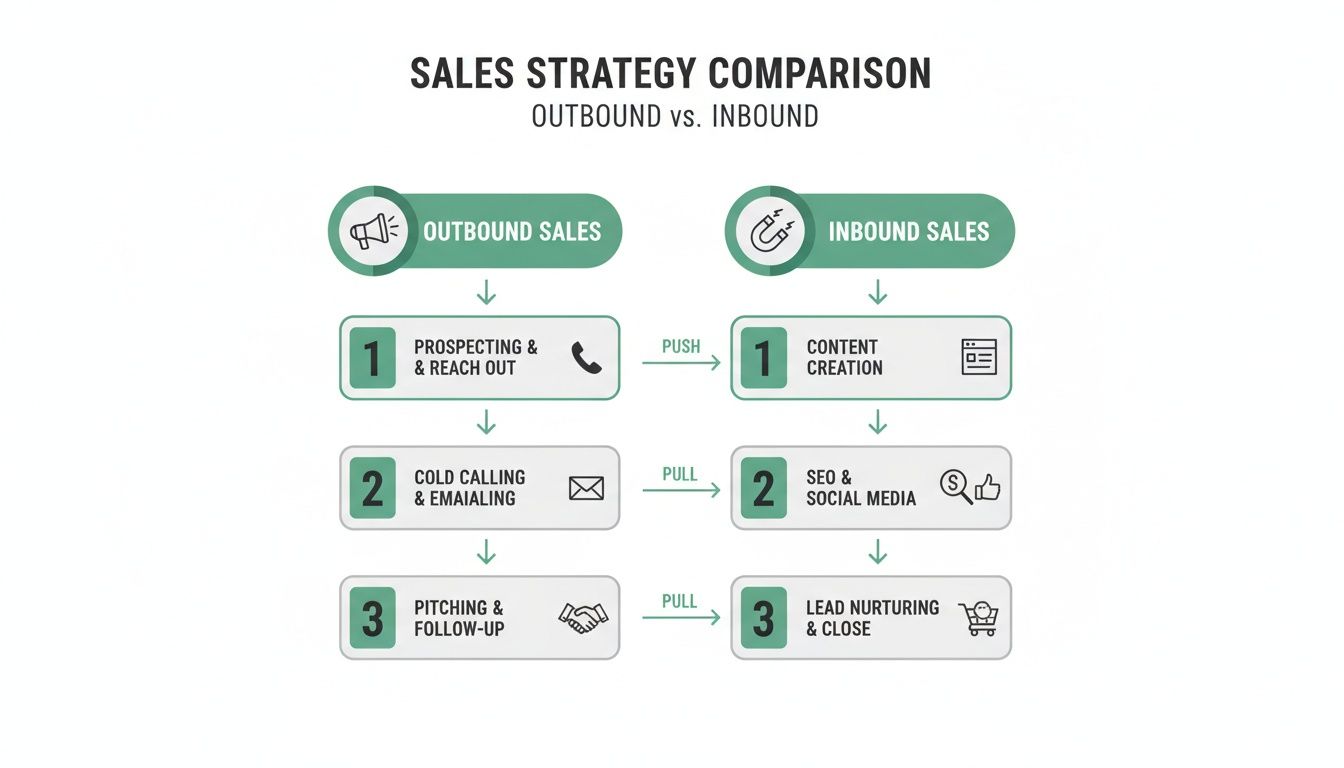
    This infographic does a great job of showing the difference between the get-up-and-go nature of outbound sales versus the more passive, waiting game of inbound.

    An infographic comparing outbound versus inbound sales strategies with their distinct steps and methods.

    You can see outbound (the megaphone) is all about pushing a message out, while inbound (the magnet) is about pulling interest in. That’s why a rock-solid prospecting foundation is non-negotiable for the outbound model to work.

    Pillar 2: Strategic Outreach

    With a high-quality list ready to go, it's time to actually make contact. This is the outreach pillar, where you craft personalized messages and figure out the best channels to connect with your prospects. The goal isn't just to get noticed; it's to start a real conversation.

    Let’s be clear: generic, mass-blasted emails are dead. Personalization is the name of the game now. Your message has to show you've done your homework and have a clue about the challenges they might be facing.

    A great outreach message is about the prospect's world, not your product. It should feel like the start of a helpful conversation, not a sales pitch. Your only goal is to earn a reply, not close a deal on the first touch.

    This is where a well-planned sales cadence becomes your best friend. It’s just a scheduled sequence of touchpoints across different channels—email, phone, social media—that keeps you persistent without being annoying. To really nail this, check out our guide on sales cadence best practices and learn how to build a sequence that actually gets responses.

    Pillar 3: Effective Qualification

    Just because someone replies doesn't mean they're a good fit. The qualification pillar is where you dig in to uncover their needs, challenges, and whether they even have the authority to buy. You're basically playing detective to see if there's a real opportunity to help them and if they're a legitimate potential customer.

    This is where the conversation shifts from you talking at them to you talking with them. Your job is to listen more than you speak. Ask smart, open-ended questions to get a feel for their current situation, their biggest headaches, and what they’re trying to achieve.

    A classic framework for this is BANT:

    1. Budget: Can they actually afford your solution?
    2. Authority: Are you talking to the person who signs the checks, or just an intern?
    3. Need: Is there a real, painful problem that your product can solve for them?
    4. Timeline: Do they need to find a solution yesterday, or is this a "maybe next year" kind of thing?

    Pillar 4: Consistent Nurturing and Follow-Up

    The final pillar is all about the long game. The hard truth of outbound sales is that most prospects aren't ready to buy the second you reach out. In fact, some studies show that up to 50% of qualified leads aren't looking to make an immediate purchase.

    That’s where nurturing comes in. It’s the art of building a relationship over time by providing value without asking for anything in return. This keeps you top-of-mind, so when they are ready to buy, you’re the first person they think of.

    This could mean sending them a helpful article, inviting them to a webinar, or connecting them with someone in your network. The key is to be genuinely useful, not pushy. This approach builds trust and slowly turns cold prospects into warm opportunities down the road.

    Mastering the Essential Outbound Sales Channels

    A laptop and tablet display profiles on a wooden desk, next to an 'Outbound Channels' sign.

    Once you've built a solid prospect list, it’s time to pick your weapons. The right outreach channels are what carry your message directly to your ideal customers. And while new platforms pop up all the time, a few classic channels are still the bedrock of any successful outbound strategy.

    These core channels are cold email, cold calling, and social selling. Each has its own rhythm and requires a unique touch. The real magic happens when you blend them together, creating a multi-channel approach that makes your outreach impossible to ignore.

    The Art of Cold Email

    Cold email is usually the first punch you throw in an outbound sequence, and for good reason. It’s scalable, doesn't interrupt someone's day like a phone call, and gives them space to consider your offer. But here’s the catch: its success is all about personalization and value.

    The average person gets hit with over 120 emails a day, so a generic, me-first message is going straight to the trash. Your email has to cut through the noise instantly, starting with a subject line that sparks curiosity without being cheap clickbait.

    A great cold email feels like a personal, one-to-one message, not a marketing blast. It should immediately show you’ve done your homework and have something genuinely useful to say.

    To write emails that actually get replies, nail these four things:

    • A Compelling Subject Line: Keep it short and personal. Something like "Quick question about [Company Name]" often beats a flashy slogan.
    • A Personalized Opening: Mention a recent company win, a LinkedIn post they wrote, or a shared connection. It proves you’re not just spamming.
    • A Clear Value Proposition: In one or two sentences, what problem do you solve? What’s the result?
    • A Low-Friction Call to Action (CTA): Instead of asking for 30 minutes, try something lighter like, "Is solving this a priority for you right now?" It’s an easier "yes."

    Getting this right is so critical we built a whole playbook on how to write cold emails that convert.

    The Power of Cold Calling

    Despite what you may have heard, cold calling is far from dead. It's still one of the most direct and powerful ways to connect with a prospect. Nothing uncovers real pain points or builds rapport faster than an actual conversation.

    In fact, the global outbound telemarketing market is expected to hit roughly USD 11.5 billion by 2025. That kind of money tells you one thing: companies are still seeing a huge return from picking up the phone.

    Modern cold calling isn’t about robotic scripts. It’s about having a flexible game plan that allows for a real, human conversation. This means a sharp opening line, smart questions to guide the chat, and knowing how to handle the inevitable objections. For a deeper dive, check out this guide on outbound calls for sales and support.

    Strategic Social Selling on LinkedIn

    Social selling, especially on LinkedIn, is the perfect partner to your calls and emails. Think of it as the warm-up act. It’s a longer game focused on building your credibility before you ever ask for anything. When your email finally lands, it’s from a familiar face, not a total stranger.

    But effective social selling isn’t about spamming connection requests or pitching in your first DM. It’s a subtle art.

    Actionable Social Selling Tactics:

    1. Engage with Their Content: Leave a thoughtful comment on their posts. Don’t just say "Great post!" Ask a question or add a related insight that keeps the conversation going.
    2. Share Valuable Content: Regularly post things that actually help your target audience. This positions you as an expert, not just a seller.
    3. Send a Personalized Connection Request: Always add a note. Mention something specific, like a mutual connection or why you want to connect.

    When you weave these three channels together, you create a powerful system. A prospect might ignore your email, but then see your name pop up on their LinkedIn feed. That little bit of familiarity makes them far more likely to open your next message. That’s modern outbound in a nutshell.

    How to Measure What Truly Matters in Outbound Sales

    In outbound sales, being busy doesn't always mean being productive. A flurry of activity might look impressive, but it’s completely meaningless if it doesn't translate into a healthy pipeline and closed deals. To stop guessing and start making informed decisions, you have to track the right key performance indicators (KPIs).

    Think of these metrics as the vital signs of your outbound engine. They show you exactly where your process is humming along and, more importantly, where it's sputtering out. By focusing on what truly matters, you can spot problems early and tune every stage of your outreach for predictable, repeatable growth.

    Leading Indicators That Signal Success

    Long before you see a signed contract, leading indicators tell you if you're even on the right path. These early metrics are all about engagement and are the first clues you get about whether your messaging and targeting are working.

    • Open Rate: This one’s simple: it’s the percentage of prospects who actually open your emails. It's not a perfect metric, but a rock-bottom open rate is a giant red flag that your subject lines are falling flat.
    • Reply Rate: This is where the rubber meets the road. A high reply rate means your message is compelling enough to start a conversation, which is the whole point of that first touch.
    • Meeting Booked Rate: The ultimate test of a successful first interaction. This KPI tracks the percentage of prospects who agree to a meeting, showing your value prop is strong enough to earn a spot on their calendar.

    These metrics give you instant feedback. If your reply rate is dismal, it’s time to A/B test your email copy, not just mindlessly send more emails.

    Lagging Indicators That Measure Results

    While leading indicators track your activity, lagging indicators measure the final outcome. These are the bottom-line metrics that tie your outbound efforts directly to revenue.

    Lagging indicators like Sales Cycle Length and Close Rate tell the final story of your sales efforts. They confirm whether the meetings you're booking are with genuinely qualified prospects who have a real potential to become customers.

    Here are the critical outcome-focused KPIs you need to watch:

    1. Sales Cycle Length: This tracks the average time it takes to get from that first "hello" to a closed deal. A long sales cycle can mean you have friction in your process or you're chasing the wrong leads.
    2. Close Rate (or Win Rate): The big one. This is the percentage of qualified opportunities that turn into a sale. It’s the ultimate test of your team's ability to turn conversations into cash.
    3. Cost Per Opportunity: This calculates how much you spend to generate a single qualified lead. Keeping this number in check is key to making sure your outbound strategy is actually profitable and can scale.

    Setting Realistic Benchmarks

    Knowing your numbers is one thing, but knowing if they're any good is another. Industry benchmarks for outbound conversion typically hover between 2% to 5% for an initial contact-to-opportunity conversion.

    But here’s the kicker: top teams using AI for personalization have seen a 10–25% increase in pipeline, which shows how the right tech can completely change the game. You can dig into more insights on how AI impacts sales conversion rates over on convin.ai.

    By consistently tracking both leading and lagging indicators, you create a powerful feedback loop. You can see how a small tweak to your email copy (leading) impacts your final close rate (lagging), allowing you to fine-tune your strategy with cold, hard data—not just gut feelings.

    Supercharge Your Outreach with the Right Tech Stack

    Modern outbound sales is all about efficiency and accuracy. While the core idea of proactively reaching out is timeless, technology is what separates the top-performing teams from everyone else spinning their wheels. The right tech stack turns those tedious, time-sucking manual tasks into smooth, automated workflows, freeing up your reps to do what they're paid for: sell.

    This is especially true when it comes to prospecting. Bad data can torpedo a campaign before you even send the first email. Nothing kills morale and wastes resources faster than spending hours hunting for contact info only to be hit with a sky-high bounce rate.

    The Problem with Manual Prospecting

    Here’s a hard truth: without the right tools, your sales reps could be spending up to 40% of their time just looking for someone to contact. They're manually digging through LinkedIn profiles, company websites, and industry news, trying to piece together a halfway decent prospect list.

    This process isn’t just slow; it's a recipe for human error, outdated contact details, and missed opportunities. At a certain point, a specialized tool stops being a "nice-to-have" and becomes a non-negotiable part of your process.

    Streamlining Your Workflow with an Email Finder

    This is exactly where tools like EmailScout come in. Think of them as a force multiplier for your sales team. They inject speed and precision right where you need it most—the prospecting phase—and turn a manual slog into a quick, one-click process.

    The best tools don't force you to jump through hoops or leave your existing workflow.

    Person typing on a laptop displaying various app icons, with a 'Sales Tech Stack' overlay.

    As you can see, the tool integrates right into your browser, letting you find and save verified email addresses from LinkedIn profiles or company sites on the fly. This single function slashes research time and dramatically improves the quality of your outreach lists.

    The impact is huge. By 2025, automation became a cornerstone of outbound sales, with reports showing teams using AI saw a typical ROI boost in the 10–25% range. For about 45% of teams, tools that automated account research cut down manual work, helping them scale outreach without hiring more people.

    Key Features That Boost Efficiency

    The right technology does more than just find emails; it fundamentally changes how you build your pipeline. By automating the foundational steps of prospecting, you free up your team’s time for personalizing outreach and having real conversations.

    Here are a few features that make a real difference:

    • Chrome Extension: Lets you grab verified emails directly from a prospect's LinkedIn profile or company website with a single click. No more switching tabs or guessing games.
    • URL Explorer: You can drop in a bunch of company URLs and pull contact information in bulk. This is a game-changer for building targeted lists for account-based marketing (ABM) campaigns.
    • AutoSave Functionality: This feature automatically saves verified contacts to your lists as you browse. It creates a seamless workflow where list-building just happens in the background while you focus on finding the right people.

    By automating the top of your funnel—the data collection and verification—you empower your sales team to spend less time digging for info and more time building relationships and closing deals.

    Ultimately, integrating the right tools is about shifting your team's energy from low-value admin work to high-value strategic selling. To complete your stack, you'll need to find the best cold email software that plays nicely with your email finder, creating a powerful, end-to-end outbound machine.

    Common Questions About Outbound Sales

    Jumping into outbound sales can feel like navigating a maze. A lot of questions pop up, and it's easy to get sidetracked by myths and outdated advice. Let's clear the air and tackle some of the most common uncertainties head-on.

    The idea of reaching out directly to potential customers isn't new, but how we do it has completely changed. Getting these details right is the secret to building a reliable sales pipeline that actually brings in revenue.

    Is Outbound Sales Still Effective?

    Yes, without a doubt. When you do it right—with smart personalization, solid data, and a genuine desire to help—outbound is one of the most predictable ways to land high-quality leads. It puts you in the driver's seat, letting you target your perfect customers instead of just waiting for them to find you.

    The game has moved on from generic, spammy blasts. Today’s winning outbound strategy is all about targeted, relevant outreach that kicks off a real conversation.

    What Is the Difference Between Outbound Sales and Marketing?

    Think of it this way: outbound sales is a direct conversation, while outbound marketing is a billboard. Both want to attract customers, but they go about it in completely different ways.

    • Outbound Sales: This is a one-to-one (or one-to-few) interaction driven by a sales rep. The whole point is to connect directly through personalized emails, calls, or social messages to start a sales dialogue.
    • Outbound Marketing: This is a one-to-many broadcast. It’s about creating broad brand awareness with things like TV commercials, print ads, or online banner ads that push a single message out to a huge audience.

    In short, outbound sales is surgical, personal, and built on relationships. It's about starting a dialogue, while outbound marketing is about delivering a monologue to a crowd.

    How Long Does It Take to See Results?

    While a full-blown, predictable pipeline often takes 3-6 months to build, you can spot the green shoots of success much, much sooner. These early signs are critical for knowing if you're headed in the right direction.

    Within the first few weeks, you should be tracking things like email open rates, reply rates, and how many meetings you've booked. These are the small wins that tell you your targeting is on point and your message is hitting home. They give you the data you need to tweak your approach long before the big deals start closing.


    Ready to supercharge your prospecting and build highly accurate lead lists in minutes? EmailScout gives your team the power to find verified email addresses with a single click, automating the most time-consuming part of outbound sales. Start finding unlimited emails and building your pipeline today at https://emailscout.io.

  • How to Build a Sales Pipeline That Converts Deals

    How to Build a Sales Pipeline That Converts Deals

    Let’s be real—building a sales pipeline boils down to three core things: finding quality leads, figuring out if they have the intent (and budget) to buy, and finally, closing the deal. This whole process is your roadmap for turning a bit of interest into revenue you can actually count on. It’s what keeps your sales team from chasing ghosts and lets them focus on the opportunities that are most likely to convert.

    Your Blueprint for a High-Performing Sales Pipeline

    Think of your sales pipeline as more than just a deal tracker. It’s an engineered system for creating consistent, predictable revenue. Without one, you’re stuck with random wins and forecasts that are basically just guesswork. A well-defined pipeline, on the other hand, gives you a clean, visual map of where every single prospect is on their journey, from the first "hello" to the signed contract.

    That clarity is everything. It's the difference between reacting to whatever sales come in and proactively managing your entire process.

    Once you can see the flow of opportunities, you can spot bottlenecks, predict future income with surprising accuracy, and put your resources where they’ll have the most impact. Flying blind just doesn’t work; your team wastes precious time on leads that were never going to pan out in the first place.

    The Core Components of a Pipeline

    A great pipeline isn't just a list of names. It’s a living, breathing process built on a few key pillars that guide prospects smoothly from one stage to the next. Nail these, and you've got the foundation for a killer sales strategy.

    Here’s a quick overview of what every pipeline needs:

    Pipeline Stage Primary Objective Key Activity Example
    Lead Generation To identify and attract potential customers. Running a targeted ad campaign or collecting contacts at a trade show.
    Qualification To determine if a lead fits your ideal customer profile (ICP). A BDR makes an initial call to assess need, budget, and authority (BANT).
    Meeting/Demo To showcase the value of your product or service. An Account Executive runs a personalized product demonstration.
    Proposal To present a formal offer outlining the solution and pricing. Sending a detailed quote that addresses the prospect's specific pain points.
    Negotiation & Closing To finalize terms and secure the signed contract. Handling objections and agreeing on final pricing and contract details.
    Post-Sale To ensure a smooth handoff and customer satisfaction. Onboarding the new client and introducing them to their account manager.

    These stages aren't set in stone—you should adapt them to your specific sales cycle. The key is to have a clear, repeatable process that everyone on your team understands and follows.

    Let's break down the foundational elements that make those stages work.

    Clearly Defined Stages

    Each stage needs to represent a real step forward in the buyer's journey. Think "Initial Contact," "Discovery Call," "Proposal Sent," and "Negotiation." This gives your team a clear playbook, so they always know what action to take next to move a deal along.

    Solid Qualification Criteria

    You need a firm set of rules to decide if a lead is even worth pursuing. This is crucial. Without it, your pipeline gets clogged with prospects who don’t have the budget, authority, or genuine need for what you’re selling. It’s the bouncer at the door of your sales process.

    Key Metrics for Success

    Tracking data is non-negotiable. You have to know your numbers. Metrics like conversion rates between stages, your average deal size, and the length of your sales cycle tell you exactly what’s working and what’s broken.

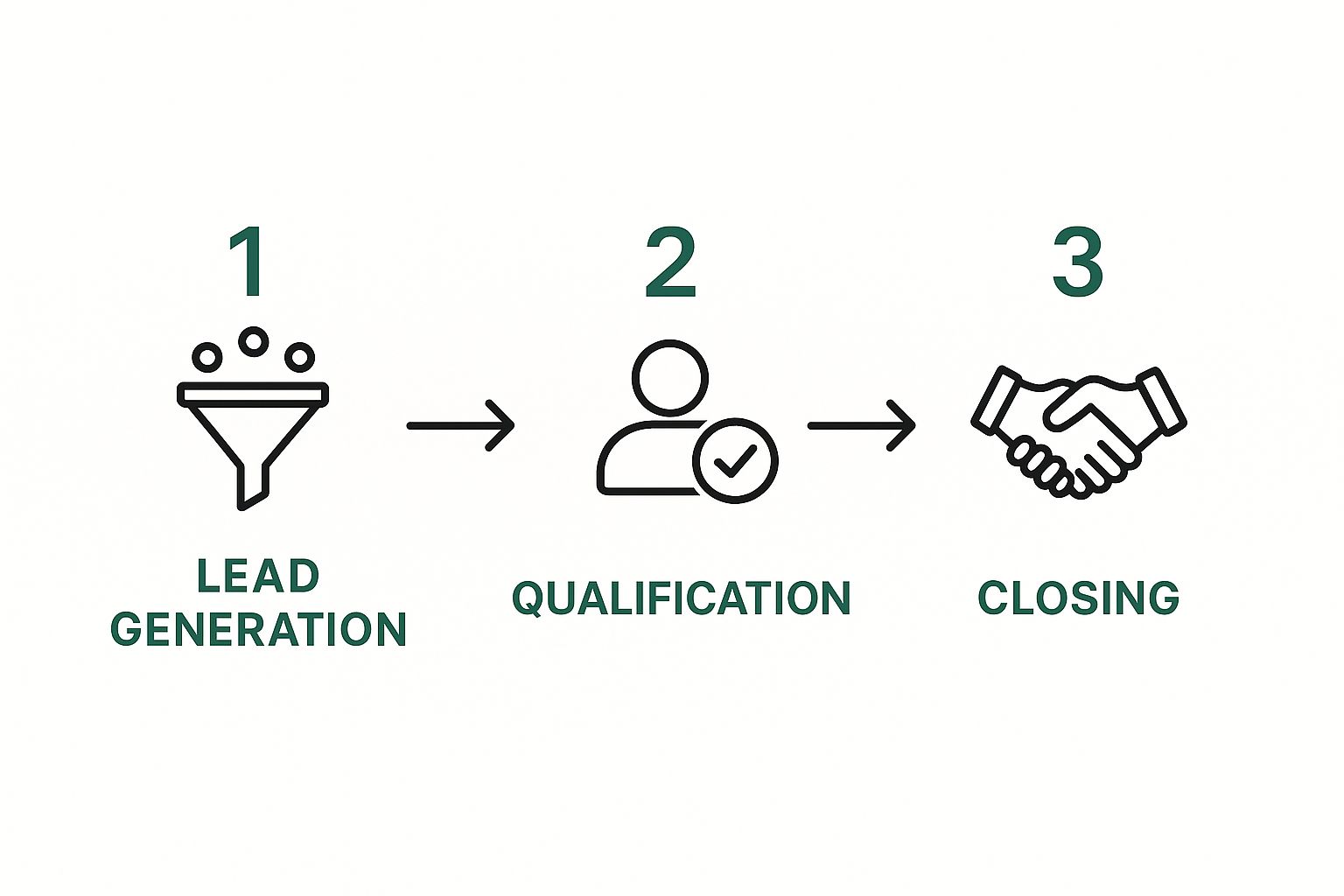
    This diagram gives a great visual of that fundamental flow from finding leads to closing deals.

    Image

    It’s a simple reminder that a pipeline is a step-by-step process. Each stage flows logically into the next, which is how you make sure no opportunity gets lost in the shuffle.

    A pipeline isn't just a sales tool; it's a business intelligence engine. Companies that formally define their sales process achieve nearly 30% higher revenue growth compared to those that don’t.

    Getting this structure right provides the framework for everything else. By breaking down the sales journey into these manageable stages, you give your team a repeatable playbook for success. It turns sales from an unpredictable art into a predictable science, which sets the stage for the specific strategies we're about to dive into.

    Finding and Engaging Your Ideal Customers

    Image

    A sales pipeline is only as good as the leads you put into it. Shoveling in a ton of random prospects is a fast track to wasted time and missed quotas. The secret to predictable revenue isn't volume; it's focus. You have to go after the right people from the very start.

    This is about ditching the old-school, scattergun approach for a smarter, more strategic way of prospecting. It all begins with a crystal-clear picture of who you're trying to reach.

    Define Your Ideal Customer Profile

    Before you write a single outreach email, you need to know exactly what your perfect customer looks like. This is your Ideal Customer Profile (ICP)—a detailed snapshot of the company that gets the most out of your product and, in turn, gives the most value back to you.

    A good ICP isn't just a hunch. It's a data-backed document that steers your entire sales and marketing ship. Without one, your team is basically flying blind, chasing leads that were never a good fit to begin with.

    So, how do you build one? Start by looking at your best existing customers. What do they have in common?

    • Firmographics: What industry are they in? How big are they, both in revenue and employee count? Where are they located?
    • Technographics: What other tech are they using? Their current software stack can be a huge tell that they're ready for your solution.
    • Behavioral Traits: How did they find you in the first place? What did their buying journey look like? What specific problems did you solve for them?

    When you spot these common threads, you're essentially creating a blueprint for who you should be targeting. This focused strategy is a core part of modern lead generation best practices and keeps your team aimed at high-potential accounts.

    Modern Prospecting for Quality Leads

    Once your ICP is locked in, the hunt begins. It’s time to find companies that fit the bill. This is where modern prospecting techniques really shine, moving you away from annoying cold calls and toward targeted, value-driven conversations. The goal isn't to interrupt someone's day but to show up with a relevant solution when they need it most.

    Think of it like fishing. You wouldn't just throw a net into a random pond. You’d go to the right lake, use the right bait, and be patient. Sales is no different.

    Companies with a well-defined sales process—which always starts with targeted prospecting—achieve 18% faster revenue growth than those without one. That's the real-world impact of focusing on quality over quantity.

    Your ICP tells you where to fish. Now, let’s talk about how to cast your line.

    Leveraging Professional Networks

    Platforms like LinkedIn are a goldmine for B2B sales. It’s where your ideal customers are talking about their challenges, sharing their wins, and connecting with others in their field. It’s not just a digital resume anymore; it’s a living, breathing business community.

    Here’s a quick-start guide to using it right:

    1. Tune Up Your Profile: First things first, make sure your profile frames you as a helpful expert, not a pushy salesperson. Your headline should talk about the problems you solve, not just your job title.
    2. Use Advanced Search: LinkedIn Sales Navigator is a beast for filtering millions of users down to the ones who perfectly match your ICP. You can slice and dice by company size, industry, title, seniority—you name it.
    3. Engage Authentically: Don’t just send a bland connection request and launch into a pitch. Follow your targets, leave thoughtful comments on their posts, and share valuable content yourself. When you finally reach out, they'll already know who you are.

    This approach builds a little bit of rapport before you ever make an ask, which drastically increases your chances of getting a reply.

    Finding Verified Contact Information

    You’ve identified the right people at the right companies. The last piece of the puzzle is actually getting in touch. A generic "info@" email just isn't going to get you anywhere. You need the direct line to the decision-makers you've been researching.

    This is where tools like EmailScout become essential. Instead of wasting hours guessing email formats or digging through company directories, an email finder can pull a verified email address right from someone's LinkedIn profile or a company website. It’s a simple step that saves a massive amount of time and makes your outreach far more efficient.

    By combining a sharp ICP with smart prospecting on platforms like LinkedIn and tools for contact discovery, you create a repeatable system. You'll start filling your pipeline not just with leads, but with genuine opportunities that have a much higher chance of closing.

    Qualifying and Prioritizing High-Value Leads

    Image

    Getting leads to flow into your system is one thing, but what you do next is what really matters. A pipeline stuffed with unqualified prospects is a fast track to missed quotas and a burned-out sales team. The most critical skill in building a sales pipeline that actually closes deals is learning to separate the serious buyers from the casual window-shoppers.

    This is where qualification comes in. Think of it as the gatekeeper for your entire sales process. It’s what ensures your team spends their limited time and energy on deals that have a real shot at closing. Skip this, and your forecast becomes pure guesswork.

    Using Frameworks to Ask the Right Questions

    Qualification isn't about running a prospect through a rigid checklist; it's about having a structured conversation to uncover what's really going on. Proven frameworks give you the guardrails for these conversations, helping your team consistently spot the high-value opportunities.

    The BANT framework is a classic for a reason—it’s simple, effective, and perfect for those initial qualification calls. It zeros in on four core areas:

    • Budget: Do they actually have money set aside for a solution like yours?
    • Authority: Are you talking to the person who can sign the check, or at least a key influencer?
    • Need: What’s the specific business pain they're trying to fix? Is it a "nice-to-have" or a "hair-on-fire" problem?
    • Timeline: When are they looking to get this done? This quarter or sometime next year?

    For more complex, big-ticket B2B sales, a more detailed framework like MEDDIC is a game-changer. It forces a much deeper level of discovery, which is essential for navigating those tricky enterprise deals.

    A pipeline clogged with unqualified leads is a slow death for a sales team. The top-performing reps aren't the ones with the most deals; they're the ones with the best-qualified deals.

    MEDDIC helps you dig into the specifics of a potential deal, so you understand the real dynamics at play. You'll get past the surface-level answers and uncover the internal politics and metrics that truly drive a purchasing decision.

    Mastering the MEDDIC Framework

    MEDDIC provides a more robust structure for qualifying enterprise-level opportunities where you’re dealing with multiple stakeholders and complex buying processes. It stands for:

    • Metrics: What measurable results does the prospect need to see? Think increased revenue, cost savings, or better efficiency.
    • Economic Buyer: Who has the ultimate profit-and-loss responsibility for this purchase? This is the person with the final say.
    • Decision Criteria: What specific technical, financial, and vendor requirements will they use to judge solutions?
    • Decision Process: What are the exact steps, timeline, and people involved from evaluation to a signed contract?
    • Identify Pain: What's the primary business problem, and what are the negative consequences if they do nothing?
    • Champion: Who inside their organization is fighting for you when you’re not in the room?

    By systematically gathering this intel, you can accurately gauge the health of any deal. You'll know if you’re talking to the right people, if the business case is strong enough, and who you need to win over.

    Implementing a Lead Scoring Model

    While frameworks are great for one-on-one conversations, how do you prioritize inbound leads at scale? This is where a good lead scoring model comes into play. It’s an automated system that ranks prospects based on who they are and how they’re engaging with your company.

    The model assigns points for different attributes and actions, giving your sales team a clear, data-driven way to decide who to call first. You can score leads based on two main categories:

    Demographic and Firmographic Fit:

    • Job Title: A C-level executive might get +15 points, while an intern gets 0.
    • Company Size: Companies in your sweet spot get +10 points.
    • Industry: Leads from your target industries get +10 points.

    Behavioral Signals (Buying Intent):

    • Website Visits: Visiting your pricing page could be worth +20 points.
    • Content Downloads: Downloading a detailed case study might add +10 points.
    • Email Engagement: Clicking a link in a marketing email gets +5 points.

    By setting a threshold—for instance, any lead with 75 points or more—you can automatically define who is "sales-qualified." This simple system ensures your reps immediately focus on the hottest leads, dramatically improving their efficiency and the predictability of your sales pipeline.

    Moving Deals Forward and Nurturing Key Relationships

    Image

    So you've qualified a lead. Great. Now the real work begins. The middle stages of your pipeline—nurturing, presenting solutions, and handling objections—are where you either build momentum or watch the deal fizzle out.

    It's a delicate dance. You need to guide a prospect from mild interest to a confident decision without being pushy or just plain annoying. This requires a fundamental shift in your mindset, moving from "selling" to genuinely "helping."

    Today’s B2B buyers are sharp. They've already done their homework, and a generic sales pitch is the last thing they want to hear. Your job is to become a trusted advisor who adds real value at every single touchpoint.

    Crafting a Digital-First Engagement Strategy

    Let's face it: modern buyers live online. They expect smooth, on-demand interactions and want to research things on their own time. This isn’t just a passing trend; it's a permanent change in how deals are won.

    In fact, recent data shows that a whopping 80% of B2B decision-makers now prefer digital engagement over old-school methods. This stat alone should tell you everything you need to know about building an effective sales pipeline today. A digital-first communication strategy is no longer optional.

    A digital-first approach simply means meeting buyers where they are. Think personalized emails, sharing genuinely useful content, and running strategic virtual meetings. Your goal is to make their buying process as easy and informative as possible.

    Personalized Follow-Up Sequences That Actually Get Replies

    Generic "just checking in" emails are a one-way ticket to your prospect's trash folder. To keep a deal moving, you need a follow-up cadence that is both persistent and valuable, respecting their time while keeping your solution on their radar.

    An effective follow-up never feels like a nag. Every single message should offer a new piece of value. This is how you prove your expertise and build the trust required to push the sale forward.

    Here’s a simple, value-driven follow-up sequence you can steal:

    • Touchpoint 1 (Day 3): Share a case study that’s highly relevant to their industry or specific problem. Frame it like this: "Thought you might find this interesting, given our conversation about [specific problem]."
    • Touchpoint 2 (Day 7): Send a link to a short blog post or webinar recording that directly answers a common question related to their challenge.
    • Touchpoint 3 (Day 12): Offer something tangible, like a quick, no-strings-attached consultation or a short demo focused on the one key feature that solves their main issue.

    This methodical approach keeps you top-of-mind without being a pest. For a deeper dive, check out our guide on https://emailscout.io/how-to-write-cold-emails/. The principles for getting a reply are just as relevant for follow-ups.

    A great follow-up isn't about reminding someone you exist. It's about giving them another reason to be glad you do. Each touchpoint should feel less like a sales nudge and more like a helpful resource.

    Leveraging Content to Solve Specific Problems

    Your content library is one of the most powerful sales tools you have. Stop sending generic product brochures and start thinking like a consultant. Match the perfect piece of content to where your prospect is in their journey. It shows you’re actually listening and are invested in their success.

    Picture this: during a discovery call, a prospect mentions they’re struggling to get buy-in from the finance team. The right move isn't to immediately book another demo. It’s to send them your ROI calculator or a whitepaper detailing the financial benefits of your solution.

    Here’s a quick way to map content to different pipeline stages:

    Pipeline Stage Prospect's Question Ideal Content Asset
    Discovery "How have others in my industry solved this?" Industry-specific case studies
    Evaluation "How does your solution compare to others?" Competitor comparison sheets or feature guides
    Decision "What will implementation look like for us?" Onboarding guides or customer testimonials

    Using content this way positions you as an invaluable partner, not just another vendor trying to make a sale.

    Handling Objections with Confidence

    Objections aren't deal-breakers. They're requests for more information. When a prospect brings up a concern about price, timing, or features, it's a golden opportunity to clarify your value and build a stronger case. Getting defensive will kill a deal on the spot.

    The secret is to listen carefully, acknowledge their concern, and then reframe the discussion around value, not cost.

    For instance, if a prospect says, "Your price is higher than your competitor's," don't jump to offer a discount. A much better response is: "That's a fair point. Could we walk through the specific features that drive a higher ROI for our clients? Many find that our [unique feature] actually saves them more in the long run."

    This turns a potential roadblock into a productive conversation, keeping the deal alive and making your relationship with the buyer even stronger.

    Fine-Tuning Your Pipeline with Data and Automation

    Your sales pipeline isn’t a "set it and forget it" kind of thing. Think of it more like a high-performance engine; it needs constant tuning to run at its best. By digging into the data to see what’s actually working and using automation to handle the grunt work, you can turn a simple deal tracker into a machine that drives predictable growth.

    This all starts with knowing your numbers. If you're not tracking the right metrics, you're flying blind. You have no way of spotting the hidden bottlenecks that are killing your momentum. When you can measure performance, you can start managing it.

    Identifying the Metrics That Truly Matter

    It’s easy to drown in data. The trick is to focus on a handful of metrics that give you a brutally honest look at your pipeline's health. These numbers tell a story, revealing exactly where your deals get stuck and where they sail right through.

    Get started by tracking these essentials:

    • Stage-by-Stage Conversion Rate: What percentage of deals actually move from one stage to the next? If you see a massive drop-off between "Demo" and "Proposal," that's a red flag. It probably means your value prop isn't landing the way you think it is.
    • Average Deal Size: Knowing the typical value of a closed-won deal is crucial for forecasting revenue. If this number starts to dip, your team might be getting a little too aggressive with discounts.
    • Sales Velocity: How long does it take for a deal to go from that first conversation to a signed contract? A slow velocity is a sign of friction somewhere in your process that you need to find and fix.
    • Pipeline Coverage: This is the simple ratio of your total open pipeline value to your sales quota. A healthy ratio—often 3x or 4x—gives you the buffer needed to hit your target even when a few deals inevitably fall through.

    Watching these metrics lets you shift from making gut-feel decisions to making smart, data-backed moves. You'll know exactly where to focus your coaching and resources to get the biggest bang for your buck.

    Using Data to Uncover Bottlenecks

    Once you start tracking, patterns will emerge. You might discover that your team is incredible at booking initial meetings but falls flat when it comes to converting them into qualified opportunities. Boom. You've found a bottleneck.

    This is where data becomes your best diagnostic tool. A low conversion rate at a specific stage points directly to a problem. Maybe your team needs better training on handling objections, or perhaps the marketing content you're sending isn't resonating with buyers at that point.

    Don't just stare at the numbers—ask what story they're telling. A pipeline report isn't a boring list of deals; it's a treasure map showing you the fastest route to revenue.

    This data-first approach also grounds your forecasts in reality. When you know your average close rate, you can look at the total value of your pipeline and predict future revenue with surprising accuracy. It also throws a spotlight on the importance of managing your Customer Acquisition Cost (CAC), which you can dig into with our Customer Acquisition Cost Calculator.

    The Power of Smart Automation

    Okay, let's talk about getting more done. So many of the tedious tasks in sales—sending follow-up emails, updating the CRM, scheduling meetings—can and should be automated. This frees your reps up to do what they're actually good at: talking to people and closing deals.

    Automation isn’t about replacing reps with robots. It’s about making them better. By taking the repetitive busywork off their plates, you give them back the time to focus on high-value activities that actually push deals forward.

    A formal sales process is the bedrock for this. In fact, companies that define one see nearly 30% more revenue growth than those that don't. When you layer automation on top of that solid foundation, things really take off. Simply automating lead management can boost revenue by 10% or more in just six to nine months.

    Here are a few areas where automation is a no-brainer:

    • Automated Email Sequences: For leads who aren't quite ready to pull the trigger, a simple nurturing sequence can keep your company top-of-mind with helpful content until the timing is right.
    • Task Creation: Set up your CRM to automatically create a task for a rep whenever a deal moves to a new stage. No more "I forgot to follow up."
    • Lead Scoring: Let automation score your inbound leads based on their profile and behavior. This instantly flags the hottest prospects so your team knows exactly who to call first.

    When you combine sharp data analysis with smart automation, you create a self-improving system. You use data to find the leaks in your pipeline, then use automation and process tweaks to patch them up. The result is a more efficient, predictable, and high-performing sales machine.

    Answering Your Top Sales Pipeline Questions

    As you get your hands dirty building out a sales pipeline, questions are going to come up. It's just part of the process. Knowing the answers to a few common sticking points can save you a ton of time and help you get your process dialed in for much better results.

    Let’s jump into some of the most frequent hurdles sales teams run into when they get serious about managing their pipeline.

    How Many Stages Should My Pipeline Have?

    There's no single magic number here, but a solid rule of thumb is somewhere between five and seven stages. The most important thing is that each stage represents a real, meaningful step forward in your sales process and requires a specific action from your sales rep to advance the deal.

    A classic mistake is building a pipeline with way too many stages. It just becomes overly complex and a nightmare to manage. On the flip side, too few stages can leave you with a blurry, inaccurate picture of where your deals actually are.

    You can't go wrong starting with the basics and then tweaking it over time:

    • Lead Generation
    • Qualification
    • Meeting/Demo
    • Proposal
    • Negotiation & Closing

    This simple structure gives you enough detail to be genuinely useful without becoming a burden. As your sales process matures, you can always add, combine, or rename stages to better match your customer’s buying journey.

    How Do I Keep My Pipeline From Stalling?

    Stalled deals are the silent killer of sales forecasts. The absolute best way to keep things moving is to lock in a clear "next step" at the end of every single interaction. Seriously—never leave a call or meeting without agreeing on a specific date and time for the follow-up.

    Letting dead deals linger is one of the biggest pipeline mistakes. It clogs your view, wastes valuable selling time, and creates a false sense of security. Top-performing teams are ruthless about disqualifying opportunities that show no signs of life.

    Another key tactic is building a consistent follow-up cadence. We know it takes an average of more than 8 touches to close a deal today, yet a shocking 44% of salespeople give up after just one. Use a smart mix of emails, calls, and even some light social media engagement to stay on a prospect’s radar—just make sure you're providing value, not just "checking in."

    What's The Difference Between a Pipeline and a Funnel?

    This one trips people up all the time. The easiest way to think about it is this: a sales funnel represents the buyer's journey from their point of view. It tracks their path from first becoming aware of you all the way to making a purchase. It's more of a marketing model, focused on volume and conversion rates between each level.

    A sales pipeline, on the other hand, is the set of stages a salesperson works through to turn a qualified lead into a closed-won deal. This is a sales-centric tool that's all about the specific actions your team is taking to win. They're two sides of the same coin, but the pipeline is your active, day-to-day playbook for managing opportunities.


    Ready to fill the top of your pipeline with verified leads? EmailScout is a powerful Chrome extension that helps you find anyone's email address in a single click, right from their LinkedIn profile or company website. Start building your outreach lists faster and more accurately today. Get started for free at https://emailscout.io.