

Let's cut through the jargon. A Sales Qualified Lead (SQL) is someone who has moved past the "just browsing" phase and is now actively looking for a solution. Think of it like a shopper who goes from casually window-shopping to walking into your store and asking, "Can you tell me more about this specific model?" They're ready for a real conversation.
Unpacking the Value of a Sales Qualified Lead

Imagine trying to find a needle in a haystack of potential leads every single day. That’s what it feels like without a solid qualification process. This is where understanding the power of an SQL becomes a complete game-changer for any sales team.
An SQL isn't just another name on a list. They're a prospect who marketing has nurtured and the sales team has personally vetted, confirming they're a genuine opportunity.
This vetting process is the secret sauce for an efficient sales machine. It makes sure your sales reps spend their valuable time and energy on people who are actually likely to buy, instead of chasing down every single person who downloaded a free whitepaper.
Why SQLs Are Your Most Valuable Prospects
Focusing on SQLs isn't just about saving time—it’s about closing more deals and building a predictable pipeline you can count on. These leads are your most valuable because their actions signal they have a real problem that your product or service can solve. They're ready to talk specifics.
This distinction is also crucial for getting your marketing and sales teams on the same page. When both teams agree on what an SQL looks like, it creates a smooth handoff and stops high-potential leads from slipping through the cracks. It turns a messy process into a strategic one.
A Sales Qualified Lead represents a critical moment in the customer's journey. It’s that perfect point where their demonstrated interest lines up with a salesperson's expertise, creating the ideal conditions for a successful sale.
The Numbers Behind Lead Qualification
The journey from a curious visitor to a sales-ready prospect is a steep one. While the average lead-to-MQL (Marketing Qualified Lead) conversion rate is a decent 31%, the jump from MQL to SQL is much tighter, sitting at a global average of just 13%.
That means for every 100 initial leads you get, only about four will become truly sales-qualified and ready for a direct conversation.
However, teams that nail their qualification process see incredible results. Some B2B teams are converting SQLs at rates nearly 4x higher than their unqualified counterparts. That’s a massive difference. You can learn more about these conversion benchmarks and see how you stack up.
The Real Difference Between MQLs and SQLs
Knowing the difference between a Marketing Qualified Lead (MQL) and a Sales Qualified Lead (SQL) is where countless growth strategies either hit their stride or fall flat. It's the critical handoff point where a flicker of interest becomes a real sales opportunity. If you get this wrong, you're just burning through leads and wasting everyone's time.
Think of it like a relay race. Your marketing team is running the first leg, warming up prospects with blog posts, webinars, and other helpful content. An MQL is the runner who grabs the baton by showing some initial engagement—maybe they downloaded an ebook or signed up for your newsletter. They're interested in your ideas.
An SQL, on the other hand, is the runner who is sprinting toward the finish line, actively looking for a coach to help them win. They've moved past just consuming content and are now signaling a direct interest in your product. This person has asked for a demo, checked out your pricing, or keeps coming back to high-intent pages on your site.
From Warm Interest to Purchase Intent
The leap from MQL to SQL doesn't just happen on its own. It’s a deliberate process that demands total alignment between your marketing and sales departments. Without a clear agreement—often called a Service Level Agreement (SLA)—the baton gets dropped. Marketing passes over leads who are still "just browsing," and the sales team gets frustrated trying to talk to people who simply aren't ready to buy.
This kind of misalignment is expensive. A shocking 87% of MQLs never turn into sales opportunities, usually because they're handed off way too early. But when that handoff is timed just right, the conversion rate can jump dramatically. The secret is creating a shared definition of what makes a lead truly "sales-ready."
A Sales Qualified Lead isn't just an interested contact. It's a prospect who has been properly vetted and confirmed by the sales team as having a genuine need, the authority to buy, and a timeline that shows they're ready for a direct sales conversation.
Defining the Handoff Criteria
To make the transition seamless, both teams need to agree on the specific triggers that promote a lead from MQL to SQL status. These triggers are based on real actions that signal strong buying intent.
- Behavioral Triggers: Actions like requesting a demo, starting a free trial, or spending a lot of time on your pricing page are dead giveaways.
- Demographic Fit: The lead has to match your Ideal Customer Profile (ICP). This means they're in the right industry, their company is the right size, and they have a relevant job title.
- Explicit Interest: This is the most obvious signal. They filled out a "Contact Sales" form or are asking direct questions about features and how to get started.
Getting this handoff right is everything. When sales and marketing are on the same page, the whole revenue engine runs smoother, turning more quality leads into happy customers. Historically, the SQL has become the gold standard for B2B sales for a reason: qualified leads convert at a rate nearly 4x higher than unqualified ones. You can dive deeper into the history and impact of sales qualified leads to see just how critical this process is.
How to Reliably Identify a Sales Qualified Lead
Figuring out when a prospect is ready to talk to sales isn't just a gut feeling. If you want to stop wasting time on dead-end leads, you need a solid process. Without a clear framework, you're just guessing, and that leads to a leaky pipeline and a frustrated sales team.
The trick is to combine what a prospect does online with what they say in a conversation. You need to read their digital body language and then ask the right questions to confirm their interest. This is where tried-and-true qualification frameworks come in handy—they give you a script to uncover what really matters.
Using Qualification Frameworks Like BANT
One of the oldest and most reliable frameworks out there is BANT. It’s incredibly straightforward and forces you to focus on the four pillars that signal a prospect is ready for a real sales conversation.
BANT stands for:
- Budget: Do they actually have the money to buy what you're selling?
- Authority: Are you talking to the person who can sign the check, or just an influencer?
- Need: Is there a real, nagging business problem that your solution can fix?
- Timeline: Do they need to solve this problem now, or is it a "some day" project?
This simple flowchart shows how a lead moves through the funnel, from a marketing-generated spark of interest to a fully vetted sales opportunity.
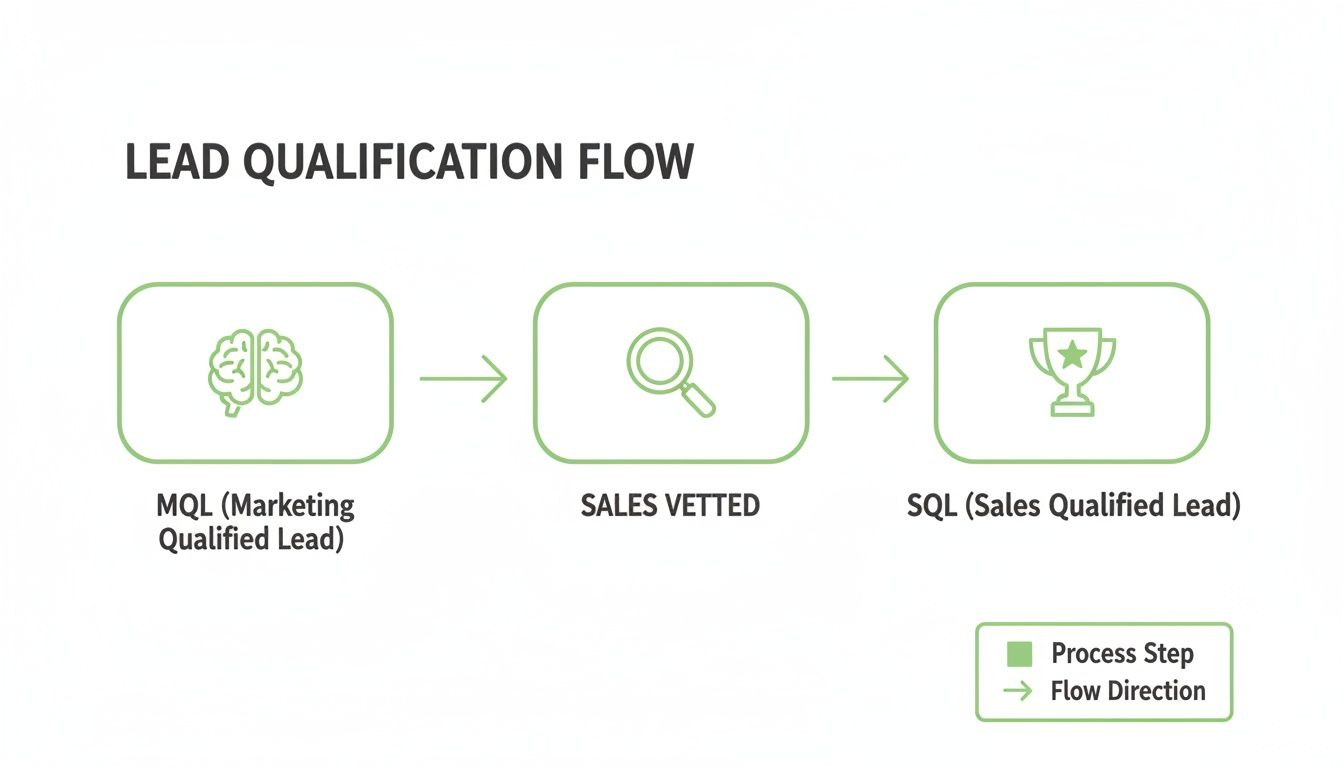
Think of this process as a filter. It ensures that only the leads who meet your specific criteria make it to your sales team's calendar.
A lead has to check off all four BANT boxes to be considered a true SQL. If they have a burning need and the budget, but no authority to make the final call, they're not an SQL. Not yet, anyway. Your job then is to work with them to get in front of the actual decision-maker.
For a more detailed look at this, check out our full guide on how to qualify sales leads effectively.
Modern Alternatives for Complex Sales
While BANT is a fantastic workhorse, it’s not always the perfect fit for long, complicated sales cycles. When you're dealing with big enterprise deals and a whole committee of decision-makers, you might need something with a bit more horsepower.
Frameworks like MEDDIC (Metrics, Economic Buyer, Decision Criteria, Decision Process, Identify Pain, Champion) provide a more detailed roadmap. It's especially useful for high-ticket sales where you need to understand every moving part of the buyer's internal process.
No matter which framework you land on, the mission is always the same: collect enough intel to confidently say, "Yes, this lead has a high chance of becoming a customer."
The best qualification conversations feel less like an interrogation and more like a consultation. You're not just checking boxes; you're diagnosing a problem and exploring whether you have the right cure.
Reading Digital Body Language
Beyond what a lead tells you, their online behavior screams volumes about their intentions. Someone who keeps coming back to your pricing page is sending a much stronger signal than someone who just downloaded a fluffy ebook a few months ago.
Keep an eye out for these high-intent digital breadcrumbs:
- Requesting a demo or free trial. This is the digital equivalent of walking into a store and asking to test drive a car. It's a huge buying signal.
- Visiting high-value pages. If you see them lurking on your pricing, case study, or feature comparison pages, they're in evaluation mode.
- Asking specific product questions. When a lead hits up your support chat to ask detailed questions about a specific feature, they're well past the initial research phase.
When you pair a structured qualification framework with a keen eye for a lead's digital behavior, you create a reliable system for identifying true Sales Qualified Leads. This lets your sales team stop chasing ghosts and start focusing their energy where it will make a real impact.
Your Action Plan After Finding an SQL

Okay, marketing has just handed you a hot sales qualified lead. The clock is officially ticking, and every single minute matters now. This isn't the time to drop them into your weekly newsletter queue. Nope. You need immediate, personalized, and persistent outreach if you want to turn that initial spark of interest into a real conversation.
Speed is your number one weapon here. An SQL is screaming, "I'm ready to buy right now." If you don't jump on it, you can bet your competitors will. In fact, research shows that contacting a new SQL within the first hour boosts your odds of actually qualifying them by a staggering 7x. Wait a day, and that opportunity might as well be dust in the wind.
This sense of urgency is a cornerstone of any high-performing sales machine. If you want to dig deeper into building this kind of system, check out our full guide on how to build a sales pipeline that turns these qualified leads into predictable cash flow.
Your First 48-Hour Outreach Cadence
Look, a single email or one missed call isn't going to cut it. You need a simple, multi-touch plan that keeps you on their radar without being annoying. The only goal for the first 48 hours is to make a connection. That's it.
Here’s a sample cadence you can steal and start using today:
- Hour 1 (The First Touch): Send a personalized email that directly references what they did. Something like, "Thanks for requesting a demo of our XYZ feature." Keep it short, sweet, and focused on one thing: scheduling a quick call.
- Hour 4 (The Follow-Up Call): Time to pick up the phone. Don't leave a bland, generic voicemail. Say something that connects the dots: "Hi [Name], I just sent you a quick email about your interest in [Product]. Just wanted to connect briefly."
- Hour 24 (The LinkedIn Touch): Find them on LinkedIn and send a connection request. Be sure to add a short, custom note: "Hi [Name], saw you were looking into [Solution Area]. Would be great to connect here."
- Hour 48 (The Second Email): Follow up again, but this time, bring something valuable to the table. A relevant case study or a short video explaining a key benefit works wonders here.
Tailoring Your Opening Lines
"Just following up" is the fastest way to get your email deleted. Your first line has to prove you've done at least a little bit of homework. Personalization is what turns a cold outreach into a warm discovery call.
The best outreach connects the prospect's recent action to a potential solution. It’s not about what you're selling; it's about why they are looking for it right now.
Here are two quick templates you can adapt based on what they did on your site:
Example 1: For a Demo Request
- Subject: Next Steps for Your Demo
- Body: Hi [Name], I saw you requested a demo to see how we solve [Pain Point]. I have a few spots open tomorrow to walk you through it and answer any questions. Does [Time] or [Time] work for a quick 15-minute call?
Example 2: For a Pricing Page Visit
- Subject: Quick Question about [Their Company Name]
- Body: Hi [Name], I noticed you were checking out our pricing page. Many teams in the [Their Industry] space use our platform to [Achieve Outcome]. Are you facing similar challenges?
Accelerate Your SQL Outreach with EmailScout
Identifying a Sales Qualified Lead is a massive win, but it’s only half the battle. You know who you need to talk to—the "Authority" from your BANT analysis—but what happens when you can't find their direct contact info? That red-hot lead starts to cool down. Fast.
This is where the real friction happens. Without verified contact data, sales reps lose hours digging for the right email address, often ending up with a generic "info@" inbox that gets ignored. Every minute spent searching is a minute you're not selling, giving competitors an open window to swoop in and start the conversation.
EmailScout slams that window shut. Instead of playing detective, you can turn a promising SQL into a real conversation in seconds.
Find Decision-Makers in One Click
Picture this: your marketing team flags an SQL from a target company that just hit your pricing page. You know the decision-maker is probably the VP of Sales, but their contact details are nowhere to be found. With EmailScout, you just find their LinkedIn profile and get their verified email with a single click.
This screenshot shows just how simple the EmailScout extension is, right on a professional profile.
The tool slips right into your existing workflow, pulling the exact email you need without you ever having to leave the page. What used to be a research project is now a one-second action.
Turn SQL Lists into Real Conversations
Or let's say you just wrapped up a webinar and have a list of attendees who fit your SQL criteria perfectly. The problem? You only have their names and companies. EmailScout's URL Explorer can take that raw list and quickly find the direct emails for each person, turning your data into a ready-to-use outreach list.
This lets you jump straight from identification to personalization.
Finding the right person is step one. Reaching them before anyone else is how you win the deal. A sales qualified lead is most valuable in the first hour after they show intent.
Once you have the right contact information, you can focus on what actually matters—crafting a message that gets a response. For more on that, our guide on how to write cold emails gives you actionable templates and strategies to book more meetings. By pairing a powerful outreach strategy with the right contact data, you build a repeatable system for turning your best SQLs into paying customers.
Common Lead Qualification Mistakes to Avoid
Even the most buttoned-up sales orgs stumble when it comes to defining a sales qualified lead. A few common—and costly—mistakes can completely derail your pipeline, leading to wasted effort and missed revenue targets. Getting ahead of these pitfalls is key for consistent growth.
One of the biggest errors is a blurry line between marketing and sales. When the MQL-to-SQL handoff lacks a crystal-clear, agreed-upon definition, good leads either get passed over too early or sit stagnant for too long. In both cases, they go cold.
Another frequent misstep? Waiting too long to engage. The moment a prospect signals they're sales-ready—by requesting a demo or hitting your pricing page—the clock starts ticking. Data consistently shows that leads contacted within the first hour are exponentially more likely to convert. Don't let a hot lead cool off.
Overlooking Personalization and Persistence
Sending a generic, one-size-fits-all outreach email is a recipe for being ignored. An SQL has already shown you what they care about through their actions. If you don't reference that context in your first email or call, you sound uninformed and waste the rapport marketing already built. Your outreach has one job: connect their problem to your solution.
A Sales Qualified Lead isn’t a guarantee; it's an opportunity. Treating it like just another name on a list is the fastest way to lose the deal to a competitor who treats it with the urgency it deserves.
Finally, giving up too early is the silent killer of conversion rates. So many reps abandon a lead after just one or two unanswered attempts. The reality is, persistent, multi-channel follow-up is almost always required to break through the noise. A well-structured cadence with calls, emails, and social touches is essential to capitalize on the opportunity an SQL represents.
A Few Lingering Questions About SQLs
To wrap things up, let's tackle a couple of common questions that always seem to pop up when teams start working with sales qualified leads. Think of this as the final polish to help you turn all this knowledge into action.
How Do You Know If Your SQL Process Is Working?
Measuring the success of your SQL process is key. Otherwise, you're just guessing. While every business is a little different, there are a few key performance indicators (KPIs) you should absolutely keep an eye on to see what’s hitting the mark.
- MQL to SQL Conversion Rate: This is your most direct measure of how well marketing and sales are aligned. A healthy rate, often somewhere between 10-20%, is a great sign that marketing is handing over genuinely qualified prospects.
- SQL to Opportunity Rate: This one tells you how many of your vetted leads actually morph into real, pipeline-worthy sales opportunities. It's a fantastic reflection of your sales team's effectiveness in those first conversations.
- Lead Response Time: Like we've touched on, speed is everything in this game. Tracking how quickly your team jumps on a new SQL is a powerful leading indicator of future success. You can't close a deal you never got to first.
Can a Lead Go from SQL Back to MQL?
Absolutely. In fact, it happens all the time. The customer journey is rarely a straight line from A to B. A prospect might get tagged as an SQL, but during that initial discovery call, it becomes painfully obvious they aren't ready to pull the trigger just yet.
Maybe their budget got slashed, their project timeline was pushed into the next quarter, or a new company priority just jumped the line. When that happens, the smartest move is to de-qualify them as an SQL and hand them back to the marketing team for more nurturing. This keeps your sales pipeline clean and ensures the lead keeps getting helpful content until they're ready to talk business again.
A lead's qualification status is fluid, not final. The goal is to engage them at the right stage, whether that's a sales conversation today or a marketing nurture campaign for tomorrow.
This approach stops you from burning a bridge with a promising—but not-yet-ready—prospect. It also lets your sales reps focus their energy exclusively on deals that have a realistic shot of closing soon.
Ready to stop searching and start selling? EmailScout finds the verified email addresses of your key decision-makers in a single click, turning your SQLs into real conversations, faster. Find unlimited emails for free today.