

Contact management is the practice of systematically collecting, storing, and organizing information about the people who matter to your business. It's less like a dusty, old Rolodex and more like a dynamic digital playbook for your entire network. This system ensures every important detail—from emails to past conversations—is always at your fingertips.
Understanding What Contact Management Actually Is

Think of your professional network as a library. Each person is a unique book filled with valuable information. Without a system, those books are just a disorganized pile on the floor. You might remember a few titles, but finding a specific fact or story is next to impossible.
That’s what happens when you try to manage business relationships with scattered spreadsheets, sticky notes, and pure memory. Contact management is the digital card catalog for that library. It’s a methodical approach that guarantees no valuable connection or conversation ever gets lost.
At its core, contact management empowers you to build meaningful relationships, track every touchpoint, and ensure no valuable connection falls through the cracks. It's the foundational layer of any successful sales, marketing, or business development strategy.
More Than Just a List of Names
It’s easy to think contact management is just about storing names and phone numbers, but that's selling it way short. A proper system consolidates all relevant data into a single, easy-to-access profile for each person.
This includes things like:
- Basic Details: Name, email, phone number, and company.
- Interaction History: Logs of calls, emails, and meetings.
- Contextual Notes: Key details from conversations, personal preferences, or important dates.
- Relationship Status: Where they are in your pipeline, from a new lead to a loyal customer.
The Financial Cost of Disorganization
Failing to organize this data has real consequences. When your team works from outdated or incomplete information, opportunities slip away, and customer experiences suffer. In fact, poor data hygiene can cause businesses to lose up to 19% of their revenue annually.
A solid contact management system tackles this risk head-on by creating a single source of truth for everyone.
Organized contact data is also a critical first step for any outreach campaign. For example, having accurate, well-segmented contacts is non-negotiable if you’re trying to generate new leads. This organized approach prevents embarrassing mistakes and empowers personalized communication that builds trust and drives results.
The Journey from Rolodex to Smart Systems
To really get why today’s tools are so powerful, it helps to look back at how we got here. Believe it or not, organizing contacts started long before computers with the humble Rolodex. That spinning wheel of business cards was once the height of professional efficiency, a physical database sitting on every desk.
Each card was a connection, but the whole system was manual, static, and totally siloed. Sharing information was a pain, real-time updates were impossible, and you had zero context beyond what was printed on a tiny piece of cardstock. This was contact management at its most basic: just simple storage.
From Spreadsheets to Shared Systems
The first big leap forward came with personal computers and the rise of digital spreadsheets. All of a sudden, you could search and edit contact lists—a massive upgrade from paper. Still, they were far from perfect.
Spreadsheets were notorious for human error, had no version control, and created frustrating information silos. Different team members would often work from separate, outdated files, leading to mix-ups and lost opportunities. It became obvious that a shared, central system was needed.
This shift from isolated files to networked databases was the most important development in the history of contact management. It transformed the practice from a personal productivity hack into a collaborative business strategy.
This very need led to the first Customer Relationship Management (CRM) systems. Early CRMs were a revelation because they created a central hub where entire teams could see and update customer information. For the first time, a salesperson could pull up a support ticket logged by a colleague, giving them a much clearer picture of the customer. This interconnected approach laid the groundwork for the intelligent platforms we rely on today.
The global CRM market, which is the engine behind modern contact management, hit $58.82 billion in 2022. It's expected to grow at a 13.9% CAGR through 2030, thanks to things like AI and the move to the cloud. You can find more CRM market trends on bigcontacts.com.
The Cloud and AI Revolution
The final piece of the puzzle was the cloud. Cloud-based platforms made contact management accessible from anywhere, on any device. This untethered professionals from their desks and enabled real-time sync, making sure everyone was looking at the same, up-to-date information.
Now, AI and automation are adding another layer of smarts. Modern systems can log your interactions automatically, pull in public data to enrich contact profiles, and even tell you the best time to reach out. What started as a simple file of business cards has evolved into a proactive, intelligent system for building and nurturing valuable relationships.
The Real-World Benefits of Organizing Your Network
Knowing what contact management is all about is one thing, but the real question is, what can it actually do for you? Let's get practical. A well-organized network delivers real, tangible results that hit your bottom line and make everyone’s job easier.
It’s the difference between reactive chaos—scrambling for a phone number—and proactive, strategic relationship building.
Imagine your sales team never missing a critical follow-up because smart reminders keep them on track. Think about your marketing campaigns getting way more engagement because you can segment your audience based on what they actually care about. This isn't just about being tidy; it's about creating a smarter way to work.
A strong contact management strategy transforms your network from a passive list of names into an active asset. It’s the engine that powers personalization, team synergy, and sustainable growth.
When all your contact data lives in one central place, everyone on your team gets the full picture. A support agent can see a customer's entire purchase history, and a salesperson knows about their recent support tickets. That leads to smarter, more empathetic conversations every single time.
Boosted Productivity and Sales Growth
One of the first things you'll notice is a huge jump in productivity. Instead of digging through old emails, spreadsheets, or sticky notes to find a phone number, your team can pull up any detail in seconds. All that saved time goes right back into high-value work, like nurturing leads and closing deals.
That efficiency pays off—literally. Companies that get contact management and CRM right see an average sales bump of 29%. When your data is organized, your team can spot opportunities, personalize their outreach, and guide prospects through the sales funnel without missing a beat. You can discover more CRM statistics on bigcontacts.com.
Ultimately, getting organized creates a domino effect of good things:
- Enhanced Personalization: You can craft messages based on a contact's history, making them feel like a valued partner, not just another number on a list.
- Seamless Team Collaboration: With a single source of truth, your sales, marketing, and support teams can finally work in sync, delivering a consistent and professional customer experience.
- Improved Customer Retention: By tracking interactions and key dates, you can anticipate what your clients need and proactively engage with them, building loyalty that lasts.
You stop being a collector of contacts and start becoming a builder of a powerful, interconnected network. Each organized profile is another brick in the foundation of a stronger, more profitable business relationship—ensuring no opportunity ever falls through the cracks again.
Must-Have Features in a Modern Contact Management Tool
Choosing the right contact management tool can feel like a chore, but it really just boils down to finding a system that solves your actual problems without overcomplicating things. Not all platforms are built the same, so focusing on a core set of features ensures you get something that helps your workflow instead of just adding another login to remember.
The absolute foundation of any good system is a unified contact database. Think of it as a central command center where every single piece of information about your contacts lives. It should pull data from all over the place—your email, social media, web forms—and organize it into one clean, complete profile for each person. No more scattered info or duplicate records.
This single source of truth is what makes everything else work. Without it, your team is just staring at an incomplete puzzle.
Core Functionality for Daily Efficiency
Once you've got that central database sorted, the next layer of features is all about making your day-to-day tasks easier and way more effective. These aren't just "nice-to-haves" anymore; they're essentials for any team that's serious about building relationships at scale.
Here are the key features to look for:
- Automated Interaction Logging: The tool should automatically log your emails, calls, and meetings. This saves a ton of time on manual data entry and makes sure every team member sees the full history of a relationship at a glance.
- Robust Segmentation: You need the ability to filter and group contacts with tags or custom fields. This is how you create super-targeted lists for marketing campaigns or sales outreach, making sure your message actually connects with the right people.
- Task Management and Reminders: A good tool lets you create tasks, set deadlines, and assign them to team members right inside a contact’s profile. This simple function is a lifesaver for making sure no follow-up ever slips through the cracks.
The real goal here is to shift your team from just reacting and entering data to proactively building relationships. When you automate the boring stuff, you free up brainpower for real conversations and smart strategy.
For digital marketers, the priorities are crystal clear. Research shows that a whopping 45% prioritize automation in their tools, with integration coming in a close second at 36%.
Integrations and Accessibility
A modern contact management tool can't live on an island. It has to connect smoothly with the other apps you use every single day. This is where integrations are critical. Look for a system that plays nice with your email client, calendar, and other key business software.
If you’re already living in Google’s world, adding a dedicated CRM for Google Contacts can transform a basic address book into a seriously powerful sales machine. By checking out the best contact management software, you can find options designed to work perfectly with the tools you already know, creating a workflow that’s truly connected and efficient.
How to Supercharge Your Contact Gathering Workflow
Let's be honest: your contact management system is only as good as the data you feed it. That old saying, "garbage in, garbage out," isn't just a cliché—it’s a massive business risk. You can have the most powerful system on the planet, but it's completely useless if it’s full of outdated, wrong, or incomplete info.
That’s why the very first step—gathering high-quality contacts—is everything.
Think of your system like a high-performance engine and your contact data as its fuel. Shovel in low-grade, dirty fuel, and that engine will choke and sputter. But give it clean, premium fuel, and it will run exactly how it was designed. This means you need to stop just collecting names and start strategically acquiring accurate, relevant data for the actual decision-makers.
Automating Your Data Acquisition
Manual data entry is the arch-nemesis of efficiency. It's painfully slow, mind-numbingly tedious, and a perfect recipe for typos and other mistakes. The real secret to kicking your workflow into high gear is automating data acquisition whenever you can. It cuts down on the grunt work and ensures you’re starting with much more accurate information.
Tools like EmailScout essentially act as a smart front door for your entire system. Instead of manually copying and pasting names and emails from websites or social media profiles, you can find and save verified contact details with a single click.
- One-Click Email Discovery: Instantly find the email addresses of key people while you’re on their company website or LinkedIn profile.
- Automated List Building: Effortlessly build targeted prospect lists without chaining yourself to your desk for hours of manual research.
This diagram breaks down the core process that solid contact data makes possible.
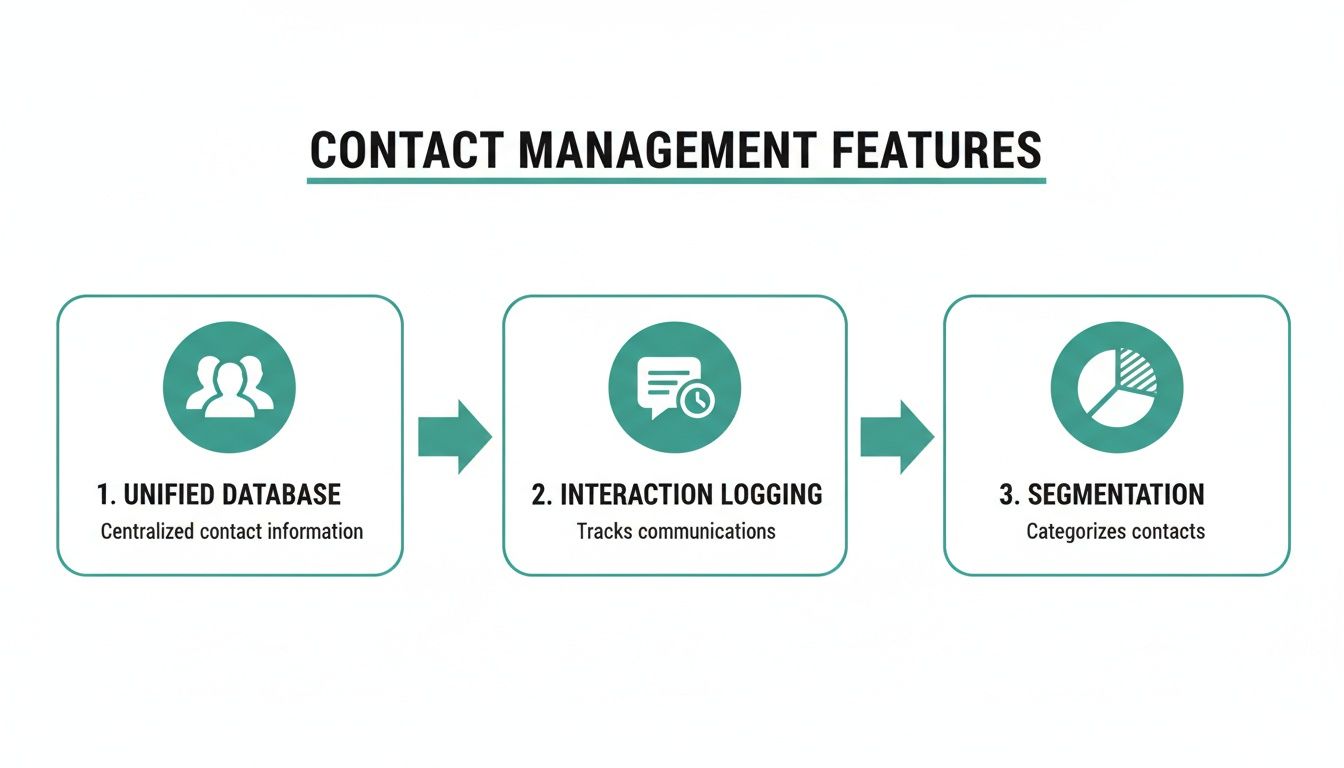
As you can see, everything from having a unified database to logging interactions and segmenting your audience hinges on the quality of the contact info you gathered in the first place.
Turning Browsing into a Lead Generation Engine
Modern tools can turn something you do every day—browsing the web—into a powerhouse for gathering leads. For example, using an email extractor from websites lets you automatically pull contact information from multiple pages at once. You can populate your database with valuable leads while you're busy with other things.
This isn't just a small tweak; it's a fundamental shift in your workflow. You stop being a data entry clerk and become a strategic prospector. Technology does the heavy lifting, freeing you up to focus on building relationships and closing deals.
The move to mobile makes this even more powerful. The mobile CRM market is expected to explode from $28.4 billion in 2024 to $55.9 billion by 2029. This growth means sales pros can manage their networks from anywhere, using simple tools like browser extensions to grab leads on the fly.
If you really want to level up, look into more advanced methods like AI-powered lead generation. This approach helps you pinpoint high-potential contacts with even more speed and precision, making sure your pipeline never runs dry. By focusing on a smarter way to acquire contacts, you're fueling every single sales and marketing activity that follows with the high-octane data needed to win.
Frequently Asked Questions About Contact Management
Diving into contact management usually brings up a few good questions. Let’s clear the air and tackle some of the most common ones so you can get a better handle on how it all works in the real world.
What Is the Main Difference Between Contact Management and a CRM?
The simplest way to look at it is that contact management is a core feature, while a Customer Relationship Management (CRM) system is a complete platform. A contact management tool is laser-focused on one thing: neatly organizing all the information you have about people.
A full-blown CRM does that, but then it adds a ton of other powerful tools on top. It helps you manage the entire customer journey with things like sales pipelines, marketing automation, and deep analytics. For a lot of startups and small businesses, a dedicated contact management system is the perfect starting point before they need the horsepower of a full CRM.
Think of it like a kitchen. Contact management is your perfectly organized pantry, with every ingredient labeled and easy to find. A CRM is the entire kitchen—the oven, the stove, and all the gear you need to cook a five-course meal.
Can I Just Use a Spreadsheet to Manage Contacts?
Sure, you can start with a spreadsheet. It’s certainly better than nothing, and it’s where most people begin. The problem is, you’ll hit a wall fast as your network grows. Spreadsheets are completely manual, which makes them a breeding ground for human error.
They also don't have the automation or collaboration features you get with a dedicated tool. Trying to share a spreadsheet with a team almost always ends in version-control nightmares and people working off old, outdated information. A real contact management system is built to scale with you, keeping your data clean and making it easy to build relationships over time.
How Does This Help with Sales and Cold Outreach?
It’s the absolute bedrock of any successful outreach. A well-organized system is what separates a strategic, personal campaign from a generic email blast that just gets ignored. It lets your sales team build hyper-targeted prospect lists and slice them up by key details like industry, job title, or location.
More importantly, it keeps a perfect record of every single interaction. This is huge for preventing those embarrassing slip-ups, like sending the same pitch twice or forgetting a key detail from a previous chat. It gives your team the context they need to send personalized follow-ups that actually connect with people. And it all starts with tools that help you find accurate contact info in the first place.
When Should My Business Start Using a Contact Management System?
Honestly, the best time to start is right now. As soon as you begin talking to customers, partners, or potential leads, you should have a system in place. Starting early builds good data habits from day one. It's a proactive approach that ensures no valuable connection ever gets lost in a messy inbox or a forgotten spreadsheet.
If you wait until your network is a huge, disorganized mess, you’re just creating a massive cleanup project for yourself down the road. With so many affordable (and even free) options out there today, there’s really no good reason to put it off. The sooner you get organized, the sooner you can start using your network to drive real growth.
Ready to supercharge your contact gathering and build pristine marketing lists from the start? EmailScout is a powerful Chrome extension that finds verified email addresses with a single click, allowing you to populate your new contact management system with high-quality leads effortlessly. Start building your network the smart way by visiting https://emailscout.io.