Tag: follow up email

  • 8 Unbeatable Subject Line for Follow Up Email Templates for 2026

    8 Unbeatable Subject Line for Follow Up Email Templates for 2026

    In a crowded inbox, the single most critical factor determining if your follow-up email gets opened or deleted is its subject line. A weak, generic message guarantees your email will be lost in the noise, wasting both your time and potential opportunities. This is especially true when your initial outreach goes unanswered, as the stakes are higher on the second or third attempt. A poorly chosen subject line for follow up email communication can permanently shut the door on a promising conversation.

    This guide moves beyond the obvious "checking in" or "just following up" phrases that recipients have learned to ignore. We have compiled eight powerful, scenario-based templates for any follow-up situation you might encounter. From reigniting cold leads after a meeting to nudging a high-value prospect toward a decision, these strategies are designed to grab attention, create curiosity, and, most importantly, get a response.

    We will break down the psychology behind each template, provide actionable examples you can copy and paste, and show you when to deploy each one for maximum impact. While a strong subject line is key, the body of your message also needs to be effective. Having access to a general follow-up email template can significantly streamline your entire communication strategy, ensuring consistency from top to bottom. Prepare to transform your follow-up game and turn silence into productive conversations.

    1. The Direct Question Template

    A powerful subject line for a follow-up email often moves the focus away from your request and onto the recipient's potential gain or problem. The direct question template accomplishes this by posing a specific, relevant question that sparks curiosity and encourages a response. Instead of simply stating your purpose, you prompt the recipient to think, making them an active participant from the moment they see your email in their inbox.

    This method works because it frames your follow-up as a potential solution rather than just another message demanding attention. A well-crafted question implies you have an answer or insight waiting inside the email, which is a compelling reason to click open.

    A person works on a laptop and holds a pen, with a 'Quick Question' speech bubble nearby.

    Why It's Effective

    The direct question creates a small "curiosity gap." The human brain is wired to seek answers and closure. When presented with a question, especially one that pertains to a professional challenge or goal, the natural inclination is to find the answer. This simple psychological principle can dramatically increase your open rates. For a deeper dive into timing and strategy for messages that don't get a reply, explore our detailed guide on crafting a follow-up email after no response.

    Examples in Action

    • Did you see the [specific feature] update?
    • Still looking for a way to [solve specific problem]?
    • What if you could reduce [metric] by 40%?
    • Are you still interested in streamlining your lead generation?

    Key Insight: The best questions are specific and benefit-oriented. A generic "Quick question" can work, but a targeted "Question about your Q4 hiring goals" is far more likely to resonate and prove you've done your research.

    How to Implement This Strategy

    To make this template work, your questions must be sharp and relevant. Vague or self-serving questions will be ignored.

    • Be Specific: Relate the question directly to their known pain points, recent company news, or industry trends. Using EmailScout to gather data on a prospect’s role and company challenges can provide the exact context needed.
    • Keep it Concise: The question should be easily understood at a glance on both desktop and mobile. Aim for 5-7 words.
    • Avoid "Yes/No" Dead Ends: Frame questions that invite a more thoughtful response. "What are your thoughts on X?" is better than "Did you like X?"
    • Focus on Value: Ensure the question hints at a clear benefit or solution you are prepared to discuss in the email body.

    2. The Value-Add Reference Template

    This approach shifts the focus of your follow-up from "checking in" to actively providing more value. The Value-Add Reference template works by referencing a specific resource or insight mentioned in a previous conversation or email, immediately positioning your message as helpful rather than demanding. It demonstrates that you are genuinely invested in the recipient's success and have continued thinking about their challenges.

    Instead of a generic reminder, this subject line for a follow-up email promises new, relevant information. This makes your message feel less like a sales pitch and more like a helpful consultation, which can significantly improve your open and reply rates by building trust and establishing your authority.

    Why It's Effective

    This strategy works by reinforcing your role as a helpful expert. By sending a relevant article, case study, or piece of data, you're not just asking for their time; you're giving them something useful upfront. This act of generosity creates a sense of reciprocity, making the recipient more inclined to engage with you. It shows you listened to their specific needs and are providing a targeted solution, not a generic sales follow-up.

    Examples in Action

    • Thought you might find this helpful: [specific resource]
    • Following up with that [case study/data] you asked about
    • Found something relevant to your [specific challenge]
    • One more resource on the [topic] we discussed

    Key Insight: The value-add must be genuinely useful and directly related to the recipient's known pain points. A generic blog post won't work; a detailed report on a competitor's strategy or a case study from their specific industry will capture their attention.

    How to Implement This Strategy

    To make this template effective, the resource you share must be highly relevant and personalized.

    • Be Specific: Mention the resource directly in the subject line. "Following up with the Q3 manufacturing report" is much stronger than "More information for you."
    • Align with Pain Points: Keep a record of each prospect's challenges. Use this information to find and share content that directly addresses those issues.
    • Segment Your Audience: Use a tool like EmailScout to segment your leads by industry or role. This allows you to send targeted resources to multiple prospects at once without sacrificing personalization.
    • Deliver on the Promise: Make sure the email body clearly explains why the resource is valuable to them and provides a clear link or attachment.

    3. The Curiosity-Gap Template

    This approach uses a powerful psychological trigger: curiosity. The template creates an "information gap" by hinting at valuable, surprising, or relevant information without giving it away in the subject line. By teasing a specific finding, statistic, or insight, you create an open loop in the recipient's mind, making them feel compelled to click and close that loop.

    It transforms a standard follow-up into an intriguing mystery that promises a payoff. Instead of asking for their time, you offer a piece of valuable knowledge, shifting the entire dynamic of the interaction. This makes your subject line for a follow-up email stand out in a crowded inbox filled with direct requests.

    A magnifying glass resting on a document with business charts and graphs, emphasizing data analysis.

    Why It's Effective

    The curiosity-gap template works because it taps into our innate desire for resolution and knowledge. When presented with a partial piece of information, our brains naturally want to fill in the blanks. This creates a mild tension that can only be relieved by opening the email. It's a classic copywriting technique that turns your email from a simple message into a must-read piece of content. For a broader look at what makes subject lines compelling, check out our guide on email subject line best practices.

    Examples in Action

    • One thing most [industry] professionals miss...
    • Here's what [competitor/successful company] is doing differently
    • We found something interesting in your [industry] data
    • The real reason your [metric] isn't improving

    Key Insight: The promise made in the subject line must be fulfilled immediately in the email. If you create a curiosity gap and then fail to deliver a satisfying answer, you will lose the recipient's trust.

    How to Implement This Strategy

    Success with this template depends entirely on the quality of the "reveal" inside your email.

    • Deliver on the Promise: Your email body must immediately provide the answer or insight teased in the subject line. Don't bury it.
    • Avoid Exaggeration: Clickbait tactics that make false or overblown claims will backfire. Keep your insights grounded and genuinely helpful.
    • Use the Preview Text: Pair a curiosity-driven subject line with compelling preview text that deepens the mystery without giving away the answer.
    • Test Different Angles: Use EmailScout to segment your lead lists and test various curiosity hooks. You might find that a data-driven insight works better for one audience, while a competitor-focused angle works for another.

    4. The Social Proof Reference Template

    This subject line for a follow-up email works by tapping into a fundamental psychological driver: people trust what others like them are already doing. The social proof reference template reduces a prospect's hesitation by highlighting the success that similar companies, competitors, or industry leaders have found with your solution. It immediately builds credibility and shifts the conversation from a sales pitch to a proven business case.

    This approach effectively lowers the perceived risk for the recipient. When they see that a peer or a competitor has already vetted and succeeded with your offering, it makes your follow-up email feel less like a cold outreach and more like an insider tip. It answers the unspoken question, "Has anyone else like me tried this?" before they even open the message.

    Two smiling businessmen shaking hands in an office, with awards on the wall and 'Trusted by Peers' text.

    Why It's Effective

    Social proof is a powerful form of validation. Mentioning a familiar name or a similar company type creates an instant connection and a sense of "fear of missing out" (FOMO). This strategy demonstrates that your value proposition isn't just a theory; it’s a reality for others in their professional circle, making your email a priority to open and consider. The reference provides a strong, third-party endorsement right in the subject line.

    Examples in Action

    • How [Competitor Name] automated their lead discovery
    • See how companies like yours reduced research time
    • [Industry Leader] chose EmailScout to scale their outreach
    • Teams at [Similar Company] found success with this approach

    Key Insight: The power of this template is its specificity. Referencing a direct competitor or a well-respected brand in their niche is far more impactful than a general statement like "Our happy customers."

    How to Implement This Strategy

    To use social proof effectively, your claims must be credible and relevant. Misusing this template can damage your reputation.

    • Segment Your References: Use a tool like EmailScout to identify and segment companies in your database by industry, size, and location. This allows you to match the most relevant success story to each prospect.
    • Get Permission: Always ask for permission before using a client's name in your outreach. If you can't use a specific name, refer to them by type, such as "another B2B SaaS in Boston."
    • Back It Up: Be prepared to provide the full case study, testimonial, or specific metrics referenced in the subject line within the email body.
    • Choose Wisely: Select references that the prospect will recognize and respect. The more aspirational or relatable the reference, the stronger the impact will be.

    5. The Time-Sensitive/Deadline Template

    This approach introduces a genuine time constraint to create a sense of urgency, compelling the recipient to act. By highlighting a limited-time offer, an upcoming event, or a closing window of opportunity, this subject line for a follow-up email positions your message as timely and important. It shifts the dynamic from a simple reminder to a valuable, time-sensitive notification.

    The core principle is to attach your follow-up to an external, legitimate deadline. This makes your outreach feel less like a repetitive chase and more like a helpful heads-up, preventing the recipient from missing out on a clear benefit. It works by tapping into the fear of missing out (FOMO) and the natural human tendency to prioritize tasks with clear deadlines.

    A desk setup with a laptop, calendar, digital timer, and 'LIMITED TIME' text on a green board.

    Why It's Effective

    Urgency is a powerful psychological trigger that prompts immediate action. When a recipient sees a specific date or deadline, their brain automatically assigns a higher priority to the message. Unlike a generic follow-up that can be put off indefinitely, a time-sensitive subject line demands attention now. For more strategies on how to craft compelling messages, consider our insights on the best cold email subject lines.

    Examples in Action

    • Closing [offer/feature access] on [specific date]
    • Last chance: [benefit] expires Friday
    • Webinar tomorrow: See how [solution] works [10 AM EST]
    • Your trial access ends in 3 days

    Key Insight: Authenticity is crucial. Using fabricated urgency can damage your credibility. The most effective deadlines are natural, such as the end of a promotion, a webinar date, or a limited number of available spots.

    How to Implement This Strategy

    To use deadlines without appearing pushy, your approach must be transparent and value-driven. False scarcity is easy to spot and will backfire.

    • Use Genuine Deadlines: Only apply this strategy when a real time constraint exists. Arbitrary deadlines feel manipulative and erode trust.
    • Be Specific: Vague terms like "soon" or "ending shortly" are weak. Use concrete dates and times, like "expires October 31st" or "today at 5 PM."
    • Align the Body Content: Ensure the email body clearly explains the deadline, what the recipient will miss out on, and the action they need to take.
    • Focus on the Benefit: Frame the deadline around the value they will lose. Instead of "Our offer is ending," try "Last day to get 20% off."

    6. The Personalized Permission/Consent Template

    This subject line for a follow-up email takes a soft, permission-based approach that respects the recipient's time and inbox. It directly acknowledges that you are following up and politely asks for consent to continue the conversation, making the interaction feel collaborative rather than demanding. This respectful tone is highly effective for cutting through the noise of aggressive sales pitches.

    By framing your follow-up as a choice for the recipient, you empower them and reduce the psychological resistance that a more forceful subject line might create. It shows confidence in the value you offer, suggesting you believe it's worth their explicit permission to discuss further.

    Why It's Effective

    The permission-based template works because it lowers the recipient's guard. Instead of making an assumption about their interest, you are politely inquiring. This approach taps into the principle of reciprocity; by showing respect for their autonomy, they are more likely to grant you a moment of their time. It’s a low-pressure tactic that can re-engage prospects who have gone cold without making them feel cornered.

    Examples in Action

    • Worth a follow-up conversation?
    • Can I send you a case study on [topic]?
    • Still interested in exploring [solution]?
    • May I reach out to discuss your [specific goal]?

    Key Insight: This strategy is about making the recipient feel in control. A subject line like "Still interested in exploring a new CRM?" gives them a simple "yes" or "no" path, making it incredibly easy to respond and re-open the dialogue.

    How to Implement This Strategy

    To make this template successful, the email body must be brief and align perfectly with the respectful tone of the subject line.

    • Keep it Short: The body of your email should be incredibly concise, ideally under 50 words. The goal is to make a quick, easy-to-answer request.
    • Provide a Clear Path: Structure your call-to-action with simple 'yes/no' options. For instance, "If so, would you be open to a brief chat next week?"
    • Qualify Your Leads: This approach is most effective with well-qualified leads. Use a tool like EmailScout to confirm you are contacting the right person with a relevant offer before sending the first email.
    • Segment Your Audience: Use this softer approach for prospects who showed initial interest but have since gone quiet. It's less effective for a very first cold outreach.

    7. The Pattern Interrupt Template

    In an inbox flooded with predictable subject lines like "Following up" or "Checking in," the pattern interrupt template deliberately breaks the mold. It uses unconventional formatting, symbols, or phrasing to grab attention by being different. This approach works by appealing to the brain's natural tendency to notice novelty and things that deviate from the expected pattern, making your email stand out visually and psychologically.

    The goal is not to be unprofessional or gimmicky, but to be just different enough to make the recipient pause and look closer. A well-executed pattern interrupt subject line for a follow-up email feels both intriguing and relevant, compelling the recipient to open it simply because it doesn't look like everything else they're ignoring.

    Why It's Effective

    Most professionals scan their inboxes on autopilot, filtering out messages that look like standard sales or marketing communications. A pattern interrupt shatters this automatic filtering process. By using brackets, a specific emoji, or a prefix like [Fwd], you create a visual hook that disrupts their scanning and focuses their attention on your message. This technique is a core principle in many successful outreach strategies, and you can get more ideas from our guide on how to write cold emails.

    Examples in Action

    • [Fwd] Your lead generation approach - thoughts?
    • Quick note: [Prospect name]
    • ↑ [Specific resource or insight]
    • [Name], checking in on [previous discussion]

    Key Insight: The success of a pattern interrupt lies in its subtlety. A single, relevant symbol or bracketed word is effective; a string of emojis or ALL CAPS is spam. The goal is to stand out, not to shout.

    How to Implement This Strategy

    Using this template requires a balance between creativity and professionalism. You want to be noticed, not dismissed as unprofessional.

    • Match the Interrupt to Your Brand: A creative agency might get away with a clever emoji, while a financial services firm might stick to brackets [ ] for a more formal feel.
    • Use Sparingly: Overusing this technique will cause it to lose its effect. Save it for important follow-ups where getting an open is critical.
    • Test and Measure: Use EmailScout to segment your leads and A/B test different pattern interrupts. See what resonates most with your audience-brackets, arrows, or personalized notes.
    • Ensure Content Delivers: The email body must provide genuine value. A clever subject line followed by a generic email will only annoy the recipient.

    8. The Specific-Problem-Solution Template

    This subject line for a follow-up email cuts straight to the point by connecting a known issue with a potential fix. It immediately shows the recipient you were paying attention during your last conversation and have invested thought into their specific challenges. Instead of a generic check-in, your email is positioned as a valuable, relevant resource from the moment it lands in their inbox.

    The template works by bridging the gap between problem identification and solution presentation. It demonstrates active listening and frames your follow-up as a helpful continuation of a previous discussion, making it feel less like a sales pitch and more like a collaborative problem-solving effort.

    Why It's Effective

    This approach is powerful because it proves your relevance. People are busy and prioritize emails that address their immediate needs or pain points. By referencing a specific challenge they've shared, you bypass the usual inbox noise and signal that your message contains tailored information. This builds credibility and shows that you see them as a partner, not just a prospect.

    Examples in Action

    • Re: The [specific challenge] you mentioned
    • Solving for [specific problem] - quick idea
    • About your [challenge]: Here's what we typically do
    • Follow-up on finding leads faster for your team

    Key Insight: The more specific the problem you reference, the more compelling the subject line. "Solving for high lead acquisition costs" is much stronger than "Solving your marketing problems."

    How to Implement This Strategy

    Success with this template depends entirely on the quality of your initial discovery and research. Vague references to problems will fall flat.

    • Take Detailed Notes: During your initial calls or meetings, document the exact language your prospect uses to describe their pain points.
    • Focus on One Thing: Center the subject line and email body on solving one primary problem. Trying to address multiple issues at once can dilute the message's impact.
    • Reference the Conversation: In the email body, briefly mention where you discussed the challenge (e.g., "On our call Tuesday, you mentioned…"). This provides context and reinforces your attentiveness.
    • Keep it Solution-Oriented: The subject line should promise a solution, idea, or resource. This gives them a clear reason to open the email and learn more.

    8-Template Follow-Up Subject Line Comparison

    Template Implementation complexity Resource requirements Expected outcomes Ideal use cases Key advantages
    The Direct Question Template Low Minimal personalization data Higher open rates; increased initial engagement Follow-ups and business development Curiosity-driven, recipient-focused
    The Value-Add Reference Template Medium Prior interaction notes; relevant resources Builds trust; deepens conversations over time Long-term outreach, relationship building Differentiates from generic follow-ups; credibility
    The Curiosity-Gap Template Medium Insight or surprising data to tease Very high opens; risk if content underdelivers Cold email campaigns and high-volume follow-ups Strong attention-grabber; scalable for data-driven audiences
    The Social Proof Reference Template Medium Verifiable case studies or references; permissions Reduces objections; higher conversion with skeptical prospects B2B enterprise and executive outreach Authority-building; risk reduction
    The Time-Sensitive/Deadline Template Low–Medium Genuine deadlines, event details or limited offers Increased response rates; drives immediate action Promotions, webinars, limited-time offers Creates legitimate urgency; justifies follow-up
    The Personalized Permission/Consent Template Low Segmentation and concise scripts Builds rapport; filters genuinely interested leads Nurture sequences and relationship-focused sales Respectful, lowers unsubscribes and complaints
    The Pattern Interrupt Template Medium Creative copy, A/B testing across segments Dramatically higher opens in some audiences; variable results Crowded inboxes; later sequence follow-ups Visually distinctive; memorable when used sparingly
    The Specific-Problem-Solution Template High Deep research and detailed prospect notes Highly relevant replies; often higher conversion for complex deals Complex B2B sales and warm leads Demonstrates understanding; solution-oriented and collaborative

    Conclusion: Putting Your Subect Lines to Work

    The journey to mastering the subject line for follow up email doesn't end with a list of templates. While the eight frameworks we’ve explored, from the direct question to the pattern interrupt, provide a powerful arsenal, their true potential is unlocked through thoughtful application, consistent testing, and a commitment to genuine personalization. Simply copying and pasting a subject line will rarely produce the results you need. The real success comes from understanding the psychology behind each approach and adapting it to your specific audience, industry, and objective.

    Remember that the ultimate goal of any follow-up is to re-engage, not to annoy. Each subject line you choose is a strategic decision. It sets the tone, manages expectations, and ultimately determines whether your message earns a click or is sent straight to the trash. A great subject line acts as a key, but it’s the value contained within the email that truly opens the door to a meaningful conversation.

    Your Actionable Path Forward

    The difference between a good and a great outreach strategy lies in action. Don't let this knowledge sit idle. Instead, commit to a cycle of implementation and refinement.

    • Categorize Your Follow-Ups: Start by segmenting your upcoming follow-ups by scenario (e.g., post-meeting, after a demo, no response). Assign one of the template types from this article to each category.
    • Set Up a Simple A/B Test: Choose two promising subject line variations for your most common follow-up scenario. Send Version A to half of your list and Version B to the other half. Track open rates over a week to find a clear winner.
    • Prioritize Personalization: Before hitting send on your next follow-up, find one unique, specific detail to include. This could be a recent company announcement, a shared connection, or a point from your last conversation. Injecting this detail into your subject line, as seen in the Value-Add and Personalized templates, can dramatically improve your open rates.

    By moving from passive reading to active experimentation, you transform these concepts into a repeatable system for better engagement. The most effective subject line for follow up email is not a static phrase but a dynamic tool that evolves with your understanding of what resonates with your audience. Treat every email as a learning opportunity, and you will steadily build a follow-up process that not only gets noticed but also gets results.


    Before you can craft the perfect subject line, you need to be certain you’re reaching the right person. EmailScout helps you find and verify the correct email addresses for your prospects, ensuring your carefully constructed messages land in the right inbox every time. Stop wasting effort on bounced emails and start connecting with key decision-makers by visiting EmailScout today.

  • 8 High-Converting Email Subject Line for Follow Up Templates for 2026

    8 High-Converting Email Subject Line for Follow Up Templates for 2026

    In the crowded landscape of digital communication, a generic "Checking in" email is destined for the trash folder. The difference between a reply and radio silence often comes down to the first five to seven words your prospect reads: the email subject line for follow up. A well-crafted subject line piques curiosity, establishes relevance, and earns the click that opens the door to a conversation. It's the single most important element determining whether your message is opened or archived without a second thought.

    This comprehensive guide moves beyond obvious advice, providing a strategic arsenal of 8 proven follow-up templates designed for specific scenarios. We will break down the psychology behind each approach, offer actionable examples, and demonstrate how to personalize your outreach for maximum impact. To truly address why your follow-up emails are being ignored and implement effective solutions, it's crucial to understand comprehensive email marketing best practices. Mastering these fundamentals provides the foundation upon which powerful subject lines are built.

    Here, you'll learn not just what to write, but why it works. We’ll explore templates covering everything from gentle reminders and curiosity-driven questions to leveraging social proof and creating urgency. By the end of this article, you will have a clear playbook to transform your follow-up strategy from an afterthought into your most powerful conversion tool. You'll be equipped with specific, actionable subject lines that ensure your messages not only get seen but also get the responses you need to move conversations forward.

    1. The Gentle Reminder with Value Add

    The "Gentle Reminder with Value Add" is a classic yet powerful strategy for a follow-up email. Instead of simply "bumping" the previous message to the top of the inbox, this approach re-engages your contact by offering something genuinely useful. This method shifts the perception of your follow-up from a self-serving nudge to a helpful, thoughtful gesture, making it a highly effective email subject line for follow up communications.

    This technique works because it respects the recipient's busy schedule while demonstrating your continued interest and expertise. By providing an additional resource, insight, or piece of data, you reinforce your value proposition and give them a compelling reason to open your message and reply.

    Why This Approach Is Effective

    This subject line strategy excels in B2B sales and professional networking, where building relationships is as crucial as closing deals. It acknowledges that decision-makers are inundated with emails. A pushy "just checking in" can be easily ignored, but a subject line promising new, relevant information sparks curiosity.

    The key is to frame your follow-up as an act of service. You’re not just asking for a response; you're contributing to their success. This builds goodwill and positions you as a helpful expert rather than just another vendor.

    Subject Line Examples

    Here are a few templates you can adapt:

    • "Quick resource I thought you'd find useful, [Prospect Name]"
    • "Following up: Thought this case study might help"
    • "One more thing I came across for [Company Name]"
    • "A helpful article about [Their Industry Challenge]"

    Actionable Tips for Implementation

    • Personalize the Value: Use a tool like EmailScout to find the prospect's direct email and LinkedIn profile. Research their company's recent announcements or industry trends to find a truly relevant article, case study, or tool to share.
    • Keep It Concise: The subject line should be short and direct. Adhering to the best practices for subject line length, aim for under 50 characters to ensure it's fully visible on mobile devices.
    • Time It Right: Send this follow-up 3-5 days after your initial email. This gives them enough time to have seen your first message without letting the conversation go cold.
    • Focus on Them: The value you add should directly address a pain point or goal you've identified. For example, if you know they're focused on reducing customer churn, send them a report on retention strategies.

    Key Insight: The goal of the value-add is to make the recipient feel like you’re invested in their success, not just in making a sale. This small shift in focus can dramatically increase your reply rates. For more on this, explore these email subject line best practices to master the fundamentals.

    2. The Curiosity-Driven Question Format

    The "Curiosity-Driven Question Format" leverages a powerful psychological trigger to boost open rates. Instead of stating your purpose, you pose a direct and relevant question that piques the recipient's interest. This strategy transforms a standard follow-up into an engaging conversation starter, making it an incredibly effective email subject line for follow up situations where you need to re-capture attention.

    This technique works because human brains are naturally wired to seek answers to questions. An intriguing question in the inbox creates an "information gap" or a "curiosity gap," compelling the recipient to open the email to find the context and, ideally, provide an answer. It immediately shifts the dynamic from a one-way broadcast to a potential two-way dialogue.

    Why This Approach Is Effective

    This subject line is a game-changer for digital marketers and sales professionals, especially in cold outreach sequences. After an initial email goes unanswered, a direct question can cut through the noise far more effectively than a generic "checking in." It feels personal and prompts the recipient to think, which is the first step toward getting a response.

    The key is to ask a question that is both thought-provoking and directly related to the value you can provide. It shows you've done your homework and are genuinely interested in their specific situation, positioning you as a potential problem-solver from the very first interaction.

    Subject Line Examples

    Here are a few templates you can adapt:

    • "Quick question about [Company Name]'s approach to [topic]"
    • "What's your biggest challenge with [industry problem]?"
    • "How are you handling [current trend] at [Company Name]?"
    • "Are you open to exploring [specific opportunity]?"

    Actionable Tips for Implementation

    • Reference Specific Details: Use a tool like EmailScout to find the prospect's direct email and research their company's recent initiatives or their role. A question like, "Quick question about your recent expansion into APAC," is far more compelling than a generic one.
    • Link to Your Value: Ensure the question directly relates to your solution. If you sell SEO services, a great question would be, "How are you preparing for Google's next algorithm update?"
    • Avoid Simple Yes/No: Frame open-ended questions that encourage a more detailed response. Instead of "Are you happy with your software?," try "What's one thing you'd change about your current software?"
    • Time It Right: This follow-up works best 48-72 hours after the initial email. This timing is soon enough to be relevant but gives them space so it doesn't feel like you're pestering them.

    Key Insight: The goal of a curiosity-driven question is to make the recipient pause and think. A well-crafted question demonstrates that you understand their world and makes them want to engage in a conversation, significantly increasing your chances of getting a reply.

    3. The Social Proof and Authority Builder

    The "Social Proof and Authority Builder" is a highly persuasive follow-up strategy that leverages the power of credibility. Instead of just asking for a response, this approach builds immediate trust by showcasing successful results, well-known clients, or industry validation. This technique transforms a standard follow-up into a compelling business case, making it an incredibly effective email subject line for follow up communications, especially in competitive markets.

    This method works by tapping into a core psychological principle: people trust what others are already using and endorsing. When a prospect sees that their peers, competitors, or respected industry leaders are getting value from your solution, it reduces perceived risk and significantly increases their interest in engaging with you.

    A laptop on a wooden desk displays various logos with a prominent green overlay stating 'TRUSTED BY LEADERS'.

    Why This Approach Is Effective

    This subject line strategy is particularly potent for B2B SaaS, enterprise sales, and any service where proven results are a primary decision-making factor. Decision-makers, especially at larger companies, are risk-averse. A subject line that immediately presents evidence of success with a similar company provides a powerful reason to open the email and learn more.

    The key is to present your credibility concisely and directly within the subject line. You’re not just following up; you’re offering proof that you solve real problems for businesses they recognize. This positions you as a low-risk, high-reward partner and a leader in your field.

    Subject Line Examples

    Here are a few templates you can adapt:

    • "How [Competitor] increased their pipeline 40% (case study)"
    • "Following up: We just helped [Well-known Company] achieve [Specific Result]"
    • "Used by leaders like [Brand 1], [Brand 2], and [Brand 3]"
    • "Following up: 3 of your competitors are seeing results with us"

    Actionable Tips for Implementation

    • Identify Relevant Peers: Use a tool like EmailScout to find your prospect's direct contact information and research their company. Identify their key competitors or industry peers to use as social proof.
    • Quantify Your Results: Always include specific, quantifiable metrics in the subject line when possible. "Increased pipeline 40%" is far more compelling than "helped increase pipeline."
    • Get Permission: Before name-dropping clients in your outreach, ensure you have explicit permission to use their name and results in your marketing materials.
    • Target Precisely: Make sure the social proof is highly relevant to the prospect's industry, size, or specific challenge. A case study from an unrelated sector will have little to no impact.

    Key Insight: Social proof shortens the trust-building cycle. By leading with evidence that others have already succeeded with your help, you bypass initial skepticism and move the conversation directly to value. To build this into your initial outreach, you can learn more about how to write cold emails that convert.

    4. The Time-Sensitive and Scarcity-Based Template

    The "Time-Sensitive and Scarcity-Based Template" leverages urgency to prompt an immediate response. By highlighting a limited-time offer, expiring access, or a closing deadline, this approach encourages prospects to act quickly rather than deferring their decision. This makes it a compelling email subject line for follow up when you need to accelerate the sales cycle or re-engage an unresponsive contact.

    This technique is effective because it taps into the psychological principle of loss aversion, the idea that people are more motivated by the fear of missing out than by the prospect of gaining something. A well-crafted scarcity-based subject line can cut through inbox noise by signaling that immediate attention is required to secure a valuable opportunity.

    A clock, books, a pen, and a calendar on a desk with 'LIMITED TIME OFFER' text.

    Why This Approach Is Effective

    This subject line strategy is particularly powerful in sales scenarios where a specific promotion, event, or enrollment period is ending. It creates a clear and legitimate reason for following up and gives the recipient a concrete deadline for action. Instead of a vague "checking in," you are providing crucial information that impacts their ability to benefit from your offer.

    The key to success is authenticity. The scarcity must be real and the deadline firm. Misleading prospects with fake urgency can damage your credibility and lead to high unsubscribe rates. When used ethically, it's a highly effective tool for converting leads who are on the fence.

    Subject Line Examples

    Here are several templates you can adapt:

    • "Last spots available: [Offer] ending Friday"
    • "Your exclusive access expires in 48 hours"
    • "[Resource/Offer] available for [Company Name] through [Date] only"
    • "Only 3 remaining: [Limited offer]"

    Actionable Tips for Implementation

    • Use Genuine Scarcity: Only apply this tactic when there is a real deadline or limited availability. Prospects can easily detect false urgency, which will harm your reputation.
    • Be Specific: Include the actual date or a specific timeframe (e.g., "ending tomorrow," "closes at 5 PM EST") in the subject line to make the deadline feel more tangible and immediate.
    • Segment Your Lists: Use a tool like EmailScout to build segmented lists of prospects who have shown interest but haven't converted. Targeting them with a time-sensitive follow-up is more effective than a broad blast.
    • Use Sparingly: Overusing urgency-based subject lines can lead to email fatigue and may trigger spam filters, impacting your overall deliverability. Save this tactic for truly critical moments in your sales cadence.

    Key Insight: The power of this approach lies in its ability to create a clear "why now" for the recipient. By framing the follow-up around a legitimate deadline, you transform your message from an interruption into a timely and valuable notification.

    5. The Personal Connection and Warm Outreach Bridge

    The "Personal Connection and Warm Outreach Bridge" is a powerful strategy that leverages a shared relationship, experience, or interest to make your follow-up feel familiar and welcome. Instead of a cold touchpoint, this approach immediately establishes common ground, significantly lowering the recipient's guard. It transforms an ordinary message into a relevant conversation, making it a highly effective email subject line for follow up when you need to stand out.

    This technique works by tapping into the principle of social proof and familiarity. A mention of a mutual contact, a shared event, or a common interest instantly makes you more credible and your email more relevant. It signals that you've done your homework and are not just another mass emailer, giving the recipient a compelling reason to engage.

    A smiling woman hands a document to a smiling man in a bright office hallway, suggesting a warm introduction.

    Why This Approach Is Effective

    This subject line strategy is incredibly effective in networking, sales development, and partnership outreach. It closes the gap between a cold email and a warm introduction. When a recipient sees a familiar name or reference, it triggers a sense of obligation and curiosity that a generic subject line simply can't match.

    The key is to make the connection feel genuine and immediate. You are not just name-dropping; you are contextualizing your outreach based on a shared reality. This builds instant rapport and frames your follow-up as a continuation of a pre-existing professional network, rather than an unsolicited interruption.

    Subject Line Examples

    Here are several templates you can adapt:

    • "[Mutual Contact] suggested I reach out"
    • "Following up from our chat at [Event Name]"
    • "I noticed we both follow [Industry Expert] on LinkedIn"
    • "Your colleague, [Colleague's Name], and I were talking about you"

    Actionable Tips for Implementation

    • Find Common Ground: Use EmailScout's URL Explorer to review a prospect's LinkedIn profile or other social media. Look for shared connections, groups, alma maters, or industry influencers they follow.
    • Be Specific and Authentic: Don't just mention a connection; add context. For example, "[Mutual Contact] and I were discussing [Topic], and she mentioned you were the expert."
    • Verify the Connection: Before mentioning a mutual contact, ensure the connection is strong enough to be meaningful. A brief confirmation with the mutual contact can strengthen your approach.
    • Act Quickly: If the connection is from a recent event or introduction, send your follow-up within 48 hours. This ensures the interaction is still fresh in their mind.

    Key Insight: A shared connection is the fastest way to build trust in a cold outreach scenario. It borrows credibility from a known source, making your message feel like a referral rather than a solicitation. To learn more about re-engaging contacts who don't reply, you can review these strategies on how to follow up on an email after no response.

    6. The Soft Re-Engagement and "I May Have Missed You" Template

    The "Soft Re-Engagement" approach is a humble and effective strategy that gives your contact the benefit of the doubt. Instead of assuming they ignored you, this method frames your follow-up as a helpful attempt to resurface a message that likely got lost in a crowded inbox. This polite framing makes it a disarming and successful email subject line for follow up communications, particularly when some time has passed.

    This technique works by lowering the recipient's guard. It acknowledges their busy schedule and removes any potential pressure or guilt associated with not responding. By taking a gentle, understanding tone, you make it easier for them to re-engage with the conversation without feeling like they are being chased or called out.

    Why This Approach Is Effective

    This subject line strategy is perfect for a second or third follow-up, especially after a period of 5-7 days or more of silence. It’s a low-pressure way to bring your original message back to their attention. The humility in phrases like "I may have gotten lost" or "circling back" is relatable and often prompts a courteous response, even if it's just to say the timing isn't right.

    The key is to position yourself as considerate of their workload. You're not demanding an answer; you're simply checking if the original message was seen. This approach preserves the relationship and keeps the door open for future communication, making it a valuable tool in any long-term sales or networking sequence.

    Subject Line Examples

    Here are a few templates you can easily adapt:

    • "Just circling back on this, [Prospect Name]"
    • "I may have gotten lost in your inbox"
    • "Sorry if this slipped through – quick follow-up"
    • "Resurfacing this for [Company Name] when timing is better"

    Actionable Tips for Implementation

    • Time It Strategically: Use this approach for your second or third follow-up, typically 5-7 days after your last email. It's often most effective later in a cadence (e.g., the 4th or 5th touch) when other methods haven't elicited a reply.
    • Keep It Humble and Short: The subject line's power is in its brevity and modest tone. Avoid anything that sounds demanding. The goal is to be respectfully persistent, not pushy.
    • Offer an Alternative: In the email body, consider offering a different way to connect. You could say, "If email isn't best, feel free to connect with me on LinkedIn." Use EmailScout to find their profile link quickly.
    • Introduce a New Angle: While the subject line is soft, the email body can add new value or a slightly different angle to your original proposition. This gives them a fresh reason to consider your offer.

    Key Insight: This approach is rooted in empathy. By assuming the best (that your email was simply missed), you create a positive, no-pressure environment that encourages the recipient to hit "reply" and re-engage.

    7. The Data-Driven and Specific Achievement Template

    The "Data-Driven and Specific Achievement Template" is an advanced strategy that leverages recent, specific accomplishments of your prospect or their company to initiate a follow-up. Instead of a generic check-in, you lead with a timely and relevant observation, proving you've done your homework. This highly personalized approach makes your email subject line for follow up feel less like a sales pitch and more like a well-informed conversation starter.

    This technique is effective because it immediately signals that your message is not a mass email. By referencing a specific funding round, product launch, or award, you connect your outreach to their current reality. It shows genuine interest in their business, which builds rapport and opens the door for a meaningful discussion about how you can contribute to their ongoing success.

    Why This Approach Is Effective

    This subject line strategy is a cornerstone of modern Account-Based Marketing (ABM) and sales development. It's particularly powerful when contacting C-suite executives or key decision-makers who value relevance and efficiency. Mentioning a tangible achievement validates their hard work and grabs their attention far more effectively than a standard follow-up.

    The key is to connect their recent win to your value proposition seamlessly. You're not just congratulating them; you're using their success as a natural bridge to a relevant business conversation. This positions you as a strategic partner who understands their growth trajectory, not just a vendor pushing a product.

    Subject Line Examples

    Here are several templates you can customize:

    • "Congrats on the [Award/Funding] – a quick thought"
    • "Your recent [News/Launch] caught my attention…"
    • "After your [Announcement], I thought of this"
    • "Inspired by [Company]'s recent milestone"

    Actionable Tips for Implementation

    • Set Up Alerts: Use Google Alerts for the company's name and monitor their LinkedIn page for announcements. This ensures your information is timely; reference achievements within two weeks of them happening.
    • Find the Right Contact: After identifying a key announcement, use a tool like EmailScout to find the direct email addresses of the relevant decision-makers involved, such as the Head of Product for a new launch.
    • Bridge to Value: In the email body, explicitly connect their achievement to a challenge or opportunity your solution addresses. For example, "With your recent funding secured for expansion, scaling your support team will be critical…"
    • Cite Your Source: Briefly mention where you saw the news (e.g., "I saw on LinkedIn that…"). This adds a layer of authenticity to your outreach.

    Key Insight: Personalization based on achievement demonstrates effort and relevance at a glance. It tells the recipient, "This email was crafted specifically for you," which is the most powerful way to cut through inbox noise and earn a response.

    8. The Alternative or Next Step Proposal Template

    The "Alternative or Next Step Proposal" template is a psychologically astute strategy that reframes the conversation. Instead of asking a yes-or-no question like "Are you interested?", it presents two or more clear pathways forward, subtly assuming the recipient's engagement. This makes it an incredibly effective email subject line for follow up because it simplifies the decision-making process for your contact.

    This technique is rooted in choice architecture, guiding the recipient toward a positive action rather than leaving the conversation open-ended. By presenting specific, tangible options, you move the dialogue from a question of interest to a question of logistics, significantly increasing the likelihood of getting a concrete next step on the calendar.

    Why This Approach Is Effective

    This subject line strategy works best after some initial engagement has been established, such as a reply to a previous email or a brief interaction. It projects confidence and momentum. By asking "Which works better?" instead of "Does anything work?", you take control of the process and make it easy for the prospect to say yes to one of your suggestions.

    It's a powerful tool for sales development representatives (SDRs) and account executives aiming to convert warm leads into meetings. The approach minimizes cognitive load for the busy professional; they don't have to think about what to do next because you’ve already laid out the most logical options for them.

    Subject Line Examples

    Here are a few templates you can adapt:

    • "Quick call Tuesday or Thursday this week?"
    • "Would a 15-min call or demo work better for you?"
    • "Option A vs. Option B for [Company Name]?"
    • "Following up: quick call or case study first?"

    Actionable Tips for Implementation

    • Qualify First: Use this approach in your second or third follow-up, but only after the prospect has shown some initial interest. It can seem too assumptive if used in a first-touch cold email.
    • Limit the Choices: Offer only two, or at most three, specific options. Providing too many choices can lead to decision paralysis, defeating the purpose of the technique.
    • Be Specific: Make your options clear and distinct. Instead of "sometime next week," offer "Tuesday at 2 PM or Thursday at 10 AM." This removes ambiguity and friction.
    • Tailor the Options: Use a tool like EmailScout to understand the prospect's role. For a technical leader, you might offer a product demo versus a technical deep-dive. For a C-level executive, you might propose a strategic overview call versus a high-level business case.

    Key Insight: The power of this template is in its assumption of continued conversation. You're not asking for permission to proceed; you're collaborating on the best way to do it, which subtly shifts the dynamic in your favor.

    8 Follow-Up Email Subject Lines Comparison

    Template Implementation complexity Resource requirements Expected outcomes Ideal use cases Key advantages
    The Gentle Reminder with Value Add Medium — needs a thoughtful follow-up Moderate — prospect research, small content/resource Better opens and goodwill; slower conversions B2B sales follow-ups to busy decision‑makers Helpful tone increases opens and brand perception
    The Curiosity-Driven Question Format Low–Medium — craft a compelling, relevant question Low–Moderate — targeted research to ensure relevance High open and reply rates; increased engagement Industry-specific outreach, SDRs, digital marketers Generates curiosity-driven replies and high engagement
    The Social Proof and Authority Builder Medium — assemble and present proof carefully High — case studies, testimonials, permissions Strong credibility with executives; boosts trust Enterprise outreach, premium positioning, competitive markets Raises perceived authority and differentiates offering
    The Time-Sensitive and Scarcity-Based Template Low — simple to write but must be precise Low–Moderate — genuine offers, list segmentation Fast responses and quicker decisions; risk if misused Limited-time promotions, closing offers, competitive sales Urgency drives immediate action and conversions
    The Personal Connection and Warm Outreach Bridge High — verify and reference real connections High — network research, LinkedIn verification Higher response and conversion; builds relationships Account-based outreach, partnerships, warm intros Humanizes outreach and significantly improves trust
    The Soft Re-Engagement / "I May Have Missed You" Template Low — brief, polite messaging Low — timing strategy and minimal updates Low-risk reopens; slower conversion recovery Later touches in sequences, low-engagement leads, long gaps Polite, non-pushy reintroduction that preserves reputation
    The Data-Driven and Specific Achievement Template High — requires accurate, timely personalization High — in-depth research tools and time per prospect Very high personalization and engaged replies; limited scale High-value accounts, ABM, executive outreach Demonstrates relevance and effort; strong engagement
    The Alternative or Next Step Proposal Template Low–Medium — prepare clear, relevant options Low — define 2–3 meaningful next steps Higher conversions by reducing decision friction Warm leads, follow-ups after initial interest Moves conversation forward; simplifies decision for prospect

    Putting It All Together: Your Blueprint for Unignorable Follow-Ups

    We've explored a comprehensive arsenal of strategies, moving far beyond generic templates to dissect the psychology behind an effective email subject line for follow up. From the value-packed gentle reminder to the decisive breakup email, the common thread is a relentless focus on the recipient. Your inbox is a battlefield for attention, and winning requires more than just showing up; it demands a strategy built on relevance, personalization, and respect for your prospect's time.

    The eight core templates covered in this guide are not just plug-and-play phrases. They are strategic frameworks. Each one serves a unique purpose, whether it's re-igniting a conversation with a curiosity-driven question or building undeniable credibility with a data-backed achievement. The true power lies not in memorizing these lines, but in understanding why they work and when to deploy them.

    Synthesizing the Core Principles

    Mastering the follow-up is an exercise in strategic empathy. To ensure your messages are opened, read, and acted upon, constantly revisit these foundational pillars:

    • Value Over Volume: Every single email must offer something of value. This could be a new resource, a relevant case study, a helpful insight, or simply a solution tailored to a pain point you've identified. Never send a "just checking in" email without a value-add.
    • Personalization is Paramount: Generic outreach is the fastest path to the trash folder. Reference previous conversations, mention their company's recent achievements, or connect on a personal interest. This is where tools that provide accurate contact and company data become indispensable, forming the bedrock of genuine connection.
    • Clarity and Brevity Reign Supreme: Your subject line must be instantly understandable and compelling. Use strong action verbs, keep it concise (ideally under 50 characters), and ensure it accurately reflects the email's content. A clear, direct subject line respects the reader's time and builds trust.

    Your Actionable Next Steps

    Knowledge without implementation is just potential. To turn these insights into tangible results, commit to the following steps starting today:

    1. Audit Your Current Sequences: Review your existing follow-up templates. Where are you being too generic? Where can you inject more value, curiosity, or personalization based on the templates we've discussed?
    2. Select Two Templates to A/B Test: Don't try to change everything at once. Choose two distinct approaches, like "The Gentle Reminder with Value Add" and "The Curiosity-Driven Question," and run a controlled test on a segment of your audience.
    3. Track Everything: Monitor your open rates, reply rates, and conversion rates for each variation. Data is your most honest feedback. Let the numbers guide your strategy and tell you what resonates most with your prospects.
    4. Build a Personalization Habit: Before sending any follow-up, spend just two minutes researching the person or their company. Find one specific detail you can use to make your outreach stand out. This small investment of time yields disproportionately large returns.

    Ultimately, a powerful email subject line for follow up is the key that unlocks the door to a conversation. It’s your single best chance to cut through the noise and earn a moment of your prospect's attention. By moving from a mindset of "checking in" to one of "adding value," you transform your follow-up process from a tedious task into your most powerful tool for building relationships and driving revenue. The blueprint is now in your hands; it's time to start building.


    Ready to supercharge your personalization efforts? Finding the right decision-maker is the critical first step before you can even write the perfect subject line. EmailScout provides the verified email addresses and company data you need to ensure your message always lands in the right inbox. Stop guessing and start connecting by visiting EmailScout to fuel your outreach strategy today.

  • No Response Follow Up Email Strategies That Work

    No Response Follow Up Email Strategies That Work

    A no response follow up email is your secret weapon for turning radio silence into a real conversation. Think of it as a brief, strategic nudge sent after your first email goes unanswered, designed to gently resurface in your recipient's inbox and dramatically boost your chances of getting a reply.

    Why Your Follow-Up Email Is Your Strongest Tool

    Let's get real for a moment: most first emails are just the opening act. An ignored email isn’t a dead end—it's an opportunity. The modern inbox is an absolute battlefield for attention. With the average professional getting hit with over 120 emails a day, it’s just plain easy for a good message to get buried.

    A smart follow-up acknowledges this reality. Thoughtful persistence isn't annoying; it's genuinely helpful. Decision-makers are busy, and they often welcome a gentle reminder because your first email might have just shown up at the wrong time or slipped through the cracks.

    The Power of Professional Persistence

    Sending a follow-up isn't about being pushy. It’s about being professional. It shows you value the potential connection and are confident in what you’re offering. I like to think of it less as a "reminder" and more as a simple continuation of the conversation.

    The single biggest mistake in outreach is giving up too soon. Silence is rarely a definitive 'no.' More often, it's just a 'not right now.' A well-crafted follow-up is what bridges that gap.

    This simple act of circling back can completely change your engagement rates. The data doesn't lie. Most replies don't come from the first message. In fact, one study I often refer back to found that over 50% of all replies to cold email campaigns were triggered by follow-up emails, not the initial outreach. If you want to dive deeper, learning more about these compelling cold email statistics really drives home the impact of persistence.

    Before we get into the templates, let's look at the numbers and what they mean for your strategy.

    The Impact of Following Up At a Glance

    This table breaks down why a solid follow-up strategy is non-negotiable for anyone serious about outreach. The stats make a clear case for not giving up after one try.

    Metric Key Statistic What This Means For You
    Replies from Follow-Ups 50%+ Over half of your potential conversations are waiting in your follow-ups. Skipping them means leaving the majority of your results on the table.
    Campaign Success Up to 27% reply rate Campaigns with 4-7 follow-ups significantly outperform those with only 1-3. Persistence pays off directly in your reply rates.
    Inbox Overload 120+ emails/day Your first email is easily missed. A follow-up gives you a second (or third) chance to be seen by a busy prospect.
    Giving Up Too Soon 44% of salespeople Nearly half of salespeople give up after just one follow-up, creating a massive opportunity for those who are willing to be more persistent.

    The takeaway here is simple: if you're not following up, you're competing with less than half of your potential.

    This isn’t about just blasting more emails into the void. It’s about building a thoughtful sequence that adds a little more value with each touchpoint. Every follow-up is a fresh chance to:

    • Provide Context: Briefly and politely remind them why you reached out.
    • Offer New Value: Share a relevant article, a quick tip, or a powerful case study.
    • Simplify the Ask: Make your call to action even clearer and easier to act on.

    When you adopt this mindset, you can turn that initial silence into a genuine conversation and massively improve your odds of getting that all-important reply.

    Mastering the Timing and Cadence of Your Follow Ups

    When you send a follow-up is just as crucial as what you write. I’ve seen incredible messages fall flat simply because the timing was off. The real art is finding that sweet spot between being helpfully persistent and just becoming an inbox pest.

    Silence doesn't always mean "no." Sometimes, your email just got buried. Other times, the person saw it but got pulled into a meeting. A well-timed no response follow up email respects their busy schedule while gently popping your message back to the top of their list.

    The Critical First Follow Up Window

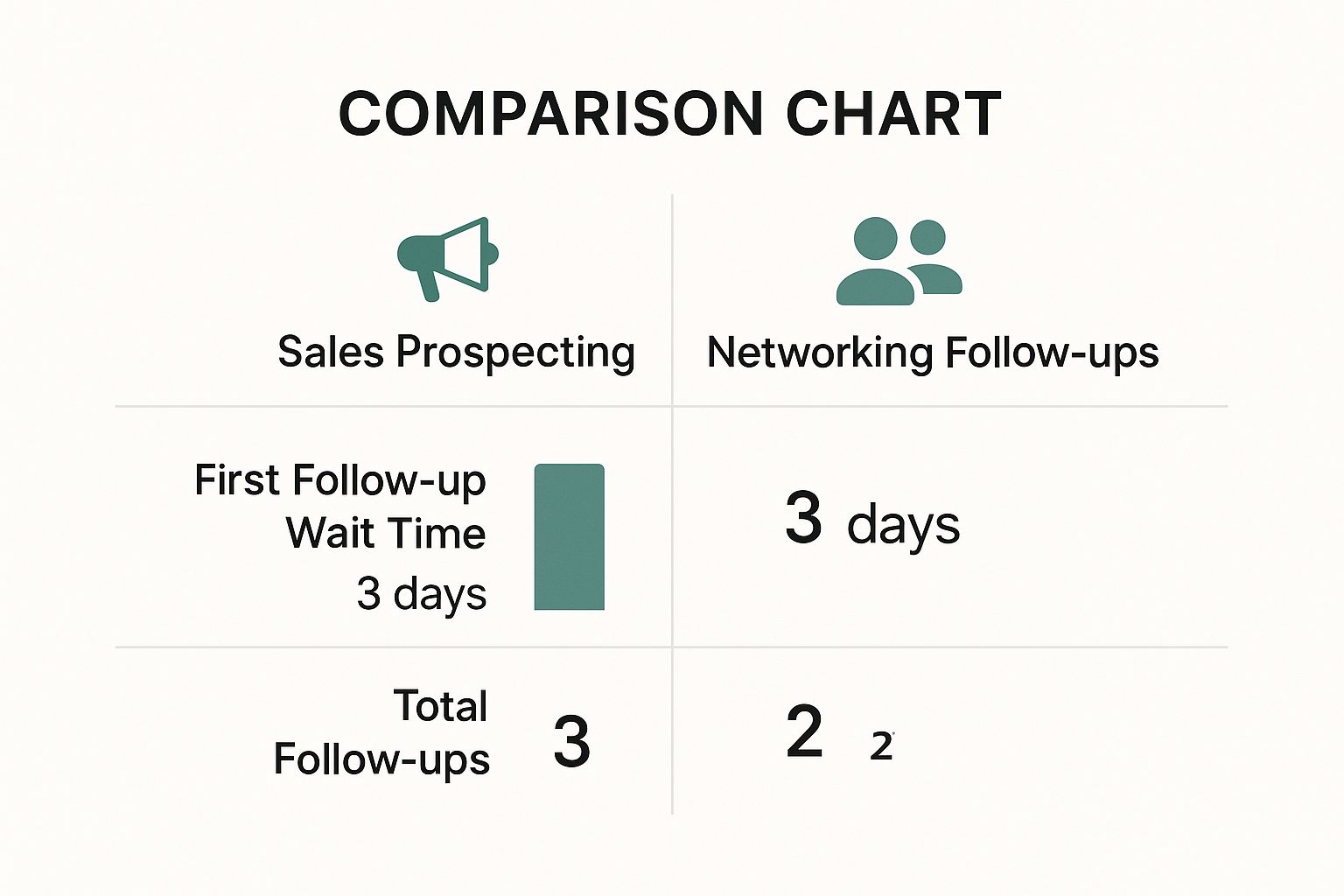
    The timing of your very first follow-up is the most important one. Jump the gun, and you look desperate. Wait too long, and they've already forgotten your original email. Through years of trial and error, I've found the ideal window is 2-3 business days after your initial outreach.

    This short pause gives them enough time to read and process your message without letting it get lost in the digital abyss. It establishes a professional rhythm that says you're on top of things, but not pushy.

    Silence is rarely a hard 'no.' More often, it's a 'not right now.' Your follow-up timing is what helps you determine the difference and stay top-of-mind for when 'right now' happens.

    The data backs this up, too. That little window between emails can make a huge difference. For instance, waiting three days before that first nudge can boost reply rates by a whopping 31%. But if you delay for more than five days, you're looking at a 24% drop in responses. You can dig into more of these fascinating cold email statistics and their impact to see for yourself.

    Building a Professional Follow Up Cadence

    One follow-up is good, but a planned-out sequence is what separates the pros from the amateurs. You need a cadence—a schedule for your follow-up attempts. This keeps you from sending random, one-off messages and makes every touchpoint feel deliberate.

    A rookie mistake is firing off follow-ups too close together. A much better strategy is to gradually increase the time between each email. This approach keeps you on their radar without completely overwhelming them.

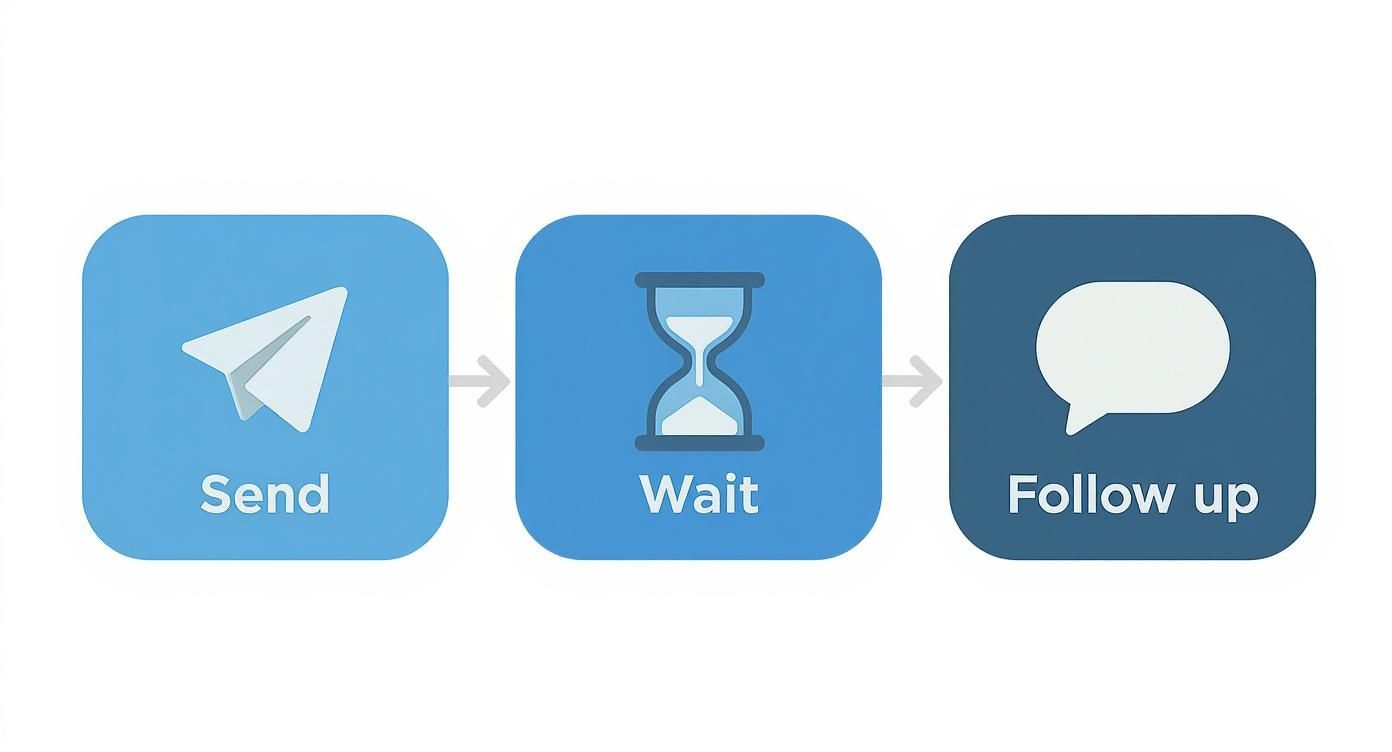
    This simple visual breaks down the core rhythm: send, wait, then follow up.

    An infographic showing a three-step process: Send (paper airplane), Wait (hourglass), and Follow up (speech bubble).

    The key thing to remember is that the 'wait' period isn't just a passive delay; it's an active part of your strategy.

    Here’s a practical, multi-touch cadence that I've seen work wonders for B2B sales and general outreach:

    • Follow-Up 1: Send 3 days after the initial email.
    • Follow-Up 2: Send 5 days after the first follow-up.
    • Follow-Up 3: Send 7 days after the second follow-up.

    If you get radio silence after three attempts, it's usually best to press pause on that sequence. This schedule gives your contact plenty of breathing room while still giving you multiple, well-spaced chances to connect. It strikes that perfect balance, making sure your no response follow up email lands with professional grace every time.

    Field-Tested Follow Up Email Templates That Get Replies

    We’ve all been there. Staring at a sent email, waiting for a reply that never comes. The temptation to just send a generic "just checking in" is strong, but it's also a fast track to the trash folder. Let's ditch that approach.

    To help you get unstuck, I’ve pulled together a few of the exact, field-tested templates I use every day. Think of them less as copy-paste formulas and more as battle-tested frameworks. They’re built on real human psychology to re-engage your prospect without being annoying.

    Of course, the golden rule is to never be generic. A little personalization goes a long way in showing you’ve actually done your homework. Use these templates as your starting point, but always add your own voice.

    A flat lay of a workspace with a laptop, notebook, pen, and a 'FOLLOW UP TEMPLATES' speech bubble.

    Template 1: The Quick Bump

    This is your first move, usually 2-3 days after your initial email goes unanswered. It's designed to be light, polite, and respectful. The whole point is to assume they’re just swamped—because most people are.

    It works because it isn’t demanding. It’s a simple nudge that brings your original message right back to the top of their inbox.

    Subject: Re: [Original Subject Line]

    Hi [First Name],

    Just wanted to quickly follow up on my email about [briefly mention original topic].

    I know how easy it is for things to get buried in a busy inbox. Just wanted to gently bump this to the top for you.

    Best,
    [Your Name]

    This template is all about being low-pressure. It gives them context without making them dig through their inbox, making it super easy to fire back a quick reply. If you need some inspiration for that first email, these https://emailscout.io/cold-email-example/ offer a great look at what actually gets opened.

    Template 2: The Value-Add

    Okay, so the quick bump didn't work. Time for a new tactic. Instead of asking for their time again, you’re going to give them something useful. This move instantly repositions you from a salesperson to a helpful resource. It's a perfect play for your second or third follow-up.

    Subject: A resource for [Their Company Name]

    Hi [First Name],

    Following up on my last note about [original topic].

    I actually came across this [article/case study/report] today and immediately thought it might be relevant to your work on [mention a specific project or goal of theirs]. It has some great insights on how to [achieve a specific positive outcome].

    No reply needed, just thought it might be helpful.

    Cheers,
    [Your Name]

    The real magic here is in its selflessness. By saying "no reply needed," you remove all the pressure, which—paradoxically—often makes people want to reply out of genuine appreciation.

    Template 3: The Breakup Email

    You've sent a few polite, value-driven follow-ups, but you're still hearing crickets. It's time to close the loop with the "breakup" email. This one works surprisingly well because it taps into a powerful psychological trigger called loss aversion.

    By politely signaling you're going to stop contacting them, you create one last chance for them to act if they ever had even a flicker of interest.

    Subject: Closing the loop

    Hi [First Name],

    I've reached out a few times about [original topic] but haven't heard back, so I'll assume this isn't a priority for you at the moment.

    I won't follow up on this again, but please don't hesitate to reach out if things change down the road.

    All the best,
    [Your Name]

    This approach is pure professionalism. It shows you respect their time and inbox, leaving the door open on a positive and memorable note. For more ideas on handling different follow-up situations, check out these 7 Sample Follow-Up Email After No Response Templates.

    Choosing Your No Response Follow Up Email Template

    To make it even clearer, here’s a quick breakdown of when to pull each template out of your toolkit.

    Template Name Best For Key Goal Tone
    The Quick Bump First follow-up (2-3 days after) Gentle reminder & easy reply Polite & brief
    The Value-Add Second or third follow-up Build credibility & offer help Resourceful & generous
    The Breakup Email Final follow-up (after 3-4 attempts) Prompt a final decision Professional & respectful

    Having a few distinct plays like this for your no response follow up email strategy is a game-changer. It lets you create a thoughtful sequence that adapts to the silence, rather than just hitting "send" on the same boring message again and again.

    Common Follow-Up Mistakes That Land You in Spam

    Even a perfectly crafted no response follow up email can misfire and tank your sender reputation if you’re not careful. Let’s be honest, many follow-ups are doomed from the start, loaded with rookie mistakes that get them instantly deleted—or worse, flagged as spam. Avoiding these common traps is just as crucial as knowing what to write in the first place.

    When your email lands in the spam folder, it's not just a wasted effort. It actively hurts your chances of reaching anyone's inbox down the road. The goal is to be persistent without being a pest, and that's a fine line to walk.

    Computer screen displaying 'AVOID SPAM' and an email icon, with crumpled paper on a wooden desk, symbolizing email management.

    Vague Subject Lines and Lazy Language

    Want a one-way ticket to the trash folder? Use a lazy, generic subject line. Phrases like "Just checking in" or "Following up" scream low effort and offer zero value to the person reading it. They give no context and force the recipient to do the mental gymnastics of remembering who you are and what you wanted.

    Just as bad is using passive-aggressive or guilt-tripping language.

    Avoid phrases like, "Just bumping this to the top of your inbox." It can come across as entitled and impatient, which is rarely a good look.

    The solution is simple: always reply in the same thread to keep the conversation history intact. And for your subject line? Add a new piece of information or a clear question to make it worth their while to open.

    The Failure to Personalize and Add Context

    Blasting out a generic, impersonal follow-up is another huge mistake. An email that just repeats the same request without adding anything new feels automated and spammy. You have to remind them of the original context and then give them a fresh angle or a new piece of value.

    It's shocking how few sales pros actually follow up, especially when the data proves it works. Industry benchmarks show that a staggering 48% of reps never even send a second message, and 44% give up after just one attempt. This massive drop-off is a huge opportunity for anyone willing to follow up thoughtfully. You can dig into more of these B2B cold email statistics on martal.ca.

    Here are a few common slip-ups that will absolutely destroy your deliverability:

    • Forgetting Context: You don't reference the original email or your last conversation.
    • No New Value: You're just nagging them with the same ask over and over.
    • Incorrect Contact Info: You're sending messages to outdated or wrong email addresses, causing high bounce rates.

    Ultimately, a massive number of follow-up failures happen before you even hit "send." Blasting emails to unverified addresses is one of the fastest ways to destroy your domain's reputation. We put together a guide on how to verify emails before you start your outreach—it’s a crucial step to protect your deliverability.

    Using EmailScout to Supercharge Your Outreach

    Let's be honest. All the clever templates and perfect timing in the world are completely worthless if your emails just land in a dead inbox. A truly great no response follow up email strategy starts long before you ever write a single word—it begins with a clean, verified list of contacts.

    This is exactly where having the right tool becomes your biggest advantage.

    Plugging a platform like EmailScout into your workflow isn't just a nice-to-have; it's a foundational move to protect your sender reputation and actually get a return on your outreach. Every email sent to an invalid address spikes your bounce rate, which email providers see as a huge red flag.

    Too many bounces will absolutely tank your domain's credibility. Before you know it, even your valid emails struggle to get through. It's the silent killer of so many outreach campaigns.

    Verify Before You Send

    The single most effective way to boost your follow-up success is to guarantee deliverability from the jump. That means verifying every single email address before it ever touches your sequence.

    Using an email verification tool is like basic digital hygiene. It scrubs your list of typos, old contacts, and those tricky catch-all addresses that almost always bounce. This one simple step has a massive impact on your campaign's health and ensures your carefully written messages actually have a chance of being seen by a real decision-maker.

    The EmailScout dashboard gives you a clean, at-a-glance view of this whole process.

    This interface lets you quickly upload lists, check verification results, and manage your contacts without any fuss, making that pre-campaign cleanup dead simple.

    Find Accurate Contact Information

    Beyond just verifying addresses, real success comes from contacting the right person. A follow-up sent to a generic info@company.com inbox is a shot in the dark. One sent directly to the department head? That’s how you start a conversation.

    Your outreach is only as good as your contact data. Spending a few extra minutes to find the direct email of a key decision-maker can be the difference between a closed deal and a deleted email.

    Tools like EmailScout were built to solve this exact problem. They help you pinpoint the correct contacts inside a target company and give you their direct email addresses. If you're looking to build hyper-targeted lists, you can learn more about how to find business emails with precision on our blog.

    When you combine accurate contact discovery with pre-send verification, you create a powerful one-two punch. This ensures your no response follow up email sequence not only dodges the spam folder but lands right in the inbox of the person who can actually say "yes." It's a proactive approach that saves you time, protects your sender score, and dramatically boosts the effectiveness of your entire outreach effort.

    Your Follow-Up Email Questions, Answered

    Even with the best templates, you'll run into situations that feel a bit tricky. When it comes to the no response follow up email, there isn't always a single right answer. This is where experience comes in handy.

    I've rounded up some of the most common questions we get, with practical advice to help you navigate those gray areas and send every follow-up with confidence.

    How Many Follow-Ups Is Too Many?

    Ah, the million-dollar question. While there's no magic number, a good rule of thumb for most cold outreach is 3-5 follow-ups spread out over a few weeks. If you send fewer, you’re probably giving up too soon. Any more than that, and you're venturing into annoyance territory, which is a quick way to get marked as spam.

    The real key, though, is to add value every single time. If all you're doing is sending "just checking in" pings, even two follow-ups will feel like too many. But if each message offers a new resource, a relevant case study, or a fresh insight, a longer sequence can feel helpful and natural.

    A good follow-up sequence shouldn't feel like a countdown. It should feel like a series of helpful nudges. When you run out of genuine value to add, it's time to send the breakup email and close the loop.

    What’s the Best Day and Time to Send a Follow-Up?

    The technically correct answer is "it depends," but we've seen enough data to spot some pretty clear trends. For most B2B communication, the sweet spots are during standard work hours.

    • Best Days: Tuesday, Wednesday, and Thursday consistently win. Mondays are a mad dash of catching up from the weekend, and people are often checked out by Friday afternoon.
    • Best Times: Mid-morning (around 10 AM) and early afternoon (around 2 PM) tend to perform best. This timing helps you avoid the morning inbox tsunami and the end-of-day scramble to wrap things up.

    Of course, use your judgment. Think about your prospect's world. An email to a restaurant owner might land better outside of the lunch and dinner rush, while a contact at a global tech company might be online at all hours.

    Should I Send a New Email or Reply in the Same Thread?

    Always, always, always reply in the same thread. I can't stress this one enough. It's a non-negotiable for sending a no response follow up email.

    Keeping the conversation in one place provides instant context. Your prospect doesn't have to go digging through their inbox to remember who you are or what you were talking about. You're making their life easier, which dramatically boosts your chances of getting a reply.

    Starting a new email for every follow-up shatters the conversational flow. It feels disjointed and, frankly, can come across like a brand new, unsolicited email each time—a surefire way to get ignored or flagged.


    Ready to make sure every follow-up has the best chance of landing in the right inbox? EmailScout helps you find and verify accurate contact information for key decision-makers, so your perfectly crafted messages never go to waste. Start building cleaner, more effective outreach lists today.

  • How to Follow Up Email No Response for Better Replies

    How to Follow Up Email No Response for Better Replies

    Figuring out how to follow up when you get radio silence can feel like walking on eggshells. The trick is to send a short, polite message that adds a little extra value, gives a gentle nudge about your first email, and ends with a crystal-clear, easy-to-do call-to-action.

    This simple shift turns a needy "just checking in" email into a smart, strategic conversation starter.

    Why Your First Email Went Unanswered

    A person looking thoughtfully at their laptop screen, considering why their email hasn't received a response.

    It’s easy to jump to conclusions and think, "They're just too busy." But honestly, the silence is often a sign that something in your original email missed the mark.

    Before you can fix it, you have to figure out why it didn't connect. Was your offer confusing? Was your ask too big? Nailing down these potential problems is the first real step to writing a follow-up that actually gets a reply.

    Plenty of outreach campaigns fizzle out because they just don't stand out in a sea of other emails. The data is pretty clear: mastering the follow-up is what separates the pros from the amateurs. Response rates for cold emails can be as low as 1% to 8.5%. But campaigns that use smart, targeted follow-ups? They can see incredible response rates of 40% to 50%.

    Quick Diagnosis for Unanswered Emails

    Sometimes, the problem isn't a lack of interest—it's that your email didn't make a strong enough case for their time and attention. Before you hit send on another message, a quick diagnosis can help you pinpoint what went wrong.

    This table breaks down some of the most common reasons for a no-reply and gives you a clear strategy for your next attempt.

    Potential Problem Strategic Fix for Your Follow-Up
    Weak or Vague Value Prop Re-explain the benefit from a new angle or highlight a different specific outcome.
    Unclear or High-Effort CTA Simplify your ask. Instead of a 30-min call, ask a simple yes/no question.
    Bad Timing or Irrelevance Offer a relevant resource (like a case study or blog post) to show you understand their world.
    Confusing or Long Message Get straight to the point. Trim your message down to the absolute essentials.

    By thinking through these points, you can turn your follow-up into a much more compelling message that’s easier for them to say "yes" to.

    Instead of just bumping your first email back to the top of their inbox, your real goal is to give them a new reason to engage. For a closer look at what makes an initial email work, you can check out some data on average cold email response rates.

    Key Takeaway: The silence on the other end isn't personal—it's feedback. Use it to refine your approach, add more value, and make responding feel effortless for the recipient.

    Think of your follow-up as a chance to re-pitch your idea from a slightly different angle. Maybe you can share a helpful resource, shine a light on a different benefit, or just make your request a whole lot simpler. This kind of thoughtful persistence shows you’re a professional who genuinely believes in the value you’re bringing to the table.

    Writing a Follow-Up That Actually Gets Read

    So, your carefully crafted email vanished into the void. No reply. The natural impulse is to fire off a quick "just checking in" message, but that's a huge missed opportunity.

    Think of your follow-up as more than just a nudge; it's your second chance to make a real impression and prove your email is worth their time.

    A great follow-up really only does three things: it jogs their memory about the original email, offers something new and valuable, and makes hitting "reply" almost effortless. Get that balance right, and you’ll start turning silence into actual conversations.

    Crafting a Subject Line That Re-Engages

    First things first: the subject line. Your goal here is to be familiar without being boring. Just hitting "forward" and typing "Following up" is lazy, and honestly, it can come across as a little passive-aggressive. You need to aim for clarity and context.

    • For Sales Outreach: Try something like, "Re: [Original Subject] – Quick Question" or "A thought on [Their Company Goal]." This links back to your first email but hints that you have something new to add.
    • For Job Applications: Be direct. "Following up on my application for the [Job Title] role" is perfect. It’s professional and makes it dead simple for a busy recruiter to find your file.
    • For Networking: A friendly touch works best. "Enjoyed our chat at [Event Name]" is personal and instantly reminds them who you are.

    The best subject lines are short, specific, and create just enough curiosity to get that open. Keeping it between 30-50 characters is a good rule of thumb, especially since most people will see it on their phone first.

    Adding New Value Is Non-Negotiable

    This is the part where most follow-ups completely fall flat. Just repeating your original request gives them zero new reasons to respond. People are busy. Their priorities have changed since yesterday. The single best way to master how to follow up on an email with no response is to bring something new to the table.

    So, what does "new value" actually look like?

    • Share a Relevant Resource: Did you stumble upon an article, a case study, or a tool that solves a problem they mentioned? Send it over. A simple "Came across this and thought of our conversation about scaling your team" works wonders.
    • Offer a New Insight: Maybe you had a fresh idea after you sent the first email. A quick note like, "I was thinking more about your challenge with [X], and it occurred to me that [Y] could be a solution" shows you’re genuinely thinking about their problems.
    • Provide a Quick Win: Instead of immediately asking for a 30-minute call, offer a small piece of advice they can use right away. For example, "I noticed a small tweak you could make on your website that might boost conversions."

    This simple shift changes the entire dynamic. You’re no longer someone asking for something; you're someone offering something. It’s a subtle change, but it shows you respect their time and have real expertise to share. Your first email sets the stage, but the follow-up is where you prove you’re a connection worth having. If you're still dialing in that first message, our guide on how to write cold emails can help.

    Design a Low-Friction Call-to-Action

    Okay, you’ve reminded them of the context and offered new value. The last step is to make it incredibly easy for them to reply. Vague CTAs like "Let me know your thoughts" feel like work. You need to be specific and make the ask as small as humanly possible.

    Just look at the difference between these two:

    High-Friction CTA: "Are you free for a 30-minute call next week to discuss this further?"
    Low-Friction CTA: "Would learning more about this be a priority for you right now?"

    The second one is a simple yes/no question. It takes almost no mental energy to answer. If they say "yes," then you can figure out the scheduling. This micro-commitment approach is way more effective at getting that initial reply, which is the only goal that matters for a follow-up email.

    Mastering Your Follow-Up Timing and Cadence

    Sending a brilliant follow-up at the wrong moment is like telling a great joke to an empty room—it just doesn't land. The art of the follow-up isn't just about what you say; it's about when you say it. Getting this rhythm right is the key to staying persistent without becoming a pest.

    The timing of your messages can dramatically change your outcomes. In fact, data shows the first follow-up email can get a reply rate that's 40% higher than later attempts. Speed is also a massive factor in some situations; companies that respond to new leads within just five minutes are 100 times more likely to actually connect and convert them. Delaying even a day can have a huge impact. You can read more about these powerful follow-up statistics to see just how much timing matters.

    This infographic gives you a great visual guide on structuring a follow-up to grab your recipient's attention.

    Infographic about how to follow up email no response

    As the image highlights, a successful email has to immediately capture attention, which reinforces why a well-timed and well-crafted message is so important.

    Finding the Right Cadence

    Look, there's no single magic number for how long you should wait, but there are some smart guidelines that work for most situations. Your goal is to build a cadence that respects their inbox while keeping your request top-of-mind.

    A solid starting point is what I call the "3-5-7 rule," which you can easily adapt based on your specific needs. It’s a balanced approach that gives you a clear follow-up sequence.

    • First Follow-Up: Wait 2-3 business days after your initial email. This is the sweet spot—enough time for them to have seen your message, but not so long that they've completely forgotten it.
    • Second Follow-Up: Give it another 4-5 business days. At this point, you're giving them more space and acknowledging they're likely busy.
    • Third Follow-Up (and beyond): Extend the gap to 7+ business days. Each message from here on out should be more spaced out to avoid overwhelming their inbox.

    Your cadence isn't set in stone. If your request is time-sensitive, like following up after a job interview where they mentioned a decision timeline, you can absolutely shorten these windows. For less urgent networking, feel free to stretch them out.

    When to Adjust Your Timing

    Context is everything when you're deciding how to follow up on an email with no response. The perfect timing can shift based on who you're talking to and why.

    For instance, reaching out to a C-suite executive requires more patience than connecting with a junior team member. Their schedules are slammed, so longer intervals between emails feel more respectful and are often more effective.

    Think about these common scenarios:

    1. After a Sales Demo: Following up within 24 hours is pretty standard. You want to capitalize on their interest while the details are still fresh in their mind.
    2. Post-Networking Event: A quick "great to meet you" email or a connection request within 1-2 days is perfect. It solidifies the connection before the memory of your chat fades.
    3. Following Up on a Proposal: Give them a few business days (3-5 days) to review the document with their team before you check in. Rushing them can come across as pushy and might undermine your position.

    Ultimately, the best cadence is one that feels natural for the relationship and the context. Listen to the signals. If you've sent three or four well-spaced, value-driven emails with zero response, it’s a strong sign to pause your outreach and try a different approach down the road.

    Follow-Up Email Examples for Any Scenario

    Knowing the theory behind a good follow-up is one thing, but having battle-tested examples you can adapt makes all the difference. This is your practical toolkit for turning silence into a conversation.

    Whether you’re nudging a cold lead, checking in after an interview, or waiting on a proposal, the right words matter. The goal isn't just to remind them you exist; it's to re-engage them with a message that feels helpful, respectful, and easy to act on.

    The Gentle Nudge for Cold Outreach

    When an initial cold email goes unanswered, your first follow-up is often your best shot at getting a reply. Don't just "bump" the old message. Instead, come at it from a slightly different angle and reframe your value.

    Example: The Quick Value-Add Follow-Up

    Subject: Re: [Original Subject] – a quick thought

    Hi [First Name],

    Just wanted to circle back on the email I sent last week about [original topic].

    I was thinking about your goal of [mention their company goal] and came across this case study on how [Similar Company] tackled the same challenge. Thought you might find it interesting: [Link]

    Is solving [pain point] a priority for your team right now?

    Best,
    [Your Name]

    Why It Works: This approach instantly provides fresh value—the case study—and connects it directly to a goal they likely care about. The final question is a simple yes/no, making it far easier to answer than a request for a call. For more ideas on nailing that first message, check out these examples of cold emails from our guide.

    Following Up After a Job Interview

    The post-interview follow-up is all about showing continued enthusiasm without being pushy. It’s a delicate balance, but a polite check-in can absolutely keep you top of mind.

    Example: The Professional Check-In

    Subject: Following up on the [Job Title] role

    Hi [Hiring Manager Name],

    Hope you’re having a great week.

    I really enjoyed our conversation on [day of interview] about the [Job Title] position and learning more about the team at [Company Name].

    You mentioned a decision might be made around this time, so I just wanted to politely check in on the status of the role. I'm still very interested and confident that my skills in [mention 1-2 key skills] would be a great asset.

    Please let me know if there's anything else you need from my end.

    All the best,
    [Your Name]

    Why It Works: It’s respectful and references the timeline they provided, which shows you were listening. It also briefly restates your interest and key qualifications without just repeating your resume. You're simply staying engaged in the process.

    Checking on a Submitted Proposal or Quote

    Once you've sent a proposal, the client is probably reviewing it and discussing it with their team. Your follow-up should be designed to help that conversation along, not pressure them into a decision.

    Example: The Helpful Resource Follow-Up

    Subject: Re: Proposal for [Project Name]

    Hi [Client Name],

    Just wanted to follow up on the proposal I sent over last [Day].

    I know you’re likely discussing it with your team. To help with that conversation, I’ve attached a brief document outlining the ROI our other clients in the [Their Industry] space have seen.

    Do you have any initial questions I can help answer?

    Regards,
    [Your Name]

    Why It Works: This email anticipates their internal process and provides a resource to help them make their case. It positions you as a helpful partner, not just another vendor waiting for a signature. It shows them you're thinking one step ahead.


    Follow-Up Template Selector

    Choosing the right approach depends entirely on your goal and your existing relationship with the person you're emailing. Use this quick guide to match your situation to the most effective follow-up style.

    Scenario Key Objective Recommended Tone Core Value Proposition
    Cold Outreach Get a first reply Helpful & Concise A new piece of relevant information (case study, article).
    Post-Interview Stay top-of-mind Professional & Enthusiastic A reminder of your key skills and continued interest.
    Proposal Sent Facilitate a decision Supportive & Proactive A resource to help them make an internal business case.
    Networking Event Re-establish connection Friendly & Specific A reminder of your conversation and a clear next step.
    Old Client Re-engagement Restart a conversation Familiar & Value-Driven A relevant update or a new idea tailored to them.

    Each scenario demands a slightly different touch. The key is to always lead with value and make it incredibly easy for the other person to respond.

    Advanced Follow-Up Strategies Beyond Email

    A hand holding a smartphone showing a LinkedIn profile, with a laptop in the background displaying an email inbox.

    When your best emails are met with silence, the gut reaction is to just send another one. But honestly, sometimes the best move is to get out of the inbox altogether. A smart multi-channel approach can get you noticed without making you look desperate.

    This requires a bit of finesse, though. The goal is to be present, not a pest. If you've already sent a couple of emails and heard nothing back, a light touch on a different platform can be the nudge that gets you a reply.

    Using Social Platforms Strategically

    LinkedIn is your best friend here. But please, don't just slide into their DMs with a "Hey, did you see my email?" That's the fastest way to get ignored or blocked. You have to be more subtle.

    • Engage with their content. A thoughtful comment or even a simple 'like' on a recent post puts your name on their radar in a low-pressure, professional way.
    • Send a connection request. Keep the note short and to the point. Something like, "Hi [Name], I sent a note over to your team last week about [topic]. Thought it'd be great to connect here, too."

    This simple move completely changes the game. You're no longer just another unread email; you're a real person and a professional contact in their network. That small shift is often all it takes.

    Knowing When to Send the Breakup Email

    Look, persistence pays off. But there's a fine line between being persistent and being annoying. The data doesn't lie: around 80% of sales require five or more follow-ups, but most people give up way too soon. While those first couple of follow-ups give you a nice bump in reply rates, the real magic often happens later in the sequence. You can dig into some more of these insightful sales follow-up statistics if you're curious.

    So, what do you do after you've sent a series of emails—say, 4 or 5—and still have nothing? It's time for the "breakup email." This isn't about being dramatic. It's about professionally closing the loop while leaving the door open for the future.

    The Breakup Email Example
    Subject: Closing the loop

    Hi [Name],

    I've reached out a few times about [your offer] but haven't heard back. I'll assume it's not a priority for you right now, so this will be my last email.

    If you ever decide to explore [solving their problem] in the future, please feel free to get in touch.

    All the best,
    [Your Name]

    This message works wonders. It’s polite, it respects their time (and their silence), and it cleanly ends your follow-up sequence. You'd be surprised how often this email gets a response. Why? It takes all the pressure off and gives the other person an easy out. It’s a must-have tool for anyone trying to figure out how to follow up when an email gets no response.

    Answering Those Awkward Follow-Up Questions

    Even with the best templates in hand, you're bound to run into some tricky situations. Knowing how to play these moments can be the difference between getting that reply you've been waiting for and being left on read.

    Let's walk through a couple of the most common dilemmas people face when they're figuring out how to follow up. This should help you handle these spots with a lot more confidence.

    What If I Spot a Mistake in My First Email?

    It happens to the best of us. You hit "send" and your stomach drops as you immediately spot a glaring typo or realize you attached the wrong file.

    Don't panic. The best move is to send a quick, polite correction as soon as you notice the mistake.

    Just address it directly and keep it short. A simple subject line like "Correction: [Original Subject]" is all you need.

    Here's how that might look:
    "Hi [Name], just a quick correction on my last email—I noticed a typo in the project timeline I sent over. My apologies for any confusion. The correct date for the project kickoff is actually [Correct Date]."

    This approach shows you're on top of things and have a good eye for detail. It fixes the error without a lot of drama and, as a bonus, bumps your message right back to the top of their inbox.

    How Should I Change My Tone for Different Seniority Levels?

    Your tone absolutely has to shift depending on who you're emailing. When you're following up with a C-suite executive or a senior manager, you always want to lean toward being more formal and concise.

    • For Executives: Get straight to the point. They're incredibly busy, so they value brevity more than anything else.
    • For Peers or Junior Staff: A slightly more casual and friendly tone is usually fine. In fact, it can help you build a better working relationship.

    At the end of the day, it's all about showing respect for their time. For a high-level contact, that means a short, direct message. For a colleague, it might mean a more conversational and collaborative style.


    Ready to stop guessing and start connecting? EmailScout helps you find the right email addresses for key decision-makers in a single click, ensuring your perfectly crafted follow-up messages land in the right inbox every time. Find unlimited emails for free.