Tag: find email

  • How to Find Anyone’s Email Address

    How to Find Anyone’s Email Address

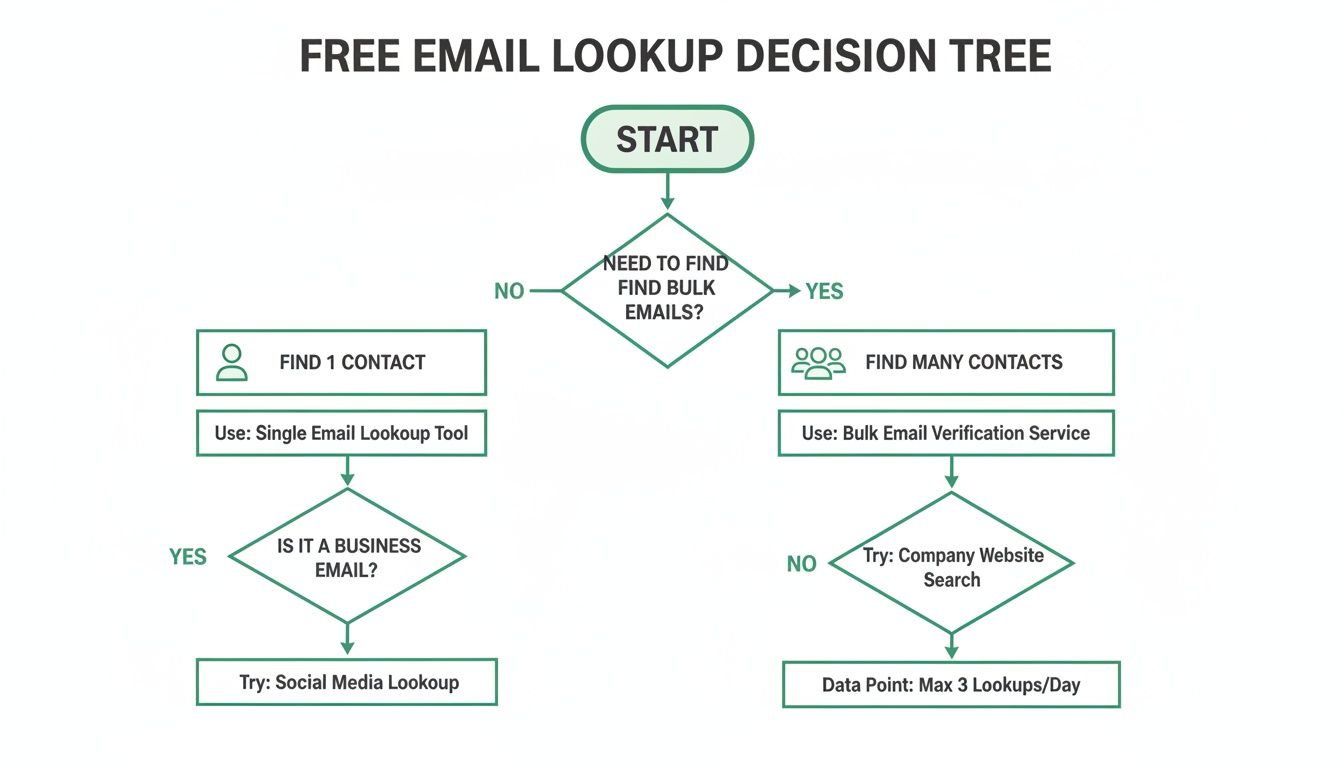
    When you need to find someone's email address, it usually comes down to two paths: making a smart guess based on common patterns (think firstname.lastname@company.com) or firing up a specialized email lookup tool. Both are great places to start before you get into more complex tactics.

    Your Smart Starting Point to Find Any Email

    Before you even think about advanced tools or paid services, it's always best to start with the foundational strategies. These often get you the email you need in just a few minutes.

    Think of it as your first line of attack. You're combining a bit of clever guesswork with information that's already out there. The goal here is to solve the puzzle quickly without overcomplicating things. It’s all about efficiency. Most companies use predictable email formats, so a quick search can often confirm your hunch. If you're trying to reach someone at a startup, for instance, they'll often use a simple firstname@company.com structure.

    Laying the Groundwork

    First things first: gather the basics. You need their first name, last name, and the company they work for. With just these three pieces of info, you can start piecing together the most likely email combinations. This manual approach is surprisingly effective and costs nothing but a little bit of your time.

    Don't forget to check professional networks, either. A person's LinkedIn profile or even a company's "About Us" page can give you clues or sometimes the email address itself. People in public-facing roles often list their contact details right out in the open. For more targeted strategies, you can check out our guide on how to find company email addresses.

    The truth is, most professional email addresses aren't truly hidden; they're just not listed front and center. Your job is to connect the dots with publicly available data, turning the search into a simple puzzle instead of an impossible mission.

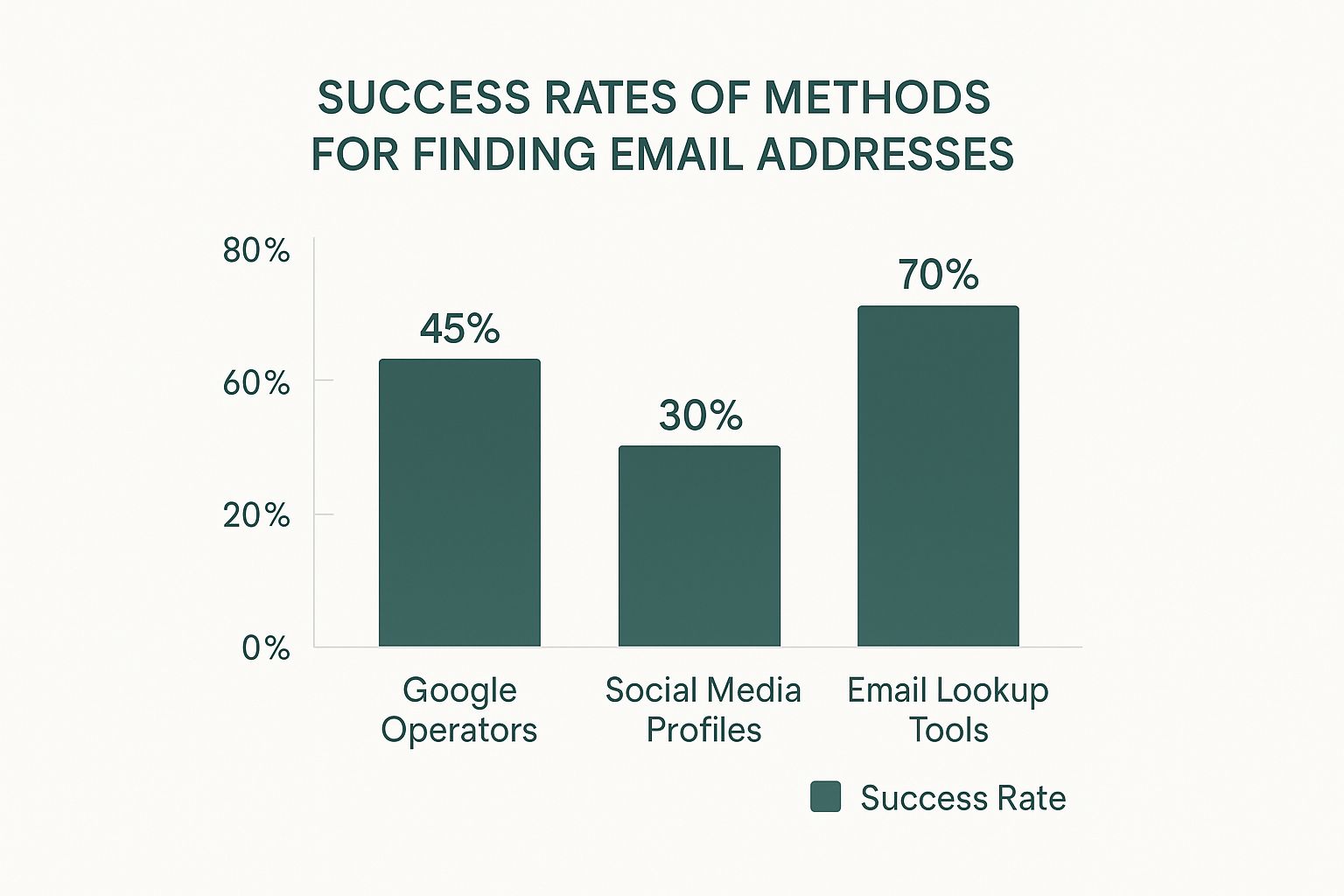
    To give you a better idea of where to spend your energy, let's look at how different methods stack up.

    Comparing Email Finding Methods

    This table offers a quick look at the most common email discovery methods, highlighting their effectiveness, time investment, and potential costs.

    Method Success Rate Time Commitment Cost
    Manual Guessing Low to Medium Medium Free
    Google Search Medium Medium Free
    LinkedIn Search Medium High Free (Time)
    Lookup Tools High Low Varies (Free to Paid)

    As you can see, while manual methods are a great start, specialized lookup tools consistently deliver the best results with the least amount of effort.

    Image

    Why Start Simple

    Kicking things off with these basic techniques helps you quickly grab the low-hanging fruit. With an estimated 4.83 billion email users worldwide by 2025, the amount of discoverable data is just massive.

    This sheer volume means that simple, pattern-based searches often work because they tap into the predictable structures that organizations use to manage their communications. This foundational approach ensures you only move on to more powerful tools when you really need to, saving you both time and money.

    Before you jump to paid tools and automated solutions, it’s worth mastering the art of the manual search. It’s a powerful, cost-free skill that feels a bit like digital detective work, often uncovering contact details that are hiding in plain sight.

    This old-school approach is perfect when you need to find that one key contact without burning through credits. Think of it as digital forensics—you're piecing together clues like a name, company, and job title to find what you need. It’s a foundational technique every sales pro or marketer should have in their back pocket.

    Image

    Go Beyond a Basic Google Search

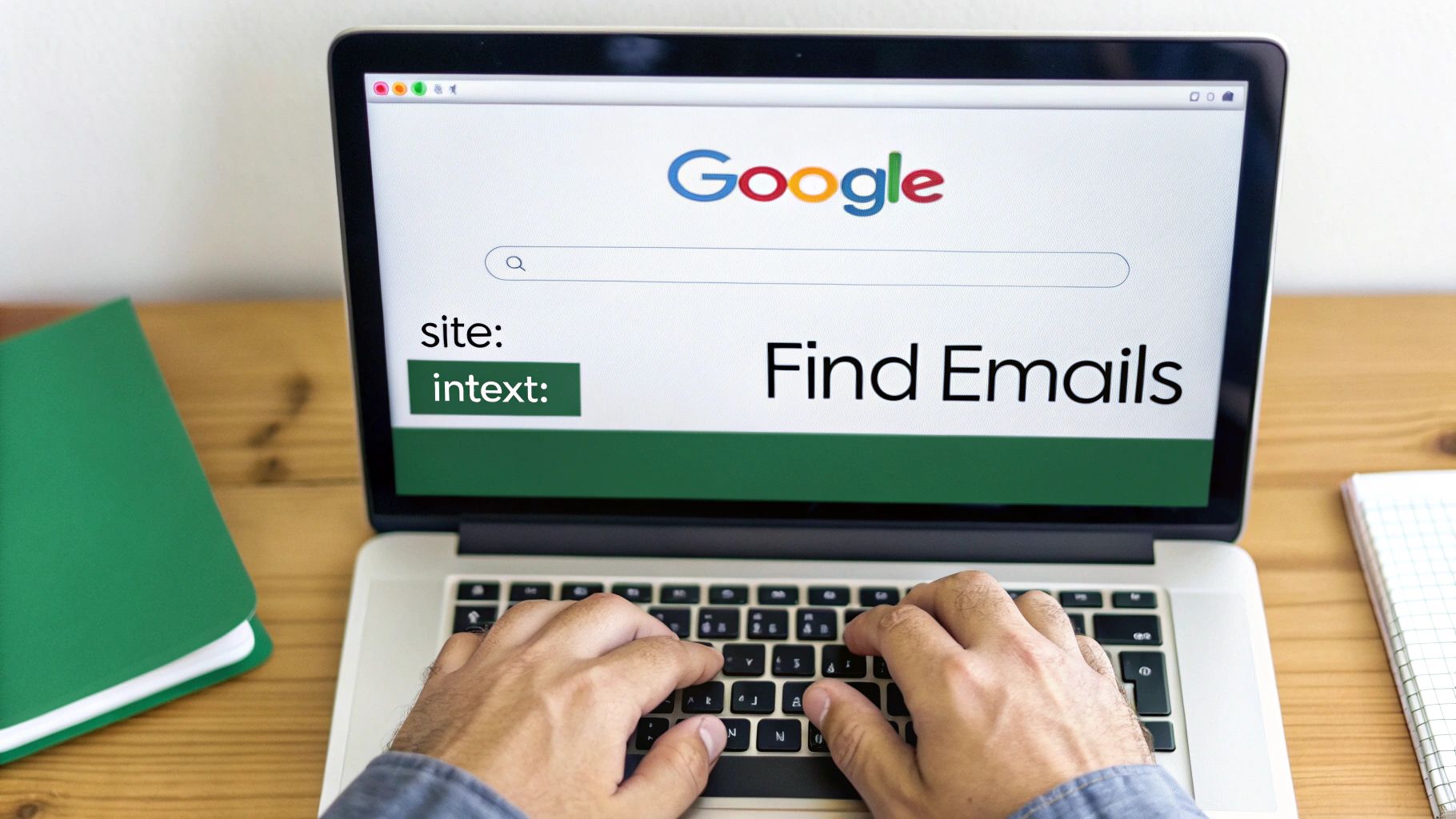
    A simple search for "John Smith Acme Corp email" probably won't get you very far. This is where Google’s advanced search operators come in. These are little commands that let you filter out the noise and narrow your search results with incredible precision.

    Using operators, you can pinpoint emails mentioned on company websites, buried in press releases, or even hidden inside public documents.

    Here are a few of my go-to operators to get you started:

    • site:company.com "John Smith" — This is a game-changer. It forces Google to only search that specific company's website.
    • "John Smith" + "email" or "contact" — This simple combo tells Google to find pages that contain both the person's name and words like "email" or "contact."
    • filetype:pdf "John Smith" email — You'd be surprised how often contact details show up in PDFs like conference speaker lists or annual reports. This operator finds them.

    The secret to effective manual searching isn't just knowing what to look for, but how. Advanced operators transform Google from a blunt instrument into a precision tool for email hunting.

    Test Out Common Email Formats

    Okay, so you have a name and a company domain. Now what? You can start making some educated guesses. Most companies use a consistent pattern for their email addresses, and your job is to figure out that pattern.

    Let's say you're looking for Jane Doe at example.com. You can quickly test a few of the most common combinations.

    Common Email Permutations

    • First Name: jane@example.com
    • First Initial + Last Name: jdoe@example.com
    • First Name + Last Name: janedoe@example.com
    • First Name . Last Name: jane.doe@example.com

    This permutation process is surprisingly effective. But you can't just start firing off emails—a bounce could hurt your sender reputation. With over 4.2 million emails sent every second in 2024, making sure your outreach actually lands is more critical than ever. (EmailToolTester.com has some wild stats on this).

    The Art of Free Verification

    Guessing the email is only half the battle; now you have to confirm it’s legit without sending a risky, bounce-prone email.

    One of my favorite quick tricks is to use Gmail. Just open a new message, paste a guessed address into the "To" field, and hover your mouse over it. If a Google profile picture or contact card pops up, you’ve likely got a valid, active account. Bingo.

    For more certainty, though, a dedicated tool is the way to go. To get the full rundown on this, check out our guide on how to validate an email address for free.

    Tap into Public Information Sources

    Sometimes, the email you need isn't on the company website at all. It's somewhere else entirely. People often share their contact info on personal platforms or in other public-facing roles. Thinking outside the box here can pay off big time.

    Here are a few often-overlooked goldmines:

    1. Author Bylines: If your prospect writes for industry publications, their bio at the end of an article frequently includes a direct email.
    2. Personal Blogs or Websites: Many professionals run a personal site for a portfolio or side hustle, and there's almost always a contact page.
    3. Company "About Us" Pages: Don't just scan the leadership team. Look for press contacts, investor relations, or department heads—these sections often list direct email addresses.

    When you combine these manual tactics, you build a methodical process for discovery. Sure, it takes more legwork than an automated tool, but the satisfaction of finding that hard-to-get email for free is totally worth it.

    Using Social and Professional Networks

    When you're trying to track down someone's email address, social and professional networks are often your most direct path. Platforms like LinkedIn were literally built for professional networking, making them a goldmine for contact info—if you know where to look.

    These sites aren't just static digital resumes. They're living, breathing communities where people share updates, post articles, and sometimes, drop their contact details right out in the open. Your job is to approach it like a detective, piecing together the clues that lead to the right inbox.

    Image

    The trick is to think beyond the obvious. Sure, the "Contact Info" section is the first place everyone checks, but many professionals keep it private or haven't updated it in years. This is where a little creativity goes a long way.

    Digging Deeper on LinkedIn

    LinkedIn is the undisputed king of B2B prospecting, but just landing on a profile is rarely enough. Always start with the "Contact Info" section, as you might get lucky. If that’s a dead end, it’s time to get resourceful.

    A person's activity feed can be incredibly revealing. Take a minute to scroll through their recent posts, articles, and even their comments on other people's content. Did they just share a big project and invite questions? They might have included their email right in the post.

    Another spot people often miss is the "About" summary. It's common for consultants, freelancers, and business owners to put a call-to-action right in their bio, complete with an email address for inquiries. This simple manual check can save you a ton of time. For a deeper dive, our comprehensive guide covers more advanced techniques for how to find emails on LinkedIn.

    Uncovering Emails on Twitter (X)

    While LinkedIn is buttoned-up and professional, Twitter (now X) is all about conversation, and that casual vibe can work in your favor. Over the years, countless users have tweeted their email address, but they often disguise it to throw off spam bots. This is where X's advanced search becomes your secret weapon.

    Instead of just searching for their name, pop these specific queries into the search bar:

    • from:[username] "email me"
    • from:[username] "at domain dot com"
    • from:[username] name [at] domain
    • from:[username] contact OR reach

    These commands can unearth old tweets where someone shared their email in a bot-proof format like "jane [at] company dot com". It feels like a long shot, but you'd be surprised how often this works, especially for journalists, marketers, and tech folks who are active on the platform.

    Remember that people share information differently across platforms. The professional persona on LinkedIn might be more guarded, while the conversational tone on Twitter could lead to a direct share of contact information.

    Leveraging Company Pages and Groups

    Don't get tunnel vision focusing only on individual profiles. Company pages on LinkedIn are another fantastic resource. Head over to the company's page and click on their "About" section. You'll often find generic but useful contact emails like press@company.com or info@company.com.

    These might not be a direct line to your target, but a polite, well-worded request can get you there. A simple message like, "Could you please forward this to the person who handles marketing partnerships?" is often passed along to the right individual.

    LinkedIn Groups in your target's industry are also a fantastic, underutilized resource. When you become an active, helpful member of a group, you earn the ability to message other members directly, even if you aren't connected. This gives you a warm entry point to build a little rapport before asking for the best email to continue the conversation. It’s about networking, not just hunting for data.

    Putting Free Email Finder Tools to Work

    When your manual detective work hits a brick wall, it's time to bring in the machines. Free email finder tools are built to do the grunt work for you, scanning public data sources in seconds to unearth the contact info you need. A good tool can feel like a superpower, turning a frustrating hour-long search into a one-click find.

    These tools work by piecing together digital footprints. They analyze company websites, social media profiles, and massive databases to predict and verify email addresses with a surprisingly high degree of accuracy. Instead of you manually trying every possible name combination, the software does it for you—and often verifies it in real-time.

    Choosing the Right Free Tool for the Job

    Of course, not all free tools are created equal. Some are browser extensions that slide right into your workflow on sites like LinkedIn, while others are web apps where you'll need to plug in data yourself. The trick is finding one that fits how you work, whether you're hunting for a single contact or building out a larger prospect list.

    When you're sizing up a tool, here’s what to look for:

    • Monthly Credits: Most free plans will cap how many searches you can do each month. This can be anywhere from 5 to 50 credits, so think about your typical outreach volume.
    • Verification Accuracy: A great tool doesn't just find emails; it verifies them. You want something that promises a high deliverability rate to protect your sender reputation from bounces.
    • Ease of Use: The best tools are just plain intuitive. A browser extension like EmailScout is fantastic because it works right where you're already prospecting, like on a LinkedIn profile.
    • Data Provided: Some tools spit out just an email address. Others might give you more context, like job titles, company size, and social media links, which is always a plus.

    The goal isn't just to find an email address, but to find the right one. A quality free tool should deliver verified, up-to-date information that saves you time and prevents bounced emails, making your outreach far more effective from the start.

    A Practical Walkthrough with EmailScout

    Let's see how this works in the real world. Say you want to connect with a marketing manager at a specific tech company. You've tried the manual approach and come up empty. Time to call in a Chrome extension like EmailScout.

    The process couldn't be simpler. First, you just add the extension to your browser from the Chrome Web Store. Once it's installed, its little icon will pop up in your toolbar, ready for action.

    Next, head over to your prospect's LinkedIn profile. The EmailScout extension is smart enough to know you're on a profile page. Give the icon a single click, and it starts its search, cross-referencing the person’s name, company, and other public data to pinpoint their most likely email address.

    In seconds, the tool serves up a verified email. You haven’t had to guess a single format or open another tab. This is how you find an email address with maximum efficiency. With the average user juggling nearly 1.86 email accounts, as noted in these email usage statistics on porchgroupmedia.com, a dedicated tool is invaluable for homing in on the correct professional address.

    Comparing Top Free Email Finder Options

    While EmailScout is a powerhouse for its seamless LinkedIn integration, other tools have different strengths. Knowing what's out there helps you build a versatile toolkit for any situation that comes your way.

    Here’s a quick look at a few popular free options:

    Tool Best For Free Plan Limits Key Feature
    EmailScout LinkedIn Prospecting Unlimited Free Searches One-click email finding directly on LinkedIn profiles and websites.
    Hunter.io Domain-Based Searches 25 monthly searches Finding all emails associated with a specific company domain.
    FindyMail Bulk Verification 10 monthly credits Uploading a list of names and companies to find emails in bulk.

    This variety means you can use one tool for highly targeted, individual searches and another when you need to build a bigger list for a broad marketing campaign.

    Limitations of Free Tools to Keep in Mind

    As useful as free email finders are, they do have their limits. The most obvious is the cap on monthly searches. If you're in a high-volume sales or recruiting role, you might torch your free credits in the first week of the month.

    Also, while accuracy is generally high, no tool is perfect. You might occasionally get an unverified or outdated email address. That's why it's always a good habit to use the built-in verification features or run a particularly important email through a secondary checker.

    Ultimately, these tools are a fantastic starting point. They save countless hours and give you a massive leg up over purely manual methods. By folding a tool like EmailScout into your workflow, you can spend less time on the hunt and more on what really matters: crafting the perfect outreach message.

    Outreach Ethics and Best Practices

    Finding a valid email is a huge win, but it’s only the first step. How you use that information is what separates successful outreach from spam that gets you blacklisted. Just because you can find anyone's email address doesn’t mean you have an automatic pass to their inbox.

    Respectful, ethical outreach is the foundation of building real professional relationships. It’s about creating value, not just making a request. Ignoring this part can seriously damage your personal brand and your company's domain reputation, making all that hard work finding the email completely pointless.

    Image

    Navigating Email Regulations

    Before you hit "send," you need to know the rules of the road. Regulations like the GDPR (General Data Protection Regulation) in Europe and the CAN-SPAM Act in the United States aren't just legal jargon; they're frameworks designed to protect people from a flood of unwanted emails.

    Let's break them down simply:

    • GDPR: This requires you to have a lawful reason for handling someone's data (like their email). For cold outreach, this usually means having a "legitimate interest" that doesn't override the individual's rights. You also have to clearly identify yourself and provide an easy way to opt out.
    • CAN-SPAM Act: While less strict, it still has clear rules. You can't use misleading subject lines, you must include a physical address, and you have to honor opt-out requests quickly.

    These laws aren't meant to stop you from doing business. They exist to stop bad actors and make sure communication is transparent and respectful.

    Professional Outreach Versus Spam

    So, what's the real difference between a thoughtful cold email and a spam message? It all boils down to personalization and value.

    Spam is generic, irrelevant, and totally self-serving. Professional outreach is the exact opposite. Your goal is to show the recipient you've done your homework and have a genuine reason for contacting them specifically.

    The moment a recipient feels like they're just one name on a massive, impersonal list, you've lost. True outreach starts with seeing the individual, not just the email address.

    This is where your initial message becomes absolutely critical.

    Crafting a Welcome First Email

    Your first email sets the entire tone. It needs to be sharp, respectful of their time, and immediately prove you're not a spammer. A poorly crafted message will get deleted in seconds, but a great one can open doors.

    Key Components of a Great First Touch

    • A Compelling Subject Line: Make it specific and intriguing, but never clickbait. Instead of "Quick Question," try something like "Idea about [Their Company]'s recent launch."
    • A Personalized Opening: Immediately show you know who they are. Mention a recent article they wrote, a project they led, or even a comment they made on LinkedIn.
    • A Clear Value Proposition: Get to the point fast. Explain why you're reaching out and what's in it for them. How can you help them solve a problem or hit a goal?
    • A Simple Call-to-Action (CTA): Don't ask for a 30-minute meeting right away. That's a huge commitment. Instead, suggest a low-friction next step, like asking if they're the right person to speak with or if they'd be open to a brief follow-up.

    Remember, your initial email isn't a sales pitch—it's the start of a conversation. By leading with respect, personalization, and a clear purpose, you honor the effort it took to find their email and dramatically increase your chances of getting a positive response.

    Common Questions About Finding Emails

    Even with the best tools, you'll eventually hit a wall or run into a gray area. Finding an email address is one thing, but knowing what to do when your search comes up empty—or navigating the legal stuff—is what really separates the pros from the amateurs.

    Let's dig into some of the most common questions that pop up.

    What If All Methods Fail?

    You’ve tried every pattern, scoured LinkedIn, and even used a top-tier email finder, but still nothing. It's a frustrating spot to be in, but it’s definitely not a dead end. When a direct approach fails, it's time to get a little more creative.

    Instead of tunneling in on that one specific address, broaden your strategy:

    • Go for a General Inbox: An info@company.com or contact@company.com might feel like a long shot, but they're always monitored. A clear, concise message asking to be connected with the right person often gets you exactly where you need to go.
    • Connect on Social: A polite, professional DM on LinkedIn or X (formerly Twitter) can work wonders. The goal isn't to pitch right away, but simply to ask for the best way to get in touch about your topic.
    • Find a Colleague: Can't find the director's email? Try their manager or someone else on the team. A friendly note to a colleague in the same department can often get your message forwarded to the right person.

    When you can't find a direct email, the game changes. Your new goal isn't to uncover a hidden address—it's to find an open door to the right conversation.

    This pivot from a direct to an indirect approach shows you're resourceful and respectful, which honestly makes for a much better first impression.

    How Can I Verify an Email for Free?

    Finding a potential email is only half the battle. Firing off a message to a bad address tanks your sender reputation and can get you flagged as spam. You have to verify before you send.

    The good news? You can do it for free.

    One of the oldest tricks in the book is the Gmail hover method. Just pop the email into the "To" field of a new draft in Gmail. Hover your mouse over it. If a Google account profile picture or contact card shows up, you've likely found a valid, active address. It's a fantastic first-pass check.

    For a more technical confirmation, free email verification tools are your best bet. Plenty of services offer a handful of free checks each month. These tools run a deeper diagnostic to confirm the address can actually receive mail, which is crucial for keeping your bounce rate low.

    Is It Legal to Contact Someone This Way?

    This is the big one, and the answer isn't a simple yes or no. Generally speaking, it is legal to use someone's publicly available business email for professional outreach, as long as you play by the rules.

    The two main regulations you need to know are:

    1. GDPR (General Data Protection Regulation): This applies to EU citizens and requires you to have a "legitimate interest" for the contact. In simple terms, your outreach has to be relevant to their professional role.
    2. CAN-SPAM Act: In the U.S., this law demands that your message isn't misleading, includes your physical address, and provides a clear, simple way for the person to opt out.

    Here's the bottom line: don't be a spammer. If your outreach is personalized, relevant to their job, and you respect their right to say "no thanks," you're operating well within ethical and legal boundaries.


    Ready to stop guessing and start connecting? The EmailScout Chrome extension finds verified email addresses in a single click, directly on LinkedIn profiles and company websites. Find unlimited emails for free and build your outreach lists faster than ever.

    Get the EmailScout Extension for Free

  • How to Find Email Addresses Quickly & Easily

    How to Find Email Addresses Quickly & Easily

    When it comes to finding an email address, you've got two main paths: old-fashioned detective work or using a specialized tool. If you're just looking for one person's email, your best bet is often a quick, educated guess. It sounds simple, but you'd be surprised how often it works.

    Your Starting Point for Finding Any Email

    Image

    Before you fire up any software or start stringing together complex search queries, stop. The most effective starting point is often the simplest. Think like a detective—start with the most obvious clues. For email hunting, that means looking at how a company typically structures its email addresses and making a smart guess.

    This manual approach is surprisingly effective, particularly for small to medium-sized companies where email formats are usually pretty consistent. The idea isn't to guess randomly but to test a few logical patterns that cover the vast majority of corporate email conventions.

    Decoding Common Email Patterns

    Most companies don't get creative with their email syntax. They stick to a handful of predictable, easy-to-manage formats. Once you know these, you can generate a short list of potential addresses to test. This is a foundational skill that helps you understand how to find email addresses without needing a tool for every single search.

    The real power of this method is its speed for single, high-value contacts. Instead of running a broad search, you can zero in on a few likely candidates and often find the right address in under a minute.

    This strategy works because it's based on how businesses actually operate. The global email user base has exploded to around 4.6 billion people, with the average person juggling about 1.86 email accounts. With that many inboxes out there, predictable patterns are essential for any organization trying to manage its communications. You can dig into more insights about global email usage statistics on EmailToolTester.

    The Most Frequent Formats to Test

    So, what are the most common patterns to try? It all comes down to combining a person's first name, last name, and their company's domain. Your initial list of guesses should always include these high-probability formats.

    I've put together a quick reference table with the patterns I always test first. These are the workhorses of corporate email formats and will give you the highest chance of a quick win.

    Common Email Patterns to Test First

    Pattern Example When It Works Best
    firstname.lastname@company.com john.smith@acmecorp.com Extremely common in large corporations and tech companies.
    flastname@company.com jsmith@acmecorp.com A popular choice for companies with lots of employees.
    firstname@company.com john@acmecorp.com Often used in smaller businesses, startups, or for executives.
    firstname_lastname@company.com john_smith@acmecorp.com Less common, but still used by some established organizations.

    By systematically running through these, you create a solid, repeatable process for that first step of email discovery. Once you have a few good guesses, the next step is to quickly see if they're valid, which we'll get into next. This simple, no-cost technique should always be your first move.

    Mastering Advanced Search Engine Techniques

    Image

    When your first few educated guesses for an email address don't pan out, it's time to dig a little deeper. Search engines like Google are more than just a box for simple questions; they're massive databases you can command with surprising precision. By using advanced search operators, you can slice through the noise and zero in on the exact pages or documents holding the email you need.

    This isn't about some complex coding wizardry. It's about learning a few simple commands that tell Google exactly what to look for—and what to ignore. Best of all, this method is completely free and often uncovers contact details hiding in plain sight. It’s a core skill for anyone serious about how to find email addresses without paying for expensive tools.

    Combining Operators for Precision Searching

    The real magic happens when you start layering these commands together in a single search. Combining operators creates a highly specific instruction that dramatically shrinks your pool of results. It’s the difference between asking a detective to "find John Smith" and telling them to "find John Smith, the accountant, who was mentioned in this company's press release."

    Let's say you're trying to track down the email for a Project Manager named "Jane Doe" who works at "Innovate Solutions" (innovatesolutions.com). Here's how you'd combine a few key operators to pinpoint her contact info.

    • site: This is your most valuable operator. It restricts your search to a single website, so you're only looking in the right place.
    • " " (Quotation Marks): Putting a name or phrase in quotes tells Google to search for that exact sequence of words. Absolutely essential for names.
    • intitle: or intext:: These are great for finding keywords within a page’s title or its main body text.
    • filetype:: This one is a gem. It lets you hunt for emails inside specific documents like PDFs or spreadsheets, which are often goldmines for contact lists.

    By mixing and matching these, you turn a vague search into a targeted mission.

    Actionable Search Strings You Can Use

    Theory is fine, but let's get to what actually works. Below are the exact search strings I use all the time. Just copy, paste, and swap the placeholder details with your target's information.

    Scenario: Find Jane Doe's email at innovatesolutions.com.

    1. Search the company site for her name and the word "email":
      site:innovatesolutions.com "Jane Doe" email

      This simple query is often enough to pull up contact pages, team bios, or blog posts where she's mentioned along with her email address.

    2. Confirm a guessed email address format:
      site:innovatesolutions.com "jane.doe@innovatesolutions.com"

      If you've already guessed a common pattern, this is a super-fast way to confirm if that exact email appears anywhere on the company's website.

    3. Search for her contact details within specific documents:
      site:innovatesolutions.com "Jane Doe" filetype:pdf

      This is my personal favorite for finding emails hidden in press releases, conference speaker lists, or company whitepapers. These documents are often less guarded with contact info than the main website pages.

    This method is about more than just finding an email; it's about finding context. Uncovering an email in a press release about a product launch gives you a perfect, relevant reason to start your outreach message.

    Don't be afraid to experiment. By trying different combinations, you can adapt your search to almost any situation. For instance, adding intitle:"contact" or inurl:"team" can further narrow your search to pages that are highly likely to contain the info you need.

    Remember, persistence is key here. Your first query might come up empty, but a small tweak to the next one could be the key that cracks the code. These techniques transform you from a passive searcher into an active investigator, giving you the power to find almost any publicly available email address out there.

    Uncovering Emails on Professional Networks

    Image

    When your Google searches hit a dead end, your next move should be the places where professionals hang out online. Platforms like LinkedIn and X (formerly Twitter) are more than just places to network—they're basically public databases, often with contact info shared directly by the users. You just have to know where to look.

    Most people barely scratch the surface, but with a little clever digging, you can track down email addresses that people have willingly shared. These self-published emails are often the most accurate ones you'll find, making this a seriously reliable technique.

    The Overlooked LinkedIn Contact Info Section

    The most direct way to find an email on LinkedIn is also the one most people completely forget. Every profile has a dedicated "Contact info" section, but it’s tucked away. This little link can be a goldmine, holding everything from personal websites and phone numbers to, of course, email addresses.

    Here’s how to find this hidden gem:

    • Go to your target's LinkedIn profile.
    • Look right under their name and headline for a blue link that says "Contact info".
    • Click it. A pop-up will show you all the contact details that person has shared with their network.

    It’s just one click, but it can end your search right then and there. And since the person provided the info themselves, you can bet it's accurate. For a more detailed walkthrough, check out our guide on how to find emails directly on LinkedIn.

    Searching for Obfuscated Emails on X (Twitter)

    Over on X, professionals often share their email addresses but try to disguise them from automated bots. They do this by "obfuscating" the email—writing it in a way that people can understand but scrapers can't easily read. This creates a perfect opening for a smart searcher.

    Instead of jane.doe@company.com, someone might tweet, "My email is jane dot doe at company dot com." Your job is to spot these patterns.

    This technique works because you're thinking like a human, not a machine. You're anticipating how someone would cleverly disguise their email in a public forum and using that insight to find what bots miss.

    You can do this using Twitter’s advanced search or by just typing a query into the main search bar. Try searching your prospect’s name or handle along with phrases like:

    • (at) (dot)
    • "email is"
    • "contact me at"

    For example, a search like "from:username (at) (dot)" will pull up any tweets from that user where they’ve used this common trick.

    Leveraging Personal Websites and Portfolios

    A lot of professionals link out to their personal website, blog, or portfolio right from their social media profiles. This is a massive clue that you shouldn't ignore. These sites are usually less formal than a corporate page and are much more likely to have direct contact information.

    Once you land on their personal site, head straight for the "Contact" or "About Me" page. That’s the most common spot for an email address. If you come up empty, don't give up just yet. The email could be hiding in the website's footer.

    The real power of this method is that you're following a digital trail left by the person you're trying to find. The massive popularity of major email providers helps here, too. For instance, the global user base for Gmail alone is projected to hit over 2.5 billion active users in 2025. This means you'll frequently find personal Gmail addresses on these sites, which can be invaluable for direct communication.

    Using Specialized Email Finder Tools

    I get it. Manual methods like pattern guessing and fancy Google searches are powerful. They can feel like a superpower. But they have a hard limit. When you need to track down emails for dozens, or even hundreds, of people, doing it by hand just isn't sustainable. It's at this point that specialized email finder tools stop being a "nice-to-have" and become absolutely essential.

    These platforms are built to do one thing and do it exceptionally well: deliver accurate, verified contact info at scale. Instead of spending an hour playing detective for a single email, you can get a reliable one in seconds. For anyone in sales, marketing, or recruiting, that time saved translates directly into more outreach and, ultimately, better results.

    The Real-World Workflow of an Email Finder

    Let's look past the feature list and see how a tool like EmailScout actually works day-to-day. The real magic is how it handles different needs, whether you're zeroing in on one high-value prospect or building out a massive list.

    For starters, you have the single search. You've got a key decision-maker in your sights—let's say a marketing director at a specific tech company. You just plug in their first name, last name, and the company domain. The tool then instantly scours its own database and public sources, cross-references everything, and spits out a verified email. It's that combination of speed and confidence you just can't get manually.

    But where these tools really earn their keep is with the bulk upload feature. Imagine you have a spreadsheet with 200 potential leads, but all you have are names and company names. You can upload that file directly, and the tool will enrich your list by finding and verifying the email for each person. This automates what would otherwise be days of mind-numbing work.

    Why Verification Status Matters (A Lot)

    Finding an email is only half the job. If you send a message to a bad address, it doesn't just disappear—it actively hurts your sender reputation. A high bounce rate is a red flag to email providers, making it more likely your future emails will get sent straight to the spam folder. This is why verification isn't optional; it's a critical step.

    Good email finders don't just find; they validate. They give you clear, simple statuses that tell you if an address is safe to contact. Think of these as your guide to keeping your sender score healthy.

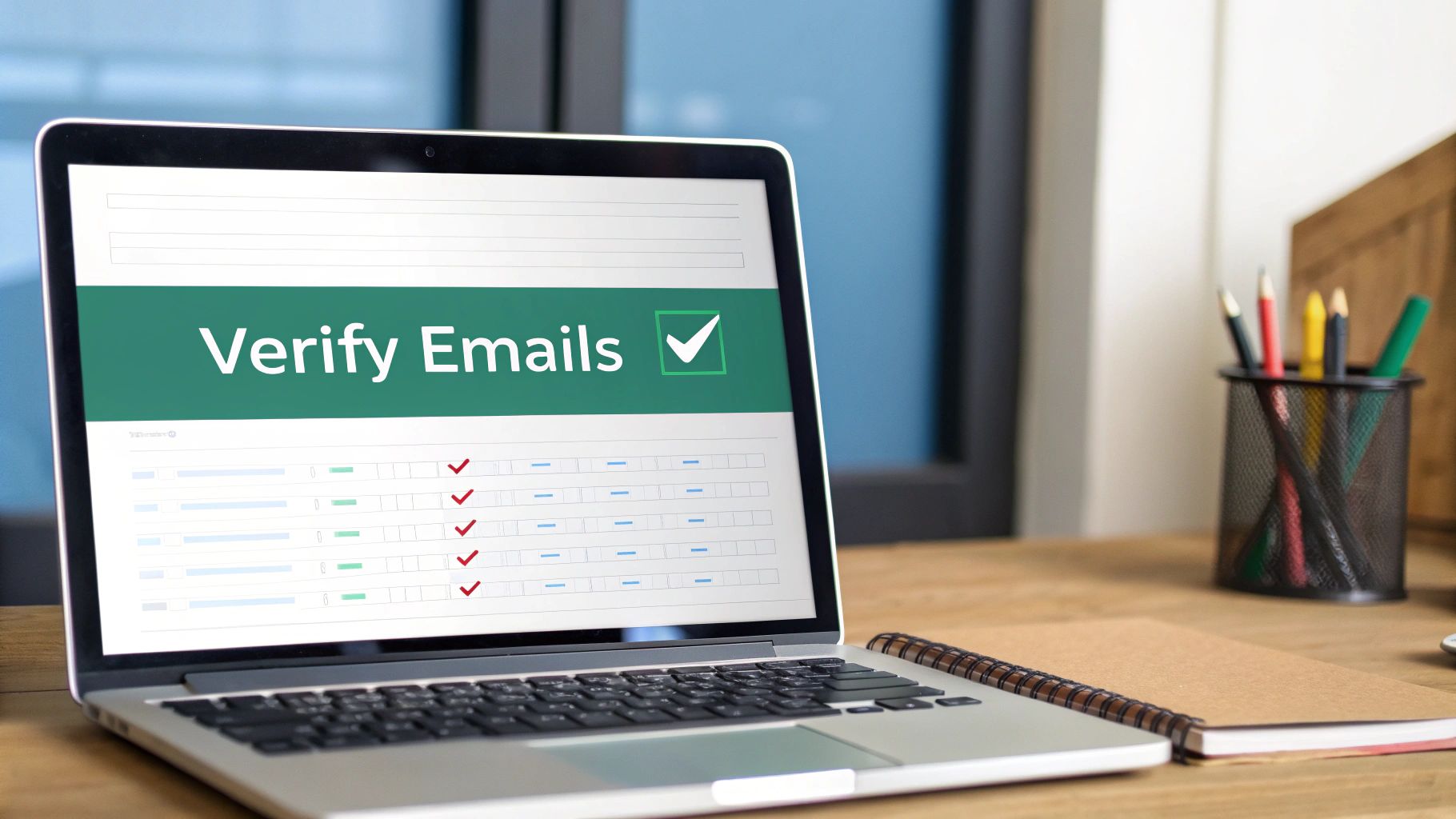
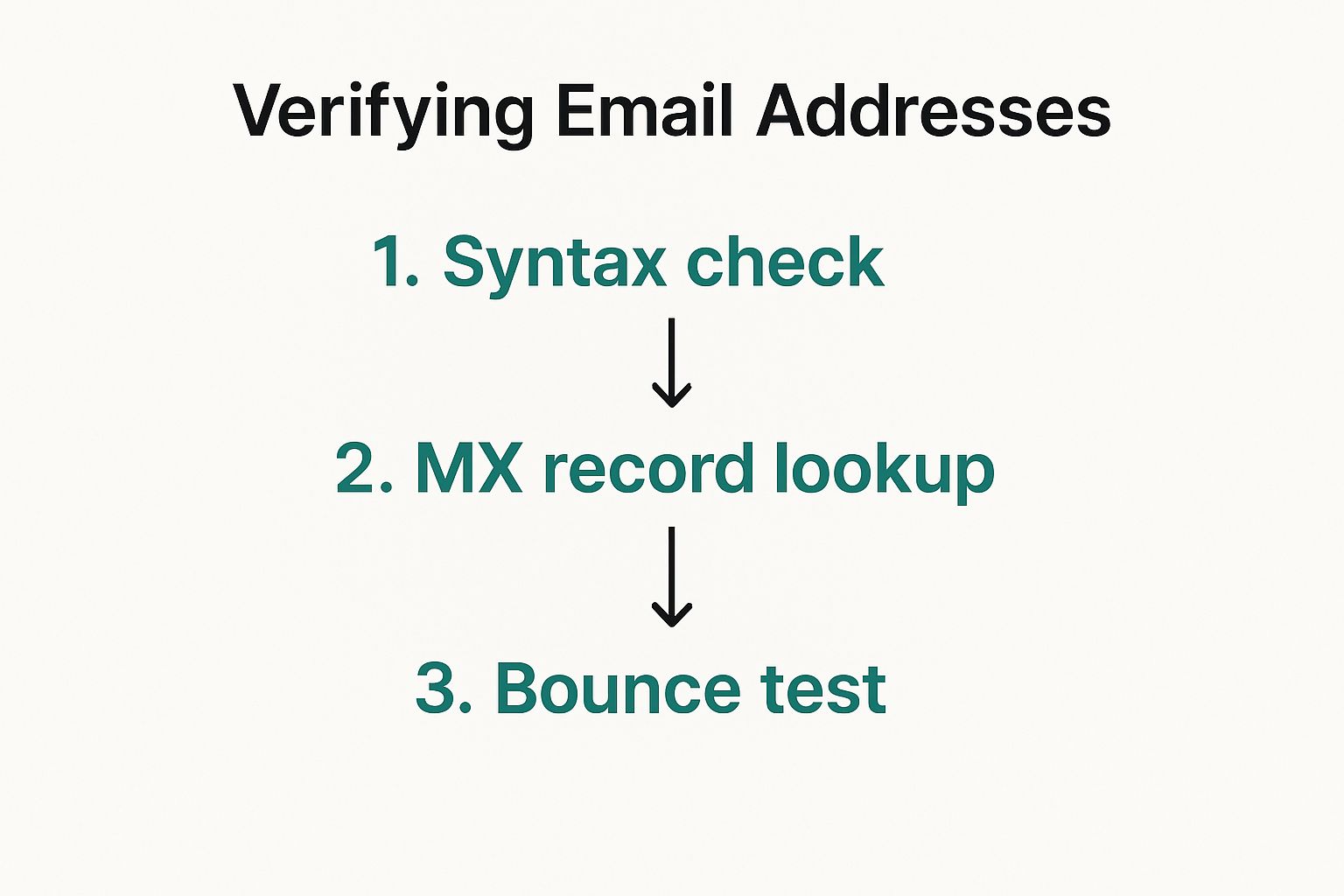
    This image breaks down the complex, multi-step process that a solid verification system uses to confirm an email's deliverability.

    Image

    As you can see, it's way more than a simple syntax check. It involves actually pinging servers and running deliverability tests to make sure the inbox is real and active.

    You'll typically see statuses like these:

    • Valid: The green light. This email address is active and safe to send to.
    • Risky or Accept-All: The server is set up to accept all incoming mail, so it’s impossible to be 100% sure the specific user exists. Proceed with caution.
    • Invalid: The big red stop sign. The email address doesn't exist. Never send to these—it will cause a hard bounce and damage your reputation.

    Understanding these statuses is everything. If you prioritize 'Valid' emails, you’ll see higher deliverability, protect your domain, and make your outreach campaigns far more effective.

    Email Finding Methods At a Glance

    To put it all into perspective, here's a quick comparison of the different ways you can find emails, from manual guesswork to sophisticated tools.

    Method Speed Cost Accuracy Best For
    Manual Guessing Slow Free Low Finding 1-2 emails when you know the company pattern.
    Advanced Search Moderate Free Moderate Uncovering a few hard-to-find public emails.
    Social Media Slow Free Variable Finding emails for freelancers or solopreneurs.
    Email Finder Tool Fast Paid High Scaling outreach and finding verified emails in bulk.

    While free methods have their place, the table makes it pretty clear: when you need speed and accuracy at scale, nothing beats a dedicated tool.

    When Is It Time to Pay for a Tool?

    The decision to invest in a paid email finder usually comes down to simple math. While there are some great free plans to get you started, a subscription becomes a no-brainer when outreach is a core function of your role.

    Think about it this way: how much is your time worth? If a tool costs $50 per month but saves you 10 hours of manual searching, you've essentially bought back that time for just $5 an hour. For most professionals, the ROI is massive and immediate. If you're just starting out, you can explore some of the best free email finder tool options to test the waters.

    The true value of these tools isn't just about finding an email address. It’s about the accuracy, the built-in verification, and the power to scale your efforts without burning out. When your success hinges on connecting with the right people, a specialized tool is one of the smartest investments you can make.

    Verifying Emails Before You Hit Send

    Finding an email address feels like a win, but don't hit "send" just yet. Firing off a message to a bad address is more than just a waste of your time—it actively hurts your sender reputation.

    A high bounce rate is a massive red flag for email providers like Google and Microsoft. It makes you look like a spammer, which can get your future messages sent straight to the junk folder or, worse, get your entire domain blacklisted. Think of verification as essential insurance for your outreach efforts.

    Why a Clean Email List Is Non-Negotiable

    A clean, verified list is the bedrock of any successful outreach campaign. It's not just about dodging bounces; it’s about making sure your messages land in front of real, active people. This has a direct line to your open rates, reply rates, and overall ROI.

    The numbers don't lie. By 2025, an estimated 4.83 billion people were active email users, sending a mind-boggling 392 billion emails every single day. With that much traffic, email providers are getting incredibly strict. You can see more on the growth of global email usage on CloudHQ's blog. A verified list is your proof that you're a legitimate sender, not just adding to the noise.

    Practical Ways to Confirm an Email

    You have a few options for confirming an email is deliverable, from quick, free tools to the powerful features built into professional platforms. What you choose usually comes down to scale.

    If you're just checking one or two high-value contacts, a free online email verifier is a great place to start. These tools run a quick check to see if the address looks valid and if the domain is set up to receive mail. They're not foolproof, but they’ll catch obvious typos and bad formats in a heartbeat.

    Verification is about more than just deliverability. It’s a mark of professionalism that shows you've done your due diligence before reaching out, which builds a foundation of trust from the very first interaction.

    When you're dealing with a whole list of prospects, checking them one by one is a nightmare. This is where a professional platform makes all the difference. An integrated tool like EmailScout doesn't just find emails; it automatically validates them as part of the process. For a closer look at what goes on behind the scenes, check out our guide on how to validate an email address.

    Beyond Deliverability: The Ethics of Outreach

    Knowing an email works is the technical part. The human part—how to reach out ethically and effectively—is just as important. Just because you can contact someone doesn't always mean you should, and how you do it matters.

    Your first message should never, ever feel like a generic blast. Personalization is everything. Mention a recent article they published, a company win you saw on LinkedIn, or a mutual connection. It shows you've actually done your homework.

    Here are a few best practices to keep in mind:

    • Be Transparent: Say who you are and why you're emailing. A sketchy subject line or a vague purpose is a one-way ticket to the trash folder.
    • Respect Privacy Laws: Always be mindful of rules like GDPR and CAN-SPAM. Make sure your outreach is genuinely relevant to their professional role.
    • Provide a Clear Opt-Out: Every single email needs a simple, one-click way for someone to unsubscribe. Don't hide the link—it's a terrible practice that will wreck your reputation.

    Following these principles isn't just about staying compliant; it's about building trust. When people feel respected, they're far more likely to actually listen to what you have to say. Combine a verified email with a thoughtful approach, and you'll make sure your outreach is both delivered and well-received.

    Common Questions About Finding Emails

    Even with the best tools, you're bound to run into a few questions when you're digging for email addresses. It’s a process with plenty of nuances, from the legal stuff to what to do when you just can't find anything.

    I've put together answers to the most common questions we hear. Think of this as your go-to guide for those "what if" moments, giving you straightforward advice to keep your outreach moving forward—the right way.

    Is It Legal to Find and Use Emails for Outreach?

    This is the big one, and the short answer is yes, but you have to play by the rules. Using a publicly available business email for professional outreach is generally fine under regulations like CAN-SPAM in the US and GDPR in the EU.

    These laws aren't a free pass, though. To stay compliant, your outreach needs to meet a few key criteria:

    • Legitimate Interest: Your message has to be relevant to their job. Pitching a new marketing tool to a marketing director? Perfect. Trying to sell them a personal loan? Not okay.
    • Transparency: Be upfront about who you are and why you're reaching out. Don't even think about using misleading subject lines or hiding your identity—that’s a huge red flag.
    • Easy Opt-Out: Every single message must have a clear and simple way for them to unsubscribe. No hoops to jump through.

    Following these rules isn't just about dodging fines; it’s about building trust and protecting your sender reputation.

    What Is the Most Accurate Way to Find an Email?

    Honestly, there’s no single "best" way. The right method really depends on the situation. For my money, the most reliable approach is combining a few smart techniques and then verifying the result. A quality paid tool like EmailScout usually gives you the best mix of speed and accuracy, since it checks multiple public and private data sources.

    But if you're after a single, high-value contact, you can get just as accurate with a manual approach. Figure out the company's likely email pattern and use a search operator to see if you're right. For instance, if you guess jane.doe@company.com, you can pop site:company.com "jane.doe@company.com" into Google to see if that exact address shows up anywhere on their site.

    No matter how you find an address, here’s the golden rule: always run it through an email verification tool before you hit send. This one last check ensures it's deliverable and saves your sender score from getting crushed by bounces.

    How Can I Find Email Addresses for an Entire List?

    When you’ve got a long list of people, manual methods just won't cut it. You'd be clicking around for days. This is where bulk search software becomes your best friend.

    The process is usually pretty simple:

    1. Get Your List Ready: You’ll need a CSV file with columns for first name, last name, and company name (or their website domain).
    2. Upload It: Drop your file into the email finder's bulk search or "enrichment" feature.
    3. Let It Run: The tool takes over from there, scanning its databases to find and verify the email addresses for everyone on your list.

    This is, without a doubt, the most efficient way to scale up your sales or marketing outreach. It turns a task that could take weeks of grinding into a job that’s done in minutes.

    What If I Still Cannot Find an Email?

    It happens. Sometimes an email is deliberately kept under wraps, or maybe the person is new to the company and hasn't shown up in any directories yet. When you’ve tried everything and come up empty, it’s time to stop chasing a ghost and pivot.

    Your best move is often to change your point of contact. Send a short, polite message to a general inbox like contact@company.com or info@company.com and ask if they can point you to the right person.

    Another great option is to connect with them on a professional network like LinkedIn. A personalized connection request explaining why you want to connect is far more effective than endlessly searching for an email that might not even be public.


    Ready to stop guessing and start connecting? EmailScout gives you the power to find verified email addresses in seconds, right from your browser. Start finding unlimited emails for free today with EmailScout and turn your prospects into connections.