Tag: EmailScout

  • Sales Leads Database: The Complete Guide

    Sales Leads Database: The Complete Guide

    Your reps are probably doing more work than your database deserves. They find a company, guess the right contact, paste details into the CRM, launch outreach, then discover the person left six months ago or the email never had a chance of landing. That isn't a prospecting problem. It's a database design problem.

    A sales leads database should help your team decide who to contact, when to contact them, and how to route that information into execution. If it only stores names and emails, it behaves like a spreadsheet with better branding. If it's built well, it becomes an intelligence engine that supports targeting, qualification, follow-up, and measurement.

    What a Modern Sales Leads Database Actually Is

    A rep pulls up an account five minutes before a call. The company fits your ICP, but the contact left last quarter, the phone number is wrong, and nobody can tell whether the account has shown any recent buying signal. The problem is not a lack of leads. The problem is that the database is acting like storage instead of a decision system.

    A modern sales leads database is an operating layer for revenue teams. It brings together fit, contact accuracy, buying context, and activity history so reps can decide who to contact, why now, and what should happen next in the CRM and outreach stack. If the record cannot support that workflow, it is incomplete no matter how many fields it contains.

    A diagram illustrating the four key components of a modern sales leads database including intelligence and growth.

    The database is the engine, not the fuel tank

    A contact repository stores names. An intelligence engine connects records, updates them, and makes them usable in live selling motion.

    That distinction changes how teams build and judge the database. As Factors.ai explains in its guide to B2B sales leads databases, effective systems combine firmographic, technographic, and behavioral data. Those layers let sales teams prioritize accounts based on fit and timing instead of sorting a giant list by job title and hoping for the best.

    In practice, each layer answers a different question:

    • Firmographic data tells you whether the company belongs in your market. Industry, size, geography, and revenue range help with ICP matching and territory decisions.
    • Technographic data shows what the account already uses. That matters if your product replaces a tool, integrates with one, or sells better into a specific stack.
    • Behavioral data adds timing and urgency. Site visits, content engagement, demo requests, and intent signals help reps focus on accounts with a reason to respond now.

    The trade-off is straightforward. More data fields create more maintenance work. But the right fields reduce wasted calls, bad routing, and low-conviction outreach. I would rather manage a smaller database with reliable context than a massive one full of records no rep trusts.

    Practical rule: If your database cannot distinguish company fit from buying timing, it will create activity without creating much pipeline.

    What teams should measure instead of raw volume

    A vendor may advertise record count. Sales ops should care about whether those records convert into meetings, opportunities, and revenue.

    A useful database supports metrics such as:

    Metric Why it matters
    Lead quality score Shows whether records match your ICP and routing rules
    Conversion by source Shows which channels produce real opportunities, not just cheap names
    Response performance Shows whether targeting and messaging match the market
    Freshness Reduces wasted outreach to outdated contacts and stale accounts

    The database becomes a revenue asset instead of a procurement exercise at this point. Teams stop asking, "How many contacts did we buy?" and start asking, "Which data sources improve conversion, and which ones create cleanup work?"

    That shift also improves tool decisions. A database should support lead scoring, routing, enrichment, outreach, and reporting without constant manual repair. If records enter the system incomplete, age quickly, or fail to map cleanly into downstream tools, the team pays for that failure in rep time, missed follow-up, and reporting noise.

    The right standard is simple. Judge the database by how well it supports qualification, prioritization, execution, and measurement across the full lead lifecycle.

    Designing Your Database Blueprint

    Most database problems start before the first record is added. Teams import leads into a vague structure, then spend months fixing inconsistent fields, duplicate picklists, and half-empty contact records. Build the schema first.

    A strong blueprint separates account data, contact data, and activity or signal data. That sounds operational because it is. If you mix everything into one flat table, segmentation gets messy and routing gets worse.

    A person presenting a virtual data dashboard interface representing a digital sales leads database concept.

    Start with the fields that change how reps work

    At minimum, your database should capture:

    • Account identity
      Company name, website, primary domain, headquarters location, industry, and company size. These fields drive territory assignment, segmentation, and ICP matching.

    • Contact identity Full name, role, department, seniority, LinkedIn URL, verified email, and where relevant, direct dial or mobile number. These fields determine whether a rep can reach the right person.

    • Commercial context
      Lead source, owner, status, account tier, target segment, and notes on pain points or use case. These fields keep records actionable after enrichment.

    • Technology and buying context
      CRM used, marketing automation platform, core software stack, known tool categories, and any relevant buying signals. These fields shape messaging and prioritization.

    The point isn't to collect every possible field. The point is to collect the fields your team will use in targeting, routing, and personalization.

    Standardization is what makes the data usable

    Free-text fields look flexible, but they create reporting chaos. If one rep enters "SaaS," another enters "Software," and a third writes "B2B SaaS," your segmentation is already broken.

    Use controlled values wherever possible. Standardize industry labels, company size bands, seniority levels, lead source names, and lifecycle stages. Then document those definitions so sales, ops, and marketing use the same language.

    A simple blueprint often looks like this:

    Data layer Example fields Main use
    Account Industry, website, employee count, location ICP fit and territory planning
    Contact Name, title, department, verified email Outreach readiness
    Tech stack CRM, marketing tools, product environment Messaging relevance
    Signals Website visits, downloads, email engagement Timing and prioritization

    A clean schema saves time twice. Once when the data enters the system, and again when the rep tries to use it.

    Freshness belongs in the blueprint too, not just in vendor evaluation. FullEnrich's guide to B2B sales lead databases stresses that databases should update frequently and verify emails, direct dials, and job titles. In live sales environments, that improves routing and personalization because high role churn quickly makes static records unreliable.

    Effective Methods for Sourcing High-Quality Leads

    Once the blueprint is clear, sourcing becomes less chaotic. You're no longer collecting random contacts. You're filling a defined system with records that can move into qualification and outreach.

    Screenshot from https://emailscout.io/

    The sourcing methods that work usually fall into three buckets: manual research, structured prospecting tools, and niche datasets. Each has a place. What fails is relying on only one method.

    How to choose the right sourcing method

    Manual research works when account quality matters more than speed. A rep can review a company site, LinkedIn presence, hiring activity, and leadership pages, then decide whether the account deserves effort. This approach produces strong context, but it doesn't scale well.

    Dedicated prospecting tools help when your team needs broader coverage and repeatable workflows. According to Prospeo's 2026 roundup of sales lead databases, leading platforms are judged on scale plus freshness, with some covering 300M+ professional profiles, 143M+ verified emails, and refreshing records on a 7-day cycle. That combination matters because broad coverage without recency creates wasted outreach.

    Specialized datasets are useful when your motion targets a narrow market. For example, if you're building lists around fundraising, partnerships, or capital relationships, a niche resource like the Gritt.io investor database can be more useful than a broad contact platform because it starts with the market structure you care about.

    A practical workflow for filling the database

    The fastest sourcing workflows reduce tab-switching and avoid manual copy-paste. A basic process looks like this:

    1. Define the account filter first
      Start with industry, location, company size, and role targets. Don't search for people before you're clear on account criteria.

    2. Capture company records before contacts
      Build the account layer first so every contact has a clean parent record and owner.

    3. Pull contact details from discoverable business sources
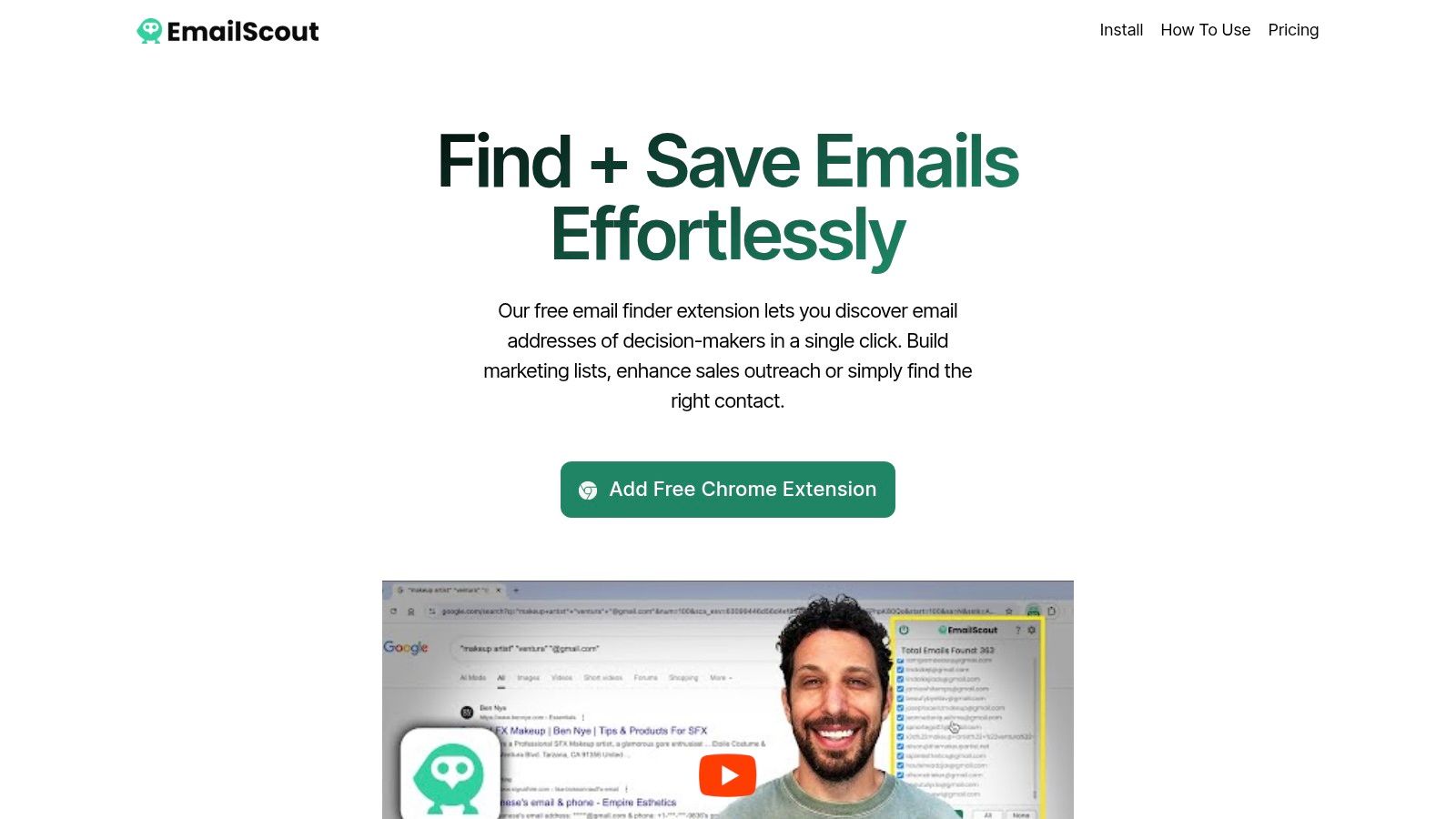
      Browser-based tools can help reveal and export business emails found on sites and public pages. One option is EmailScout, which is designed to find business email addresses while browsing and can support database population without manual re-entry.

    4. Verify fit before scale
      Review a sample of records before you export large batches. Bad field mapping spreads fast.

    For readers who want a tactical walkthrough, this guide on how to find sales leads covers the mechanics of turning prospecting into a repeatable list-building process.

    A short product demo helps if you're building this workflow for a team:

    What doesn't work

    A few sourcing habits create more cleanup than value:

    • Buying volume without field logic leads to bloated imports and weak segmentation.
    • Scraping without validation fills the system with records nobody trusts.
    • Mixing niche and broad data blindly creates duplication and ownership confusion.
    • Importing directly into CRM first turns the CRM into a dumping ground instead of a controlled destination.

    Good sourcing feels slower at the beginning and faster six weeks later, because reps spend less time fixing records and more time contacting the right people.

    Maintaining a Clean and Compliant Lead Database

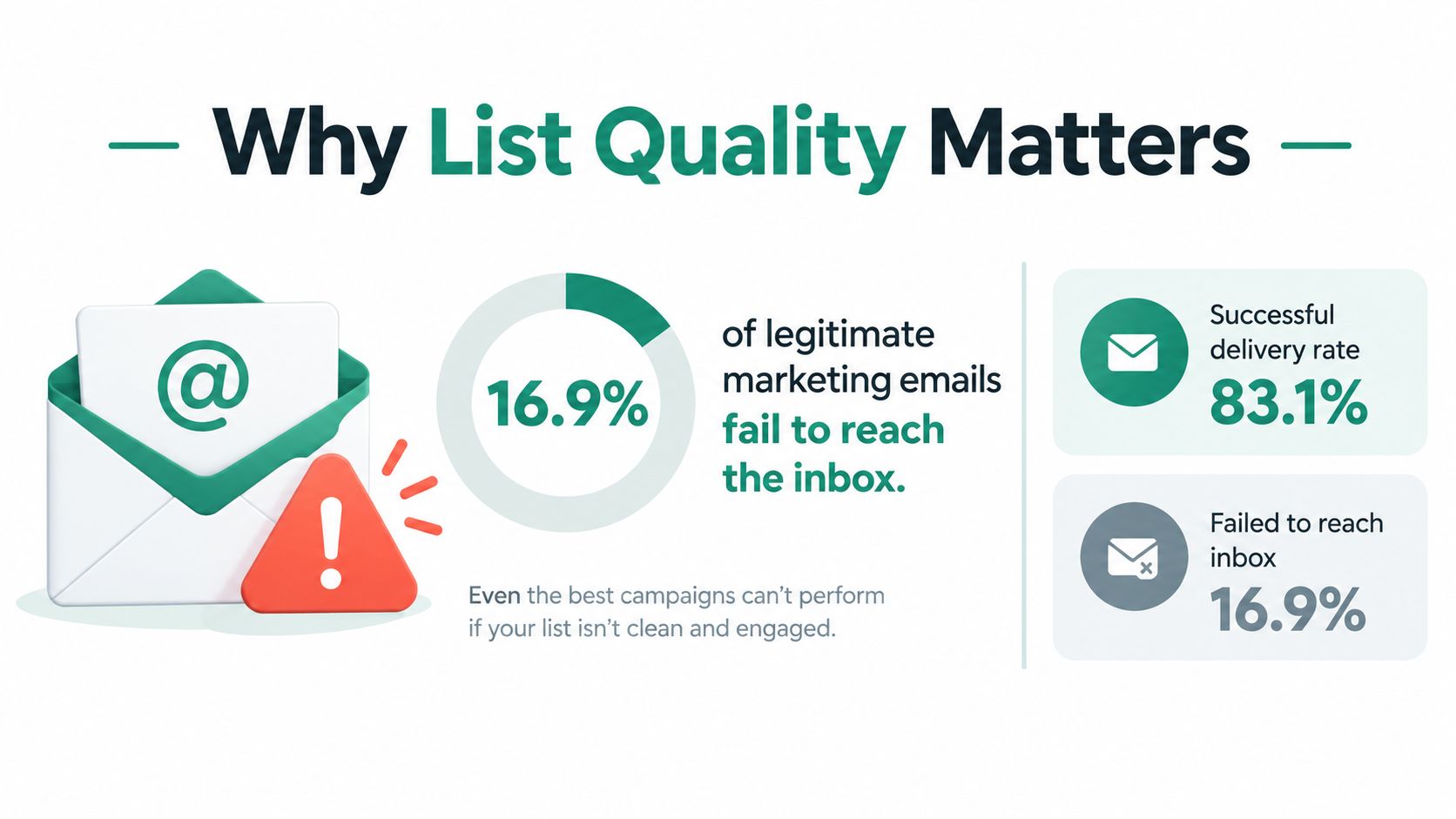
    Teams often overestimate the value of record count and underestimate the cost of bad records. A dirty database slows reps down, pollutes reporting, and weakens deliverability. Bigger isn't better if the team won't trust the data.

    The most overlooked metric is simple: how much of the database is usable. CoreSignal's discussion of lead generation databases points out that many guides focus on features while ignoring the harder question of usable contact rate. That's the ultimate test. A record only matters if it fits your CRM structure, reaches the right person, and survives deliverability checks.

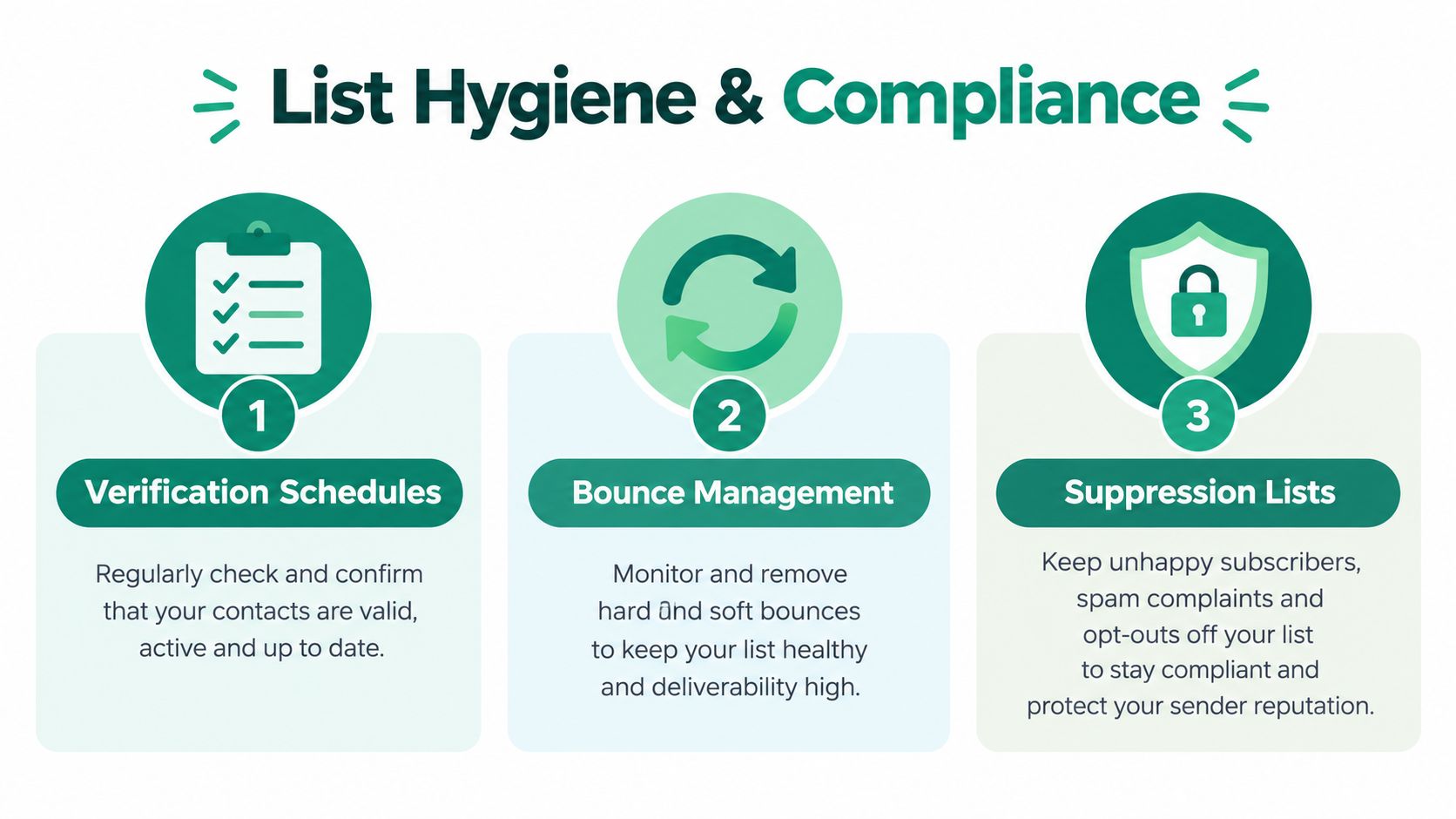
    The three maintenance jobs that can't be skipped

    Database hygiene isn't one task. It's three separate operational disciplines.

    • Deduplication keeps account and contact ownership clear. Duplicate records create split activity histories, conflicting owners, and outreach collisions.
    • Enrichment fills missing context. A contact with a name and email but no role, company segment, or account mapping can't be routed well.
    • Verification checks whether the contact point still works. This step matters most right before launch, not only at import.

    If your team doesn't have a verification step in the process, add one before every outbound push. A tool for email address verification fits here because it helps filter out records that would otherwise damage sender reputation or waste sequence volume.

    Compliance is part of data quality

    Compliance shouldn't sit in a separate legal checklist that ops ignores until a problem appears. It belongs inside sourcing and maintenance.

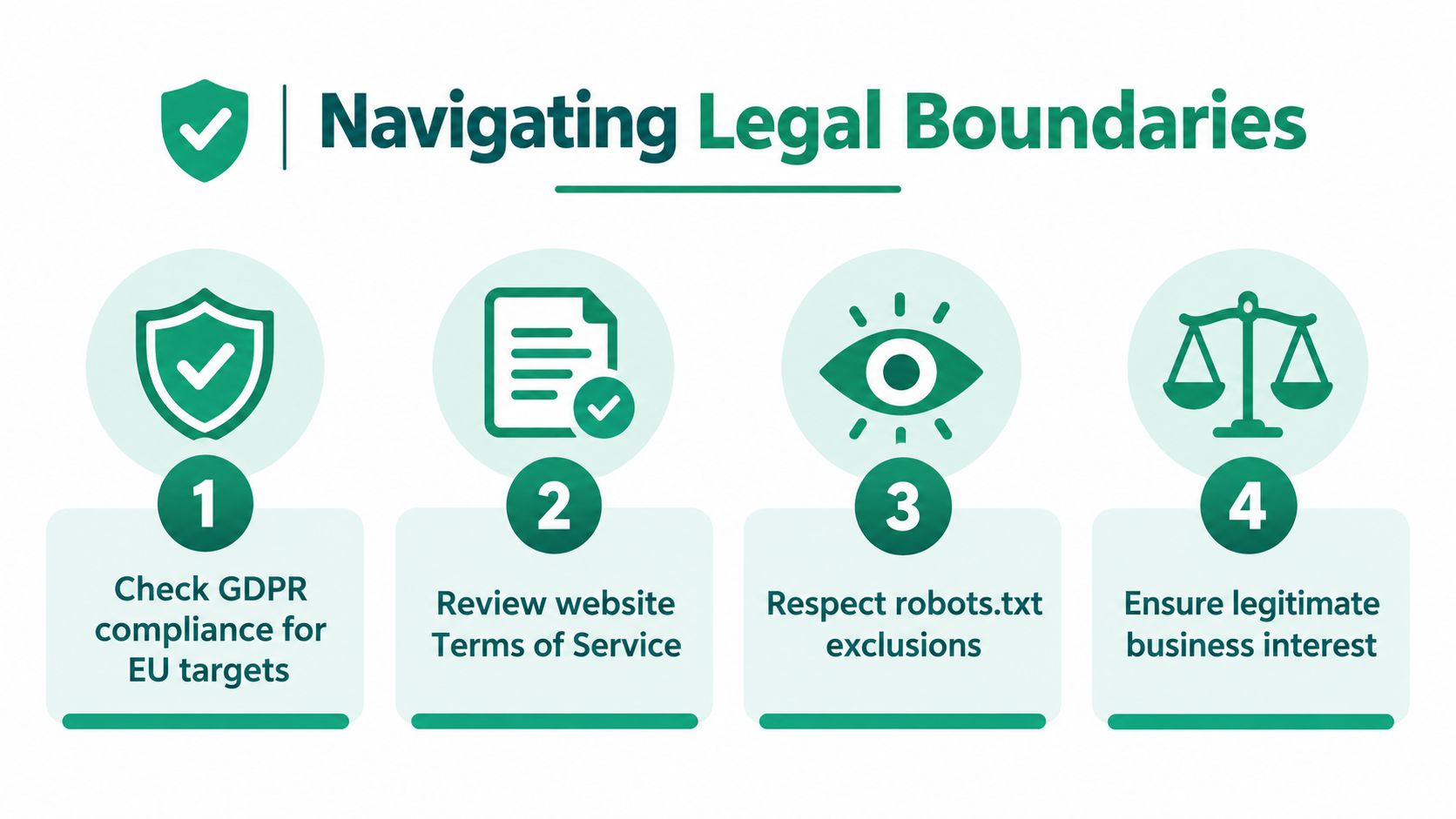
    Use data that has a clear business purpose. Store source context when possible. Respect suppression rules. Remove records when they no longer belong in your active prospect pool. If a vendor can't explain how data is sourced, that uncertainty becomes your problem later.

    Here's a practical weekly review list:

    • Check duplicate accounts before assigning new territories.
    • Review bounced or failed contacts and remove them from active sequences.
    • Audit stale titles and role changes on high-value accounts.
    • Confirm source labeling so reporting stays credible.
    • Apply suppression and consent rules consistently across tools.

    A clean sales leads database protects more than outreach. It protects forecasting, attribution, and trust between ops and reps.

    Integrating Your Database with Sales Outreach Tools

    A rep opens the sequencer at 8:30 a.m., pulls a fresh list, and finds missing company names, outdated titles, and contacts assigned to the wrong account owner. That problem rarely starts in the outreach tool. It starts with weak integration between the database, CRM, and sequencing layer.

    A sales leads database should operate like an intelligence engine, not a static list export. Once a record is ready for outreach, the system should carry source context, segmentation, ownership, and status into the tools reps use every day. If that handoff breaks, reps fill the gaps by hand, sequence quality drops, and reporting loses credibility.

    The core stack usually includes a CRM, a sales engagement platform, and an enrichment or verification layer. The goal is operational speed with control. Qualified leads should move into execution without retyping fields, rebuilding lists, or guessing who owns the account.

    A digital graphic displaying the Sequin platform connecting various sales tools like CRM, email, and calendars on mobile.

    The workflow that keeps records usable

    A practical integration flow looks like this:

    Step What happens Why it matters
    Capture Lead enters the database with source and ownership fields Prevents orphaned records
    Validate Email, title, and account mapping are checked Protects deliverability and routing
    Sync Qualified records move into CRM and outreach tools Reduces manual handling
    Sequence Contacts enter the right messaging track by segment Improves relevance
    Feedback Replies, bounces, and stage changes flow back Keeps the database current

    The feedback step is where many teams fall short. They push leads out, but they do not pull outcomes back in a usable way. If bounce data stays inside the sequencer, if replies never update lead status, or if meetings booked do not map back to source and segment, the database stops learning. At that point, it is just feeding campaigns instead of improving them.

    Segmentation starts paying off here. If the database stores industry, company size, role, buying context, and account relationship correctly, outreach can branch based on real conditions instead of broad personas. A prospect from a mid-market healthcare account with a known technology stack should not receive the same sequence as a founder at a 20-person software company.

    Personalization depends more on field design than writing talent.

    Reps write better emails when the system already provides the inputs: role, segment, territory, source, and relevant account notes. Without that structure, every "personalized" message requires manual research. That trade-off does not scale, and it usually pushes reps toward lower-volume, inconsistent outreach.

    If you're comparing systems for execution, this roundup of email outreach tools is useful because the handoff between database and sequencing platform is where many workflows break.

    The primary job of integration is to shorten the time between finding a qualified lead and starting the right follow-up, while feeding performance signals back into the database so the next campaign starts smarter.

    Success Stories From a Well-Managed Database

    The clearest sign that a sales leads database is working is that teams use it for decisions, not just exports.

    One common win comes from technographic targeting. A SaaS team that tracks software stack data can build a list of accounts already using a complementary tool, a legacy product, or a system their buyers often replace. That changes the message from generic outreach to a sharper point of view about migration, integration, or operational friction. The database does the filtering, so reps spend time on the angle instead of the hunt.

    Another strong use case is white-space analysis. Many teams still use lead databases only for contact discovery, but the more strategic use is territory planning. MapBusinessOnline's article on underserved markets highlights the value of using location analysis to identify underserved markets. In practice, that means combining geography, industry segmentation, and buying signals to find micro-markets where your coverage is thin and competitor presence appears weaker.

    A well-managed database also improves handoffs across the revenue team. Marketing can see which segments convert into qualified pipeline. Sales can see which sources produce reply-worthy accounts. Ops can spot where routing breaks or enrichment is incomplete. None of that requires a flashy dashboard first. It requires a database people trust enough to run the business from it.

    The shift is simple. Stop treating the sales leads database as a static list. Use it as a living operating layer for targeting, outreach, and expansion decisions.


    If you're building or rebuilding your prospecting workflow, EmailScout fits the practical side of the job. It helps teams discover business email addresses while browsing, which makes it useful for populating a sales leads database without turning list-building into manual copy-paste work.

  • AI Email Finder: A Guide to Finding Verified Contacts

    AI Email Finder: A Guide to Finding Verified Contacts

    You probably know the drill. A rep finds the right company, the right title, and even the right timing signal. Then the next hour disappears into guessing email formats, checking company pages, scanning LinkedIn, and sending one test message that comes back with a bounce.

    That's the hidden cost of prospecting. It's not just the bad address. It's the research time, the list cleanup, the follow-up you never send because the first step already took too long.

    An ai email finder solves that problem when it's used the right way. Not as a magic lookup box, and not as a replacement for targeting, but as part of a workflow that turns partial contact data into something your team can effectively use. The difference matters. In practice, the useful output isn't “an email was found.” The useful output is “this contact is safe enough to send, in the right sequence, with the right level of risk.”

    From Manual Search to Automated Discovery

    Many teams don't notice how much prospecting time gets burned on contact discovery until they watch a rep do it live. One browser tab has the company site open. Another has LinkedIn. A third has a domain search tool. Then someone starts guessing whether the format is first name, first initial plus last name, or some exception the company set up years ago.

    A woman looks frustrated and stressed while viewing a delivery failure notification on her computer screen.

    That process still works once in a while. It just doesn't work reliably, and it definitely doesn't scale.

    Why manual prospecting breaks down

    A manual search creates three problems at once:

    • Research drag: Reps spend time hunting for contact details instead of writing messages or handling replies.
    • False confidence: A guessed address can look right and still bounce.
    • Dirty handoffs: Marketing ops and sales ops end up inheriting lists with no verification status attached.

    When teams want extra context around a contact, it can also help to identify people by email after you've found an address, especially when you're trying to confirm whether the contact matches the role and company you want.

    A better starting point is to stop treating contact discovery as a one-off task and start treating it as a repeatable workflow. That's where tools built for finding contact info fit into the stack.

    Practical rule: If a rep has to manually guess the format more than once for the same account segment, the process needs automation.

    What changes with an ai email finder

    The value of an ai email finder isn't just speed. It's consistency.

    Instead of relying on a rep's memory of common email patterns, the tool handles lookup, matching, and verification in one flow. That means your team can move from “I hope this is the right address” to “this contact is ready for the next step” with less friction. For outbound teams, that shift changes throughput. For marketing teams, it improves the quality of the list before it ever hits a nurture or sales-assisted sequence.

    The practical win is simple. Your reps stay focused on targeting and messaging, while the system handles the repetitive parts of contact discovery that humans are slow at and bad at doing repeatedly.

    How an AI Email Finder Actually Works

    A good ai email finder works like a digital investigator. It doesn't just spit out a guessed address. It builds a case, checks the evidence, and labels the result based on risk.

    A five-step infographic showing how an AI email finder tool locates and verifies professional contact information.

    It starts with strong inputs

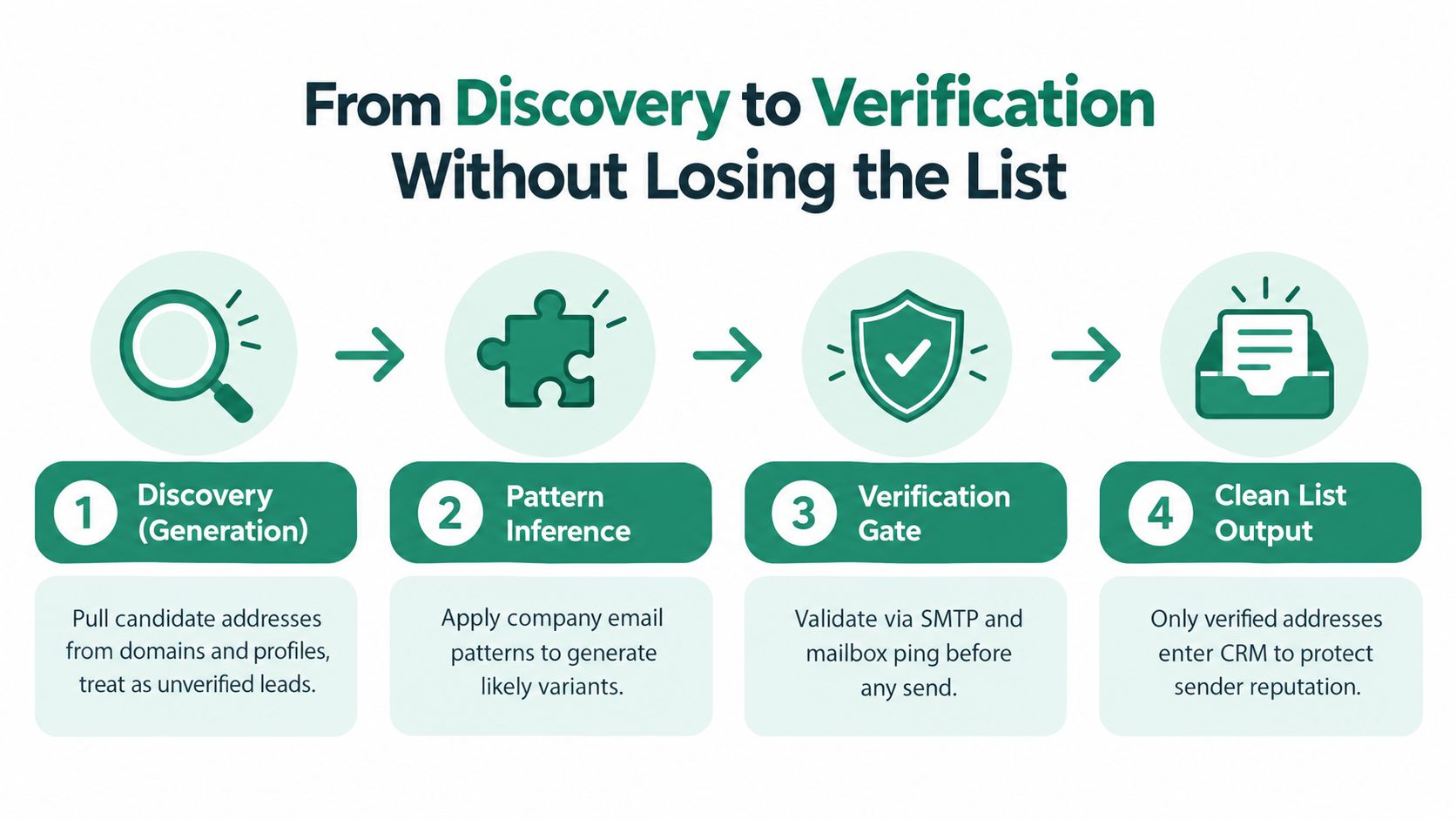
    The highest-quality workflow starts with a person's name and company domain, then moves through candidate generation, identity matching, and deliverability verification, with outputs labeled as valid, risky, or invalid according to Prospéo's explanation of AI email address finder workflows.

    That first part is easy to overlook. If your input data is weak, everything after it gets weaker too. “Sarah at Acme” is not the same as “Sarah Chen at acme.com.” The second input gives the system enough structure to generate realistic candidates and screen out obvious mismatches.

    Teams that compare different search methods often benefit from reviewing multiple email search engines because each one tends to handle the first input stage a little differently.

    Candidate generation is only the first pass

    Most bad prospecting data comes from confusing a plausible address with a usable one.

    A finder usually starts by generating likely email formats from the person's name and company domain. That may come from recognized naming conventions, prior domain-level patterns, or an internal database. At this point, the tool hasn't proven much. It has only created candidates.

    Then comes the step that separates a simple guesser from a useful system. The tool checks whether the person is associated with that company. It looks for signals tied to role, profile data, or public presence that support the match.

    Here's the important operational takeaway:

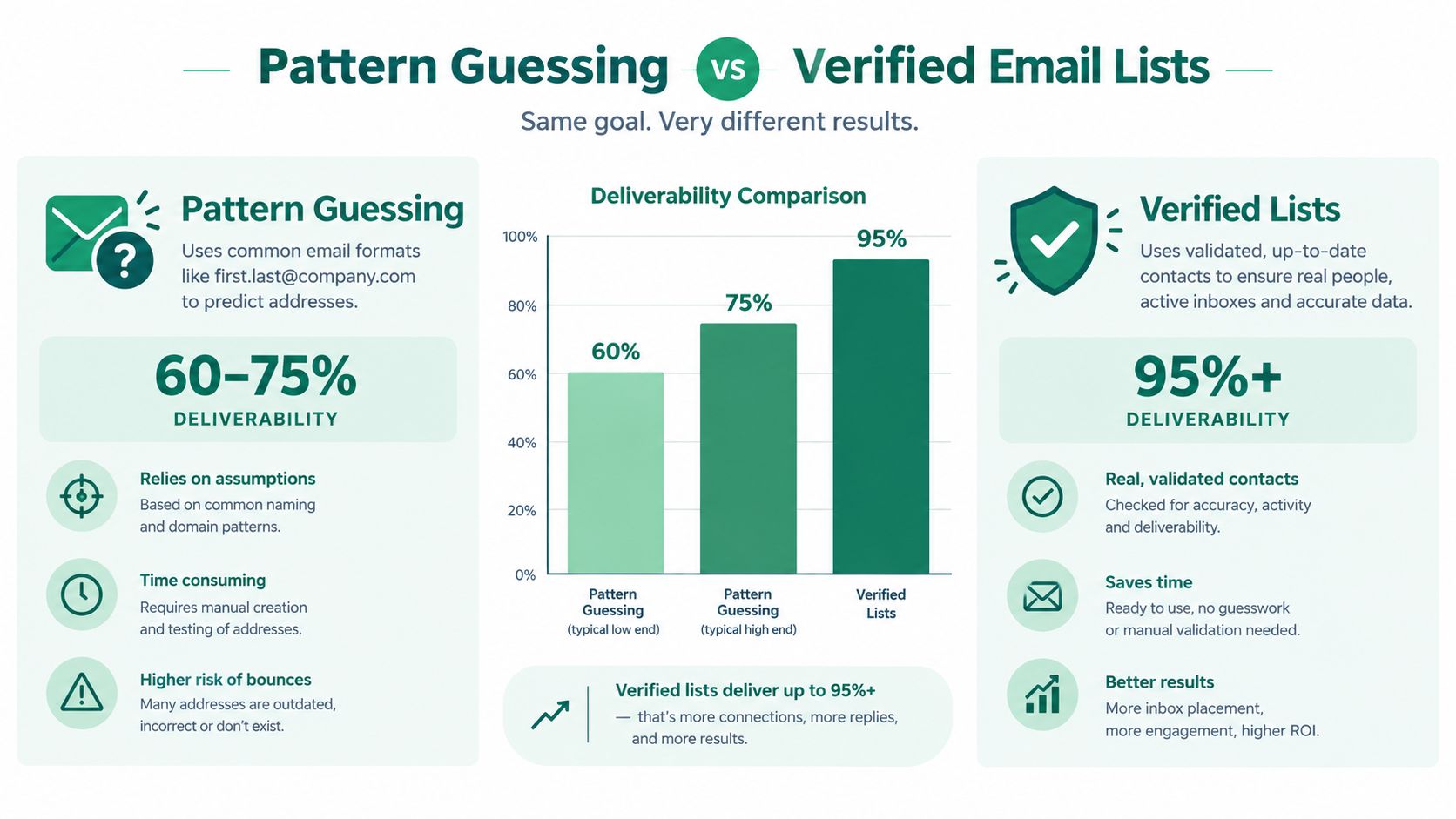
    • Pattern match alone: Fast, but risky.
    • Pattern plus identity match: Better.
    • Pattern, identity, and technical verification: Good enough to route into outbound with confidence rules.

    A found address without identity matching is often just a polished guess.

    Verification is where deliverability gets decided

    This is the stage many basic guides skip, even though it's the part that matters most to the sending team.

    Technical verification checks whether the domain is set up to receive email and whether the mailbox is likely to accept mail. That can include MX-record checks, SMTP validation, disposable-domain detection, and catch-all risk scoring, as described in the same Prospéo workflow reference above.

    The status label matters because it changes what your team should do next. A valid contact can go into your normal sequence. A risky or catch-all contact may need slower sending, a different mailbox, or manual review. An invalid contact shouldn't be touched.

    What actually works in practice

    The teams that get the most from an ai email finder usually follow a few habits:

    1. Start with clean lead inputs: Name and company domain whenever possible.
    2. Keep verification status with the record: Don't export just the email field and drop the risk label.
    3. Route by confidence: High-confidence contacts go into your primary campaign. Uncertain contacts go into a separate queue.
    4. Review misses by segment: If a tool struggles with early-stage startups, agencies, or nonstandard domains, adjust the workflow instead of assuming the data is universally strong.

    That's why “found email” is a weak success metric. The stronger metric is whether the contact was both matched correctly and safe enough to use.

    Practical Workflows for Sales and Marketing Teams

    The best ai email finder workflows don't feel flashy. They remove small pieces of friction that slow reps down all day.

    One of the most common examples is browser-based prospecting. A rep is already reviewing a person's profile, company site, or team page. Instead of copying names into multiple tools, they use an extension to surface contact details while they work.

    Screenshot from https://emailscout.io/

    Workflow one for live prospecting on profiles and websites

    This is the fastest day-to-day use case for SDRs and founders doing their own outreach.

    A rep opens a LinkedIn profile, company about page, or team directory. The extension identifies available contact information and saves what's useful while the rep keeps moving. That cuts out the worst part of prospecting, which is constant tab switching.

    What makes this workflow effective isn't just speed. It keeps momentum. A rep can qualify the account, check the title, collect the contact, and move directly into personalization.

    A lot of teams pair that with broader systems for automating lead generation once they know the manual workflow is producing the right kind of contacts.

    Workflow two for building a list from search intent

    Marketing teams often have a narrower targeting problem. They don't need every person at a company. They need a specific role in a specific market.

    A practical move is to start with search results, niche directories, company leadership pages, event speaker pages, or “about us” sections. From there, the finder helps turn partial information into reachable contacts. This works especially well when the targeting criteria are tighter than what a broad contact database can handle.

    For example, if you're looking for heads of partnerships at midsize SaaS companies in a region, you can build the account list first, then use the finder to resolve the right people and verify what's usable. That tends to produce cleaner outreach than starting from a giant database and filtering down later.

    Field note: Narrow targeting plus verified contact discovery usually beats broad targeting plus heavy list cleanup.

    Here's a walkthrough style example of how teams think about that process in practice:

    Workflow three for enriching existing lists

    Here, marketers and rev ops teams usually get the fastest operational win.

    You already have a list, but it's incomplete. Maybe it came from webinar registrations, conference scans, inbound demo requests with personal emails, partner referrals, or CRM records that only include name and company. The ai email finder fills in the business contact layer and adds verification context before the list gets handed to sales.

    A simple enrichment workflow usually looks like this:

    • Start with what you already know: Name, company, and any known website or domain.
    • Run the finder in batch or semi-batch mode: Resolve likely business emails.
    • Keep status labels attached: Don't strip out valid, risky, or invalid labels before import.
    • Segment before sending: Higher-confidence records can support faster follow-up. Lower-confidence records should get reviewed or isolated.

    This is one of those quiet workflow improvements that saves a lot of cleanup later. It also keeps sales reps from working recycled lists that look full on paper but collapse once outreach starts.

    Key Features to Evaluate in an AI Email Finder

    A rep pulls 200 accounts for the week, runs them through a finder, and comes back with a big list. On paper, that looks productive. In practice, the only number that matters is how many of those contacts are safe to send to and worth putting into a sequence.

    That is the filter good teams use when they evaluate an ai email finder. Output volume matters, but deliverable output matters more.

    A woman thinking while viewing a digital dashboard comparing automated software features and data management capabilities.

    Yield and verification are two different metrics

    Teams often lump these together and then wonder why a tool that looked strong in a demo creates problems in production.

    Yield measures how many usable business emails a finder can return from your lead list. Verification accuracy measures how reliable the tool is when it labels an address as valid, risky, invalid, or catch-all. Those answers support different decisions. One affects pipeline coverage. The other affects deliverability risk.

    An independent comparison published by Prospéo found wide variation across tools on both dimensions, with email yield and verification performance moving independently rather than in lockstep in its AI email finder benchmark.

    That distinction matters in daily operations. A high-yield tool can still waste rep time if too many returned emails are questionable. A strict verifier can protect sending reputation but leave the team short on reachable contacts. The right choice depends on your motion.

    What buyers should compare first

    Start with the unit that affects outbound performance. Safe, usable contacts per list.

    Some tools return more addresses. Some label risk more conservatively. Some are cheaper at scale but require tighter filtering before records reach reps. I have seen teams buy on raw match rate, then spend weeks fixing bounce issues and rebuilding routing rules in the CRM. That is usually more expensive than paying slightly more for cleaner contact data upfront.

    For sales teams working named accounts, a higher-yield tool can be worth the premium if each additional verified contact opens another path into the account. For marketing and ops teams enriching large databases, the better option may be the tool that keeps verification labels clear and cost predictable, even if total output is lower.

    That is also why process fit matters as much as feature count. Teams trying to streamline marketing with AI usually get better results from a finder that preserves confidence signals all the way into campaign execution.

    Features that matter in daily use

    Once performance is clear, evaluate the parts that affect adoption and list quality after the lookup.

    Evaluation area What to look for Why it matters
    Browser workflow Extension support on sites your reps already use Cuts manual copying and keeps prospecting fast
    Verification labels Clear statuses such as valid, risky, invalid, catch-all Lets ops and reps decide what can be mailed, reviewed, or suppressed
    Bulk handling CSV input, list enrichment, export flexibility Helps with event lists, database cleanup, and large campaign builds
    Integration path CRM and sequencer compatibility Keeps verification context attached after enrichment
    Speed in context Fast enough for single lookups and list work Prevents delays for reps and bottlenecks for ops

    A polished dashboard is nice. Clear status handling is more useful.

    If the finder cannot show confidence cleanly, your team ends up making send decisions blind. That usually leads to two bad outcomes. Reps mail risky records because they need volume, or ops suppresses too much because the tool gives them no middle ground.

    Questions worth asking before you choose

    A short buying checklist will tell you more than a feature tour:

    • What counts as success: A found address, or a found address with enough confidence to use in outreach?
    • How is risk exposed to users: Can reps and ops see which records are safe, uncertain, or unsuitable?
    • What happens to weak matches: Are they labeled clearly, separated, or mixed into the main export?
    • Does the tool fit the actual motion: One-off prospecting, batch enrichment, or both?
    • Can your team act on the output: Do statuses survive export into the CRM or sequencer?

    The best ai email finder for a team is usually the one that turns raw discovery into campaign-ready contacts with the fewest extra steps. That is a better buying standard than headline yield alone.

    Integrating AI Finders Into Your Outreach Stack

    Single lookups help individual reps. Bulk workflows help teams.

    Modern AI email finders increasingly support CSV bulk lookups, REST APIs, and webhook exports to CRM systems, which makes them most useful when they're embedded into repeatable prospecting workflows in tools like Salesforce or HubSpot, as described in Clay's overview of AI email finder workflows.

    What integration changes operationally

    Once the finder is connected to your stack, contact discovery stops being a manual pre-send task and becomes part of the system.

    A common setup looks like this:

    1. Lead enters the workflow through a form, outbound target list, event import, or account research process.
    2. The finder enriches the record using a name and company domain or another available identifier.
    3. Verification status stays attached to the contact record.
    4. The CRM or sequencer routes the contact based on confidence, owner, campaign type, or stage.

    That last step is often underestimated. If verification status disappears between enrichment and sequencing, your reps lose the context they need to send responsibly.

    Bulk enrichment is where scale starts paying off

    The most effective use case is usually a list you already have.

    Think conference attendee exports, partner lists, target account spreadsheets, webinar signups, or CRM records missing business emails. Instead of assigning manual cleanup to SDRs, ops can enrich thousands of rows in one pass and push the output back into the systems the team already uses.

    Useful integration patterns include:

    • CRM-first enrichment: New or incomplete records get enriched before reps touch them.
    • Sequencer gating: Only records with acceptable verification status enter the main outbound sequence.
    • List hygiene loops: Existing contacts get rechecked before large campaigns.
    • Webhook-driven handoffs: Enriched contacts move automatically into the next system without spreadsheet work.

    For marketing leaders trying to reduce tool sprawl and streamline marketing with AI, the big lesson is the same here. The tool matters less than the workflow design around it.

    The finder should disappear into the process. Reps shouldn't have to think about enrichment every time they need a contact.

    What not to automate blindly

    Automation helps, but it also makes bad data move faster.

    A few guardrails keep that from happening:

    • Map status fields clearly: Don't collapse all verification outcomes into one generic email field.
    • Separate enrichment from send logic: A contact found by the system isn't automatically ready for your highest-volume sequence.
    • Watch duplicate creation: Multiple enrichment passes can create messy CRM records if deduplication isn't set up.
    • Review segment-level performance: Some industries and company types need different handling.

    The strongest setup is usually quiet. Contacts enter the stack, get enriched, keep their status labels, and reach the right person or campaign without extra admin work.

    Choosing Your Plan Free vs Premium Tools

    A rep pulls up a target account, finds one likely contact, and needs an email address fast. A free plan usually handles that job. The decision changes once the team is enriching hundreds of records, pushing contacts into sequences, and dealing with the cost of bad data.

    That is the defining line between free and premium. It is not just volume. It is whether you are collecting names or building a workflow that produces deliverable contacts reps can use without extra cleanup.

    Free vs premium decision points

    Consideration Free Plan (e.g., EmailScout Free) Premium Plan (e.g., EmailScout Premium)
    Best fit Solo users, founders, freelancers, light prospecting SDR teams, marketers, rev ops, agencies
    Lookup style One-off searches while browsing Bulk workflows and recurring enrichment
    Workflow depth Manual or semi-manual Automated and integrated
    Team collaboration Limited Better for shared processes and repeatable systems
    Export and enrichment needs Basic list building Higher-volume list processing and operational use
    CRM and stack fit Good for testing Better once contact discovery becomes part of the pipeline

    When free is enough

    Free plans are a good fit when the team is still proving the motion. That usually means one-to-one prospecting, early outbound testing, or founder-led sales where speed matters more than process design.

    They also help expose adoption issues early. If reps do not trust the finder, skip verification steps, or fall back to manual research, a paid plan will only scale the same behavior.

    EmailScout is one example in this category. It offers a Chrome extension for finding email addresses while browsing webpages, and the free tier is enough for profile-by-profile research and low-volume testing.

    When premium becomes the right call

    Premium plans start to pay for themselves when the bottleneck shifts from finding an email to managing what happens after it is found.

    That usually shows up in a few predictable ways:

    • Lists need processing in batches: Event attendee lists, outbound target accounts, and stale CRM records are hard to work one contact at a time.
    • Reps are spending time on admin work: Manual exports, copy-paste steps, and repeated lookups slow down pipeline creation.
    • Verification status affects send logic: A contact with weak confidence should not enter the same sequence as a fully verified address.
    • Multiple teams touch the same data: Sales, marketing, and ops need the same status rules and handoff process.

    Often, teams make the wrong comparison. They compare free versus premium on credits alone. The better question is whether the premium plan reduces labor, lowers bounce risk, and produces more contacts that are safe to send to.

    A simple rule works well. Start free while the team is learning how to source and use contacts. Upgrade once email discovery is part of a repeatable revenue process, and the cost of missed handoffs or questionable data is higher than the subscription.

  • Email Finder Chrome Extension LinkedIn: 2026 Guide

    Email Finder Chrome Extension LinkedIn: 2026 Guide

    You're probably doing one of two things right now. You're either clicking through LinkedIn profiles one by one, opening company sites in new tabs, and guessing email formats. Or you've already tried an email finder chrome extension linkedin workflow, but the results felt messy, risky, or unreliable.

    That frustration is normal. Manual prospecting breaks down fast once your list gets beyond a handful of people. The fundamental problem isn't only speed. It's context switching, copy-paste mistakes, stale records, and the false confidence that finding an address means it's safe to email.

    The End of Manual Prospecting on LinkedIn

    Most reps start the same way. You find a promising Head of Marketing on LinkedIn, check the About section, see no contact details, then hunt through the company website. If that fails, you guess a few patterns, move to an email verifier, and repeat the whole process on the next profile.

    That workflow feels productive because you're busy. It isn't scalable.

    Modern LinkedIn email finders changed that. Vendor documentation shows these extensions have moved beyond simple scraping. GetProspect says its extension can search emails for 1st-, 2nd-, and 3rd+ LinkedIn connections, save leads in bulk from Sales Navigator lead lists or LinkedIn group members, and export fields like name, position, location, company name, industry, website, and LinkedIn URL from the browser workflow itself via the GetProspect Chrome extension listing.

    That shift matters because it changes what LinkedIn is in practice. It stops being just a place to browse profiles and becomes a structured B2B research layer.

    What the old method gets wrong

    Manual prospecting usually fails in three places:

    • It wastes prime selling time by forcing reps to research like analysts instead of moving qualified people into outreach.
    • It loses data quality when names, titles, and company details are copied by hand.
    • It hides the actual bottleneck because the issue usually isn't discovery. It's turning discovery into a clean, usable contact record.

    Practical rule: If a rep spends more time moving data than writing relevant outreach, the workflow is broken.

    There's another reason this matters. When your team does outbound seriously, your LinkedIn presence and company credibility start working together. If you're tightening your foundation before scaling outbound, this guide on creating a company profile on LinkedIn is worth reviewing. Prospects check your company page more often than many teams realize.

    A browser extension fixes the operational side of the problem. Instead of bouncing between tabs, you enrich the contact where you found the lead. That is the essential upgrade. Less searching, more qualification, fewer handoff errors.

    Installing Your Email Finder and First Setup

    The install itself is simple. The setup choices right after install matter more than people think.

    Start in Chrome Web Store and install your extension of choice. If you're evaluating tools, keep in mind that many email finders offer a low-friction way to test the workflow. For example, Skrapp is described as free to start with 50 verified business emails per month without a credit card, and its free plan includes 100 emails per month, according to the GetProspect comparison page.

    Screenshot from https://emailscout.io/

    Set it up so you'll actually use it

    After installation, do these four things before opening LinkedIn:

    1. Pin the extension so the icon stays visible in your browser toolbar. If it's hidden, you won't use it consistently.
    2. Log in immediately and confirm the extension is connected to the right workspace or account.
    3. Check save behavior inside the dashboard. If the tool supports automatic capture, decide whether you want manual saves or background collection while you browse.
    4. Review export destinations early. If you plan to send contacts into a CRM, list, or CSV, set that path now instead of after your first extraction session.

    Why the first settings matter

    Bad setup creates downstream cleanup. Reps often install an extension, test one profile, see an email appear, and assume they're done. Then they realize later that nothing was saved, the wrong fields were collected, or the data never reached the CRM.

    That's why I prefer treating setup like pipeline plumbing, not like app onboarding.

    If you want a concrete example of this workflow, EmailScout's email extractor Chrome extension shows the kind of browser-based setup sales teams use when they want extraction tied directly to list building rather than one-off lookups.

    The minimum viable configuration

    Use this as your baseline:

    Setting Recommended choice Why it matters
    Toolbar access Pinned Faster use during live prospecting
    Save mode Deliberate default Prevents messy duplicates early
    Export path Defined upfront Avoids spreadsheet cleanup later
    Team usage Shared naming rules Keeps prospect lists usable

    Don't optimize for the first profile. Optimize for the hundredth.

    Once the extension is visible, connected, and saving data the way you want, you're ready for the part that changes daily prospecting speed.

    Finding Emails in Real-Time on LinkedIn Profiles

    You open a target account on LinkedIn, find the right stakeholder, and need a working email before the research thread goes cold. Real-time profile lookup solves that problem fast, but only if the rep treats it as qualification plus verification, not as blind extraction.

    A person sitting at a desk using a laptop with an email finder extension on LinkedIn.

    On a live LinkedIn profile, the extension should help you answer three questions in one pass. Is this the right person? Is the company a fit? Is the email likely safe enough to use in outreach? If any of those answers is weak, saving the contact usually creates cleanup later.

    EmailScout is a good example because the workflow stays inside the page you are already reviewing. You check the profile, trigger the lookup, capture the result, and keep the role, company, and profile URL attached to the record. That context matters more than new reps expect. A contact without role context is hard to route, hard to personalize, and easy to misuse.

    A profile-by-profile workflow that holds up

    Use a short decision process:

    • Check current relevance. Confirm the title is current, the company belongs on your target list, and the profile still looks active.
    • Run the lookup from the profile page. Working from the live profile cuts mistakes that happen when reps copy names into separate tools later.
    • Keep the surrounding data. Save the role, company, LinkedIn URL, and any account notes with the email.
    • Verify before outreach. An unverified address should not go straight into a sequence, even if the pattern looks right.
    • Choose the next action immediately. Send it to the CRM, add it to a review queue, or discard it.

    That last step matters. Good prospecting speed comes from fast decisions, not from collecting every possible record.

    If you want to see that workflow in more detail, this guide to finding emails on LinkedIn shows how teams use a browser extension during live profile review.

    A quick walkthrough helps if you're visual:

    What AutoSave helps with, and where it creates risk

    AutoSave can speed up account research sessions. If you are reviewing ten to twenty stakeholders across one account set, removing repeated save clicks keeps your attention on fit and messaging.

    It also creates a trade-off. Bulk saving while browsing can pull in weak contacts, stale records, or people you never intended to email. That matters for compliance, for CRM hygiene, and for sender reputation. A rep who saves first and verifies later usually ends up doing twice the work.

    Use AutoSave only when the filters are already tight and the team has a review step before outreach.

    What works, what fails, and why verification stays required

    Direct profile enrichment usually works better for established B2B contacts at companies with a clear domain and a predictable email pattern. Hit rates drop with freelancers, tiny firms, stealth startups, and profiles tied to businesses with weak public data.

    That pattern is consistent with how these tools operate. They infer or match business emails from company domains, public web signals, and prior verification data. They are not pulling hidden email fields out of LinkedIn profiles. The Mallary.ai LinkedIn API guide is a useful reference if you want to understand the difference between platform data access, browser-side workflows, and the limits imposed by LinkedIn's rules.

    The practical lesson is simple. Do not stay on low-probability profiles too long. If the company has no clear domain, the person's role is fuzzy, or the result cannot be verified, move on. Outreach quality improves when the rep treats verification as required and resists the urge to turn profile review into bulk extraction.

    Advanced Strategies for Bulk Prospecting

    A rep runs a broad Sales Navigator search, exports everything they can reach, and ends the day with a bloated list full of weak fits, unverified emails, and contacts that never should have entered the CRM. Bulk prospecting breaks down that way.

    The fix is not more volume. The fix is tighter selection, smaller batches, and a verification step before anything touches outreach.

    A five-step infographic showing how to use an email finder chrome extension for lead generation.

    Start with search quality, not extraction speed

    Bulk workflows only hold up when the source list is narrow enough to support a real campaign. If the search is messy, the output gets messy faster.

    I want reps to filter for buying relevance before they ever click an extraction button. That means checking role seniority, function, company size, geography, and whether the account matches the market you sell to. A list of 80 strong prospects beats 800 random contacts every time because the message can stay specific and the review step stays manageable.

    Use filters that answer practical questions:

    • Role fit. Can this person influence budget, evaluate vendors, or own the problem?
    • Company fit. Does the account match your deal size, sales motion, and customer profile?
    • Timing clues. Does the team look active and real, or are you looking at stale titles and edge cases?

    If you need a browser-led process for scraping email addresses from LinkedIn search results, start with that filter discipline first. The tool matters less than the list quality.

    A bulk process that stays usable

    The safest pattern is simple. Build a narrow search, review the first page by hand, run enrichment in batches, verify the results, then send only approved records into your CRM or sequencing tool.

    That manual review step at the front saves hours later. It catches bad titles, duplicate companies, irrelevant regions, and search logic mistakes before those issues spread across a larger batch.

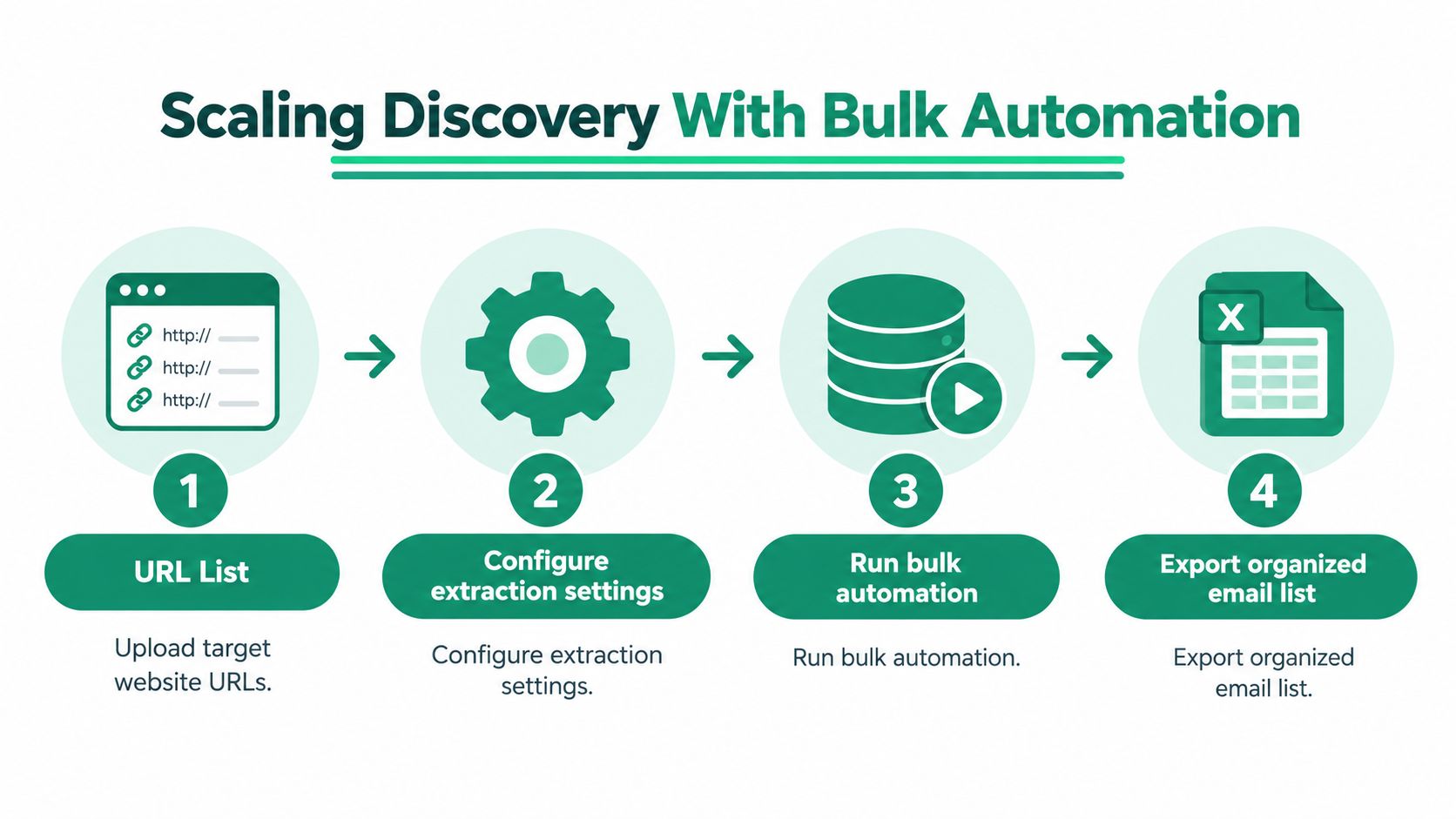
    EmailScout fits well here because it supports both profile-level lookups and bulk extraction from multiple LinkedIn URLs inside the browser. That gives reps one workflow for targeted research and another for list building, without forcing an immediate jump to a heavier data stack. The trade-off is clear. Browser extensions are good for controlled, human-reviewed collection. They are a poor excuse for mass grabbing every contact on a page and sorting it out later.

    Work in batches because LinkedIn already does

    LinkedIn's interface naturally slows bulk collection. Search pages and Sales Navigator views are built for repeated review, not unlimited one-click harvesting. Good teams use that constraint to their advantage.

    Run smaller batches. Check match quality after each batch. Remove poor-fit segments early. Verify before export, not after the sequence is already live.

    That approach also reduces compliance risk. If a batch produces contacts outside your target market, personal emails, or records with weak business context, you can stop before that data spreads into other systems. Bulk extraction without a review standard creates problems for privacy, CRM hygiene, and sender reputation at the same time.

    Bulk prospecting works when each batch is treated like a list to approve, not a pile of records to dump into outreach.

    Browser extensions versus API workflows

    Some teams ask whether they should skip extensions and move straight to an API-based setup. Usually, not yet.

    For outbound teams doing live research inside LinkedIn, browser extensions are often the more practical option because the rep can see the profile, judge fit, and collect data in the same session. API workflows make more sense later, when operations teams need system-to-system processes, strict enrichment rules, and engineering support. The Mallary.ai LinkedIn API guide explains that difference well and is useful context if your team is comparing manual prospecting workflows with programmatic data access.

    Power users keep one principle in place regardless of tooling. They do not treat captured data as ready-to-email data.

    They verify, trim, and document why each contact belongs in the campaign. That discipline is what keeps bulk prospecting productive instead of expensive.

    Navigating Compliance and Outreach Best Practices

    Most content about LinkedIn email tools stops at “it found the email.” That's the easy part. The hard part is using the data in a way that doesn't create compliance problems, account risk, or a sender reputation mess.

    Clearout's prospecting material highlights the gap directly. Tools often promote bulk extraction and scraping from LinkedIn search pages, but they rarely explain GDPR/CCPA obligations, lawful basis for contact, or data retention, even though those are central questions for businesses adopting these workflows in the first place, as discussed in Clearout's Chrome extension prospecting guide.

    A professional woman wearing glasses using a laptop while researching ethical outreach and data compliance solutions.

    Smart prospecting beats scrape-everything behavior

    If a tool makes it easy to collect a lot of data, that doesn't mean you should keep all of it. Responsible teams define why they're collecting contact data, who should access it, how long they'll keep it, and when it should be deleted.

    That sounds boring until you have to answer a privacy question from legal, leadership, or the prospect themselves.

    Use a basic standard:

    • Have a clear reason for contacting the person.
    • Limit the fields you store to what your outreach needs.
    • Avoid indefinite retention of old lists that no one has reviewed.
    • Give recipients a straightforward opt-out in your outreach process.

    LinkedIn rules and account safety

    There's also a platform risk angle. Browser tools that run only when a user clicks are generally easier to defend operationally than always-on scraping behavior. If your workflow relies on passive collection while you do unrelated browsing, you're adding risk without adding much quality.

    That's why I prefer intentional extraction. Review a target list. Trigger the tool. Save what belongs in the pipeline. Skip the rest.

    If your team wants a practical reference for this kind of workflow, EmailScout's page on scraping email from LinkedIn is useful as an example of how these browser-based collection methods are positioned, but the main decision still comes down to internal controls and how disciplined your reps are.

    Outreach quality starts before the first email. It starts when you decide which data you had a good reason to collect.

    Better outreach reduces risk and improves response quality

    The safest outreach also tends to be the most effective. Relevance beats volume. A short message tied to the person's role, company context, or current priority is more sustainable than generic sequencing.

    If your team sells technical services, this guide on effective email outreach for software development is a useful example of how specificity improves cold outreach without turning every first touch into a hard pitch.

    Compliance isn't a separate layer from performance. It's part of performance. Teams that collect carefully, store less, verify before sending, and personalize outreach usually produce cleaner pipelines and fewer avoidable problems.

    Verification Troubleshooting and Common Pitfalls

    Verification is where a lot of prospecting programs either become reliable or fall apart.

    The key distinction is simple. Search success means a tool found a candidate email. Verification accuracy means the address is deliverable. HyperClapper's comparison makes that difference explicit, noting claims such as about 95% accuracy with real-time verification for GetProspect, 92% average email search success for Skrapp, and 97%+ verification accuracy with a daily-refreshed database for Skrapp in its email finder accuracy review.

    The failures that hurt teams most

    The biggest mistake is treating every found email as outreach-ready. That's how bounce risk creeps into your sequences and damages your sending reputation.

    The second mistake is relying on always-on scraping or bulk capture without a verification pass. Vendor guidance in this category warns that background scraping can raise account-risk and compliance concerns, while verified, user-triggered workflows are generally safer.

    What to do when a lookup fails

    When the extension doesn't find an email, don't force it. Check the likely reason:

    • Small company issue. Very small businesses often have weaker domain patterns and fewer public signals.
    • Profile mismatch. The person may have changed companies or the role may be stale.
    • Browser conflict. Another extension can interfere with overlays or page behavior.
    • Unverifiable result. A candidate address may exist, but the tool can't confirm deliverability.

    A good troubleshooting order looks like this:

    1. Refresh the LinkedIn profile and rerun the lookup.
    2. Disable other prospecting extensions briefly and test again.
    3. Confirm the company domain and current role still match.
    4. If the result remains unverifiable, skip the contact or hold it for manual review.

    A simple standard for list hygiene

    Use this rule with new reps:

    Status Action
    Verified Safe to route into outreach review
    Found but unverified Hold back until confirmed
    No result Move on to another contact at the account
    Stale context Requalify before saving

    Your list quality isn't defined by how many emails you collected. It's defined by how many valid contacts you can safely use.

    A team that verifies before export will usually outperform a team that exports first and cleans later. Not because the tool is smarter. Because the workflow is.


    If you want a browser-based workflow that fits this approach, EmailScout is one option for finding emails on LinkedIn profiles, saving contacts while browsing, and supporting larger extraction tasks from within Chrome. The value isn't the lookup alone. It's keeping discovery, capture, and list building in one controlled process.

  • Find That Email Extension: A 2026 Guide to Unlimited Leads

    Find That Email Extension: A 2026 Guide to Unlimited Leads

    You've got the right account. You've identified the right person. You even know why your offer matters to their team.

    Then outreach stalls because the one thing you need, a working business email, isn't obvious anywhere.

    That's where the find that email extension category became so popular with sales reps, founders, recruiters, and marketers. The promise is simple: open a profile, click an icon, get the contact. It is often messier in practice. Some extensions are useful for one-off lookups. Some are decent for list building. A lot of them look free until you hit a wall, burn through credits, or realize the address you found still needs validation before it's safe to use.

    Used well, these tools can speed up prospecting. Used badly, they waste time and create bounce problems. The difference usually comes down to workflow, verification, and knowing which limits matter before you build your process around them.

    The Search for the Right Contact in a Digital Haystack

    The most common prospecting failure isn't a bad email sequence. It's never getting to the inbox in the first place.

    A rep finds a VP on LinkedIn, sends a connection request, maybe follows up with InMail, and waits. The buyer is busy, the message gets buried, and the opportunity goes cold. That's why browser-based email finders became part of the standard outbound stack. They remove the delay between identifying a contact and starting direct outreach.

    The frustration starts when “free” doesn't mean usable at working volume. According to analysis summarized from reviews and forum complaints, 70% of comments on some forums mention quota burnout within days, and only 15% of users are retained after free trials because they hit unexpected paywalls (review analysis on the Chrome Web Store listing). If you prospect every day, that matters more than a slick interface.

    What usually breaks the workflow

    A lot of reps don't fail because they picked the wrong prospect. They fail because their tool forces them to ration searches.

    • Credit anxiety: You stop checking secondary contacts because every lookup feels expensive.
    • Trial trap: The extension works during testing, then locks the useful features when real prospecting starts.
    • List paralysis: You avoid broad account coverage because you can't afford to enrich more than a handful of names.
    • Bad habits: Reps start guessing emails manually instead of using a repeatable process.

    Practical rule: If a tool makes you think harder about credits than contacts, it's shaping your outreach in the wrong direction.

    That's why many teams have started looking for an unlimited model instead of another “free” extension with a hidden ceiling. The appeal isn't just cost. It's momentum. You can check the first contact, the backup contact, and the department head without debating whether the search is worth spending.

    For teams building a broader outbound engine, this matters as much as message quality. If you're refining your list-building process alongside outreach, these strategies for B2B growth give useful context on how contact discovery fits into the bigger pipeline, not just the first click.

    What actually works

    The best workflow is simple. Identify the account, map likely decision-makers, pull direct business emails, verify what you can, and move into outreach while the research is still fresh. Anything that interrupts that sequence lowers output.

    That's why a find that email extension should be judged on one question first. Can you keep prospecting without hitting a wall?

    How to Install and Set Up Your Email Finder in Minutes

    The setup should take less time than writing your first cold email.

    Most Chrome extensions in this category are straightforward to install. You find the official listing in the Chrome Web Store, click the install button, approve the browser permissions, and the icon appears near your address bar. After that, the only habit that matters is pinning it so you can launch it without hunting through the extension menu.

    A hand pointing at the install button on a browser screen for the ProjectBridge extension software.

    What to check before you install

    A lot of users skip this part and regret it later. Before adding any find that email extension, check the listing carefully.

    Look for the official publisher name, a clear description of what the extension does, and whether the tool is built around credits or open usage. That pricing model matters early. FindThatLead uses a credit-based system where one credit is consumed per contact found, which is common across the category and can force reps to be selective about lookups (FindThatLead Chrome extension details).

    That doesn't make credit-based tools bad. It just means you should know the trade-off before the extension becomes part of your daily prospecting routine.

    The small setup move that saves time

    Pin the extension to your toolbar immediately.

    That sounds minor, but it changes how often you'll use it. If the icon is visible while you browse LinkedIn, company sites, and search results, checking a contact becomes automatic. If it's hidden behind the Chrome extension menu, you'll use it less and break your research flow.

    A clean setup usually looks like this:

    1. Install the extension from the official listing.
    2. Pin it to Chrome so it stays visible.
    3. Log in once so your searches and saved contacts sync properly.
    4. Open a prospect page right away to confirm the extension loads.

    For users comparing options, it also helps to review a dedicated product page instead of relying only on store screenshots. This email extractor Chrome extension overview is useful if you want to understand the kind of workflow modern prospecting extensions are built for before committing to one.

    The best setup is the one that gets you from install to first prospect without friction.

    If your extension asks for too much effort upfront, expect that friction to show up every day afterward too.

    Finding Your First Prospect Email with EmailScout

    The first successful lookup is usually what makes the category click.

    You open a prospect's LinkedIn profile. Maybe it's a marketing director at a target account, maybe a founder at a startup you've been tracking. You click the pinned extension icon, wait a moment, and the tool returns the most useful thing on the page: a business email you can use for outreach.

    A person holding a laptop displaying a LinkedIn profile with an email address found on the screen.

    A good extension doesn't just spit out one field. It often gives surrounding context too, such as job title and company information, which helps when you're writing the first message. That context matters because the strongest cold emails don't sound like they were sent to a database row. They sound like they were written for a person with a role and a business problem.

    What you'll usually see in the pop-up

    When a lookup works, the interface is normally compact and practical. You click once, and the extension displays the contact details tied to that person or company.

    What matters isn't flashy design. It's whether the result helps you act immediately. Can you copy the address, confirm the company, and move to outreach without opening three more tabs?

    Here's the part many users miss. Not every result is equal, and the better tools are honest about that.

    Some extensions use confidence scores to signal whether an email is strongly supported or more tentative. One prominent extension in this space has over 12,000 user reviews and displays likely results in different colors, such as green for stronger confidence and orange for unverified cases, which helps set expectations instead of pretending every result is equally certain (Chrome Web Store listing for Find That Email).

    A transparent tool is easier to trust than one that labels every guessed address as a win.

    That matters during prospecting because false certainty is expensive. A guessed address can still be useful, but you should treat it differently from a strongly supported one.

    A practical first-use routine

    If you're trying a find that email extension for the first time, don't start with a giant list. Start with a single target account and work one profile at a time.

    Use this quick routine:

    • Open one decision-maker profile: Pick someone you'd email today if you had the address.
    • Run the lookup: Check whether the extension returns an email plus role context.
    • Assess confidence: If the tool uses labels or colors, respect them.
    • Write the email immediately: Don't let found contacts pile up unused.

    A short visual walkthrough helps if you prefer seeing the motion of the process before doing it yourself.

    When no email appears

    This happens more often than beginners expect, and it doesn't always mean the extension failed.

    Sometimes the company's email pattern is hard to confirm. Sometimes the person has a weak public footprint. Sometimes the domain is correct but the role is too new to show up cleanly across the sources the tool checks. In those cases, smart prospectors don't stop at one person. They move laterally across the account and look for another relevant contact.

    That's the core value of a smooth extension workflow. It keeps you moving instead of getting stuck on a single missing address.

    Supercharge Prospecting with Advanced Features

    Finding one contact is useful. Building a working list while you browse is where the true advantage begins.

    Most reps underuse advanced extension features because they treat the tool like a lookup box instead of a prospecting system. That's a mistake. The strongest find that email extension workflow usually combines two modes: active searching when you need a specific person, and passive collection while you research accounts.

    AutoSave changes the pace

    AutoSave is one of those features that sounds small until you've used it for a week.

    As you move through profiles, company pages, and lead sources, the extension captures useful contact details without forcing you to manually copy everything into a spreadsheet. That matters because manual saving breaks concentration. Reps start skipping good contacts because the admin work feels annoying.

    Field note: The easier it is to save contacts during research, the more complete your account coverage becomes.

    This is especially helpful when you're mapping departments instead of chasing one champion. You can review multiple stakeholders in one sitting and keep your momentum.

    URL Explorer is where scale starts

    URL-based extraction is the feature power users usually want once they've outgrown one-by-one lookups.

    Instead of checking every profile individually, you work from a structured input such as company pages or a search results URL and let the extension pull available contact data from that source set. That's much closer to how real outbound teams operate when they're building campaigns by segment, title, or account list.

    The underlying mechanics are more advanced than many users realize. According to a benchmark summary from Prospeo, email finder tools rely on domain pattern recognition across 100+ formats, real-time API verification, and confidence scoring. The same source notes that top tools can achieve 95% accuracy on verified emails, while real-world usable rates after bounces are often closer to 70% (Prospeo benchmark overview).

    That gap is important. It explains why a list that looks strong at extraction time still needs sensible sending discipline afterward.

    What advanced users do differently

    They don't treat extracted lists as final truth. They treat them as working inputs for outreach.

    A stronger operating model looks like this:

    Workflow stage What good users do
    Research Build around target accounts and relevant titles
    Extraction Use URL-based collection for speed
    Review Separate stronger signals from weaker guesses
    Outreach Personalize by role, company, and trigger
    Cleanup Remove weak fits and recheck risky records

    If your team is comparing prospecting methods more broadly, this breakdown of B2B sales tactics for RevOps managers is worth reading because it frames list-building in the wider outbound versus inbound decision, not just the tool layer.

    Some users also compare extension options head to head before deciding which workflow suits them best. This Hunter email extension comparison is useful for seeing how different prospecting models align with daily outbound habits.

    The bottom line is simple. Advanced features aren't extras. They're what make an extension worth keeping open all day.

    Best Practices for Ethical and Effective Outreach

    A found email address is not permission to send lazy outreach.

    The sales teams that get the most from a find that email extension are usually the same teams that respect compliance, relevance, and timing. They know the job isn't “collect emails.” The job is “start qualified conversations without creating legal, platform, or deliverability problems.”

    An infographic titled Ethical Outreach Best Practices outlining six key strategies for professional and compliant email marketing.

    The platform risk is real

    Aggressive scraping habits have become a bigger issue, especially around LinkedIn. A source summarizing post-2025 enforcement reports notes that LinkedIn banned over 15 million accounts in 2025 for scraper violations, and a HubSpot survey found 60% of sales teams report churn from account bans (summary of enforcement trend).

    That should change how you prospect.

    The safest path is to avoid brittle, aggressive workflows that depend on heavy automated scraping behavior. Tools and methods centered on user-initiated actions and normal browsing patterns are easier to fold into a professional outreach process than anything that tries to brute-force extraction at platform-risking volume.

    What good outreach looks like

    Once you have the address, the next move matters more than the lookup.

    Use a simple standard:

    • Lead with relevance: Mention the role, company situation, or a concrete reason they're in your list.
    • Keep the first email narrow: One problem, one angle, one clear ask.
    • Sound like a person: If the message reads like mass automation, it will be treated like mass automation.
    • Make opt-out obvious: Professional outreach respects the recipient's choice.
    • Use timing well: A decent email sent at a sensible time beats a clever email sent thoughtlessly.

    Personalized outreach isn't about adding a first name token. It's about proving you understand why this person should care.

    That same principle applies to your public profile too. If prospects look you up after your email lands, your profile should support the message. This guide on how to optimize your LinkedIn headline is a practical reference because it helps align your outbound identity with the audience you're targeting.

    A clean first-touch framework

    Here's a structure that consistently beats generic pitching:

    1. Opening line
      Reference something real about the person, role, or company.
    2. Reason for contact
      Explain why you chose them specifically.
    3. Value statement
      State the outcome you help with, not a feature dump.
    4. Light ask
      Invite a reply, not a commitment to a full demo.

    This approach protects your reputation in two ways. It lowers the chance that your email gets ignored as obvious spam, and it keeps your process grounded in legitimate business context instead of indiscriminate list blasting.

    Ethical prospecting isn't slower. It's more durable.

    Troubleshooting and Privacy Considerations

    Most problems with a find that email extension are routine. They feel bigger than they are because they interrupt momentum.

    If the extension doesn't load, refresh the page first. If no email appears, check whether you're on a page with enough company or contact context for the tool to work from. If the contact seems perfect but the result is blank, move to another person at the same account instead of forcing the issue.

    Quick fixes that solve common problems

    A short checklist usually handles most day-to-day friction:

    • Extension not responding: Reload the browser tab and reopen the extension.
    • No contact found: Try a company page, another employee, or a different source page.
    • Results feel uncertain: Treat the address as tentative and validate before sending.
    • Toolbar icon missing: Re-pin the extension from Chrome's extension menu.
    • Saved contacts not appearing: Make sure you're logged into the correct account.

    Most prospecting issues are workflow issues, not tool failures.

    That mindset helps. You don't need every lookup to work. You need a process that keeps producing enough good contacts to sustain outreach.

    Privacy questions people should ask

    A lot of users ask whether email finder extensions are safe. That's the right question.

    The practical answer is this: the safety comes from how you use the tool, what permissions you grant, and whether you follow compliant outreach practices after you find the contact. Read the extension permissions before installation. Use business context, not indiscriminate scraping. Validate risky addresses before launching a sequence.

    Another smart habit is checking uncertain records with a dedicated verifier before they enter a campaign. This email address validation tool is the kind of extra step that helps reduce mistakes when a found address looks plausible but not fully reliable.

    What to remember

    Email finding tools are not magic. They're prospecting accelerators.

    They work best when you use them to support account research, not replace it. They're most valuable when they remove friction instead of adding new limits. And they're safest when they sit inside a disciplined outreach process that respects privacy, relevance, and platform rules.


    If you want an easier way to prospect without getting boxed in by credits and paywalls, try EmailScout. It's built for finding business emails fast, saving contacts as you work, and helping you build outreach lists without slowing down your day.

  • 10 Startup Customer Acquisition Strategies for 2026

    10 Startup Customer Acquisition Strategies for 2026

    You launch, a few early users trickle in, and the signal looks promising. Then the pipeline gets messy. Demo requests come from poor-fit accounts, paid tests burn cash before you learn enough, and referral growth never turns into a system. At that point, customer acquisition stops being a marketing topic and becomes the operating problem.

    Start with the constraint that matters. A pre-seed founder with limited cash should not copy the channel mix of a Series A team with a sales pod and paid budget. A growth-stage company should not rely on the same manual tactics that helped it find its first 20 customers. Stage changes the job. Budget changes the tool set.

    Use two filters before choosing any channel.

    First, match acquisition to startup stage. Pre-seed and seed teams need fast feedback loops, direct buyer conversations, and channels that expose weak positioning quickly. Series A teams need repeatability, cleaner attribution, and a tighter handoff between marketing and sales. Growth teams need scale, channel specialization, and stronger efficiency controls.

    Second, match acquisition to budget. Low-budget channels reward focus, operator time, and strong messaging. Medium-budget channels reward process, content production, and tighter conversion tracking. High-budget channels only make sense once you know your audience, your economics, and the conditions that produce qualified pipeline.

    The market has also gotten less forgiving. CAC is up across many channels, targeting is less precise than it used to be, and weak execution gets exposed faster. Startups that treat acquisition like a bag of tactics usually learn the expensive way.

    This guide is built to prevent that. It breaks 10 startup customer acquisition strategies through the filters that matter most in practice: stage and budget. That makes it easier to decide what to test first, what to avoid for now, and where to put the next dollar or hour.

    Use it like an operator, not a browser. Pick the channels that fit your stage, your budget, and your sales motion. Then execute them well. If outbound is one of your first bets, start with a proven framework for writing cold emails that get replies.

    1. Cold Email Outreach

    A founder sends 40 well-targeted emails on Monday, gets 6 replies by Thursday, and learns more about the market than a month of passive traffic would have revealed. That is why cold email stays useful. It creates direct contact with buyers and exposes weak positioning fast.

    It also changes by stage and budget. Pre-seed and seed teams with a low budget should use it to learn. Series A teams should use it to build a repeatable outbound motion. Growth teams should use it with tighter segmentation, cleaner data, and stricter rules around account selection and deliverability.

    Here is the key trade-off. Cold email is cheap in cash and expensive in discipline. Teams that treat it like a volume game usually burn domains, waste good leads, and blame the channel instead of the process.

    A professional working on a laptop at an office desk overlooking a city skyline during daytime.

    Match cold email to stage and budget

    Start with the setup that fits your company now, not the one you hope to need later.

    1. Pre-seed and seed, low budget: Run founder-led outreach. Keep lists small. Write plain emails. Ask for a simple next step, such as a 15-minute call or a quick yes or no on relevance. The goal is message-market feedback, not scale.

    2. Series A, medium budget: Split campaigns by persona, industry, and problem. One sequence for operations leaders is not the same as one for sales managers. One pain point per sequence is enough if the targeting is right.

    3. Growth, higher budget: Treat outbound like infrastructure. Use verified data, clear ownership, reply handling rules, domain management, and reporting by segment. Broad blasts create noise. Tight targeting creates pipeline.

    A few execution rules improve results across every stage:

    • Use verified contacts: Build the list before writing copy. If LinkedIn is part of your prospecting workflow, use a process for finding work email addresses from LinkedIn profiles.
    • Protect deliverability: Set up SPF, DKIM, and a separate sending domain. Warm inboxes gradually and keep sending patterns steady.
    • Write short emails: Lead with relevance, not biography. Ask for a small next step.
    • Use triggers when possible: Funding events, hiring, job changes, and new initiatives give the email a reason to exist.

    Practical rule: If your cold email needs three paragraphs to explain the problem, your positioning is still too vague.

    Cold email remains attractive for startups because it gives you control. You do not need to wait for organic search to rank or paid campaigns to stabilize. You need a sharp list, a credible point of view, and enough process to protect your domain while you learn what the market responds to.

    2. LinkedIn Sales Navigator & Outreach

    Some channels are built for speed. LinkedIn is built for signal. You can see job titles, company changes, hiring activity, posted opinions, and mutual context before sending a single message. That makes it useful for seed startups with a medium budget, Series A teams building a real pipeline, and growth companies running account-based programs.

    The mistake is treating LinkedIn like email with profile photos. It isn’t. Buyers respond differently there. They expect relevance, not volume.

    A simple way to improve response quality is to warm the account before outreach. Comment on a prospect’s post. Save target accounts. Watch for role changes. Then send a concise connection request tied to something specific. After that, move the conversation into email when appropriate.

    A practical workflow helps:

    • Start with a narrow search: Filter by role, geography, company size, and recent activity.
    • Prioritize active prospects: People who post, hire, or comment give you easier openings.
    • Bridge to email carefully: This walkthrough on how to find emails on LinkedIn helps when you want a warmer follow-up outside the platform.

    Use this video if your team is still learning the basics of list building and outreach cadence.

    Where LinkedIn fits best

    Pre-seed founders should use it manually. No automation. You need message feedback more than scale.

    Series A teams can combine Sales Navigator with CRM discipline. Save searches for your highest-fit accounts and track every touchpoint. Growth-stage teams should align sales and marketing around the same target account list so content, ads, and outreach reinforce each other.

    Buyers often ignore a first message. They rarely ignore a sequence of familiar touches that all point to the same clear problem.

    3. Content Marketing & Organic SEO

    A founder publishes two blog posts, sees no traffic after a month, and writes off SEO. That call is usually premature. Content marketing works on a slower clock than outbound, but the payoff can last for years if you target the right searches and publish with buying intent in mind.

    This channel fits seed and Series A startups especially well. You already know the problem you solve, your buyers are searching for answers, and you need an acquisition engine that does not depend on paying for every click. Pre-seed teams can still use it, but only if the category is clear enough to support search demand. Growth-stage companies should treat SEO as a scaling system, not a side project.

    The trade-off is straightforward. Content takes longer to produce, rank, and refine. In return, a useful page can keep attracting qualified buyers long after the publishing cost is gone. Paid acquisition gives speed. Organic search gives durability.

    A laptop showing a blog post draft about organic traffic alongside a notepad with SEO keywords.

    What to publish first

    Start with content tied to revenue, not broad brand topics.

    Founders often waste early cycles on trend pieces, opinion essays, and generic thought leadership. Those formats can help later. They rarely help first. Early-stage SEO should answer the specific questions buyers ask when they are comparing options, fixing a problem, or trying to implement a solution.

    Use this order:

    1. Pain-point articles: Write pages around expensive, urgent problems your buyer wants solved now.
    2. Comparison pages: Cover alternatives, category comparisons, and "X vs Y" searches.
    3. Use-case pages: Show how your product fits a job, team, or workflow.
    4. Templates and checklists: Give the reader something practical they can apply today.

    If you sell to SDR leaders, publish content around reply rates, list quality, sequencing mistakes, and tool evaluation. If you sell to operations teams, publish implementation guides, process templates, and integration advice. Match the topic to the work your buyer is already doing.

    Stage and budget filter

    This channel only works if you match the program to your stage and budget.

    Pre-Seed, Low Budget:
    Write one high-intent article each week. Founders should handle topic selection themselves because early message-market fit matters more than publishing volume. Focus on five to ten topics that sit close to conversion.

    Seed or Series A, Medium Budget:
    Build topic clusters around repeat buying themes. Bring in a freelance editor or subject-matter writer if needed, but keep product and customer insight in-house. Add basic SEO discipline: internal content briefs, search intent review, refresh cycles, and clear CTAs.

    Growth, High Budget:
    Run content like a portfolio. Update winners, expand clusters, improve internal linking, and create supporting assets for sales enablement. Do not measure success by post count. Measure pipeline influence, assisted conversions, demo intent, and non-brand organic growth.

    Execution rules that keep SEO from turning into a content treadmill

    • Pick keywords with commercial intent: Prioritize searches that signal evaluation, implementation, or problem solving.
    • Use subject-matter expertise: Generic AI-assisted summaries rarely rank well for hard B2B problems, and they convert even worse.
    • Add a clear conversion path: Every article should point to a next step such as a demo, template, product page, or email capture.
    • Refresh what works: Updating a page that already has traction usually beats publishing another weak article.
    • Distribute every piece: Send it to prospects, customers, communities, and your sales team. Ranking takes time. Distribution closes the gap.

    Ahrefs and HubSpot earned authority by publishing material buyers returned to because it helped them do the job better. That is the bar. Write for the person trying to solve a real problem this week, then organize your content strategy by startup stage and budget so the effort matches what your team can sustain.

    4. Product Hunt & Community Launch

    Product Hunt is not a business model. It’s a launch event. That distinction matters.

    Used well, it’s a strong fit for pre-seed and seed startups that need early adopters, concentrated feedback, and social proof. Used badly, it becomes a vanity spike that sends a lot of curious visitors who never return. The teams that benefit most prepare for what happens after launch day, not just for the ranking itself.

    For low-budget teams, Product Hunt works as a high-impact awareness moment. For medium-budget teams, it can support a broader launch sequence that includes email outreach, founder posting, community seeding, and follow-up nurture. For growth-stage companies, it’s usually best reserved for major feature launches or new product lines.

    Launch for conversations, not applause

    Treat the page like a conversion asset. Clear screenshots. A direct tagline. A first comment that explains who the product is for, what problem it solves, and why now. Then stay present. Founders who disappear during launch day waste the best part of the channel, which is live buyer feedback.

    Before launch, line up three things:

    • A tight onboarding path: Don’t send traffic to a generic homepage if a use-case page converts better.
    • A follow-up sequence: Everyone who signs up needs education fast.
    • A simple ask: Trial start, demo request, workspace invite, or template download. Pick one.

    Product Hunt works best for products with obvious utility and a fast time to value. Tools like Figma, Notion, and Zapier fit that pattern because prospects can understand the benefit quickly. If your product needs six calls and procurement approval, use Product Hunt for awareness and learning, not for immediate revenue expectations.

    Launch day is rented attention. Your onboarding decides whether you keep any of it.

    5. Strategic Partnerships & Channel Partnerships

    Partnerships are one of the most underused startup customer acquisition strategies because they require patience, clarity, and mutual value. They don’t give the instant feedback of paid ads or outreach. But once they work, they can create distribution that feels far more durable than campaign-based acquisition.

    This channel usually fits seed startups with a focused niche, Series A teams with clearer positioning, and growth companies that already know who influences their buyers. Budget matters less than credibility. A small startup can win partnerships if the fit is obvious and the value exchange is concrete.

    Think about companies your buyers already trust. If you sell to sales teams, that might be a CRM consultant, a RevOps agency, or a workflow tool with an adjacent use case. If you sell to ecommerce teams, it might be a platform app, analytics provider, or lifecycle agency.

    How to build a partnership pipeline

    Don’t start by asking for referrals. Start by showing overlap. Explain who you serve, where your product helps, and what the partner gains if customers use both products together.

    A strong first pass usually includes:

    • Partner shortlist: List complementary companies with overlapping buyers and non-competing offers.
    • Specific proposal: Offer co-marketing, integration ideas, referral structure, or bundled value.
    • Named owner: One person should run partner communication, enablement, and follow-up.

    Pre-seed founders should begin with warm intros and simple collaborations like webinars or guest content. Series A teams can formalize referral motions and integration partnerships. Growth teams should build partner onboarding, assets, and performance reviews the same way they manage other channels.

    Slack and Zapier became harder to ignore partly because they embedded themselves in ecosystems buyers were already using. That’s the bigger lesson. Good partnerships don’t just send leads. They place your product inside an existing workflow or trust network.

    6. Webinars & Virtual Events

    Webinars work when you stop treating them like product demos in disguise. Buyers sign up for insight, not for a fifty-minute sales pitch with a Q&A at the end. When the topic is sharp and the speaker is credible, webinars can create qualified conversations at every stage from seed through growth.

    For seed startups on a low or medium budget, webinars are a good way to borrow authority by inviting a customer, operator, or niche expert. For Series A teams, they become a repeatable mid-funnel channel. Growth-stage companies can use them to support launches, educate larger segments, and accelerate pipeline already in motion.

    The strongest topics sit at the intersection of urgency and competence. Choose a problem your team can teach well and your audience already cares about solving. “How to improve outbound targeting for RevOps teams” is stronger than “A webinar about our platform.”

    Build the post-event system first

    Most webinar ROI is won after the live session. If the follow-up is weak, the event underperforms no matter how many people registered.

    Set up these pieces before promotion starts:

    • Registration page: Promise a specific outcome, not vague learning.
    • Live CTA: Offer one clear next step, such as a template, audit, trial, or meeting.
    • Follow-up paths: Separate attendees, no-shows, and engaged viewers into different email tracks.

    I’ve seen early teams get better results from a focused workshop with the right audience than from a polished event aimed at everyone. Relevance beats production quality. A tactical session with a founder and one good customer can outperform a bigger, more expensive panel.

    Use webinars when your sales cycle benefits from education. Skip them if your audience wants immediate self-serve value and has little patience for scheduled events.

    7. Referral Programs & Word-of-Mouth

    A founder ships a referral program, adds a discount, and waits for growth. Nothing happens. The usual problem is simple. The product has not created a moment people want to talk about yet.

    Referrals work after users get a clear result fast and can explain that result in one sentence. Until then, incentives add cost without adding much distribution. Start there.

    Two men sitting at a table discussing business opportunities while looking at a mobile phone screen.

    Use the right referral approach for your stage and budget

    This channel looks different at each stage. Founders should filter it by product maturity and available budget, not treat it like a standard growth checklist item.

    Pre-Seed, low budget: Skip formal referral software. Find your strongest activation or success moment, then ask satisfied users a direct question: “Who else on your team has this problem?” Keep it manual. The goal is to learn which outcomes create enough conviction that people naturally recommend you.

    Seed, low to medium budget: Build a simple referral path with email prompts, share links, or a lightweight in-product invite. Do not overbuild rewards yet. First prove that users are willing to refer at all, and identify which trigger produces the best response.

    Series A, medium budget: Add tracking, clearer rewards, and lifecycle timing. This is the point where referrals can become a repeatable acquisition motion, especially if your product has collaborative use cases or obvious team expansion paths.

    Growth, medium to high budget: Layer referrals into the product, customer marketing, and account expansion plays. Team-based invites, partner introductions, customer advocacy, and formal rewards can all work here. Paid acquisition can support this too, but treat it as amplification after the core referral motion works. If you need support on that side, use experienced PPC management rather than trying to force ads to cover weak product advocacy.

    Build the referral loop in this order

    1. Identify the referral moment. Ask after the user gets a real outcome, such as completing a workflow, saving time, or hitting a target.
    2. Match the reward to the product. Credits, extra usage, premium access, or team benefits usually work better than generic prizes.
    3. Reward both sides. Give the referrer and the new user a reason to act now.
    4. Reduce sharing friction. Use prefilled invites, short links, and a clear CTA.
    5. Track quality, not just volume. Measure activation, retention, and revenue from referred users.

    The trade-off is straightforward. A bigger incentive can raise referral volume, but it can also lower quality if people share for the reward instead of fit. Early-stage teams should bias toward relevance and timing. Later-stage teams can test incentive size once the baseline behavior is already healthy.

    Word-of-mouth follows the same rule. Design for it. Make the product easy to describe, give customers a reason to mention it, and create shareable wins people want credit for passing along. That is how referrals become a real acquisition channel instead of a widget nobody uses.

    8. Paid Advertising (Google Ads, LinkedIn Ads, Facebook Ads)

    You launch a campaign on Monday, pay for clicks all week, and end Friday with traffic but no clear learning. That is how paid ads burn early-stage startups. The problem usually is not the platform. It is weak targeting, vague positioning, or a landing page that asks cold traffic to do too much.

    Use paid acquisition by stage and budget.

    Pre-seed and seed teams with low budgets should treat ads as a testing tool, not a scaling channel. Run small campaigns to validate one audience, one message, and one conversion action. Series A teams with medium budgets can put spend behind channels that already show conversion from outbound, SEO, or founder-led sales. Growth-stage teams with larger budgets should separate paid into clear jobs: protect branded search, capture high-intent demand, retarget engaged visitors, and support sales with account-specific campaigns.

    Start with audience clarity. If the team cannot define who should click, paid spend turns into expensive noise. Tighten the target first with a clear ideal customer profile definition, then match the platform to buyer intent.

    Match the platform to the job

    Use Google Ads for active demand. Search works best when prospects already know the problem and are looking for options, pricing, alternatives, or a solution category.

    Use LinkedIn Ads for narrow B2B audiences where a single qualified demo can justify higher CPMs. That trade-off is common in Series A and growth-stage SaaS.

    Use Facebook and Instagram when creative does the heavy lifting, the audience is broader, and the offer can convert without a long sales conversation.

    Do not spread a small budget across all three.

    A better operating model is simple:

    1. Pick one primary channel. Put 70 to 80 percent of spend into the platform that best matches intent and deal size.
    2. Build one clean conversion path. Ad, landing page, CTA, and follow-up should all push toward the same action.
    3. Test one variable at a time. Change the audience, the offer, or the creative. Do not change all three at once.
    4. Review down-funnel metrics. Track qualified demos, activation, pipeline, or revenue. Click-through rate alone is not enough.
    5. Cut losers fast. If a campaign brings cheap traffic but poor-fit leads, stop it and reallocate spend.

    Outside help can speed this up, but only if the operator understands unit economics and funnel design. Good PPC management matters because paid programs usually break at the handoff points. The keyword does not match the offer. The ad promises one thing and the page asks for another. Sales follows up too late. Those are execution failures, not platform failures.

    Paid ads expose weak positioning fast. That is useful if the team is ready to learn and adjust. It is expensive if the team expects the channel to create demand that does not exist yet.

    9. Account-Based Marketing (ABM)

    ABM makes sense when a small set of accounts could materially change the business. If your average deal is meaningful, multiple stakeholders influence the sale, and generic lead gen floods the pipeline with low-fit contacts, ABM is often the cleaner move.

    This is usually not a pre-seed strategy unless the founder is already selling into a narrow enterprise niche. It fits Series A and growth-stage B2B startups far better, especially those with medium to high budgets and a sales process built around larger contracts.

    The operating principle is simple. Pick accounts deliberately. Treat each one like its own market. Coordinate outreach, content, ads, and sales follow-up around that account instead of hoping random leads eventually map back to pipeline.

    Keep the account list tight

    Founders often ruin ABM by choosing too many accounts too early. Start with a manageable set and go deep. You need account research, stakeholder mapping, specific messaging, and coordinated follow-up.

    Your baseline process should include:

    • Clear ICP definition: If your targeting is fuzzy, your ABM program will be expensive noise. This guide on what is an ideal customer profile is a useful starting point for tightening selection.
    • Stakeholder mapping: Identify economic buyers, users, champions, and blockers.
    • Message variation: The CFO, operator, and team lead should not receive the same value proposition.

    ABM works best when sales and marketing stop acting like separate departments. Marketing should help create account-specific relevance. Sales should feed objections and account intelligence back into the system. Platforms like 6sense, Terminus, and Demandbase can help with orchestration, but they won’t rescue a weak target list or unclear positioning.

    For startups moving upmarket, ABM can prevent a lot of wasted activity. Fewer accounts. Better research. Higher relevance.

    10. Community Building & Thought Leadership

    A founder joins the same Slack groups, shows up in a few niche webinars, shares useful teardown posts every week, and answers hard questions without pitching. Six months later, that founder gets invited into buying conversations before any outbound sequence starts. That is what this channel can do when it is run with discipline.

    Community and thought leadership work across every startup stage, but the format should match your stage and budget. Pre-Seed and Seed teams with low budgets should borrow distribution first. Join existing communities, contribute useful expertise, and build recognition with a narrow audience. Series A teams can support that effort with a newsletter, small virtual events, and a founder or operator-led content cadence. Growth-stage companies with more budget can add dedicated community programs, customer councils, member events, and advocacy systems that feed both acquisition and retention.

    Treat community like a trust engine, not a side project.

    The mistake is building around the company name too early. Strong communities form around a shared job, problem, or identity. RevOps leaders want working sessions with other RevOps leaders. Security teams want implementation patterns from peers. Early-stage founders want honest operating advice from people one or two steps ahead, not polished brand content.

    Start with a narrow operating model:

    1. Choose one audience. Pick a role, company stage, or specific problem area. Broad communities lose relevance fast.
    2. Set one recurring format. Run office hours, teardown calls, AMAs, workshops, or curated roundtables. Consistency matters more than volume.
    3. Make members visible. Feature customer workflows, operator lessons, and peer examples. If every post points back to your brand, participation drops.
    4. Capture insight. Turn recurring questions into posts, event topics, sales enablement, and product feedback.
    5. Define a business path. Track signups, activated members, referrals, influenced pipeline, and expansion signals. If you do not measure contribution, the program turns into busy work.

    Thought leadership follows the same rule. Publish material that helps buyers do the job better. Skip generic opinions. Share operating lessons, failure points, benchmarks from your own customer base, and clear points of view on trade-offs. A useful framework or teardown will outperform a stream of broad trend commentary.

    Budget changes the playbook. Low-budget teams should use founder time and existing platforms. Medium-budget teams should add editing support, event production, and community ops. High-budget teams can support the motion with ambassador programs, private groups, in-person meetups, and original research. The channel gets stronger as the audience starts teaching each other, not just consuming your content.

    Community can lower dependence on rented reach because it gives you direct relationships, direct feedback loops, and a warmer path into pipeline. If you want acquisition impact, make the space worth returning to. Useful communities create repeat attention first. Pipeline follows.

    10-Strategy Startup Acquisition Comparison

    Strategy Implementation complexity Resource requirements Expected outcomes Ideal use cases Key advantages
    Cold Email Outreach Low–Medium, list, templates, deliverability setup Small budget, outreach tools, time for personalization Fast lead generation, low response rate, measurable metrics Early-stage B2B outreach to decision-makers, SMB acquisition Cost-effective, scalable, direct control of messaging
    LinkedIn Sales Navigator & Outreach Medium, search setup, engagement cadence Paid subscription, time for engagement, CRM integration Targeted prospect discovery, relationship-driven pipeline ABM, professional services, enterprise prospecting Rich profile data, warmer outreach, professional context
    Content Marketing & Organic SEO Medium–High, strategy, SEO, consistent production Ongoing content creation, SEO expertise, time Long-term inbound traffic, authority, compounding ROI Brand building, SaaS with longer funnels, inbound lead gen Sustainable growth, high-quality self-qualified leads
    Product Hunt & Community Launch Medium, pre-launch planning, assets, moderation Team bandwidth for launch day, PR materials, audience prep Short-term visibility spike, signups, press and feedback New product launches, developer tools, early-adopter acquisition Massive single-day exposure, social proof, media attention
    Strategic Partnerships & Channel Partnerships High, negotiation, legal, onboarding Business development time, legal/contracts, co-marketing resources Access to partner audiences, shared revenue channels Market expansion, integrations, reseller/affiliate models Credibility via association, shared costs, scalable distribution
    Webinars & Virtual Events Medium, content prep, technical setup, promotion Speakers, webinar platform, promotion budget Highly qualified leads, engagement, content for repurposing Product demos, thought leadership, lead nurturing campaigns High engagement, authority building, strong lead capture
    Referral Programs & Word-of-Mouth Low–Medium, program design and tracking Incentives, referral tracking tools, customer base High conversion rates, low CAC, viral growth potential Products with strong PMF, consumer and B2B SaaS Best conversion and LTV, low acquisition cost, trusted referrals
    Paid Advertising (Google/LinkedIn/Facebook) Medium–High, campaign setup and optimization Ad spend, creative assets, analytics and PPC expertise Immediate traffic and scalable leads, variable ROI Demand capture, scaling growth, high-intent keyword targeting Quick visibility, precise targeting, measurable performance
    Account-Based Marketing (ABM) High, account research, multi-channel orchestration Cross-functional time, ABM tools, personalized content Larger deal sizes, higher win rates, clear account ROI Enterprise B2B, high-value accounts, long sales cycles High ROI per account, tight sales-marketing alignment
    Community Building & Thought Leadership High, ongoing engagement and content programs Community managers, content/events, long-term time investment Long-term retention, organic referrals, brand authority Niche markets, platforms seeking product moat, creator-led businesses Strong retention, durable competitive advantage, earned credibility

    From Strategy to Execution: Your Acquisition Roadmap

    A founder with six months of runway does not need more channel ideas. They need a clear sequence of bets. The mistake I see most often is simple: teams spread effort across too many acquisition plays, collect weak signals, and call the result a strategy.

    Start with your stage and budget, then match that to your current constraint.

    1. Pre-Seed or Seed, low budget: pick direct, learn-fast channels such as cold email, LinkedIn outreach, founder-led content, or manual partnerships. The goal is conversations and message clarity.
    2. Seed to Series A, medium budget: add systems that compound, such as SEO, webinars, structured referrals, and small paid tests. The goal is repeatability.
    3. Series A and beyond, higher budget: scale channels that already convert, then layer in ABM, partnerships, and paid distribution with tighter segmentation. The goal is efficient volume, not volume for its own sake.

    Run one primary channel for the next 90 days. Keep one secondary channel only if it directly supports the first. For example, content can support outbound. Webinars can support ABM. Partnerships can support distribution in a narrow market.

    Budget does not fix a weak motion. It increases the cost of bad decisions.

    Build your operating plan around a few practical steps:

    1. Define the bottleneck. Need discovery calls fast? Use outbound. Need trust and education? Use content or webinars. Need to win a short list of high-value accounts? Use ABM or partnerships.
    2. Set one success metric and two supporting metrics. For outbound, track positive replies, meetings, and qualified pipeline. For content, track qualified conversions, rankings on buyer-intent topics, and assisted pipeline. For paid, track lead quality, sales acceptance, and conversion to opportunity.
    3. Set a weekly cadence. Review messaging, volume, conversion points, and sales feedback every week. Do not wait until the end of the quarter to find out the channel is off track.
    4. Protect focus. If a channel has not had enough volume, time, or iteration to produce a clear signal, do not abandon it because another tactic looks interesting on LinkedIn.

    As noted earlier, acquisition has become less forgiving. That is why disciplined startups put more weight on channels that improve with learning, such as SEO, referrals, product-led loops, first-party data, and tightly targeted outbound. Broad top-of-funnel spend can work, but only after the economics and message are stable.

    Channel choice should follow business reality. If LTV is still unclear, avoid a model that depends on expensive paid acquisition. If positioning keeps changing, hold back on scale until the message stops drifting. If the buyer needs education, choose channels that teach. If the buyer already knows the problem, prioritize channels that capture intent quickly.

    Tie acquisition to activation and onboarding. A strong channel can look weak if new users do not reach value fast enough. A strong product can stay invisible if the acquisition motion brings in the wrong audience. Treat these as one system, especially at Pre-Seed and Seed, where each misaligned lead wastes time your team cannot afford to lose.

    For outbound, partnerships, webinars, or ABM, start by building a target account list you can work. Tools can help with this step. If your process depends on finding decision-makers and organizing prospecting work, EmailScout is one option for contact data and list building. Use the tool that fits your stack, but keep the workflow simple enough that the team uses it.

    If you want a broader planning reference, this overview of SaaS marketing strategies is a useful companion. Then execute. Pick the channel that fits your stage. Match it to your budget. Work it hard for a quarter, measure what matters, and adjust from evidence instead of impulse.

    If outbound, partnerships, or ABM are on your list, try EmailScout to find decision-maker emails, build prospect lists, and support a more repeatable outreach workflow.

  • What Is Permission Based Email Marketing? A 2026 Guide

    What Is Permission Based Email Marketing? A 2026 Guide

    You’ve got a spreadsheet full of prospects, a sales target that won’t wait, and a familiar temptation. Upload the list, write a broad pitch, hit send, and hope enough replies come back to justify the effort.

    That approach usually burns the list faster than it builds pipeline.

    Permission based email marketing works differently. You don’t treat an inbox like open territory. You earn the right to keep showing up there. That shift matters because email only performs when recipients expect your message, recognize your brand, and see clear value in staying subscribed. It also matters because the inbox is increasingly controlled by filters, authentication checks, and compliance rules that punish sloppy sending.

    If you’re asking what is permission based email marketing, the practical answer is simple. It’s email marketing sent to people who have knowingly agreed to receive it, usually through a signup form, checkbox, confirmation process, or another verifiable action. That consent turns email from interruption into an asset.

    The business case is strong. 77% of consumers prefer permission-based promotional emails over other channels according to CodeCrew’s 2025 email marketing analysis. That preference tells you something important. People don’t hate marketing email. They hate irrelevant email they didn’t ask for.

    Your Gateway to the Inbox Not the Spam Folder

    Finding contacts is not typically the struggle. The difficulty lies in the actions taken once a contact is acquired.

    A list of names and email addresses feels like progress, but it isn’t a marketing asset until the people on that list have given you a reason to contact them repeatedly. If you skip that step, you end up with the classic blast-and-pray cycle. Low engagement, rising complaints, weak domain reputation, and a team that thinks email “doesn’t work” when the underlying issue is the sending model.

    Permission changes the equation. It gives recipients context. It gives mailbox providers positive signals. It gives your team a cleaner path from first touch to ongoing nurture.

    Practical rule: Finding an address gives you a route to a person. It does not give you permission to add them to a marketing program.

    That distinction is where a lot of companies go wrong. They blur sales outreach and email marketing into one bucket, then wonder why performance stalls. One-to-one outreach can open a conversation. Marketing email needs verifiable consent, clear expectations, and a value exchange that makes continued contact welcome.

    A good permission-first program also tends to be better organized. Teams define why someone subscribed, what content they expect, and how often they’ll hear from you. If you want a useful companion resource on structure, segmentation, and campaign planning, these effective email marketing strategies are worth reviewing alongside your own workflow.

    Deliverability sits underneath all of this. Even strong copy won’t save a weak sending setup. If your campaigns land in junk, the list quality and permission process need attention, along with technical setup. This guide on improving email deliverability is a practical place to tighten that side of the system.

    Building Relationships Not Just Lists

    Permission based email marketing is less about collecting addresses and more about building an exchange both sides understand.

    When someone gives you access to their inbox, they’re inviting you into a private space. Treat that like being invited into someone’s home. You don’t walk in shouting offers. You show up with a reason to be there, you respect boundaries, and you leave if you’re no longer wanted.

    An infographic titled Permission Marketing explaining core philosophy, inbox analogy, key benefits, and how it works.

    The value exchange that makes permission work

    Subscribers don’t opt in because they love forms. They opt in because they expect something useful in return.

    That value can take different forms:

    • Education: A newsletter that teaches something practical, not one that recycles product updates.
    • Access: Webinars, templates, research summaries, or product insights they can’t get elsewhere.
    • Utility: Alerts, onboarding help, product usage tips, or curated recommendations.
    • Commercial value: Discounts, launch access, or subscriber-only offers when that fits the brand.

    If the value is vague, permission gets weak. A form that says “subscribe for updates” often attracts less committed subscribers than one that says exactly what the person will receive and how often.

    For teams building from scratch, this matters as much as traffic generation. A bigger list isn’t automatically a better list. A smaller list with clear expectations often produces healthier engagement because every signup had context. A practical starting point is a focused signup workflow tied to one audience problem. This resource on how to build an email list is useful if your forms, offers, and list structure still feel too broad.

    Explicit permission and implied permission

    Not all consent is equal.

    Explicit permission is the gold standard for marketing. The contact takes a clear action that says, in effect, yes, send me marketing emails. That can happen through a checkbox, a written consent field, or a confirmed subscription.

    Implied permission is looser. It may come from an existing business relationship, a recent purchase, or another direct interaction where email contact is reasonably expected. In practice, implied permission can support limited communication in some contexts, but it’s weaker for ongoing marketing because the recipient may not expect campaign-style email.

    The strongest lists are built on actions a subscriber took deliberately and can be verified later.

    That’s why experienced teams prefer clear opt-ins over assumptions. If someone downloaded a guide, signed up for a newsletter, or confirmed a subscription, you can shape a welcome flow around that intent. If someone only handed over a business card or appeared in a database, the path is less certain and the risk is higher.

    Choosing Your Opt-In Strategy

    The debate usually comes down to two options. Single opt-in gets people onto the list quickly. Double opt-in adds a confirmation step before they’re fully subscribed.

    On paper, single opt-in looks easier. In practice, the trade-off is list quality.

    Double opt-in processes significantly enhance deliverability and engagement by verifying subscriber ownership and intent, reducing spam complaints by up to 90% compared to single opt-in methods, according to Bloomreach’s guidance on permission-based email marketing.

    What each process actually looks like

    With single opt-in, a person fills out a form and is immediately added to your active marketing list. That lowers friction. It also means typos, fake addresses, bot signups, and accidental submissions can enter the database without a second check.

    With double opt-in, the person fills out the form, receives a confirmation email, and clicks a verification link to activate the subscription. That extra click filters out weak or invalid signups and creates a stronger record of consent.

    Here’s the side-by-side view.

    Factor Single Opt-In (SOI) Double Opt-In (DOI)
    Subscriber path Form submit adds contact immediately Form submit triggers confirmation, then contact is activated after click
    Friction Lower Higher
    List growth speed Faster at the top of funnel Slower, because some people won’t confirm
    Data quality More vulnerable to typos, fake entries, and bots Cleaner because the address owner must confirm
    Consent record Weaker Stronger and easier to defend
    Deliverability impact Can degrade if poor-quality signups accumulate Usually better because intent is verified
    Best fit Low-risk scenarios where speed matters more than precision Most serious marketing programs that prioritize quality and compliance

    When single opt-in still makes sense

    Single opt-in isn’t automatically wrong. It can work when the source is tightly controlled, the offer is straightforward, and the audience already has high intent. Some publishers and ecommerce brands use it because every extra step reduces completed subscriptions.

    But you need controls around it. That means form protection, clear copy, immediate welcome emails, and regular list cleaning. Without those safeguards, the extra volume often becomes noisy volume.

    Why experienced teams lean toward double opt-in

    Double opt-in forces a small commitment upfront. That’s usually a good thing.

    You’re not just asking whether someone can type an address into a form. You’re asking whether they want the relationship enough to confirm it. That one action screens for intent. It also gives your team cleaner data, fewer bad addresses, and fewer future arguments about whether consent was granted.

    If your brand depends on trust, list quality matters more than raw signup count.

    For B2B teams, double opt-in is especially useful after high-value lead capture such as reports, webinars, and demo-adjacent content. It creates a cleaner divide between casual interest and real subscription intent.

    Why Permission Drives Unbeatable ROI

    Permission-first email performs better because every part of the system gets easier. The audience is warmer. The content is more relevant. The complaints are lower. Deliverability becomes more stable because mailbox providers see signals that recipients want the messages.

    That shows up commercially. Permission-based email marketing yields ROI of 10:1 to 36:1 on average, with elite programs over 50:1, according to Campaign Monitor’s email marketing benchmarks guide.

    A person using a tablet to analyze a bar chart showing positive ROI growth trends over time.

    Where the financial gain comes from

    Permission doesn’t create ROI by itself. It improves the conditions that make ROI possible.

    • Better inbox placement: People who opted in are less likely to ignore, complain about, or distrust your mail.
    • Stronger engagement: Subscribers already know why they’re hearing from you, so the content starts with context.
    • Lower waste: You send fewer messages to people who were never likely to care.
    • More durable performance: Healthy list practices preserve domain reputation over time.

    Those gains compound. A permissioned list is easier to segment by interest, source, lifecycle stage, and product intent. That lets you send fewer generic campaigns and more relevant ones. Relevance is where email starts pulling ahead of broader channels that can’t match the same level of direct, opted-in attention.

    What works and what doesn't

    What works is consistency. A clear signup promise, a welcome sequence that delivers what was promised, regular cadence, and segmentation that reflects real behavior.

    What doesn’t work is pretending frequency can replace relevance. If someone opted in for a guide on one problem and you immediately switch to broad promotional blasts, permission erodes quickly. The inbox remembers bad first impressions.

    Another common failure is chasing short-term list growth at the cost of long-term list health. Teams do this when they add every lead source into one master list and call it “scale.” It isn’t scale if half the audience never asked to be there.

    Navigating Global Email Compliance Laws

    Permission is good marketing practice, but it also sits at the center of compliance. Once you send at scale across regions, legal requirements stop being a side note and start shaping how your forms, records, and unsubscribe flows must work.

    A stylized globe featuring network connection lines with the text Global Laws on a dark background.

    The core laws marketers run into most often are CAN-SPAM in the United States, GDPR in the European Union, and CASL in Canada. They don’t say exactly the same thing, but they all push you toward the same operational habits. Identify yourself clearly. Don’t mislead recipients. Give people a real way to opt out. Keep records that show why you’re emailing them.

    What each framework means in practice

    CAN-SPAM is often misunderstood as a free pass for broad outreach. It isn’t. It requires accurate sender information, non-deceptive subject lines, and a working opt-out mechanism. If your unsubscribe process is buried, confusing, or ignored by your team, you’re creating risk.

    GDPR sets a higher bar around consent and data handling. If you’re marketing into the EU, the standard is stricter. Consent must be specific, informed, and freely given in contexts where consent is the legal basis.

    CASL is also demanding, particularly around express consent. Canadian rules make many marketers rethink casual list imports because “we had the address” isn’t enough on its own.

    For a useful side-by-side overview of privacy frameworks and how they affect digital operations more broadly, Divimode's GDPR CCPA guide is a helpful reference.

    The safest operating model

    The easiest way to work across borders is to hold your list building process to the highest practical standard rather than the lowest legal minimum.

    That means:

    • Use clear signup language: Tell people what they’re subscribing to.
    • Keep consent records: Save the source, date, and mechanism of opt-in.
    • Make unsubscribing easy: Don’t hide the exit.
    • Separate one-to-one outreach from marketing: A sales intro is not the same thing as adding someone to a newsletter.
    • Review old lists carefully: Legacy data is where compliance problems often hide.

    A short legal explainer can help teams align on the basics:

    Compliance gets easier when your operational habits are permission-first from the start, not patched in after the list is built.

    That mindset also reduces internal confusion. Marketers, SDRs, RevOps, and founders stop arguing about edge cases because the rule becomes simple. If the person didn’t clearly opt in to marketing, don’t add them to marketing automation.

    Actionable Strategies for a Healthy Email List

    A healthy list doesn’t happen because the signup form is live. It comes from a series of small operational choices that protect trust after the opt-in.

    The strongest programs work on two layers at once. First, they give people a clear reason to subscribe. Second, they maintain the technical and segmentation discipline that keeps wanted mail landing where it should.

    A laptop screen displaying a list of plant care needs including water, light, and soil.

    Build the list with intent

    Lead magnets still work when they solve a concrete problem. Generic “join our newsletter” asks usually underperform because they don’t tell the subscriber what they’re getting.

    Good offers tend to be specific:

    • Short guides: Useful when they answer one pressing question for one audience segment.
    • Templates and checklists: Strong for operators who want immediate application.
    • Webinars and live sessions: Best when the topic is narrow and the speaker has practical credibility.
    • Free tools or calculators: Strong because utility creates instant value.

    Form copy matters as much as the asset. State what the subscriber will receive, how often you’ll send it, and whether they can choose topics. If your list covers multiple interests, don’t force every new subscriber into one generic stream. Start segmenting at the point of capture when possible.

    Maintain the list like infrastructure

    Deliverability has a technical side, and teams ignore it at their own expense. Email authentication protocols (SPF, DKIM, DMARC) form the technical backbone of permission-based marketing, boosting inbox placement from 70-80% (unauthenticated) to 95-99% by preventing spoofing-induced spam traps, according to Apollo’s analysis of permission-based email marketing.

    That matters because mailbox providers don’t judge your campaigns only by content. They also evaluate whether your sending identity is trustworthy and properly configured.

    A practical maintenance routine usually includes:

    1. Authenticate the sending domain before scaling volume.
    2. Watch engagement by segment rather than only at the account level.
    3. Remove or suppress chronically inactive contacts instead of endlessly mailing them.
    4. Use preference centers so subscribers can reduce frequency or narrow topics rather than leaving entirely.

    Segment for relevance, not for show

    A lot of teams say they segment when what they really do is sort people by industry once and never revisit it.

    Useful segmentation is tied to why the person subscribed and what they did after that. Someone who downloaded an operations template shouldn’t receive the same sequence as someone who asked for product updates. A recent customer also shouldn’t stay in the same nurture as a top-of-funnel subscriber.

    Field note: Segmentation only helps when it changes the content, cadence, or call to action.

    That’s why practical segments usually revolve around source, interest, lifecycle stage, and engagement status. If a segment won’t change what you send, it’s probably administrative, not strategic.

    For marketers looking to tighten the commercial side of this process, this guide on boosting email marketing ROI offers useful ideas on turning cleaner list practices into stronger campaign outcomes.

    Responsibly Using Email Finders Like EmailScout

    Many teams get confused. They use an email finder, discover a valid business address, and assume they’ve solved both contact discovery and permission.

    They’ve only solved discovery.

    A found contact can be useful for one-to-one outreach. It does not automatically belong in your newsletter, nurture sequence, or promotional automation. That line matters ethically, operationally, and legally.

    The responsible workflow

    The clean approach looks like this:

    • Identify a relevant contact based on role, company fit, and actual reason to reach out.
    • Send a personalized one-to-one message tied to a specific business problem or opportunity.
    • Offer something valuable in that first exchange, such as a relevant resource, insight, or invitation.
    • Ask for the opt-in explicitly if the person wants ongoing updates, reports, or content.
    • Move them into marketing only after that consent is clear and recorded.

    If your team uses prospecting tools, this distinction keeps your outreach aligned with permission-based marketing instead of undermining it. You can still find business emails for targeted prospecting. The key is what you do next.

    What good outreach sounds like

    A responsible first message doesn’t read like a disguised newsletter signup. It reads like a thoughtful business email from one person to another. It references something real about the company, role, or context. It offers a relevant next step. It doesn’t bury the recipient in promotional copy.

    If the conversation develops, then you can invite the contact to subscribe to a specific stream. That invitation should be explicit. For example, you might ask whether they’d like to receive your monthly industry brief, product education series, or research updates. Once they say yes through a verifiable action, the relationship changes from found contact to permissioned subscriber.

    What fails is taking scraped, sourced, or discovered emails and bulk-adding them to marketing software. That shortcut usually creates weak engagement and stronger resistance. It also teaches your team the wrong lesson about email. The issue isn’t the channel. The issue is skipping consent.

    Making Permission Your Most Valuable Marketing Asset

    Permission based email marketing isn’t a formality. It’s the operating model that makes email sustainable.

    When you earn consent clearly, set expectations well, authenticate your sending setup, and respect the difference between outreach and marketing, the rest of the channel gets easier. Deliverability improves. Segmentation gets sharper. Compliance becomes more manageable. Your list turns into an asset instead of a liability.

    That’s the definitive answer to what is permission based email marketing. It’s a trust-based system for turning interest into durable attention.

    Teams that treat permission as a constraint usually keep chasing replacement leads. Teams that treat permission as an asset build a list that keeps producing value over time.


    If you're building prospect lists and want a cleaner way to identify the right decision-makers before earning permission properly, EmailScout can help you find business contacts efficiently. Use it as the start of the process, then follow the workflow in this guide to turn discovered contacts into opted-in subscribers the right way.

  • How to Automate Lead Generation: A Step-by-Step Playbook

    How to Automate Lead Generation: A Step-by-Step Playbook

    Many teams start automating lead generation for the wrong reason. They want to save time on list building, stop living in spreadsheets, and avoid spending half the day copying names out of LinkedIn. Those are valid reasons, but they’re not the reason automation pays off.

    Automation pays off when sales can use what marketing or ops hands over.

    A lot of teams already know how to generate names. The problem, however, is that the names arrive without context, the contact data is unreliable, follow-up is inconsistent, and reps don’t know which leads deserve attention first. That’s how you end up with a bloated CRM, weak reply rates, and the familiar complaint that “the leads are bad” when the system is what’s bad.

    From Manual Grind to Automated Growth

    Manual lead generation usually breaks in predictable places. Someone builds a list by hand. Someone else tries to clean it. Reps send cold emails from a spreadsheet export. Replies land in personal inboxes. Follow-up depends on memory. Three weeks later, nobody knows which contacts were valid, which accounts showed buying intent, or which rep owns the conversation.

    That isn’t a lead gen strategy. It’s busy work with occasional wins.

    A proper automated system does four jobs at once:

    1. Finds the right people instead of flooding the funnel with weak-fit contacts.
    2. Validates and enriches data before outreach starts.
    3. Routes attention so sales works the best opportunities first.
    4. Maintains follow-up without letting prospects fall through the cracks.

    The business case is already strong. 80% of marketing automation users see an increase in the number of leads, companies that excel at lead nurturing generate 50% more sales-ready leads at a 33% lower cost, and nurtured leads make 47% larger purchases than non-nurtured leads, according to lead generation statistics compiled by Email Vendor Selection.

    That’s why it helps to start with a clear model of understanding marketing automation. If your team treats automation as “send more emails faster,” results usually get worse. If your team treats it as a coordinated system for capture, qualification, nurturing, and handoff, it starts producing reliable pipeline.

    The distinction matters just as much in sales. If you need a practical grounding in workflow design, this guide to sales automation basics is a useful companion because it frames automation as process support, not rep replacement.

    Practical rule: Automate repetitive actions, not judgment. The system should gather, sort, and trigger. Reps should decide, personalize, and close.

    When people ask how to automate lead generation, they usually mean tools. Tools matter. Process matters more. The playbook below starts at the logical starting point: with the definition of a good prospect, not with software.

    Define Your Ideal Prospect Before You Automate

    Most automation problems start before the first workflow is built. They start when a team hasn’t defined what a good lead looks like.

    If your targeting is vague, automation scales the mistake. You don’t get better lead generation. You get faster bad lead generation.

    A diverse team collaboratively analyzing data visualizations and market segments on a digital whiteboard in an office.

    Start with your closed won customers

    Build your Ideal Customer Profile, or ICP, from accounts that already buy, renew, and expand. Don’t start with aspirational logos. Start with evidence.

    Pull a list of your best customers and look for overlap in:

    • Industry fit. Which verticals close without long education cycles?
    • Company size. Where does your product fit operationally and financially?
    • Geography. Which regions can your team support well?
    • Sales motion. Which accounts buy through outbound, inbound, partner, or founder-led sales?
    • Decision-maker pattern. Which titles sign, champion, or influence the deal?

    If you need a simple framework, this primer on an ideal customer profile gives the base definitions. In practice, the useful version is much narrower than many organizations expect.

    A weak ICP says “B2B SaaS companies.”
    A useful ICP says “US-based SaaS firms with 100+ employees, selling to other businesses, with a VP-level marketing or sales leader who owns pipeline.”

    Separate company fit from contact fit

    A common mistake is mixing account criteria and buyer criteria into one messy filter set. Keep them separate so your prospecting and scoring can work cleanly later.

    Layer What to define Example
    Account fit Industry, size, location, growth stage, tech environment SaaS, US, 100+ employees
    Buyer fit Department, seniority, function, likely pain point VP Sales, Director Demand Gen
    Trigger fit Observable reason to reach out now Hiring, funding, product launch

    That separation changes how your system behaves. Account fit tells you where to hunt. Buyer fit tells you who to contact. Trigger fit tells you when to send the message.

    Build exclusion rules early

    Good teams define who they want. Strong teams also define who they don’t want.

    Add exclusion criteria such as:

    • Low-likelihood segments. Students, agencies, consultants, or tiny firms if they rarely convert.
    • Bad title matches. Contacts with adjacent roles that open emails but can’t buy.
    • Territory conflicts. Accounts already assigned to reps or partner channels.
    • Operational mismatch. Regions, languages, or use cases your team can’t support well.

    Bad automation usually isn’t random. It follows sloppy targeting rules with perfect consistency.

    Turn the ICP into filters your tools can use

    An ICP only matters if you can operationalize it. That means writing it in the exact fields your tools will use later in Sales Navigator, your CRM, enrichment tools, and sequencing software.

    A practical ICP worksheet should include:

    1. Target industries
    2. Minimum and maximum company size
    3. Geographic scope
    4. Primary buyer titles
    5. Secondary influencer titles
    6. Disqualifying attributes
    7. Relevant trigger events
    8. Preferred outreach angle

    Write those as filters, not as broad descriptions. “Fast-growing tech companies” is too fuzzy. “B2B SaaS, US, 100+ employees, VP or Director in sales or marketing” is actionable.

    Validate the ICP with sales before scaling it

    A junior ops person can build a technically clean target list that a sales team still won’t use. That usually happens because the ICP was created in a spreadsheet vacuum.

    Before automating anything, put the draft ICP in front of reps and ask:

    • Which titles reply?
    • Which accounts stall after meetings?
    • Which prospects look good on paper but never close?
    • Which buyer pains create urgency right now?

    That conversation prevents a lot of downstream waste. It also creates buy-in, which matters later when scoring, routing, and handoff rules start affecting rep workflows.

    An ICP is not branding language. It’s the operating system for how to automate lead generation without drowning sales in irrelevant contacts.

    Find and Capture Emails with Smart Automation

    Once your ICP is clear, list building becomes mechanical. That’s where automation should take over.

    This is also where teams make an expensive mistake. They focus on volume first. In outbound, volume without control usually turns into weak data, low trust in the list, and more cleanup work than the team had before.

    A human hand reaching toward a digital interface display with email icons and a chart graphic.

    Use high-intent sources first

    For B2B prospecting, source quality matters more than scraping speed. LinkedIn accounts for 80% of all B2B social media leads, and 50% of marketers cite email as their top automation channel, according to Thunderbit’s lead generation statistics roundup. That pairing explains why most strong outbound systems start with professional profile data and end with email outreach.

    Use sources in this order when possible:

    • LinkedIn Sales Navigator searches for role and company targeting
    • Company websites for leadership pages, team pages, and contact structures
    • Owned inbound sources such as demo requests, downloads, and event lists
    • Intent-rich public signals such as job posts, new launches, or hiring pages

    If your team also runs inbound, these prospecting workflows should support broader SEO lead generation tactics rather than replacing them. Organic demand and outbound list building work better together when both target the same ICP.

    Build list creation around repeatable inputs

    A scalable workflow starts with a repeatable search pattern. For example:

    Input source Example filter Output
    Sales Navigator VP Marketing, US, SaaS, 100+ employees Named prospects by role
    Company websites ICP company domains Team pages and public contacts
    Manual account lists Named target accounts from sales Contact discovery by account

    A finder tool belongs in the stack. One option is EmailScout, which can collect email addresses while you browse, save contacts automatically with AutoSave, and extract contacts in bulk from company URLs with URL Explorer. That’s useful when you’ve already identified the right accounts and need to convert them into usable contacts without manual copying.

    Use a tool like that for collection, not judgment. The system should assist research, not decide your targeting.

    Don’t collect everything you can see

    Early-stage teams often make the same list-building error. They grab every title from every company page because the software makes it easy.

    That creates three problems:

    1. Too many weak personas. You end up emailing managers and specialists who can’t move a deal.
    2. Message dilution. The sequence becomes generic because it has to fit too many roles.
    3. Rep resistance. Sales stops trusting the list because too many contacts are irrelevant.

    A cleaner approach is to capture in layers.

    Start with the primary decision-maker. Add one likely influencer. Add a backup contact only if the account is important enough to justify multiple touches. That preserves relevance and makes account-based follow-up easier later.

    The fastest way to wreck an automated prospecting system is to confuse “available contact” with “qualified lead.”

    Set collection rules before the first export

    Before anyone scrapes, define the rules that govern what enters the database.

    Use simple collection rules such as:

    • Only include titles already approved in the ICP
    • Only pull contacts from approved geographies
    • Tag the source on every record
    • Separate new accounts from existing CRM accounts
    • Flag uncertain records for review instead of pushing them straight into outreach

    Those rules sound basic, but they prevent a common ops mess: duplicate accounts, confused ownership, and sequence lists full of old opportunities.

    Treat capture and qualification as two different jobs

    List building tools are good at finding people. They’re not good at deciding whether a person belongs in this month’s campaign.

    That decision needs a second pass. After capture, review the list for:

    • Role relevance
    • Account match
    • Campaign fit
    • Existing relationship or ownership
    • Personalization potential

    That’s the difference between automated lead generation and automated list hoarding.

    The right mindset is simple. Use automation to remove handwork from discovery. Keep human review in the places where bad-fit leads enter the system and later create downstream bottlenecks for sales.

    Verify and Enrich Contacts to Maximize Deliverability

    A contact list isn’t campaign-ready when it has names and email addresses. It’s campaign-ready when the data is trustworthy enough to protect deliverability and rich enough to support relevant outreach.

    This step is often rushed because it feels like admin work. It isn’t. It’s the control point that determines whether the outreach engine stays healthy.

    A four-step infographic illustrating the data quality process for maximizing email marketing campaign deliverability and success.

    Why clean data matters more after automation

    The paradox of automation is simple. The faster you collect contacts, the more damage bad records can do.

    As Gumloop’s analysis of automated lead generation gaps points out, most guides underplay the problem that garbage data in equals garbage results out, and they don’t address how to quarantine bad data before it hurts sender reputation. That gap matters most in cold email, where accuracy and deliverability are tightly linked.

    Use email address verification before a record enters sequencing, not after a campaign underperforms.

    Build a quarantine workflow

    Don’t think in binary terms like valid or invalid. Think in buckets.

    Status What it means What to do
    Verified Safe enough for outreach Push to CRM or sequence
    Uncertain Incomplete or questionable Hold for review
    Duplicate Already exists in CRM or list Merge or suppress
    Bad fit Contact is real but irrelevant Exclude from campaign

    This one step keeps your sequence tools cleaner and your reporting more honest. When uncertain records are isolated early, reps don’t waste time arguing over whether the campaign or the data failed.

    Enrich selectively, not blindly

    Enrichment helps when it improves targeting, routing, or personalization. It hurts when teams append fields nobody uses.

    Add data that changes action. Useful enrichment often includes:

    • Company context. Industry, size, and business model.
    • Role context. Seniority, function, and likely responsibility.
    • Account signals. Hiring, recent launches, or visible growth indicators.
    • Ownership context. Territory, account status, and CRM history.

    Skip fields that don’t affect messaging, routing, or qualification. More rows in the database don’t automatically produce better outreach.

    Field test: If a data point doesn’t change who gets contacted, what gets said, or who owns the follow-up, it probably doesn’t need to be enriched yet.

    Connect discovery, hygiene, and execution

    The strongest workflow looks like this:

    1. Capture contacts from approved sources.
    2. Verify before they hit outbound.
    3. Enrich only the fields your team will use.
    4. Sync to CRM and sequencing with clear statuses.

    That flow turns prospecting into an operational system rather than a one-off scraping exercise. It also gives sales a cleaner handoff: a contact with context, ownership, and enough trust to engage confidently.

    Verification protects deliverability. Enrichment protects relevance. You need both.

    Build and Deploy Your Automated Outreach Sequences

    A good sequence doesn’t feel automated to the buyer. It feels timely, relevant, and restrained.

    That’s the standard. If the sequence reads like a template blast, no amount of tooling will save it. If it reads like a thoughtful note triggered by a real business reason, automation starts working in your favor.

    Structure the sequence around contact behavior

    Most underperforming sequences fail because they’re built around sender convenience. The team decides to send five emails on preset dates and calls that nurture.

    A usable system reacts to signals. It sends the first touch based on campaign logic, then changes pace based on opens, replies, clicks, site visits, or silence. That requires a sequence tool such as GMass, Lemlist, or HubSpot Sequences connected to your CRM and list source.

    A simple multi-touch structure works well:

    • Touch one. Direct email tied to a role-specific pain or trigger.
    • Touch two. Follow-up with a narrower angle, proof point, or reframed problem.
    • Touch three. Manual LinkedIn task, profile visit, or connection request.
    • Touch four. Short re-engagement note that references the business issue, not your previous emails.
    • Pause on reply. Always stop automation the moment a real response arrives.

    Personalize with fields that matter

    Many overestimate how much personalization they need and underestimate how specific it should be. “Hi FirstName” isn’t personalization. Neither is “I saw your company is growing.”

    Use merge fields and snippets for details that support a credible reason to reach out:

    Field type Good use Bad use
    Role Tie the message to likely responsibility Generic flattery
    Company Reference known context Stuff the company name everywhere
    Trigger Mention a visible event or shift Fake urgency
    Pain point Match likely friction to the role Dump product features

    Keep the first email short enough that a busy VP can process it on a phone. Ask for one next step. Don’t stack three asks into one message.

    If a prospect can’t tell why you chose them, the sequence is automated in the wrong way.

    Use AI carefully in copy generation

    AI can help with first drafts, variant generation, and role-based messaging blocks. It shouldn’t be allowed to fabricate relevance. That’s where teams get robotic fast.

    Use it for:

    • subject line variants
    • role-specific opening lines
    • concise rewrites
    • summarizing account research into notes for reps

    Don’t use it to invent familiarity, fake customer understanding, or flood a sequence with over-personalized filler.

    The performance upside is real when the inputs are good. High-performing teams report 18-25% reply rates on hyper-personalized AI-generated emails, A/B testing email variants can lift open rates by an average of 28%, and using a multi-tool stack like EmailScout plus GMass plus a CRM can yield a 2.7x efficiency gain over monolithic platforms, according to Assembly’s automated lead generation benchmarks.

    Blend automation with manual tasks

    The strongest outbound systems don’t automate every touch. They automate sequence control and leave room for human moves where those moves matter.

    Manual tasks still belong in the workflow when:

    • the account is strategically important
    • the prospect has engaged but not replied
    • a rep needs to tailor a follow-up after reading account context
    • the buying committee includes multiple relevant personas

    That hybrid model solves a problem many teams ignore. Better targeting creates more conversations, but conversations still need a person to own them. If the sales team can’t absorb the engagement, automation just moves the bottleneck downstream.

    Build exit rules, not just send rules

    A sequence should define when to stop as clearly as it defines when to send.

    Stop or suppress when:

    1. A prospect replies
    2. The account is already in an active opportunity
    3. The contact is clearly not the right persona
    4. A rep manually takes ownership
    5. The data quality is later questioned

    Teams usually obsess over cadence and ignore exits. That’s how duplicate outreach, awkward overlaps, and CRM mistrust start.

    Implement Lead Scoring to Prioritize Sales Efforts

    Automation becomes useful when it helps sales spend time in the right places. Without scoring, every new lead looks equally urgent, and reps default to the loudest alert or the freshest name.

    That’s how good leads get buried under recent activity that doesn’t mean much.

    A person pointing at a digital dashboard interface showing lead scoring data and analytics on a monitor.

    Use a model sales can understand

    Lead scoring should be simple enough that a rep can glance at the logic and trust it. If the model feels opaque, reps ignore it and go back to instinct.

    A practical starting point is a blended model with fit and behavior.

    • Fit score answers whether this person and company match the ICP.
    • Behavior score answers whether they’ve shown enough interest to deserve attention now.

    According to Artisan’s automated lead generation methodology, a predictive lead scoring model can assign points like +10 for a director title, +15 for VP or C-level, +25 for a demo request, and -10 for inactivity over 14 days. The same source notes that teams with integrated scoring see 20-30% higher conversion from SQL to close, with a 2-3x ROI on automated versus manual lead qualification.

    A starter scoring model

    Here’s a clean version that a junior ops team can build inside most CRMs or automation platforms.

    Signal Score
    Director title +10
    VP or C-level title +15
    Target company size Add based on your ICP rules
    Email open Add modestly
    Demo request +25
    Inactivity over 14 days -10

    Keep the model readable. You can always get more advanced later.

    Define stage thresholds with action rules

    Scoring is only useful when it triggers something. Every threshold should lead to a clear operational action.

    For example:

    • MQL. Good fit, limited behavior. Keep in nurture.
    • SAL. Good fit plus meaningful engagement. Notify the rep or queue a task.
    • SQL. Strong fit plus explicit intent, such as a demo request. Route for direct follow-up.

    Those thresholds should map to ownership and response expectations inside the team. If scoring upgrades a lead but nobody acts on it, the model isn’t broken. The process is.

    A short explainer can help if your team is training reps or new ops hires on scoring logic:

    Score for prioritization, not vanity

    A lot of teams chase a perfect universal score. That usually wastes time. The score only needs to do one job well: sort attention.

    Use that lens when deciding what belongs in the model:

    • Include signals that change rep behavior
    • Exclude signals that create noise
    • Review decay rules regularly
    • Adjust scoring when the ICP changes

    Behavior without fit is misleading. Fit without behavior is cold. The model should balance both.

    A score should answer one practical question: should a rep work this lead now, later, or not at all?

    Watch for the handoff bottleneck

    Lead scoring doesn’t fix poor sales capacity. It just makes the mismatch more obvious.

    If automation and scoring increase lead flow, sales may need:

    • tighter territory rules
    • clearer ownership assignment
    • task queues instead of inbox alerts
    • playbooks for first response by lead type

    That’s the strategic link too many automation projects skip. Capturing and qualifying more leads only helps when the sales team has a defined way to absorb and work them.

    Monitor Performance and Ensure Long-Term Success

    An automated lead generation system isn’t finished when the workflows are live. It’s finished when the team can monitor it, diagnose issues quickly, and improve it without rebuilding the whole stack.

    Track the signals that show system health

    Start with a short operating dashboard. Teams typically need to watch:

    • Open rates to catch subject line or deliverability issues
    • Reply rates to judge message relevance
    • Bounce rates to catch list quality problems
    • Meeting-booked rates to judge campaign quality, not just engagement
    • Stage conversion rates to see whether handoff from automation to sales is working

    Review those metrics by source, persona, and campaign type. If one title group opens but never replies, your targeting may be right but your messaging is off. If replies are decent but meetings don’t materialize, sales follow-up or qualification may be the issue.

    Protect compliance and sender reputation

    Automation fails quietly when teams ignore rules and sending hygiene. Keep the basics tight:

    • Use permission-aware practices. Respect GDPR and CAN-SPAM requirements in how you collect, store, and contact leads.
    • Honor opt-outs fast. Suppression logic should be automatic.
    • Warm up new sending activity carefully. Sudden volume shifts create avoidable risk.
    • Separate testing from production. Don’t experiment recklessly on your main outbound motion.

    Review the system monthly

    Use a monthly operating review to ask:

    1. Which source produced leads that sales worked?
    2. Which campaigns created replies but not pipeline?
    3. Where did leads get stuck between capture and follow-up?
    4. Which fields in the CRM are useful, and which are dead weight?

    The teams that succeed with how to automate lead generation don’t treat the system as fixed. They tune targeting, data rules, sequence logic, and handoff based on what sales can convert.

    Your Engine Is Built What Comes Next

    The durable version of automated lead generation isn’t a pile of tools. It’s a connected system.

    You define the right prospect. You capture contacts from reliable sources. You verify and enrich the data before outreach. You run sequences that adapt to behavior. You score leads so sales knows where to focus. Then you monitor the machine and fix weak points before they become habits.

    That’s the difference between more activity and more pipeline.

    If you build the system this way, automation stops being a shortcut and becomes infrastructure. Reps spend less time digging for contacts. Ops spends less time cleaning avoidable messes. Sales gets clearer priorities. Marketing gets better feedback on what converts.


    If you're building this workflow and need a simple way to turn target accounts into usable contact data, EmailScout is one option to consider. It can help collect email addresses while browsing, save contacts automatically, and extract contacts from batches of company URLs, which makes it easier to feed a lead generation system without relying on manual copy-paste work.

  • Find Contacts of Companies: A 2026 How-To Guide

    Find Contacts of Companies: A 2026 How-To Guide

    You’re probably in the same spot a lot of sales teams land in. You’ve got a list of target accounts, a sequence ready to go, and enough confidence in the offer to start outreach. Then the campaign goes live, replies barely show up, bounce notices pile in, and half the “right contacts” turn out to be wrong people, old roles, or dead inboxes.

    That usually isn’t a messaging problem first. It’s a contact quality problem.

    Finding contacts of companies isn’t hard in the abstract. The hard part is finding the right contacts, confirming they’re still reachable, organizing them so outreach stays relevant, and then following up with enough precision that the list turns into conversations instead of noise. That’s the workflow that separates random prospecting from repeatable pipeline generation.

    Why Your Contact List Is Leaking Revenue

    Most prospecting problems look like copy problems from the surface. Reps rewrite subject lines. Marketers test new angles. Founders tweak offers. But if the underlying contact data is stale, none of that fixes the underlying issue.

    A concerned young man rests his chin on his hands next to a screen showing network connections.

    B2B contact data decays at 2.1% per month, or 22.5% annually, and that decay costs organizations an average of $12.9 million each year according to Landbase’s contact data analysis. If you’re working from old exports, scraped lists, or spreadsheets that haven’t been touched in months, a meaningful chunk of that file is already compromised.

    Why this happens so fast

    People change jobs. Companies restructure. Teams merge. Startups shut down old domains and launch new ones. A title that mattered last quarter might now sit with a different person entirely.

    That’s why “more leads” often makes things worse. If your process just adds names without checking freshness, you aren’t building pipeline. You’re stacking error on top of error.

    Practical rule: A contact list is never finished. It’s either being refreshed or it’s getting worse.

    There’s a second leak many teams overlook. Bad contact data doesn’t only waste send volume. It distorts performance signals. When a rep sends to the wrong inbox, the campaign can look like weak positioning or poor timing when the actual failure happened before the first message left the outbox.

    What a reliable list actually does

    A strong list does three jobs at once:

    • Points at the right person so the message matches the job.
    • Stays current enough that outreach reaches a live inbox or phone line.
    • Supports follow-up because you can trust the data enough to keep working the account.

    If you’re serious about contacts of companies, stop thinking in terms of list building alone. Think in terms of list maintenance, list confidence, and list usability. The companies that win with outbound aren’t always the ones with the biggest databases. They’re the ones with a cleaner operating system behind their prospecting.

    Digital Detective Work Where to Manually Find Contacts

    Manual research still matters. Even if you use automation later, the fastest way to improve list quality is to understand where good contact data usually hides and what weak data looks like before you ever save it.

    A hand holding a magnifying glass over a computer screen displaying social media contact lists.

    Start with company-owned pages

    A company website gives away more than is commonly understood. The obvious pages are “About,” “Team,” “Leadership,” “Contact,” “Press,” and “Careers.” The useful part isn’t just the names. It’s the structure.

    Look for patterns such as:

    • Team hierarchy: Who appears on leadership pages versus department pages.
    • Naming conventions: Whether the company lists full names, initials, or role-only contacts.
    • Department clues: Sales, partnerships, operations, growth, and customer success often indicate who owns the problem you solve.
    • Email format hints: If a press contact or support alias is visible, you can often infer the company’s broader address pattern.

    A press release can be just as useful as a contact page. Companies often name the spokesperson, quote the executive sponsor, and include media relations details. That gives you both a decision-maker candidate and a likely email format.

    Use LinkedIn for role accuracy, not just names

    LinkedIn is strongest when you use it to validate org structure. Search by company, then filter by title keywords tied to your offer. If you sell recruiting support, “Head of Talent” beats a generic founder title at a larger company. If you sell outbound services, “VP Sales” may be better than “CEO.”

    For smaller firms, ownership gets blurrier. The founder may still own operations, hiring, and vendor decisions. For underserved segments, that matters a lot. SMBs represent 99.9% of all US firms, and generic B2B approaches fail with these diverse segments 70% of the time, which is why targeted discovery matters in these markets, as noted by Bain on underserved small business selling.

    Small companies rarely fit enterprise-style persona maps. You often need to find the person wearing the problem, not the person with the fanciest title.

    Check the overlooked sources

    If the usual pages are thin, use secondary clues:

    Source What to look for
    Company blog Author names, department leaders, guest contributors
    Webinar pages Speakers, hosts, partnership contacts
    Podcast appearances Founders and operators discussing active priorities
    Event listings Booth contacts, sponsorship leads, community managers
    WHOIS and business directories Useful mainly for smaller businesses with limited public team pages

    When I’m researching small agencies, local service businesses, or remote-first startups, I also look at partner pages and hiring pages. They tell you who the company wants to become, which often reveals who currently owns that function.

    That’s especially useful if you’re prospecting firms expanding distributed teams. In that case, a resource like hire LATAM talent can help you understand the hiring ecosystem around those businesses and the kinds of operators, founders, or talent leaders likely to be involved in buying conversations.

    Manual research works, but it doesn’t scale cleanly

    The strength of manual research is context. The weakness is speed. Once you’re checking five tabs, matching titles, and copying records into a sheet, the work starts to bottleneck.

    If you want a practical baseline process for gathering this information, EmailScout has a useful guide on finding contact info. The bigger point is simpler. Manual work is best for confirming fit and understanding the account. It’s not the fastest way to build volume.

    Automate Discovery with an Email Finder

    Once you know what a good contact looks like, the next bottleneck is extraction. Manual prospecting gives you context, but it burns time on copy-paste work that software can handle faster.

    A conceptual graphic illustrating automated email collection and real-time verification process using abstract data particles.

    An email finder changes the workflow because it lets you stay inside your research process instead of breaking it every few minutes to save data. You’re reviewing a company site, scanning a profile, opening a team page, and capturing potential contacts in the same motion.

    The real comparison is context versus throughput

    Manual research is good at answering, “Should I target this account?”

    Automated discovery is good at answering, “Can I build a working contact list from this account without wasting the next hour?”

    That difference matters. When you’re sourcing contacts of companies at scale, your best process usually combines both:

    • Use manual research to decide if the company and role are worth pursuing.
    • Use an email finder to pull likely contacts while the account context is still fresh.
    • Save records immediately so you don’t lose momentum and have to retrace your work later.

    If I’m looking at a company with a thin team page, I want a tool that can still work off the domain, related URLs, and profile context. That’s where browser-based workflows are faster than spreadsheets and static lead dumps.

    What to look for in the tool

    A useful finder isn’t just a search bar. It should fit the way prospecting happens.

    Some features matter more than others:

    • Domain-based discovery: Helpful when you know the company but not the people.
    • Page-level extraction: Useful for team pages, blog author pages, and company directories.
    • Auto-capture: Good when you’re moving through many accounts and don’t want to save each record manually.
    • Bulk URL processing: Important if you prospect from lists of company websites or specific page types.

    One option in this category is EmailScout. It’s a Chrome extension built for finding contacts while browsing, with features such as AutoSave and URL Explorer that support both single-contact research and larger pulls from company pages. If you’re comparing finder workflows, their overview of the best email finder tool is a useful starting point.

    For edge cases, I also like checking whether a person’s address appears elsewhere on the public web before adding them to a sequence. A lightweight tool like this email lookup can help with that kind of manual confirmation.

    A quick walkthrough helps if you haven’t used this style of workflow before.

    Automation should remove friction, not judgment

    The mistake is letting automation replace thinking. A finder can pull names and addresses quickly, but it won’t tell you whether the contact owns budget, feels the pain, or sits too far from the buying decision.

    Don’t automate your standards away. Automate the repetitive part, then spend the saved time on targeting and message quality.

    The best setup is simple. Research the account enough to know which roles matter. Use the finder to gather likely contacts fast. Save the promising records. Then move straight to validation before outreach.

    The Critical Step Most People Skip Verifying Your List

    A found email is not the same thing as a usable email. That’s where most prospecting workflows break.

    Teams spend time building lists, then treat discovery as the finish line. It isn’t. If you send to unverified addresses, you don’t just waste messages. You damage deliverability, pollute campaign data, and make future outreach harder.

    A flowchart showing the four-stage process of building, verifying, and engaging with a professional contact list.

    Why verification matters more than another hundred contacts

    As many as 45% of B2B emails can bounce due to invalid addresses, and combining a finder with real-time verification to achieve over 98% deliverability is essential according to Luth Research’s underserved market analysis.

    That one fact changes the economics of list building. A smaller verified list is worth more than a much larger unverified one because you can trust it.

    What verification is checking

    Verification doesn’t need to feel technical to be useful. In practical terms, it answers a few simple questions:

    • Does the address look correctly formed?
    • Does the domain appear active for email use?
    • Does the mailbox show signs that it can receive mail?
    • Does anything suggest the address is risky or role-based in a way that makes outreach weaker?

    Those checks don’t guarantee a reply. They do something just as important. They stop obvious failures before they reach your sending platform.

    The difference in day-to-day workflow

    Here’s the trade-off often missed:

    Approach What happens
    Find and send immediately Faster upfront, but more bounce risk and noisier campaign data
    Find, verify, then send Slightly slower upfront, but cleaner list and more confidence in performance signals

    That second path is what professionals do because it protects the rest of the workflow. If a verified contact ignores the message, you can work on copy, timing, and follow-up. If the contact was never valid, your test was flawed from the start.

    Field note: Bad verification discipline makes good copy look bad.

    How to handle verification in practice

    Don’t treat verification as a cleanup task for later. Run it as a gate before a contact enters your active list.

    A simple operating rule works well:

    1. Discover the contact
    2. Verify before import
    3. Tag confidence level
    4. Only sequence verified records

    That process keeps your CRM or spreadsheet from filling up with junk. It also keeps reps from arguing over whether the outreach angle failed when the message never had a fair chance.

    If you want to build this step into your workflow, EmailScout’s guide to email address verification covers the practical side of validating addresses before you send.

    One more point matters. Verification is not just about avoiding bounces. It sharpens your follow-up strategy because you know the contact is real enough to justify another touch. That confidence changes behavior. Reps follow through more consistently when the list feels trustworthy.

    Organizing Contacts for Effective Outreach

    A raw contact file is not a prospecting system. It’s just inventory.

    The moment you collect contacts of companies, you need structure. Otherwise your team ends up sending the same message to founders, directors, and managers as if they all care about the same problem in the same way.

    Build around fields you’ll actually use

    Teams often overbuild or underbuild. They either dump names into a sheet with no tags, or they create a CRM maze nobody maintains. The better path is a compact structure tied directly to outreach decisions.

    At minimum, track:

    • Company and domain
    • Full name and role
    • Source page or source method
    • Status of verification
    • Primary pain point or likely use case
    • Last touch and next action

    That works in a spreadsheet. It also works in a CRM. The difference is volume and team complexity, not the logic itself. If you’re comparing setups, this guide to a contact manager system is a useful reference for thinking through how records should be maintained once they leave the research stage.

    Segment by relevance, not convenience

    The most useful segmentation isn’t alphabetical or by industry alone. It’s by why this person should hear from you now.

    Top-performing teams use contact-level intent signals in a structured way. When they score contacts based on recent activity and personalize outreach accordingly, they see 8-10% reply rates versus 2-5% for generic cold emails, as described in DemandView’s contact-level intent methodology.

    That doesn’t mean you need a complex scoring stack on day one. It means your list should tell you who deserves attention first.

    A clean structure might look like this:

    • Hot now: The account showed current buying or research behavior.
    • Good fit, no signal: Worth contacting, but not urgent.
    • Low confidence: Keep for later review, not active outreach.
    • Wrong persona: Don’t delete immediately, but don’t sequence.

    The list should help you decide faster, not just store names more neatly.

    Keep ownership clear

    If multiple people touch the same records, assign ownership. Someone should be responsible for refreshing stale entries, marking role changes, and closing the loop after replies. Without that discipline, even a well-built database turns into a parking lot of old assumptions.

    Good organization makes personalization easier because the thinking is already attached to the record. You’re not starting from zero every time you write.

    Crafting Outreach That Actually Gets Replies

    The earlier work pays off. If your contacts are well chosen, verified, and organized, writing the email becomes much simpler because you know who you’re talking to and why they’re on the list.

    Most cold outreach fails because it sounds like it was sent to a category, not a person. A founder gets the same message as a sales director. A small agency gets the same language as a large software company. The sender has data, but not relevance.

    Use a simple message formula

    You don’t need a fancy template. You need a short structure that respects the reader’s time.

    A practical formula looks like this:

    1. Reason for reaching out
    2. Specific observation about the company or role
    3. Clear value tied to that observation
    4. Small, easy next step

    That keeps the message grounded. It also forces you to use the work you did during research and segmentation.

    Here’s the difference in plain terms:

    Weak outreach Strong outreach
    Generic problem statement Specific context tied to role or company situation
    Broad service pitch One relevant outcome or use case
    Long company intro Short note focused on recipient
    Big ask for a meeting Low-friction next step

    Follow-up is where verified data earns its keep

    The average cold email campaign sees only an 8.5% response rate, but multiple well-crafted follow-ups to the same verified contact can more than double that rate, according to Nextiva’s contact center statistics.

    That matters because a lot of reps stop too early, especially when they don’t trust the list. If you know the contact is valid and relevant, follow-up becomes rational instead of hesitant.

    A solid follow-up sequence usually changes one thing each time:

    • First message: relevance
    • Second message: sharper use case
    • Third message: brief proof or practical angle
    • Fourth message: easy close-the-loop note

    A good follow-up doesn’t repeat. It advances.

    Keep personalization narrow and believable

    Personalization doesn’t mean writing a custom essay for every prospect. It means referencing something real enough that the recipient believes the email was meant for them.

    Use signals like:

    • a recent hiring push
    • a role-specific responsibility
    • a visible product motion
    • a team structure clue from the website
    • a pain point implied by the company’s market or growth stage

    Don’t overdo it. One sharp observation beats a paragraph of stitched-together research.

    The final test is simple. If you remove the company name and role, does the email collapse into generic outbound? If yes, rewrite it.


    If you want a simpler way to move from research to a usable outreach list, EmailScout helps you find company contacts while browsing, save records as you work, and build a cleaner prospecting workflow before you start sending.

  • Master the Difference Between Lead, Prospect, and Customer

    Master the Difference Between Lead, Prospect, and Customer

    Your CRM looks full, but your pipeline feels empty.

    That usually means the team is treating every contact like a potential deal. Marketing hands over a list. Sales starts calling. Reps burn hours on people who downloaded a guide, opened one email, or filled out a form with no buying intent. Then leadership asks for more leads, which makes the problem worse.

    The difference between lead, prospect, and customer isn't a vocabulary issue. It's a workflow issue. If you don't separate those stages clearly, your reps chase noise, your follow-up gets inconsistent, and your real opportunities slow down.

    Why Most Sales Funnels Are Broken (And How to Fix Yours)

    Most sales funnels break at the handoff between attention and qualification. Teams generate names, emails, and company records, but they don't apply different rules to different contact stages. Everything gets dumped into one pipeline bucket labeled "lead."

    A woman working on a laptop displaying a complex CRM interface representing business workflow management challenges.

    That isn't just messy. It's expensive. Salesforce's 2025 State of Sales report says 68% of leads never convert due to poor qualification, and teams misallocate 40% of sales time to unqualified leads, resulting in 25% lower close rates according to Adobe's breakdown of sales lead vs prospect basics.

    More contacts doesn't mean more pipeline

    A large top of funnel can help, but only if your team can sort signal from clutter fast. If you can't, every extra contact adds review time, follow-up load, and CRM bloat. Reps start skipping notes, managers lose forecasting accuracy, and good accounts get buried under weak ones.

    This problem shows up in e-commerce too. If you're working across both outbound and on-site conversion, this practical guide on how to increase your e-commerce conversion rate is useful because it forces the same discipline. Diagnose where buyers drop, then fix the stage instead of blindly adding volume.

    Practical rule: If sales and marketing use the same label for everyone who entered the database, your funnel isn't segmented enough to move quickly.

    What a working funnel looks like

    A healthy process does three things well:

    • Separates stages clearly: A new contact isn't treated like an active buyer.
    • Assigns the right owner: Marketing nurtures early interest. Sales works qualified intent.
    • Changes the next action: Leads get education. Prospects get direct outreach. Customers get retention and expansion plays.

    If your current process doesn't do that, rebuild it around stage-specific actions. This guide on how to create a sales funnel is a useful reference point if you're mapping handoffs, lifecycle stages, and follow-up logic from scratch.

    The Three Core Identities in Your Sales Pipeline

    Teams move faster when everyone agrees on what a contact is. Not in theory. In the CRM, in the queue, and in the rep workflow.

    Here’s the simplest working model.

    Stage What it means Typical signal Team response
    Lead An unqualified contact with early interest or discovered relevance Form fill, email signup, list add, website visit, sourced account contact Research, nurture, score, qualify
    Prospect A qualified lead that fits your ideal customer profile and shows active interest Reply, call, demo request, repeat site activity, confirmed fit Personalized outreach, discovery, objection handling
    Customer A buyer who completed a purchase Signed agreement, completed transaction, activated service Onboarding, support, expansion, renewal

    Lead means possible, not probable

    A lead is someone you know about, but don't know enough about yet. They may have touched your brand, or your team may have identified them as a relevant contact at a company that fits your market.

    Think of a lead like someone who walked past your store and glanced through the window. They're not ignored, but they aren't ready for a sales conversation just because they exist in your database.

    What works at this stage is lightweight qualification. Check company fit, role relevance, and whether there is any visible signal of interest. What doesn't work is dropping every lead into an aggressive call sequence on day one.

    Prospect means qualified and engaged

    A prospect is a lead that has earned more attention. They fit your ideal customer profile, and there's enough evidence that a real buying conversation could happen.

    The store analogy changes here. This person didn't just glance through the window. They came inside, asked a question, compared options, and stayed long enough to show intent.

    A prospect doesn't need to be ready to buy immediately. But they do need enough fit and engagement to justify direct rep time.

    Prospects sit in the part of the pipeline where rep attention has leverage. That's why qualification quality matters more than list size.

    Customer means the deal is closed, not the work

    A customer is the contact or account that has already purchased. At this point, the company has crossed from potential revenue to actual revenue.

    Too many teams stop thinking once a deal closes. That creates a second efficiency problem. Customers need onboarding, support, adoption, and expansion planning. If that handoff breaks, retention suffers and referrals disappear.

    The practical distinction matters because each identity needs a different playbook:

    • Leads need context
    • Prospects need conversation
    • Customers need outcomes

    If you blur those categories, your pipeline slows down because every person gets the wrong message at the wrong time.

    Comparing Leads Prospects and Customers Across Key Metrics

    Definitions help, but reps need a faster filter. When a name appears in the CRM, you should be able to identify the stage by behavior, fit, and next action.

    A comparison chart outlining the differences between leads, prospects, and customers across five key business metrics.

    The side by side view

    Metric Lead Prospect Customer
    Qualification status Not yet qualified Qualified against fit and buying criteria Fully converted
    Intent level Unclear or early Active and visible Purchase completed
    Engagement type Mostly one-way Two-way Ongoing relationship
    Information known Basic contact or firmographic data Fit, need, role, likely use case Purchase history, product usage, account context
    Sales action required Research and nurture Discovery and solution selling Retain, support, expand

    Engagement is the clearest dividing line

    One of the easiest ways to tell the difference between lead prospect and customer is by looking at the direction of communication.

    Prospects actively communicate back through phone calls, email replies, website exploration, and demo requests, whereas leads typically exhibit one-directional communication only, like a form fill. Advanced sales teams track these behavioral signals to classify contacts and prioritize high-intent prospects for immediate sales conversation, as described in Trellus' explanation of prospect and lead behavior.

    That matters operationally. A form submit tells you someone noticed you. A reply tells you they're participating.

    A lead consumes information. A prospect exchanges information.

    What sales should know at each stage

    The amount of usable information should increase as the contact moves down the pipeline.

    For a lead, you usually know things like company name, email, job title, source, and maybe industry. That's enough to decide whether to keep researching or move them into nurture.

    For a prospect, the record should get sharper. You want to know the role they play in the decision, the problem they're trying to solve, whether your product fits their environment, and what kind of next step makes sense.

    For a customer, your focus changes again. The CRM should reflect what they bought, who owns the relationship, what onboarding status looks like, and where expansion could happen later.

    The wrong move at the wrong stage kills velocity

    A lot of funnel drag comes from stage mismatch. Reps call leads as if they're prospects. Marketers nurture prospects as if they're still cold. Customer success inherits accounts with poor notes and no context.

    Here are the common mistakes:

    • Pushing too early: Sales asks for a meeting before the contact has shown enough intent.
    • Waiting too long: A qualified prospect sits in automation when a rep should be calling.
    • Treating customers like net-new buyers: Post-sale communication starts over from zero instead of building on purchase context.

    A simple operating test

    If you want a fast diagnostic, ask these three questions about any contact:

    1. Do they fit the kind of account we sell to?
    2. Have they shown enough engagement to justify rep time?
    3. Have they already bought from us?

    If the answer is only fit or only early interest, they're a lead. If fit and engagement are both present, they're a prospect. If the purchase already happened, they're a customer.

    The label matters because the next action changes. Good sales ops doesn't just name stages. It routes work correctly.

    The Art of Qualification Turning Raw Leads into Viable Prospects

    The biggest speed gain in most pipelines doesn't come from better closing. It comes from better filtering before reps spend serious time.

    A person sorting through colorful glass gems and small dark pebbles, symbolizing the lead qualification process.

    The handoff from lead to prospect is where funnels usually clog. GMass notes that the greatest attrition happens during qualification, and a business might generate 100 leads in a quarter but advance only 15 highly qualified prospects after assessing budget, authority, need, and timeline in its discussion of lead vs prospect qualification.

    Use a first-pass screen before outreach

    You don't need a full discovery call to qualify a contact enough for prioritization. You need a fast first pass.

    A practical screen includes:

    • Fit: Does the company match your target market by industry, size, geography, or operating model?
    • Role: Is the contact close enough to the problem or purchase decision to matter?
    • Need signal: Is there any evidence of pain, initiative, or interest?
    • Timing clue: Are they just browsing, or is there a reason this matters now?

    If those signals are weak, keep the contact in nurture. If they're strong, move them toward direct outreach.

    Apply BANT without turning it into a script

    BANT works when teams use it as a lens, not a robotic checklist.

    • Budget: Can this account realistically buy?
    • Authority: Is this person the decision-maker, a recommender, or an end user?
    • Need: Is there a problem your offer can solve?
    • Timeline: Is there momentum behind a decision?

    Not every answer needs to be complete before outreach starts. The point is to know whether the rep should spend more time here than elsewhere.

    A short walkthrough can help the team standardize how that looks in practice.

    Build a qualification workflow your reps will actually use

    The best qualification process is the one your team can run every day without friction. Keep it simple:

    1. Capture and enrich the contact
      Add the basic record, then attach company and role context.

    2. Score for fit before intent
      A contact can be active and still be a poor account. Fit comes first.

    3. Check for engagement signals
      Replies, repeat visits, and direct questions move a lead closer to prospect status.

    4. Route by readiness
      High-fit, engaged contacts go to reps. Others stay in nurture with clear review dates.

    If your current system relies on reps manually hunting this information across tabs, it won't scale. That's why many teams use enrichment and outreach tools to tighten this step. If you want a practical reference for the criteria and process, this guide on how to qualify sales leads is worth reviewing.

    Qualification isn't about rejecting people. It's about protecting rep time for the contacts most likely to move.

    From Conversation to Conversion Activating Your Prospects

    Once a contact becomes a prospect, the job changes. You're no longer trying to determine whether they belong in the pipeline. You're trying to help them make a decision.

    That means generic nurture usually stops working. Prospects need specific answers, relevant examples, and a path to action that matches where they are in the buying process.

    What moves a prospect forward

    The most reliable prospect activation has three traits.

    • It reflects their situation: Messaging ties directly to the role, problem, and account context.
    • It reduces decision friction: Reps answer implementation, pricing, risk, and timing questions early.
    • It creates momentum: Every touch has a clear next step, whether that's a call, demo, stakeholder meeting, or proposal review.

    A lot of teams lose momentum because they keep sending broad educational content after the buyer has already signaled intent. At that point, the prospect usually wants direct conversation, not another top-of-funnel asset.

    Personalization beats pressure

    Prospects don't convert because sales follows up more often. They convert when follow-up becomes more relevant.

    That means ditching vague messages like "just checking in" and replacing them with something useful. Bring a recommendation. Reference a known pain point. Show the trade-off between doing nothing and solving the issue now.

    If a prospect has already engaged, your outreach should help them decide. It shouldn't remind them that you exist.

    For teams building nurture sequences around this stage, Mastering Automated Lead Nurturing is a useful resource because it focuses on how automation can support timing and relevance instead of replacing thoughtful sales work.

    Don't ignore dormant prospects

    One of the most overlooked parts of the difference between lead prospect and customer is what happens when a qualified prospect goes quiet. Most pipelines treat silence as loss. That's a mistake.

    Gartner's 2025 Pipeline Health study shows 52% of prospects go dormant within 30 days, but re-engagement via automated multi-channel sequences can recover 22% as customers, compared with the 5% industry average, based on Revenue.io's discussion of prospect stages and re-engagement.

    That should change how you manage stalled deals.

    A practical reactivation sequence

    When a prospect goes dormant, use a short, structured reset:

    1. Acknowledge the pause
      Keep the tone direct. Reference the last conversation and the reason timing may have slipped.

    2. Add one new piece of value
      Share a use case, product update, implementation insight, or concise answer to a known objection.

    3. Offer a smaller next step
      Don't force a full demo if the buyer isn't there. Suggest a brief review, async answer, or stakeholder check-in.

    4. Use more than one channel
      Email alone often isn't enough. Pair it with a call, LinkedIn touch, or another relevant channel your team already uses.

    Dormant doesn't always mean dead. Often it means priorities shifted, approvals stalled, or internal alignment broke. Those deals can still close if your re-entry is timely and useful.

    Building an Efficient Pipeline with EmailScout

    Pipeline efficiency comes from execution discipline. You need clean inputs, clear segmentation, and a repeatable way to move contacts from research to outreach without wasting rep hours.

    Screenshot from https://emailscout.io/general-google-scraping-edited-2/

    A lot of teams fail here because their process is split across too many manual steps. They find accounts in one place, gather contact data in another, score fit in a spreadsheet, and push partial records into the CRM later. That lag hurts speed and data quality.

    Segment first, then assign the play

    Organizations that implement CRM segmentation to separate leads from prospects achieve better resource allocation, as sales reps can optimize their approach by identifying which contacts require research versus those ready for consultative selling, improving conversion rates and reducing wasted effort, according to Crunchbase's overview of lead and prospect segmentation.

    That principle should drive your workflow:

    • Lead lane: New contacts, basic firmographic review, nurture or enrichment
    • Prospect lane: Qualified fit, active engagement, direct rep ownership
    • Customer lane: Closed accounts, onboarding, adoption, upsell monitoring

    If your CRM doesn't make those lanes obvious, reps will improvise. Improvised pipelines always get slower over time.

    Where a contact discovery tool fits

    EmailScout functions effectively within a practical stack. It helps teams find business emails and build contact lists while researching accounts, which is useful at the top and middle of the funnel when you're identifying decision-makers, filling missing contact data, and preparing outreach lists. Features like AutoSave and URL Explorer are especially relevant when reps are moving through many accounts and need a cleaner way to collect and organize records before sending sequences.

    Used well, a tool like that supports pipeline velocity in three places:

    • During list building: Reps can collect target contacts without pausing research momentum.
    • During qualification: Role and employer context help determine whether a contact belongs in the lead or prospect lane.
    • During activation: Focused account lists make personalized outreach easier to operationalize.

    If you're sourcing contacts as part of outbound prospecting, the simplest starting point is to find business emails for accounts that already match your ICP, then push only the records with clear fit into qualification review.

    The workflow that keeps reps fast

    A high-velocity pipeline usually runs best with a simple operating rhythm:

    1. Source accounts intentionally
      Start from target companies, not random names.

    2. Collect the right contacts
      Focus on relevant roles tied to the buying problem.

    3. Segment before sequencing
      Separate raw leads from active prospects before any automation goes live.

    4. Hand off with context
      A rep should see role, company, likely use case, and recent engagement in one view.

    5. Close the loop after purchase
      Once the deal is won, hand the account to post-sale with usable notes and expectations.

    The difference between lead prospect and customer only matters if the team operationalizes it. Once those labels drive routing, outreach style, and ownership, pipeline speed gets better because each person works the right contacts at the right depth.


    If your team is spending too much time sorting contacts instead of working real opportunities, EmailScout can help tighten the front half of the pipeline. Use it to collect business contact data, organize account research, and give reps cleaner records for qualification and outreach.

  • 7 Best Days to Send Emails for Max Opens in 2026

    7 Best Days to Send Emails for Max Opens in 2026

    Stop guessing. The timing window is tighter than commonly believed. MailerLite’s 2026 analysis found that Tuesday at 10 AM reached an average open rate of 48.7%, with Tuesday engagement staying strong between 7 AM and 1 PM according to MailerLite’s 2026 email timing analysis.

    That doesn’t mean Tuesday is the only answer. It means timing needs context. The best days to send emails depend on what you’re sending, who you’re sending to, and whether you want opens, clicks, replies, or booked meetings.

    That’s where most advice falls apart. “Send on Tuesday” is too broad to run a serious outreach program. Sales emails, newsletters, follow-ups, and global campaigns behave differently. A C-suite prospect doesn’t manage inbox time like a freelancer. A nurture email shouldn’t be timed like a hard CTA.

    This guide gives you a working playbook instead of a one-size-fits-all rule. You’ll see how to match day and timing to email type, how to build segmented lists with EmailScout, and how to turn timing into a repeatable workflow instead of a guess. If you want a deeper breakdown for outreach specifically, this guide on the best time to send cold emails is a useful companion.

    1. Tuesday The Power Day for B2B Cold Outreach

    Tuesday is still the cleanest starting point for B2B cold outreach.

    By then, most buyers have cleared Monday backlog, reset priorities, and started making room for new conversations. If you’re emailing operations leaders, sales directors, founders, or department heads, Tuesday morning gives you the best mix of attention and work-mode focus.

    A practical workflow works better than a last-minute blast. Build your prospect list on Monday, tighten the copy, then schedule Tuesday sends in the recipient’s local morning. If you use EmailScout to gather contacts from company sites and LinkedIn research, you can spend Monday enriching the list instead of scrambling to launch.

    A laptop and smartphone on a wooden desk with a green text overlay saying B2B Send Tuesday.

    Why Tuesday works for first-touch outreach

    Tuesday gives cold email what it needs most: a realistic chance to be seen before the day gets noisy.

    Mailchimp also notes that Tuesdays often lead opens and clicks across industries, and the logic matches what sales teams see in practice. Recipients are past Monday catch-up, but they haven’t shifted into Friday wrap-up mode. That makes Tuesday one of the best days to send emails when the goal is a first response, not just passive visibility.

    Practical rule: Use Tuesday for the first message in a cold sequence, not for the entire sequence.

    That distinction matters. Teams often overuse Tuesday and stack every touch there. The result is self-created congestion. Tuesday should carry your best opener, strongest subject line, and cleanest personalization.

    What to send and what to avoid

    Use Tuesday for outreach that asks for attention, not a huge commitment. Good examples include a short intro, a concise problem statement, or a focused invitation to talk.

    Keep the structure tight:

    • Lead with relevance: Mention a trigger tied to the prospect’s role, team, or company direction.
    • Ask for one next step: A reply, a yes or no, or permission to send details.
    • Keep personalization real: Reference something you found during research, not a fake compliment.

    What doesn’t work on Tuesday is lazy volume. Generic pain-point copy sent to a broad list will still underperform, even on a strong day.

    If you’re building a campaign calendar, start with this guide to cold email timing with EmailScout and then adapt by segment. B2B SaaS buyers, agencies, consultants, and local service businesses won’t all react the same way.

    2. Wednesday The Prime Time for Follow-Ups and Nurturing

    Wednesday is where good sequences start earning results.

    A first email introduces you. A follow-up gets the job done. It catches people who opened, skimmed, postponed, or meant to answer but got pulled into meetings. That makes Wednesday one of the best days to send emails when you’re continuing a conversation instead of starting one.

    Klaviyo’s cross-industry analysis found Wednesday led average click rates at 2.18%, with an average open rate of 12.49% according to Klaviyo’s best day to send emails analysis. For follow-ups, that matters more than broad “best day” claims. Click-friendly days tend to reward emails that contain a clear next step.

    Why Wednesday fits the follow-up motion

    Midweek is a different inbox environment from Tuesday. Prospects have seen your first message, or they’ve at least had time to mentally sort it. Wednesday is a strong day to re-enter with more clarity and less friction.

    That second email should not be a bump that says “just checking in.” It should add something.

    A strong Wednesday follow-up usually includes one of these:

    • A sharper angle: Reframe the problem in a way that better matches the prospect’s role.
    • A useful asset: Share a teardown, brief observation, article, or example relevant to their team.
    • A lower-friction ask: Offer a quick reply option instead of pushing straight to a meeting.

    Don’t repeat the first email. Advance it.

    That’s the mistake I see most often. Teams send follow-ups that only remind the prospect they ignored the first note. A better move is to give the reader a new reason to respond.

    How to write a Wednesday follow-up that gets read

    Use the previous thread if the original subject line was clear. That preserves context. Then make the body shorter than the first email.

    A practical pattern looks like this:

    1. Reference the original outreach in one line.
    2. Add one new idea, observation, or resource.
    3. Close with a simple reply question.

    If your sequence needs a stronger framework, this guide to follow-up emails after no response is a good operational reference. You can also layer in these effective email follow ups approaches when you need more variation across touches.

    Wednesday is also a strong day for nurture emails to warm leads who aren’t ready for a sales ask. Send insights, a short point of view, or an industry note. Keep the pressure low and the usefulness high.

    3. Thursday The Decision Day for Closing and Booking Meetings

    Thursday is built for movement.

    By then, many buyers want to close loops before the week slips away. If a lead already knows who you are, Thursday is one of the best days to send emails that ask for a concrete next step. Not a soft introduction. Not a content drop. A real CTA.

    Teams often miss the moment when they send a long recap, bury the ask, and make the reader work to figure out the next move. Thursday rewards clarity.

    Two business people exchanging a business card over a desk with a calendar and coffee.

    The Thursday email should be shorter than you think

    If you’re trying to book a meeting, the body should point to one action. That’s it. A Thursday email works best when the prospect can decide in under a minute.

    MailerLite’s 2026 analysis found Thursday at 9 AM reached an average open rate of 49.6% in its day-by-day timing breakdown, with Thursday morning staying above the broader midweek baseline in strong work hours, as cited in the MailerLite analysis referenced earlier. That doesn’t guarantee replies, but it does support Thursday as a strong visibility window for action-oriented emails.

    Use Thursday for messages like:

    • booking a demo
    • proposing two times to talk
    • confirming interest
    • nudging a stalled conversation forward
    • sharing the exact next step after prior discussion

    What strong Thursday CTA emails look like

    The strongest Thursday messages remove choice overload.

    Instead of “let me know if you’d like to connect sometime,” try a direct close such as a 15-minute chat next week or a yes/no reply. If you use Calendly or another scheduling tool, include it only after you’ve framed why the meeting matters.

    A Thursday CTA email should answer one question fast: why should this person act before the week ends?

    For sales teams, this is also a good day to separate warm leads from polite non-responders. If someone has opened prior emails or engaged with earlier content, Thursday is a clean time to ask for commitment. If they haven’t engaged at all, save the hard ask and keep nurturing.

    A practical rhythm is simple. Tuesday starts the conversation. Wednesday clarifies. Thursday closes for a next step.

    4. Monday The Contrarian Choice for High-Value Outreach

    Monday is often avoided. That’s exactly why it can work.

    I wouldn’t use Monday for broad cold outreach. Too much inbox cleanup, too little patience. But for a narrow list of high-value prospects, Monday can become a positioning play. If your message is sharp, specific, and obviously written for one person, it can stand out while everyone else is still triaging the week.

    This is especially useful for C-suite outreach, enterprise targets, and founder-to-founder emails. The standard “we help companies like yours” pitch won’t survive Monday morning. A highly relevant note might.

    When Monday is worth testing

    Reserve Monday for your best prospects only. The people on this list should justify deeper research, better personalization, and a slower send pace.

    MailerLite’s 2026 timing breakdown found Monday peaked at 10 AM with an average open rate of 49.4% in its analysis. That’s a reminder that Monday isn’t automatically dead. The problem isn’t the day itself. The problem is bad email sent into a crowded inbox.

    Use Monday when you have something timely to say:

    • a reaction to a recent announcement
    • a comment on a hiring move
    • a partnership idea tied to a visible company initiative
    • a concise insight about their market position or messaging

    What fails on Monday

    Templates fail on Monday. So do multi-paragraph intros and generic benefit stacks.

    A Monday email to an executive should feel like a memo, not marketing copy. One clear idea. One reason it matters now. One next step. If you’re using EmailScout to source contacts, spend extra time validating role fit before adding anyone to a Monday segment.

    Monday is not for scale. Monday is for precision.

    That’s the trade-off. You’ll send fewer emails, but each one has a better chance of feeling worth the recipient’s time. If your team is chasing enterprise deals, this matters more than squeezing out one extra batch send.

    I treat Monday as a selective test lane. Not the default. But in the right account list, it can outperform assumptions because almost nobody puts real craft into Monday outreach.

    5. Friday The Gold Standard for Content and Relationship Building

    Friday works best when you stop trying to sell.

    That doesn’t mean Friday is weak. It means the mindset is different. People are wrapping tasks, scanning for useful ideas, and shifting out of meeting-heavy mode. That makes Friday one of the best days to send emails built around value, not pressure.

    If you publish a newsletter, share industry commentary, send customer education, or distribute a useful resource, Friday deserves a permanent place in your calendar.

    A cozy home workspace with a laptop displaying text, a notebook, and a mug on a table.

    Why Friday behaves differently

    MailerLite found Friday at 6 PM reached an average open rate of 49.7% in its 2026 analysis, and the same analysis noted that weekends also performed surprisingly well for opens. That’s a useful reminder that old weekday-only advice is too rigid.

    Friday is strong for readers who want something interesting, practical, or easy to save for later. It’s weaker for aggressive asks that require immediate commitment.

    Good Friday sends include:

    • curated newsletters
    • original commentary
    • market roundups
    • useful templates or guides
    • educational lifecycle emails
    • soft-touch check-ins with no hard CTA

    How to use Friday without wasting the send

    The biggest mistake on Friday is mixing value with a hidden pitch. Readers notice. If the email promises insight and turns into a demo request, trust drops.

    Use a lighter tone. Make the email easy to skim. Give the recipient something they can use without scheduling anything.

    A few practical rules help:

    • Lead with usefulness: Put the best idea or resource near the top.
    • Keep the ask optional: A reply prompt works better than a meeting push.
    • Segment tightly: Match the content to industry, role, or maturity level.

    If opens are your immediate concern, this guide on how to increase email open rates helps tighten the other half of the equation. Timing matters, but weak subject lines and muddy positioning can waste a strong Friday slot.

    Friday is also a smart day to stay visible with prospects who aren’t ready to buy. If you keep showing up with substance, your Tuesday and Thursday sales emails land in a warmer context later.

    6. Caveat The Mid-Week Window for Freelancers and Small Businesses

    Freelancers, consultants, local service providers, and small business owners don’t always behave like classic B2B buyers.

    They often juggle delivery work, admin, sales, and client communication all in the same week. That changes inbox behavior. The best days to send emails to this group usually sit in the middle of the week, when they’ve moved past Monday setup and can think about outside help.

    Broad “B2B best practices” can mislead. A founder running a ten-person shop is not reading email like a VP inside a large company.

    Why Wednesday and Thursday tend to fit SMB buying behavior

    Klaviyo’s broader analysis identified Wednesday and Thursday as the strongest overall days for campaigns, with Thursday posting an average click rate of 2.13% and an average open rate of 12.43% in its cross-industry data. For small business outreach, that aligns with the actual rhythm many operators follow. Midweek is when they start making decisions about vendors, contractors, and upcoming work.

    If you’re a freelancer or agency using EmailScout, this is a strong lane for:

    • service pitches
    • partnership outreach
    • local business prospecting
    • startup founder offers
    • done-for-you operational help

    What small-business buyers need from the email

    SMB readers tend to respond to practical value faster than polished positioning. They want to know what problem you solve, how quickly you can help, and whether you understand their business context.

    That changes the writing. Skip abstract language. Use concrete language about outcomes, process, or fit. If you scraped a list from relevant directories or niche business sites with EmailScout’s URL Explorer, segment by industry before you send. A dentist, a real estate broker, and a seed-stage founder won’t react to the same hook.

    The smaller the business, the more your email has to sound like help, not a campaign.

    Midweek is also useful because smaller teams often use Friday for client delivery and Monday for planning. Wednesday and Thursday are where buying intent tends to become visible. If you want to pitch services, propose support, or open a conversation with a local business owner, that’s the window I’d test first.

    7. Strategy Time Zone Optimization for Global Campaigns

    A great send day becomes a bad send if it lands at the wrong local hour.

    That’s the problem with single-blast outreach across the US, Europe, Asia, and other regions. One schedule can’t match everybody’s workday. If you’re running international campaigns, time zone segmentation matters as much as the actual day.

    Salesforce’s email timing guidance highlights a clear gap here. Teams know local time matters, and “follow the sun” strategies are discussed, but there’s still limited detailed implementation guidance and no specific 2025 to 2026 performance comparison between unified global sends and localized sends in the material provided by Salesforce’s email timing guide.

    The practical way to run a follow-the-sun schedule

    You don’t need a complex system to start. You need clean segmentation and discipline.

    As you build lists with EmailScout, tag contacts by region from the start. Even a simple structure like North America, EMEA, and APAC is enough to avoid obvious timing mistakes. Then schedule each segment for the same local window instead of the same universal clock time.

    General guidance still points to weekday windows like 10 AM to 2 PM in major markets. Consequently, ignoring local time means a strong US morning send can hit Asia late in the day and Europe at an awkward edge of schedule.

    Here’s the video version if you want to think through timing and sequencing visually.

    What to test first in a global program

    Start simple. Pick one proven local-time window and run it across regions before trying to optimize every market differently.

    A clean starting setup:

    • Tag by geography: Add region labels during list building.
    • Use send-by-time-zone tools: Most email platforms support this directly.
    • Create separate campaigns if needed: Manual segmentation still beats one mistimed blast.
    • Watch holidays and local work patterns: Timing rules break around regional closures.

    The hidden advantage of this approach is consistency. Your team can keep the same messaging logic while letting timing adapt to where the prospect is. For global outreach, that’s often the fastest win available.

    Best Days to Send Emails, 7-Point Comparison

    Item Implementation complexity Resource requirements Expected outcomes Ideal use cases Key advantages
    Tuesday: The Power Day for B2B Cold Outreach Low–Medium, simple scheduling and timing Verified prospect list, scheduling tool, strong subject lines Highest open & click rates for B2B; best early-week engagement Initial cold outreach to corporate decision-makers Peak engagement window (9–11 AM); statistically highest opens
    Wednesday: The Prime Time for Follow-Ups and Nurturing Medium, sequence coordination and A/B testing Automation for follow-ups, variant content, tracking Higher reply rates on 2nd–3rd touches; improved conversions Follow-up campaigns, drip sequences, A/B testing Less saturated than Tuesday; effective for nurturing
    Thursday: The Decision Day for Closing and Booking Meetings Medium, focused CTAs and precise timing Calendar links, concise copy, warmed leads Higher demo/meeting bookings and CTA conversions Booking demos, scheduling meetings, advancing deals End-of-week decision momentum; lower inbox competition
    Monday: The Contrarian Choice for High-Value Outreach High, intensive personalization and research Deep prospect research, hyper-personalized copy, selective targeting High-risk/high-reward: standout replies from top executives C-suite outreach, ABM, high-value enterprise prospects Much less competition; opportunity to set the week's agenda
    Friday: The Gold Standard for Content and Relationship Building Low, content production and segmentation High-quality long-form content, audience segments Strong engagement with educational content; relationship growth Newsletters, thought leadership, long-term nurturing Low unsubscribe rates; positions sender as a trusted expert
    Caveat: Mid-Week Window for Freelancers & Small Businesses Medium, requires testing and segmentation Segmented lists by business size, industry-specific proposals Better response and conversion for service offers midweek Freelancers, consultants, agency proposals to SMBs Aligns with SMB decision cycles; flexible timing for services
    Strategy: Time Zone Optimization for Global Campaigns High, rolling sends and regional coordination Timezone-capable ESP, accurate location data, regional tracking Improved global open/response rates; extends peak windows Global B2B outreach, international sales and marketing Local send times boost engagement and professionalism

    From Data to Deals Your A/B Testing and EmailScout Workflow

    The data gives you a starting point. Your audience gives you the final answer.

    That’s the mindset behind the best days to send emails. You don’t need a myth. You need a system. Use broad timing patterns to set the first schedule, then test against your own list until you know which day, hour, and sequence structure your market responds to.

    Start with one clean hypothesis at a time. Don’t test Tuesday morning against Wednesday afternoon with different subject lines and a different CTA. That muddies the result. Keep the email identical and only change the send variable you want to measure.

    A practical first test is simple. Split a comparable list into two groups. Send one group on Tuesday morning in local time and the other on Wednesday morning in local time. Watch opens, clicks, and replies after a reasonable window, then pick the stronger day for that segment.

    A simple testing playbook that stays usable

    Use EmailScout to build a list of similar prospects, not a mixed bag. The closer the audience match, the more useful your results become. If you’re targeting SaaS heads of growth in North America, don’t combine them with local agencies and ecommerce founders in the same test.

    Then move in order:

    • Segment the list: Keep industry, role, and geography as consistent as possible.
    • Choose one timing variable: Day of week or hour of day, not both at once.
    • Send the same email: Same subject line, same body, same CTA.
    • Wait for enough signal: Give the campaign time to settle before calling a winner.
    • Apply the finding narrowly: A result for one segment doesn’t automatically transfer to every other segment.

    Better testing beats stronger opinions.

    That one rule saves teams from endless debate. Instead of asking whether Tuesday or Thursday is “best” in the abstract, you learn what works for your exact list and offer.

    The workflow that makes timing repeatable

    The most effective outreach teams separate prospecting, scheduling, sending, and review. That sounds obvious, but often, teams collapse the whole process into one rushed session and then blame timing when results disappoint.

    A better workflow looks like this in practice.

    On list-building day, use EmailScout’s Chrome extension and URL Explorer to gather the right contacts. Tag by role, industry, and location as you go. That gives you the structure you need later for both send timing and message relevance.

    On scheduling day, map each segment to a sequence. Tuesday for first-touch B2B outreach. Wednesday for follow-ups and nurture. Thursday for CTA emails and meeting asks. Friday for value-led newsletters and relationship content. Midweek for small business and freelancer outreach. Local-time scheduling for international lists.

    On execution day, let the campaign run without changing variables midstream. Don’t panic because one segment starts slower than another in the first few hours. Evaluate after a consistent window, then compare performance by segment, not just campaign-wide totals.

    On analysis day, review what happened. Which role group opened most often. Which segment clicked. Which day drove replies. Which CTA moved meetings. Then adjust one piece at a time.

    EmailScout is more than a list builder. It becomes the front end of a timing system. When your prospect data is tagged cleanly from the start, timing stops being guesswork. You can launch targeted campaigns that match both audience and inbox behavior.

    That’s the practical takeaway. There isn’t one universal best day for every email. There are better days for different jobs. Tuesday is strong for B2B first-touch outreach. Wednesday works for follow-ups. Thursday is strong for decision-stage asks. Friday fits content and relationship-building. Midweek often suits small businesses. Local-time scheduling matters for global campaigns.

    Use those as your baseline. Then test until your own pattern is clear.


    If you want to turn timing advice into a usable outbound system, EmailScout is a smart place to start. It helps you find decision-maker emails, build segmented prospect lists, save contacts while you browse, and organize outreach by industry and region so you can send the right message on the right day.