Your reps finish a full day of work and still struggle to answer a basic question: what moved the pipeline forward? Too often, the hours went to logging calls, fixing contact records, updating stages, and hunting for data that should already be in the system. That is the first sign a sales process needs better automation, not more activity.
The market has grown for a reason. The global sales automation market was valued at USD 7.80 billion in 2019 and is projected to reach USD 16.00 billion by 2025, according to MarketsandMarkets sales automation research. For sales teams, that shift reflects a practical change in how revenue operations gets built. Automation tools now sit at the center of prospecting, outreach, follow-up, forecasting, and CRM hygiene.
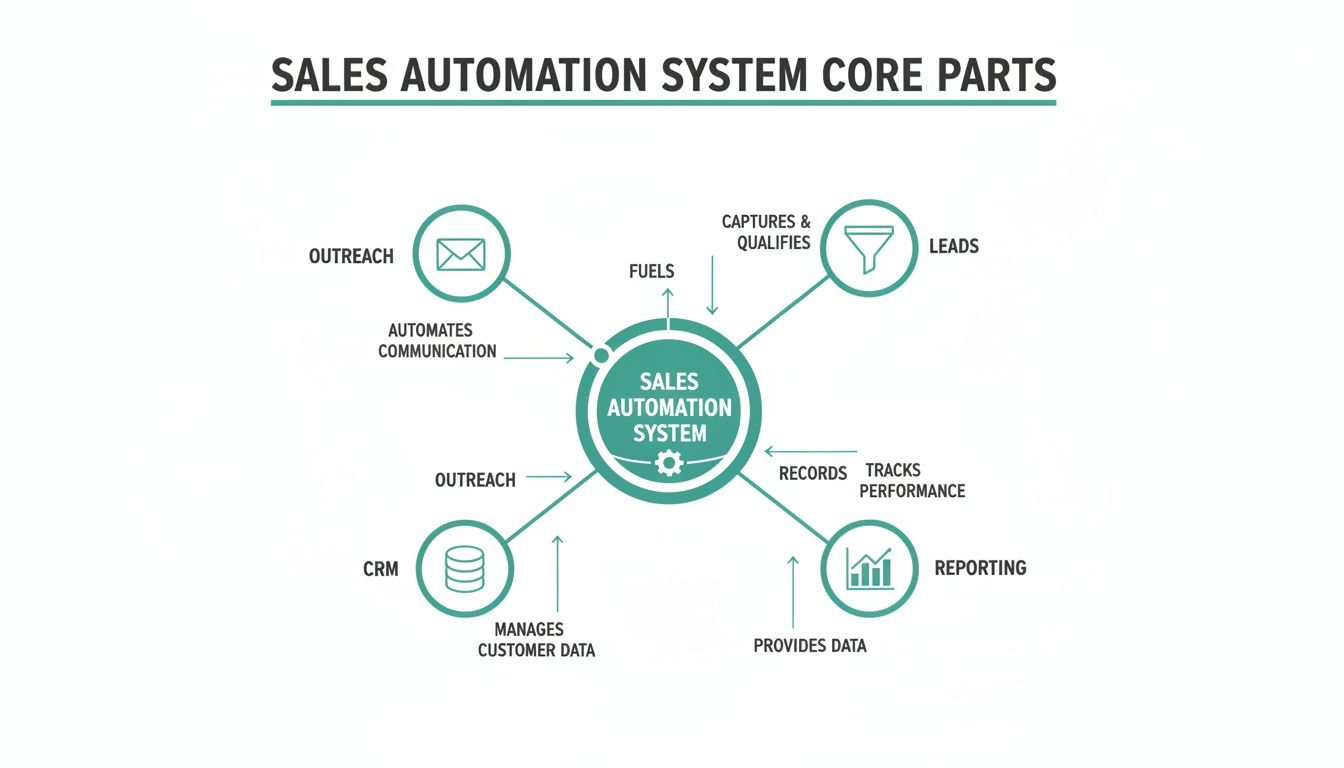
The hard part is choosing the right layer. A rep who needs fast contact discovery should not start with a heavy engagement platform. A manager trying to enforce process across a growing team usually needs more than a point tool. Tool selection works better when you sort platforms by primary function first, then compare fit, cost, and implementation effort.
That is how this guide is organized.
Instead of giving you a flat top-10 list, it groups sales automation tools by the job they do best, such as all-in-one CRM, sales engagement, and prospecting, and pairs each one with a clear "Best For" tag. That makes the trade-offs easier to see. A startup building its first outbound motion will buy differently than a mature sales org replacing parts of an existing stack.
The goal is simple: help you pick tools your team will use, integrate them cleanly, and avoid paying for features that solve the wrong problem.
1. EmailScout

Best for: Fast email discovery and lightweight list building
EmailScout solves a narrow problem, and that's why it works. You install the Chrome extension, visit a company website or even scan Google results, click once, and pull the email addresses found on the page. For founders, SDRs, recruiters, agencies, and freelancers, that speed matters more than a giant feature set.
What stands out is the low-friction entry point. EmailScout offers unlimited free email finding and export, which makes it unusually easy to test on real workflows before you commit budget. If your team is still building first-touch outbound motion, that's a better starting point than buying an oversized platform and hoping reps adopt it.
Where EmailScout fits
This isn't a full sales engagement platform. It won't replace your CRM, sequence engine, or call workflow. It sits earlier in the motion, at the top of funnel, where reps need to identify reachable contacts quickly and move them into outreach.
That makes it a strong fit for teams that need:
- Fast prospect collection: Pull emails while browsing sites instead of bouncing between tabs and databases.
- Simple exports: Copy results directly or export to CSV or TXT for the next step in your workflow.
- Low-cost validation of process: Prove your ICP and outreach motion before you add more tools.
EmailScout also becomes more useful once volume increases. AutoSave can collect emails as you browse, and URL Explorer can scan batches of pages so list building doesn't stay manual.
Practical rule: Use EmailScout to build a first-pass contact list, then move those contacts into a CRM or outreach tool with clear ownership and follow-up rules. Discovery alone doesn't create pipeline.
Trade-offs to know before you install it
The main trade-off is precision versus simplicity. Because EmailScout extracts emails from pages you visit, deliverability and data quality can vary. That means you need a sensible process after export. Clean the list, segment it, and avoid blasting scraped contacts with generic sequences.
A few things to keep in mind:
- Chrome-only workflow: Great if your team lives in Chrome. Less ideal if your workflow is locked into another browser setup.
- Not a verification-first tool: You may still want a separate validation step depending on how strict your outbound process is.
- Compliance is on you: If you're emailing scraped addresses, your team needs to follow applicable rules and internal standards.
For solo operators and small teams, EmailScout is one of the easiest ways to remove prospecting friction. For larger teams, it works best as a lightweight email-finding layer inside a broader outbound stack.
2. HubSpot Sales Hub

Best for: SMB and mid-market teams that want CRM, sales, and marketing connected
A common breaking point looks like this. Reps are working sequences in one tool, pipeline in another, meeting links somewhere else, and marketing handoffs live in a spreadsheet or inbox thread. Activity exists, but accountability gets fuzzy fast.
HubSpot Sales Hub works well in that situation because it centralizes the core motion. Reps can run sequences, log calls, send meeting links, manage deals, generate quotes, and work from the same contact record the rest of the company sees. For teams trying to reduce admin drag, that matters more than chasing a specialized point solution for every task.
Its real value is operational visibility. If marketing already uses HubSpot, sales gets useful context without extra integration work. Reps can see lead source, recent site activity, form fills, lifecycle stage, and prior conversations in one place. Managers get cleaner handoff rules and fewer arguments about whether a lead was worked.
HubSpot also fits teams building more repeatable lead generation automation workflows. The product makes routing, task creation, follow-up, and reporting easier to configure than many systems in its category, especially for companies without a large RevOps bench.
Where HubSpot earns its cost
HubSpot is strongest as an all-in-one CRM category option. It is a good choice when the problem is not "we need one more outbound feature." The problem is disconnected systems and inconsistent process.
What teams usually get from it:
- Shared source of truth: Sales, marketing, and customer-facing teams work from the same record.
- Built-in sales execution: Sequences, templates, meetings, calling, and pipeline management sit close together.
- Cleaner handoffs: Lead routing, ownership, and follow-up rules are easier to standardize.
- Large integration ecosystem: Useful if you need to connect enrichment, support, billing, or calling tools later.
The trade-off is straightforward. HubSpot is easy to start and more expensive to grow into. Advanced automation, forecasting, permissions, and reporting often push teams into higher tiers, and seat costs can become a real budget line item once the org expands.
I usually recommend HubSpot in two cases. First, the company already runs marketing on HubSpot and wants sales to stop working in a separate system. Second, leadership wants one platform that can support handoff, pipeline, and reporting without a long implementation cycle.
If your team is still very outbound-heavy and only needs basic CRM plus sequencing, HubSpot can be more platform than you need. If you are handling inbound, outbound, renewals, and cross-functional routing in one funnel, the extra structure is usually worth it.
You can explore the platform directly at HubSpot Sales Hub.
3. Apollo
Best for: Small teams that want prospect data and outbound in one subscription
Apollo is attractive for one reason. It compresses two buying decisions into one. You get a B2B database, enrichment options, sequencing, basic calling, and workflow automation in a single product. For startups and small outbound teams, that can remove a lot of operational drag.
This setup is especially useful when your team is still building repeatable lead generation automation workflows. Instead of buying a data provider, then an engagement tool, then wiring them together, Apollo gives you a faster path to launch.
Where Apollo works best
Apollo is strongest in environments where speed matters more than perfect specialization. If you need reps prospecting this week, not after a RevOps implementation sprint, it makes sense.
The practical benefits are clear:
- Data plus sequencing: One login, one workflow, fewer handoffs.
- Free entry point: Useful for testing before you expand usage.
- API and integrations: Enough flexibility to connect into a broader stack later.
The trade-off is that all-in-one convenience rarely means best-in-class in every layer. Credit-based usage can change the economics quickly once reps are doing meaningful volume. Data quality also varies by segment, geography, and job function, so teams should test their actual target market before standardizing on it.
Apollo is a good example of a category shift happening across sales automation tools. AI and ML are increasingly treated as core capabilities, not add-ons, in modern sales force automation stacks, and the market itself was valued at USD 9.25 billion in 2022 and is projected to reach USD 17.94 billion by 2030 with an 8.7% CAGR, according to Grand View Research on the sales force automation software market.
If your reps are early in the process and need one platform to source, enrich, and contact prospects, Apollo is hard to ignore. If you already have a strong data vendor and prioritize specialized engagement features, it becomes less compelling.
4. Outreach

Best for: Enterprise sales orgs with layered teams, governance needs, and Salesforce dependence
Outreach is built for complexity. Not startup complexity where everyone wears five hats. Real enterprise complexity, where SDRs, AEs, managers, enablement, ops, and leadership all need different views, rules, and controls inside the same system.
That shows up in the product. Sequencing is mature, analytics are deeper than most SMB tools, and the admin layer is built for larger deployments. If your team needs governance, permissions, reporting discipline, and strong Salesforce alignment, Outreach is usually on the shortlist for a reason.
What Outreach is really buying you
You're not just buying sequence automation. You're buying operational control. Larger teams need consistency across messaging, task design, handoff standards, and manager visibility. Outreach helps with that, especially once outbound becomes a system rather than a rep-by-rep habit.
A few strengths stand out:
- Enterprise controls: Roles, permissions, governance, and workflow discipline.
- Conversation and forecasting layers: Helpful when leadership wants more than activity metrics.
- Deep integration model: Important for Salesforce-heavy environments.
The downside is equally clear. Outreach can become overkill for teams that don't need that level of structure. Quote-based pricing, annual commitments, and implementation overhead make sense for mature orgs. They don't make sense for a founder-led sales team with one pipeline and two reps.
Buy Outreach when inconsistency is expensive. Don't buy it just because it's a known name.
The broader direction of the category supports why enterprise teams keep investing here. Recent coverage points to AI-assisted revenue operations, conversation intelligence, automated lead assignment, and cross-channel orchestration as the next layer of sales automation, not just basic sequencing, as discussed in Dealcode's overview of modern sales automation tool trends.
For companies with real process complexity, Outreach earns its place. For smaller teams, it often solves problems you don't have yet.
5. Salesloft

Best for: Mid-market and enterprise teams that want structured outbound and strong rep coaching
Salesloft sits in a similar tier to Outreach, but many teams prefer it because the product tends to feel more rep-friendly in day-to-day usage. Cadences, call tasks, email steps, analytics, and coaching all live in a system that was clearly designed for recurring outbound execution at scale.
If your team is already Salesforce-centric, Salesloft is especially attractive. The integration story is mature, and the platform works well when managers care about adoption, message consistency, and coaching quality just as much as volume.
Where Salesloft shines
Salesloft is strongest when you need a frontline execution layer with management oversight built in. That's different from a lightweight email platform. It gives leaders a better way to standardize process without forcing reps into a rigid script.
Useful strengths include:
- Multichannel cadences: Email, calls, and social touches in one motion.
- Coaching and conversation insight: Good for manager-led improvement.
- Enterprise readiness: Security and governance are built for larger orgs.
The practical caution is implementation effort. Salesloft works best when someone owns the design. If cadences are messy, stages aren't defined, and CRM hygiene is weak, the platform won't fix that. It will just automate the mess faster.
McKinsey makes that point clearly in its discussion of sales automation implementation and ROI. Early adopters report efficiency gains and sales uplift, but the benefits depend on choosing the right use cases, quantifying automation potential, and cleaning up process and data first.
That's exactly the Salesloft story in practice. Salesloft is powerful when your operating model is ready for it. It disappoints teams that expect software to replace discipline.
6. Reply

Best for: Outbound teams that want multichannel sequences without enterprise pricing weight
Reply hits a useful middle ground. It's broader than a cold email tool, but lighter than an enterprise sales engagement platform. You can build sequences across email, LinkedIn, SMS, and calling, then layer in its AI SDR assistant for drafting, prioritization, and task support.
That makes it a practical option for teams that want channel variety without taking on a complex RevOps project. It also pairs naturally with a separate data source if your contact acquisition process already works well.
What makes Reply practical
A lot of sales automation tools look good in demos because they have one deep feature. Reply is better judged on workflow clarity. Reps can move through multichannel steps without the tool feeling bloated, and managers can get enough structure without needing full enterprise administration.
A few reasons teams like it:
- Simple multichannel sequencing: Good for email-first teams adding LinkedIn, SMS, or call steps.
- Reasonable learning curve: Faster to deploy than heavier engagement suites.
- Useful AI assist layer: Helpful for drafting and prioritizing, not just novelty.
The gap shows up when you need deeper conversation intelligence, governance, or RevOps analytics. Reply can support growing teams, but it usually isn't the long-term command center for a large enterprise motion.
If your outbound motion is still being built, simplicity beats feature depth every time.
Reply makes the most sense for teams comparing it with inbox-first tools and trying to choose a platform that supports more than basic cold email. If that's your lane, reviewing a broader set of cold email software options helps clarify whether you need a sequence tool or a fuller engagement layer.
For practical multichannel outbound, Reply is one of the cleaner options in the middle of the market.
7. lemlist

Best for: Cold outbound teams that need tighter deliverability control and higher-quality personalization
A common outbound problem looks like this: the team has decent targeting, reps are sending enough volume, and reply rates still slide because inbox placement slips or every message sounds templated. lemlist is built for that specific job. In this guide's decision framework, it fits the sales engagement bucket for teams that prioritize deliverability and personalized outreach over broader CRM control.
That focus is why lemlist shows up often with agencies, SDR pods, and founder-led sales teams. It combines multistep outreach across email and LinkedIn, supports personalization at the message level, and keeps sender health closer to the day-to-day workflow than many CRM-led tools do.
Where lemlist earns its place
I would shortlist lemlist when the primary question is not "Which platform should run our entire sales process?" but "Which tool helps us send outbound that gets seen and feels relevant?" Those are different buying decisions.
What lemlist does well:
- Deliverability management: Better fit for teams that send enough volume for domain health and inbox placement to affect pipeline.
- Personalization options: Useful for segmented outbound where generic copy hurts response rates.
- Email and LinkedIn sequencing: Good for smaller teams running coordinated touches without buying a heavier enterprise platform.
The trade-off is straightforward. lemlist is an outbound execution layer, not the system of record. Teams that need stronger forecasting, territory management, approval controls, or full RevOps reporting usually pair it with a CRM and other tooling. Pricing can also get harder to model as you add users, inboxes, or extra capabilities, so I would map the total setup before rolling it out across a larger team.
One practical note. Warmup and personalization features help, but they do not fix weak list quality, poor domain setup, or sloppy sending practices. Teams get the best results from lemlist when they treat it as part of a defined outbound process, with clear ICP filters, sending limits, domain rotation rules, and copy standards.
If your team needs a sales engagement tool built around outbound performance, lemlist is a credible option. It is strongest for teams that already know their motion and want better control over whether their outreach lands, gets opened, and reads like it came from a person.
8. Mailshake

Best for: Startups, small sales teams, and agencies that need a simple sales engagement tool for email-first outbound
A common point in a team's tooling journey looks like this. Reps are ready to run outbound consistently, but the business is not ready for the cost, setup work, or process overhead of Outreach or Salesloft. Mailshake fits that middle ground well.
Its value is focus. Mailshake handles the core job of outbound execution, building sequences, sending cold email, managing replies, and giving reps a clear place to work, without pulling the team into a larger platform decision too early. For small teams, that matters. They can get campaigns live fast and keep the motion easy to manage.
I recommend Mailshake for teams with a narrow use case and a defined workflow. If outbound is mostly email, the rep count is still modest, and leadership does not need complex reporting or governance, it usually covers the basics at a sensible cost.
Where Mailshake fits best
Mailshake works best as a sales engagement layer, not an all-in-one system. That distinction helps when choosing between categories of sales automation tools. If the team already has a CRM and just needs a practical way to run outbound, Mailshake is easier to justify than buying a platform built for a much larger org.
A few strengths stand out:
- Fast rollout: Teams can start sequences and train reps quickly.
- Clear workflow: Good fit for managers who want consistency without heavy admin work.
- Accessible pricing: Useful for startups, agencies, and lean outbound teams.
The trade-off is headroom. As process complexity rises, Mailshake can start to feel narrow. Teams that need deeper analytics, stronger multi-channel orchestration, tighter controls, or broader RevOps visibility usually end up adding other systems or switching platforms.
Cost can also change as needs expand. The base product is straightforward, but the math shifts if you add data features, extra sending capacity, or other supporting tools around it. I would map the full stack before standardizing on it across multiple reps or clients.
One implementation note matters here. Mailshake performs best when the team already knows its outreach motion. Clean lists, sensible sending limits, mailbox setup, and reply handling rules do more for results than any sequence builder on its own.
For teams that want focused outbound execution without enterprise complexity, Mailshake is still a practical pick.
9. Mixmax

Best for: Gmail-first teams that want light sales engagement without leaving the inbox
A rep opens Gmail at 8:30, works replies, books meetings, sends follow-ups, and moves on to the next account. For teams that already sell that way, Mixmax fits the motion better than a heavier engagement platform that asks reps to spend half the day in a separate workspace.
That inbox-first model is the reason to buy it. Mixmax keeps sequences, templates, meeting scheduling, tracking, and simple workflow automation inside Gmail, so adoption usually comes faster than with tools built around a standalone command center. I have seen this matter most on lean teams where every extra tab creates drag.
Mixmax works well in a specific category of sales automation tools. It is a sales engagement and productivity layer for Google Workspace teams, not a system meant to run the full RevOps stack. That makes it a strong fit for SMB sales teams, account managers, founders, and customer-facing teams that do consistent outreach but do not need enterprise controls.
A few strengths stand out:
- Gmail-native workflow: Reps can send, schedule, and sequence emails where they already work.
- Fast rep adoption: Less process change means less training and fewer rollout delays.
- Useful meeting and email tools: Scheduling, templates, and lightweight automation solve daily execution problems quickly.
The trade-off is management depth. Mixmax is easier to adopt than larger platforms, but it does not give leaders the same level of dialer functionality, advanced reporting, governance controls, or cross-team orchestration found in platforms built for larger outbound programs.
That distinction matters during evaluation. If the goal is to improve rep productivity inside Gmail, Mixmax is often enough. If the goal is to standardize outbound across teams, enforce process, and give managers deeper visibility, the team may outgrow it and need a broader engagement system.
Implementation also matters here. Mixmax performs best when the team already has clear sequence rules, mailbox setup standards, and ownership for reply handling. Without that structure, the product stays easy to use, but results become inconsistent across reps.
For teams that want practical automation in the inbox instead of a larger engagement platform, Mixmax is a sensible choice.
10. Close

Best for: Startup and SMB inside-sales teams that want CRM and outreach in one app
A common early-stage sales problem looks like this. Reps are calling from one tool, emailing from another, logging notes later, and losing follow-ups in the gaps. Close solves that by putting the core inside-sales workflow in one system: pipeline management, calling, SMS, email sync, sequences, tasks, and reporting.
That setup works best for teams that need speed more than system design.
Close is an all-in-one CRM category pick. It is a strong fit for inbound follow-up, SMB outbound, transactional sales, and founder-led teams that want reps working leads quickly instead of waiting on a long RevOps buildout. Reps can call, text, email, update the opportunity, and set the next task without bouncing between tabs. Managers also get a cleaner view of activity because communication stays tied to the record.
The upside is straightforward:
- Built-in communication tools: Calling, SMS, and email live inside the CRM, so activity tracking is easier to maintain.
- Faster rollout: Teams can get live without stitching together a separate CRM, dialer, and sequencing tool.
- Good fit for lean operations: Admin overhead is lighter than what you get with larger enterprise platforms.
The trade-off shows up as the sales org gets more complex. Teams that need deep forecasting, stricter governance, heavier customization, or broad cross-functional support across sales, marketing, and service will usually hit the edges faster here than they would in a larger platform. If marketing automation is a major requirement, expect to add another tool.
That does not make Close limited. It makes it opinionated.
In practice, Close performs best when the sales process is already defined. Stages should be clear, follow-up rules should be documented, and reps should know when to call, text, or enroll a lead in a sequence. Without that discipline, an all-in-one setup can still turn into inconsistent rep behavior, just in fewer tabs.
For teams that run an inside-sales motion and want one system that is quick to launch and easy for reps to use, Close is a strong choice.
Top 10 Sales Automation Tools Comparison
| Product | Core features | Best for | Unique selling point | Price summary |
|---|---|---|---|---|
| EmailScout | Chrome extension, one‑click email discovery, CSV/TXT export, AutoSave, URL Explorer | Marketers, sales reps, founders, freelancers, from light to high volume | Unlimited free searches/exports, browser‑native workflow, AutoSave & bulk URL scanning, Recommended | Free unlimited searches; Premium trial 200 emails/mo; paid tiers scale to thousands → 1M+/mo |
| HubSpot Sales Hub | CRM‑native sequences, templates, CPQ, AI assist, inbox/calling | Teams wanting unified CRM + marketing + service | Native CRM alignment and large app marketplace | Free CRM → paid per‑seat tiers; enterprise pricing |
| Apollo | B2B contact database, enrichment, sequencing, dialer, APIs | Teams that want prospect data + outreach in one tool | Large contact dataset with integrations; API access | Free tier; credit‑based plans (usage can raise costs) |
| Outreach | Advanced sequencing, conversation intelligence, analytics, Salesforce integration | Large enterprises with complex sales ops | Mature governance, deep analytics, AI coaching | Quote‑based enterprise pricing (usually high) |
| Salesloft | Cadences, coaching, conversation insights, analytics, Salesforce sync | Mid‑market & enterprise sales teams | Robust admin, analytics and enablement at scale | Custom quotes; enterprise pricing |
| Reply | Multichannel sequences (email/LinkedIn/SMS/phone), AI SDR, integrations | Teams needing broad outbound channels and SDR support | AI SDR assistant, clear multichannel workflows | Mid‑range plans; often paired with external data sources |
| lemlist | Email + LinkedIn steps, personalization, deliverability tools, leads DB | Cold email teams focused on personalization & deliverability | Deliverability tooling and bundled leads database | Plan‑dependent; some tiers require contacting sales |
| Mailshake | Cold email sequences, A/B testing, dialer, inbox, add‑ons (Data Finder) | Startups, agencies, small teams | Easy setup and affordable entry with optional data add‑ons | Affordable entry pricing; add‑ons increase total cost |
| Mixmax | Gmail‑embedded sequences, tracking, scheduling, templates, AI copilots | Google Workspace teams wanting inbox automation | Inbox‑first automation with low adoption friction | Competitive SMB pricing; advanced features in higher tiers |
| Close | CRM with native calling, SMS, inbox, sequences, pipelines | SMB/startup inside‑sales teams | All‑in‑one communications + pipeline; fast to implement | Clear SMB pricing; fewer enterprise controls |
How to Choose and Integrate Your Sales Tools
A common sales ops mistake looks like this: the team misses pipeline targets, leadership buys two new tools, reps keep working from the same messy data, and output gets worse. The problem usually is not tool count. It is a broken handoff, weak data hygiene, or a platform that does not match the team's actual workflow.
Start by choosing the category that fixes the current bottleneck. If reps struggle to build lists, prioritize prospecting. If sourced leads sit too long without follow-up, add a sales engagement layer. If pipeline ownership, reporting, and stage discipline are inconsistent, fix the CRM first. That function-based view matters more than a feature checklist.
The "Best For" labels in this guide should help with that decision. An SMB team may get faster value from an all-in-one system like Close or HubSpot Sales Hub. A mid-market team with SDRs, AEs, and a RevOps owner often gets better control from a specialized stack, such as Apollo for data and Outreach or Salesloft for execution. The trade-off is simple: fewer tools are easier to run, while specialized tools usually give better control, reporting, and role-specific workflows.
Run a pilot before a full rollout. Pick one team, one motion, and one success metric. Good pilots are narrow enough to manage and busy enough to produce signal within a few weeks. I usually start with one segment, one sequence framework, and a short list of operational KPIs: records created correctly, sequence enrollment rate, task completion, reply handling, and CRM updates.
A few implementation rules prevent most failures:
- Set the system of record first: Decide whether the CRM or engagement platform owns account, contact, and activity history.
- Define stage entry and exit criteria: "Qualified," "working," and "meeting booked" need exact definitions or reporting breaks fast.
- Clean the data before syncing tools: Duplicate contacts, missing owners, and inconsistent field values create routing errors and kill rep trust.
- Use native integrations where you can: They are usually easier to support and less likely to break during product updates.
- Limit custom fields at launch: Every extra field creates more admin work and lowers adoption unless it supports a real decision.
- Train managers on inspection: Reps follow process more consistently when managers review usage in pipeline meetings and one-on-ones.
Automation helps when the underlying process is sound. As noted earlier, teams often see shorter sales cycles after adoption, but that result usually comes from faster follow-up, cleaner routing, and fewer dropped tasks, not from buying the broadest platform.
Be careful with the all-in-one pitch. It works well for small teams that need speed and can accept lighter specialization. It works less well when different roles need different workflows, approval rules, and reporting standards. In practice, founders and early-stage teams often benefit from a simple setup. Larger teams usually need clearer ownership across prospecting, engagement, CRM, and analytics.
Choose the tool your team will use every day, then integrate it in the simplest way that supports your process. If the setup requires constant manual cleanup, reps will work around it and managers will stop trusting the data. That is the point where automation becomes overhead instead of capacity.