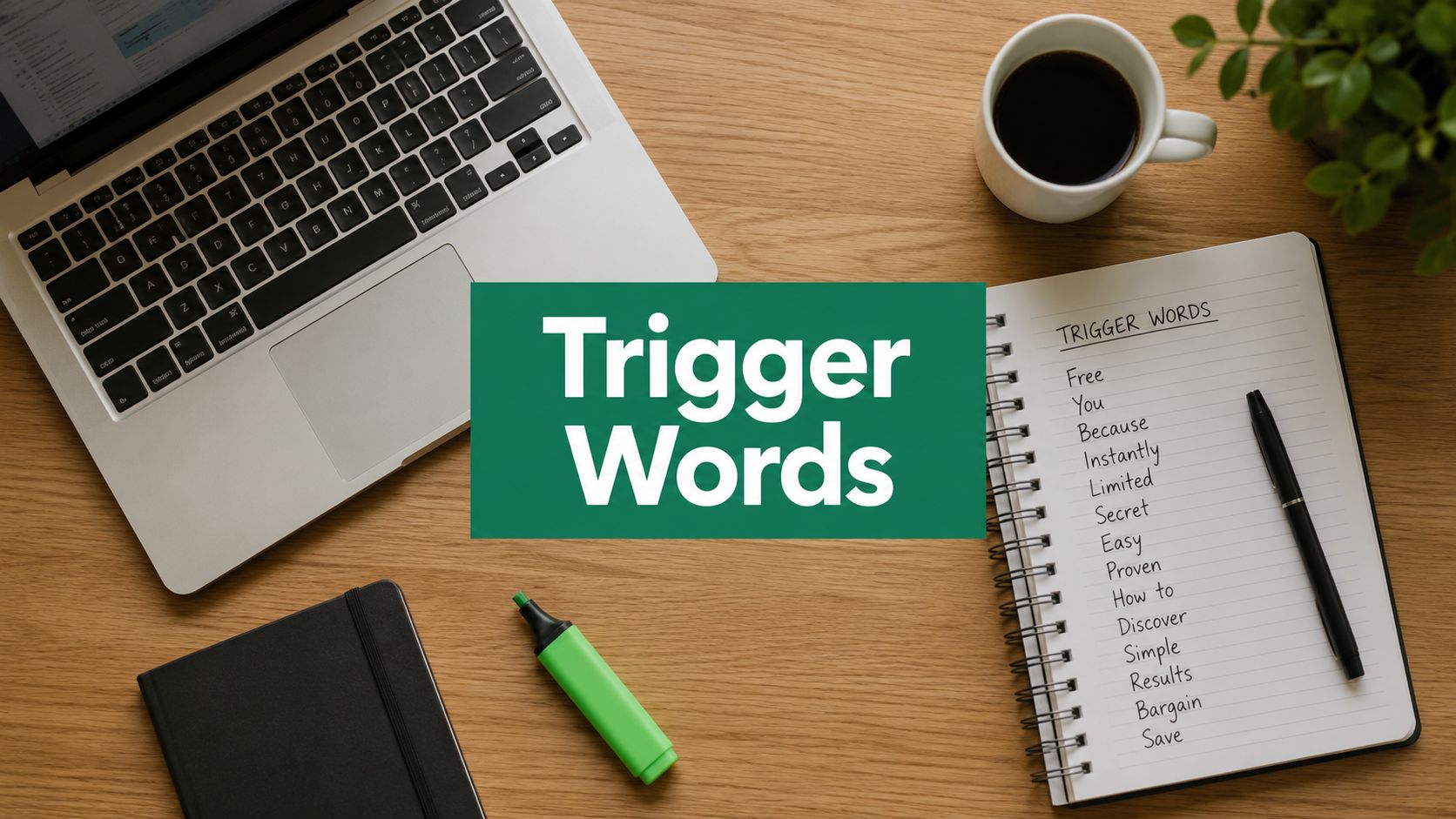
Tag: conversion rate optimization

  • What Are Trigger Words: Psychology & Examples 2026

    What Are Trigger Words: Psychology & Examples 2026

    You sent a campaign on Monday. The list was clean, the offer was solid, and the copy looked polished. By Wednesday, the numbers told a different story. Opens were flat, replies were worse, and the only people engaging were unsubscribing or ignoring you completely.

    That usually isn't a list problem first. It isn't even always an offer problem. In cold outreach, language often decides whether your message gets a chance at all.

    Small word choices change how a prospect feels in the first second. One subject line sounds specific and worth opening. Another sounds mass-blasted and disposable. One opening line lowers friction. Another triggers resistance before the reader reaches your value proposition.

    That's where trigger words matter. Used well, they help a cold email feel relevant, timely, and worth attention. Used badly, they make you sound like an infomercial, damage trust, and push your message closer to spam.

    Introduction Why Your Emails Are Being Ignored

    Most ignored emails share the same flaw. They describe the sender's offer without giving the buyer an immediate emotional reason to care.

    A subject line like “Improving Your Sales Process” is technically clear. It's also easy to skip. It asks the prospect to do too much interpretive work. They have to decide whether your message is useful, urgent, credible, or different from every other pitch in their inbox.

    A stronger line uses one carefully chosen trigger word to frame the message before the reader thinks too hard about it. “Proven sales process” signals trust. “Hidden sales bottleneck” sparks curiosity. “Missed pipeline” introduces loss aversion. The offer may be the same, but the entry point changes.

    Most cold emails don't fail because they're unreadable. They fail because they don't create enough emotional momentum to earn the next click or the next sentence.

    That matters more than commonly acknowledged. Buyers scan fast. They judge tone fast. And if your wording feels generic, exaggerated, or manipulative, they move on just as fast.

    The practical question isn't whether trigger words work. It's whether you know when to use them, where to place them, and which ones undermine your results. That's the difference between persuasive outreach and noisy outreach.

    What Are Trigger Words in Sales and Marketing

    Trigger words in sales and marketing are words or short phrases chosen to provoke a psychological reaction that nudges a reader toward action. In cold outreach, they work like verbal shortcuts. Instead of asking a prospect to analyze your message from scratch, they push attention toward a feeling such as curiosity, urgency, trust, exclusivity, or relevance.

    In outreach terms, a trigger word is not decoration. It's a cue.

    According to BDOW's explanation of trigger words in outreach, trigger words in marketing and cold email are linguistically selected catalysts that bypass conscious deliberation to provoke a specific psychological reaction, such as curiosity or urgency, and they can be split into hard triggers that demand immediate action and soft triggers that subtly shift attitude.

    Hard triggers and soft triggers

    This distinction is useful in practice because not every email needs pressure.

    Hard triggers push for immediate movement. They include language tied to urgency, deadlines, loss, or direct action. These can work when the context supports them, such as event-driven outreach or follow-ups tied to a timely business change.

    Soft triggers create interest without forcing a decision. They're usually safer in first-touch cold email because they sound more human and less promotional. Curiosity, credibility, specificity, and relevance all fall into this bucket.

    A simple way to understand this:

    • Hard trigger example: urgent, now, limited, final
    • Soft trigger example: proven, hidden, relevant, practical

    For most B2B outreach, soft triggers are the better default. They earn attention without sounding like a late-night ad.

    Trigger words in marketing are not the same as trigger words in psychology

    This causes confusion because the same phrase exists in two different contexts.

    In marketing, trigger words are persuasive tools meant to move someone from passive browsing to active engagement. In psychology, the term often refers to language that can provoke an emotional response linked to trauma or painful memories. That distinction matters because careless wording can create defensiveness instead of interest, especially in a cold email where trust is fragile.

    If you're sharpening subject lines and hooks, a good companion read is this set of essential copywriting advice for professionals. The useful part isn't fancy persuasion theory. It's the reminder that good copy reduces friction and makes the next step feel obvious.

    What trigger words actually do in an email

    They help answer a prospect's silent first questions:

    • Why should I open this
    • Why should I trust this
    • Why should I care now
    • Why is this different from the usual pitch

    If your wording doesn't answer those quickly, your email gets treated like background noise. If it does, you earn a little attention. In cold outreach, that little bit is often all you need.

    The Psychology Behind Why Trigger Words Work

    People don't evaluate every email with calm, rational patience. They scan, infer, and react. That's why trigger words work. They connect with mental shortcuts buyers already use when deciding what deserves attention.

    Research summarized by Benny's analysis of emotional trigger words notes that 95% of purchase decisions occur below the level of conscious awareness, and trigger words target hardwired mechanisms like scarcity, trust, and curiosity to activate subconscious decision-making systems directly.

    A useful mental model for this is buyer behavior under limited attention. This breakdown of the buyer behaviour model helps frame why buyers react to emotional cues long before they fully evaluate your offer.

    Here's the core mechanism visually.

    A diagram illustrating how trigger words in human psychology influence emotional responses, cognitive biases, and desired user actions.

    Scarcity and loss get attention fast

    People are more alert to what they might miss than what they might gain. In outreach, this shows up when a subject line or opening hints that the prospect is overlooking something costly, inefficient, or time-sensitive.

    That doesn't mean writing fake urgency. It means framing the downside of inaction clearly. Words tied to scarcity or missed opportunity can create enough tension for the buyer to keep reading.

    Examples include language around limited access, missed opportunities, bottlenecks, or gaps. The strongest versions feel grounded in a real business context, not manufactured pressure.

    Curiosity closes the information gap

    Curiosity is one of the safest and most effective trigger types in cold outreach because it invites attention without demanding compliance.

    Words like secret, hidden, overlooked, or unexpected work because they imply incomplete information. The reader feels a small gap between what they know and what they could know. Opening the email becomes the easiest way to close that gap.

    This is the same logic behind strong pricing pages and offers. The right framing changes perception before the buyer reviews the full details. If you want to see that principle outside email, this guide to psychological pricing is a useful parallel.

    A short explanation of the same idea in practice can help here.

    Trust lowers resistance

    Trust words don't create excitement as dramatically as scarcity or curiosity, but they reduce skepticism. In B2B outreach, that's often more valuable.

    Words such as proven, practical, clear, tested, or specific signal that the message is grounded. They suggest competence instead of hype. This is significant as most cold emails don't lose because the offer is terrible. They lose because the prospect expects the email to waste their time.

    Practical rule: If the buyer doesn't trust your framing, they won't evaluate your value.

    Social proof and value shape perceived relevance

    Some trigger words work by implying validation or usefulness. Terms that signal peer behavior, recognized standards, or clear business value can make a message feel safer to engage with.

    The effect is subtle. You're not trying to overpower the reader. You're helping them classify the email quickly. Relevant. Credible. Worth a skim. That first classification is what opens the door.

    Trigger Word Categories and Examples for Cold Outreach

    Lists of trigger words are easy to publish and hard to use. The problem isn't finding words. The problem is matching the right word to the right situation.

    A curiosity trigger works well when your angle reveals an overlooked issue. A trust trigger works better when the buyer has likely seen too many exaggerated claims. An urgency trigger can help in follow-ups, but it can also tank credibility if you use it before you've earned attention.

    For cleaner subject line structure, this guide to email subject line best practices is worth keeping nearby while you draft.

    Use the category that fits the buying moment

    Think about the prospect's state, not just your campaign goal.

    • Cold first touch: curiosity, trust, relevance
    • Problem-aware outreach: loss aversion, value, specificity
    • Warm follow-up: urgency, exclusivity, direct action
    • High-resistance audience: low-pressure trust language

    If you start with urgency when the buyer doesn't know you, the email feels pushy. If you use only soft language when the buyer already knows the problem is serious, the email feels weak.

    Trigger Word Examples for Subject Lines & Email Copy

    Category Trigger Words Subject Line Example Email Body Snippet
    Curiosity hidden, secret, overlooked, discover Hidden pipeline leak I noticed a likely gap in how inbound leads are routed after form fills.
    Trust proven, practical, tested, clear Proven way to reduce no-shows This is a practical fix teams use when booked meetings slip after handoff.
    Value faster, simpler, efficient, useful Simpler lead routing The goal is a faster path from inquiry to first reply without adding tools.
    Loss aversion missed, wasted, leak, gap Missed demo opportunities You may be losing qualified interest before sales ever sees it.
    Exclusivity selected, private, exclusive, priority Private idea for outbound I'm reaching out with a targeted suggestion based on your current motion.
    Scarcity limited, closing, final, urgent Closing the follow-up gap There's a narrow window after intent signals where reply odds are strongest.
    Social proof trusted, standard, adopted, preferred Preferred outreach fix This approach aligns with how many teams now tighten first-touch messaging.

    Before and after subject lines

    A few examples show the difference better than theory.

    Before After
    Quick question Hidden churn signal
    Sales improvement idea Proven outbound fix
    Following up Missed follow-up gap
    Help with lead gen Simpler lead sourcing
    Checking in Relevant idea for hiring outreach

    The “after” versions work better because they frame a reason to care. They don't just announce that an email exists.

    Body copy matters just as much

    A good trigger word in the subject line gets the open. The body has to carry the same emotional logic without becoming theatrical.

    Use lines like these:

    • For curiosity: There's an overlooked issue in the current process that may be costing replies.
    • For trust: I'll keep this specific and tied to what your team is already doing.
    • For value: This usually simplifies the first step without changing your broader workflow.
    • For loss aversion: The current setup may be leaving qualified interest untouched.
    • For exclusivity: This note is based on a narrow observation, not a generic pitch.

    Good trigger words don't feel inserted. They feel native to the buyer's problem.

    A simple selection rule

    If you're unsure which category to use, start here:

    1. Use curiosity when the prospect is likely unaware of the issue.
    2. Use trust when the market is crowded and skepticism is high.
    3. Use value when the problem is obvious but the solution must feel low-friction.
    4. Use loss aversion when inaction has a real cost the buyer already understands.
    5. Use urgency sparingly and only when timing is genuine.

    That keeps your outreach persuasive without slipping into spammy language.

    The Fine Line Between Persuasion and Manipulation

    A trigger word helps when it sharpens relevance. It hurts when it exaggerates, overpromises, or pretends a mass email is somehow exclusive.

    That's the line too many teams cross. They hear that words like exclusive, urgent, secret, or guaranteed can lift opens, so they stack several into one subject line and hope intensity will beat indifference. It usually does the opposite. The email starts looking engineered instead of credible.

    Data highlighted by Overloop's trigger word analysis says that subject lines with 2–4 words including exactly one trigger word achieve 46% average open rates in B2B, while stacking multiple triggers like “exclusive urgent limited-time secret” increases spam-filter rejection and causes credibility collapse.

    This matters even more if your outreach doesn't follow the principles behind permission-based email marketing. When relevance and trust are weak, aggressive wording gets punished faster.

    An infographic comparing ethical persuasion and unethical manipulation with examples of how to use trigger words responsibly.

    What ethical persuasion looks like

    Ethical use of trigger words does four things well:

    • Matches the message to reality. If the offer isn't exclusive, don't call it exclusive.
    • Creates interest without pressure. Curiosity should invite a read, not corner the buyer.
    • Supports a real next step. The email body should deliver on the promise of the subject line.
    • Protects long-term trust. One open isn't worth sounding deceptive.

    A subject line like “Hidden follow-up gap” can be persuasive and fair if the email points to a credible handoff issue. A line like “Urgent exclusive final notice” is pressure without substance.

    What backfires in 2026 outreach

    The biggest mistake is stacking triggers. The second biggest is using old-school spam language with no awareness of filtering risk.

    One 2025 to 2026 source says words like free, now, and guaranteed can boost open rates up to 60% but also increase AI spam scoring risk when combined with urgency phrases, while curiosity terms and FOMO language can perform strongly without triggering filters in the same way, according to SEO Swarm's 2025 to 2026 trigger word review. Treat that as directional guidance, not a license to chase extremes.

    A safer practitioner view looks like this:

    Risk level What it looks like Likely result
    Low risk One credible trigger word tied to a real pain point Better fit, cleaner opens
    Medium risk Repeated urgency or exaggerated exclusivity Lower trust, more skepticism
    High risk Multiple stacked triggers, hype language, mismatch with offer Spam signals, weak replies, credibility loss

    Negative trigger words are the hidden problem

    Not all trigger words persuade. Some trigger defensiveness.

    In interpersonal and psychological contexts, words like absolutes such as always and never, or blaming statements built around you, can provoke anger or frustration, as noted in Wiktionary's summary of trigger word usage in psychology. In outreach, that means phrases like “you're missing,” “you never,” or “you need to fix” can make a prospect defensive before they consider your point.

    Use observational language instead.

    • “I noticed a possible gap”
    • “There may be friction in”
    • “This could be creating delays”

    That sounds collaborative. It keeps the channel open.

    If the email makes the prospect feel judged, your trigger word didn't trigger action. It triggered resistance.

    How to Test and Measure Trigger Word Impact

    Some teams guess. They swap words based on instinct, run one campaign, and call the result a lesson. That isn't testing. It's improvisation.

    If you want trigger words to improve reply rates, test them the same way you'd test any other messaging variable. Keep the offer, audience, and send window stable. Change one language element at a time. Then look at what happened.

    What to test first

    Start with subject lines. They're the cleanest place to isolate trigger word impact.

    Empirical A/B test data summarized by Tradewinds' trigger word research shows that subject lines containing words like Secret, Proven, or Exclusive generate 18–22% higher engagement rates, and marketers often use a 5–10% lift in open rates as a success benchmark.

    That gives you a practical standard. If a trigger word variant doesn't produce a meaningful lift or hurts downstream quality, it isn't helping.

    A simple testing workflow

    Use a controlled process:

    1. Pick one category to test
      Compare curiosity against trust, or trust against value. Don't test five emotional angles at once.

    2. Write close variants
      Example: “Proven onboarding fix” versus “Hidden onboarding gap.” Same audience. Same offer. Different trigger.

    3. Hold the body copy steady
      If you rewrite the entire email, you won't know what caused the change.

    4. Run the test long enough to gather a real signal
      The same Tradewinds source notes that marketers often run subject line tests for 1–2 weeks across lists of 1,000+ subscribers when validating performance shifts.

    5. Track more than opens
      A better open rate with weaker replies isn't a win.

    Metrics that matter

    Focus on a short list:

    • Open rate for first signal
    • Click-through rate if the email includes a relevant link
    • Reply quality to judge commercial value
    • Unsubscribes to catch fatigue or over-aggressive language

    Tradewinds also notes that when unsubscribes rise significantly, teams should reduce aggressive urgency usage to fewer than two instances per quarter to avoid campaign fatigue. That's a useful warning. A trigger word can increase curiosity while slowly damaging audience trust if used too often.

    How to interpret results

    Not every positive result deserves to scale.

    If “exclusive” lifts opens but replies turn colder, your subject line may be overpromising. If “proven” lifts both opens and reply quality, that's a stronger signal because the emotional frame matched the body copy.

    The goal isn't a flashy win in one campaign. It's a repeatable language pattern your audience responds to without distrust. Once you find that pattern, document it and use it across segments with care.

    Putting It All Together with Your EmailScout Workflow

    Good trigger words don't rescue bad targeting. They amplify good targeting.

    That's why the workflow matters. Start with the right contacts, then write with the emotional precision the situation calls for. If you reverse that order, even strong copy gets wasted on the wrong people.

    A practical outreach flow looks like this. You identify decision-makers connected to a real business function, shortlist the most relevant contacts, and then draft subject lines that fit their likely awareness level. For a Head of Sales, that may mean loss aversion or trust. For a RevOps lead, clarity and value may work better. For a founder, curiosity often earns the open if the angle is tight.

    Screenshot from https://emailscout.io

    Here's where teams usually improve fastest:

    Build the list around context

    A trigger word only works if the underlying message fits the reader. If you're reaching out to broad titles with the same generic angle, even polished copy feels irrelevant.

    Narrow the contact list by role, company motion, or visible problem. Then write to that context.

    Choose one emotional angle per email

    Don't cram curiosity, urgency, exclusivity, and trust into one subject line. Pick the dominant emotion that best matches the buyer's likely mindset.

    For example:

    • A skeptical buyer may respond better to proven
    • A distracted buyer may respond better to hidden
    • A problem-aware buyer may respond better to missed

    That single decision often cleans up the whole message.

    Carry the same promise into the body

    If the subject line says “Hidden retention gap,” the first lines of the email should identify the gap quickly and credibly. Don't open with company history, feature lists, or vague compliments.

    The best cold emails keep emotional continuity. The subject line creates the reason to open. The first sentence validates the decision. The next lines make the CTA feel low-friction.

    When teams get this right, outreach stops sounding like outreach. It starts sounding like a useful observation sent to the right person at the right time.


    If you want a faster way to find decision-makers and turn this trigger word framework into real outreach, try EmailScout. It helps you build targeted prospect lists while you browse, so you can spend less time hunting for contacts and more time writing emails that get opened and answered.
  • How to Increase Sales Conversion Rate: 7 Proven Tactics to Convert More

    How to Increase Sales Conversion Rate: 7 Proven Tactics to Convert More

    If you're trying to boost your sales conversion rate, the first move isn't to start throwing new tactics at the wall. You need to diagnose the real friction points in your sales funnel and get a clear baseline of where you stand today.

    This means calculating your current rate, figuring out exactly where prospects are dropping off, and digging into customer feedback. Only then can you focus your efforts where they'll make the biggest impact.

    Your Starting Point: Diagnosing Low Conversion Rates

    Before you can fix a leaky bucket, you have to find the holes. I've seen too many teams rush to implement new strategies without ever understanding why their current process is broken. That's a surefire way to waste time and money on changes that miss the mark entirely.

    A systematic diagnosis is your foundation for real improvement. This isn't about chasing vanity metrics like website traffic or social media likes. It's about getting into the hard numbers that reveal the health of your sales process from top to bottom. The goal here is to shift from guesswork to a data-driven plan.

    Calculate Your Baseline Conversion Rate

    First things first: what is your current sales conversion rate? Without this number, you have no way of knowing if anything you do is actually working.

    The formula is simple:

    (Total Number of Sales / Total Number of Leads) x 100 = Sales Conversion Rate

    So, if you generated 500 leads last quarter and closed 25 of them, your conversion rate is 5%. This single metric is your north star. It's the benchmark you'll measure all future changes against.

    It also gives you context. While averages vary wildly by industry, a typical B2B conversion rate often hovers between 2-5%. Knowing where you stand is a critical first step.

    Pinpoint Funnel Drop-Off Points

    Okay, you have your overall rate. Now you need to break down your funnel stage-by-stage. A 5% overall conversion rate doesn't tell you where the other 95% of leads went. You have to find the leaks.

    This diagram breaks down the core diagnostic process I follow.

    A diagram illustrating a 3-step sales funnel diagnostics process with metrics and root causes.

    The flow from calculation to root cause analysis ensures you’re targeting the weakest links in your sales process, not just making random tweaks.

    To pinpoint these weaknesses, I always start by tracking a few key metrics at each stage of the funnel.

    Key Metrics for Diagnosing Your Sales Funnel

    This table breaks down the essential metrics you should be tracking to find performance gaps in your sales process.

    Funnel Stage Key Metric What It Tells You Industry Benchmark
    Awareness Lead-to-MQL Rate Is your initial messaging attracting the right people? 10-15%
    Consideration MQL-to-SQL Rate How well is your sales team qualifying inbound interest? 20-30%
    Decision SQL-to-Opportunity Rate Are qualified leads turning into real sales conversations? 50-60%
    Closing Opportunity-to-Win Rate How effective is your team at closing deals? 20-30%

    Tracking these numbers will quickly show you where the biggest drop-offs are happening. For a deeper dive, our guide on how to qualify sales leads offers some great insights for shoring up the early stages.

    Some common problem areas I see all the time include:

    • Initial Contact to Demo: Leads go dark after your first email? It could be a problem with your value proposition or targeting.
    • Demo to Proposal: Prospects seem excited during the demo but never ask for a proposal? Your presentation might not be connecting their pain points to your solution.
    • Proposal to Close: A big drop-off after you send pricing? That usually points to sticker shock or a failure to properly build value and ROI.

    Analyze Qualitative and Quantitative Data

    The numbers tell you what is happening, but they rarely tell you why. For the full picture, you have to pair your quantitative data with qualitative feedback.

    • Website Analytics: Use a tool like Google Analytics to see what users are doing on key pages. Are people bouncing from your pricing page instantly? Is your contact form too long, causing people to give up?
    • Customer Feedback: Survey your current customers. I love asking, "What almost stopped you from buying?" Their answers are pure gold.
    • Sales Team Insights: Your sales reps are on the front lines. They hear objections every single day. Create a simple system to log this feedback and look for patterns.

    Once you’ve identified the weak spots, figuring out how to improve your website conversion rate is a great next step for driving more sales. By methodically auditing each touchpoint, you can build a clear, data-backed roadmap to a higher conversion rate.

    Fine-Tuning Your Funnel for Maximum Impact

    Now that you’ve pinpointed your funnel's weak spots, it's time for some strategic fine-tuning. This is where small, smart tweaks can create massive gains in your sales conversion rate. Forget about a complete overhaul; we're going to zero in on the critical touchpoints where prospects are making key decisions.

    A person uses a laptop displaying 'BOOST CONVERSIONS' charts and graphs on a wooden desk.

    The name of the game is reducing friction. You want to build momentum and guide people smoothly from one step to the next. Let's get into the practical psychology behind high-converting pages and how you can put it to work.

    Crafting a High-Converting Landing Page

    Your landing page is often the first real conversation you have with a potential customer. It has exactly one job: get the visitor to take a specific action. Every single element—from the headline to the button color—needs to work together to make a powerful case.

    Think of it as a lightning-fast sales pitch. You have just a few seconds to grab attention, show your value, and build enough trust to earn that click. The data is clear: you have less than eight seconds to make an impression before someone hits the back button.

    To make every second count, I always focus on these three things:

    • A Magnetic Headline: Your headline has to speak directly to your visitor's biggest problem or their most desired outcome. It needs to be dead simple and instantly answer, "What's in it for me?"
    • Persuasive Copy: Use simple, benefit-focused language. Don’t just list features; show how they solve a real-world problem. Short sentences and scannable bullet points are your best friends.
    • Compelling Social Proof: People trust other people, not brands. Slapping on testimonials, case studies, customer logos, or positive reviews is the quickest way to build credibility and show you’re the real deal.

    A well-crafted landing page isn’t just about looking good; it's about creating a psychological journey that makes the visitor feel understood and confident in their decision to move forward.

    Simplifying the Path to Purchase

    Every extra field in a form, every confusing link, every surprise at checkout—these are all exit doors for your customers. Friction is the absolute enemy of conversions. Your mission is to make the entire process feel effortless and obvious.

    A classic mistake I see all the time is a bloated sign-up form. If you're asking for a phone number and company size just to download a simple PDF, you’re putting up a huge roadblock. Get only the info you absolutely need right now. You can always ask for more later.

    Here are some high-impact areas to simplify:

    1. Streamline Your Forms: Cut fields down to the bare minimum. For every single field, ask yourself, "Do I really need this right now?"
    2. Clarify Your Call-to-Action (CTA): Use strong, action-oriented words. Instead of a lazy "Submit," try "Get Your Free Demo" or "Download My Guide." The button should promise exactly what happens next.
    3. Optimize the Checkout Process: For e-commerce, this is make-or-break. A clunky checkout is the #1 reason for abandoned carts. Offer guest checkout, show off security badges, and be completely transparent with costs upfront.

    For more hands-on strategies, these 10 proven e-commerce conversion rate optimization tips are worth a read. Even something as simple as offering the right payment options can make a huge difference; one study found it boosted conversions by 7.4% on average.

    Ultimately, you need to walk through the entire journey from your user's point of view. If you want to get a better handle on how all these touchpoints connect, check out our guide on how to create a sales funnel that works. By methodically knocking down the barriers on each page, you turn interested visitors into paying customers.

    Refining Your Outreach with Hyper-Personalization

    Once your website and funnel pages are dialed in, the next big lever you can pull to lift conversion rates is your direct outreach. Let's be honest: sending generic, one-size-fits-all emails is a surefire way to get ignored or, worse, land in the spam folder.

    In today's packed inboxes, personalization isn't just a nice-to-have. It’s the only way to cut through the noise and prove to a prospect that you’re worth their time. This isn't about just dropping a {{first_name}} tag in your template and calling it a day. True hyper-personalization turns your cold outreach from a numbers game into a genuine relationship-building strategy. It takes a little more effort upfront, but the payoff in reply rates and closed deals is massive.

    Smartphone displaying a personalized outreach app, notebook, pen, and coffee on a clean desk.

    The goal here is simple: show you’ve done your homework. When you can demonstrate a real interest in the person on the other end, you immediately stand out from the 95% of outreach that’s just lazy automation.

    Moving Beyond Basic Personalization

    The first step is gathering the right intel. Before you write a single word, you need to know who you're contacting and what they actually care about. This is where finding the right decision-makers becomes so critical.

    A tool like the EmailScout Chrome extension is perfect for this. It lets you find verified email addresses right from a prospect's LinkedIn profile or company website. This simple step saves a ton of time and ensures you’re actually talking to the right person, not just shouting into the void of a generic "info@" address.

    Once you've got the correct contact, the real work starts. You need to find a specific, relevant "hook" to build your message around.

    Some of my favorite hooks include:

    • A recent LinkedIn post: "Saw your post on scaling sales teams—your point about data accuracy really hit home…"
    • Company news or funding: "Congrats on the Series B funding! Scaling your SDR team must be a huge priority right now."
    • A podcast or article quote: "Heard you on the 'SaaS Breakthroughs' podcast and loved your take on product-led growth."
    • A shared connection or interest: "Noticed we both went to the SaaStr conference last year. Did you happen to catch the session on enterprise sales?"

    This kind of opener instantly transforms the dynamic from a cold pitch into a warm conversation.

    Crafting Messages That Actually Connect

    With your research done, you can now write an email that feels like it was crafted for an audience of one. The key is to be quick, concise, and immediately relevant.

    The data backs this up, too. Personalizing your emails can bump your sales conversion rates by up to 10% and boost click-through rates by 14%. The latest 2025 email marketing stats are even more convincing, showing that personalized messages drive transactions at six times the rate of generic blasts. For EmailScout users, this is a clear playbook: use the extension to get verified emails, then build your pitch around their recent activity or company news. You can dig into more of the data on the importance of email personalization.

    Let's look at a real-world example.

    Generic Outreach (The Bad Way):

    Subject: Quick Question

    Hi Jane,

    My name is Alex and I'm with XYZ Corp. We help companies like yours increase their sales.

    Can we schedule a 15-minute call next week to discuss?

    Best,
    Alex

    This email is all about Alex, offers zero value to Jane, and is destined for the trash folder.

    Hyper-Personalized Outreach (The Better Way):

    Subject: Your LinkedIn post on SDR burnout

    Hi Jane,

    I saw your post yesterday on the challenges of SDR burnout and it struck a chord. Your point about tedious manual tasks draining motivation is something we see a lot.

    My team at XYZ Corp. built a tool that automates lead list building, which our clients say saves each rep about 5 hours a week of that exact kind of manual work.

    No pressure for a call, but thought you might find our recent case study on this interesting.

    Cheers,
    Alex

    See the difference? The second email focuses on Jane, references something she actually said, connects it to a pain point, and offers value without a hard sell. This is how you start conversations that lead to higher conversion rates. It’s about being a helpful resource, not just another salesperson clogging up an inbox.

    Building High-Quality Lead Lists with Smart Segmentation

    Personalized outreach is a game-changer, but it falls flat if you’re talking to the wrong people. Your sales conversion rate lives and dies by the quality of your lead list. Sending the perfect email to a bad-fit prospect is just as useless as sending a generic template to your dream customer.

    So, the focus has to shift from just crafting the message to building the right audience. You're not just hunting for emails; you're hunting for the right emails—contacts who fit your ideal customer profile (ICP) to a T. Without a clean, targeted list, you’re basically sending your sales team into battle unarmed.

    From Mass Collection to Strategic Curation

    Forget buying those massive, dusty email lists or scraping thousands of contacts who couldn't care less about your product. Modern lead gen is all about precision. Quality over quantity, every single time. Every single person on your list should be there for a reason.

    This starts with finding prospects efficiently. A tool like EmailScout's URL Explorer can take a list of company websites and pull out verified emails in minutes, turning what used to be hours of mind-numbing manual work into a quick, automated task.

    Combine that with a feature like AutoSave, which grabs contacts while you're browsing LinkedIn or company pages, and you can build a super-relevant prospect list without ever disrupting your workflow. These tools aren't just finding random emails; they're helping you curate a list of actual decision-makers at companies you’ve already vetted.

    The Power of Smart Segmentation

    Okay, so you've built a solid list of prospects. Now for the fun part: segmentation. Blasting the same exact message to every single person on your list is a classic rookie mistake. Segmentation is simply the art of slicing your list into smaller, smarter groups based on things they have in common.

    This lets you tailor your messaging with surgical precision. You can speak directly to the unique pain points, priorities, and even the industry jargon of each subgroup. Instead of a generic, one-size-fits-all pitch, you're starting multiple, highly relevant conversations at scale.

    Some of the most effective ways to segment are pretty straightforward:

    • Job Title/Role: The CEO cares about high-level ROI. The Marketing Manager is worried about campaign performance and MQLs. Segmenting by role lets you frame your value proposition in a way that actually resonates with them.
    • Industry: A SaaS startup and a construction firm operate in different worlds. They face different challenges and speak different languages. Segmenting by industry shows you've done your homework.
    • Company Size: A 20-person startup has different buying processes and budget constraints than a 2,000-employee enterprise. Your pitch needs to reflect that reality.
    • Lead Source: Where did they come from? A contact you found using EmailScout's site finder needs a different introduction than someone you met at a conference last month.

    Turning Segments into Conversions

    This isn't just about being organized; it's about getting results. Ruthless email segmentation can boost click-to-open rates to 15.49% and drive conversions well past the typical 2-5% benchmark.

    While the most recent data shows average email click rates sit around 2.09%, top-tier segmented campaigns can hit as high as 4.90% in certain industries. For EmailScout users, this means strategically dividing your lists to get maximum engagement. You can dig into more of the data on how segmentation impacts conversion rates by industry to see for yourself.

    Segmentation isn’t just a list-cleaning tactic; it's a core conversion strategy. It makes sure the right people get the right message at the right time, which massively increases the odds they’ll actually pay attention and take action.

    Think of it this way. If you’re selling a project management tool, you could create two distinct segments: "Startup Founders" and "Enterprise Project Managers."

    • For the Founders: You'd talk about speed, affordability, and getting set up in minutes.
    • For the Enterprise PMs: You'd highlight security, robust integrations, and scalability for huge teams.

    Both groups get a message that feels like it was written specifically for them. That's how you make your outreach feel personal, not programmatic, and start seeing your conversion rates climb.

    Putting Smart Automation to Work for Nurturing and Conversion

    If you're still relying on manual follow-up for every single lead, you're guaranteed to be leaving money on the table. It's just not scalable. Smart automation is what allows you to consistently nurture leads, making sure every prospect gets the right message at the right time—without burning out your team.

    Person holding a tablet displaying a network of email automation process icons and banner.

    This is where those high-quality, segmented lists we talked about become your secret weapon. They fuel automated sequences that guide prospects along their buying journey, which frees up your sales reps to focus on what they do best: closing deals with high-intent leads.

    Setting Up Your Core Automated Sequences

    You don't need a dozen complicated workflows to see a real impact. In fact, you can completely change your conversion game by starting with just three foundational automation sequences. Think of these as the workhorses doing the heavy lifting for you.

    From my experience, these are the three to build first:

    • The Welcome Series: This is your first impression. A solid welcome sequence confirms a new lead's interest, delivers immediate value, and sets the stage for what's to come. It’s your best shot at turning a flicker of curiosity into real engagement.
    • The Re-engagement Campaign: What about leads that have gone dark? A re-engagement campaign automatically pings dormant contacts with a compelling offer or useful content to try and bring them back into the conversation.
    • The Abandoned Cart Flow: For any e-commerce business, this is an absolute must. This sequence emails users who added items to their cart but bailed before buying, recovering revenue that would have otherwise been lost.

    The numbers back this up. Email automation quietly works in the background, delivering an average 1.9% conversion rate. Specific sequences, like a well-timed welcome series, can hit 42.1% open rates and 5.4% click rates. When done right, the ROI is massive.

    By automating these key touchpoints, you build a system that works for you 24/7. No lead gets forgotten, and every prospect is nurtured based on their behavior, which dramatically boosts your odds of making a sale.

    A Practical Welcome Sequence Example

    Let's make this real. Imagine a prospect just downloaded an e-book from your site and landed on a segmented list you built with EmailScout. A welcome sequence is the perfect tool to nurture this warm lead and nudge them toward a sale.

    Here’s a simple but incredibly effective three-part flow:

    1. Day 1 – The Immediate Value Add: The first email goes out instantly. It delivers the e-book they asked for and includes a short, personal intro to your company, reinforcing the fact that they made a good choice.
    2. Day 3 – The Problem-Focused Follow-Up: A couple of days later, a second email arrives. This one hones in on the core problem your product solves, maybe sharing a quick case study or a customer story related to the e-book's topic.
    3. Day 7 – The Soft Call-to-Action: The final email in the sequence gently nudges them toward the next step. This could be an offer for a no-pressure demo, a free trial, or an invite to an upcoming webinar.

    Notice this isn't a hard sell; it's a strategic conversation. You're building trust and proving your value over a few days. Each email is a small step guiding the prospect closer to becoming a customer. If you want to dig deeper into the strategy behind this, check out our guide on what sales automation is and how it can help.

    By putting these smart, targeted sequences in place, you create a scalable system that nurtures leads from initial interest to final sale—all without you lifting a finger.

    Common Questions About Increasing Conversion Rates

    When you dive into conversion optimization, a few questions always pop up. It’s totally normal to wonder about industry benchmarks, how long it’ll take to see results, or even where to start. Getting straight answers helps you stop guessing and start making smarter moves.

    This section breaks down the questions I hear most often from sales and marketing pros trying to bump up their sales conversion rate.

    What Is a Good Sales Conversion Rate?

    This is the big one, and the honest answer is always: it depends. A "good" sales conversion rate changes dramatically based on your industry, price point, how people find you, and how long it takes to close a deal. Chasing some universal number is a recipe for frustration.

    For instance, an e-commerce site doing high volume might average a 2.8% conversion rate and be happy. But a B2B SaaS company with a six-month sales cycle might be popping champagne for a 2.4% rate. The only number that truly matters is your own.

    Your real goal should be to make consistent, measurable improvements from where you are right now. For a business with decent traffic, even a 1% lift in conversions can mean a huge jump in revenue.

    How Long Does It Take to See an Increase?

    The timeline for results depends on what you change and the length of your sales cycle. You’ve got to be patient, but you can definitely watch for early signs that you’re moving in the right direction.

    • Quick Wins (A Few Weeks): Small, focused tweaks can show results fast. Think A/B testing a headline on a popular landing page or changing the CTA on your demo form. You could see a statistically significant difference in just a few weeks.
    • Strategic Shifts (A Few Months): Bigger projects, like rolling out a new lead nurturing sequence or completely overhauling your outreach strategy, will take longer. For B2B, you might not see the impact on closed deals for a couple of months.

    Keep an eye on leading indicators like email open rates, demo requests, and the number of proposals you send out. These are the breadcrumbs that tell you if your bigger strategy is working, long before the final sales numbers come in.

    Which Part of the Sales Funnel Should I Optimize First?

    When you’re trying to figure out where to start, always begin at the bottom of the funnel and work your way up. I know it sounds backward, but it delivers the fastest return on your effort. You’re fixing the leak that’s closest to the money.

    Here’s how to think about it:

    1. Start at the Close: Optimizing your checkout process, final proposal, or trial-to-paid conversion has the most immediate impact. These are people who are this close to buying.
    2. Move to the Middle: Once the last step is solid, move up to the consideration phase. This could mean improving your sales demos or fine-tuning your follow-up emails.
    3. Optimize the Top Last: Finally, focus on top-of-funnel stuff like ads and blog posts. There’s no point in pouring more water into a leaky bucket.

    Dig into your data and find the biggest drop-off point closest to the sale—that's where you'll get the most bang for your buck.

    Can I Increase Conversions Without Spending More on Ads?

    Absolutely. In fact, that's the whole point of conversion rate optimization (CRO). It’s not about getting more traffic; it’s about getting more out of the traffic you already have. This makes every dollar you're already spending on marketing work that much harder.

    When you focus on the strategies we’ve talked about—like improving the user experience, personalizing your outreach, and building better lead lists—you're directly boosting the value of every single visitor. This is how you make a real impact on your bottom line without increasing your customer acquisition cost one bit.


    Ready to stop guessing and start finding the right decision-makers? With EmailScout, you can build high-quality, targeted lead lists in minutes, not hours. Find unlimited verified emails, streamline your outreach, and connect with the people who can actually say "yes." Start building your perfect lead list for free at https://emailscout.io.