Tag: content marketing

  • Skyscraper SEO Technique: Your 2026 Step-by-Step Guide

    Skyscraper SEO Technique: Your 2026 Step-by-Step Guide

    You publish a strong article. The research is solid, the design is clean, and the topic matters to your audience. Then nothing happens. No meaningful links, no authority lift, and no steady stream of organic demand.

    That's the problem the Skyscraper SEO Technique solves when you use it correctly. Instead of guessing what people might link to, you start with a page that has already proven it can attract backlinks, build something noticeably better, and then run a focused outreach process to people who already care about that topic. For sales and marketing teams, that makes this more than an SEO play. It becomes a repeatable way to build credibility, create useful assets for prospects, and support pipeline with content that earns attention instead of waiting for it.

    Why the Skyscraper Technique Still Wins in 2026

    Most content teams don't have a publishing problem. They have a distribution and authority problem.

    The web is full of decent content that never earns traction because nobody has a reason to reference it. The Skyscraper Technique still works because it starts from a smarter assumption. If a page already ranks and already has a strong backlink profile, the market has already voted that the topic is link-worthy. You're not inventing demand from scratch. You're improving on something with clear evidence of traction.

    Brian Dean of Backlinko popularized the approach, and the core workflow still holds: find a ranking page with many backlinks, create a substantially better version, then contact sites linking to the original and ask them to switch their link, as explained in this overview of the Skyscraper Technique. That matters because this is fundamentally a backlink acquisition strategy, not just a content refresh exercise.

    Why teams still get results from it

    The reason this method keeps surviving trend cycles is simple. It forces discipline.

    Instead of brainstorming random blog topics, you work backward from existing link graphs. Instead of writing “helpful” content and hoping people discover it, you build an asset with an outreach plan attached to it. That structure is why the tactic still fits modern marketing and outreach workflows, especially for B2B teams that need authority assets sales can use.

    Practical rule: If a page doesn't have a realistic outreach path, it's probably not a good skyscraper candidate.

    Why this matters beyond SEO

    A good skyscraper campaign gives your team more than rankings. It can create:

    • Sales enablement content that reps can send after calls
    • Authority assets that improve trust with buyers
    • Lead support content that answers objections clearly
    • Partnership hooks that open conversations with publishers and niche sites

    That's a significant advantage. Done well, the Skyscraper SEO Technique turns one strong piece of content into an asset that supports search visibility, outreach, and lead generation at the same time.

    Finding Your Perfect Skyscraper Target

    A Skyscraper campaign usually succeeds or fails before anyone writes a headline. The deciding factor is target selection.

    Pick a page with real link demand, obvious weaknesses, and a clear fit for your buyers. Pick a page that only looks good in a tool, and the team burns weeks producing content nobody has a reason to replace. That is why I review targets with two questions first: does this topic already attract links, and would the right prospect actually care if we improved it?

    A flowchart showing a four-step process for finding the perfect content target using the skyscraper SEO technique.

    What a good target looks like

    Good targets sit at the overlap of SEO value, sales relevance, and outreach feasibility.

    The page should already earn links from real sites in your field. It should also be replaceable. Editors rarely swap a link because your article is newer by a few months or longer by a few hundred words. They switch when your resource makes their page more accurate, more useful, or better aligned with what their readers need now.

    That last point matters for lead generation. A high-performing target often maps to a buyer question your revenue team already hears on calls. If the topic supports comparison, evaluation, implementation, or problem definition, the finished asset can rank, win links, and help reps move deals forward. That is where persona work sharpens selection. If your team has not documented those reader priorities well, build them first with a buyer persona research process for B2B content teams.

    Use these filters when judging candidates:

    • Proven link demand: The page already attracts links from legitimate blogs, publications, and resource pages.
    • Visible weaknesses: The content is dated, shallow, hard to scan, poorly structured, or missing practical detail.
    • Business fit: The topic connects to your product, service, category, or a recurring sales objection.
    • Editorial replaceability: A publisher can update their existing citation without rewriting their article around your link.

    How to review targets without wasting a week

    Start in Ahrefs or Semrush and pull the top-linked pages for a broad topic in your niche. Then stop trusting the tool for a minute and read the actual page.

    I look at the page the same way an editor would. Is it still credible? Is it still useful? Does it answer the reader's likely next question? A page can have a healthy backlink profile and still be a poor target if the content is already strong and the linking sites have no reason to update.

    Use this review process:

    1. Search broad parent topics and export pages with meaningful referring domains.
    2. Remove weak candidates fast by filtering out junk-heavy link profiles and off-topic pages.
    3. Read the content manually to find gaps a better resource could fix.
    4. Check the publish date and update signals to see whether the page has been maintained.
    5. Scan linking domains to confirm the links come from active sites you would want to contact.
    6. Score the topic against revenue relevance so the campaign produces an asset sales and marketing can both use.

    A simple example helps. Say your company sells sales software. An outdated roundup of sales tools with dead products, vague descriptions, and no guidance for different team sizes is a strong candidate. A polished, recently updated guide from a respected category publisher is usually not. The first gives your team room to create a stronger asset and a credible reason to contact linkers. The second gives you very little outreach angle, even if it has more links.

    Strong target selection saves more campaigns than strong copy.

    Red flags that should make you walk away

    Some targets look attractive because the backlink number is high. The workflow falls apart after a closer review.

    Red flag Why it hurts the campaign
    Brand-dominated topic Editors often prefer linking to the known market leader, even if your page is better
    Link profile full of low-quality sites Outreach time goes to pages that are unlikely to update or pass useful authority
    Transactional intent Pages built to convert directly are harder to replace with an editorial resource
    Existing page is already excellent Your team will struggle to create meaningful differentiation
    No clear outreach angle You cannot give site owners a convincing reason to swap the link

    Build the outreach list while you choose the target

    Do not treat target research and outreach research as separate jobs. They belong in the same workflow.

    As soon as a page looks promising, export the linking domains and review them. This gives marketing and sales teams a fast sanity check. If the backlink profile is packed with forums, scraped directories, inactive blogs, or irrelevant sites, move on. If you see active publishers, association sites, niche blogs, and resource pages that still maintain their content, keep going.

    That early list does more than validate SEO potential. It tells you whether the campaign can become a repeatable authority and lead engine. You are not just choosing a keyword target. You are choosing a topic with reachable publishers, a believable replacement pitch, and a content asset your commercial team can use after the links start coming in.

    Building Content That Towers Above the Rest

    The biggest mistake in skyscraper SEO is assuming “better” means longer. It usually doesn't.

    A bigger article filled with repeated points, generic AI phrasing, and padded subheadings won't persuade editors to replace an existing link. Your page has to feel more useful, more current, easier to trust, and easier to cite. That's a much higher bar.

    A compass, mechanical pencil, and ruler on top of a technical blueprint for home construction

    What “better” actually means

    A winning replacement asset usually improves in several ways at once.

    First, it matches the original page's useful coverage, then it fixes what the original left weak. That might mean stronger examples, cleaner structure, more practical steps, sharper visuals, or clearer positioning for the reader.

    Use this review lens before drafting:

    • Coverage depth: Does the original skip important questions, edge cases, or implementation details?
    • Freshness: Does it feel behind current tools, workflows, or buyer expectations?
    • Readability: Is it cluttered, slow, bloated, or difficult to scan?
    • Decision support: Does it help a reader act, compare, choose, or implement?
    • Original value: Is there anything on your page that a publisher can't already find elsewhere?

    Turn weaknesses into your outline

    Junior marketers often overcomplicate the process. You don't need a brilliant creative breakthrough. You need a disciplined teardown of the target page.

    Create a simple two-column planning doc.

    What the target page does poorly What your version should do better
    Surface-level explanations Add step-by-step detail and decision criteria
    Old screenshots or examples Replace with current workflows and modern tooling
    Generic audience targeting Write for a specific buyer or job role
    Weak formatting Use comparison tables, visuals, and stronger hierarchy
    No conversion utility Add checklists, templates, or next-step guidance

    That last point matters for commercial teams. The best skyscraper content doesn't just rank. It helps prospects move forward. If you serve multiple audience segments, this is the right stage to tighten the page around real use cases and clearer personas. A well-defined audience framework like this guide to creating buyer personas helps sharpen what “more useful” should mean on the page.

    If your content can't help a reader make a better decision, it probably won't earn a better link.

    The upgrade stack that usually works

    The strongest pages tend to combine several upgrades instead of relying on one dramatic change.

    One page may win because it's far easier to use. Another wins because it explains trade-offs accurately. Another wins because it gives publishers a cleaner, more current citation. Stack enough of those improvements and the replacement pitch becomes credible.

    A practical upgrade stack often includes:

    1. A sharper opening that tells readers exactly what they'll get.
    2. Clear segmentation by audience, use case, or problem.
    3. Original framing based on what teams do, not just theory.
    4. Helpful visuals that simplify comparison or execution.
    5. Useful assets such as templates, checklists, or email examples.
    6. Editorial cleanup so the piece feels publishable and reference-worthy.

    What usually fails

    Thin rewrites fail. So do “ultimate guides” that merely restate common knowledge with more subheadings.

    Editors and site owners can tell when a page is just a dressed-up copy of the original. They can also tell when a page is better for their readers. The difference usually comes down to whether you added real utility.

    That's why practical specificity matters more than volume. If the old article lists tactics, show how to execute them. If it names tools, explain where each tool fits. If it talks to everyone, write for a defined buyer. Better content isn't the tallest page. It's the page people prefer linking to.

    Your Step-by-Step Skyscraper Outreach Playbook

    Most skyscraper campaigns don't fail because the content is terrible. They fail because the outreach is lazy.

    Generic email blasts don't work here. Editors, content managers, and site owners have seen the “I loved your post and wrote something better” pitch too many times. If your outreach reads like automation, it gets archived like automation.

    A five-step funnel chart illustrating the Skyscraper Outreach Playbook process for effective digital marketing and backlink building.

    Start with a clean prospect list

    The first job is exporting the backlink profile of the original page from Ahrefs or Semrush. Then clean it aggressively.

    Practitioner guidance consistently treats this as a link-reclamation process. Build a list from sites already linking to the weaker page, then remove low-value targets such as forums, directories, abandoned sites, or links older than about 12–18 months. Backlinko's campaign, after cleaning, had 160 solid outreach targets, summarized in this walkthrough of the Skyscraper prospecting process.

    That filtering step matters more than is often realized. A smaller, cleaner list beats a bloated export full of dead ends.

    Use a review sheet with these fields:

    • Domain
    • Linking page URL
    • Page title
    • Why they linked to the original
    • Best contact role
    • Personalization note
    • Outreach status

    Find the right contact, not just any contact

    Outreach gets easier when you map contact roles to page types.

    For editorial blogs, the author or content editor is usually the best first target. For resource pages, look for the site owner, webmaster, or marketing lead. For company blogs, an editor, content manager, or demand generation lead may own the page.

    A homepage inbox is better than nothing, but it's rarely ideal. You want the person with both context and authority to update the link.

    Here's the kind of workflow many teams use to speed that up:

    Personalization that actually matters

    Most “personalized” emails aren't personalized. They insert a first name, mention an article title, and then drop the same pitch everyone else sends.

    Real personalization explains why your page is a better fit for that specific linking page. That means you need to understand the context of the link. Was the old resource cited for a statistic, a definition, a how-to reference, or a tools list? Your pitch should mirror that reason.

    Outreach rule: Personalize around the linking context, not just the recipient's name.

    Three outreach templates you can adapt

    Use these as starting points, not scripts.

    Direct heads-up email

    Subject: possible update for your [topic] resource

    Hi [Name],

    I was reading your page on [page topic] and noticed you linked to [old resource].

    We recently published an updated piece on [your topic] that goes deeper on [specific angle]. I thought it might be useful if you're refreshing that section for readers.

    If helpful, here's the article:
    [Your URL]

    Either way, thanks for putting together the original page. I found the section on [specific detail] especially useful.

    Best,
    [Your Name]

    Why this works: it's short, respectful, and doesn't overstate the ask.

    Broken link variation

    Subject: broken or outdated resource on your page

    Hi [Name],

    Quick heads-up. On your page about [topic], the link to [old resource] appears outdated for the point you're referencing.

    We published a current guide covering [specific topic], including [specific differentiator], in case you want a replacement:
    [Your URL]

    If you're updating the page, it may be a useful fit.

    Best,
    [Your Name]

    Why this works: the email provides value before asking for anything.

    Content upgrade pitch

    Subject: updated resource for your [topic] page

    Hi [Name],

    I came across your article on [topic] and saw that you reference [old resource] in the section about [specific section].

    We just published a more current version covering:

    • [specific improvement]
    • [specific improvement]
    • [specific improvement]

    It may be a stronger resource for that section if you're open to updating the link:
    [Your URL]

    Thanks for the helpful article.

    [Your Name]

    Why this works: it gives a concrete replacement case instead of a vague “better content” claim.

    Outreach cadence and follow-up

    You don't need a complex sequence. You need a sane one.

    Send the initial note. Wait a few business days. Follow up once with a short reply in the same thread. If there's still no response, move on unless the target is especially valuable and there's a strong reason for a final nudge.

    A simple follow-up can be:

    Hi [Name], just bumping this in case you're updating the [topic] page. The replacement resource is here if useful: [URL]

    Keep the tone calm. No guilt, no fake familiarity, no “just checking in again” parade.

    Tools and workflow choices

    An efficient campaign usually combines backlink analysis, list cleaning, contact discovery, and email sending. Some teams keep this inside spreadsheets plus lightweight tools. Others connect the entire workflow to outreach software.

    Here's a simple comparison frame:

    Tool Primary Use Case Best For
    Ahrefs Backlink export and target discovery Finding linked pages worth replacing
    Semrush Backlink research and prospect validation Cross-checking target quality
    Google Sheets or Airtable Prospect management Small teams running manual campaigns
    Outreach platform Sequencing and reply tracking Teams handling larger prospect lists

    If you want broader context beyond skyscraper campaigns, Raven SEO has a useful roundup of effective methods for organic links that helps place this tactic in a wider link-building strategy.

    For teams that also run parallel campaigns like contributor outreach, these guest post outreach workflows can complement skyscraper campaigns well because they rely on similar list-building and personalization habits.

    This walkthrough is worth watching if you want a visual explanation of how the outreach motion fits together:

    Measuring Your SEO Lift and Optimizing for Growth

    A skyscraper page isn't finished when it goes live. It starts working after publication.

    Modern guidance treats the method as a living process. Teams should promote the page aggressively and refresh it every 6 to 12 months to maintain authority, measuring success with signals like referring domains and organic traffic, as noted in this guide on executing the Skyscraper Technique and maintaining results.

    An infographic illustrating four key metrics for measuring SEO growth, including traffic, rankings, backlinks, and engagement.

    The metrics that matter most

    Don't drown the campaign in vanity reporting. Track the signals that reflect whether the page is gaining authority and visibility.

    Focus on:

    • New referring domains: This tells you whether outreach is turning into links.
    • Organic traffic to the page: This shows whether the asset is earning sustained discovery.
    • Keyword movement: Track the main query and a cluster of supporting terms in Google Search Console or your SEO tool.
    • Lead-support signals: Watch form fills, assisted conversions, or sales usage if the page is part of your funnel.

    A simple operating rhythm

    Teams often benefit from a lightweight review cycle rather than constant tinkering.

    Review window What to check
    Weekly after launch New links, email replies, indexing, obvious page issues
    Monthly Organic visibility, ranking trend, assisted conversion role
    Scheduled refresh window Accuracy, outdated screenshots, weaker sections, missing new angles

    Strong skyscraper content compounds when the team keeps promoting it after launch instead of treating publication as the finish line.

    What optimization usually looks like

    Useful post-launch work includes adding clearer sections where readers hesitate, improving internal linking, refreshing examples, and tightening weak headers that don't match search intent.

    Promotion matters too. Share the page in newsletters, use it in sales follow-ups, include it in partner conversations, and give your outreach team a reason to keep using it. The longer the asset stays current and useful, the easier it is to defend the links and rankings you've earned.

    Is the Skyscraper Technique Always the Right Move?

    No. It's a high-effort strategy, and some teams use it when a simpler content play would be smarter.

    The best fits are informational topics where the current winners are clearly weak, dated, or incomplete, and where there's an existing backlink pattern you can realistically tap into. That's where the workload has a clear payoff. You're not just writing a better article. You're stepping into an established link ecosystem with a credible replacement.

    It's a weaker fit when the search results are dominated by giant brands, the target topic doesn't attract links naturally, or your team can't produce anything meaningfully different. In those cases, you may be better off publishing niche thought leadership, product-led content, comparison pages, or partnership-driven assets.

    A quick decision filter

    Use the technique when these statements are mostly true:

    • The topic already earns backlinks
    • The current ranking page has visible weaknesses
    • Your team can add real value, not filler
    • You have time for manual outreach
    • The finished asset supports brand authority or pipeline

    Skip it when you'd be forcing the process.

    Recent coverage also warns that campaigns producing only 2–3 links after 80 hours likely failed because the outreach was generic or the content lacked unique value, according to this analysis of whether the Skyscraper Technique is still worth it. That's the right final test. If your page isn't distinct enough to justify outreach, or your outreach isn't sharp enough to earn attention, the campaign becomes expensive busywork.

    The teams that win with skyscraper SEO don't treat it like a content hack. They treat it like a system. Smart target selection, clear differentiation, disciplined outreach, and steady refresh cycles. That's what makes it work.


    If your team is running skyscraper campaigns at scale, the slowest part is usually finding the right people to contact. EmailScout helps sales and marketing teams build contact lists faster so they can spend less time digging for emails and more time sending relevant, personalized outreach.

  • Guest Post Outreach: A Playbook for Landing Links in 2026

    Guest Post Outreach: A Playbook for Landing Links in 2026

    You publish solid content. It's useful, accurate, and better than most of what's already ranking. Then you check analytics and see almost nothing. No meaningful referral traffic. No authority lift. No steady stream of links. Just a slow drip of visits from people who already know your brand.

    That is where many organizations stall. They treat content creation as the finish line when it is really the input. Guest post outreach is what turns that input into distribution, links, and brand authority. Done badly, it is a pile of ignored emails. Done well, it behaves like a sales funnel: prospecting, qualification, messaging, follow-up, and relationship building.

    The email template matters. It just matters a lot less than people think. The system around the template is what scales.

    From Content Creation to Authority Building

    A lot of businesses don't have a content problem. They have a distribution problem.

    They publish helpful articles on their own site, but nobody sees them because they're still building trust, links, and audience. Guest posting fixes that when you approach it as an authority play, not a one-off backlink grab. You're borrowing distribution from established publications while building your own reputation in the process.

    Why outreach works when publishing alone doesn't

    Guest post outreach puts your expertise in front of readers who already trust the host site. That changes the starting point. Instead of waiting for search engines or social algorithms to notice your content, you place your ideas inside ecosystems that already have attention.

    That's why the process needs to be repeatable. A documented workflow beats random pitching every time. A 2026 Search Engine Land case on guest post outreach described one expert securing over 350 guest articles through a repeatable process built around hyper-personalization and keyword gap analysis. The important lesson isn't just the headline number. It's that repeat placements came from a system, not hustle.

    Practical rule: Guest posting gets easier after the first few wins because editors prefer contributors who already know how to deliver clean drafts, follow guidelines, and write for a specific audience.

    Authority compounds when the placements fit your niche and your expertise is obvious from the byline, topic selection, and writing quality. If you need a quick calibration point for what strong editorial content looks like across formats, this roundup of Match My Assistant on content writing is useful because it shows how different content types communicate expertise.

    The shift most teams miss

    The biggest mistake is treating outreach like a creative task instead of an operational one. One person writes an email. Another person hunts for contact info. Nobody tracks statuses consistently. Follow-ups happen late or not at all. Good prospects get buried next to weak ones.

    A real outreach engine looks more like this:

    • Prospecting first: Build a large pool of possible sites before writing a single pitch.
    • Qualification second: Remove bad fits aggressively.
    • Direct outreach third: Contact the person who can say yes.
    • Follow-up on schedule: Most opportunities aren't won on the first touch.
    • Editorial relationship after placement: A published article should open the next door.

    That's how content stops being a sunk cost and starts acting like an asset.

    Building Your High-Value Prospecting Machine

    Most outreach campaigns fail before the first email goes out. The list is weak.

    If your prospecting process is “Google a few blogs and hope for the best,” you'll waste time on dead sites, irrelevant sites, and sites that were never open to outside contributors in the first place. Good prospecting is volume with logic behind it.

    Start with search operators, not broad keyword searches

    Search operators pull up sites that have already signaled intent. That matters because you're not trying to convince every blog in your industry to accept outside content. You're trying to find the ones that already do, or have done so before.

    Use patterns like these:

    • intitle:"write for us" + [niche keyword] to find active contributor pages
    • [niche keyword] "guest post" to find sites that publish guest authors
    • site:domain.com [topic] to inspect a specific site's content coverage and style
    • [brand or competitor name] "guest author" to uncover where peers have already published

    A guest post outreach methodology from My Codeless Website's cited guidance stresses the importance of granular research before outreach, including domain authority, traffic, content gaps, and checking whether a site accepts guest contributions. It also recommends prioritizing active blogs with frequent publication schedules and skipping sites with closed submission policies.

    That last part saves a surprising amount of time. Sending a polished pitch to a site that clearly says “we do not accept guest posts” isn't persistence. It's bad process.

    Build a raw list before you judge it

    At this stage, quantity matters more than perfection. Don't over-filter too early. Pull together a broad list of prospects, then sort and qualify afterward.

    Good raw-list sources include:

    1. Search operator results
      These produce the fastest wins because the intent is explicit.

    2. Competitor backlink profiles
      If a site published your competitor, it may publish you. That doesn't guarantee a fit, but it's a strong signal.

    3. Known author footprints
      Search for recognizable names in your niche plus “guest post” or “author” and inspect where they've contributed.

    4. Industry publications with contributor pages
      Some of the best opportunities aren't hidden. They're just buried behind mediocre site navigation.

    What to capture in your spreadsheet

    Your first-pass database doesn't need to be fancy. It needs to be usable.

    Field Why it matters
    Domain Your core record for the prospect
    Niche relevance Filters out broad but low-fit sites
    Guest post policy Confirms whether outreach is worth sending
    Recent publishing activity Tells you if the site is alive
    Notes on content style Helps personalize later
    Potential decision-maker Prevents generic-contact outreach

    For teams that want to speed up company research during list building, pulling likely contacts from domains through a workflow like finding contacts of companies helps reduce the manual hunt after the site is already shortlisted.

    Prospecting should feel a little mechanical. That's good. Creativity belongs in topic selection and messaging, not in reinventing how you build lists every week.

    Qualifying Targets to Maximize Your Response Rate

    A big list feels productive. It often isn't.

    Raw prospect lists usually contain a mix of excellent targets, low-value sites, abandoned blogs, generic media farms, and websites that would never publish your work. If you email all of them, you lower campaign quality fast. Better qualification protects your time and your sender reputation.

    A glass filled with green apples on a green background with marketing text about qualifying prospects.

    The fastest way to disqualify a site

    You don't need a long checklist to reject weak prospects. You need a few hard filters.

    If any of these are true, the site usually isn't worth outreach:

    • No signs of active publishing over a recent stretch of posts
    • No topical overlap with your expertise or client niche
    • No clear editorial standards, which often signals low-quality acceptance practices
    • No evidence they publish outside contributors
    • Content quality is obviously weak, outdated, or stuffed with irrelevant links

    The point of qualification isn't to find reasons to keep sites. It's to find reasons to remove them quickly.

    What a strong target looks like

    A qualified prospect usually checks several boxes at once. The best ones are active, niche-relevant, and structurally easy to pitch. You can see who they publish, how they frame topics, and what kind of articles perform on the blog.

    Here's a practical decision table:

    Signal Weak target Strong target
    Editorial activity Dormant or irregular Publishes consistently
    Audience fit Broad or mismatched Clear overlap with your buyers
    Contributor openness Unclear or closed Has guidelines, contact path, or prior guest posts
    Topic opportunity Covered everything already Has visible content gaps
    Contact path Only generic form Named editor or content lead

    That last column matters more than commonly realized. A decent site with a reachable editor often outperforms a bigger site with no obvious path to the right person.

    Alignment matters more than vanity

    Marketers often chase logos instead of fit. That creates weak pitches.

    A mid-tier blog with the right audience, a real editor, and room for your expertise can be more valuable than a big publication with strict editorial walls. I'd rather pitch a site where I can clearly explain the value of the topic than force a generic idea into a brand-name outlet.

    If you're thinking through workflow automation during qualification, it's worth studying how tools classify repetitive tasks before humans step in. The way the Donely AI agent platform breaks down task routing is a good mental model for outreach ops: let the system handle repetitive steps, then keep judgment calls with a person.

    A qualified prospect is one where you can answer three questions quickly: Who reads this site, what are they missing, and who decides what gets published?

    Once a site passes that test, collect the editor or content manager contact and move it into outreach. Generic inboxes still have a place for small sites, but direct contacts usually lead to cleaner conversations and fewer dead ends.

    Crafting Personalized Outreach That Gets Opened

    Editors don't ignore outreach because they hate guest posts. They ignore bad outreach because it creates work.

    The pitch that gets opened and answered is usually the one that removes uncertainty fast. It shows relevance, proves you've read the site, and offers topics that make editorial sense. That's different from “Dear Webmaster, I'd love to contribute a high-quality article to your amazing blog.”

    A refreshing cocktail with a lime wedge, symbolizing effective and personalized guest post outreach strategies.

    The data point worth paying attention to

    Personalization gets dismissed because people confuse it with flattery. It's not about compliments. It's about relevance.

    In a 2024 Respona guest post outreach study, researchers sent 1,000 outreach emails across four campaigns and received 205 responses, a 20.5% response rate. The campaign relied on targeted prospecting, filtering for relevant sites, and personalized outreach. That result matters because it shows scale and quality aren't opposites. You can run outreach at volume without sounding automated if the list is tight and the messaging is grounded in actual research.

    What personalization actually means

    Good personalization is specific and brief. It should tell the editor why you chose their site and why your idea fits their audience.

    Use this framework:

    • Subject line that sounds editorial
      Clear beats clever. Avoid fake urgency.

    • Opening line tied to the site
      Mention a recent article, content angle, or audience pattern you noticed.

    • One-sentence credibility marker
      Keep it relevant. Don't dump your whole bio.

    • Topic ideas with editorial logic
      Offer a small set of ideas that clearly fit their site.

    • Easy close
      Ask if they're open to one of the ideas, not for a long call or a complicated next step.

    For teams that want a sharper foundation for outreach copy, this guide on how to write cold emails is useful because the mechanics of clarity, brevity, and relevance apply directly to guest post pitches.

    Bad pitch versus good pitch

    Weak version

    Hi there,
    I'm a passionate writer and would love to submit a guest post to your website. I can write on marketing, sales, SEO, business, technology, startups, and many more topics. Please let me know if you accept guest posts.
    Thanks

    This fails for obvious reasons. No audience match. No topic discipline. No proof that the sender read the site. It creates work for the editor because they have to imagine the fit themselves.

    Stronger version

    Hi [Name],
    I noticed your blog publishes practical content for [audience segment], especially pieces that turn broad topics into execution-focused advice. I think there's room for a contribution on a topic you haven't covered directly yet.

    I work on [specific area of expertise], and I'd be glad to draft one of these for your editorial review:

    • [Topic idea one tied to a clear search intent]
    • [Topic idea two tied to a visible content gap]
    • [Topic idea three tied to a related audience problem]

    If one of these fits your calendar, I can tailor the outline to your style and internal linking preferences.

    The difference is simple. The second pitch behaves like an editorial suggestion, not a favor request.

    Topic ideas close the deal

    Most editors don't want a writer. They want a publishable idea.

    That's why keyword gap analysis is so effective in guest post outreach. If you can show that a site is missing a topic their audience would reasonably care about, your pitch moves from “Can I contribute?” to “Here's something useful for your editorial calendar.”

    A few rules make this work:

    1. Pitch topics the site would realistically publish
      Don't send beginner how-tos to a publication that only runs advanced tactical pieces.

    2. Offer options, not a single precious idea
      Editors like choice because they're balancing multiple priorities.

    3. Write titles in the site's style
      A mismatch in framing can kill a good concept.

    The best outreach email doesn't feel like outreach. It feels like a contributor who understands the publication and is easy to work with.

    The Art of the Follow-Up Without Being Annoying

    Many marketers quit too early.

    They send one email, get silence, and assume the pitch was bad. Sometimes it was. Often it wasn't. Editors miss messages, triage inboxes, save things for later, and forget to reply. That's normal. A follow-up sequence isn't pushy when it's respectful and concise. It's part of competent outreach.

    A hand holding a glass of iced water against a green background, illustrating follow-up email tips.

    Why follow-up drives so many wins

    The easiest outreach mistake to fix is skipping follow-up. According to By Jessica La's guest post outreach analysis, 60 to 70% of replies in cold outreach campaigns come from follow-ups, and the second follow-up can achieve a 49% open rate. That doesn't mean you should hammer people with endless nudges. It means one email is rarely enough.

    The practical implication is straightforward. If you stop after the first send, you're leaving a large share of possible replies untouched.

    A follow-up sequence that feels professional

    I prefer a short sequence. Long enough to recover missed opportunities, short enough to avoid looking careless with someone else's inbox.

    Try this rhythm:

    • Initial email
      Clear pitch with topic ideas.

    • First follow-up after a few business days
      Short bump. No guilt, no pressure.

    • Second follow-up after another short gap
      Add a small new angle, such as a refined topic or a simpler ask.

    That's enough for most campaigns. More touches can work, but they also raise the risk of sounding automated or inattentive to silence.

    What to say in each follow-up

    The first follow-up should barely feel like a new email.

    Just bumping this in case it got buried. If you're open to guest contributions, I'm happy to tailor one of the ideas to your current editorial priorities.

    The second can add a little value:

    One quick extra idea that may fit your blog especially well: [new topic]. It lines up with the type of practical content you publish for [audience]. If guest contributions aren't a fit right now, no worries.

    That closing line matters. It gives the editor an easy way to decline without friction, which often increases the odds of getting a real answer.

    For anyone refining this part of the workflow, a simple resource on writing no-response follow-up emails can help tighten tone and timing.

    One caution: Follow-up should resurface the opportunity, not escalate pressure. If your message sounds annoyed that they didn't reply, the thread is probably over.

    Track who opened, who replied, and which step generated the response. That's where operational outreach separates itself from random emailing. You don't need more noise. You need better timing and cleaner sequencing.

    Common Guest Post Outreach Pitfalls to Avoid

    Most failed campaigns don't collapse because the writer lacks talent. They collapse because the habits are sloppy.

    The first bad habit is pitching irrelevant topics. If the site covers technical SEO and you send a broad leadership article, the editor has to do too much translation work. They won't. Relevance has to be obvious on contact.

    The second is using fake personalization. Editors can spot the “love your blog” line immediately. If your opening could be pasted into an email to any other site, it isn't personalized.

    The mistakes that quietly kill campaigns

    • Ignoring submission guidelines
      If a site tells contributors how to pitch, follow the instructions exactly.

    • Writing to the wrong person
      A generic inbox can work sometimes, but many strong opportunities die because the message never reaches editorial.

    • Showing no proof of credibility
      If you have relevant published work, include it. If you don't, start with smaller sites and build a portfolio.

    • Pitching sites that are clearly closed
      This isn't persistence. It's list quality failure.

    • Treating the link as the product
      Editors care about content quality, audience fit, and reliability. The link is your outcome, not their motivation.

    A final one gets overlooked. People send decent pitches, land an approval, then submit average drafts. That burns the relationship fast. In guest post outreach, the first accepted pitch is only the audition. Stronger influence develops when an editor wants your next piece without needing to be convinced again.


    If you want to spend less time digging for the right contact and more time sending qualified pitches, EmailScout is worth a look. It helps you find decision-maker emails faster, build cleaner outreach lists, and remove a lot of the manual contact-hunting that slows guest post outreach down in the first place.

  • How to Generate B2B Leads for Predictable Growth

    How to Generate B2B Leads for Predictable Growth

    Generating B2B leads isn't something you can just jump into. You need a solid strategy first. It all starts with defining your Ideal Customer Profile (ICP), getting inside their heads to understand their biggest problems, and then finding them where they hang out—usually on channels like LinkedIn or through targeted content. This initial legwork is what makes your outreach hit the mark instead of falling flat.

    How to Build Your Lead Generation Foundation

    A person at a desk building a foundation for a project with colorful blocks, symbolizing the start of a B2B lead generation strategy.

    Before you even dream of sending that first cold email or launching an ad campaign, you absolutely need a blueprint. Trying to generate B2B leads without one is like building a house with no plans. You'll waste a ton of time and money, and the whole thing will probably collapse.

    That essential blueprint is your Ideal Customer Profile (ICP).

    Too many teams stop at the surface level, defining their ICP with basic stuff like company size or industry. That’s a start, but it’s not enough. A real ICP digs way deeper. You need to pinpoint the specific operational headaches, professional goals, and critical buying triggers that push your best-fit customers to look for a solution.

    The secret to great lead generation isn't about reaching more people. It’s about reaching the right people with a message that resonates so deeply it feels like you've read their minds. Your ICP is the key that unlocks that connection.

    Uncovering Actionable Customer Insights

    To build an ICP that actually works, you have to get out of your own head and do some real research. This isn't just about crunching data; it's about understanding the human behind the job title.

    The best place to start? Talk to your happiest current customers. Interview them. Ask them about their daily grind, the metrics they live and die by, and what finally made them say, "I need help with this." These conversations are pure gold for uncovering the exact language and pain points you should be using in your marketing.

    Next, figure out where these people congregate online. This means you need to:

    • Find their communities: Are they hanging out in specific LinkedIn Groups, Slack channels, or niche industry forums?
    • See what they consume: What blogs, podcasts, or newsletters do they trust to stay sharp?
    • Watch their interactions: Who are they following on social media? What problems are they complaining about in public posts?

    This level of detail turns your ICP from a stale document into a dynamic, actionable guide for your entire team. For a great breakdown of what a modern B2B lead generation strategy looks like, the Interactive LeadGen Blog has some excellent context.

    Putting in this work upfront ensures every email you send and every ad you run is aimed at the right person with the right message. You can find more details in our complete guide to https://emailscout.io/lead-generation-best-practices/.

    Mastering LinkedIn for High-Quality B2B Leads

    A professional interacting with their network on a laptop, symbolizing LinkedIn's power for B2B lead generation.

    Let's be clear: LinkedIn is no longer just an online resume. It's the undisputed powerhouse for B2B professionals. When you figure out how to generate quality leads on the platform, you unlock a steady, predictable stream of opportunities.

    The numbers don't lie. A staggering 89% of B2B marketers now turn to LinkedIn for lead generation, making it the top channel for getting in front of key decision-makers.

    The trick is to stop thinking of it as just a profile. Your presence on LinkedIn—both personal and for your company—needs to become an inbound lead magnet. It's about establishing instant credibility and shifting away from spammy outreach toward building real relationships that actually grow your business.

    Optimize Your Profile to Attract, Not Just List

    Your personal profile is your digital storefront. It needs to be dialed in for your Ideal Customer Profile (ICP), not for recruiters. This means your headline and "About" section should speak directly to your ideal client's problems and frame you as the person with the solution.

    For instance, ditch a generic headline like "Sales Manager at XYZ Corp." Try something client-focused instead: "Helping SaaS Founders Reduce Churn with Data-Driven Onboarding Strategies." That small change immediately tells a potential lead what you can do for them. Fill your profile with the kind of keywords your ICP would use when searching for answers.

    Your LinkedIn profile isn’t about what you’ve done; it’s about what you can do for your next client. Frame every section through the lens of solving their specific problems.

    Pinpoint Decision-Makers with Precision

    Connecting with random people is a complete waste of time. The real magic of LinkedIn is in its powerful search filters, especially if you're using a tool like Sales Navigator. This is how you drill down and find the exact people who hold the purchasing power at your target companies.

    Get granular with your search filters based on your ICP:

    • Job Title: Look for specific roles like "VP of Marketing" or "Director of Operations."
    • Industry: Zero in on the sectors you serve best, like "Financial Services" or "Healthcare Technology."
    • Company Size: Filter for businesses that fall into your ideal customer's headcount range.
    • Geography: Pinpoint leads in specific regions or cities you're targeting.

    Once you have a solid list, don't just hit "connect" with a blank request. That first message is your first impression. Reference a recent post they shared, a mutual connection, or an article their company just published. Your goal is to show you’ve actually done your homework.

    After they accept, grabbing their email for a more formal conversation is a great next step. Check out our guide on https://emailscout.io/how-to-find-emails-on-linkedin/ to make that process a breeze.

    To really stand out, think beyond text. Creative content formats can make a huge difference. You can find some excellent strategies to create engaging videos from LinkedIn content that will help you cut through the noise. By combining a polished profile with targeted, thoughtful outreach, you build a powerful system for generating B2B leads right from the world's biggest professional network.

    Driving Inbound Leads with Strategic Content

    A person at a desk analyzing charts and content on a screen, symbolizing a strategic approach to inbound B2B lead generation.

    Outreach is great for getting in front of people, but a solid inbound strategy is what brings qualified leads straight to your doorstep. Think of it as building a content engine that actually solves problems for your ideal customers, turning your brand into the go-to authority.

    When you get this right, you stop chasing leads. Instead, you build a powerful asset that attracts them 24/7. The idea is to create genuinely useful resources that your prospects are already searching for. This builds a foundation of trust and warms them up for a sales call long before they ever talk to a real person.

    Choosing the Right Content Formats

    Let’s be honest, not all content works for B2B. Your prospects are busy professionals. They want deep, data-driven insights, not fluffy listicles. To really generate B2B leads, you have to focus on formats that prove your expertise and offer real value.

    Here are the heavy hitters that consistently deliver for B2B:

    • Data-Rich Case Studies: These are probably your best sales tool. A killer case study is pure social proof—it shows exactly how you solved a specific, painful problem for a real client, complete with all the juicy, measurable results.
    • In-Depth Whitepapers and Ebooks: When your ideal customer is deep in research mode, a comprehensive whitepaper or ebook can become their bible. This is your chance to go deep on a topic and establish your company as a true thought leader.
    • Engaging Webinars: Whether live or on-demand, webinars give you a direct, interactive line to your audience. They're perfect for demoing your product, answering questions on the fly, and capturing leads who are clearly showing high interest.

    A great piece of B2B content doesn't just talk about a problem; it hands over a framework for solving it. When you give away that kind of value for free, prospects start seeing you less like a vendor and more like a partner they can't live without.

    Optimizing Content for Discovery

    Creating amazing content is just step one. If no one can find it, it might as well not exist. This is where search engine optimization (SEO) comes into play. Your ideal customers are on Google every single day, searching for solutions. You need to be there when they look.

    Start by figuring out the exact keywords and phrases your prospects use when they’re trying to solve a problem your product addresses. Get specific. Instead of a broad term like "project management software," you'll get far more traction with a long-tail keyword like "how to improve cross-functional team collaboration."

    This little shift in strategy makes a huge difference. It ensures you attract visitors with a specific, urgent need, meaning you get a more qualified audience that’s already in problem-solving mode.

    The numbers back this up. An overwhelming 85% of B2B marketers rely on content marketing to pull in and nurture leads. To get even more granular, it’s worth looking at what specific channels are driving the best results.

    Comparing B2B Lead Generation Channels by Effectiveness

    This table highlights the most effective B2B lead generation channels as reported by marketers, helping you prioritize your efforts and budget.

    Channel Reported Effectiveness (by B2B Marketers)
    Webinars 32%
    SEO / Organic Traffic 23%
    Email Marketing 18%
    Social Media Marketing 14%
    Paid Search (PPC) 8%
    Events (Virtual/In-Person) 5%

    As you can see, webinars are a powerhouse, with 32% of marketers calling them their top lead source. SEO and organic traffic follow closely behind at 23%. This data makes it clear that investing in high-value, discoverable content is a winning strategy.

    By blending high-impact content with smart SEO, you create a dependable system that consistently brings in quality inbound leads and fuels a predictable growth engine for your business.

    How to Build a Scalable Cold Outreach System

    Let's be real—effective B2B lead gen isn't about firing off random emails and hoping for the best. It's about building a repeatable, predictable system. A truly scalable process moves past one-off messages into a structured sequence that actually engages people without driving them crazy.

    The entire system is built on one thing: accurate data. You could write a Pulitzer-worthy email, but if it lands in the wrong inbox (or a spam filter), it’s worthless. This is why getting your hands on verified contact info for your ideal customers is an absolute must. Don't skip this part.

    Crafting a Multi-Touchpoint Sequence

    A single email is just too easy to ignore. A thoughtful, multi-channel sequence, on the other hand, shows you're serious and professional. The best strategies I've seen blend email, LinkedIn, and maybe even a quick phone call to create multiple shots on goal.

    Think about it—your prospects are busy. They might miss your email but see that LinkedIn connection request. By showing up in a few different places, you dramatically increase the odds of being seen and getting a response.

    Here’s a simple but incredibly effective sequence to start with:

    • Day 1 (Email & LinkedIn): Kick things off with a highly personalized email. The same day, pop over to their LinkedIn profile for a quick view and send a connection request. Keep the note short and non-salesy.
    • Day 3 (Email): Follow up, but make it valuable. Send them a link to a relevant case study or a quick tip related to a problem their company is likely facing.
    • Day 5 (LinkedIn): If they accepted your connection request, find a recent post of theirs and leave a thoughtful comment. This is a low-key way to stay on their radar.
    • Day 7 (Email): Time for the "break-up" email. Keep it short, polite, and professional. Let them know you won't be following up again but you're around if they ever need help.

    This multi-touch approach is respectful of their time and gives your message a real chance to break through the noise. It’s a system that keeps you organized and prevents good leads from slipping through the cracks.

    The Art of the Follow-Up

    It’s shocking how many people give up after just one or two attempts. The data is clear: most responses come after multiple follow-ups. The secret is to add value each time, not just ping them with "Did you see my last email?"

    The psychology of a great follow-up is simple: be helpfully persistent, not annoyingly repetitive. Each message should offer a new piece of value or a different perspective, showing that you've put thought into their specific business challenges.

    Of course, that initial outreach message has to land perfectly to even open the door. Getting that first email right is absolutely critical for the rest of your sequence to work. For a much deeper look into this, our guide offers solid advice on how to write cold emails that get replies.

    At the end of the day, a scalable system is about having a defined process, not just relying on charm. By mapping out your steps, using the right tools to find contacts, and creating a value-packed follow-up sequence, you build a powerful B2B lead generation engine that just works.

    Measuring Success and Optimizing Your Funnel

    Landing a steady stream of B2B leads is a great start, but it's only half the battle. If you can't measure what's working—and what's tanking—you’re basically flying blind. To build a predictable growth engine, you have to stop guessing and start treating your lead generation like a science.

    That means looking past feel-good numbers like website visits or social media likes. Those are vanity metrics. They don’t tell you if you're actually making money. The real goal is to zero in on a few key performance indicators (KPIs) that tie your marketing efforts directly to revenue.

    Identifying Your Core Lead Generation KPIs

    You need to cut through the noise and focus on the metrics that truly show the health of your sales funnel. These numbers will become your guide for every decision you make.

    Start by tracking these essentials:

    • Lead Conversion Rate: This is the percentage of leads who take the action you want them to, like booking a demo. It’s a dead-simple way to see how well your offer is landing.
    • Cost Per Lead (CPL): How much are you spending to get one single lead? Just divide your total campaign cost by the number of leads you got. A low CPL means you’re running an efficient machine.
    • Customer Acquisition Cost (CAC): This one takes it a step further. CAC is the total cost to land a new paying customer, including all your sales and marketing spend. It gives you the full picture of your ROI.

    Keeping a close eye on these three metrics helps you spot bottlenecks fast. For example, if you have tons of leads but a terrible conversion rate, something is likely wrong with your landing page or your follow-up game. A high CAC? You might be overspending on a channel that isn't pulling its weight.

    The point of tracking metrics isn't just to fill up a spreadsheet. It's about getting answers. The data should give you the confidence to know exactly what you'll get back if you invest one more dollar into a specific channel.

    Creating a Continuous Optimization Loop

    Once you have your core metrics dialled in, it's time to start A/B testing. This is where the magic happens. You simply create two versions of one thing—an email subject line, a CTA button, a headline—and see which one performs better. Even tiny improvements from these tests can stack up into massive gains over time.

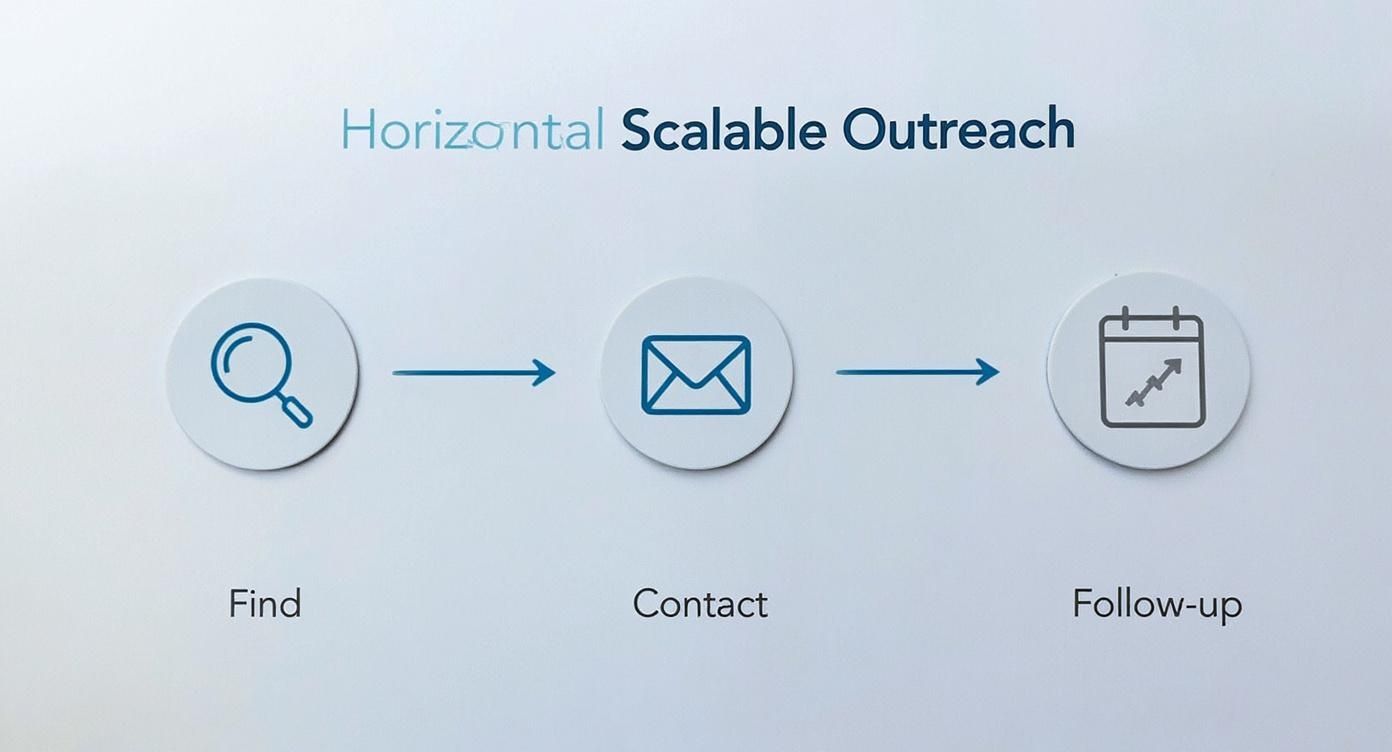
    This infographic breaks down a simple, scalable outreach process that you can measure and optimize at every single stage.

    Infographic about how to generate b2b leads

    As you can see, the process is broken into three key steps: Find, Contact, and Follow-up. Each one is a clear opportunity to measure what you're doing and make it better.

    Set up a simple dashboard—even a Google Sheet works—to see your data clearly. This makes it easy to spot trends and figure out where you can improve. When you consistently track your numbers, test new ideas, and go all-in on what works, you transform lead generation from an unpredictable art into a data-driven science.

    Got Questions About B2B Lead Gen? We’ve Got Answers.

    When you're deep in the trenches of B2B lead generation, a few common roadblocks always seem to pop up. Whether you're building your strategy from scratch or just fine-tuning what you already have, getting these fundamentals right can be the difference between a stalled pipeline and a flood of opportunities.

    Let's tackle one of the biggest questions I hear all the time: "How many follow-ups are too many?"

    Honestly, most teams stop way too soon. The data doesn't lie—most positive replies happen after the fourth or even fifth touchpoint. But here's the catch: it's not about the number, it's about the value. Each follow-up has to bring something new to the table, not just be a carbon copy of your first email.

    The secret to great follow-ups is helpful persistence, not annoying repetition. If every email offers a fresh insight or a new way to solve your prospect's problem, you earn the right to keep showing up in their inbox.

    Another massive pain point is lead quality. It’s easy to get a long list of names, but turning those names into actual conversations? That's a different game entirely.

    MQL vs. SQL: Know The Difference or Waste Your Time

    This is where so many teams drop the ball. Mixing up a Marketing Qualified Lead (MQL) with a Sales Qualified Lead (SQL) is a recipe for a frustrated sales team and a ton of wasted effort.

    • Marketing Qualified Lead (MQL): Think of this as someone who's shown some interest. They downloaded your latest ebook or signed up for your newsletter. They're curious, but they are not ready for a sales call. These folks need more nurturing.
    • Sales Qualified Lead (SQL): This is someone who's raised their hand and shown real buying intent. Maybe they requested a demo or filled out your "contact sales" form. These leads need to go straight to your sales team, no detours.

    Finally, there’s always the debate about which channel is "best." While the right answer always depends on your specific customer profile, some channels just consistently deliver.

    For instance, a whopping 32% of B2B marketers point to webinars as their top channel for netting high-quality leads. Why? Because they’re interactive and let you showcase your expertise in real-time, which builds trust faster than almost anything else.

    At the end of the day, generating B2B leads that actually convert comes down to focusing on quality conversations, understanding where each lead is in their journey, and picking channels that let you build real authority. Nailing these basics will put you on the fast track to a predictable and scalable pipeline.


    Ready to stop guessing and start finding the right contacts in one click? EmailScout is the powerful Chrome extension that helps you discover verified email addresses of decision-makers effortlessly. Build your marketing lists and supercharge your outreach for free. Get started with EmailScout today.