Tag: b2b sales strategy

  • Cold Calling vs Cold Emailing The Definitive Sales Guide

    Cold Calling vs Cold Emailing The Definitive Sales Guide

    When it comes to the great cold calling vs. cold emailing debate, the difference boils down to this: cold calling is immediate and personal but tough to scale. Cold emailing is scalable and efficient but feels less direct. Your choice really depends on what you value more—high-touch, personal engagement for big-ticket sales, or broad, efficient outreach to fill a volume-based pipeline.

    The Modern Sales Debate: Cold Calling vs. Cold Emailing
    Two businessmen compare sales strategies: one is cold calling on the phone, the other is cold emailing on a laptop.

    Picking the right outreach method is a massive decision for any sales team. This isn't just about choosing a channel; it's about making sure your strategy clicks with your target audience, sales cycle, and the bigger picture of your business goals. While both are designed to turn strangers into customers, they work off completely different playbooks for engagement and resource management.

    Cold calling is the old-school heavyweight of sales, relying on direct, real-time phone conversations. It's fantastic for building instant rapport and crushing objections on the spot. You'll often see this method used for high-value, complex deals where a genuine human connection can seal the deal.

    On the other hand, cold emailing is the modern, asynchronous approach. It's text-based and lets prospects engage whenever it suits them. The biggest wins here are scalability and efficiency. A single rep can hit up hundreds of potential leads in the time it takes to make just a handful of calls. This makes it a go-to for SaaS companies, startups, and any team aiming for a wide market.

    Cold Calling vs. Cold Emailing Quick Comparison

    To help you quickly grasp the fundamental differences in efficiency and outcomes, here’s a side-by-side comparison of key performance indicators.

    Metric Cold Calling Cold Emailing
    Speed of Connection Immediate (if answered) Delayed (hours or days)
    Scalability Low (one-to-one) High (one-to-many)
    Prospect Disruption High (interruptive) Low (non-intrusive)
    Personalization Adaptive, in-the-moment Data-driven, at scale
    Cost Per Lead Higher Lower
    Ideal For High-value, complex sales Volume-based pipelines, SaaS

    As you can see, each channel has its clear strengths. The key is understanding how these metrics align with your specific sales motion and resources.

    Core Comparison Criteria

    To really get to the bottom of the "cold calling vs. cold emailing" dilemma, we need to measure them against the same yardstick. Throughout this guide, we'll break down each strategy using four crucial factors:

    • Cost and Scalability: A hard look at the financial and operational muscle needed to run each strategy effectively.
    • Response and Conversion Rates: Digging into which method actually gets more replies and, more importantly, books more meetings.
    • Lead Quality: An honest assessment of the engagement quality and how that translates to real pipeline value.
    • Ideal Use Cases: Pinpointing the exact scenarios where one channel is the obvious winner over the other.

    The smartest outreach strategy is rarely a choice between one or the other. The truly successful sales teams know exactly when to shoot off an email and when to pick up the phone, weaving them together into a powerful, multi-touch sequence.

    This guide gives you a data-backed framework to help you make smarter decisions, making sure your outreach efforts hit the mark every time.

    Comparing Scalability and Return on Investment

    Two people analyzing business growth data on a tablet, one pointing while the other smiles.

    When you get down to the brass tacks of running a sales team, two things matter more than anything: scalability and return on investment (ROI). It's here that the differences between cold calling and cold emailing really come into sharp focus. For any team trying to build sustainable growth, these numbers tell the real story of what each channel costs and what it can deliver.

    Cold calling, at its core, is a one-to-one game. Every single dial demands a rep's undivided attention—from the prep work to navigating the call itself and logging the notes afterward. This human touch is exactly what makes it great for building rapport, but it's also its biggest operational weakness.

    On the other hand, cold emailing is practically built for scale. You can take one well-written template, personalize it, and get it in front of hundreds of prospects in the time it takes a rep to make a handful of calls. It's a one-to-many approach that's just flat-out more efficient.

    The Economics of Outreach Volume

    This gap in scalability directly shapes how many people a single rep can actually reach in a day. The numbers don't lie, and they paint a pretty clear picture.

    A dedicated sales rep who is purely cold calling might manage 6-9 calls per hour. That number isn't just dialing—it's everything that goes with it, like getting past gatekeepers, leaving voicemails, and having the actual conversations. It's a slow, methodical grind.

    Now, flip that. A rep armed with an email automation platform can send 80-120 personalized emails per hour. That massive difference in sheer output means your team can test markets, collect data, and pack the top of your funnel at a speed that's impossible to match with manual dialing.

    The scalability debate boils down to simple math. One channel is linear—you add one prospect at a time. The other is exponential—you can engage entire segments of your market all at once.

    For any team with aggressive growth targets, that distinction is a game-changer. Email lets you build momentum fast, whereas calling requires a much larger—and more expensive—team to get anywhere near the same reach.

    Analyzing the Return on Investment

    At the end of the day, the only metric that truly matters to a sales leader is ROI. When you stack up the costs against the results, cold email pulls way ahead. That efficiency translates directly to a better cost-per-lead and a much healthier return.

    The data shows cold emailing just crushes cold calling from a financial standpoint. On average, email marketing can bring in up to $42 for every $1 you spend. Cold calling? It generates about $1.80 per dollar invested. That massive gap is exactly why so many modern sales teams build their outreach strategy around email first.

    This all comes back to the high labor costs tied to calling. A sales rep's salary is your biggest expense, and because their time results in fewer contacts per hour, the cost for each interaction is naturally much higher. While tools like a CRM with VoIP integration can certainly make calling more efficient and trackable, they can't change the fundamental economics.

    Even with the best tech, the math is what it is. For businesses that need to stretch every dollar in their outreach budget and show a clear, positive return, cold emailing is the smarter financial bet. Its low overhead and incredible scalability make it a powerhouse for generating leads without draining your bank account.

    Analyzing Response Rates and Lead Quality

    Beyond the costs and scalability, the real debate between cold calling and cold emailing boils down to a simple question: which one actually gets a response? And just as important, which one delivers leads who are genuinely ready to talk? This is where we stop looking at volume and start focusing on the quality of engagement.

    A successful cold call can feel like a massive win, but the data often shows email pulling in a higher number of initial replies. Cold emailing just works on a different psychological level. It’s less intrusive, and it gives prospects the space to engage when they’re ready, which often translates to more thoughtful initial interest.

    On the other hand, a cold call is an interruption by nature. When a rep manages to get a decision-maker on the line, the conversation is immediate and alive. That real-time interaction is unmatched for instantly qualifying a lead, handling objections on the spot, and building a human connection.

    Dissecting the Numbers: Open Rates vs. Conversation Rates

    To figure out which channel really performs, we need to look at their core engagement metrics. For email, it's all about opens and replies. For calls, it’s connection and conversation rates.

    When you compare response rates, cold emailing usually has an advantage in raw volume, especially for B2B teams focused on scalable growth. The numbers show that cold emails can average a 24% open rate and an 8.5% response rate. Highly tuned campaigns can even push opens to 55% and responses to an incredible 30%.

    In contrast, a solid cold calling strategy might hit a 13-14% response rate, but getting there takes serious persistence—we’re talking up to six calls to land a single conversation. You can learn more about how to boost these numbers by checking out our guide on improving your cold email response rate.

    Research from Cognism drives this point home, showing a 65.6% success rate for calls that actually lead to a conversation. The catch? The overall success rate for calling has plummeted to just 2.3%, mostly because a staggering 80% of calls go straight to voicemail. These numbers, which you can find more of over on HubSpot's blog, clearly show the uphill battle callers are facing.

    The Quality of Engagement: Direct vs. Asynchronous

    The raw numbers are one thing, but the quality of the lead you get from each channel is a whole different story. A positive reply to a cold email often signals genuine, considered interest. The prospect took the time to read your message, think about your offer, and decide to respond on their own terms. That lead has essentially pre-qualified themselves.

    A great cold call, however, can produce an exceptionally high-quality lead. A direct conversation lets a skilled rep dig into deep pain points, answer complex questions, and forge a personal connection that email just can't replicate.

    A great cold call can turn a lukewarm prospect into a hot lead in five minutes. A great cold email plants a seed that requires careful nurturing to grow into a qualified opportunity.

    This fundamental difference in engagement style has a huge impact on the sales cycle.

    • Cold Calling Leads: These leads often move faster through the sales funnel. The direct qualification and rapport built during that first call give them momentum. They're typically a better fit for high-value, complex sales where building trust is everything.
    • Cold Emailing Leads: These leads might need more follow-up and nurturing, since the initial connection is less personal. But the scalability of email lets you fill the top of your funnel with a much larger pool of these interested prospects.

    Ultimately, deciding between cold calling and cold emailing for lead quality comes down to your sales model. Are you hunting for a few big "whales" where that personal touch is critical? Or are you casting a wide net, hoping to catch as many potential customers as you can? Answering that question is the key to aligning your outreach with your business goals.

    Choosing Your Outreach Strategy: When to Call vs. Email

    Picking between a cold call and a cold email isn't about which one is "better"—it's about knowing which tool to pull out of the toolbox for a specific job. The right choice depends entirely on your ideal customer, how complex your product is, and the typical length of your sales cycle. Instead of a hard-and-fast rule, think of it as a strategic framework that guides you to the best channel for each scenario.

    For instance, if you're chasing a high-value enterprise deal with a long, complicated sales process, the direct, personal connection of a cold call is almost always the way to go. On the flip side, a SaaS startup that needs to get in front of a huge audience quickly will find cold emailing a much more powerful engine for growth.

    This infographic breaks down the core engagement numbers, showing how the high conversation rate from calling stacks up against the typical open rate for emailing.
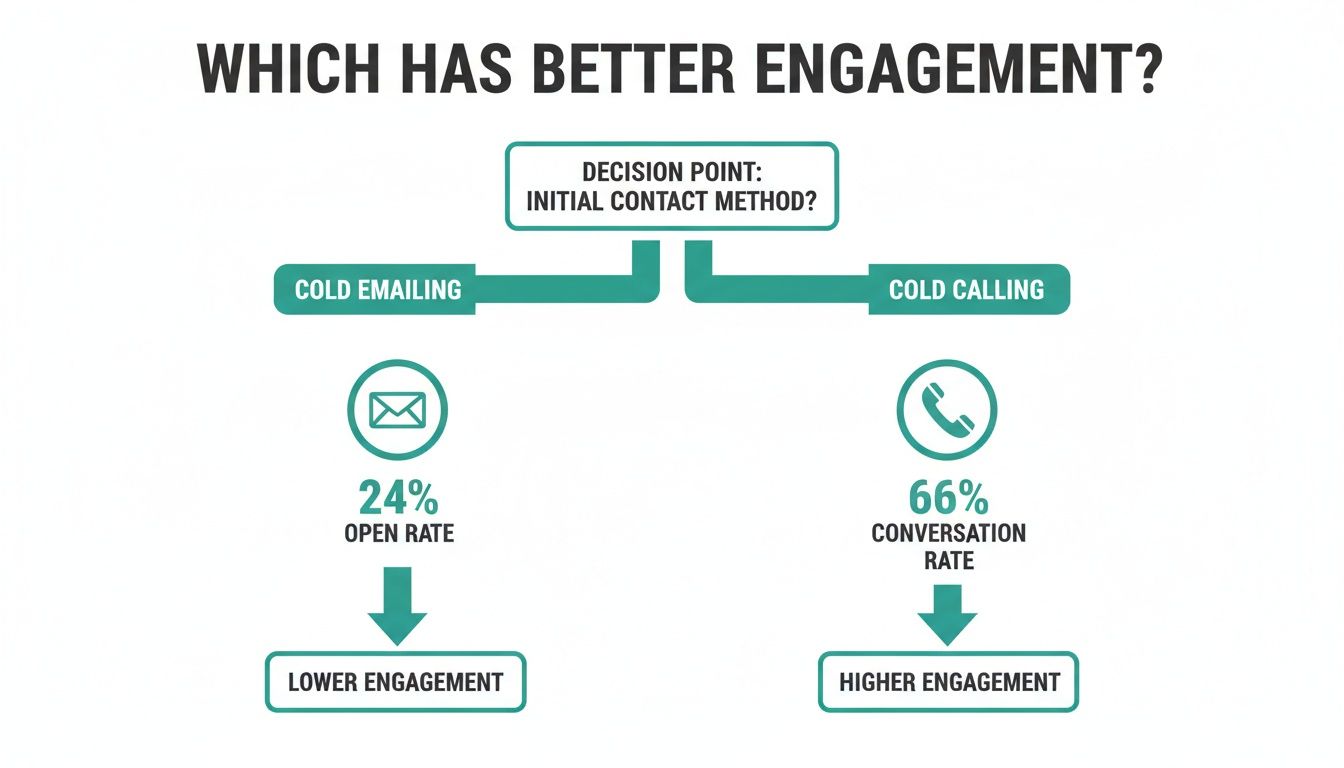
    Infographic comparing cold emailing (24% open rate) versus cold calling (66% conversation rate) for engagement.

    The data is pretty clear: while you might connect on fewer calls, the ones that get through have a much higher chance of becoming a real conversation than an email has of just being opened.

    When Cold Calling Wins

    Cold calling shines in situations where building instant, personal rapport is what moves a deal forward. It's the right move for high-stakes scenarios that need a human touch to cut through complexity and build real trust.

    You should be cold calling when:

    • Your Deal Size is Large: For six-figure contracts or major enterprise solutions, the time invested in a direct conversation is a no-brainer. Handling objections on the fly and making a personal connection can make or break the deal.
    • The Product is Complex: If what you're selling needs a detailed explanation or a consultative approach, a phone call beats an email every time. You can pivot your pitch in real-time based on how the prospect reacts.
    • You're Targeting Senior Executives: C-level leaders are usually guarded by gatekeepers. A confident, well-timed phone call can often slice through the noise better than an email that gets buried in a crowded inbox.
    • Urgency is a Factor: When a market shift or competitor move creates a time-sensitive opening, a direct call telegraphs that urgency and lets you qualify the opportunity immediately.

    Cold calling is an act of precision and impact. It’s not about the volume of dials but the quality of the conversation. Use it when the value of the potential relationship outweighs the inefficiency of the method.

    Cold calling still holds its ground for landing high-quality leads in complex B2B sales. Research shows a conversation success rate of 65.6% for calls that actually connect, with average call times stretching to 93 seconds. Digging deeper, some data suggests that 51% of leads can come from cold calls, a channel that 80% of sales directors still see as essential. However, the overall B2B cold call success rate hovers around 5%, even though 82% of buyers have accepted meetings from calls—often after an average of eight attempts. You can see more cold calling statistics from Cognism to get the full picture.

    When Cold Emailing is the Smarter Choice

    Cold emailing is the engine of modern, scalable outreach. Its power is in efficiency, data-driven optimization, and its non-intrusive nature. This makes it perfect for reaching a broad audience without a massive time sink.

    Choose cold emailing when:

    • Scalability is the Goal: If your business model depends on a high volume of leads at the top of your funnel, nothing beats email. A single sales rep can reach out to hundreds of prospects in the time it takes to make a dozen phone calls.
    • Your Target Audience Prefers It: Let's be honest, many professionals—especially in tech and SaaS—prefer to communicate on their own time. An email lets them review your pitch without being interrupted.
    • You Need to Reach Multiple Stakeholders: For deals that require buy-in from a whole committee, an email is easily forwarded and shared among decision-makers. It ensures your message gets seen by the entire team.
    • Your Offer is Straightforward: For products with a simple value proposition that doesn't need a long explanation (like a free SaaS trial), email is the perfect vehicle for sparking initial interest and driving clicks.

    Building a Hybrid Outreach Strategy That Works

    A desk with a laptop showing email, a phone, and notebooks, with a 'HYBRID OUTREACH' sign.

    The best sales teams I know have stopped debating "cold calling vs. cold emailing." They've moved on. They figured out that the real magic happens when you stop picking sides and start combining them into a smart, multi-touch sales cadence. This hybrid approach gives you the best of both worlds: the sheer scale of email and the personal punch of a phone call.

    When you blend both channels, you meet prospects on their own turf. An initial email warms up a completely cold lead, making a follow-up call feel less like an interruption and more like a continuation of a conversation. It's a simple, powerful formula that consistently beats single-channel efforts every time.

    The Modern Hybrid Sequence Framework

    A great hybrid sequence isn't just about sending emails and making calls; it's about timing and telling a cohesive story. You want each step to build on the last, creating a flow that feels helpful, not harassing.

    Here’s a tried-and-true five-step sequence that just works:

    1. Day 1: The Personalized Email. Kick things off with a well-researched email. This isn't a template blast. It should hit on a specific pain point and offer a clear bit of value, ending with a low-pressure call-to-action.
    2. Day 3: The Follow-Up Call. Did they open your email but not reply? That's your green light to call. You can immediately reference the email to give the call context, making it feel ten times warmer.
    3. Day 5: The Voicemail and Email Combo. If the call goes to voicemail, leave a short, compelling message. Then, right away, shoot them a quick email saying, "Just left you a voicemail." It’s a simple way to reinforce the touchpoint.
    4. Day 7: The Value-Add Email. Send another email, but this time, don't ask for anything. Share a genuinely useful resource—a case study, a relevant blog post, or an interesting industry article. This positions you as an expert, not just another salesperson.
    5. Day 10: The Final Call and Breakup Email. Give them one last call. If you still don't connect, send a polite "breakup" email to close the loop respectfully. This often gets a response and leaves the door open for later.

    This structured cadence ensures you're persistent without being a pest. You can dive deeper into structuring these multi-step plans by checking out these sales cadence best practices.

    Best Practices for a Seamless Experience

    For a hybrid strategy to really click, every touchpoint needs to feel connected. Your messaging should evolve with each step, referencing what came before to create one continuous conversation. It shows you’re actually paying attention.

    A hybrid strategy works because it adapts to the prospect. An email gives them control, while a call offers a direct connection. By offering both, you empower them to engage on their terms, which dramatically increases your chances of getting a positive response.

    A truly comprehensive approach means understanding how all your channels work together. It’s worth learning more about building a multi-channel communication strategy to refine your outreach even further. At the end of the day, your goal is to create a persistent, professional, and personalized experience that guides your prospect into a real conversation, no matter how they prefer to communicate.

    Finding Accurate Emails to Fuel Your Outreach

    While the whole cold call vs. cold email debate usually focuses on strategy, the success of any email campaign really comes down to one thing: accurate contact data. A perfectly written email is completely worthless if it just bounces back. This is where the real work starts—making sure your outreach actually lands in front of the right person.

    Bad data is the silent killer of email campaigns. I’ve seen sales teams waste countless hours digging around for contact info, only to wind up with a list of old or wrong addresses. That doesn't just waste time; it hurts their sender reputation and tanks deliverability. Effective cold emailing demands a clean, verified list of prospects who actually fit your ideal customer profile.

    Streamlining Your Prospecting Workflow

    This is the exact problem a dedicated tool like EmailScout was built to solve. Instead of spending all day on manual research, it lets sales teams build highly targeted and verified email lists in just a few clicks. It shifts the focus from hunting for data to crafting messages that actually connect with people.

    The platform takes the whole prospecting process and makes it simple, hitting common pain points like data decay and inefficient research head-on. By automating the discovery of verified email addresses, it ensures your messages get to the right inbox and gives every campaign you launch the best possible chance of success.

    This screenshot shows just how clean the interface is. You can start a search right away, making the process of finding contacts incredibly straightforward.

    The simple design really highlights what the tool is all about: making email finding fast and efficient for anyone.

    The biggest bottleneck in scaling cold email outreach isn’t writing the emails—it’s finding the right people to send them to. Solving the data accuracy problem is the first and most critical step to building a predictable sales pipeline.

    When you use a reliable email finder, you fundamentally change the math of your outreach efforts. All those hours you save on manual prospecting can be put back into personalization and follow-ups—the activities that actually get replies and book meetings. For any team trying to maximize ROI, that kind of efficiency is a total game-changer.

    Ultimately, tools like EmailScout are the fuel for your cold email engine. They provide the high-quality data you need to run scalable, effective campaigns that drive real results. To get a better handle on this, you can learn more about how to find anyone's email address in our detailed guide. This makes sure your efforts in the cold calling vs. cold emailing debate are built on a solid foundation, giving your email outreach its best shot at winning.

    Frequently Asked Questions

    Let's dig into some of the most common questions that pop up when you're weighing cold calls against cold emails. These are the details that often make or break an outreach strategy.

    Is Cold Calling Still Effective Today?

    Absolutely, but its job has changed. Blasting a generic list with hundreds of calls a day? That's dead. It's inefficient and, frankly, a bit annoying.

    But strategic, well-researched cold calling is more powerful than ever. When you're trying to land a high-value client or navigate a complicated deal, a direct conversation is often the only way to cut through the noise. Think of it as a precision tool for building immediate rapport, not a sledgehammer for generating volume.

    What Is a Good Success Rate for Cold Emailing?

    Success rates can swing wildly depending on your industry and how clean your contact list is. That said, some solid benchmarks to aim for with a good campaign are a 20-30% open rate, a 5-10% reply rate, and ultimately, a 1-2% meeting booked rate. Hitting these numbers means your process is working.

    Keep in mind, these are just baselines. If you're running a hyper-personalized campaign to a small, niche audience, you can blow these numbers out of the water. The three things that always move the needle are the quality of your list, how well your message solves a real problem for the prospect, and simple, clear writing.

    A strong cold email campaign isn't just about getting a "yes." It's about starting a conversation. Even a "not right now" reply is a valuable piece of feedback that helps you refine your targeting and messaging for the future.

    How Do I Best Combine Calling and Emailing?

    The magic happens when you stop thinking of them as separate tactics and start weaving them into a multi-touch sales cadence. This approach leverages the strengths of both channels and respects your prospect's time.

    A sequence that consistently gets results looks something like this:

    1. Start with a Personalized Email: Lead with a thoughtful, well-researched email. It's a low-pressure way to introduce yourself and provide immediate context.
    2. Follow Up with a Call: A day or two later, pick up the phone. You can reference the email you sent, which instantly makes the call feel warmer and less "cold."
    3. Use a Voicemail and Email Combo: If they don't pick up, leave a short, compelling voicemail and immediately send a follow-up email. This creates a powerful one-two punch across two different channels.
    4. Continue the Sequence: Keep mixing your touchpoints over the next several days, alternating between calls and value-packed emails.

    This integrated strategy meets prospects where they are and dramatically increases your odds of getting a meaningful conversation started.


    Ready to supercharge your cold email outreach with verified contacts? EmailScout helps you find accurate email addresses for decision-makers in seconds, ensuring your messages always land in the right inbox. Start finding unlimited emails for free today.


  • What is social selling? A Practical Guide to Boost Your Sales

    What is social selling? A Practical Guide to Boost Your Sales

    Let's cut through the noise. What really is social selling?

    Forget the buzzwords for a second. At its core, social selling is about using social media platforms to find the right prospects, build real connections, and ultimately, hit your sales goals. It’s a shift away from the old-school, interruptive cold-calling model.

    Instead of being just another unread email or an unwanted phone call, you become a valued resource.

    What Is Social Selling at Its Core

    A person uses a laptop and smartphone for social selling, interacting with social media profiles.

    Imagine you're at a big industry conference. You wouldn't just walk around the room, blindly shoving business cards into people's hands, right? Of course not. You'd join a conversation, offer a helpful insight, listen to what others are working on, and build a little rapport.

    That's exactly what social selling is, just in a digital space. You're building a reputation as a trusted, knowledgeable expert. When people in your network finally need the solution you offer, who do you think they’ll call? The random person who spammed their inbox, or the helpful expert they've been following?

    This strategy flips the script from aggressive, outbound pitching to a more organic, inbound pull. It's all about establishing credibility first. And it works—research shows that a staggering 78% of salespeople who use social media outsell their peers who don't.

    To give you a clearer picture, here’s a quick breakdown of what makes up a solid social selling strategy.

    Social Selling At a Glance

    Component Description
    Prospecting Using social platforms like LinkedIn to identify and research potential customers.
    Engagement Actively participating in conversations, liking, and commenting on prospects' posts.
    Content Sharing Posting valuable, relevant content that addresses your audience's pain points.
    Relationship Building Nurturing connections over time, moving from a stranger to a trusted advisor.
    Personal Branding Crafting your social media profile to showcase your expertise and value.

    This table shows how the different pieces work together to create a cohesive, relationship-driven sales process. It’s a marathon, not a sprint.

    From Cold Calls to Warm Conversations

    The fundamental change here is moving from pushing a product to pulling in customers. You accomplish this by consistently providing value long before you ever ask for anything in return.

    Here’s what that looks like in action:

    • Sharing relevant content: You find a great article that solves a common problem for your ideal customer. You don't just post it—you add your own two cents, explaining why it's so valuable.
    • Engaging with prospects: You see a prospect post about a recent company win. Instead of just hitting "like," you drop a thoughtful comment congratulating them and asking a genuine question.
    • Building a personal brand: You optimize your LinkedIn profile so that when someone lands on it, they don't see a resume. They see a resource—a person who understands their industry and can help them succeed.

    Social selling isn't about spamming your product link on social media. It's about using social platforms to build the trust that eventually leads to a sale. You're turning your profile from a static online resume into a dynamic lead-generation machine.

    This relationship-first model is a natural fit for professional platforms where people are already looking to network, learn, and grow. By becoming a familiar, helpful face in their feed, you stay top-of-mind. When the time is right, that sales conversation feels less like a pitch and more like the next logical step.

    The Core Principles of Building Relationships Online

    Close-up of a person in a green shirt reading an article on a tablet with a 'Build Trust' banner.

    Let's get one thing straight: social selling isn't just another buzzword or a new sales tactic. It’s a complete mindset shift. It’s about ditching the old playbook of cold calls and generic emails that interrupt people's days. Instead, you focus on building real connections and earning trust long before a pitch ever enters the picture.

    Think of it this way. You could be the street vendor shouting at everyone who walks by, hoping someone stops. Or, you could be the local expert everyone in the community seeks out for advice. The second approach is built on credibility and genuine helpfulness—and that’s the heart of social selling.

    This process is all about transforming yourself from a salesperson into a trusted advisor. You get there by consistently sharing content that actually helps people, joining in on industry conversations, and positioning yourself as a go-to source for valuable insights. It’s about being useful, first and foremost.

    The goal isn't to push a product. It's to pull in prospects by becoming an indispensable resource in their professional network. This is the essence of building digital trust.

    From Seller to Trusted Advisor

    Becoming that trusted advisor online really boils down to three key activities. Nail these, and you'll build the momentum you need to create a magnetic personal brand.

    • Establish Credibility: Start sharing insights, industry news, and expert opinions that speak directly to your prospects' biggest headaches. This isn't about you; it's about showing you understand their world.
    • Nurture Relationships: Don’t just be a passive observer. Engage thoughtfully with posts from people in your network. A meaningful comment or a shared article is a thousand times more powerful than a simple "like."
    • Listen Actively: Pay close attention to what people are talking about online. Social conversations are full of buying signals, like when a prospect asks for recommendations or announces a new project they're starting.

    These steps are all connected. Each one reinforces the others to help you build authentic, lasting connections. For a deeper dive, our guide on how to build rapport with clients offers even more strategies for creating these strong professional bonds. When you apply these principles day in and day out, you create a powerful attraction engine for your sales efforts.

    The impact is huge, especially on professional networks. On LinkedIn, for example, a staggering 75-85% of all B2B leads are generated from social media. It turns out that sales reps who get good at building relationships and engaging with insights create 45% more sales opportunities than those with weaker social selling skills. It's not just a "nice-to-have" anymore; it's a critical skill.

    Why Social Selling Is a Game Changer for Your Pipeline

    Let's be real—social selling isn't just another buzzword to throw around. It's a fundamental shift in how we build a strong, predictable sales pipeline. Instead of relying on disruptive cold calls and emails, you're building genuine connections that lead to real business. We're talking shorter sales cycles and better close rates.

    Think of it this way: a billboard screams at everyone, hoping for a glance. But a recommendation from a trusted friend? That’s delivered to the right person, at the exact right moment. That’s the power of social selling.

    This relationship-first approach creates a kind of momentum that old-school outreach just can't compete with. When you consistently show up and provide value, you stop being just another salesperson and start being a credible advisor.

    Amplify Your Revenue and Reach

    The numbers don't lie. Teams that get social selling right consistently crush their quotas. In fact, companies that lean into social selling see nearly 60% higher revenue growth compared to those that don't. And with 75% of B2B buyers now using social media to vet their purchasing decisions, can you really afford to sit on the sidelines?

    This is where smart tools give you a serious edge. Say you’ve built some great rapport with a prospect on LinkedIn. You can then use a tool like EmailScout to find their direct email address for a more personal follow-up. It's a simple, effective way to turn a warm social connection into a tangible business opportunity.

    Focusing on authentic engagement isn't just about lead gen. It's about building a foundation of trust that pays off in higher customer lifetime value and more predictable revenue. This is a huge piece of learning how to build a sales pipeline that’s both healthy and sustainable.

    At the end of the day, the real magic of social selling is its ability to help you generate leads on social media like an expert. It transforms your sales process from a numbers game into a relationship-building engine, creating benefits that ripple across your entire pipeline.

    See How the Pros Use Social Selling

    Theory is great, but let's be honest—the real learning happens when you see social selling in action. The best reps aren't just spamming connection requests and hoping for the best. They're running well-oiled plays that build genuine trust and, more importantly, drive revenue.

    Let's break down a couple of powerful examples. These mini-case studies show just how flexible social selling is, whether you're hunting for massive enterprise deals or building a loyal customer base from the ground up.

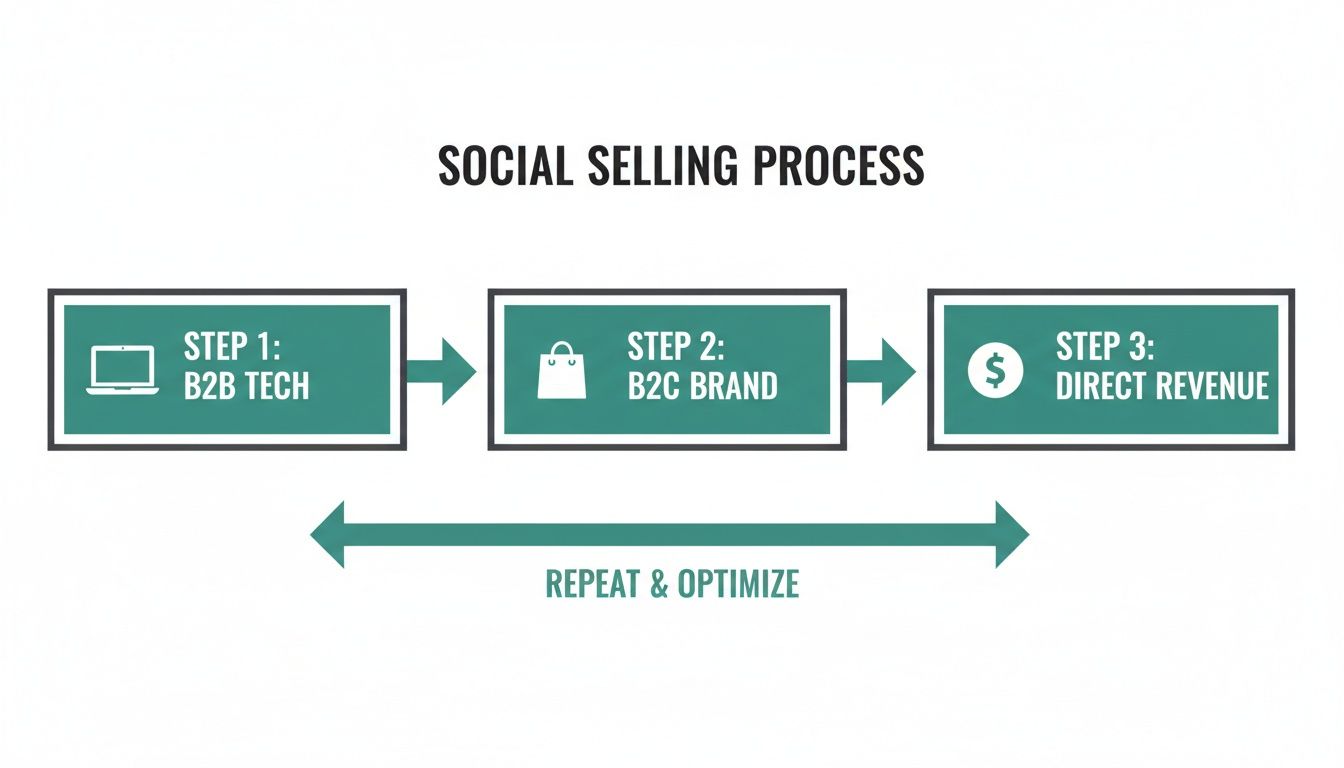
    The B2B Tech Strategist on LinkedIn

    Picture a SaaS salesperson trying to land a huge enterprise client. The old way? A cold email straight to the CIO's inbox that probably gets deleted. The new way is much smarter.

    She starts by mapping out the key decision-makers on LinkedIn Sales Navigator. For the next few weeks, she doesn't pitch a thing. Instead, she just engages. She'll share insightful articles about the exact problems that company is facing, maybe tagging a few industry experts (but never her targets directly—that's too aggressive).

    She also leaves thoughtful comments on her prospects' posts. Not just "great post!" but smart questions or genuine praise that shows she's actually paying attention. This subtle work positions her as a credible expert, not just another vendor trying to make a sale.

    When she finally sends that connection request, it’s warm and personalized: "Hi [Name], I've been following your work on [Project] and was seriously impressed. I found this article on [Topic] and thought your team might get some value out of it." The groundwork has already been laid. The conversation starts on the right foot, and when it's time to take it offline, it feels like the natural next step. This is the perfect time to use a tool like EmailScout to find their direct email and continue the conversation privately.

    The B2C Brand Builder on Instagram

    Now, let's switch gears to a direct-to-consumer wellness brand. Their game is all about building a community that buys. They use Instagram for more than just pretty pictures; it's a direct line to their customers.

    When a customer posts a photo using their product, the brand doesn’t just tap "like." They leave a meaningful comment and then slide into their DMs.

    That first message is never a sales pitch. It’s a simple thank you, maybe with a small discount code for their next purchase as a genuine token of appreciation. That one small act can turn a happy customer into a vocal brand advocate. They also use Instagram Stories to host live Q&As with the founder, building incredible trust by making themselves accessible.

    The big takeaway from both examples is this: lead with value, build a real relationship, and you'll earn the right to ask for the sale.

    This isn't just "good marketing"—it's about tapping into a massive shift in how people buy. The global social commerce market is expected to blow past $1.17 trillion by 2026. That number proves people are more than comfortable buying directly from the platforms where they already spend their time. You can explore more on these e-commerce trends to see how social media is becoming a core sales channel, making social selling a direct line to revenue.

    Your Five-Step Social Selling Implementation Plan

    Alright, let's get down to brass tacks. Moving from theory to action is where most people get stuck. A solid social selling program isn't about random likes and comments; it's a repeatable system designed to turn your social media activity into a predictable pipeline.

    This five-step framework will walk you through the process, breaking it down into manageable chunks. By following this roadmap, you can systematically build relationships, establish yourself as an authority, and gently guide prospects toward becoming paying customers.

    Step 1: Craft a Magnetic Social Profile

    Before you send a single message, your profile needs to do the heavy lifting for you. Think of it as your digital storefront. When a prospect lands on your page, it should scream, "This is who I help and this is the problem I solve."

    Your profile is a resource, not a resume.

    • Optimize Your Headline: Ditch the generic job title. Use a value-driven headline that grabs attention, like "Helping SaaS companies shorten their sales cycle with automation." It instantly tells people what you do for them.
    • Use a Professional Photo: It sounds basic, but a clear, high-quality headshot builds trust and makes you seem approachable. No blurry vacation pics.
    • Tell a Story in Your Summary: Your bio section is prime real estate. Use it to speak directly to your ideal customer's pain points and position yourself as the person with the solution.

    Step 2: Pinpoint and Connect with Ideal Customers

    With a polished profile, it’s time to find the right audience. Firing off connection requests to everyone is the digital version of cold calling from a phonebook—it just doesn't work. You have to be precise.

    Use the powerful search tools built into platforms like LinkedIn Sales Navigator. You can filter prospects by industry, company size, specific roles, and even recent job changes. As you start identifying the key decision-makers, you can build a highly targeted outreach list.

    This is where a tool like EmailScout comes in handy. It lets you find professional emails directly from social profiles, which is perfect for this stage. For a full walkthrough, check out our guide on how to find emails on LinkedIn. It'll really streamline your process.

    Flowchart of the social selling process, featuring steps: B2B tech, B2C brand, direct revenue, plus repeat and optimize.

    As you can see, capturing a prospect's email can be as simple as a single click, integrating perfectly into your workflow.

    Step 3: Engage with Valuable Content

    Now that you've connected, the real work begins. The goal is to become a familiar, trusted name in their feed. You don’t do this by pitching your product every day. You do it by consistently providing value.

    Share articles you know they'll find interesting. Leave thoughtful comments on their posts that add to the conversation. Create your own content that tackles common problems in their industry. Think of every single interaction as a small deposit into the "trust bank." For more on this, check out this step-by-step guide to generating leads on Facebook for some proven tactics.

    A good rule of thumb is to give value 90% of the time and only ask for a conversation 10% of the time. This keeps you from being seen as just another salesperson.

    Step 4: Nurture Relationships into Opportunities

    As you build that rapport, you can start shifting conversations from public comments to private messages. This is the delicate transition from being just another connection to becoming a potential sales opportunity.

    Your direct messages should always be personalized. Reference a recent post of theirs or a shared interest. Ask open-ended questions to get a better feel for their needs. The idea is to gently guide the chat toward a discovery call, but only when the timing feels right.

    Step 5: Measure What Matters

    Finally, you have to track your efforts to see what’s actually working. Forget vanity metrics like likes and follower counts. They don't pay the bills. Instead, measure the things that directly impact your pipeline.

    • Connection Acceptance Rate: Are your personalized requests hitting the mark?
    • Engagement Rate: Are people actually interacting with the content you share?
    • Conversations Started: How many of your DMs are turning into real back-and-forth dialogue?
    • Meetings Booked: This is the big one. How many of your social interactions are turning into scheduled calls?

    If you're not measuring your social selling efforts, you're just guessing. Likes and follower counts are nice for the ego, but they don't exactly pay the bills. To prove your strategy is actually working, you have to connect your activity to the one thing that matters: your sales pipeline.

    True success isn't about going viral—it's about systematically turning conversations into conversions. That means drawing a clear line from your social media activity to real business results.

    Key Metrics That Actually Move the Needle

    To get a clear picture of what’s working, you need to track metrics that show progress at each stage of the relationship-building process. Start with these foundational KPIs to understand where your efforts are paying off and where you need to make some tweaks.

    Here are the essentials to keep an eye on:

    • Connection Acceptance Rate: This tells you how well your personalized outreach is landing. If the rate is low, it’s a good sign that your profile or your initial message needs some work.
    • Engagement Rate: Are people actually interacting with your content? This isn’t just about likes; it's about meaningful comments, shares, and direct messages that show you’re providing real value.
    • Pipeline Influence: This is the ultimate test. You need to track how many discovery calls, booked demos, and new CRM opportunities came directly from your social selling activities.

    A great starting point is LinkedIn's Social Selling Index (SSI). This free tool scores you on four key pillars: building a professional brand, finding the right people, engaging with insights, and nurturing relationships. A higher score often directly correlates with creating more sales opportunities.

    Proving Your Return on Investment

    When you track these metrics properly, you can draw a straight line from a simple LinkedIn comment all the way to a closed deal.

    Think about it. When you can walk into a meeting and show that your social selling activities led to a 20% increase in qualified leads last quarter, you're not just justifying your time—you're proving ROI. This data gives you the power to double down on what works and get even better results.

    Got Questions About Social Selling? Let's Clear Things Up

    Even with the best roadmap, a few questions always pop up when you're getting started. Let’s tackle the most common ones so you can move forward without any confusion.

    Social Selling vs. Social Media Marketing

    It’s easy to mix these two up. They both happen on social media, but their goals couldn't be more different.

    • Social Media Marketing is all about broadcasting. It’s a one-to-many game, like putting up a billboard on a busy highway. The aim is to build brand awareness and cast a wide net.
    • Social Selling is the polar opposite. It’s a one-to-one strategy focused entirely on building genuine relationships. Think of it as having a quiet, personal conversation at a coffee shop instead of shouting from a megaphone.

    Marketing sets the stage and builds the brand’s reputation. Social selling steps onto that stage to turn that reputation into real, one-on-one sales conversations.

    What Are the Best Tools for the Job?

    The right tech can make a massive difference. For finding and keeping tabs on the right people, LinkedIn Sales Navigator is an absolute powerhouse. It's built for precision prospecting.

    But what about when you’ve built that initial rapport and want to take the conversation to a more professional setting? That's where tools like EmailScout come in. Once you’ve connected and warmed up a prospect, you can find their direct email with a single click. It’s the perfect way to move from a casual chat to a more formal follow-up.

    The ultimate social selling toolkit isn’t just one thing. It’s a combination of platforms for building relationships and tools for making direct, personalized contact. The goal is to move smoothly from a public comment to a private conversation that delivers real value.

    How Do You Actually Measure ROI?

    This is the big one. Forget vanity metrics like likes and follower counts—they don't pay the bills. To measure the real return on investment, you have to track KPIs that are directly tied to sales.

    Focus on what moves the needle: your connection acceptance rate, how many DMs actually turn into meaningful conversations, and the most important metric of all—how many meetings get booked directly from your efforts on social media.


    Ready to turn those social connections into leads you can actually act on? EmailScout helps you find anyone's professional email in a single click, making your outreach smooth and effective. Start finding emails for free today.

  • What Are Outbound Sales and How Do They Drive Growth

    What Are Outbound Sales and How Do They Drive Growth

    Outbound sales is all about making the first move. Instead of waiting for customers to find you, your sales team actively seeks them out through channels like cold calls, targeted emails, and social media. It's the art of starting the conversation yourself.

    Defining Outbound Sales: The Proactive Growth Engine

    A man plans outbound sales strategy, looking at a map and using a laptop at his desk.

    Think of your business like a fishing boat. You could drop a net and wait for fish to swim into it—that's inbound. Or, you could use a fish finder to locate the most promising spots, head directly there, and cast your line. That’s outbound sales. You don't wait for opportunities; you create them.

    This strategy hinges on identifying potential customers who perfectly match your Ideal Customer Profile (ICP), even if they've never heard of you. Your team initiates every single interaction.

    The Core Philosophy of Modern Outbound

    Outbound has come a long way from the old-school, aggressive sales tactics. Today, it’s about intelligent, value-driven outreach. The goal isn't just to close a deal on the first call but to start a real conversation by showing you understand a prospect’s problems and have a solution that can genuinely help.

    At its heart, this is a "push" strategy—you’re pushing your message out to a carefully selected audience. Understanding the difference between push and pull marketing for B2B demand generation is key to building a smart, effective outbound plan.

    At its core, outbound sales is about precision and control. It gives you the power to choose exactly which markets and companies you want to pursue, rather than leaving growth entirely to chance.

    Key Outbound Activities

    While the methods can vary, they all share one thing: proactive engagement. The most common activities include:

    • Cold Calling: Picking up the phone and calling prospects to introduce your business and qualify their needs.
    • Cold Emailing: Sending personalized emails to get a foot in the door with key decision-makers.
    • Social Selling: Using platforms like LinkedIn to connect with potential clients and build relationships.

    This proactive engine is a must-have for any business serious about growth. By actively hunting for new opportunities, companies can build a predictable and scalable revenue stream that perfectly complements the leads coming in from other channels.

    The Modern Outbound Sales Process From Target to Close

    A winning outbound sales strategy isn't just a series of random acts—it's a structured, repeatable process. Think of it like building a high-performance engine. Every single part has to be perfectly tuned and work in harmony to generate real momentum. This methodical approach is what separates the top-performing teams from everyone else just spinning their wheels.

    The whole process is designed to take someone from being a complete stranger to a happy customer. It starts with laser precision—knowing exactly who to talk to—and ends with a closed deal, creating a predictable stream of revenue.

    Stage 1: Building Your Ideal Customer Profile

    Before you even think about sending an email or making a call, you have to know who you’re talking to. This is the foundation of the entire outbound process, and honestly, it’s the most important part. If you don't have a clear target, you're just shooting in the dark.

    This is where your Ideal Customer Profile (ICP) comes in. An ICP is a super-detailed description of the exact type of company that gets the most value from what you sell. It goes way beyond industry and company size, digging into things like their revenue, the tech they use, and the specific headaches they're trying to solve.

    A solid ICP is your North Star, guiding every single decision you make from here on out. To really nail this crucial first step, check out our guide on how to identify your target audience.

    Stage 2: Prospecting and List Building

    Once you know who you're looking for, it's time to actually find them. This is where you build a list of specific companies that match your ICP and pinpoint the key decision-makers inside those organizations. Data accuracy here is completely non-negotiable.

    An inaccurate list will kill your outbound campaign faster than anything else. You'll get bounced emails, call the wrong people, and waste a ton of time, all while making your brand look bad. This is exactly why tools like EmailScout are so essential—they help sales teams find verified contact info for the right people, making sure your outreach actually gets delivered.

    A successful outbound campaign is built on a foundation of high-quality data. Spending extra time here to ensure your prospect list is clean, accurate, and perfectly aligned with your ICP will pay massive dividends later in the process.

    Stage 3: Crafting and Launching Outreach Sequences

    With a solid list of prospects in hand, it's go-time. Modern outbound isn't about a single email or call; it's about using multi-channel, multi-touch sequences. That means you're engaging prospects across different platforms—like email, phone, and LinkedIn—over a specific period.

    A typical sequence might look something like this:

    1. Day 1: Send a highly personalized email that mentions a specific trigger event or company challenge.
    2. Day 3: Connect on LinkedIn with a short, non-salesy note.
    3. Day 5: Follow up with another email, this time offering something valuable like a case study or a relevant report.
    4. Day 7: Pick up the phone for a cold call to try and have a real conversation.

    The trick is to add value with every single touchpoint, not just beg for a meeting. For teams wanting to scale these efforts, it's worth understanding how outbound sales automation can manage these sequences and free up your reps' time.

    Stage 4: Qualifying and Running Discovery Calls

    When a prospect finally replies, the next goal is to qualify them. A discovery call isn't a sales pitch. It's a conversation where you dig in to understand their needs, challenges, and goals on a deeper level.

    During this call, your Sales Development Reps (SDRs) ask smart questions to figure out if the prospect actually has a problem you can solve. If the lead is a good fit, the SDR books a more in-depth meeting or demo with an Account Executive (AE). This handoff is critical because it makes sure your AEs only spend their time on opportunities that have a real shot at closing.

    Stage 5: Closing and Onboarding

    The final stage belongs to the Account Executive. They're the ones running the product demo, handling objections, negotiating the contract, and getting the deal across the finish line. This requires a deep understanding of the customer’s business and the ability to show exactly how your solution makes their life better.

    But the work doesn't stop when the contract is signed. A smooth handoff to the customer success or onboarding team is crucial. This makes sure new customers have a great first experience and are set up to get the value they were promised, turning that closed deal into a long-term, successful partnership.

    Mastering Key Outbound Channels and Strategies

    Once you’ve mapped out your outbound sales process, it’s time to get your hands dirty with the actual channels you'll use to connect with prospects. Modern outbound isn't about throwing everything at one channel; it’s about creating a coordinated effort across several touchpoints. Each one has its own rules of engagement.

    Think of your outreach channels like a carpenter's toolkit. You wouldn't use a hammer to cut a piece of wood, right? In the same way, a cold call might be perfect for one prospect, while another will respond better to a well-crafted email. The real magic happens when you know which tool to use and when.

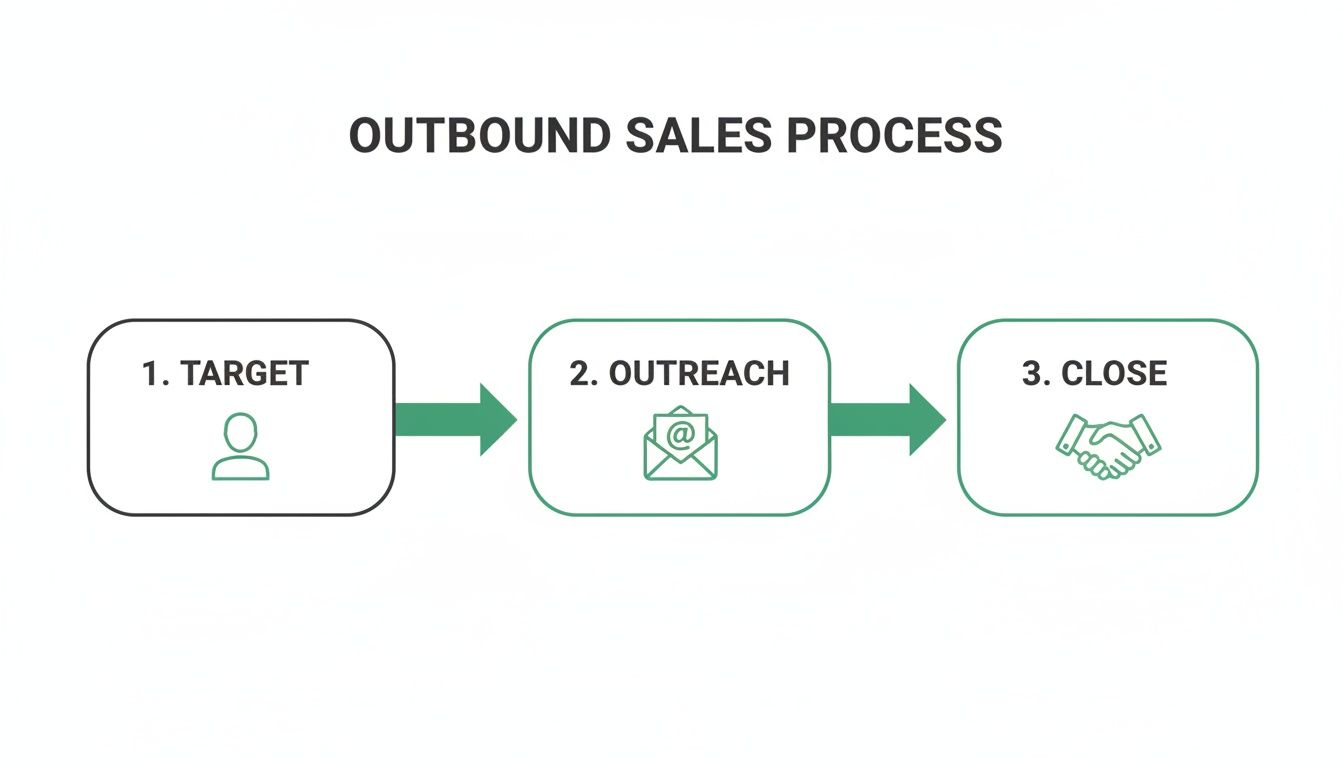
    This simple diagram breaks down how the whole process flows, from identifying the right people to reaching out and, finally, closing the deal.

    Diagram illustrating the three key steps of an outbound sales process: target, outreach, and close.

    As you can see, great outreach starts with precise targeting, and a closed deal is the natural result of effective outreach.

    The Art of the Modern Cold Call

    Don’t believe the rumors—cold calling is far from dead. It’s just evolved. Today’s best cold calls aren't about sticking to a rigid script. They're about using a flexible framework to guide a natural, human conversation. The goal isn’t to sell on that first call; it’s simply to book a proper meeting.

    Telemarketing is still a huge global industry. The outbound telemarketing market is expected to hit USD 11,524.8 million by 2025, proving it's here to stay. Europe is leading the charge with over 30% market share, thanks to new tech making calls smarter and more effective. You can dig into the numbers in this in-depth market report on outbound telemarketing.

    Here’s a simple framework for a better cold call:

    1. The Permission Opener: Start with your name and company, then immediately ask for permission to talk. Something like, "Hi [Prospect Name], this is [Your Name] from [Your Company]. I know I'm calling you out of the blue, do you have 27 seconds for me to tell you why I called?"
    2. Quick, Value-Driven Context: Show you did your homework. "I saw your company recently expanded its logistics division, and we help businesses like yours cut shipping costs."
    3. A Problem-Focused Question: Ask an open-ended question that gets them talking. "How are you currently managing the increase in outbound freight?"
    4. A Clear Next Step: If you sense interest, don't push for the sale. Secure the next meeting. "Sounds like it might be worth a longer chat. Are you open to a 15-minute call next Tuesday?"

    Crafting Cold Emails That Actually Get Replies

    Cold email is easily the most scalable outbound channel, but it's also the most crowded. Your message is fighting for attention in an inbox flooded with hundreds of others. To have any chance, your email needs two things: personalization and value. Every single email should feel like you wrote it for one person, not a mailing list.

    Of course, the foundation of any email campaign is having the right contact info. A perfectly written email is worthless if it lands in the wrong inbox. This is where tools like the EmailScout Chrome extension become essential. It helps you find verified email addresses for key decision-makers with a single click, making sure your messages actually get delivered.

    Your subject line has one job: get the email opened. That's it. Ditch the generic, clickbait titles and focus on being specific, relevant, and a little intriguing.

    To really level up your email game, focus on these three things:

    • A Hyper-Personalized Opening Line: Prove you've done your research. Mention a recent blog post they wrote, a company milestone, or a mutual connection.
    • A Clear Value Proposition: In one or two sentences, explain how you solve a problem they probably have.
    • A Low-Friction Call-to-Action (CTA): Instead of asking for a 30-minute demo, try an interest-based question like, "Are you open to learning more about how we solved this for [Competitor]?"

    For a deeper dive, check out our complete guide on how to write cold emails that convert.

    Building Relationships with Social Selling

    Social selling, especially on a platform like LinkedIn, is the long game of outbound sales. It’s all about building credibility and starting relationships before you ever ask for anything. This approach "warms up" a cold prospect, so when you finally do reach out, you’re not a total stranger.

    But let’s be clear: effective social selling is not about spamming connection requests or sliding into DMs with a sales pitch. It's about consistently adding value for your target audience.

    Start by identifying your top accounts and following the key people there. Engage with their content—and I don't just mean "liking" their posts. Leave thoughtful comments that add to the conversation. Share articles you think they'd find interesting and offer your own perspective on industry trends. When you do this, you slowly position yourself as a trusted advisor, not just another salesperson. Then, when you finally send that direct message, they're far more likely to listen.

    Best Practices for a Winning Outbound Playbook

    Knowing the outbound process is one thing, but actually mastering it is a whole different ballgame. The real difference between teams that just spin their wheels and those that actually scale is their playbook—a core set of principles that guides every single interaction. Building a winning strategy isn't about grinding harder; it's about working smarter with a repeatable, value-first approach.

    The top sales teams don't just get lucky. They operate from a clear playbook that turns cold outreach into real conversations and, most importantly, predictable revenue.

    Embrace Hyper-Personalization at Scale

    Let's be honest—prospects are drowning in generic, templated messages. In this environment, personalization is your most powerful weapon. And I don't mean just slotting in a {first_name} tag. Real personalization shows you've done your homework and actually understand their world.

    This means finding specific triggers that make your outreach feel timely and genuinely relevant.

    • Company News: Did they just announce a funding round, a new product, or a big hire? Mention it. "Saw your recent Series B announcement on TechCrunch—congratulations. As companies scale post-funding, they often face [challenge you solve]."
    • LinkedIn Activity: Reference something they recently posted or commented on. "I really liked your take on the future of supply chain logistics in your post yesterday."
    • Job Postings: If a company is hiring for a specific role, it's a huge clue about their priorities. "Noticed you're hiring for a new data security lead, which usually means managing [problem] is a top priority."

    This kind of detail proves you see them as more than just another name on a list. It cuts through the noise and dramatically boosts your reply rates.

    Design a Multi-Touchpoint Strategy

    If you're only using one channel, you're setting yourself up to fail. Your prospects are busy, and they all have different communication preferences. A solid outbound playbook coordinates a multi-channel sequence to stay on their radar without being annoying.

    A well-designed sequence feels less like a series of cold interruptions and more like a helpful, persistent conversation happening across different platforms.

    A typical strategy might blend email, phone calls, and social selling over a few weeks. Each touchpoint should build on the last, creating one cohesive story. For example, a LinkedIn connection request can reference an email you sent a couple of days ago. This reinforces your message and makes it much more likely they'll engage. You have to meet buyers where they are.

    Master the Art of Polite Persistence

    Newsflash: most deals are not won on the first try. Or the second. Or even the third. Studies show it can take eight or more touchpoints just to get a meeting. This is where the follow-up becomes absolutely critical. But let’s be clear: persistence should never feel like pestering.

    The trick is to add value with every single follow-up. Ditch the lazy "just checking in" emails and offer them something useful instead.

    • Share a case study that’s relevant to their industry.
    • Send them a link to a new industry report you found insightful.
    • Invite them to a webinar you’re hosting on a topic they care about.

    This value-first approach immediately positions you as a helpful resource, not just another salesperson. It flips the follow-up from an "ask" to an "offer," making people far more willing to talk when the timing is right for them.

    Maintain Impeccable Data Hygiene

    Your entire outbound engine runs on data. If that data is bad, your results will be too. Inaccurate or outdated contact info is the silent killer of sales productivity. It leads to bounced emails, wasted calls, and can even get your domain blacklisted.

    Making data hygiene a priority is non-negotiable. This means regularly cleaning your CRM, verifying contact information, and ensuring everything is up to date. Using reliable data validation tools is the only way to maintain this accuracy at scale. Clean data ensures your perfectly personalized messages actually land in the right inbox, maximizing the ROI of every single outreach effort.

    Building Your Essential Outbound Sales Tech Stack

    Modern sales tech stack on a wooden desk with a laptop, tablet, and smartphone showing data.

    A great outbound strategy isn't just about hard work—it runs on the right technology. Think of your tech stack as the engine that powers everything your sales team does, transforming repetitive manual tasks into a smooth, automated process. This frees up your reps to do what they do best: build relationships and close deals.

    Without the right tools, your team is essentially flying blind. They'll waste countless hours on administrative work that software can knock out in seconds. The right combination of platforms creates a single, powerful system where data moves effortlessly from one stage to the next.

    Let's break down the three pillars of a modern outbound tech stack.

    Prospecting and Data Accuracy Tools

    This is ground zero for any outbound motion. Before you can draft an email or pick up the phone, you need one thing above all else: accurate contact information for the right people. Bad data is the fastest way to kill a campaign, leading to bounced emails, wasted calls, and a ding to your sender reputation.

    Tools in this category are your first line of defense.

    • Email Finders: You absolutely need a tool like EmailScout to uncover the verified email addresses of decision-makers. It’s the difference between your message landing in the right inbox or getting lost in the ether.
    • Data Enrichment: These platforms take your basic prospect lists and add layers of valuable context, like company size, industry, and the tech they already use. This is crucial for personalization.

    For a deeper dive, check out this guide to the best sales prospecting tools on the market.

    Sales Engagement Platforms

    Okay, so you have a clean list of prospects. Now what? You need a system to manage your outreach without driving yourself crazy. A Sales Engagement Platform (SEP) is your command center for automating and tracking multi-channel communication.

    Platforms like Outreach or Salesloft let you build and run sequences that weave together emails, calls, and social media touchpoints over a set period. They provide a clear framework for following up, ensuring no prospect ever falls through the cracks. It's this systematic approach that turns outbound from a guessing game into a predictable revenue machine.

    An SEP transforms your outbound strategy from a series of random actions into a disciplined, measurable process. It provides the automation needed for volume and the analytics required for continuous improvement.

    Customer Relationship Management Systems

    The Customer Relationship Management (CRM) system is the heart of your entire sales operation. It's the central database, the single source of truth for every single interaction you have with prospects and customers. Think Salesforce or HubSpot.

    While your SEP handles the top-of-funnel outreach, the CRM tracks the entire journey from the first touchpoint to a closed deal. Every email, call log, and meeting note lives here, giving anyone in the company a complete history of the relationship. This integration is non-negotiable—it ensures that sales, marketing, and support are all working from the same playbook.

    How to Measure Outbound Sales Success

    You can't improve what you don't measure. Running an outbound sales strategy without clear metrics is like trying to navigate a ship in the dark—you're moving, but you have no clue if you’re heading toward your destination or a rocky shore.

    To get a real pulse on how your program is doing, you have to track the numbers that actually matter. This means ditching the vanity metrics and zeroing in on the indicators that show how efficient and effective your team really is. By tracking the right data, you can spot problems early, double down on what’s working, and actually prove the ROI of your outbound efforts.

    Top of Funnel Activity Metrics

    Think of these as the early warning signs for your entire outbound campaign. They tell you right away if your targeting is on point and if your messaging is hitting home with your audience. If these numbers are tanking, nothing else down the funnel is going to work.

    Here’s what to watch:

    • Reply Rate: This is simply the percentage of prospects who actually write back to your emails. A low reply rate is a huge red flag, usually pointing to a problem with your subject lines, your personalization, or the value you're offering.
    • Meetings Booked: This is the name of the game for most top-of-funnel outreach. Tracking how many qualified meetings your SDRs are setting is a direct measure of their ability to turn a cold prospect into a warm conversation.

    Great outbound teams are obsessive about their top-of-funnel metrics. They know that even a 1% bump in reply rates can create a massive ripple effect, leading to a lot more closed deals down the line.

    Bottom of Funnel Business Metrics

    While activity metrics are crucial, these are the numbers that tie your outbound efforts directly to the bottom line. They answer the big question: Are the meetings we're booking actually turning into real business?

    These metrics paint the clearest picture of your success:

    • Conversion Rate: What percentage of those booked meetings become qualified opportunities? And of those, how many turn into closed-won deals? This is the ultimate stress test for both your lead quality and your sales process.
    • Sales Cycle Length: This tracks the average time it takes to go from that first touchpoint to a signed contract. A shorter sales cycle means you're bringing in revenue faster and more efficiently.
    • Customer Acquisition Cost (CAC): This is the total cost—salaries, tools, everything—it takes to land one new customer. A healthy outbound program must have a CAC that is way lower than the lifetime value (LTV) of the customers it acquires.

    Common Questions About Outbound Sales

    As you start to build or fine-tune your outbound sales engine, a few key questions almost always come up. Getting straight answers is the first step to sidestepping common pitfalls and building a solid foundation for growth.

    Here are the no-fluff answers to the questions we hear most often from sales teams just like yours.

    Is Outbound Sales Even Still a Thing?

    Absolutely. While inbound is fantastic, outbound remains one of the most direct ways to land high-value accounts, crack into new markets, and build a revenue stream you can actually predict.

    The secret isn't about blasting more emails or making more calls. It's about shifting from the old-school "spray and pray" tactics to a smarter, personalized approach that genuinely helps your prospect. Done right, outbound is a powerful growth lever for any B2B company.

    An outbound strategy puts you in the driver's seat. Instead of waiting for leads to hopefully find you, your team gets to decide exactly who they want to work with.

    What's the Single Biggest Hurdle in Outbound?

    The obvious challenge is cutting through the insane amount of noise to get a busy decision-maker's attention. That takes a message that’s sharp, relevant, and personal. But before you even get to write that message, you hit a much bigger, more fundamental roadblock: finding accurate contact data.

    Think about it—the most perfectly crafted email or sales script is completely useless if it never reaches the right person. This is exactly why getting reliable data is the make-or-break first step of the entire outbound process.

    How Fast Can We Expect to See Results?

    This really depends on your industry and how complex your typical sales cycle is. You should start seeing early signs of life—like positive replies and meetings getting booked—within the first few weeks of consistent, focused outreach.

    But turning that initial buzz into closed deals and a measurable ROI? That usually takes somewhere between two and six months. This is especially true in B2B, where deals often need buy-in from multiple people and the decision-making process just takes longer.


    Finding accurate contact info shouldn't be the hardest part of your job. EmailScout gives you the verified emails you need to fuel your outreach and connect with the right decision-makers in a single click. Start building better prospect lists today at https://emailscout.io.