

Moving a small business from survival to significant scale requires more than just hard work; it demands a strategic playbook. Many entrepreneurs and sales leaders hit a frustrating plateau where initial momentum wanes, leaving them unsure which levers to pull next for consistent expansion. The critical shift is moving from random, reactive tactics to a focused, repeatable system for acquiring and retaining high-value customers. This transition is the foundation of all effective small business growth strategies.
This guide is designed to provide that system. We break down 10 proven, actionable frameworks that deliver measurable results across the entire customer lifecycle. You won't find vague advice here. Instead, we dive into the specific mechanics of hyper-targeted outreach, building powerful partner ecosystems, and leveraging customer advocacy for exponential growth.
Each strategy is presented as a practical roadmap, complete with implementation steps, key performance indicators (KPIs) to track success, and brief examples. We'll cover everything from precision-targeted Account-Based Marketing (ABM) and cold email outreach to scalable content marketing engines and product-led growth models. Whether you're in B2B SaaS, a professional service firm, or a startup looking to scale, these frameworks will provide the clarity and direction needed to fuel your next stage of expansion. We'll also provide practical notes on how tools like EmailScout can accelerate your outreach and lead generation efforts within these strategies.
1. Cold Email Outreach & Lead Generation
Cold email outreach is a powerful direct marketing strategy for businesses aiming to connect with potential clients who have not previously engaged with their brand. This approach involves sending targeted, unsolicited emails to a carefully curated list of prospects. It's a proactive method for generating leads, particularly effective in the B2B space where identifying key decision-makers is crucial for success.
This strategy works by combining precision targeting with compelling, personalized messaging. Tools like EmailScout are essential for discovering and verifying the email addresses of specific individuals within target companies, ensuring your message reaches the right inbox. When executed correctly, cold email serves as a direct line to potential customers, enabling you to start conversations and book meetings at scale.
How to Implement This Strategy
Successful cold email outreach requires a systematic approach rather than just sending mass emails. Start by defining your ideal customer profile (ICP) to build a hyper-targeted prospect list.
- Build a Targeted List: Use an email finder to identify contacts who fit your ICP. Focus on roles, industries, and company sizes that align with your solution.
- Craft Personalized Messages: Generic emails are ignored. Personalize your outreach by referencing the prospect's company, recent achievements, or industry-specific challenges. A compelling subject line is your first and most important hurdle.
- Develop a Follow-up Sequence: Most responses come from follow-up emails. Plan a sequence of 3-4 polite, value-driven messages sent over two to three weeks. For a deeper dive, explore these proven techniques for writing effective cold emails.
- A/B Test and Optimize: Continuously test different subject lines, body copy, and calls-to-action to see what resonates with your audience.
Key Insight: The goal of a cold email isn't to make an immediate sale; it's to start a conversation. Focus on providing value and sparking curiosity with a single, clear call-to-action, like scheduling a brief call.
This method stands out among small business growth strategies because it is highly scalable and cost-effective. While social platforms are valuable, combining your email efforts with the Top LinkedIn Lead Generation Strategies can create a multi-channel outreach system that significantly amplifies your pipeline and accelerates growth.
2. Account-Based Marketing (ABM)
Account-Based Marketing (ABM) is a focused growth strategy where marketing and sales teams collaborate to target a select list of high-value accounts. Instead of casting a wide net with broad marketing campaigns, ABM treats individual accounts as unique markets, delivering highly personalized experiences to key decision-makers within them.
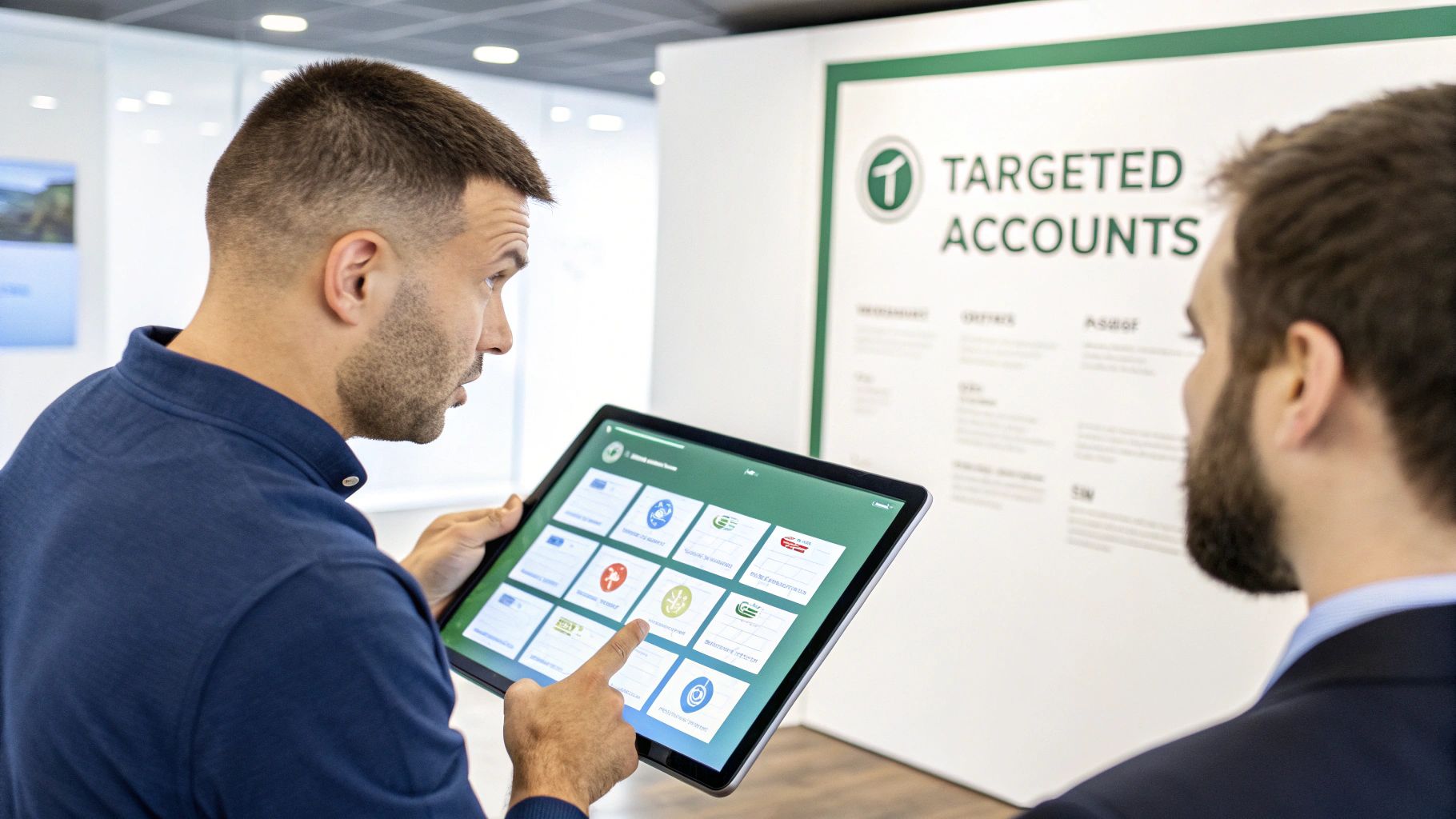
This strategy works by concentrating resources on prospects that are most likely to convert into significant, long-term customers. It’s particularly effective for B2B companies with complex sales cycles and high-ticket solutions, as it aligns outreach directly with the specific pain points and goals of each target organization. Platforms like 6sense and Terminus have popularized this data-driven approach, enabling businesses to orchestrate multi-channel campaigns with precision.
How to Implement This Strategy
A successful ABM campaign requires deep research, tight sales-marketing alignment, and a commitment to personalization. The process begins with identifying and prioritizing your most valuable potential accounts.
- Identify Target Accounts: Define your ideal customer profile (ICP) based on firmographics like industry, company size, and revenue. Build a shortlist of high-value target accounts that match this profile.
- Map Key Stakeholders: Use an email finder to identify and verify the key decision-makers and influencers within each target account. Focus on building a comprehensive picture of the buying committee.
- Create Personalized Content: Develop bespoke messaging, content, and offers that speak directly to the unique challenges and objectives of each account. Generic pitches will not work in an ABM context.
- Coordinate Multi-Channel Outreach: Execute a synchronized campaign across multiple channels, such as email, LinkedIn, targeted ads, and even direct mail, to engage stakeholders consistently.
Key Insight: ABM flips the traditional marketing funnel. Instead of generating a large volume of leads to nurture, you start with a specific list of target accounts and work to engage them deeply, ensuring higher conversion rates and deal sizes.
This approach is one of the most effective small business growth strategies for companies aiming to land larger, more strategic clients. By focusing your efforts, you eliminate wasted marketing spend and create a more relevant and impactful buying experience, which significantly shortens sales cycles and boosts revenue.
3. Social Selling & LinkedIn Engagement
Social selling is a modern sales approach where professionals leverage social media platforms, primarily LinkedIn, to find, connect with, and nurture prospects. This strategy moves beyond traditional cold outreach by focusing on building authentic relationships through valuable content, personal engagement, and targeted communication. It transforms the sales process from a direct pitch into a consultative conversation.
This strategy works by establishing credibility and trust before a sales conversation even begins. Sales teams engage with prospects' content, share relevant industry insights, and provide value upfront. Research shows that 78% of social sellers outperform their peers who don't use social media, making this one of the most effective small business growth strategies for building a strong sales pipeline.

How to Implement This Strategy
A successful social selling strategy requires consistency and genuine engagement, not just automation. Start by optimizing your own LinkedIn profile to clearly communicate your value proposition to potential clients.
- Engage Before Connecting: Interact with a prospect's posts by liking or leaving thoughtful comments before sending a connection request. This warms up the interaction.
- Personalize Your Outreach: Always personalize your connection requests and initial messages. Mention a mutual connection, a shared interest, or a piece of content they recently published.
- Share Valuable Content: Regularly post content that addresses your target audience's pain points. To maximize your social selling efforts, mastering the art of crafting engaging LinkedIn posts is essential for connecting with your audience.
- Create a Multi-Channel Approach: Use LinkedIn to build the initial relationship, then use a tool like EmailScout to find their verified email for a more formal follow-up. You can learn how to find professional emails from LinkedIn profiles to streamline this process.
Key Insight: Social selling is a long-term play focused on relationship-building. Your primary goal should be to become a trusted resource in your industry, not just a vendor. Sales will follow naturally from the trust you build.
This method is powerful because it allows you to build rapport with key decision-makers in a less intrusive way than traditional methods. By combining social engagement with targeted email follow-ups, you create a comprehensive outreach system that warms up leads and significantly increases conversion rates.
4. Strategic Partnerships & Channel Partnerships
Strategic partnerships are a powerful growth lever where businesses collaborate with non-competing companies to tap into new markets and share resources. This strategy involves creating mutually beneficial relationships, such as co-marketing campaigns, referral programs, or technology integrations, to reach a broader audience than either company could alone.
This approach works by leveraging the established trust and customer base of a partner. For example, a SaaS company could partner with a complementary software provider to offer an integrated solution, instantly gaining credibility and access to the partner's users. It’s an efficient way to scale customer acquisition and enhance your product's value proposition simultaneously.
How to Implement This Strategy
Building effective partnerships requires a clear vision and a structured approach. It's about finding the right fit and creating a win-win scenario that drives tangible results for both parties.
- Identify Complementary Partners: Use tools like LinkedIn and industry directories to find companies whose customer base aligns with your ideal customer profile but who aren't direct competitors.
- Define the "Win-Win": Clearly articulate the mutual benefits. This could be a revenue share from referrals, access to a new audience through co-branded content, or an enhanced product offering via an integration.
- Start with a Pilot Project: Begin with a small, manageable initiative like a joint webinar or a limited-time co-promotion. This allows you to test the partnership dynamics and measure initial results before committing to a larger-scale agreement.
- Establish Clear KPIs: Define success from the outset. Track key metrics like partner-sourced leads, referral conversion rates, and the overall revenue generated from the collaboration.
Key Insight: The most successful partnerships are built on a foundation of shared value for the end customer. Focus on collaborations that genuinely solve a bigger problem for your target audience, making the combined offering more compelling than the individual parts.
This method is one of the most effective small business growth strategies because it creates an exponential reach that is difficult to achieve through solo marketing efforts. For example, an email verification tool like EmailScout could partner with a CRM platform, providing the CRM's users with a seamless way to clean their contact lists, thereby adding value to both products and driving cross-promotional growth.
5. Content Marketing & SEO-Driven Lead Generation
Content marketing is the strategic creation and distribution of valuable, relevant, and consistent content to attract and retain a clearly defined audience. When combined with Search Engine Optimization (SEO), it becomes a powerhouse for generating inbound leads. Instead of you finding customers, they find you when searching for solutions to their problems.
This strategy works by establishing your business as an authority in its niche. By creating high-quality blog posts, guides, and case studies that answer your audience's questions, you build trust and organically attract prospects. When potential customers find your content through search engines like Google, they are already qualified and actively seeking information, making them highly receptive to your message.

How to Implement This Strategy
A successful content and SEO strategy requires a long-term commitment to creating exceptional content that serves your audience's needs. The goal is to become the go-to resource in your industry.
- Target High-Intent Keywords: Focus on long-tail keywords (phrases of 3-4 words) that indicate a user is close to making a purchase decision or seeking a specific solution.
- Create Problem-Solving Content: Develop blog posts, guides, and videos that directly address the pain points of your ideal customer. Use data and original research to add authority.
- Optimize for On-Page SEO: Ensure every piece of content has optimized title tags, meta descriptions, and header tags. Internally link to other relevant content on your site to build a strong topic cluster.
- Capture Leads with Gated Assets: Create downloadable resources like checklists, templates, or whitepapers that require an email address for access. This turns your website traffic into a tangible lead list.
Key Insight: SEO and content marketing are not about short-term wins; they are about building a sustainable asset. A single well-ranked article can generate qualified leads for years with minimal ongoing effort, delivering one of the highest ROIs among all growth strategies.
This method is one of the most effective small business growth strategies for building brand equity and a predictable lead flow. While creating content, you can use EmailScout to find contact information for industry experts you want to quote or collaborate with, adding further credibility and reach to your efforts. Combining this inbound approach with proactive outreach creates a powerful, multi-faceted growth engine.
6. Referral Programs & Customer Advocacy
Referral programs are a powerful growth engine that incentivizes existing customers to become brand advocates, recommending your product or service to their network. This strategy transforms your happiest customers into an active, motivated sales force, driving high-quality leads through trusted, word-of-mouth marketing. It capitalizes on the principle that people trust recommendations from friends and colleagues far more than traditional advertising.
This strategy works by creating a simple, rewarding system for both the referrer and the new customer. Companies like Dropbox famously used this model, offering extra storage space to both parties, which fueled explosive user growth. When implemented effectively, referral programs generate leads with significantly lower acquisition costs and higher lifetime value, making it one of the most efficient small business growth strategies.
How to Implement This Strategy
A successful referral program is built on simplicity and value. The easier it is for customers to share, and the more compelling the reward, the more effective it will be. Start by identifying your most satisfied customers and making them an offer they can't refuse.
- Make Sharing Effortless: Design a simple, one-click sharing process. Provide customers with a unique referral link or code that is easy to find within your app, website, or email communications.
- Offer Compelling Incentives: The reward must be valuable to both the referrer and the new customer. This could be a discount, a monetary bonus, account credits, or access to exclusive features.
- Track and Automate Rewards: Use referral marketing software or a built-in system to automatically track referrals and distribute rewards instantly. Immediate gratification reinforces the desired behavior.
- Nurture New Leads: Once a referral comes in, use a tool like EmailScout to find their professional contact details and send a personalized welcome email that acknowledges the person who referred them.
Key Insight: Your most valuable marketing asset is a happy customer. A well-designed referral program doesn't just acquire new users; it deepens the loyalty of your existing ones by rewarding them for their advocacy.
This method stands out because it leverages social proof and trust to drive growth. Referred customers are often a better fit for your business and tend to be more loyal over time. By systematically encouraging and rewarding word-of-mouth, you can build a sustainable, cost-effective acquisition channel that scales alongside your customer base.
7. Email Segmentation & Personalized Nurture Campaigns
Email segmentation is the practice of dividing your email list into smaller, more targeted groups based on specific criteria. Instead of sending a generic message to everyone, this strategy allows you to send highly relevant content to subscribers who share common characteristics, such as industry, job title, purchase history, or engagement level. Personalized nurture campaigns then guide these segments through the buyer's journey with a sequence of tailored messages.
This approach works by acknowledging that not all customers are the same. By delivering content that directly addresses a segment's specific needs and pain points, you dramatically increase relevance. This leads to higher open rates, better engagement, and more conversions, transforming your email list from a simple broadcast tool into a sophisticated sales and relationship-building engine.
How to Implement This Strategy
Effective segmentation and nurturing require a data-driven approach. Start by analyzing your audience to identify meaningful groups, then build automated workflows to deliver personalized experiences.
- Define Your Segments: Use data from tools like EmailScout to segment your list by job title, company size, and industry. Also, consider behavioral data like website activity or past email engagement.
- Create Tailored Content: Develop unique content, offers, and messaging for each key segment. An email for a marketing manager in the tech industry should address different challenges than one for a CEO in manufacturing.
- Build Automated Nurture Sequences: Set up automated email workflows (nurture campaigns) triggered by specific actions, such as a new subscriber joining a particular segment. These sequences should deliver value over time and guide prospects toward a purchasing decision.
- Track and Optimize Performance: Monitor key metrics like open rates, click-through rates, and conversion rates for each segment. Use this data to refine your messaging and improve campaign effectiveness.
Key Insight: Personalization goes beyond using a contact's first name. True personalization involves delivering the right message to the right person at the right time, based on data-driven segments. This makes your audience feel understood, not just marketed to.
This method is one of the most effective small business growth strategies for maximizing the value of your existing audience. By moving from a one-size-fits-all approach to a segmented one, you build stronger relationships, increase customer loyalty, and drive significantly higher revenue from your email marketing efforts.
8. Product-Led Growth (PLG) & Free Trial Strategy
Product-Led Growth (PLG) is a go-to-market strategy where the product itself serves as the primary driver of customer acquisition, conversion, and expansion. Instead of relying on traditional sales-led motions, this approach allows users to experience the product's value firsthand through free trials or freemium models, creating a frictionless path to adoption. Companies like Slack and Figma have demonstrated its power, achieving massive scale by letting the product's quality speak for itself.
This model works by aligning user value directly with business growth. When customers can self-serve and discover the product's benefits on their own terms, acquisition costs decrease, and user engagement deepens. It's one of the most effective small business growth strategies for modern SaaS companies, as it builds a loyal user base that can be nurtured into paying customers over time.
How to Implement This Strategy
A successful PLG motion hinges on a seamless user experience that quickly demonstrates your product's core value. The goal is to make the journey from sign-up to "aha!" moment as short as possible.
- Design a Value-Driven Free Tier: Offer a freemium plan or free trial that showcases your product’s essential features. Limit usage in a way that encourages an upgrade once users become reliant on the value provided, like Calendly’s limit on event types.
- Optimize User Onboarding: Guide new users with in-product tooltips, tutorials, and checklists to help them achieve a key outcome during their first session. A strong onboarding experience is critical for retention.
- Nurture Free Users: Use automated email sequences to educate users on advanced features and share success stories. Verifying contact information with a tool like EmailScout ensures your onboarding and upgrade-focused messages land in the right inbox.
- Identify Upgrade Triggers: Track user behavior to pinpoint when they hit usage limits or attempt to access premium features. These moments are perfect opportunities to prompt an upgrade.
Key Insight: In a PLG model, your product is your best salesperson. Every feature, from onboarding flows to in-app notifications, should be designed to guide users toward realizing value and ultimately converting to a paid plan.
This strategy is particularly powerful because it creates a scalable, low-friction acquisition channel. By letting users try before they buy, you build trust and demonstrate ROI upfront, making the sales conversation much easier. It turns your user base into a self-sustaining engine for growth.
9. LinkedIn Ads & Retargeting Campaigns
LinkedIn advertising allows B2B companies to reach key decision-makers with precision-targeted sponsored content, InMail, and display ads. The platform's extensive professional data enables hyper-specific targeting by job title, company size, industry, and skills, making it an invaluable tool for reaching high-value prospects. This strategy combines paid reach with audience intelligence for highly efficient lead generation.
This approach works by placing your message directly in front of the professionals who matter most to your business. When combined with retargeting, it becomes even more powerful. You can serve tailored ads to warm prospects, such as recent website visitors or individuals who have engaged with your content, nurturing them through the sales funnel. For instance, B2B SaaS companies using LinkedIn ads often see conversion rates between 3-5% for high-quality leads.
How to Implement This Strategy
A successful LinkedIn Ads strategy requires a deep understanding of your audience and a structured approach to campaign management. It's not just about boosting posts; it's about building a predictable lead-generation machine.
- Build Custom Audiences: Upload a list of contacts from an email finder like EmailScout to create a Matched Audience. This allows you to retarget a specific list of high-intent prospects or create lookalike audiences to find similar professionals.
- Segment and Personalize: Don't run one generic ad campaign. Segment your audiences by job title, company size, or industry and craft ad copy that speaks directly to their unique pain points.
- Use Lead Gen Forms: Implement LinkedIn Lead Gen Forms to capture prospect information directly within the platform. This reduces friction and often pulls pre-filled data from user profiles, increasing conversion rates.
- Create Multi-Stage Campaigns: Develop separate campaigns for different funnel stages. Run brand awareness campaigns to a broad audience and conversion-focused retargeting campaigns to warmer prospects who have already shown interest.
Key Insight: The power of LinkedIn ads is in the follow-up. Once a lead is captured, use a verified email from EmailScout to immediately send a personalized welcome or follow-up sequence, converting platform engagement into a direct sales conversation.
This method is one of the most effective small business growth strategies for B2B companies due to its unparalleled targeting capabilities. It ensures your marketing budget is spent reaching individuals with purchasing power, delivering a higher ROI compared to broader advertising platforms.
10. Sales Automation & CRM Integration
Sales automation is a transformative strategy that uses technology to streamline and automate repetitive sales tasks, such as email follow-ups, data entry, lead scoring, and meeting scheduling. By integrating automation tools with a Customer Relationship Management (CRM) platform like HubSpot or Salesforce, businesses can centralize prospect data and create efficient workflows. This frees up sales teams from administrative burdens, allowing them to focus on high-value activities like building relationships and closing deals.
This strategy works by creating a seamless system where technology handles the manual, time-consuming parts of the sales process. For example, platforms like Outreach.io or Salesloft can trigger automated email sequences, score leads based on their engagement, and log every interaction in the CRM without human intervention. This approach accelerates sales cycles, improves lead nurturing, and ensures no opportunities fall through the cracks, making it one of the most impactful small business growth strategies for scaling sales operations.
How to Implement This Strategy
Effective sales automation requires a thoughtful setup that aligns technology with your sales process. The goal is to enhance, not replace, the human element of selling.
- Integrate Your Tools: Connect your email outreach tools directly with your CRM. For instance, import validated contact lists from EmailScout into your CRM to ensure clean data from the start and power your automated campaigns.
- Automate Initial Outreach: Develop automated email sequences for initial contact and follow-ups. Use personalization tokens to maintain a human touch while reaching prospects at scale.
- Implement Lead Scoring: Set up rules to automatically score leads based on their behavior (e.g., opening an email, clicking a link, visiting your pricing page). This helps your team prioritize the most engaged and sales-ready prospects.
- Create Trigger-Based Workflows: Build smart campaigns that are triggered by specific prospect actions. If a prospect downloads a whitepaper, an automated workflow can send them a series of relevant follow-up emails.
Key Insight: The most effective sales automation doesn't just save time; it creates a more intelligent sales process. Use automation to gather data on what messaging, timing, and sequences work best, and use those insights to continuously refine your approach for better conversion rates.
This strategy is essential for any small business looking to scale its sales efforts without exponentially increasing its headcount. By systemizing outreach and follow-up, you can manage a larger pipeline more effectively. To get a comprehensive overview, explore this guide on what is sales automation and how it can drive revenue growth.
Top 10 Small Business Growth Strategies Comparison
| Strategy | Implementation complexity | Resource requirements | Expected outcomes | Ideal use cases | Key advantages |
|---|---|---|---|---|---|
| Cold Email Outreach & Lead Generation | Low–Medium: list building, sequence setup, compliance | Email data, copywriting, automation tools; low upfront cost | Scalable meetings/leads; variable response rates | B2B outbound prospecting, early-stage SaaS growth | Cost-effective, direct access to decision-makers, measurable |
| Account-Based Marketing (ABM) | High: research, coordination, multi-channel personalization | Sales + marketing alignment, CRM/ABM tools, account research | High conversion and deal size; fewer targeted accounts | Enterprise or high‑ticket B2B sales | Highly personalized outreach, higher win rates, shorter cycles |
| Social Selling & LinkedIn Engagement | Medium: profile strategy, consistent engagement | Time for content and networking; LinkedIn tools | Warm relationships and qualified leads; slower conversions | Relationship-driven sales, professional services, enterprise | Builds trust and credibility; warm introductions; targeted outreach |
| Strategic & Channel Partnerships | Medium–High: partner selection, agreements, integrations | Legal, integration work, co‑marketing resources | Access to new segments, shared revenue, faster penetration | SaaS integrations, reseller/channel expansion | Rapid reach expansion, shared costs, credibility via partners |
| Content Marketing & SEO-Driven Lead Gen | Medium: content strategy, SEO optimization | Content creators, SEO expertise, ongoing time investment | Qualified inbound leads; compounding long-term traffic | Thought leadership, inbound lead generation, brand building | Low long-term CPL, authority building, sustainable traffic |
| Referral Programs & Customer Advocacy | Low–Medium: program design, tracking and rewards | Incentives, tracking system, customer success resources | High-quality, low-cost leads; improved retention | Products with happy customers; viral growth strategies | Lowest CAC, high conversion and retention, organic growth |
| Email Segmentation & Personalized Nurture Campaigns | Medium–High: data modeling, workflows, testing | CRM/marketing automation, quality data, content variants | Higher open/click rates and conversions from email | Lead nurturing, onboarding, retention campaigns | Improved engagement, personalized journeys, better ROI |
| Product-Led Growth (PLG) & Free Trial Strategy | Medium: UX optimization, onboarding flows | Product development, analytics, customer support | Self-qualified users, lower CAC, viral adoption | Self‑serve SaaS, developer tools, freemium models | Faster time-to-value, natural virality, data-driven expansion |
| LinkedIn Ads & Retargeting Campaigns | Medium: audience setup, creative, optimization | Ad budget, creative assets, analytics, LinkedIn tools | Targeted paid leads and conversions; good mid-funnel performance | Account targeting, event promotion, retargeting warm audiences | Precise professional targeting, lead gen forms, retargeting ability |
| Sales Automation & CRM Integration | Medium–High: integration, workflow design, governance | CRM, automation platform, data hygiene, training | Increased sales productivity; consistent follow-up; better forecasting | Scaling sales teams, high-volume outreach, complex pipelines | Efficiency gains, centralized data, consistent nurturing and tracking |
Putting Your Growth Engine into Action
Navigating the landscape of small business growth strategies can feel overwhelming. We've explored ten powerful avenues, from the direct impact of cold email outreach and the precision of Account-Based Marketing to the long-term value generated by content marketing and strategic partnerships. The core lesson is clear: sustainable growth isn't born from a single magic bullet. It’s the result of building a dynamic, interconnected growth engine.
True momentum is achieved when these strategies work in concert. Your LinkedIn social selling efforts become exponentially more effective when you can seamlessly transition high-value conversations into a personalized email sequence. Your content marketing acts as the fuel for your nurture campaigns, providing the value that keeps leads engaged. Similarly, a well-executed referral program can supercharge your sales pipeline, feeding it with the highest quality leads imaginable.
This interconnectedness is the secret to scaling efficiently. Each component supports and amplifies the others, creating a system that is far greater than the sum of its parts.
From Strategy to Execution: Your Actionable Next Steps
The journey from knowledge to results begins with a single, decisive step. Don't try to implement all ten strategies at once. Instead, adopt a focused, methodical approach to build your growth engine piece by piece.
-
Audit and Prioritize: Begin by evaluating your current resources, team skills, and business model. Which one or two strategies from this list offer the lowest barrier to entry and the highest potential impact for your specific business right now? A B2B service company might prioritize ABM and LinkedIn engagement, while a SaaS startup could focus on Product-Led Growth and targeted retargeting ads.
-
Implement and Measure: Dedicate your focus to executing your chosen strategies flawlessly. Define clear Key Performance Indicators (KPIs) from the start. For cold outreach, this could be your reply rate and meeting booked rate. For content, it might be organic traffic and lead magnet downloads. Meticulous tracking is non-negotiable; it's the only way to know what's working.
-
Iterate and Expand: Once you have a proven, repeatable process generating positive results from your initial strategies, it's time to layer on the next. Use the insights gained from your first experiments to inform your next move. Perhaps the data shows your ideal customers are highly responsive to case studies, signaling that a more robust content strategy is the logical next step.
The Unifying Thread: Efficient Outreach
A common thread weaving through many of these powerful small business growth strategies is the need for efficient, accurate, and scalable outreach. Whether you are executing a targeted cold email campaign, building a list for a new partnership announcement, or following up with leads from a LinkedIn ad, your success hinges on your ability to connect with the right person.
This is where the friction often lies for small businesses. Manually finding and verifying contact information consumes precious hours that could be spent on strategy, relationship-building, and closing deals. By automating this foundational step with tools designed for precision and speed, you reclaim your most valuable asset: time. This allows you to focus your energy on the high-level thinking and human connection that truly drive business growth, turning your strategic plans into tangible revenue. The path to scalable success is not about working harder, but about working smarter and equipping your team with the right tools to execute with precision.
Ready to stop searching for emails and start building relationships? EmailScout provides the verified contact data you need to fuel your outreach, connect with key decision-makers, and implement these growth strategies with speed and accuracy. Find any email in seconds and build your growth engine on a foundation of reliable data at EmailScout.