
An email address list is way more than just a collection of contacts you've gathered from prospects and customers. It’s a direct, owned communication channel. It gives you a way to talk to your audience without getting stuck behind the unpredictable walls of social media algorithms. This direct line is your secret weapon for sales, marketing, and building real relationships.
Why Your Email Address List Is a Core Business Asset
In a world where social media platforms change the rules on a whim, your email address list is one of the only assets you truly own. Think of it this way: your social media following is like renting an apartment. You're living there, but you're always subject to the landlord's rules, which can change without warning. Your email list? That's like owning the entire building.
This ownership gives you a direct, unfiltered pipeline to your audience. You’re in the driver’s seat—you decide when and how to communicate. Your message actually reaches people who want to hear from you, instead of getting buried by an algorithm that's only there to sell more ads.
The Foundation of Predictable Revenue
When you treat your email list right, it stops being a simple marketing tool and transforms into a powerful engine for predictable revenue. It lets you send personalized campaigns that speak directly to what different groups of people need, which is far more effective at nurturing leads and driving sales than any generic blast.
For instance, a sales team can put together a hyper-targeted list of decision-makers and send them a pitch that actually resonates. Meanwhile, the marketing team can send special offers to customers who've already shown interest in a specific product. You just can't get that level of precision on other platforms.
Mitigating Platform Risk
Putting all your eggs in the social media basket is a huge risk. Accounts get suspended, algorithms crush your reach overnight, and entire platforms can fall out of favor. We've all seen it happen. An email address list is your insurance policy against that digital chaos. It’s a stable, reliable channel that you control, period.
The real power of an email address list lies in its resilience. While social platforms are volatile, your list is a stable, appreciating asset that you build and control, providing a direct and reliable connection to your audience.
The sheer scale of email usage backs this up. It's projected that by 2025, 4.59 billion people will be using email, sending over 376.4 billion messages every single day. But here’s the kicker: businesses that segment their lists see revenue jump by as much as 760%. That’s an ROI that absolutely blows social media out of the water for customer acquisition. If you want to dive deeper into the numbers, check out the email industry insights on Clean.email to see its full potential.
To help you visualize what makes a list truly valuable, let's break down its core components.
Core Components of a High-Value Email List
This table outlines what separates a killer email list from a basic spreadsheet of contacts.
| Component | Description | Why It Matters for Outreach |
|---|---|---|
| Opt-In Source | How and where the contact subscribed (e.g., webinar, newsletter signup, free download). | Tells you their initial interest, allowing for highly relevant follow-up and segmentation. |
| Contact Data | Core information like name, company, and job title, not just the email address. | Enables personalization that goes beyond "Hey there," making your message feel human. |
| Engagement History | A record of opens, clicks, and replies for each contact. | Shows who your most active subscribers are so you can focus your best efforts on them. |
| Segmentation Tags | Labels based on behavior, interests, or purchase history (e.g., "prospect," "repeat_customer"). | This is the key to sending the right message to the right person at the right time. |
| Verification Status | Confirmation that the email address is valid and deliverable. | Protects your sender reputation and ensures your messages actually land in the inbox. |
A list built with these components is more than a simple database—it's a strategic asset.
Ultimately, you have to stop seeing your email list as just a tool. It’s a foundational piece of your business, fueling everything from that first sales pitch to long-term customer loyalty. It’s an indispensable part of any modern growth strategy.
Finding Qualified Prospects with Speed and Precision
Knowing you need a good email list is one thing, but actually building it is where the real work begins. The old way—spending hours mind-numbingly copying and pasting contact info from websites into a spreadsheet—is not just tedious; it's a huge waste of time.
Thankfully, we can now move past that manual grind. The modern workflow is all about strategic automation. By using a tool built for this exact job, like the EmailScout Chrome extension, you can automate the most soul-crushing parts of the process. This frees you up to think about strategy—finding the right people, not just hoarding random contact details.
This flowchart really nails the connection between a well-built list and real business results.
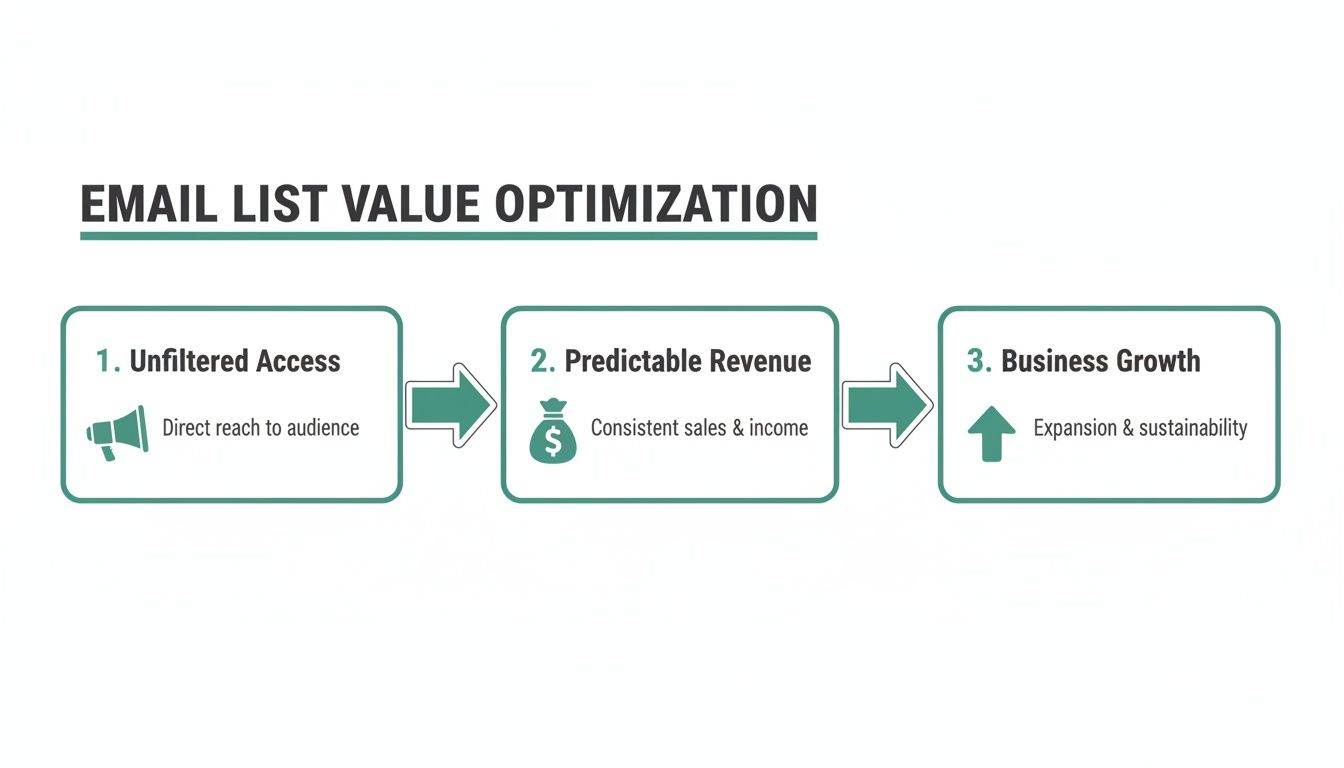
As you can see, a quality list gives you direct, unfiltered access to your ideal audience. That access is what drives predictable revenue and, ultimately, sustainable growth for your business.
A Real-World Prospecting Scenario
Let's walk through a common B2B sales situation. Picture this: you're a sales rep at a SaaS company, and your task is to build an email address list of 50 VPs of Sales at Series B tech companies across North America. Doing this the old-fashioned way could easily eat up your entire day, if not more.
With the right setup, you can knock this out in under an hour. It all starts on a professional networking site like LinkedIn, where you can zero in on your ideal customer profiles.
- Define Your Search: You’d kick things off with a filtered search for "Vice President of Sales."
- Layer on Criteria: Next, add filters for company size, funding stage (Series B), and industry (Technology/SaaS).
- Geographic Targeting: Finally, you'd narrow the location down to the United States and Canada.
Just like that, you've got a high-quality pool of potential prospects who perfectly match your criteria. Now for the fun part.
The goal isn't just to find emails; it's to find the right emails. Precision beats volume every single time. A small, hyper-targeted list will always crush a massive, generic one because your message is relevant from the very first word.
Automating Contact Discovery
Once you have your target list of profiles pulled up, a tool like EmailScout can step in and automatically find their professional email addresses. For instance, you can switch on the AutoSave feature and let it run in the background as you browse the search results.
As you scroll, the tool quietly identifies and saves verified email addresses linked to those profiles. It builds your list for you, without a single extra click for each contact. This completely eliminates the manual data entry bottleneck.
Expanding Your Reach with URL Explorer
But what if your prospects aren't all in one place? Maybe you need to pull contacts from a company's "About Us" page or grab the speaker list from a virtual conference. This is where a bulk processing feature is a game-changer.
The URL Explorer function lets you paste in a list of website URLs and extracts all the available email addresses from those pages at once. This is incredibly powerful for a few key scenarios:
- Targeting Specific Companies: Gather emails from the leadership pages of your top 20 target accounts.
- Conference Prospecting: Pull the contact info for every speaker or sponsor from an industry conference website.
- Directory Scraping: Extract emails from online business directories or association member lists.
This method scales your efforts dramatically. Instead of visiting site after site, you’re building a comprehensive email address list in a fraction of the time. If you want more ideas on scaling up, check out our guide on how to find local business emails in minutes.
By blending precise targeting on professional networks with smart automation tools, you turn list-building from a chore into a strategic advantage. You end up spending far less time searching and more time actually connecting with the people who can move your business forward.
You’ve put in the work to build a great email address list. That’s a huge win, but now the real challenge begins: making sure your messages actually land in the inbox.
A high bounce rate isn't just a sign of a wasted email. It’s a red flag to Internet Service Providers (ISPs) that actively damages your domain's sending reputation. If they see too many of your emails bouncing, they'll start treating you like a spammer. Before you know it, your carefully crafted messages are going straight to junk or getting blocked entirely.
This is where list hygiene comes in. It's the non-negotiable process of keeping your list clean and valid, and it's something you have to do consistently. Think of it as preventative maintenance for your most valuable outreach asset.
Why Emails Bounce in the First Place
Emails bounce for a few key reasons, and knowing what they are is the first step to fixing the problem. While not all bounces are created equal, every single one chips away at your sender score.
- Invalid Emails: These are addresses that just don't exist. Maybe there was a typo (
john.doe@gmial.com), or maybe John left the company six months ago. These are called "hard bounces" and they’re the most toxic for your reputation. - Defunct Domains: Sometimes the entire company just isn't there anymore. Any email you send to a
@thatcompany.comaddress is going to bounce right back. - Full Inboxes: A "soft bounce" happens when an inbox is too full to accept new mail. It’s less severe, but if you keep hitting a full inbox, ISPs will eventually start treating it like a hard bounce.
- Catch-All Servers: Some companies set up their servers to accept email for any address at their domain, even fake ones. This prevents a hard bounce, but your message usually just disappears into a black hole. Spotting these helps you avoid shouting into the void.
Keeping your list clean is crucial because email isn't going anywhere. The number of worldwide email users is projected to hit 4.73 billion by 2026, and 90% of people over 15 in the U.S. use it.
A Practical Routine for Cleaning Your List
To keep your sender reputation safe, list hygiene needs to be a regular habit, not a one-off task you do once a year. It should be baked right into your outreach workflow.
The absolute best practice is to verify emails right when you collect them or just before you hit send. Modern tools make this easy. If you’re using a feature like EmailScout's AutoSave, for instance, it often verifies the contact as it’s being found, so you build a clean list from day one.
A clean email address list is the foundation of deliverability. Regularly verifying your contacts is like changing the oil in your car—it’s a simple, essential task that prevents catastrophic failure down the road.
Got an existing list? You absolutely need to scrub it before your next campaign. Run the whole thing through a dedicated service to get rid of the dead weight. If you want to get into the weeds on this, it's worth learning exactly how to validate email addresses properly.
Best Practices for Long-Term List Health
Beyond the occasional big scrub, a few simple habits will keep your list healthy and your sender score high for the long haul. A great starting point is to set up a solid email address verification process from the beginning.
Here’s a simple framework that works:
- Verify Before Sending: Never, ever launch a major cold outreach campaign without verifying the list first. This one step can slash your bounce rate.
- Watch for Engagement: Every so often, clean out subscribers who aren't opening or clicking your emails. If someone hasn't engaged in over 90 days, they're probably not interested, and sending to them signals to ISPs that your content might be unwanted.
- Do a Quarterly Audit: At least once every three to six months, do a deep clean of your entire database. This will catch any bad emails that slipped through the cracks and keep your deliverability strong.
Using Smart Segmentation for Personalized Outreach

You’ve painstakingly built and cleaned your email list. Now what? The temptation is to blast a generic message to everyone. Don't do it. This is a massive mistake.
Sending the same email to a startup founder and a corporate marketing manager guarantees your message will feel irrelevant to at least one of them, if not both. Effective outreach hinges on one thing: personalization. But true personalization goes far beyond just using a {first_name} tag.
It all starts with smart segmentation—the practice of dividing your list into smaller, more focused groups based on shared characteristics.
Moving Beyond Basic Filters
Basic segmentation might involve filtering by country or company name. While that’s a start, it barely scratches the surface. To make your emails really connect, you need to group contacts based on criteria that reveal their specific context, challenges, and priorities. This is where you unlock the real power of your list.
Look at the data points you have for each contact. You can create hyper-relevant campaigns by combining these attributes into specific audience buckets. The goal is to make each person feel like you're speaking directly to them and their unique situation.
A well-segmented email address list allows you to craft messages that are not just personalized, but contextually aware. It’s the difference between shouting into a crowd and having a meaningful one-on-one conversation.
This approach transforms your outreach from a numbers game into a relationship-building exercise. The result? Dramatically higher engagement, more positive replies, and a stronger sales pipeline.
Criteria for Meaningful Segmentation
To start building these targeted groups, think about segmenting your list based on a few key dimensions. Each one gives you a different angle for personalizing your message.
Job Function: Grouping contacts by their role (e.g., Sales, Marketing, Engineering) lets you address their specific professional pain points. A message for a VP of Engineering should sound very different from one for a Head of HR.
Industry Vertical: A fintech startup has vastly different needs than a manufacturing company. Segmenting by industry means you can use relevant jargon, reference specific industry trends, and share case studies they'll actually care about.
Company Size and Stage: An early-stage startup with 10 employees is focused on survival and rapid growth. A 500-person enterprise is more concerned with scale and efficiency. Your pitch needs to match their current business priorities.
Technology Stack: Knowing what software a company uses is a goldmine. If you know a prospect uses HubSpot, you can frame your solution as an integration or a superior alternative.
Contact Source: How did you find this person? A contact from a webinar on "AI in Sales" should get a different follow-up than someone you found on a list of conference attendees.
By combining these criteria, you can create incredibly specific segments.
Actionable Segmentation Scenarios
Let’s put this into practice. Imagine you have a new project management tool. Instead of one generic email, you could create multiple campaigns targeting distinct segments from your list.
The Hyper-Specific Tech Segment:
- Criteria: Marketing Managers at SaaS companies with 50-200 employees using Asana.
- Message Angle: Focus on how your tool integrates seamlessly with their existing marketing workflows and solves collaboration bottlenecks specific to growing SaaS teams.
The Founder-Focused Segment:
- Criteria: Founders of UK-based fintech startups with under 50 employees.
- Message Angle: Emphasize affordability, ease of setup, and how your tool helps lean teams stay agile and meet tight regulatory deadlines.
The Enterprise Upgrade Segment:
- Criteria: Directors of Operations at manufacturing companies with over 1,000 employees using a legacy system.
- Message Angle: Highlight enterprise-grade security, scalability, and dedicated support, positioning your tool as a modern solution for complex supply chain management.
Each of these messages speaks a different language, addresses different pain points, and proposes a different value proposition. This is the level of detail that cuts through the noise and gets a response. Segmentation isn't just a best practice; it's the core strategy for turning a simple email address list into your most powerful engine for growth.
Activating Your List with Templates and Key Metrics
You’ve done the heavy lifting—building, cleaning, and enriching your email address list. You’re sitting on a goldmine of potential. But potential doesn’t pay the bills. Now it’s time to put that asset to work.
Activating your list is all about strategic outreach. It's where the rubber meets the road. And just as crucial as sending the emails is meticulously tracking what happens next, so you can learn what truly clicks with your audience and what falls flat.
Think of a great list as potential energy. A well-executed campaign with clear metrics is how you convert it into kinetic energy—sales, partnerships, and real growth. To do this right, you'll want to find the right email marketing software to manage the process.
Adaptable Templates for Common Scenarios
You don't need to reinvent the wheel every single time you hit "compose." Starting with a solid template frees you up to focus on what matters most: personalization.
Treat these templates as flexible frameworks, not rigid scripts you copy and paste. The magic happens when you adapt the language to fit your brand's voice and the specific person you're contacting.
Here are a couple of solid starting points for B2B outreach.
The Cold Sales Outreach Template
When you're sending a cold email, you're interrupting someone's day. Be direct, be respectful, and get to the value proposition—fast.
Subject: Quick question about [Prospect's Company]
Hi {first_name},
I was just looking at your work with [mention a specific project or recent company news] and was really impressed.
My team at [Your Company] helps businesses like yours solve [specific pain point] by [briefly describe your solution's core benefit]. We recently helped [Similar Company] achieve [specific, quantifiable result].
Would you be open to a quick 15-minute chat next week to see if this could be a fit for you?
Best,
[Your Name]
This approach works because it’s short, shows you did at least a little homework, and offers immediate social proof. It connects their world to your solution without wasting time. For more ideas, you can always check out a range of cold email examples and templates to see what resonates with your style.
The Partnership Proposal Template
Here, the focus shifts to mutual benefit. Your email needs to scream "what's in it for them" right from the start.
Subject: Idea for [Your Company] + [Their Company]
Hi {first_name},
I've been following [Their Company]'s growth in the [Industry] space for a while now, and your recent [mention a specific achievement or product launch] caught my eye.
At [Your Company], we focus on [your area of expertise], and I see a strong potential for collaboration. I believe our combined audiences could create significant value, specifically by [propose a clear, simple partnership idea, e.g., co-hosting a webinar, creating a joint content piece].
Is this something that falls under your purview? If so, I’d love to share a few more thoughts.
Cheers,
[Your Name]
Tracking the Metrics That Matter
Sending emails without tracking performance is like driving with your eyes closed. You might be moving, but you have no idea if you're headed in the right direction.
To really dial in your campaigns, you need to live and breathe a few Key Performance Indicators (KPIs). These numbers tell the true story of your outreach.
These aren't just stats for a spreadsheet; they're direct feedback from your audience. Low open rates? Your subject lines are boring. High opens but zero clicks? Your message isn't compelling enough.
Essential Outreach Metrics and Industry Benchmarks
Tracking your numbers is the first step, but you also need context. Knowing how your performance stacks up against industry averages can tell you whether you’re on the right track or need to make some serious adjustments.
| Metric | What It Measures | Good Benchmark (B2B) | How to Improve It |
|---|---|---|---|
| Open Rate | The percentage of recipients who opened your email. | 20% – 40% | Test different subject lines. Personalize with name or company. Send at different times of day. |
| Click-Through Rate (CTR) | The percentage of recipients who clicked on a link in your email. | 2% – 5% | Make your call-to-action (CTA) clearer and more compelling. Ensure links are visible and relevant. |
| Reply Rate | The percentage of recipients who replied to your email. | 1% – 10% | Ask a direct, easy-to-answer question. Personalize the body content more deeply. |
| Bounce Rate | The percentage of emails that couldn't be delivered. | Under 2% | Regularly clean your list using an email verification tool to remove invalid addresses. |
By keeping a close eye on these KPIs, you can shift from a strategy of guesswork to one that’s informed by real data. It’s the only way to consistently improve.
A Simple Framework for A/B Testing
The only way to know for sure what works is to test it. A/B testing, also called split testing, is your best friend here. It’s simple: you send two slightly different versions of an email to a small slice of your list, see which one performs better, and then send the winner to everyone else.
Don't overcomplicate it. Start with simple, high-impact elements:
- The Subject Line: This is your first impression and has a massive impact on open rates. Test a question vs. a statement. Or try a personalized subject vs. a generic one.
- The Call-to-Action (CTA): Experiment with different phrasing. Does "Book a demo" perform better than "Find a time to chat"? Test a button against a simple text link.
By testing one thing at a time, you can make small, steady improvements that add up in a big way. Over time, this iterative process will turn your email list into a predictable, high-performing engine for your business goals.
Common Questions About Building an Email Address List
Even the most straightforward strategy can spark a few questions. When it comes to building an email address list, getting clear answers upfront helps you move forward with confidence. Let's tackle some of the most common queries I hear.
Is It Legal to Email Contacts I Find Online?
This is a big one, and rightly so. Navigating regulations like GDPR in Europe and CAN-SPAM in the U.S. is non-negotiable. For B2B outreach, the conversation often revolves around the concept of "legitimate interest." Generally, this allows you to contact someone if your product or service is truly relevant to their professional role.
But this isn't a free pass. You have a responsibility to be transparent about who you are and always provide a dead-simple way to opt-out. Every single unsubscribe request must be honored immediately. This guide is all about responsible B2B outreach—not spamming consumer inboxes.
Always chat with a legal professional for advice tailored to your specific business and location. The rules have nuances, and getting it right from the start protects you from serious penalties and protects your reputation.
How Often Should I Clean My Email List?
Think of list hygiene as ongoing maintenance, not a one-and-done task. People switch jobs, companies fold, and email addresses go stale faster than you'd think. The best practice is to verify emails right before launching any major campaign.
As a rule of thumb, plan to do a deep clean of your entire email address list at least every 3-6 months. This routine purges inactive contacts and re-verifies older ones, which is critical for keeping your bounce rate down and protecting your all-important sender reputation.
What Is a Good Open Rate for Cold Outreach?
Benchmarks for cold email can be all over the place, depending heavily on your industry, list quality, and how compelling your copy is. That said, a "good" open rate for a well-targeted cold campaign usually lands somewhere between 20% and 40%.
- Below 15%: This is a red flag. It often points to problems with your subject lines, sender reputation, or the quality of your list itself.
- High Opens, Low Replies: Getting great open rates but a reply rate under 2%? The issue is almost certainly the body of your email. Your message just isn't hitting the mark with the people who opened it.
Can I Build an Email List for Free?
Absolutely. You can definitely get started without spending a dime. Plenty of great tools offer generous free plans that let you find a surprising number of professional emails at no cost. It’s a perfect starting point for freelancers, startups, or anyone just testing the waters with a new outreach idea.
The process might require a bit more manual effort, like browsing websites and profiles individually, but the tools that actually find the contact info can be free. As you scale, you might decide a premium plan with features like bulk processing or CRM integration is worth the investment, but you can build that initial foundation for $0.
Ready to build your own high-quality email address list with speed and precision? EmailScout gives you the tools to find unlimited verified contacts, automate your workflow, and connect with decision-makers in a single click. Try it for free and start building your most valuable business asset today at https://emailscout.io.