
Email marketing is already the primary customer acquisition channel for 81% of small businesses, while 80% use it for retention, according to recent industry research summaries. That changes the startup question. Email isn't a backup channel for when paid acquisition becomes too expensive. It can be the operating layer that turns a first visit into a conversation, a trial into activation, and a customer into a repeat buyer.
A founder running product, sales, and marketing doesn't need a complicated lifecycle machine on day one. They need a clear promise, a permission-based list, a few useful campaigns, reliable automation, and a dashboard that favors clicks, replies, conversions, and revenue over flattering numbers. This is a lean playbook for building email marketing for startups around those priorities.
Why Email Still Wins for Early-Stage Companies
A small startup often faces a simple problem: the founder understands the product, while potential customers may not know the company exists. Paid ads buy attention, social platforms provide reach, and outbound creates conversations, but each depends on budget, another platform's distribution, or manual effort. Email gives the team a direct channel to people who have agreed to hear from the business.
Adoption data from independent small-business surveys shows that email remains a default owned channel even as newer platforms attract attention. Its value is practical: the team can reach subscribers without paying for every impression, retain control of the audience relationship, and connect messages to measurable actions.
A founder handling demos, onboarding, and support can turn that control into an operating advantage. A welcome email can answer a question raised during a sales call. An onboarding message can direct a new user to the action that creates value. A customer update can bring an inactive account back into the product without another manual follow-up.
The goal is not a larger send volume or a higher open rate. It is a useful response: a click, a reply, an activation, a purchase, or more revenue from each recipient.
Email works best when every send moves a relationship forward, not when every send tries to close a sale.
The lean sequence is straightforward. Define the audience and promise, build a permission-based list, launch a small set of campaigns, automate repeated moments, and measure the actions tied to growth. Keep list hygiene and deliverability in the operating plan. Remove invalid or disengaged contacts before they waste budget or weaken inbox placement. If messages do not reach the inbox, strong copy and careful segmentation cannot rescue the program.
Laying the Strategic Foundation
Before choosing an email service provider, write one sentence that explains who the product helps, what problem it solves, and what changes afterward. “Project management software for everyone” is too broad to guide a campaign. “A lightweight workspace that helps small agencies keep client work moving without scattered spreadsheets” gives the team a usable starting point.
Choose only the audience segments that can change a decision now. A SaaS startup might begin with trial users and subscribers who downloaded an onboarding checklist. A commerce startup might separate first-time buyers from customers who haven't purchased again. More segments can wait until the team has enough behavior to justify different messages.
The operating model can stay modest. A 2025 small-business email marketing survey found that 69.2% spend less than $2,000 per month on email marketing costs, 85.6% devote 40 or fewer hours per week, and 83.1% expect to invest more over the following 12 months. The useful lesson isn't that every startup should copy those figures. It's that a focused program doesn't require a large department.

Build a one-page email brief
Write the answers in a document the whole team can use:
- Primary audience: Who has the problem urgently enough to act?
- Core promise: What useful outcome does the subscriber get from staying on the list?
- First conversion: Is the next action a product trial, demo, purchase, reply, or activation event?
- Initial segments: Which one or two groups need different messages?
- Cadence: How often can the team send something useful?
- Owner: Who writes, reviews, sends, and checks results?
Owned-channel principle: Build an audience you can reach directly, then earn attention often enough that the relationship becomes more valuable over time.
Don't promise a daily newsletter if the founder can only produce a thoughtful message occasionally. Consistency matters, but a reliable weekly or event-based rhythm beats bursts of activity followed by silence. The strategy is sound when the promise, audience, cadence, and business action fit together on one page.
Building Your Startup Email List the Right Way
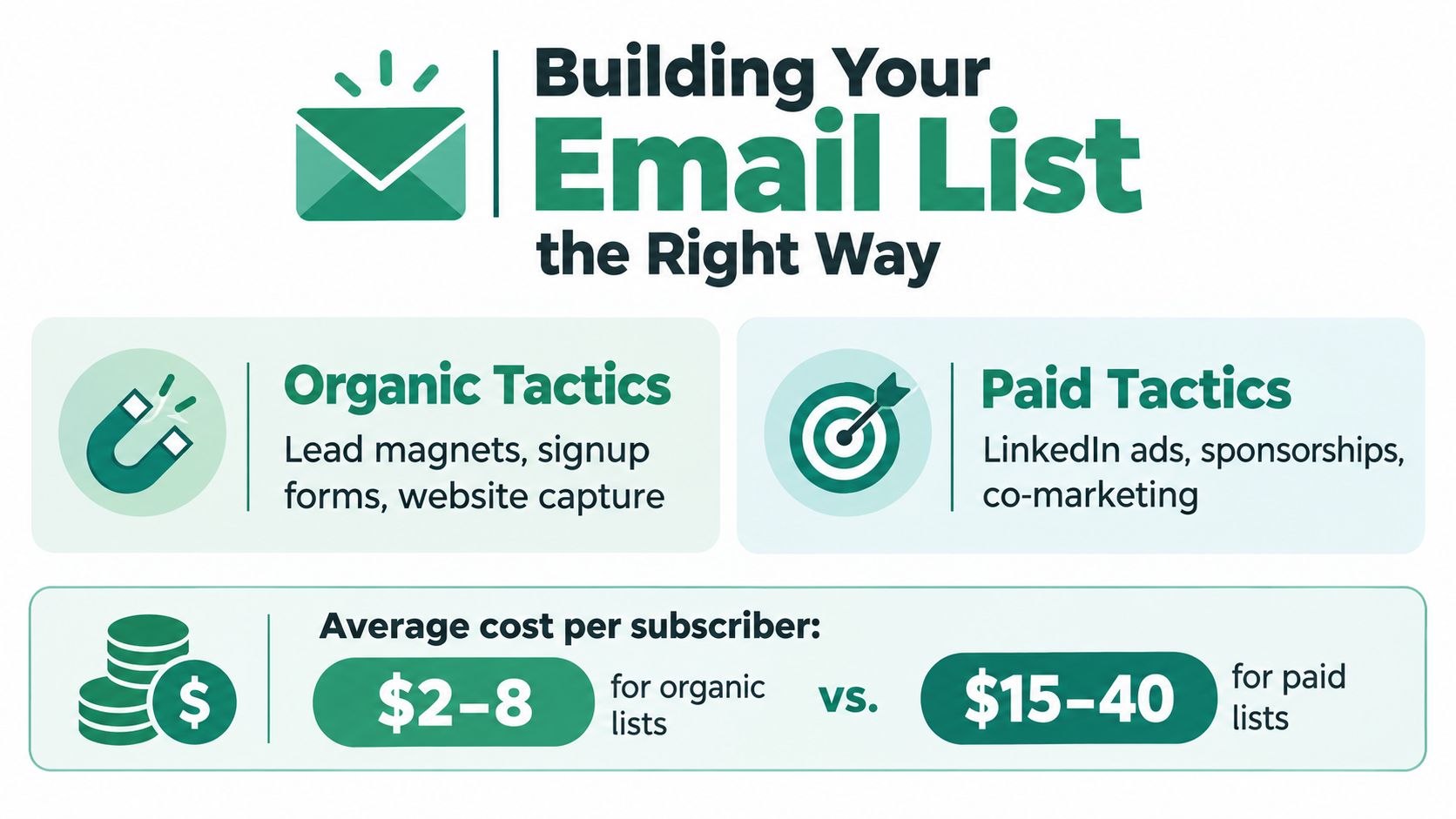
Start with people who have a reason to hear from you. Organic capture usually produces the clearest permission because the visitor understands the exchange. A SaaS company could offer an onboarding checklist that helps a prospect complete a task before they ever use the product. A consultant might provide a practical audit template. The form should state exactly what the person receives and what kind of follow-up to expect.
Place capture where intent already exists. Add a focused signup form to relevant product pages, put a contextual offer inside useful articles, and include an invitation after a webinar or product demo. Keep the form short, but don't hide the value behind vague language such as “Join our newsletter.” Explain the benefit in the same terms the visitor used to describe the problem.
Outreach is different from opt-in acquisition. It can help a startup identify relevant decision-makers for a targeted conversation, but it carries greater responsibility. Publicly available contact information isn't the same as permission to send unlimited promotional mail. Keep outreach relevant, identify yourself clearly, explain why you're contacting the person, and honor objections immediately.
EmailScout can support prospect research through a Chrome extension that finds publicly available email addresses, with features including AutoSave, URL Explorer, and unlimited email discovery on its free offering. Use that type of workflow to assemble a targeted outreach list, then verify addresses and apply the rules that govern your market before sending.
Protect the asset you're building
A purchased list looks like a shortcut but usually creates a quality and reputation problem. Recipients don't recognize the sender, complaints rise, and the startup learns very little about genuine demand. A smaller list of people who requested a resource or accepted a relevant conversation is more useful than a larger file with uncertain provenance.
Use this checklist before importing contacts:
- Capture permission: Record how and why an opted-in subscriber joined.
- Separate outreach: Don't mix cold prospects into a newsletter audience without a lawful, transparent basis.
- Verify addresses: Remove invalid and risky contacts before a campaign.
- Set expectations: State the content type and approximate frequency at signup.
- Make opting out easy: Every marketing message needs a visible unsubscribe path.
- Suppress objections: Never re-add people who have unsubscribed or asked not to be contacted.
For a practical implementation reference, use this guide to build an email list while keeping acquisition, permission, and verification as separate steps. The startup list becomes an asset only when the people on it expect the messages and can leave without friction.
Creating Campaigns and Sequences That Convert
A campaign has one job. Decide that job before writing the subject line. If the purpose is to activate a trial user, don't add three competing calls to action for a webinar, blog post, and product tour. One primary action makes the message easier to scan and the result easier to interpret.
A reliable email structure is simple:
- Subject line: State the useful outcome or relevant reason to pay attention.
- Preview text: Complete the thought instead of repeating the subject.
- Opening: Show that you understand the recipient's situation.
- Proof or explanation: Give the smallest amount of context needed.
- Single call to action: Ask for one measurable next step.
- Mobile-first layout: Use short paragraphs, readable type, and a button that works on a small screen.
The welcome series should also progress logically. Five emails can give a new subscriber a clear path without turning onboarding into a product manual.
A five-email welcome sequence
Email one, deliver the promise. Send the requested checklist, trial details, or resource immediately. Confirm what the subscriber can expect and make the first action obvious.
Email two, frame the problem. Explain the costly or frustrating situation your product addresses. Use the subscriber's language, not internal feature names.
Email three, teach one useful move. Give a tactic the reader can apply without buying anything. This earns attention and reveals whether the audience cares about the problem.
Email four, show the path to activation. Demonstrate the product's relevant workflow, preferably with a short example. Link to the action that lets the subscriber experience the outcome.
Email five, make the first pitch. Present the offer, remove a genuine objection, and invite a reply or conversion. If the subscriber isn't ready, offer a useful alternative rather than forcing urgency.
Each message should earn the next one. If a person clicks the activation guide, the following message can address the step they haven't completed. If they don't engage, reduce pressure and test whether the promise or audience is wrong. For more detailed guidance on crafting cold email copy that converts, focus on relevance, clarity, and a specific action rather than clever phrasing.
Automating Growth Funnels on a Startup Budget
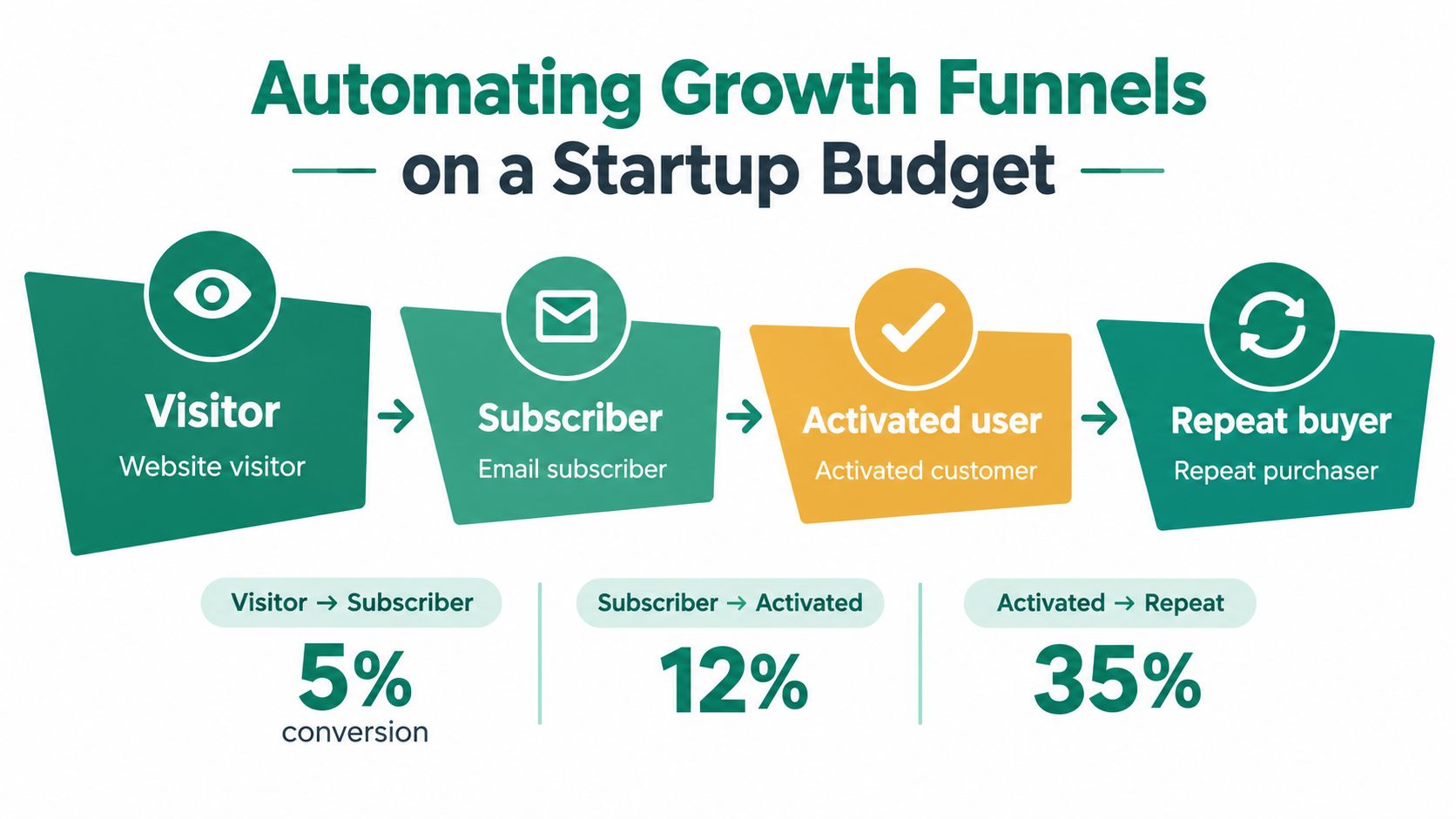
Automation should remove repeated work, not remove judgment. The useful startup funnel begins with a website visitor, moves to a subscriber, guides that person toward an activated user, and then creates reasons for a customer to buy or renew again.
Automate the moments with repeated logic
Visitor to subscriber: Use a form, lead magnet, or product signup to capture permission. The confirmation and delivery email should run automatically because delay weakens the exchange.
Subscriber to activated user: Trigger onboarding based on an action, not only a date. Someone who hasn't started setup needs a different message from someone who has completed the first task.
Activated user to repeat buyer: Send education, usage prompts, renewal reminders, or relevant recommendations when behavior supports them. Keep high-value or unusual accounts manual until the team understands the pattern.
Re-engagement: Give inactive subscribers a clear reason to return, then offer preference changes or removal. A re-engagement flow shouldn't become a permanent source of unwanted mail.
A two-person team can automate the welcome flow, core onboarding, and basic re-engagement first. Keep founder-led sales replies, sensitive customer recovery, unusual objections, and early product feedback manual. Those interactions contain learning that a trigger can't provide.
Let deliverability set the pace
Industry guidance recommends keeping hard bounces below 2% and spam complaints near 0.01% or lower, while broad benchmark datasets report typical bounce rates around 2.33% and unsubscribe rates around 0.15% in wider datasets, as outlined by startup email deliverability guidance. Treat these as warning boundaries, not targets to approach casually.
Authenticate the sending domain with SPF, DKIM, and DMARC before scaling volume. Verify new contacts, suppress hard bounces, remove repeated non-engagers when appropriate, and investigate complaint spikes before sending more. More volume can't compensate for poor list quality. It can make the damage spread faster.
A useful workflow library can help teams map email automation workflows around actual customer events. Start with the few triggers you understand, name the exit conditions, and review every automation as if you were the recipient. If the message feels surprising, the trigger probably needs work.
Measuring What Actually Matters
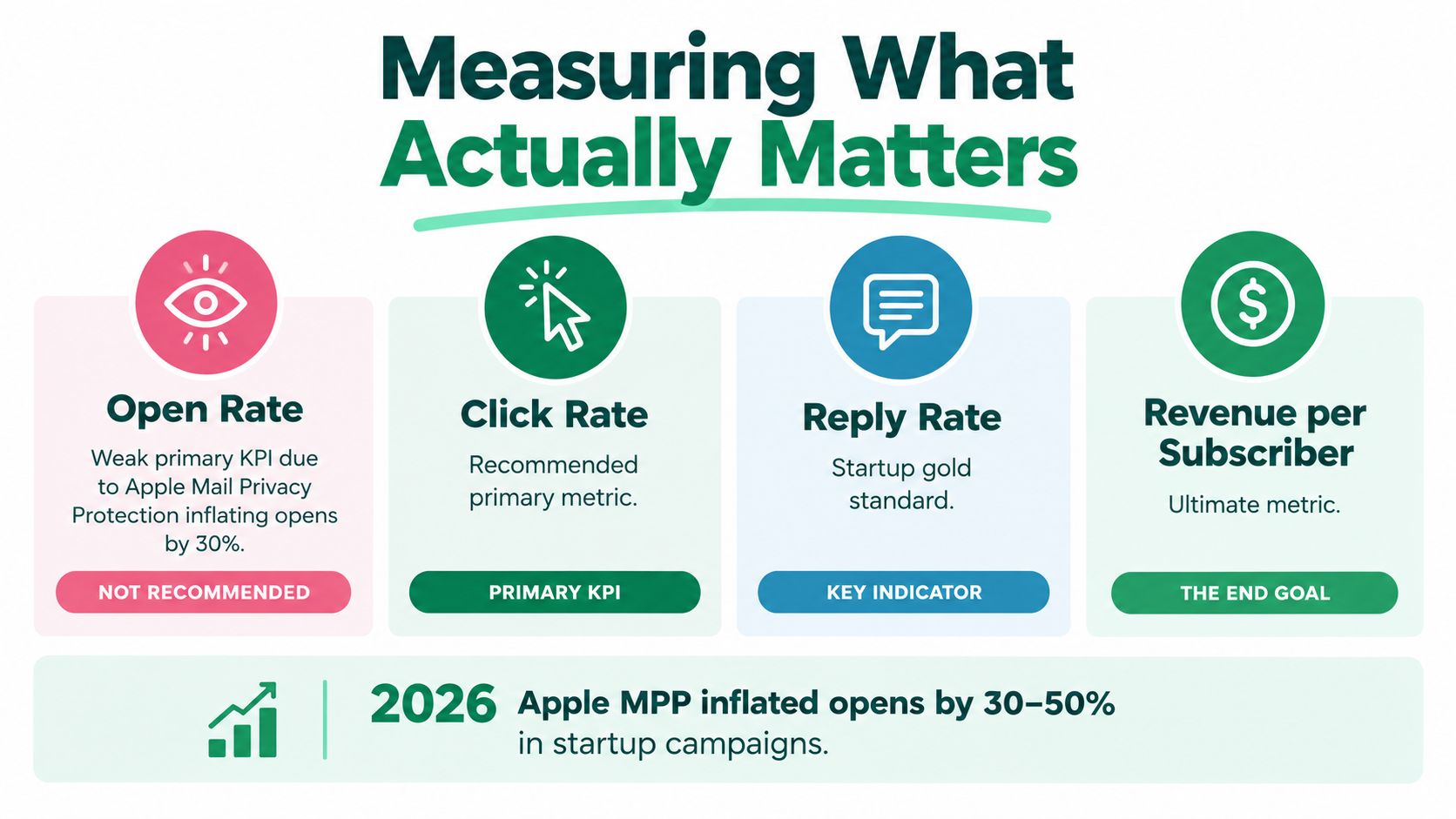
Open rate is an unreliable primary KPI for startup email programs. Apple Mail Privacy Protection can inflate opens, and 2026 email benchmark coverage places average open rates across datasets from 20.73% to 42.35%. That range is broad enough to show why comparing opens across audiences, providers, and campaigns can lead a small team toward the wrong decision.
The better question is not “How do we get more opens?” It's “Which message causes a valuable action?” Clicks show interest in a destination. Replies show active intent. Conversions show that the recipient completed the business goal. Revenue per recipient connects the campaign to economics.
Use a practical metric hierarchy
| Priority | Metric | What it tells you |
|---|---|---|
| Highest | Revenue per recipient | Whether the campaign creates economic value |
| High | Conversion rate | Whether recipients complete the intended goal |
| High | Click rate | Whether the message motivates a meaningful next step |
| High | Reply rate | Whether the message starts a useful conversation |
| Guardrail | Unsubscribe rate | Whether the promise, content, or cadence is misaligned |
| Guardrail | Complaint rate | Whether recipients or providers reject the messages |
| Diagnostic | Open rate | A directional signal that privacy changes weaken |
The dashboard should show these results by campaign, audience segment, and lifecycle stage. A high click rate with weak conversion can indicate a landing-page problem. Strong conversions from one segment can justify a more specific promise. A rising unsubscribe rate may point to frequency, targeting, or a gap between the signup offer and subsequent content.
For a lean testing rhythm, change one meaningful variable at a time. Test the offer, call to action, audience, or message angle, and document the result in a shared sheet. Don't declare a winner from a tiny fluctuation. Look for a pattern across comparable sends, then apply the learning to the next campaign.
The dashboard doesn't need to be elaborate. Include the campaign goal, delivered messages, clicks, replies, conversions, revenue per recipient, unsubscribes, complaints, and a short note on what changed. That record turns each send into an experiment instead of an isolated report.
Choosing Tools and Staying Compliant
A startup stack should match the work, not the imagined future department. An email service provider handles permission, campaigns, automation, and reporting. A prospecting tool supports targeted outreach. A verification service protects the list before contacts enter a sending workflow. These categories solve different problems, so choosing one tool to do everything often creates avoidable compromises.
| Tool Category | Typical Cost Tier | Best For | Team Fit |
|---|---|---|---|
| Free-tier email service provider | Free or low entry tier | Opt-in newsletters, forms, basic automation, reporting | Founder-led teams and early marketing hires |
| Email finder extension | Free or paid tier | Researching publicly available contacts for targeted outreach | Sales-led founders and small business development teams |
| Verification service | Usage-based or paid tier | Checking addresses and reducing invalid contacts before sending | Any team importing or enriching prospect data |
Choose an ESP for deliverability controls, segmentation, event triggers, exports, and transparent pricing as the audience grows. Don't choose solely on the first invoice. A cheap tool that makes suppression, authentication, or behavioral automation difficult can cost more in migration work and damaged reputation.
Use prospecting and verification tools only within a clearly defined outreach process. A contact's availability online doesn't remove the need for relevance, lawful processing, identification, and an easy way to object. Email privacy and data regulation guidance is useful when the team is deciding what information to collect, why it needs it, and how long it should retain it.
Make compliance part of setup
Consent language should describe the content and the sender. Every marketing email needs an accessible unsubscribe mechanism, and suppression lists should prevent accidental re-imports. Store the source and status of each contact so the team can answer basic questions about permission without reconstructing history from memory.
Domain authentication belongs in the first setup sprint, not after the first deliverability problem. Keep transactional messages, opted-in marketing, and cold outreach logically separated where the sending platform and business process require it. Review templates on mobile, check every link, and send internal tests before a public launch.
Use this first-week checklist:
- Choose the sending platform: Confirm automation, reporting, exports, and suppression features.
- Write consent copy: State what subscribers will receive and why.
- Authenticate the domain: Configure SPF, DKIM, and DMARC through the responsible technical owner.
- Create suppression rules: Include unsubscribes, hard bounces, complaints, and manual objections.
- Build one form and one welcome flow: Keep the first path easy to inspect.
- Test the full journey: Submit the form, receive the message, click the action, and verify the record.
Your First 90 Days of Email Marketing
The first phase is foundation. Write the one-page strategy, choose the platform, authenticate the sending domain, publish a focused lead magnet, and connect the signup form to a welcome email. Keep the path small enough that one person can inspect every trigger and message.
The second phase is traction. Put the welcome sequence live, run consistent list-building efforts through relevant content and conversations, and establish a baseline for clicks, replies, conversions, unsubscribes, and complaints. Treat responses as product research, not just campaign feedback.
The third phase is optimization. Test one variable at a time, launch a restrained re-engagement flow, improve the weakest activation step, and track revenue per recipient where the data supports it. Don't add complexity until the existing journey is reliable.
Email compounds because each useful interaction can improve the next one. Start with a promise people understand, protect the list, and keep sending messages that deserve attention. Paid channels can disappear when budgets or algorithms change, but a permission-based audience gives a startup an owned foundation it can keep improving.
EmailScout helps startup teams discover publicly available decision-maker email addresses through its Chrome extension, then save or explore contacts for focused outreach research. Visit EmailScout to support your list-building workflow while keeping verification, relevance, and permission at the center of your email program.