
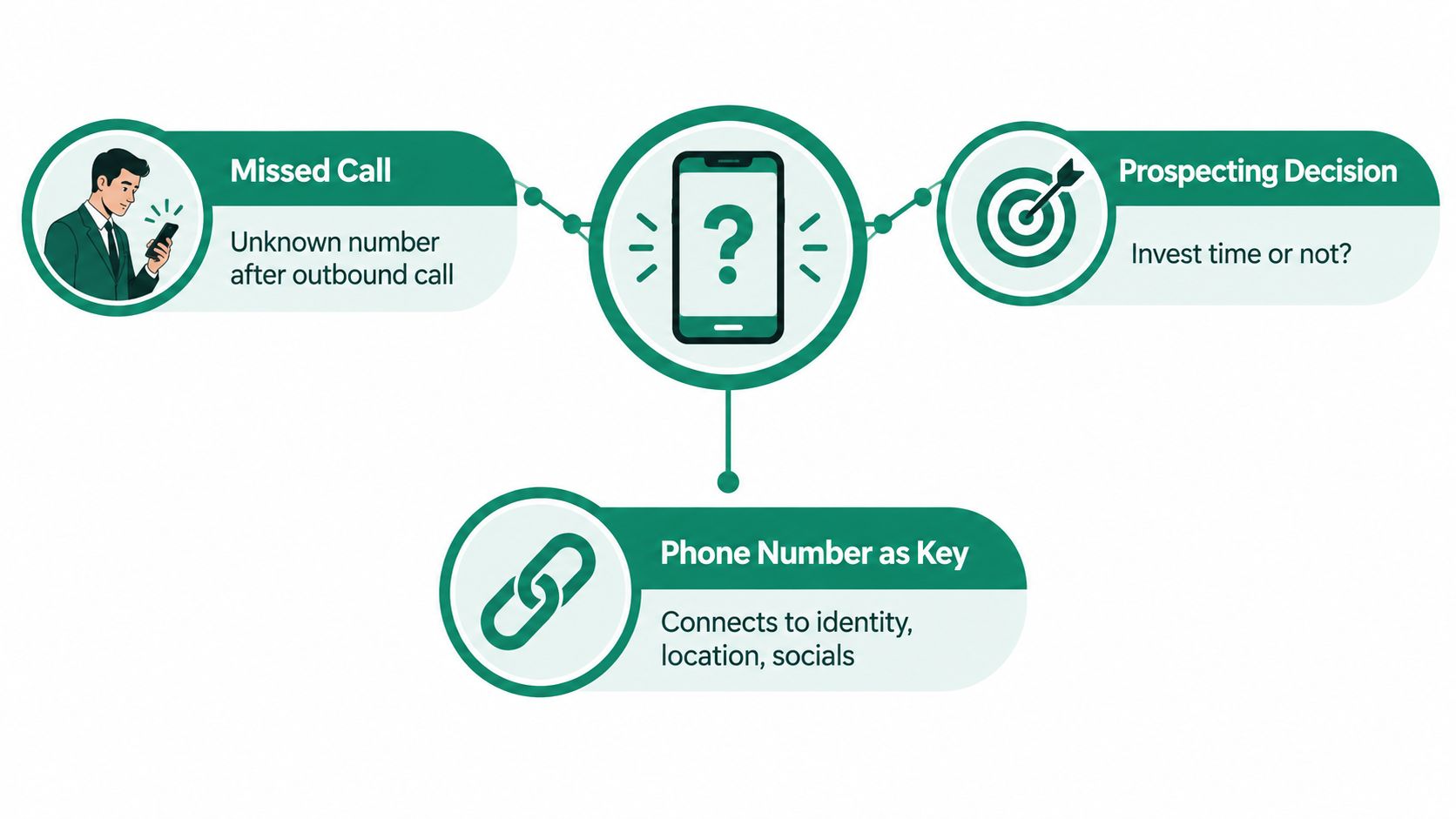
A rep misses a callback from an unfamiliar mobile number ten minutes after a cold outbound block. The CRM shows no confirmed match. The area code looks plausible, but that doesn't answer the question: should anyone spend another touch on it, save it, enrich it, or leave it alone?
That's the daily reality behind buscar a personas por numero de telefono. One expectation is that a single lookup box will produce a name, company, and confidence score. In practice, phone-based identification works better when you treat the number as a clue and run it through a layered verification process.
Why a Phone Number Is a Starting Point
A phone number is useful, but it isn't a person. It's a routing identifier first, a weak identity signal second, and a verification anchor only after you've checked what kind of number it is and what other sources agree with it.
In sales ops, that distinction matters. A callback after outbound can come from a decision-maker, a gatekeeper, a shared office line, a recycled mobile number, or a VoIP account that's now attached to a different user. If you act on the first result you see, you'll mislabel contacts and poison your CRM faster than you realize.
The three layers that matter
I separate phone search into three checks:
- Carrier validation. Is the number structurally valid, and what line type is it?
- Identity resolution. Does any credible source connect it to a person or business?
- Reputation signals. Does the number look safe, suspicious, spammy, or high risk?
This sounds simple, but most lookup tools blend these layers together and make the output look more certain than it is.
Why one match isn't enough
Caller ID can be falsified. In the United States, Congress passed the Truth in Caller ID Act in 2009, and the FCC later expanded its rules in August 2019 to cover malicious spoofing in text messages and calls originating outside the country, with those foreign-call rules effective February 5, 2020. In the year before that action, the FCC said it had issued forfeitures totaling more than $200 million and proposed another $37.5 million in fines for Truth in Caller ID violations, which shows how seriously spoofing affects phone-number trust (FCC anti-spoofing order).
Practical rule: A phone number can justify a lookup. It can't justify certainty.
If your workflow includes page-level contact enrichment, EmailScout's email and phone number search is one example of a tool that can surface contact data from the page context. But even then, treat the phone field as something to verify, not something to trust blindly.
Validating the Number Before Anything Else
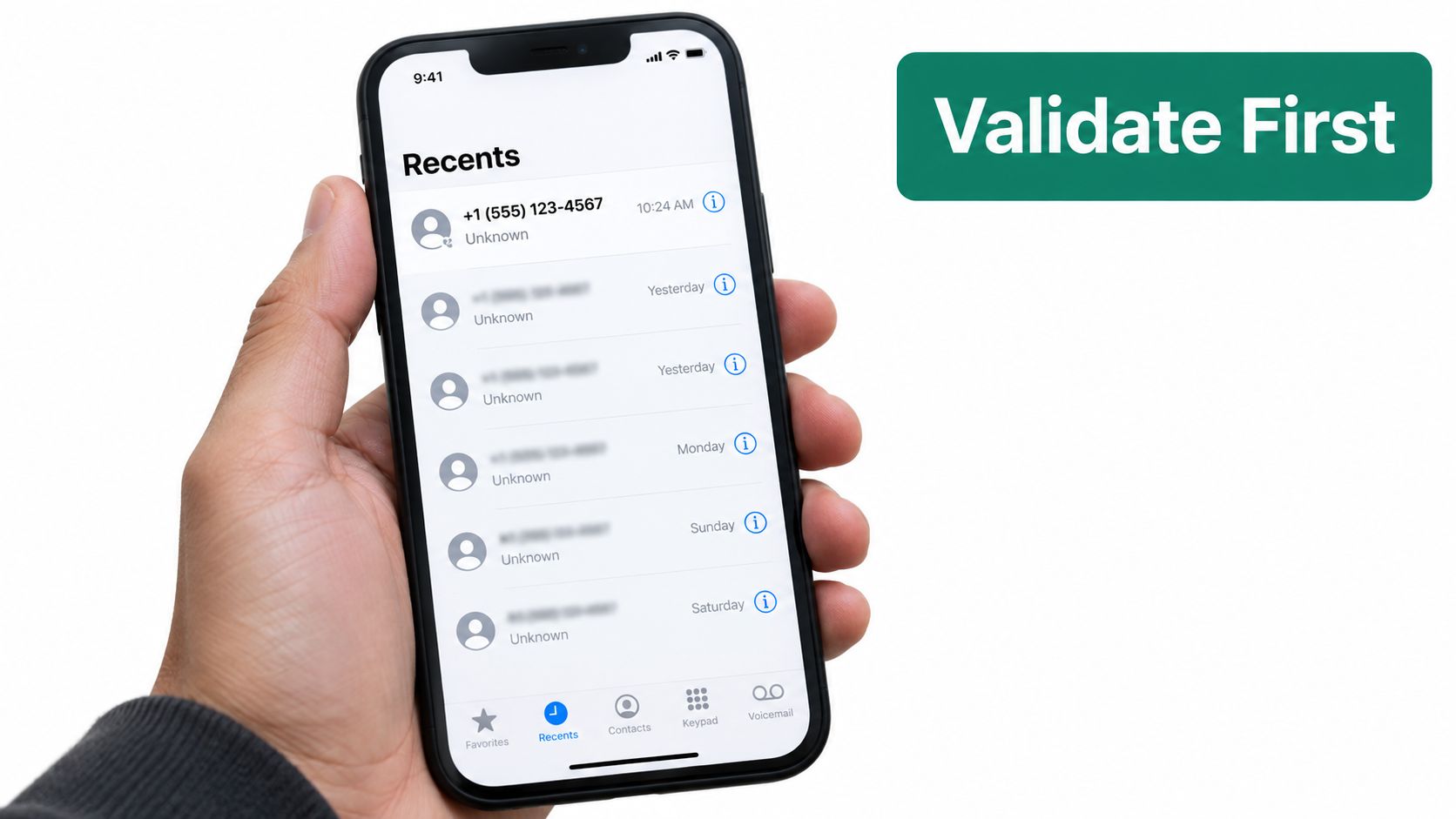
Before you try to find a name, check whether the number is even worth resolving. Start with format, country, line type, and carrier metadata. That first pass eliminates a lot of bad assumptions.
A proper validation step usually answers questions like these:
- Format validity. Does the number normalize cleanly to E.164?
- Country assignment. Is it a US, Mexico, Brazil, or other country number as expected?
- Line type. Mobile, landline, VoIP, or toll-free?
- Carrier data. Which network is associated with it right now?
What this step actually tells you
This is metadata validation, not person validation. A clean result can tell you the number exists in a numbering plan and may return carrier or line-type details. It still won't prove who picks up.
That difference matters because reverse-phone-lookup workflows are strongest when they combine numbering-plan validation, carrier and line-type metadata, and then public-record enrichment. The practical order is to normalize first, verify carrier and line type second, and attempt identity resolution after that, because a single phone-number match can attach the wrong person to a recycled, ported, or compromised number (phone lookup workflow guidance).
A simple API test
If you want a fast technical check, telecom lookup APIs are the cleanest starting point. Teams commonly test with Twilio Lookup, NumVerify, or Telnyx because they return structured metadata instead of making identity claims they can't support.
A basic test call usually looks like this:
curl -X GET "https://lookups.twilio.com/v1/PhoneNumbers/+14155552671?Type=carrier"
-u "ACCOUNT_SID:AUTH_TOKEN"
Expect fields like country code, national format, carrier, and line type if available.
What to watch for in the response
The most useful outcomes aren't glamorous:
- Mobile with expected country. Good sign for reachability, not ownership.
- VoIP. Higher caution. These numbers are often harder to bind to a stable individual.
- Landline. Better for business identification, weaker for direct-person outreach.
- Toll-free. Usually a business endpoint, not a personal identity clue.
A short walkthrough helps if you haven't used lookup APIs before.
One operational caveat: in the US, mobile number portability means the current carrier can differ from the original assignment. So if the carrier looks odd, don't jump to fraud or assume the lead record is wrong. Get a second corroborating signal before anyone updates ownership in the CRM.
Comparing Reverse Lookup Services
Most confusion around buscar a personas por numero de telefono comes from using the wrong tool for the wrong question. A spam directory, a people finder, and a telecom API are solving different problems.
What each category really returns
Free directories tend to return crowd labels first. You might get a name, but you're just as likely to get complaint tags, business category hints, or “suspected spam” style verdicts. Useful for triage. Weak for identity confirmation.
Paid people finders do better when the number has a public-record trail. They're often stronger on US landlines, older records, and household-level links. They're less dependable for mobile-first users, recent ports, and numbers outside the US.
Telecom APIs don't try to identify a person. That's their advantage. They stay in the metadata lane and tell you whether the number itself looks structurally and operationally real.
Reverse Lookup Service Comparison
| Category | Examples | Cost | Data Returned | Best For |
|---|---|---|---|---|
| Free directories | Truecaller, Sync.me, USPhoneBook | Free or freemium | Crowdsourced names, spam labels, public reports | Fast triage on unknown callers |
| Paid people finders | Spokeo, BeenVerified, Intelius | Paid | Public records, possible household links, social traces | Deeper US-centric identity resolution |
| Telecom APIs | Twilio Lookup, NumVerify, Veriphone | Usage-based or subscription | Carrier, line type, country, validity metadata | Pre-checking numbers before enrichment |
The practical trade-off
The mistake I see most often is expecting one product to answer all three questions:
- Is the number real?
- Who might it belong to?
- Is it safe to contact?
No single service handles that cleanly.
A telecom API can confirm line type and country. It won't tell you whether the person listed in your CRM still owns that mobile number.
If you're assembling enrichment stacks and research workflows, data scraping tools for lead research can help gather surrounding context from the web. Just keep the phone-specific work separated by stage. Metadata first, identity second, reputation third.
Using Social Platforms and Search Operators
Before paying for a people-finder result, cross-check the number in places where real users attach numbers to accounts. This takes a few minutes and often gives cleaner directional evidence than a generic aggregator.
Start with platform-native checks
WhatsApp is often the fastest manual test in Latin America and many international workflows. Save the number as a contact, refresh your address book inside the app, and see whether a profile appears. You may get a name, profile photo, business label, or nothing at all.
Telegram can also reveal whether the number is attached to an account, depending on that user's privacy settings. Facebook and Instagram are less consistent than they used to be. LinkedIn is usually poor for direct phone discovery, but it can still help when you already have a candidate name and company from another source.
Search Operator Patterns for Phone Lookups
| Platform | Search Pattern | What It Returns |
|---|---|---|
" +1 415 555 2671 " |
Exact-match pages containing that format | |
"4155552671" |
Bare-number mentions with no spacing | |
"415-555-2671" site:linkedin.com/in |
Public profile mentions indexed on LinkedIn | |
"415 555 2671" site:facebook.com |
Public Facebook references | |
"4155552671" site:instagram.com |
Bios or indexed profile mentions | |
" +52 55 1234 5678 " -directory -aggregator |
Removes low-value resellers and directory pages |
Test multiple formats
Phone numbers show up online in messy ways. Search all of these variations separately:
- International format with country code
- Domestic format without country code
- Spaced version used in directories
- Dashed or parenthesized version common in US listings
- Digits only for scraped or indexed pages
Where false positives come from
A recycled mobile number can produce social fragments from an earlier owner. A VoIP number used for signups may point to multiple unrelated accounts. Shared business reception lines create another problem, because the number may be tied to the company while your CRM tries to force it onto one person.
Search operators are strongest when they confirm a candidate identity you already suspect. They're weaker when you use them to invent one from scratch.
If two platforms surface different names, stop there. Don't merge the records. Route it for manual review or leave the number unresolved.
How Accurate Is Phone-Based Identification
Phone-based identification gets worse as the data becomes more personal. Carrier and broad location signals are much easier to resolve than actual ownership.
Research on telephone metadata makes that clear. A peer-reviewed PNAS study found that telephone metadata is densely interconnected, can be trivially reidentified, and enables automated location and relationship inferences. At the same time, the public-data side is limited. In that study, Google Places matched 16.6% of look-up attempts, Yelp matched 10.5%, and all automated sources together matched 31.9% (PNAS telephone metadata study).
That tells you two things at once. A phone number can expose more than most users expect, but public lookup sources still miss a large share of real identities.
Accuracy changes by number type
Independent summaries report that basic carrier or general-location lookups can reach roughly 60 to 70% accuracy, while actual owner identification can fall below 40% for prepaid mobile numbers. The same body of expert writeups says landlines and business numbers are easier to resolve than mobile or VoIP lines, and one industry test reported an average correct owner or category match of 62% with 19% outdated or recycled-number records (reverse phone lookup accuracy discussion).
Accuracy by Number Type
| Number Type | Identity Match Rate | Common Limitation |
|---|---|---|
| Landline | Higher than mobile in practice | Can map to household or business rather than one person |
| Business number | Usually easier to resolve | Often identifies the company, not the individual |
| Mobile | Can fall below 40% for prepaid mobile numbers | Recycling, privacy restrictions, stale owner data |
| VoIP | Often weak for owner identity | Shared use, disposable setup, sparse public records |
| Toll-free | Usually poor for person-level identity | Business endpoint only |
Why sources disagree
Aggregators often pull from old public records, app contact graphs, complaints, and user-submitted labels. That mix creates conflicts. One database may still show the prior owner. Another may label the line by company. A third may only know the carrier and region.
That's why I don't treat a name hit as a fact unless at least two independent source types support it. “Independent” matters. Two directories that copied the same stale record don't count as confirmation.
Reputation signals are often more useful than names
A lot of public reverse lookup products now behave more like fraud-prevention tools than people-finding tools. Many emphasize complaint signals, community reports, and safe or suspicious verdicts instead of personal identity. That reflects a real user need: people often want to decide how to handle a number, not necessarily who owns it (phone reputation emphasis).
A separate market trend points the same way. Some tools now limit outputs to carrier, number type, and public reports, and the ecosystem is shifting from people lookup toward reputation lookup. One useful takeaway is that the biggest practical question is often not “Who is this?” but “What's the safest action with incomplete data?” (cross-border lookup limits and reputation trend).
How I read risk signals in practice
Risk labels help, but they don't prove identity and they don't prove intent. A “clean” number can still belong to the wrong person. A “spam” label can reflect recycled ownership or community overreporting.
I look for combinations such as:
- Line type plus use case. A direct-sales record tied to a VoIP line gets extra scrutiny.
- Reputation plus source consistency. Complaint-heavy numbers are poor candidates for outbound saves.
- Business context. If a number appears on a company website, that matters more than a generic app label.
- Known messaging behavior. Numbers used for account creation, app verification, or disposable routing need caution.
For teams testing WhatsApp-based workflows, a virtual number for WhatsApp can be useful context for understanding how non-traditional numbers get used operationally. It also highlights why WhatsApp presence alone isn't proof that you've identified the right person.
A workable confidence standard
Use phone matches probabilistically.
- One source says “John Smith.” That's a lead.
- A second independent source ties the same number to John Smith at the same company. Better.
- A social profile or confirmed reply aligns with that identity. Now you have something usable.
If the evidence never converges, don't force certainty into the CRM.
Privacy, Consent, and Cross-Border Limits
Technical access and lawful use aren't the same thing. A number can be searchable and still be off-limits for outreach, storage, profiling, or CRM enrichment depending on jurisdiction and use case.
The US reality
In the US, spoofing enforcement alone shows why phone-number trust is regulated. The FCC defines spoofing as deliberately falsifying caller ID information to disguise identity, which is one reason reverse phone lookup became a practical verification tool in the first place, not just a convenience feature.
For outreach teams, the harder issue is downstream use. Looking up a number for verification is one thing. Calling or texting it for prospecting is a separate compliance decision. Teams also get into trouble when they treat a successful match as implied permission to market.
Regional Rules for Phone-Based Lookup and Outreach
| Region | Key Law | Lookup Use | Outreach Use |
|---|---|---|---|
| United States | TCPA, FCRA, state-level calling and texting rules | Verification may be possible depending on source and use | Calling and SMS require separate compliance review |
| EU and UK | GDPR, PECR, ePrivacy enforcement | Must have a lawful basis for processing | Marketing use needs tighter consent and legitimate-interest analysis |
| Latin America | Local privacy laws such as Mexico's LFPDPPP and Brazil's LGPD | Rules vary by country and source type | Reuse for outreach often needs clear internal justification and local review |
The cross-border problem
What works for a US landline often doesn't work for a mobile or VoIP number in Latin America. Public-record depth, carrier exposure, and platform visibility vary widely. Some services only show public reports or line metadata, not identity, and many don't explain those limits well.
That's why global teams need a documented standard for data origin, retention, and use. If a researcher finds a number in a directory, saves it to a CRM, and then a rep texts it from another jurisdiction, the compliance risk now spans collection, storage, and contact.
Compliance check: A lookup hit is not consent. A callable number is not a contactable number.
For teams building policy around lawful outreach, this guide to GDPR consent for B2B outreach is useful background alongside a broader review of data privacy regulations for prospecting workflows.
Common mistakes
Three mistakes repeat constantly:
- Treating identity as permission. Knowing who might own a number doesn't create outreach rights.
- Saving unverifiable results. Bad or unsupported phone identities create compliance debt inside the CRM.
- Reusing numbers across regions. A process that passes in one market can fail in another.
The safest standard is simple. Minimize what you store, document why you stored it, and separate informational lookup from contact activation.
A Practical Verification Checklist
When someone on the team wants to trust a number, I use a short verification chain. It's strict enough to prevent bad saves, but light enough that reps will follow it.
The pre-action checklist
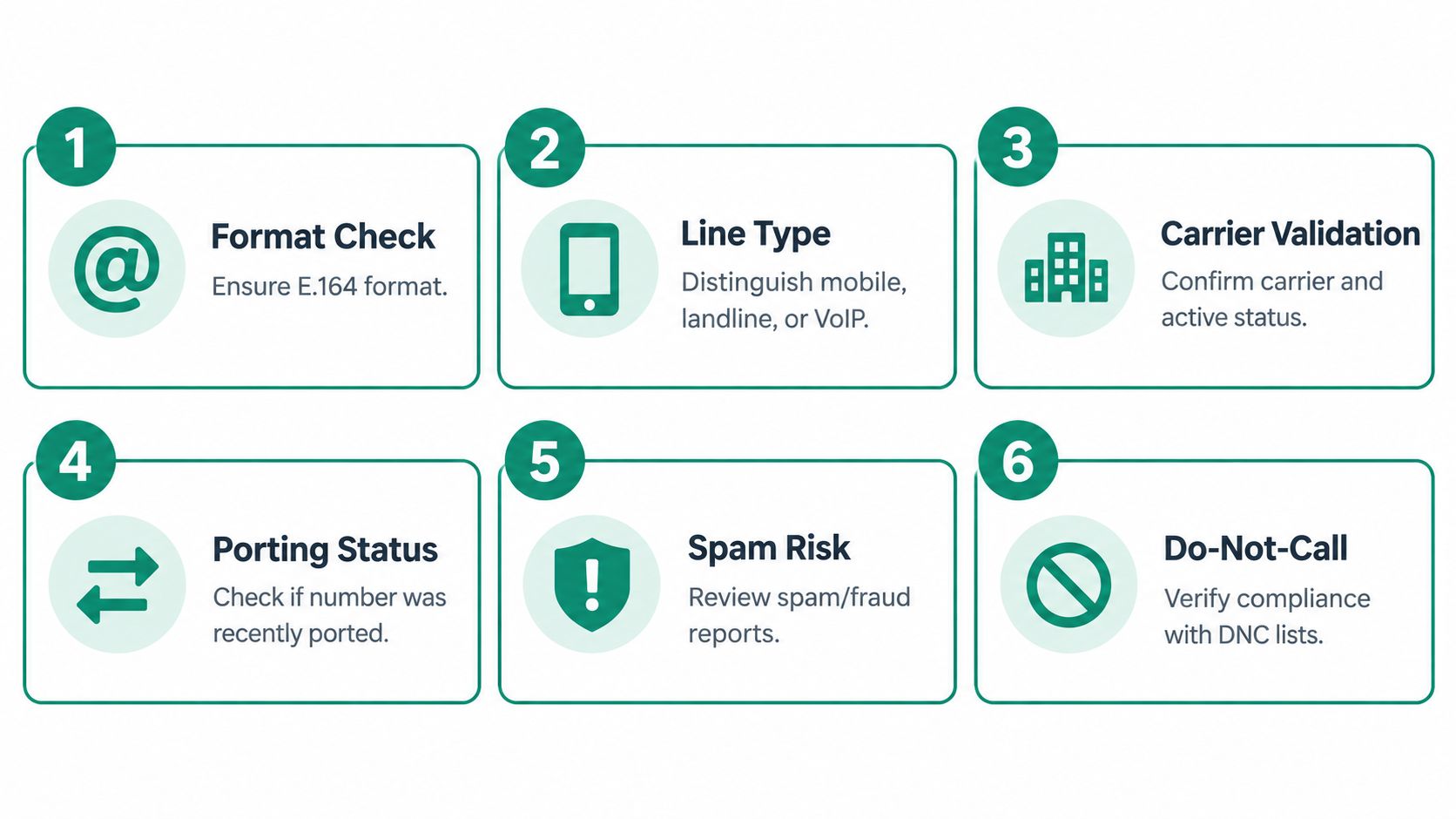
- Normalize the number. Convert it to E.164 and confirm the country code is what you expect.
- Validate line metadata. Use a telecom API to confirm line type, country, and carrier details.
- Run two distinct lookup methods. Use one identity-oriented source and one reputation-oriented source.
- Cross-check on a social or public business surface. WhatsApp Business, a company site, or a public profile works better than a random aggregator alone.
- Review spam and complaint context. If the number looks risky or heavily reported, don't save it for outreach.
- Confirm against a real interaction. A reply, signature block, meeting invite, or published company listing is much stronger than any standalone reverse lookup.
Decision rule for messy results
If two independent identity signals disagree, treat the number as unresolved. Don't guess. Don't merge. Don't assign ownership because the area code looks right or because one database returned a neat-looking name.
Save the certainty for contacts who actually earned it through corroboration.
That discipline keeps your CRM cleaner, reduces bad outreach, and stops reps from building follow-up sequences on top of false identity matches.
If you're already doing contact research and need a faster way to pair page-level prospecting with verification, EmailScout helps surface professional contact details while you browse. It fits best as part of the enrichment layer, after you've validated the number and before you decide whether the record is strong enough for outreach.