Tag: outreach strategies

  • How to Generate Leads for B2B A Practical Guide

    How to Generate Leads for B2B A Practical Guide

    Before you even think about generating a single lead, you have to know exactly who you're talking to. The bedrock of any successful B2B lead generation playbook is a rock-solid Ideal Customer Profile (ICP). Think of it as your North Star for every sales and marketing move you make. This isn't just about company size or industry; it's about digging into the DNA of the businesses that get the most out of what you sell.

    Defining Your Ideal Customer Profile

    A laptop displaying various business charts and graphs, documents, and a pen on a wooden desk.

    Wasting time and money on prospects who will never convert is the quickest way to kill your budget and your team's morale. Seriously, crafting a precise ICP is the single most important thing you can do to build a predictable revenue engine. Without one, you're just shouting into the wind and hoping the right person happens to walk by.

    A great ICP is more than a list of basic company details. It's a living document that describes your perfect-fit customer, and it should be built on hard data—not guesswork. The best place to find that data? Your existing customer base.

    Look at Your Best Customers First

    Start simple. Make a list of your top 5-10 clients. These are the champs—the ones who renewed without a fuss, upgraded their plans, and send you referrals. They get the value you provide, and your mission is to clone them.

    With that list in hand, it's time to play detective. Look for the common threads that tie them all together.

    • Firmographics: What's their typical industry? What about company size, both in revenue and employee count? Where are they located?
    • Technographics: What other tech are they using? A big one I see a lot is a shared CRM like Salesforce or a marketing platform like HubSpot. This can be a huge qualifying signal.
    • Behavioral Data: How did they find you in the first place? Did they all come from a specific webinar or a blog post? Map out their journey from stranger to happy customer.

    An ICP is your filter. It gives you the power to say "no" to dead-end opportunities and a confident "yes" to prospects who are ready for success. This focus is what separates the high-growth companies from everyone else.

    Uncover Pain Points and Buying Triggers

    Data tells you who to target, but understanding their "why" tells you how to sell to them. The next layer is all about qualitative insights. Go talk to your customer success and sales teams; they’re in the trenches every single day.

    Here are a few questions to get the conversation started:

    • What was the exact problem our best customers were facing right before they found us?
    • Was there a "trigger event" that kickstarted their search? Think things like hiring a new VP of Sales, landing a big funding round, or failing a compliance audit.
    • What specific words and phrases do they use to describe their challenges? Use their language, not yours, in all your messaging.

    This process turns your ICP from a stale checklist into a powerful tool for connecting with people on a human level. It ensures your emails, ads, and content actually land with the right audience. For a deeper dive, check out our complete guide on how to identify your target audience.

    By putting in the work upfront to build a data-backed ICP, you're setting every other step of your lead gen strategy up for success.

    Building Your Prospect List with Precision

    Okay, you've got your Ideal Customer Profile locked in. That's your blueprint. Now it's time to stop theorizing and start building a real, tangible list of people and companies who fit that mold. This is where modern prospecting tools come in to turn your research into high-octane fuel for your outreach.

    The mission here isn't just to find any contacts. It’s about finding the right contacts with accurate, verified information. A meticulously built list is what separates a campaign that books meetings from one that just fills your inbox with bounce-back notifications.

    Leveraging LinkedIn Sales Navigator for Pinpoint Targeting

    Your first stop should almost always be LinkedIn, specifically Sales Navigator. It's the undisputed champion for B2B. A staggering 89% of B2B marketers use it to find prospects, and 62% claim it generates leads at double the rate of the next best social channel. These are powerful numbers, and you can dig into more B2B lead generation statistics to see the full picture.

    Sales Navigator is where you bring your ICP to life. You can slice and dice the entire LinkedIn database with incredible detail, filtering prospects by:

    • Job Title: Get specific with roles like "VP of Marketing" or "Director of Operations."
    • Company Size: Zero in on businesses with the exact employee count you're targeting.
    • Industry: Hand-pick the verticals you know you serve best.
    • Geography: Focus your energy on specific regions, states, or countries.
    • Keywords: Search for terms like "SaaS" or "logistics" right in a prospect's profile.

    By layering these filters, you can build hyper-targeted lists of people who are almost certainly a great fit for what you offer. This kind of precision means you're not wasting a single outreach effort on a bad lead.

    Pro Tip: Don't just save individual leads. Get organized by creating and saving "Lead Lists" and "Account Lists" in Sales Navigator. This helps you map out your target companies and the key decision-makers within them, making your follow-up so much easier.

    Extracting Verified Emails with a Single Click

    So you've found the right people on LinkedIn. Great. Now for the next hurdle: getting their contact info. This is where a specialized tool like the EmailScout Chrome extension becomes your best friend. Instead of the soul-crushing (and often inaccurate) process of manually hunting for email addresses, you can pull them directly from LinkedIn profiles.

    Here's what it looks like when EmailScout gets to work on a website.

    This little pop-up instantly finds and verifies email addresses, saving you hours of grunt work. See that "verified" checkmark? That's your golden ticket to a lower bounce rate and a healthier domain reputation.

    This one-click process lets you quickly move from Sales Navigator research to a fully-loaded, actionable outreach list. It's this kind of smooth workflow that helps you build serious momentum in your lead-gen game.

    Scaling Your Efforts with Bulk Processing

    What if you're a step ahead and already have a list of target company websites? Visiting each one manually to find contacts is a massive time-sink. This is where bulk processing comes into play, using a feature like EmailScout’s URL Explorer.

    Just upload a list of company domains (company-a.com, company-b.net, etc.), and the tool will crawl them all to find publicly available email addresses. It's a huge shortcut, especially for account-based marketing (ABM) where you have a defined hit list of target accounts. If you want to dive deeper into these kinds of techniques, check out our guide on how to find company email addresses.

    By combining sharp targeting on LinkedIn with efficient data extraction tools, you can build high-quality prospect lists at scale. It’s a methodical approach that ensures every single name on your list is a relevant, qualified contact, dramatically boosting your outreach effectiveness and setting you up for more meaningful sales conversations.

    Mastering The Art of B2B Outreach

    Okay, so you’ve built a pristine, highly-targeted prospect list. That’s a huge win, but it’s only half the battle. A brilliant list is just a document until you have a rock-solid outreach strategy to turn those names into actual conversations.

    This is where you shift gears from research to relationship-building. We're talking about smart, multi-touch sequences that cut through the noise and get people to actually hit "reply."
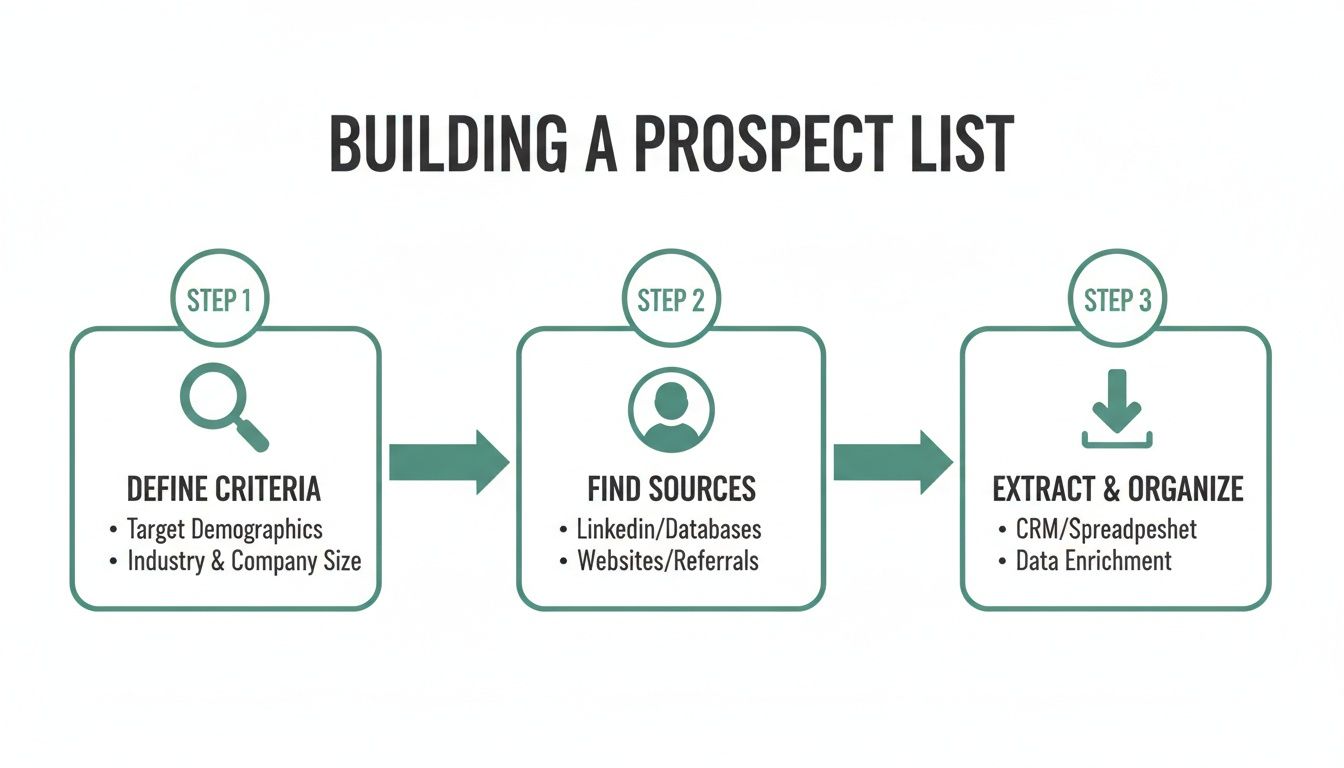
    An infographic outlines three steps for building a prospect list: define criteria, find sources, and extract & organize.

    This simple flow—Define, Find, Extract—is the foundation. It makes sure your outreach lands with the right people at exactly the right time.

    The goal here isn't to blast a generic template to hundreds of people and cross your fingers. That's a rookie mistake. Real B2B outreach is a thoughtful mix of personalization, persistence, and pure value. Let’s break down how to get this right on the two most powerful channels today: email and LinkedIn.

    Crafting Emails That Get Opened and Answered

    Cold email is still one of the most direct and effective ways to kickstart a B2B relationship, but you’re fighting for attention in a very crowded inbox. Success comes down to nailing a few key elements.

    Your first impression is everything, and it starts with the subject line. Think of it as the gatekeeper. A weak one gets your message archived or deleted on sight.

    • Don't use: "Intro," "Quick Question," or anything that screams sales pitch.
    • Instead, try: "Idea for [Their Company Name]" or "Thoughts on your recent [Project/Post]." Make it specific. Make it intriguing.

    Once they open it, that first line is your make-or-break moment. You have maybe three seconds to prove you did your homework and aren't just another spammer. This is where real personalization shines.

    Here's what I mean:
    Instead of the generic, "I saw you're the VP of Sales at Acme Corp," try something that shows you're paying attention: "I really enjoyed the point you made on the SaaS Growth podcast about scaling sales teams. Your take on data-driven coaching was spot-on."

    See the difference? That simple shift takes you from a cold pitch to a peer-to-peer discussion. For a much deeper dive, our post on how to write cold emails is a complete playbook.

    Finally, every email needs a clear, low-friction call-to-action (CTA). Please don't ask for a 30-minute demo right out of the gate. That's asking way too much. Aim for a micro-commitment instead.

    • Weak CTA: "Are you free for a call next week?"
    • Strong CTA: "Is this a problem you're currently facing?"

    This approach is about starting a conversation, not forcing a sale. The goal of that first email is simple: get a reply. Earn the right to keep talking.

    Starting Genuine Conversations on LinkedIn

    LinkedIn is the B2B social hub, making it the perfect place to complement your email outreach. But the same rules apply—personalization beats volume, every single time. Your whole vibe here should be less "sales rep" and more "professional networker."

    Your first touchpoint is usually a connection request. Sending a blank one is a huge missed opportunity. Always, always add a short, personalized note.

    Connection Request Templates That Actually Work:

    1. Shared Interest: "Hi [Name], I saw your comment on [Influencer]'s post about ABM and thought it was insightful. Would love to connect and follow your work."
    2. Mutual Connection: "Hi [Name], I see we're both connected with [Mutual Connection Name]. I'm also in the [Industry] space and would be great to connect."
    3. Simple & Direct: "Hi [Name], your work at [Company Name] in the [Their Industry] space is impressive. I'm building my network of experts in this area and would be glad to connect."

    Once they accept, don't immediately slide into their DMs with a pitch. That’s just tacky. The goal is to build rapport. Go like or comment on one of their recent posts. Then, a day or two later, you can send a follow-up message that gently pivots to a business conversation.

    For a deeper look into platform-specific tactics, these strategies to generate leads on LinkedIn offer some great, practical insights.

    When you combine thoughtful email outreach with genuine relationship-building on LinkedIn, you create a powerful one-two punch. This multi-touch approach respects your prospect's time, shows you’ve done your homework, and dramatically increases your chances of turning a name on a list into a real sales opportunity.

    Using Content and Partnerships to Attract Leads

    A tablet displays 'LEAD MAGNET' content with two business people shaking hands, on a wooden desk.

    While a sharp outbound strategy gets you quick wins, a powerful inbound engine is what builds a sustainable, long-term pipeline. This is how you get B2B leads coming to you, already sold on your expertise.

    It’s all about attracting, not just chasing.

    This approach really boils down to two things: creating seriously valuable content and building strategic partnerships. Instead of interrupting a prospect's day, you become the go-to resource they actively look for when they have a problem.

    Turn Your Website Into a Lead Magnet

    Think of your website as your best salesperson—one that works 24/7 to capture interest. The best way to do this is by offering high-value downloadable resources, often called lead magnets, that solve a very specific problem for your Ideal Customer Profile.

    These aren't just blog posts. They’re substantial resources that prospects are happy to trade their email addresses for. Ask yourself: what does my ICP actually struggle with every day? What piece of information would make their job noticeably easier?

    Effective lead magnets usually look like this:

    • Ebooks or Whitepapers: A deep dive into a complex industry topic, backed by real data. A cybersecurity firm might offer "The CISO's Guide to Vendor Risk Management."
    • Checklists or Templates: Actionable tools that make a process less painful. A project management software company could create a "Perfect Project Kickoff Checklist."
    • Webinar Recordings: On-demand access to an expert discussion that tackles a major pain point.

    The rule of thumb is simple: the more specific and valuable the resource, the higher the quality of the lead. A generic "Marketing Tips" ebook attracts tire-kickers. A detailed guide on "Building a B2B SaaS Funnel" gets you in front of your exact target buyer.

    Once you have these assets, make it painfully obvious how visitors can get them. Use prominent calls-to-action (CTAs) on your homepage and blog. You can even build a chatbot for lead generation to engage visitors and guide them to the right resource.

    Forge Strategic Partnerships for Audience Growth

    Why build an audience from scratch when you can borrow one? Partnership marketing is one of the most overlooked strategies for generating high-quality B2B leads. It's all about teaming up with non-competing businesses that serve the same ICP.

    The key is finding partners who are complementary, not competitive. If you sell sales automation software, a great partner could be a CRM consulting firm. You both want to help sales leaders win, but you aren't fighting for the same budget.

    Once you find a few good potential partners, the collaborations are endless:

    • Co-Hosted Webinars: This is a classic for a reason. You and your partner present on a topic you both know well, and each of you promotes it to your email lists. Every single registrant is a warm lead for both companies.
    • Co-Created Content: Pool your expertise to create a definitive ebook or industry report. This gives you a killer lead magnet that both teams can use to generate leads for months.
    • Guest Blogging: Write for your partner's blog to get your name in front of their audience and build some SEO authority. Then, have them do the same for you.

    These are true win-win scenarios. You get access to a brand new, highly relevant audience, and the endorsement from a trusted partner gives you instant credibility. I've found this method consistently delivers some of the most qualified leads you'll ever get, simply because they show up with a built-in layer of trust.

    Getting Leads Ready for a Sales Handoff

    Getting a lead is a great start, but it's just that—a start. Not every person who downloads your ebook or fills out a form is a real sales opportunity. The difference between a B2B lead generation program that works and one that just keeps sales busy with dead-end calls comes down to proper qualification.

    Your goal is to build a solid, reliable bridge between your marketing efforts and your sales team. This way, when a lead gets passed over, it’s not a cold transfer. It's a warm introduction to someone who’s actually ready to talk business. This alignment is everything; without it, you’ll burn out your sales reps and waste time on prospects who were never going to buy anyway.

    Using a Framework to Spot Real Opportunities

    To add some structure to this process, many successful teams lean on a qualification framework. One of the most tested and reliable is BANT, which stands for Budget, Authority, Need, and Timeline. Think of it as a simple but powerful checklist to help you figure out if a lead is worth chasing right now.

    The real trick is to weave these questions into a natural conversation, not fire them off like an interrogation. You're trying to understand their situation, not just tick boxes on a list.

    • Budget: Can they actually afford your solution? You can get a feel for this by asking about what they currently spend to solve the problem or what they've set aside for similar projects.
    • Authority: Are you talking to the person who makes the final call? If not, can they get you to that person? A great way to ask this is, "Who else on your team is usually involved in making decisions like this?"
    • Need: Is the problem you solve a big deal for them? You have to uncover a real, urgent business challenge that your product is the perfect answer for.
    • Timeline: How soon are they looking to get a solution in place? Knowing their urgency helps you prioritize. A lead hoping to buy this quarter is a lot hotter than one planning for next year.

    BANT isn't a rigid script; it's a guide. The goal is to have a consultative conversation that brings this information to the surface organically. It helps both you and the prospect figure out if it's a good fit.

    Defining the MQL to SQL Handoff

    The entire qualification process builds up to one critical moment: the handoff. This is where a Marketing Qualified Lead (MQL)—someone who’s interacted with your marketing content—becomes a Sales Qualified Lead (SQL), a lead the sales team agrees is a genuine opportunity.

    Having a clear, agreed-upon definition of an SQL is non-negotiable. Your marketing and sales teams have to be on the exact same page about what makes a prospect ready to engage.

    An SQL profile might look something like this:

    • Fits the Ideal Customer Profile (ICP) on company size (e.g., 100-500 employees, SaaS industry).
    • Is a Director-level contact or higher.
    • Has clearly stated a business pain point that we solve.
    • Indicated a timeline of 6 months or less for a solution.

    This isn’t just about flicking a name and email over the fence. The handoff has to include all the rich context you’ve gathered. What content did they look at? What problems did they mention on your first call? Who else is involved in the decision?

    This context is gold. It lets the sales rep jump into a conversation from a place of knowledge and value, referencing the prospect's specific situation instead of starting from square one. A smooth handoff turns a simple lead into a well-qualified opportunity and gives your sales team a much better shot at closing the deal.

    Measuring Success and Scaling Your Efforts

    Getting leads in the door is just the beginning. If you aren't tracking what happens next, you're flying blind—mistaking activity for actual progress. You can't improve what you don't measure, and this is where you finally turn all that raw effort into predictable revenue.

    This whole process starts by zeroing in on a few key performance indicators (KPIs) that actually matter. Forget the vanity metrics like social media likes; we're talking about the hard numbers that directly tie back to your bottom line.

    Key Metrics for B2B Lead Generation

    First, build a simple dashboard to track the health of your lead generation engine. This doesn't need to be some complex, over-engineered report. A basic spreadsheet or a custom view in your CRM is more than enough to get started.

    Focus on these essential metrics:

    • Cost Per Lead (CPL): Think of this as your efficiency score. Just divide the total cost of a campaign by the number of leads it pulled in. This tells you exactly how much you're paying to get a single name on your list.
    • Lead-to-Customer Conversion Rate: Honestly, this is the metric that matters most. It answers the big question: "How many of our leads actually become paying customers?" A low rate here usually signals a problem with either your lead quality or your sales process.
    • Channel Performance: Break down where your leads are coming from. Are you getting better-quality leads from your LinkedIn outreach or from your content marketing? Pinpointing which channels deliver the highest ROI is how you know where to double down.

    Measuring isn't about creating complicated reports nobody reads. It’s about gaining clarity. With the right data, you can confidently answer the question, “If we put another dollar into this channel, what can we realistically expect to get back?”

    From Data to Decisions

    Once you've been tracking these KPIs for a month or two, clear patterns will start to show up.

    You might find out that while your last webinar brought in a ton of leads, the cold email campaigns you ran produced leads that converted into customers at twice the rate. That's the kind of game-changing insight we're looking for.

    When you're armed with this kind of data, scaling stops being a gamble and becomes a calculated decision. You'll know exactly which levers to pull. If one of your email sequences is knocking it out of the park, it's time to build more variations and expand that prospect list. If a particular lead magnet is a massive success, you can confidently put some ad spend behind it to reach a lookalike audience.

    This data-first approach takes the guesswork out of how to generate leads for b2b. It transforms your lead generation from a bunch of disconnected tactics into a cohesive, scalable growth engine—one that you can tune and optimize over time for maximum impact on the business.

    Your B2B Lead Gen Questions, Answered

    If you're diving into B2B lead generation, you've probably got questions. It's a field with a lot of moving parts, and it's easy to get stuck on the details. Let's clear up some of the most common challenges teams run into when they're trying to fill their pipeline.

    What’s a Go-To Channel for B2B Lead Gen?

    While the "best" channel always circles back to your Ideal Customer Profile (ICP), LinkedIn is consistently the top performer for most B2B outfits. There's just no other platform that lets you zero in on decision-makers with that level of precision, filtering by job title, industry, company size—you name it.

    When you pair a targeted LinkedIn strategy with a solid cold email outreach plan, you’ve got a powerful one-two punch for sourcing high-quality leads. That said, don't put all your eggs in one basket. A smart content marketing strategy is your long game, building inbound interest that creates sustainable growth over time.

    How Many Times Do I Really Have to Follow Up?

    Generating a B2B lead is rarely a one-and-done deal. We're playing the long game here. Research shows it takes somewhere between 8 to 13 touchpoints just to get a response from a cold prospect.

    A "touchpoint" isn't just another email clogging up their inbox. It could be a LinkedIn connection request, a thoughtful follow-up message, a comment on their post, or even a quick phone call. The magic is in using multiple channels and adding real value with every single interaction.

    Can I Generate B2B Leads with a Tiny Budget?

    Absolutely. You don't need a massive war chest to get started. Generating B2B leads on a shoestring budget just means you have to be scrappy and focus on high-leverage activities that don't cost a dime.

    • Go Manual: Start by manually prospecting on LinkedIn. It’s tedious, but it works.
    • Use Freemium Tools: Take advantage of the free plans from tools like EmailScout to find verified email addresses without paying upfront.
    • DIY Your Outreach: Instead of hiring a pricey agency, roll up your sleeves and write those personalized email sequences yourself.
    • Create Your Own Content: Write insightful blog posts or share valuable content on LinkedIn. This is how you attract inbound leads over time without spending a penny on ads.

    Don't forget about online communities and forums in your niche. Jumping into relevant conversations is a great way to build authority and generate leads organically.


    Ready to turn all that prospecting into an actual list? The EmailScout Chrome extension finds verified emails with a single click, so you can stop researching and start reaching out. Start finding unlimited emails for free today.

  • 9 Powerful Sales Prospecting Techniques for 2025

    9 Powerful Sales Prospecting Techniques for 2025

    In today's competitive market, a full pipeline is the lifeblood of any successful business. However, relying on the same old methods is a surefire way to fall behind. The sales prospecting techniques that once guaranteed a steady flow of leads may no longer deliver the results you need. To thrive, sales professionals must master a diverse set of modern strategies designed for today’s discerning buyer. Sticking to a single approach limits your reach and leaves valuable opportunities on the table.

    This guide is designed to be your definitive resource for revitalizing your outreach efforts. We will break down nine distinct and powerful sales prospecting techniques, providing a comprehensive toolkit for building a resilient and high-performing pipeline. You will learn how to effectively implement everything from digital-first strategies like social selling and video prospecting to refined traditional methods such as cold calling and referral networking. Each section is packed with actionable steps, practical examples, and expert best practices tailored for the current sales environment.

    Forget generic advice and surface-level tips. Our focus is on providing you with the specific, detailed insights required to not just identify potential leads, but to meaningfully engage high-value prospects. By the end of this article, you will have a clear roadmap to diversify your prospecting activities, connect with more decision-makers, and ultimately, convert more opportunities into loyal customers. It's time to move beyond outdated tactics and supercharge your pipeline with strategies that consistently deliver.

    1. Cold Email Outreach: The Art of the Scalable First Touch

    Cold email remains a cornerstone of B2B sales prospecting techniques, offering a direct and scalable way to connect with high-value decision-makers. The modern approach, however, has evolved far beyond simple mass messaging. Success now hinges on delivering personalized value at scale, transforming a cold touch into a warm conversation. This method involves creating targeted, multi-step sequences that build familiarity and trust over time.

    Cold Email Outreach: The Art of the Scalable First Touch

    When executed correctly, cold email generates impressive results. Salesforce, for example, reportedly increased its sales pipeline by 40% using personalized campaigns. Similarly, outreach automation platform Outreach.io reports its clients achieving response rates between 8-12% with highly targeted sequences, proving that relevance trumps volume. The key is focusing on the recipient's world, not your own.

    How to Implement This Technique

    To make cold email work, you need a strategic, not a spammy, mindset. This starts with finding accurate contact details, a task simplified by tools like EmailScout, which allows you to focus your energy on crafting the perfect message. From there, your outreach should be concise, relevant, and centered on the prospect’s potential challenges.

    Here are actionable steps to get started:

    • Research and Personalize: Go beyond the prospect's name and title. Mention a recent company announcement, a shared connection, or a post they published on LinkedIn. This shows you’ve done your homework.
    • Craft a Compelling Subject Line: Keep it under 50 characters and make it intriguing. Avoid clickbait and focus on curiosity or relevance, such as "Question about [Their Company's Recent Project]" or "Idea for [Their Role]".
    • Write a Concise Message: Aim for under 150 words. A short, powerful email respects the recipient's time and is more likely to be read. Structure it with a clear opening, a value proposition, and a specific call-to-action (CTA).
    • Use a Clear, Low-Friction CTA: Instead of "Book a demo," try an interest-based question like, "Would you be open to learning more about how we helped [Similar Company] achieve [Result]?"
    • Follow Up Systematically: Don't give up after one email. A sequence of 3-5 follow-ups, each adding new value (like a case study or relevant article), is crucial.

    This technique is most effective when you need to reach specific decision-makers within a defined ideal customer profile (ICP). It provides a direct line of communication that, when used with precision and respect, can open doors to significant business opportunities. To dive deeper into crafting messages that get replies, you can explore these expert tips on how to write effective cold emails.

    2. Social Selling: Building Relationships Before the Pitch

    Social selling is a modern prospecting technique that shifts the focus from interruption to interaction. Instead of a cold pitch, it leverages social media platforms like LinkedIn to find, connect with, and nurture prospects. This method is about building genuine relationships by providing value, establishing credibility as an industry expert, and engaging in relevant conversations. It’s a long-term strategy that turns social networks into powerful lead-generation engines.

    Social Selling

    The impact of this approach is well-documented. LinkedIn reports that social sellers are 51% more likely to achieve their sales quotas. In a landmark case, IBM’s social selling program contributed to a staggering 400% increase in sales. These results highlight a fundamental shift: modern buyers are more informed and prefer to engage with salespeople who add value before asking for a sale.

    How to Implement This Technique

    Effective social selling requires a strategic and consistent presence, not just random connection requests. The goal is to become a familiar, trusted resource for your target audience. You can start by optimizing your social profiles to speak directly to your ideal customer’s pain points and then consistently share insights that help them.

    Here are actionable steps to get started:

    • Optimize Your LinkedIn Profile: Treat your profile like a landing page. Use a professional photo, a benefit-driven headline, and a summary that addresses your target audience’s challenges.
    • Share Valuable Content: Regularly post relevant articles, industry insights, and success stories. This establishes you as a thought leader and keeps you top-of-mind.
    • Engage Authentically: Like, comment on, and share your prospects' posts. Offer thoughtful comments that add to the conversation, showing you’re paying attention.
    • Use Advanced Search Tools: Leverage platforms like LinkedIn Sales Navigator to identify and monitor key decision-makers who fit your ideal customer profile.
    • Participate in Relevant Groups: Join and contribute to LinkedIn Groups where your prospects are active. Answer questions and share expertise to build your reputation.

    This technique is most effective for B2B sales cycles where trust and relationship-building are paramount. By consistently providing value, you warm up potential leads so that when you do reach out, it’s a natural next step in an existing conversation. For those looking to combine social selling with direct outreach, it's crucial to find the right contact information, and you can explore expert advice on how to find emails on LinkedIn.

    3. Cold Calling: The Power of the Direct Conversation

    Cold calling is the traditional sales prospecting technique of making unsolicited phone calls to potential customers. Despite the rise of digital channels, it remains one of the most direct and immediate ways to introduce your product, qualify leads, and secure meetings. Modern cold calling isn't about aggressive, high-pressure tactics; it’s a disciplined approach focused on research, relevance, and creating a genuine human connection in a matter of seconds.

    Cold Calling

    This method’s power lies in its immediacy and potential for real-time feedback. Legends in the industry were built on this foundation; Salesforce’s early growth was famously fueled by a relentless cold calling strategy. More recently, ZoomInfo reported that 82% of buyers still accept meetings from cold calls, proving its continued relevance. The key is transforming an interruption into a valuable, well-timed conversation.

    How to Implement This Technique

    Successful cold calling requires a blend of preparation, confidence, and adaptability. It’s less about a rigid script and more about a flexible framework that guides the conversation toward a specific objective. Your goal is to quickly establish credibility and pivot from your introduction to the prospect's potential pain points.

    Here are actionable steps to get started:

    • Research Before You Dial: Spend five minutes on LinkedIn to understand the prospect’s role, company initiatives, and recent activities. Mentioning a specific detail shows you’ve done your homework.
    • Use a Proven Call Framework: Don't read a script verbatim. Instead, structure your call with an introduction, a relevance statement (the "why you, why now"), your value proposition, and a clear call-to-action.
    • Time Your Calls Strategically: Studies show the best times to call are often between 8-10 AM and 4-6 PM in the prospect's time zone, catching them before or after the day's main rush.
    • Practice Active Listening: Pay close attention to the prospect's tone and responses. The best cold callers adapt their approach based on what they hear, not just what they plan to say.
    • Have a Clear Objective: Know what you want to achieve with each call. Is it to book a 15-minute discovery meeting, identify the right contact, or simply gather information?

    This technique is most effective when you need to break into new accounts quickly or when targeting industries where decision-makers are less active on digital channels. For sales professionals looking to master this skill, resources from experts like Jeb Blount in Fanatical Prospecting offer invaluable frameworks.

    4. Referral Prospecting: The Power of Warm Introductions

    Referral prospecting is a highly effective technique that leverages your existing network of satisfied customers, partners, and professional contacts to generate warm introductions to qualified leads. This method bypasses the initial friction of cold outreach by capitalizing on the trust and social proof established by a mutual connection, making it one of the most powerful sales prospecting techniques available. It transforms a cold call into a trusted recommendation.

    Referral Prospecting

    The impact of referrals is undeniable. Dropbox famously grew its user base by 3900% in 15 months through a simple referral program. Similarly, Tesla generates a significant portion of its sales through customer referrals, and American Express attributes 30% of its new customers to this channel. These examples highlight that a referral from a happy customer is often more persuasive than any marketing campaign.

    How to Implement This Technique

    Building a successful referral system requires a proactive and systematic approach, not a passive hope that clients will send business your way. The goal is to make it incredibly easy for your advocates to connect you with their network. This means being clear about who you want to meet and providing the tools to facilitate the introduction.

    Here are actionable steps to get started:

    • Be Specific with Your Ask: Instead of a generic "Do you know anyone who could use our service?", ask, "Do you know any other marketing managers in the SaaS industry who are focused on lead generation?" This helps your contact identify the right people.
    • Make Referring Easy: Provide your contacts with a pre-written email template or a short blurb they can easily forward. This removes the friction and effort required on their part.
    • Time Your Request Perfectly: The best time to ask for a referral is right after a major success or a moment of high satisfaction, such as after a positive quarterly business review or a successful project launch.
    • Thank and Reward Referrers: Always acknowledge the introduction, whether it leads to a sale or not. A simple thank-you note, a small gift card, or a discount can go a long way in encouraging future referrals.
    • Create a Formal Process: Don't leave referrals to chance. Integrate the referral ask into your customer lifecycle, making it a standard part of your process for all happy clients.

    This technique is most effective when you have a base of satisfied customers or a strong professional network. It's the ideal way to generate high-quality, high-conversion leads with a significantly shorter sales cycle, as the initial trust is already established.

    5. Account-Based Prospecting (ABP): Targeting High-Value Accounts

    Account-Based Prospecting (ABP) flips the traditional sales funnel on its head. Instead of casting a wide net, this strategic approach focuses on identifying a small number of high-value accounts and treating each as a market of one. It involves creating highly personalized, coordinated campaigns that engage multiple stakeholders within a target organization, turning prospecting into a team sport between sales and marketing.

    This targeted focus yields significant results. For example, ABM platform Terminus reported that its customers increased their average deal size by 73% by adopting these strategies. Similarly, 6sense, an account engagement platform, found that practitioners see a 208% increase in marketing-generated revenue. These outcomes highlight ABP's power as one of the most effective sales prospecting techniques for landing large, complex deals.

    How to Implement This Technique

    Successful ABP requires deep research and tight cross-functional alignment. The goal is to surround an account with relevant, valuable touchpoints across multiple channels, making your outreach feel less like a sales pitch and more like a tailored consultation. This starts with a deep understanding of the account's specific needs and internal structure.

    Here are actionable steps to get started:

    • Define Your Ideal Customer Profile (ICP): Before selecting accounts, clearly define the firmographic and technographic characteristics of your best customers. This ensures you target companies with the highest potential.
    • Identify and Research Target Accounts: Build a shortlist of high-value companies that fit your ICP. Use data sources to gather intelligence on their challenges, goals, and recent activities.
    • Map Stakeholders and Influencers: A single decision-maker is rare. Identify everyone involved in the buying process, from champions and influencers to budget holders and legal reviewers.
    • Coordinate Sales and Marketing Plays: Align both teams on messaging, content, and outreach channels. A unified front ensures a consistent and impactful experience for the prospect.
    • Create Account-Specific Content: Develop content that speaks directly to the target account's pain points. This could be a custom report, a tailored case study, or a personalized webinar invitation.
    • Engage Across Multiple Channels: Use a mix of email, social media, targeted ads, and direct mail to reach different stakeholders where they are most active.

    This technique is most effective when pursuing large, enterprise-level clients where a longer, more consultative sales cycle is expected. It requires more upfront investment than mass outreach, but the payoff in deal size and customer lifetime value is substantial. For a deeper understanding of building a targeted pipeline, explore these lead generation best practices.

    6. Video Prospecting: Building Human Connections in a Digital World

    Video prospecting is a modern sales technique that cuts through the noise of text-based communication. Instead of another plain email or message, this method involves sending short, personalized videos to prospects. It's a powerful way to humanize your outreach, build rapport instantly, and make your message memorable in a crowded inbox. This approach leverages the power of face-to-face interaction at scale.

    The impact of video is undeniable. Vidyard, a leading video platform, reports that emails with video can see an 8x higher response rate. Similarly, BombBomb users have experienced a 68% increase in click-through rates. The success of this technique lies in its ability to convey tone, personality, and genuine intent, something plain text often fails to do. It shows you're willing to go the extra mile.

    How to Implement This Technique

    Effective video prospecting is more about authenticity than high production value. A simple, genuine video recorded from your webcam or phone can be far more effective than a slick, corporate production. The goal is to create a one-to-one connection that feels personal and direct.

    Here are actionable steps to get started:

    • Keep it Short and Sweet: Aim for a video length of 60-90 seconds. Prospects are busy, so get straight to the point while maintaining a friendly and engaging tone.
    • Personalize the Opening: Mention the prospect's name and company within the first 10 seconds. Holding up a small whiteboard with their name on it for the video thumbnail is a popular and effective tactic.
    • Focus on Them, Not You: Structure your message around a specific challenge they face or a goal they have. Briefly explain how you can provide value, referencing something specific you learned from your research.
    • Ensure Good Quality: You don't need a professional studio, but clear audio and good lighting are essential. Make sure your face is visible and you're speaking clearly.
    • End with a Clear CTA: Guide them on what to do next. A simple "Reply to this email if this sounds interesting" or "Click the link below to see an example" works well.

    This sales prospecting technique is ideal for high-value accounts where personalization can make a significant difference. It’s perfect for breaking into a new account, re-engaging a cold lead, or following up after an initial conversation. When you need to stand out and build trust quickly, video is one of the most effective tools in your arsenal.

    7. Content-Based Prospecting: Becoming a Trusted Advisor

    Content-based prospecting is a strategic technique that shifts the sales dynamic from selling to helping. Instead of leading with a product pitch, this approach focuses on providing valuable, educational content that addresses a prospect's pain points and challenges. By sharing relevant insights, industry reports, and thought leadership, you position yourself as a trusted advisor, not just another salesperson.

    This method builds credibility and nurtures leads by attracting them with solutions. For example, HubSpot built its entire empire on inbound marketing, using blogs and free tools to draw in potential customers. Similarly, Salesforce generates thousands of leads through its Trailhead platform, which offers free training. The core principle is simple: answer your customers' questions before they even have to ask you directly.

    How to Implement This Technique

    Successful content-based prospecting involves creating and distributing resources that your ideal customer profile finds genuinely useful. It's about earning attention, not demanding it. The goal is to make your prospect smarter and better equipped to solve their problems, with your solution becoming the logical next step.

    Here are actionable steps to get started:

    • Identify Prospect Pain Points: Create content that directly solves your target audience's most pressing issues. Think blogs, whitepapers, or short video guides addressing common industry challenges.
    • Use Multiple Content Formats: Cater to different preferences by offering a mix of formats, including articles, webinars, case studies, and infographics. This widens your reach and appeal.
    • Gate High-Value Assets: Offer your most in-depth content, like comprehensive ebooks or exclusive reports, in exchange for contact information. This is a classic lead-generation tactic.
    • Share Third-Party Content: You don't have to create everything yourself. Share valuable articles or research from other industry leaders and add your own unique insights to start a conversation.
    • Track Engagement: Use tools to see who is interacting with your content. A prospect who downloaded a case study on a specific problem is a much warmer lead than a cold contact.

    This technique is especially effective for complex B2B sales with long cycles, where building trust and educating the buyer is paramount. It's a long-term play that nurtures relationships and establishes your authority, making it one of the most powerful sales prospecting techniques for sustainable growth.

    8. Event-Based Prospecting: Turning Handshakes into Opportunities

    Event-based prospecting leverages the concentrated gathering of industry professionals at conferences, trade shows, and webinars to build high-quality connections. This strategy moves beyond digital-only interactions, capitalizing on the natural networking environment events provide to engage prospects in a more personal and memorable context. The goal is to transform fleeting conversations into meaningful pipeline opportunities by being strategic, prepared, and timely.

    The power of this sales prospecting technique is evident in major industry gatherings. Salesforce famously generates a significant portion of its sales pipeline from its annual Dreamforce conference, while Adobe has reported creating over $100 million in pipeline from its Adobe Summit. These events demonstrate that a well-executed event strategy can dramatically accelerate the sales cycle by fostering trust and rapport face-to-face or in a shared virtual space.

    How to Implement This Technique

    Success in event prospecting hinges on preparation before, engagement during, and follow-up after the event. It’s about creating a plan to connect with the right people rather than just showing up and hoping for the best. This proactive approach ensures you maximize your return on the investment of time and resources.

    Here are actionable steps to get started:

    • Research and Plan: Before the event, research the attendee and speaker lists. Identify key prospects and set specific, realistic meeting goals. Use event apps or LinkedIn to schedule brief introductory meetings in advance.
    • Prepare Your Value Proposition: Craft a concise, compelling "event pitch" that explains who you are and what problem you solve. Focus on asking insightful questions to understand their needs rather than launching into a hard sell.
    • Engage Meaningfully: During the event, prioritize listening over talking. Attend relevant sessions, ask thoughtful questions, and participate in networking functions. Your goal is to build genuine connections, not just collect business cards.
    • Follow Up Promptly and Personally: The 48-hour window after an event is critical. Send a personalized follow-up email referencing a specific detail from your conversation. This shows you were paying attention and solidifies the connection.
    • Host Your Own Session: If possible, position yourself as an authority by hosting a small workshop, a dinner, or a speaking session. This draws qualified prospects directly to you.

    This technique is most effective for B2B companies with a clearly defined customer profile whose decision-makers regularly attend industry events. It provides an unparalleled opportunity to build personal relationships, gather market intelligence, and stand out from the competition in a crowded digital landscape.

    9. Trigger Event Prospecting: Seizing the Moment of Need

    Trigger event prospecting is a powerful, timing-based sales technique that focuses on identifying specific events within a prospect's company that signal an immediate need or an openness to change. Instead of reaching out randomly, you engage when a company is most likely to be receptive to a new solution. These triggers, such as new funding rounds, executive hires, or office relocations, create a compelling reason for your outreach and dramatically increase its relevance.

    This approach transforms a cold outreach into a timely, consultative conversation. For instance, a company announcing a major expansion is likely evaluating its operational software, while a new VP of Sales might be looking to overhaul their team's technology stack. According to research popularized by sales experts like Craig Elias, prospects are up to five times more likely to become a customer if you are the first to reach out after a trigger event occurs.

    How to Implement This Technique

    The key to successful trigger event prospecting is building a system to monitor for these opportunities and acting on them quickly. Your outreach must be fast, relevant, and directly tied to the event that prompted it. This proves you are paying attention and understand the prospect’s current situation, instantly differentiating you from the competition.

    Here are actionable steps to get started:

    • Identify Your Key Triggers: Determine which events are most likely to create a need for your product or service. Examples include new leadership, company acquisitions, poor financial reports, or regulatory changes.
    • Set Up Monitoring Systems: Use tools like Google Alerts, LinkedIn Sales Navigator, or specialized platforms like Owler to track news, press releases, and job postings related to your target accounts.
    • Craft a Trigger-Specific Message: Your outreach should directly reference the event. For example, "Congratulations on your recent Series B funding! As you scale your operations, ensuring [your solution's benefit] often becomes a top priority."
    • Prepare Relevant Content: Have case studies or resources ready that align with the specific trigger. If you're targeting a company that just hired a new CMO, have a guide ready on "Modernizing Your Martech Stack."
    • Act with Urgency: The window of opportunity after a trigger event is small. Aim to be one of the first vendors to reach out with a relevant, value-driven message.

    This sales prospecting technique is most effective for B2B sales where organizational changes directly impact purchasing decisions. By aligning your outreach with a prospect’s moment of need, you position yourself not as a salesperson, but as a timely problem-solver.

    Sales Prospecting Techniques Comparison

    Prospecting Method Implementation Complexity Resource Requirements Expected Outcomes Ideal Use Cases Key Advantages
    Cold Email Outreach Moderate (requires copywriting & tools) Low to moderate (email platform, CRM) Low response rates (~1-5%), scalable lead generation Broad outreach, scalable lead gen Low cost, scalable, measurable
    Social Selling High (content creation & relationship building) High (time, content, social media tools) Higher engagement than cold outreach, builds trust B2B networking, brand building, long sales cycle Builds authentic relationships, credible
    Cold Calling Moderate to high (training & call scripts) Moderate to high (dialing platforms, CRM) Immediate two-way communication, higher conversion with skill Direct sales, immediate qualification Real-time feedback, personal rapport
    Referral Prospecting Moderate (process and relationship management) Low to moderate (tools for tracking) Highest conversion rates (30-50%), faster sales cycles Businesses with strong networks/customers Warm leads, low acquisition cost
    Account-Based Prospecting High (account research and coordination) High (research, multi-channel tools, team alignment) Higher deal values, higher close rates Targeting high-value accounts Personalized, aligned sales & marketing
    Video Prospecting Moderate (video production skill & tools) Moderate (video software, editing tools) Higher engagement (16x text), memorable outreach Differentiated communication, building trust Visual engagement, builds personality
    Content-Based Prospecting High (content creation & distribution) High (content team, SEO, publishing tools) Builds credibility, attracts qualified long-term leads Inbound marketing, thought leadership Credibility, scalable, lasting impact
    Event-Based Prospecting High (event planning and participation) High (travel, booths, time, sponsorship) High-quality, in-person interactions Industry events, trade shows, networking Personal relationships, targeted audience
    Trigger Event Prospecting Moderate (monitoring & quick response) Moderate (monitoring tools, alerts) Higher conversion due to timely and relevant outreach Timing-sensitive sales opportunities Perfect timing, increased relevance

    Building Your Prospecting Engine: Combining Techniques for Unstoppable Growth

    We've explored a comprehensive suite of modern sales prospecting techniques, from the personalized precision of cold email and the relational power of social selling to the direct impact of a well-executed cold call. You’ve seen how to leverage referrals, implement targeted Account-Based Prospecting, and capture attention with dynamic video messages. Each method, whether it's content-driven, event-based, or triggered by a specific company action, is a powerful tool in its own right. However, the true masters of sales don't just pick one tool; they build an entire workshop.

    The ultimate takeaway is this: isolated prospecting efforts yield isolated results. A single channel can be easily ignored, but a multi-threaded, strategic approach is impossible to overlook. The goal is to move beyond thinking in terms of "which technique is best?" and instead ask, "which combination of techniques is best for this specific prospect, right now?" This strategic mindset transforms prospecting from a linear checklist into a dynamic, responsive engine that consistently generates high-quality leads.

    Synthesizing Your Strategy: From Theory to Pipeline

    The path from learning these techniques to implementing them successfully involves a strategic synthesis. It’s about creating a prospecting "playbook" where each method supports the others, creating a seamless and compelling experience for your potential customer.

    Imagine this practical workflow:

    1. Initial Connection (Social Selling): You first engage with a prospect on LinkedIn by thoughtfully commenting on a post they shared, establishing a flicker of familiarity.
    2. Precision Outreach (Email): Using a tool to find their verified email, you send a highly personalized message that references your social interaction and a recent company "trigger event," like a new funding round or product launch.
    3. Human Touch (Video Prospecting): Embedded in that email is a short, 30-second video of you, adding a human face to the name and briefly explaining the value you can provide in the context of their recent success.
    4. Strategic Follow-up (Cold Call): Two days later, you place a brief, well-timed call. It's no longer a "cold" call but a warm follow-up, referencing the previous touchpoints and asking for a brief conversation.

    In this scenario, no single action carries the full weight of the outreach. Instead, you've created a narrative of engagement that feels organic, respectful, and value-driven. This multi-channel approach demonstrates persistence without being pushy and showcases your genuine interest in their business.

    The Power of Continuous Optimization

    Building your prospecting engine is not a one-time setup. It's a continuous process of testing, measuring, and refining. Your most valuable asset in this journey is data. Track which sequences generate the highest response rates. Analyze which channels are most effective for different customer segments. Is your video outreach resonating more with tech startups, while referral prospecting works better for established enterprise clients?

    Answering these questions allows you to double down on what works and adapt your strategy as market dynamics shift. By embracing this analytical approach, you move from guesswork to data-driven decision-making, ensuring your pipeline remains robust and predictable. Mastering these diverse sales prospecting techniques isn't just about filling your calendar with meetings; it’s about building a resilient, adaptable system that fuels sustainable business growth and solidifies your position as a trusted, strategic advisor.


    Ready to power up your outreach? The most effective email and Account-Based Prospecting campaigns start with accurate contact data. EmailScout provides a powerful email finder and verifier to ensure your carefully crafted messages reach the right inbox every time, maximizing your deliverability and response rates. Find any email address you need and build your ideal prospect list with EmailScout.