Tag: outbound sales

  • What Are Outbound Sales and How Do They Drive Growth

    What Are Outbound Sales and How Do They Drive Growth

    Outbound sales is all about making the first move. Instead of waiting for customers to find you, your sales team actively seeks them out through channels like cold calls, targeted emails, and social media. It's the art of starting the conversation yourself.

    Defining Outbound Sales: The Proactive Growth Engine

    A man plans outbound sales strategy, looking at a map and using a laptop at his desk.

    Think of your business like a fishing boat. You could drop a net and wait for fish to swim into it—that's inbound. Or, you could use a fish finder to locate the most promising spots, head directly there, and cast your line. That’s outbound sales. You don't wait for opportunities; you create them.

    This strategy hinges on identifying potential customers who perfectly match your Ideal Customer Profile (ICP), even if they've never heard of you. Your team initiates every single interaction.

    The Core Philosophy of Modern Outbound

    Outbound has come a long way from the old-school, aggressive sales tactics. Today, it’s about intelligent, value-driven outreach. The goal isn't just to close a deal on the first call but to start a real conversation by showing you understand a prospect’s problems and have a solution that can genuinely help.

    At its heart, this is a "push" strategy—you’re pushing your message out to a carefully selected audience. Understanding the difference between push and pull marketing for B2B demand generation is key to building a smart, effective outbound plan.

    At its core, outbound sales is about precision and control. It gives you the power to choose exactly which markets and companies you want to pursue, rather than leaving growth entirely to chance.

    Key Outbound Activities

    While the methods can vary, they all share one thing: proactive engagement. The most common activities include:

    • Cold Calling: Picking up the phone and calling prospects to introduce your business and qualify their needs.
    • Cold Emailing: Sending personalized emails to get a foot in the door with key decision-makers.
    • Social Selling: Using platforms like LinkedIn to connect with potential clients and build relationships.

    This proactive engine is a must-have for any business serious about growth. By actively hunting for new opportunities, companies can build a predictable and scalable revenue stream that perfectly complements the leads coming in from other channels.

    The Modern Outbound Sales Process From Target to Close

    A winning outbound sales strategy isn't just a series of random acts—it's a structured, repeatable process. Think of it like building a high-performance engine. Every single part has to be perfectly tuned and work in harmony to generate real momentum. This methodical approach is what separates the top-performing teams from everyone else just spinning their wheels.

    The whole process is designed to take someone from being a complete stranger to a happy customer. It starts with laser precision—knowing exactly who to talk to—and ends with a closed deal, creating a predictable stream of revenue.

    Stage 1: Building Your Ideal Customer Profile

    Before you even think about sending an email or making a call, you have to know who you’re talking to. This is the foundation of the entire outbound process, and honestly, it’s the most important part. If you don't have a clear target, you're just shooting in the dark.

    This is where your Ideal Customer Profile (ICP) comes in. An ICP is a super-detailed description of the exact type of company that gets the most value from what you sell. It goes way beyond industry and company size, digging into things like their revenue, the tech they use, and the specific headaches they're trying to solve.

    A solid ICP is your North Star, guiding every single decision you make from here on out. To really nail this crucial first step, check out our guide on how to identify your target audience.

    Stage 2: Prospecting and List Building

    Once you know who you're looking for, it's time to actually find them. This is where you build a list of specific companies that match your ICP and pinpoint the key decision-makers inside those organizations. Data accuracy here is completely non-negotiable.

    An inaccurate list will kill your outbound campaign faster than anything else. You'll get bounced emails, call the wrong people, and waste a ton of time, all while making your brand look bad. This is exactly why tools like EmailScout are so essential—they help sales teams find verified contact info for the right people, making sure your outreach actually gets delivered.

    A successful outbound campaign is built on a foundation of high-quality data. Spending extra time here to ensure your prospect list is clean, accurate, and perfectly aligned with your ICP will pay massive dividends later in the process.

    Stage 3: Crafting and Launching Outreach Sequences

    With a solid list of prospects in hand, it's go-time. Modern outbound isn't about a single email or call; it's about using multi-channel, multi-touch sequences. That means you're engaging prospects across different platforms—like email, phone, and LinkedIn—over a specific period.

    A typical sequence might look something like this:

    1. Day 1: Send a highly personalized email that mentions a specific trigger event or company challenge.
    2. Day 3: Connect on LinkedIn with a short, non-salesy note.
    3. Day 5: Follow up with another email, this time offering something valuable like a case study or a relevant report.
    4. Day 7: Pick up the phone for a cold call to try and have a real conversation.

    The trick is to add value with every single touchpoint, not just beg for a meeting. For teams wanting to scale these efforts, it's worth understanding how outbound sales automation can manage these sequences and free up your reps' time.

    Stage 4: Qualifying and Running Discovery Calls

    When a prospect finally replies, the next goal is to qualify them. A discovery call isn't a sales pitch. It's a conversation where you dig in to understand their needs, challenges, and goals on a deeper level.

    During this call, your Sales Development Reps (SDRs) ask smart questions to figure out if the prospect actually has a problem you can solve. If the lead is a good fit, the SDR books a more in-depth meeting or demo with an Account Executive (AE). This handoff is critical because it makes sure your AEs only spend their time on opportunities that have a real shot at closing.

    Stage 5: Closing and Onboarding

    The final stage belongs to the Account Executive. They're the ones running the product demo, handling objections, negotiating the contract, and getting the deal across the finish line. This requires a deep understanding of the customer’s business and the ability to show exactly how your solution makes their life better.

    But the work doesn't stop when the contract is signed. A smooth handoff to the customer success or onboarding team is crucial. This makes sure new customers have a great first experience and are set up to get the value they were promised, turning that closed deal into a long-term, successful partnership.

    Mastering Key Outbound Channels and Strategies

    Once you’ve mapped out your outbound sales process, it’s time to get your hands dirty with the actual channels you'll use to connect with prospects. Modern outbound isn't about throwing everything at one channel; it’s about creating a coordinated effort across several touchpoints. Each one has its own rules of engagement.

    Think of your outreach channels like a carpenter's toolkit. You wouldn't use a hammer to cut a piece of wood, right? In the same way, a cold call might be perfect for one prospect, while another will respond better to a well-crafted email. The real magic happens when you know which tool to use and when.

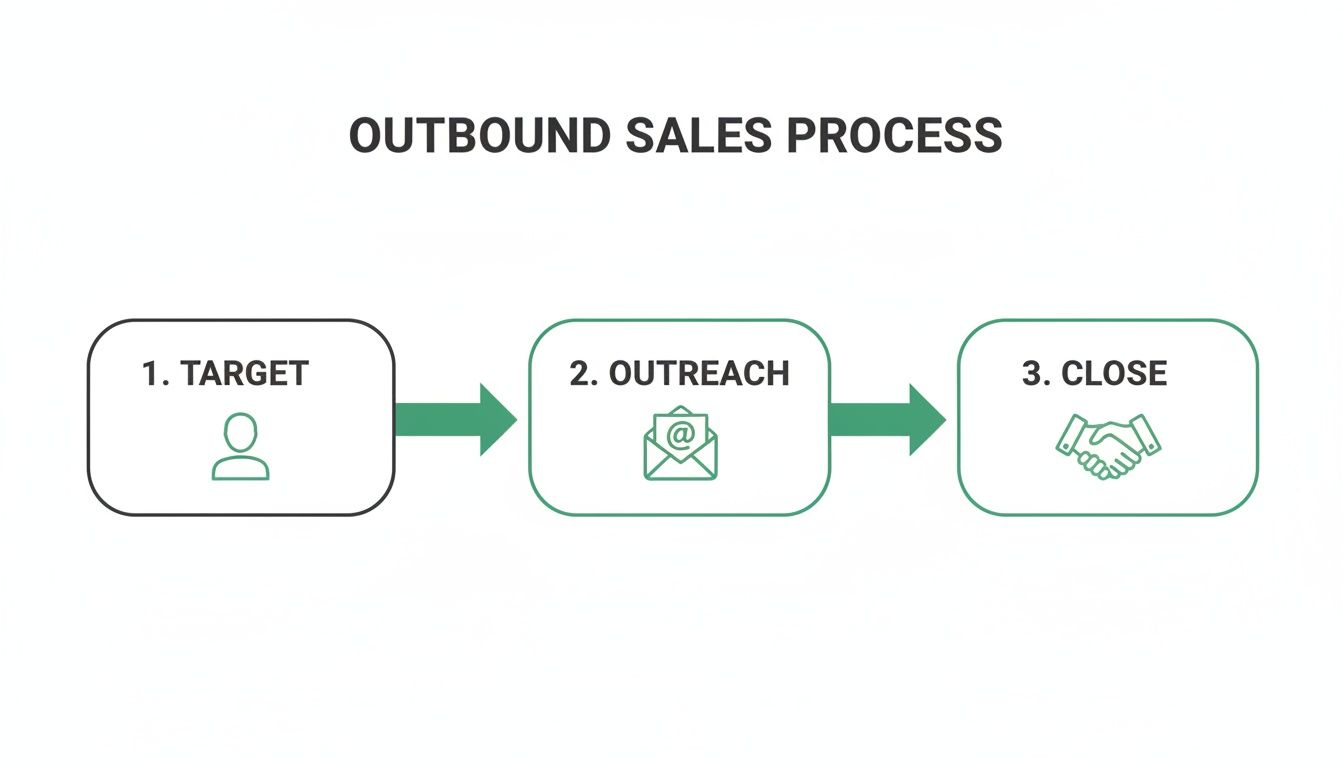
    This simple diagram breaks down how the whole process flows, from identifying the right people to reaching out and, finally, closing the deal.

    Diagram illustrating the three key steps of an outbound sales process: target, outreach, and close.

    As you can see, great outreach starts with precise targeting, and a closed deal is the natural result of effective outreach.

    The Art of the Modern Cold Call

    Don’t believe the rumors—cold calling is far from dead. It’s just evolved. Today’s best cold calls aren't about sticking to a rigid script. They're about using a flexible framework to guide a natural, human conversation. The goal isn’t to sell on that first call; it’s simply to book a proper meeting.

    Telemarketing is still a huge global industry. The outbound telemarketing market is expected to hit USD 11,524.8 million by 2025, proving it's here to stay. Europe is leading the charge with over 30% market share, thanks to new tech making calls smarter and more effective. You can dig into the numbers in this in-depth market report on outbound telemarketing.

    Here’s a simple framework for a better cold call:

    1. The Permission Opener: Start with your name and company, then immediately ask for permission to talk. Something like, "Hi [Prospect Name], this is [Your Name] from [Your Company]. I know I'm calling you out of the blue, do you have 27 seconds for me to tell you why I called?"
    2. Quick, Value-Driven Context: Show you did your homework. "I saw your company recently expanded its logistics division, and we help businesses like yours cut shipping costs."
    3. A Problem-Focused Question: Ask an open-ended question that gets them talking. "How are you currently managing the increase in outbound freight?"
    4. A Clear Next Step: If you sense interest, don't push for the sale. Secure the next meeting. "Sounds like it might be worth a longer chat. Are you open to a 15-minute call next Tuesday?"

    Crafting Cold Emails That Actually Get Replies

    Cold email is easily the most scalable outbound channel, but it's also the most crowded. Your message is fighting for attention in an inbox flooded with hundreds of others. To have any chance, your email needs two things: personalization and value. Every single email should feel like you wrote it for one person, not a mailing list.

    Of course, the foundation of any email campaign is having the right contact info. A perfectly written email is worthless if it lands in the wrong inbox. This is where tools like the EmailScout Chrome extension become essential. It helps you find verified email addresses for key decision-makers with a single click, making sure your messages actually get delivered.

    Your subject line has one job: get the email opened. That's it. Ditch the generic, clickbait titles and focus on being specific, relevant, and a little intriguing.

    To really level up your email game, focus on these three things:

    • A Hyper-Personalized Opening Line: Prove you've done your research. Mention a recent blog post they wrote, a company milestone, or a mutual connection.
    • A Clear Value Proposition: In one or two sentences, explain how you solve a problem they probably have.
    • A Low-Friction Call-to-Action (CTA): Instead of asking for a 30-minute demo, try an interest-based question like, "Are you open to learning more about how we solved this for [Competitor]?"

    For a deeper dive, check out our complete guide on how to write cold emails that convert.

    Building Relationships with Social Selling

    Social selling, especially on a platform like LinkedIn, is the long game of outbound sales. It’s all about building credibility and starting relationships before you ever ask for anything. This approach "warms up" a cold prospect, so when you finally do reach out, you’re not a total stranger.

    But let’s be clear: effective social selling is not about spamming connection requests or sliding into DMs with a sales pitch. It's about consistently adding value for your target audience.

    Start by identifying your top accounts and following the key people there. Engage with their content—and I don't just mean "liking" their posts. Leave thoughtful comments that add to the conversation. Share articles you think they'd find interesting and offer your own perspective on industry trends. When you do this, you slowly position yourself as a trusted advisor, not just another salesperson. Then, when you finally send that direct message, they're far more likely to listen.

    Best Practices for a Winning Outbound Playbook

    Knowing the outbound process is one thing, but actually mastering it is a whole different ballgame. The real difference between teams that just spin their wheels and those that actually scale is their playbook—a core set of principles that guides every single interaction. Building a winning strategy isn't about grinding harder; it's about working smarter with a repeatable, value-first approach.

    The top sales teams don't just get lucky. They operate from a clear playbook that turns cold outreach into real conversations and, most importantly, predictable revenue.

    Embrace Hyper-Personalization at Scale

    Let's be honest—prospects are drowning in generic, templated messages. In this environment, personalization is your most powerful weapon. And I don't mean just slotting in a {first_name} tag. Real personalization shows you've done your homework and actually understand their world.

    This means finding specific triggers that make your outreach feel timely and genuinely relevant.

    • Company News: Did they just announce a funding round, a new product, or a big hire? Mention it. "Saw your recent Series B announcement on TechCrunch—congratulations. As companies scale post-funding, they often face [challenge you solve]."
    • LinkedIn Activity: Reference something they recently posted or commented on. "I really liked your take on the future of supply chain logistics in your post yesterday."
    • Job Postings: If a company is hiring for a specific role, it's a huge clue about their priorities. "Noticed you're hiring for a new data security lead, which usually means managing [problem] is a top priority."

    This kind of detail proves you see them as more than just another name on a list. It cuts through the noise and dramatically boosts your reply rates.

    Design a Multi-Touchpoint Strategy

    If you're only using one channel, you're setting yourself up to fail. Your prospects are busy, and they all have different communication preferences. A solid outbound playbook coordinates a multi-channel sequence to stay on their radar without being annoying.

    A well-designed sequence feels less like a series of cold interruptions and more like a helpful, persistent conversation happening across different platforms.

    A typical strategy might blend email, phone calls, and social selling over a few weeks. Each touchpoint should build on the last, creating one cohesive story. For example, a LinkedIn connection request can reference an email you sent a couple of days ago. This reinforces your message and makes it much more likely they'll engage. You have to meet buyers where they are.

    Master the Art of Polite Persistence

    Newsflash: most deals are not won on the first try. Or the second. Or even the third. Studies show it can take eight or more touchpoints just to get a meeting. This is where the follow-up becomes absolutely critical. But let’s be clear: persistence should never feel like pestering.

    The trick is to add value with every single follow-up. Ditch the lazy "just checking in" emails and offer them something useful instead.

    • Share a case study that’s relevant to their industry.
    • Send them a link to a new industry report you found insightful.
    • Invite them to a webinar you’re hosting on a topic they care about.

    This value-first approach immediately positions you as a helpful resource, not just another salesperson. It flips the follow-up from an "ask" to an "offer," making people far more willing to talk when the timing is right for them.

    Maintain Impeccable Data Hygiene

    Your entire outbound engine runs on data. If that data is bad, your results will be too. Inaccurate or outdated contact info is the silent killer of sales productivity. It leads to bounced emails, wasted calls, and can even get your domain blacklisted.

    Making data hygiene a priority is non-negotiable. This means regularly cleaning your CRM, verifying contact information, and ensuring everything is up to date. Using reliable data validation tools is the only way to maintain this accuracy at scale. Clean data ensures your perfectly personalized messages actually land in the right inbox, maximizing the ROI of every single outreach effort.

    Building Your Essential Outbound Sales Tech Stack

    Modern sales tech stack on a wooden desk with a laptop, tablet, and smartphone showing data.

    A great outbound strategy isn't just about hard work—it runs on the right technology. Think of your tech stack as the engine that powers everything your sales team does, transforming repetitive manual tasks into a smooth, automated process. This frees up your reps to do what they do best: build relationships and close deals.

    Without the right tools, your team is essentially flying blind. They'll waste countless hours on administrative work that software can knock out in seconds. The right combination of platforms creates a single, powerful system where data moves effortlessly from one stage to the next.

    Let's break down the three pillars of a modern outbound tech stack.

    Prospecting and Data Accuracy Tools

    This is ground zero for any outbound motion. Before you can draft an email or pick up the phone, you need one thing above all else: accurate contact information for the right people. Bad data is the fastest way to kill a campaign, leading to bounced emails, wasted calls, and a ding to your sender reputation.

    Tools in this category are your first line of defense.

    • Email Finders: You absolutely need a tool like EmailScout to uncover the verified email addresses of decision-makers. It’s the difference between your message landing in the right inbox or getting lost in the ether.
    • Data Enrichment: These platforms take your basic prospect lists and add layers of valuable context, like company size, industry, and the tech they already use. This is crucial for personalization.

    For a deeper dive, check out this guide to the best sales prospecting tools on the market.

    Sales Engagement Platforms

    Okay, so you have a clean list of prospects. Now what? You need a system to manage your outreach without driving yourself crazy. A Sales Engagement Platform (SEP) is your command center for automating and tracking multi-channel communication.

    Platforms like Outreach or Salesloft let you build and run sequences that weave together emails, calls, and social media touchpoints over a set period. They provide a clear framework for following up, ensuring no prospect ever falls through the cracks. It's this systematic approach that turns outbound from a guessing game into a predictable revenue machine.

    An SEP transforms your outbound strategy from a series of random actions into a disciplined, measurable process. It provides the automation needed for volume and the analytics required for continuous improvement.

    Customer Relationship Management Systems

    The Customer Relationship Management (CRM) system is the heart of your entire sales operation. It's the central database, the single source of truth for every single interaction you have with prospects and customers. Think Salesforce or HubSpot.

    While your SEP handles the top-of-funnel outreach, the CRM tracks the entire journey from the first touchpoint to a closed deal. Every email, call log, and meeting note lives here, giving anyone in the company a complete history of the relationship. This integration is non-negotiable—it ensures that sales, marketing, and support are all working from the same playbook.

    How to Measure Outbound Sales Success

    You can't improve what you don't measure. Running an outbound sales strategy without clear metrics is like trying to navigate a ship in the dark—you're moving, but you have no clue if you’re heading toward your destination or a rocky shore.

    To get a real pulse on how your program is doing, you have to track the numbers that actually matter. This means ditching the vanity metrics and zeroing in on the indicators that show how efficient and effective your team really is. By tracking the right data, you can spot problems early, double down on what’s working, and actually prove the ROI of your outbound efforts.

    Top of Funnel Activity Metrics

    Think of these as the early warning signs for your entire outbound campaign. They tell you right away if your targeting is on point and if your messaging is hitting home with your audience. If these numbers are tanking, nothing else down the funnel is going to work.

    Here’s what to watch:

    • Reply Rate: This is simply the percentage of prospects who actually write back to your emails. A low reply rate is a huge red flag, usually pointing to a problem with your subject lines, your personalization, or the value you're offering.
    • Meetings Booked: This is the name of the game for most top-of-funnel outreach. Tracking how many qualified meetings your SDRs are setting is a direct measure of their ability to turn a cold prospect into a warm conversation.

    Great outbound teams are obsessive about their top-of-funnel metrics. They know that even a 1% bump in reply rates can create a massive ripple effect, leading to a lot more closed deals down the line.

    Bottom of Funnel Business Metrics

    While activity metrics are crucial, these are the numbers that tie your outbound efforts directly to the bottom line. They answer the big question: Are the meetings we're booking actually turning into real business?

    These metrics paint the clearest picture of your success:

    • Conversion Rate: What percentage of those booked meetings become qualified opportunities? And of those, how many turn into closed-won deals? This is the ultimate stress test for both your lead quality and your sales process.
    • Sales Cycle Length: This tracks the average time it takes to go from that first touchpoint to a signed contract. A shorter sales cycle means you're bringing in revenue faster and more efficiently.
    • Customer Acquisition Cost (CAC): This is the total cost—salaries, tools, everything—it takes to land one new customer. A healthy outbound program must have a CAC that is way lower than the lifetime value (LTV) of the customers it acquires.

    Common Questions About Outbound Sales

    As you start to build or fine-tune your outbound sales engine, a few key questions almost always come up. Getting straight answers is the first step to sidestepping common pitfalls and building a solid foundation for growth.

    Here are the no-fluff answers to the questions we hear most often from sales teams just like yours.

    Is Outbound Sales Even Still a Thing?

    Absolutely. While inbound is fantastic, outbound remains one of the most direct ways to land high-value accounts, crack into new markets, and build a revenue stream you can actually predict.

    The secret isn't about blasting more emails or making more calls. It's about shifting from the old-school "spray and pray" tactics to a smarter, personalized approach that genuinely helps your prospect. Done right, outbound is a powerful growth lever for any B2B company.

    An outbound strategy puts you in the driver's seat. Instead of waiting for leads to hopefully find you, your team gets to decide exactly who they want to work with.

    What's the Single Biggest Hurdle in Outbound?

    The obvious challenge is cutting through the insane amount of noise to get a busy decision-maker's attention. That takes a message that’s sharp, relevant, and personal. But before you even get to write that message, you hit a much bigger, more fundamental roadblock: finding accurate contact data.

    Think about it—the most perfectly crafted email or sales script is completely useless if it never reaches the right person. This is exactly why getting reliable data is the make-or-break first step of the entire outbound process.

    How Fast Can We Expect to See Results?

    This really depends on your industry and how complex your typical sales cycle is. You should start seeing early signs of life—like positive replies and meetings getting booked—within the first few weeks of consistent, focused outreach.

    But turning that initial buzz into closed deals and a measurable ROI? That usually takes somewhere between two and six months. This is especially true in B2B, where deals often need buy-in from multiple people and the decision-making process just takes longer.


    Finding accurate contact info shouldn't be the hardest part of your job. EmailScout gives you the verified emails you need to fuel your outreach and connect with the right decision-makers in a single click. Start building better prospect lists today at https://emailscout.io.
  • What Is Outbound Sales (what is outbound sales) – A Practical Growth Guide

    What Is Outbound Sales (what is outbound sales) – A Practical Growth Guide

    Outbound sales is all about being proactive. Instead of waiting for customers to find you, your sales team actively goes out and starts the conversation with potential buyers. It's the art of seeking out prospects who fit your ideal customer profile and engaging them through channels like cold calls, emails, and social media.

    Essentially, you're taking control of your own sales pipeline.

    Understanding Outbound Sales in Today's Market

    Think of a farmer who doesn't just wait for rain. Instead, they build irrigation channels to bring water directly to the most promising parts of their field. That's the core idea behind outbound sales. It’s a strategic, predictable way to fill your pipeline instead of just hoping people stumble upon your website.

    A lot of people think outbound is old-school, but that couldn't be further from the truth. While inbound sales focuses on attracting buyers with content and SEO, outbound is about creating interest where it might not have existed before. In fact, 80% of high-performing teams still count on outbound as a major part of their growth strategy, often mixing it with inbound for a one-two punch.

    The Proactive Growth Engine

    The main goal of any outbound strategy is to connect with potential customers who probably don't know you exist or aren't actively shopping for a solution like yours. This go-getter approach has some serious benefits:

    • Predictable Pipeline: You're in the driver's seat. You control how much outreach you do, which gives you a much better handle on the number of leads coming into your funnel.
    • Targeted Approach: You get to be picky. You can zero in on the exact companies, industries, and job titles that match your Ideal Customer Profile (ICP), making sure you're only talking to high-value prospects.
    • Faster Feedback: When you talk directly to your target market, you get instant feedback. You'll quickly find out what's working (and what's not) with your messaging, pricing, and product, allowing you to make smart adjustments on the fly.

    To really get a grip on outbound today, it helps to understand what is inside sales, since the two are often linked. Both usually involve reps selling from a distance, but outbound is specifically about making that first move.

    Outbound Sales vs Inbound Sales At a Glance

    The simplest way to wrap your head around what is outbound sales is to see how it stacks up against its counterpart, inbound sales. They both aim to bring in revenue, but they start from completely different places. Think of one as a megaphone and the other as a magnet.

    Here's a quick breakdown of how they differ.

    Characteristic Outbound Sales Inbound Sales
    Initiation The seller initiates the first contact. The buyer initiates the first contact.
    Prospect State "Cold" – Unaware or not actively seeking a solution. "Warm" – Already aware and showing interest.
    Approach Proactive and direct outreach. Passive attraction through valuable content.
    Primary Channels Cold email, cold calling, social selling, direct mail. SEO, content marketing, blogs, social media.
    Core Goal Create demand and start a sales conversation. Capture existing demand and nurture interest.

    As you can see, they are two sides of the same coin. Outbound pushes the message out, while inbound pulls interested people in. A truly powerful sales strategy often finds a way to make them work together.

    The Four Pillars of a Winning Outbound Process

    A solid outbound sales program isn't about luck or random calls. It’s a well-oiled machine, built on a structured and repeatable system. Getting this process right is what turns proactive effort into predictable revenue.

    It all boils down to four essential pillars that hold up every successful outreach campaign.

    Think of it like building a house. Each pillar is distinct—the foundation, walls, plumbing, and roof—but they all have to work together. If one is weak, the whole structure is at risk of collapse.

    Pillar 1: Prospecting and List Building

    Before you ever dream of sending an email or picking up the phone, you have to know exactly who you're trying to reach. This is prospecting, and it’s arguably the most critical step of all. If you get this wrong, you’re just wasting time and money on people who were never going to buy from you anyway.

    The first job is to nail down your Ideal Customer Profile (ICP). This is a super-detailed description of the perfect company for your product—think industry, company size, revenue, and even where they're located.

    Once you know what your ideal customer looks like, you can build a targeted list of prospects who fit that profile. This is where data accuracy is everything. A list riddled with bad contacts or bounced emails will sink your campaign before it even sets sail.

    • Data Quality is Everything: A reliable tool like EmailScout is a game-changer here. It helps ensure the email addresses you find are actually valid, which drastically improves your deliverability and response rates.
    • Go Beyond Job Titles: Look for buying signals. Is a company hiring a new VP? Did they just get a round of funding? Are they expanding into a new market? These are signs they might need you.

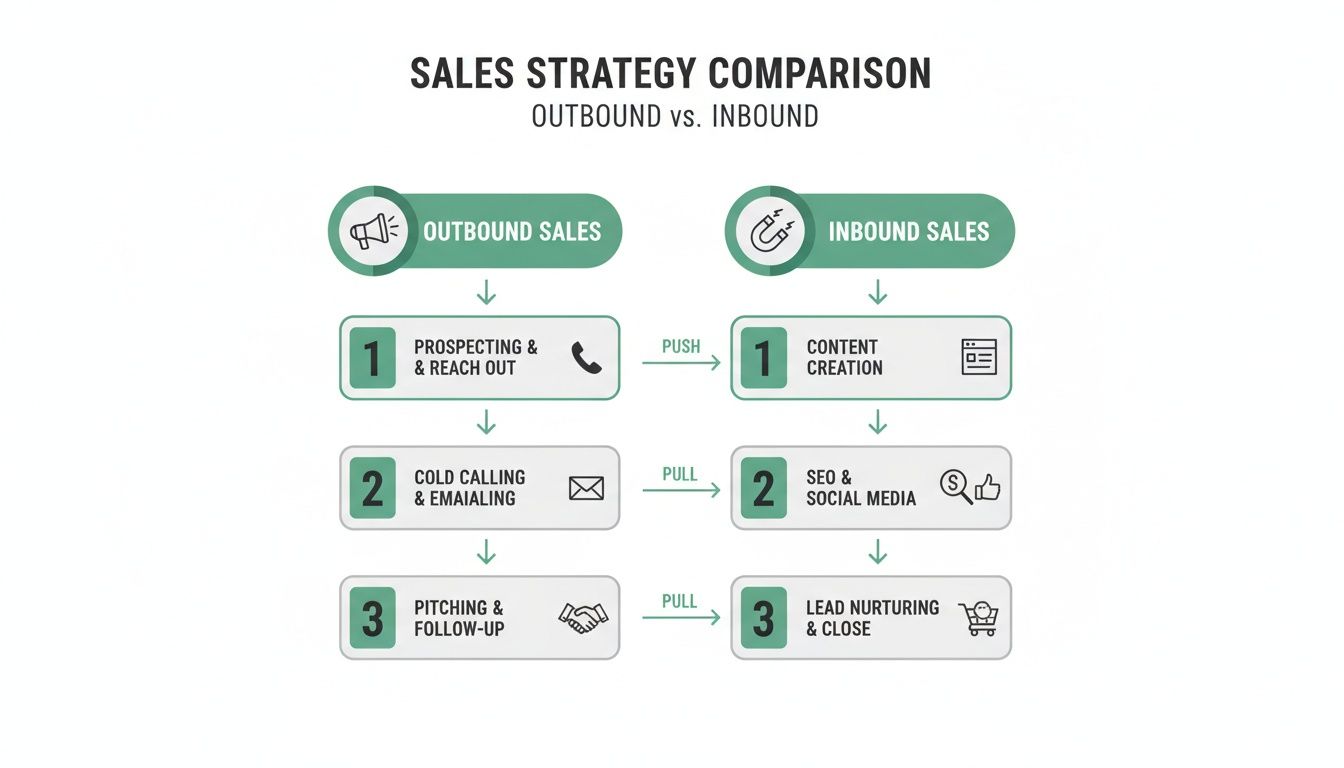
    This infographic does a great job of showing the difference between the get-up-and-go nature of outbound sales versus the more passive, waiting game of inbound.

    An infographic comparing outbound versus inbound sales strategies with their distinct steps and methods.

    You can see outbound (the megaphone) is all about pushing a message out, while inbound (the magnet) is about pulling interest in. That’s why a rock-solid prospecting foundation is non-negotiable for the outbound model to work.

    Pillar 2: Strategic Outreach

    With a high-quality list ready to go, it's time to actually make contact. This is the outreach pillar, where you craft personalized messages and figure out the best channels to connect with your prospects. The goal isn't just to get noticed; it's to start a real conversation.

    Let’s be clear: generic, mass-blasted emails are dead. Personalization is the name of the game now. Your message has to show you've done your homework and have a clue about the challenges they might be facing.

    A great outreach message is about the prospect's world, not your product. It should feel like the start of a helpful conversation, not a sales pitch. Your only goal is to earn a reply, not close a deal on the first touch.

    This is where a well-planned sales cadence becomes your best friend. It’s just a scheduled sequence of touchpoints across different channels—email, phone, social media—that keeps you persistent without being annoying. To really nail this, check out our guide on sales cadence best practices and learn how to build a sequence that actually gets responses.

    Pillar 3: Effective Qualification

    Just because someone replies doesn't mean they're a good fit. The qualification pillar is where you dig in to uncover their needs, challenges, and whether they even have the authority to buy. You're basically playing detective to see if there's a real opportunity to help them and if they're a legitimate potential customer.

    This is where the conversation shifts from you talking at them to you talking with them. Your job is to listen more than you speak. Ask smart, open-ended questions to get a feel for their current situation, their biggest headaches, and what they’re trying to achieve.

    A classic framework for this is BANT:

    1. Budget: Can they actually afford your solution?
    2. Authority: Are you talking to the person who signs the checks, or just an intern?
    3. Need: Is there a real, painful problem that your product can solve for them?
    4. Timeline: Do they need to find a solution yesterday, or is this a "maybe next year" kind of thing?

    Pillar 4: Consistent Nurturing and Follow-Up

    The final pillar is all about the long game. The hard truth of outbound sales is that most prospects aren't ready to buy the second you reach out. In fact, some studies show that up to 50% of qualified leads aren't looking to make an immediate purchase.

    That’s where nurturing comes in. It’s the art of building a relationship over time by providing value without asking for anything in return. This keeps you top-of-mind, so when they are ready to buy, you’re the first person they think of.

    This could mean sending them a helpful article, inviting them to a webinar, or connecting them with someone in your network. The key is to be genuinely useful, not pushy. This approach builds trust and slowly turns cold prospects into warm opportunities down the road.

    Mastering the Essential Outbound Sales Channels

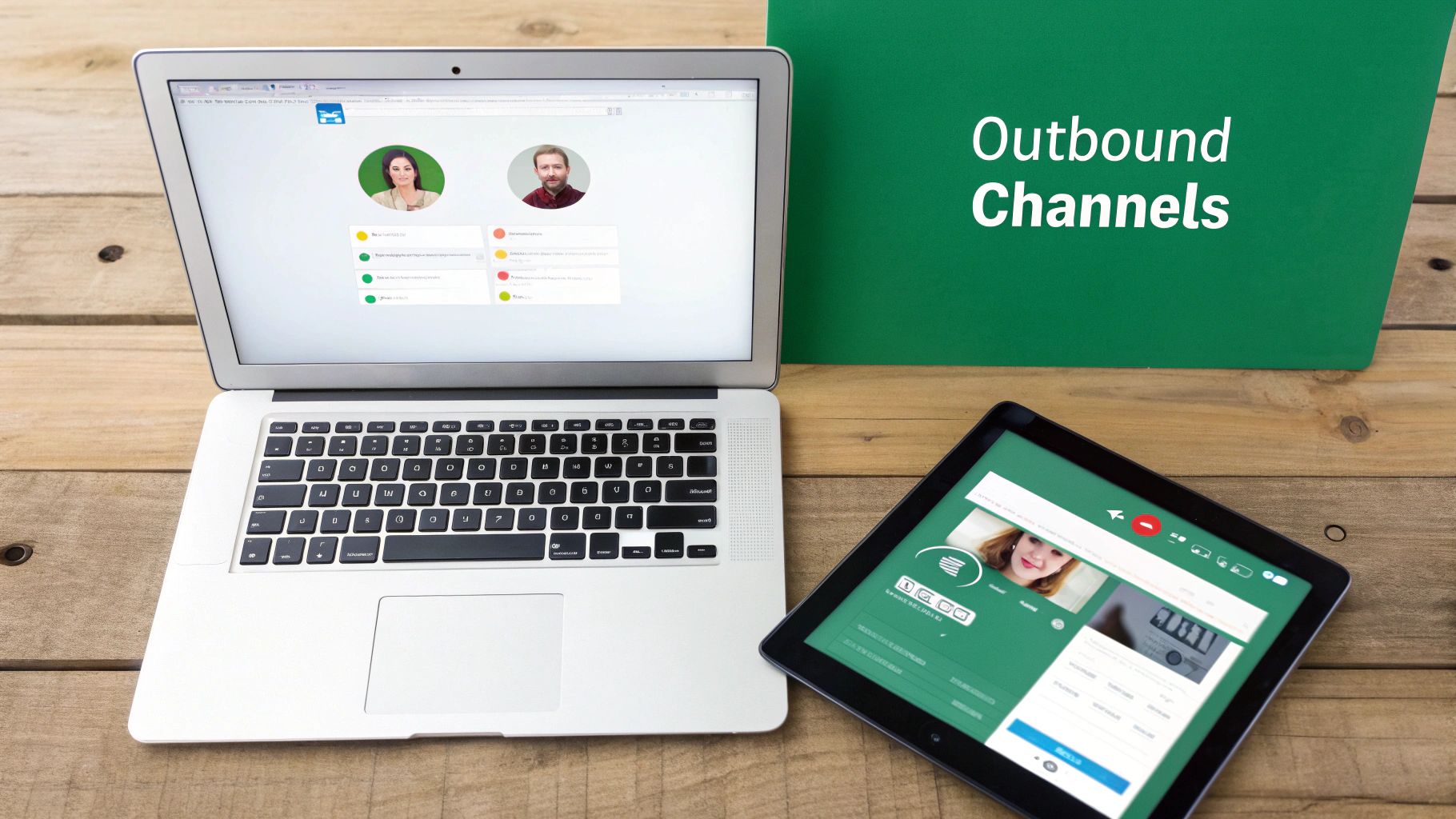
    A laptop and tablet display profiles on a wooden desk, next to an 'Outbound Channels' sign.

    Once you've built a solid prospect list, it’s time to pick your weapons. The right outreach channels are what carry your message directly to your ideal customers. And while new platforms pop up all the time, a few classic channels are still the bedrock of any successful outbound strategy.

    These core channels are cold email, cold calling, and social selling. Each has its own rhythm and requires a unique touch. The real magic happens when you blend them together, creating a multi-channel approach that makes your outreach impossible to ignore.

    The Art of Cold Email

    Cold email is usually the first punch you throw in an outbound sequence, and for good reason. It’s scalable, doesn't interrupt someone's day like a phone call, and gives them space to consider your offer. But here’s the catch: its success is all about personalization and value.

    The average person gets hit with over 120 emails a day, so a generic, me-first message is going straight to the trash. Your email has to cut through the noise instantly, starting with a subject line that sparks curiosity without being cheap clickbait.

    A great cold email feels like a personal, one-to-one message, not a marketing blast. It should immediately show you’ve done your homework and have something genuinely useful to say.

    To write emails that actually get replies, nail these four things:

    • A Compelling Subject Line: Keep it short and personal. Something like "Quick question about [Company Name]" often beats a flashy slogan.
    • A Personalized Opening: Mention a recent company win, a LinkedIn post they wrote, or a shared connection. It proves you’re not just spamming.
    • A Clear Value Proposition: In one or two sentences, what problem do you solve? What’s the result?
    • A Low-Friction Call to Action (CTA): Instead of asking for 30 minutes, try something lighter like, "Is solving this a priority for you right now?" It’s an easier "yes."

    Getting this right is so critical we built a whole playbook on how to write cold emails that convert.

    The Power of Cold Calling

    Despite what you may have heard, cold calling is far from dead. It's still one of the most direct and powerful ways to connect with a prospect. Nothing uncovers real pain points or builds rapport faster than an actual conversation.

    In fact, the global outbound telemarketing market is expected to hit roughly USD 11.5 billion by 2025. That kind of money tells you one thing: companies are still seeing a huge return from picking up the phone.

    Modern cold calling isn’t about robotic scripts. It’s about having a flexible game plan that allows for a real, human conversation. This means a sharp opening line, smart questions to guide the chat, and knowing how to handle the inevitable objections. For a deeper dive, check out this guide on outbound calls for sales and support.

    Strategic Social Selling on LinkedIn

    Social selling, especially on LinkedIn, is the perfect partner to your calls and emails. Think of it as the warm-up act. It’s a longer game focused on building your credibility before you ever ask for anything. When your email finally lands, it’s from a familiar face, not a total stranger.

    But effective social selling isn’t about spamming connection requests or pitching in your first DM. It’s a subtle art.

    Actionable Social Selling Tactics:

    1. Engage with Their Content: Leave a thoughtful comment on their posts. Don’t just say "Great post!" Ask a question or add a related insight that keeps the conversation going.
    2. Share Valuable Content: Regularly post things that actually help your target audience. This positions you as an expert, not just a seller.
    3. Send a Personalized Connection Request: Always add a note. Mention something specific, like a mutual connection or why you want to connect.

    When you weave these three channels together, you create a powerful system. A prospect might ignore your email, but then see your name pop up on their LinkedIn feed. That little bit of familiarity makes them far more likely to open your next message. That’s modern outbound in a nutshell.

    How to Measure What Truly Matters in Outbound Sales

    In outbound sales, being busy doesn't always mean being productive. A flurry of activity might look impressive, but it’s completely meaningless if it doesn't translate into a healthy pipeline and closed deals. To stop guessing and start making informed decisions, you have to track the right key performance indicators (KPIs).

    Think of these metrics as the vital signs of your outbound engine. They show you exactly where your process is humming along and, more importantly, where it's sputtering out. By focusing on what truly matters, you can spot problems early and tune every stage of your outreach for predictable, repeatable growth.

    Leading Indicators That Signal Success

    Long before you see a signed contract, leading indicators tell you if you're even on the right path. These early metrics are all about engagement and are the first clues you get about whether your messaging and targeting are working.

    • Open Rate: This one’s simple: it’s the percentage of prospects who actually open your emails. It's not a perfect metric, but a rock-bottom open rate is a giant red flag that your subject lines are falling flat.
    • Reply Rate: This is where the rubber meets the road. A high reply rate means your message is compelling enough to start a conversation, which is the whole point of that first touch.
    • Meeting Booked Rate: The ultimate test of a successful first interaction. This KPI tracks the percentage of prospects who agree to a meeting, showing your value prop is strong enough to earn a spot on their calendar.

    These metrics give you instant feedback. If your reply rate is dismal, it’s time to A/B test your email copy, not just mindlessly send more emails.

    Lagging Indicators That Measure Results

    While leading indicators track your activity, lagging indicators measure the final outcome. These are the bottom-line metrics that tie your outbound efforts directly to revenue.

    Lagging indicators like Sales Cycle Length and Close Rate tell the final story of your sales efforts. They confirm whether the meetings you're booking are with genuinely qualified prospects who have a real potential to become customers.

    Here are the critical outcome-focused KPIs you need to watch:

    1. Sales Cycle Length: This tracks the average time it takes to get from that first "hello" to a closed deal. A long sales cycle can mean you have friction in your process or you're chasing the wrong leads.
    2. Close Rate (or Win Rate): The big one. This is the percentage of qualified opportunities that turn into a sale. It’s the ultimate test of your team's ability to turn conversations into cash.
    3. Cost Per Opportunity: This calculates how much you spend to generate a single qualified lead. Keeping this number in check is key to making sure your outbound strategy is actually profitable and can scale.

    Setting Realistic Benchmarks

    Knowing your numbers is one thing, but knowing if they're any good is another. Industry benchmarks for outbound conversion typically hover between 2% to 5% for an initial contact-to-opportunity conversion.

    But here’s the kicker: top teams using AI for personalization have seen a 10–25% increase in pipeline, which shows how the right tech can completely change the game. You can dig into more insights on how AI impacts sales conversion rates over on convin.ai.

    By consistently tracking both leading and lagging indicators, you create a powerful feedback loop. You can see how a small tweak to your email copy (leading) impacts your final close rate (lagging), allowing you to fine-tune your strategy with cold, hard data—not just gut feelings.

    Supercharge Your Outreach with the Right Tech Stack

    Modern outbound sales is all about efficiency and accuracy. While the core idea of proactively reaching out is timeless, technology is what separates the top-performing teams from everyone else spinning their wheels. The right tech stack turns those tedious, time-sucking manual tasks into smooth, automated workflows, freeing up your reps to do what they're paid for: sell.

    This is especially true when it comes to prospecting. Bad data can torpedo a campaign before you even send the first email. Nothing kills morale and wastes resources faster than spending hours hunting for contact info only to be hit with a sky-high bounce rate.

    The Problem with Manual Prospecting

    Here’s a hard truth: without the right tools, your sales reps could be spending up to 40% of their time just looking for someone to contact. They're manually digging through LinkedIn profiles, company websites, and industry news, trying to piece together a halfway decent prospect list.

    This process isn’t just slow; it's a recipe for human error, outdated contact details, and missed opportunities. At a certain point, a specialized tool stops being a "nice-to-have" and becomes a non-negotiable part of your process.

    Streamlining Your Workflow with an Email Finder

    This is exactly where tools like EmailScout come in. Think of them as a force multiplier for your sales team. They inject speed and precision right where you need it most—the prospecting phase—and turn a manual slog into a quick, one-click process.

    The best tools don't force you to jump through hoops or leave your existing workflow.

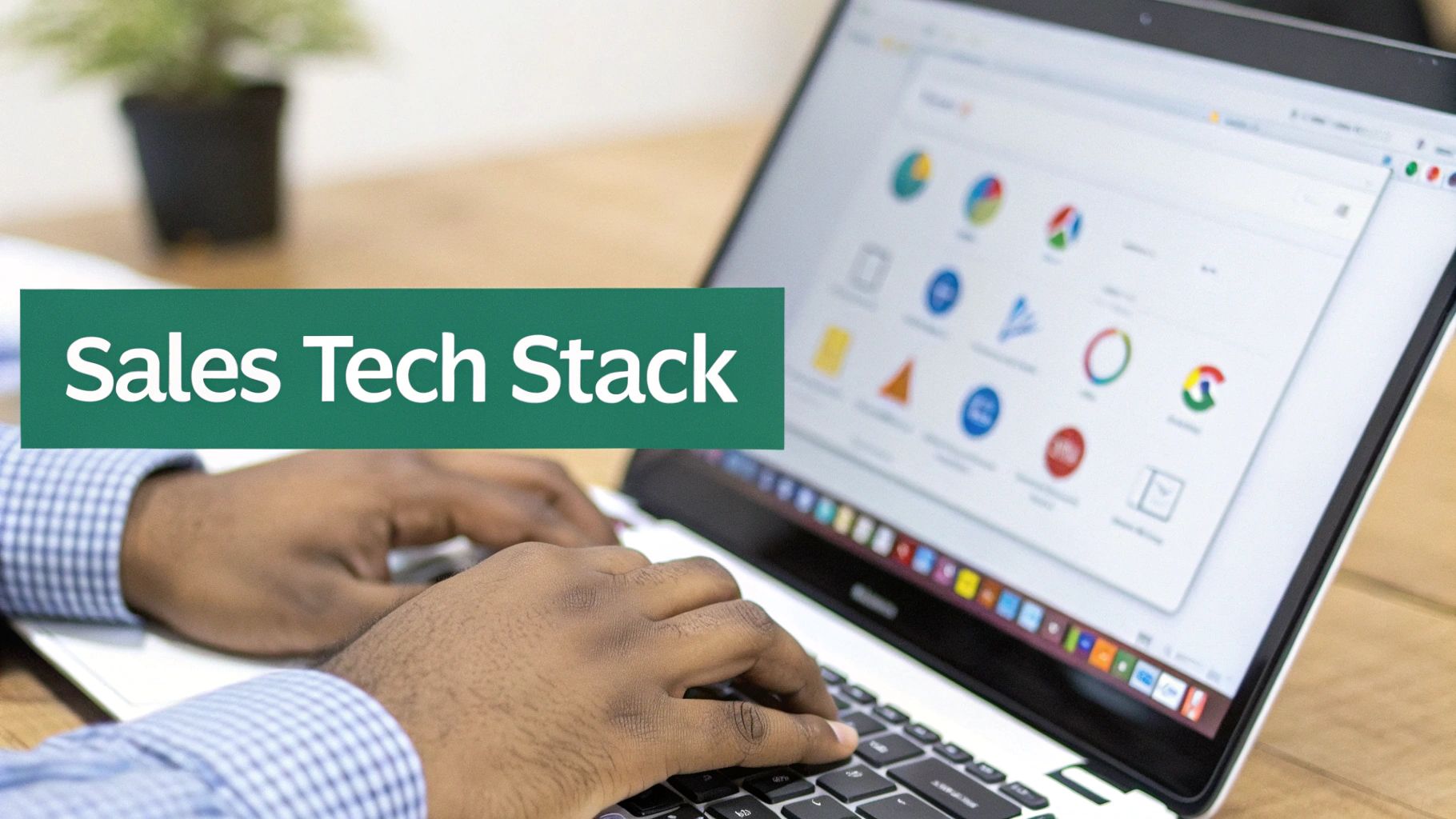
    Person typing on a laptop displaying various app icons, with a 'Sales Tech Stack' overlay.

    As you can see, the tool integrates right into your browser, letting you find and save verified email addresses from LinkedIn profiles or company sites on the fly. This single function slashes research time and dramatically improves the quality of your outreach lists.

    The impact is huge. By 2025, automation became a cornerstone of outbound sales, with reports showing teams using AI saw a typical ROI boost in the 10–25% range. For about 45% of teams, tools that automated account research cut down manual work, helping them scale outreach without hiring more people.

    Key Features That Boost Efficiency

    The right technology does more than just find emails; it fundamentally changes how you build your pipeline. By automating the foundational steps of prospecting, you free up your team’s time for personalizing outreach and having real conversations.

    Here are a few features that make a real difference:

    • Chrome Extension: Lets you grab verified emails directly from a prospect's LinkedIn profile or company website with a single click. No more switching tabs or guessing games.
    • URL Explorer: You can drop in a bunch of company URLs and pull contact information in bulk. This is a game-changer for building targeted lists for account-based marketing (ABM) campaigns.
    • AutoSave Functionality: This feature automatically saves verified contacts to your lists as you browse. It creates a seamless workflow where list-building just happens in the background while you focus on finding the right people.

    By automating the top of your funnel—the data collection and verification—you empower your sales team to spend less time digging for info and more time building relationships and closing deals.

    Ultimately, integrating the right tools is about shifting your team's energy from low-value admin work to high-value strategic selling. To complete your stack, you'll need to find the best cold email software that plays nicely with your email finder, creating a powerful, end-to-end outbound machine.

    Common Questions About Outbound Sales

    Jumping into outbound sales can feel like navigating a maze. A lot of questions pop up, and it's easy to get sidetracked by myths and outdated advice. Let's clear the air and tackle some of the most common uncertainties head-on.

    The idea of reaching out directly to potential customers isn't new, but how we do it has completely changed. Getting these details right is the secret to building a reliable sales pipeline that actually brings in revenue.

    Is Outbound Sales Still Effective?

    Yes, without a doubt. When you do it right—with smart personalization, solid data, and a genuine desire to help—outbound is one of the most predictable ways to land high-quality leads. It puts you in the driver's seat, letting you target your perfect customers instead of just waiting for them to find you.

    The game has moved on from generic, spammy blasts. Today’s winning outbound strategy is all about targeted, relevant outreach that kicks off a real conversation.

    What Is the Difference Between Outbound Sales and Marketing?

    Think of it this way: outbound sales is a direct conversation, while outbound marketing is a billboard. Both want to attract customers, but they go about it in completely different ways.

    • Outbound Sales: This is a one-to-one (or one-to-few) interaction driven by a sales rep. The whole point is to connect directly through personalized emails, calls, or social messages to start a sales dialogue.
    • Outbound Marketing: This is a one-to-many broadcast. It’s about creating broad brand awareness with things like TV commercials, print ads, or online banner ads that push a single message out to a huge audience.

    In short, outbound sales is surgical, personal, and built on relationships. It's about starting a dialogue, while outbound marketing is about delivering a monologue to a crowd.

    How Long Does It Take to See Results?

    While a full-blown, predictable pipeline often takes 3-6 months to build, you can spot the green shoots of success much, much sooner. These early signs are critical for knowing if you're headed in the right direction.

    Within the first few weeks, you should be tracking things like email open rates, reply rates, and how many meetings you've booked. These are the small wins that tell you your targeting is on point and your message is hitting home. They give you the data you need to tweak your approach long before the big deals start closing.


    Ready to supercharge your prospecting and build highly accurate lead lists in minutes? EmailScout gives your team the power to find verified email addresses with a single click, automating the most time-consuming part of outbound sales. Start finding unlimited emails and building your pipeline today at https://emailscout.io.