
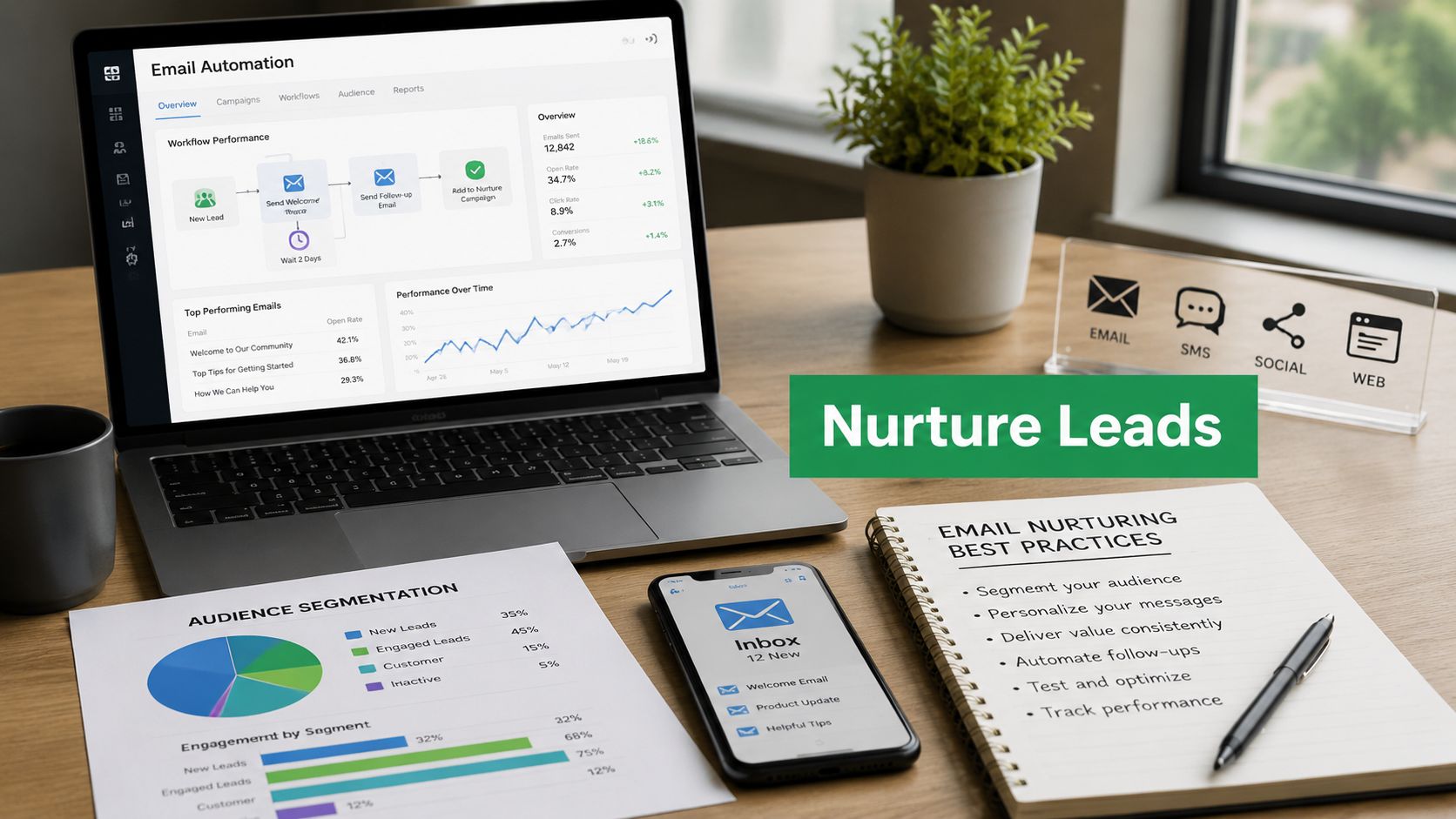
Most leads don't fail because the offer is weak. They fail because follow-up is generic, delayed, or disconnected from what the buyer cares about. That's a costly mistake when properly nurtured leads generate 50% more sales-ready leads at 33% lower cost.
Lead nurturing is the disciplined process of turning raw interest into buying intent. It isn't just sending a few emails after someone fills out a form. It's segmenting the right people, sending relevant content, knowing when to escalate to sales, and keeping the conversation alive long enough for timing and fit to line up.
That's a common point of failure. Campaigns often spend heavily to find leads, then dump everyone into the same sequence and hope automation does the rest. It won't. Good nurturing starts earlier, with better list quality and cleaner targeting. If you're building outbound or enrichment-driven workflows, tools like EmailScout can help you build focused contact lists so your nurture engine starts with the right people instead of a random database.
The playbook below is built for operators who care about conversion, not vanity metrics. These lead nurturing best practices connect list building, segmentation, messaging, scoring, and handoff rules into one system. Use them together, and your pipeline gets more predictable. Ignore them, and even strong lead sources will stall out.
1. Segmentation and List Targeting
If everyone gets the same message, no one feels understood. Segmentation fixes that first.
The fastest way to improve lead quality is to narrow the audience before the first nurture email goes out. Start with practical cuts that sales can use: industry, job title, company size, lead source, and engagement level. For example, a VP of Sales at a mid-market SaaS company shouldn't get the same email as an operations manager at a local services business.

Teams using EmailScout for list building can make this step easier by collecting contact and company details up front, then organizing those contacts into practical groups. If you need a framework, this guide on how to segment email lists is a useful starting point.
Build segments sales will actually use
Don't create twelve segments on day one. Create three to five that map to real differences in messaging.
- Industry segment: Send financial services buyers a risk, compliance, and process angle. Send SaaS buyers a speed, pipeline, and efficiency angle.
- Role segment: Executives want strategic outcomes. Managers want implementation details. Practitioners want workflow help.
- Source segment: Webinar leads, outbound prospects, referral leads, and demo request contacts need different first follow-ups.
Practical rule: If a segment doesn't change the message, it's not a useful segment yet.
A common mistake is segmenting only by behavior. Behavior matters, but firmographic fit matters just as much. A lead who opens three emails but doesn't match your ideal customer profile may still be lower priority than a quieter lead from the exact type of account you want.
2. Personalization and Dynamic Content
Personalization isn't adding a first name tag and calling it done. Buyers see through that instantly.
Useful personalization reflects context. Mention the prospect's market, role, likely priorities, or the problem that usually shows up at their stage. If you found the contact through EmailScout and know they work at a manufacturing company, reference supply chain visibility, quoting speed, or plant-level coordination if those issues match your offer. That lands better than a generic “thought this might help.”
Keep it relevant, not invasive
Organizations often overthink personalization and underuse the basics. Start with information that makes the email more relevant without sounding creepy.
- Company context: Reference the industry, business model, or team function.
- Role context: Adjust the CTA based on decision-making power. A founder may take a strategy call. A specialist may prefer a teardown or example.
- Content context: If someone came in through a guide, webinar, or comparison page, continue that thread instead of resetting the conversation.
Dynamic content helps at scale. One sequence can swap examples, proof points, and calls to action by persona or industry while keeping the core structure intact. A sales leader might see messaging around pipeline coverage and forecasting confidence. A marketing leader might see campaign efficiency and lead quality.
The trade-off is complexity. If you don't have clean data, dynamic content can break relevance fast. It's better to run a simpler sequence with accurate fields than an advanced workflow filled with mismatched details.
Good personalization answers one silent question. “Why are you sending this to me?”
3. Email Drip Campaigns and Automated Sequences
Most nurture programs fail in the first week. Not because the offer is bad, but because the cadence is weak.
A practical B2B pattern is to send two to three emails over seven days right after capture, combine that with timely sales outreach, and then move the lead into a long-term evergreen stream segmented by persona, industry, or lead source, as outlined in Pipeline360's lead nurturing guidance. That early sequence matters because interest fades quickly if nothing happens after the hand-raise.

If you're building outbound or list-led workflows, EmailScout can feed the initial audience into automation. This explainer on what is a drip email campaign covers the basic mechanics. For tactical inspiration, these expert tips for email campaigns can help shape your sequence structure.
Separate short-term follow-up from long-term nurture
Don't cram everything into one endless drip. Use distinct tracks.
- New lead sequence: Confirm relevance fast. Offer one useful idea, one proof point, and one low-friction next step.
- Active evaluation sequence: Send comparison content, objections handling, stakeholder-specific material, and booking prompts.
- Evergreen nurture: Share helpful education, category insights, event invites, and periodic reactivation offers.
What doesn't work is writing seven emails that all ask for a meeting. What works is changing the job of each email. One earns attention. One builds trust. One handles a common objection. One invites the next step.
4. Lead Scoring and Qualification
Lead scoring decides whether a new contact gets a sales call today, stays in nurture, or gets filtered out before your team wastes time. If you collect names with EmailScout but do not rank them, you hand sales a pile of leads instead of a workable queue.
A useful model blends two inputs. Fit answers, “Is this the kind of account we want?” Intent answers, “Is there a reason to act now?” Teams that score only engagement usually send reps after the loudest leads, not the best ones. Teams that score only firmographics miss timing and reach out after interest has already faded.
If you need a setup primer, EmailScout breaks down the basics in this guide to lead scoring.
Score for fit first, then layer in intent
Start with fit because it changes less often and keeps the model tied to revenue, not vanity activity. Then add behavioral signals that show movement.
- Fit signals: job title, company size, industry, geography, tech stack, and ICP match
- Intent signals: repeat site visits, pricing page views, webinar signups, demo page activity, email replies, and form fills
- Negative signals: student emails, competitor domains, bad territories, unsubscribes, and long inactivity
Keep the model simple enough that sales will trust it. In practice, four score bands are usually enough: hot leads go to immediate outreach, mid-tier leads get rep follow-up on a short SLA, lower-score leads stay in automated nurture, and poor-fit leads stay out of active pipeline review.
That last category matters more than many teams admit. A lead who opens three emails from the wrong market is still the wrong lead.
Set qualification rules alongside scoring. For example, a director at an ICP account who visited the pricing page twice may deserve a rep handoff. A manager at a non-target company with the same behavior may deserve one more nurture touch instead. The point is consistency. Reps should know why a lead was passed over, and marketing should know why a lead was accepted.
A score should trigger an action inside your process, not sit in the CRM as decoration.
Review the model every month. If high-scoring leads rarely book meetings, your point values are off. If sales keeps cherry-picking low-scoring leads and winning, your fit criteria may be too rigid. Good scoring models are built, tested, and adjusted against actual pipeline outcomes.
5. Content Marketing and Educational Email Series
Hard-sell nurture emails wear people out fast. Educational sequences hold attention longer and create better sales conversations later.
Nurtured leads can close 23% faster and deliver 47% higher value when programs are built around relevant, multi-channel personalization instead of generic drips. The practical takeaway is simple. Teach before you pitch, and map that education to the buyer's stage.
A cold prospect usually doesn't want a demo invitation in email one. They want help understanding the problem, the options, and the trade-offs. An educational series does that job better than a feature dump.
Match content to the stage
Different stages need different material. Treating them the same is one of the most common nurture mistakes.
- Awareness stage: Send explainers, industry trends, checklists, and problem-framing content.
- Consideration stage: Send comparison guides, implementation notes, ROI logic, and stakeholder FAQs.
- Decision stage: Send customer stories, rollout plans, security answers, and direct invitations to talk.
A real-world example: if you sell software to RevOps teams, an awareness email might focus on data inconsistency across tools. A consideration email might compare workflow options. A decision email might show how sales and marketing would work inside the platform after rollout.
Educational series also give sales a cleaner handoff. When a prospect has consumed useful content over time, the rep can continue the conversation naturally instead of restarting from zero.
6. Multi-Channel Lead Nurturing Integration
Email alone is rarely enough in B2B. Inbox competition is too high, and buying decisions rarely move through one channel.
That's why modern lead nurturing best practices use coordinated touchpoints. Email handles structured education well. LinkedIn adds visibility and social context. Calls create urgency and uncover objections. Retargeting keeps the brand present while buyers compare options.
A simple pattern works for many teams. Day one email, later LinkedIn profile view or connection, then a follow-up email, then a call if the account is qualified and engaged. The message stays consistent, but the format changes.
Coordinate channels instead of repeating yourself
Repetition across channels feels lazy. Reinforcement feels professional. There's a difference.
- Email: Deliver the clearest argument and the most useful resource.
- LinkedIn: Add familiarity, light commentary, or a short insight tied to the same issue.
- Phone: Use only when the account is qualified enough to justify the interruption.
- Retargeting: Reinforce category awareness or decision-stage proof points.
Most recent guidance also points out a gap many teams miss: B2B deals involve buying groups, not just one lead. Stronger programs build parallel tracks for economic buyers, technical evaluators, operations, security, and finance while keeping the core message aligned, as discussed in INFUSE's perspective on lead nurturing mistakes.
For a quick visual walkthrough of coordinated outreach, this video is worth a look.
7. A/B Testing and Continuous Optimization
A nurture program gets better through controlled testing, not constant rewrites.
The teams that improve fastest pick one variable, define the outcome they care about, and keep records. Change the subject line and hold the rest steady. Change the CTA and keep the audience, timing, and offer consistent. If you test three things at once, you may get a lift, but you will not know what caused it.
Test the parts that move outcomes
Start with elements tied to opens, replies, and stage progression. Leave button color debates for later.
- Subject lines: Direct benefit versus curiosity, short versus specific, company-name mention versus role-specific relevance.
- Opening lines: Problem-led, industry-led, or trigger-led intros.
- CTAs: Ask for a reply, offer a resource, or suggest a call.
- Send timing: Test by audience segment instead of relying on generic best times.
Keep the baseline honest. Low open rates often point to targeting problems before they point to copy problems. Weak segmentation, stale contacts, and poor-fit accounts will drag down results even when the email is well written. That is the trade-off many teams miss. Testing creative on a messy list gives you noisy conclusions.
The gap between lead generation and lead nurturing holds significance. If EmailScout is part of your list-building workflow, tighten audience fit before you run messaging tests. A cleaner, more relevant list gives you a better read on what changed and why.
Run optimization like a cadence, not a one-off project. Review results every two to four weeks, keep a simple test log, and promote winners into the main sequence only after they hold up across enough volume to be credible.
8. Behavioral Triggers and Event-Based Email
Scheduled nurture has limits. Trigger-based nurture catches intent while it's happening.
If someone downloads a guide, visits a pricing page, registers for a webinar, or replies to a campaign, waiting a week to follow up makes no sense. Event-based emails work because they feel timely and connected to the buyer's action. They answer the question the prospect is already thinking about.

Build triggers around meaningful signals
Not every click deserves a sequence. Use actions that show actual movement.
- Form submission: Send the requested asset immediately, then follow with context that helps the person use it.
- Pricing page visit: Route to a sales-aware sequence or rep review if the lead is also a good fit.
- Webinar registration or attendance: Follow up based on whether they attended, how long they stayed, and what topic they chose.
- Inactivity: Reduce frequency, change the angle, or move them into a lower-touch stream.
A common mistake is overreacting to weak signals. One email open isn't sales intent. One pricing page visit from an unqualified account may not mean much either. Strong trigger programs combine the event with fit and recent engagement, then decide whether to automate, alert sales, or hold the lead in nurture.
9. Relationship Building and Social Proof Integration
Trust usually breaks before conversion does. The prospect starts wondering whether your product will work in their environment, whether the rollout will be painful, or whether your team understands their use case. Social proof answers those doubts.
The key is using the right proof at the right time. Early-stage leads may respond to category credibility or recognizable logos. Mid-stage leads need evidence from similar companies or similar roles. Late-stage leads want specifics they can repeat internally to a manager, buyer committee, or procurement contact.
Use proof that matches the buyer's risk
Generic testimonials don't do much if they don't match the reader's situation.
- Role-matched proof: A finance leader cares about control and predictability. An ops lead cares about workflow friction and adoption.
- Industry-matched proof: A healthcare buyer wants examples that understand compliance realities. A SaaS buyer wants speed and scalability.
- Stage-matched proof: Earlier emails can use light credibility. Later emails should get more concrete and objection-oriented.
The strongest proof doesn't say “we're great.” It says “a company like yours made this decision and didn't regret it.”
You don't need to stuff every nurture email with customer quotes. That often turns the message into a brochure. A better move is to drop in one tight example, one relevant result if you have a verified one, or one short scenario tied to the buyer's likely concern. Then keep moving.
10. Preference Center and Engagement Management
Not every lead wants the same cadence, topics, or channel mix. Pretending they do is one reason lists decay.
A preference center gives buyers a way to stay subscribed without staying overloaded. That means they can reduce frequency, choose topics, or opt into a digest instead of every campaign. For long sales cycles, this matters because some prospects are interested in the category but not ready for active evaluation.
Manage engagement before it becomes a deliverability problem
Good nurture programs don't just ask “how do we send more?” They ask “when should we pull back?”
Recent guidance highlights a question often poorly answered: when to stop nurturing and hand off to sales. It emphasizes clean contact lists, inactivity signals, and explicit handoff rules, while also noting that nurturing should be indefinite and continuously optimized rather than treated as a short campaign with a hard stop, according to Zendesk's lead nurturing guidance.
Use that logic inside your preference and engagement system.
- Offer frequency choices: Weekly digest, event-only updates, or product-specific alerts.
- Watch inactivity: If engagement drops, lower frequency before the lead unsubscribes or marks spam.
- Define handoff rules: Sales should know exactly when outreach is appropriate and when marketing should keep warming the account.
A healthy list isn't the one with the most contacts. It's the one where recipients still want to hear from you.
Lead Nurturing: 10 Best Practices Comparison
| Strategy | Implementation complexity | Resource requirements | Expected outcomes | Ideal use cases | Key advantages |
|---|---|---|---|---|---|
| Segmentation and List Targeting | Moderate, requires data modeling and maintenance | CRM/data enrichment, list hygiene, time to define segments | Higher open and conversion rates; improved ROI | B2B targeting, persona-based campaigns, list optimization | Relevant messaging at scale; reduced unsubscribes |
| Personalization and Dynamic Content | Moderate–High, conditional logic and templates | Clean contact data, dynamic content engine, testing resources | Increased opens, CTRs and conversion rates | One-to-one outreach, ABM, product recommendations | Highly relevant, personalized experiences |
| Email Drip Campaigns and Automated Sequences | Moderate, workflow design and testing | Automation platform, copywriting, sequence testing time | Consistent nurturing, time savings, improved conversions | Onboarding, lead nurturing, multi-touch outreach | Scalable, consistent follow-up and timing |
| Lead Scoring and Qualification | Moderate, model design and tuning | Historical data, analytics, CRM integration | Prioritized leads; higher sales efficiency and shorter cycles | Sales prioritization, MQL/SQL workflows, enterprise sales | Data-driven prioritization; better sales alignment |
| Content Marketing and Educational Email Series | High, significant content production and planning | Writers, designers, content calendar, long-term resources | Trust building; higher-quality leads over time | Thought leadership, long-term nurture, complex buys | Establishes authority; provides value without hard selling |
| Multi-Channel Lead Nurturing Integration | High, cross-platform orchestration and syncing | Multiple tools (LinkedIn, SMS, ads), data unification, training | Higher conversion rates and stronger brand recall | ABM, enterprise outreach, complex buying journeys | More touchpoints; reaches prospects on preferred channels |
| A/B Testing and Continuous Optimization | Low–Moderate, structured testing process | Sufficient email volume, analytics tools, discipline | Incremental metric gains and actionable audience insights | Subject lines, CTAs, send time optimization | Empirical improvements; reduces reliance on guesswork |
| Behavioral Triggers and Event-Based Email | Moderate–High, tracking and event configuration | Tracking infrastructure, automation platform, privacy controls | Timely engagement at high-intent moments; faster conversions | Cart abandonment, downloads, pricing page visits | Context-aware, high-relevance messaging |
| Relationship Building and Social Proof Integration | Low–Moderate, content collection and placement | Customer interviews, case study production, approvals | Increased trust and late-stage conversion rates | Bottom-of-funnel nurture, testimonials-driven outreach | Credibility boost; reduces buyer hesitation |
| Preference Center and Engagement Management | Moderate, preference UI and send logic | Subscription management tools, integration and upkeep | Lower unsubscribes, improved deliverability and engagement | Large subscriber bases, high-frequency senders | Subscriber control; better sender reputation |
From Leads to Loyal Customers
Lead nurturing works best when you stop treating it like a single email sequence and start treating it like an operating system. Every part connects to another part. Better targeting improves relevance. Better relevance improves engagement. Better scoring improves timing. Better timing improves sales conversations.
That's why the strongest programs don't begin after a form fill. They begin before the first send, with list quality and clear audience definition. If the wrong contacts enter the funnel, your personalization gets weaker, your scoring gets noisy, and your sales team loses faith in the process. If the right contacts enter the funnel, even simple nurture systems perform better because the message has a chance to land.
The practical approach is straightforward. Build a focused list. Segment it into a few meaningful groups. Write sequences that match buyer stage instead of blasting everyone with the same pitch. Add scoring so sales knows when to step in. Layer in trigger-based follow-up and a light multi-channel rhythm so the lead doesn't go cold between touches.
The trade-off is discipline. Good lead nurturing best practices aren't complicated, but they do require consistency. Teams need shared lead definitions, clear handoff rules, and a willingness to trim weak segments and stale contacts. They also need patience. Some leads respond quickly. Others need months of useful contact before timing changes. If your system only works for the fastest buyers, it leaves too much pipeline on the table.
One of the clearest signals that a nurture engine is working is that sales conversations start warmer. Reps know what the lead has engaged with. Buyers recognize the company and understand the problem you solve. The conversation moves forward instead of starting from scratch. That's the difference between a database and a pipeline.
If you want to connect lead generation with nurturing in a practical way, EmailScout is one option for building targeted contact lists and feeding that data into your outbound and nurture workflows. Used well, it helps solve the front-end problem many teams ignore: getting the right people into the system before automation begins.
The companies that convert more leads usually don't have magical sequences. They have better fundamentals. They target more carefully, follow up more consistently, and adapt their messaging to fit the buyer instead of forcing the buyer into a generic campaign. Do that well, and leads don't just convert. They stay engaged longer, move through the funnel with less friction, and become stronger customers after the deal closes.
If you want a cleaner starting point for your nurture campaigns, try EmailScout to build targeted contact lists, find decision-maker emails, and feed better-fit prospects into your segmentation and follow-up workflows.