You've probably done some version of this already. You made a free guide, added a signup form to your site, mentioned it on social once or twice, and watched a few subscribers come in. Then the list stalled. Or worse, it kept growing on paper while replies, clicks, and opens disappeared.
That's the part most advice skips. Learning how to build an email list for free isn't mainly about finding one more tactic. It's about fixing the points where free acquisition breaks down: weak offer, weak placement, weak traffic match, and no retention system after the signup.
Email is still a massive channel. A 2026 benchmark put global email usage at 4.73 billion users and 392.5 billion emails sent and received daily, with healthy senders averaging about 2.5% monthly list growth when they sustain it through owned channels like forms, content, and lead magnets, according to Sender's email marketing statistics. That's the good news. The harder truth is that free list growth only works when each step in the funnel does its job.
Why Most Free List Building Falls Short
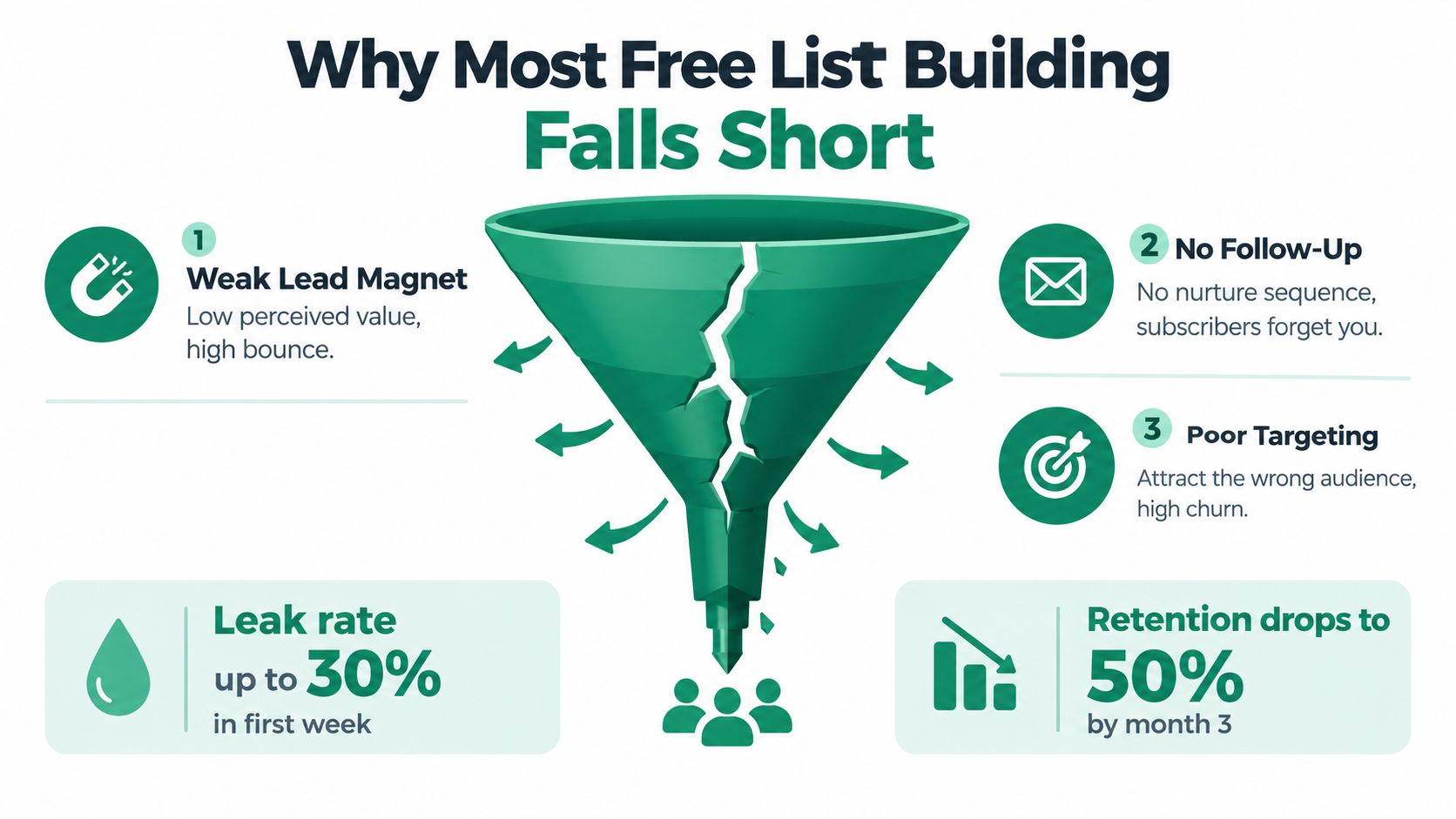
The common failure mode is boring, not dramatic. A business launches a free PDF, sticks a generic “join our newsletter” box in the footer, gets a trickle of opt-ins, then wonders why the list feels dead a month later. The problem usually isn't effort. The problem is that the system leaks at multiple points.
A free list grows through small compounding gains. Offer relevance gets the click. Form placement captures the email. Traffic intent determines whether that subscriber wanted help or was only mildly curious. Follow-up decides whether that person remembers you next week.
The leak usually starts upstream
Most underperforming lists don't have a sending problem first. They have an acquisition problem first. If the lead magnet is vague, the page converts weakly. If the page converts well but attracts the wrong person, engagement drops. If the subscriber was a fit but receives nothing useful after opting in, they forget why they signed up.
Practical rule: Don't judge list growth by signup count alone. Judge it by whether the right people still care two weeks later.
Free growth has to overcome normal attrition. One 2026 benchmark reports about 22.5% annual list churn and says 45% of email addresses become inactive within 12 months, while mature lists often need to grow at 1% to 3% per month just to stay healthy, according to Digital Applied's 2026 email marketing data points. If you're adding subscribers casually and losing relevance quickly, you're not building an asset. You're refilling a bucket with a hole in it.
What usually wastes time
A few patterns show up again and again:
- Generic newsletters: “Get updates” is not a compelling exchange.
- One-form thinking: A single homepage form rarely carries the whole system.
- Traffic mismatch: Broad social traffic often signs up with weak intent.
- No onboarding: If someone joins and hears nothing meaningful, retention falls fast.
- Ignoring deliverability basics: A decaying list creates inbox placement problems over time. If that's already happening, tighten your list hygiene and review these email deliverability improvements.
The businesses that grow lists for free usually do less, but they do it tighter. One lead magnet per audience slice. One page per offer. One clear source path. One welcome sequence that starts immediately.
Designing a Lead Magnet That Converts
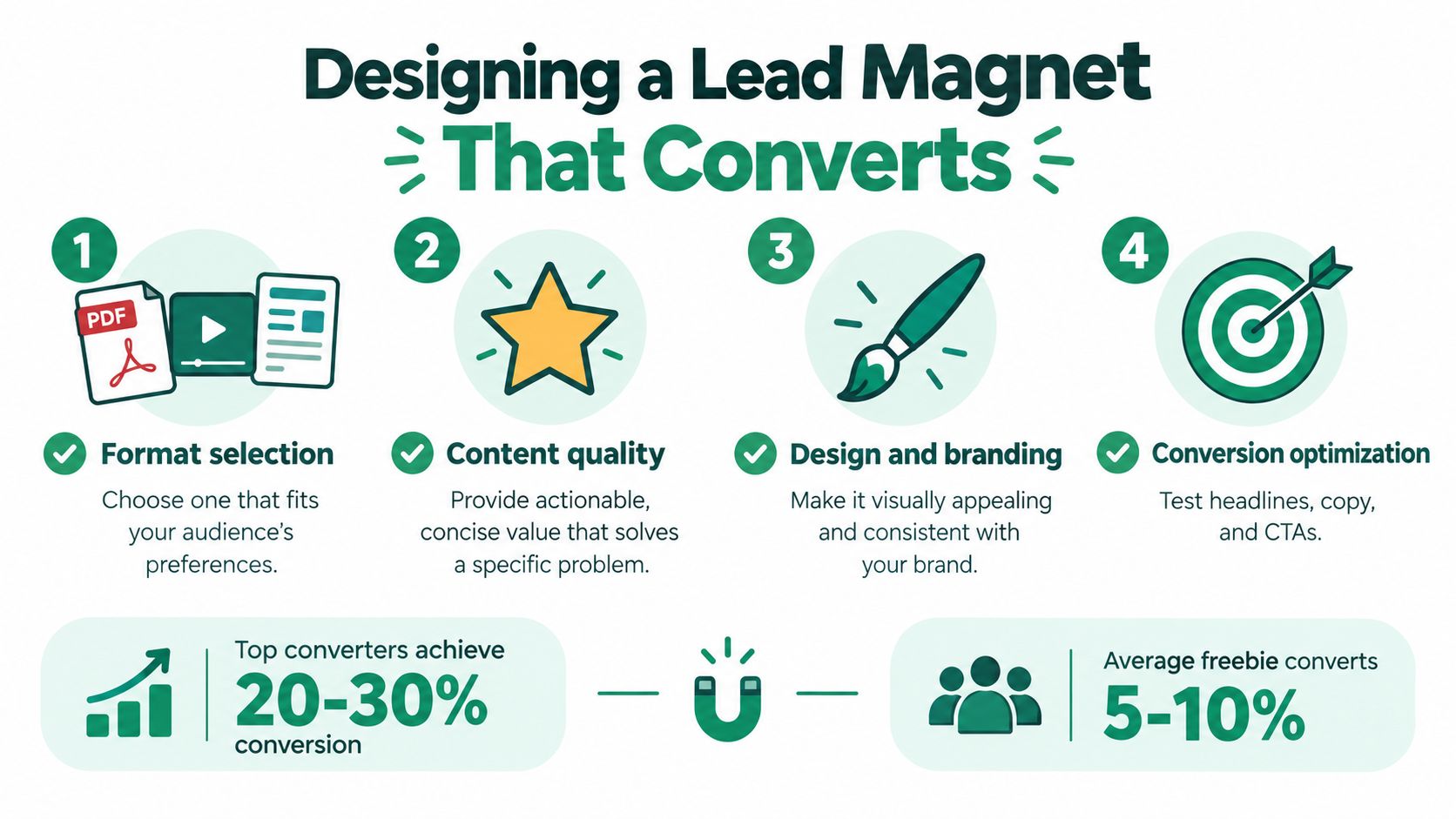
A lead magnet doesn't need to be big. It needs to be easy to use and tightly matched to one problem. The fastest way to waste time is to create a broad eBook nobody urgently wants.
Toolkits, templates, and swipe files tend to work better than generic guides because they shorten time to value. A template gives the subscriber something they can open and use today. A swipe file removes blank-page friction. A checklist turns a fuzzy problem into a sequence of actions.
Pick a format that solves a specific job
Good examples are practical and narrow:
- Template: Notion CRM template for freelancers tracking leads
- Swipe file: 30 cold email openers for agency outreach
- Checklist: 12 local SEO fixes for multi-location businesses
- Toolkit: onboarding email pack for a SaaS free trial
- Worksheet: offer positioning prompts for consultants
Bad lead magnets are usually too broad to create urgency. “Marketing tips” is weak. “Homepage copy prompts for B2B SaaS founders” is stronger because it names the audience and the outcome.
If you need help getting that audience definition tighter before you build the asset, this guide on how to identify your target audience is a useful place to sharpen the offer around a real buyer problem.
Use a dedicated page, not a casual embed
Many free list-building efforts underperform. Benchmark data shows dedicated landing pages convert at roughly 15% to 30% on average, compared with 0.5% to 2% for embedded inline forms and 3% to 6% for immediate welcome popups, based on average email signup conversion benchmarks from Acceleroi. The same benchmark notes that popups with no incentive can convert around 0.5% to 1%, while incentive-based popups often reach 2% to 3% or more.
That gap changes how you should build. Don't send someone to a generic blog post and hope they notice a form in the sidebar. Send them to a page with one job.
A solid above-the-fold layout looks like this:
- Headline: restates the deliverable clearly
- Hero image: shows the actual file, template, or toolkit
- Three bullets: explain what the subscriber gets and why it helps
- Single-field form: ask for the email and nothing else
- Immediate delivery: trigger the asset right away
A lead magnet converts best when it looks finished before the subscriber asks for it.
Place the video below after the reader already understands the offer. That keeps the page from feeling like a media dump instead of a conversion asset.
Pre-launch checklist
Before publishing, run through these questions:
- Audience fit: Does this solve one urgent problem for one clear segment?
- Format fit: Would the subscriber rather get a template, checklist, or swipe file than a long PDF?
- Promise clarity: Can someone understand the value in one glance?
- Specificity: Does the title name the audience, asset, or result?
- Visual proof: Does the page show the actual deliverable?
- Form friction: Are you asking only for the email?
- CTA strength: Does the button promise the asset, not “submit”?
- Traffic match: Does the landing page continue the message from the post, social update, or referral?
- Delivery speed: Does the first email arrive immediately?
- Follow-up path: Does the subscriber know what comes next?
Placing Opt-In Forms Where Signups Actually Happen
Most sites don't need more forms. They need better form-to-page matching. A popup on a low-intent homepage visitor and a gated form on a high-intent tutorial reader are not the same thing, even if both collect an email.
The benchmark ranges below are useful because they stop you from expecting one form type to do every job. A dedicated lead magnet page often wins because it concentrates attention, but on-site forms still matter for visitors who land deeper in your content.
Match the form to the visitor moment
| Form Type | Avg Conversion Range | Best-Fit Traffic Source |
|---|---|---|
| Embedded inline form | 0.5% to 2% | Blog readers already consuming the article |
| Immediate welcome popup | 3% to 6% | Warm traffic when the offer is strong |
| Incentive popup | 2% to 3% or more | Visitors shown a clear value exchange |
| Dedicated landing page | 15% to 30% | Traffic from one campaign, post, or link |
| Warm dedicated lead magnet page | 20% to 35% | Readers who already know the topic |
| Engaged quiz offer | 30% to 40% | Audiences willing to interact before opting in |
These ranges come from the benchmark summaries in Shno's email list growth statistics, which also place average website opt-in performance around 1.95%, with 0.8% at the low end and 6.5% among top performers.
A practical form map
On content-heavy sites, form density matters less than context. One strong inline offer inside a relevant article will usually outperform several unrelated asks. On service pages, the best signup moment is often near pricing questions, implementation concerns, or a resource section that reduces purchase friction.
Use placement this way:
- Inline content forms: Best inside educational posts where the lead magnet extends the article.
- Popups: Best when delayed, targeted, and tied to a specific incentive.
- Dedicated pages: Best for all traffic you actively send from social, email signatures, partner mentions, or content repurposing.
- Gated upgrades: Best when the bonus is concrete, such as a checklist, worksheet, or template connected to that page.
Three placement rules that keep forms from hurting the page
- One meaningful ask per scroll depth: Don't stack three forms in one viewport.
- Don't interrupt instantly: Avoid asking in the first moment before the visitor has seen any value.
- Offer the asset inside the copy: “Get the checklist” beats “Join our newsletter” nearly every time.
If a page has traffic but weak signups, change the offer first, then the placement. Most pages don't have a form problem in isolation. They have a message match problem.
Driving Free Traffic From Search and Content
Free list building gets easier when the traffic arrives with intent. Search does that better than most channels because the visitor is already trying to solve something.
Start with the questions your ideal subscriber types before they're ready to buy. Not broad industry terms. Specific problem queries. A consultant might target “sales call follow-up template.” A local agency might target “Google Business Profile mistakes.” A SaaS founder might target “customer onboarding email examples.”
Build one content cluster around one offer
The cleanest setup is one lead magnet per topic cluster. If you create a checklist for onboarding emails, build supporting articles around onboarding emails. Don't send those readers to a random social media guide. Tight message match is what makes free traffic convert.
A simple workflow works well:
- Pull query ideas from Search Console, Google Keyword Planner, or another free-tier keyword tool.
- Group related searches into one cluster with one main lead magnet.
- Publish a pillar article that solves part of the problem.
- Place one inline offer for the related asset.
- Link every repurposed piece back to the same landing page.
| Traffic Source | Typical Opt-in Rate | Cost to Acquire | Compounding? |
|---|---|---|---|
| Organic search to dedicated landing page | Qualitatively stronger when intent and offer match | Free in cash terms, time-heavy upfront | Yes |
| Organic search to inline content form | Usually lower than a dedicated page | Free in cash terms, time-heavy upfront | Yes |
| Repurposed social content to landing page | Varies widely by audience intent | Free in cash terms, requires consistent distribution | Partial |
| Community mentions and partner referrals | Often quality-driven rather than volume-driven | Free in cash terms, relationship-heavy | Partial |
The useful thing about SEO is not speed. It's accumulation. One article can keep feeding the same magnet long after the original social post disappears. That's why teams that invest in content marketing for agencies often pair search content with one conversion asset per topic rather than spraying multiple offers across every page.
Repurpose without splitting attention
A lot of marketers repurpose content badly. They turn one article into five posts, then send each post to a different offer. That spreads effort and weakens measurement.
Do the opposite. Turn the same article into a LinkedIn post, a short thread, a YouTube Short, or a simple carousel. Then send each version back to the same landing page. You'll learn faster which surface brings the most qualified subscriber because the conversion point stays constant.
Track source, not just subscriber count. The signup only matters if you know what brought it in.
Picking Free Acquisition Channels by Quality Not Just Volume
Free channels can look productive while damaging list quality. A spike in signups feels good. A month later, those subscribers never open, click, or buy anything, and your list becomes harder to manage.
The fix is simple. Stop ranking channels by raw volume alone. Rank them by the quality of the subscriber they produce.
Compare channels by intent
| Channel | Avg. Conversion | Subscriber Intent | 90-Day Retention |
|---|---|---|---|
| Organic search | Qualitatively solid when query and offer align | High | Typically stronger than low-intent social |
| Guest posts | Qualitatively moderate but warm | High | Often stable |
| Podcast appearances | Lower volume but intent-rich | High | Often stable |
| LinkedIn organic | Variable | Medium to high depending on topic match | Mixed |
| Reddit and broad social threads | Variable | Often curiosity-driven | Frequently weaker |
| Communities and referrals | Variable | High when audience trust already exists | Often strong |
The benchmark context behind this matters. Mailchimp's opt-in trends report says 66% of U.S. consumers have opted into email communications and 65% have opted into text messaging, so permission itself isn't the scarce resource. Attention is. The same report notes that the newsletter economy grew from 26,911 to 52,809 active newsletters between 2023 and 2024, a 96.2% year-over-year increase. That means more channels can generate signups, but not all of them generate subscribers who stay engaged.
What to prioritize first
If you're working with limited time, prioritize channels where the audience already trusts the context:
- Search traffic: People are already solving a problem.
- Partner mentions: Borrowed trust improves lead quality.
- Guest content: Smaller volume, usually warmer attention.
- Podcasts and webinars: Less scale, stronger intent.
Broad social channels still have a place. They're useful for testing headlines, validating interest, and occasionally pushing a working magnet further. They're weak as the foundation of a free strategy if the audience clicks out of curiosity and never returns.
A healthy list isn't the one with the most signups. It's the one where new subscribers still act like subscribers after the novelty wears off.
Automating Welcome and Retention on a Free Stack
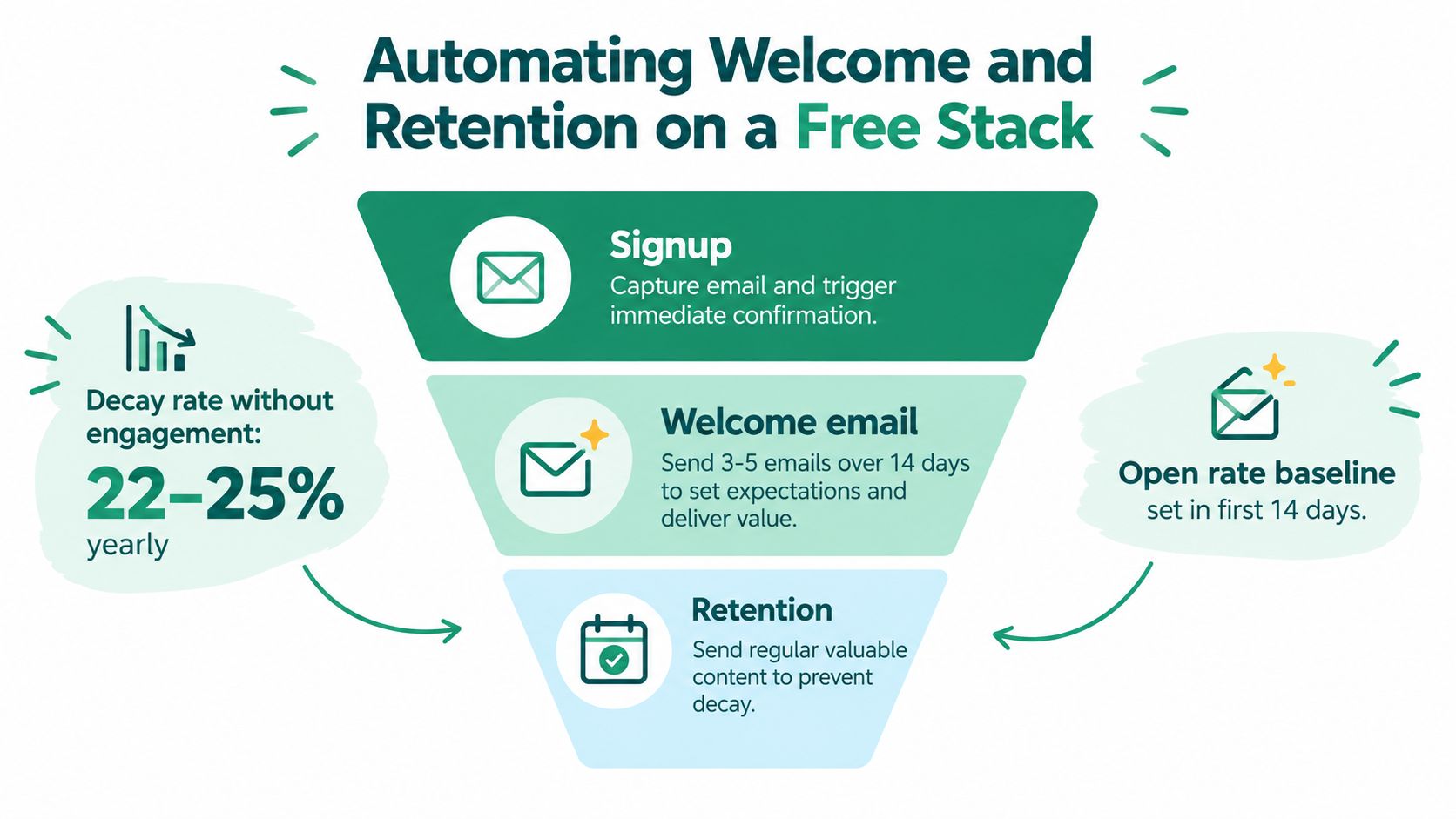
A signup without a welcome sequence is unfinished work. The subscriber raised a hand. If your system doesn't respond properly, you trained them to ignore you.
Lists naturally decay. Independent benchmarks report about 22.5% annual loss, roughly 2% per month, and say 30% of subscribers change their email address every year, according to BounceZero's 2026 email marketing statistics. Free list building only holds up when your post-signup system slows that erosion.
A simple free stack that works
You don't need a complicated setup. Most solo operators can run this with a free email platform tier, a basic automation tool, and a spreadsheet.
Use:
- MailerLite, Brevo, or Mailchimp free tier for forms and autoresponders
- Make or Zapier for light routing if needed
- Google Sheets as a manual source dashboard
- EmailScout if you need to find publicly available contact emails from websites for outreach, partnerships, or list-building support work alongside subscriber capture. It functions as a Chrome extension with manual email search and URL-based extraction.
If you want examples of what those automations should look like in practice, these email automation workflows are a good reference point.
The welcome sequence should do five jobs
A clean sequence across the first week is enough:
- Day 0: deliver the lead magnet fast
- Day 1: explain who the emails are for
- Day 3: give one small win the subscriber can use immediately
- Day 5: make a soft next-step offer
- Day 7: ask for a reply or preference signal
The first email is not the relationship. It's the handoff.
Tag every subscriber by source and lead magnet. That gives you a usable segmentation base later. Someone who joined through an SEO checklist should not receive the same follow-up as someone who joined after a podcast appearance.
Retention rules that protect the list
Once the list starts moving, add lightweight rules:
- Source tags: Track where the subscriber came from.
- Topic tags: Track what they wanted.
- Re-engagement trigger: Send a check-in campaign to inactive subscribers.
- Sunset rule: Stop sending broad broadcasts to people who never re-engage.
Most “free list building” advice ends at the form. That's incomplete. The list only becomes valuable when the first week teaches the subscriber to expect useful emails from you.
Your 30-Day Free List Building Plan
They don't need more tactics. They need a sequence they can finish. One focused month is enough to put a real list-building system in place without paying for traffic.
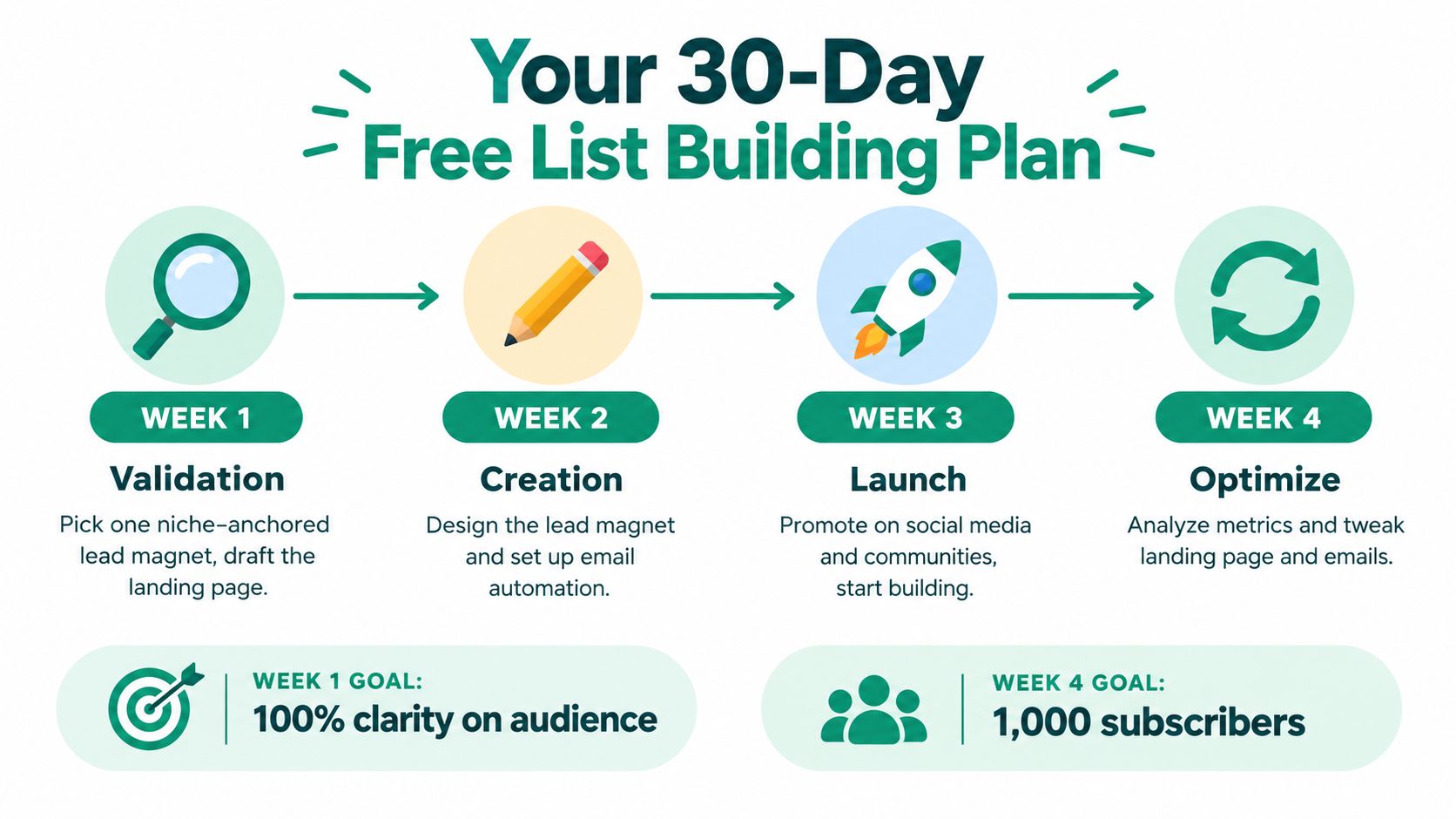
Week 1
Pick one audience segment and one lead magnet. Write the landing page headline, three benefit bullets, and CTA. Set up one dedicated form and make sure every signup records its source.
Week 2
Build the asset and write the welcome sequence. Keep it simple. Publish two search-focused articles tied directly to that magnet, each with one relevant inline opt-in.
Week 3
Push distribution. Reach out for one partnership, mention, guest contribution, or community placement each day. Repurpose one existing article or post into a new format and send all versions to the same landing page.
Week 4
Review what happened. Look at source by source performance, not just total signups. Keep the channels that send engaged subscribers. Rework the ones that attract the wrong people or create weak handoffs after signup.
Use this review list:
- Offer check: Did the magnet attract the right questions and replies?
- Page check: Did the headline and CTA match the traffic source?
- Source check: Which channel produced the most engaged subscriber?
- Sequence check: Did the first emails create clicks or replies?
- Retention check: Are new subscribers still interacting after the first week?
By week five, add a second magnet only if the first one is already converting and retaining attention. Then layer in a re-engagement automation so the list stays usable instead of just larger.
Free list building works when you treat it like a measured system. One focused offer. One clean page. One or two reliable traffic inputs. One welcome sequence that keeps the subscriber warm after the form fill.
EmailScout helps sales and marketing teams find publicly available email addresses, build contact lists, and support outreach workflows when list growth also depends on partnerships, placements, and direct relationship-building. If you want a simple way to support the acquisition side of that process alongside your opt-in strategy, visit EmailScout.