Tag: lead generation tools

  • Email Address Finder for Free: Find Any Email Address with This Ultimate Guide

    Email Address Finder for Free: Find Any Email Address with This Ultimate Guide

    The best email address finder for free is one that gives you a steady stream of verified emails without asking for a credit card. It should let you build targeted lead lists for sales, marketing, or networking on the fly. A tool like EmailScout’s Chrome extension does exactly this, letting you pull contacts straight from websites and professional networks with a single click.

    Why a Free Email Finder Is Your Outreach Superpower

    A man types on a laptop displaying 'OUTREACH SUPERPOWER' on its screen, indicating online marketing.

    In a world overflowing with digital noise, just getting your message to the right person is the first—and often the hardest—part of the battle. Every cold email, partnership proposal, or sales pitch lives or dies by its ability to land in the correct inbox.

    Sending your message to a generic info@ or contact@ address is like shouting into a void. Your carefully crafted email gets lost in a sea of spam and support tickets, never reaching the decision-maker who actually matters.

    This is where a solid, free email finder becomes more than a simple utility; it’s a genuine strategic advantage. It’s not about finding any email. It's about finding the right email, fast. This simple shift turns your outreach from a game of chance into a targeted, effective operation.

    The True Cost of Bad Data

    Let's be clear: guesswork is expensive. Every bounced email hurts your sender's reputation, making it more likely that your future messages will end up in spam folders. Every message sent to the wrong person is a wasted opportunity and a drain on your most valuable resource: time. For anyone in sales or marketing, that inefficiency translates directly into lost revenue and missed connections.

    A reliable email address finder for free cuts right through that problem. It gives you the power to:

    • Connect Directly: Get past the gatekeepers and generic inboxes to engage with the people who make decisions.
    • Boost Engagement: A personalized message sent to a specific person has a dramatically higher chance of getting opened and read.
    • Protect Your Reputation: Verified emails slash your bounce rates, which signals to email providers that you’re a legitimate sender.
    • Maximize ROI: By focusing your energy on qualified contacts, you get better results from your outreach without spending a dime upfront.

    The Market Is Shifting Toward Precision

    The demand for accurate contact information isn't just a fleeting trend; it’s a massive market shift. The global email finder tools market was valued at around $642 million just a few years ago and is on track to explode to $5.6 billion by 2032.

    Why the huge jump? Because businesses see real results. Companies that use precise email finders consistently report a 30% boost in open rates and 25% higher reply rates. It just works.

    To help you see the bigger picture, here’s a quick rundown of how free tools stack up against their paid counterparts.

    Free vs. Paid Email Finders at a Glance

    Feature Free Tools (Like EmailScout) Typical Paid Tools
    Cost $0, no credit card required Monthly or annual subscription fees
    Email Credits Often unlimited or very generous Tiered, with limited credits per month
    Core Functionality Excellent for finding emails on-the-fly from websites and social profiles Often includes bulk finding, CRM integrations, and advanced APIs
    Verification Basic to moderate verification included Advanced, multi-step verification to ensure high deliverability
    Ease of Use Simple, one-click browser extension Can be more complex with dashboards and campaign features
    Best For Individuals, freelancers, and small teams starting outreach Larger sales/marketing teams with high-volume, automated needs

    While paid tools offer advanced features for large-scale operations, a powerful free tool like EmailScout provides the essential functionality most people need to get started and see immediate results.

    The real value of an email finder isn't just about collecting data. It’s about starting meaningful conversations that would otherwise be impossible. It’s the first step in every successful outreach campaign.

    This is the power EmailScout delivers. By offering an unlimited free model, it removes the financial barrier to effective outreach, giving you the essential tool you need to cut through the noise. To fully grasp how a free email finder fits into the broader picture, it's worth exploring modern lead acquisition strategies. After all, finding the right contact is the critical first step to opening doors, building relationships, and ultimately, growing your business.

    Find Emails Instantly with the EmailScout Chrome Extension

    While the manual methods definitely have their place, let's be honest—the fastest way to get your hands on verified contact info is with a tool built for the job.

    This is where the EmailScout Chrome extension comes in. It’s designed to turn your browser into a powerful, on-demand email address finder for free. It just sits quietly in the background, ready to pull contact details with a single click. No more tedious searching, guessing patterns, or manually verifying addresses.

    You can find the email you need right on a person’s professional profile or company website. It’s a massive time-saver, freeing you up to focus on actually reaching out.

    Quick and Easy Installation

    Getting started with EmailScout is a breeze and takes less than a minute. The first thing you need to do is add the extension to your Chrome browser straight from the official Chrome Web Store.

    Here’s what the Chrome Web Store looks like, where you can find and install extensions like EmailScout.

    Once you find it, just click "Add to Chrome." The EmailScout icon will pop up in your browser's toolbar, and you're good to go.

    Here's a pro-tip: "pin" the extension to your toolbar so it's always visible. Click the little puzzle piece icon in Chrome, find EmailScout in the list, and hit the pin icon. Now, it's always ready for action. For a more detailed walkthrough, you can check out our guide to the EmailScout email extractor Chrome extension.

    A Real-World Scenario: Finding a Key Contact

    Okay, so you've got the tool installed. Let's put it to work in a situation you've probably faced a dozen times.

    Imagine you're a sales rep for a SaaS company. Your mission is to connect with the Head of Marketing at a promising tech startup to pitch your new analytics platform. Your first stop? LinkedIn, of course.

    After a quick search, you land on the profile of "Jane Doe, Head of Marketing at InnovateTech." Her profile is a goldmine—full of details about her role and accomplishments. But the one thing you actually need, her email address, is nowhere to be found.

    This is exactly where EmailScout shines. With the extension active, all you do is stay on her LinkedIn profile.

    A single click on the EmailScout icon is all it takes. The extension instantly scans the page data and reveals Jane's professional email address, often with her full name and title, right there in a small pop-up.

    You never have to leave the page or run complicated searches. The info appears right where you need it, letting you jump straight from prospecting to outreach without missing a beat.

    Automate Your Lead Collection with AutoSave

    Finding emails one by one is great, but what if you could build an entire lead list just by browsing the web? That's the idea behind EmailScout’s AutoSave feature.

    When you flip this feature on, it works silently in the background. As you browse company websites, professional network profiles, or online directories, the extension automatically grabs and saves any email addresses it finds.

    This is a game-changer for tasks like:

    • Building Prospect Lists: Just browse the "Team" or "About Us" page of a target company, and EmailScout will automatically collect the contact details for everyone listed.
    • Networking at Scale: Working through the speaker list for an upcoming conference? The tool will save the emails of every potential connection for you.
    • Market Research: Exploring a list of companies in your target industry? AutoSave will build a list of key contacts as you go.

    All the contacts collected via AutoSave are neatly organized in your EmailScout account. From there, you can export them as a CSV and upload them directly into your CRM or outreach platform. It turns casual browsing into a productive lead-gen activity, making sure you never miss an opportunity.

    Scale Your Outreach with Bulk URL Email Extraction

    Finding one email with a single click is a nice little win. But what happens when you need to find contacts for dozens, or even hundreds, of people across different companies? Suddenly, that one-click tool feels slow, and you're staring down hours of tedious, manual work.

    When you need to scale, you need a different game plan. Forget hunting for contacts one by one. The real power comes from gathering them in bulk from a list of highly targeted websites. That’s exactly what EmailScout’s URL Explorer was built to do—turn a simple list of web pages into a ready-to-use list of leads.

    This feature is a lifesaver for anyone building targeted lists at scale. Sales teams can use it to map out entire departments at key accounts. Marketers can pull together contact lists from industry blogs or conference speaker pages. It completely automates what used to be a major bottleneck in any outreach process.

    Your Workflow for High-Volume Lead Generation

    The process itself is surprisingly simple. It all starts with putting together a list of URLs where your ideal contacts are likely to be found. Get strategic here—think about where your prospects are publicly listed online.

    Good sources for URLs include:

    • Company 'About Us' or 'Team' Pages: These are often goldmines for direct contact information of key people.
    • Conference Speaker Rosters: Grab the URLs from speaker bios to connect with industry experts and thought leaders.
    • Industry Association Member Directories: If a directory is public, its pages can be a source of highly relevant contacts.
    • "Top 10" Lists and Round-Up Blog Posts: Articles like "Top 20 SaaS Companies to Watch" have already done the curation work for you.

    Once you have your list of URLs, just paste them into the URL Explorer. EmailScout takes over from there, visiting each page and pulling every email address it finds. The results are then neatly compiled into a clean, downloadable list, ready for your next campaign.

    A Practical Example in Action

    Let's imagine you're trying to connect with marketing leaders at fast-growing SaaS companies. You could start by gathering the 'About Us' page URLs for 10-15 of your top target companies.

    Instead of visiting each page yourself, clicking on profiles, and copying emails one by one—a task that could easily burn an hour—you just feed the entire URL list into the tool. Within minutes, EmailScout spits out a consolidated list of every email it found across all of those pages.

    This simple workflow is at the heart of the process.
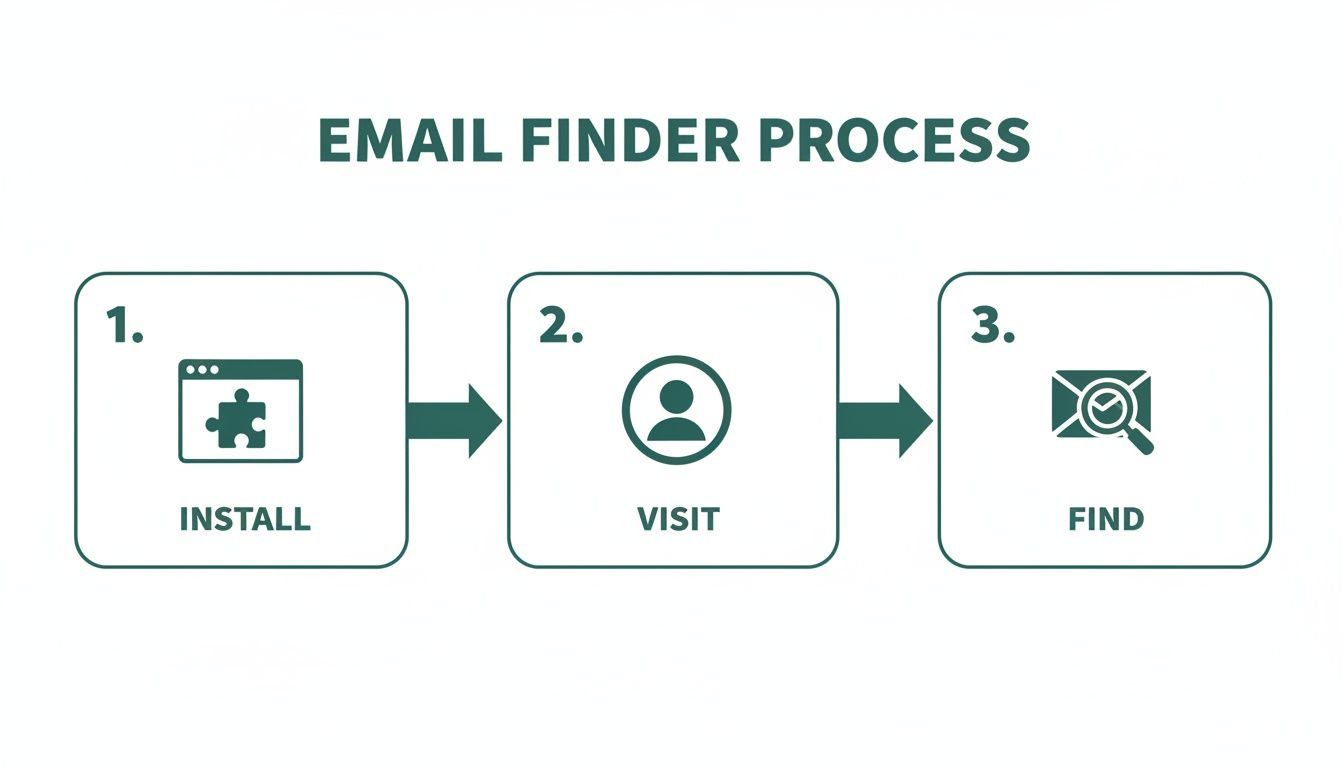
    A three-step process graphic showing how to find email addresses: install, visit, then find.

    The graphic nails the simplicity: install the tool, visit a source, and find the email. This efficiency gets even more dramatic when you're working with dozens of URLs at once, turning a major time-sink into a minor task on your to-do list.

    The Impact of Scalable Email Discovery

    The ability to extract emails in bulk isn't just a time-saver; it’s about moving faster on market opportunities. Email marketing is absolutely booming, with a projected market value of $36.3 billion by 2033—a massive jump from $14.8 billion in 2025. With over 4.6 billion global email users, the channel delivers an incredible ROI of $36 for every $1 spent, but that only works if your messages actually get to the right people.

    By automating the discovery process, you can build bigger, more targeted lists faster than your competitors. This allows you to run larger campaigns, test different messaging, and ultimately generate more leads and revenue.

    Tools like the URL Explorer empower marketers and sales teams to tap into this potential at scale. You can learn more about the specifics in our guide on how to use an email extractor from a website. Ultimately, this approach bridges the gap between knowing who your target companies are and actually having the contacts you need to start a conversation, making your outreach both efficient and incredibly effective.

    Manual Tricks for Finding Hard-to-Get Emails

    While an automated email address finder for free is a massive shortcut, no tool is perfect. You’re bound to hit a wall eventually, especially when hunting for a high-level executive or someone who keeps a low digital profile. When the easy button fails, it’s time to put on your detective hat.

    Picking up a few manual search skills is the secret weapon that separates amateur outreach from professional prospecting. Think of these techniques as your fallback plan, ensuring that even the most elusive contact is still within your grasp. With a little cleverness, you can often uncover exactly what automated tools miss.

    Master the Art of Google Dorking

    Google is far more than a search engine; it's a colossal, searchable database. "Google Dorking" is just a fancy term for using advanced search operators to force Google to give you hyper-specific results. It’s like having a secret key to unlock hidden information.

    Instead of a generic search like "Jane Doe email," you can use powerful commands to really narrow the field. These operators act as filters, telling Google precisely what to look for and where.

    For instance, a search like site:linkedin.com/in/ "Jane Doe" "VP Sales" email tells Google to only search within LinkedIn profiles for pages that contain Jane Doe's name, her title, and the word "email." This simple string can often surface profiles or related documents where her contact info is mentioned.

    This is a game of trial and error. You're searching for digital breadcrumbs—a mention in a press release, a bio on a conference website, or an old forum post. The right combination of search terms often leads you straight to the prize.

    Intelligently Guess and Verify Email Patterns

    Most companies follow a predictable pattern for their email addresses. This is a huge advantage. If you know a person's name and their company's domain, you can make a highly educated guess. Honestly, this is often the fastest manual method.

    Common patterns you'll see are:

    Once you have a few likely candidates, you don't have to just send a blind email and hope for the best. Use a free email verification tool to check if the address is valid without sending a message. These tools do a quick ping to see if the server recognizes the address, giving you a green light before you hit send. If you want to dive deeper into this topic, you can read our guide on finding email addresses by name.

    Top-tier email finders often use this same pattern-deduction logic. But even the best tools aren't flawless. Benchmarks show that leading services can have a surprisingly high rate of unusable emails—sometimes as high as 25.4%. This really highlights why knowing how to manually guess and verify is such a crucial backup skill. You can learn more about these findings on email finder accuracy.

    Mine Company Websites for Hidden Clues

    Sometimes, the contact information you're looking for is hiding in plain sight. Company websites, especially for smaller to mid-sized businesses, are often filled with direct contact details if you know where to dig.

    Go beyond the main contact page and explore these less-obvious sections:

    • The 'About Us' or 'Team' Page: This is the first place to look. Many companies proudly list their leadership team, and you might get lucky with direct email addresses or links to their professional profiles.
    • Press Releases or 'News' Section: When a company issues a press release, they almost always include a media contact. This is often a real person in marketing or PR, and their direct email is usually listed right there.
    • Blog Author Bios: If your target has ever written for the company blog, check their author bio at the bottom of the article. It's a common spot to find an email address or a link to a personal site with more contact info.

    These manual strategies take a bit more elbow grease, but they're incredibly effective when automated tools come up short. By combining smart searching, logical deduction, and thorough website investigation, you dramatically increase your odds of finding the exact email you need to start a real conversation.

    How to Conduct Ethical and Effective Outreach

    Person uses a stylus on a tablet, with 'Ethical Outreach' text on green papers and a checklist.

    Finding a verified email address feels like a win, but it’s just the starting line. The real work—and the real opportunity—is in what you do next. How you use that email will determine if you build a genuine connection or just add to the noise in someone's inbox.

    Effective outreach has nothing to do with blasting a generic template to hundreds of people. It’s about being thoughtful, respectful, and personal. Your goal should be to start a conversation, not just shove a sales pitch in someone's face.

    Personalization Is Your Secret Weapon

    In a world drowning in automated messages, a small touch of real personalization can make you stand out immediately. I'm not just talking about using a {FirstName} tag. I mean real personalization that shows you’ve actually done your homework.

    This proves you see the recipient as a human being, not just another lead on a spreadsheet.

    Think about what you can reference that shows you've paid attention:

    • A Recent Accomplishment: Did they just publish a killer article on their company blog? Mention a specific point you found interesting.
    • A Shared Connection: Reference a mutual colleague you both know or a conference you both attended.
    • A Company Milestone: Congratulate them on a recent product launch, funding announcement, or a great piece of press.

    A simple sentence like, "I really enjoyed your recent post on sustainable marketing—your point about supply chain transparency was spot on," instantly proves you’re not a robot. It turns a cold email into a warm introduction.

    Navigating Compliance and Ethics

    Using an email address finder for free means you also have a responsibility to be an ethical sender. Bending the rules isn't just bad practice; it can bring on serious penalties and do lasting damage to your brand's reputation. Always keep two key regulations in mind: GDPR (for EU contacts) and the CAN-SPAM Act (in the U.S.).

    Don't get bogged down in the legal jargon. The core principles are just good business sense.

    The essence of ethical outreach is providing clear value, being transparent about who you are, and making it incredibly easy for people to opt out. Respect the inbox, and you'll protect your sender reputation.

    At an absolute minimum, every outreach email you send should include your physical address and a clear, one-click unsubscribe link. Never use shady or misleading subject lines, and always honor opt-out requests right away. This isn’t just about dodging fines; it’s about building trust from the very first interaction.

    To keep things straightforward, here's a quick reference table for what to do—and what to avoid—in your outreach.

    Email Outreach Dos and Don'ts

    Do Don't
    Personalize your message with specific details. Use a generic, one-size-fits-all template.
    State your purpose clearly and concisely. Hide your intention in long, vague paragraphs.
    Include a clear, one-click unsubscribe link. Make it difficult or confusing to opt out.
    Provide genuine value or a solution to a problem. Focus only on your product or sales pitch.
    Honor opt-out requests immediately. Continue sending emails after a person unsubscribes.
    Be transparent about who you are and your company. Use deceptive or misleading subject lines.

    Following these simple rules helps ensure your emails are welcomed, read, and acted upon, all while keeping your sender reputation intact.

    A Simple and Effective Outreach Template

    You don't need a five-paragraph essay to get a response. In fact, shorter is almost always better. Here’s a simple, value-first template you can adapt for your own use. To really boost your open rates, check out these expert tips on writing catchy email subject lines.

    Subject Line: Quick question about [Their Company]'s [Specific Area]

    • Opening: Kick things off with your personalized compliment or observation. (e.g., "Hi Jane, I saw your team just launched the new X feature—congratulations, it looks fantastic.")
    • Value Proposition: Get straight to the point. State your purpose clearly, focusing on a problem you can solve for them. (e.g., "We help B2B SaaS companies like yours reduce user onboarding friction by about 25%.")
    • Call to Action: Make your ask simple and low-commitment. No one wants to book a 60-minute demo off a cold email. (e.g., "Would you be open to a brief 15-minute call next week to explore if this could be a fit?")

    This structure works because it respects their time, shows you've done your research, and gets directly to the point. It frames the entire conversation around their world, making them far more likely to reply. When you combine a verified email with a thoughtful message, you turn cold outreach into a powerful way to build real relationships.

    Got Questions? Here Are Some Answers

    Even with the best tools, you're bound to have some questions. That's a good thing—it means you're thinking critically about how to find emails the right way.

    Let's clear up a few of the most common things people ask when they start using free email finders.

    Is It Legal to Use an Email Finder?

    This is the big one, and the short answer is yes, it’s legal. Finding a publicly available business email is not the problem. It’s what you do with that email that counts.

    Laws like the CAN-SPAM Act in the U.S. and GDPR in Europe are not there to stop you from doing business. They exist to stop spam. As long as you're reaching out with a legitimate business reason, being transparent about who you are, and providing an easy way to opt-out, you're generally in the clear.

    Think of it this way: The tool is just a map. Where you drive and how you drive is on you. Always be respectful and provide real value.

    How Accurate Are These Free Tools, Really?

    It’s important to set the right expectations here. Free email finders are incredibly useful, but they're not crystal balls. No tool can guarantee 100% accuracy because the business world is constantly changing—people switch jobs, companies rebrand, and email structures get updated.

    A good tool like EmailScout works by cross-referencing multiple data points to give you the highest possible chance of a valid email. You can generally expect a success rate anywhere from 70% to 95%. This is more than enough to fuel a powerful outreach campaign, but you should always plan for a small percentage of emails to bounce. That’s just part of the game.

    Why Do These Tools Only Find Professional Emails?

    You’ve probably noticed that email finders are built to find name@company.com addresses, not personal ones like name@gmail.com. There are a few very practical reasons for this:

    • Keeping it Professional: When you’re doing business outreach, you want to reach people in a professional context. Their work email is the right place for that conversation.
    • Staying Compliant: Privacy laws are much stricter with personal data. Contacting a business email for a relevant business purpose is widely accepted, but landing in someone's personal inbox uninvited can feel intrusive and cross a legal line.
    • They're Easier to Find: Business emails usually follow predictable patterns, which makes them far easier for algorithms to find and verify. Personal emails are totally random.

    Focusing on professional emails helps you run smarter, more effective outreach that respects people’s boundaries.

    What if I Still Can't Find an Email?

    It happens. Sometimes a person has a tiny digital footprint or works at a company with a bizarre email format. When your automated tools come up short, it’s time to put on your detective hat and go back to the manual methods.

    Don’t just give up on a great prospect. Try these moves:

    1. Advanced Google Searches: Use "Google dorking" tricks with different combinations of their name, company, and words like "email" or "contact."
    2. Dig Through the Company Website: Check out the "About Us," "Press," or "Team" pages. You might find an author bio on a blog post or a media contact that gives you a clue.
    3. Guess and Verify: This is a classic for a reason. Try the most common patterns (first.last@domain.com, firstinitial.lastname@domain.com) and pop them into a free verification tool. You’d be surprised how often this works.

    When you combine a great tool with a bit of manual sleuthing, there aren't many contacts who can stay hidden for long.


    Ready to stop guessing and start connecting? With EmailScout, you get an unlimited free email finder that integrates directly into your browser. Find verified emails, build lead lists automatically, and supercharge your outreach in minutes. Get started with EmailScout for free today


  • Master Your Email Extractor Chrome Extension

    Master Your Email Extractor Chrome Extension

    An email extractor chrome extension is a simple but powerful browser tool that does one thing exceptionally well: it finds and collects email addresses from websites, social media pages, and just about any other online source. It essentially automates a tedious manual process, turning hours of grunt work into a task that takes just a few clicks. For anyone in sales or marketing, it’s a total game-changer.

    Why An Email Extractor Is Your New Secret Weapon

    Workspace with a laptop displaying lead generation software, a coffee mug, and a 'Generate Leads' book.

    In sales and marketing, speed and efficiency are everything. If you're still manually digging through websites and LinkedIn profiles for contact info, you're falling behind. That kind of work is a massive time drain, pulling you away from the activities that actually move the needle—building relationships and closing deals.

    This is exactly where an email extractor extension comes in. Think of it less as another browser add-on and more as a strategic asset. It automates the most frustrating part of lead generation, letting you build hyper-targeted prospect lists with incredible speed.

    A Few Real-World Examples

    Let's get practical. Imagine you're prepping for a big industry conference. Instead of spending the week before hunting down contacts, you could just visit the event's exhibitor page and pull hundreds of relevant emails in a matter of minutes. This gives you a massive head start, allowing you to kick off your outreach before the event even starts.

    Here are a few other ways you can get a strategic edge:

    • Laser-Focused Prospecting: Scrape emails from niche forums, industry blogs, or LinkedIn groups to find people actively talking about problems your product solves.
    • Smarter Competitor Analysis: See where your competitors are active online. You can often identify potential customers they might be overlooking in those same communities.
    • Quick Networking: Need to gather contacts fast? Use it on online portfolios, speaker bios from virtual events, or professional directories to build a list in no time.

    The scale these tools operate at is what makes them so powerful. The best extensions are trusted by millions of professionals and have processed billions of email searches. By 2025, tools like these have become standard issue, with some maintaining databases of over 200 million regularly refreshed B2B profiles. That data integration means you're not just getting emails; you're often getting verified contacts, which is a huge deal for keeping bounce rates low. You can read more about how B2B data collection is scaling to see just how critical this has become.

    To put it simply, a good email extractor tool brings several key advantages to your daily grind.

    Core Benefits of Using an Email Extractor Extension

    Here’s a quick breakdown of how these tools can immediately improve your workflow.

    Benefit Impact on Your Workflow
    Time Savings Cuts down hours of manual research into minutes, freeing you up for high-value tasks like outreach and follow-ups.
    Increased Accuracy Reduces human error from copy-pasting, leading to cleaner data and lower email bounce rates.
    Scalable Lead Generation Allows you to build large, targeted prospect lists quickly, something that's simply not feasible to do by hand.
    Targeted Outreach Enables you to gather contacts from specific sources (like niche communities or competitor sites) for hyper-relevant campaigns.

    These benefits aren't just about convenience; they directly contribute to a more effective and profitable sales or marketing operation.

    Key Takeaway: Using an email extractor isn't just about getting emails faster. It’s about building smarter, more relevant lists that let you execute personalized outreach at a scale that was impossible before.

    This shift from manual labor to automated intelligence is the foundation of any modern, data-driven workflow. By removing the data entry bottleneck, you free up your most valuable resource—time—to focus on crafting great messages, nurturing leads, and driving revenue. The job becomes less about finding people and more about effectively engaging them.

    Setting Up Your Email Extractor for First Use

    Getting a new tool up and running should be the easiest part of the job. We designed EmailScout to be a simple email extractor chrome extension that takes you from zero to finding emails in just a couple of clicks, all right from the Chrome Web Store.

    First things first, you need to find the extension. Just pop "EmailScout" into the Chrome Web Store search bar, and it'll be the top result. You'll see a big blue button that says “Add to Chrome.” Go ahead and click it—that’s literally the only step. Chrome takes care of the rest, downloading and setting it up for you.

    Understanding Permissions

    Once you click that button, Chrome will show you a pop-up asking for certain permissions. This is a totally standard security check for any extension, but it’s good to know what you’re actually saying "yes" to. It will ask for permission to “read and change your data on the websites you visit.”

    That might sound a little intense, but it's essential for the tool to do its job. Here's the simple breakdown of what that means:

    • Reading Data: The extension needs to scan the code and text on a webpage to spot anything that looks like an email address (like contact@company.com).
    • Changing Data: This permission is usually just so the extension can display its icon on the page, often with a little badge showing how many emails it found.

    Good extensions only use these permissions for what they say they will. EmailScout isn't reading your personal emails or grabbing your passwords; it’s just scanning the public content on websites for you.

    Key Insight: Granting these permissions is what brings the extension to life. It’s what allows the tool to actively scan the sites you're on and pull out contact information, turning a simple webpage into a lead-generating resource.

    Activating and Pinning the Extension

    After it's installed, you’ll find the EmailScout icon tucked away under the puzzle piece icon in your browser's toolbar. To save yourself a click every time, I recommend pinning it.

    Just click the puzzle piece, find EmailScout in the list, and click the little pin icon next to it. This will lock the icon to your toolbar so it's always visible and ready to go.

    And that's it! You're all set to start finding emails. If you’re just getting started and want to learn more about the different ways to approach this, check out our guide on using a free email scraping tool.

    Putting Core Features into Action

    Now that you're all set up, let's get down to business. A powerful email extractor Chrome extension is more than just a button you click; it’s a tool you weave into your daily workflow to hit specific goals. I’ll walk you through how to use EmailScout’s core functions in real-world situations to get immediate results.

    The whole point of a tool like this is to make your life easier. Getting started is designed to be quick and painless.

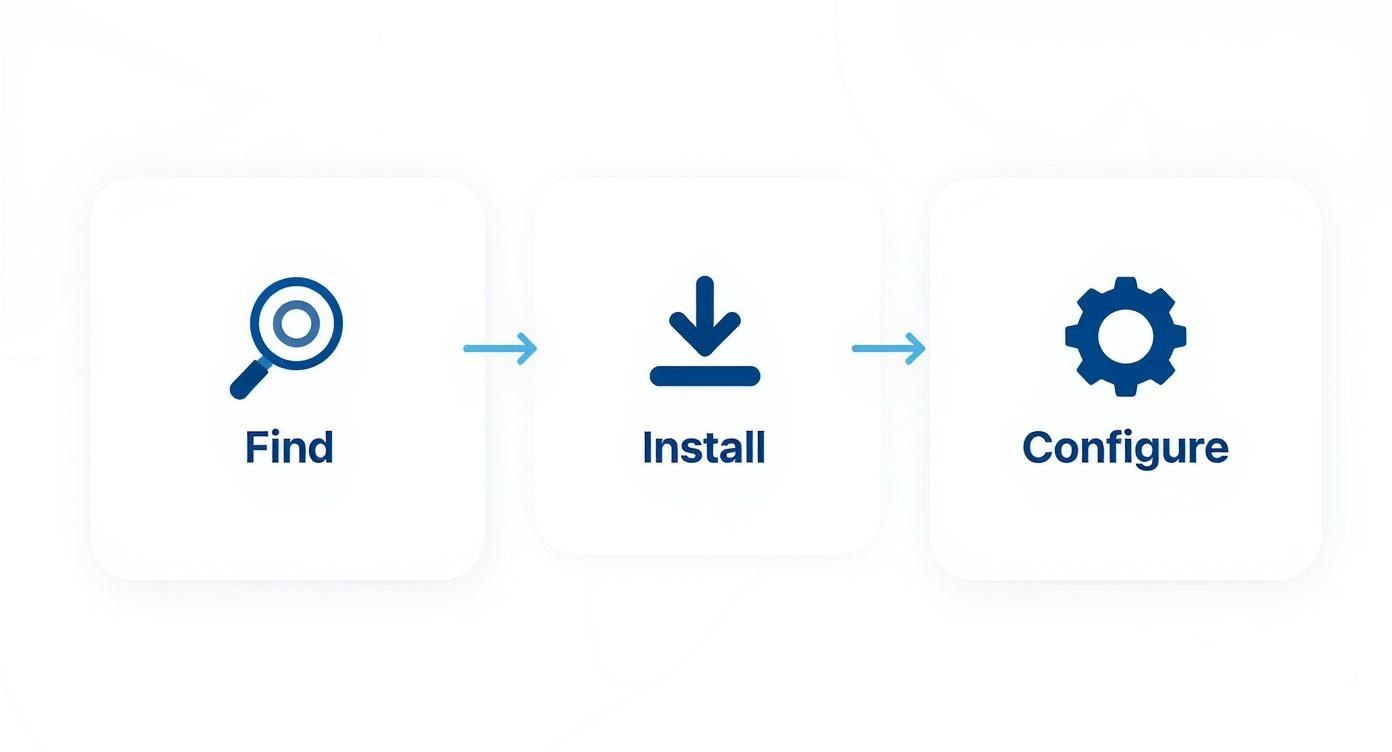
    A three-step process diagram showing Find, Install, and Configure with magnifying glass, download, and gear icons.

    This simple flow—Find, Install, and Configure—is all it takes to get EmailScout ready for action. So, what’s next?

    Extracting from a Single Webpage

    The most common way to use an extractor is for pulling emails from a single, high-value source. This is your go-to move for targeted, on-the-spot needs.

    Let's say you're a SaaS sales rep who just stumbled upon a blog post: "Top 50 Marketing Agencies in Texas." That page is pure gold. All you have to do is navigate to that URL, click the EmailScout icon in your toolbar, and watch it work. In seconds, it scans the entire page and gives you a clean list of every email address it found. Just like that, you have a hot prospect list ready to go.

    This on-demand method is perfect for situations like:

    • Conference Exhibitor Lists: Instantly grab contacts from event pages.
    • Industry Directories: Scrape member lists from professional associations.
    • "About Us" Pages: Pinpoint key decision-makers at your target companies.

    This is the bread and butter of any solid email scraper. If you want a deeper dive, check out our guide on how to extract emails from any website.

    Leveraging Automation with AutoSave and URL Explorer

    One-off extractions are great, but automation is where the real magic happens. This is where features like AutoSave and URL Explorer step in to save you a massive amount of time.

    These features are what truly scale your efforts. For example, EmailScout’s AutoSave and AutoVisit features can automatically crawl and scan up to 1,000 URLs at a time, pulling emails even from websites that are tricky to scrape manually. It builds and maintains cloud-based lists you can even share with your team.

    Better still, these systems have built-in filters to remove duplicates and block spammy addresses, keeping your list quality high. For sales development reps, this means you get verified, up-to-date contact lists that can hit deliverability rates over 97% when you pair them with a verification tool. That’s how you maximize campaign efficiency.

    Pro Tip: When you're using the URL Explorer for a bulk job, remember that a highly targeted list is everything. A tight list of 50 relevant URLs will always beat a generic list of 500. Quality over quantity wins every time in outreach.

    Understanding these advanced features is what separates a basic tool from one that can genuinely scale your lead generation. To see what’s possible, it’s worth exploring some specific lead scraping capabilities out there. This is how you build a robust pipeline while you focus on the work that really matters.

    Advanced Strategies for Building Better Lists

    Businesswoman creating targeted lists using a computer and a pen to organize data.

    Having a powerful tool is just the first step. The real magic happens when you use it strategically—that's what separates the pros from the beginners. Just grabbing every single email you come across is a surefire way to get low open rates and burn through your leads.

    The true power of an email extractor chrome extension isn't just about collection; it's about building high-quality, targeted lists that are actually ready to convert.

    This requires a shift in mindset. Move away from broad, generic scrapes and start thinking with precision. Instead of just pulling contacts from a homepage, dig deeper. Where do your ideal prospects hang out online? Maybe they’re leaving thoughtful comments on niche industry blogs or are listed as speakers for a specialized webinar. Those are the goldmines you want to tap into.

    Refining and Segmenting Your Data

    Once you have your raw data, the real work begins. A clean, organized list is your most valuable asset. The first thing you should always do is scrub for duplicates and get rid of those generic, role-based emails like info@ or contact@. They rarely get you a real conversation and can do a number on your sender reputation.

    Next up is segmentation. This is where you can get really smart with your outreach. Group your contacts based on where you found them or what their job title is.

    For example, you could:

    • Segment by Source: Keep contacts from a marketing blog in one list and those from a tech forum in another.
    • Segment by Job Title: Create separate lists for decision-makers (like CEOs or VPs) and operational staff.

    This simple act of organizing your data lets you create hyper-personalized emails. A message crafted specifically for a marketing manager will always outperform a generic blast sent to everyone. Clean data is everything in successful campaigns, and using an email address verification service is a non-negotiable step to keep your lists healthy.

    Key Takeaway: A small, super-targeted list of 100 engaged prospects will crush a generic, messy list of 1,000 every single time. It's all about quality, not quantity.

    Turning Raw Data into Conversations

    With a clean, segmented list in hand, you’re ready to start writing outreach that actually gets a response. A cold email doesn't have to feel cold.

    By simply mentioning the context of where you found their email—"I saw your insightful comment on the XYZ blog"—you instantly break the ice, establish relevance, and start building rapport. It shows you did your homework.

    Of course, once you’ve built your lists, you need to make sure your messages actually land in the inbox. For a masterclass on that, check out this fantastic email deliverability guide from the experts.

    Sample Outreach Templates

    To help you hit the ground running, here are a couple of versatile templates for different outreach scenarios using your newly extracted email lists.

    Template Type Subject Line Idea Body Snippet
    Cold Sales Quick question about [Company Name] Hi [First Name], I found your email on [Source, e.g., the speaker list for the Tech Growth summit] and was impressed by your work in [their field]. At [Your Company], we help businesses like yours solve [problem]. I had a specific idea for how we could help you achieve [goal].
    Networking Loved your post on [Topic] Hi [First Name], I came across your profile while browsing [Platform/Website] and was really impressed with your article on [Article Topic]. Your point about [specific insight] was particularly sharp. I'm also working in the [Your Industry] space and would love to connect.

    Remember, these are just a jumping-off point. The real power comes from customizing them with genuine, specific details you've gathered. This strategic approach is how you turn a simple list of emails into a pipeline of real opportunities.

    Navigating Pricing and the Competitive Landscape

    Picking the right email extractor Chrome extension almost always boils down to one thing: value. What are you getting for your money? The market is crowded, and every tool seems to have a different pricing structure. It’s not about finding the cheapest option—it’s about finding the one that actually fits your goals, whether you're a freelancer building your first list or a sales team scaling up your outreach.

    Most tools you'll find run on a tiered model. You’ll almost always see a free plan, which is perfect for just testing the waters. These plans give you a small number of credits or basic features, enough to see if the tool works for you before pulling out your credit card. Once you're ready, paid plans unlock the good stuff and raise the usage limits.

    Decoding Common Pricing Models

    The pricing for these extensions usually falls into a few buckets, each designed for a different kind of user. It’s crucial to look past the monthly fee and understand what you’re actually paying for.

    • Credit-Based Plans: A lot of tools sell "credits," where one credit gets you one email find or verification. This model is great if your prospecting needs are unpredictable—you just pay for what you use, when you use it.
    • Subscription Tiers: This is the classic monthly or annual plan. You typically get a set number of credits per month, and higher tiers throw in more credits and advanced features like bulk finding or CRM integrations.
    • Unlimited Plans: For the real power users, some premium tools offer plans with unlimited email credits. If you're running high-volume campaigns day in and day out, this is your best bet. You never have to worry about hitting a cap.

    The email extractor space is incredibly competitive, and the pricing reflects that. You can find premium tools offering unlimited credits and bulk prospecting for around $59 per month. On the other end, some offer free basic versions with affordable upgrades like cloud storage for about $9.99 per month. The best tools integrate right into company websites, letting marketing teams pull entire lead lists seamlessly. This variety just goes to show that there are solid options whether you're searching for a few thousand emails or over 50,000 each month. You can discover more about the competitive market on swordfish.ai.

    What Separates the Good from the Great

    When you're weighing your options, price is only one piece of the puzzle. A truly great tool gives you features that make your entire workflow faster and more effective.

    Key Takeaway: The best value isn't always the lowest price. It's the tool that offers the right combination of features, accuracy, and support to match your specific outreach strategy and scale.

    Look for tools that integrate smoothly with the CRM you already use. Built-in email verification is another non-negotiable—it keeps your bounce rate low and your sender reputation high. And don't forget about customer support. These are the things that save you time, get you better results, and ultimately deliver a much higher return on your investment. A smart decision here will pay off big time in your future campaigns.

    Got Questions About Email Extractors?

    Jumping into the world of automated email collection always brings up a few important questions. Using an email extractor Chrome extension is a seriously powerful technique, but you absolutely have to approach it the right way. Let's tackle the most common concerns so you can use these tools with confidence.

    Probably the biggest question we hear is about the legality and ethics of it all. It's a valid concern. The short answer is that using an extractor is generally legal, but it really comes down to how you use the data you find. The key is to stick to publicly available business information for legitimate B2B outreach, not scraping private data.

    Crucial Insight: Compliance with rules like GDPR and the CAN-SPAM Act isn't about the tool you use—it's about your entire process. You must always give people a clear and easy way to opt out of your messages. This isn't just a legal hoop to jump through; it's ethical, respectful, and frankly, just good business.

    Responsible use means treating the contact info you gather as the first step toward a real connection, not just another number in a database.

    How Do I Know the Emails I Find Are Accurate?

    Data quality is everything. A list full of bad emails will absolutely tank your deliverability, hurt your sender reputation, and waste your time. So, how can you trust the data you're pulling?

    First off, pick an extension with a solid reputation for accuracy. Many modern tools, including EmailScout, have verification features baked right in, checking an email's validity the moment it's found. Think of this as your first line of defense against bounces.

    Beyond that, you should always practice good list hygiene. This isn't a one-and-done thing; it's an ongoing process.

    • Deduplication: Make sure your tool automatically removes duplicate entries. This keeps your list clean and prevents you from annoying the same person with multiple messages.
    • Filter Generic Emails: You'll want to avoid collecting role-based addresses like contact@, info@, or support@. They rarely get you to a decision-maker and almost always have terrible engagement rates.
    • Verify Periodically: If you're building a big list over several months, it’s a smart move to run it through a dedicated email verification service every so often. This helps you weed out any emails that have gone inactive.

    What if the Extension Can't Find Any Emails?

    It’s going to happen. You land on what looks like the perfect prospect's website, run your extractor, and… nothing. Don't panic. This is usually an easy fix.

    Before you assume there are no emails to be found, run through a quick troubleshooting checklist. Sometimes, a simple page refresh is all it takes. Seriously. If that doesn't do the trick, try clearing your browser's cache, since old data can occasionally mess with how extensions work.

    It's also good to remember that many modern websites use dynamic content. This means information—including email addresses—might not even load until you scroll down or click on something. Try interacting with the page a bit. And of course, some sites just don't list public emails. In those cases, the tool is actually working perfectly by not finding anything.


    Ready to build better, cleaner prospect lists with confidence? EmailScout gives you the tools you need to find accurate contacts quickly and responsibly. Start extracting unlimited emails for free today.

  • 12 Best Email Lookup Tool Options for 2025 (Reviewed)

    12 Best Email Lookup Tool Options for 2025 (Reviewed)

    In today's competitive landscape, reaching the right decision-maker directly can make or break a deal. Generic outreach is dead; personalized communication is key, but getting that crucial email address without spending hours on manual searches is a significant challenge. The right technology doesn't just save time, it multiplies your opportunities.

    An effective email lookup tool is the engine behind successful sales prospecting, targeted marketing campaigns, and meaningful networking. It cuts through the noise, delivering accurate contact information directly into your workflow, and a single verified email can be the difference between a closed deal and a bounced message. The core problem these platforms solve is bridging the gap between identifying a key prospect and actually initiating a conversation.

    This guide is designed to help you navigate the crowded market and identify the best email lookup tool for your specific goals. We'll move beyond marketing claims to provide an in-depth, practical analysis of 12 leading solutions, including Hunter, Apollo.io, ZoomInfo, and Lusha. We evaluate their core strengths, hidden limitations, and ideal use cases. Each review includes screenshots and direct links to help you see the platform in action.

    Whether you're a solo founder building your first contact list or a sales leader equipping a global team, you'll find the insights needed to make an informed decision. This resource will help you stop guessing and start connecting with the people who matter most to your business's growth.

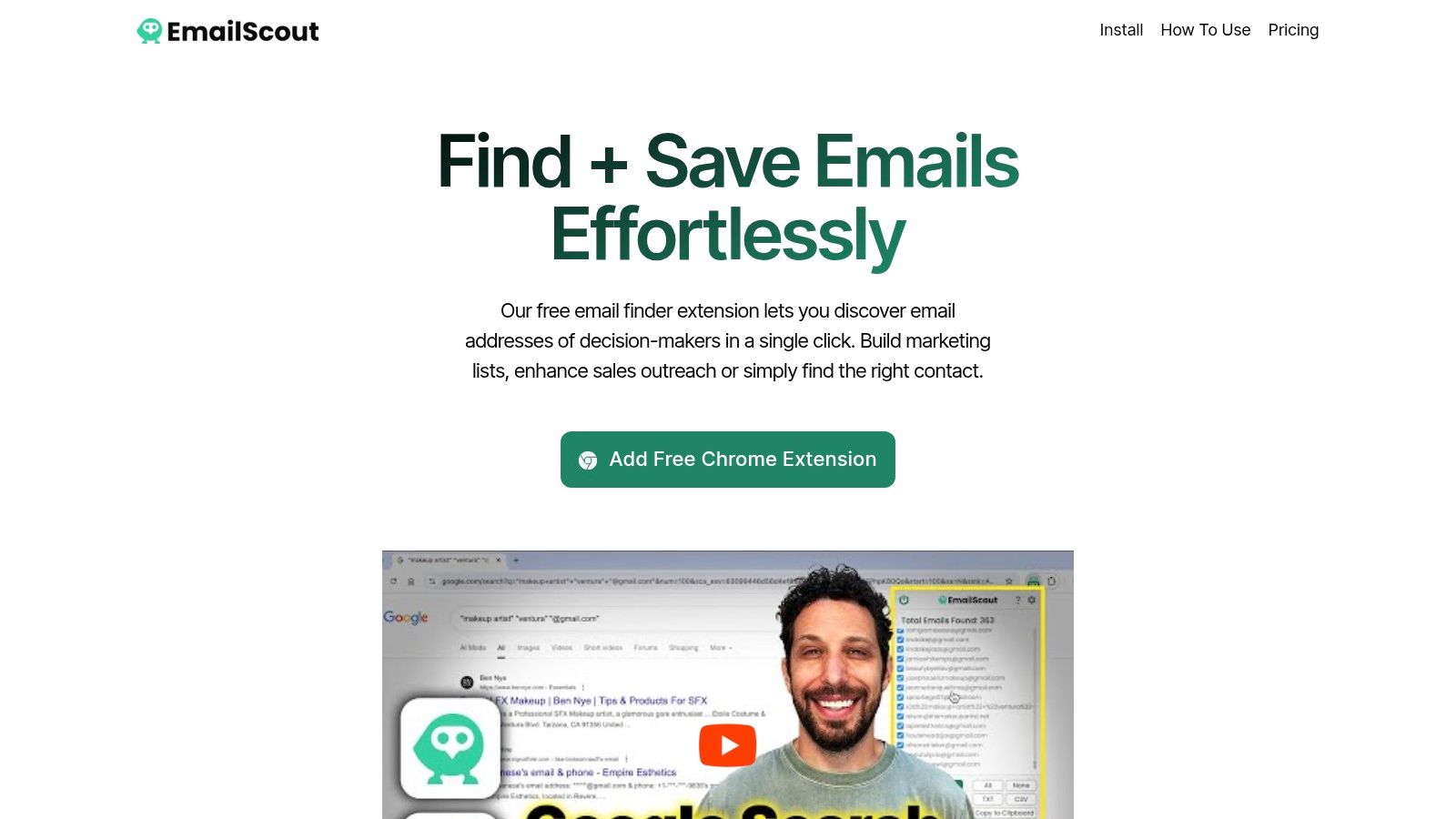
    1. EmailScout

    EmailScout stands out as a premier and remarkably accessible choice for professionals seeking the best email lookup tool. It operates as a powerful yet intuitive Chrome extension, seamlessly integrating into your daily workflow to uncover valuable email contacts directly from websites and Google search results. Its primary strength lies in its ability to automate and simplify the often tedious process of lead generation.

    For sales teams, digital marketers, and entrepreneurs, EmailScout transforms browsing into a productive data-gathering activity. The extension’s core function allows you to extract publicly available email addresses with a single click, immediately populating a clean, manageable list. This efficiency is a significant advantage for anyone building outreach campaigns from scratch.

    EmailScout

    Key Features and Practical Applications

    EmailScout's feature set is designed for both initial outreach and large-scale campaigns, making it a versatile tool.

    • Generous Free Plan: Unlike many competitors, EmailScout offers unlimited email discoveries and exports on its free tier. This makes it an ideal starting point for freelancers, startups, or anyone wanting to test its capabilities without financial commitment.
    • AutoSave (Premium): This feature is a game-changer for passive lead collection. Once enabled, it automatically captures emails from every page you visit, building a substantial contact list in the background with zero manual effort.
    • URL Explorer (Premium): For massive data extraction projects, the URL Explorer allows you to input up to 1,500 URLs at once. It then systematically visits and scrapes emails from these pages, an invaluable tool for market research or building hyper-targeted lists.

    Pricing and Overall Value

    EmailScout’s pricing model is structured to support growth. The free plan provides foundational tools, while Premium plans start at an affordable $9 per month for 5,000 emails. This scales up to enterprise-level packages that can handle one million emails monthly, ensuring the tool remains cost-effective as your outreach needs expand. The ability to export findings as CSV, TXT, or to the clipboard adds to its practical utility.

    Pros:

    • Unlimited email finding and exports on the free plan
    • AutoSave feature provides hands-free list building
    • URL Explorer is excellent for bulk extraction and scaling
    • Highly affordable and flexible pricing tiers
    • Simple, user-friendly Chrome extension

    Cons:

    • Advanced automation features (AutoSave, URL Explorer) require a paid subscription
    • Effectiveness is limited to publicly visible emails on web pages

    Website: https://emailscout.io

    2. Hunter

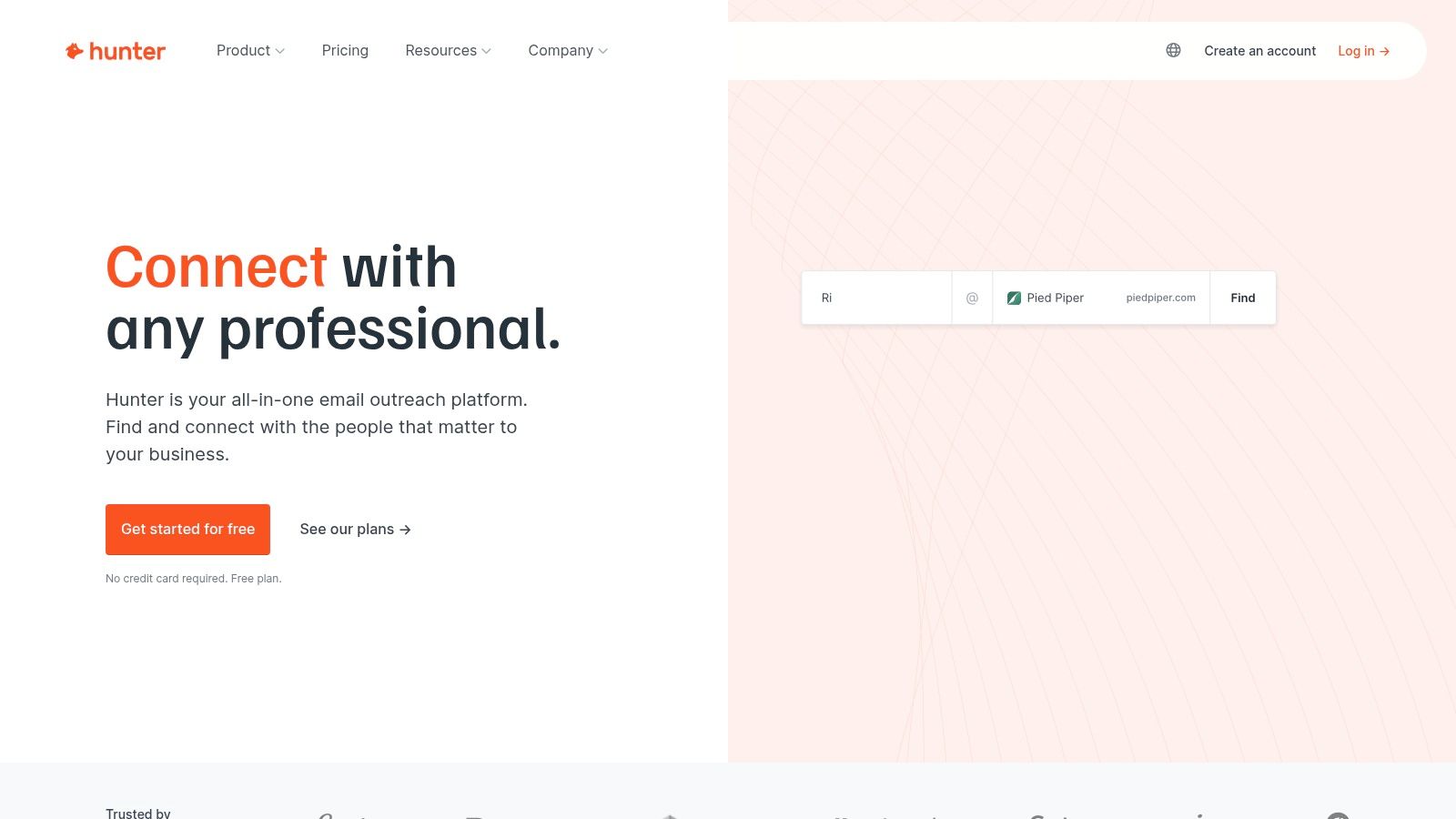
    Hunter is a highly reputable and well-established player in the email lookup space, making it one of the best email lookup tool options for sales professionals and marketers. It excels at finding professional email addresses associated with a specific company domain. Its straightforward interface and powerful browser extensions for Chrome, Firefox, and Edge allow you to find email addresses directly from a company's website or a LinkedIn profile, streamlining your prospecting workflow significantly.

    Hunter

    The platform offers a suite of tools including a single Email Finder, a bulk Domain Search, and an Email Verifier to ensure your outreach lists are clean. A standout feature is the built-in Campaigns tool, which allows you to send cold email sequences directly from the platform. For those looking to integrate email finding into their existing processes, Hunter offers a robust API and a convenient Google Sheets add-on. Its transparent, credit-based system is easy to understand, and its free plan is perfect for occasional users.

    Key Features & Pricing

    • Core Tools: Email Finder, Domain Search, Email Verifier, and Bulk Search.
    • Integrations: Native browser extensions, a Google Sheets add-on, and a full-featured API.
    • Unique Offering: A built-in "Campaigns" feature for sending cold email sequences.
    • Pricing: Starts with a free plan offering 25 monthly searches. Paid plans begin at $49/month for 500 monthly searches and 1,000 verifications. A key benefit is that all paid plans include unlimited team members (seats), making it cost-effective for larger teams.

    Pros:

    • Generous free plan for light usage.
    • Unlimited seats on all paid plans.
    • User-friendly interface and seamless browser extensions.

    Cons:

    • Primarily focused on B2B; less effective for finding personal or generic emails.
    • Credits can be consumed quickly with large-scale bulk searches.

    Visit Hunter

    3. Apollo.io

    Apollo.io transcends being just an email finder; it's a comprehensive go-to-market platform designed for sales and marketing teams who need an all-in-one prospecting solution. While its core strength is a massive B2B database, its email lookup capabilities are seamlessly integrated into powerful sequencing, lead scoring, and analytics tools. This makes it an incredibly efficient and one of the best email lookup tool choices for users looking to manage the entire outreach lifecycle, from finding a contact to closing a deal, within a single ecosystem.

    The platform is distinguished by its deep filtering capabilities and flexible credit system. The robust Chrome extension allows for one-click prospecting on LinkedIn and company websites, feeding contacts directly into your customized outreach sequences. A unique benefit is its credit refund policy; Apollo automatically refunds credits for any emails that bounce when sent through its native sequencer, ensuring you only pay for valid data. This integrated workflow from discovery to outreach makes it a favorite for teams aiming for high-velocity sales.

    Key Features & Pricing

    • Core Tools: B2B database with advanced filters, Email and Phone Number Finder, robust Chrome Extension, and a fully integrated Sequencer.
    • Integrations: Deep integration with Salesforce, HubSpot, and other major CRMs, plus a comprehensive API.
    • Unique Offering: Refunds credits for bounced emails sent via Apollo. A single credit can reveal a business, personal, or any available email for a contact.
    • Pricing: Offers a generous free plan with 60 email credits per year. Paid plans start at $49/user/month, providing significantly more credits and features. Pricing tiers are not all public and may require a sales consultation for enterprise needs.

    Pros:

    • All-in-one platform combining prospecting, engagement, and analytics.
    • Flexible credit logic can provide multiple email types for one credit.
    • Credit refunds for bounced emails reduce wasted spend.

    Cons:

    • Can be more complex than standalone email finders.
    • Credit costs for phone numbers (direct dials) can add up quickly.
    • Some advanced features are locked behind higher-tier plans.

    Visit Apollo.io

    4. ZoomInfo (SalesOS)

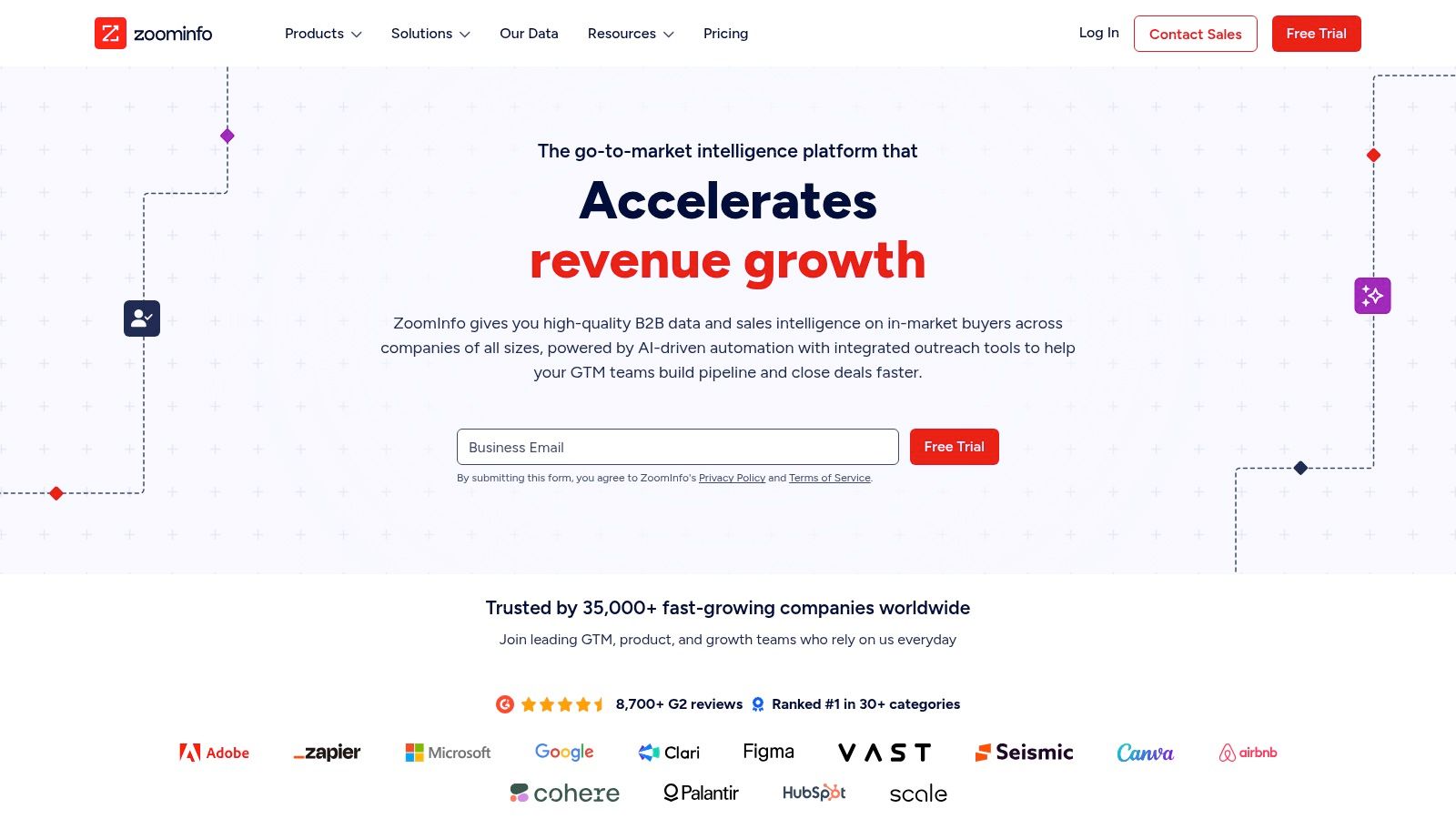
    ZoomInfo is an enterprise-grade B2B intelligence platform that goes far beyond simple email lookups. Positioned as a go-to-market (GTM) solution, it offers one of the most comprehensive databases of company and contact information, particularly for the US market. Its power lies not just in finding emails but in providing a complete profile, including direct-dial phone numbers, company firmographics, buying intent signals, and organizational charts, making it an indispensable tool for established sales and marketing teams.

    ZoomInfo (SalesOS)

    The platform, known as SalesOS, integrates deeply into existing workflows with a robust Chrome extension and native integrations for popular CRMs like Salesforce and HubSpot. This allows for seamless data enrichment and prospecting directly within the systems your team already uses. While its extensive features and data depth make it a top-tier email lookup tool, its enterprise focus means it operates on a different pricing model than many competitors, requiring annual contracts and custom quotes tailored to specific data needs and team sizes.

    Key Features & Pricing

    • Core Tools: Extensive B2B contact and company database, advanced search filters, data enrichment, and intent data signals.
    • Integrations: Powerful Chrome extension ("ReachOut") and deep native integrations with major CRM and marketing automation platforms.
    • Unique Offering: Provides a full suite of GTM intelligence, including direct dials, org charts, and technographics, not just emails.
    • Pricing: Custom quote-based pricing on annual contracts. There are no public monthly plans, and pricing is geared towards mid-market and enterprise teams. Access is often based on a system of view/export credits.

    Pros:

    • Extremely high data accuracy and depth, especially for US-based contacts.
    • Comprehensive feature set including intent data and direct-dial numbers.
    • Seamless integration with existing sales and marketing stacks.

    Cons:

    • Pricing is not transparent and can be a significant investment.
    • Annual contracts make it inaccessible for individuals or small businesses.
    • The credit system for exports and views can be complex to manage.

    Visit ZoomInfo

    5. Lusha

    Lusha has established itself as a leading contender for the title of best email lookup tool, particularly for sales and recruiting teams who need accurate B2B contact data, including direct dial phone numbers. Its primary strength lies in its powerful Chrome extension, which integrates seamlessly with LinkedIn, Salesforce, and company websites, allowing users to reveal contact information with a single click. This streamlined workflow makes it incredibly efficient for building targeted prospect lists on the fly.

    Lusha

    The platform operates on a straightforward credit-based system and places a strong emphasis on data privacy and compliance with GDPR and CCPA. Beyond just email finding, Lusha provides access to mobile numbers, company firmographics, and technology stacks, making it a comprehensive intelligence tool. Lusha is often featured among the best lead generation tools because it goes beyond simple email lookups to enrich contact profiles with valuable context for outreach. Its free plan offers a handful of credits each month, providing a great starting point for individuals.

    Key Features & Pricing

    • Core Tools: Chrome Extension for one-click lookups, API for programmatic access, Bulk Enrichment, and CRM integrations.
    • Integrations: Connects directly with major CRM and sales platforms like Salesforce, HubSpot, and SalesLoft.
    • Unique Offering: Strong focus on providing both verified emails and direct-dial phone numbers for contacts.
    • Pricing: A free plan is available with 5 credits per month. Paid plans start at $39/user/month for 480 annual credits. Credits are used for revealing contacts, with phone numbers costing significantly more credits than emails.

    Pros:

    • Excellent for finding both email addresses and direct phone numbers.
    • Simple credit system and a very fast, efficient workflow via the browser extension.
    • Strong commitment to data compliance (CCPA/GDPR).

    Cons:

    • Phone numbers are expensive, consuming a large number of credits per reveal.
    • Advanced features like CRM integrations are reserved for higher-tier plans.

    Visit Lusha

    6. RocketReach

    RocketReach is a popular and robust email lookup tool, trusted by major companies for its extensive database of professional and personal contact information. It’s designed to help both individuals and large teams streamline their prospecting and outreach efforts. The platform offers a user-friendly Chrome extension that allows users to find contact details directly from company websites, LinkedIn profiles, and other web pages, making it a highly efficient part of any workflow.

    RocketReach

    The platform is more than just an email finder; higher-tier plans also provide direct phone numbers, adding another layer to your outreach strategy. RocketReach features advanced search filters, bulk lookup capabilities, and CRM integrations to keep your data synchronized. A key differentiator is its credit system, which separates "lookups" (finding contact info) from "exports" (saving it to a list or CRM). While its pricing can seem complex, the low-friction signup with free lookups is a great way to test its data quality before committing.

    Key Features & Pricing

    • Core Tools: Individual and bulk email lookups, phone number search, and company information.
    • Integrations: Chrome/Edge browser extensions, a robust API on higher tiers, and various CRM integrations.
    • Unique Offering: Provides both professional and personal emails, along with direct phone numbers on Pro/Ultimate plans.
    • Pricing: Starts with a free trial of 5 lookups. Paid plans like Essentials (email only) begin around $39/month (billed annually) for 125 lookups. Pro and Ultimate plans add phone lookups and higher credit limits. Pricing and limits often vary based on the billing term (monthly vs. annual).

    Pros:

    • Generous free lookups to test data accuracy before purchase.
    • Provides both email and phone numbers, offering more contact options.
    • Extensive database with high accuracy rates.

    Cons:

    • The credit system distinguishing between "lookups" and "exports" can be confusing for new users.
    • Exact pricing is sometimes unclear until you proceed to the checkout page.

    Visit RocketReach

    7. Snov.io

    Snov.io positions itself as more than just an email finder; it's an all-in-one cold outreach automation platform. This makes it an ideal candidate for the best email lookup tool for sales teams and marketers who want a unified solution for prospecting and outreach. Its strength lies in its comprehensive suite of tools, which includes an email finder, a verifier, a drip campaign sender, and even a free sales CRM, all managed from a single dashboard.

    Snov.io

    The platform provides powerful Chrome extensions, including an Email Finder for company websites and a LI Prospect Finder for sourcing leads directly from LinkedIn. A key differentiator is its credit system, where credits are universal and can be used for email searches, verifications, or campaign recipients. This flexibility, combined with its strong feature-to-price value, makes it particularly attractive for startups and small to medium-sized businesses looking to scale their outreach without a massive budget.

    Key Features & Pricing

    • Core Tools: Email Finder, Email Verifier, Email Drip Campaigns, Sales CRM, and Technology Checker.
    • Integrations: Chrome extensions for website and LinkedIn prospecting, plus integrations with Pipedrive, Zapier, and more.
    • Unique Offering: A flexible credit system usable across multiple tools and an included email warm-up feature on higher-tier plans.
    • Pricing: Offers a free, renewable monthly plan with 50 credits. Paid plans start at $39/month for 1,000 credits and 2,000 email recipients. All paid plans include unlimited users (seats), offering exceptional value for teams.

    Pros:

    • Excellent all-in-one value with CRM and outreach tools included.
    • Unlimited seats on paid plans makes it highly scalable for teams.
    • Flexible credit system can be used across different features.

    Cons:

    • Advanced features like LinkedIn automation may require separate add-on costs.
    • Data accuracy and coverage can be inconsistent for certain niche industries.

    Visit Snov.io

    8. VoilaNorbert

    VoilaNorbert positions itself as a friendly and highly accurate email finder, focusing on a simple, effective approach that makes it a strong contender for the best email lookup tool. Its core strength lies in its transparency and "pay-only-for-found" logic, where you are not charged a credit for searches that don't yield a valid email address. This fair-use policy, combined with a clean user interface, makes it particularly appealing for users who prioritize accuracy and predictable costs in their prospecting efforts.

    VoilaNorbert

    The platform offers a focused set of tools, including a single email finder, bulk verification, data enrichment, and a simple outreach tool called "Sequences" for sending basic email campaigns. VoilaNorbert also provides a convenient Chrome extension for finding emails on the fly from websites and LinkedIn profiles. Its API and bulk worker options on paid plans cater to more demanding, high-volume needs, allowing for seamless integration into custom workflows. The free trial of 50 credits is a great way to test its accuracy firsthand.

    Key Features & Pricing

    • Core Tools: Email Finder, Email Verifier, Data Enrichment, and Bulk Search.
    • Integrations: Chrome extension, a full-featured API, and various native integrations.
    • Unique Offering: A fair "pay-only-for-found" credit system and a simple "Sequences" outreach module.
    • Pricing: Starts with a free trial of 50 credits. Paid plans begin at $49/month for 1,000 leads and scale up. Pay-as-you-go options are also available, and credits on annual plans roll over, a significant benefit for users with fluctuating monthly needs.

    Pros:

    • You only pay for successfully found emails.
    • Simple, user-friendly interface.
    • Credits on annual plans roll over month-to-month.

    Cons:

    • Primarily focused on B2B emails; less effective for personal emails.
    • Outreach features are less advanced than dedicated sales engagement platforms.

    Visit VoilaNorbert

    9. ContactOut

    ContactOut positions itself as a powerful recruiting and sales intelligence platform, excelling at finding personal and work emails with impressive accuracy, particularly from LinkedIn profiles. It is widely regarded as one of the best email lookup tool choices for sourcing professionals who need direct contact details, including phone numbers, which many other tools do not provide. Its primary strength lies in its powerful Chrome extension, which integrates seamlessly with LinkedIn and company websites, allowing users to uncover contact information with a single click.

    ContactOut

    The platform is more than just a finder; it includes a comprehensive search portal for building targeted lists, an email campaigns feature for outreach, and a Google Sheets add-on called ContactSheets for enriching data in bulk. This makes it a versatile solution for users who want to manage a significant portion of their outreach workflow within one ecosystem. The combination of high match rates for both personal and professional emails, plus the inclusion of phone numbers, makes it a unique and valuable asset for sales and recruitment teams.

    Key Features & Pricing

    • Core Tools: Chrome Extension, Search Portal, List Building, Email Campaigns, and API access.
    • Integrations: Deep LinkedIn integration via its extension and a Google Sheets add-on for bulk enrichment.
    • Unique Offering: High success rate in finding personal emails and direct dial phone numbers, not just professional addresses.
    • Pricing: Offers a free plan with a generous allotment of credits. Paid plans are available, but pricing for team and API access is not transparent and requires contacting their sales team for a custom quote.

    Pros:

    • Excellent data coverage and speed, especially for LinkedIn prospecting.
    • Free daily credits allow for consistent trial usage.
    • Easy installation and user-friendly extension.

    Cons:

    • Pricing is not fully transparent, particularly for team or API plans.
    • The strong focus on personal emails may raise data compliance considerations depending on your region.

    Visit ContactOut

    10. UpLead

    UpLead positions itself as a premium B2B data provider, making it a strong contender for the best email lookup tool for teams that prioritize accuracy above all else. Its core value proposition is a 95% data accuracy guarantee, which ensures that outreach efforts are directed at real, verified contacts. This commitment to quality data extends beyond emails to include mobile direct dials, making it a comprehensive solution for sales and business development professionals who need multiple touchpoints.

    UpLead

    The platform offers an impressive array of over 50 search filters, including technographics (what software a company uses) and buyer intent data on higher-tier plans. This allows for highly targeted prospecting. Users can find contacts through its web platform or a convenient Chrome Extension that works over company websites and LinkedIn profiles. Its seamless CRM integrations and data enrichment capabilities help maintain a clean and up-to-date database, solidifying its place for data-driven teams.

    Key Features & Pricing

    • Core Tools: B2B Prospecting Database, Data Enrichment, Chrome Extension, Real-time Email Verification.
    • Integrations: Direct integrations with popular CRMs like Salesforce, HubSpot, Zoho, and more.
    • Unique Offering: Includes advanced data points like technographics and buyer intent data on higher plans.
    • Pricing: Starts with a free trial of 5 credits. The Essentials plan begins at $74/month for 170 credits per month (billed annually). Credits roll over, and all plans include a single user seat.

    Pros:

    • Industry-leading 95% data accuracy guarantee.
    • Advanced filtering with technographics and intent data.
    • Provides mobile direct dials in addition to verified emails.

    Cons:

    • Monthly credit allowances on lower-tier plans can be limited.
    • Some of the most powerful features are gated behind more expensive plans.

    Visit UpLead

    11. Anymail Finder

    Anymail Finder distinguishes itself with a unique, cost-effective pricing model: you only pay for verified, deliverable email addresses. This makes it a strong contender for the title of best email lookup tool, especially for users who prioritize budget predictability and data accuracy. The platform guarantees a 97%+ delivery rate for the emails it provides, ensuring that credits are not wasted on addresses that are likely to bounce. It is designed for efficiency, allowing users to find emails individually by name and domain or in bulk for larger campaigns.

    Anymail Finder

    The platform's core philosophy is that users should not pay for uncertain results. Any email classified as risky or that cannot be found is provided free of charge, which is a significant advantage over many competitors. Anymail Finder offers both a powerful API for developers looking to integrate email finding into their own applications and a simple bulk finder for sales and marketing teams. The combination of its pay-for-performance model and robust technical tools makes it a highly practical choice for data-driven outreach efforts. Learn more about the importance of this process in our guide to email address verification.

    Key Features & Pricing

    • Core Tools: Single and Bulk Email Finder, API access.
    • Integrations: Robust API for custom integrations and a Zapier connection.
    • Unique Offering: Pay-only-for-valid-emails model where you are not charged credits for risky or unfound emails.
    • Pricing: Offers a free trial with 20 verified emails. Paid plans start at $49/month for 1,000 verified emails. Annual plans offer the best value with a large upfront credit allocation and the ability to roll over unused credits up to 2x the annual amount.

    Pros:

    • Excellent value with its "pay-for-verified-emails-only" system.
    • Generous credit rollover on annual plans.
    • Powerful API is ideal for large-scale data enrichment projects.

    Cons:

    • Monthly plans are less cost-effective per credit compared to annual commitments.
    • Lacks the built-in sales engagement features (e.g., email sequencing) of all-in-one platforms.

    Visit Anymail Finder

    12. Dropcontact

    Dropcontact is a privacy-first, EU-based email lookup tool that sets itself apart by generating and validating emails in real-time rather than pulling from a static database. This approach makes it a standout option for teams highly conscious of GDPR and data privacy. The platform is designed to find, verify, and enrich B2B contact information directly within your workflow, ensuring you have the most current data without relying on stored, potentially outdated lists.

    Dropcontact

    Beyond its single and bulk email finder, Dropcontact's core strength lies in its deep CRM integration and data enrichment capabilities. It can automatically correct and enrich contact data within HubSpot, Pipedrive, and Salesforce, adding verified professional emails, job titles, and company information. This makes it an invaluable tool for maintaining a clean and powerful CRM. Its pricing model is straightforward, where a single credit covers the entire find, verify, and enrich process.

    Key Features & Pricing

    • Core Tools: Real-time email finding, data enrichment (job title, company info), and email verification.
    • Integrations: Native integrations with HubSpot, Pipedrive, and Salesforce for seamless CRM enrichment.
    • Unique Offering: GDPR-compliant, database-free approach that generates emails on-demand.
    • Pricing: Standalone finder plans start at €24/month for 1,000 credits. CRM enrichment is priced separately, starting at €49/month. A free trial is available to test the platform.

    Pros:

    • Excellent for GDPR compliance and data privacy.
    • One credit conveniently covers finding, verifying, and enriching a contact.
    • Powerful, native CRM integrations for automated data cleaning.

    Cons:

    • Primarily focused on B2B contacts; less effective for personal emails.
    • CRM enrichment plans are priced separately from the standalone lookup tool.

    Visit Dropcontact

    Top 12 Email Lookup Tools Comparison

    Product Core Features User Experience/Quality Value Proposition Target Audience Price Points
    EmailScout Unlimited free email finds; AutoSave; URL Explorer (bulk) User-friendly Chrome extension; seamless Free unlimited emails; affordable premium plans Marketers, sales pros, entrepreneurs From $9/month for 5K emails
    Hunter Email finder, verifier; browser & Sheets add-ons; campaigns Clear pricing; good data quality Generous annual discounts; native integrations Marketing, sales teams Credits-based, free plan available
    Apollo.io Email/phone lookup; Chrome extension; credit refunds Deep workflows; strong documentation Flexible credits; all-in-one prospecting Sales, marketing professionals Credit system, pricing varies
    ZoomInfo (SalesOS) Large US B2B data; intent & enrichment; CRM integrations Enterprise-grade; broad product suite High coverage for mid/enterprise Enterprises, mid-market Quote-based, annual contracts
    Lusha Email/phone lookup; Chrome extension; API access Simple credit system; fast workflow Compliance-focused; free monthly credits Salespeople, recruiters Credits-based, free plan
    RocketReach Email+phone lookup; bulk options; API access Easy signup; public pricing references Team & solo plans; multiple pricing tiers Solopreneurs, teams Tiers vary, some pricing opaque
    Snov.io Email finder, verifier, warm-up; campaigns Strong value; unlimited exports Competitive pricing; free trial Startups, SMBs Credit-based, free trial
    VoilaNorbert Email finder/verifier; pay-only-for-found; sequences Clear pricing; simple interface No charge if email not found Small teams, SMBs Pay-as-you-go, free 50 credits
    ContactOut LinkedIn-focused; email+phone; Google Sheets add-on Fast, high LinkedIn coverage Free daily credits; strong sourcing Recruiters, sales pros Pricing not fully transparent
    UpLead Verified emails; intent data; CRM integrations Transparent pricing; 95% verification guarantee Strong accuracy and filters SMBs, professionals Per-credit pricing, annual discounts
    Anymail Finder Pay only for valid emails; bulk finder; API access High delivery rate; budget predictable Credit rollover; cost-effective for large scale Developers, verification teams Pay-for-valid, annual plans better
    Dropcontact Real-time email finding & enrichment; CRM integration Privacy-by-design; GDPR compliant One credit for find + verify + enrichment GDPR-conscious teams, CRM users Pricing mainly in euros

    Finding Your Connection: The Final Verdict

    Navigating the crowded landscape of email verification and discovery platforms can feel overwhelming. After dissecting a dozen of the top contenders, from comprehensive sales intelligence giants like ZoomInfo to agile, specialized finders like VoilaNorbert, a clear pattern emerges: the best email lookup tool is not a one-size-fits-all solution. Instead, it is the one that seamlessly integrates into your unique workflow, respects your budget, and most importantly, delivers the accurate data you need to forge meaningful professional connections.

    Your choice should be a strategic one, directly tied to your primary objectives. Are you a solo entrepreneur or a small startup focused on lean growth? A tool with a generous free tier and scalable features, like EmailScout or Hunter, provides a powerful yet cost-effective entry point. Are you part of a large sales organization that requires deep company insights, org charts, and buying intent signals? In that case, an investment in a robust platform like ZoomInfo or Apollo.io becomes a critical competitive advantage.

    Key Takeaways and Decision-Making Framework

    To simplify your decision, let's distill our findings into actionable insights. Your ideal tool likely excels in one of these key areas:

    • For All-in-One Sales Engagement: If you need a platform that not only finds emails but also manages sequences, tracks engagement, and enriches CRM data, Apollo.io and Snov.io are standout choices. They centralize the entire top-of-funnel process, saving valuable time by keeping everything under one roof.
    • For High-Accuracy and Direct Dials: When your strategy relies heavily on phone outreach alongside email, accuracy is paramount. Lusha and ContactOut have built their reputations on providing reliable mobile numbers and direct dials, making them indispensable for sales development representatives who need to get decision-makers on the phone.
    • For Bulk Enrichment and Data Cleansing: If your primary need is to enrich large existing lists of leads or clean your CRM data, tools like UpLead and Dropcontact offer powerful, API-driven solutions. Their focus is less on manual lookups and more on automated, high-volume data processing.
    • For Unmatched Value and Automation: For users who demand efficiency and robust features without a hefty price tag, EmailScout carves out a unique position. Its unlimited free plan removes the barrier to entry, while its innovative automation features like AutoSave and URL Explorer drastically reduce manual prospecting time, making it a powerful contender for the title of best email lookup tool for productivity-focused users.

    Actionable Next Steps: Putting Your Knowledge to Work

    Reading reviews is just the first step. The true test comes from real-world application. We strongly recommend you identify the top two or three tools from this list that align with your specific use case and budget. Sign up for their free trials or utilize their free credit allowances.

    Create a small, targeted list of 20-30 prospects you want to reach. Run this same list through each of your chosen platforms. This hands-on comparison will give you a definitive answer on:

    1. Data Accuracy: Which tool returned the most valid and verified emails?
    2. User Experience: Which interface felt the most intuitive and efficient for your workflow?
    3. Speed and Performance: How quickly could you build your target list?
    4. Feature Utility: Did the supplementary features (like social media links or technology lookups) provide tangible value?

    Choosing the right tool is more than a software decision; it's a strategic investment in your outreach effectiveness. It’s about minimizing bounces, maximizing deliverability, and ultimately, spending less time searching and more time connecting. The perfect tool will feel like an extension of your team, empowering you to build your network and drive growth with confidence.


    Ready to experience the next level of prospecting efficiency? EmailScout offers an unlimited free plan to help you find the verified email addresses you need without any upfront cost. Stop guessing and start connecting today by trying the EmailScout Chrome extension.