
To really build a sales funnel that works, you first have to get inside your customer's head. It’s about mapping out their entire journey, from the moment they realize they have a problem to the second they click "buy."
This process is built on four key stages: Awareness, Interest, Consideration, and Action. Think of it as a framework that guides people from being complete strangers to becoming happy customers, using the right message at exactly the right time.
Understanding Your Customer's Journey
Before you even think about landing pages or email sequences, a great sales funnel starts with empathy. You need a rock-solid understanding of the path someone takes to find you and eventually buy from you. This isn't just some abstract marketing theory; it's the blueprint for every single piece of content and every offer you create.
When you map this journey, you can align your marketing with your customer's state of mind. It stops you from making the classic mistake of pushing a sale on someone who isn't even sure what their problem is yet.
The Four Core Funnel Stages
The modern sales funnel is pretty much universally broken down into four distinct phases. Each stage represents a psychological shift in your potential customer, and each one demands a different approach from you. The whole game is about moving prospects from one stage to the next as smoothly as possible.
Let's break down what's happening at each stage and what your focus should be.
| The Four Core Stages of a High-Performing Sales Funnel | ||
|---|---|---|
| Funnel Stage | Primary Goal | Key Activities & Channels |
| Awareness (ToFU) | Attract attention and make prospects problem-aware. | Blog posts, social media updates, SEO, infographics, paid ads, videos. |
| Interest | Engage prospects and position your brand as a helpful resource. | Lead magnets (e-books, checklists), webinars, case studies, detailed guides. |
| Consideration (MoFU) | Nurture leads and prove your solution is the best choice. | Email sequences, free trials, product demos, comparison guides, customer testimonials. |
| Action (BoFU) | Drive the final purchase and close the deal. | Compelling offers, discounts, clear call-to-actions, easy checkout process, sales pages. |
As you can see, each stage has a clear purpose and a set of tools to get the job done. It's a natural progression.
This visual really helps to see how the journey unfolds.
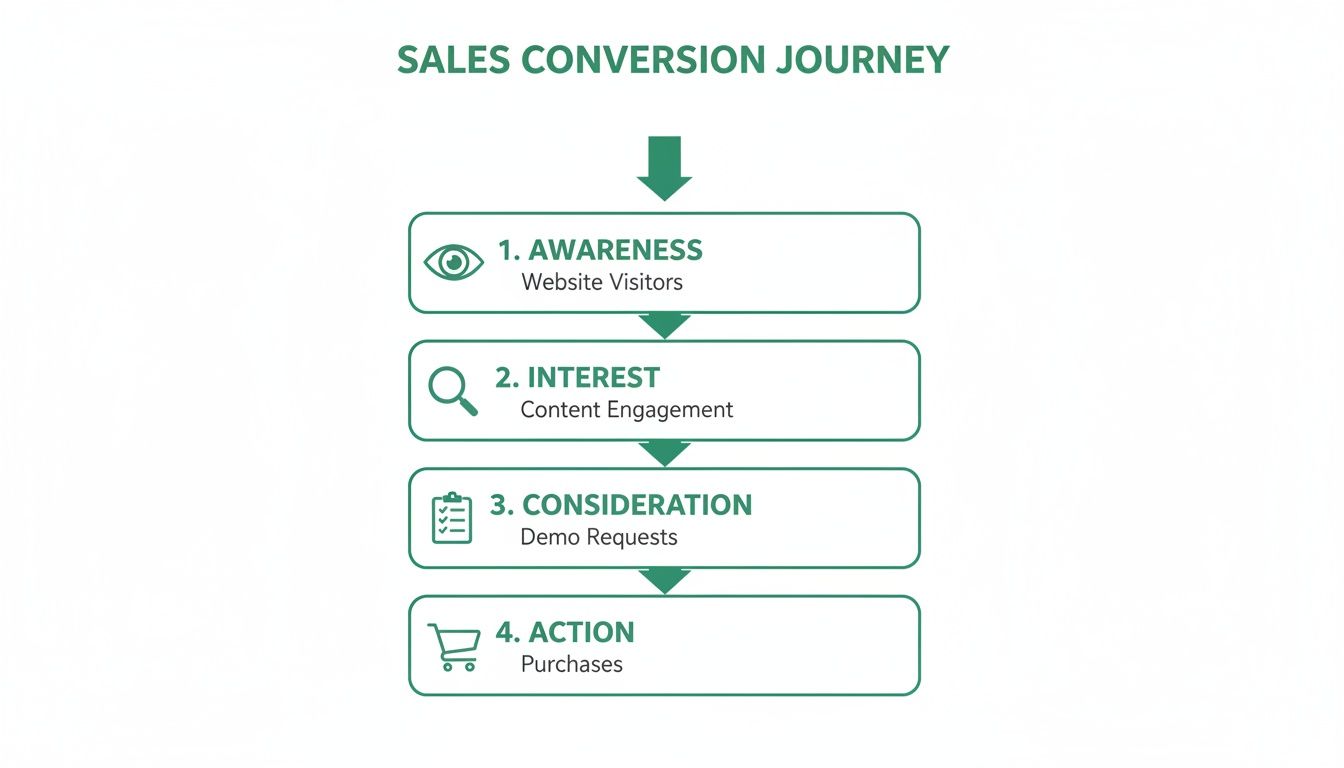
The model shows how you start with a wide audience at the top, and through targeted nurturing, you filter it down to a smaller, more committed group of actual customers at the bottom.
A sales funnel isn't some rigid formula. It's a flexible framework that mirrors how people actually make decisions. Getting these stages right is the foundation for building a system that predictably turns website visitors into real revenue.
Building the Top of Your Funnel to Attract the Right People
This is where it all begins. The top of your funnel (ToFU) is your first impression—it's all about grabbing the attention of people who are just starting to realize they have a problem you might be able to fix.
Forget about selling for a minute. Your only job right now is to attract and engage. You do this with valuable content, placing it right where your ideal audience already hangs out online. Think of yourself as a helpful resource, not a salesperson.
Driving Traffic with Strategic Content
Before anyone can slide into your funnel, they have to find you first. That means you need to be visible, and the best way to do that is by consistently creating helpful content.
- Search Engine Optimization (SEO): Think about the exact questions your ideal customer is typing into Google. Now, create blog posts and guides that answer them directly. For instance, if you sell project management software, an article like "How to Manage a Remote Team Effectively" is a perfect starting point.
- Content Marketing: Don't stop at blog posts. Create shareable infographics, quick-tip videos, and social media content that’s easy for people to digest and pass along. This is how you build a reputation as the go-to expert in your field.
- Targeted Social Media Campaigns: Use platforms like LinkedIn, Facebook, or Instagram to push your content out. You can run ads targeting users based on their job title, interests, or behaviors that match your customer profile.
The key here is to keep the content broad and educational. You're casting a wide net.
Crafting an Irresistible Lead Magnet
Okay, you've got their attention. What's next? You need a way to turn a casual visitor into a potential lead. That's where the lead magnet comes in. It’s a simple value exchange: you give them an amazing resource, and they give you their email address.
This isn't the place for a generic, low-effort PDF. A great lead magnet solves a real, specific problem for your audience and gives them a quick win. It builds trust right out of the gate.
Your lead magnet is the handshake of your sales funnel. Its quality directly reflects the value you promise to deliver later. Make it so good that people would have paid for it.
Here are a few ideas that work wonders:
- Interactive Checklists: A step-by-step list that helps someone complete a specific task.
- Custom Templates: Ready-to-use spreadsheets, design templates, or document outlines.
- Exclusive Mini-Webinars: A short, recorded training that goes deep on solving one specific pain point.
- Resource Guides: A curated list of the best tools, articles, or resources for a specific challenge.
Specificity is everything. Instead of a generic "Guide to Marketing," offer a "5-Day Email Course to Writing High-Converting Ad Copy." The more targeted it is, the better it will convert.
Designing a High-Converting Landing Page
Your lead magnet needs its own home—a dedicated landing page. This page has one job and one job only: convince people to download your resource. Every single word and image should support that goal.
A landing page that actually converts has a few key ingredients:
- A Powerful Headline: Don't be clever, be clear. State the benefit of the lead magnet right away.
- Benefit-Oriented Copy: Focus on what the lead magnet will do for them. Use bullet points to make the benefits scannable.
- Compelling Visuals: Show them what they're getting. A simple mock-up of the checklist or a thumbnail from the video works perfectly.
- A Frictionless Form: Ask only for what you absolutely need. Name and email are usually plenty for a top-of-funnel offer. Every extra field you add will hurt your conversion rate.
The whole process needs to feel smooth. The ad that brought them there, the landing page, and the thank you page should all have consistent messaging. This is your first real transaction with a potential customer, so make it a good one.
Getting that initial email list built is a huge first step, and as you grow, you can explore more advanced strategies for how to build an email list to really ramp things up.
Nurturing Leads with Smart Email Automation
Getting a new lead is a great feeling, but that’s just the starting line. The real work—and the real chance to build a relationship—begins the second they trust you with their email address. This is where smart email automation comes in, turning a simple sign-up into a guided journey toward becoming a customer.
Without a solid follow-up plan, that initial flicker of interest dies out fast. The numbers don't lie: a shocking 79% of marketing leads never convert to sales simply because they aren't nurtured properly. On the flip side, companies that nail this process generate 50% more sales-ready leads while spending around 33% less to get them. You can explore more data on sales funnel performance to see just how big the impact is.
Your job isn't to blast them with sales pitches. It’s to build trust, provide genuine value, and show them you understand their problem better than anyone else.
Crafting the Perfect Welcome Sequence
The first emails a new subscriber gets are absolutely critical. This is when they're most engaged and waiting to see if you’ll deliver on the promise you made with your lead magnet. A well-designed welcome sequence is your opportunity to make a killer first impression.
This is more than a single "thanks for joining" email. Think of it as a strategic, multi-part conversation designed to educate, engage, and gently point them toward your solution. A proven framework uses about five emails sent over a week or two.
Here’s a breakdown of a powerful 5-email welcome sequence that builds trust and keeps them hooked.
-
Email 1 (Immediate): Instant Delivery and a Warm Welcome. This email has one job: deliver the lead magnet. The subject line needs to be dead simple, like "Here's Your [Lead Magnet Name]!" Keep the email short and sweet. Welcome them, give them a direct download link, and let them know what to expect next.
-
Email 2 (Day 2): Make a Personal Connection. Now it's time to introduce yourself or your brand's story. Share your "why"—the reason you're so committed to solving their specific problem. End with a simple question to get a conversation started, like, "What's the biggest challenge you're facing with [topic] right now?"
-
Email 3 (Day 4): Deliver a Quick Win. Give them another piece of high-value, actionable advice related to your lead magnet. It could be a short video tutorial, a case study, or a simple tip that helps them get a small but immediate result. You're proving your expertise and generosity.
-
Email 4 (Day 6): Tackle a Common Hurdle. Address a frequent pain point or myth your audience deals with. You can frame it as "The #1 Mistake People Make When…" and then offer a clear fix. This shows you genuinely understand their struggles.
-
Email 5 (Day 8): The Pivot to Your Solution. You've spent the last week building trust and providing value. Now you can gently introduce your core offer. Explain how your product or service is the natural next step for solving the problems you've been talking about. Present it as the ultimate solution, not just another thing to buy.
The point of a welcome sequence is to turn a passive subscriber into an engaged fan. Every email should focus on giving value first, building a relationship long before you ask for the sale.
Writing Emails That People Actually Open
A brilliant email sequence is worthless if it sits unopened. Your subject line is the gatekeeper, and the email copy is what keeps them reading.
For subject lines, curiosity and clarity are king. Ditch the clickbait and focus on either sparking interest or stating a clear benefit. A quick A/B test on your subject lines can make a huge difference in your open rates.
For the body copy, stick to these simple rules:
- Write like you talk. Use a conversational and personal tone. Write to "you" and don't be afraid to use "I" to share your perspective.
- Keep paragraphs short. Aim for 1-3 sentences each. This makes your emails easy to scan, especially on phones where most people read them.
- Use one clear call-to-action (CTA). Every email should have a single goal. Whether it's "read this post," "watch this video," or "book a demo," don't confuse your reader with multiple asks.
Treat each email as one small part of a bigger conversation. By consistently delivering value and showing you care about their challenges, you're not just selling; you're building a real relationship. This is the heart of how to create a sales funnel that not only converts but also creates loyal, long-term customers.
Finding High-Quality Leads with EmailScout
Sure, a solid inbound funnel is a great asset. But sitting back and waiting for leads to come to you can feel like watching paint dry. For a lot of businesses, especially in the B2B world, predictable growth comes from getting out there and finding your customers yourself.
This is all about proactive prospecting. Instead of just hoping the right people stumble upon your content, you go find them. You’re not casting a wide net; you’re using a spear. You pinpoint the exact companies and decision-makers you want to work with and find a direct line to their inbox.
Pinpointing Decision-Makers on LinkedIn
When it comes to B2B prospecting, LinkedIn is the undisputed king. It’s a massive, searchable directory of professionals you can filter by industry, company size, job title—you name it. This is ground zero for building a list of people who are a perfect match for what you sell.
Let's say you sell project management software to marketing agencies. You could hop on LinkedIn and search for "Marketing Director" at agencies with 50-200 employees. Boom. In a couple of minutes, you've got a list of hundreds of potential buyers.
But there's a catch: you don't have their email addresses.
This is where a tool like EmailScout becomes your secret weapon. The EmailScout Chrome extension plugs right into LinkedIn, letting you pull a verified email address from someone's profile with a single click.
Here’s a peek at what it looks like in action. It’s clean, simple, and sits right on the prospect's profile.
That simple integration turns a static profile into a real, actionable lead. It closes the gap between finding a prospect and actually starting a conversation with them.
Building Prospect Lists at Scale
Grabbing one email is good. Building a whole campaign list is where the magic happens. This is how you really start to fill your sales funnel fast. But it's not just about speed; it's about getting more high-quality leads without sacrificing that quality.
EmailScout has a couple of features built for exactly this:
- AutoSave: As you scroll through LinkedIn search results, this feature just works in the background, finding and saving emails to a list you choose. No more clicking into every single profile like a robot.
- URL Explorer: You can drop a list of LinkedIn profile URLs or even company websites into the tool, and it will go to work finding and verifying the email addresses for key contacts at those companies.
Mini Case Study: Let's build a list of 50 qualified prospects in under an hour.
- First, we define our target: "Head of Sales" at SaaS companies in North America.
- Next, we run that search in LinkedIn Sales Navigator. We'll get thousands of results back.
- Then, we use EmailScout's AutoSave feature to scan the first few pages. It automatically grabs the verified emails and saves them to a new list we’ll call "SaaS Sales Leaders."
- In less time than it takes to watch an episode on Netflix, we have a list of 50+ hand-picked leads, complete with their names, titles, companies, and verified emails. They're ready to be dropped right into a personalized email sequence.
This isn't just mindless data scraping. It's about strategically stacking the top of your funnel with people you already know are a great fit. When you're that specific about who you're reaching out to, your emails hit harder, your offers are more compelling, and your entire funnel just works better. If you want to dive deeper, you can learn how to find business emails and make sure you're always connecting with the right person.
Closing the Deal at the Bottom of the Funnel
You’ve done the hard work of guiding your prospect from a curious stranger into a warm lead. Now they're at the bottom of the funnel (BoFU), the make-or-break moment where all that nurturing pays off. This is where a lead becomes a customer. It's also where any hesitation or last-minute doubt can kill the whole deal.
Your job here is simple: make buying from you feel like the easiest, most logical, and safest choice they could possibly make. At this point, you're not educating anymore. You're building confidence and giving them that final, gentle nudge to take action. A high-converting BoFU is built on two things: trust and a crystal-clear, compelling offer.
Crafting an Irresistible Offer
By now, your lead gets their problem and sees your product as a legitimate solution. The last question bouncing around in their head is, "Is this the right deal for me, right now?" Your offer needs to answer that with a loud, confident "yes."
This goes way beyond just listing features. You need to frame the entire pitch in a way they can't refuse.
- Benefit-Driven Sales Copy: Stop talking about what your product is and start showing them what it does for them. Don't say "10GB of storage." Instead, try "Never worry about running out of space for your important files again." See the difference?
- Transparent Pricing: Nobody likes surprise fees. Lay out your pricing clearly. If you have different tiers, a simple comparison table is your best friend—it helps people instantly spot the best fit.
- A Powerful Call-to-Action (CTA): Your CTA needs to be singular and direct. Vague buttons like "Submit" are conversion killers. Use strong, action-oriented commands like "Get Instant Access Now" or "Start My Free Trial."
Building Unshakeable Social Proof
Right before people pull out their credit cards, they instinctively look for validation from others who've already made the leap. Social proof is your secret weapon for crushing that last-minute skepticism. It makes the purchase feel less like a risk and more like a smart, proven decision.
The most effective way to sell anything is to let your happy customers do it for you. Authentic testimonials and real-world results are far more persuasive than any marketing copy you could ever write.
Weave these elements directly into your sales and product pages:
- Case Studies: Tell a detailed story of how a specific customer won with your product. Use their real name, their picture, and hard data to make it believable.
- Testimonials: Sprinkle in short, punchy quotes from happy customers. The best ones highlight a key benefit or tackle a common objection head-on.
- Reviews and Ratings: Got star ratings? Flaunt them. They provide a quick, scannable dose of validation that people trust.
Understanding Your Most Valuable Leads
Let’s be honest: not all leads are created equal. This becomes painfully obvious at the bottom of the funnel. Where a lead came from has a massive impact on whether they'll convert.
The data doesn't lie. Benchmarks show a huge gap, with referral traffic converting as high as 10.99% and leads from email campaigns hitting nearly 13%. Even better, call-to-close rates for referrals hover around an impressive ~25.6%.
Knowing these numbers helps you stop wasting time and double down on what’s actually working. If you're curious, you can explore detailed sales conversion benchmarks to see how your own industry measures up.
Optimizing Your Funnel with Data-Driven Decisions

A sales funnel isn’t a machine you can just “set and forget.” Think of it more like a living system that needs your attention to thrive. The moment you launch is just the starting line; real profitability comes from making smart, continuous improvements based on data, not guesswork.
Without tracking performance, you’re just flying blind. You might feel like your funnel is working, but feelings don't pay the bills. Data tells you exactly where your system is strong and, more importantly, where it’s leaking money.
Pinpointing Your Funnel’s Bottlenecks
Every single sales funnel has weak spots—bottlenecks where potential customers drop off. Your job is to play detective and find them. To do that, you need to track a handful of essential metrics at each critical transition point.
These metrics are your signposts, giving you a clear picture of each stage's health:
- Landing Page Conversion Rate: What percentage of people who see your lead magnet page actually sign up? A low number here (anything under 20%) often points to a weak headline, a confusing offer, or too much friction in the sign-up form.
- Email Open & Click-Through Rate (CTR): Are people opening your nurture emails? Are they clicking the links inside? Low open rates suggest your subject lines aren't cutting it, while low CTRs often mean the email copy isn't creating enough value or curiosity.
- Sales Page Conversion Rate: Of the leads who finally see your offer, how many pull the trigger and become customers? This is the ultimate test of your funnel's persuasiveness.
These numbers tell a story. A sky-high landing page conversion but a terrible email CTR tells you the lead magnet is great, but your follow-up is falling flat. This kind of insight lets you focus your energy right where it'll make the biggest impact.
Using A/B Testing to Systematically Improve Results
Once you've zeroed in on a bottleneck, A/B testing is your tool to fix it. The process is simple: create two versions of a single element (like a headline or a button color), show each version to a different segment of your audience, and see which one performs better.
Don’t guess what your audience wants. Let them tell you with their actions. A/B testing removes ego and opinions from the equation and replaces them with cold, hard data.
Let's say your landing page conversion rate is in the gutter. You could test:
- Headline A: "The Ultimate Guide to Email Marketing"
- Headline B: "Double Your Email Clicks in 7 Days"
By measuring which headline gets more sign-ups, you make a data-driven decision that permanently improves your funnel. Incrementally testing your headlines, offers, email copy, and calls-to-action is how you build a funnel that actually evolves and gets better over time.
The impact can be massive. Across different markets, average funnels convert at around 2.35%, while the top performers smash that with rates over 5.31%. That difference means getting 126% more customers from the exact same traffic, a powerful testament to optimization. As you scale, keeping a close eye on your numbers with a customer acquisition cost calculator becomes non-negotiable for staying profitable.
Your Top Sales Funnel Questions, Answered
Got a few lingering questions before you dive in? Perfect. Let's tackle some of the most common things people wonder about when they're getting started.
How Long Does It Take to Build a Sales Funnel?
Honestly, this one really depends. You could get a simple, effective funnel up and running in just a few days if you’re focused. I’m talking a solid lead magnet, a clean landing page, and a short email sequence.
But if you're building something more complex—maybe with webinars, different product tiers, or deep CRM integrations for a sales team—you’ll want to budget several weeks. That gives you enough time to plan, build, and test everything properly without cutting corners.
What Are the Most Important Metrics to Track?
It's easy to get lost in a sea of data. My advice? Zero in on the conversion rate at each major handover point in your funnel.
If you only watch three things, make them these:
- Landing Page Conversion Rate: Are your visitors actually turning into leads? This is your first and most important checkpoint.
- Email Open and Click-Through Rates: This tells you how interested your new leads are. If these numbers are low, your emails aren't hitting the mark.
- Final Sales Conversion Rate: The bottom line. How many of those hard-won leads become paying customers?
These three numbers will give you a brutally honest look at what’s working and, more importantly, where your funnel is leaking money.
Can I Create a Sales Funnel on a Small Budget?
Absolutely. You don't need a huge budget to make this work. In fact, you can get started with a handful of low-cost or even free tools for building landing pages and managing your email marketing.
A smart strategy beats a big budget every time. The most important investment is your time in creating a genuinely valuable lead magnet and writing thoughtful emails that build trust.
Ready to supercharge the top of your funnel with high-quality, verified leads? EmailScout helps you find the right decision-makers in a single click, filling your pipeline faster. Find unlimited emails for free with EmailScout.